

INTRODUCTION
In this study, we examined the effectiveness of knowledge acquisition strategies for enhancing the knowledge depth and breadth of firms in a production network. As a product becomes increasingly complicated, its architecture typically transforms from integral to modular, and firms increasingly specialize in differentiated knowledge domains (Brusoni, Prencipe, & Pavitt, Reference Brusoni, Prencipe and Pavitt2001; Brusoni & Prencipe, Reference Brusoni and Prencipe2001a). Along with increased knowledge specialization, different roles emerge in a production network. System integrators focus on mastering architectural knowledge while component specialists concentrate on harnessing component knowledge. Component knowledge refers to knowledge about each of the core design concepts and the way in which they are implemented in a particular component. Architectural knowledge refers to knowledge about the ways in which the components are integrated and linked together into a coherent whole. Given that different knowledge is required by system integrators and component specialists, it is plausible that they need different knowledge strategies for acquiring the knowledge particularly relevant to them. However, the organizational learning literature has yet to explore firm specialization in a production network as a contingent factor when investigating knowledge strategies (Brusoni et al., Reference Brusoni, Prencipe and Pavitt2001).
To bridge this gap, we investigate the research question, ‘Do system integrators and component specialists adopt different knowledge acquisition strategies for building their respective knowledge repertoires’? We examine two knowledge acquisition strategies: inter-organizational partnering and intra-organizational acquisition (Autio, Kanninen, & Gustafsson, Reference Autio, Kanninen and Gustafsson2008; Berchicci, Reference Berchicci2013; Kogut & Zander, Reference Kogut and Zander1992; Köhler, Sofka, & Grimpe, Reference Köhler, Sofka and Grimpe2012). We then assess the extent to which a firm broadens and deepens its knowledge repertoire (Ireland & Webb, Reference Ireland and Webb2007; March, Reference March1991) by using the two strategies. In sum, this study seeks to investigate the effectiveness of knowledge acquisition strategies on enhancing the knowledge breadth and depth for system integrators and component specialists, respectively. This study contributes to the literature by bridging two research streams: the effects of knowledge specialization in a production network (Brusoni & Prencipe, Reference Brusoni and Prencipe2006; Brusoni, Jacobides, & Prencipe, Reference Brusoni, Jacobides and Prencipe2009; Henderson & Clark, Reference Henderson and Clark1990; Hoetker, Reference Hoetker2006; Sanchez & Mahoney, Reference Sanchez and Mahoney1996; Sosa, Eppinger, & Rowles, Reference Sosa, Eppinger and Rowles2004; Takeishi, Reference Takeishi2002) and knowledge acquisition strategies (e.g., Grimpe & Kaiser, Reference Grimpe and Kaiser2010), thereby advancing our understanding of the effectiveness of knowledge acquisition on shaping knowledge depth as well as breadth for system integrators and component specialists.
Our empirical results also provide useful insights to guide the formulation of knowledge acquisition strategies for firms in a production network. Our empirical context, the Taiwanese information technology and electronics (IT&E) sector, has built production networks for various electronic products and served as a global supplier since the 1990s (Dedrick & Kraemer, Reference Dedrick and Kraemer1998; Sturgeon & Lee, Reference Sturgeon, Lee, Berger and Leste2005). This context offers appropriate and rich information regarding firm specialization in production networks. By examining these IT&E firms, our findings also have important practical implications for firms participating in production networks. First, we differentiate more clearly the different roles played by firms in a production network (component specialist versus system integrator). Second, this study also identifies the most appropriate knowledge acquisition strategies for accumulating knowledge breadth versus knowledge depth for each of these roles.
While prior research has focused on the role of knowledge acquisition strategies in enhancing a firm's knowledge level in general, only a small number of studies distinguished the effects of knowledge acquisition strategies on different dimensions of a knowledge repertoire. (cf., Grant, Reference Grant1996; Kogut & Zander, Reference Kogut and Zander1992; Ryle, Reference Ryle1984). Our study includes both knowledge depth and knowledge breadth as two knowledge dimensions in order to obtain more refined research conclusions. Generally, the existing studies of knowledge acquisition strategies have documented the positive association between external as well as internal knowledge sourcing and learning outcomes. Many different industry-specific factors, and firm-specific factors are also identified as important contingent factors (e.g., Garriga, von Krogh, & Spaeth, Reference Garriga, von Krogh and Spaeth2013; Laamanen, Reference Laamanen2005). However, to the best of our knowledge, a firm's role in a production network has never been examined as a determinant.
We identify a firm's role in a production network (i.e., firm specialization) as a vital contingency influencing the aforementioned association between knowledge acquisition strategies and the resulting knowledge repertoire. The literature on knowledge specialization in a production network has clearly identified system integrators as distinct from component specialists in their role in leading and coordinating the production network (Brusoni & Prencipe, Reference Brusoni and Prencipe2001a; Brusoni & Prencipe, Reference Brusoni and Prencipe2001b; Prencipe, Reference Prencipe2000). Although both system integrators and component specialists operate in the same industry, they are significantly different in terms of the knowledge they master and the rivals they compete with. Therefore, these production roles cannot be captured by either industry-specific or firm-specific factors and should be included and examined as an independent variable.
Despite the important insights provided by this research stream, a firm's role as a system integrator or a component specialist has received limited attention in the knowledge strategy literature. This literature has disproportionately focused on system integrators while ignoring component specialists. It has found that system integrators source knowledge internally and externally (Brusoni & Prencipe, Reference Brusoni and Prencipe2001b) to maintain knowledge broader than what they manufacture (Brusoni et al., Reference Brusoni, Prencipe and Pavitt2001; Bergek, Tell, Berggren, & Watson, Reference Bergek, Tell, Berggren and Watson2008) for adapting to technological dynamics. However, it rarely contrasts system integrators with component specialists explicitly. Consequently, we have a limited understanding about the knowledge strategies that component specialists employ. Our study extends this literature by including both production roles in our empirical analyses and provides a more holistic picture of knowledge acquisition strategy for firms in a production network.
In the next sections, we discuss the current literature on the division of knowledge and its linkage with two dimensions of knowledge acquisition strategies in order to develop our hypotheses. Subsequently, our empirical approach is elaborated. In the final section, we discuss our research contributions and limitations as well as the theoretical and managerial implications of our findings.
THEORETICAL BACKGROUND AND HYPOTHESES
It has been recognized that knowledge acquisition is a fundamental activity in organizational learning (Autio, Kanninen, & Gustafsson, Reference Autio, Kanninen and Gustafsson2008; Berchicci, Reference Berchicci2013; Kogut & Zander, Reference Kogut and Zander1992; Köhler et al., Reference Köhler, Sofka and Grimpe2012). Yet, little is known about how different strategies for knowledge acquisition broaden and deepen a firm's knowledge repertoire in their production network. To deepen our understanding of the effects of knowledge acquisition strategies on a knowledge repertoire and to assess the degree to which they may be more or less effective depends on firms’ specialized roles as system integrators or component specialists, we reviewed research on the division of knowledge, knowledge repertoire and knowledge acquisition strategies. While early research pointed to the importance of inter-organizational partnering and intra-organizational knowledge acquisition in the knowledge acquisition process (Allen & Cohen, Reference Allen and Cohen1969; Laursen & Salter, Reference Laursen and Salter2006; Lorenzoni & Lipparini, Reference Lorenzoni and Lipparini1999; Shan & Song, Reference Shan and Song1997; Sørensen & Stuart, Reference Sørensen and Stuart2000), other research hints that these two strategies will have different impacts on knowledge breadth and depth (Henderson & Cockburn, Reference Henderson and Cockburn1994; Katila & Ahuja, Reference Katila and Ahuja2002; Prahalad & Hamel, Reference Prahalad and Hamel1990; Wang & von Tunzelmann, Reference Wang and von Tunzelmann2000). We review these strategies in more detail below by exploring the relative effectiveness of knowledge acquisition strategies on knowledge breadth and depth and by probing contingencies, specifically, firms’ specialized roles in a production network (system integrators vs. component specialists).
The idea of distinguishing between a product as a whole, i.e., the system, and the product in its parts, i.e., the components, first arose in the design literature (Alexander, Reference Alexander1964). Henderson and Clark (Reference Henderson and Clark1990) further elaborated on this idea noting that product development requires component knowledge (i.e., knowledge about each of the core design concepts and the way in which they are implemented in a particular component) on the one hand, and architectural knowledge (i.e., knowledge about the ways in which the components are integrated and linked together into a coherent whole) on the other hand. Albeit simple, the idea of viewing a product through such perspective leads to the important idea that the success of the design, development, and manufacture of products relies on different types of knowledge (Henderson & Clark, Reference Henderson and Clark1990; Takeishi, Reference Takeishi2002). For instance, firms need architectural knowledge to solve problems concerning how to link or integrate components together, but require component knowledge to solve problems within components. When a firm focuses on the development of components, it needs relatively more knowledge about the core design concepts and the way they are implemented in a particular component, what Henderson and Clark (Reference Henderson and Clark1990) refer to as component knowledge. Alternatively, when a firm focuses on the development of a system, it needs relatively more knowledge about how each component is integrated into a coherent whole, what Henderson and Clark (Reference Henderson and Clark1990) refer to as architectural knowledge.
However, as the number of disciplines involved in the design, development, and manufacture of products increases, there has been a tendency for firms to either become specialized in one domain and/or to rely on specialized suppliers of equipment and knowledge. Wang and von Tunzelmann (Reference Wang and von Tunzelmann2000) stressed that the range of disciplines relevant to firms’ learning processes expands in both breadth, i.e., the number of relevant disciplines, and depth, i.e., their sophistication and specialization. We suggest that firms differ regarding the degree of new and existing knowledge that they possess in particular technological disciplines. This heterogeneity of knowledge can be reflected as knowledge breadth and knowledge depth. Knowledge breadth is the degree of new knowledge disciplines explored and used, and knowledge depth is the extent to which existing knowledge disciplines are repeatedly exploited and reused (cf., Katila & Ahuja, Reference Katila and Ahuja2002). In this view, firms that need a relatively greater degree of architectural knowledge may need to increase their knowledge breadth to harness the increasing technological complexity of products, while firms that require a relatively greater degree of component knowledge may need to foster greater knowledge depth for fostering componential innovations.
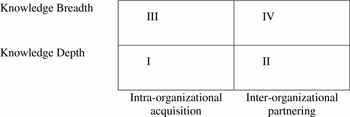
One means of increasing knowledge depth and breadth is to employ knowledge acquisition strategies that enable exploration and exploitation via external and internal sources of knowledge (Katila & Ahuja, Reference Katila and Ahuja2002; March, Reference March1991; Rosenkopf & Nerkar, Reference Rosenkopf and Nerkar2001; Rothaermel & Alexandre, Reference Rothaermel and Alexandre2009). Exploratory search involves moving away from current organizational routines to explore new knowledge that may go beyond a firm's existing knowledge domain (March, Reference March1991). In contrast, exploitative search refers to reusing the existing knowledge or using knowledge that is closely related to the preexisting knowledge bases (Helfat, Reference Helfat1994; Stuart & Podolny, Reference Stuart and Podolny1996). We propose that the type and degree of newness of the knowledge needed, determine whether the preferred source of knowledge will be internal to the organization through intra-organizational acquisition or external, through inter-organizational partnering. Based on this theoretical framework, four possible combinations of exploration and exploitation emerge (see Figure 1).
Knowledge breadth versus knowledge depth and knowledge acquisition strategies

Prior research suggests two fundamental means that firms can use to acquire knowledge: inter-organizational partnering and intra-organizational acquisition. Partnering with other organizations, an approach of exploratory search across firms’ boundary, allows the firm to explore new knowledge, gain insights into novel problems, technologies, and advances what have been identified or are being worked on by the partner. In contrast, intra-organizational knowledge acquisition focuses on deepening knowledge through knowledge sharing among employees, groups and departments within the organization.
While prior studies have found that both approaches to knowledge acquisition are important means of learning (Allen & Cohen, Reference Allen and Cohen1969; Laursen & Salter, Reference Laursen and Salter2006; Lorenzoni & Lipparini, Reference Lorenzoni and Lipparini1999; Shan & Song, Reference Shan and Song1997; Sørensen & Stuart, Reference Sørensen and Stuart2000), they have not addressed the question of the relative importance of each approach to the acquisition of different types and levels of newness of knowledge. We argue that inter-organizational partnering will be more effective than intra-organizational acquisition in seeking greater knowledge breadth (Cell IV in Figure 1), while intra-organizational knowledge acquisition will be more effective than inter-organizational partnering in enhancing knowledge depth (see Cell I in Figure 1).
For harnessing diverse knowledge domains, partnering with other organizations has been suggested as an important strategy (Jansen et al., Reference Jansen, Van Den Bosch and Volberda2006). A firm's external partnerships can be categorized into four groups, including upstream suppliers, downstream customers, horizontal competitors, and universities and research institutes (URIs) (Germunden, Ritter, & Heydebreck, Reference Germunden, Ritter and Heydebreck1996). Partnering with these external partners provides timely access to knowledge beyond the scope of a firm's expertise (Khoury & Pleggenkuhle-Miles, Reference Khoury and Pleggenkuhle-Miles2011; Powell, Koput, & SmithDoerr, Reference Powell, Koput and SmithDoerr1996) thus is helpful to enhance its knowledge breadth (Quintana-Garcia & Benavides-Velasco, Reference Quintana-García and Benavides-Velasco2008). For example, suppliers can provide knowledge about materials and equipment while customers provide the knowledge about their needs, as well as the insufficiencies and shortcomings of existing products.
Further, by looking more closely at major competitors’ business models, firms can obtain knowledge about how to retain customers and attract new customers. On the other hand, partnerships with URIs may facilitate different sorts of leaning than from the other three types of partners. Studies indicate that URIs typically supply basic scientific knowledge that firms can transform into viable products (Rothermal & Deeds, Reference Rothermael and Deeds2006). Empirical studies also show that biotechnology firms heavily rely on basic science knowledge to increase their knowledge depth, i.e., their sophistication and specialization for patenting (Cockburn & Henderson, Reference Cockburn and Henderson1998; McMillan, Narin, & Deeds, Reference McMillan, Narin and Deeds2000). Additionally, firms and their employees can also participate in cooperative technical organizations such as technical committees (Rosenkopf & Tushman Reference Rosenkopf and Tushman1998, Rosenkopf, Metiu, and George, Reference Rosenkopf, Metiu and George2001), jointly author technical papers (Liebeskind, Oliver, Zucker, & Brewer, Reference Liebeskind, Oliver, Zucker and Brewer1996), and form alliances (Mowery, Oxley, and Silverman, Reference Mowery, Oxley and Silverman1996). Participating in networks of R&D alliances facilitates the growth of new biotechnology firms, because these networks create access to knowledge (Powell et al., Reference Powell, Koput and SmithDoerr1996). Matsushita Electric is an example of a firm that moved into new technological areas through the use of an alliance (Stuart & Podolny, Reference Stuart and Podolny1996).
It has also been suggested that the knowledge acquired from partnering seldom contributes meaningfully to the depth of component specialists’ understanding of core design concepts (Tagliaventi & Mattarelli, Reference Tagliaventi and Mattarelli2006). This stems from the tendency of groups of specialists to create barriers that set their group apart from other groups as a consequence of the sets of practices that they develop, the language that evolves, and the identity that becomes shared among members of the group (Wenger, Reference Wenger2000). These specialized practices actually raise barriers to communication, understanding, and knowledge development between different communities, in our case ‘partners’.
In contrast to an inter-organizational partnering strategy, intra-organizational knowledge acquisition focuses on learning from knowledge sharing among employee groups and departments within an organization. In this way, intra-organizational acquisition provides the opportunity for continuous, intense knowledge exchange (Tagliaventi & Mattarelli, Reference Tagliaventi and Mattarelli2006) within existing knowledge domain of an organization. Numerous studies have identified intra-organizational knowledge acquisition, specifically in-house R&D, as an important driver of a firm's technological innovation (Sørensen & Stuart, Reference Sørensen and Stuart2000). In-house R&D enhances depth of knowledge and capability by concentrating on specific technology innovation targets, particularly in high-technology markets, where the ability to innovate hinges on heavy investments in competence building in particular areas of technology (Abernathy & Utterback, Reference Abernathy and Utterback1978; Burgelman, Reference Burgelman1994; Henderson & Clark, Reference Henderson and Clark1990; Tushman & Anderson, Reference Tushman and Anderson1986). Other studies suggest that acquiring the same knowledge elements and repeated usage of a given set of concepts can lead to significantly deeper understanding of those concepts and boost a firm's ability to identify valuable knowledge elements within them (Katila & Ahuja, Reference Katila and Ahuja2002; Levinthal & March, Reference Levinthal and March1981). It also enables a firm's ability to develop connections among them and to combine them in many different and significant ways that are not apparent to less experienced users of those concepts for creating new knowledge. Identifying valuable knowledge elements and new connections as well as combinations among elements relies on reliable and familiar knowledge search of an existing technology within the organization. In this view, intra-organizational knowledge acquisition may be the most effective strategy for improving and enhancing deep knowledge about core technologies and design concepts. Prior studies have also suggested that certain organizational practices, including job rotation programs, cross-functional departments seminars and task teams, and the use of IT to foster intra-organizational boundary spanning that in turn facilitates the distribution and sharing of knowledge leading to increased knowledge breadth (Carlile, Reference Carlile2002; Von Krogh, Reference Von Krogh2002).
While prior research has found that inter-organizational partnering and intra-organizational knowledge acquisition can foster knowledge breadth and depth, it has not explored which approach is relatively more important for enhancing knowledge breadth versus knowledge depth. We argue that because intra-organizational knowledge acquisition constrains the knowledge search domain within a similar and familiar one, it is less likely to broaden organizational knowledge base (Katila & Ahuja, Reference Katila and Ahuja2002) than is inter-organizational partnering. Instead, local search through intra-organizational knowledge acquisition builds ‘component competence’ (Henderson & Cockburn, Reference Henderson and Cockburn1994; Prahalad & Hamel, Reference Prahalad and Hamel1990) that is helpful for firms to increase their knowledge sophistication and specialization (Wang & von Tunzelmann, Reference Wang and von Tunzelmann2000). Taken together, we argue that inter-organizational partnering will be more important than intra-organizational knowledge acquisition to enhance knowledge breadth, while intra-organizational knowledge acquisition will be more effective than inter-organizational partnering to build knowledge depth. In other words, we predict that firms will tend to rely on more inter-organizational partnering than on intra-organizational knowledge acquisition to foster knowledge breadth. But this tendency may have a negative effect on deepening knowledge. Thus, we propose:
Hypothesis 1: Greater reliance on inter-organizational partnering than on intra-organizational knowledge acquisition will have a positive impact on knowledge breadth.
Hypothesis 2: Greater reliance on inter-organizational partnering than on intra-organizational knowledge acquisition will have a negative impact on knowledge depth
We draw on contingency theory to inform the effects of firm specialization, specifically system integrators and component specialists on knowledge acquisition strategies. Contingency theory suggests that management practices, structures, strategy, etc. depend on the situation confronting the firm (Lawrence & Lorsch, Reference Lawrence and Lorsch1967). The application of contingency theory to research on strategic management focuses on the performance effects of ‘fit’ between two or more organizational factors of concern (Donaldson, Reference Donaldson2001; Van de Ven & Drazin, Reference Van de Ven, Drazin, Cummings and Staw1985). Accordingly, it suggests the better fit between the two or more factors yields greater performance outcomes. In our study, we explore the contingency of firm specialization on the production network. We argue that the relative effectiveness of knowledge acquisition strategies on knowledge breadth and depth will be contingent on firms’ specialized roles (system integrators vs. component specialists) in a production network and their limited capacity for acquiring, storing and processing knowledge (cf., Simon, Reference Simon1957).
The Context of Production Network and Firm Specialization
The increased sophistication and specialization of disciplines has resulted in the formation of a production network where firms occupy different positions in the network. Specifically, firm specialization differentiates system integrators from component specialists (Brusoni et al., Reference Brusoni, Prencipe and Pavitt2001). In a production network, component specialists need to master component knowledge in order to develop modular innovation while systems integrators need to master architectural knowledge in order to develop architectural innovations (Henderson & Clark, Reference Henderson and Clark1990).
We use the example of Modine Manufacturing Corporation to elaborate on this point. Modine is a supplier of heating and cooling components that are used in trucks and automobiles. One of the components that they manufacture is radiators. To develop innovations in radiator technology requires that their engineers and scientists develop deep knowledge of the effects of heating and cooling on metals, how different sizes and shapes of metal will impact airflow, and of the effects of spacing different metals on cooling properties. To achieve this depth of knowledge in these knowledge domains, they employ experts in these fields with advanced degrees and house these experts on the same floor of their headquarters in Racine. Doing so provides these experts with the opportunity to interact with each other and to share ideas that they are working on in the lab or on their computers. In this way they are able to continually develop their expertise in specific components.
One of the truck manufacturers that Modine supplies components to is DaimlerChrysler. The engineers at DaimlerChrysler have no need for the depth of knowledge of physics and metallurgy required of the scientists and engineers at Modine, i.e., they do not need to be component specialists. Instead, they need an understanding of how the radiators from Modine will interface with the other ‘under the hood’ components, how they will impact on design and styling decisions, and how they will affect fuel efficiency. In other words they need to understand how the components interact and link with each other from a systems point of view. There is no need for them to be world-class experts on metallurgy, e.g., but there is a need for them to be experts on systems integration issues that will enable them to develop architectural innovation that provides them with competitive advantage.
As this example suggests, component specialists need to become increasingly specialized within narrow knowledge domains in large part as a consequence of modularity. But at the same time they need to have an intimate understanding of the underlying core design concepts inherent in the components in which their firm specializes. System integrators, on the other hand, need to master knowledge of product architecture that spans a number of knowledge domains including component knowledge.
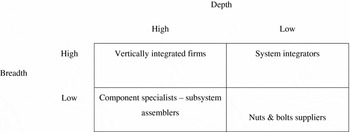
In contrast, Toyota and its suppliers in the production network work closely to share and transfer specialized component knowledge. Specifically, Toyota transfers knowledge directly to suppliers through its ‘operations management consultant division’ and sends its personnel to suppliers to help foster their ability to assimilate and apply the new knowledge (Nishiguchi, Reference Nishiguchi1994; Womack, Jones, & Roos, Reference Womack, Jones and Roos1990). Accordingly, Toyota personnel know better what knowledge will be useful to suppliers, and work collaboratively to develop modular innovations (Dyer & Singh, Reference Dyer and Singh1998). Given the characteristics of our sample, our study reflects DaimlerChrysler and Modine's reality that each firm requires a different degree and type of knowledge for a particular innovation, rather than Toyota's. Figure 2 combines the perspectives of Henderson and Clark (Reference Henderson and Clark1990) as well as Katila and Ahuja (Reference Katila and Ahuja2002) and suggests that system integrators will require high breadth of knowledge but low depth, while component specialists will require high depth of knowledge but low breadth. Firms supplying nuts and bolts, on the other hand, have neither the need for breadth or depth of knowledge and will thus occupy the low, low quadrant. Firms that are highly vertically integrated in the sense that they not only develop technologically sophisticated components but also are also responsible for integrating these components into complete systems will have a need for both high depth and breadth, and thus occupy the high, high quadrant.
Knowledge breadth versus knowledge depth for component specialists and systems integrators

Firm Specialization as a Contingency
System integrators developing a product containing a set of integrated components involving different technologies need to partner, collaborate, and coordinate with suppliers in order to understand linkages among components and to unravel engineering problems (Brusoni et al., Reference Brusoni, Prencipe and Pavitt2001; Takeishi, Reference Takeishi2002). Understanding these linkages does not require a detailed knowledge of each technology that is used. Instead, systems integrators seek knowledge about how parts can be integrated as they design the product architecture. In this sense, a system integrator requires knowledge in various technological disciplines to collaborate with a variety of individual specialists operating in distinct technological domains (Grant, Reference Grant1996). In other words, it is important for systems integrators to cast a wide net across diverse knowledge domains so that they may be able to design innovative products in response to market needs.
Component specialists also search for knowledge externally from universities, buyers, suppliers, or even competitors. However, in contrast to system integrators, enhancing knowledge breadth is inherently less useful to component specialists since they seek to become more and more expert in specialized component technologies. Given that the role of component specialists in a production network is to specialize in a relatively narrow technological domain, when component specialists engage in partnering activity, their focus is on acquiring specialized knowledge as opposed to a broader array of knowledge. But because component specialists lack a diversified knowledge base that allows them to learn knowledge distant from their existing knowledge, the benefit of knowledge breadth derived from inter-organizational partnering is likely to be constrained.
In sum, greater reliance on inter-organizational partnering provides the opportunity for firms to acquire greater knowledge breadth. However, system integrators will take greater advantage of enhancing knowledge breath as a consequence of their role in production networks and their capacity to learn diverse knowledge from partners. Thus, we propose:
Hypothesis 3: The positive association between greater reliance on inter-organizational partnering and knowledge breadth will be stronger for system integrators than for component specialists.
We also explore the impact of the association between greater reliance on inter- organizational partnering and knowledge depth for systems integrators versus component specialists. We argue that the impact of this association is stronger for component specialists than for system integrators. The goal of component specialists is to achieve a deep understanding of underlying core design concepts and technologies. Achieving depth of understanding is facilitated by focusing on a specific technological domain. In addition, the specific and aligned goals of organization members, as well as their specialized knowledge background helps to enable a component specialist to achieve knowledge depth primarily through intra-organizational knowledge acquisition. In contrast, the goal of systems integrators is to acquire architectural knowledge that facilitates their ability to integrate components. Enhancing knowledge depth in a specific domain is neither a sufficient nor a necessary contingency for a system integrator to be competitive. As a consequence, there is relatively low incentive for them to become expert in specific technological domains. Furthermore, their generalist orientation results in their having relatively fewer capabilities enabling them to acquire greater knowledge depth. Thus, we expect that component specialists are more likely to suffer from a lack of knowledge depth than systems integrators as a result of acquiring knowledge from inter-organizational partnering. Thus, we propose:
Hypothesis 4: The negative association between greater reliance on inter-organizational partnering and knowledge depth will be stronger for component specialists than for system integrators.
METHOD
Empirical Context
Our empirical setting was the companies listed on the Taiwan Stock Exchange (TSE) or the Gre-Tai Securities Market (an over-the-counter market) and operated in the sector of IT&E. The chosen sector, IT&E, has been the largest category in both stock exchange markets since 1998 in terms of firm number, market capitalization, and volatility. Positioning themselves as global electronics manufacturers, most of our sample firms mainly provide contractual design and manufacturing services to worldwide industrial buyers (Sturgeon & Lee, Reference Sturgeon, Lee, Berger and Leste2005). A small number of them (e.g., Acer & D-Link) manufacture their own brands. Additionally, the industry structure of the IT&E sector is characterized with a few system integrators coordinating with many small-and-medium size component suppliers. With global competitiveness (Ding & Abetti, Reference Ding, Abetti and Libecap2002), a complex production network, and vigorous patenting activities in the Taiwanese IT&E industry, this research context is adequate for demonstrating how firms with different epistemic roles capitalize on differing knowledge acquisition approaches in the pursuit of technological innovation (Ernst, Reference Ernst2000; Tsai & Wang, Reference Tsai and Wang2008).
Sample and Procedure
To test our hypotheses, we gathered both primary and secondary data. We constructed a survey questionnaire to collect information about firms’ knowledge acquisition strategies. The survey was distributed via mail, fax, or email during late 2007. Our sample frame included all listed firms in 2007 that were operating in five segments based mainly on two-digit Standard Industrial Classification (SIC) code: IC design (SIC 7112), basic metal manufacturing (SIC 24) electronic parts and components manufacturing (SIC 26), computers, electronic and optical products manufacturing (SIC 27), and electrical equipment manufacturing (SIC 28). We administered the survey to CEOs/Presidents of the 264 firms. After the initial survey mailing, we followed up with extensive communications including a mailed reminder, a telephone calls, and via other informants such as the CEO, president,Footnote [1] spokesperson, chief technology executives, senior managers of the R&D department, or public relations officers. We received 91 completed surveys. The response rate for this study was 34% (91 companies completed the survey out of the 264 that were initially approached).
The survey data received in late 2007 and early 2008 were used to capture knowledge acquisition strategies. We matched it with our other time-variant secondary variables over the three-year (2006~2008) window and therefore form the panel dataset. To ensure that our survey data was valid from 2006 to 2008, we checked two issues. First, we checked the annual financial report of each firm regarding its top management team as well as firm strategy. We dropped 9 firms because they introduced a new chairman of the board or CEO during 2006 to 2008. We believe that the change of chairman or CEO could indicate an instability in policy and strategy, thus the survey data is less likely to be valid for the three-year duration. We also scrutinized shareholder letters to ensure no significant changes in knowledge policy had taken place. Second, in 2008, we contacted 30 informants who were randomly selected from prior respondents to see if there was a change of knowledge acquisition strategy. All of them confirmed that no significant change of knowledge acquisition approach was implemented during 2006 through 2008. Besides, we believed that knowledge acquisition strategy is usually embedded in routines with few dramatic changes and therefore is unlikely to be an ephemeral processes.
Our secondary data was collected primarily from two sources. Financial data were drawn from the Taiwan Economic Journal (TEJ). Patent data came from the United States Patent and Trademark Office (USPTO). The patent data is used to construct the dependent variables, knowledge breadth and knowledge depth; the observation window for the dependent variables was 2007 through 2009 since all independent variables are one-year lagged. In the process of integrating primary and secondary data, 13 additional firms were eliminated because of the unavailability of patent data. In our final sample, there were 205 observations from 69 firms in the three-year observation window.
Measures
Dependent variables
In this study, the dependent variables are knowledge breadth and knowledge depth. Knowledge breadth refers to the degree of new knowledge disciplines explored and used while knowledge depth refers to the extent to which existing knowledge disciplines are repeatedly exploited and reused (cf., Katila & Ahuja, Reference Katila and Ahuja2002). We follow Katila and Ahuja's (Reference Katila and Ahuja2002) approach to construct our two variables, but use the analytical unit of international patent classification (IPC) rather than individual patent entries. We chose to use IPC because it is a classification system based on technological domains, which is the focus of this study. Therefore, our revised measure better captures how a firm's knowledge evolves within technological domains. The two dependent variables are calculated as follows:
 $$\begin{equation*}
{\rm{Knowledge\ breadt}}{{\rm{h}}_t} = \frac{{{\rm{new\ IP}}{{\rm{C}}_t}}}{{{\rm{total\ IP}}{{\rm{C}}_t}}}
\end{equation*}$$
 $$\begin{equation*}
{\rm{Knowledge\ dept}}{{\rm{h}}_t} = \frac{{\mathop \sum \nolimits_{t - 1}^{t - 5} {\rm{repetition\ counts\ of\ IPC}}}}{{{\rm{total\ IP}}{{\rm{C}}_t}}}
\end{equation*}$$
The notion t represents the year of patent application rather than that of patent issue because apparently knowledge has been built when patent is applied. Considering the one-year-or-longer time lag between patent application and granting, we use patent database, where only granted patents are incorporated, as well as patent application database, where patent applied in USPTO in accordance with the 18 month pre-grant publication rules are documented. We analyzed the patent data of the sampled firms and found that about half of patent applications filed in application database were granted later. Thus, we put a weight of 0.5Footnote [2] on records from the database of patents that have been applied for but not yet granted. Firms that did not apply for any patent over the observation window, 2007 through 2009, are eliminated. As a result, 33 (14%) observations from 13 companies were excluded from our sample.
Independent variables
As mentioned, all independent variables were collected from survey questionnaires during 2007. Our instruments were originally constructed in English and were then translated into Chinese and back-translated into English to ensure the accuracy of the meaning of the questions. In order to minimize response bias, we used prevention methods as Podsakoff, MacKenzie, Lee, and Podsakoff (Reference Podsakoff, MacKenzie, Lee and Podsakoff2003) suggested. Prevention methods included asking our company contacts to give the questionnaire in person to the best-qualified person to answer. The questionnaire was then pre-tested using a sample of managers in Taiwan. All constructs in this study were measured on a seven-point Likert type scale. After checking their internal consistency by using Cronbach's alpha, survey items were averaged to generate the independent variables.
The first independent variable is the relative intensity of two types of knowledge acquisition strategy, inter-organizational partnering and intra-organizational acquisition. These are described in detail below.
Greater reliance on inter-organizational partnering than on intra-organizational knowledge acquisition. We measured inter-organizational partnering and intra-organizational acquisition separately and then calculated the ratio of inter-organizational partnering to intra-organizational acquisition.
The measure of inter-organizational partnering was adapted from the work of Faems and his colleagues (Faems, Van Looy, & Debackere, Reference Faems, Van Looy and Debackere2005). In order to determine the number of items, which contribute to common variance actually needed to describe the dimension of inter-organizational partnering, we conducted common factor analyses on inter-organizational partnering. The results showed that one factor consisting of three items represented inter-organizational partnering. The 7-point Likert-scale items were ‘This company partners with other organizations for the specific purpose of innovating’, ‘This company considers it important to partner with other organizations for the purpose of innovating’, and ‘Partnerships have been an important source of innovations for the company’. Cronbach's alpha was 0.89.
Our measure of intra-organizational knowledge acquisition was drawn from the work of Tsai (Reference Tsai2002). The factor consisted of three items representing intra-organizational knowledge acquisition: ‘The employees of this company learn from one another’, ‘The employees of this company exchange ideas with people from different areas of the SBU’, and ‘If I am working on a problem or new idea I am likely to seek out someone in the company with whom to collaborate’. Using the same approach described above we found confirmation of a single common factor. Cronbach's alpha was 0.83.
Our independent variable, greater reliance on inter-organizational partnering than on intra-organizational knowledge acquisition, was then constructed by dividing inter-organizational partnering by intra-organizational acquisition.
Contingencies
System integrators and component specialists. We employed two senior security analysts to identify whether a firm is a system integrator or a component specialist. Following Brusoni, Prencipe, and Pavitt (Reference Brusoni, Prencipe and Pavitt2001), we suggest the following criterion for analysts to identify a system integrator. The criterion include: (1) a system integrator coordinates multiple suppliers in a production network to offer products and (2) a system integrator is capable of maintaining the existing product architecture as well as developing new ones. We also explained to the analysts that product architecture is a core design concept that integrates multiple components into a whole. System integrators in our sampled firms can be identified as manufacturers of 3C products including computers, mobile phones, cameras, and etc. Component specialists are providers of chips, mother boards, batteries, and etc.
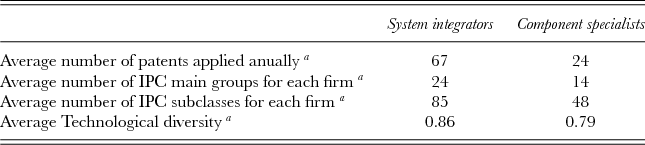
Over the 69 firms in our sample, the two experts only disagree on 2 (2.4%) of them after the initial classification. They held a subsequent discussion with each other to reach a consensus. Among our sampled firms, 14 of them were identified as system integrators and the remaining 55 were component specialists. Table 1 summarized the knowledge-related information of system integrators and component specialists in our sample. The average number of patents applied for annually by system integrators is 67, while the number for component specialists is 24. On average, each system integrator applied for patents distributed among 24 IPC main groups and 85 IPC subclasses. For component specialists this number is 14 main groups and 48 subclasses. Generally speaking, system integrators need to handle more and more diverse technological knowledge resulting in greater technological diversity (0.86), as compared with component specialists.
Comparison of innovation and knowledge between system integrators and component specialists

Notes: a Only firms with patents are included.
Control variables
Recognizing that technological innovation can come from knowledge management schemes as well as other firm and industry attributes, it is necessary to control for these effects. Accordingly, we included several industry-level and firm-level factors. For firm-level factors, we controlled for each firm's total number of patents, age, size, and technological diversity. As for industry-level factors, we controlled for industrial segments, and the dynamism of the firms’ corresponding main segments. To ensure the causal relationships between the control and dependent variables, the study lagged all the time-variant control variables by one year except for logarithm of patent counts. The detailed information for the control variables is as below.
Logarithm of patent counts
For firms filling only a small number of patents, its knowledge breadth and depth is likely to oscillate wildly over time. To control for this patent number effects, we added logarithm of patent counts as a control variable.
Firm age
We included firm age to control for its potential effects on organizational innovation (Sørensen & Stuart, Reference Sørensen and Stuart2000).
Firm size
We measured firm size by the logarithm of number of employees.
Year dummy
Because we collected patent applied from 2008 through 2010 for the measurement of dependent variable, we incorporated two-year dummy variables to control for the time effect.
Industry dummy
Industry features also influence firms’ knowledge deployment. We created three industry dummies for main two-digit SICs in our sample. SIC26 represents industry of electronic parts and components manufacturing, SIC27 represents computers, electronic and optical products manufacturing, and SIC28 for electrical equipment manufacturing. The dummy variable is 0 when an industry is not one of the abovementioned three industries.
Environmental dynamism
The technological dynamism that a firm faces may have implications for their innovation performance. Dynamic industries usually present an abundance of opportunities for innovation. We controlled for this effect by calculating the variation of equity prices in the stock marketFootnote [3] (Folta, Reference Folta1998).
Analyses
Our sample is a three-year unbalanced panel data with dependent variables observed during 2008 through 2010 and independent variables from 2007 to 2009. It is reasonable to use cross-sectional and time-series regression to analyze our panel dataset. Although both fixed-effects and random-effects options are available, time-invariant variables, including all independent variables and industry dummies, render fixed-effects specification impossible.
RESULTS
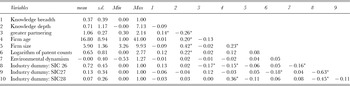
Descriptive statistics and correlations are shown in Table 2.
Descriptive statistics and correlations

Notes: N = 205; * p < 0.05
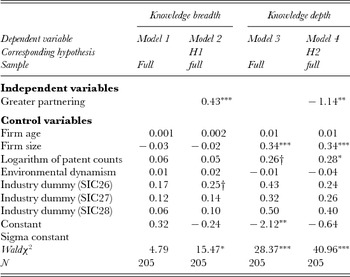
The results of hypothesis 1 and 2 are presented in Table 3. The full dataset (i.e., 205 observations) consists of two subsamples. The subsample of system integrators includes 14 system integrators and each of them is observed for three years, thus, our observation size is 42. In contrast, the subsample of component specialists consists of 55 firms. However, one of them is newly listed and their financial data are not available for all three years. This resulted in an observation number of 163. Model 1 and Model 3 only incorporate control variables as regressors. The results showed that firm-level variables, firm age, firm size and logarithm of patent counts, were positively associated with knowledge breadth and knowledge depth despite the fact that only the effects of firm size and logarithm of patent counts on knowledge depth are significant. The industry dummies, SIC26, SIC27 and SIC28 were also positive, although only SIC26 in model 2 was significant. This effect of environmental dynamism is not significant. One possible explanation is that during 2007 through 2009, the stock index volatility reflects the fact that that financial turbulence is stronger than the prospects for market opportunity.
Regression results of knowledge strategies on knowledge breadth and knowledge depth

Notes: †p < 0.1; * p < 0.05; ** p < 0.01; *** p < 0.001
To test hypothesis 1, we regressed knowledge breadth on the independent variables, greater reliance on inter-organizational partnering than on intra-organizational knowledge acquisition (i.e., greater partnering in Table 3 and 4), with our full sample. The results shown in Model 2 indicate that the positive coefficient is significant (β = 0.43, p < 0.001). Therefore, hypothesis 1 was supported. In hypothesis 2, we predicted that greater partnering has a negative impact on knowledge depth. This hypothesis is examined by Model 4. The results in model 4 showed that greater partnering has a significantly negative effect (β = - 1.14, p < 0.01) on knowledge depth. Therefore, Hypothesis 2 was supported. To provide further insight into the effects of greater partnering, we conducted supplementary analyses by examining the direct effect of inter-organizational partnering and intra-organizational knowledge acquisition on knowledge breadth and knowledge depth separately. The results indicate that inter-organizational partnering is positively associated with knowledge breadth (β = 0.14, p < 0.01) while intra-organizational knowledge acquisition has modestly negative effect (β = -0.07, p < 0.1). These results provide more detailed information for hypothesis 1. Specifically, they suggest that greater partnering is the major contributor to knowledge breadth. Regarding knowledge depth, inter-organizational partnering and intra-organizational knowledge acquisition have opposite effects. The coefficient of inter-organizational partnering is negative and insignificant (β = -0.5, p > 0.1), while the coefficient of intra-organizational knowledge acquisition is significantly positive (β = 0.67, p < 0.001). These results indicate that intra-organizational knowledge acquisition is the major contributor for knowledge depth. In sum, greater reliance on inter-organizational partnering rather than intra-organizational knowledge acquisition has a negative impact on knowledge depth.
Regression results of knowledge strategies on knowledge breadth and knowledge depth

Notes: †p < 0.1; * p < 0.05; ** p < 0.01; *** p < 0.001
a: The variable of greater partnering is mean-centered.
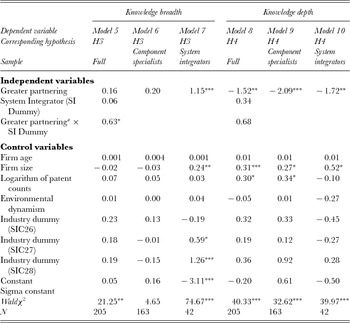
The results of hypothesis 3 and hypothesis 4 are presented in Table 4. To test hypothesis 3, two approaches were used. First, we used previously constructed greater partnering and also created and the dummy variable of system integrator (SI dummy). In our case, where the interaction term involves a continuous variable and a dummy variable, the significant coefficient of the interaction term reflects the significant mean difference between two groups (Jaccord and Turrisi, Reference Jaccard and Turrisi2003). As shown in Model 5, the interaction term is significant and positive (β = 0.63, p < 0.05). Therefore, hypothesis 3 was supported. We also ran separate regressions on subsamples of system integrators (SI subsample) and component specialists (CS subsample) in model 6 and 7. Greater partnering is not significant for the CS subsample (β = 0.2, p > 0.1 as shown in Model 6), but it is for the SI subsample (β = 1.15, p < 0.001 as shown in Model 7). The regression results from both approaches confirmed hypothesis 2.
To test hypothesis 4, we included an interaction term of mean-centered greater partnering and SI dummy in Model 8. The result of greater partnering was not significant (β = 0.34, p > 0.1). Separate regressions were also performed on the SI subsample and the CS subsample as supplementary examinations of hypothesis 4. The results in model 9 and 10 show that greater partnering is significantly negative in both subsamples (β = -2.09, p < 0.001 for CS subsample and β = -1.72, p < 0.01 for SI subsample). Thus, Hypothesis 4 was not supported.
While we have controlled for the industry factor by creating industry dummies, one finding required further exploration. In most of our regression models, industry dummies were not significant. However, in Model 7, when regressed on knowledge breadth within the subsample of system integrators, the industry dummies, SIC27 (computers, electronic and optical products manufacturing) and SIC28 (electrical equipment manufacturing) were positively significant. The possible explanation is that industries of computers, electronic and optical products manufacturing as well as electrical equipment manufacturing have more specialized components and are with complicated functions and sub-functions, therefore, system integrators in these industries tend to maintain relatively high knowledge breadth.
DISCUSSION
The findings of this study support the notion that different knowledge acquisition strategies have different effects on knowledge breadth and knowledge depth for component specialists and systems integrators. Several broad insights emerge from this research. First, we proposed and found that greater reliance on inter-organizational partnering has a positive impact on knowledge breadth. This positive effect on knowledge breadth is stronger for system integrators than for component specialists. Systems integrators are more concerned with finding novel ways of integrating technologies that are currently in use, as well as finding new technologies. As a consequence, these firms need to have a general knowledge of technological and market trends, as well as developments that could impact on how components fit together. Their use of a knowledge strategy entailing relatively more inter-organizational partnering enables them to acquire this broad array of knowledge.
We speculate that while the strategy employed by a firm to acquire knowledge plays an important role, it is also important to take account of the goals, needs, and absorptive capacity of those doing the searching. Clearly additional research is needed that examines the motivations of component specialists and systems integrators that leads to a heightened sensitivity about what knowledge is relevant and important.
Second, as shown in the comparison of model 8 through 10, the results also support our argument that greater reliance on inter-organizational partnering detracts from a firm's ability to enhance knowledge depth to a greater degree. In other words, fostering knowledge depth requires that firms engage in relatively more intra-organizational knowledge acquisition. By remaining within the firm's boundaries, the experience and competence of its members remain relatively closely connected, thus facilitating their learning from each other. Learning from beyond the organization's boundaries may not be fruitful in cultivating knowledge depth as a consequence of having limited intersections of language, interest, experience, and competence that allow for mutual understanding and comprehension (Wenger, Reference Wenger2000). The ability to conduct in-depth learning depends not only on a knowledge acquisition strategy, but also on the existing knowledge depth of a firm. In an era of increasing specialization, such knowledge depth is more likely to be acquired within the organization than across organizational boundaries.
We had also proposed that the negative association between greater reliance on inter-organizational partnering and knowledge depth would have a stronger impact for component specialists than for system integrators. However, our results did not support this supposition. Instead, we found that the association between greater reliance on inter-organizational partnering and knowledge depth was not significantly different for systems integrators and component specialists. That is, engaging in relatively more inter-organizational partnering decreases knowledge depth for both component specialists and system integrators. Systems integrators who engaged in greater inter-organizational partnering were also not able to acquire a higher depth of knowledge. This may stem from the fact that system integrators need in-depth knowledge concerning the product architecture including component allocation and interfaces (Fixson, Reference Fixson2005; Fixson & Park, Reference Fixson and Park2008; Ulrich, Reference Ulrich1995). Lacking an in-depth understanding of how the different components interact via interfaces would make it difficult, perhaps impossible, for systems integrators to successfully integrate components. Even though such knowledge involves various knowledge domains, the enhancement of knowledge thoroughness and sophistication in these domains still require intra-organizational knowledge acquisition rather than partnering with other organizations.
Beyond examining the association between knowledge acquisition strategies and the features of a knowledge repertoire, i.e., its breadth and depth, it is interesting to explore that link between knowledge repertoire and firm performance. The literature has demonstrated that both knowledge depth and knowledge breadth are positively associated with firm innovation (Wu & Shanley, Reference Wu and Shanley2009). Drawing on this empirical evidence, it is plausible to infer that relative reliance on partnering to internal knowledge acquisition could be detrimental to firm innovation since this strategy has a negative effect on knowledge depth and an insignificant effect on knowledge breadth.
This finding also provides implications regarding how we view the role of systems integrators. While prior research has acknowledged that systems integrators play a dynamic role in introducing new product architectures and requires an ‘all-around knowledgeable firm’ (Brusoni et al., Reference Brusoni, Prencipe and Pavitt2001), from our evidence it appears that systems integrators in a fast moving industry have a greater need for deep knowledge of components than previously thought (Prencipe, Reference Prencipe2000). In fact, our results indicate that the negative association between relative more inter-organizational partnering and knowledge depth is similar for component specialists and system integrators. It suggests that interorganizational partnering may be more useful for obtaining ‘less developed’ ideas that can subsequently be brought back in house for further refinement and development. It is possible that the Taiwanese culture plays a role. The collectivist orientation of the Taiwanese culture may result in the sharing of ideas among the group within the organization, but also result in the development of an in-group mentality that makes it more difficult for ‘outsiders’ to the group to effectively communicate and thus learn from the in-group (Gudykunst, Yoon, & Nishida, Reference Gudykunst, Yoon and Nishida1987; Newman & Nollen, Reference Newman and Nollen1996). The fact that our results show that knowledge depth decreases for both component specialists and system integrators suggests that the collectivist culture of Taiwan may have an overriding effect on individuals, regardless of the type of work that they are engaged in or the type of organization from which they come. Additional research will be needed to identify the boundaries of this relationship. Whether this finding is generalizable or is simply a phenomenon that occurs when particular contingencies such as industry dynamism exist will have to be left for future studies to explore. It is possible, e.g., that the national culture from which component specialists and systems integrators come from play a role in how they search and acquire knowledge that may in turn impact of the level of depth of knowledge that they are able to acquire.
Prior research also explores how product structure influences organizational structure (Ozman, Reference Ozman2010; Sanchez & Mahoney, Reference Sanchez and Mahoney1996). Our research extends this research stream. We suggest that the influence of product structure is not limited to inside the organization, but rather extends to industry structure as well. A more holistic picture would include not only the division of labor within firms, but also the coordination among them.
Our research highlights the different roles played by a system integrator and a component specialist. In fact, the theoretical and empirical implication of the two types of firms in a production network has been scarcely investigated. Our study also has important implications for managers. Specifically, it suggests the need of different knowledge acquisition strategies for different direction of knowledge accumulation (knowledge breadth versus knowledge depth) and for different roles firms playing in a production network (component specialist versus systems integrator). Specifically, while greater reliance on partnering acquisition strategy than on intra-organizational acquiring is beneficial to achieve knowledge breadth for system integrators, it is not the case for component specialists (see Model 6 through 8). This result contradicts many prior studies, which suggested a general positive association of knowledge acquisition strategy and knowledge outcome without a careful distinction between system integrators and component specialists (Rosenkopf & Almeida, Reference Rosenkopf and Almeida2003). Our finding suggests the need to take a firm's role in a production network into consideration when formulate its knowledge strategy in order to construct a more holistic understanding of the effectiveness of knowledge strategy. That ‘one size’ does not fit all when it comes to employing a knowledge strategy.
Although this study uses a Taiwanese sample, its implications are not limited to this particular context. We believe the need for different strategies for system integrators and component specialists would apply for various production networks in different regions. Our hypotheses can be further tested in different contexts in future research. At the same time, our research provides a direct link to the IT&E industry in a Chinese context, particularly when IT&E production gradually shifted from Taiwan to China (Fuller, Reference Fuller2008) and when China built global production networks in various segments of the IT&E industry (Henderson & Nadvi, Reference Henderson and Nadvi2011). In other words, our empirical findings provide practical implications for knowledge acquiring decisions for Chinese firms operating in production networks.
Limitations and Future Research Directions
A promising extension for future research would be to explore the impact of industry dynamism on production networks, as well as the phase of industry development on the type of knowledge acquisition strategies that systems integrators or component specialists need to employ. Accordingly, we need to better understand how the needed knowledge acquisition strategies differ as a production network evolves. It is plausible to consider that component specialists will increasingly pursue knowledge depth as specialization and modulation increase in the industry they operate in, and therefore intra-organizational search will become more important. Future research is needed to incorporate this dynamic element to test the relationship between knowledge acquisition strategy and knowledge type in different stages of the evolution of production network.
Further investigation of the means by which systems integrators balance and integrate partnering and intra-organizational search strategies is also needed. It may be that this balance follows the level of maturity in the industry, with partnering strategies becoming more important as the industry matures. Similarly, it is also important for future research to pay attention to whether component specialists need to change their knowledge acquisition strategies as their production network evolves.
It would also be useful for future research to explore the impact of knowledge specialization on choices of knowledge acquisition strategies in other cultural settings. According to Hofstede (Reference Hofstede2003), Taiwan is relatively more collective oriented than individual oriented. This collective orientation may have a subtle impact on where and how firms search for and share knowledge. For example, in a more collective orientated country, people have a tendency to work together in groups. Future research that investigates the use of these strategies by component specialists and systems integrators in other cultures (e.g., in a more individual oriented culture) would help to provide answers regarding country culture's impact.
CONCLUSION
Using both primary and secondary data from Taiwanese IT&E firms in the three-year observation window, our study empirically support that organizations at different positions in a production network requires different knowledge acquisition strategies to effectively foster knowledge breadth and knowledge depth respectively. However, we found that the association between greater reliance on inter-organizational partnering and knowledge depth was not significantly different for systems integrators and component specialists. Based on the dynamic concept of evolution theory, the empirical findings are likely to be fruitful for future research to use longitudinal data with a longer observation window to explore the effects of industry dynamism and industry structure on the type of knowledge acquisition strategies that systems integrators and/or component specialists need to employ. The merit of longitudinal data concerning timing issues may provide additional insights into how knowledge acquisition strategies differ for system integrators and component specialists as a production network and industry evolve. While our data was observed in three years, it may not be longer enough for observing the evolution of industry and production network. The contribution of the development of dynamic knowledge strategy typology will offer more insight than the basic static strategy typology (Bierly & Chakrabarti, Reference Bierly and Chakrabarti1996).