


1. Introduction
Internal conical flow, which usually serves as a basic model for internal compression systems including the inward-turning inlet (You Reference You2011; Zuo & Mölder Reference Zuo and Mölder2019), has received extensive attention. Owing to the specific constraint of internal contraction, some effects, such as the shock convergence, may result in serious total pressure loss and poor performance of the internal flow. Early studies (Ferri Reference Ferri1946; Mölder Reference Mölder1967; Mölder et al. Reference Mölder, Gulamhussein, Timofeev and Voinovich1997) on axisymmetric simplified models found that a shock in the internal conical flow cannot maintain a constant strength or shock angle; instead, the shock will continuously converge downstream, especially steepening when it approaches the axis. It has been proved that no matter how weak the initial strength is, an axisymmetric shock will strengthen so that regular reflection is eventually impossible, and a Mach disk will inevitably appear on the centreline (Rylov Reference Rylov1990; Isakova et al. Reference Isakova, Kraiko, Pyankov and Tillyayeva2012; Shoesmith et al. Reference Shoesmith, Mölder, Ogawa and Timofeev2017). Therefore, attention should be given to the fact that the behaviours of the propagations and interactions of axisymmetric shocks (AIS) are fundamentally different from those of planar oblique shocks generated by two-dimensional wedges (Ben-Dor Reference Ben-Dor2007). Nevertheless, well-developed two-dimensional shock theories can still be reasonably applied in the vicinity of the triple point of a Mach reflection on the symmetry plane if the scale of the Mach disk is sufficiently large compared with the thickness of the shock wave (Gounko Reference Gounko2017); this approach yields a quick and helpful description of the local shock configurations. However, two-dimensional theory cannot always effectively predict and evaluate the behaviours of a curved shock, such as the strengthening process accompanied by shock convergence. Fortunately, the curved shock theory (CST) proposed by Mölder (Reference Mölder2016, Reference Mölder2017a,Reference Mölderb,Reference Mölderc) manifests that the pressure gradient behind a doubly curved shock is closely related to the shock angle and curvatures, thus providing a theoretical path for revealing the underlying mechanisms of shock strengthening. Subsequently, the CST was applied by Filippi & Skews (Reference Filippi and Skews2017, Reference Filippi and Skews2018) to investigate AIS constrained by curved internal surfaces. Recently, Shi et al. (Reference Shi, Han, Deiterding, Zhu and You2020) developed the second-order CST, which improves the accuracy in describing the flow behind axisymmetric curved shocks. Shi et al. (Reference Shi, Zhu, You and Zhu2021) then proposed a method of curved-shock characteristics based on CST and applied it to the inverse design of axisymmetric flow fields. This method is more effective and accurate than the conventional method of characteristics. With the expansion of knowledge, the intrinsic convergence effects of AIS have been progressively revealed.
A perfectly conical convergent shock is a special case of an axisymmetric model for various curved shocks with convergences since it can be theoretically treated as a two-dimensional structure on the symmetry plane. However, pure axisymmetric flow is scarcely possible from a practical point of view. If there is a deviation from the axisymmetric condition, the complexities come not only with the necessity of three-dimensional analyses but also with the possibility of fundamental changes in the mechanism because the condition under which the central Mach disk is an inevitable product, i.e. axial symmetry or circumferential uniformity, cannot be guaranteed. Unfortunately, to the authors’ knowledge, little attention has been given to how converging shocks behave when the flow deviates from the condition of axial symmetry. In aerodynamic applications, some deviations easily originate from model geometries and flow conditions, and thus cause different non-uniformities of a convergent shock. Zhang et al. (Reference Zhang, Li, Ji, Si and Yang2021) proposed an elliptic conical configuration that geometrically deviates the flow from the axial symmetry. It was revealed that the central Mach disk will be replaced by a regular reflection as the aspect ratio of the elliptic entrance reaches a certain level. From the view of flow conditions, non-axial incoming flow is another representative factor of deviation, which is of frequent occurrence in practice (Zuo, Mölder & Chen Reference Zuo, Mölder and Chen2020). When the incoming flow does not coincide with the direction of the axis or angles of attack (AoAs) are generated, the strengths of the conical shocks become non-uniform circumferentially compared with the AIS, and the convergence behaviours may change substantially. Eventually, whether the shocks interact in the form of inevitable Mach reflections is worthy of clarification.
In the present study, the progress of non-uniformity for converging shocks in non-axial flows is investigated, and the AoA is used to quantitatively describe the deviation from axial symmetry. At a series of typical AoAs, the flow fields are illustrated through experimental visualizations and numerical simulations. The non-uniform features of the shock convergences and the configurations of some typical interactions are identified and discussed.
2. Model and methods
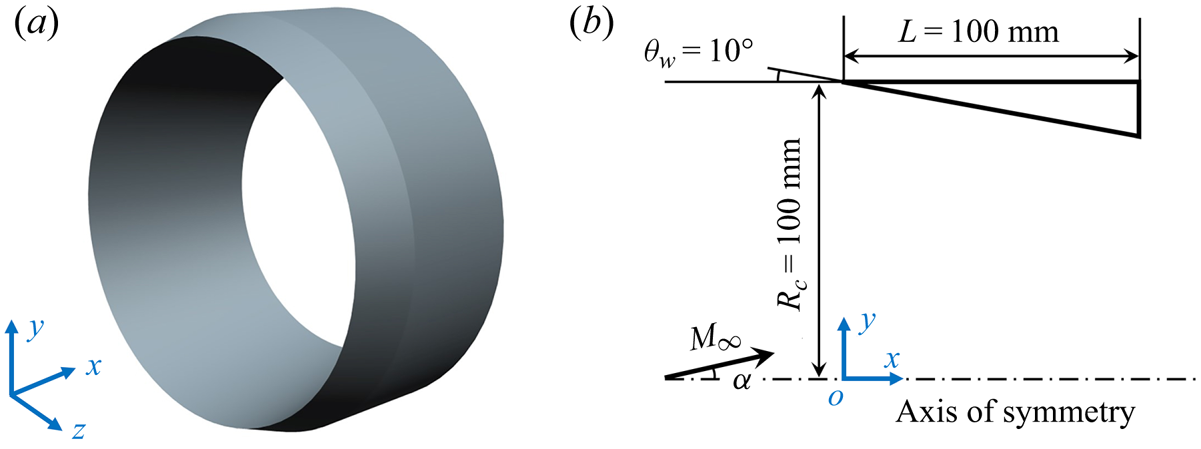
The circular ring wedge model shown in figure 1(a) was used as the shock generator in the shock tunnel experiments, and the geometric parameters are given in figure 1(b). For comparison with an inward-turning inlet (You, Zhu & Guo Reference You, Zhu and Guo2009; You Reference You2011), the leading-edge angle ( $\theta _w$) of the model was properly designed to be
 $10^\circ$, at which the initial shock is relatively weak and, as far as the present study is concerned, it is conducive to highlighting the strengthening of the shock during the convergence process. Both the axial length of the model (
 $L$) and the radius of the circular entrance (
 $R_c$) are 100 mm. Taking the centre of the entrance as the origin (
 $O$), the
 $x$,
 $y$ and
 $z$ axes denote the axial, vertical and transverse directions, respectively.
Circular ring wedge model for experiment. (a) Schematic; (b) parameters.

The model tests were conducted in the KDJB330 reflected shock tunnel (Li et al. Reference Li, Gao, Jiang and Yang2013; Zhang et al. Reference Zhang, Li, Ji, Si and Yang2021) at the University of Science and Technology of China with a nominal free stream Mach number ( $M_\infty$) of 6. Air was used to generate the incoming flow. The static pressure and temperature of the incoming flow were approximately 900 Pa and 110 K, respectively, with an effective test time of approximately 20 ms. When the model is installed on pedestals with different elevation angles, AoAs (
 $\alpha$) are formed. As shown in figure 1(b), the anticlockwise angle between the incoming flow and the
 $x$ axis is defined to be positive. A few representative AoAs selected for testing were determined by a series of advanced numerical investigations that covered a sufficient range of interests. The numerical results indicated that at
 $\alpha = 0^\circ$,
 $2^\circ$,
 $3^\circ$ and
 $5^\circ$, the flows are distinct and capable of providing the required information for discussion. Ultimately, the flow fields at these four AoAs were experimentally tested. The axisymmetric flow field at
 $\alpha = 0^\circ$ was examined as the reference sample. A schlieren photographic system adopting a vertical knife edge was equipped on the shock tunnel to visualize the patterns of the flow fields downstream of the model exit from the
 $z$ axis. The schlieren images were recorded by a camera whose rate was set as 7500 frames per second, and the exposure time was set as
 $2 \ \mathrm {\mu }\textrm {s}$. The uncertainty of the angle caused by processing and assembly of the model was measured by an inclinometer with a resolution of
 $0.05^\circ$.
To obtain more quantitative information that is difficult to measure through experiments, numerical information was obtained in the present study. In addition to the flow fields which are our main concern, at  $\theta _w = 10^\circ$ (with or without AoA), a number of specific axisymmetric flow fields at
 $\theta _w = 5^\circ$,
 $8^\circ$,
 $12^\circ$ and
 $15^\circ$ were also simulated for comparison and to support the discussion. The effects of the viscosity were not considered in the numerical simulations because the boundary layers in the flow fields only attach to the near wall of the model and are minimally involved in the regions of concern where the main shock structures exist (Filippi & Skews Reference Filippi and Skews2017). Therefore, the Euler equations were solved. The robust AUSM
 $^+$ scheme (Liou Reference Liou1996) was employed to compute the flux vector. The equation of state for perfect gas was satisfied, and the ratio of specific heat was 1.4. All flow fields at non-zero AoAs were assessed through three-dimensional simulations, while the axisymmetric cases (
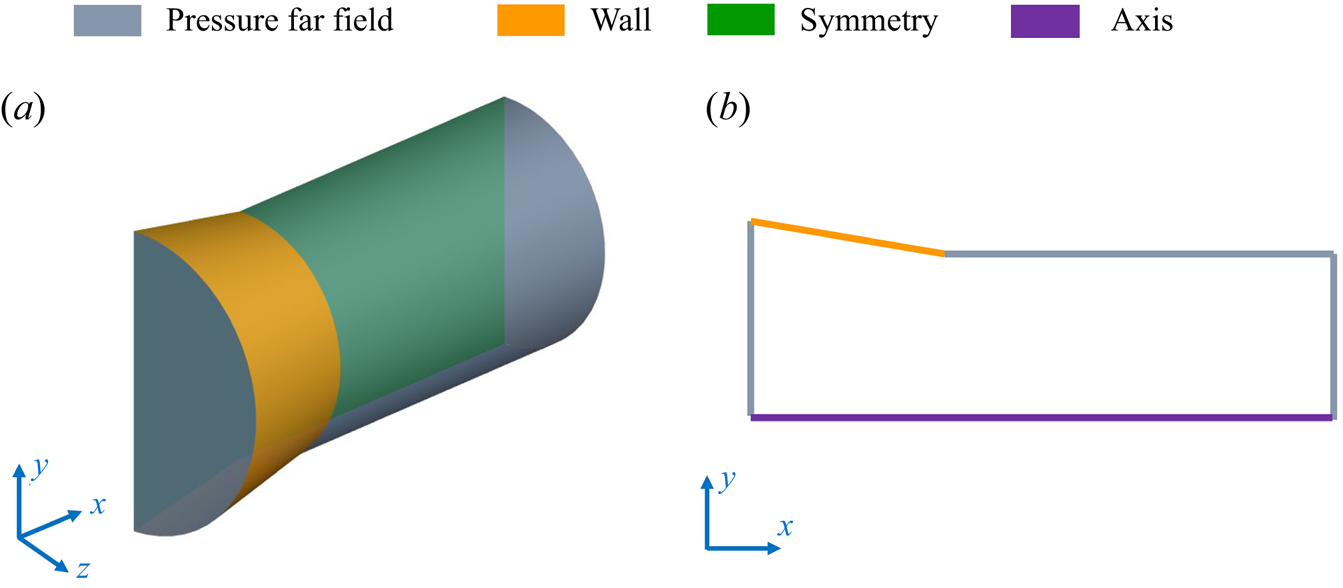
 $\alpha = 0^\circ$) were assessed with two-dimensional–axisymmetric simulations. To improve the simulation efficiency, half-model domains were used in all simulations. The diagrams of the three-dimensional domain, which is symmetric about the
 $x$–
 $y$ plane, and a two-dimensional domain, which is axisymmetric about the
 $x$ axis, are shown in figures 2(a) and 2(b), respectively. The different colours of the domains distinguish different boundaries. Wall boundaries were applied to the internal compression surfaces. In addition to the wall and symmetric boundaries, non-reflective pressure far fields were imposed on other boundaries (Filippi & Skews Reference Filippi and Skews2017). The parameters at the far field boundaries were set to be consistent with that of the incoming flow in the experiments. Initially, the three-dimensional domain was discretized into
 $8\times 10^6$ structured hexahedral cells, and the size of each cell was approximately
 $0.1 \times 0.08 \times 0.08\ \textrm {mm}$. The two-dimensional domain was discretized into
 $5\times 10^4$ quadrilateral cells with cell sizes of
 $0.1 \times 0.08\ \textrm {mm}$. To centralize the resources on the shock structures and achieve a high resolution, adaptive refinements of the cells based on the density gradient were successively applied three times. After the third refinement, the shock structures did not distinguishably shift compared with those at the previous time. Thus, three refinements were considered to be sufficient, and the numerical results using the final refined meshes were adopted in this study. The final three-dimensional and two-dimensional meshes contained approximately
 $4\times 10^7$ and
 $9\times 10^4$ cells, respectively. In the simulations, the flow parameters at some critical positions, such as the reflection points on the symmetry plane, were monitored. When the residuals of the governing equations were reduced by three to five orders of magnitude and no longer dropped with iterations and the variations in the monitored parameters were persistently less than 0.1 %, the simulations were regarded as converging.
Computational domains. (a) Three-dimensional domain; (b) two-dimensional domain.

3. Results and discussion
3.1. Typical axisymmetric case
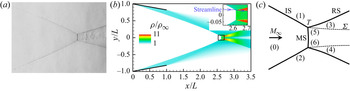
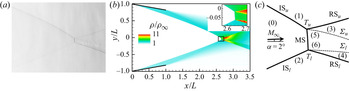
A typical case of ideally axisymmetric flow at  $\theta _w = 10^{\circ }$ is presented as a reference sample for the subsequent discussion. Figures 3(a), 3(b) and 3(c) show the experimental schlieren image, the numerical contour of the normalized density (
 $\rho /\rho _\infty$,
 $\rho _\infty$ is the density of the incoming flow) and the schematic of the shock structures, respectively. The incident shock (IS) generated by the leading edge continuously converges, where dramatic strengthening is exhibited from the increment of the shock angle when IS approaches the axis. As a result, a Mach disk (or Mach stem (MS) on the symmetry plane) is formed upright on the axis at approximately
 $x/L = 2.62$. Moreover, a reflected shock (RS) and shear layer (
 $\varSigma$) are also generated.
Axisymmetric flow at  $\theta _w = 10^{\circ }$. (a) Schlieren image; (b) numerical contour of normalized density on the symmetry plane; (c) zoomed-in schematic of the shock structures near the centre.

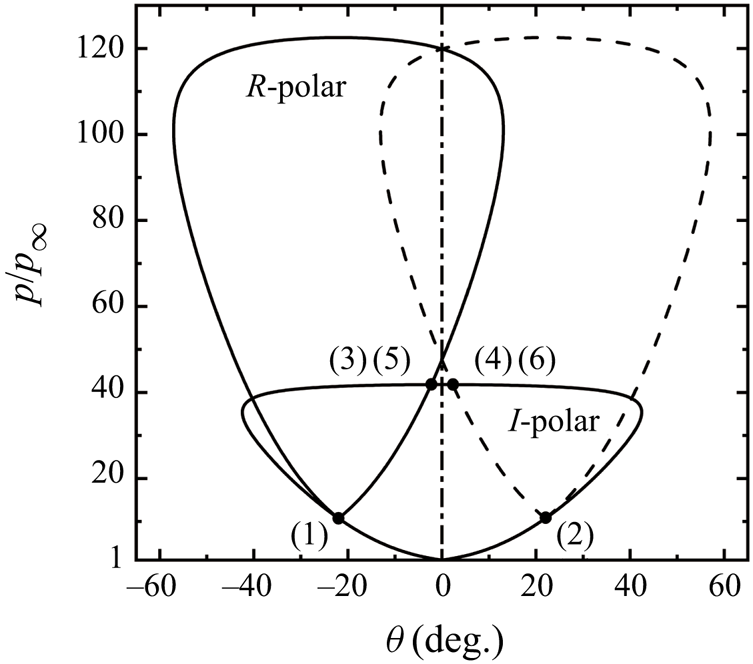
As shown in figure 3(c), six flow regions around the vicinity of the symmetric triple points (the upper triple point is labelled  $T$) are marked. In accordance with the flow parameters in these regions, figure 4 gives the pressure-deflection shock polars used to quantify the reflection solution. The pressure (
 $p$) is normalized by the static pressure of the incoming flow (
 $p_\infty$), and the anticlockwise deflection (
 $\theta$) relative to the direction of the incoming flow is defined as the positive angle. The
 $I$-polar is first determined by the parameters of the incoming flow, and the
 $R$-polar is determined by the flow parameters extracted from a numerical streamline that passes through the recognizable IS in the vicinity of
 $T$ (see the close-up in figure 3b). Considering the symmetry, only the upper half of the flow in regions (0), (1), (3) and (5) is analysed. The flow deflection angle in region (1) in figure 3(c), corresponding to point (1) in figure 4, is approximately
 $-22^{\circ }$, which indicates a considerable strength increment of IS compared with the initial compression angle of
 $-10^{\circ }$. It can be concluded that the convergence effect makes it possible that the shock that is initially not capable of Mach reflection, owing to insufficient strength, is enhanced to such a strength that Mach reflection can occur. From the intersection point between the
 $I$-polar and the
 $R$-polar (3) or (5), it is obvious that the deflection angle in region (3) or (5) is still negative, that is,
 $\varSigma$ is centripetally contracted. This configuration of Mach reflection is categorized as direct Mach reflection (DiMR) according to two-dimensional shock reflection theory (Courant & Friedrichs Reference Courant and Friedrichs1948; Ben-Dor & Takayama Reference Ben-Dor and Takayama1986; Ben-Dor Reference Ben-Dor2007). In DiMR, the continuous variation of deflection behind MS from
 $T$ to the axis indicates that MS is a concave segment facing the incoming flow (Tan, Ren & Wu Reference Tan, Ren and Wu2006; Ben-Dor Reference Ben-Dor2007). From an axisymmetric view, the Mach disk is approximately part of the concave spherical surface. However, since the solution on the symmetry plane is close to the von Neumann point (where the
 $I$-polar intersects the
 $R$-polar on the centreline of
 $\theta = 0^{\circ }$) (Ben-Dor Reference Ben-Dor2007), the flow parameters behind the Mach disk are relatively uniform, and the concave Mach disk is shallow, which quite resembles a normal shock. Nevertheless, it is worth mentioning that at lower Mach numbers, the Mach disk will curve to a greater extent, which signifies that the flow uniformity behind it will be poorer (Gounko Reference Gounko2017).
Shock polars describing the axisymmetric flow in the vicinity of the triple points at  $\theta _w = 10^{\circ }$.

To explore the inherent mechanisms, it is valuable to clarify key factors that dominate the inevitable appearance of Mach reflection and the shock convergence behaviours. The CST proposed by Mölder (Reference Mölder2016, Reference Mölder2017b) suggests that the normalized pressure gradient ( $P_2$) behind a three-dimensional doubly curved shock is closely related to its local strength and curvatures, thereby providing a parametric evaluation approach for shock convergence. For a uniform incoming supersonic flow over an axisymmetric circular ring wedge, it is easy to simplify the expression of
 $P_2$ (Mölder Reference Mölder2016, Reference Mölder2017b,Reference Mölderc; Filippi & Skews Reference Filippi and Skews2018; Zhang et al. Reference Zhang, Li, Ji, Si and Yang2021) as
 $P_2 = c S_c$ at the leading edge, where
 $c$ is a coefficient positively correlated with the shock angle on the symmetry plane and
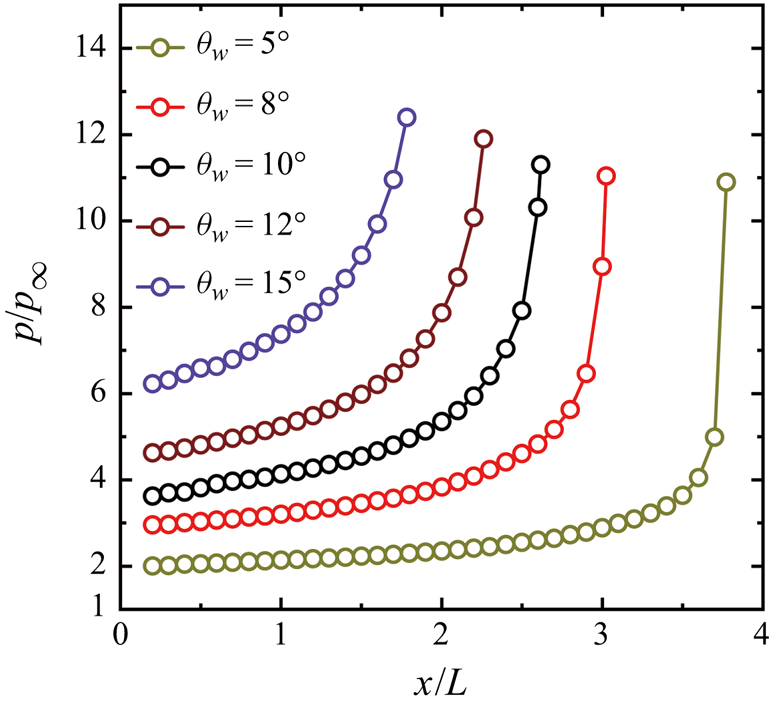
 $S_c$ is the transverse curvature of the shock. As a result, the axisymmetric shock with a larger initial strength and a larger transverse curvature will have a greater postshock pressure gradient and thus converge faster. To support this conclusion and provide specific data for the later discussion, figure 5 provides the numerical pressure ratio (
 $p/p_\infty$) variations for the incident shocks from the leading edge to where the Mach reflections occur, with a series of
 $\theta _w = 5^{\circ }$,
 $8^{\circ }$,
 $10^{\circ }$,
 $12^{\circ }$ and
 $15^{\circ }$. The pressure ratio represents the shock strength, while the slope of the pressure ratio curve represents the convergence rate. Since the initial
 $S_c$ of the shocks are the same for the present cases with identical leading-edge diameters, the only impact on the convergence rate is exerted by shock strengths compressed by different values of
 $\theta _w$.
Pressure ratio variations of the AIS with different  $\theta _w$.

It is evident from figure 5 that with  $\theta _w$ increasing, the convergence of the initial shock becomes faster (i.e. the initial slope of the pressure ratio curve becomes larger), which confirms the prediction of the CST. As the shock converges farther downstream, the convergence rate becomes less well predicted by the given expression of the CST because the postshock flow is less constrained by the wall. Nevertheless, from figure 5, it can still be reasonably concluded that the increased shock strength and transverse curvature accelerate the convergence because for all the presented data, the slopes of the pressure ratio curves increase with
 $x/L$ extension. From the view of geometrical properties, the transverse structure of an axisymmetric shock surface is circular, so the radius of the transverse curvature of the shock (
 $1/S_c$) is the distance from the shock surface to the axis on the symmetry plane. As convergence occurs towards the axis,
 $1/S_c$ diminishes gradually. Assuming there was no Mach disk, an axisymmetric shock would reach the axis, and
 $1/S_c$ would be zero, which means that the shock would converge without limitation and its strength would reach infinity. However, in reality, it is known that the Mach disk will inevitably appear to terminate the shock convergence. Note from figure 5 that the superiority of a higher convergence rate possessed by the shock at a larger
 $\theta _w$ is maintained only at a fixed
 $x/L$, and it becomes relatively lower when compared with the rates nearby where the Mach reflection occurs (i.e. the slope near the end of the pressure ratio curve is smaller for a larger
 $\theta _w$). This is because the shock with a larger initial strength reaches the occurrence of the Mach reflection earlier where the shock surface is farther from the axis, which means that the local
 $S_c$ is smaller and thus results in a relatively lower contribution to the convergence rate. In contrast, a longer distance of convergence caused by a weaker initial shock also means a smaller-scale Mach disk, where the corresponding local
 $S_c$ can be drastically large.
Based on the above discussion, it can be summarized that in the shock convergence process, both the shock strength and the transverse curvature play important roles and should be taken into consideration. It needs to be noted that the entire axisymmetric flow field can be discerned merely from the symmetry plane. However, when an AoA is applied, the flow will deviate from the axial symmetry, and three-dimensional characteristics will inevitably be activated. The strength of the IS forming at the entrance will suffer from a non-uniform change along the circumferential direction. Furthermore, the initial non-uniformity will exert a thorough influence on the shock convergence downstream. The morphology of the shock surface may substantially change compared with the axisymmetric flow field, and the analysis of circumferential shock structures might be necessary. After undergoing a non-uniform convergence, the final reflection type will be impacted, and whether Mach reflection inevitably occurs needs to be clarified.
3.2. Non-axisymmetric flow with AoA
3.2.1. AoA of  $2^{\circ }$

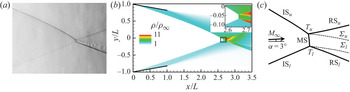
Figures 6(a), 6(b) and 6(c) show the schlieren image, the numerical contour of the normalized density on the symmetry plane (the  $x$–
 $y$ plane) and the schematic of the shock structures, respectively, at a relatively small AoA of
 $2^{\circ }$. Compared with the axisymmetric flow, the characteristics of non-uniformity between the windward side and leeward side are revealed and noticeable in the way that the IS on the windward side is stronger than that on the leeward side throughout, particularly steepening near the converging centre. Consequently, the IS moves against the inclined incoming flow, and the converging centre shifts towards the leeward side. The Mach disk is observed near the converging centre at approximately
 $x/L = 2.64$, which exhibits a typical feature similar to the axisymmetric flow that the Mach reflection remains, although the Mach disk leans slightly forward with a shrinkage in size for the inclined flow. Meanwhile, the
 $\varSigma$ also obviously shows a non-uniform behaviour between the windward side and leeward side, and interestingly, the stream enclosed by the
 $\varSigma$ turns in the opposite direction against the inclination of the incoming flow.
Near-conical flow with an AoA of  $2^{\circ }$ at
 $\theta _w = 10^{\circ }$. (a) Schlieren image; (b) numerical contour of normalized density on the symmetry plane; (c) zoomed-in schematic of the shock structures near the centre.

According to the CST discussed in § 3.1, the upper incident shock (such as  $\textrm {IS}_u$ in figure 6c) and the lower incident shock (such as
 $\textrm {IS}_l$ in figure 6c) on the symmetry plane should have different initial convergence rates due to the unequal initial shock strengths. At a general AoA, the expression of
 $P_2$ near the leading edge can be rewritten as
 $P_{2u} = c_u S_c$ at the zenith and
 $P_{2l} = c_l S_c$ at the nadir. The new coefficients
 $c_u$ and
 $c_l$ have slight differences from
 $c$ in the axisymmetric flow since
 $c_u$ is raised by the stronger windward leading shock, whereas
 $c_l$ is reduced by the weaker leeward leading shock. Nevertheless, the expression of
 $P_2 = c S_c$ in the axisymmetric flow can still be reasonably applied, and therefore, the following qualitative considerations are suggested. At an AoA of
 $\alpha$, the effective deflection angles behind IS
 $_u$ and IS
 $_l$ at the leading edge are
 $\theta _w+\alpha$ and
 $\theta _w-\alpha$, respectively. Therefore, the initial angles of
 $\textrm {IS}_u$ and
 $\textrm {IS}_l$ at
 $\alpha = 2^{\circ }$ are equivalent to those of the AIS at
 $\theta _w = 12^{\circ }$ and
 $8^{\circ }$, respectively, producing the initial non-uniformity of shock strength. Meanwhile, the transverse curvatures of
 $\textrm {IS}_u$ and
 $\textrm {IS}_l$ at the leading edge are the same as those of the axisymmetric shocks (because of the same entrance), which means that the
 $S_c$ of the shocks are initially identical. As a result, the initial convergence rates of
 $\textrm {IS}_u$ and
 $\textrm {IS}_l$ should be approximately equal to those of the AIS at
 $\theta _w = 12^{\circ }$ and
 $8^{\circ }$, respectively, and thus, the initial convergence rate of
 $\textrm {IS}_u$ is higher than that of
 $\textrm {IS}_l$ resulting from the initially different shock strengths.
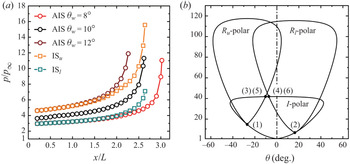
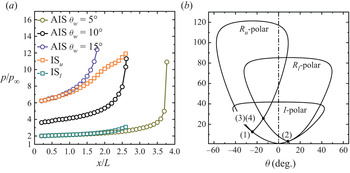
For comparison, figure 7(a) gives the numerical pressure ratio variations for  $\textrm {IS}_u$ and
 $\textrm {IS}_l$, together with those of the AIS at
 $\theta _w = 8^{\circ }$,
 $10^{\circ }$ and
 $12^{\circ }$. On the one hand, the initial convergence rates of
 $\textrm {IS}_u$ and
 $\textrm {IS}_l$ based on the above analysis by the CST are intuitively verified. On the other hand, the convergence behaviours of
 $\textrm {IS}_u$ and
 $\textrm {IS}_l$ during the downstream developed process can be further evaluated. From figure 7(a), it is not difficult to find that downstream of the entrance for a long distance, there is no considerable difference in the shock strengths and the convergence rates between
 $\textrm {IS}_u$,
 $\textrm {IS}_l$ and their corresponding AIS. The difference between
 $\textrm {IS}_u$ and
 $\textrm {IS}_l$ gradually escalates, indicating intensified non-uniformity. However, when the convergence exceeds approximately
 $x/L = 2$, the consistencies of
 $\textrm {IS}_u$ and
 $\textrm {IS}_l$ with their corresponding AIS are gradually broken. As the convergence steps farther downstream, the strength increment of
 $\textrm {IS}_u$ slows down obviously in comparison with the corresponding axisymmetric shock at
 $\theta _w = 12^{\circ }$. In contrast,
 $\textrm {IS}_l$ shows the opposite trend: its convergence rate becomes faster than its corresponding axisymmetric shock at
 $\theta _w = 8^{\circ }$. On the other hand, however, the final strength of
 $\textrm {IS}_u$ ahead of the Mach reflection climbs much higher than that of the axisymmetric shock at
 $\theta _w = 12^{\circ }$, whereas the final strength of
 $\textrm {IS}_l$ before the Mach reflection stops growing and is much lower than that of the axisymmetric shock at
 $\theta _w = 8^{\circ }$. A suggested explanation is described as follows. Unlike axisymmetric shock convergence, where the IS uniformly strengthens and starts an identical transition to Mach reflection between the upper and lower parts on the symmetry plane (as presented in § 3.1), with an AoA, the non-uniformity between
 $\textrm {IS}_u$ and
 $\textrm {IS}_l$ is intensified during convergence (see figure 7a). It can be imagined that the stronger
 $\textrm {IS}_u$ on the windward side tends to ignite the Mach reflection, but the weaker
 $\textrm {IS}_l$ on the leeward side tends to delay it. As a result,
 $\textrm {IS}_u$ undergoes a longer distance with a slower convergence rate than its corresponding axisymmetric shock of
 $\theta _w = 12^{\circ }$, which approaches an even higher strength before the Mach reflection, while
 $\textrm {IS}_l$ goes the opposite way when compared with its corresponding axisymmetric shock of
 $\theta _w = 8^{\circ }$.
Pressure ratio variations and shock polars at  $\alpha = 2^{\circ }$. (a) Pressure ratio variations of the incident shocks on the symmetry plane compared with the axisymmetric incident shocks. (b) Shock polars describing the flow in the vicinity of the triple points on the symmetry plane.

Further analysis will be helpful by the method of pressure-deflection polar with the flow parameters extracted from the numerical result. Near the two triple points ( $T_u$ and
 $T_l$) of the Mach reflection on the symmetry plane (see figure 6c), the deflection angles relative to the incoming flow behind
 $\textrm {IS}_u$ and
 $\textrm {IS}_l$ in regions (1) and (2) are approximately
 $-27^{\circ }$ and
 $16.3^{\circ }$, respectively. Compared with the initial deflection angles of
 $-12^{\circ }$ and
 $8^{\circ }$, the intensified non-uniformity is further quantified. Based on the deflection angles in regions (1) and (2), the polars named
 $R_u$-polar and
 $R_l$-polar, respectively, derived from the corresponding points (1) and (2) on the
 $I$-polar are drawn in figure 7(b). The intersection points between the
 $I$-polar and the
 $R_u$-polar (i.e. (3) or (5)) and between the
 $I$-polar and the
 $R_l$-polar (i.e. (4) or (6)) indicate an asymmetric Mach reflection. As shown in figure 7(b), the solution in the upper part at
 $T_u$ where the stronger
 $\textrm {IS}_u$ has the prior trend to Mach reflection is farther away from the von Neumann point compared with the axisymmetric case at
 $\theta _w = 10^{\circ }$ (see figure 4), and it shows an excessive DiMR. However, the hysteretic solution in the lower part at
 $T_l$ is forced to be an inverse Mach reflection (InMR) (Li, Chpoun & Ben-Dor Reference Li, Chpoun and Ben-Dor1999). Consequently, both the streams passing
 $T_u$ and
 $T_l$ are clockwise deflected, although the absolute value of the deflection angle of the upper shear layer (
 $\varSigma _u$) is larger than that of the lower shear layer (
 $\varSigma _l$). The stream tube enclosed by
 $\varSigma _u$ and
 $\varSigma _l$ converges similar to the axisymmetric flow unless there is an overall inclination against the direction of the incoming flow. The asymmetric MS itself can be further described as follows. On the one hand, the overall deflection behind MS indicates that MS leans forward relative to the incoming flow. On the other hand, the scale of MS is observed to be significantly reduced compared with the axisymmetric flow at
 $\theta _w = 10^{\circ }$. Moreover, the misalignment solution at the two triple points (i.e. points (3) or (5) and (4) or (6)) indicates that MS is concave in shape and that the flow behind MS is non-uniform. However, since the solution point (3) or (5) is closer to point (4) or (6) compared with that for the axisymmetric flow (see figures 7b and 4), the flow parameters of MS become relatively more uniform, which means that MS is lesser curved.
From the results discussed above, the difference between the windward and leeward sides and the intensification of this difference during the convergence process with slight flow inclination is primarily assessed from the view of the symmetry plane. However, problems are raised regarding why and how the convergence rates of  $\textrm {IS}_u$ and
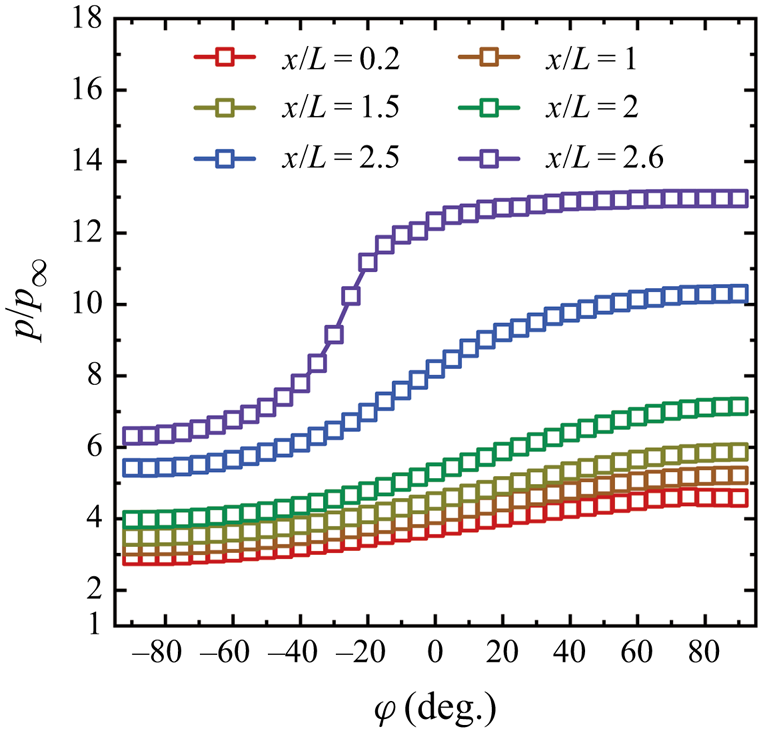
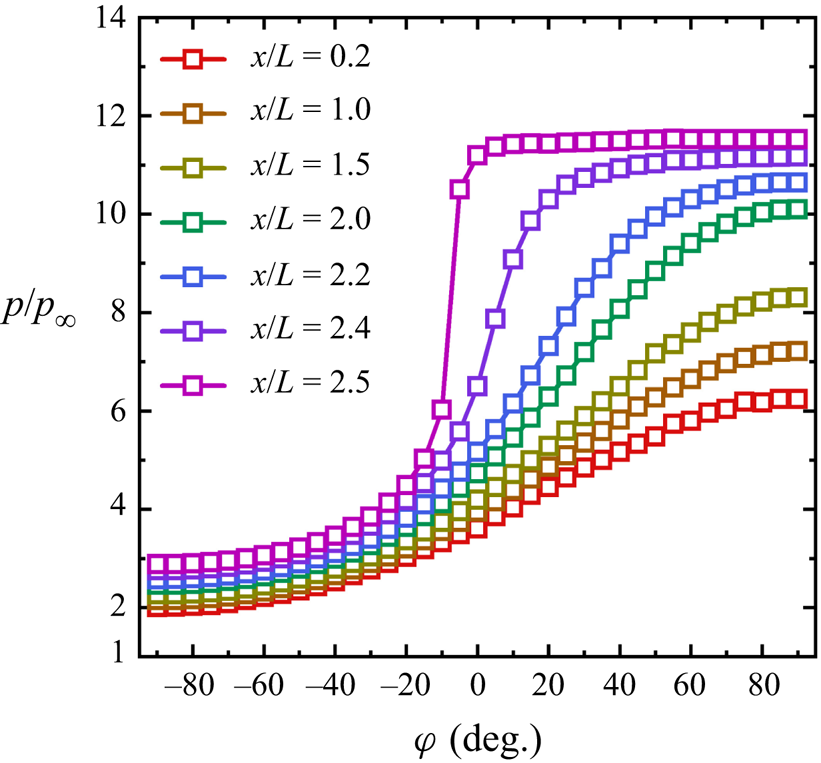
 $\textrm {IS}_l$ on the symmetry plane show incongruent tendencies compared with their corresponding AIS. Obviously, more complicated three-dimensional features must be characterized for further explanation. A series of transverse cross-sections are selected, and the pressure ratios of the convergent IS for these sections are extracted from the numerical flow field, as shown in figure 8. The pressure ratios are circumferentially distributed in polar coordinate systems, where the origins are the intersection points between the cross-sections and the
 $x$ axis and the angular coordinates (
 $\varphi$) begin from
 $0^{\circ }$ where the rays coincide with the positive
 $z$ direction. Because of the symmetry, only the interval of
 $\varphi = [-90^{\circ }, 90^{\circ }]$ is considered. The numerical contours of the normalized density for some pivotal cross-sections are given in figure 9.
Circumferential pressure ratio variations of the incident shock at  $\alpha = 2^{\circ }$.

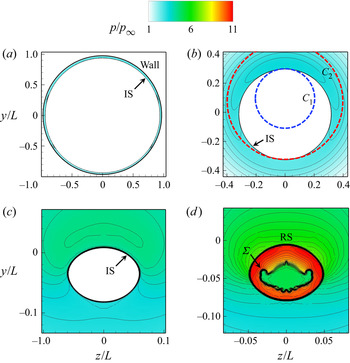
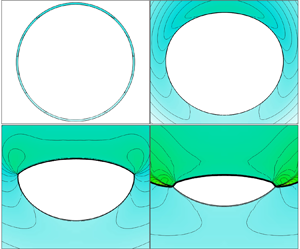
Numerical contours of normalized density on typical cross-sections at  $\alpha = 2^{\circ }$ with (a)
 $x/L=0.2$; (b)
 $x/L=2$; (c)
 $x/L=2.6$; (d)
 $x/L=2.7$.

As shown in figure 8, the shock strength is circumferentially non-uniform and is continuously enhanced during the convergence process. According to the development of non-uniform characteristics, two typical phases can be roughly classified. From the entrance ( $x/L = 0$) to approximately
 $x/L = 2$, the convergence is identified as the first phase. During this initial phase, the pressure ratio rises faster where the shock is stronger (i.e. the pressure ratio is larger), which indicates that the convergence rate mainly follows the rule: the larger the shock strength is, the faster the convergence is. Nevertheless, there remains a smooth distribution in strength variation. The flow configurations shown in figures 9(a) and 9(b) also indicate that the morphologic change of the convergent IS is relatively sluggish, as IS basically maintains the shape close to a circle, which manifests that the non-uniformity in the transverse curvature is inconspicuous. In other words, the shock strength is the dominant factor of the non-uniform convergence, and the transverse curvature has little impact in the first phase. That is why upstream at
 $x/L = 2$, the strengths of
 $\textrm {IS}_u$ and
 $\textrm {IS}_l$ (see figure 6) remain consistent with their corresponding axisymmetric shocks (see figure 7a) discussed on the symmetry plane. By further detailed comparison in figure 9(b), two transverse circles of curvature (
 $C_1$ and
 $C_2$) with the same radii as the cross-sectional structures of the AIS at
 $\theta _w = 12^{\circ }$ and
 $8^{\circ }$ at
 $x/L = 2$, respectively, are deliberately drawn where they are tangent to IS at the zenith and the nadir, respectively. The differences show that the transverse curvature of IS at the zenith is less than the curvature of
 $C_1$, while the transverse curvature of IS at the nadir is greater than the curvature of
 $C_2$. Recalling the analysis on the symmetry plane, a reasonable explanation can be obtained as follows: this developed difference in the transverse curvatures between IS and the AIS indicates a sign of downstream characteristics of convergence that the convergence rate of
 $\textrm {IS}_u$ becomes slower than the axisymmetric shock at
 $\theta _w = 12^{\circ }$ while that of
 $\textrm {IS}_l$ becomes faster than the axisymmetric shock at
 $\theta _w = 8^{\circ }$ (see figure 7a).
With further development downstream, different features arise and are referred to as the second convergence phase because the intensified non-uniformity is no longer torpid. Figure 8 shows that downstream at  $x/L = 2$, the strength enhancement of IS on the windward side (mainly within the range of positive
 $\varphi$) becomes much higher than that on the leeward side (in part of the range of
 $\varphi < -40^{\circ }$). Such non-uniformity of convergence induces prominent variations in both the strength and morphology of IS. From the cross-section at
 $x/L = 2.6$ shown in figure 9(c), it is observed that IS seems to be ‘squashed’, and the corresponding morphology substantially deviates from a circle as the vertical scale becomes smaller than the horizontal scale. Therefore, the non-uniform convergence, which is originally characterized by the difference between the windward side and leeward side, brings the effect that the two lateral sides of IS are extruded and their transverse curvatures are relatively larger (see figure 9c). In turn, the two lateral sides of IS with enlarged curvatures increasingly strengthen in this phase (see figure 8 in the range of
 $-20^{\circ } < \varphi < 20^{\circ }$), and their convergence rates even exceed that of IS on the windward side. At the end of the second phase, the convergence is terminated with the formation of the Mach disk. Although the occurrence of the Mach disk serves as a feature similar to axisymmetric flow, the morphology of the Mach disk shows typical non-uniformity compared with axisymmetric flow. Downstream of the Mach disk, figure 9(d) shows RS and
 $\varSigma$, which are also obviously non-uniform.
In summary, the initially slight non-uniformity in shock strength will be intensified in the convergence process and ultimately results in remarkable differences downstream. In the incipient phase, the convergence behaviours are mainly dominated by the shock strength, and the non-uniformity of the convergent shock evolves slowly. During the second phase of the convergence, the non-uniformity becomes aggravated, and the effects brought by the transverse curvature are gradually exposed. Even if the Mach disk appears at the end of convergence, it shows non-uniform characteristics that are obviously different from the axisymmetric flow. However, in general, the major configuration of the entire flow field is less severely non-uniform at  $\alpha = 2^{\circ }$ due to its small deviation from the axial symmetry.
3.2.2. AoA of $3^{\circ }$ and appearance of kinks

With merely  $1^{\circ }$ more inclination to the preview case, the flow configuration deviates from the axial symmetry more prominently. Figure 10 shows shock structures in the experimental and numerical flow fields. In comparison with the case at
 $\alpha = 2^{\circ }$, more obvious non-uniformity between
 $\textrm {IS}_u$ on the windward side and
 $\textrm {IS}_l$ on the leeward side can be observed on the symmetry plane. Although at the end of convergence
 $\textrm {IS}_u$ and
 $\textrm {IS}_l$ are still terminated by DiMR (at
 $T_u$) and InMR (at
 $T_l$), respectively, at approximately
 $x/L = 2.66$, it is worth mentioning that MS is evidently shrunk and leaned forward farther compared with that of
 $\alpha = 2^{\circ }$.
Near-conical flow with an AoA of  $3^{\circ }$ at
 $\theta _w = 10^{\circ }$. (a) Schlieren image; (b) numerical contour of normalized density on the symmetry plane; (c) zoomed-in schematic of the shock structures near the centre.

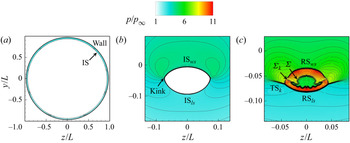
The numerical contours of the normalized density on some typical cross-sections are given in figure 11 for comparison with that of  $\alpha = 2^{\circ }$ shown in figure 9. As shown in figure 11(b), IS becomes oblate more quickly. The transverse curvatures of IS at the two lateral sides increase rapidly and become the maximum along the circumferential direction, which leads to a fundamental change with a pair of kinks dividing IS into two shock segments. To eliminate the confusion with
 $\textrm {IS}_u$ and
 $\textrm {IS}_l$ previously discussed on the symmetry plane, the stronger shock segment on the windward side is labelled
 $\textrm {IS}_{ws}$, while the weaker shock segment on the leeward side is labelled
 $\textrm {IS}_{ls}$ (see figure 11b). The appearance of kinks during the shock convergence process is one of the key findings of the present work because once the originally continuous shock surface is broken into segments, the infinite increment of shock strength induced by the shock convergence would suffer from fundamental change. Further attention and discussion about the development of the discontinuous shock will be carried out in § 3.2.3. Not far downstream from the aforementioned kinks, the Mach disk forms, and its morphology undergoes a new change compared with that of
 $\alpha = 2^{\circ }$. Not only is the Mach disk more inclined and further oblate-deformed, but its circumferential outline is also discontinuous, which indicates a more complex effect brought by the non-uniformity. The features can be partially exhibited by the closely cutting-through plane behind the Mach disk at
 $x/L = 2.7$ (see figure 11c). It is obvious that the RS is composed of two shock segments named
 $\textrm {RS}_{ws}$ and
 $\textrm {RS}_{ls}$. Meanwhile, a pair of transmitted shocks (
 $\textrm {TS}_k$) and a pair of shear layers (
 $\varSigma _k$), which are generated upstream of the Mach disk from where the kinks form, can be observed. The pair of
 $\varSigma _k$ extend downstream and connect with
 $\varSigma$ from the Mach reflection.
Numerical contours of normalized density on typical cross-sections at  $\alpha = 3^{\circ }$ with (a)
 $x/L=0.2$; (b)
 $x/L=2.6$; (c)
 $x/L=2.7$.

It can be imagined that a greater increase in AoA will result in stronger non-uniformity and a further reduction in the size of the Mach disk. Therefore, the possibility of ‘overturning’ the inevitability of Mach reflection might be a result of sufficient AoA.
3.2.3. AoA of $5^{\circ }$

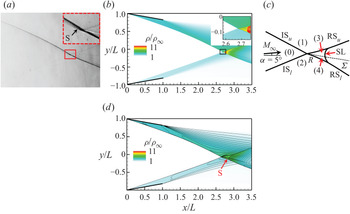
At a relatively large AoA of  $5^{\circ }$, the flow field exhibits some more critical features that differ remarkably from the previous cases. As shown in figure 12, the most striking point is that the inevitable appearance of the Mach disk as a result of axisymmetric shock convergence is no longer observed, and instead, the IS interacts via regular reflection, which overlaps with complex wave structures aslant the reflection region (see S in the close-up of the schlieren image in figure 12a). Interestingly, S does not appear on the symmetry plane (see figure 12b,c), while it is identified on a plane of
 $z/L = 0.06$ as shown in figure 12(d). The formation of S will be discussed later on the cross-sections. To eliminate the complexity, the numerical shock structures on the symmetry plane shown in figure 12(b) are first focused on. Meanwhile, the pressure ratios of
 $\textrm {IS}_u$ and
 $\textrm {IS}_l$ (see figure 12c) are extracted, and their variations with
 $x/L$ increments are given in figure 13(a), in which the pressure ratio variations of the AIS at
 $\theta _w = 15^{\circ }$ and
 $5^{\circ }$, corresponding to
 $\textrm {IS}_u$ and
 $\textrm {IS}_l$, respectively, are attached to demonstrate the three-dimensional effects of axial asymmetry. Compared with the cases of lower AoA, the increased non-uniformity of the initial shock strength leads to a larger difference in convergence behaviours. As a result, not only is the gap of the shock strengths between
 $\textrm {IS}_u$ and
 $\textrm {IS}_l$ rapidly enlarged, but the discordance between the incident shocks and their corresponding AIS quickly arises after a shorter distance of ‘keeping pace’ (see figure 13a); in particular, the increments of
 $\textrm {IS}_u$ and the corresponding axisymmetric shock of
 $\theta _w = 15^{\circ }$ show a remarkably distinct trend downstream at approximately
 $x/L = 1.5$.
Near-conical flow with an AoA of  $5^{\circ }$ at
 $\theta _w = 10^{\circ }$. (a) Schlieren image; (b) numerical contour of normalized density on the symmetry plane; (c) zoomed-in schematic of the shock structures near the centre; (d) numerical contour and isolines of normalized density on the plane of
 $z/L=0.06$.

Pressure ratio variations and shock polars at  $\alpha = 5^{\circ }$. (a) Pressure ratio variations of the incident shocks on the symmetry plane compared with the axisymmetric incident shocks. (b) Shock polars describing the flow in the vicinity of the triple points on the symmetry plane.

A noticeable change against the cases of lower AoA is that the enhancement of  $\textrm {IS}_u$ obviously slows down from approximately
 $x/L = 2$ (see figures 13a and 7a), and such three-dimensional effects of axial asymmetry will be further exhibited on the cross-sectional planes later. On the other hand, an unapparent difference between
 $\textrm {IS}_l$ and the corresponding axisymmetric shock of
 $\theta _w = 5^{\circ }$ is maintained until the occurrence of reflection. From the different coincidence of
 $\textrm {IS}_u$ and
 $\textrm {IS}_l$ with their corresponding AIS, it is inferred that in the convergence process, the windward stronger part suffers from more effects of axial asymmetry than that of the leeward weaker part. Consequently, the final strength of
 $\textrm {IS}_u$ before the reflection reaches a much lower amplitude than in the cases of lower AoAs, in which strengths are sufficient for the formation of Mach reflections. Meanwhile, on the opposite side of
 $\textrm {IS}_u$, the strength increment of
 $\textrm {IS}_l$ is even further insufficient. As a result, the measured shock polars extracted from the numerical data (see figure 13b) obviously show that the solution falls short of the condition of Mach reflection, and points (3) or (4) (corresponding to regions (3) or (4) in figure 12c) suggest a regular reflection (Ben-Dor Reference Ben-Dor2007). The point of regular reflection (
 $R$) is located at approximately
 $x/L = 2.675$, where
 $\textrm {RS}_u$,
 $\textrm {RS}_l$ and
 $\varSigma$ from the regular reflection form and develop downstream. Therefore, the inevitability of existence of a Mach disk will be destroyed, and the reflection will be replaced by a transition to regular reflection when the flow adequately deviates from the axial symmetry.
The analysis from the symmetry plane uncovers basic characteristics of the flow that completes the transition to regular reflection. However, the overall reflection is not merely constituted by the aforementioned regular reflection. The vertical structure (shock intersection line (SL)) not far downstream  $R$ on the symmetry plane (see figure 12b,c), which bridges
 $\textrm {RS}_u$ and
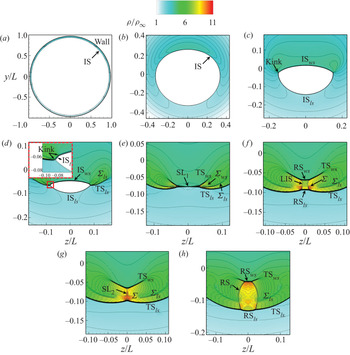
 $\textrm {RS}_l$, indicates a sign of one more reflection from other direction. It will be helpful for the three-dimensional clarification that the development of the transverse shock structures on cross-sections are concerned. Figure 14 shows the circumferential pressure ratio variations of the convergent IS on different cross-sections, and figure 15 gives the normalized density contours on some typical cross-sections.
Circumferential pressure ratio variations of the incident shock at  $\alpha = 5^{\circ }$.

Numerical contours of normalized density on typical cross-sections at  $\alpha = 5^{\circ }$ with (a)
 $x/L=0.2$; (b)
 $x/L=2$; (c)
 $x/L=2.5$; (d)
 $x/L=2.62$; (e)
 $x/L=2.675$; (f)
 $x/L=2.72$; (g)
 $x/L=2.735$; (h)
 $x/L=2.8$.

From the pressure ratio variations upstream  $x/L = 2.5$, the convergence process consists of two analogous phases, as in the case at
 $\alpha = 2^{\circ }$. In the first phase from the entrance to approximately
 $x/L = 1.5$, the slow-developing non-uniformity of IS is mainly dominated by the non-uniformly distributed shock strength. The influence of the transverse curvature of IS on the convergence rate mainly becomes prominent in the second phase starting from approximately
 $x/L = 1.5$. However, for the case of a larger AoA, the non-uniformity is intensified much more quickly, and the morphology of IS deviates from the circular shape much more quickly. At approximately
 $x/L = 2$ (see figure 15b), the tendency of IS to be oblate is distinct and particularly flattened on the windward side. The pressure ratio variation along the circumferential direction of the shock shows a fast concentration (see figure 14 in the range of
 $-10^{\circ } < \varphi < 50^{\circ }$) during convergence and approaches a steep change at approximately
 $x/L = 2.5$. Accordingly, the appearance of kinks at the two lateral sides of IS can be seen at
 $x/L = 2.5$ (see figure 15c), which divides the IS into two segments,
 $\textrm {IS}_{ws}$ on the windward side and
 $\textrm {IS}_{ls}$ on the leeward side. It can be imagined that the discontinuity of IS arises earlier compared with the case at
 $\alpha = 3^{\circ }$ owing to the larger AoA. One more striking point that needs to be emphasized is that from
 $x/L = 2$ to
 $x/L = 2.5$, the increment of the shock strength on the windward side is relatively small (see figure 14 mainly in the range of
 $\varphi > 60^{\circ }$), although
 $\textrm {IS}_{ws}$ is the stronger part, which exactly corresponds with the stagnation of the convergence rate of
 $\textrm {IS}_u$ on the symmetry plane (see figure 13a). Figures 15(b) and 15(c) show that
 $\textrm {IS}_{ws}$ on the windward side is almost maintained, and no significant increase in its transverse curvature is visible. Thus, a reasonable explanation can be obtained that the negligible change in curvature contributes to scarce growth of convergence rate on the windward side.
When IS becomes discontinuous, more different behaviours from the lower AoAs are revealed. Downstream of  $x/L = 2.5$, a pair of
 $\textrm {TS}_{ls}$ and
 $\varSigma _{ls}$ are generated from where the first pair of kinks are born and laterally grow, as seen at
 $x/L = 2.62$ in figure 15(d). It is also noticeable that soon after the formation of the first pair of kinks and propagation of
 $\textrm {TS}_{ls}$ downwards, another pair of perturbations from the other leeward side takes a fade-in effect. As a result, one more pair of kinks arises on
 $\textrm {IS}_{ws}$ at
 $x/L = 2.62$ (see the upper kink in the close-up of figure 15d). Similarly, another pair of
 $\textrm {TS}_{ws}$ and
 $\varSigma _{ws}$ that are generated from the second pair of kinks transmit towards the windward side, as seen slightly downstream in figure 15(e). Ultimately, the initially continuous IS is divided into four segments, including
 $\textrm {IS}_{ws}$,
 $\textrm {IS}_{ls}$ and a pair of transverse incident shocks (
 $\textrm {IS}_t$).
In the following convergence process, two groups of incident shocks, one consisting of  $\textrm {IS}_{ws}$ and
 $\textrm {IS}_{ls}$ are continuously getting close to each other in the vertical direction, while the other composed of the pair of
 $\textrm {IS}_t$ approaching in the horizontal direction, form a shrinking near-quadrilateral shock structure. Since the vertical distance is much shorter,
 $\textrm {IS}_{ws}$ and
 $\textrm {IS}_{ls}$ intersect regularly first at
 $x/L = 2.675$, forming an approximately horizontal (
 $\textrm {SL}_1$), as shown in figure 15(e). Combining the shock structures on the symmetry plane (see figure 12b,c),
 $R$ is exactly the midpoint of SL
 ${\rm _1}$ from the first reflection. Furthermore,
 $\textrm {RS}_{ws}$,
 $\textrm {RS}_{ls}$ and
 $\varSigma$ as the results of the first reflection can be seen in figure 15(f). The other pair of
 $\textrm {IS}_t$ continue to approach each other horizontally even though they undergo a vertical interaction from the first reflection. Therefore, they transform into a pair of shock segments named lateral inward shocks (LIS) and continue to be incident, as shown in figure 15(f). Farther downstream at approximately
 $x/L = 2.735$ (see figure 15g), the pair of LIS intersects and reflects regularly with another
 $\textrm {SL}_2$ formed. Now
 $\textrm {SL}_2$ is exactly SL downstream
 $R$ on the symmetry plane (see figure 12b,c). A pair of transverse RSs (
 $\textrm {RS}_t$) forms as the result of the second reflection, which propagates apart, as shown in figure 15(h). With the help of the above characterization of the three-dimensional shock interaction, it is possible to explain the previously mentioned observation of the complex shock structures recorded by the schlieren image and presented on the plane of
 $z/L = 0.06$ (i.e.
 $S$ in the close-up of figure 12a,d). It can be reasonably imagined that the shock structure appears aslant the first reflection region is the edge of
 $\textrm {TS}_{ls}$ which is relatively strong and is outstretched throughout the reflection process.
To summarize the above discussion, it can be concluded that at a sufficient AoA, the intensification effects of the axial asymmetry will prompt the originally continuous shock surface to be discontinuous. The formation of kinks separates the shock surface into two pairs of shock segments, which tend to be planarized with a considerable reduction in strength increment. The two crossovers of the two pairs of shock segments with relatively weak strength provide an opportunity to ‘overturn’ the inevitability of the Mach reflection and switch to the transition of regular reflection. It is suggested that the formation of kinks due to axial asymmetry intensification is responsible for the transition from Mach reflection to regular reflection because a continuous convergent shock will always strengthen without limitation owing to its transverse curvature approaching infinity.
Similarly, the transition to regular reflection after the formation of kinks on a near-elliptic convergent shock was found by Zhang et al. (Reference Zhang, Li, Ji, Si and Yang2021). Combined, these studies suggest that once a convergent shock is adequately deviated from the axial symmetry, whether by the model geometry (Zhang et al. Reference Zhang, Li, Ji, Si and Yang2021) or by the flow condition (the present study), the regular reflection becomes possible. The formation of kinks provides a geometric condition, and the insufficient strengths of the shock segments determine the appearance of regular reflection.
It should be noted that when regular reflection occurs, the near-conical shock and the near-elliptic shock behave in different ways. As presented by Zhang et al. (Reference Zhang, Li, Ji, Si and Yang2021), the near-elliptic convergent shock is divided into two pairs of shock segments by the kinks, including one stronger pair around the major axis and the other weaker pair around the minor axis. From the view of geometrical properties, the minor axis is much shorter than the major axis, and thus the weaker pair cannot sufficiently strengthen before their intersection. The insufficient strengths of the weaker pair of shock segments are responsible for the regular reflection. For a near-conical convergent shock as discussed in § 3.2.3, the strengths of the vertically incident pair of shock segments are still moderate although they contract from an adequate distance. On one hand, the flattened shock segment on the windward side suffers from a scarce growth of convergence rate. On the other hand, the initially weak shock on the leeward side cannot sufficiently converge. Eventually, the pair of vertically incident shock segments regularly intersect. In summary, the adequate deviations by the model geometry and the flow condition can result in the insufficient strengths of the shock segments, which make the regular reflection admissible.
4. Conclusions
The behaviours of near-conical convergent shocks generated by a circular ring wedge with typical AoAs are investigated using a combination of shock tunnel experiments and numerical simulations at the free stream Mach number of 6. As the AoA increases, the intensification of non-uniformity during the shock convergence process, and the final form of the interaction, are obtained. The following conclusions are drawn.
In the shock convergence process, the convergence rate is dominated by the shock strength and the transverse curvature. When an AoA is applied, the initial strength of the leading shock becomes circumferentially non-uniform, inducing downstream intensified non-uniformity during convergence. In the preliminary phase, shock strength mainly dominates the convergence in the way that where the shock strength is larger, the convergence rate is higher. Generally, non-uniformity develops slowly with mild discrepancies in the shock strength and slight changes in the transverse shock morphology. However, with further development into the late phase, convergence is accelerated, and non-uniformity is rapidly intensified. Effects associated with the non-uniform transverse curvature of the shock highlight and cause the two lateral sides of the shock surface to rapidly evolve.
Owing to non-uniformity, the strong part of the convergent shock on the windward side causes the convergence centre to shift against the inclination of the incoming flow towards the leeward side. As the AoA increases, a transition from Mach reflection to regular reflection is found at the convergence centre. For a relatively small AoA ( $\alpha = 2^{\circ }$), the Mach disk, which serves as a prototypical feature of the axisymmetric case (
 $\alpha = 0^{\circ }$), remains, but the Mach disk leans forward, shrinks in size, and displays an oblate shape. When the AoA increases to approximately
 $\alpha = 3^{\circ }$, a pair of kinks form on the convergent shock surface at the two lateral sides and extend to the Mach disk. The Mach disk is further inclined and decreases in size. For a larger AoA (
 $\alpha = 5^{\circ }$), the kinks on the shock surface appear earlier. As a result, the downstream development process exhibits a new phase of convergence that is substantially different from that at smaller AoAs and induces the transition to regular reflection. The shock surface is eventually divided into a pair of vertically incident shock segments with a short distance and a pair of horizontally incident shock segments with a relatively long distance. The planarization of the shock segment on the windward side, and the insufficient strength of the shock segment on the leeward side, make the vertically incident pair of shock segments regularly intersect. Subsequently, the pair of horizontally incident shock segments intersect downstream. The present study enriches the knowledge of three-dimensional convergent shocks in near-conical hypersonic flow.
Funding
This study was supported by the National Natural Science Foundation of China (grant nos. 11872356, 11772325 and 11621202).
Declaration of interests
The authors report no conflict of interest.