During the coronavirus disease 2019 (COVID-19) pandemic, shortages of personal protective equipment (PPE) have forced many healthcare facilities to require personnel to reuse N95 filtering facepiece respirators. Reference Ranney, Griffeth and Jha1 The reuse of N95 respirators is problematic because the respirator surfaces may become contaminated with pathogens that potentially could be transferred to the wearer, particularly if improper technique is used. Reference Brady, Strauch and Almaguer2,3 To address this concern, decontamination of reused respirators has been implemented in some facilities as a strategy to maintain supplies in crisis situations. 3–Reference Golladay, Leslie and Zuelzer8 A variety of decontamination technologies have been shown to be effective, and some have received emergency use authorization for respirator decontamination from the Food and Drug Administration. 3–5,Reference Kenney, Chan and Kortright9 However, many current technologies require transfer of respirators to a central processing area and are labor and time intensive. 3,4 Decontamination is therefore typically performed after multiple reuses resulting in a potential risk for transmission if a contaminated N95 respirator is reused.
We conducted simulation studies to address 3 questions related to reuse of N95 respirators. First, does reuse of contaminated respirators present a risk for transfer of live viruses to wearers and to patients and environmental surfaces, particularly if suboptimal technique for handling the respirator is used? Second, can transfer be reduced by more optimal technique in handling the contaminated respirator? Finally, will rapid decontamination of respirators with an ultraviolet-C (UV-C) light device between each use reduce the risk for transfer of virus particles? The rationale for studying a rapid decontamination technology was that providing decontamination between each use could potentially reduce pathogen transfer to a greater degree than approaches that provide higher-level decontamination but only after multiple reuses. We studied a 1-minute cycle of UV-C light administered using a device designed for rapid decontamination of individual respirators. Reference Kayani, Weaver and Gopalakrishnan10 UV-C light is effective for killing of severe acute respiratory syndrome coronavirus 2 (SARS-CoV-2), 3,Reference Bianco, Biasin and Pareschi11 but efficacy potentially can be limited against organisms associated with irregular, soft surfaces such as respirators. Reference Cadnum, Li, Redmond, John, Pearlmutter and Donskey6
Methods
Simulation protocol
The study protocol was approved by the Cleveland VA Medical Center’s Institutional Review Board. We used simulated patient-care interactions to assess the potential for contamination of personnel, patients, and the environment during the use of contaminated respirators and to compare the effectiveness of interventions to reduce contamination. 3M 8210 N95 respirators (3M, Saint Paul, MN) were contaminated by pipetting 1 mL solution containing bacteriophage MS2 onto the exterior surface of the facepiece with spreading to contaminate the entire exterior surface. In initial experiments, 109 plaque-forming units (PFU) bacteriophage MS2 was applied; preliminary experiments demonstrated that this inoculum resulted in recovery of ∼106 PFU when a premoistened swab was used to sample the exterior surface of the facepiece. Bacteriophage MS2 was prepared as previously described. Reference Tomas, Kundrapu and Thota12 The study was conducted in a simulated patient room with a life-sized mannequin in a hospital bed. Other items in the room included a bedside table, trash can, and an alcohol-based hand sanitizer dispenser.
On different days, 12 healthcare personnel each performed 3 standardized simulations. The order of the simulations was randomly assigned within subjects. The simulations involved donning and doffing of PPE before and after examination of the mannequin. The examinations required moving the table, lowering the bed rail, examining the mannequin by auscultating the chest, and palpating the abdomen and chest. PPE included gloves, a cover gown, a contaminated N95 respirator, and a face shield (Medline, Northfield, IL). The respirator was placed in a clean paper bag after the examination. Face shields were shared by the participants but were cleaned and disinfected with 70% ethanol and subjected to 2 minutes of UV-C treatment inside a UV-C box (Advanced Ultraviolet Systems, South Hill, VA). Reference Cadnum, Li, Redmond, John, Pearlmutter and Donskey6
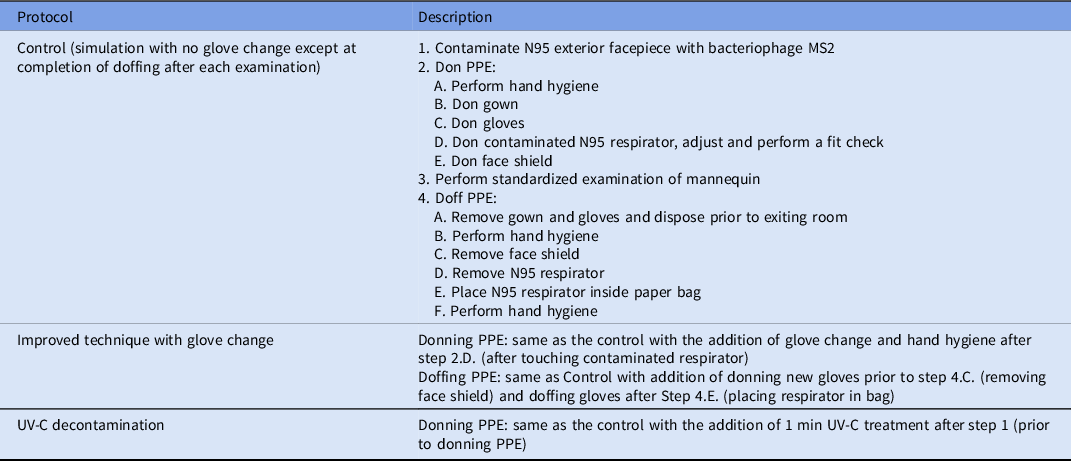
A detailed description of the 3 simulation protocols is shown in Table 1. The groups included (1) control (simulation with no glove change except after doffing); (2) improved technique with glove change after respirator contact during donning (ie, after adjusting respirator and performing fit check) and before removing face shield and respirator during doffing; and (3) same as control but with 1-minute UV-C light treatment of the respirator prior to donning. The rationale for including the control with no glove change until after doffing was based on observations in 2 hospitals indicating that personnel not infrequently touched their respirators with gloved hands (eg, seal check, adjusting respirator) during patient care and would subsequently touch their clothing or skin, environmental surfaces or patients (authors’ unpublished data). The UV-C treatments were administered using the Synchronous UV Decontamination System (SUDS), a device designed for rapid point-of-care decontamination of single respirators. Reference Kayani, Weaver and Gopalakrishnan10 According to the manufacturer, a 1-minute cycle delivers a dose of ∼2 J/cm Reference Brady, Strauch and Almaguer2 . Reference Kayani, Weaver and Gopalakrishnan10
Three Simulation Protocols Performed in Random Order by Study Participants

Note. PPE, personal protective equipment; UV-C, ultraviolet C.
After each simulated examination, sterile polyester swabs (Puritan, Guilford, ME) premoistened with phosphate-buffered saline were used to sample the entire exterior facepiece of the respirator, the participants (entire surface of both hands, clothing covering upper chest and collar, face including nose and cheeks, and back of head), medical equipment (entire surface of face shield, inner surface of bag holding the respirator), and the environment (mannequin chest and abdomen, 20-cm section of the bedrail, and 20-cm × 20-cm section of the bedside table). The swabs were cultured for bacteriophage MS2. Reference Tomas, Kundrapu and Thota12
During the simulations, participants were observed and potential routes of transfer from the exterior surface of the respirator facemask to participants, surfaces, and fomites were recorded. To further evaluate routes of transfer, 6 control simulations were conducted after 1 mL of fluorescent lotion (Glo-Germ lotion) was applied to cover the front of the respirator facepiece and allowed to air dry. Contamination with the fluorescent solution was assessed using a black light (UV Ultra Blacklight ULG 1, Ultra Light, Guangdong, China).
A second set of the simulations was conducted with 12 additional participants using a 100-fold lower inoculum of bacteriophage MS2 (ie, 1 mL of solution containing 107 PFU). The rationale for including the lower inoculum was to simulate levels of contamination more likely to be present in clinical settings.
Statistical analysis
We estimated that the rate of contamination in the control group would be 80% and assumed 12 outcomes within each subject (3 simulation types × 4 contamination opportunities). Based on these estimates, a power calculation indicated that inclusion of 12 subjects would provide 80% power to detect reductions in contamination to 60% for the improved technique group and 50% for the UV-C group.
In the analysis of the experimental data, a random-intercept, multilevel logistic model was first estimated to assess variability in contamination explained by subject and detected no such effect. In subsequent analyses assessing the effects of treatment controlling for or analyzing subsets of contamination opportunities, we used Firth penalized likelihood estimation to address separation by treatment in logistic regressions. All statistical analyses were performed in R version 3.5.1 software (R Foundation for Statistical Computing, Vienna, Austria), and functions from the logistf package were implemented.
Results
After inoculation of the higher and lower inoculums of bacteriophage MS2, ∼6 log10PFU and ∼4 log10PFU were recovered from the exterior surface of the respirator per swab, respectively. With the higher inoculum, UV-C treatment reduced bacteriophage MS2 by 2 to 3 log10PFU but did not eliminate detection from any of the respirators. With the lower inoculum, UV-C treatment resulted in no detection of bacteriophage MS2 on any of the treated respirators.
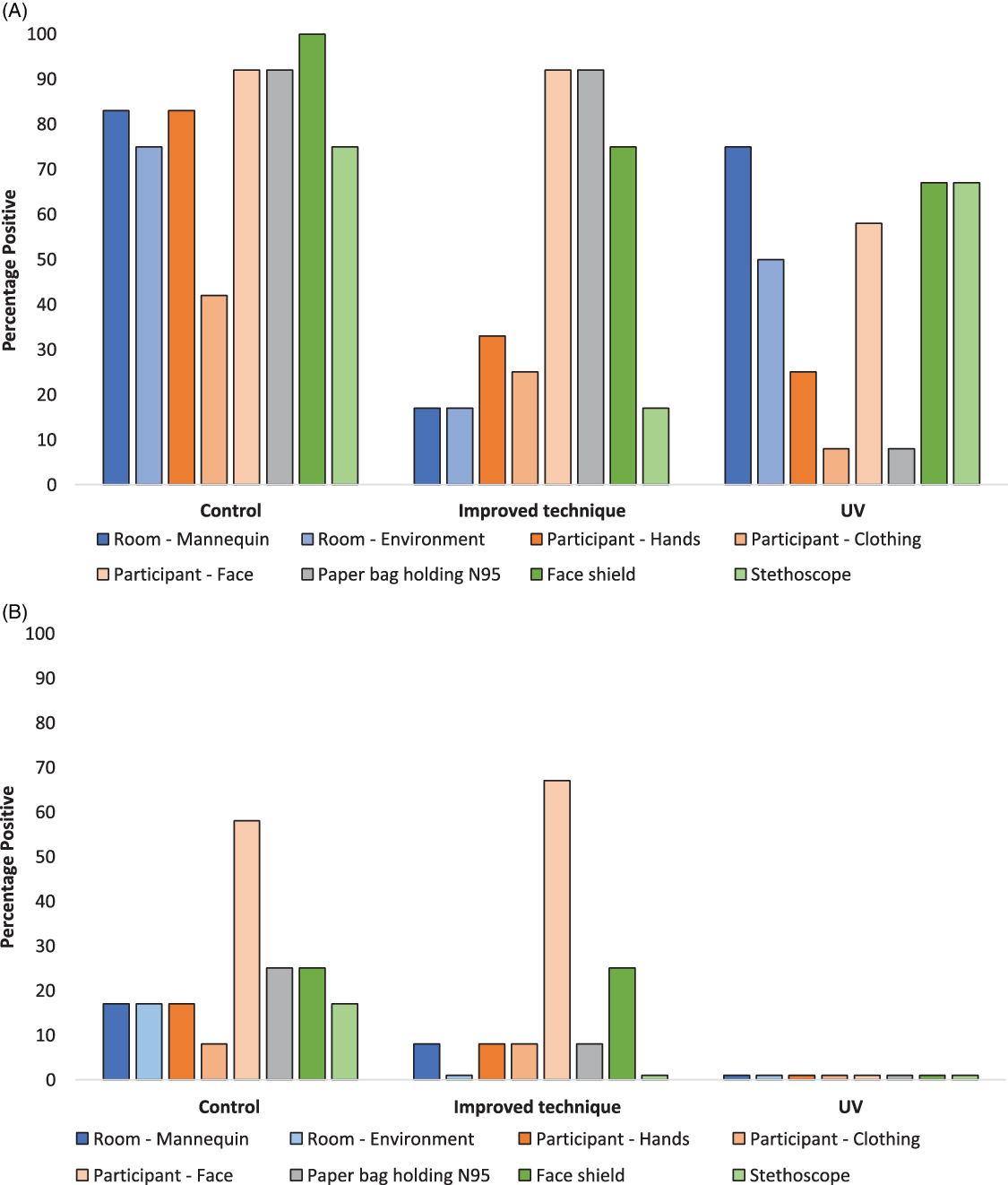
Figure 1 shows the percentage of sites positive for contamination with bacteriophage MS2 in the 3 groups during simulations with respirators with the higher (A) and lower (B) levels of contamination. For the control simulation with suboptimal respirator handling technique, bacteriophage MS2 was frequently transferred to the participants, mannequin, and environmental surfaces including the paper bag holding the respirator, face shield, stethoscope, and room environment. In comparison to the control simulation, improved technique with changing of gloves after any respirator contact significantly reduced contamination with bacteriophage MS2 with the higher inoculum (P < .01) but not the lower inoculum (P = .17). UV-C treatment significantly reduced contamination in both the higher- and lower-inoculum groups (P < .01); no contamination was detected after UV-C treatment with the lower inoculum simulations. The median log10 PFUs recovered from the sites of dissemination for the higher and lower inocula were 2 (range, 1–5) and 1 (range, 0.3–2), respectively.
Percentage of sites positive for contamination with bacteriophage MS2 in 3 groups during simulations with N95 respirators with (A) a higher level and (B) a lower level of contamination.

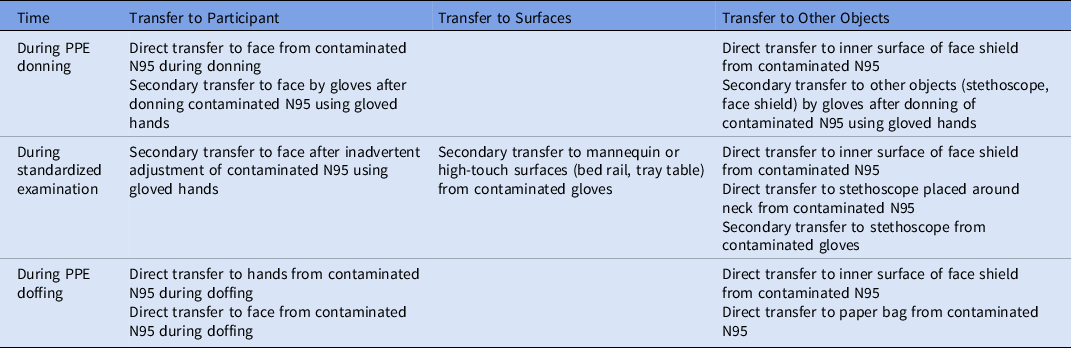
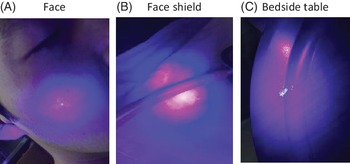
Table 2 shows potential routes of contamination of personnel, environmental surfaces, and fomites by contaminated respirators identified based on observations of participants. The observations indicated the potential for direct transfer from the contaminated portion of the respirator to participant’s skin, face shield, and stethoscope due to inadvertent contact during the simulations. Potential direct transfer to the paper bag was also observed. We also detected opportunities for indirect transfer of contamination from the respirator via gloved hands to the participant’s skin and hair, face shield, stethoscope, mannequin, and environmental surfaces. During each of the 6 control simulations conducted with respirators contaminated with fluorescent lotion, there was evidence of transfer of fluorescence to multiple sites on the participants as well as to fomites and environmental surfaces. Figure 2 shows pictures of fluorescent lotion contamination transferred from a respirator to a participant’s skin and face shield and a bedside table during the patient care simulations.
Potential Routes of Contamination of Personnel, Environmental Surfaces, and Fomites by Contaminated N95 Respirators Based on Observations of Study Participants

Note. PPE, personal protective equipment.
Pictures showing fluorescent lotion transferred from the external facepiece of an N95 respirator during simulated patient care encounters to (A) a participant’s face, (B) face shield, and (C) bedside table.

Discussion
Bacteriophage MS2 was frequently transferred from a contaminated N95 respirator to wearers and to a mannequin, environmental surfaces, and fomites during simulated patient examinations. Improved technique for handling the contaminated respirators reduced transfer of bacteriophage MS2, but only to a modest degree. Observations and simulations with a fluorescent lotion identified multiple potential opportunities for direct and indirect transfer of bacteriophage MS2. Rapid decontamination of the respirator with UV-C light provided a modest reduction in transfer of heavily contaminated respirators but complete elimination of transfer with lower-level contamination. These results demonstrate the potential for contamination of personnel, patients, and surfaces during the reuse of contaminated respirators, and they highlight the potential for decontamination technologies to reduce the risk for pathogen transmission.
In a previous simulation study, Brady et al Reference Brady, Strauch and Almaguer2 demonstrated the frequent transfer of bacteriophage MS2 and fluorescein from contaminated respirators to hands of wearers when improper technique was used. Improved technique reduced, but did not eliminate, transfer to hands. Reference Brady, Strauch and Almaguer2 Our findings expand on those results by demonstrating the potential for widespread transfer of virus particles from contaminated respirators to the face of personnel and to fomites, environmental surfaces, and patients. In addition, we demonstrate the potential for UV-C treatments to provide rapid decontamination of respirators at the point of care between each use. Given the risk for transfer of pathogens from respirators, decontamination approaches that provide point-of-care decontamination between each use could offer benefits over approaches that only provide decontamination after multiple reuses.
The failure of UV-C treatment to reduce the higher inoculum enough to eliminate transfer may be due in part to the irregular, soft surfaces of respirators, which may shield some viral particles from UV-C, particularly if they are absorbed beneath the surface. Reference Cadnum, Li, Redmond, John, Pearlmutter and Donskey6 Nevertheless, UV-C deserves consideration if point-of-care decontamination is to be implemented. UV-C was effective in preventing transfer of the lower inoculum, which may be more reflective of levels of real-world contamination. Many healthcare facilities have experience using UV-C devices and UV-C boxes that could be used for respirator decontamination are commercially available. Reference Cadnum, Li, Redmond, John, Pearlmutter and Donskey6
Our study has some limitations. Simulations cannot mimic all conditions present in clinical settings. Donning and doffing technique in simulations may differ from real-world settings. The virus was applied to the entire exterior surface of the facepiece, which could present a greater risk for transfer than contamination by respiratory droplets. The higher inoculum and the fluorescent lotion are likely to reflect a worst-case scenario for transmission. However, frequent transfer was also demonstrated for the lower inoculum. Bacteriophage MS2 is a nonenveloped virus that may survive longer on respirators than enveloped viruses such as SARS-CoV-2. Our results may underestimate the efficacy of UV-C because bacteriophage MS2 is relatively resistant to UV-C in comparison to enveloped viruses. Reference Cadnum, Li, Redmond, John, Pearlmutter and Donskey6,Reference Ozog, Sexton and Narla7,Reference Bianco, Biasin and Pareschi11 It is also plausible that our results overestimate the benefit of UV-C because organisms contaminating other surfaces on respirators, such as the interior surface of the facepiece and the straps, may be less susceptible to being reduced by UV-C. Reference Cadnum, Li, Redmond, John, Pearlmutter and Donskey6,Reference Ozog, Sexton and Narla7,Reference Mills, Harnish, Lawrence, Sandoval-Powers and Heimbuch13 Finally, we did not evaluate the impact of the UV-C treatment on factors such as filtration and fit, and some previous studies have suggested that UV-C may alter the strength of respirator materials, including weakening of the straps. Reference Lindsley, Martin and Thewlis14,Reference O’Hearn, Gertsman and Sampson15 However, testing conducted by the National Personal Protective Technology Laboratory demonstrated that 20 cycles of UV-C treatment with the SUDS device did not adversely affect 3M 8210 N95 respirator filtration efficiency and manikin fit. 16
The importance of respirators and other fomites in transmission of respiratory viruses is uncertain and remains an area of debate. 3,Reference Boone and Gerba17–Reference Colaneri, Seminari and Novati21 In a recent study, no SARS-CoV-2 contamination was detected on respirators and other PPE used by personnel working with COVID-19 patients, suggesting that contamination may be infrequent in clinical settings. Reference Ong, Tan and Sutjipto22 Further studies are needed to investigate the potential for respirators to become contaminated during patient care activities and to contribute to transmission of SARS-CoV-2 and other pathogens. There is also a need to compare the effectiveness of strategies that provide lower-level decontamination of respirators after each use versus higher-level decontamination after multiple uses.
In conclusion, contaminated N95 respirators that are reused are a potential source for dissemination of viral pathogens to wearers and to environmental surfaces, fomites, and patients. Improvements in donning and doffing techniques can reduce but may not eliminate the risk for transmission. Technologies that provide rapid decontamination of respirators between each use could be useful to further minimize the risk for transfer of viral particles. Further studies are needed to clarify the risk for respirators to serve as a source of transmission in clinical settings.
Acknowledgments
We thank the nurses and environmental management services personnel at the Cleveland VA Medical Center who participated in the study. The Synchronous UV Decontamination System (SUDS) was designed by Michael J. Scott, MD, and Ian Charnas, BS, and a prototype was produced with support from the Case Western Reserve University School of Engineering and Sears think[box].
Financial support
This work was supported by a merit review grant (no. CX001848)) from the Department of Veterans’ Affairs to C.J.D.
Conflicts of interest
C.J.D. has received research grants from Clorox, Pfizer, and PDI. I.C.C. and J.G.S. have received a patent for the Synchronous UV Decontamination System (SUDS). All other authors report no conflicts of interest relevant to this article.