INTRODUCTION
Glycogen synthase kinase-3 (GSK-3) is a ubiquitously expressed Ser/Thr kinase with 2 related isoforms, GSK-3α and GSK-3β. It is described as highly conserved among several organisms, mainly in the catalytic domain region (Bradley and Woodgett, Reference Bradley and Woodgett2003). GSK-3 from Rhipicephalus microplus tick embryos has recently been characterized, and its protein sequence analysis showed high similarity to the corresponding enzyme, from both vertebrate and invertebrate animals (Logullo et al. Reference Logullo, Witola, Andrade, Abreu, Gomes, Vaz, Imamura, Konnai, Ohashi and Onuma2009).
GSK-3 was originally characterized as an enzyme that controls glycogen synthesis in response to the insulin cascade (Welsh et al. Reference Welsh, Wilson and Proud1996). GSK-3 is an essential downstream element of the PI3 kinase/Akt cell survival pathway and plays an important role in the Wnt signalling pathway in Drosophila, Xenopus and mammalian development (Nusse, Reference Nusse1997). This enzyme is associated with several substrates and takes part in numerous signalling pathways, including glycogen metabolism, translation, transcription, intracellular vesicular transport, cytoskeleton regulation, cell cycle progression and apoptosis (Jope and Johnson, Reference Jope and Johnson2004). Due to the diversified functions attributed to GSK-3, the molecule has raised interest in the field of developmental biology. Many genetic and molecular approaches have already been used to study the GSK-3 functions during embryo development in Drosophila, Paracentrotus lividus, Xenopus, Dictyostelium and others (Siegfried et al. Reference Siegfried, Chou and Perrimon1992; Emily-Fenouil et al. Reference Emily-Fenouil, Ghiglione, Lhomond, Lepage and Gache1998; Ferkey and Kimelman, Reference Ferkey and Kimelman2000).
After maturation during oogenesis of an oviparous organism, oocytes increase in size and accumulate large amounts of RNA, carbohydrates, lipids and proteins that serve as substrates for functional metabolic pathways of the developing embryo (Oliveira and Machado, Reference Oliveira and Machado2006). The embryogenesis of oviparous animals occurs in the absence of exogenous nutrient supply during development and is mainly dependent on material nutrients stored in oocytes, during the oogenesis process (Sappington and Raikhel, Reference Sappington and Raikhel1998; Song et al. Reference Song, Wong and Wessel2006). In many cases, proteins that participate in different metabolic pathways or aspects of the adult organism are also expressed during embryogenesis. Modifications in these processes can result in decreased egg viability or even precocious lethality (Logullo et al. Reference Logullo, Da Silva Vaz, Sorgine, Paiva-Silva, Faria, Zingali, Rosa de Lima, Abreu, Oliveira, Alves, Masuda, Gonzales, Masuda and Oliveira1998; Catteruccia et al. Reference Catteruccia, Benton and Crisanti2005). The study of tick embryogenesis has been proposed as an important means for the development of novel strategies for parasite control (Da Silva Vaz Jr et al. Reference Da Silva Vaz, Logullo, Sorgine, Velloso, Rosa de Lima, Gonzales, Masuda, Oliveira and Masuda1998; Logullo et al. Reference Logullo, Witola, Andrade, Abreu, Gomes, Vaz, Imamura, Konnai, Ohashi and Onuma2009; Parizi et al. Reference Parizi, Pohl, Masuda and Da Silva Vaz2009).
Kinase inhibitors have been used to characterize kinase activity and their participation in a given pathway (Coghlan et al. Reference Coghlan, Culbert, Cross, Corcoran, Yates, Pearce, Rausch, Murphy, Carter, Cox, Mills, Brown, Haigh, Ward, Smith, Murray, Reith and Holder2000). Several GSK-3 inhibitors have already been identified and proved to be useful to the characterization of the enzyme (Meijer et al. Reference Meijer, Flajolet and Greengard2004). These chemicals also exhibit potential therapeutic use for the treatment of various diseases (Medina and Castro, Reference Medina and Castro2008). The use of inhibitors is a classical strategy to characterize the role of GSK-3 activity, including embryonic development (Hoeflich et al. Reference Hoeflich, Luo, Rubie, Tsao, Jin and Woodgett2000). Alsterpaullone and indirubin-3-oxime are ATP-competitive inhibitors of GSK-3β, and these inhibitors act in the catalytic site of the enzyme (Leost et al. Reference Leost, Schultz, Link, Wu, Biernat, Mandelkow, Bibb, Snyder, Greengard, Zaharevitz, Gussio, Senderowicz, Sausville, Kunick and Meijer2000; Meijer et al. Reference Meijer, Flajolet and Greengard2004), increasing insulin levels and intensifying glucose production (Barillas et al. Reference Barillas, Friehs, Cao-Danh, Martinez and del Nido2007). It has been previously demonstrated that alsterpaullone administration in mice induces embryo anomalies due to interferences in mitosis and nuclear differentiation (Acevedo et al. Reference Acevedo, Wang, Dunn and Smith2007). Another inhibitor, bromo-indirubin-oxime-6 (BIO-6), inhibits tyrosine phosphorylation (GSK-3 active site) and is able to induce cardiomyocyte proliferation in embryonic stem cells (Tseng et al. Reference Tseng, Engel and Keating2006).
RNA interference offers an alternative approach for the characterization of the function of the protein (Aljamali et al. Reference Aljamali, Sauer and Essenberg2002). This gene-silencing technique was first used in ticks by Aljamali et al. (Reference Aljamali, Sauer and Essenberg2002) and rapidly became widely adopted (de la Fuente and Kocan, Reference de la Fuente and Kocan2006), being useful in the biochemical and functional characterization of tick molecules (de la Fuente et al. Reference de la Fuente, Almazán, Blas-Machado, Naranjo, Mangold, Blouin, Gortazar and Kocan2006; Kocan et al. Reference Kocan, Zivkovic, Blouin, Naranjo, Almazán, Mitra and de la Fuente2009). Kurscheid et al. (Reference Kurscheid, Lew-Tabor, Valle, Bruyeres, Doogan, Munderloh, Guerrero, Barrero and Bellgard2009) shows evidence of the presence of RNAi pathway-associated proteins in R. microplus ESTs genome reads, including a tick homologue for Dicer, Argonaute proteins, RdRP and proteins associated with dsRNA uptake.
In our previous work we identified and cloned a cDNA sequence highly similar to GSK-3β. In that paper, we showed that the transcription and activity present diverse patterns during embryogenesis in adult R. microplus female tick organs (Logullo et al. Reference Logullo, Witola, Andrade, Abreu, Gomes, Vaz, Imamura, Konnai, Ohashi and Onuma2009), indicating that the enzyme probably has differential regulation in these development stages. We also show the importance of GSK-3β in tick oocyte formation and egg hatching by activity inhibition and gene silencing.
MATERIALS AND METHODS
Rhipicephalus microplus ticks
R. microplus ticks of the Porto Alegre strain were collected from bovines housed in individual tick-proof pens on slatted floors. Female ticks were collected and incubated at 28°C and 85% relative humidity until oviposition completion and larvae eclosion. Partially engorged tick females (40–50 mg each) were manually removed from cattle and used in the RNA interference and inhibitor administration experiments.
Inoculation of GSK-3β specific inhibitors
The specific inhibitors alsterpaullone, BIO-6 or indirubin (4 nm, 5 nm and 22 nm, respectively) were inoculated on the dorsal surface of fully engorged females with a micro-syringe (Hamilton – 33 gauge needle) to the final volume of 10 μl. Final concentrations were based on the IC50 (Meijer et al. Reference Meijer, Flajolet and Greengard2004). Control groups were inoculated with 1% DMSO (v/v) (inhibitor solvent), or PBS. After inoculation, each group of ticks (up to 5 g of fully engorged females (250 mg each), formed by around 20 ticks, was maintained as described above and analysed according to the method of Toro-Ortiz et al. (Reference Toro-Ortiz, da Silva Vaz, Gonzáles and Masuda1997). The two biological parameters analysed were the reduction in oviposition rate and the reduction in larvae eclosion. The percentage reduction in egg weight was calculated by comparison with the weight of eggs produced by ticks inoculated with 1% DMSO in PBS. The percentage eclosion reduction was calculated by comparison with the eclosion of eggs produced by ticks inoculated with 1% DMSO in PBS.
Two independent experiments were conducted for inhibitors of BIO-6, indirubin and alsterpaullone. In addition, to confirm the results obtained with alsterpaullone, 2 other independent experiments were carried out.
Administration of GSK-3β inhibitors by artificial capillary feeding
Blood from non-infested bovines was collected in heparinized tubes and used to feed partially engorged tick females that were removed from bovines. Alsterpaullone was dissolved in blood (4 nm final concentration) and administered with a microhaematocrit capillary tube. Females (10 partially engorged tick females of each group) were fixed on expandable polystyrene plates with double-faced adhesive tape. Control groups were fed with 1% DMSO (v/v) in blood, or blood alone. Every 3 h the capillary tubes were replaced and females were kept on feeding for 28 h and maintained as described above. The biological parameters analysed were the number of engorged ticks, weight of ticks, weight of eggs and of larvae, as well as the reduction in total number of eggs laid and the reduction in larvae eclosion. The percentage reduction in egg weight was calculated by comparison with the weight of eggs produced by ticks inoculated with 1% DMSO in PBS. The percentage eclosion reduction was calculated by comparison with the eclosion of eggs produced by ticks inoculated with 1% DMSO in PBS. Three independent experiments were performed.
GSK-3β dsRNA analyses and synthesis
The RNAi was designed against R. microplus GSK-3 gene. For the design of RNAi, we first selected suitable regions of the gene and the selected RNA sequence was screened by using BLAST to search R. microplus sequences deposited in GenBank and B. microplus Gene Index to determine the specificity of the designed RNA fragment. So, the GSK dsRNA target sequence contained 798 nucleotides within the region of nucleotides 697–1495 of the GSK mRNA. Given that the R. microplus complete genome sequence is not available, we estimated siRNA specificity and potential off-targets based on equivalent regions of the GSK-3 orthologue genes and genome sequences of the other tree species (Drosophila melanogaster and Caenorhabditis elegans; Accession numbers X70864, NM_060842 respectively) with dsCheck (Naito et al. Reference Naito, Yamada, Matsumiya, Ui-Tei, Saigo and Morishita2005) and DEQOR (Henschel et al. Reference Henschel, Buchholz and Habermann2004) programs.
Oligonucleotide primers containing T7 promoter sequences for in vitro transcription and synthesis of dsRNA were synthesized to amplify the DNA-encoding tick GSK-3 (798 bp) (GenBank Accession number EF142066). The primer sequences were as follows: GSK-3T7L: 5′-TAATACGACTCACTATAGGGTTATGCGACGGCTAGAACACT-3′ and GSK-3T7R: 5′-TAATACGACTCACTATAGGGGCTCTTGCTCTGTGAAGTTGAA-3′. The amplicons generated from 15-day-old eggs were purified by gel filtration in a S-400 spin column (Amersham) and a 2 μg aliquot was used for in vitro transcription of dsRNA using the T7 RiboMAX™ Express RNAi System (Promega).
dsRNA injection in ticks
Partially engorged female ticks were removed from the cattle and injected with approximately 4 μg of dsRNA GSK-3β (1·5 μl) in the lower quadrant of the ventral surface using a Hamilton syringe with a 33-gauge needle. Control ticks were injected with unrelated dsRNA for E. coli β-galactosidase or buffer alone (10 mm PBS, pH 7·4). Partially engorged females were fixed on expandable polystyrene plates, with double-faced adhesive tape. Every 3 h the capillary tubes were replaced. Females were kept on feeding for 28 h with blood from non-infested bovines collected in heparinized tubes. The two biological parameters analysed were the number of engorged ticks and the weight of ticks. After the oviposition period (10 days), ticks and egg mass weight were determined. Egg hatching was verified up to 40 days after oviposition.
GSK-3β relative transcription analysis
Total RNA was isolated from ovaries dissected from 2 ticks of each group at 24, 48 and 72 h after feeding, using Trizol® reagent (Invitrogen), following the manufacturer's recommendations.
cDNA was generated from equal amounts (5 μg) of total RNA using the High-Capacity cDNA Reverse Transcription Kit® (Applied). cDNA aliquots (200 ng) were used as templates in 10 μl quantitative PCR (qPCR) reactions with Master SYBR Green kit (Roche), using gene specific primers (validated by qPCR). Amplification was performed using a LightCycler® 1.5 (Roche). Serial dilutions of the cDNA were used for curve calibration. Reaction efficiencies between 85 and 100% were determined from calibration curves for each set of primers. The primer sets were 5′-CGAGGTGTACCTGAACCTGGT-3′ (forward) and 5′-CGATGGCAGATGCCCAGAGAC-3′ (reverse) for GSK-3 and 5′-GGACGACCGATGGCTACCT-3′ (forward) and 5′-TGAGTTGATTGGCGCACTTCT-3′ (reverse) for 40-S ribosomal protein (GenBank Accession no. EW679928). The relative expression ratio of the GSK gene was measured using the housekeeping gene, 40S ribosomal protein as endogenous control (Pohl et al. Reference Pohl, Sorgine, Leal, Logullo, Oliveira, Da Silva Vaz and Masuda2008).
Light microscopy studies of tick eggs
Egg samples of RNAi treatments were collected from individual 18-day-old egg masses, placed on a microscope slide in a drop of immersion oil, examined using a light microscope and photographed with a digital camera. Females, oviposition and hatching were also examined in a light microscope without immersion oil and photographed with a digital camera.
RESULTS
GSK-3β effects of inhibitors inoculated in fully engorged females
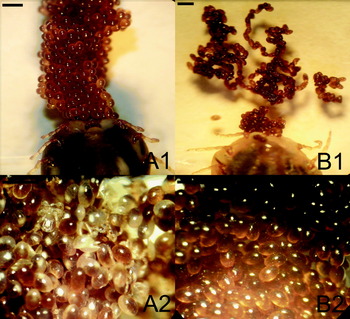
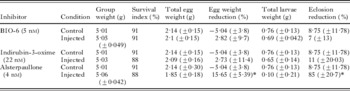
To evaluate the role of GSK-3β in embryogenesis, engorged females were inoculated with specific inhibitors in the first experiment. Significant reduction (15%) in the oviposition rate was observed in alsterpaullone-treated females when compared with control groups (Table 1). In addition, after 20 days of incubation, the eggs from females treated with alsterpaullone showed an atypical external appearance, with a modest presence of embryo formation (Fig. 1A2 and B2). As late as 40 days after oviposition, larval hatching occurred at low percentage (85% reduction in hatching), indicating that embryo development was affected. The eggs of the control group, (females treated with 1% DMSO) demonstrated normal appearance and egg hatching (Table 1 and Fig. 1A1 and A2).
Effects of alsterpaullone on tick oviposition and larval hatching. (A1) Oviposition (10 days after the start of oviposition) of partially engorged females fed with blood with 1% DMSO. (A2) Egg hatching (30 days after the start of oviposition) from eggs of buffer-injected fully engorged females (inoculated). (B1) Oviposition (10 days after the start of oviposition) of partially engorged females fed with blood with alsterpaullone (artificial feeding). (B2) Egg hatching (40 days after the start of oviposition) from eggs of alsterpaullone-injected fully engorged female (inoculated). (Scale bars=1 mm.)

Effects of GSK-3 inhibitors injection into fully engorged female ticks

Percentage reduction in egg weight was calculated by comparison with the weight of eggs produced by ticks inoculated with 1% DMSO in PBS. Percentage eclosion reduction was calculated by comparison with the eclosion of eggs produced by ticks inoculated with 1% DMSO in PBS. Control group inoculated with 1% DMSO in PBS was not statistically different from control without any treatment (P>0·05). Results are expressed as mean (±s.e.m.) of 2 independent experiments. * P<0·05 (compared to control – tick inoculated with 1% DMSO) (Student's t-test). Each group contains 20 tick females.
In turn, the inoculation of BIO-6 or indirubin-3-oxime, alternative specific inhibitors of GSK-3β, produced a less intense reaction in comparison to alsterpaullone concerning oviposition and larvae hatching (Table 1). To confirm the results obtained with alsterpaullone, 2 extra independent experiments with inhibitor only were conducted. The percentage reduction in hatching (58·62%) remained, with significant difference (Table 2).
Effects of alsterpaullone (GSK-3 inhibitor) injection into fully engorged female ticks

Percentage reduction in egg weight was calculated by comparison with the weight of eggs produced by ticks inoculated with 1% DMSO in PBS. Percentage eclosion reduction was calculated by comparison with the eclosion of eggs produced by ticks inoculated with 1% DMSO in PBS. Control group inoculated with 1% DMSO in PBS was not statistically different from control without any treatment (P>0·05). Results are expressed as mean (±s.e.m.) of 2 independent experiments. * P<0·05 (compared to control – tick inoculated with 1% DMSO) (Student's t-test). Each group contains 20 tick females.
The effect of alsterpaullone on oviposition and egg hatching was more pronounced in partially engorged females (Table 3) without mature eggs in the ovaries than in fully engorged females with mature eggs in the ovaries (Tables 1 and 2).
Effects of the alsterpaullone in partially engorged females ticks (artificial feeding)

Results are expressed as mean (±s.e.m.) of 3 independent experiments. Each group contains 10 partially engorged females. Percentage reduction in egg weight was calculated by comparison with the weight of eggs produced by ticks inoculated with 1% DMSO in PBS. Percentage eclosion reduction was calculated by comparison with the eclosion of eggs produced by ticks inoculated with 1% DMSO in PBS. Control group blood-fed with 1% DMSO was not statistically different from control group without any treatment (P>0·05). * P<0·05 (compared to control – tick inoculated with 1% DMSO) (Student's t-test).
Effects of alsterpaullone administration by artificial capillary feeding
Since embryogenesis was altered by inoculation of alsterpaullone in fully engorged females, we decided to test the effect of the administration of inhibitors by artificial capillary feeding in partially engorged females. The weight of female ticks after feeding was not significantly different (P>0·1) between control and treated groups (control group: 41 mg±20·05 mg; alsterpaullone-treated: 33·6 mg±16 mg), indicating that the presence of an inhibitor did not negatively interfere in the feeding behaviour of the tick. However, in the alsterpaullone-treated group, a reduction in oviposition (32·7%) and in eclosion of larvae (69·5%) was verified (Table 3).
Effects of GSK-3 silencing in partially engorged tick females
An important main step involved in the use of the dsRNAs is the determination of which genes, if any, share significant sequence identity with the proposed siRNA in order to predict specificity and off-target effects. We used the 798 bp fragment of R. microplus GSK-3 to perform a BLAST search against R. microplus and Ixodes ricinus sequences available in the NCBI database, and the equivalent fragment of GSKs of C. elegans and D. melanogaster was compared against all possible targets on the respective genome with the dsCheck and DEQOR programs. This analysis showed that the chance for off-target effects was significantly lower in comparison with the specific effect of RNAi knockdown.
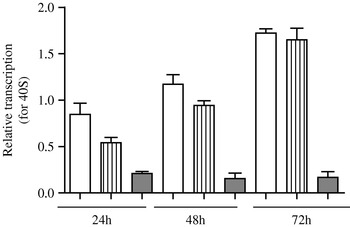
R. microplus GSK-3 expression was silenced by RNAi in partially engorged female ticks. Ticks were injected with dsRNA, or buffer alone, and subsequently submitted to artificial feeding for 28 h. qPCR was performed to analyse GSK-3 silencing in ovaries collected 24, 48 and 72 h after artificial feeding (Fig. 2). GSK-3 transcription levels in ovaries from the control group increased gradually at all defined times (Fig. 2). However, in females injected with GSK-3 dsRNA, a strong reduction in GSK-3 expression level was detected in ovaries, which remained low (95% reduction) up to 72 h after artificial feeding, when compared to the control (Fig. 2).
GSK-3 silencing in ovaries from partially engorged female ticks. GSK-3 relative expression was determined by quantitative PCR of the total RNA extracted from ovaries from female ticks injected with buffer alone, dsRNA E. coli β-galactosidase (striped bar) or GSK-3 dsRNA (grey bar) collected 24, 48 and 72 h after artificial feeding.

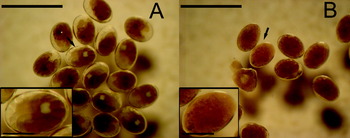
Moreover, tick treatment with RNAi reduced significantly both oviposition (29·1% reduction) and hatching (76% reduction) when compared with the negative control (Table 4). The individual weight of female ticks after feeding was not significantly different (P>0·81) between control and treated groups (media± standard deviation) (control group 70 mg±19·74 mg; (non-related gene group): 75 mg±28·05 mg; dsRNA GSK3 group: 73 mg±28·79 mg), indicating that the presence of dsRNAi did not negatively interfere in the tick feeding behaviour. On the other hand, eggs from GSK-3 dsRNA-injected females exhibited an altered appearance when observed under a stereomicroscope, and in comparison to the eggs from control groups (Fig. 3). While embryos were totally visible in 18-old-day eggs from the control group, those obtained from GSK-3 dsRNA injected females presented an undifferentiated aspect.
Effect of gene silencing by GSK-3 RNAi on tick oviposition and egg hatching. (A) Embryo development (18 days) of eggs from β-galactosidase-injected female ticks. (B) Embryo development (18 days) of eggs from GSK-3 dsRNA injected female ticks. (Scale bars=1 mm; inserts:scale bars=0·25 mm.)

Effect of GSK-3 silencing by RNAi on oviposition and hatching

Results are expressed as mean (±s.e.m.) of 2 independent experiments. Percentage reduction in egg weight was calculated by comparison with the weight of eggs produced by ticks inoculated with PBS. Percentage eclosion reduction was calculated by comparison with the eclosion of eggs produced by ticks inoculated with PBS. Negative control group inoculated with dsRNA of non-related gene (E. coli β-galactosidade) is not statistically different from control without any treatment (P>0·05). * P<0·05 (compared to control – tick inoculated with 1% DMSO) (Student's t-test).
DISCUSSION
GSK-3 is constitutively active in resting cells, and its activity can be inhibited using a variety of extracellular stimuli, including insulin, epidermal growth factor (EGF), fibroblast growth factor (FGF) and Wnt ligands (Grimes and Jope, Reference Grimes and Jope2001; Frame and Cohen, Reference Frame and Cohen2001). Studies on both vertebrate and invertebrate organisms positioned GSK-3 as a kinase that is essential for the specification of cell fate in early embryos, within the canonical Wnt signalling pathway (Ferkey and Kimelman, Reference Ferkey and Kimelman2000). This pathway determines embryo polarity segments in Drosophila and embryo axis formation in Xenopus. Moreover, it promotes cellular growth and differentiation during mammal embryogenesis (Ikeda et al. Reference Ikeda, Kishida, Yamamoto, Murai, Koyama and Kikuchi1998). In addition to its role in Wnt signalling, GSK-3 plays a key role in glycogen metabolism (Grimes and Jope, Reference Grimes and Jope2001). In the absence of insulin signalling, GSK-3 phosphorylates and inhibits glycogen synthase. When blood glucose levels are high, insulin levels also rise. Insulin signalling results in the activation of Akt, a kinase that phosphorylates and inhibits GSK-3. Due to GSK-3 inhibition by Akt, active glycogen synthase promotes glycogen formation. GSK-3 is a highly conserved kinase and is present in diverse vertebrate and invertebrate species (Dornelas et al. Reference Dornelas, Lejeune, Dron and Kreis1998). Logullo et al. (Reference Logullo, Witola, Andrade, Abreu, Gomes, Vaz, Imamura, Konnai, Ohashi and Onuma2009) first characterized GSK-3 in ticks. Their study showed that only 1 GSK-3β isoform is present in R. microplus ticks. Furthermore, the ovaries from R. microplus females appeared to be the major site of GSK3 transcription.
The treatment with GSK-3 specific inhibitor produced a reduction in oviposition and egg hatching. The effect of alsterpaullone was more pronounced than that of bromo-indirubin-oxime 6 (BIO-6) or of indirubin-3-oxime, which are other specific inhibitors of GSK-3β. Selenica et al. (Reference Selenica, Jersen, Larsen, Pedersen, Helboe, Leist and Lotharius2007) tested the efficacy of GSK-3 inhibitors in the post-natal rat model of tau hyperphosphorylation. In this work, indirubin-3-oxime was shown to be efficient in promoting change in neuronal culture (in vitro), but it did not promote changes in vivo. As BIO-6 belongs to that class of indirubin-3-oxime, this may explain the result obtained for these two inhibitors. This discrepancy could be explained by the difficulty to dissolve some inhibitors in various vehicles, the administration pathway used and the increased metabolism in vivo.
Since embryogenesis was altered to a greater extent with alsterpaullone (inoculation) in fully engorged females, we decided to test the effect of oral administration of the inhibitors in partially engorged females whose ovaries were not completely formed. This effect was more pronounced in partially engorged females.
The promotion of any change (silencing, mutation or over-expression) in GSK-3 expression and activity appears to promote phenotypes related to alteration in embryo formation and/or lethality. The loss of function mutations of the GSK-3 gene in Drosophila led to the loss of bristles (Siegfried et al. Reference Siegfried, Chou and Perrimon1992). Studies in Xenopus laevis showed that the expression of a catalytically inactive mutant of GSK-3 on the ventral side of embryos induced the duplication of the dorsal axis (He et al. Reference He, Saint-Jeannet, Woodgett, Varmus and Dawid1995). Over-expression of the normal and mutant forms of GSK-3β in the sea urchin, disturbs the formation of the dorsal-ventral axis (Emily-Fenouil et al. Reference Emily-Fenouil, Ghiglione, Lhomond, Lepage and Gache1998). Furthermore, our group showed that R. microplus GSK-3 is involved in the metabolism of glycogen during tick embryogenesis (Logullo et al. Reference Logullo, Witola, Andrade, Abreu, Gomes, Vaz, Imamura, Konnai, Ohashi and Onuma2009). A change in its expression or activity could thus be due to energy depletion, because excessive amounts of free glucose are probably mobilized to glycogen synthesis. We cannot discard Wnt pathway involvement in the phenotype observed, as the GSK-3 plays an important role in this pathway and Wnt signalling is deeply involved in embryo formation.
The use of RNAi in the characterization of metabolic pathways in ticks was first reported by Aljamali et al. (Reference Aljamali, Sauer and Essenberg2002) and rapidly became a widely used gene-silencing technique (de la Fuente and Kocan, Reference de la Fuente and Kocan2006; Kocan et al. Reference Kocan, Zivkovic, Blouin, Naranjo, Almazán, Mitra and de la Fuente2009). The reduction in oviposition and hatching with silencing of GSK-3 expression, or with GSK-3 inhibitors suggests that suppression of GSK expression and/or function is responsible for the biological effects observed in treated ticks. Previous experiments demonstrated systemic RNAi responses in ticks after injection of dsRNA into unfed ticks, and the corresponding gene silencing occurred in multiple tick tissues (de la Fuente et al. Reference de la Fuente and Kocan2006; Nijhof et al. Reference Nijhof, Taoufik, de la Fuente, Kocan, Vries and Jongejan2007). Nijhof et al. (Reference Nijhof, Taoufik, de la Fuente, Kocan, Vries and Jongejan2007) and Kocan et al. (Reference Kocan, Manzano-Roman and de la Fuente2007) demonstrated the effect of systemic RNAi on tick progeny when dsRNA injected into the haemolymph of fully engorged female ticks caused silencing in the next generation larvae. Additionally, eggs from GSK-3 dsRNA-injected females presented an altered appearance when compared with the negative control, which demonstrates the effect of GSK-3 silencing in tick development.
Algorithms based on sequence-specific and thermodynamic parameters are used in order to design efficient iRNAs; however, potential off-target effects can only be analysed if adequate species-specific sequence data are available. As a result, in most cases, researchers are left with the task of screening multiple siRNAs in order to identify a suitable one. An R. microplus complete genome sequence is not available for guiding off-target analyses. So, we estimated potential off-targets based on sequence of the other two species (D. melanogaster and C. elegans), whose genomic sequences are available. After analysing the genomic sequence of these two species, we identified GSK-3 orthologue genes. These genes were used to test the siRNA efficiency and off-target effects. Two different programs (dsCheck and DEQOR) were used and neither of them indicated the presence of off-targets. We cannot completely exclude the possibility of off-targets, since we did not analyse them with R. microplus sequences, and the evolutionary distance between R. microplus and the two species could cast some doubts on the reliability of the analyses. However, the region of R. microlus GSK-3 gene used in RNAi synthesis is 57% and 69% identical to C. elegans and D. melanogaster homologues. So, the GSK-3 genes are relatively conserved, which makes this analysis a practical and potentially useful method for organisms whose genome sequence is not available.
The study of tick embryogenesis and proteins that participate in this process has been suggested as an important means for the development of novel strategies for parasite control. GSK-3β is an essential protein involved in the embryonic processes and for this reason it has already been suggested as a possible antigen candidate for tick control (Logullo et al. Reference Logullo, Witola, Andrade, Abreu, Gomes, Vaz, Imamura, Konnai, Ohashi and Onuma2009). In this work we showed that GSK-3β interferes in the R. microplus oviposition and in larval hatching. Our data reinforce the use of this enzyme to develop new strategies for tick control. These strategies could act in the reproductive capacity of the tick and probably reduce the number of new individuals.
ACKNOWLEDGMENTS
We are grateful to Professor Laurent Meijer from Station Biologique (Roscoff, France) for collaboration and donation of the inhibitors utilized in the work.
FINANCIAL SUPPORT
This work was supported by grants from CNPq-Instituto Nacional de Ciência e Tecnologia de Entomologia Molecular (573959/2008-0); FINEP (01.04.0347.00); CAPES (AUX-PROCAD-986/2005); CNPq (470520/2007-8); FAPERJ (E-26/100.551/2007); and FAPERGS (05/2128.7).