1. Introduction
In evolutionary theory, a common way of measuring the fitness of biological individuals is inclusive fitness (hereafter abridged “IF”). As is well known, IF is composed of two parts (Gardner, West, and Wild Reference Gardner, West and Wild2011). The first is a direct term that accounts for the costs and benefits accrued to the individuals’ personal fitness, while the second is an indirect term that accounts for the costs and benefits accrued to the personal fitness of their close relatives, weighted by the proper coefficient of relatedness—a measure of genetic similarity. When IF (i.e., the sum of these two terms) is positive, the social behavior that is responsible for this effect evolves under the action of natural selection; otherwise, the corresponding social behavior is wiped out of the population by the very same force.
Hamilton (Reference Hamilton1964), who was the first to introduce IF in evolutionary biology, derived from it a general “principle” about the adaptive behaviors of individuals in social contexts. This principle says that “the social behaviour of a species evolves in such a way that in each distinct behaviour-evoking situation the individual will seem to value his neighbors’ fitness against his own according to the coefficients of relationship appropriate to the situation” (Hamilton Reference Hamilton1964, 19; my emphasis). In his paper, Hamilton insisted on the “unrigorous” character of this principle. But, despite this caveat, it has become increasingly popular among behavioral ecologists. Especially, its most famous application concerns the representation of altruistic traits—which, despite their absolute cost to the altruist, can evolve through the indirect benefits they provide to the relatives. In this case, this principle simply predicts that, when natural selection is at work, an individual facing a decision of either behaving altruistically or not will appear to weight the value of her possible fitness cost against the value of her possible relative’s gain by an amount equivalent to the relatedness coefficient.
Today, Hamilton’s principle is most often formulated in terms of the so-called “maximization analogy” (Grafen Reference Grafen2006). According to this approach, biological individuals are represented as if they were “IF maximizers,” that is, as if they were rational agents “striving to maximize” their IF. The basis of this analogy lies in a parallel between rational choice and natural selection, which both can be conceived of as instances of maximizing processes. Hence, just as rational agents behave as if they were maximizing a utility function (which represents their subjective preferences over a set of consumption bundles or options), natural selection favors organisms who behave in such a way that they obtain the highest IF in social contexts.
The maximizing agent analogy constitutes a powerful tool in the study of social behaviors. Especially, it provides an intuitive framework for modeling social adaptations in terms of “costs” and “benefits.” But it also provides a useful model for representing the causal influence that the organisms have on their main components of social fitness—direct versus indirect (West and Gardner Reference West and Gardner2013). This last point, ultimately, relates to the very idea of agency in decision theory, for rational agents are usually supposed to have a causal control over the utilities associated with each possible strategy.
One key implication of the maximizing agent analogy is also that IF can be represented as a (cardinal) measure of biological utility. From the viewpoint of rational choice theory, this consequence is hardly surprising, for any quantity that is maximized by an individual agent can also be envisaged as a form of utility function.Footnote 1 Yet, as I will show, this interpretation of biological utility raises several conceptual issues (which, though relevant for IF theory, are rarely addressed by evolutionists). Two of them, in particular, will be discussed in this article. First, IF can be interpreted differently according to how we read the relatedness coefficient, namely, either as a measure of value for the relatives’ reproductive success or as a measure of uncertainty about the genotype of the partner. Currently, both of these interpretations are accepted in the evolutionary literature. Yet some contradictions may ensue when they are adopted simultaneously. Second, IF (though maximized by biological agents in numerous contexts) is not the only quantity that is maximized in these contexts. Indeed, whenever IF is maximized, another quantity is always maximized—a quantity that is not only more general but also conceptually distinct.Footnote 2
The structure of this article goes as follows. In section 2, I illustrate the connection between IF and utility in the context of a simple, 2 × 2 additive prisoner’s dilemma. In sections 3 and 4, I address some specific puzzles relating to the “value versus uncertainty” interpretations of the relatedness coefficient—the latter being envisaged as a component of the individual’s utility function. Finally, in section 5, I discuss some interpretative issues related to the existence of an alternative biological utility function to IF.
2. The Simplest Connection between Inclusive Fitness (IF) and Utility
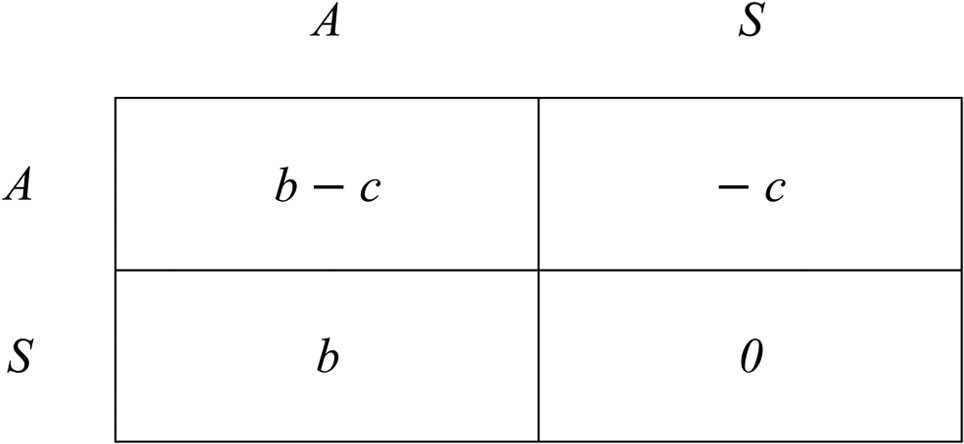
To set the stage for the interpretation of biological utility in IF terms, imagine an infinite population in which individuals sometimes engage in pairwise, one-shot social interactions and no individual has a causal influence on the phenotype of its partner.Footnote 3 In any single interaction, each player is facing an alternative between two behavioral options, namely, altruism A or selfishness S. Individuals who behave altruistically provide a benefit b to their partner at a cost c to themselves, while individuals who behave selfishly incur no cost and receive a benefit b when their partners adopt the altruistic option. Cost and benefit are measured in terms of personal reproductive success, so the payoff structure corresponds to a 2 × 2 prisoner’s dilemma, with
 (fig. 1).
The one-shot prisoner’s dilemma.

Suppose now we are interested in determining which of the altruistic or the selfish disposition will fix in the population under the action of natural selection. Assuming each disposition is perfectly heritable, the outcome of natural selection will depend on the nature of the assortment pattern. If interactions are random, altruism will not evolve, for the cost of altruism (by definition) is always positive (
 ). However, if interactions are nonrandom, altruism will evolve provided there are enough positive correlations in the population. Specifically, if the assortment leads individuals with similar genes to interact more often with each other, the condition for the evolution of altruism will be given by
 —an inequality known as Hamilton’s rule for the evolution of altruism (Hamilton Reference Hamilton1964). In this expression, r denotes the coefficient of relatedness and measures the amount of genetic similarity between any two partners at the locus for the altruistic disposition.
Suppose now we want to determine whether altruism would be chosen by a rational agent in the same game-theoretic context. For the sake of the argument, I will follow the common usage in rational choice theory and assume that our rational agent is an individual who seeks to maximize its expected utility EU(·) as defined by Savage (Reference Savage1954), namely,

In this formula, U(Act(statei)) is the utility of the act in the state of the world i and P(statei) the agent’s (degree of) belief or “credence” that statei is the actual state of the world. Here, and in the remainder of this article, I will assume that the subjective credences of this agent, represented by the probability function P(·), match the objective distribution of the states. This assumption will help us to focus more specifically on the discussion of the utility function U(·); but it is also quite intuitive from a normative perspective: indeed, an organism “endowed” with true beliefs about the relevant aspects of her social environment (or who behaves “as if” she was endowed with such beliefs) should usually enjoy a fitness advantage over an organism endowed with incorrect beliefs.Footnote 4
Using this model of expected utility, we may now reach two different conclusions concerning the relationship between natural selection and rational choice, depending on our biological interpretation of U(·).
If utility is interpreted as personal fitness, then the payoffs for our rational agent turn out to be identical to those in the prisoner’s dilemma of figure 1; that is, the corresponding expected utilities of altruism and selfishness are


The problem, however, is that under this interpretation, altruism is a strictly dominated strategy—as can be seen from the fact that
 —which means that, whatever the partner does, behaving selfishly will always be the rational option. Hence, assuming Savage’s model of expected utility, personal fitness is not an appropriate measure of U(·), for it always leads to a wrong prediction when
 .
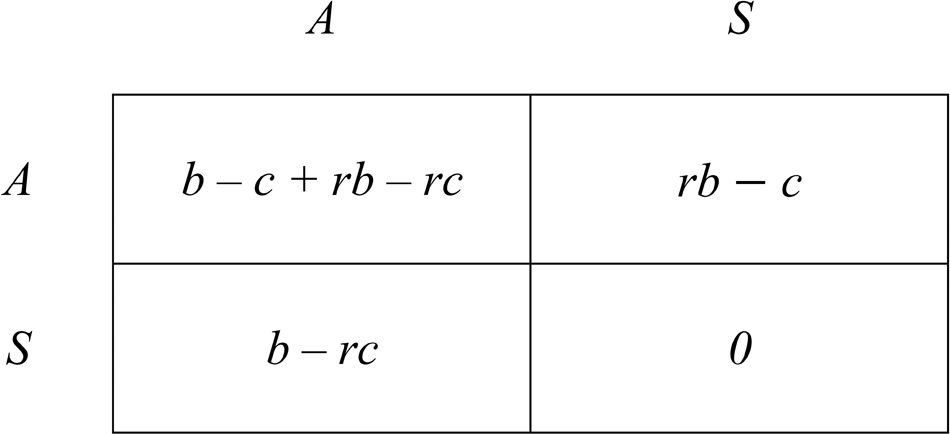
A better alternative consists in using IF as a measure of biological utility (together with Savage’s model). In the context of a two-player game, IF can be defined as the sum of the agent’s personal fitness and of the personal fitness of her partner, weighted by the proper coefficient of relatedness r. Thus, denoting by V(I, J) the personal fitness of an individual playing I against an individual playing J, the IF interpretation of the utility function U(I, J) can be written as

With this utility function in hand, it is possible to derive a payoff matrix for our agent, which is an “r-transformation” of the prisoner’s dilemma. This payoff matrix is represented in figure 2.
A modified prisoner’s dilemma with inclusive fitness payoffs.

In this new game, one can see that the agent has an interest in the reproductive success of her partner “up to r,” where r can be envisaged as the analog of an “exchange rate” between two kinds of goods, that is, the offspring of the agent and that of her relatives (Frank Reference Frank1998).Footnote 5 From this representation, it follows that the optimal behavior for our rational agent corresponds to the trait favored by natural selection; for altruism (in this model) is the rational choice iff
 , a condition that is equivalent to the simple version of Hamilton’s rule given earlier. Hence, rational choice theory makes perfect sense of the individual behaviors of biological agents, provided IF—and not personal fitness—is used as a measure of biological utility.Footnote 6
Before pursuing the discussion, it is worth saying a word about the domain where IF is actually maximized by individual organisms. Recently, a number of significant papers have been written on this topic, and one main result that has emerged from this literature is that IF maximization does not obtain when the payoffs are nonadditive (Skyrms Reference Skyrms2002; Lehmann, Alger, and Weibull Reference Lehmann, Alger and Weibull2015; Okasha and Martens Reference Okasha and Martens2016). In reaction to this point, some authors have argued that IF should no longer be used as a measure of social fitness (Nowak, Tarnita, and Wilson Reference Nowak, Tarnita and Wilson2010), while other have tried to generalize Hamilton’s theory so as to account for nonadditive scenarios (Gardner et al. Reference Gardner, West and Wild2011). My position here is somewhat intermediary: though I do not think that IF maximization makes much sense when applied to nonadditive settings, I still consider this hypothesis as a valuable one in additive scenarios. Therefore, I do not think that this actual limitation should be envisaged as an argument against IF maximization per se.
As mentioned above, the “value” interpretation of r is one key component of the representation of biological individuals as IF maximizers. But this interpretation is neither the sole nor the commonest interpretation of this coefficient in social contexts. In his original papers, Hamilton (Reference Hamilton1964) defined r primarily as a measure of the probability that two individuals share a given set of genes due to common ancestry; then he quickly realized that common ancestry was only one possible cause of genetic similarity and that other factors, such as partner choice and green-beard effects, could also raise the probability that the partners share the same gene(s) at a given locus (or loci).
To account for these multiple sources of genetic similarity, Hamilton suggested that the coefficient of relatedness should be defined in more general terms (Hamilton Reference Hamilton and Fox1975), that is, as a statistical regression of the recipient’s genotype on the actor’s genotype, relative to the whole population mean. This definition—now widely accepted by evolutionary biologists—provides an intuitive measure of conditional information about the genotype of the recipient (given the genotype of the actor); and importantly, it does not rely on any assumption concerning the possible causes of genetic similarity. Thus, in the case in which an agent i has a probability P(GAi) of having the altruistic gene GA, assuming the deviation of her genotype from the average genotype of the population
 is given by
 , the coefficient r simply predicts the extent to which the genotype GAj of a potential recipient j is expected to deviate from the average altruistic gene’s frequency:

The consequence of this representation is that r—in addition to its interpretation as a measure of the value for the reproductive success of an agent’s relative—can also be read as a measure of uncertainty about the genotype of the partner; that is, with a probability r the partner has the gene for altruism, and with a probability
 the partner does not have the gene.
Up to now, both of these interpretations have coexisted in the evolutionary literature. But biologists, admittedly, have been more interested in discussing the formal definition of r than in discussing the role it is meant to play in the conceptual interpretations of IF. Hence, in order to clarify the latter, I will focus in the next sections (secs. 3 and 4) on two puzzles that relate to the “value” interpretation of r introduced above. The first (discussed in sec. 3) stems from a brief remark made by Skyrms (Reference Skyrms2002), while the second (discussed in sec. 4) deals with an apparent conflict between the value interpretation of r and its interpretation as a measure of uncertainty about the type of the partner.
3. Conditional versus Unconditional Behaviors
Skyrms (Reference Skyrms2002), in a short paper on inclusive fitness and rational choice, noticed the existence of a contradiction with the IF game (fig. 2) when altruism is determined by the possession of a single, dominant gene. His argument—which I will refer to as “Skyrms’s paradox”—goes as follows. Suppose a focal individual is confronted with an IF game with a partner related to a degree r (with
 ) and the phenotype of her partner is exclusively determined by the possession of a single, dominant allele. Suppose also that the focal individual behaves altruistically and that her partner behaves selfishly. In this case, the actor’s payoffs are equal to
 (as can be seen from the upper-right case of the IF game in fig. 2). But clearly, these payoffs are inconsistent with the genotype of the partner; indeed, the latter does not have the gene for altruism. Hence, we should not include a component of indirect fitness rb in the calculation of the actor’s payoffs.
To avoid this inconsistency, Skyrms suggested that we should give up the metaphorical representation of individuals as “IF-maximizers” and that the r coefficient should be “added to the expected fitnesses of the strategies, rather than to the individual terms in the payoff matrix” (Skyrms Reference Skyrms2002, S107). According to Skyrms, the best way to do this is by using conditional probabilities to represent the conditional pairing proportions in the population—instead of mere unconditional probabilities (Skyrms Reference Skyrms1994). More specifically, assuming
 represents the probability that the partner behaves as an X, given that one behaves as a Y, the expected fitnesses of both altruism and selfishness become


Now, in these formulas, the type of the partner can be expressed as a function of r and p. For instance, in the case in which the agent behaves altruistically A, the probabilities can be written as


Substituting expressions (8) and (9) into expressions (6) and (7), it follows that
 iff
 ; that is, using conditional probabilities to represent the degree of assortment between the individuals—together with personal fitness payoffs—allows us to correctly predict the evolution of altruism while avoiding the inconsistency attached to the IF game.
Skyrms’s solution is actually quite general, for unlike the “IF utility function,” his model applies as well to situations in which payoffs are nonadditive. But what about its interpretation in terms of the maximizing agent analogy? Could we make sense of formulas (6) and (7) by adopting the epistemic stance of an individual seeking to maximize its expected utility? For Skyrms, the answer is negative: in an earlier paper (Skyrms Reference Skyrms1994), Skyrms noticed that, though his model makes perfect sense from the perspective of evolutionary dynamics, its interpretation as a model of expected utility makes no sense from the viewpoint of rational choice theory. The reason is that its application leads to Newcomb problems in correlated prisoner’s dilemmas (Lewis Reference Lewis1979); indeed, in the prisoner’s dilemma, altruism does not increase the probability that the partner will behave in the same way (whatever the value of r is) and so remains a strictly dominated strategy even when
 , that is, even when the agent’s expected utility, as defined by (6) and (7), is maximized. Following Skyrms, then, we should not only renounce to IF as a measure of biological utility but also more generally to the maximizing agent analogy.
Skyrms’s paradox, unquestionably, raises a puzzle for the representation of organisms as IF maximizers. But as I will now argue, this puzzle does not constitute a reason for giving up this representation. In fact, his paradox stems from a simple assumption, which is that both altruism and selfishness are unconditionally determined by the possession of a single allele. But when this assumption is removed, the IF game is no longer self-contradictory.
To illustrate this point, consider the following example. Suppose a situation in which the focal actor and its partner are, respectively, an ant worker and a royal larva living in the same colony. Suppose also that the worker has the choice, at some point, between two behavioral strategies A and S, that is, providing the larva with a benefit b at a cost c to herself or diverting this energy for her own reproduction. Assuming the focal worker is related to the larva by an amount of r, the implications of her choice should correspond to the scenario in which the partner behaves selfishly in the IF game (by definition, a larva is unable to help a worker). But in this case, Skyrms’s conclusion no longer applies; for here, the phenotypic strategies of the individuals are no longer correlated with their respective genotypes—meaning that, even though the larva is of a selfish type S, the worker still has an incentive to behave altruistically (up to
 ) toward her. So, provided the behaviors within the strategy set are of a conditional type, there is no longer a paradox stemming from the inclusion of r within the payoff matrix.
At this point, one could wonder whether the restriction of the maximizing agent analogy to conditional behaviors really solves the puzzle raised by Skyrms’s paradox. In the worker/larva scenario, and, more generally, in every situation in which the phenotype of the actor and the phenotype of the partner do not affect each other (i.e., assuming no manipulation, reciprocity, or coercion), this restriction works well; for in the absence of causal influences, the payoffs caused by the partner (the b in fig. 2) do not make any difference to the outcome of the IF game; hence, they can be neglected. Yet, in more complicated scenarios, such as the ones involving causal influences, there is no guarantee that this restriction will continue to work; for in those cases, the phenotype of the partner affects the outcome of the social game (through its influence on the actor’s payoffs).
Should we be worried about these more complicated sorts of conditional behaviors? My answer is that we should not; for even though they reveal an important limitation to the application of the IF maximization hypothesis, this limitation is ultimately irrelevant to the issue addressed by Skyrms against the IF game.
To understand this point, it is crucial to emphasize the distinction between the interpretation of IF as a (consistent) measure of biological utility and the application of IF maximization as a (correct) predictive tool. Causal influences, in social games, entail a form of frequency-dependent selection that is usually incompatible with the predictive use of the IF maximization hypothesis (Grafen Reference Grafen2006). Indeed, the latter generally fails to provide correct predictions about the evolutionary dynamics in the presence of frequency dependence and so is better avoided in those cases. But the conceptual implications of Skyrms’s paradox concern exclusively the interpretation of IF maximization, not its domain of empirical or predictive validity—as can be seen from the fact that Skyrms’s paradox also arises in those situations in which the IF maximization hypothesis is satisfied. Thus, even though the maximization agent analogy is clearly inappropriate when it comes to the evolutionary modeling of conditional behaviors involving causal influences, the reason why it is inappropriate in those cases has nothing to do with Skyrms’s paradox; rather, it is a mere consequence of the fact that the IF game is predictively incorrect in the presence of frequency-dependent selection.
The previous argument, however, leaves open the following question; namely, is there an independent, that is, non–ad hoc justification (independent from Skyrms’s paradox) for restricting the use of the IF maximizing agent analogy to the cases in which the behaviors of individuals are strictly conditional? If the answer is yes, then surely Skyrms’s paradox should not be called a paradox at all, for this would mean that it would occur only when the analogy does not apply in the first place. If the answer is no, then Skyrms’s argument would certainly be a good reason for not considering the IF maximizing agent analogy as theoretically justified. In what follows, I will show that there is one intuitive reason for restricting the use of the maximizing agent analogy to the description of conditional behaviors. Simply put, this reason is that, when behaviors are unconditional, the minimal form of agency demanded for a relevant application of this analogy is not satisfied in the first place. To vindicate this claim, however, it is important to distinguish between two uses of the maximizing agent analogy in evolutionary biology.
In the biological/philosophical literature, a common use of the maximizing agent analogy consists in thinking of natural selection as the analog of a maximizing agent and of biological individuals as “mere tokens” instantiating the phenotypic strategies. This particular use is characteristic of evolutionary game theory—where no choice is assumed from the part of individuals (Maynard Smith Reference Maynard Smith1982)—and can also be envisaged, mutatis mutandis, as an “updated” version of the Darwinian analogy between natural selection and artificial selection. In what follows, I will refer to it as “analogy 1.”
Analogy 1 admits two possible forms that have to be distinguished. The first is the direct, formal analogy between natural selection, or “Mother Nature,” and rational choice; whereas the second is more indirect and derives from the representation of the individual tokens as rational agents. This second version is the one we have been using (implicitly) so far and relies on a simple counterfactual trick, namely, “assume that the strategy that will evolve under the action of natural selection, in a given population, is also the strategy that would be chosen by a member of this population (given the hypothesis of fitness maximization) if she had the choice between the different options.” This counterfactual, individual-based approach of analogy 1 has been dubbed by Sober (Reference Sober and A1998) the heuristic of personification and is nicely illustrated by his example of the evolution of running speed: “When running speed evolves in a population of zebras, we may ask ourselves whether we would want to be fast or slow, if we were zebras who wanted to survive and reproduce. We get the right answer by this line of questioning; since we would want to be fast, it follows that fast is a fitter trait than slow, which means that selection will lead the population to a configuration in which all the organisms are fast and none are slow” (Sober Reference Sober and A1998, 409).
In Sober’s example, the behavior envisaged is clearly unconditional (indeed, a zebra cannot “choose” or even adapt its maximal running speed, as it depends on its physiologic constitution); hence the metaphorical dimension of this method is obvious: because there is no way for a zebra to “choose” its genotype, the proper analog of rational choice has to be natural selection itself, or Mother Nature. But the same reasoning would apply as well in the case of a conditional behavior. Thus, assuming two conditional strategies coexist in a population, say “if s do A” and “if s do S” (with s being some cue or signal in the environment), and assuming both are encoded by two distinct genotypes, say G if s do A and G if s do S, one should expect—according to this interpretation—the preferred genotype (from the viewpoint of a particular individual) to be the one favored by natural selection.
The second use of the maximizing agent analogy that is often implicitly assumed in behavioral ecology consists, by contrast, in explaining the adaptive decisions that individual organisms make in particular environments. This is, for instance, the kind of reasoning that biologists adopt when they try to explain why birds “choose” to leave a given patch after some time spent foraging in it, or why social insects “decide” to cooperate and not to attack certain kinds of individuals. Unlike the former, this second version of the maximizing agent analogy (hereafter “analogy 2”) does not envisage individuals as mere tokens, but as genuine agents, where “agency” refers here to the (minimal) ability that most organisms have to respond, adaptively, to some of the challenges raised by their environment. Agency, in this respect, is not an exclusive property of organisms such as plants or animals; in fact, even genes can be envisaged as “agents” in this sense, provided they respond differentially to specific cues or signals in their phenotypic/molecular expression.Footnote 7
At first, the two versions of the maximizing agent analogy seem pretty close. Yet only analogy 1 is vulnerable to Skyrms’s puzzle, as it applies as well to conditional traits and to unconditional traits. In contrast, analogy 2 applies only when the behaviors are somehow conditional, that is, when the individual can adjust its behavior to some part of its environment. So Skyrms’s paradox, which applies only to unconditional traits, does not constitute a threat for the theoretical justification of analogy 2.
Coming back to our previous question, we may now ask if there an independent reason for preferring analogy 2 to analogy 1. There is, I think, one theoretical reason that can be given in favor of analogy 2. This reason, as I will now show, has to do with the ontological level at which the maximizing agent analogy can be applied.
In both versions of the maximizing agent analogy, individuals are represented on the model of rational agents, that is, as if they were facing a choice between alternative strategies. But in each case, the nature of the analogy is different. With analogy 2, the correspondence occurs at the level of behavioral mechanisms—namely, phenotypic plasticity and rational choice—which both are individual processes (in decision theory, rational agents are supposed to respond adaptively/rationally, as individuals, to different circumstances). With analogy 1, however, there is no such correspondence, and the only biological analog one may find to the individual process of choice is a populational process, namely, natural selection. Thus, in the example of running speed, each zebra is instantiating a given phenotype, but there is no analog of choice at the individual level; instead, natural selection is the one that “chooses” among them. As a result, the personification of individual organisms appears quite artificial, as it compels us to think of individuals as “facing a decision” in a situation in which, clearly, there is not even a possibility of choice in the first place (i.e., no “behavior-evoking situation,” to borrow Hamilton’s expression).
Of course, one could object that biologists using this heuristic are not assuming that organisms actually make decisions like intentional agents. But against this point, one might retort that an analogy, to be useful, must be based on a formal correspondence between—at least—two structures; and, in the case of analogy 1, the problem is precisely that no such correspondence can be found at the level of individual organisms. Indeed, in the case of analogy 2, we have a direct correspondence between two individual (behavioral) processes; but there is no such equivalent at the individual level in analogy 1, which has its roots in the sole personification of natural selection (Mother Nature as an optimizing agent). Hence, with analogy 1, not much is gained by envisaging a given individual as a choosing agent—at least compared to what is already gained by thinking of natural selection in those terms.
For this reason, I think that analogy 2 should be preferred to analogy 1 in behavioral ecology, where the tools of rational choice theory are typically used at the individual level. Now if analogy 2 is to be preferred to analogy 1, then Skyrms’s argument no longer poses a difficulty to the use of IF as a measure of biological utility. Yet, ultimately, we should keep in mind that this vindication of IF is somewhat indirect, as it relies exclusively on the particular vindication of analogy 2.
4. The Meaning of r: What an Animal “Knows” about Its Relatives
In section 2, I distinguished between two possible interpretations of r, namely, r as a measure of value for the partner’s reproductive success and r as the probability that the partner has the same genotype as the actor—conditional on any cause of assortment. Both of these interpretations, actually, fit with the second version of the maximizing agent analogy (analogy 2). Yet, when taken together, both seem to conflict with an important principle of Savage’s rational choice theory (formula [1]). In this section, I briefly expose the cause of this apparent conflict, and I propose a simple solution.
Savage (Reference Savage1954), in his theory of rational choice, assumes a strict separation between the states of the world, the acts, and the consequences associated with each state. In his view, the states are (all) the possible scenarios that might correspond to the actual world—once a decision has been made by the agent—whereas the acts are each functions from the state space to the set of consequences, represented within the payoff matrix. All the utility of an act resides exclusively in its consequences, and all the uncertainty is supposed to be “resolved” by the states of the world, which means that a rational agent knowing the actual state of the world should no longer have any uncertainty concerning the payoff of her action.
When the agent’s payoffs are measured in IF terms, however, this separation condition (between the payoffs and the states) seems no longer satisfied. The cause of this apparent discrepancy is simple: IF, by definition, always includes the r coefficient as a part of its payoff structure—which, in turn, can always be read as a “residual” measure of uncertainty about the genotype of the partner (except when
 and
 ). So, when the payoffs are defined in IF terms—as in figure 2—knowing the actual state of the world (i.e., the strategy, A or S, of the partner) does not resolve all the uncertainty about the agent’s indirect payoffs; that is, there is still a remaining uncertainty about the actual genotype of the partner, which is represented by r in the payoff structure.
To avoid this technical difficulty, one might be tempted, here again, to follow Skyrms’s suggestion to extract r from the utility function (cf. sec. 3), for example, by putting it on the credence side—hence embracing the exclusive interpretation of r as a measure of probability about the genotype of the partner. But as we have seen, this solution amounts to giving up on an important aspect of Hamilton’s theory, namely, the representation of individuals as IF maximizers. Fortunately, there exists a simple redescription of the IF game that suffices to dissipate the apparent conflict described above, while preserving the key Hamiltonian subdivision of the payoffs into a direct component and an indirect component. This redescription involves a new partitioning of the states for the IF game, which I am now going to introduce.
Suppose an agent is facing a situation of helping or not a potential relative. What, then, should be the most relevant partition of the states from the viewpoint of this agent, given the hypothesis of IF maximization?
A first possibility would be to have the agent’s partition defined over the following two states of the world: namely, either the partner has the same gene due to common descent or she has not. In that case, the best estimations for the objective probabilities of these two states would be, respectively, r and
 . Clearly, this partition would be the most fine-grained one from the viewpoint of the agent; but at the same time, the true value of r is certainly not the kind of thing that an organism—be it a human, a bird, an ant, or a bacterium—should be able to know or infer (in the sense of having access to) from the information available in her social environment (apart from those organisms who had a chance to take an elementary course in population genetics). Hence r, understood as the objective probability that an individual and her partner share the same genes due to common descent, should not figure on the information-processing side (the “credence function”) of our biological utility model—not, at least, if we assume that the purpose of this credence function is to represent all of the information that could be actually relevant or accessible to an IF maximizer.
A more reasonable approach, then, would be to envisage the problem faced by our IF maximizer as one of determining the class of relatives to which her partner belongs. In this case, the partition of the states would thus become a coarse-grained one, defined over the set of each possible kind of relatives she may encounter (cousin, son/daughter, sister/brother, etc.).
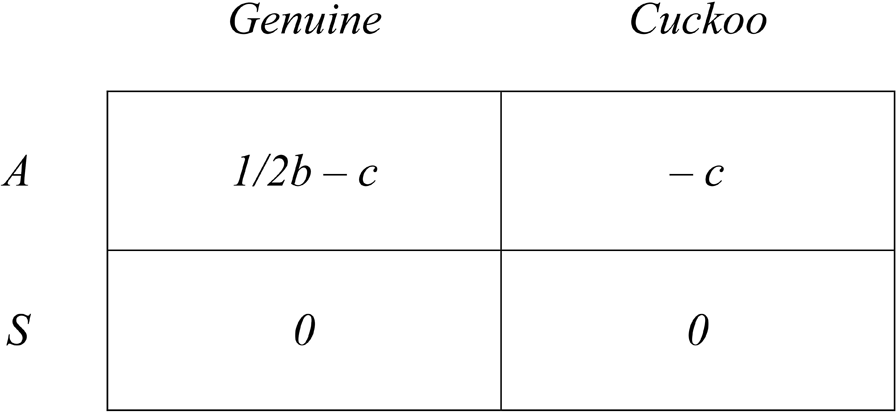
To illustrate this second alternative, let us consider the hypothetical scenario of a mother bird who has to decide whether or not to feed a given chick in her nest. For simplicity, assume two kinds of chicks coexist in the global population, namely, parasitic “cuckoo” chicks, which are unrelated to the agent (
 ), and genuine chicks, which have a relatedness of
 to the agent (the mother). The corresponding “game” is represented in figure 3.
An IF game with correct partition over the states.

In this model, payoffs are measured in inclusive fitness terms, and the two states of the world are Chick = Cuckoo and Chick = Genuine. From there, two possible situations can be distinguished.
If the agent (the mother bird) cannot obtain any further information about the type of her chick—either because of her cognitive limitations or because of the opacity of her social environment—then the (Savage’s) expected utilities of both helping A and not helping S are given by


In these formulas, P(Genuine) and P(Cuckoo) refer to the unconditional credences of our agent and correspond to the objective probabilities that the partner is a genuine chick or a cuckoo. This means, consequently, that A will be the optimal choice in this case iff

Importantly, the equation of the agent’s credences with the objective probabilities of the corresponding states does not imply that the former must “know” the true value of P(Genuine) in order to maximize her IF. Rather, the purpose of this assumption is simply to outline the fact that natural (kin) selection will always favor birds who behave as if they knew the average frequency of genuine chicks and cuckoo chicks in the average nest.Footnote 8
Now, if there is some cue or signal m that turns out to be correlated with the type of the partner,Footnote 9 then helping A becomes optimal for the agent iff

In this inequality,
 denotes the conditional, objective probability that the partner is a genuine chick, given that m is observed (m could be, for instance, a certain eggshell pattern reflecting the chick’s pedigree). This expression, in turn, is related to the unconditional probability P(Genuine) by the classical form of the Bayes rule, namely,

Interestingly, an implicit correlate of (14) is that kin selection will favor those organisms who behave “as if” they were updating their epistemic state about the type of the partner following Bayes’s rule (Frank Reference Frank1998). Again, this latter implication does not mean that our focal organism should be able to “compute” or “update” anything like a rational, Bayesian agent, or even that it should be able to store information in the form of epistemic states; but, instead, the content of this assertion is simply that those mechanisms that underlie the process of kin discrimination are expected to produce social behaviors in accordance with the formal constraint of Bayesian updating (Okasha Reference Okasha2012). Hence, it should be clear, at this point, that the general format of the expected utility function (formulas [10] and [11]) has essentially a predictive value, which aims at modeling the outcome of kin selection at the level of individual behaviors.
At this point, two virtues of the previous reformulation of our model of expected utility can be outlined. First, this model is probably more realistic than any other one (e.g., Skyrms Reference Skyrms1994, Reference Skyrms2002) that would put the r coefficient on the side of the credence function; for as we have seen, the true value of r is not something that could be accessed by any organism. But more importantly, this model also provides a simple solution to the apparent conflict between Savage’s separation condition and the two interpretations of r mentioned at the beginning of this section. The reason is simple: r, in our model, represents a variable whose values (1/2 or 0) correspond to the different states of the world (being a genuine relative or a parasite) that are actually relevant to the agent. Hence, all uncertainty is exclusively about these two states of the world, and there is no point about whether r should also count as a measure of uncertainty about the genotype of the partner; indeed, the latter remains out of reach of the cognitive capacities of the agent and so should not be represented in the model as being a part of her world, in Savage’s sense.
To further emphasize this point, one could resort to the familiar distinction between the de re and the de dicto modalities. From the perspective of a population geneticist (i.e., according to the de re modality), the proposition “this chick is a genuine offspring of the agent”—which corresponds to the first state in game 3—implies logically the proposition “this chick is related to 1/2 to the agent.” Yet from the epistemic point of view of the bird, (i.e., according to the de dicto modality), this implication does not hold, for the truth of the second proposition is not something that she could be able to assess from the cues or signals present in her environment. So from the perspective of this agent, the parameters 1/2 and 0 weighting the potential indirect benefits b in the payoff matrix should simply represent a measure of the agent’s incentive’s intensity concerning the choice of altruism, conditional on the corresponding state of the world.
This latter redefinition of our biological utility model—with the states of the world being defined over the possible values of r—adds, however, a nonnegligible limitation to the representation of individuals as IF maximizers. Previously, I argued that this representation was vindicated only in the cases in which the individuals have the ability to respond to significant aspects of their social environment—that is, when they behave as minimal agents. Transposed to the context of the present discussion, this restriction implies that biological individuals should be envisaged on the model of IF maximizers only if (i) they are able to discriminate between their kin and (ii) they are able to adjust their behavior accordingly. However, most of the studies that have been conducted on this topic have failed—for now—to establish unambiguous cases of kin recognition (Gardner and West [Reference Gardner and West2007] provide a useful survey of this problem). Hence, we must be careful about the use of the IF maximizing analogy, for the extent to which it can be applied meaningfully is an open question.
5. An Alternative to the IF Function
In additive, 2 × 2 game-theoretical contexts, natural selection always favors the strategy that maximizes the IF of individuals—as defined by expression (4). But IF, as is well known, is not the only quantity that turns out to be maximized by individual organisms. Indeed, another utility function (which is not mathematically equivalent to IF) is also maximized in additive—and some nonadditive—settings. This quantity can be expressed as an r-weighted sum of V(I, J), the personal fitness of the agent when playing I against a partner playing J, and V(I, I), the personal fitness of the agent playing I against a clone (Grafen Reference Grafen1979; Allen and Nowak Reference Allen and Nowak2015; Okasha and Martens Reference Okasha and Martens2016):

Because this quantity is actually maximized in nonadditive settings that fail to result in IF maximization (Lehmann et al. Reference Lehmann, Alger and Weibull2015), it has a greater generality than its IF alternative. But this generality—mainly formal—should not obscure the conceptual differences between their respective interpretations.
As first noticed by Bergstrom (Reference Bergstrom1995, Reference Bergstrom2003) and more recently by Alger and Weibull (Reference Alger and Weibull2013), a rational agent endowed with utility function (15) can be interpreted as a “semi-Kantian” agent or as a “homo moralis.” In their 2013 paper, Alger and Weibull describe the homo moralis as follows: “It is as if homo moralis is torn between selfishness and morality. On the one hand, she would like to maximize her own payoff. On the other hand, she would like to ‘do the right thing,’ that is, choose a strategy that, if used by all individuals, would lead to the highest possible payoff. This second goal can be viewed as an application of Kant’s (1785) categorical imperative, to ‘act only on the maxim that you would at the same time will to be a universal law’” (2276). This interpretation, admittedly, contrasts sharply with the IF interpretation of the utility function represented in (4); for unlike a Hamiltonian agent, who seems to “care” primarily about the well-being of her relatives, a homo moralis seems to care primarily (up to r) about her well-being in a situation in which her choice is adopted by every member of the population.Footnote 10
Using a psychological analogy, the difference between these two utility functions could be illustrated by referring to the distinction between morality and sympathy. Morality, on the one hand, derives from the conformity of an agent’s behavior to an abstract normative principle, such as duty or pure reason, whereas sympathy, on the other hand, is an emotion exclusively driven by the welfare of the other—envisaged for her own sake—which is often associated with genuine altruistic incentives (Darwall Reference Darwall1998). Thus, transposing our discussion from a biological to an economical setting, a Hamiltonian utility function would seem more appropriate to represent altruistic behaviors based on sympathy-like mechanisms (i.e., mechanisms triggered by the condition of a relative, such as “being in danger”) than a semi-Kantian utility function, which seems more appropriate to represent those biological mechanisms responsible from moral behaviors, like reciprocity.
In their paper, Alger and Weibull (Reference Alger and Weibull2013) envisage the IF maximizer—which they call “homo hamiltonensis”—as a special case of homo moralis. Though it might seem surprising, they do so for two reasons. First, and as noticed earlier, the semi-Kantian utility function is always maximized in additive contexts and sometimes maximized in nonadditive contexts as a result of natural selection. So when IF is maximized, the semi-Kantian utility function is always maximized, though the converse is not true. Second, the semi-Kantian utility function to which these authors refer is distinct from the function expressed in (15) and turns out to be more general than IF even in simple additive contexts. The reason is that Alger and Weibull do not define the semi-Kantian utility function by using as a weight the r coefficient, but by using a more general coefficient of assortment a that can be positive when
 :

Because of its greater generality, their utility function can account for the kind of preferences that an individual agent might evolve in social settings in which
 , but in which an incentive to cooperate still exists (as in the case of reciprocity, e.g., where there is a positive probability a that the partner will adopt the same strategy as the agent). In expression (16), the a coefficient therefore can be interpreted as an index of assortativity measuring the extent to which individuals with similar phenotypic dispositions interact between each other (Bergstrom Reference Bergstrom2003).
Comparing these two utility functions (4) and (16)—together with their respective “as if” interpretations—it would now be interesting to see whether any argument for preferring one over the other could be vindicated in the context of our discussion on biological altruism (assuming additive payoffs). From a mathematical point of view, as we have seen, there should be no reason to favor one of them over the other in additive scenarios—not, at least, as long as
 . Yet, from a biological point of view, there might well be some reasons to favor one over the other—depending, first, on whether the equality
 is (or not) satisfied and also on the nature of the organisms considered.
When some utility function is used to describe the altruistic behaviors of simple organisms such as ants, plants, or bacteria, there is no point in wondering whether the individuals behave “as if” they were caring about the well-being of their partner or “as if” they were striving to “weight” morality against selfishness in proportion to r. The reason is that neither an ant nor a bacterium possesses intentional-like states that could, in the first place, be envisaged as the “causes” or “rationales” of her behavior. Nevertheless, it could make sense, in those cases, to prefer the use of an IF utility function; for under the IF approach, both the b and c terms admit a natural interpretation in terms of quantities that are ultimately caused by the individuals. In contrast, the semi-Kantian alternative does not provide any such heuristic advantage when applied to simple organisms and just appears more cumbersome.
In the case of higher animals and humans, however—whose behavior can be driven by emotional states (or, at least, by “emotion-like states”)—there might be some biological reasons to favor one utility function over the other, depending on the case at hand. For instance, a possible reason of privileging an IF interpretation in the case of, say, the social behaviors of birds and apes could be that the cognitive mechanisms needed to implement a Hamiltonian incentive (e.g., a mechanism for sympathy conditional on the state of a relative) are presumably much less demanding than those requested to implement a Kantian incentive (namely, some kind of weighting process involving a counterfactual scenario, i.e., the fictional state in which every individual behaves like the agent). Thus, according to such a cognitive hypothesis, an IF utility function should certainly be preferred for modeling the social behaviors of nonhuman animals.
In other circumstances, however, a semi-Kantian utility function could be more appropriate. For instance, in the case of humans, learning and enforcement often lead individuals to conform their social behavior to common rules or practices. So it might be that, at least in our species, something like “semi-Kantian preferences” have been developed by individuals under the action of these cultural forces, without necessarily involving a component of sympathy (i.e., an affection for the well-being of others). Such preferences, in turn, would be better represented by the homo moralis model than by the Hamiltonian model, and IF would no longer be the most appropriate measurement for representing the main determinants of social behaviors.
In fact, it is likely that something close to the Kantian interpretation should be adopted when one is describing the other-regarding or self-sacrificing behaviors that human agents often exhibit toward nonrelatives. But in this case,
 , which means that this situation does not correspond to a situation in which both the IF function and the semi-Kantian function (the a version) are equally applicable. Instead, the semi-Kantian utility function (which holds for any value of a, the phenotypic correlation coefficient) is empirically superior, and there is, accordingly, no problem of which function to use in the first place.
To conclude on this point, the main lesson that we could draw from these speculations is that, in spite of their apparent character of interchangeability (in the additive case), the two functions are not really designed to represent the same sets of behaviors. When
 , an IF interpretation will often be preferable, at least in the cases in which it can be shown that the altruistic behaviors of the individual have been partly driven by the condition of (a “concern” for) the partner. However, when
 , or when payoffs are nonadditive, the two functions are no longer equivalent, and the semi-Kantian utility (16) will often be preferable, at least from a purely mathematical point of view (i.e., because of its greater generality). Nonetheless, we should keep in mind that, as long as we are concerned with the mere description of the individual behaviors in additive contexts and not with the description of the underlying mechanisms (e.g., sympathy-like or empathy-like mechanisms), there should be no principled way of discriminating between the IF utility function and the r version of the semi-Kantian utility function expressed in (15).
6. Conclusion
In this article, I outlined three conceptual difficulties concerning the representation of IF as a measure of biological utility. Though none of these issues constitutes a decisive reason against the use of this measure in social evolutionary biology, all provide some limiting conditions to its actual application. First, the existence of an alternative to IF shows that the choice of the latter (as a measure of biological utility) may be more or less appropriate depending on our knowledge of the mechanisms that drive the social behavior one is trying to explain. Second, Skyrms’s paradox shows that the idea of IF maximization does not have a clear justification in the case in which there is no agency in the first place. And finally, Savage’s separation condition shows that this very same idea should not be applied to cases in which the individuals are unable to discriminate between their kin, as these correspond to situations in which the individuals cannot adapt their behavior to alternative situations. All of these limitations, admittedly, provide some refinement to the concept of IF maximization. But they also restrict its scope to a nonnegligible extent.