













1 Introduction
Let A and B be subsets of an additive abelian group. The Minkowski sum
$A+B=\{a+b:a\in A,\ b\in B\}$
 underlies the theory of additive bases, tilings, covering codes and structural inverse problems in additive combinatorics. In the group of integers, a set
$C\subseteq \mathbb Z$
 is called an additive complement to
$W\subseteq \mathbb Z$
 if
$C+W=\mathbb Z$
 . It is a minimal additive complement if no proper subset of C remains an additive complement to W. The investigation of such minimal structures has deep roots in Weinstein’s classical work on complementary sets [Reference Weinstein11], the subsequent developments by Chen and Fang [Reference Chen and Fang5], and Ruzsa’s study on the additive completion of lacunary sequences [Reference Ruzsa10]. The field gained substantial momentum after Nathanson [Reference Nathanson9] formulated the general existence problem for minimal additive complements of infinite integer sets, connecting it to nets in groups and shortest-length representations.
In [Reference Nathanson9], Nathanson proved that every additive complement to a nonempty finite set of integers contains a minimal complement and posed the fundamental question of whether a similar reduction holds for infinite sets. Chen and Yang [Reference Chen and Yang6] made the first structural dichotomies. They proved that if W is unbounded in both directions, then a minimal complement always exists. After reflection and translation, the challenging one-sided situation can be standardised as

Chen and Yang [Reference Chen and Yang6] also showed that if the consecutive gaps
$\overline w_{i+1}-\overline w_i$
 tend to infinity, then W admits no minimal additive complement. Kiss et al. [Reference Kiss, Sándor and Yang7] later demonstrated that this gap condition cannot be weakened to an unbounded limsup hypothesis, revealing subtle phenomena in eventually periodic structures. Subsequent work by Kwon [Reference Kwon8], Alon et al. [Reference Alon, Kravitz and Larson1], Biswas and Saha [Reference Biswas and Saha2], Burcroff and Luntzlara [Reference Burcroff and Luntzlara3], and Zhou [Reference Zhou12] has further clarified inverse structures, co-minimal pairs and existence criteria across various algebraic domains.
Chen and Ding [Reference Chen and Ding4] recently isolated a sparse-hole mechanism that prevents the existence of ordinary minimal complements. In the notation above, if there exists a sequence of selected indices
$i_1<i_2<\cdots $
 such that the gaps between selected holes grow arbitrarily large while the total number of holes lying between successive selected indices remains uniformly bounded, then W has no minimal complement. Their proof assigns a ‘private representation’ to each essential element of a putative minimal complement C. Large gaps force many representation differences into a finite window of holes, where the pigeonhole principle yields a collision that destroys privacy.
In this article, we elevate this theory from classical two-set additions to higher-order additive representations. For an integer
$h\geq 1$
 , let

denote the h-fold sumset of C. A set C is defined as an h-fold additive complement to W if the iterated Minkowski sum satisfies
$hC+W=\mathbb Z$
 . We say that C is a minimal h-fold additive complement to W if
$hC+W=\mathbb Z$
 , but
$hC'+W\neq \mathbb Z$
 for every proper subset
$C'\subsetneq C$
 . The classical setting corresponds precisely to
$h=1$
 . It is important to note that the general case
$h\geq 2$
 exhibits intricate combinatorial phenomena that do not arise in ordinary one-fold sumsets. Indeed, in classical problems concerning additive bases of order h and Waring-type representation functions, analysing the redundancy and minimality of generating sets is notoriously challenging due to the combinatorial growth of multi-term representations. Crucially, the h-fold minimality problem cannot be formally reduced to the classical setting by substituting
$D=hC$
 and studying
$D+W=\mathbb Z$
 . This irreducibility stems from nonlinear coupling: deleting a single element c from the source set C causes a cascading loss in
$h(C\setminus \{c\})$
 of all combinatorial sums involving c across all multiplicities from
$1$
 to h. Consequently, establishing structural obstructions for minimal h-fold complements requires controlling multi-term representation redundancies that do not appear in ordinary sumsets.
The primary objective of this paper is to provide a quantitative structural obstruction to the existence of minimal h-fold additive complements. To overcome the nonlinear coupling of higher-order sumsets, we introduce a methodological refinement of the private-representation technique by systematically tracking the algebraic multiplicity
$r_c\in \{1,\ldots ,h\}$
 with which an essential element c appears in its private h-term representation. By stratifying the essential elements according to their multiplicities, we establish an explicit combinatorial threshold behind the pigeonhole interference.
Our main theorem uses a four-neighbourhood formulation of the sparse-hole hypothesis. Let
$a_1<a_2<\cdots $
 be an infinite sequence of elements in
$\overline W$
 . We require the consecutive gaps to diverge,

subject to a uniform density bound on the number of holes contained within the extended four-neighbourhood windows

While this four-window formulation is slightly broader than strictly necessary for the one-fold case, it provides the geometric containment required for the finite-fold argument, confining all multi-term boundary interference within a single bounded window.
Theorem 1.1 (Main theorem).
Let
$W\subseteq \mathbb Z$
 satisfy
$\inf W=1$
 and let
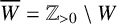
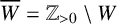
$\overline W=\mathbb Z_{>0}\setminus W$
 . Suppose that there exist elements
$a_1<a_2<\cdots $
 of
$\overline W$
 , an integer
$K\geq 0$
 and an integer
$T\geq 3$
 such that

and

Then, for every integer
$h\geq 1$
 , the set W admits no minimal h-fold additive complement in
$\mathbb Z$
 .
The combinatorial threshold driving Theorem 1.1 is explicit. When a bounded window contains at most K holes in
$\overline W$
 and each private representation carries one of h possible multiplicities, the pigeonhole threshold is given by

Specifically, among
$\Phi (K,h)$
 private elements, at least
$K+1$
 must share the same multiplicity. Once the divergence of the gaps forces these
$K+1$
 corresponding representation differences into a single K-point hole window, a collision becomes unavoidable, destroying the minimality hypothesis. This quantitatively recovers and broadens the Chen–Ding nonexistence theorem [Reference Chen and Ding4] as the special case
$h=1$
 .
The remainder of this article is organised as follows. Section 2 establishes the notational framework, formulates the multi-term private-representation lemma and proves the finite-fold pigeonhole threshold. Section 3 provides the complete, exhaustive proof of Theorem 1.1. Finally, Section 4 presents immediate corollaries recovering classical results, constructs a concrete example of higher-order nonexistence and concludes with open questions for future investigation.
2 Preliminaries and private representations
The aim of this section is to isolate the two facts that drive the proof. The first is algebraic: minimality of an h-fold complement provides private integers, but a private integer may use the essential element several times. The second is combinatorial: once the multiplicity is fixed, the one-dimensional pigeonhole argument is restored.
For a subset
$X\subseteq \mathbb Z$
 and an integer
$m\geq 1$
 , define

and set
$0X=\{0\}$
 . Thus,
$hC+W=\mathbb Z$
 means that every integer n admits a representation

A set C is a minimal h-fold additive complement to W if
$hC+W=\mathbb Z$
 and
$hC'+W\neq \mathbb Z$
 for every proper subset
$C'\subsetneq C$
 .
Lemma 2.1 (Private representations).
Let
$h\geq 1$
 . Let
$C,W\subseteq \mathbb Z$
 and suppose that C is a minimal h-fold additive complement to W. For every
$c\in C$
 , there exist an integer
$n_c$
 , an integer
$r_c$
 with
$1\leq r_c\leq h$
 , an element
$B_c\in (h-r_c)(C\setminus \{c\})$
 and an element
$w_c\in W$
 such that

If
$N_c=n_c-B_c$
 , then
$ N_c=r_c c+w_c, $
 and
$ N_c-r_c y\notin W $
 for every
$y\in C\setminus \{c\}$
 . Consequently, if
$W\subseteq \mathbb Z_{>0}$
 and
$N_c-r_c y>0$
 , then
$ N_c-r_c y\in \mathbb Z_{>0}\setminus W. $

Proof. Fix
$c\in C$
 . Since C is minimal, the proper subset
$C\setminus \{c\}$
 is not an h-fold additive complement to W. Hence, there exists an integer
$n_c$
 such that

However,
$hC+W=\mathbb Z$
 , so there are
$x_1,\ldots ,x_h\in C$
 and
$w_c\in W$
 with

If none of the
$x_i$
 were equal to c, then
$x_1+\cdots +x_h\in h(C\setminus \{c\})$
 , and this would put
$n_c$
 in
$h(C\setminus \{c\})+W$
 , contrary to the choice of
$n_c$
 . Therefore, at least one of the
$x_i$
 is equal to c. Let
$r_c$
 be the number of indices i for which
$x_i=c$
 . Then,
$1\leq r_c\leq h$
 . Let
$B_c$
 be the sum of the remaining
$h-r_c$
 terms. Every term contributing to
$B_c$
 lies in
$C\setminus \{c\}$
 , so
$B_c\in (h-r_c)(C\setminus \{c\})$
 and
$ n_c=B_c+r_c c+w_c. $
 Put
$N_c=n_c-B_c$
 . Then,
$N_c=r_c c+w_c$
 .
Now, let
$y\in C\setminus \{c\}$
 . Suppose, to obtain a contradiction, that
$N_c-r_cy\in W$
 . Since
$B_c$
 is a sum of
$h-r_c$
 elements of
$C\setminus \{c\}$
 and
$r_cy$
 is a sum of
$r_c$
 elements of
$C\setminus \{c\}$
 , the integer
$B_c+r_cy$
 belongs to
$h(C\setminus \{c\})$
 . Hence,

belongs to
$h(C\setminus \{c\})+W$
 , which contradicts the defining property of
$n_c$
 . Thus,
${N_c-r_cy\notin W}$
 . If
$W\subseteq \mathbb Z_{>0}$
 and
$N_c-r_cy>0$
 , then the positive integer
$N_c-r_cy$
 lies in
$\mathbb Z_{>0}\setminus W$
 .
Lemma 2.2 (Finite-fold pigeonhole threshold).
Let
$K\geq 0$
 and
$h\geq 1$
 be integers. Among
$hK+1$
 objects, each labelled by one of the labels
$1,\ldots ,h$
 , at least
$K+1$
 objects have the same label. If
$K+1$
 integers all belong to a set of cardinality at most K, then two of the integers are equal.
Proof. If each of the h labels occurred at most K times, then the total number of objects would be at most
$hK$
 , which contradicts the existence of
$hK+1$
 objects. Thus, some label occurs at least
$K+1$
 times. The second assertion is the usual pigeonhole principle: an injective map from a set of cardinality
$K+1$
 to a set of cardinality at most K cannot exist.
3 Proof of the main theorem
We now prove Theorem 1.1. While our proof architecture builds upon the private-integer framework, we introduce a crucial methodological refinement: we stratify the private representations by the exact algebraic multiplicity
$r\in \{1,\ldots ,h\}$
 with which an essential element c appears. Consequently, all analytical inequalities are formulated in terms of the multiplicity-weighted elements
$rc$
 . This algebraic scaling is precisely where the finite-fold nature of the theorem manifests within the one-dimensional gap estimates, ultimately driving the combinatorial threshold
$\Phi (K,h)$
 .
Proof of Theorem 1.1.
Assume, for contradiction, that there is a minimal h-fold additive complement C to W. Since
$\inf W=1$
 , we have
$W\subseteq \mathbb Z_{>0}$
 . The hypotheses imply
$K\geq 3$
 , since
$a_{t-1},a_t,a_{t+1}$
 all belong to
$\overline W\cap (a_{t-2},a_{t+2})$
 for every
$t\geq T$
 . We first prove that
$\inf C=-\infty $
 . If
$\inf C=m$
 for some integer m, then every element of
$hC$
 is at least
$hm$
 and every element of
$hC+W$
 is at least
$hm+1$
 . This is impossible because
$hC+W=\mathbb Z$
 . Therefore, C is unbounded below.
After discarding finitely many elements if necessary, enumerate the elements of
${C\cap (-\infty ,-a_3)}$
 in strictly decreasing order,
$ c_1>c_2>\cdots. $
 For each
$s\geq 1$
 , apply Lemma 2.1 to
$c_s$
 . We obtain integers
$n_s$
 ,
$r_s\in \{1,\ldots ,h\}$
 ,
$B_s\in (h-r_s)(C\setminus \{c_s\})$
 and
$w_s\in W$
 such that, with
$N_s=n_s-B_s$
 ,

and

Since the set of possible values of
$r_s$
 is finite, there exists an integer
$r\in \{1,\ldots ,h\}$
 such that
$r_s=r$
 for infinitely many s. Let
$ e_1>e_2>\cdots $
 be the subsequence of the
$c_s$
 for which
$r_s=r$
 , still written in decreasing order. For each m, let
$n_m$
 ,
$N_m$
 ,
$B_m$
 and
$w_m$
 denote the corresponding private data, so that


Because
$e_m\to -\infty $
 , after discarding finitely many initial terms, we may assume that
$-r e_m\geq a_2$
 for every m. For each m, there is then a unique integer
$u_m\geq 2$
 such that

The sequence
$u_m$
 tends to infinity. Indeed, if
$u_m$
 were bounded along an infinite subsequence, then
$-r e_m$
 would be bounded above along that subsequence by one of the finitely many corresponding
$a_u$
 , which contradicts
$e_m\to -\infty $
 .
Define

By (3.3), both
$\alpha _m$
 and
$\beta _m$
 are nonnegative integers, and
$\beta _m>0$
 unless
$-re_m=a_{u_m}$
 , which cannot occur because the right inequality in (3.3) is strict. We split into three exhaustive cases.
First, suppose that

Since the
$\alpha _m$
 are nonnegative integers,
$\rho $
 is a nonnegative integer and the set

is infinite. Fix
$m_0\in H$
 and write
$N=N_{m_0}$
 . Since
$e_m\to -\infty $
 , there exists
$M_1>m_0$
 such that

for all
$m\in H$
 with
$m\geq M_1$
 . Since
$a_{t+1}-a_t\to \infty $
 and
$u_m\to \infty $
 , there exists
$M_2\geq M_1$
 such that, for all
$m\in H$
 with
$m\geq M_2$
 , we have
$u_m\geq T$
 and

Let
$m\in H$
 with
$m\geq M_2$
 . Because
$m>m_0$
 , the elements
$e_m$
 and
$e_{m_0}$
 are distinct. From (3.2), with
$y=e_m$
 , and from (3.5), we get

Since
$m\in H$
 , (3.4) gives

Using the first inequality in (3.6),

Adding
$N+\rho +a_{u_m-2}$
 to both sides gives
$ N+a_{u_m-1}+\rho>a_{u_m-2}. $
 Together with (3.8), this is

Using the second inequality in (3.6),

Since
$a_{u_m}>a_{u_m-1}$
 and
$|N|\geq N$
 , this implies

From (3.7), (3.9) and (3.10), we have proved that, for every fixed
$m_0\in H$
 , there exists
$M(m_0)$
 such that

whenever
$m\in H$
 and
$m\geq M(m_0)$
 .
Choose
$K+1$
 distinct indices
$m_{0,1},\ldots ,m_{0,K+1}$
 in H. Since H is infinite, we may choose
$m\in H$
 so large that

Then, (3.11) gives

The latter set has cardinality at most K by the hypothesis of the theorem. Hence, by Lemma 2.2, two of these
$K+1$
 integers are equal. Thus, there exist
$1\leq j_1<j_2\leq K+1$
 such that
$ N_{m_{0,\, j_1}}-r e_m=N_{m_{0,\, j_2}}-r e_m $
 and, hence,

By (3.1),
$ N_{m_{0,\, j_2}}=r e_{m_{0,\, j_2}}+w_{m_{0,\, j_2}}. $
 Substituting this into (3.12) yields

The element
$e_{m_{0,\, j_2}}$
 is not equal to
$e_{m_{0,\, j_1}}$
 . Also,
$B_{m_{0,\, j_1}}\in (h-r)(C\setminus \{e_{m_{0,\, j_1}}\})$
 . Therefore,
$B_{m_{0,\, j_1}}+r e_{m_{0,\, j_2}}$
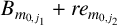 belongs to
$h(C\setminus \{e_{m_{0,\, j_1}}\})$
 . Since
$n_{m_{0,\, j_1}}=B_{m_{0,\, j_1}}+N_{m_{0,\, j_1}}$
 , (3.13) gives

which contradicts the private choice of
$n_{m_{0,\, j_1}}$
 . This contradiction disposes of the first case.
We may now assume that

Suppose next that

Since the
$\beta _m$
 are positive integers,
$\ell $
 is a positive integer and the set
$ L=\{m:\beta _m=\ell \} $
 is infinite. Fix
$m_0\in L$
 and set
$N=N_{m_0}$
 . As before, there exists
$M_1>m_0$
 such that

for all
$m\in L$
 with
$m\geq M_1$
 . Since
$u_m\to \infty $
 and the gaps
$a_{t+1}-a_t$
 tend to infinity, there exists
$M_2\geq M_1$
 such that, for all
$m\in L$
 with
$m\geq M_2$
 , we have
$u_m\geq T$
 and

Let
$m\in L$
 with
$m\geq M_2$
 . Since
$m>m_0$
 , we may use (3.2) with
$y=e_m$
 ; together with (3.14), it gives

Because
$m\in L$
 , we have

The first inequality in (3.15) gives

Adding
$N-\ell +a_{u_m-1}$
 to both sides gives
$ N+a_{u_m}-\ell>a_{u_m-1}. $
 Using (3.17), this becomes

For the upper bound, observe that

Since
$|N|+\ell \geq N-\ell $
 , we obtain

From (3.16), (3.18) and (3.19), for every fixed
$m_0\in L$
 , there exists
$M(m_0)$
 such that

whenever
$m\in L$
 and
$m\geq M(m_0)$
 .
Choose
$K+1$
 distinct indices
$m_{0,1},\ldots ,m_{0,K+1}$
 in L, and choose
$m\in L$
 so large that

By (3.20), the
$K+1$
 integers
$N_{m_{0,\, j}}-r e_m$
 all lie in
$\overline W\cap (a_{u_m-2},a_{u_m+2})$
 , which has cardinality at most K. Hence, by Lemma 2.2, there exist indices
$1\leq j_1<j_2\leq K+1$
 such that

Cancelling the common integer
$r e_m$
 gives
$ N_{m_{0,\, j_1}}=N_{m_{0,\, j_2}}. $
 Using (3.1) for
$m_{0,\, j_2}$
 , we obtain

Since
$j_1\neq j_2$
 , the elements
$e_{m_{0,\, j_1}}$
 and
$e_{m_{0,\, j_2}}$
 are distinct. The element
$B_{m_{0,\, j_1}}$
 is a sum of
$h-r$
 elements of
$C\setminus \{e_{m_{0,\, j_1}}\!\}$
 , and
$r e_{m_{0,\, j_2}}$
 is a sum of r elements of
$C\setminus \{e_{m_{0,\, j_1}}\!\}$
 . Thus,
$B_{m_{0,\, j_1}}+r e_{m_{0,\, j_2}}\in h(C\setminus \{e_{m_{0,\, j_1}}\!\})$
 and, therefore,

This contradicts the private choice of
$n_{m_{0,\, j_1}}$
 . Thus, the second case is impossible.
It remains to consider the case

Choose arbitrary distinct indices
$m_{0,1},\ldots ,m_{0,K+1}$
 and put

By (3.21) and
$u_m\to \infty $
 , there exists m larger than all the
$m_{0,\, j}$
 such that
$u_m\geq T$
 and

For every j, since
$m>m_{0,\, j}$
 , (3.2) with
$y=e_m$
 applies. We first show that the relevant differences are positive and lie in a bounded window. From
$\alpha _m=-r e_m-a_{u_m-1}>Q\geq |N_{m_{0,\, j}}|$
 , we obtain
$ -r e_m>a_{u_m-1}+|N_{m_{0,\, j}}|. $
 Adding
$N_{m_{0,\, j}}$
 gives

From
$\beta _m=r e_m+a_{u_m}>Q\geq |N_{m_{0,\, j}}|$
 , we obtain
$ -r e_m<a_{u_m}-|N_{m_{0,\, j}}|. $
 Adding
$N_{m_{0,\, j}}$
 gives

Equations (3.22) and (3.23) show in particular that
$N_{m_{0,\, j}}-r e_m>0$
 . Hence, (3.2) gives

for all
$1\leq j\leq K+1$
 . The final set has cardinality at most K, so by Lemma 2.2, there exist indices
$1\leq j_1<j_2\leq K+1$
 such that

Cancelling
$r e_m$
 gives
$N_{m_{0,\, j_1}}=N_{m_{0,\, j_2}}$
 . Equation (3.1), applied to
$m_{0,\, j_2}$
 , gives

The indices
$j_1$
 and
$j_2$
 are distinct, so
$e_{m_{0,\, j_2}}\neq e_{m_{0,\, j_1}}$
 . Consequently,
$B_{m_{0,\, j_1}}+r e_{m_{0,\, j_2}}$
 is an element of
$h(C\setminus \{e_{m_{0,\, j_1}}\!\})$
 . Since
$n_{m_{0,\, j_1}}=B_{m_{0,\, j_1}}+N_{m_{0,\, j_1}}$
 , we have

which contradicts the private choice of
$n_{m_{0,\, j_1}}$
 .
The cases exhaust the possibilities and all lead to contradictions. Therefore, no minimal h-fold additive complement to W exists.
4 Consequences, examples and open questions
In this final section, we explore the ramifications of Theorem 1.1. We first derive two immediate corollaries: Corollary 4.1 demonstrates that the four-neighbourhood hypothesis quantitatively subsumes the Chen–Ding [Reference Chen and Ding4] sparse-hole condition as the special case
$h=1$
 , while Corollary 4.2 formally establishes the structural irreducibility of finite-fold minimality compared with ordinary sumsets. Furthermore, we construct an explicit example illustrating higher-order nonexistence in exponential sequences, and we conclude by formulating open questions concerning optimal quantitative thresholds and coordinate minimality.
Corollary 4.1 (Finite-fold Chen–Ding obstruction).
Let
$W\subseteq \mathbb Z$
 satisfy
$\inf W=1$
 and write
$\overline W=\mathbb Z_{>0}\setminus W=\{\overline w_1<\overline w_2<\cdots \}$
 . Suppose that there are indices
${i_1<i_2<\cdots }$
 such that, with
$a_t=\overline w_{i_t}$
 ,
$ a_{t+1}-a_t \to +\infty $
 and
$ \limsup _{t\to \infty } |\overline W\cap (a_t,a_{t+1})|<+\infty. $
 Then, for every
$h\geq 1$
 , the set W has no minimal h-fold additive complement. In particular, the case
$h=1$
 recovers the nonexistence conclusion of Chen and Ding.
Proof. Choose an integer
$K_0$
 and an integer
$T_0$
 such that

For
$t\geq T_0+2$
 , the interval
$(a_{t-2},a_{t+2})$
 is the disjoint union of the four open intervals

together with the three selected points
$a_{t-1},a_t,a_{t+1}$
 . Each open interval contains at most
$K_0$
 elements of
$\overline W$
 , and the three selected points belong to
$\overline W$
 . Therefore,

Theorem 1.1 applies with
$K=4K_0+3$
 .
Corollary 4.2 (No coordinate-minimal diagonal finite-fold complement).
Under the hypotheses of Theorem 1.1, there is no set
$C\subseteq \mathbb Z$
 for which the diagonal finite-fold sum
$C+\cdots +C+W$
 equals
$\mathbb Z$
 and remains minimal under deletion of elements from the diagonal set C.
Proof. This statement is a direct reformulation of Theorem 1.1 in the explicit language of diagonal multi-term sumsets. To see the necessity of stating this independently of the classical case
$h=1$
 , observe that minimality here is defined with respect to the source set C, not the iterated sumset
$hC$
 . Suppose, for contradiction, that such a coordinate-minimal set C exists. Even if the sumset
$D=hC$
 is viewed as an ordinary additive complement to W satisfying
$D+W=\mathbb Z$
 , a proper sub-complement of D is generally not of the restricted diagonal form
$hC'$
 with
$C'\subsetneq C$
 . Therefore, the nonexistence of coordinate-minimal diagonal complements is a structurally distinct phenomenon that cannot be formally deduced from the classical one-fold obstruction.
Example 4.3. Let

Then,

For
$k\geq 1$
 , set
$ a_k=2^k+8. $
 Each
$a_k$
 belongs to
$\overline W$
 and

Moreover, for
$k\geq 3$
 , the interval
$(a_{k-2},a_{k+2})$
 can meet only the four blocks

The lower endpoint
$a_{k-2}=2^{k-2}+8$
 excludes all earlier blocks and the upper endpoint
$a_{k+2}=2^{k+2}+8$
 excludes the last point of the fourth displayed block. Hence,

Theorem 1.1 therefore implies that for every
$h\geq 1$
 , there is no minimal h-fold additive complement C with
$hC+W=\mathbb Z$
 .
For
$h=1$
 , this is the Chen–Ding example [Reference Chen and Ding4]. For
$h\geq 2$
 , the conclusion lies outside the ordinary minimal-complement statements: those results concern subsets D satisfying
$D+W=\mathbb Z$
 , whereas the present assertion concerns deletion from a set C before the finite-fold sum
$hC$
 is formed.
Question 4.4. Can the four-neighbourhood bound in Theorem 1.1 be replaced by the sharper one-window count appearing in Chen and Ding’s proof [Reference Chen and Ding4] while retaining an explicit finite-fold threshold depending only on h and that single-window bound?
Question 4.5. Is there a nontrivial asymptotic growth threshold for the local density
$|\overline W\cap (a_t,a_{t+1})|$
 , depending only on W and the selected gap sequence, which still prevents the existence of minimal finite-fold additive complements?
A positive answer to Question 4.5 cannot be deduced from the present pigeonhole architecture alone. If the local hole density is unbounded, the required combinatorial threshold
$\Phi (K_t,h)$
 becomes dynamic and grows with t. This creates a quantifier-inversion difficulty: an unbounded local count would have to be compared against the number of available private representations before a single, sufficiently negative translate is selected. Developing an asymptotic obstruction will therefore require a new mechanism to handle multi-term representation collisions without a static pigeonhole box.
Question 4.6. For ordered multi-term additions
$C_1+\cdots +C_h+W=\mathbb Z$
 , what structural conditions on W prevent simultaneous coordinate minimality, in the sense that no coordinate set
$C_j$
 can be properly thinned while all other coordinates remain fixed?
The private-representation framework developed in Section 2 should theoretically extend to any coordinate
$C_j$
 whose essential elements are unbounded below. However, in an asymmetric multi-term sumset, the coupling between distinct coordinate sets creates complex boundary interference. Determining the optimal geometric and combinatorial formulation required to trap these asymmetric private differences inside a single bounded window of holes remains an intriguing open problem.
Acknowledgement
The author would like to express his sincere gratitude to the anonymous referee for the careful reading of the manuscript and highly encouraging comments.



