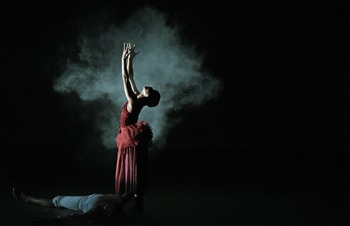
Barefoot and bare chested, arms precision punching through the air, legs slicing and stomping in time … this ain't your mama's Giselle. In 2017, Dada Masilo created her fourth contemporary revision of a classic ballet. The work features a Black cast of diverse body types, a male Queen Myrtha, male and female wilis, and a Giselle that does not forgive. I examine Dada Masilo's Giselle not simply for how it differs from the Giselle performed by ballet companies, but for the ways that it centers African and diasporic practices and philosophies within contemporary dance choreography. Dada Masilo was born in 1986 in the Johannesburg township of Soweto (Vernon Reference Vernonn.d.). In 2006, Masilo received South Africa's Gauteng Arts and Culture Award for the Most Promising Female Dancer in a Contemporary Style, and in 2008 she was the Standard Bank Young Artist of the Year (Van Wyk Reference Van Wyk and Friedman2012). She choreographed a contemporary Romeo and Juliet in 2008, Carmen in 2009, and Swan Lake in 2010 (Sulcas Reference Sulcas2016). In 2017, she debuted her rendition of Giselle at South Africa's National Arts Festival. I offer an Africanist reading of Dada Masilo's Giselle that is necessarily polycentric—observing how the choreography achieves many distinct but interrelated objectives at once. I argue that this work transforms Giselle by embodying Indigenous principles and practices of sociality, gender, and sexuality, as a form of decolonial love that transcends the romantic love of the original tale, to center Indigenous freedom and joy in a violently colonized world (Simpson Reference Simpson2013).
Giselle epitomizes the Romantic Era of nineteenth-century Western Europe, portraying unrequited love that draws the title character to madness, metaphysical realms and beings, and representations of idealized and demonized femininity (Sowell Reference Sowell2011). Giselle is a Pan-European creation drawn from German poet Heinrich Heine's poem “De l'Allemagne,” inspired by a Slavic legend about wilis—vampiric entities born of the pain of betrayed women. Inspired by Heine's poem and Victor Hugo's “Fantômes,” French librettists Jules-Henri Vernoy de Saint Georges and Théophile Gautier dreamed up a story in which a girl, betrayed by her forbidden lover, dies of a broken heart, but through undying love, is able to save him from the vengeful wilis. In doing so, she saves herself from becoming one (Schwarm Reference Schwarmn.d.). Frenchmen Jean Coralli and Jules Perrot choreographed the ballet with original music by Adolphe Adam, and the revisions made by Marius Petipa between 1884 and 1903 are still widely performed (Marius Petipa Society 2016).
Dada Masilo's Giselle has audiences cheering not for the heroine's selflessness but for her self-determination. In her version of the story, Giselle is abandoned by her community but embraced by the wilis, who help her exact revenge on her formerly beloved Albrecht. Although she does die of a broken heart, in the ancestral realm she becomes more powerful than in life. The combination of strong, precise, brilliantly executed movement with an empowering narrative makes the performance electric. By transforming Giselle from a frail victim of unconditional love to a powerful African ancestor, Masilo creates a heroine that is both familiar and fantastical. It is important to note that the movement vocabulary of her production is not ballet. Masilo sources footwork of South African Tswana dances, American and European modern and postmodern dance vocabularies, pedestrian gestures, and her own movement creations. Reinvented by Masilo, Giselle's self-love, forged in relation with Indigenous and diasporic traditions, turns the European romance into a decolonial love story.
Decolonizing through Ballet
In “Ballet Blanc to Ballet Black: Performing Whiteness in Post-Apartheid South African Dance,” Steven Van Wyk introduces a critique of whiteness as an aesthetic that assumes that a Eurocentric artistic perspective is both preferred and universally understood. He explains, “Under British colonial rule, South Africa inherited ballet, as well as western European ideas of the body that came with it. Ballet is implicated in the ‘civilizing process’ of colonial culture, providing one model that could be employed in attempts to control, regulate and outlaw the overtly erotic and disorderly ‘native’ dances” (Reference Van Wyk and Friedman2012, 39). The Dutch and British were political and economic enemies in the colonial era, but after the Dutch rebranded themselves Afrikaners, their apartheid system initiated a white brotherhood between these culturally distinct peoples. Whiteness could therefore transcend differences in language and cultural practices by subsuming them under the illusion of superiority guaranteed through skin color. Maintaining a colonial mentality throughout the apartheid era (roughly 1948–1994), many arts presenters still preferred anything European to anything not, and when presenters allowed expressions of Indigenous culture, they were expected to buttress notions of the “savage African” and the “civilized European.”
In contrast to the historic mobilization of ballet as a colonizing embodiment, I argue that Masilo's choreography activates what Maori activist and scholar Linda Tuhiwai Smith calls “decolonizing methodologies.” Smith writes, “Coming to know the past has been part of the critical pedagogy of decolonization. To hold alternative histories is to hold alternative knowledges.… Transforming our colonized views of our own history (as written by the West), however, requires us to revisit site by site, our history under Western eyes” (Smith 2012, 36). To revisit a Western practice and understand its foreignness in a colonized space, suggests a recognition of ballet's troubled past and its radical potential as a set of narratives and movements that can be remixed to more aptly reflect the environment in which they are produced. Revising Giselle creates an alternative way of understanding its history, and Masilo's diverse use of movement vocabularies tells a history of its own. Although governments, presenters, and educators have used ballet in South Africa to culturally colonize dance artists and audiences (Van Wyk Reference Van Wyk and Friedman2012), Dada Masilo's Giselle decolonizes through ballet by transforming oppressive narratives into empowering ones and incorporating Indigenous South African traditions and ideologies. Rather than accepting ballet's stories and aesthetics unchallenged, Masilo revisits and transforms them scene by scene, through casting and choreographic choices.
In 2017, Dada Masilo's Giselle debuted in the National Arts Festival at Rhodes University Theatre in Makhanda (formerly known as Grahamstown), in the Eastern Cape province of South Africa. Rhodes University drama professor Anton Krueger explains that the production was particularly charged because the festival's theme was “Disruption,” in response to the prior year's massive student protests. #RhodesMustFall called for the decolonization of South Africa's university education, and #FeesMustFall protested a proposed tuition increase that would have a disproportionately negative effect on students of color. Krueger explains that the protests engendered a contagious feeling of hope. “It felt as though there was a buoyant mood, particularly among enthusiastic young black theatre-makers.… There was an expectant energy in the air, an eagerness to fight for a just cause, ready to right wrongs and do battle against racism, inequality and gender violence” (Krueger Reference Krueger2018, 203).
Viewing performance as a creative act rather than a representative one insinuates a radical potential akin to protest. As Masilo described in an interview during the festival, “In the world that we're living in now there's so much disruption. There's so much chaos happening and I think that the Giselle I made kind of fits very well into what is happening in the world” (CueTV 2017). Masilo's Giselle character is a woman of her own mind and body, so the 2017 performance was particularly resonant in light of the numerous acts of violence against women being reported regularly across the nation (Amnesty International n.d.), including on the Rhodes University campus where the piece was presented (Kwoba, Chantiluke, and Nkopo Reference Kwoba, Chantiluke and Nkopo2018). This atmosphere of racial tension, misogyny, and resistance permeated the campus and its theater. Krueger writes:
Dada Masilo's new ballet responded directly to the other major student protests held last year, the uprisings against what has come to be called “Rape Culture.” … Masilo's piece is not about reconciliation, it does not hope for a harmonious, syncretic rainbow nation like so many plays of the 1990s; but rather, as Masilo said in an interview … her production is about “betrayal and revenge.” (Krueger Reference Krueger2018)
Just as Coralli and Perrot's Giselle was a feminine archetype of their romantic era, Masilo's Giselle represents an ideal South African woman in the #Fall era. Her Giselle is not interested in following rules or offering herself as sacrifice. She is determined, and her vengeance reflects the anger of a generation experiencing the socioeconomic failures of Truth and Reconciliation. The choreographic strategies Masilo activates to create her heroine circulate within the African diaspora.
Choreographic Signifyin(g): How Africana Dance Talks Back
Dada Masilo's Giselle enacts a linguistic technique observed in African America and practiced in several colonized African spaces. Signifyin(g) means taking a word or phrase and using it with its original meaning and/or a new one, amplifying its meaning. In Talkin and Testifyin: The Language of Black America, Geneva Smitherman establishes eight characteristics of signifyin(g) (Smitherman Reference Smitherman1986, 121). These can be observed in Masilo's choreography.Footnote 1 The application of an African American practice to a South African context is appropriate, considering how in both countries, literature and dance create and convey meaning within the systematic polarization of Black and white cultures. Additionally, South African political theories and aesthetics have been influenced by oscillating interactions with African America and the Afro-Caribbean for decades (Biko Reference Biko2002). Despite spatial segregation and differences in cultural traditions, European and African epistemologies have been enmeshed for centuries, and in fact rely on one another to exist as maneuverable ideologies within the construct of race in all settler-colonial spaces (Gates Reference Gates1989, 66). Signifyin(g), whether verbally or physically, demonstrates the co-creation of racialized cultures, as a colonial language can be used by the colonized with various and even oppositional meanings. Decolonizing in dance is therefore not only done by sourcing Indigenous traditions, but by signifyin(g) on the ways that modern Indigenous and settler cultures are co-created under a paradigm of white supremacy and resistance to it.
In words and movement, the interweaving, embodied universes of African and European cultures relate through contrast, conflict, co-creation, and collaboration. In The Signifying Monkey: A Theory of African-American Literary Criticism, Henry Louis Gates Jr. applies Smitherman's verbal theory to literature, offering an analysis that points to its broader implications. Gates explains that “free of the white person's gaze, black people created their own unique vernacular structures and relished in the double play that these forms bore to white forms. Repetition and revision are fundamental to black artistic forms, from painting and sculpture to music and language use” (Gates Reference Gates1989, 19). Here, the repetition of the Giselle narrative structure is obvious, but the changes can be understood not only as moving from classical to contemporary dance or from a white cast to a Black one. Dada Masilo's Giselle talks back to the tradition with a knowing wit, signifyin(g) on it—nudging the viewer to revisit the tradition with an Africanist lens because “black formal repetition always repeats with a difference” (Gates Reference Gates1989, 17). Masilo uses the story of Giselle but not the movement of ballet. Her characters maintain their general identities, but their humor, formations, movement vocabularies, vocalizations, and performances of gender identity are distinctly South African.
Indigenizing Foreign Influence into Local Resonance
The 1970s saw the establishment of the Black Consciousness movement in South Africa. This, along with the international use of the term Black as a marker of African ancestry, diasporic cultural practices that survived slavery, and shared experiences of anti-Black racism, affirms Blackness as a sociopolitical orientation rather than an ethnicity. I use the term Indigenous when describing precolonial practices and perspectives that continue to help shape practices and perspectives of people racialized as Black. When available and appropriate, I refer to theories and practices of specific ethnic groups. In what follows, I explain how Giselle becomes indigenized.
The Merriam-Webster dictionary defines indigenize as “to cause to have Indigenous characteristics or personnel” (Merriam-Webster n.d.), whereas Oxford's Lexico.com explains it is to “bring (something) under the control, dominance, or influence of the people native to an area” (Lexico n.d.). Dada Masilo's Giselle gives Indigenous characteristics to the ballet, bringing it under the control and influence of Black South Africans. Smith includes indigenizing as one of twenty-five Indigenous projects being undertaken by scholars and activists. She describes indigenizing as a “centering in consciousness of the landscapes, images, languages, themes, metaphors and stories of the indigenous world” (Smith Reference Smith2002, 147). Masilo's transformation of Giselle's setting, music, language, technique, and plot do exactly that.
Dada Masilo's Giselle begins to transform the ballet immediately with a backdrop suggesting a South African metropolis. The appreciation of the natural world common during Europe's Romantic Era is usually represented in elaborate lifelike painted cycloramas of natural settings (Sowell Reference Sowell2011). In contrast, Masilo's production opens with William Kentridge's beautiful black-and-white illustration of a lagoon surrounded by oil wells and other signs of industrial life and waste. The setting is at once archaic and modern. By fusing pond reeds with iron towers, the viewer is immediately confronted with the conflations characterizing South Africa as a highly developed and deeply impoverished country. It is a near-impressionistic rendering of a postcolonial aesthetic, which diffuses the production.
Dada Masilo's Giselle opens with a scene that is both ancient and ongoing. Several dancers are bending low or laboring on the ground. Dancers exactly emulate the gestures and movement qualities of scrubbing and sweeping floors—one even has a broom. Their steps are heavy. The cast is dressed in khaki-colored skirts and pants, with classic white peasant blouses, but jobs are not divided by gender. Masilo indigenizes Giselle by speaking to and through the local and making it resonate with a Black South African experience of labor. They seem exhausted and burdened.
As I sat in theaters in Makhanda, New York, and Los Angeles, I could not help but notice the spectacle of Black bodies toiling on stage in the context of Black bodies toiling on American plantations and South African mansions—each city built by Black and Brown labor, each city built on the bones of Black and Brown bodies, one generation after another. To see Black bodies laboring on stage and not hiding the effort invites audiences to confront the arduous exploited labor of Black bodies in South Africa and globally, on stage, backstage, and offstage. It also subtly suggests the parallels between European peasants and colonized Africans. South African casts and audiences are likely conscious of the perils of classism and racism, and this initial scene is haunted by both, without making an outright statement about either. As the scene continues, dancers refuse to be disciplined, but their Indigenous methodology is subtle and comical.
South African Sociality: Comedic Refusal & Code Switching
Dada Masilo's Giselle combats historic and ongoing efforts to pacify and demobilize African culture through comedic refusal and code-switching. These subtle and overt words and gestures perform what I term South African sociality: Indigenous social practices developed for collaborative intra-ethnic and inter-ethnic communication, and later mobilized against colonialism and apartheid. Comedic refusal describes those moments when someone refutes authority in a playful or humorous manner—even if there may be deadly risks involved. In Dada Masilo's Giselle, I understand the moment when the peasant characters refuse to obey as more than just a bit of frivolous comedy. I read this refusal as a nod to Black rebellion.
As Giselle and her working-class counterparts toil across the downstage space, two dreadlocked performers enter from upstage left. Princess Bathilde is performed by Liyabuya Gongo. Gongo and her male assistant are both dressed in knee-length, sleeveless, blue velvet coats that are open down the front. Underneath it, Gongo wears a blue velvet corset with gold trim that starts outside her breasts and narrows down toward her midline, accentuating her hourglass frame. She dons a full white skirt and blue velvet pumps. Her assistant wears a white top with billowing arms and pants that shape his legs to mid-calf. Their costumes identify their high status but do not guarantee their power. Expecting official acknowledgement from the peasants, they stand and wait, as the scene is noisy with chatter. Then an officer of the royal court enters, and the dancers, busily engaged with each other, ignore his call to attention. He hails them again. They continue keeping to themselves until he yells at them to “shut up!” shaking two fists in the air.
This scene differs from other versions of the ballet by asserting the will of the people through comedic refusal. In the ballet, dancers would immediately bow and perhaps even cower when faced with royalty. Here, the dancers seem utterly uninterested in the princess and her court. After ignoring them completely, the peasantry responds reluctantly, more so to stop the nuisance of the screaming officer than out of any real deference. This utter disregard for the authority they do not recognize strongly resembles the speech and actions of anti-apartheid activists in their risky, relentless, and often artistic and comedic refusals to cooperate with apartheid (Hirsch Reference Hirsch2003).
The performers also reflect South African sociality in their use of verbal and embodied code-switching. In linguistics, code-switching means to alternate between two or more languages or dialects, often to assimilate to or resist a dominant culture. Code-switching reflects inter-ethnic and geographic diversity in South Africa, where many citizens belong to multiple cultural groups simultaneously. Graceful switching is frequently executed in a country with eleven official languages. In the ensemble phrase that occurs just after the first entrance of the princess, multi- and non-lingual vocalizations cue the group to enter a phrase together. The dancers are verbally and physically multilingual. This scene demonstrates that code-switching is not only relevant for navigating between dominant and oppressed social groups. It also characterizes simultaneous multicultural memberships based on ethnicity and/or rural/urban designations. These affiliations can suggest political alliances, facilitate social mobility, and create practices of inclusion and exclusion. Code-switching is the result of a postcolonial society whereby the system of apartheid that mandated social division inadvertently birthed transgressive forms of intercultural communication (Slabbert and Finlayson Reference Slabbert, Finlayson and Mesthrie2002, 237).
Linguistic code-switching in Dada Masilo's Giselle signifies the multiplicity of the cast and their agency in determining when to speak to which audience. English is a second language for many South Africans; but it should not be misconstrued to be the more important text of the phrase. More accurately, I think it represents a rupture between the moments of “dancing for ourselves” and “dancing for you,” the international audience. By 2017, Masilo had already developed a following across Europe and the United States, and probably foresaw the diversity of audiences she would encounter at the National Arts Festival. Skillful code-switching facilitates movement between diverse and increasingly integrated South African spaces (Slabbert and Finlayson Reference Slabbert, Finlayson and Mesthrie2002, 254). The need to bounce between us or them, and us and them, is a survival skill mastered by South Africans through spoken language but also through the arts and quotidian interactions.
The danced code-switching in Dada Masilo's Giselle also demonstrates multicultural membership and fluency. The contemporary dance vocabulary in the first ensemble phrase demonstrates Africanist aesthetics and movement vocabulary that predate, include, and transcend the genre. Contemporary dance discourse tends to promulgate ballet aesthetics in movement even as it defines itself in opposition to ballet philosophically, and this paradox is danced. At one point, the dancers perform a series of turns similar to a ballet pirouette in that they balance on one leg and turn on a single axis without traveling in space. Here, though, the dancers barely lift the bottom heel off the ground as the opposite foot hovers near the knee. They switch direction—clockwise and counterclockwise—several times before pushing the pelvis off-center to the left, forcing the arms to shoot up, leaving the hands to flop downward. After teasing that very brief moment of suspension, they squeeze hands together at chest height before tossing them down and behind the body as the head and left foot reach back. This is followed by a phrase, which alternates between low grounded running steps toward the four corners of the stage and fast, tightly punching arm gestures. Suddenly they arrive in recognizably ballet vocabulary, with the legs and arms in fourth position, but with the rear end pulling back away from the trajectory of the chest as the head darts left to right like a squirrel's. This is an embodied comedic refusal as well. The position expresses a familiarity with the technique of ballet, but a refusal to be confined by it. Within a few seconds, dancers visit ballet, postmodern, and contemporary dance, performing each with Africanist ephebism (Gottschild Reference Gottschild, Dils and Albright2001). Throughout the work, dancers speak to one another and to the audience in multiple languages of the body and voice, amplifying South Africa's rich diversity. This embrace of diversity is also addressed through gender in Masilo's use of locally resonant feminist praxis.
African Feminism: Giselle's Embodied Agency
In her New York Times review, Gia Kourlas writes, “Ms. Masilo's Giselle is a feminist” (Kourlas Reference Kourlas2018). I would say that she is an African feminist. African feminism is enacted and embodied (Rodriguez, Tsikata, and Ampofo Reference Rodriguez, Tsikata and Ampofo2015). The Nigerian chair of gender studies at the University of Cape Town, Amina Mama, states, “Feminism remains a positive and movement-based term, with which I am happy to be identified. It signals a refusal of oppression, and a commitment to struggling for women's liberation from all forms of oppression—internal, external, psychological and emotional, socioeconomic, political and philosophical” (Salo and Mama Reference Salo and Mama2001, 60). I understand the term movement here as both physical enactment and political organizing. Mama's description validates the importance of what is seen, felt, and manifested through a holistic feminist theory. Expressing a similar sentiment, Nigerian American feminist theorist Obioma Nnaemeka explains African feminism as more easily experienced than theorized:
“… the majority of African women are not hung up on ‘articulating their feminism’; they just do it.” In my view, it is what they do and how they do it that provide the “framework”; the “framework” is not carried to the theater of action as a definitional tool. The dynamism of the theater of action with its shifting patterns makes the feminist spirit/engagement effervescent and exciting but also intractable and difficult to name. (Nnaemeka Reference Nnaemeka and Cornwall2005, 32)
Interestingly, like Mama's use of movement, Nnaemeka uses the term theater to describe the performance of everyday life, but it can certainly apply to the “theater of action” known as concert dance. Through dynamic and diverse steps and symbols, Masilo enacts a particular feminism that operates in relation to African philosophies of embodiment wherein dance, music, and theater create and recreate social identities, including gender (Oyěwùmí Reference Oyěwùmí1997). This is an important lens through which to analyze the moving bodies of women and those with nonnormative gender or sexual identities that have been oppressed through bodily means. In Masilo's words, “It was really for me about empowering women—giving them a voice” (Radio France n.d.). Dada Masilo's Giselle enacts an African feminism through sexual agency, gender fluidity, and storytelling.
Masilo's Giselle uses her body to experience pleasure and to establish boundaries. In act 1, Masilo's beloved Albrecht walks across the stage, and a group of women flirt with him. With delicious grins, they stretch their arms toward him, tilting their heads back and letting their jaws fall open seductively as he stumbles back and away from them. They laugh and flick their skirts, performing a series of chassés forward and back, leading with the pelvis. Dancers offstage even join in with teasing sounds. Masilo makes it clear that Albrecht is desirable, but also that women have sexual desire, and agency with that desire. This is not something promoted in nineteenth-century ballets and is a dramaturgical revision that reflects an African feminism. In one reoccurring phrase, Masilo and dancers dash their hands and hips left to right several times before rolling the head and hips in a percussive circle, like hands ticking on a clock. The arms grip the skirts that ride up over the knees as they circle. In a 2018 interview, Masilo explains this gesture she named “the flirt,” saying, “I think that what that movement says about Giselle is that she's not entirely innocent.… I think that she's curious … she's started noticing men you know so she's trying to find herself as a woman … and I guess trying to find herself sexually as well” (Radio France n.d.). By naming the dance “the flirt” and assigning the pelvis-led movements to Giselle, Masilo proposes a character whose sexuality and sexual curiosity are components of her love and devotion but are also aspects of her strength as a person. Masilo's Giselle breaks from the classical Giselle, whose desire leads to her downfall.
In the next scene, Masilo's various forms of undress convey a mosaic notion of Black women's bodies that oscillates between dangerous vulnerability and fierce agency. Albrecht, his admirers, and Giselle exit, and Giselle reenters with her blouse half-open. Khaya Ndlovu, playing Giselle's mother, Berthe, approaches her with a short, handheld stick broom. She uses it to slowly push Giselle down to her knees. She removes Giselle's shirt and swipes the broom down each breast, telling her that they must not grow any more. The mother reprimands her for running wild and reminds Giselle that her destiny is sealed with Hilarion, warning, “I won't run after you. I've chosen someone.” In Western contemporary dance a bare female chest is usually employed to make a critique on Western culture's simultaneous discomfort and obsessive hypersexualization of female breasts. More rarely, women are topless or nude alongside topless or nude men in an attempt to make a gender-neutral work that celebrates the unfettered human form. Here, I sense a different intention is at work.
Berthe's actions communicate the misogyny that is often taught by mother to daughter. Black feminist scholar Patricia Hill Collins outlines this phenomena as a “matrix of domination” to explain coercion and violence against women at the hands of other women as an example of “interlocking systems of oppression where oppressor/oppressed positions shift” (Collins Reference Collins2008). Giselle's sexuality and love life are controlled by her mother, while the men in the story are free to love who they wish. Nonetheless, Giselle seems to heed Nnaemeka's warning that “African women (as daughters) must rethink the hierarchies and ‘privileges’ that subtend the perpetration and perpetuation of woman-on-woman violence as daughters grow up to become wives and widows” (Nnaemeka Reference Nnaemeka and Cornwall2005, 37). Despite the threatening guidance, Giselle willfully defies her mother's plan and pursues her own desires.
Although Masilo's bare chest facilitates a scene of matriarchal domination, it also singles her out as the only character willing to defy social mores in an act of self-determination. Masilo's bare chest conjures a history of embodied defiance (Andrade Reference Andrade, Cole, Manuh and Miescher2007) and points to conflicting worldviews on Black women's nudity. Writing on Senegal's controversial African Renaissance monument and the 2009 proposed Anti-Nudity Bill in Nigeria, gender scholar Ayo Coly argues that
the colonial discourse of clothing worked in tandem with the sexual grammar of the colonial encounter and the inscription of sexual deviance on the black female body to single out the African female body in unique ways that subsequently offered it for grab as a rhetorical element of colonial discourses about Africa. The colonial rhetorical deployment of the African female body to signify Africa led to a postcolonial African angst over the female body and subsequently sealed the fate for the African female body as a rhetorical element of African postcolonial discourses. (Coly Reference Coly2015, 13)
Colonial rhetoric defined foreign land and foreign women as essentially the same imperial conquest (McClintock Reference McClintock1995). Dada Masilo's Giselle counters this rhetoric of African land and African women as one obtainable, disposable entity with the flesh and blood, sweat and soul of dance.
In the scene with her mother, Masilo's breasts are not exposed for audience pleasure, but to situate the character as she would be “back home.” In rural South African communities where Indigenous traditions are more widely and openly practiced, it is more common for young women to not cover their breasts. Being bare breasted here indicates that Giselle is back in her mother's community and under her mother's domain. Dancing bare breasted, Masilo transforms a lovesick Giselle into a proud Tswana woman with all of the conflicting complexities of this postcolonial repertoire. The choreography here embodies decolonial philosophy by problematizing the sexualization of women's breasts and the occupation of Black women's bodies. When Masilo bears her breasts, there is an encounter between precolonial comfort and postcolonial shame. There is a liminal space that can only be understood as the entangled space/time of postcoloniality in which both of these ideologies exist in one body (Mbembe Reference Mbembe2001).
When Berthe exits, Hilarian, played by Tshepo Zasekhaya, arrives. He gives Giselle a flower, and she quickly covers her breasts, smacking the flower away. She screams and smacks him each time he approaches her, filled with rage and having no intention of succumbing to her mother's wishes. He runs off and she begins a pas de deux with her true love, Albrecht (played in New York and Los Angeles by Xola Willie). With her shirt back on but only partly buttoned, she grabs his upper arms and he swings her body in a circle as she extends one leg and bends the other. She lands and he spins her around twice one way and then once the other, until they face each other and press their palms together overhead. With a foot and a half between them, they bend their knees and grind their hips toward each other. Eventually they share a passionate and joyous kiss. He leaves and she falls asleep with a huge grin of satisfaction. Clearly, Masilo's Giselle knows what she wants. She pursues her sexual and romantic desires despite her mother's warning and Hilarion's attempts to court her. Her self-determined passion thrives in the conflict rather than being subsumed by it. Both choreographer and character exhibit various forms of agency by expressing desire and repulsion, obedience and rebellion, creating a dynamic space for feminist movement.
African Feminism: Gender Fluidity
In Dada Masilo's Giselle, Queen Myrtha is an African feminist hero. In the next scene, as if appearing in Giselle's dream, the wilis enter in bloodred velvet corsets and two-tiered red velvet and tulle tutus. Their movements are unpredictable, without a recognizable rhythmic structure, but they dance precisely in unison. Myrtha, Queen of the Wilis, is played by a Black dancer (who reads as male) named Llewellyn Mnguni. Long blond braids whip around their head, mirroring the action of their blond cow-tail whip, or itshoba. The gender fluidity, itshoba, and red dress are all symbols of a sangoma, a Zulu term used inter-ethnically to describe traditional healers in South Africa. I infer that the choice to cast a gender non-conforming person as Queen Myrtha is more than an allusion to drag queens. It may reflect an Indigenous understanding of gender and spirituality.
According to Graeme Reid's ethnography of homosexuality in small towns, sangoma work is the second most popular form of employment for gay men (Reid Reference Reid2013, 28). Several studies suggest global Indigenous beliefs that queer sexuality and gender are manifestations of a liminal space between the mortal and the divine, the living and the ancestors. Some believe that a queer sexual identity facilitates spiritual border crossing as well. Sandra Slater's work on Indigenous North America asserts that “two-spirit individuals often performed important functions in battle as handlers of the bodies of dead warriors” (Slater Reference Slater and Yarbrough2011, 7). This is one example in which nonconforming gender identity is upheld within the society as a role associated with sacred rites of passage into the ancestral realm. Ruth Morgan and Graeme Reid's ethnography of lesbian sangomas found that many explain their sexuality as the desire of the male ancestor that lives through them (Morgan and Reid Reference Morgan and Reid2003). The sangoma therefore mediates between the living and the ancestral, sometimes embodying this liminality through gender identity.
The gender-neutral casting of the wilis promises vengeance to all wronged lovers. Nnaemeka explains that “power-sharing complementarity, accommodation, compromise, negotiation, and inclusiveness form the foundation of African feminism” (Nnaemeka Reference Nnaemeka and Cornwall2005, 34). This African feminist take embraces male persons into the feminine element that the wilis represent, as both male and female dancers perform the wilis' roles. Masilo's wilis counter the colonial prescription that rendered Myrtha abject. In dance scholar Rebecca Chaleff's reading of Giselle, only the wilis express sexual desire, through their dancing in the afterlife, so their love of dance is considered to be linked to “excessive” sexual desire within its context (Chaleff Reference Chaleff, Manning, Ross and Schneider2020). In the ballet, the wilis represent fallen women. They are the villains.
In Dada Masilo's Giselle, the wilis signify on the African concept of ancestorism, wherein the dead are dynamic beings collaborating with the living (Welsh-Asante Reference Welsh-Asante2000). Wilis are the spirits of ordinary women who express their sexual desires openly, comically, and from a place of power. Their post-life sexuality and ferocity are celebrated, not feared. Far beyond the subtlety of a waltz, these women snap their fingers overhead, swivel their hips, and swipe their groins. Africanist scholars have observed that through dance, African epistemologies honor the necessity and sacred nature of sexuality (Oyěwùmí Reference Oyěwùmí1997; Daniel Reference Daniel2005; Kringelbach Reference Kringelbach2013; Stuckey Reference Stuckey and DeFrantz2002). African feminist dance is therefore a site of sexual expressivity without taboo.
As Queen of the Wilis, Myrtha embodies the ideal ancestral power. In ballet scholar Geraldine Morris's description of Myrtha, she writes, “Gliding across the stage, she appears illusory and her extensive jumps, so light, soundless and airborne, convey her spectral identity” (Morris Reference Morris and Nicholas2017, 240). The choreography for Masilo's Myrtha is decidedly opposite. Mnguni is breathtaking. Their slow, stealthy struts across the stage make the air thicken. Masilo's Myrtha relates to the earth element, not the air. Mnguni moves more like a panther than a ghost. Emphasizing the dancer's mass through grounded steps makes their magic all the more tangible. Queen Myrtha uses flesh and blood to mediate the metaphysical. By giving literal weight and kinetic agency to the feminine principle in a male Myrtha, Masilo activates ancestorism through gender fluidity. With incredible speed and direct flow of motion, the wilis distinguish themselves as vengeful wielders of supernatural energy. Led by a mediator between the living and the dead, Myrtha and the wilis represent an otherworld that is feared for its power but not its maleficence. The anger and retribution of the wilis is not the villainy of “fallen women,” but the righteousness of ancestral spiritual energy that is danced.
Critical Reappropriation: African Traditions in Contemporary Dance
Making Indigenous traditions matter in the now is an act of decolonization. The battle scene in Dada Masilo's Giselle includes a critical reappropriation of Tswana and Zulu movements and aesthetics, which further indigenize the ballet and affirm the significance of local knowledge. In “African Modernities and the Critical Reappropriation of Indigenous Knowledges: Towards a Polycentric Global Epistemology,” Pascah Mungwini explains that “critical reappropriation entails engaging in a systematic process of sifting from the past those practical, theoretical and normative frameworks and ideas that can provide solutions to the challenges of the present” (Mungwini Reference Mungwini2013, 87). Mungwini asserts that, although every tradition cannot and need not be maintained or revived, dismissing traditional African epistemologies and practices as irrelevant to the contemporary world would be as detrimental as trying to revive traditions uncritically. Critical reappropriation is how he describes a process of activating traditional epistemological and methodological wisdom for rural and urban Africans today.
Breaking from the somber mood of the wilis’ dance, in the next scene, Giselle and the villagers form a large, loud group with an upbeat score based around Brazilian samba rhythms. Princess Bathilde and her fiancé, Albrecht, share a duet punctuated with the grounded rhythmic footwork of Tswana dances. I witnessed several neotraditional performances of Tswana choreographies at the National Arts Festival in 2017 and 2018. In this scene, I recognized the flat-footed, forward-bending posture and the characteristic unison stomping in patterns of six, using the full foot, heel, or metatarsal as a percussive instrument. We should not mistake this technical knowledge as second nature because of Masilo's nationality. She grew up in a big city and is of a generation that does not necessarily expect or value knowing one's ethnic dance lineage. After her Los Angeles class in April 2018, she explained to me that she had to go “back home” (to a rural environment where traditions are better maintained) to learn her dances for this choreography, “and it was hard!” (Masilo Reference Masilo2019).
The choreography then features a group of men dancing the high kicks and grounded stomps of the ngoma, a Zulu dance performed in battle preparation and in neotraditional competitions. Normally this is performed in a line, but here the dancers are more scattered as they enter the circle. Ngoma is characterized by kicks that swoop down—an opposite accent from the grand battement of ballet. After ngoma, everyone begins dancing together, and Bathilde notices Giselle's masterful movements. She subtly invites her to a playful dance-off.
Masilo's “flirt” movement returns, followed by a grounded parallel non-locomotor triplet step into a body roll. Bathilde indulges in a slow developpé—extending one leg into the air until the foot curves into a point. She switches her hips and tosses her head back. Dance scholars such as Adanna Kai Jones (Reference Jones2016) and Hélène Neveu Kringelbach (Reference Kringelbach2013) have remarked on the autoerotic space of women's pelvic choreographies in Afro-Caribbean and Senegalese dance events respectively. Here the interaction between the two women is likewise far more autoerotic than homoerotic, each movement seeming to fulfill the dancers’ own desires, with self-admiration reflected in the onlookers' smiles and jaw drops. The critical reappropriation of these sacred and social movements entangles the various pasts and presents of South African dance in order to adeptly express the neocolonial present.
Circuits of Africana Performance
For people of African descent, part of the decolonizing project is forging Pan-African alliances that help us identify and trace our heritage despite colonial attempts to destroy it. This can happen politically and aesthetically. When Masilo borrows from African American aesthetics developed from West and Central Africans enslaved in the United States, she demonstrates how Pan-African philosophies are embodied. Two Africanist traditions are amplified in this scene: battling and shouting. The battle scene incorporates a West African tradition of competitive dancing within a participatory circle that proliferated in the diaspora. Although solos are a common way to distinguish a soloist or principal dancer from the corps de ballet and give dancers a moment to demonstrate superior skill, here the tight semicircular formation of the crowd as well as their verbal and physical engagement most closely resembles hip-hop cyphers and their West African predecessors (Stuckey Reference Stuckey and DeFrantz2002, 44). In contrast, many traditional South African dances are done in lines, with dancers singing and playing their hands and feet in unison, sometimes with a soloist in front. The participatory circle facilitates and supports the solos and duets that take place within it. The competition that ensues creates a playful game of one-upmanship that does not necessitate a winner, but instead establishes an ever-increasing set of aesthetic criteria that the next soloist hopes to surpass.
In a secular space, battling can still create an amplifying dynamic that resembles trance. As dance scholars Sally Banes and John Szwed note in their research on African American social dance and music, the vernacular and the sacred often meet in the circle (Banes and Szwed Reference Banes, Szwed and DeFrantz2002, 193–194). Because of the significance of spirituality in traditional and diasporic circle dances, how one performs is as, if not more, important than what one performs—even when battling. In other scenes, Giselle's choreography is full of technical virtuosity; but here she wins the crowd and the princess over with style, not impressive technical challenges, because the goal is to experience and evoke something sublime.
Giselle plays a rhythm with her feet, sweeps her arms from front to back, dips back and snaps. The princess regally and humbly offers Giselle the necklace off her chest, a prize for being the best dancer. Although technical mastery is definitely prized in African aesthetics, when considering the vernacular dance idiom displayed in this scene, individual style is highly valued. As scholar/journalist Cleis Abeni (formerly Jonathan Jackson) explains, “Key to this field is the dancer's negotiation of her or his style according to the aesthetics that inform the dancing. These aesthetics are always interrelating superstructural fundamentals … and ritualized adaptations” (Jackson Reference Jackson2001, 45). The dancers signify on African and African American dances in an individually stylized and responsive manner, aiming to prove themselves more unique and creative than the others within the ritual of the battle. This is established through the mastery of rhythmic footwork interlocking with rhythms in the music, facial expressions, and playing with dynamic shifts in tempo and quality of movement while being mindful of the responses from the crowd.
To battle within a participatory circle establishes one's own artistry and proficiency within a technique, but also one's inclusion and interdependence within a community (Johnson Reference Johnson2011, 173). The cypher allows for a particular type of competition that builds social status rather than tangible capital. Although Giselle wins a necklace, she does so by engaging and impressing the audience with a unique style that responds to the specific dynamics of each moment. It is a solo that is only valuable because of its interaction with the group. In Masilo's cypher, dancers interweave movement vocabularies with all of their various cultural meanings to impress both peasantry and royalty, and to establish themselves as valuable. Even though we might traditionally assume the princess holds more social power and perhaps would not and should not compete alongside peasants, in many African epistemologies, one must prove one's value and earn one's status by dancing well (Gearhart Reference Gearhart2005). Both the princess and the peasant must dance their way into membership and status in the community.
In Africanist performance, the spectator actively participates in the spectacle, and the two are interdependent actors in the co-creation of performance (Drewal Reference Drewal, Albright and Gere2003). The interactions between dancers in the battle scene also reflect the Africanist tradition of shouting. Zora Neale Hurston describes this phenomenon in African American churches, but similar practices exist in secular spaces throughout the African diaspora. Hurston describes two main types of shouters: silent and vocal. The silent shout is expressed in movement and catalyzes the events that follow it (Hurston Reference Hurston1995, 852). In the battle, dancers’ eyes are wide-open, watching and critiquing every move as it dashes before them. By incorporating Tswana and Zulu moves, battling, and shouting, Masilo recirculates diverse African aesthetics and creates a scene of Pan-African decolonial love.
Black Love and Immortality
Act 2 of Dada Masilo's Giselle replaces the scorned and sacrificial maiden trope with a call to the ancestors to fortify a woman warrior. It begins with a danced duel between Albrecht and Hilarion. Princess Bathilde performs a cocky solo that peaks with one of few ballet gestures—she lifts her right leg, pointing her foot in its blue suede pump, and then fans it open as the gathering peasants cheer with awe. Albrecht enters and dances with her right in front of Giselle. Everyone is shocked as the two lovers gaze at each other happily. Giselle is bewildered and then humiliated. As if to rub salt in her wound, once the happy couple leaves, Giselle's comrades degrade her, stripping her of all her clothes except a pair of nude briefs. She drops to her knees. Albrecht comes back and tries to offer her a symbolic flower. She ignores him until he leaves. Traditionally, when Giselle descends into madness, it is marked by her loosening her hair and letting it hang long. Masilo performs with a bald head, and when she is heartbroken, it is much more visceral than symbolic. She thrashes about the stage in utter agony, dancing alone to the point of exhaustion. Frantic and broken, she dies.
Dance is featured in many Indigenous South African funerals, which are often a public celebration of life. In Dada Masilo's Giselle, however, the choreography presents a solemn scene closer to European funerary traditions. A procession enters, led by a priest and accompanied by a recorded church choir. Giselle's mother is grief-stricken, covering her head in a black scarf, and appears so bone heavy she is barely able to walk, but she adds a seemingly improvisational polyrhythmic layer of sung and wailed vocalizations to the song. She crosses her chest with four thuds of her right hand. The gesture is more penitence than praise, and as the dancer cries, I imagine she might now regret having scorned her daughter so harshly. The whole scene is reminiscent of too many Black funerals. As an American having watched the wailing mothers of Black youth stolen by gang and police violence, and women killed at the hands of their lovers, the imagery is stark. This too was signifyin(g): the repetition of Black death in systems of white supremacy and femicide under patriarchy. For me, this moment performs a real tragedy, not a fairy tale.
After her death, the wilis are poised to defend Giselle. Hilarion walks in to lay flowers at Giselle's grave, but the wilis will have none of this. His lack of care for her wishes renders him culpable in her death. Striking huge leather whips, they scare him off for good. Myrtha enters with proud elastic steps, dancing in silence and then to the funeral hymn “Hamba Nhliziyo Yami” playing again, this time layered with strong female multi-vocals. The program offers a translation: “Go to heaven my heart, for there is no peace on this earth” (Masilo Reference Masilo2017). Giselle reenters with the cast as wilis. The costuming remains the same for all genders: a red velvet top with a plunging neckline, and deep red tulle tutus stopping at the knee. Casting men and women as wilis makes both betrayal and revenge universal.
Gender neutral choreography is quite common in contemporary dance, though diverting from gender and sexuality norms is almost never undertaken in Romantic Era ballets. I read this ensemble as the incorporation of biological male and female dancers into a shared human experience of heartbreak. The wilis’ dresses signify the potential for a new vision for men and women on stage—one of strong women and vulnerable men. Giselle wears a tiny red crown on her shaved head. With parallel legs, she and the other wilis chassé forward with their bodies angled to the downstage right corner. Moving as one, their arms swipe upward along the sides of their bodies and then slam downward, just barely avoiding contact with their legs. The right arm guides the head in a circle, an action that seems less about relaxing and more about gathering energy. Physical markers of gender are almost indistinguishable in this ensemble, proposing that men, too, suffer the devastation of heartbreak, and women can enjoy the redemption of vengeance. The production is gendered, but gender is expressed as a nonhierarchical and fluid experience (Oyěwùmí Reference Oyěwùmí1997).
African Feminism: Women Warriors
African feminism is not a duplication or extension of Western feminism. It is the precursor to it. As Africanist anthropologist Niara Sudarkasa explains, precolonial African women were “conspicuous in high places” as queens, princesses, and chiefs, wielding substantial sociopolitical and economic power (Sudarkasa Reference Sudarkasa and Cornwall2011). Since colonization, African women have been vital to liberation struggles. To this day, nearly half of South Africa's parliament is comprised of women (Gender Links n.d.). Nigerian scholar Anthonia Kalu's scholarship demonstrates that African feminism exemplifies the feminine principle as complementary to the masculine in African epistemologies. Similarly, Masilo makes choices in casting that allow for the audience to revel in a feminine victory without disposing of the male characters, to acknowledge the mother's role in perpetuating misogyny, and to be enchanted by a male Queen Mythra.
Giselle continues to establish herself as an African feminist even as an ancestor. In the aforementioned interview, Masilo explains, “I wanted to do a version that's much stronger, more visceral. I wanted to do it because of the wilis.… I want them to be vicious. I want them to be dangerous, to be powerful, to be strong” (Romaeuropa n.d.). When Albrecht tries repeatedly to beg Giselle for forgiveness, a trio of wilis forces him back, striking their whips all around him. Giselle enters and three wilis encircle Albrecht, forcing him to dance until he collapses. Giselle returns and uses her whip to strike at him repeatedly and viciously. Myrtha shakes their hips and grand jetés as Giselle kisses Albrecht slowly and then … simply walks away from his body, which has collapsed to the floor. Myrtha raises their itshoba and Giselle her whip. They exit in victory on opposite sides of the stage. Wilis slowly cross the stage with taut fists crossed behind their heads. Just before leaving, they break their arms free and walk casually. Giselle reenters, following them and repeating the gesture, only she stops at the body of Albrecht, places a foot on his chest, and then walks over him like so much trash. With her head and chest proudly protruding, poof!—a plume of white dust escapes her fist. She saunters off as the lights fade to black.
In the ballet, Giselle forgives and therefore saves Albrecht. Masilo is not so understanding. Watching her and the wilis whip Albrecht, I was on the edge of my seat worrying they'd actually strike him! When she denies him forgiveness, there is an almost visceral, collective sense of justice felt in the audience. This simple but profound change in the plot shifts the subtext from “love conquers all” to “strike a woman and you strike a rock” (Clark, Mafokoane, and Nyathi Reference Clark, Mafokoane and Nyathi2019). At a moment when violence against women has become an epidemic in South Africa, the image of Giselle victorious over the man who violated her is a psychosocial balm and catalyst for change.
Dada Masilo and Xola Willie in Dada Masilo's Giselle, photo by Kevin Parry.

African Feminism: Revisiting Our Stories
Dada Masilo's Giselle embodies South African storytelling traditions that empower women. There are several documented examples of Xhosa oral histories that teach respect for girls and women in the face of misogyny, so Masilo's feminism is linked to a heritage of African feminism. In a story titled “A Poor Girl Marries a King,” the girl becomes a woman and has a girl child of her own. The mother dies, and her father neglects and disrespects her. The mother's spirit returns and empowers the child to have the food and bath she needs and to go on to live a good life. In another tale, “The Man Who Beat His Wife,” a girl begins to steal things and her father beats her. Her mother intervenes, telling him that is enough. He gets angry and beats the mother over the head very badly. He kicks her out and wants to keep her dowry, so her friends seek revenge. “Now he too had a head wound.… The women beat him then, and the husband fled. He even left his garments behind; he was running naked” (Zenani and Scheub Reference Zenani and Scheub1992, 367). In each of these stories, women band together to uplift one another in acts of justice, just like Masilo's wilis who accept no mistreatment without retribution.
Although Masilo is not AmaXhosa, I wish to analyze her choreography from a South African paradigm wherein women are always already strong leaders. From this ideology comes the phrase “Wathint' Abafazi, Wathint' Imbokodo,” or “When you strike a woman, you strike a rock” (the longer version of the phrase ending “and it crushes you and you die”). This phrase evolved into an iconic slogan in the 1956 Women's March that was organized in response to the government mandate that non-white women be required to carry passbooks to enter urban areas (Clark, Mafokoane, and Nyathi Reference Clark, Mafokoane and Nyathi2019). The pass laws were hated not only because of their irrationality and dehumanizing nature, but because officials could and did use them to summarily arrest people, who were then subject to any of the vile and violent whims of the officers holding them captive. “This was a significant turning point in the struggle against unjust apartheid laws. Although the march was against the restrictive pass laws, it led to significant changes toward the emancipation of women” (SAHA n.d.). The revenge of the wilis and Giselle's refusal to forgive Albrecht relate to a long line of power and justice enacted by South African women.
Closing the Circle
Around the globe, Black expressive culture is fluid and dynamic by nature and by necessity, revealing how precolonial methods of creation become postcolonial methods of resistance. Dada Masilo's Giselle exemplifies this with its complex expressions of contemporary South African life. Masilo indigenizes Giselle by incorporating Indigenous vocabulary, but she further decolonizes the performance by centering African philosophies and social practices. Through signifyin(g), ancestor invocation, alluding to sangomas, deconstructing gender, and empowering Black women, this work radically alters the effect of the ballet's narrative. As one of her performers expressed to me, these choreographic strategies allowed the dancers to be themselves in the work. This is the crux of the matter. The work of decolonization in dance is not solely based on whether the movement vocabulary is “traditional” or “contemporary,” “Western” or “non-Western.” What is at stake is the ability for Indigenous people and audience members to be able to see themselves inside of and beyond the shackles of colonial mentality. Brilliantly crafted, the work demonstrates Masilo's love of storytelling through dance, which she has experienced in both Europe and Africa. However, Dada Masilo's Giselle goes beyond a mere reiteration of an old romantic tale. By centering Black South African ways of knowing and being under ongoing neocolonial threat, this work embodies decolonial love.