INTRODUCTION
Damselfish (family Pomacentridae) are one of the most abundant groups of rocky-reef fish in tropical and temperate regions (Aguilar-Medrano et al., Reference Aguilar-Medrano, Frédérich, De Luna and Balart2011). This family includes more than 340 species (Allen, Reference Allen1991; Nelson, Reference Nelson2006). In the eastern Pacific, 22 species have been reported, all endemic to this region (Allen & Robertson, Reference Allen and Robertson1994).
In the eastern Pacific region, one of the most abundant species of the Pomacentridae family is Stegastes rectifraenum (Gill, Reference Gill1862), and it is distributed from Bahia Magdalena, on the western coast of Baja California Sur, to the Gulf of California (Allen & Robertson, Reference Allen and Robertson1994). In general, this damselfish is considered an herbivorous consumer (Montgomery, Reference Montgomery1980a), and is territorial and dominant on the rocky reef at Los Frailes (Moreno-Sánchez, Reference Moreno-Sánchez2009).
Los Frailes is part of the Cabo Pulmo National Marine Park (Reyes-Bonilla, Reference Reyes-Bonilla1997), an ecological reserve that is part of the World Heritage Natural Sites List of UNESCO because of its unique and rich ecosystem in the Gulf of California (Álvarez-Filip & Reyes-Bonilla, Reference Álvarez-Filip, Reyes-Bonilla and Suzuki2006). In spite of the importance of this reef, the knowledge about its ichthyological composition has been poorly studied (Villarreal-Cavazos et al., 2000; Moreno-Sánchez, Reference Moreno-Sánchez2009; Villarreal-Cavazos, unpublished results), and particularly of S. rectifraenum. The studies in the area have focused only on their presence and abundance in the reef (Reyes-Bonilla, Reference Reyes-Bonilla1997; Villareal-Cavazos et al., Reference Villareal-Cavazos, Reyes-Bonilla, Bermúdez-Almada and Arizpe-Covarrubias2000; Álvarez-Filip & Reyes-Bonilla, Reference Álvarez-Filip, Reyes-Bonilla and Suzuki2006). The feeding habits of the Cortez damselfish have not been determined in this marine park. The purpose of this study was to describe the feeding habits of the Cortez damselfish on a rocky reef at Los Frailes, Baja California Sur, Mexico with the emphasis on their variation as a function of the gender and season.
MATERIALS AND METHODS
Samplings were made during January to October 2006 at the reef located in the southern Baja California Peninsula (23°22′54.44″N 109°25′4.04″W). The reef surface area is about 0.070 km2 and it is composed of rocks of different sizes (from ~0.3 m to 3 m) that provide a large number of cavities from the intertidal zone to 10-m depth, along with sandy patches and a few coral patches. The water in the area is clear and rainfall is scarce, but occurs between July and September (Moreno et al., Reference Moreno, Abitia, Favila, Gutiérrez and Palacios2009). The capture of the fish was made by SCUBA diving and spearing between 1000 and 1500 m. The temperature in the water column was recorded by using a mercury thermometer.
The specimens caught were kept in plastic bags previously labelled and then frozen for subsequent analysis in the Laboratory of Fish Ecology at the Centro Interdisciplinario de Ciencias Marinas (CICIMAR–IPN). Each specimen was measured for total length (TL) and gender was recorded. The fish were dissected through a lengthwise incision in the abdominal region to extract the digestive tracts and obtain the food content. Prey items were identified to the lowest taxonomic category. Identification of crustaceans was made using the taxonomic keys of Brusca (Reference Brusca1980) and Fischer et al. (Reference Fischer, Krupp, Schneider, Sommer, Carpenter and Niem1995), whereas the algae were identified and classified according to Abbott & Hollenberg (Reference Abbott and Hollenberg1976) and Dawson (Reference Dawson1966).
Food components were quantified by several different methods, according to Hyslop (Reference Hyslop1980).
The percentage by number (%N) is the number (abundance) of a specific prey item with respect to the total number of prey items in all the stomachs with food content examined:

The gravimetric percentage method (%W) is in grams (g) and is the total wet weight of one prey item within the total wet weight of stomach contents of all the fish sampled:

The percentage of the frequency of occurrence (%FO) is the frequency of a specific prey item within the total number of stomachs with food:

To determine the importance of each food component, we used the index of relative importance (IRI) proposed by Pinkas et al. (Reference Pinkas, Oliphant and Iverson1971):

This index combines information from the component indices above and contains information on the contribution of each item prey to the predator (Liao et al., Reference Liao, Pierce and Larscheid2001). The IRI was expressed as a percentage (%IRI) (Cortés, Reference Cortés1997):

We drew the curve of accumulated diversity (Estimate Swin820) to determine if the number of stomachs analysed were representative for characterization of the diet of the Cortez damselfish. For this, we considered the IRI of each prey in the stomachs, estimating the value of the Shannon–Wiener (H′) diversity index for each stomach. The coefficient of variation (CV) was calculated to obtain a quantitative estimation of the number of stomachs that would be adequate and representative of the diet. When this CV is low or equal to 5% (0.05), the number of stomachs examined is adequate to represent the diet.
The Costello plot, modified by Amundsen et al. (Reference Amundsen, Gabler and Staldvik1996), was used to determine the feeding strategy of the Cortez damselfish. Also, the diet breadth was calculated by the Levin standardized index (Bi) according to Hurlbert (Reference Hurlbert1978). For this analysis, we used the absolute values of the frequency of occurrence. This index assumes values from 0 to 0.59 when the species uses few prey resources and prefers certain prey, and it is then characterized as a specialist predator, whereas values of Bi over 0.6 indicate that predator uses all resources without selection and therefore is a generalist predator.
Differences between genders and among seasons were evaluated by using an analysis of similarity (ANOSIM) by permutation–randomization methods in the similarity matrix (ANOSIM, PRIMER 6. V. 6.1.6). This analysis assumed a value of R (global rank similarity) from zero to 1. Values near zero mean a similar diet between the categories.
The months of the sampling were separated into two seasons according to Álvarez-Borrego & Schwartzlose (Reference Álvarez-Borrego and Schwartzlose1979) by using the temperature recorded in the study area, with the cold season (20–26°C) being January to May and the warm season (27–31°C) being June to October.
RESULTS
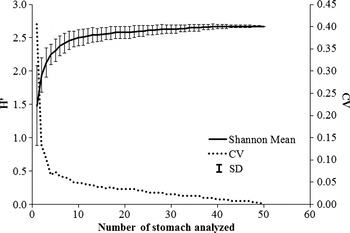
The CV in the cumulative trophic-diversity curve indicated that curve reached an asymptote of about 11 stomachs (Figure 1), which is sufficient to represent the diet of the Cortez damselfish.
Cumulative prey curve for Stegastes rectifraenum from the rocky reef at Los Frailes, Baja California Sur, Mexico. Vertical lines are standard deviation (SD) and CV is the coefficient of variation.

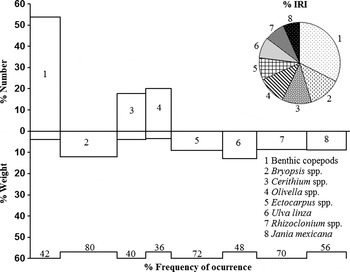
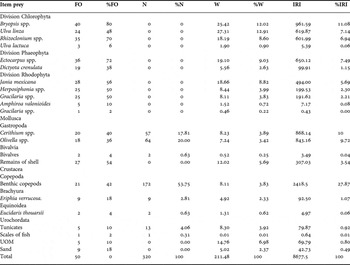
A total of 50 stomachs were examined and all had food content. The diet of S. rectifraenum was composed of 23 food components, from algae to benthic invertebrates, but only nine were 80% of the total diet of the Cortez damselfish. Numerically, the most important food components were benthic copepods (54%), the gastropods Olivella spp. (20%) and Cerithium spp. (18%), and tunicates (4%). The rest of components had lower values (<5% IRI) (Figure 2).
Main prey of the Cortez damselfish Stegastes rectifraenum, shown as a percentage by number, weight, frequency of occurrence, and index of relative importance (%IRI).

For the gravimetric method, the main prey were green algae Ulva linza (13%) and Bryopsis spp. (12%), followed by the brown algae Ectocarpus spp. (9%), red algae Jania mexicana (9%) and the remains of shells (6%) (Figure 2). The Bryopsis spp. (80%), Ectocarpus spp. (70%), Jania mexicana (56%), remains of shells (54%) and benthic copepods (42%) were the prey most frequently found in the stomachs of the Cortez damselfish (Figure 2).
From the IRI, the benthic copepods (28%), Bryopsis spp. (11%), Cerithium spp. (10%), Olivella spp. (10%), and Ectocarpus spp. (7%) were the most important foods in the diet (Figure 2).
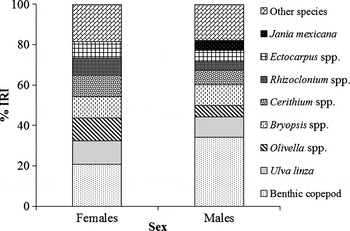
The diet of females consisted primarily of benthic copepods (21%), and the algae Ulva linza (12%), Olivella spp. (11%) and Bryopsis spp. (11%). The same dietary components were found for males but in a different order of importance. The males fed on benthic copepods (34%) and the algae Bryopsis spp. (10%) and Ulva linza (10%) (Figure 3).
Diet by gender of the Stegastes rectifraenum as a percentage of the index of relative importance (%IRI).

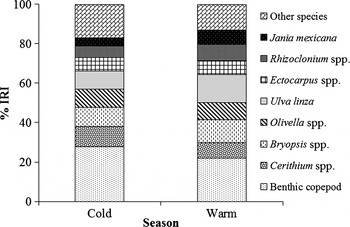
In the cold season, the main items consumed by S. rectifraenum were benthic copepods (28%), Cerithium spp. (10%), Bryopsis spp. (10%), Olivella spp. (9%) and Ulva linza (9%). During the warm season, Cortez damselfish prey on benthic copepods (22%), Ulva linza (14%), Bryopsis spp. (12%) and Olivella spp. (9%) (Figure 4). When calculating the Levin standardized index (Bi = 0.30), we found that the breadth of the diet is relatively narrow, indicating that S. rectifraenum is a specialist predator.
Feeding by season of the Stegastes rectifraenum as a percentage of the index of relative importance (%IRI).

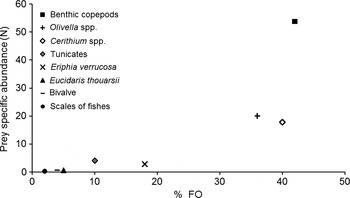
Also, the Costello plots based on number of prey (%N) (Figure 5) showed most frequent and abundant prey to be the benthic copepods, which confirms that it is a specialist consumer. The analysis of similarities of diet composition by gender (ANOSIM, PRIMER 6 v. 6.1.6) showed no differences by gender (R = 0.002, P = 0.001) and season (R = 0.046, P = 0.001). Unfortunately, ontogenetic variations in the diet were not evaluated because of the small size interval obtained in the sample, which was the result of the selectivity of the method of capture.
Prey-specific abundance (N) as plotted by numerical values against frequency of occurrence (FO%) of prey species in the diet of the Cortez damselfish.

DISCUSSION
The genus Stegastes is considered herbivorous and a territorial species (Allen & Robertson, Reference Allen and Robertson1994), but our results show that this species also preyed on animals. Of the 23 prey (11 algae and 12 marine invertebrates), only 5 were dominant in the diet; benthic copepods, Bryopsis spp., Cerithium spp., Olivella spp., and Ectocarpus spp., all together represented 66% of relative importance in the diet.
This indicates a high percentage of animal components, in contrast to Montgomery (Reference Montgomery1980a) who reported 12 prey in the diet of S. rectifraenum, of which the algae were 87% of the diet, and the animal component only 1.5%. However, Aguilar-Medrano et al. (Reference Aguilar-Medrano, Frédérich, De Luna and Balart2011) suggested, by using underwater observations, that the Cortez damselfish should be considered as an omnivorous species and mainly a benthic feeder. Our work, based on the food contents, supports this information and also provides information on the quantitative aspects of the diet (biomass and number of prey).
Hobson (Reference Hobson1965) found that the specimens of the Cortez damselfish between 7.8- and 9.6-cm TL only fed on benthic algae. This can be explained because of the ontogenetic shift observed in several species, yielding feeding-pattern changes with a size increase (Gerking, Reference Gerking1994), with the number of species in the trophic spectrum increasing. In our study, the size interval of the sample was reduced (10.3- to 12.5-cm TL), but compared with the study of Hobson (Reference Hobson1965), the Cortez damselfish in our sample used a higher percentage of animals as food because of higher energetic requirements necessary in large size specimens.
Though the diet of the Cortez damselfish was composed of 23 preys, the Levin standardized index indicated a specialist trophic behaviour, because 6 food components represented more than 70% of their diet. The specialist behaviour is the preference of few preys (Jones et al., Reference Jones, Ferrell, Sale and Sale1991), which in this case were benthic copepods and algae.
At the Los Frailes reef, the Cortez damselfish cohabits with various other herbivorous species, such as Acanthurus triostegus, Kyphosus elegans, Prionurus punctatus, Microspathodon dorsalis, other omnivorous species Thalassoma lucasanum and T. grammaticum, and its congeners S. acapulcoensis and S. flavilatus, all of whom feed on algae and invertebrates in the reef (Montgomery Reference Montgomery1980a, Reference Montgomeryb; Montgomery et al., Reference Montgomery, Gerrodette and Marshall1980; Moreno-Sánchez, Reference Moreno-Sánchez2009; Abitia-Cárdenas et al., Reference Abitia-Cárdenas, Moreno-Sánchez, Palacios-Salgado and Escobar-Sánchez2011) (Table 1). Despite having a large number of competitors around them, S. rectifraenum are located strategically in rocky cavities for refuge and defence against these potential competitors. The range of territorial behaviour and feeding area is 1.7-m2 per fish (Montgomery, Reference Montgomery1980a), a range that they defend aggressively and vigorously from competing species (Thomson et al., Reference Thomson, Findley and Kerstitch2000). Similar behaviour is reported for many other damselfish species (Galletto & Bellwood, Reference Galletto and Bellwood1994; Wilson & Bellwood, Reference Wilson and Bellwood1997; Hata & Kato, Reference Hata and Kato2002).
Food components of the Cortez damselfish Stegastes rectifraenum in the rocky reef at Los Frailes, Gulf of California, Mexico.

FO, frequency of occurrence; %FO, percentage of frequency of occurrence; N, prey-specific abundance; %N, percentage by number; W, wet weight; %W, gravimetric percentage; IRI, index of relative importance; %IRI, percentage of the index of relative importance; UOM, unidentified organic matter.
From our results, we confirm the omnivorous habits of S. rectifraenum, which prey on invertebrates (benthic copepods and gastropods) and algae (mainly green and brown algae), showing behaviour similar to its congeners from around the world.
ACKNOWLEDGEMENTS
This article is part of the project ‘Ecología trófica de dos especies de peces herbívoras del arrecife rocoso de Los Frailes, B.C.S., México’ (SIP 20061088). We are grateful to Programa Institucional de Formación de Investigadores (PIFI–IPN) and Consejo Nacional de Ciencia y Tecnología (CONACyT) for the support given through scholarship programmes. L.A.A.C. thanks the Instituto Politécnico Nacional (IPN) for funds received through COFAA and EDI. Also, X.G.M.S. wishes to thank the CONACyT programme ‘Apoyos Complementarios para la Consolidación Institucional de Grupos de Trabajo: Retención’. Thanks to Dr Ellis Glazier who edited this English-language text.