1. Introduction
Marine invertebrate borings are common in carbonate rocks, less common in calcareous clastic sedimentary rocks, e.g. in calcareous sandstones, but very rare in non-calcareous sedimentary rocks or in crystalline rocks (Warme, Reference Warme and Frey1975; Johnson, Reference Johnson2006). In the latter case, they are almost limited to weathered basaltic rocks and only a few occurrences are reported from other types of crystalline rocks (e.g. Masuda & Matsushima, Reference Masuda and Matsushima1969; Fischer, Reference Fischer1981; Allouc, Le Campion-Alsumard & Leung Tack, Reference Allouc, Le Campion-Alsumard and Leung Tack1996; Santos et al. Reference Santos, Mayoral, Johnson, Gudveig, Cachão, Silva and Ledesma-Vázquez2012). Therefore, every new contribution on borings in crystalline rocks enlarges the knowledge on the adaptation and abilities of animals to colonise atypical substrates.
A unique occurrence of marine macroborings in gneiss boulders is present in the Upper Miocene deposits of the Sorbas Basin in SE Spain. They are mentioned by Wood (Reference Wood, Mather and Stakes1996) as the ‘Gastrochaenolites (Lithophagid) borings’ from the locality studied in this paper. Doyle, Bennett & Cocks (Reference Doyle, Bennett and Cocks1998) noted borings in gneiss boulders and the bivalve boring Gastrochaenolites and sponge boring Entobia in calc-silicate-schists on the northern margin of the Sorbas Basin, but without data on localities.
New field research in this area has allowed the distinguishing of two types of borings in gneiss boulders, one of them assigned to a new ichnotaxon. Their presentation and interpretation are the main aims of this paper. The paper contributes not only to the knowledge on borings in crystalline rocks but also refers to a certain stage in the development of the Miocene transgression in the Sorbas Basin.
2. Geological setting
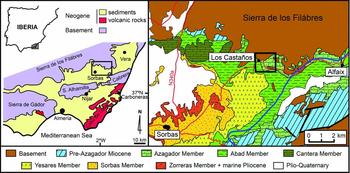
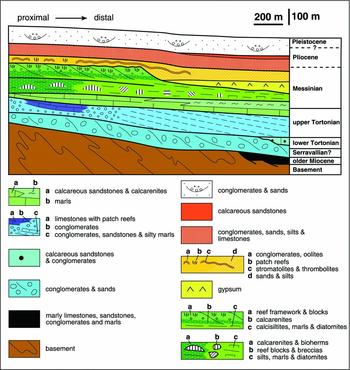
The Sorbas Basin is a small intermontane basin in the Almería Province (southern Spain) formed as a result of the uplift of the Betic Cordillera during Miocene time (Weijermars, Reference Weijermars1991). The basin infilling, up to 700 m thick, extends from the Middle Miocene(?) to the Pleistocene (Fig. 1) and comprises several stratigraphic units separated by unconformities (Martín & Braga, Reference Martín and Braga1994). The lower Tortonian to Messinian units are marine and include alternating warm- and temperate-water carbonate deposits (Fig. 2), and a thick selenite gypsum formed over a major, basin-scale, subaerial erosive surface (Martín & Braga, Reference Martín and Braga1994; Riding et al. Reference Riding, Braga, Martín and Sánchez-Almazo1998; Braga et al. Reference Braga, Martín, Riding, Aguirre, Sánchez-Almazo and Dinarés-Turrel2006). Continental sediments deposited in fluvial, lacustrine and alluvial systems and a thin marine unit compose the top of the succession (Fig. 2). Metamorphic rocks (phyllites, micaschists, quartzites, dolomites, marbles and gneisses) from the Internal Zone of the Betic Cordillera constitute the basement of the basin.
Location map. Neogene basins in southeastern Spain and detailed geological map of the northeastern side of the Sorbas Basin (modified from Montenat, Reference Montenat1990). Insets show location of the study area.

Miocene to Pleistocene stratigraphy of the Sorbas Basin (modified from Martín & Braga, Reference Martín and Braga1994).

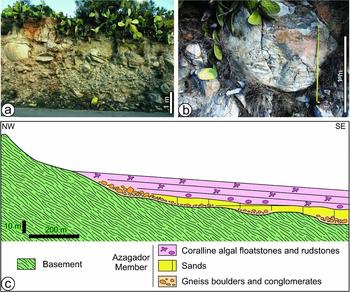
The study borings occur in the Azagador Member of the Turre Formation (Ruegg, Reference Ruegg1964). This unit was deposited on shallow-water carbonate ramps at the northern and southern margins of the basin during latest Tortonian to earliest Messinian times (Puga-Bernabéu, Braga & Martín, Reference Puga-Bernabéu, Braga and Martín2007; Puga-Bernabéu, Martín & Braga, Reference Puga-Bernabéu, Martín and Braga2007; Fig. 3). The study outcrop is located on the northeastern side of the basin, along the main road just east of the village of Los Castaños (GPS coordinates: 37° 08.789′ N, 002° 02.349′ W; Fig. 1). Here, the Azagador Member sediments onlap the basement formed by gneisses originated by metamorphism of Permian peraluminous granites intruded into the Nevado Filábride Complex of the Betic Cordillera (Gómez-Pugnaire et al. Reference Gómez-Pugnaire, Rubatto, Fernández-Soler, Jabaloy, López-Sánchez-Vicaíno, González-Lodeiro, Galindo-Zaldívar and Padrón-Navarta2012), and locally by quartzites and micaschists. Gneisses are mainly augen-type, consisting of large lenticular crystals of K-feldspar set in a matrix showing a penetrative foliation. Idioblastic pink garnets, acicular tourmaline crystals and large flakes of white micas are widespread in these rocks. Thin-sections from a sample of gneiss block containing borings show that it is composed mostly of quartz, and rarely of feldspar in the augen. Between the augen, non-serictized feldspar (alkaline or albite) is common. Also garnet and augite are present. Conglomerates composed of rounded gneiss cobbles and boulders up to 1.2 m in diameter (around 60 cm on average) lie on the basement rocks, filling in an irregular palaeorelief. These very coarse-grained sediments, interpreted as submarine cliff deposits (Puga-Bernabéu, Martín & Braga, Reference Puga-Bernabéu, Martín and Braga2007), show the macroborings described in this study. Conglomerates containing the boulders are overlain by few-metres-thick, quartz-rich, structureless, fine-grained sands that change upward into coralline algal-rich floatstones and rudstones deposited below the fair-weather wave base on small carbonate ramps that adjusted to the irregular underlying topography (Puga-Bernabéu, Martín & Braga, Reference Puga-Bernabéu, Martín and Braga2007).
Synthetic scheme of the palaeorelief infilling in the study area. Sediment distribution shows an overlapping (transgressive) infilling of the underlying topography (based on Puga-Bernabéu, Martín & Braga, Reference Puga-Bernabéu, Martín and Braga2007).

3. Ichnological analysis
Ichnological analysis reveals the presence of two well-differentiated types of borings.
Ichnogenus Gastrochaenolites Leymerie, Reference Leymerie1842
Gastrochaenolites isp.
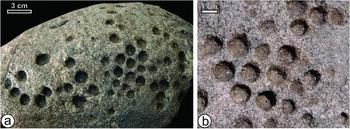
Figures 4, 6, 7
Gastrochaenolites isp. in a fragment of a gneiss boulder (a) and its detail (b). A specimen housed in the Departamento de Estratigrafía y Paleontología, Universidad de Granada (specimen UGR-LC-4–104).

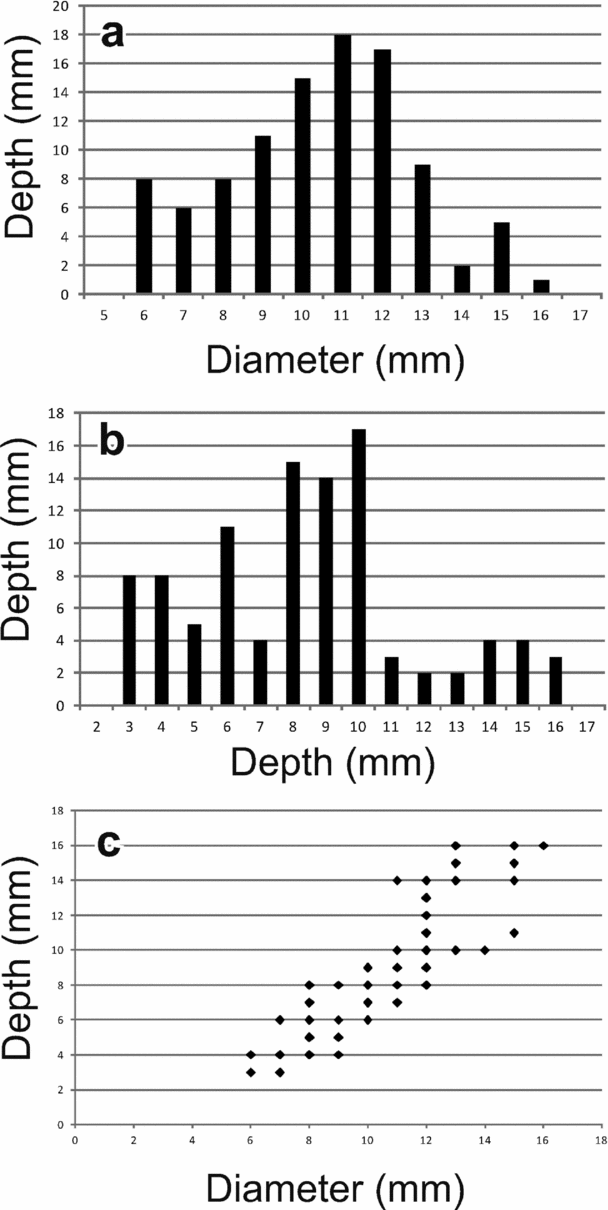
Measured parameters of Gastrochaenolites isp. (100 specimens). Histogram showing variation in diameter of structure (a), variation in depth of structure (b) and correlation between diameter and depth (c).

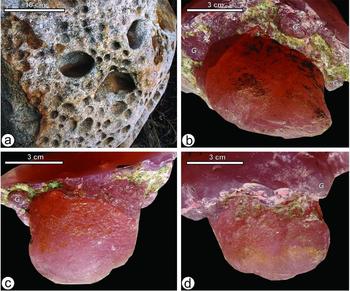
Cuenulites sorbasensis isp. nov. (a) in a boulder in the field (elliptical depressions), together with Gastrochaenolites isp. (smaller depressions). (b, c, d) The holotype (specimen UGR-LC-1) in different views, together with Gastrochaenolites isp. (G); an epoxy cast obtained from the boulder illustrated in (a).

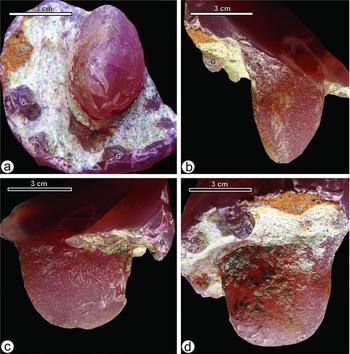
Cuenulites sorbasensis isp. nov., the paratype (specimen UGR-LC-2), together with Gastrochaenolites isp. (G); an epoxy cast obtained from the boulder illustrated in Figure 6a.

Material. A fragment of boulder collected with 10 borings, plus a half of a boulder with around 100 borings collected by J. Wood and housed in the Aula Museo de Paleontología, Universidad de Granada (specimen UGR-LC-4–104). Tens of borings observed in the field.
Description. Regular hemispherical depressions on the surface of gneiss boulders up to 1.2 m in diameter. The depressions are 6–16 mm in diameter (mean = 10.4 mm; mode of 11 mm; n = 100), and 3–16 mm deep (mean 8.38 mm; mode of 10 mm; n = 100). As shown in Figure 5a, diameter measurements show a normal distribution, with maximum values at 11 and 12 mm decreasing to both extremes. Depth, however, reveals a maximum in the range of 8–10 mm, but also several peaks in the lower values (i.e. 3, 4 and 6 mm; Fig. 5b). This fact determines that, although the relationship between diameter and depth shows a continuous pattern (Fig. 5c), two groups of specimens can be differentiated according to their size: smaller forms with diameters of 6–12 mm and depths of 3–10 mm, and larger forms with diameters of 13–16 mm and depths of 11–16 mm. The margins of the depressions are smooth, and it is necessary to take into account the incidence of weathering.
Remarks. The morphology of the depressions is the same as in erosionally truncated Gastrochaenolites in which only the basal, circular-in-outline part is preserved (Bromley & Asgaard, Reference Bromley and Asgaard1993). Among Gastrochaenolites ichnospecies, a hemispherical basal part is present in G. lapidicus Kelly & Bromley, G. dijugus Kelly & Bromley, G. torpedo Kelly & Bromley, G. ampullatus Kelly & Bromley or G. anauchen Wilson & Palmer (the latter does not show a neck; see Wilson & Palmer, Reference Wilson and Palmer1998), which are produced by bivalves that bore rocks mechanically and display rotating movements (Kelly & Bromley, Reference Kelly and Bromley1984). However, more complete Gastrochaenolites that show the chamber and the neck were not found. The distinguishing of two morphotypes of the depressions suggests that more than one ichnospecies of Gastrochaenolites were originally present as the base of the chamber can differ in morphometric parameters (e.g. Röder, Reference Röder1977).
Ichnogenus Cuenulites igen. nov.
Type ichnospecies. Cuenulites sorbasensis Rodríguez-Tovar, Uchman & Puga-Bernabéu, introduced in this paper.
Derivation of name. From Latin cuenus (wedge) and lites, a common latinised ending in names of popular borings, e.g. Gastrochaenolites, in reference to lithic substrate.
Diagnosis. Pouch-like depression in hard substrate, tapering downward, elliptical in outline.
Remarks. Similar ichnogenera can be found among non-circular-in-outline, pouch-shaped, macroborings, which belong to Rogerella Saint-Seine, Reference Saint-Seine1951, Zapfella Saint-Seine, Reference Saint-Seine1951 (the latter is questioned by some authors as a possible junior synonym of Rogerella; see Pickerill, Donovan & Portell, Reference Pickerill, Donovan and Portell2002), Asthenopodichnium Thenius, Reference Thenius1979 or Petroxestes Wilson & Palmer, Reference Wilson and Palmer1988. Rogerella Saint-Seine, Reference Saint-Seine1951, typified by R. lecontrei Saint-Seine, Reference Saint-Seine1951, and Zapfella Saint-Seine, Reference Saint-Seine1951, typified by Z. pattei Saint-Seine, 1954, are small, millimetric-sized borings, which are wider on one side and narrower on the other side, usually slit-like in cross-section, with a comma-like curl at the narrower end, produced by acrothoracican barnacles, mostly in shells of molluscs (Codez & Saint-Seine, Reference Codez and Saint-Seine1957; Rodriguez & Gutschick, Reference Rodriguez and Gutschick1977). Asthenopodichnium Thenius, Reference Thenius1979, typified by A. xylobiontum Thenius, Reference Thenius1979, are small (less than 20 mm deep), U-shaped spreiten or pouch-like structures in wooden, organic-rich or bone substrates, produced in non-marine environments (Uchman et al. Reference Uchman, Gaigalas, Melešytė and Kazauskas2007). Petroxestes Wilson & Palmer, Reference Wilson and Palmer1988, typified by Petroxestes pera Wilson & Palmer, Reference Wilson and Palmer1988, is a pouch-shaped depression with a rounded basal termination and parallel walls.
None of these ichnogenera fits well with the described new ichnospecies. Asthenopodichnium and Petroxestes display parallel margins, while Cuenulites tapers downward. Moreover, Asthenopodichnium does not occur in lithic substrates, and major types of substrate are considered an ichnotaxobase (Bertling et al. Reference Bertling, Braddy, Bromley, Demathieu, Genise, Mikuláš, Nielsen, Nielsen, Rindsberg, Schlirf and Uchman2006). Rogerella and Zapfella display the characteristic slit-like outline and are limited to much smaller structures. Therefore, Cuenulites appears to be a distinct structure.
Cuenulites sorbasensis isp. nov.
Figures 6–8
Material and types. Three epoxy casts housed in the Departamento de Estratigrafía y Paleontología (Universidad de Granada), obtained from one gneiss boulder. Cast UGR-LC-1 is the holotype and the casts UGR-LC-2 and UGR-LC-3 are paratypes. Moreover, about 10 specimens are left in the field.
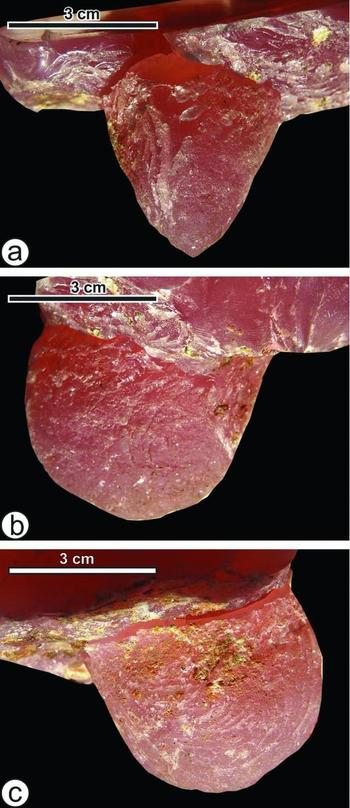
Cuenulites sorbasensis isp. nov., the paratype (specimen UGR-LC-3); an epoxy cast obtained from the boulder illustrated in Figure 6a.

Derivation of name. From the Sorbas Basin, in which this trace fossil occurs.
Diagnosis. A pouch-like depression, elliptical in outline, usually deeper than wide, slightly tapering downward. Margins of the depression are smooth.
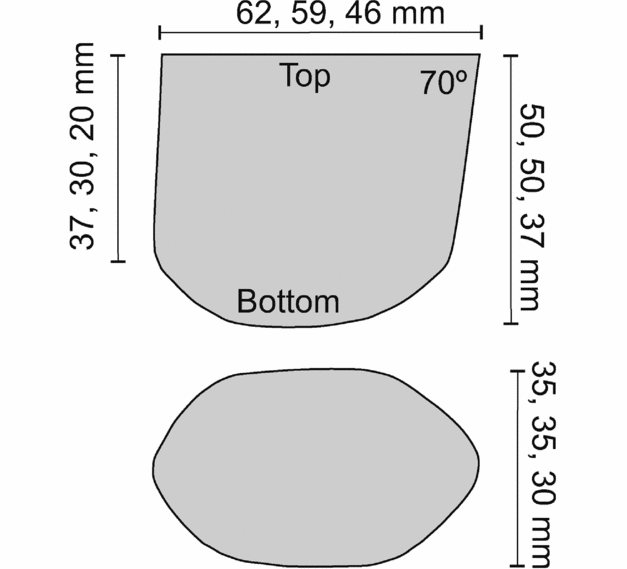
Description. As in the diagnosis, with the following additions. The depressions are scattered on the surface without any order and are accompanied by Gastrochaenolites isp. The axis of the depression is perpendicular or oblique with respect to the boulder surface. In the latter case, in consequence, the upslope margin of the depression is longer than the downslope margin. The elliptical entrance of the depression is 30–35 mm wide and 46–62 mm long. The depth of the depression ranges from 37 to 50 mm (Fig. 9). Curvature of the side (larger) margin of the depression is gently concave inward, locally with low (less than 1 mm), gentle undulations, which are not in any pattern that can be considered as ornamentation. The depression terminates at the base with a wedge-like, smooth, slightly rounded crest, without any evidence of a keel or a suture. The course of the crest is straight or only slightly curved. Its margin is slightly undulating. Generally, the boring is symmetrical in respect to the vertical plane running along the longer axis of the elliptical horizontal section, but slightly asymmetrical in respect to the perpendicular, vertical plane. In some specimens, one of the narrow margins is slightly overhanging, i.e. slightly convex inward, and the profile of the opposite, narrow side margin is distinctly rounded with convexity outward.
Morphometric parameters of Cuenulites sorbasensis isp. nov.

Remarks. The morphology of the boring resembles sometimes, but is smaller than, the bivalve boring Gastrochaenolites cor Bromley & D’Alessandro, Reference Bromley and D’Alessandro1987, which, however, displays a distinct heart shape in horizontal section and a tapering toward the entrance. Also the overall shape of the lower part of Phrixichnus phrix Bromley & Asgaard, Reference Bromley and Asgaard1993 is similar, but it shows a distinct sculpture and tapers toward the entrance. These features are not observed in Cuenulites sorbasensis.
The overall shape of Cuenulites sorbasensis suggests an endolithic or semi-endolithic bivalve as the tracemaker, which did not rotate but bored by chemical means (for mechanical and chemical ways of boring by bivalves see Warme, Reference Warme and Frey1975). The bivalve Petricola lapicida Gmelin, Reference Gmelin1791 produces borings of this type, but the borings become narrower toward the entrance (Bromley, Reference Bromley1978). Also the bivalve Claudiconcha monstrosa (Gmelin) produces elliptical borings; its shell can stick partly out of the coral limestone surface (Savazzi, Reference Savazzi2005).
4. Discussion
4.a. Borings in crystalline rocks: a brief review
Borings are known mostly from carbonate rocks (Johnson, Reference Johnson2006). The literature data on borings in crystalline rocks are scarce. The oldest are reports on recent bivalve borings. Cuyot in Anonymous (1854) noted borings of Pholas dactylus Linnaeus in gneisses from the coast of France (see also Tryon, Reference Tryon1862; Kennedy, Reference Kennedy1974). Grosse (Reference Grosse1854) mentioned that Gastrochaena can bore into granites. The same was repeated by Jeffreys (Reference Jeffreys1865), who also added that Pholas can bore into mica shales and gneisses. Ripley & Dana (Reference Ripley and Dana1873) illustrated a specimen of gneiss bored by Pholas.
Abel (Reference Abel1935, Fig. 406, p. 481) illustrated borings of the echinoid Strongylocentrotus lividus Linnaeus in a granitic block from Brittany, and mentioned their occurrence also from Normandy in France and in volcanic rocks of the Azores. They are 4–4.5 cm in diameter and fit the trace fossil Circolites kotoncensis Mikuláš, Reference Mikuláš1992.
Masuda & Matsushima (Reference Masuda and Matsushima1969) reported borings of Lithophaga curta (Lischke) in andesites from Japan. McHuron (Reference McHuron1976) noted that the bivalve Penitella penita (Conrad) can bore into olivine basalts. Warme & McHuron (Reference Warme, McHuron and Basan1978) mentioned borings by Penitella penita in basalts and other hard rocks on the North American Pacific Coast. Fischer (Reference Fischer1981) described borings made by polychaetes, sea-urchins (Diadema mexicana A. Agassiz) and decapods (Alpheus saxidomus Holthuis) in basalts on the Pacific coast of Costa Rica (for the decapod borings therein see also Fischer & Meyer, Reference Fischer and Meyer1985). Allouc, Le Campion-Alsumard & Leung Tack (Reference Allouc, Le Campion-Alsumard and Leung Tack1996) presented fungal and cyanobacteria microborings and macroborings produced by echinoids in magmatic rocks (mainly dolerites and basanites) from the coast of Senegal. They also mentioned borings by bivalves and polychaetes in these rocks.
Fossil borings in crystalline rocks are described only in a few papers. Apart from the reports by Wood (Reference Wood, Mather and Stakes1996) and Doyle, Bennett & Cocks (Reference Doyle, Bennett and Cocks1998) from the Sorbas Basin (see Section 1), Masuda (Reference Masuda1968) described Miocene Gastrochaenolites in volcanic rocks near Sendai in Japan. Zwiebel & Johnson (Reference Zwiebel and Johnson1995) presented the Upper Pleistocene Petricola carditoides (Conrad) in borings within andesites from Baja California in Mexico, but this bivalve was regarded as a nestler within pre-existing borings. Mikuláš, Němečková & Adamovič (Reference Mikuláš, Němečková and Adamovič2002) described Upper Cretaceous ?Gastrochaenolites isp. from Na-metarhyolite of the Czech Republic. They are subvertical shafts, 28 mm deep, 13–15 mm in diameter, slightly enlarged at their base to irregular, roughly drop-shaped chambers. Because of their irregularity, they have been compared to recent decapod borings in basalts of Costa Rica as described by Fischer (Reference Fischer1981). Haga, Kurihara & Kase (Reference Haga, Kurihara and Kase2010) reported borings of Lithophaga ascribed to Gastrochaenolites in a volcanic substrate from the lower Middle Miocene Moniwa Formation of northern Honshu (Japan). Buatois & Encinas (Reference Buatois and Encinas2011) reported Upper Cretaceous Gastrochaenolites penetrating into a transgressive surface built of metamorphosed clastic rocks in Chile.
Santos et al. (Reference Santos, Mayoral, Johnson, Gudveig, Cachão, Silva and Ledesma-Vázquez2012) described Miocene borings (Gastrochaenolites lapidicus, G. torpedo, G. ornatus) in a trachy-basalt rocky shore in the Madeira Archipelago, Portugal, which penetrate the basaltic substrate up to 4.5 cm, in some places through encrusting algae or corals.
4.b. Borings in gneiss boulders in the Sorbas Basin
As shown in the Section 4.a, fossil macroborings in crystalline rocks are limited mostly to volcanic rocks, mainly to basalts and andesites, and are very rare in acidic magmatic rocks and their metamorphic counterparts. Therefore, the occurrence of borings in gneiss boulders in the Sorbas Basin appears to be unique. Probably, the benefits of a food-rich environment prompted the tracemakers to colonise such a hard substrate. Reports on recent macroborings in gneisses or granites, produced mostly by bivalves and echinoids, are known from the old literature. Modern research on them would be welcomed.
As already noted by Wood (Reference Wood, Mather and Stakes1996), the studied borings occur only in large boulders at the top of the conglomerate resting on an uneven abrasional platform cut in the crystalline basement. Deposition of the overlying sandstones and floatstones and rudstones prove a decreasing energy up the section as a result of advancing transgression. A decrease in water turbulence and mobility of boulders, especially the largest of them, enabled colonisation of the substrate in a more stable environment.
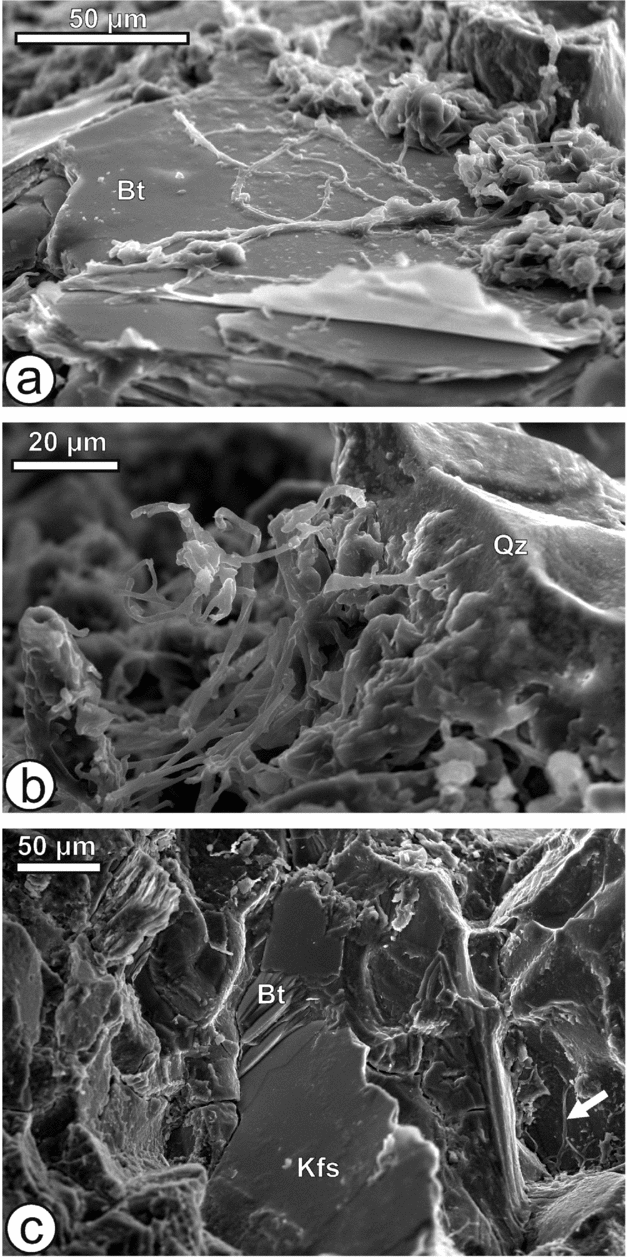
The mechanism for the bioerosion in gneiss is challenging. For Gastrochaenolites, mechanical action seems to be involved as its outline is circular. It is known from recent pholadid bivalves, including Pholas dactylus, which was reported as a borer into gneisses of the French coast (Cuyot in Anonymous, 1854). For Cuenulites sorbasensis, mechanical bioerosion seems to be less important or even absent, because its morphology reflects the shape of the body, which was not able to rotate in the elliptical-in-outline boring. Bioerosion would be easier if the surface layer of the boulders was softened by weathering. It is worth noting that at least a part of the studied bored blocks is weathered close to the surface. Weathered gneisses, with softened feldspars, might enable colonisation; however, the age of the weathering is unknown, but it is not excluded that it may come from the time of deposition. Fischer (Reference Fischer1981) regarded bioerosion in basalts as mechanical and is based on the differences in the hardness of the minerals. Johnson, Wilson & Redden (Reference Johnson, Wilson and Redden2010), who described borings in quartzites, supposed that the basalt was at first softened by microendolithic organisms. Indeed, microendolithic organisms are known from basalt glass (e.g. Montague, Walton & Hasiotis, Reference Montague, Walton and Hasiotis2010), where they use energy from Fe and Mn oxidation (McLoughlin et al. Reference McLoughlin, Furnes, Banerjee, Staudigel, Muehlenbachs, de Wit, Van Kranendonk, Wisshak and Tapanila2008). The role of endolithic organisms in bioerosion of the studied boulders remains unknown. The scanning electron microscope (SEM) analysis of a sample taken from a boulder surface bored with Gastrochaenolites isp. shows that an about 1 mm thick layer of the rock is covered in fibrous illite, which is occasionally associated with irregular globular structures (Fig. 10a, b). The fibres, 2–3 μm thick, penetrate into the space between the surfaces of quartz, K- and Na-feldspar or biotite blasts, which are mostly less than 0.5 mm in diameter. Many fibres are almost welded with the blasts. The number of fibres decreases greatly with increasing distance from the boulder surface (Fig. 10c). The fibrous illite is probably of diagenetic origin (M. Skiba, pers. comm. 2014). If the fibrous illite originated prior to the formation of the borings, its washing out could have caused weakening of the boundaries between blasts and enabled their displacement from the rock fabric by the tracemakers.
SEM images of gneiss from the surface layer of a bored boulder showing the fibrous illite on biotite (a) and quartz (b) blasts. A short distance from the surface only a few fibres can be seen (white arrow in c). Bt – biotite; Qz – quartz; Kfs – K-feldspar.

Colonisation by boring organisms was stopped probably due to the supply of fine-grained sediment coming with the advancing transgression. Filter-feeding boring organisms are very sensitive to fine-grained sediment suspended in the water. The hard body parts of the dead tracemakers were crushed and washed out by waves and currents, and the surface of the blocks was subjected to abrasion before final burial under sandstones. Therefore, only the basal part of the borings in the case of Gastrochaenolites, which is the commonest boring in the locality, is preserved. Cuenulites sorbasensis is probably also truncated, but it is not clear to which level, because it can be produced by a semi-endolithic organism.
The blocks are bored from the top and sides. Gastrochaenolites is distributed unevenly, in some places in patches. Only a few per cent of boulders are bored. This contrasts with observations by Doyle, Bennett & Cocks (Reference Doyle, Bennett and Cocks1998), who investigated borings in dolomite boulders in lower Messinian conglomerates at Polopos, a locality in the transitional area between the Sorbas and Carboneras basins, where 40–50 % of the boulders are intensively bored with Gastrochaenolites, Entobia and rarely with Trypanites. This confirms that carbonate substrates are much more suitable for marine borers (e.g. Warme, Reference Warme and Frey1975; Johnson, Reference Johnson2006). As shown by Buatois & Encinas (Reference Buatois and Encinas2011), borings in crystalline rocks represent the impoverished Trypanites ichnofacies, dominated mostly by Gastrochaenolites. The studied borings can rather be ascribed to the impoverished Entobia ichnofacies sensu Gibert, Martinell & Domènech (Reference Gibert, Martinell and Domènech1998). The cited authors noted that bored boulders are dominated by Entobia while cliffs are by Gastrochaenolites, but in the case of crystalline rocks, Entobia is absent. Only Doyle, Bennett & Cocks (Reference Doyle, Bennett and Cocks1998) noted Entobia in calc-silicate-schists on the northern margin of the Sorbas Basin. Generally, the assemblage of borings on transgressive conglomerates is less mature than on wave-cut platforms due to the instability of clasts (Domènech, Gibert & Martinell, Reference Domènech, Gibert and Martinell2001); only occasionally a high diversity of bioerosion trace fossils has been registered in marble boulders (Santos, Mayoral & Bromley, Reference Santos, Mayoral and Bromley2011).
5. Conclusions
Gastrochaenolites is a dominant boring in gneiss boulders in the transgressive Miocene succession of the Sorbas Basin (Almería, SE Spain). The associated pouch-like depressions, tapering downward and elliptical in outline, are distinguished as a new ichnogenus and ichnospecies Cuenulites sorbasensis, with the suggested tracemaker being an endolithic or semi-endolithic, chemically boring bivalve. Stabilisation of boulders on an abrasional platform as a consequence of decreasing energy after some phase of transgression enabled their colonisation by borers in a food-rich environment. Subsequent supply of fine-grained sediments killed the tracemakers. The scarcity of marine invertebrate borings in crystalline rocks, especially in gneisses, supports the unique, extraordinary record, here presented.
Acknowledgements
The paper benefited from comments and suggestions by Ana Santos (Universidad de Huelva) and Mark A. Wilson (The College of Wooster). Funding for the research of RT was provided by Project CGL2012–33281 (Secretaría de Estado de I + D + I, Spain) and Project CGL2010–20857 (Ministerio de Ciencia e Innovación, Spain), and Project RNM-3715 and Research Group RNM-178 (Junta de Andalucía). A.U. was supported by the Jagiellonian University (DS funds). Dorota Salata (Jagiellonian University) helped in determination of the composition of the gneisses in thin-sections. The analyses with the Scanning Electron Microscope equipped with an EDS spectrometer Hitachi 4700 were made at Jagiellonian University with the aid of Katarzyna Maj-Szeliga. Michał Skiba (Jagiellonian University) provided his opinion on the fibrous illite.