1. INTRODUCTION
In the early design stage of an engineering system, it is important to consider the reliability of the system under design. Reliability is usually quantified as the probability that a system performs its intended function without failures. When generating design concepts, designers not only identify potential solutions that can realize the overall function of the system but also normally focus on those solutions that may lead to high reliability. After a number of design concepts are generated, best design concepts are selected for further developments in the later design stages. System reliability may be again a focus when design concepts are evaluated and compared. Design concepts with low system reliability are likely to be screened out. It is therefore desirable to accurately predict the system reliability during the system design stage.
Predicting system reliability, however, is difficult because there are many uncertainties and challenges that system designers will face. Some of the challenges are shown below.
-
• Systems, such as mechanical systems, power systems, and software systems, become more complicated. It is hard to know the explicit statistical relationships between the states of components in a system. This information is often essential for the accurate system reliability analysis.
-
• Many components of a system are outsourced to outside suppliers. Although this common practice brings larger profits by greatly reducing production costs, it also poses a challenge as system designers may have no access to details of component design (Cheng & Du, Reference Cheng and Du2016).
-
• Without physical prototypes and facilities in the early design stage, it is difficult for system designers to obtain enough experimental information to predict system reliability (Ormon et al., Reference Ormon, Cassady and Greenwood2002).
In spite of the above challenges, it is possible to predict system reliability approximately with assumptions. For example, if the reliability of each component in the system is available to system designers, they could use the assumption that component sates are independent. Then for a given system configuration (series, parallel, or mix), the system reliability is a function of only component reliabilities and can be readily calculated (Dhingra, Reference Dhingra1992; Arnljot & Rausand, Reference Arnljot and Rausand2009). The assumption, however, may lead to large errors, especially for engineering systems, such as those in mechanical, civil, and aerospace engineering applications. The major reason is that component failures are actually dependent. The state of one component affects those of other components in the system.
Even though components may be designed and manufactured independently by different companies, they become dependent once they operate with other components in the system. For example, all the components may share the same stochastic external load (Pozsgai et al., Reference Pozsgai, Neher and Bertsche2003) and may be exposed to the same random operating environment. In this case, a failure of any component in the system may affect the states of others.
When components are dependent, the accuracy of the system analysis relies on the complete joint probability distribution of all the component states, and only the marginal distributions of component states (or component reliabilities) are not sufficient. Knowing the joint probability distribution, however, requires that the system designers have all the detailed information about the component designs, such as the limit-state functions, concrete structures, and material properties of the components. However, the information is usually unknown to the system designers and is proprietary to only component designers. To this end, approximations, especially the bounds of system reliability, are used (Ditlevsen, Reference Ditlevsen1979; Zhang, Reference Zhang1993). The common problem is that the difference between the upper and lower reliability bounds is often large. In many cases, the width of system reliability bounds is too large to make any reliable decisions.
Feasibility studies on more accurate system reliability prediction have been recently reported (Cheng & Du, Reference Cheng and Du2016; Hu & Du, Reference Hu and Du2016). A physics-based system reliability method (Cheng & Du, Reference Cheng and Du2016) allows system designers to obtain narrower system reliability bounds in the early design stage by considering dependent components that share the same system load. This method treats unknown distribution parameters of component details as to-be-determined variables or design variables of an optimization model. All types of information available to system designers, such as component reliabilities, are treated as constraints. Optimization is then used to solve for such unknown variables while maximizing and minimizing the system reliability, thereby producing narrower system reliability bounds. The major contributor to the more accurate system reliability is the consideration of component dependence that is embedded in the system reliability analysis, which is part of the optimization model. It is demonstrated that the narrower system reliability bounds can better assist system designers to make decisions on design concept selection.
The other feasibility study (Hu & Du, Reference Hu and Du2016) indicates that it is possible to produce a single-valued system reliability prediction, instead of reliability bounds, with more information supplied to system designers by component designers. Given components reliabilities at different load levels, system designers can construct physics-based component and system reliability models using the strength-stress interference theory. With this method, it is flexible for component designers to generate their component reliability functions with respect to the component load. They could use statistics-based approaches based on field and testing data, and they could also use any physics-based approaches, such as the first-order reliability method, the second-order reliability method, or the saddle point approximation approach (Dolinski, Reference Dolinski1982; Hohenbichler & Rackwitz, Reference Hohenbichler and Rackwitz1982; Cai & Elishakoff, Reference Cai and Elishakoff1994; Du & Chen, Reference Du and Chen2000; Du & Sudjianto, Reference Du and Sudjianto2004; Dilip et al., Reference Dilip, Ravi and Babu2013). Because the component reliabilities are functions of component loads, which are also functions of the stochastic system load, the component reliability functions are statistically dependent. The system reliability model, which depends on the dependent component reliability functions, can therefore account for component dependence and thus produce an accurate system reliability prediction. This work, however, is only a proof-of-concept study, and there are many open questions that need to be answered.
The objective of this research is to realize the concept developed in (Hu & Du, Reference Hu and Du2016). More specifically, the objective of this research is to allow system designers to accurately predict system reliability for systems whose components share a stochastic system load. The new developments in this research include the following:
-
1. Construct component reliability functions with respect to component loads (Sec. 3.2)
This task creates a continuous reliability function with respect to the component load for each of the components in the system. The function construction is based on data of component reliabilities, and the data may be discrete or tabulated.
-
2. Construct composite component limit-state functions (Sec. 3.3)
Without knowing component design details, for each of the components, system designers construct a component limit-state function no matter how many failure modes a component may have. The reconstructed component limit-state function can accurately predict the state of the component (either a working state or a failure state).
-
3. Refine the system analysis procedure (Sec. 3.4)
Using the component reliability functions, system designers build the system reliability analysis model and obtain the joint probability density function needed for the system reliability analysis. Then the system reliability can be produced.
The rest of this article is organized as follows. Basic concepts and methodologies used in this study are reviewed in Section 2. The proposed methodology is discussed in Section 3 and is demonstrated with an example in Section 4. The conclusions and future work are given in Section 5.
2. REVIEW OF SYSTEM RELIABILITY ANALYSIS
System reliability is the probability that a system works properly without failures. The overall system may fail due to the failure of one or more components in the system. In this work, we focus on time-invariant reliability.
2.1. System reliability with independent component states
A series system is shown in Figure 1, in which the components in the system are denoted by C 1, C 2, … , C n . The system will fail if one of its components fails. If all the component failures are independent, the system reliability R S is
 $$R_{\rm S} = \prod\limits_{i = 1}^n {R_i}\comma $$
where R i (i = 1, 2, … , n) is the reliability of component i.
A series system.

Component reliability can be estimated by a statistics-based approach with testing or field data. It can also be estimated by a physics-based approach. If the latter approach is used, component reliability is given by
 $$R = \Pr \left\{ {Y = g({\bf X}) \gt 0} \right\}\comma \,$$
where X is a vector of random input variables, and Y is the state variable. If Y > 0, the component functions; otherwise, the component fails.
In this work, we focus on mechanical applications where series systems are usually involved.
2.2. System reliability bounds
Eq. (1) is easy to use, but may produce a large error due to the independent component assumption and may be too conservative. The actual system reliability is bounded as shown (Arnljot & Rausand, Reference Arnljot and Rausand2009):
 $$\prod\limits_{i = 1}^n {R_i \le R_{\rm S} \le \min \{ R_i \}}\comma \quad i = 1\comma \, \ldots\comma \, n. \,$$
If a mechanical system consists of 20 components with identical component reliabilities R = 0.999, Eq. (3) gives the bounds of 0.9802 ≤ R S ≤ 0.999. The bounds may be too wide to help system designers to compare design concepts for concept selection.
2.3. System reliability with components sharing the same system load
To improve system reliability analysis, we performed a preliminary study for systems whose components share the same stochastic system load L (Hu & Du, Reference Hu and Du2016). The system designers have good knowledge about L and therefore know the cumulative distribution function (CDF) of L; L is distributed through components, and the component load L i (i = 1, 2, … , n) of component i is a function of L. Such a function is assumed to be
 $$L_i = w_i L\comma \,$$
where w i indicates the fraction of the load that the component shares. This w i can be determined from a system level analysis, such as a force analysis.
System designers request component designers to provide component reliability functions at different component load levels, specified by variable l. The component designers may conduct experiments or use a physics-based approach to calculate component reliability R i by varying the values of l. Then the component reliability functions R i (l) are available to system designers.
System designers then assume that the component state could be predicted by the following component limit-state function:
 $$g_i (L_i ) = Y_i = S_i - L_i = S_i - w_i L\comma \,$$
where S i is the general resistance of the component. The component limit-state function should reproduce the same component reliability, namely,
 $$R_i (L_i ) = \Pr \{ g_i (L_i ) \gt 0\}. $$
The probability of system failure is then given by
 $$\eqalign{ p_{\rm fs} &= {\rm Pr} \{S_1 \lt L_1 \bigcup S_2 \lt L_2 \bigcup \cdots \bigcup S_n \lt L_n\} \cr &= {\rm Pr} \left\{ \mathop \bigcup \limits_{i = 1}^n S_i \lt w_i L \right\}. } $$
The system reliability is then available and is given by
 $$R_{\rm S} = 1 - p_{\,\rm fs}. $$
It is obvious that component failure events S i < w i L are dependent because of the common random variable L. The component dependence is therefore considered automatically. The reliability function R i (l) is directly related to the CDF of S i , because the CDF of S i is 1 − R i (l) (Hu & Du, Reference Hu and Du2016). If S i and L are independent, system designers know the joint distribution of all the random variables in Eq. (7), and thus, they can use Eq. (7) to find the system reliability.
3. SYSTEM RELIABILITY ANALYSIS WITH SHARED LOAD AND UNKNOWN COMPONENT DETAILS
The objective of this research is to realize the concept proposed in the feasibility study in (Hu & Du, Reference Hu and Du2016), which has been reviewed in Section 2.3. We now discuss how the concept could be realized with more detailed models and procedures.
We are concerned with systems whose components are provided by outside companies. The system may also have in-house components designed and manufactured by the firm of system designers. This is a common practice, especially in automotive and defense industries where most of components of a system come from multiple-layer suppliers. The proposed method intends to be used by system designers whose task is to predict the system reliability in the system design stage. The method is applicable for systems with the following features:
-
• The system load is distributed through all the components. The components are subjected to component loads that are fractions of the system load.
-
• System designers know the relationship between the system load and component loads through statics, dynamics, stress, or other analyses.
-
• Component and system failures are primarily due to excessive general loading, such as forces, stresses, deformation, and demand. Component failures can therefore be predicted by limit-state functions defined by the design margin, or the difference between a general resistance (yield strength, allowable deformation, capacity, etc.) and a general load (forces, stress, strain, demand, etc.).
3.1. Procedure of system reliability prediction
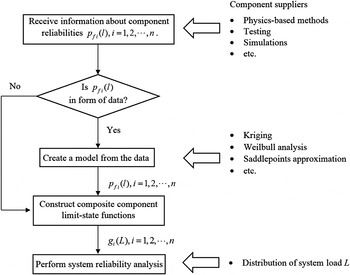
To make system reliability prediction possible, system designers ask component suppliers to provide component reliabilities with respect to their component loads. As the information of component reliabilities may be in different forms, for system designers, the first step is to formulate component reliability functions R i (l), i = 1, 2, … , n, with respect to the component load l. The second step is to construct composite component limit-state functions g i (·) based on R i (l). A composite component limit-state function ensures that it can reproduce accurate component reliability regardless of the number of failure modes the component may have. A composite component limit-state function does not require any component design details, and thus, it prevents the proprietary information of the component supplier. Because the common system load appears in all composite component limit-state functions, the dependence between component states is preserved. This helps improve the accuracy of system reliability prediction. The last step is to perform system reliability analysis. The flowchart indicating the procedure is given in Figure 2.
Flowchart of the proposed method.

3.2. Formulation of component reliability functions
Component designers may use different methods to estimate component reliabilities R i (l), such as using testing, field data, simulations, or a physics-based method. This may result in different forms of information about R i (l), such as limited reliability data, a scatter plot, or a mathematical model. If no mathematical model exits, system designers need to fit a model from these limited data. As will be discussed in Section 3.3, the probability of failure, p fi (l) = 1 − R i (l), is actually the CDF of the general component resistance. Then, the task becomes to fit a CDF model. Many methods could be used for the CDF fitting such as metamodeling methods, the saddle point approximation, and the Weibull analysis.
Now we discuss how system designers could fit a CDF model given the limited reliability data. For a general component with probability of failure p f (l), the available data are given as a set of (l j , p f(l j )), j = 1, 2, … , m. Let the continuous mathematical model be
 $$p_{\rm f} = H(l).$$
Next, we discuss two specific approaches to obtain H(l) from (l j , p f(l j )), j = 1, 2, … , m.
3.2.1. Kriging method
The kriging method has been widely used in engineering applications, including reliability analysis (Kleijnen, Reference Kleijnen2009; Viana & Haftka, Reference Viana and Haftka2012; Kolios & Salonitis, Reference Kolios and Salonitis2013). The kriging method considers the mathematical model in Eq. (9) as a realization of a Gaussian process given by (Sacks et al., Reference Sacks, Welch, Mitchell and Wynn1989):
 $$p_{\rm f} (l) = H(l) = {\rm \alpha} (l){\rm \xi} + Z(l)\comma \,$$
where α(l) is a regression function, ξ is the regression coefficient, and Z(·) is a stationary Gaussian process with zero mean. The covariance between two points l i and l j is defined by
 $$\eqalign{ {\rm cov}\lsqb Z\lpar {l_i} \rpar \comma \,Z\lpar {l_j} \rpar \rsqb = {\rm \sigma} _Z^2 K(l_i\comma \, &l_j )\comma \, \cr &i = 1\comma \,2\comma \, \ldots\comma \,m; \; j = 1\comma \,2\comma \, \ldots\comma \, m\comma \,}$$
where
 ${\rm \sigma} _Z^2 $
is the variance of the Gaussian process, and K( · , · ) is the correlation function and is commonly defined by the following Gaussian correlation (Sacks et al., Reference Sacks, Welch, Mitchell and Wynn1989; Lophaven et al., Reference Lophaven, Nielsen and Sondergaard2002):
 $$K\lpar {l_i\comma \, l_j} \rpar = \exp \lsqb { - {\rm \theta} \lpar {l_i - l_j} \rpar^2} \rsqb \comma \,$$
where θ is a parameter that indicates the correlation between the points. The best linear unbiased predictor (Sacks et al., Reference Sacks, Welch, Mitchell and Wynn1989) of H(l) gives to a random prediction
 $$\hat p_{\rm f} = \hat H(l) \sim N\lpar {{\rm \mu}_H \lpar l \rpar \comma \,{\rm \sigma}_H^2 \lpar l \rpar } \rpar \comma \,$$
where the prediction μ H (·) and the associated variance are computed by
 $${\rm \mu}_H (l) = {\rm \alpha} (l)\hat \xi + {\bf r}^T (l){\bf K}^-1 ({\bf p}_{\bf f} - {\bf F}{\rm \hat \xi} )\comma \,$$
 $${\rm \sigma} _H^2 (l) = {\rm \hat \sigma} _Z^2 \left\{ \matrix{1 - [{\bf r}(l)]^T {\bf K}^{ - 1} {\bf r}(l) \hfill \cr + \left[ {{\bf F}^T {\bf K}^{{\rm-1}} {\bf r}{\rm (}l{\rm )} - {\rm \alpha (}l{\rm )}} \right]^T \left( {{\bf F}^T {\bf K}^{{\rm-1}} {\bf F}} \right)^{{\rm-1}} \hfill \cr \left[ {{\bf F}^T {\bf K}^{{\rm-1}} {\bf r}{\rm (}l{\rm )} - {\rm \alpha (}l{\rm )}} \right] \hfill} \right\}\comma \,$$
in which K is the correlation matrix defined by
 ${\bf K} = \lsqb {K(l_i\comma \, l_j )} \rsqb \comma \, {\bf p}_{\bf f} $
is a column vector of responses of current sample points, and
 ${\bf r}( \cdot )$
is the vector of cross-correlations between the m samples and the prediction point,
 ${\bf r}(l) = \lsqb {R(l\comma \,l_1 )\comma \, \ldots\comma \, R(l\comma \,l_m )} \rsqb ^T $
. F is a column vector with rows α(l
i
), i = 1, 2, … , m, and
 ${\rm \hat \sigma} _Z^2 $
is the maximum likelihood estimation of the process variance,
 $${\rm \hat \sigma} _Z^2 = \displaystyle{1 \over m}({\bf p}_{\bf f} - {\bf F}{\rm \hat \xi} )^T {\bf K}^{ - 1} ({\bf p}_{\bf f} - {\bf F}{\rm \hat \xi} )\comma \,$$
and
 ${\rm \hat \xi} $
is the generalized least square estimate of ξ,
 $${\rm \hat \xi} = \left[ {{\bf F}^T {\bf K}^{ - 1} {\bf F}} \right]^{ - 1} {\bf F}^T {\bf K}^{ - 1} {\bf p}_{\bf f}. $$
Substituting Eqs. (14) and (15) into Eq. (13), system designers obtain the reliability mathematical model in the form of
 $p_{\rm f} = \hat H(l)$
for p
f = H(l) in Eq. (9).
3.2.2. Weibull method
A Weibull distribution can fit different data and distributions. Due to this advantage, system designers may use a Weibull model to fit the component reliability data. A three-parameter Weibull distribution is given by
 $$p_{\rm f} = H(l) = 1 - \exp \bigg( { - \bigg( {\displaystyle{{l - {\rm \gamma}} \over {\rm \eta}}} \bigg)^{\rm \beta}} \bigg)\comma \,$$
in which l > γ, β > 0, η > 0. The location parameter γ defines the location of the distribution; β is the shape parameter, and η is the scale parameter.
For a given set of (l j , p f(l j )), j = 1, 2, … , m, system designers could use the maximum likelihood method (Lockhart & Stephens, Reference Lockhart and Stephens1994) to find the three distribution parameters. They could also use a curve fitting method (Hamming, Reference Hamming2012) to find the three distribution parameters.
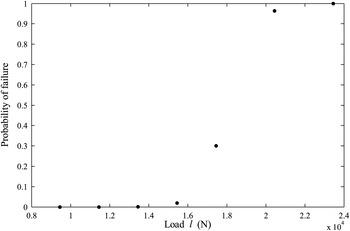
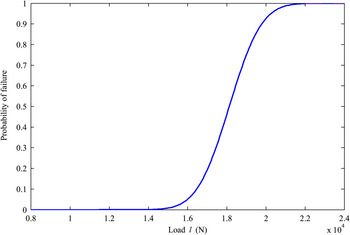
Other regression analysis methods could also be used for the CDF fitting. One example showing the CDF fitting follows. Suppose the probabilities of component failure p f at seven load levels are given and are shown in Figure 3. A mathematical model of p f with respect to the component load l can be then fitted as shown in Figure 4.
Component reliability data.

The complete p f model.

3.3. Reconstruction of component limit-state functions
The next task of system designers is to reconstruct component limit-state functions, which should meet the following requirements:
-
• Do not require component design details
-
• Maintain dependence between component states
-
• Be functions of the system load
-
• Be easy to evaluate
-
• Accommodate multiple component failure modes
Based on these requirements, for the ith component, system designers reconstruct the limit-state function in the form of
 $$Y_i = S_i - L\comma \,$$
where S i is the general component resistance, and L is the system load. Note that no matter how many failure modes the component may have, there is only one reconstructed component limit-state function as shown in Eq. (19).
Although the reconstructed component limit-state function is linear with respect to L, it can accommodate the situation where the actual component limit-state function is nonlinear with respect to L. One example follows. Let the yield strength of the i-th component be S y . If the maximum stress is h(L), where h(·) is a nonlinear function, also depending on other component parameters, such as dimensions, and then component designers build their limit-state function as
 $$Y^{\prime}_i = S_y - h(L).$$
Theoretically, they can solve for L by letting S y − h(L) = 0 at the limit state and obtain
 $$L = h^{ - 1} (S_y )\comma \,$$
where h −1(·) is the inverse function of h(·).
Then the limit-state function is modified as
 $$Y_i = h^{ - 1} (S_y ) - L.$$
Let S i = h −1(S y ), which is regarded as the general component resistance. Then Eq. (22) is exactly the one reconstructed by system designers in Eq. (19). This indicates that the reconstruct component limit-state functions do cover actual component limit-state functions that are nonlinear with respect to the system load.
Before explaining the procedure of reconstructing the composite limit-state function, we first prove that the probability of component failure p fi (l) is the CDF of the general component resistance S i . According to Eq. (19), for a constant l,
 $$p_{\,{\rm f}i} (l) = \Pr (S_i \lt l).$$
The CDF of S i is defined by
 $$F_{S_i} (s) = \Pr (S_i \lt s).$$
Replacing l with s in Eq. (23), we have
 $p_{\,fi} (s) = \Pr (S_i \lt s).$
As a result,
 $$F_{S_i} (s) = p_{\,{\rm f}i} (s) = 1 - R_i (s).$$
Because system designers know the component reliability function R i (l) or probability of component failure p fi (l), they also know the CDF of the general component resistance S i .
The composite component limit-state function is not only a simple (linear) function but also safeguards the proprietary information of component designers. Next, let us look at the component design of the example that will be presented in Section 4.
In the example, Component 2 has two failure modes due to excessive normal stress and excessive shear stress. The component designer decides to use a physics-based approach to evaluate the component reliability. The limit-state functions of the two failure modes are given by
 $$Y_{21} = S_y - \displaystyle{{(h + H_1 )} \over {W_x}} \displaystyle{L \over 2}\comma \,$$
 $$Y_{22} = {\rm \tau} - \displaystyle{1 \over {hb}}\displaystyle{L \over 2}\comma \,$$
in which L/2 is the load shared by the component, and h, H 1, W x , and b are random parameters related to component details. The two limit-state functions indicated that component details are required for the component reliability analysis. The details include material properties, component structure, and component dimensions.
The two limit-state functions for the two failure modes can be rewritten as
 $$Y^{\prime}_{21} = \displaystyle{{2W_x S_y} \over {h + H_1}} - L = S_{21} - L\comma \,$$
 $$Y^{\prime}_{22} = 2{\rm \tau}hb - L = S_{22} - L\comma \,$$
in which
 $S_{21} = (2W_x S_y)/(h + H_1)$
and S
22 = 2τhb. Then, the probability of component failure is
 $$\eqalign{ p_{\,{\rm f}2} &= \Pr \!\lcub {S_{21} \lt L \bigcup S_{22} \lt L} \rcub \cr &= \Pr\! \lcub {\min \lpar {S_{21}\comma \, S_{22}} \rpar \lt L} \rcub = \Pr\! \lcub {S_2 \lt L} \rcub \comma \,}$$
where S 2 = min(S 21, S 22) is the general component resistance in Eq. (19). Note that the details such as h, H 1, W x , and b in Eqs. (26) through (29) are only known to component designers who could find the component probabilities of failure at different load levels of load l i (i = 1, 2, … , n) by testing or using a physics-based reliability approach. Then the results could be provided to the system designers in the form of (p f2(l i ), l i ). As shown in Eqs. (24) and (25), the probability of component failure p f2 is exactly the CDF of the general component resistance S 2. Thus, the distribution of S 2 is known to system designers, and with this distribution, they no longer need any design details. No proprietary information is therefore required. Equation (19) also indicates that the system load L appears in all the reconstructed component limit-state functions, and the dependence between component states is automatically maintained. Meanwhile, the composite limit-state function takes into account the multiple component failure modes, and it has a simple expression to evaluate. Thus, the obtained composite limit-state functions satisfy all the requirements mentioned above.
3.4. System reliability analysis
We now discuss how system designers use the reconstructed composite component limit-state functions in Eq. (19) to predict system reliability. The probability of system failure is given by
 $$p_{\rm fs} = \Pr \left\{ {\bigcup\limits_{i = 1}^n {Y_i = S_i - L \lt 0}} \right\}.$$
The prerequisite for calculating p fs is to find the joint probability distribution of S i (i = 1, 2, … , n) and L. We now discuss how to obtain such a joint probability distribution.
Denote the n + 1 input random variables by Z = (S 1, S 2, … , Sn , L) and all the output variables by Y = (Y 1, Y 2, … , Yn ). As discussed in Section 3.3, the general component resistances S i (i = 1, 2, … , n) are determined by component material properties, concrete component structures, geometric dimensions, and other component parameters. As all the components are independently designed, manufactured, and tested by different suppliers, their general resistances are likely statistically independent. The system load L is also independent from the general component resistances. Thus, all the components in Z are independent.
Denote the CDF of S
i
and L by
 $F_{S_i} (s_i )$
, and F
L
(l), respectively. The joint CDF of Z is then given by
 $$F_{\bf Z} ({\bf z}) = F_L (l)\prod\limits_{i = 1}^n {F_{S_i} (s_i )}\comma \, $$
where
 ${\bf z} = (s_1\comma \, s_2\comma \, \ldots\comma \, s_n\comma \, l)$
. Because system designers know CDFs of S
i
and L, it is easy for them to predict the probability of system failure. Denote the joint probability density function (PDF) of Z by
 $f_{\bf Z} ({\bf z})$
. Then the probability of system failure is computed by
 $$p_{\rm fs} = \int\limits_\Omega {\,f_{\bf Z} ({\bf z})} d{\bf z}\comma $$
where Ω is the system failure region defined by
 $$\Omega = \left\{ {{\bf Z} \vert S_i \lt L\comma \quad i = 1\comma \,2\comma \, \ldots\comma \,n} \right\}\comma \,$$
where p fs can be calculated by an numerical integration or Monte Carlo simulation (MCS). Next, we demonstrate this with two special cases.
In the first case, the components S i (i = 1, 2, … , n) of Z = (S 1, S 2, … , Sn , L) follow Weibull distributions, while L follows a distribution with PDF F L (l). Note that Y i = S i − L, and thus Y 1, Y 2, … , Y n are dependent. Because the distribution parameters of Y are unknown, it is not possible to directly find p fs using Eq. (31). However, as we know that S 1, S 2, … , S n , and L are independent, the joint PDF of Z could be calculated by
 $$\eqalign{ f_{\bf Z} ({\bf z}) &= f_{\bf Z} (s_1\comma \,s_2\comma \, \ldots\comma \,s_n\comma \,l) \cr &= f_L (l) \prod\limits_{i = 1}^n \bigg[ {\displaystyle{{{\rm \beta}_i} \over {{\rm \eta}_i}} \left( {\displaystyle{{s_i - {\rm \gamma}_i} \over {{\rm \eta}_i}}} \right)^{\!{\rm \beta}_i - 1} \exp \bigg( { - \bigg( {\displaystyle{{s_i - {\rm \gamma}_i} \over {{\rm \eta}_i}}} \bigg)^{\!\!{\rm \beta}_i}} \bigg)} \bigg] .}$$
Then, according to Eq. (33), by integrating the joint PDF
 $f_{\bf Z} ({\bf z})$
in Eq. (35) in the failure region Ω defined in Eq. (34), system designers can obtain the probability of system failure.
In the second case, the components of
 ${\bf Z} = (S_1\comma \,S_2\comma \, \ldots\comma \,S_n\comma \,L)$
are normally distributed. From Eq. (31), the distribution of the reconstructed component limit-state function is
 $Y_i \sim N({\rm \mu} _{Y_i}\comma \, {\rm \sigma} _{Y_i} ^2 )$
, with
 ${\rm \mu} _{Y_i} = {\rm \mu} _{S_i} - {\rm \mu} _L $
, and
 ${\rm \sigma} _{Y_i} = \sqrt {{\rm \sigma} _{S_i} ^2 + {\rm \sigma} _L^2} $
, in which μ
L
and σ
L
are the mean and standard deviation of L. All the reconstructed limit-state functions
 ${\bf Y} = (Y_1\comma \,Y_2\comma \, \ldots\comma \,Y_n )$
then follow a multivariate normal distribution determined by the following mean vector and covariance matrix:
 $${\bf \mu} = \lpar {{\rm \mu}_{S_1} - {\rm \mu}_L\comma \, {\rm \mu}_{S_2} - {\rm \mu}_L\comma \, \ldots\comma \, {\rm \mu}_{S_n} - {\rm \mu}_L} \rpar \comma \,$$
 $$\sum = \left[ \matrix{ {\rm \sigma}_{Y_1}^2 \cr {\rm cov} (Y_2\comma \, Y_1 ) \cr \vdots \cr {\rm cov} (Y_n\comma \, Y_1 )} \quad \matrix{ {\rm cov} (Y_1\comma \, Y_2 ) \cr {\rm \sigma}_{Y_2}^2 \cr \vdots \cr {\rm cov} (Y_n\comma \, Y_2 )} \quad \matrix{ \cdots \cr \cr \ddots \cr \cdots} \quad \matrix{ {\rm cov} (Y_1\comma \, Y_n ) \cr {\rm cov} (Y_2\comma \, Y_n ) \cr \vdots \cr {\rm \sigma}_{Y_n}^2} \right] \comma \,$$
in which
 ${\mathop{\rm cov}} (Y_i\comma \, Y_j ) = {\rm \sigma} _L^2 $
. For this special case, because the distribution parameters of Y could be easily derived, it is more convenient to find p
fs using the PDF of Y, which is given by
 $$f_{\bf Y} ({\bf y}) = \displaystyle{1 \over {\sqrt {(2{\rm \pi} )^n \vert \sum \vert}}} \exp \left( { - \displaystyle{1 \over 2}({\bf y} - {\bf \mu} ) \sum\nolimits^{- 1} ({\bf y} - {\bf \mu} )} \right).$$
Then p
fs is easily obtained by integrating Eq. (38) in the failure region
 $\{ {\bf Y}\vert{\bf Y} \lt {\bf 0}\} $
.
4. EXAMPLE
In this section, an engineering example is used to show the procedure of the proposed method and demonstrate its feasibility and accuracy.
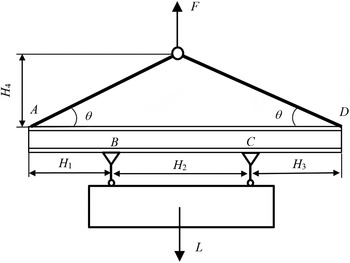
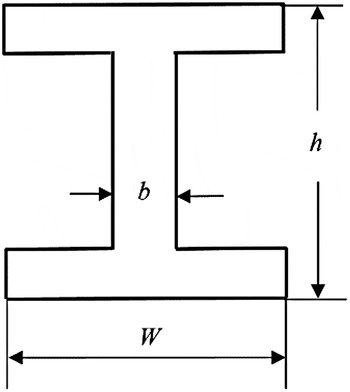
A lifting system, as shown in Figures 5 and 6, consists of two components from different suppliers: one cable (Component 1) from Company 1 and one spreader beam (Component 2) from Company 2.
Lifting system.

Cross-section of the spreader beam.

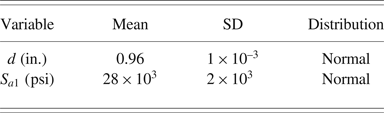
Company 1 designs the cable with a diameter d and an allowable tensile stress S a1 as shown in Table 1. The designers of Component 1 also evaluate the reliability of the cable with respect to different component load levels. They could obtain the component reliability using either a physics-based reliability method or by testing. If a physics-based reliability method is used, the limit-state function is given by
 $$Y_{11} = S_{a1} - \displaystyle{{L_1} \over {2\sin {\rm \theta}}}\comma \, $$
in which L 1 is the component load. Component designers calculate the probabilities of component failure p f1(l) by replacing L 1 with different load levels, denoted by l 1. The equation is given by
 $$p_{\,{\rm f}1} (l_1 ) = \Pr \left\{ {Y_{11} = S_{a1} - \displaystyle{{l_1} \over {2\sin {\rm \theta}}} \lt 0} \right\}.$$
Note that l 1 is a deterministic variable in the component reliability analysis.
Detailed information of Component 1

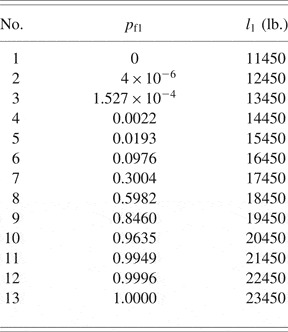
Component designers then provide the results to system designers, and the results are given in Table 2. The reliability results may also be generated by testing at the same load levels.
Reliability data of Component 1

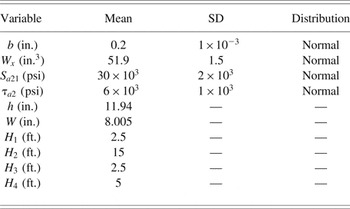
At Company 2, the designers decide to use a W12 × 40 beam, as shown in Figure 6. They know the allowable normal and shear stresses of the beam, denoted by S a2 and τ a2, respectively. The design details are shown in Table 3. There are two failure modes caused by excessive normal and excessive shear stresses. The associated limit-state functions are then given by
 $$Y_{21} = S_{a21} - \displaystyle{{L_2 (h + H_1 )} \over {2W_x}}\comma \, $$
 $$Y_{22} = {\rm \tau} _{a2} - \displaystyle{{L_2} \over {2hb}}.$$
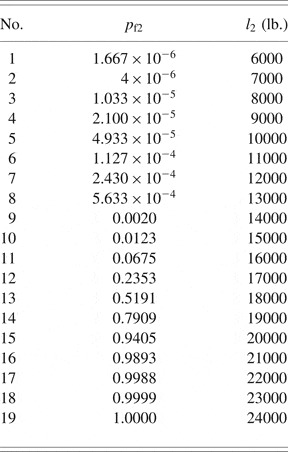
The component designers perform reliability analysis and supply their results in Table 4 to system designers.
Detailed information of Component 2

Reliability data of Component 2

Note that neither Component 1 designers nor Component 2 designers need to know the system load L. Only component loads are needed at the component design level. The component load values are treated as deterministic, and this makes component reliability analysis easier.
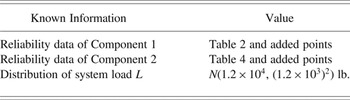
Now let us discuss how system designers use component reliability functions to predict the system reliability. To make the numerical analysis robust, system designers may add more data points to the probabilities of component failure. For example, for Component 1, the data from Company 1 show that when l 1 = 11450 lb, p f1 = 0. If the component load is less than 11450 lb., p f1 will therefore be 0. System designers then add two more points (9450.0) and (10450.0), where the first element denotes the load, and the second element denotes the probability of failure. When the load is greater than 23450 lb., p f1 will be 1. System designers also add two other data points (24450.1) and (25450.1). For the same reason, they also add one data point (25000.1) for Component 2. Adding more data points makes the CDF fitting more robust.
All the information that the system designers know is shown in Table 5, including the limited component reliability data provided by Component 1 and 2 designers, added data points, and the distribution of the system load.
Information available to system designers

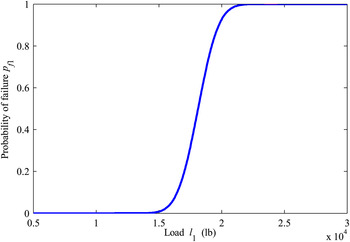
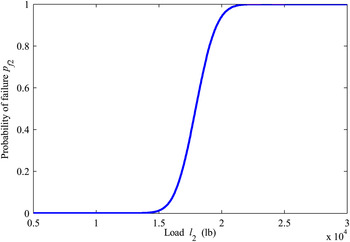
To predict the system reliability, system designers first fit the CDFs of component resistances with the kriging method. The results are shown in Figures 7 and 8. Then they reconstruct two composite component limit-state functions as
 $$Y_1 = S_1 - L\comma \,$$
 $${Y_2 = S_2 - L}. $$
Finally, the probability of system failure is evaluated by Eq. (45) using MCS. Other physics-based reliability methods, such as first-order reliability method, second-order reliability method or saddle point approximation approach, can also be used:
 $$p_{\rm fs} = \Pr \! \lcub {Y_1 \lt 0 \cup Y_2 \lt 0} \rcub .$$
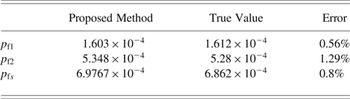
The results of the probabilities of failure of Component 1 (p f1), Component 2 (p f2), and the system (p fs) generated by system designers are shown in Table 6.
Fitted probability of failure for Component 1.

Fitted probability of failure for Component 2.

Results of system reliability prediction

To evaluate the accuracy of the proposed method, we use MCS to find the true probability of system failure as if everything was known at the system analysis level. The complete information includes the three original limit-state functions in Eqs. (39), (41), and (42), and the distributions of all the design variables and the system load. The true result is shown as “True value” in Table 6. The results indicate that the proposed method leads to an accurate probability of system failure, and the error is only 0.8%.
5. CONCLUSIONS
Accurately predicting system reliability in the design stage is a challenging task, and one of the major challenges is to incorporate statistical dependence between components in the system reliability analysis. Previous concept-proof studies have demonstrated the feasibility of improving the accuracy of system reliability prediction by considering component dependence through a shared system load, and this work develops a methodology to realize the concept.
The proposed work is intended to be used by system designers and is applicable to series mechanical systems with components that share a stochastic system load. The components may be designed and manufactured by independent outside suppliers. The detailed information about component design is not available to system designers. As a result, the statistical component dependence is unknown to system designers even though they have access to component reliabilities.
The requirement of the present method is the component reliability function with respect to the component load. System designers therefore need to request information about component reliability with respect to the component load and then use the information to generate the component reliability function. After this, the proposed method helps system designers construct composite component limit-state functions that can not only reproduce the same component reliabilities but also incorporate component dependence automatically. As a result, system designers can accurately predict system reliability without knowing proprietary information about component design.
The present method is limited to systems with components whose failures are caused by excessive loads (stresses, deformation, etc.). It is also limited to applications where only one system load is applied. The method could be extended to multiple system loads in future work. Other future research directions include the application to parallel systems and mix systems, accommodation of time-dependent failures, and consideration of non-strength failure modes.
ACKNOWLEDGMENTS
The authors are grateful for the support from the National Science Foundation through Grants CMMI 1234855, CMMI 1300870, and CMMI 1562593.
Zhengwei Hu is a PhD student in the Department of Mechanical and Aerospace Engineering at Missouri University of Science and Technology. His research interests focus on reliability analysis and prediction, model calibration, and probabilistic engineering design.
Xiaoping Du is a Professor of mechanical engineering. In addition to his academic job, he assumed mechanical engineer positions at two companies. He has served as principal investigator for five grants from the National Science Foundation and other funding organizations in support of his research in design under uncertainty. He has authored over 100 journal and conference papers. He is currently Associate Editor of the Journal of Mechanical Design and Editor of Structural and Multidisciplinary Optimization.