Successful rebel-to-party transformations are often crucial for the sustainability of peace and democracy (Ishiyama Reference Ishiyama2016). Particularly, peace agreements with rebel-to-party provisions have emerged after the Cold War, frequently backed by international third parties. According to Mimmi Söderberg Kovacs and Sophia Hatz (Reference Söderberg Kovacs and Hatz2016), 93 rebel groups from across the globe transformed into political parties between 1975 and 2011, of which 33 parties emerged after signing a peace agreement.
Consequently, an increasing number of studies investigate how former rebel organizations function as regular political parties (Ishiyama and Marshall Reference Ishiyama and Marshall2015, Reference Ishiyama and Marshall2017). But, as noted by Gyda Sindre and Johanna Söderström (Reference Sindre and Söderström2016: 110), ‘how these groups function in politics after the transition and the internal workings of such parties has largely been ignored’. Former rebel groups are frequently also required by procedural rules to ‘become democratic on the inside’ (Sindre Reference Sindre2016: 501). New political parties need to build a national organization and recruit new members, adopt procedures to select party leaders and candidates, collect funds to be competitive in elections, and devise political campaigns that appeal to voters. These tasks differ substantially from the skills and organizational requirements of rebel groups, which engage in clandestine military operations (de Zeeuw Reference de Zeeuw2007). The case studies on internal politics of former rebel groups suggest that the organizational legacy matters: transformed parties with a hierarchical leadership structure from their militant past are associated with ideological radicalism and party coherence (Allison and Álvarez Reference Allison and Álvarez2012; Ishiyama and Batta Reference Ishiyama and Batta2011; Sindre Reference Sindre2016). By contrast, intra-party division tends to lead to ideological moderation (Curtis and Sindre Reference Curtis and Sindre2019; Sindre Reference Sindre2018).
We argue that the mass support base of former rebel parties consists overwhelmingly of supporters who are willing to become politically active because the social costs of joining a rebel organization were high, thus only attracting very dedicated supporters. While such an internal composition is advantageous in electoral campaigns, the party politics literature (Art Reference Art2011; May Reference May1973; Michels Reference Michels1915; Panebianco Reference Panebianco1988) highlights that a large proportion of dedicated supporters could create internal conflicts, as they are more likely to resist moderation attempts by the leadership. We further argue that newly transformed parties are particularly susceptible to intra-party conflicts if spoils of this transformation are unequally distributed or exclusively benefit the leadership, while the costs of the transformation are disproportionally shared by their supporters, in the form of social hardship or by being exposed to violent attacks by the state or other groups. Under such conditions, the risk is high that the rebel-to-party transformation may fail, and that former dissatisfied rebels reconsider the use of violence.
The most prominent rebel-to-party transformation in international politics in recent years was led by the Fuerzas Armadas Revolucionarias de Colombia – Ejército del Pueblo (FARC-EP) in Colombia.Footnote 1 The FARC, as a newly transformed political party, participated for the first time in the 2018 Colombian legislative elections, receiving a disappointing vote share of 0.36%. Since the election of a right-wing government in 2018, parts of the 2016 peace agreement have been revoked, and a growing number of ex-combatants are returning to arms. Previous studies on former rebel parties had to rely on qualitative sources to study internal affairs of former rebel parties due to sampling difficulties. We use the advertising option of the social media platform Facebook to obtain large-scale samples of party supporters before the 2018 Colombian legislative elections and after the presidential election. Facebook sampling allows for pre-sampling demographic quotas, and can achieve a large-scale sample of party supporters due to its low costs. Facebook sampling generates representative samples that can be used to estimate the internal affairs of political parties (Bentancur et al. Reference Bentancur, Rodríguez and Rosenblatt2019; Jäger Reference Jäger2017; Samuels and Zucco Reference Samuels and Zucco2013, Reference Samuels and Zucco2014).
Thus, we are able to draw on a unique data set of FARC supporters that we obtained via Facebook Ads, which allows us to compare FARC supporters to other supporters of Colombian parties and FARC supporters over time.Footnote 2 The empirical analysis shows that the FARC has the most left-wing supporters in the Colombian political system. FARC supporters indeed appear to be relatively more politically active, but they also seem to be less satisfied with intra-party politics and Colombian democracy overall. Support for moderation remains a highly contested internal issue, and support for the peace agreement decreased after their first electoral participation.
The article proceeds as follows: the next section discusses the literature on rebel-to-party transformation and presents our contribution and three hypotheses. Subsequently, we show how we used Facebook Ads to obtain our samples; we follow this with the empirical section and conclusion.
Rebel-to-party transformations and their supporters
The emerging literature on rebel-to-party transformations suggests that newly established rebel parties inherit the structure of their military past. A centralized military command structure is associated with ideological coherence of the rank and file. Sindre (Reference Sindre2016) finds that in the case of the former rebel parties Partai Aceh in Indonesia and Fretilin in East Timor, formal procedures of intra-party democracy were ignored in favour of the past authoritarian command structure during the violent struggle. John Ishiyama and Anna Batta (Reference Ishiyama and Batta2011) show that the hierarchical leadership structures of the Communist Party of Nepal (Maoist) are shaped by the organizational legacy of the former rebel group. The centralized leadership structure of El Salvador's Farabundo Martí National Liberation Front (FMLN) allowed the leadership to expel moderate critics, and to ensure ideological homogeneity based on the Marxist–Leninist tenets of their rebel past (Allison and Álvarez Reference Allison and Álvarez2012). Analysing the Free Aceh Movement, the predecessor of the Partai Aceh, Sindre (Reference Sindre2018) shows that a prerequisite for ideological moderation of the party was organizational diversification, which strengthens party factions and internal debates.
By building on the classical party literature, we argue that there are additional consequences of the rebel past for political behaviour in electoral politics. The experience as a secretly operating military organization required highly committed supporters, which bestows former rebel groups with a support base that is willing to engage in unpaid volunteering for party-related activities. However, the downside of dedicated supporters is that they have a greater tendency to become dissatisfied with intra-party politics, particularly if the leadership engages in a moderation strategy that disproportionally benefits them vis-à-vis the rank and file. The dissatisfaction transcends to the political system if the electoral participation turns out to be unsuccessful and if former rebels are vulnerable to violent attacks by the state or other groups. As a consequence, unsatisfied supporters could thwart moderation attempts, or even demand a return to arms.
The classical literature on party organization has regularly distinguished between different types of party supporters based on their motivation to engage in politics (Art Reference Art2011; Kitschelt Reference Kitschelt1989; May Reference May1973; Michels Reference Michels1915; Panebianco Reference Panebianco1988). In an ideal-type model, they can be classified as supporters who are prompted by their ideological convictions to become active in politics (activists or ideologues), and as supporters who are motivated by material benefits and political offices (careerists or pragmatists). The association between ideological motivation and political activism is frequently discussed in the party literature (e.g. Layman et al. Reference Layman, Carsey, Green, Herrera and Cooperman2010). Activists tend to care more about the purity of party principles than vote-maximization strategies. Their ideological conviction motivates them to participate relatively more often in unpaid campaigning and canvassing for the party. Careerists, by contrast, are more willing to adopt a vote-maximization strategy in order to acquire public office. Moderation is also important for them, as it increases the likelihood of the party joining a government coalition.
External conditions affect the type of supporters who are attracted to a political party. The distribution of activists and careerists within a party could be shaped by the repression of the social and political environment. In authoritarian regimes, opposition parties rarely have access to economic spoils and face regime pressure, often in the form of violence or ostracism. These opposition parties are more likely to attract activists who tend to be ideologically motivated or have a source of income that is relatively unaffected by the regime (Greene Reference Greene2007: 5; Magaloni Reference Magaloni2006: 70).
This logic also applies to rebel organizations. The ideological conviction must be substantial to outweigh the social costs of supporting an illegal organization that engages in violence (Stewart Reference Stewart2018: 208), and even after disarmament, social sanctions remain high. In the particular case of the FARC, a general sense of distrust and dislike by a large proportion of the civil society has persisted beyond the insurgent years (Nussio and Quishpe Reference Nussio, Quishpe, McFee and Rettberg2019). Therefore, we argue that the support base of the FARC overwhelmingly consists of activists at the expense of careerists vis-à-vis other parties. We expect FARC supporters to be more willing to engage in campaign activities, such as participating in canvassing or distributing campaign leaflets. This discussion gives rise to our Activists Hypothesis:
Activists Hypothesis: The FARC has the highest proportion of activists among its supporters in comparison to other parties in the Colombian political system.
The party literature, however, also highlights that supporters could be a source of intra-party conflict. Radical preferences of supporters may explain why parties depart from a vote-maximization strategy that would be appealing to the median voter and also why party polarization could increase. Thus, supporters can function as a constraint on the leadership and its potential moderation attempts (Aldrich Reference Aldrich1983; Bawn et al. Reference Bawn, Cohen, Karol, Masket, Noel and Zaller2012; Enos and Hersh Reference Enos and Hersh2015; Miller and Schofield Reference Miller and Schofield2003).
In the case of right-wing populist parties in Western Europe, intra-party conflicts are associated with failures to moderate, hence party organization plays an important role in electoral success (Heinisch and Mazzoleni Reference Heinisch and Mazzoleni2016). David Art (Reference Art2011) argues that the success of right-wing populist parties depends on their ability to attract the right type of supporters. A permissive environment would allow supporters to engage in politics with relatively little fear about job security, social reputation and physical safety. By contrast, in repressive environments, supporters have to fear for their jobs and social status. Consequently, parties that face a repressive environment are more likely to attract supporters who have little else to lose. Furthermore, he finds that such supporters are more likely to cause intra-party conflicts over moderation attempts by the leadership.
Due to their past as an illegal rebel organization that actively fought the establishment, former rebel parties also have to operate regularly in repressive political environments. We argue that disparities between leaders and supporters are pronounced for former rebel parties, leading to supporters' discontent, for two reasons: first, ideologically convicted supporters might be less willing to support the moderation of the party's ideology, which is necessary for the rebel organization to become a regular party in the political system. In particular, supporters of former rebel parties tend to bear the costs of moderation attempts by the leadership in civil society. They are more vulnerable in a post-conflict society to violent attacks by non-state actors or the state, as they are now without armed protection. This vulnerability and their military skills may influence them to abandon moderation attempts and reconsider a return to violence (Kreutz Reference Kreutz2018).
Second, the coherence of the rebel organization grew during a violent struggle, frequently with a centralized hierarchical command structure. Although there were substantial benefits to being part of the rebel leadership during the insurgency years (Nussio and Ugarriza Reference Nussio and Ugarriza2021), they came at a high cost, as leaders faced the substantially higher risk of being easily identified and targeted by state or non-state forces. With the transformation of the rebel organization into a regular political party, however, access to public offices and public funds becomes readily available for party leaders. These funds predominantly benefit the personal careers of the party leadership. While access to public offices is normal for supporters of regular parties, it leads to a new distinction between leaders and supporters in organizations undergoing a rebel-to-party transformation. This process introduces a substantial imbalance regarding benefits and costs between leadership and supporters. A good performance in elections should attenuate the distinction, as it would provide public offices, associated jobs and party funding to a broader range of the party's strata. Positive electoral results should also provide supporters with a feeling of vindication and validation.
For instance, the rank and file of the Revolutionary United Front Party (RUFP) in Sierra Leone overwhelmingly consisted of ideologically convicted supporters who joined during the party's rebel past. The lack of financial resources led to the desertion of pragmatists and patronage-oriented supporters. As a consequence, the RUFP was not able to moderate its programmatic appeal and performed poorly at the ballot box, reinforcing the internal distribution of supporters in favour of hardliners (Söderberg Kovacs Reference Söderberg Kovacs2021).
The 2016 peace agreement between the Colombian government and the FARC-EP stipulated that the FARC-EP must terminate the armed struggle in order to become a regular party in the political system. Regardless of its election results, the peace agreement guaranteed the FARC party ten seats in Congress for two electoral cycles or eight years. Thus it ensured financial benefits and prestige exclusively for the higher commanders, as senior leaders filled all the granted positions in parliament without a proper democratic selection process within the party.
Although several violence indicators such as homicides, kidnapping and terrorist attacks were at a historic low, demobilized FARC supporters were regularly the target of political violence. Up to the 2018 presidential election, only the paramilitaries had killed 40 demobilized FARC members and 261 social leaders, particularly in areas that were former FARC-EP territories. There were also numerous reports of killings involving dissident groups and selective targeting by state forces (Nussio and Quishpe Reference Nussio, Quishpe, McFee and Rettberg2019). FARC members expressed major concerns about their security in interviews (Maher and Thomson Reference Maher and Thomson2018: 2149–2151). The FARC party was forced to suspend its electoral campaign for the legislative election as a response to public animosity that culminated in violent protests. The number of FARC splinter groups, which ultimately renounced the peace agreement and returned to the armed struggle, also began to increase, reaching an estimated 1,200 dissidents by March 2018 (Reuters 2018).
This discussion suggests that FARC supporters were relatively dissatisfied with intra-party democracy. The peace agreement required rapid moderation attempts, which were conducted by the party leadership in a centralized fashion based on the group's legacy as a highly centralized organization. The same leadership benefited the most from the transformation to a regular political party as they had guaranteed access to seats in parliament and all of the benefits that these imply. FARC supporters were regularly the target of political violence, even prompting the suspension of campaigning. Some factions subsequently renounced moderation attempts and resumed the insurgency. This leads to our second hypothesis, the Party Discontent Hypothesis:
Party Discontent Hypothesis: FARC supporters are the least satisfied with internal politics in comparison to supporters of other parties in the Colombian political system.
In the legislative election of 11 March 2018, the FARC received 0.36% of the vote share. While the vote share was too low to pass the threshold of parliamentary representation, the peace agreement ensured that the FARC party received five seats in the Senate and five seats in the House of Representatives. On 9 March 2018, two days before the legislative election, the FARC party announced that it was withdrawing from the first round of the presidential election on 27 May 2018 due to health problems of their party leader and presidential candidate Rodrigo ‘Timochenko’ Londoño.
The presidential election campaign led to further polarization. The right-wing candidate, Iván Duque, who based his electoral campaign on challenging the peace agreement – specifically, eliminating amnesty and other stipulated rights for former FARC fighters (Gamboa Reference Gamboa2018) – won the run-off election on 17 June 2018 against the left-wing candidate Gustavo Petro, who is a former member of the ex-rebel organization 19th of April Movement (M-19). Growing discontent and fragmentation within the FARC party led to the return to arms of a faction led by Iván Márquez in 2019.
These political developments in Colombia between the pre- and post-election periods suggest that FARC supporters became more dissatisfied with Colombian democracy. They experienced repression during their campaign and a catastrophic election result, while the biggest opponent of the peace agreement won the presidency. Moreover, critical intra-party voices on the peace agreement became more pronounced. This gives rise to our third hypothesis, the Dissatisfaction Hypothesis:
Democracy Dissatisfaction Hypothesis: The supporters of the FARC became more dissatisfied with Colombian democracy in the post-election period compared to the pre-election period.
Sampling procedure
Representative surveys of party members are hardly available due to the difficulty of sampling them. Only a small minority of a population becomes active in politics, making representative population surveys an unreliable sampling source. Surveying members requires the cooperation of the respective party administration, which might be unwilling or might want to achieve its own agenda. This problem is prominent for former rebel parties. Their illegal nature forced them to operate in an opaque environment beyond the reach of the public. Consequently, newly transformed rebel parties might not have accessible membership data or are unwilling to share this sensitive information with researchers due to security concerns.
The sampling is based on a novel procedure to sample different parties or social movements over time and space by utilizing the advertising option of the social media webpage Facebook, which can quasi-randomly target members of political groups. Facebook Ads have been used in some studies to sample hard-to-reach populations, such as party supporters (Bentancur et al. Reference Bentancur, Rodríguez and Rosenblatt2019; Jäger Reference Jäger2021; Samuels and Zucco Reference Samuels and Zucco2013, Reference Samuels and Zucco2014), or to conduct experiments in order to evaluate the impact of political advertising (Broockman and Green Reference Broockman and Green2014; Ryan Reference Ryan2012; Ryan and Brader Reference Ryan and Brader2017). In a prior study, Kai Jäger (Reference Jäger2017) shows that by using the quotas and large-scale surveys, Facebook sampling is able to approximate the results of intra-party results, suggesting that Facebook Ads can be used to study party supporters.
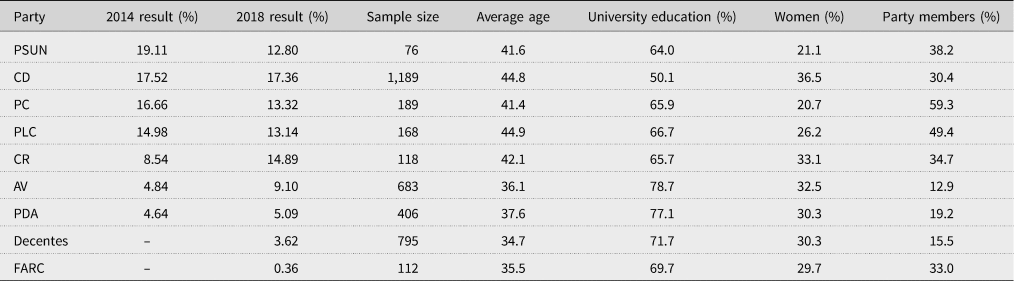
Shortly before the 2018 Colombian legislative elections on 11 March 2018, Facebook Ads were used to invite users whom Facebook considered to have an interest in the political parties, to an online questionnaire between 6 and 11 March 2018. The sampling procedure was based on nine advertising campaigns for each party to ensure equal sampling quotas for the age groups 18 to 24, 25 to 29, 30 to 34, 35 to 39, 40 to 44, 45 to 49, 50 to 54, 55 to 59 and 60 years and older. The sample consists of 4,059 party supporters and includes sizeable subsamples for the supporters of the following nine parties: Partido de la U (PSUN) of then incumbent President Juan Manuel Santos, Centro Democrático (CD) of former President Álvaro Uribe Vélez and of President-elect Duque, Partido Conservador Colombiano (PC), Partido Liberal Colombiano (PLC), Cambio Radical (CR), Alianza Verde (AV), Polo Democrático Alternativo (PDA), the election alliance Lista de la Decencia (Decentes) of Petro and the FARC. Table 1 shows the election results and descriptive statistics for these groups.Footnote 3
Election Results and Descriptive Statistics of Parties and Their Supporters

Participants are defined as supporters of a party if they state that they voted for it and at least weakly identify with the party. Besides the lack of access to membership data for all parties, we chose this definition as Colombia's party system is deinstitutionalized, with low levels of partisanship and formal membership (Albarracín et al. Reference Albarracín, Gamboa, Mainwaring and Mainwaring2018). Most of the participants whom we defined as supporters were involved in some form of party politics. Among the FARC supporters, 83.04% directly interacted with the FARC party, suggesting that the used definition is appropriate to evaluate the hypotheses.
We also conducted a second survey from 27 July to 17 August 2018 only among FARC supporters to evaluate the Democracy Dissatisfaction Hypothesis. We used the same sampling procedure with the same age quotas of the pre-election survey, capturing 298 FARC supporters.
Empirical analysis
Comparing the FARC with other parties
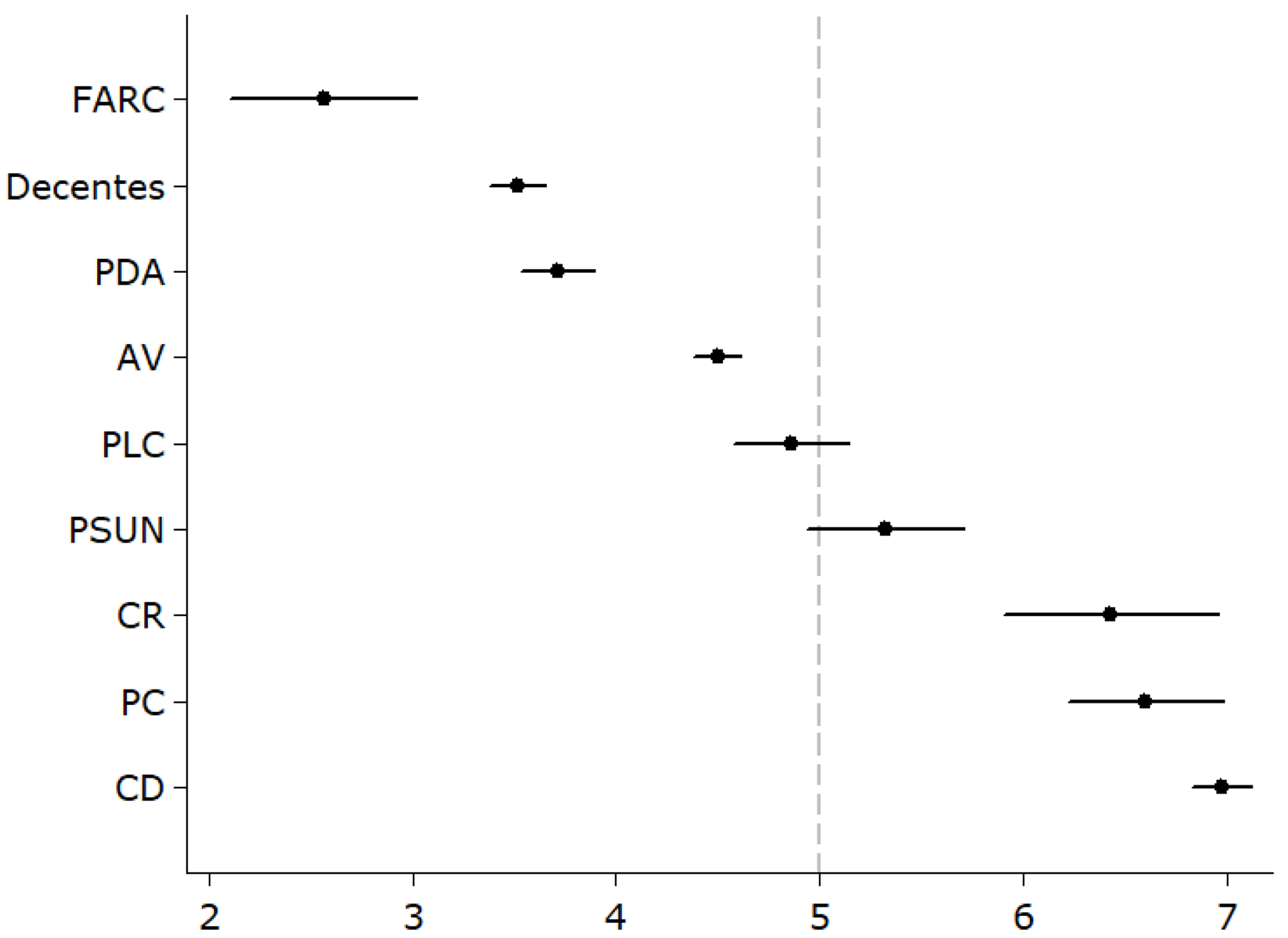
Before evaluating the hypotheses, our large-scale data set of all political parties allows for a categorization of the FARC in the political spectrum. Given its background as a left-wing guerrilla organization, we would expect that the FARC is placed on the far left in the Colombian party system. Two measurements are used to evaluate whether the FARC is indeed the most far left-wing party: first, the average self-placement of supporters in the left–right dimension, and second, the perceived average difference between the supported party and the median voter by the respondents.
Figure 1 shows the average self-placement of supporters of the different parties on a left–right dimension. On a 0–10 scale, FARC supporters place themselves on average at about 2.3. As the 95% confidence interval is not overlapping with any other group, the FARC supporters appear to be the most left-wing in the party system. Decentes with an average score of 3.4, the PDA (3.6) and AV (4.5) are also placed significantly to the left in the Colombian party system. The PLC (4.8) and PSUN (5.4) are statistically indistinguishable from the centre, and the PC (6.6), CR (6.7) and CD (7.0) are placed significantly to the right.
Average Self-Placement of Party Supporters on a Left–Right Scale (0–10)
Note: Error bars give the 95% confidence interval.

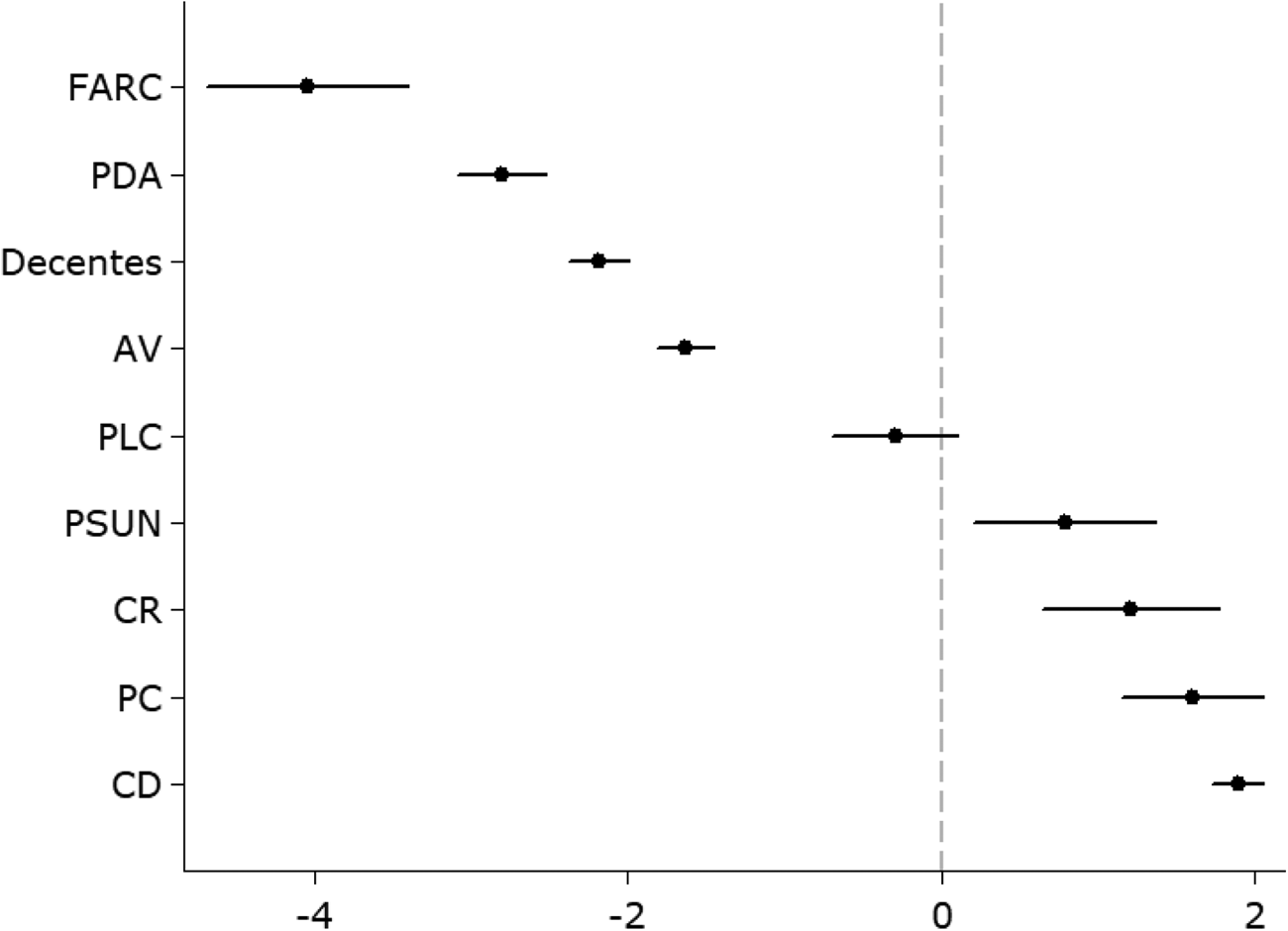
Figure 2 shows the perceived average difference between the supported party and the median voter. A negative score indicates that supporters perceive the party to be to the left of the median, whereas a positive score indicates a placement right of the median. FARC supporters placed the FARC party on average 4.2 points to the left of the median voter, which is significantly more left-wing compared to all other parties. Thus, the comparisons suggest that the FARC is the most left-wing party in the Colombian party system.
Average Perceived Distance by Party Supporters between Their Preferred Party and the Median Voter on a Left–Right Scale (0–10)
Note: Error bars give the 95% confidence interval.

In order to evaluate the Activists Hypothesis, we require a dependent variable that measures the political activity levels of the respondents. The measurement is based on the factor score of five items that asked respondents whether they engaged in the following political activities: putting up election posters, handing out flyers, attending demonstrations/party rallies, participating in party meetings and joining canvassing efforts. A higher score indicates a higher degree of political activism.
The dependent variable for testing the Party Discontent Hypothesis is an index that measures how satisfied supporters are with various aspects of intra-party democracy based on five items: the ability of their party to recruit new members, the involvement of simple members in programmatic decisions and candidate selection, the division of the party into different factions and the outreach of their party to civil society groups.
For both dependent variables, we use the following set of explanatory variables. The main explanatory variable is a binomial measurement of whether a respondent is a FARC supporter. The control variables consist of political and demographic variables. The political control variables are party membership and political career aspiration. Party membership is included because party members should have more opportunities to engage in political activities, and a better insight into the processes of intra-party politics. Political career aspiration is based on the survey item that asked respondents whether they would like to run for higher party or public offices in the future. The answer options range from never (1) to already holding a higher position (5). Political career aspiration might affect the willingness of respondents to become active in politics as well as their evaluation of intra-party politics. The demographic control variables are age, gender and level of education.
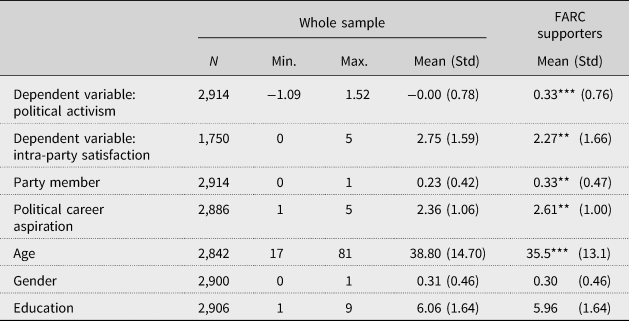
Table 2 shows the descriptive statistics of the variables. In addition, Table 2 also shows the descriptive statistics for FARC supporters. The t-tests of means suggest that FARC supporters had a significantly higher level of political activism (t-value 3.99) at the 99% confidence level and a significantly lower level of satisfaction on intra-party processes (t-value −2.40) at the 95% confidence level compared to the other respondents.Footnote 4
Descriptive Statistics

Notes: t-test of means for significant differences between FARC and other supporters: *p ⩽ 0.10; **p ⩽ 0.05; ***p ⩽ 0.01.
The ordinary least squares (OLS) regression analysis is based on robust standard errors to account for heteroskedasticity. As a further robustness test, the empirical analysis is also based on a smaller subsample that only includes the supporters of parties that are situated to the left of the Colombian party system (FARC, Decentes, PDA, AV). These parties appeal to voters with a similar platform, thus they are the primary competitors of the FARC.
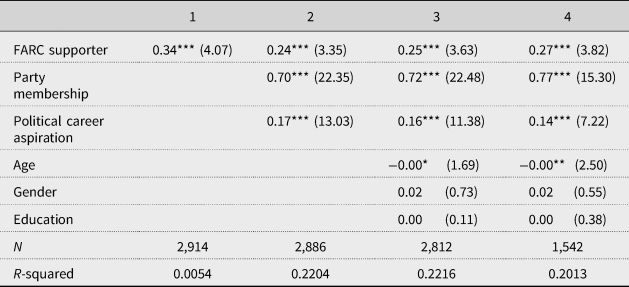
Table 3 shows the regression analysis with the factor score of political activism as the dependent variable, which is relevant for the Activists Hypothesis. Model 1 only includes the FARC supporter dummy as the explanatory variable. Model 2 adds the political control variables party membership and political career aspiration. Model 3 is the fully specified model that also includes the demographic control variables: age, gender and education. Model 4 is based on the subsample of supporters of the left-wing parties FARC, Decentes, PDA and AV.
Regression Analysis to Explain Level of Political Activism

Notes: *p ⩽ 0.10; **p ⩽ 0.05; ***p ⩽ 0.01. Absolute t-values in brackets. Model 4 includes only supporters of left-of-centre parties (FARC, Decentes, PDA, AV).
Across all model specifications, the FARC dummy appears to be positively associated with political activism at the 99% confidence level. The coefficient in Model 3 is 0.25, indicating that the FARC dummy tends to increase political activism by nearly a third of a standard deviation, which provides evidence for the Activists Hypothesis. The positive association is even more sizeable for the control variables party membership and political career aspiration. As expected, this suggests that party members and respondents with political career aspirations tend to be more active in politics.
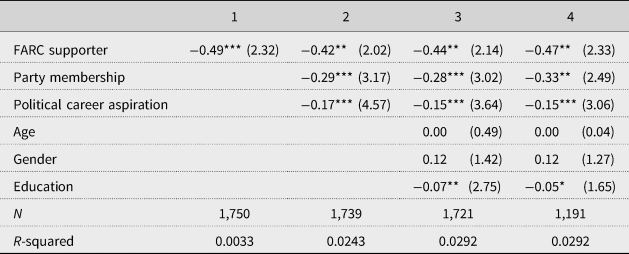
The Party Discontent Hypothesis is tested in Table 4. The dependent variable is replaced with the index for intra-party satisfaction, and all model specifications remain the same. FARC supporters tend to be significantly less satisfied with intra-party politics. The FARC dummy is negatively associated with intra-party satisfaction at the 99% confidence level in Model 1, and at the 95% confidence level in Models 2–4. The size of the coefficient in Model 3 is 0.44, suggesting that the FARC dummy reduces intra-party satisfaction by over a quarter of a standard deviation. The political control variables are also negatively associated with intra-party satisfaction, indicating that party members and those with political career aspirations are less satisfied with the internal affairs of their preferred parties. Consequently, Table 4 provides evidence for the Party Discontent Hypothesis.
Regression Analysis to Explain Satisfaction with Intra-Party Politics

Notes: * p ⩽ 0.10; ** p ⩽ 0.05; *** p ⩽ 0.01. Absolute t-values in brackets. Model 4 includes only supporters of left-of-centre parties (FARC, Decentes, PDA, AV).
Comparing the FARC over time
This section evaluates whether the responses of FARC supporters changed over time between the pre-election survey in March 2018 and the post-election survey in July/August 2018. In terms of age, gender, education and FARC membership, the two samples of FARC supporters are statistically indistinguishable from each other. The average age was 35.5 years, 29.7% were female and 33.0% were FARC party members in the pre-election survey. For the post-election survey, the figures were: 35.5 years, 27.2% female and 37.9% FARC party members. In terms of ideological placement, the two samples were not statistically different from each other, as respondents in the post-election survey placed themselves (2.2) and the FARC (1.8) nearly identically to the respondents in the pre-election survey (2.3 and 1.8, respectively).
To test the Democracy Dissatisfaction Hypothesis, the dependent variable is estimated by the factor score of the following three statements ‘TV news favours the government’, ‘voters are threatened with violence’ and ‘Colombia is governed democratically’. The answer options ranged from strongly disagree (1) to strongly agree (5). The higher the factor score, the higher the democracy dissatisfaction score. A second dependent variable measures support for programmatic radicalization, which asked respondents whether the FARC should moderate (1) or radicalize (5) its political programme.
The independent variable of interest is the dummy variable post-election, which is 0 in the pre-election survey and 1 in the post-election survey. The other explanatory variables are FARC party membership, political career aspiration, age, gender, education and political activism. Ideological self-placement is also used as a control variable.
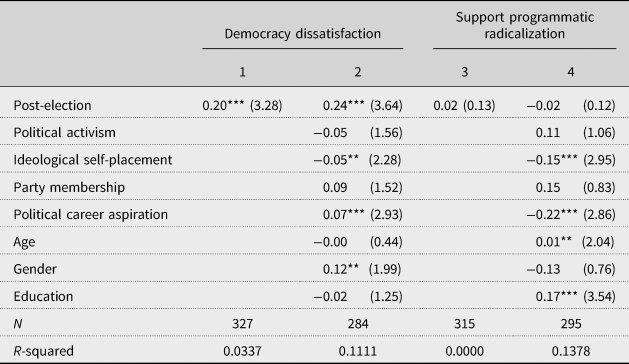
A t-test of means suggests that the post-election FARC supporters are more dissatisfied with democracy at the 99% confidence level (t-value 3.36), but very similar in regard to supporting programmatic radicalization (t-value 0.12). The latter item was closely contested among FARC supporters in both surveys. About 28.8 (29.7)% of respondents favoured moderation and 37.9 (41.4)% supported radicalization before (after) the electoral cycle.
Table 5 shows the regression results relevant for the Democracy Dissatisfaction Hypothesis. The significantly negative post-election coefficient at the 99% confidence level in Models 1–2 indicates that dissatisfaction with democracy was higher among FARC supporters after the electoral cycle. This equates to a substantial influence of about 0.5 standard deviations. By contrast, Models 3–4 show that support for programmatic radicalization did not appear to be higher after the electoral cycle. Among the control variables, democracy dissatisfaction and the support for radicalization increased among those who considered themselves more left-wing. Post-electoral dissatisfaction was also higher among those with political career aspirations, but support for moderation increased among them. In addition, a higher education was associated with post-electoral support for radicalization.
Regression Analysis of FARC Supporters to Explain Democracy Dissatisfaction and Support for Programmatic Radicalization

Notes: *p ⩽ 0.10; **p ⩽ 0.05; ***p ⩽ 0.01. Absolute t-values in brackets.
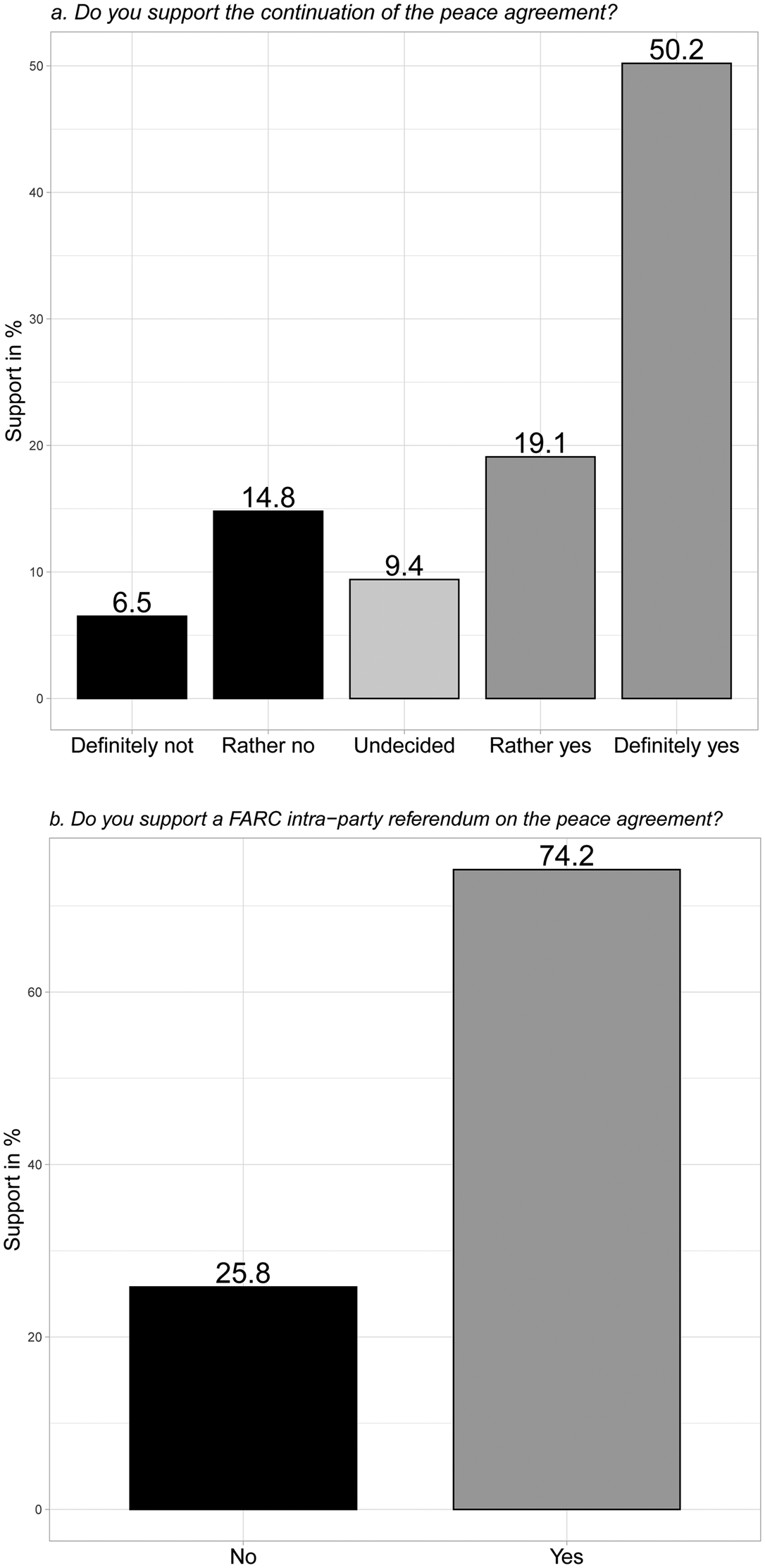
Further evidence for the Democracy Dissatisfaction Hypothesis can be obtained by evaluating how support for the peace agreement developed among FARC supporters over the electoral cycle. Figure 3 shows their post-electoral support for the peace agreement and for conducting an intra-party referendum on the peace agreement. A clear majority of nearly 69% supported the peace agreement. However, support for the peace agreement was unanimous in the pre-election survey. Thus, the support for the continuation of the peace agreement is relatively lower after the electoral cycle, and nearly 22% of respondents rejected the peace agreement in the post-election survey.
Post-Election Views on the Peace Agreement
Note: Support for the peace agreement was unanimous in the pre-election period.

Figure 3 also shows that over 74% of FARC supporters would welcome an intra-party referendum on the peace agreement. This could imply that there is an even more critical perspective on the peace agreement, as such an intra-party referendum could only affect the status quo if the supporters decide against the peace agreement. A t-test of means reveals that the supporters of an intra-party referendum were significantly more likely at the 99% confidence level to be against the continuation of the peace agreement (t-value 2.74). The support for a referendum may also imply additional evidence for the Party Discontent Hypothesis, because FARC supporters are dissatisfied with the involvement of the rank and file in party decision-making. As a consequence, they may demand more inclusive measures in intra-party politics and support a referendum on the peace agreement.
In summary, the empirical analysis shows that FARC supporters are the most far left in the Colombian party system. As suggested by the hypotheses, FARC supporters tend to be significantly more politically active than supporters of the other parties. However, FARC supporters also appear to be relatively less satisfied with intra-party politics. Dissatisfaction with democracy was higher after the electoral cycle, and the previous unanimous support for the peace agreement also decreased. While support for radicalization did not change, it did remain a contested issue among FARC supporters.
Conclusion
This article presents an unprecedented perspective on rebel-to-party transformations. By surveying supporters of the former rebel party FARC, we provide an insight into the internal dynamics of support and activism in former rebel parties. Drawing on classical party politics theory, we argue that the support base of former rebel parties consists predominantly of active supporters who are often dissatisfied with intra-party democracy and are more resilient to moderation attempts made by the party leadership.
Our results show that in comparison to other parties in the Colombian political system, FARC supporters indeed tend to be more politically active as well as more dissatisfied with internal politics. Moreover, dissatisfaction with democracy was higher among FARC supporters after their first electoral participation, and their support for the peace agreement decreased. The issue of programmatic radicalization remained a contested intra-party issue.
In addition, we can also observe exogenous security factors that influence the position of the support base of the party. The costs of the democratic transition and of political moderation are unequally distributed between the leadership and the rank and file. Whereas the leadership enjoys the benefits of political moderation and democracy in the form of public offices, the support base has been subjected to violent attacks and retaliation by state and non-state actors. Moderation attempts by the leadership following a rebel-to-party transformation are difficult, particularly with a support base consisting of a highly dedicated rank and file.
Indeed, the FARC has experienced continuous intra-party conflicts since its first electoral participation. The dissenting faction has accused the current party leadership of anti-democratic behaviour and the persecution of intra-party opposition groups. This faction has sought to focus the attention of the party on the issues affecting the reintegration of former rebels, particularly those on the lower ranks in remote areas of the country. These issues are primarily the security concerns related to the assassination of hundreds of militants and social leaders, economic reintegration and the failure of the government to implement several points of the peace agreement.
On the other hand, the current leadership continues to have a strong hierarchical structure. The attention of the central administration is focused on programmatic issues concerning the party name change, political platform, restructuring of the party leadership and the FARC's electoral strategy for the 2022 elections. Dissenting voices inside the party have been subjected to intra-party disciplinary measures for various reasons. In some cases, militants have been expelled from the party, and two leaders have been removed from their seats in Congress for the upcoming legislative period.
This division has resonated strongly throughout the party ranks, and the leadership has been accused of being politically disconnected from a large group of the party militancy. This fragmentation reached its pivotal point when the dissenting faction requested in 2021 the official division of the party and, thus, the legislative seats granted by the peace agreement for two electoral periods. The request was denied, but it evidenced the seemingly irreconcilable differences between the two factions.
The FARC received 0.31% of the vote share in the 2022 Colombian legislative election – even lower than the 0.36% it received in 2018. This shows the persisting negative image of the former FARC with voters and the minimal or non-existent effect of the party rebranding. Such a result in the 2026 election would eliminate the presence of the former rebel party in parliament. This could negatively affect former rebels' willingness to participate in the political process, mainly if the government makes little to no effort to uphold its responsibilities with peace agreement implementation, as was the case with the Duque administration over the period 2018–2022.
Nonetheless, the FARC leadership has sought to join the left coalition Pacto Historico. It is not clear how much it is willing to compromise on ideology if the party does eventually join this left-wing coalition. Still, it is indeed an important development for the FARC, a party born of a Marxist–Leninist rebel group, to actively seek to join an alliance with parties more at the centre-left of the Colombian political spectrum. However, the policies of the newly elected president, the continued implementation of the peace agreement, the outcome of intra-party conflicts, actions by FARC re-armed dissident groups, and the intensification of violence by other non-state actors will all ultimately determine the overall success of the 2016 Colombian peace agreement.
By examining supporters comparatively and over time, our study provides unique insights that are relevant for the broader rebel-to-party transformation literature. While our case study is by design tailored to the FARC, it also has broader implications beyond Colombia for the recent wave of rebel-to-party transformations around the world. As participation in rebel organizations tends to incur substantial social and legal costs, it is likely that former rebel parties predominantly draw on ideologically committed activists. The implications of an active and committed support base tend to be positive for regular political parties, particularly regarding campaigning activities. In the case of former rebel parties, however, such supporters may be particularly prone to become dissatisfied with intra- and inter-party democracy if social costs remain substantial and if their parties are unsuccessful at the ballot box. Ideological moderation is not likely if former rebels face state-sponsored repression and if electoral performances are weak. In such an environment, the dedicated supporters of a former rebel group disproportionally pay the cost for moderation, whereas the leadership disproportionally enjoys the benefits in the form of public offices. This cost–benefit disparity did not exist during their rebel past, leading to increasing dissatisfaction among former rebels.
Supplementary material
The supplementary material for this article can be found at https://doi.org/10.1017/gov.2022.33.
Acknowledgements
We are grateful to Nikolay Marinov, Thomas Bräuninger, Sabine Carey, John Ishiyama and Enzo Nussio for helpful comments and support. In addition, we thank Gyda Sindre, Jacqui Cho, members of the Politics After War Research Network and the Folke Bernadotte Academy, and participants of the virtual seminar series ‘From Armed to Non-Armed Politics: Research-Policy Dialogue on the Political Dynamics of Disarmament, Demobilization, and Reintegration (DDR)’ for inviting us to present our work and for their feedback. We would also like to thank the three anonymous reviewers and the editors of Government and Opposition for their helpful comments.