Introduction
Refugees, in addition to displacement from their homes, have been exposed to many horrifying traumatic events such as threat of death, torture, or serious injury and the injury, death, disappearance of family members, rape, lack of food and water, or lack of shelter (Mollica et al. Reference Mollica, Caspi-Yavin, Bollini, Truong, Tor and Lavalle1992). Epidemiological studies indicate a high risk of mental health problems among refugees (Fazel et al. Reference Fazel, Wheeler and Danesh2005; Porter & Haslam, Reference Porter and Haslam2005). A meta-analysis including studies conducted among refugees in Western countries indicated that one in every 10 adult refugees has post-traumatic stress disorder (PTSD) and one in every 20 has major depression (Fazel et al. Reference Fazel, Wheeler and Danesh2005). If not treated, mental health problems among refugees may become chronic. A longitudinal study conducted in two different refugee camps for Bosnian refugees indicated that 24–30% had PTSD co-morbid with depression, 4–6% had only PTSD and 19% had only depression 3 years after the war (Vuković et al. Reference Vuković, Jovanović, Kolarić, Vidović and Mollica2014). PTSD has a chronic course if not treated and those with PTSD have low quality of life (Kessler, Reference Kessler2000; Mollica et al. Reference Mollica, Sarajlic, Chernoff, Lavella, Vukovic and Massagli2001).
Since the start of the war in Syria in 2011, 3.8 million Syrians have been forced to find a safer place. Almost half of them have fled to other countries as refugees (UNHCR, 2015). Turkey hosts the highest number of Syrian refugees who sought asylum (UNHCR, 2015), residing either in refugee camps or in cities. A study using a structured diagnostic interview in a sample of 352 Syrian refugees staying at refugee camps in Turkey (Alpak et al. Reference Alpak, Unal, Bulbul, Sagaltici, Bez, Altindag, Dalkilic and Savas2014) showed that 33.5% had a diagnosis of PTSD. Female refugees who were exposed to two or more traumatic events and had a personal and family history of psychiatric disorder had higher risk for PTSD.
In humanitarian settings, such as refugee camps, specialized mental health interventions have been shown to reduce symptoms of mental disorders such as PTSD and depression (Tol et al. Reference Tol, Barbui, Galappatti, Silove, Betancourt, Souza, Golaz and van Ommeren2011). Two randomized controlled trials (RCTs) in Uganda show evidence for the efficacy of narrative exposure therapy (NET) in refugee camps (Neuner et al. Reference Neuner, Onyut, Ertl, Odenwald, Schauer and Elbert2008). In one of them, 43 Sudanese refugees living in a refugee settlement either received NET, supportive counselling, or psychoeducation. NET was more effective than both control conditions (Neuner et al. Reference Neuner, Schauer, Klaschik, Karunakara and Elbert2004). A second study with 277 refugees indicated the effectiveness of NET when delivered by lay counsellors besides the mental health professionals (Neuner et al. Reference Neuner, Onyut, Ertl, Odenwald, Schauer and Elbert2008). However, limitations in these studies such as a high attrition rate suggest a need for further studies in similar settings.
According to recent guidelines, eye movement desensitization and reprocessing (EMDR), in addition to trauma-focused cognitive–behavioural therapy (TF-CBT), is an effective treatment for PTSD (National Institute for Clinical Excellence, 2005; World Health Organization, 2013). EMDR is carried out while the patient focuses on the most distressing memory of the traumatic event besides the related negative self-cognition. At the same time, the patient is asked to make eye movements or exposed to bilateral tones or tapping while recalling the traumatic memories. The efficacy of EMDR and its underlying working mechanism have been a matter of scientific debate (Herbert & Mueser, Reference Herbert and Mueser1992). Some have argued that the eye movements in EMDR do not add to EMDR's effectiveness, and that the effects of EMDR may be explained by exposure to the traumatic memory. However, a recent meta-analysis has shown that eye movements do contribute to EMDR's efficacy (Lee & Cuijpers, Reference Lee and Cuijpers2013). Recent studies have supported the working memory explanation to account for the effect of eye movements in EMDR (e.g. Engelhard et al. Reference Engelhard, van den Hout, Janssen and van der Beek2010). According to this theory, eye movements are considered a dual task that taxes working memory. When a patient retrieves the mental image of the trauma and performs the dual task such as eye movements, the mental image of the trauma is rendered less vivid and emotional since the two tasks (retrieving the memory and performing eye movements) compete for limited working memory capacity (Van den Hout & Engelhard, Reference Van der Hout and Engelhard2012). This effect is retained upon retrieval (Gunter & Bodner, Reference Gunter and Bodner2009; Ho & Lee, Reference Ho and Lee2012; Leer et al. Reference Leer, Engelhard and van den Hout2014). Other explanations that have been put forward to explain how EMDR works include that eye movements induce an orienting response, similar to rapid eye movements (REM) during sleep, which facilitates cortical integration of traumatic memories (e.g. Stickgold, Reference Stickgold2002).
The studies that have evaluated the efficacy of EMDR in non-Western refugee populations are scarce. So far, only one small pilot RCT compared EMDR with stabilization treatment in the reduction of PTSD symptoms in 20 refugees who were living in the Netherlands for on average 10 years (Ter Heide et al. Reference Ter Heide, Mooren, Kleijn, de Jong and Kleber2011). This study showed that EMDR was feasible and acceptable but did not show a difference between EMDR and stabilization in reduction of PTSD symptoms (Ter Heide et al. Reference Ter Heide, Mooren, Kleijn, de Jong and Kleber2011). However, apart from our earlier pilot trial (see below), no studies evaluating the efficacy of EMDR in refugee camp settings have been published yet. Therefore, a question remains whether evidence-based interventions such as EMDR are also effective in refugees who reside in refugee camps. In these camp settings, refugees may experience high levels of ongoing stress and insecurity about the future.
In our previous smaller pilot we conducted an exploratory RCT in Kilis Refugee Camp with Syrian refugees (Acarturk et al. Reference Acarturk, Konuk, Cetinkaya, Senay, Sijbrandij, Cuijpers and Aker2015). This pilot RCT showed that EMDR is accepted and effective in reducing symptoms of PTSD and depression among Syrian refugees compared with a wait-list control condition. The current study builds upon this pilot study and examines the efficacy of EMDR treatment v. a wait-list control condition in a different sample of 70 Syrian refugees located in a Turkish refugee camp at the Syrian border.
Method
Participants and procedure
The study was reviewed and approved by the Ethics Committee of Istanbul Şehir University (Institutional Review Board Protocol 04/2013). The study was registered to Clinical Trials (ClinicalTrials.gov identifier: NCT01847742). Participants provided their written informed consent to participate in this study.
The Consolidated Standards of Reporting Trials (CONSORT) checklist is available as supporting information (see online Supplementary material). This study was a single-blind, parallel-group, open-label RCT with two groups: the EMDR intervention and a waiting-list control group.
The study was conducted at Kilis Refugee Camp between September 2013 and June 2014 at the border between Turkey and Syria.
Eligible participants were recruited from the treatment-seeking adult refugees who applied to the Psychosocial Support Centre of the camp. Inclusion criteria were: (1) diagnosis of PTSD according to the Diagnostic and Statistical Manual of Mental Disorders, 4th edition (DSM-IV); (2) age 18 years and older. Exclusion criteria were: (1) diagnosis of psychotic disorder or substance abuse according to DSM-IV; (2) being pregnant; (3) any psychotherapy during the trial; (4) concurrent use of any psychotropic medication during the trial. Eligibility was judged with the Mini-International Neuropsychiatric Interview Plus (M.I.N.I. PLUS; Sheehan et al. Reference Sheehan, Lecruiber, Sheehan, Amorim, Janavs, Weiller, Hergueta, Baker and Dunbar1998).
Informed consent was collected from all participants prior to the pre-treatment assessment. Assessments were scheduled at three time periods: a pre-treatment assessment [M.I.N.I. PLUS, Harvard Trauma Questionnaire (HTQ), Impact of Event Scale-Revised (IES-R), Beck Depression Inventory-II (BDI-II) and Hopkins Symptoms Checklist-25 (HSCL-25)], a post-treatment assessment at 1 week after finishing the intervention (M.I.N.I. PLUS, HTQ, IES-R, BDI-II and HSCL-25) and a follow-up assessment at 5 weeks after finishing the intervention (M.I.N.I. PLUS, HTQ, IES-R, BDI-II and HSCL-25). All questionnaires were self-report instruments. A research assistant who was blind to the treatment conditions administered the scales by means of a face-to-face interview. The reason for this was the lack of familiarity with mental health assessments in Syrian culture and the low educational level of the refugees (48.9% had completed only primary school).
Randomization and blinding
After including the participants, another researcher, not involved in the current study, used a computer-generated random-number list for the allocation of participants to different treatment groups. Participants were randomly assigned on a 1:1 basis to the EMDR or wait-list group. The participants and the therapists were necessarily aware of the allocated arm, but the outcome assessors were kept blind to the allocation.
Intervention
EMDR therapy: Recent Traumatic Episode Protocol (R-TEP)
EMDR therapy approaches psychotherapy from a trauma perspective. The guiding model is adaptive information processing (AIP) which asserts that unprocessed memories and memory networks are the primary base of psychopathology. The disruption of the information processing causes storage of disturbing memories as they are. These are called dysfunctional memories. AIP takes the disruption to an adaptive solution. In this way, it builds functional memory networks (Shapiro, Reference Shapiro2001, Reference Shapiro1995). This study utilized the EMDR R-TEP (Shapiro & Laub, Reference Shapiro and Laub2008, Reference Shapiro, Laub and Luber2013). This EMDR application has a focus on recent traumatic events with an extended time perspective. The traumatic episode is defined as the trauma continuum starting from the original critical incident up to the present. The refugees in this study have suffered life-changing traumatic events with ongoing disruption and uncertainty that hinders the consolidation or integration of these experiences. Their situation can be described as a trauma episode that has been going on for up to 1 year or more, affecting many aspects of their life. The R-TEP, like the standard EMDR protocol, follows an eight-phase protocol while working with the fragmented nature of the memories in a safety-oriented contained way.
Three psychologists who were trained in EMDR (level II) and R-TEP administered the protocol individually. An EMDR trainer provided face-to-face and online live (Skype) supervision. Treatment fidelity was supported by the supervisor, who attended at least two sessions of each participant.
None of the participants gave permission for the video or audio taping of the sessions. The reason reported for refusal was fear of the Syrian government. However, the supervisor checked whether the therapists were complying with the protocol during at least one live session of each therapist and conducted one-to-one and group supervision sessions.
Cultural sensitivity
In Syria, there is a low familiarity with mental health care. A study about the mental health service use in Arab countries indeed reported that in Syria there were fewer than 0.5 psychiatrists and no psychologists per 100 000 population in 2007 (IASC, 2007).
For that reason, we had to adapt the research procedures to the local culture. First, all interviews were carried out in the local language, with the help of Syrian interpreters. Second, in order to decrease the possible prejudice against mental health, psychoeducation related to trauma, PTSD and EMDR was provided. In addition, we introduced our study to key members of the community (Syrian opinion leaders at the camp such as imams, village leaders and a few women with strong social networks). Third, we scheduled sessions in the late afternoon because in Syria people prefer to stay up late in the evening and wake up later in the morning, due to high temperatures in the area.
Moreover, possibly related to perceived stigma, refugees preferred to hide the fact that they were receiving treatment. The clinic was at the kindergarten building in the camp. The participants did not want to be labelled as ‘majnun’ (insane). To avoid this stigma, those participants who were parents were bringing their children to the building to pretend that they were coming to the kindergarten. Someone in our team was taking care of the child while the parent participant had the session. Fifth, we tried to ensure a match between the gender of the therapist and the client. But if that was not possible, we matched the gender of the interpreter with the client.
Wait-list control
Participants in the control group did not receive any intervention in the camp or outside the camp. After the 5-week follow-up assessment, patients who still met diagnostic criteria for PTSD were offered additional EMDR therapy.
Measures
M.I.N.I.
The M.I.N.I. (Sheehan et al. Reference Sheehan, Lecruiber, Sheehan, Amorim, Janavs, Weiller, Hergueta, Baker and Dunbar1998) is a brief semi-structured clinician-rated interview to screen for DSM-IV Axis-I disorders. The following modules of the Turkish version of M.I.N.I. PLUS were administered (Engeler, Reference Engeler2004): psychotic disorders, post-traumatic stress disorder, major depression, alcohol and drug dependence.
HTQ
To assess the exposure of traumatic events and the PTSD symptoms, the first and the fourth parts of HTQ were employed (Mollica et al. Reference Mollica, McDonald, Massagli and Silove2004). The HTQ is a widely used instrument in various cultures and languages. In the present study, the Arabic version of the HTQ was used (Shoeb et al. Reference Shoeb, Weinstein and Mollica2007). In the first part of the HTQ, the participants were asked whether they had experienced 43 traumatic (yes or no) events or not. To detect PTSD, 45 symptom items with a four-point scale (1 = ‘not at all’, 2 = ‘a little’, 3 = quite a bit’, and 4 = ‘extremely’) were assessed in the fourth part. An average score across 43 items that is over 2.5 indicates PTSD symptoms. The possible range of average score is from 1 to 4. In the present study, the baseline administration of the questionnaire produced a Cronbach's α value of 0.90, indicating an excellent internal consistency.
IES-R
The IES-R is a 22-item self-report instrument which rates the severity of PTSD symptoms (Weiss & Marmar, Reference Weiss, Marmar, Wilson and Keane1997). Participants rated each item on a five-point Likert scale from 0 (not at all) to 4 (extreme). IES-R total scores range between 0 and 88, with higher scores indicating higher levels of PTSD symptoms. There are three subscales of IES-R: re-experiencing/intrusion, avoidance/numbing, and hyperarousal. The validity of IES-R has been tested in different populations (Panahi et al. Reference Panahi, Moghaddam, Sahebkar, Nazari, Beiraghdar, Karami and Saadat2011). We used a cut-off score of ⩾33 as indicating a probable PTSD (Weiss & Marmar, Reference Weiss, Marmar, Wilson and Keane1997). The scale has been translated into Arabic by independent native Arabic speakers. The previous administration of the scale in a sample of native Arabic speakers yielded a Cronbach's α of 0.93 (M Zaghrout, unpublished observations). The test–retest reliability calculated by administering the scale to the same sample on two occasions, 2 weeks apart, yielded a Pearson correlation coefficient of r = 0.88 (M Zaghrout, unpublished observations). In the present study, the baseline administration of the scale yielded a Cronbach's α value of 0.87, indicating a good internal consistency of all items.
BDI-II
Depression symptoms were measured with the BDI-II, which is a widely used self-report instrument with satisfactory psychometric properties. The Arabic version of the BDI-II was developed by Ghareeb (Reference Ghareeb2000), which included Syrian participants as well as participants from 17 other Arabic groups (as cited in Bader, Reference Bader2006). The BDI-II has 21 items and the total score varies between 0 and 63, with higher scores indicating more severe depression (Beck et al. Reference Beck, Steer and Brown1996). A score of 21 or higher indicates moderate depression and a score lower than 10 is considered to indicate the absence of any depression. In the context of the present study, the baseline administration of the inventory yielded a Cronbach's α value of 0.71, indicating an acceptable level of reliability for items.
HSCL-25
The HSCL-25 is a widely used 25-item instrument to measure anxiety and depression. The first 10 items (part I) assess anxiety while the remaining 15 items (part II) assess major depression as defined by the DSM-IV. Participants rated each item on a four-point Likert scale ranging from 1 (not at all) to 4 (extremely). The total score, showing emotional stress, is the average of all 25 questions while the depression score is the average of depression items and ranges between 1 and 4. Previous studies indicated good evidence that the Arabic version of the HSCL-25 is reliable and valid (Kobeissi et al. Reference Kobeissi, Araya, El Kak, Ghantous, Khawaja, Khoury, Mahfoud, Nakkash, Peters, Ramia and Zurayk2011). In the present study, the baseline administration of the checklist yielded a Cronbach's α value of 0.87, indicating good reliability for items.
Data analysis
We used χ2 tests and independent t tests to compare the baseline characteristics of the two study groups. All outcome analyses were conducted according to the intention-to-treat principle. We used linear mixed models to analyse changes over time in IES-R, HSCL-25, HTQ and BDI-II scores. No specific covariance type (unstructured) was used in the linear mixed models. These procedures take into account that the dependent measures are correlated across time and also allow for analysing data not only for completers but all participants allocated to the study arms. The analysis model had four independent factors: group (EMDR v. control), time (post-test and 1-month follow-up), the interaction between time and group and the dependent variable (IES-R, HSCL-25, HTQ and BDI-II scores) measured at baseline. The time × group interaction was included in the models as a factor to test if the difference between the groups immediately after the post-test was maintained at the 1-month follow-up assessment. The effect sizes (ω 2) for linear mixed models were calculated based on the suggestions of Xu (Reference Xu2003). We also used χ2 analysis to compare M.I.N.I. PTSD diagnosis between groups at the post-treatment and the 1-month follow-up time points, and calculated odds ratios and the number needed to treat (NNT). To provide a robust test of the efficacy of the treatment, and to follow the intention-to-treat principles of data analysis, the missing data points in the χ2 analyses were replaced with values that would indicate that drop-outs retained the diagnosis of trauma after the intervention. IBM SPSS Statistics version 22 (USA) was used in the analysis of the data. A two-tailed p value of 0.05 was used as the statistical significance cut-off point.
Results
Baseline characteristics
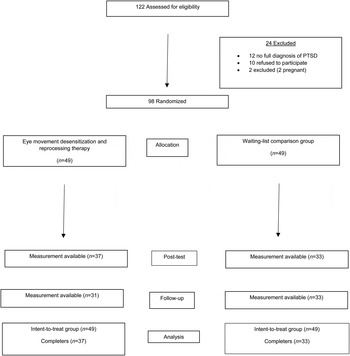
Fig. 1 summarizes the flow of participants and Table 1 compares the groups’ demographic characteristics. First, 122 participants were assessed for eligibility. Of the excluded 24 participants, 12 had no diagnosis of PTSD, 10 refused to participate in the study, and two were pregnant. A total of 98 participants were randomly assigned either to receive EMDR therapy (n = 49) or to be wait-listed (n = 49) as the control group. In all, 37 and 33 people remained in the respective EMDR and control groups for the post-test assessments. The main reasons of drop-out in the control group were moving out of the camp (n = 9) and refusal (n = 7). The mean number of completed intervention sessions within the EMDR participants was 4.2 (s.d. = 1.3, range = 2–7). Of the participants, 37 (76%) completed the full EMDR therapy while 12 (25%) did not complete it. Among the drop-outs, two participants (4%) received two sessions, six participants (12%) received three sessions, three participants (6%) received four sessions, and one participant (2%) received five sessions. Reasons for drop-out in the EMDR group were refusal of entering into treatment (n = 7) and moving out of the camp (n = 5). Whilst the number of people in the control group (n = 33) remained the same for the follow-up assessment at 1 month, the number of people decreased from 37 to 31 in the EMDR group. Among the reasons for drop-out (n = 6) was leaving the camp. Drop-outs did not differ significantly from the completers, except that a trend indicated that participants who dropped out of the trial were more likely to be females than males [n = 17; 61% v. n = 11; 39%; χ2 (1, n = 96) = 3.60, p = 0.058].
Study design and flow of patients throughout trial. PTSD, Post-traumatic stress disorder.

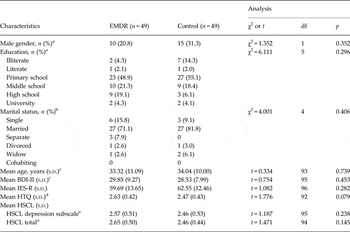
Demographic characteristics of groups at baseline

EMDR, Eye movement desensitization and reprocessing; df, degrees of freedom; s.d., standard deviation; BDI-II, Beck Depression Inventory-II; IES-R, Impact of Events Scale-Revised; HTQ, Harvard Trauma Questionnaire; HSCL, Hopkins Symptoms Checklist-25.
a Data from 96 participants.
b Data from 71 participants.
c Data from 95 participants.
d Data from 94 participants.
e Data from 97 participants.
The sample was predominantly female (n = 71; 74%), with primary or secondary education (n = 69, 72%), and married (n = 54; 76%). The average age of the EMDR group was 33.32 years (range = 18–59 years), and of the control group 34.04 years (range = 17–64 years). The groups also did not differ on their scores on BDI-II, IES-R, HTQ and HSCL total and HSCL depression scales.
The traumatic events that our sample was exposed to were death of family members, threatened death to self or others, serious injury to self or loved ones, husband being at war, arrested family members, not being able to bury significant others who have died in Syria and lack of shelter.
Primary outcomes
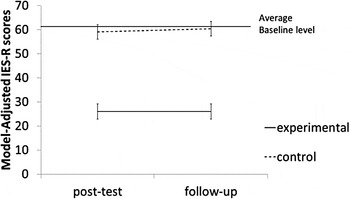
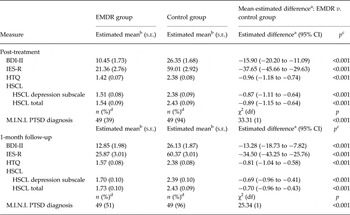
The linear mixed-model analysis of IES-R scores showed a significant effect of group (F 1,63.32 = 102.74, p < 0.001, ω 2 = 0.52). There was no time or time × group interaction effect on IES-R scores of the groups (F 1,62.52 = 1.74, p = 0.192, and F 1,62.52 = 0.50, p = 0.483, respectively), showing that the treatment advantage at the post-test was maintained over time (Fig. 2). The post-hoc comparisons are presented in Table 2. The model-adjusted IES-R scores of the EMDR group were significantly lower in the EMDR group than in the control group both at the post-treatment (p < 0.001) and at the 1-month follow-up (p < 0.001). This improvement was observed for all subscales of IES-R. There was a significant difference between the EMDR and the control groups (F 1,67.03 = 84.92, p < 0.001, ω 2 = 0.44, F 1,67.01 = 85.47, p < 0.001, ω 2 = 0.44, F 1,67 = 112.78, p = < 0.001, ω 2 = 0.52) on the avoidance, intrusion and hyperarousal subscales scores of IES-R, respectively. There was no significant time × group interaction effect (F 1,68 = 0.10, p = 0.749, F 1,68 < 0.01, p = 0.952, F 1,68 = 0.10, p = 0.759) on the avoidance, intrusion and hyperarousal subscale scores of IES-R, respectively.
Impact of Event Scale-Revised (IES-R) scores at post- and follow-up assessments adjusted for group, time, group × time interaction and the mean baseline IES-R of 61.12. Values are means, with standard errors represented by vertical bars.

PTSD and depression scores at the immediate post-treatment and 1-month follow-up for participants in the EMDR and the wait-listed control group

PTSD, Post-traumatic stress disorder; EMDR, eye movement desensitization and reprocessing; s.e., standard error; CI, confidence interval; BDI-II, Beck Depression Inventory-II; IES-R, Impact of Events Scale-Revised; HTQ, Harvard Trauma Questionnaire; HSCL, Hopkins Symptoms Checklist 25; df, degrees of freedom; M.I.N.I., Mini-International Neuropsychiatric Interview.
a Contrast estimates based on the mixed models with group, time, group × time interaction and the baseline measure as model factors.
b Group means estimated based on the mixed models with group, time, group × time interaction and the baseline measure as model factors.
c p for the mixed-model tests.
d Percentages and analyses based on the imputed data.
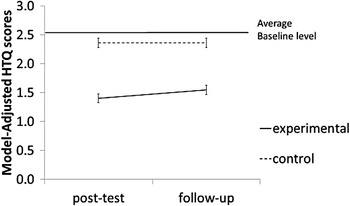
The linear mixed-model analysis results of HTQ scores were in line with those of the IES-R results. There was a significant effect of group (F 1,59.77 = 91.44, p < 0.001, ω 2 = 0.43). There was no effect of time (F 1,58.82 = 1.25, p 0.268) or time × group interaction (F 1,58.81 = 1.33, p = 0.254) with respect to HTQ scores. This indicated that the mean estimated differences between the HTQ scores of the groups did not change between the post-treatment and the follow-up (Fig. 3). As shown in Table 2, the model-adjusted HTQ scores in the EMDR group were significantly lower in the EMDR group than in the control group both at the immediate post-test (p < 0.001) and the 1-month follow-up (p < 0.001) assessments.
Harvard Trauma Questionnaire (HTQ) scores at post- and follow-up assessments adjusted for group, time, group × time interaction and the mean baseline HTQ score of 2.56. Values are means, with standard errors represented by vertical bars.

We also conducted χ2 tests to compare the M.I.N.I. PTSD diagnosis at the post-test and the M.I.N.I. PTSD diagnosis at the 1-month follow-up. To provide a robust test of the efficacy in χ2 analyses, we replaced the missing values with the values indicating that the trauma diagnosis was retained by the drop-outs at both post-treatment assessments. At the immediate post-test, PTSD was diagnosed in 19 out of 49 (39%) participants assigned to the EMDR group v. 46 out of 49 (94%) participants assigned to the wait-listed control group [χ2(1, n = 98) = 33.31, p < 0.001]. The odds ratio was 24.21 [95% confidence interval (CI) 6.59–88.98]. In other words, it was 24.21 times more likely to be diagnosed with PTSD for someone in the control group as compared with the EMDR group at the immediate post-test. The NNT at the post-treatment was 2 (95% CI 1.4–2.5), meaning that at least two individuals with PTSD should be treated with EMDR in order for one patient to recover from PTSD at the post-treatment. At the 5-week follow-up, 25 out of 49 participants (51%) who were assigned to the EMDR group and 47 out of 49 participants (96%) who were assigned to the wait-listed group were diagnosed with PTSD [χ2 (1, n = 98) = 25.34, p < 0.001]. The odds ratio at the follow-up assessment was 22.56 (95% CI 4.92–103.35), meaning that the control participants were about 23 times more likely to be diagnosed with PTSD as compared with the EMDR group at the 1-month post-assessment. The NNT at this time point was 3 (95% CI 1.9–5.7). This meant that at least three individuals with PTSD should be treated with EMDR in order for one patient to recover from PTSD at the follow-up.
The completers’ analyses of the measures (IES-R, HTQ and M.I.N.I. PTSD diagnosis) produced the same results.
Secondary outcomes
The linear mixed-model analysis of the BDI scores revealed a significant effect of group (F 1,62.75 = 48.94, p = 0.001, ω 2 = 0.35). There was no main effect of time (F 1,60.70 = 0.52, p = 0.472) or an interaction effect of time × group with respect to the BDI scores (F 1,60.73 = 0.76, p = 0.368), meaning that the difference between the groups was maintained from post-treatment to the follow-up. As shown in Table 2, the model-adjusted BDI scores were significantly lower in the EMDR group than in the control group both at the post-treatment (p < 0.001) and at the 1-month follow-up (p < 0.001).
The linear mixed-model analysis of HSCL-25 scores revealed a significant effect of group (F 1,64.37 = 55.03, p < 0.001, ω 2 = 0.36). There was no main effect of time (F 1,62.74 = 1.76, p = 0.186) or an interaction effect of time × group (F 1,62.75 = 1.79, p = 0.186) on the HSCL total scores of the groups. This latter set of results showed that the HSCL total score difference between the groups was preserved between the post-treatment and the follow-up. As shown in Table 2, the model-adjusted HSCL total scores were significantly lower in the EMDR group than in the control both at the post-treatment (p < 0.001) and the 1-month follow-up assessments (p < 0.001).
Discussion
The purpose of this study was to examine the efficacy of EMDR in reducing symptoms of PTSD and depression among refugees residing at a refugee camp. The results supported the efficacy of EMDR in reducing symptoms of PTSD assessed with the HTQ and the IES-R and symptoms of depression assessed with the BDI and the HSCL.
The efficacy of EMDR as a treatment for PTSD has been reported across a number of meta-analyses (Bradley et al. Reference Bradley, Greene, Russ, Dutra and Westen2005; Seidler & Wagner, Reference Seidler and Wagner2006; Bisson et al. Reference Bisson, Roberts, Andrew, Cooper and Lewis2013). To our knowledge, no studies were conducted that evaluated the efficacy of EMDR in refuges located in a refugee camp.
Our results are in line with previous trials indicating that psychotherapies, such as TF-CBT (Palic & Elklit, Reference Palic and Elklit2010; Nickerson et al. Reference Nickerson, Bryant, Silove and Steel2011) or NET (Morina et al. Reference Morina, Maier, Bryant, Knaevelsrud, Wittman, Rufer, Schnyder and Müller2012) are helpful in alleviating mental health problems among refugees. However, the majority of studies were conducted in Western countries, far away from the war area, in a secure environment (McFarlane & de Girolamo, Reference McFarlane, de Girolamo, van der Kolk, MacFarlane and Weisaeth2007). These resettled refugees constitute less than 1% of all persons of concern according to the UNHCR (Murray et al. Reference Murray, Davidson and Schweitzer2010). In the context of refugee camps, mental health professionals face specific challenges. Daily hassles mainly related to perceived safety and basic needs (i.e. food, clean water, firewood, privacy) are additionally related to distress among refugees (Rasmussen & Annan, Reference Rasmussen and Annan2010). In addition, post-migration stressors could make it more difficult to cope with war-related memories. However, the present results indicate that a trauma-focused therapy in the months following displacement is effective in reducing PTSD and depression symptoms, even when offered in such challenging circumstances as a refugee camp.
Strengths and limitations
Strengths of this study include the use of a clinical interview to assess PTSD and valid self-report measures to assess symptoms of PTSD and depression. The study was also conducted in difficult circumstances with a group in high need of treatment. Furthermore, the EMDR protocol was adapted to the local culture. However, this study also has a few limitations. First, we could not compare the treatment group with a control group other than a wait-list condition. This may have affected symptom scores in the wait-list control group, since recent studies have shown that wait-list control groups usually show smaller effect sizes compared with active control groups (Furukawa et al. Reference Furukawa, Noma, Caldwell, Honyashiki, Shinohara, Imai, Chen, Hunot and Churchill2014). Second, treatment fidelity was not formally evaluated but supported by frequent supervisions. Third, due to the high mobility of the refugees, we had sizeable drop-outs in both groups and we had no longer-term follow-up data than 5 weeks after the intervention.
Clinical implications
As indicated in the report of the UNHCR (2013), war and conflict do increase the risk for new mental health problems while escalating the pre-existing ones. For that reason, implementing mental health and psychosocial support (MHPSS) for people of concern (refugees, asylum seekers, internally displaced people and stateless people) is highly important (Tol et al. Reference Tol, Barbui, Galappatti, Silove, Betancourt, Souza, Golaz and van Ommeren2011). Among MHPSS one may think to create child-friendly spaces, to support parenting groups or to provide specialized mental health services such as trauma-specific interventions. EMDR seems to be a beneficial treatment for PTSD in Syrian refugees, even when they are still in a refugee camp and experiencing high levels of ongoing trauma. Our results support the notion that evidence-based treatments for PTSD such as EMDR should not be withheld under such circumstances.
Conclusion
In conclusion, our results support that EMDR therapy is effective in alleviating PTSD and depression symptoms among Syrian refugees who live in refugee camps. Future research needs to determine long-term effects of EMDR among Syrian refugees.
Supplementary material
For supplementary material accompanying this paper visit http://dx.doi.org/10.1017/S0033291716001070
Acknowledgements
This research received no specific grant from any funding agency, commercial or not-for-profit sectors.
Declaration of Interest
None.