


Statement of Research Significance
Research Question(s) or Topic(s): Which digital tools are currently available for assessing attention and executive functions in adults? How accessible and psychometrically validated are they? Main Findings: A systematic search identified 107 distinct digital tools across 236 studies. Most tools were administered in-person and operated under paid licensing models; only a minority were freely available. Notably, tool number of citations did not perfectly align with validation depth. Widely used tools were not necessarily the most thoroughly evaluated ones. Study Contributions: Beyond an updated overview of the field, this review introduces a novel measure (psychometric coverage index) to quantify validation depth and maps the relationship between accessibility and psychometric rigor in digital cognitive assessment. The findings provide researchers and clinicians with a practical framework for selecting tools. The high potential of digital testing for measuring attention appears limited by practical aspects related to accessibility including technical constraints and limited openness of materials.
Introduction
Digital testing has become progressively integrated into neuropsychological research. A growing number of digital tools is being developed, spanning from computerized tasks, web-based platforms, tablet-based assessments, and virtual reality (VR) environments (Chen et al., Reference Chen, Zhen and Peng2023). However, their features have been seldom systematically reviewed, in particular with reference to “practical” aspects like their effective availability, usability, clinical applicability, and validation (Chen et al., Reference Chen, Zhen and Peng2023). Notably, despite the suitability of digital tools for remote administration, most of them are still primarily administered in person (Hammers et al., Reference Hammers, Stolwyk, Harder and Cullum2020). In principle, unlike traditional paper-and-pencil instruments, digital tools can be distributed and implemented across different geographical and cultural contexts with relatively limited constraints, thereby facilitating large-scale and potentially worldwide adoption (Chen et al., Reference Chen, Zhen and Peng2023; Parsey & Schmitter-Edgecombe, Reference Parsey and Schmitter-Edgecombe2013). The actual gap between their high potential for widespread use and comparatively limited implementation requires a more in-depth exploration. The primary objective of this systematic review is therefore to provide a structured overview and categorization of the currently available digital tools for the assessment of attention and executive functions (EFs) in adults. The idea is that by describing the characteristics of the digital tests available for these cognitive domains we might better understand the reason why digital tools are not considered the gold standard for testing these domains. We focused on attention and EF as these domains are particularly suitable for digital assessment as they involve fast, context-sensitive, and dynamically interacting components (Martínez-Pernía et al., Reference Martínez-Pernía, Olavarría, Fernández-Manjón, Cabello, Henríquez, Robert, Alvarado, Barría, Antivilo, Velasquez, Cerda, Farías, Torralva, Ibáñez, Parra, Gilbert and Slachevsky2025). Digital testing allows the swift presentation of stimuli to investigate all aspects of attention and an easy recording of response speed. We also decided to focus on attention and EF as they play a prominent role in cognition. Indeed they are central, integrative components of the cognitive system (Diamond, Reference Diamond2013; Gazzaley & D’Esposito, Reference Gazzaley and D’Esposito2007) and reliable predictors of functional outcomes across the lifespan (Friedman et al., Reference Friedman, Miyake, Young, DeFries, Corley and Hewitt2008; McCabe et al., Reference McCabe, Roediger, McDaniel, Balota and Hambrick2010; Miller & Cohen, Reference Miller and Cohen2001; Rapp & Reischies, Reference Rapp and Reischies2005).
We evaluated three key dimensions relevant to their adoption in research and clinical practice: (i) accessibility, including heterogenous aspects such as licensing costs, technical requirements, data availability, and source code openness; (ii) psychometric robustness, including evidence regarding reliability and validity; and (iii) administration characteristics, including the feasibility of self-administered, remotely supervised, or in-person use. We aimed to identify current strengths and limitations of digital assessment tools and to discuss their implications for the future development of digital and tele-neuropsychology.
Digital tools have been proposed to enhance measurement sensitivity, scalability, ecological validity, and temporal resolution of cognitive assessment (Harris et al., Reference Harris, Tang, Birnbaum, Cherian, Mendhe and Chen2024). Features such as standardized stimulus presentation, automated scoring, and the possibility of generating multiple parallel versions may support longitudinal assessment and reduce examiner-related variability (Spreij et al., Reference Spreij, Ten Brink, Visser-Meily and Nijboer2020). Notably, some platforms offer remote and/or self-administration, therefore potentially facilitating access to cognitive evaluation. This aspect is particularly relevant, as digital tests represent the backbone of tele-neuropsychology; their design, accessibility, and psychometric properties directly shape the feasibility, validity, and scalability of remote neuropsychological assessment. Regardless of their administration modality, all digital tools may also foster data sharing and promote collaborative research through the use of cloud-based infrastructures (Parsey & Schmitter-Edgecombe, Reference Parsey and Schmitter-Edgecombe2013).
Yet, the adoption of digital assessments raises methodological and practical concerns. Earlier reviews have highlighted issues such as the lack of established regulatory standards and usability challenges for certain populations (Zygouris & Tsolaki, Reference Zygouris and Tsolaki2015). The most recent literature documents the need for standardized approaches to digital neuropsychological assessment in clinical settings (Maggio et al., Reference Maggio, Giambò, Barbera, De Pasquale, Bruno, Calderone, Quartarone, Rizzo and Calabrò2025; Veronelli et al., Reference Veronelli, Sperling and Mondini2025). Available instruments are characterized by substantial heterogeneity in interface design, hardware requirements, and psychometric validation (Wild et al., Reference Wild, Howieson, Webbe, Seelye and Kaye2008).
In this systematic review, we addressed the following research questions:
-
1. What types of digital tools (e.g., digital versions of traditional paper-and-pencil tests, computerized batteries, hybrid tools integrating devices such as eye-tracking or VR) are currently available for the assessment of attention and EF in adults and older adults, and which are their relative advantages and limitations?
-
2. To what extent are these digital tools accessible in terms of licensing costs, software and hardware requirements, and openness with open-source materials, scoring algorithms, or analysis scripts?
-
3. Can these assessments be self-administered, or do they require supervision either in person or via web-based streaming?
-
4. What are the primary psychometric characteristics of these tools, including their reliability, validity, and sensitivity?
-
5. Which specific cognitive functions do these tools measure?
By synthesizing the available evidence from multiple study designs, this systematic review aims to provide a comprehensive overview of the current landscape of digital tools in neuropsychological settings, focusing on their accessibility and applicability for cognitive assessment in adulthood and aging. This focus is particularly timely given the co-occurrence of two different and partly conflicting phenomena. On the one hand, there is increasing reliance on digital tools for research, including their remote administration (Chen et al., Reference Chen, Zhen and Peng2023). On the other hand, in the clinical field their use seems much less established. For instance, in the domain of spatial neglect, a recent expert consensus and a systematic review (Williams et al., Reference Williams, Loetscher, Hillier, Hreha, Jones, Bowen and Kernot2025, Reference Williams, Rich, Chen, Eskes, Loetscher, Kernot, Hillier, Namesna, Mancuso, Hreha, Fordell and Bowen2026) described that neuropsychological assessment continues to rely almost exclusively on traditional paper-and-pencil and observational tools despite the availability of several digital alternatives (for review: Bonato, Reference Bonato2012).
This is, to some extent, understandable for tele assessment: after a surge of interest during the Covid-19 pandemic, part of the neuropsychological community no longer regards it as a feasible long-term clinical option despite evidence supporting its validity (Alva et al., Reference Alva, Brewster, Mahmood, Harrell, Kaiser, Riesthuis, Young Sciortino, Brunet, Johnson and Kovach2025; Braga et al., Reference Braga, Oliveira and Souza2024; Messler et al., Reference Messler, Hargrave, Trittschuh and Sordahl2023; Zanin et al., Reference Zanin, Aiello, Diana, Fusi, Bonato, Niang, Ognibene, Corvaglia, De Caro, Cintoli, Marchetti and Vestri2022). The same reluctance is far harder to justify, at least when measuring attentional functions, for the underuse of digital tools to be administered in-person (Rabin et al., Reference Rabin, Spadaccini, Brodale, Grant, Elbulok-Charcape and Barr2014; Schmand, Reference Schmand2019) despite carrying comparatively few contraindications and offering substantial practical advantages.
Methods
This systematic literature review was performed in accordance with the Preferred Reporting Items for Systematic Reviews and Meta-Analyses (PRISMA) 2020 (Page et al., Reference Page, McKenzie, Bossuyt, Boutron, Hoffmann, Mulrow, Shamseer, Tetzlaff, Akl, Brennan, Chou, Glanville, Grimshaw, Hróbjartsson, Lalu, Li, Loder, Mayo-Wilson, McDonald and Moher2021) guidelines. The search protocol was preregistered in PROSPERO (CRD42024564688).
Search strategy and study selection
A systematic search was conducted in two stages across three electronic databases (PubMed, Scopus, and Embase). The first search run was completed in June 2024, and the second (final) update was performed on August 25, 2025. The search strategy incorporated a combination of keywords related to digital cognitive assessment tools, attention, and EF (see the Supplementary Materials for details on the queries employed). Titles and abstracts of the retrieved studies were screened to determine their relevance to the review objectives. Two independent reviewers (MV and VL) applied predefined eligibility criteria to select studies for inclusion. Discrepancies in selection were resolved through discussion, and when necessary, a third independent reviewer (MB) provided a final decision. A digital spreadsheet was used to systematically organize and manage study information and record decisions at each stage of the selection process.
Eligibility criteria
Studies were included in the review if they met the following criteria: i) a digital device was used for administering the stimuli and/or recording the responses; ii) the assessment focused on attention and/or executive functions (EF); iii) the tool was validated; and iv) participants were over 18 years old. Tools assessing global cognition were therefore eligible for inclusion provided that at least one subtest or component was explicitly designed to evaluate attention or EF as defined below; once included, these tools were treated in the same way as all other instruments. Attention was conceptualized as including sustained, selective, divided, alternating, and visuospatial attention, as well as processing speed when directly linked to attentional performance. EF were defined as encompassing working memory, inhibition, interference control, cognitive flexibility, shifting, planning, decision making, problem solving, and composite EF measures when no better specified. We acknowledge that processing speed and working memory occupy a conceptually intermediate position, with substantial overlap with both attentional and executive processes (Diamond, Reference Diamond2013; McCabe et al., Reference McCabe, Roediger, McDaniel, Balota and Hambrick2010). Their inclusion in the present review was determined by how they were framed in the source studies, rather than by an a priori theoretical assignment to either domain. Other cognitive domains (e.g., short-/long-term memory, language, orientation, arithmetic) were recorded when reported but were not the primary focus of the present review. Regarding the third criterion for inclusion, we considered a tool to be validated if at least one of its psychometric properties had been tested either in the study itself or in previous research, provided that a validation reference was reported. This requirement was introduced to ensure the inclusion of instruments with established or emerging clinical relevance, beyond purely experimental use. Consequently, we excluded computerized tasks developed ad hoc for a single study, experimental paradigms without any reported psychometric evaluation, and tasks designed solely for cognitive research without reference to clinical validation or applicability.
We excluded hybrid testing methods that did not involve a digital modality for stimuli presentation (e.g., paper-and-pencil tests administered via videoconference); tools that did not include at least one component specifically designed to evaluate attention or EF; studies focusing on rehabilitation tools, even if digital, unless they included a digital assessment tool that met the inclusion criteria.
Data extraction
Data extraction was conducted on the same digital spreadsheet used for study selection, including key variables such as psychometric characteristics of the digital assessment tools and accessibility as defined above. Information regarding the cognitive functions and the clinical population (if any) assessed, the number of identified digital tools, the languages available for each tool, the devices required for administration, the type of platform, and the type and duration of administration was also extracted.
Risk of bias assessment
The methodological quality of the included studies was evaluated using the Joanna Briggs Institute (JBI) Critical Appraisal Tools (Hilton, Reference Hilton2024). Two independent raters assessed the studies, and discrepancies were resolved by a third reviewer. This assessment ensured the reliability of the extracted data and helped in identifying potential biases. No studies were excluded based on JBI appraisal scores, as this review aimed to comprehensively map available digital assessment tools and their characteristics. Risk of bias, in fact, refers to the extent to which study design or reporting may influence its results and affect reliability of the evidence. It was therefore reported descriptively to contextualize the psychometric evidence and to highlight methodological limitations within the literature.
Data synthesis
A narrative qualitative synthesis of the extracted data was provided. Digital assessment tools were categorized based on their primary focus, distinguishing between tools designed specifically for assessing attention and EF and those assessing global cognitive functioning with subcomponents related to attention and EF. Additionally, tools were described according to their stage of validation, ranging from initial pilot data to robust psychometric validation and full standardization based on normative samples.
Subgroup analysis
Digital tools were extracted from the included studies and subsequently classified according to their year of publication, the available languages, the required devices (such as PCs, tablets, or web-based platforms), the duration of assessment, and the type of administration, whether remote, in-person, hybrid, or self-administered. Access modalities were examined, including whether registration or software downloads were required. Finally, we extracted the behavioral measures recorded, such as accuracy, reaction time, and psychophysiological responses (or eye-tracking). The complete dataset, including all coded variables and extracted data, is available on the Open Science Framework repository (OSF; osf.io/guz9t).
Results
Overview of included studies
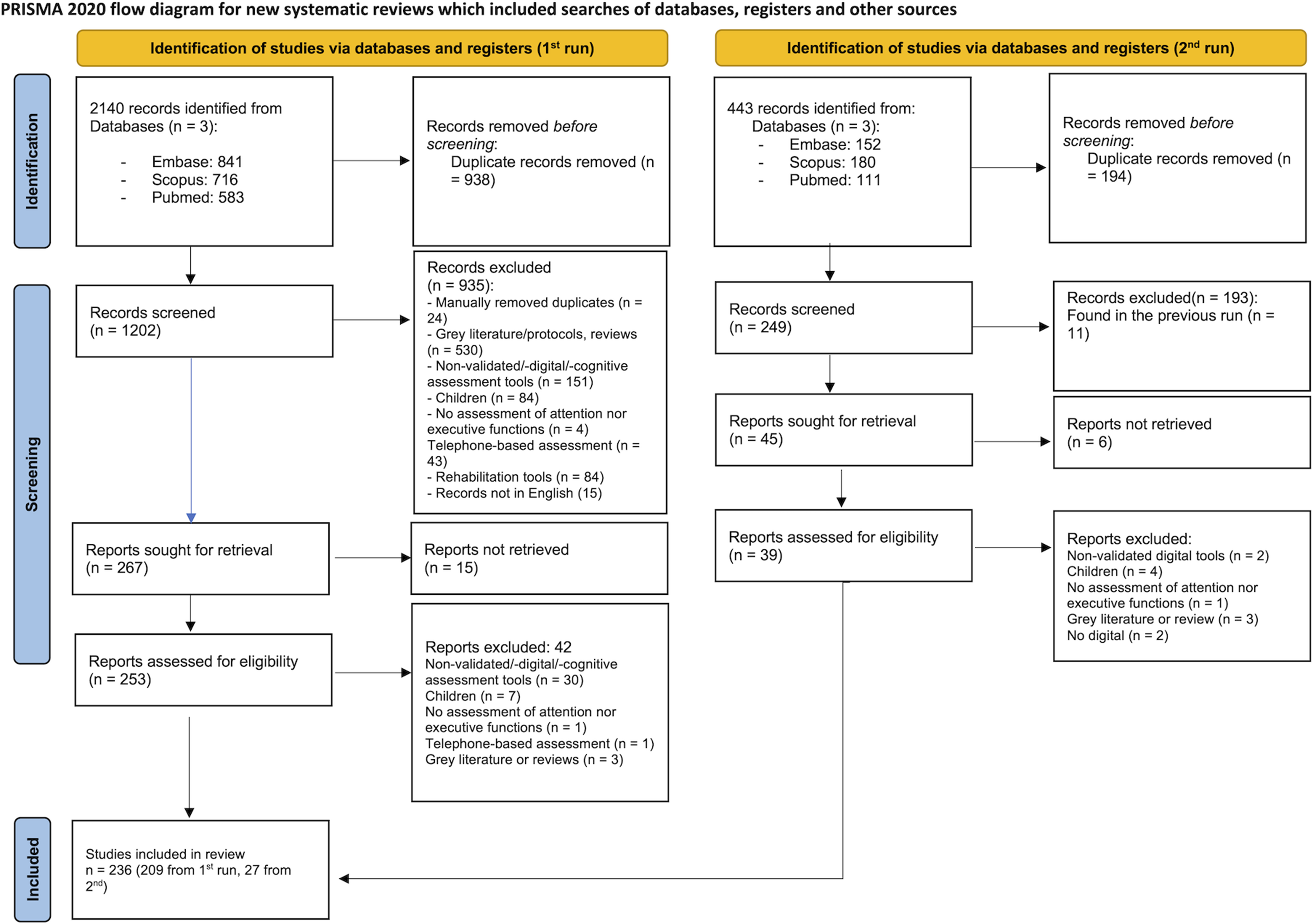
The systematic search was conducted in two separate runs. In the first run, 2,140 records were identified. After removal of duplicates (N = 938), 1,202 records were screened. Of these, 935 were excluded primarily because they consisted of gray literature or review articles, involved non-validated, non-digital, or noncognitive assessment tools, focused on pediatric populations, described rehabilitation interventions rather than assessment tools, or did not assess attention or EF. Additional exclusions were due to telephone-based assessments or publications not in English (Figure 1). Following full-text assessment and further eligibility screening, 209 studies from the first run met the inclusion criteria.
PRISMA 2020 flow diagram of the study selection process. Two independent database searches (Embase, Scopus, PubMed) were conducted. Following duplicate removal, screening, and eligibility assessment, a total of 236 studies were included in the final review (209 from the first run, 27 from the second).

A second search run identified 443 additional records. After the removal of duplicates (N = 194), 249 records were screened, of which 193 were excluded, mainly because they had been identified in the previous run or did not meet the eligibility criteria. After full-text assessment, 27 additional studies were included.
Overall, the final sample comprised 236 studies (209 from the first run and 27 from the second run), spanning from randomized controlled trials to observational and longitudinal designs, to validation studies. The studies were rather heterogeneous also when considering population characteristics, ranging from healthy adults and aging cohorts to clinical groups with neurological or psychiatric conditions. The methodological quality of the included studies was generally good. According to the JBI categories, 123 studies (52.1%) had a low risk of bias, 54 (22.9%) a low-to-moderate risk of bias, 43 (18.2%) a moderate risk of bias, 15 (6.4%) a moderate-to-high risk of bias, and 1 study (0.4%) a high risk of bias. Different JBI critical appraisal checklists were applied according to study design, with the Analytical Cross-Sectional Studies checklist being the most frequently used (N = 123, 52.1%), followed by the Diagnostic Test Accuracy checklist (N = 57, 24.2%) and the Cohort Studies checklist (N = 31, 13.1%). Methodological quality varied across study designs. Most analytical cross-sectional studies were rated as having a low risk of bias (78.9%), whereas diagnostic accuracy studies were more frequently classified as moderate risk (42.1%) or moderate-to-high risk of bias (21.1%). Among cohort studies, ratings were more evenly distributed, with 32.3% judged as low risk and 32.3% as low-to-moderate risk of bias. Nearly all case–control studies were classified as low or low-to-moderate risk of bias (83.3%). The following subsections present these findings in relation to each research question.
The technological continuum
Among the 236 included studies 107 distinct digital tools were identified. Despite their heterogeneity, these tools can be broadly categorized following a gradient of technological sophistication and complexity (Chen et al., Reference Chen, Zhen and Peng2023).
At the lower end of the continuum there are purely digitized versions of traditional paper-and-pencil tests, which were reported either as standalone tools (N = 10) or as components within larger test batteries (N = 6). The most used among these were the Trail Making Test, the Wisconsin Card Sorting Test, and the Stroop task. Moving along the gradient, native computerized test batteries can be found. Among these, NeuroTrax (N = 27), Cognitive Drug Research (CDR) System (N = 17), and CANTAB (N = 13) were those most frequently reported. While many subtests are intrinsically digital, some retain conceptual continuity with traditional measures. For example, NeuroTrax incorporates digital adaptations of the Trail Making Test, Stroop task, and Digit Span. In contrast, batteries such as CANTAB, Cogstate, CDR, and ANAM include tasks modeled on established constructs (e.g., memory, attention, processing speed) which however are not digital versions of well-established paper-and-pencil tests. Overall, these platforms occupy an intermediate position.
At the higher end of the technological gradient there are emerging and immersive technologies, including VR platforms, serious games, and hybrid systems integrating eye-tracking. These tools capitalize on the digital medium itself to enable assessments that cannot be replicated on paper nor on a monitor, offering interactive, immersive, and ecologically valid testing environments. VR has been applied to the assessment of multiple cognitive domains across clinical and nonclinical populations. For instance, two studies specifically investigated attention and executive dysfunctions using VR-based paradigms, focusing on attention deficits following traumatic brain injury and on the ecological evaluation of EF through immersive multitasking scenarios (Jansari et al., Reference Jansari, Devlin, Agnew, Akesson, Murphy and Leadbetter2014; Malegiannaki et al., Reference Malegiannaki, Garefalaki, Pellas and Kosmidis2024). One study examined the characterization and assessment of EF through a realistic virtual cooking task in euthymic patients with bipolar disorder (Cañada et al., Reference Cañada, Torres, Andreu-Martinez, Cristancho, Chicchi Giglioli, Garcia-Blanco, Adriasola, Navalón, Sierra and Alcañiz2024). Two validation studies addressed the psychometric properties of established neuropsychological measures adapted to VR environments, namely the Virtual Reality Paced Auditory Serial Addition Test (VR-PASAT) in a college sample and the Virtual Reality Stroop Task (VRST) in active-duty military personnel (Armstrong et al., Reference Armstrong, Reger, Edwards, Rizzo, Courtney and Parsons2013; Parsons & Courtney, Reference Parsons and Courtney2014). In addition, one experimental study introduced a gamified VR paradigm to assess visual search, response inhibition, and visual short-term memory (Hadjiaros et al., Reference Hadjiaros, Shimi, Neokleous, Pattichis and Avraamides2025). Eye-tracking has been used to examine cognitive functioning through the analysis of eye movement behavior in clinical populations. One study investigated the relationship between eye movement parameters and cognitive domains in non-demented patients with Parkinson’s disease (Wong et al., Reference Wong, Fung and Chan2019). One randomized controlled trial assessed the effectiveness of an eye movement–based intervention to improve EF in stroke patients (He et al., Reference He, Ji, Wei, Wang, Xu, Lu, Ma and Wang2021). One study validated eye-tracking measures embedded in the computerized Wisconsin Card Sorting Test by comparing stroke patients with healthy controls (Leitner et al., Reference Leitner, Coady, Miller and Libben2023). These platforms enable the measurement of multitasking, attention, visuospatial skills, and EF in dynamic, immersive, and interactive environments, providing richer, more behaviorally relevant data than conventional digital or digitized paper-and-pencil batteries (Kirkham et al., Reference Kirkham, Kooijman, Albertella, Myles, Yücel and Rotaru2024). These “emerging technology” tools aim to create more ecologically valid assessments of cognitive function, capturing performance in contexts that closely resemble real-life situations rather than structured, artificial tests. While still less frequently used than standardized computerized assessments, their adoption is increasing, reflecting a trend toward leveraging digital technology to move beyond screen-based testing (Harris et al., Reference Harris, Tang, Birnbaum, Cherian, Mendhe and Chen2024).
Administration modalities
Administration modality can be decomposed along two independent dimensions: (i) the location of the examiner, ranging from fully in-person to fully remote, and (ii) the type of software installation of the test, distinguishing between locally installed software and web- or app-based platforms. As these dimensions are independent, their combinations give rise to different ways of administering the test. For instance, a web-based tool may still be administered in person. Yet this was not the case for most studies in this review which almost invariably described conventional administration setups.
The vast majority of administrations were conducted in person only, accounting for 200 out of 236 studies (85%). In terms of software installation, most of the studies relied on locally installed software administered via standard computers (N = 153), tablets (N = 27), or multi-device platforms (N = 13), whereas only 2 studies used explicitly web-based platforms, both in the context of remote unsupervised administration. Remote, unsupervised administration accounted for 28 out of 236 studies (11.9%). Remote, supervised sessions were reported in 5 out of 236 studies (2.1%). Hybrid approaches combining in-person and remote modalities were reported in 4 studies: in two cases the remote component was unsupervised, in one case it was supervised, and in one case it involved videoconference-based administration (1.7%). Importantly, several web- or app-based platforms that in principle are technically suitable for self-administration, were only delivered under supervision, either in person or via videoconference, likely to better ensure protocol adherence. Their usability and operational requirements, including the need for guidance, clear instructions, and support for digital literacy, are even more critical for certain populations such as older adults, whereby sensory or motor limitations and accessibility needs can strongly limit the feasibility of independent use (Wallace et al., Reference Wallace, Donoso Brown, Simpson, D’Acunto, Kranjec, Rodgers and Agostino2019).
Licensing, technical requirements, and open access
Only 37 out of the 107 identified digital tools (34.9%) were presented with relevant information on licensing or normative data availability, even after tracing each tool to at least one external validation publication identified through the reference lists of the included studies. Among these, the majority were available exclusively through commercial license (N = 20; 18.9% of all tools), including widely adopted platforms such as CANTAB (Kuzmickienė & Kaubrys, Reference Kuzmickienė and Kaubrys2016), CDR (McKeith et al., Reference McKeith, Del Ser, Spano, Emre, Wesnes, Anand, Cicin-Sain, Ferrara and Spiegel2000), CogState (Cairney et al., Reference Cairney, Clough, Jaragba and Maruff2007), NeuroTrax (Dwolatzky et al., Reference Dwolatzky, Whitehead, Doniger, Simon, Schweiger, Jaffe and Chertkow2003), and TAP (Schulz et al., Reference Schulz, Kopp, Kunkel and Faiss2006). Two additional tools (1.9%) offered free versions with limited features, typically requiring payment for enabling full functionality such as scoring (LUMOSITY, Kassam et al., Reference Kassam, Chen, Nosheny, McGirr, Williams, Ng, Camacho, Mackin, Weiner and Ismail2023; NeuroCognitive Performance Test, Jaffe et al., Reference Jaffe, Kaluszka, Ng and Schafer2022), and two (1.9%) provided demo-only versions (NIH-TB-CB, O’Shea et al., Reference O’Shea, Cohen, Porges, Nissim and Woods2016; OCS-Plus, Demeyere et al., Reference Demeyere, Haupt, Webb, Strobel, Milosevich, Moore, Wright, Finke and Duta2021).
Seven tools (6.5%) could be accessed without requiring payment: two usable directly online without installation (Cognitron, Shibata et al., Reference Shibata, Attaallah, Tai, Trender, Hellyer, Hampshire, Irani, Manohar and Husain2024; VIRTRAEL, Rute-Perez et al., Reference Rute-Perez, Rodriguez-Dominguez, Saez-Sanz, Perez-Garcia and Caracuel2025), and five available via free download or dedicated software (THINC-it, Shibaoka et al., Reference Shibaoka, Masuda, Iwasawa, Ikezawa, Eguchi and Nakagome2023; ABBA, Loring et al., Reference Loring, Hewitt, Drane, Zhao, Xu, Lah and Goldstein2025; ACE-X, O’Laughlin et al., Reference O’Laughlin, Cheng, Volponi, Lorentz, Obregon, Younger, Gazzaley and Uncapher2025; BoxTask, Foxe et al., Reference Foxe, Irish, Carrick, Cheung, Teng, Burrell, Kessels and Piguet2024; CNBC, Zhang et al., Reference Zhang, Hong, Yang, Li and Ye2024). A further tool, CALCAP (Waterloo et al., Reference Waterloo, Ingebrigtsen and Romner1997), resulted available for free download yet requiring obsolete hardware, substantially limiting its practical usability. None of these tools provided public access to source code or normative data. Only one tool, SATURN (Self-Administered Tasks Uncovering Risk of Neurodegeneration; Bissig et al., Reference Bissig, Kaye and Erten-Lyons2020), met the stricter criterion of genuine open-source release: its source code is publicly available, and an independent research group has already used it to derive normative data (e.g., for Italy see Giaquinto et al., Reference Giaquinto, Assecondi, Leccese, Romano and Angelelli2024). Finally, three tools (2.8%) were not publicly available or were restricted to academic research contexts, and none reported normative data, limiting their current clinical applicability (CoCoSc, Wong et al., Reference Wong, Fong, Mok, Leung and Tong2017; CoGNIT, Behrens et al., Reference Behrens, Elgh, Leijon, Kristensen, Eklund and Malm2020; KeyStrokes, Lopez et al., Reference Lopez, Fulton, Kristinsson, Kim, Stuart, Chen, Thomas, Hussey-Zommers, Roy, Kapoor and Conrad2025).
Regarding technical requirements, most tools (N = 56; 52.8%) could be administered using standard computers. An additional 20 tools (18.9%) were designed for tablets (e.g., TabCAT, Tsoy et al., Reference Tsoy, Possin, Thompson, Patel, Garrigues, Maravilla, Erlhoff and Ritchie2020; THINC-it, Shibaoka et al., Reference Shibaoka, Masuda, Iwasawa, Ikezawa, Eguchi and Nakagome2023; OCS-Plus, Demeyere et al., Reference Demeyere, Haupt, Webb, Strobel, Milosevich, Moore, Wright, Finke and Duta2021), and one (0.9%) for smartphones (EMCA, Campbell et al., Reference Campbell, Paolillo, Heaton, Tang, Depp, Granholm, Heaton, Swendsen, Moore and Moore2020). Twenty tools (18.9%) operated across multiple device types. Specialized hardware was required for the six VR-based platforms reported above. Two tools (1.9%) were exclusively web-based, requiring only a browser without dedicated software installation (NIH-TB-CB, O’Shea et al., Reference O’Shea, Cohen, Porges, Nissim and Woods2016; ONAs, Biagianti et al., Reference Biagianti, Fisher, Brandrett, Schlosser, Loewy, Nahum and Vinogradov2019). Finally, two tools (1.9%) did not specify the device used: CADTS (Walia et al., Reference Walia, Kumar, Khosla and Grover2023) and an unnamed computerized battery (Lorenzo-Lopez et al., Reference Lorenzo-Lopez, Cibeira, Hemadeh, Lopez-Lopez, Lema-Arranz, Maseda, Fernandez-Bertolez, Costa, Pasaro, Valdiglesias, Millan-Calenti and Laffon2025).
This heterogeneity may directly influence their implementation, scalability, and adoption in clinical and research contexts, independently of their technological sophistication or psychometric coverage. However, these results align with a growing shift in recent years toward tablet‑based and cross‑platform digital tools, which offer greater portability and ease of deployment compared with desktop‑only solutions (Asensio & Duñabeitia, Reference Asensio and Duñabeitia2023; Koo & Vizer, Reference Koo and Vizer2019).
Psychometric characteristics
For each digital tool we tried to quantify the extent to which it has been validated from a psychometric point of view. To this aim, we calculated a psychometric coverage index (PCI) on the number of psychometric properties evaluated across validation-related studies only (N = 122). The set of psychometric properties included in the PCI was not defined a priori based on a specific psychometric framework. Instead, a data-driven approach was adopted. All psychometric characteristics assessed across the eligible validation studies were extracted during data collection. The final set of 11 psychometric properties corresponded to all the psychometric outcomes reported in at least one of the included studies. These were: criterion validity, concurrent validity, ecological validity, factorial/construct validity, discriminant validity, internal consistency, test–retest reliability, convergent validity, inter-setting reliability, practice effects, and intra-rater reliability. The PCI was then calculated as a proportion based on the presence or absence of each of these properties. Since studies that used previously validated tools without novel psychometric data were excluded from this counting, the PCI reflects the extent of psychometric evaluation for each tool, rather than their number of citations or the number of studies. This approach ensures that those tools that have been thoroughly validated even in a small number of studies still receive a high PCI, also when they are then widely used without additional validation. For example, a tool with a single validation study assessing five properties would be characterized by a PCI = 5/11≈ 0.45, whereas a widely used tool evaluated in multiple studies would not achieve a higher PCI unless new properties were assessed. Note that the PCI reflects psychometric coverage only within the attention/EF literature captured by our search; tools extensively validated for other domains may therefore show a lower PCI than their overall validation record would suggest.
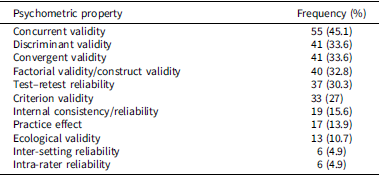
Across validation-focused studies (N = 122), certain psychometric properties were examined more frequently than others (Table 2). Concurrent validity was the most reported psychometric property (45.1%), followed by discriminant validity and convergent validity (33.6% each), and factorial/construct validity (32.8%). Test–retest reliability and criterion validity were reported in approximately 30% and 27% of studies, respectively. In contrast, internal consistency, practice effects, and ecological validity were less frequently evaluated, ranging from 10.7% to 15.6%. Inter-setting reliability and intra-rater reliability were rarely reported (4.9% each). While some core psychometric properties are widely assessed, several important dimensions of reliability and validity remain underexplored across digital tools, indicating potential gaps in comprehensive psychometric evaluation.
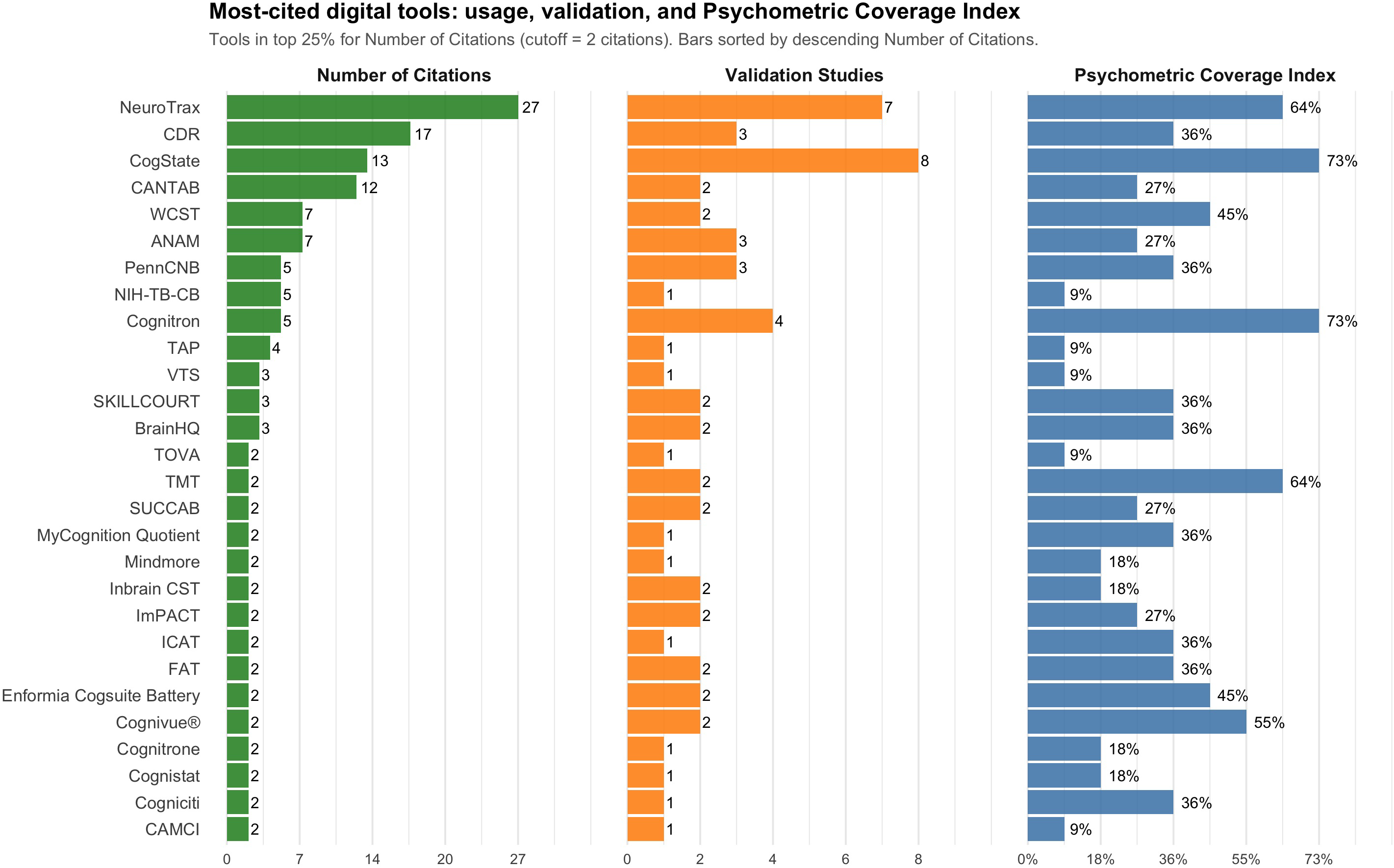
Importantly, a comparison between psychometric coverage, number of validation studies, and absolute number of citations revealed a partial mismatch. Tools that were most frequently used were not consistently those with the highest number of validation studies or the broadest psychometric coverage. Only a few tools simultaneously ranked highly across all three indicators. This pattern, illustrated in Figure 2, highlights a gap between empirical adoption and depth of psychometric evaluation: many tools that are widely used may nonetheless show limited psychometric coverage, reflecting a predominance of passive use over active psychometric validation. To examine this relationship more systematically, tools were cross-tabulated by licensing model, the primary determinant of accessibility in our dataset. Table 1 summarizes the 88 validated digital neuropsychological tools according to licensing models, reporting the number of tools, mean PCI, PCI distribution across three bands, and median and maximum number of citations.
Most-used digital cognitive assessment tools by number of citations, number of validation studies, and psychometric coverage index. Tools appearing in the top 25% for number of citations across included studies (cutoff ≥ 2 uses) are displayed, sorted by number of citations. The left panel shows overall number of citations across all included studies. The center panel shows the number of dedicated validation studies identified for each tool. The right panel shows the psychometric coverage index, computed exclusively from validation studies and defined as the proportion of psychometric properties assessed across validation studies relative to the total number of psychometric properties considered.

Psychometric coverage and number of citations of digital neuropsychological tools by licensing model

Table 1. Long description
A table summarizing 88 validated digital neuropsychological tools according to licensing models. The table has 5 rows and 8 columns. Column headers are Licensing model, N, Mean PCI, PCI < 33% N (%), PCI 33–66% N (%), PCI > 66% N (%), Median number of citations, and Max number of citations. Row labels are Pay to use, Free to use/Open access, NS, Other, and Total. Row 1: Pay to use, 17, 0.33, 7 (41%), 9 (53%), 1 (6%), 2, 27. Row 2: Free to use/Open access, 8, 0.33, 3 (38%), 4 (50%), 1 (12%), 1, 5. Row 3: NS, 57, 0.25, 40 (70%), 17 (30%), 0 (0%), 1, 7. Row 4: Other, 6, 0.30, 3 (50%), 3 (50%), 0 (0%), 1, 5. Row 5: Total, 88, 0.28, 53 (60%), 33 (38%), 2 (2%), 1, 27.
Note: N = 88 tools with at least one validation study (total validation studies N = 122). PCI = psychometric coverage index (proportion of 11 psychometric properties reported in validation studies only). Number of Citations = number of independent studies employing each tool among the 236 included. “Other” includes free demo, academic-use-only, limited free version, and not-public licensing. NS = not specified in any associated publication.
Frequency and percentage of psychometric properties examined across validation studies

Table 2. Long description
A table with two columns and twelve rows. The first column lists psychometric properties, and the second column shows their frequency in percentage. Row 1: Concurrent validity, 55 (45.1 percent). Row 2: Discriminant validity, 41 (33.6 percent). Row 3: Convergent validity, 41 (33.6 percent). Row 4: Factorial validity/construct validity, 40 (32.8 percent). Row 5: Test-retest reliability, 37 (30.3 percent). Row 6: Criterion validity, 33 (27 percent). Row 7: Internal consistency/reliability, 19 (15.6 percent). Row 8: Practice effect, 17 (13.9 percent). Row 9: Ecological validity, 13 (10.7 percent). Row 10: Inter-setting reliability, 6 (4.9 percent). Row 11: Intra-rater reliability, 6 (4.9 percent).
Note: N = 122 validation studies. Percentages reflect the proportion of studies examining each psychometric property; values do not sum to 100% as individual studies could examine multiple properties.
The mismatch between number of citations and psychometric coverage hypothesized above becomes clearer when tools are examined by their licensing model in more detail. The highest number of citations was concentrated in a small cluster of well-established platforms (e.g., NeuroTrax, Cogstate, CDR). These platforms benefit from decades of refinement, broad normative datasets, and relatively robust psychometric properties, offering both remote and unsupervised administration (e.g., Smith et al., Reference Smith, Need, Cirulli, Chiba-Falek and Attix2013; Wärn et al., Reference Wärn, Andersson and Berginström2025; Wragg et al., Reference Wragg, Skirrow, Dente, Cotter, Annas, Lowther, Backx, Barnett, Cree, Kroll and Cormack2024). The psychometric evidence supporting these tools includes studies of reliability, validity, and normative standardization across multiple populations (CogState: Hammers et al., Reference Hammers, Spurgeon, Ryan, Persad, Barbas, Heidebrink, Darby and Giordani2012; Kataja et al., Reference Kataja, Karlsson, Tolvanen, Parsons, Schembri, Kiiski-Mäki and Karlsson2017; Maruff et al., Reference Maruff, Thomas, Cysique, Brew, Collie, Snyder and Pietrzak2009; CDR: Saxby et al., Reference Saxby, Harrington, McKeith, Wesnes and Ford2003; Wesnes et al., Reference Wesnes, Edgar, Dean and Wroe2009; CANTAB: Backx et al., Reference Backx, Skirrow, Dente, Barnett and Cormack2020; NeuroTrax: Doniger et al., Reference Doniger, Zucker, Schweiger, Dwolatzky, Chertkow, Crystal and Simon2005; Golan et al., Reference Golan, Wilken, Doniger, Fratto, Kane, Srinivasan, Zarif, Bumstead, Buhse, Fafard, Topalli and Gudesblatt2019). Their structured administration and well-defined scoring procedures make them particularly suitable for clinical diagnostics, longitudinal monitoring, and multicenter research, where comparability and methodological rigor are essential (Parsons & Duffield, Reference Parsons and Duffield2020). However, such tools are often proprietary and costly, with closed algorithms and restricted access to raw data and scoring procedures. Second, and more critically, despite their wide diffusion not all the tools within the category can be considered robust from a psychometric point of view: the validity of some widely used, well-established tools is sometimes assumed rather than empirically tested. For instance, CANTAB, despite ranking fourth in number of citations, shows a PCI of only 0.27 (3 out of 11 properties evaluated). NIH-TB-CB has been applied across different populations including aging cohorts, COVID-19 long haulers, and metabolic disorders (Christ et al., Reference Christ, Clocksin, Zalik, Goodlett, Sacharow and Abbene2023; Graham et al., Reference Graham, Clark, Orban, Lim, Szymanski, Taylor, DiBiase, Jia, Balabanov, Ho, Batra, Liotta and Koralnik2021; O’Shea et al., Reference O’Shea, Cohen, Porges, Nissim and Woods2016; Yassi et al., Reference Yassi, Pase, Buckley, Rosenich, Watson, Maruff and Lim2022), yet it only achieves a PCI of 0.09, because only its construct validity has been formally evaluated, in a single study (Ott et al., Reference Ott, Schantell, Willett, Johnson, Eastman, Okelberry, Wilson, Taylor and May2022). Conversely, Cognivue®, despite its comparatively limited frequency of use (2 citations), achieved a considerably higher PCI (0.55, 6 out of 11 properties evaluated).
Open-access and freely available tools, which represent the smallest (N = 6) and empirically least-developed portion of the identified instruments showed limited psychometric coverage, a pattern likely reflecting the small number of independent validation studies available for each instrument. As a notable exception within the broader category of freely available tools Cognitron achieved a high PCI (0.73) alongside moderate number of citations (N = 5). Its psychometric properties have been evaluated across diverse clinical and community populations, including COVID-19 (Hampshire et al., Reference Hampshire, Chatfield, MPhil, Jolly, Trender, Hellyer, Giovane, Newcombe, Outtrim, Warne, Bhatti, Pointon, Elmer, Sithole, Bradley, Kingston, Sawcer, Bullmore and Rowe2022, Reference Hampshire, Azor, Atchison, Trender, Hellyer, Giunchiglia, Husain, Cooke, Cooper, Lound, Donnelly, Chadeau-Hyam, Ward and Elliott2024), traumatic brain injury (Del Giovane et al., Reference Del Giovane, Trender, Bălăeţ, Mallas, Jolly, Bourke, Zimmermann, Graham, Lai, Losty, Oiarbide, Hellyer, Faiman, Daniels, Batey, Harrison, Giunchiglia, Kolanko, David and Hampshire2023), Parkinson’s disease (Bălăeț et al., Reference Bălăeţ, Alhajraf, Zerenner, Welch, Razzaque, Lo, Giunchiglia, Trender, Lerede, Hellyer, Manohar, Malhotra, Hu and Hampshire2024), and autoimmune limbic encephalitis (Shibata et al., Reference Shibata, Attaallah, Tai, Trender, Hellyer, Hampshire, Irani, Manohar and Husain2024). Cognitron thus represented an exception in which high psychometric coverage co-occurred with free accessibility, a combination otherwise uncommon among these tools.
Tools relying on emerging and immersive technologies such as VR platforms, serious games, and eye-tracking hybrid systems were often characterized by a lack of licensing information and psychometric validation that remained the most limited among the included tools. Immersive environments enable researchers to assess attention in settings that more closely resemble the multitasking demands of everyday life. They also generate multimodal data, including gaze patterns and real-time behavioral adaptations. Together, these measures can capture aspects of performance that are often missed by conventional, computer-based, tasks (Kirkham et al., Reference Kirkham, Kooijman, Albertella, Myles, Yücel and Rotaru2024). However, we observed that available evidence derived from pilot studies conducted in small, often clinical, samples (VRST, Armstrong et al., Reference Armstrong, Reger, Edwards, Rizzo, Courtney and Parsons2013; JEF VR, Jansari et al., Reference Jansari, Devlin, Agnew, Akesson, Murphy and Leadbetter2014; VR-PASAT, Parsons & Courtney, Reference Parsons and Courtney2014; WCST + Eye-tracking, Leitner et al., Reference Leitner, Coady, Miller and Libben2023; CBAAD, Malegiannaki et al., Reference Malegiannaki, Garefalaki, Pellas and Kosmidis2024; VirtualCookingTask, Cañada et al., Reference Cañada, Torres, Andreu-Martinez, Cristancho, Chicchi Giglioli, Garcia-Blanco, Adriasola, Navalón, Sierra and Alcañiz2024; VR traditional tests, Hadjiaros et al., Reference Hadjiaros, Shimi, Neokleous, Pattichis and Avraamides2025). Licensing information was not specified for seven of the eight tools in this group, with only one tool explicitly released under an open-access model (VIRTRAEL, Rute-Perez et al., Reference Rute-Perez, Rodriguez-Dominguez, Saez-Sanz, Perez-Garcia and Caracuel2025).
Cognitive domains measured
In our sample of 107 unique cognitive assessment tools, most instruments assessed attention and EF as part of broader cognitive batteries rather than in isolation. Specifically, 67 tools measured both attention and EF together with additional domains such as memory, language, arithmetic, or orientation. Nine tools combined EF but not attention with other cognitive domains (C-TOC, Jacova et al., Reference Jacova, McGrenere, Lee, Wang, Le Huray, Corenblith, Brehmer, Tang, Hayden, Beattie and Hsiung2015; CANS-MCI, Memória et al., Reference Memória, Yassuda, Nakano and Forlenza2014; CCAB, Woods et al., Reference Woods, Pebler, Johnson, Herron, Hall, Blank, Geraci, Williams, Chok, Lwi, Curran, Schendel, Spinelli and Baldo2024; CFT, Trustram Eve & de Jager, Reference Trustram Eve and de Jager2014; CoCoSc, Wong et al., Reference Wong, Fong, Mok, Leung and Tong2017; EMCA, Campbell et al., Reference Campbell, Paolillo, Heaton, Tang, Depp, Granholm, Heaton, Swendsen, Moore and Moore2020; GrayMatters®, Brinkman et al., Reference Brinkman, Reese, Norsworthy, Dellaria, Kinkade, Benge, Brown, Ratka and Simpkins2014; ICAT, Zarp et al., Reference Zarp, Bruun, Christiansen, Krogh, Kuchinke, Bernsen, Jespersen, Bardram, Kessing and Miskowiak2025; MOST, Clionsky & Clionsky, Reference Clionsky and Clionsky2014), while 6 combined attention but not EF with other domains (BOCA, Vyshedskiy et al., Reference Vyshedskiy, Netson, Fridberg, Jagadeesan, Arnold, Barnett, Gondalia, Maslova, de Torres, Ostrovsky, Durakovic, Savchenko, McNett, Kogan, Piryatinsky and Gold2022; CCTE, Kurzbuch et al., Reference Kurzbuch, Pauli, Gaál, Kerling, Kasper, Stefan, Hamer and Graf2013; FePsy, Odiase et al., Reference Odiase, Ogunrin and Ogunniyi2007; HK-VMT, Fung et al., Reference Fung, Lee, Ma and Lam2024; Headminder, Cheung et al., Reference Cheung, Ng, Shwe, Ho, Foo, Cham, Lee, Fan, Tan, Yong, Madhukumar, Loo, Ang, Wong, Chay, Ooi, Dent, Yap, Ng and Chan2015; Neurit. Space, Massetti et al., Reference Massetti, Albini, Casati, Toneatto, Terruzzi, Etzi, Tesio, Gallace and Vallar2023). In contrast, 18 tools measured attention and EF without including these broader domains (e.g., PASAT, Aliyari et al., Reference Aliyari, Golabi, Sahraei, Daliri, Minaei-Bidgoli, Tadayyoni and Kazemi2022; TMT, Park & Schott, Reference Park and Schott2022; THINC-it, Shibaoka et al., Reference Shibaoka, Masuda, Iwasawa, Ikezawa, Eguchi and Nakagome2023), 3 assessed EF only (JEF VR, Jansari et al., Reference Jansari, Devlin, Agnew, Akesson, Murphy and Leadbetter2014; Koski et al., Reference Koski, Brouillette, Lalonde, Hello, Wong, Tsuchida and Fellows2011; Leitner et al., Reference Leitner, Coady, Miller and Libben2023), and 2 assessed attention only (CADTS, Walia et al., Reference Walia, Kumar, Khosla and Grover2023; CBAAD, Malegiannaki et al., Reference Malegiannaki, Garefalaki, Pellas and Kosmidis2024). Notably, even among tools with a narrower cognitive scope, the majority explicitly incorporated working memory and/or processing speed alongside their primary attentional or EF measures. Overall, these findings indicate that even among tools specifically selected for their focus on attention and EF, these functions are normally assessed as part of broader multidimensional batteries, with relatively few tools targeting specifically attention or EF.
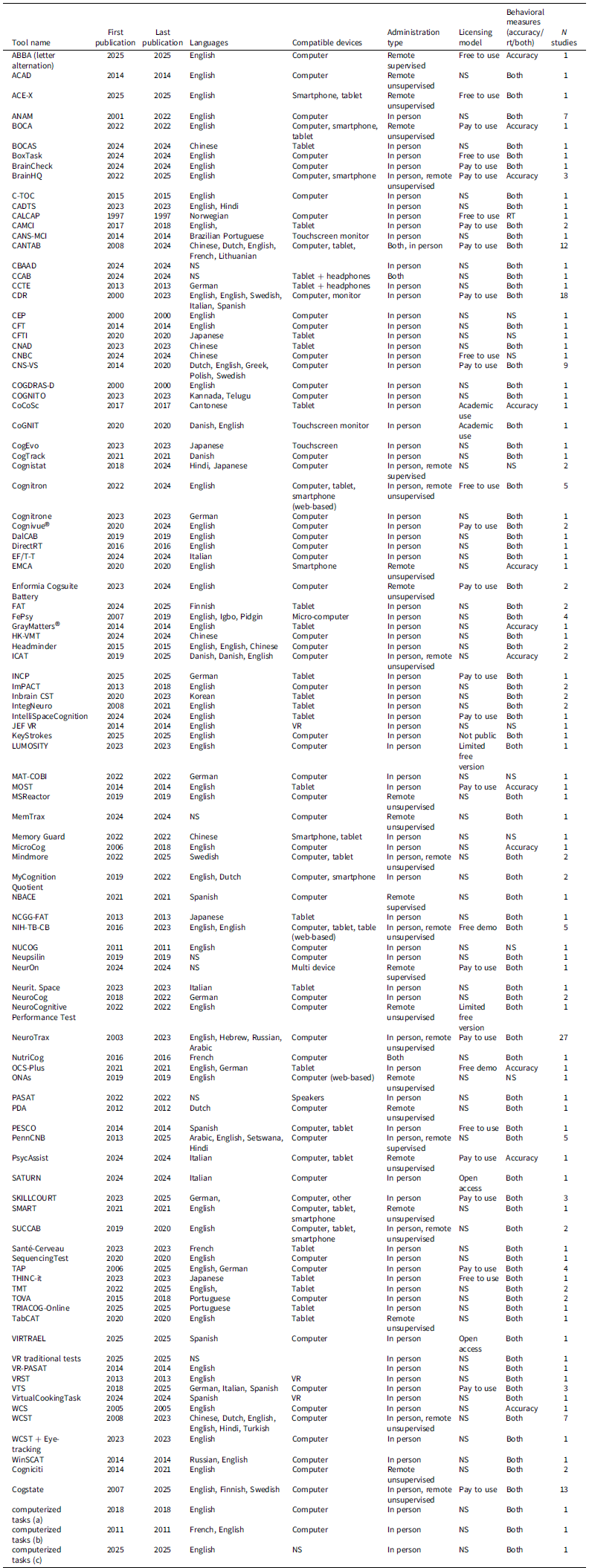
Table 3 provides an overview of the key characteristics of all digital neuropsychological tools described in the review, including device requirements, administration modality, licensing costs, and type of behavioral measures collected. Additionally, for each tool the table reports the administration languages and the number of studies referring to each tool alongside the year of first and last publication (see OSF for details: osf.io/guz9t).
Main characteristics of the digital neuropsychological tools included in the review

Table 3. Long description
The table compares digital neuropsychological tools based on first publication year, last publication year, languages, compatible devices, administration, licensing costs, and behavioral measures. It includes 100 rows and 11 columns. Column headers are Tool name, First pub. year, Last pub. year, Languages, Compatible devices, Administration, Licensing costs, Behavioral measures, N studies, and Notes. Each row lists a different tool with corresponding details. For example, the first row describes the ABSA System, first published in 2014, compatible with computers, administered remotely, with free-to-use licensing, and measuring accuracy.
Note: The table reports all digital tools identified in the systematic review for the domains of attention and executive functions, including year of first and last publication, available languages, required devices, administration modality, licensing models, behavioral measures, and number of studies per tool. NS = not specified; N studies = number of studies using that tool. The entries “computerized tasks (a),” “computerized tasks (b),” and “computerized tasks (c)” refer to digital tools that were not assigned a specific name in the original studies.
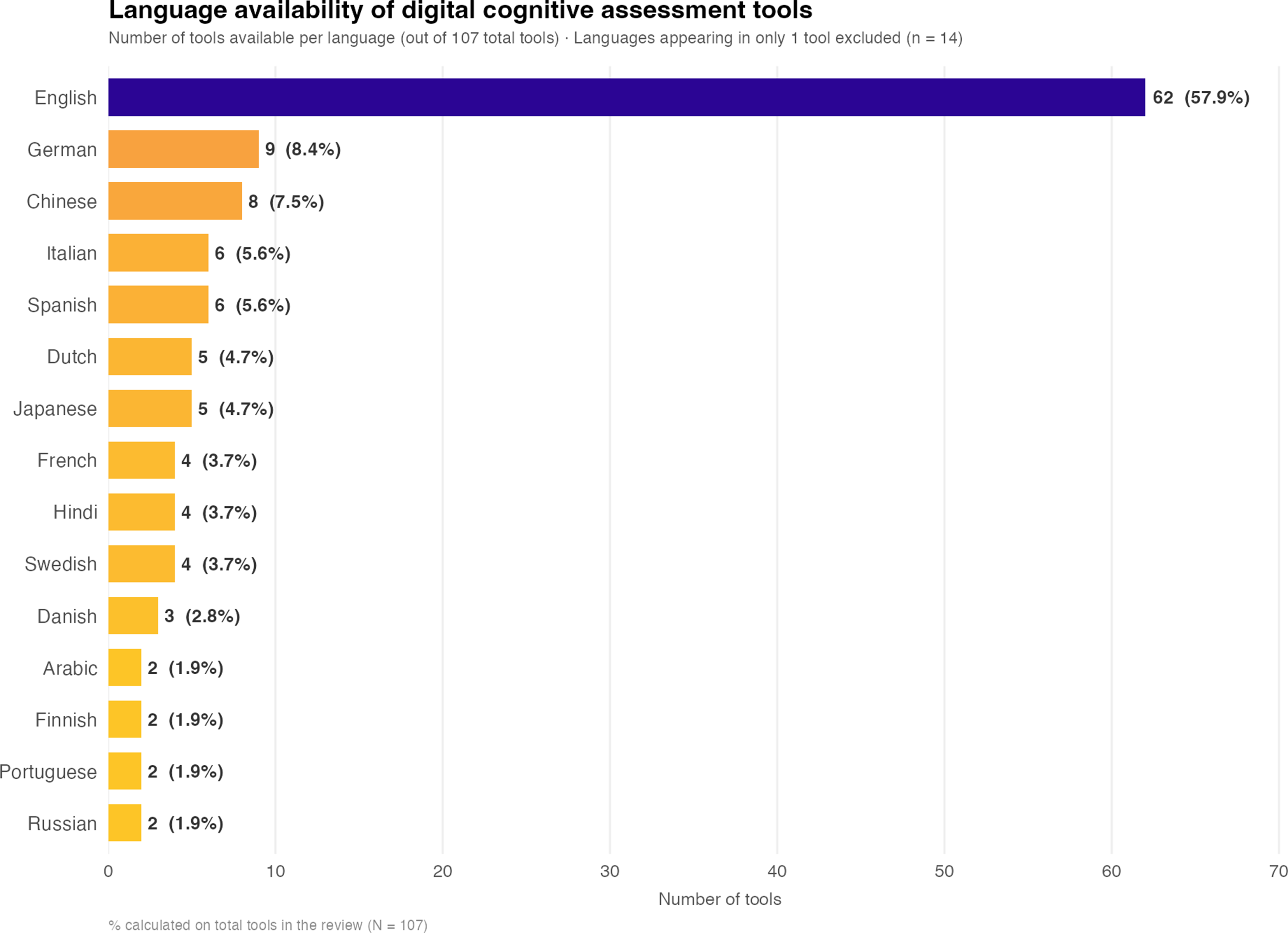
Regarding administration language, 45 tools (42.1%) were reported exclusively in English, while 35 (32.7%) were reported in a single non-English language (spanning 19 different languages, most frequently German, Chinese, Italian, Spanish, and Japanese). Only 20 tools (18.7%) were available in more than one language, and multi-language availability was concentrated in a small subset of established commercial batteries (e.g., CANTAB, CDR, NeuroTrax). Notably, of the 29 distinct languages identified overall, 14 (48.3%) were represented by only a single tool (Figure 3).
Number of digital tools by administration language. Bar chart showing the number of identified tools available in each administration language, based on the languages reported across the included validation and usage studies. Only languages available in at least two tools are displayed for readability (out of 107 total tools).

Discussion
In the present review we provided a comprehensive overview of digital tools designed to assess attention and EF either as primary outcomes or as part of more comprehensive cognitive batteries in adults. Such an overview is particularly relevant, as attention and EF are inherently dynamic and multifaceted processes. Despite their increasing use in research, digital tools remain far less established in routine clinical practice, where these functions are still frequently assessed using paper-and-pencil tests whose static nature makes them intrinsically incapable of capturing several of their aspects (Kirkham et al., Reference Kirkham, Kooijman, Albertella, Myles, Yücel and Rotaru2024). Digital technologies offer the opportunity to capture multiple dimensions of performance with greater precision, automation, and flexibility, but the range of available tools has expanded considerably and remains highly heterogeneous. Across 236 studies we identified 107 distinct tools, spanning a wide spectrum of technological approaches: from digital adaptations of traditional neuropsychological tests to more sophisticated computerized batteries and more recent immersive or hybrid systems. While the vast majority of tests were computer-based only a minority were also administered online. We sought to highlight how this rapidly expanding field remains structurally heterogeneous, both in terms of implementation but also because the tools dramatically differ with respect to the availability of their psychometric properties. Besides cataloging available instruments, we examined how these tools differ along several dimensions that are highly relevant for real-world neuropsychological use. In particular, we focused on their accessibility (both in terms of licensing and openness), administration modalities, and degree of psychometric validation. A central contribution of this review lies in explicitly examining the relation between psychometric robustness and accessibility of the tests, an issue that is seldom addressed in the existing literature on digital neuropsychology. To this end, we introduced the Psychometric Coverage Index (PCI), a novel measure based on the number of psychometric properties examined across validation studies.
The accessibility–validity imbalance
Combining data on accessibility, in terms of licensing models and openness, and validity, in terms of psychometric robustness, the tools identified in this review appear to broadly cluster into three profiles. The first encompasses restricted-access batteries whose validity is not always empirically demonstrated, despite their widespread adoption. The second includes freely accessible tools with generally limited, yet occasionally comparably strong, validation. The third comprises emerging technologies, for which licensing information was rarely specified and psychometric validation remained the most limited overall. These three profiles suggest that there is not a “better” test, but rather the most appropriate tool for the specific goals of an assessment. Clinicians, who need diagnostic precision, normative comparisons, and well-established psychometric properties may tend to favor standardized computerized batteries. Researchers interested in ecological validity, aging trajectories, or real‑world cognition may instead prioritize flexible, immersive paradigms capable of capturing subtle behavioral signatures that traditional tests overlook. Large‑scale or remote assessments, including population‑level screening or clinical trials, may benefit most from tools that emphasize accessibility, self‑administration, and minimal technical requirements.
Implications for attention and EF across adulthood
Digital tools are seen as particularly appropriate for measuring attention and EF (Kessels, Reference Kessels2019; Sternin et al., Reference Sternin, Burns and Owen2019) as they allow measuring inherently dynamic, time-dependent, and context-sensitive processes (Diamond, Reference Diamond2013; Gruber & Goschke, Reference Gruber and Goschke2004; Nobre & van Ede, Reference Nobre and van Ede2023). Metrics such as reaction time variability, error dynamics, and adaptive performance provide valuable indicators of cognitive control that are often more sensitive than aggregate accuracy scores (Agam et al., Reference Agam, Carey, Barton, Dyckman, Lee, Vangel and Manoach2013; Del Popolo Cristaldi et al., Reference Del Popolo Cristaldi, Toffoli, Duma and Mento2023). These measures may be especially informative in aging populations, where subtle declines in processing speed and attentional regulation often precede impairments in other cognitive domains (Del Popolo Cristaldi et al., Reference Del Popolo Cristaldi, Saccani, Contemori, Livoti and Bonato2025; Haynes et al., Reference Haynes, Bauermeister and Bunce2017; Lu et al., Reference Lu, Nicholas, James, Lane, Parker, Keshavan, Keuss, Buchanan, Murray-Smith, Cash, Sudre, Malone, Coath, Wong, Henley, Fox, Richards, Schott and Crutch2020).
Emerging technologies, including VR and eye-tracking (e.g., Armstrong et al., Reference Armstrong, Reger, Edwards, Rizzo, Courtney and Parsons2013; Cañada et al., Reference Cañada, Torres, Andreu-Martinez, Cristancho, Chicchi Giglioli, Garcia-Blanco, Adriasola, Navalón, Sierra and Alcañiz2024; Hadjiaros et al., Reference Hadjiaros, Shimi, Neokleous, Pattichis and Avraamides2025; He et al., Reference He, Ji, Wei, Wang, Xu, Lu, Ma and Wang2021; Jansari et al., Reference Jansari, Devlin, Agnew, Akesson, Murphy and Leadbetter2014; Leitner et al., Reference Leitner, Coady, Miller and Libben2023; Malegiannaki et al., Reference Malegiannaki, Garefalaki, Pellas and Kosmidis2024; Parsons & Courtney, Reference Parsons and Courtney2014; Wong et al., Reference Wong, Fung and Chan2019; Zangemeister et al., Reference Zangemeister, Röhr, Heesen and Gold2020), offer unique opportunities to assess executive functioning in environments that approximate everyday multitasking demands (Braun et al., Reference Braun, Schäfer, Walter, Erk, Romanczuk-Seiferth, Haddad, Schweiger, Grimm, Heinz, Tost, Meyer-Lindenberg and Bassett2015; Gratton et al., Reference Gratton, Cooper, Fabiani, Carter and Karayanidis2018; Zelazo & Carlson, Reference Zelazo and Carlson2023). Such approaches may even be particularly sensitive to early or mild deficits in neurological and psychiatric conditions (Kirkham et al., Reference Kirkham, Kooijman, Albertella, Myles, Yücel and Rotaru2024; see also Saccani et al., Reference Saccani, Contemori, Corolli and Bonato2022). However, in the absence of rigorous validation and normative benchmarks, their clinical utility remains limited.
Accessibility, technical feasibility, and Open Science considerations
Less than half of the identified tools provided clear information regarding licensing, normative data availability, or technical requirements. Many tools rely on proprietary software, subscription-based models, or specialized hardware, potentially limiting their adoption in routine clinical practice, particularly in low-resource settings. The scarcity of openly available normative datasets represents a major barrier to equitable and culturally sensitive assessment. Normative data are essential for meaningful interpretation of performance, yet only a minority of tools reported such information. Regardless of licensing model, a stronger commitment to Open Science (open documentation, transparent scoring, shared normative data) would likely substantially enhance reproducibility and cross-study comparability (Munafò et al., Reference Munafò, Nosek, Bishop, Button, Chambers, du Sert, Simonsohn, Wagenmakers, Ware and Ioannidis2017; Poldrack et al., Reference Poldrack, Baker, Durnez, Gorgolewski, Matthews, Munafò, Nichols, Poline, Vul and Yarkoni2017).
We conclude that the landscape of digital neuropsychological tests is currently shaped by a paradoxical tension. In principle their core characteristics would enable widespread access and diffusion, even across multiple languages thanks to the ease of translation and administration. Yet, our empirical investigation revealed that this potential is rarely utilized: tools that could in principle be shared worldwide are instead used almost exclusively locally. Indeed, most non-English tools were single-language instruments developed independently for a specific linguistic context rather than adaptations of an already validated tool, and nearly half of the languages identified in this review were covered by only one isolated tool. This paradox seems to be related to either commercial motivation (for tools requiring a license) or, alternatively, to a lack of incentive to promote shared tools (e.g., screening instruments developed by a research lab).
It is also worth mentioning that not all tools which are free to use also are genuinely open source. Several instruments identified in this review are freely accessible but operate on proprietary platforms, with closed algorithms and no public access to source code or normative data. This distinction matters: free access increases the number of potential users, but complete openness more swiftly enables independent validation, adaptation to new languages and populations, and integration into broader Open Science workflows.
There are notable exceptions like, for instance, SATURN (Self-Administered Tasks Uncovering Risk of Neurodegeneration; Bissig et al., Reference Bissig, Kaye and Erten-Lyons2020), a fully open-source, self-administered digital screening tool designed to identify early signs of cognitive decline. SATURN is freely available, requires no specialized hardware, and provides automated scoring. Crucially, its source code is openly accessible, enabling independent adaptation, translation, and extension by the broader research community. A recent Italian normative study (Giaquinto et al., Reference Giaquinto, Assecondi, Leccese, Romano and Angelelli2024) further demonstrated the feasibility of deriving culturally specific normative benchmarks for this tool. Beyond SATURN, several other open tools have been missed by our search strategy (see Limitations). It is for instance the case of the ANTI-Vea (Attentional Networks Test for Interactions and Vigilance-Executive and Arousal; Luna et al., Reference Luna, Marino, Roca and Lupiáñez2018) and the Auto-GEMS (Auto-Global Examination of Mental State; Pucci et al., Reference Pucci, Contemori, Saccani, Arcara, Mondini and Bonato2024). Like SATURN, both tools provide access to their source code, which may facilitate adaptation, extension, or translation by independent researchers. If anything, their relatively limited visibility in the literature may itself reflect the indexing and diffusion gaps this review seeks to highlight.
Limitations of the present review
Some limitations should be acknowledged. First, the scope of the review was deliberately domain-specific, focusing exclusively on digital tools assessing attention and EFs. Furthermore, the search strategy was restricted to title and abstract fields. While this approach improved the specificity and the feasibility of screening, it likely reduced its sensitivity: tools primarily designed for other cognitive domains (e.g., global cognition, memory, or screening measures) may have been missed unless their application to attention or executive outcomes was explicitly stated in titles or abstracts. Therefore, the findings should be interpreted as specific to tools explicitly targeting attention and EFs, rather than as a comprehensive overview of all cognitive digital assessment instruments.
Second, the extreme heterogeneity of digital tools, paradigms, and outcome measures limited the feasibility of quantitative synthesis and direct comparison across instruments. In particular, the lack of standardized reporting of psychometric properties and the limited transparency of commercial licensing models further constrained comparability. This fragmentation also reflects the current state of the field of digital neuropsychology, characterized by a continuous evolution of methodological and reporting standards.
Third, the definition of “validated” tools was necessarily broad, as inclusion required evidence for at least one psychometric property. This low threshold made it possible to include relatively new tools and avoid overrepresenting well-established commercial platforms. However, it also resulted in a heterogeneous sample of instruments, ranging from fully standardized and extensively validated batteries to tools with limited or preliminary psychometric evidence. Similarly, the PCI we developed quantified the breadth of reported psychometric evaluation across instruments by summarizing the number of psychometric properties that had been examined in validation studies. The PCI does not assess the quality, methodological rigor, sample characteristics, statistical robustness, clinical utility, or strength of the reported evidence. Consequently, a higher PCI should be interpreted as indicating a more or less thorough psychometric evaluation of that tool within the attention/EF domain rather than stronger or higher-quality validation overall. This variability should be considered when interpreting the distribution and maturity of the identified tools.
Finally, publication and visibility bias may have influenced the composition of the included studies, with a possible overrepresentation of widely disseminated or commercially available tools and underrepresentation of less visible or open-source alternatives, often deriving from the outcome of single labs. As a consequence, the proportion of open-access tools identified in this review may likely underestimate their actual availability.
Future directions and concluding remarks
These findings have important implications for both clinical neuropsychology and cognitive research. From a clinical perspective, the increasing availability of validated computerized batteries supports more standardized and scalable assessment practices (Asensio & Duñabeitia, Reference Asensio and Duñabeitia2023). However, the limited accessibility of many tools, due to licensing costs, proprietary software, or specialized hardware, may limit their adoption in routine clinical settings, especially in low‑resource contexts. This imbalance highlights why a stronger commitment to Open Science principles is warranted: despite their clear advantages in terms of transparency, reproducibility, and cross-study comparability, only a very small proportion of currently available tools completely adhere to open licensing and full transparency in data and code sharing. As digital neuropsychology continues to evolve, the challenge will be to balance innovation with methodological rigor. Rather than replacing clinical expertise, digital tools may be best understood as a complement to it, offering new ways to capture the complexity of cognitive functioning while maintaining the methodological standards necessary for accurate and meaningful interpretation.
Supplementary material
The supplementary material for this article can be found at https://doi.org/10.1017/S1355617726102197.
Acknowledgments
None.
Funding statement
VL is funded by the Ministerial Decree No. 118/2023 within the National Recovery and Resilience Plan (PNRR), as part of Mission 4, Component 1, Investment 3.4: “Digital and Environmental Transition”, financed by European Union (EU) - NextGenerationEU.
Competing interests
None.
Use of generative AI/AI tools
During the preparation of this work the author(s) used Claude Sonnet 4 by Anthropic to improve language and readability. After using this tool/service, the author(s) reviewed and edited the content as needed and take(s) full responsibility for the content of the publication.



 Open access

