1. Introduction
There is wide evidence that cooperation can improve natural resource management. Cooperation can be particularly important in watershed contexts where the actions of individuals often have widespread spillover effects, and there is strong interdependence among people in different geographical locations. Collective action around water in a watershed context involves both the provision and the appropriation of the resource (Ostrom et al., Reference Ostrom, Gardner and Walker1994). Provision decisions determine how much water will be available. In a watershed context, they refer to actions taken mainly in the upper watershed but possibly financed by resources also from downstream users, to maintain or increase the quantity and quality of water flows. Appropriation decisions are the decisions that people make about how much water to extract. These extraction decisions are asymmetric in that people upstream will always have first access to water supplies. The cooperation needed for water provision can be undermined by the rival nature of the resource and the asymmetries in its appropriation. This helps explain why achieving and maintaining collective action in watershed management is particularly challenging (Ostrom, Reference Ostrom1992; Ostrom and Gardner, Reference Ostrom and Gardner1993; Swallow et al., Reference Swallow, Johnson, Meinzen-Dick and Knox2006). Lam (Reference Lam1998) studied about 150 irrigation systems in Nepal that were managed either by government agencies or by farmers using the same notion of provision and appropriation as key components. His results, in general, suggest that self-governed irrigation systems can outperform government managed systems in terms of these two key variables. Our experimental results will later relate to Lam's study as we compare externally imposed rules against self-governed agreements with consistent results.
This paper is an effort to identify the factors that affect collective action in watershed contexts characterized by significant externalities where the land and water use decisions of some individuals have effects in the options available to others in a sequential way. Following Ostrom (Reference Ostrom1998), the crucial variables hypothesized to enhance cooperation in regard to common pool resources (CPRs) are those related to reciprocity, reputation, and trust. Field experiments can be designed to test the effectiveness of alternative institutional options for stimulating collective action by strengthening those crucial variables. For example, there is ample evidence about the critical importance of communication in CPR dilemmas, even more than exogenous rules that are monitored at realistic levels (Cardenas, Reference Cardenas2004; Ostrom, Reference Ostrom1993, Reference Ostrom2006).
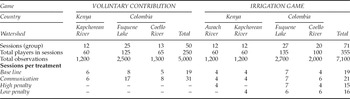
We present here the results of a series of artefactual field experiments conducted in the Fuquene Lake and Coello River watersheds in the Colombian Andes and in the Awach and Kapchorean River watersheds in the Nyando Basin in Western Kenya. These watersheds have great ecological and socioeconomical importance and face critical challenges to water management. We recruited around 500 watershed inhabitants from upstream, midstream, and downstream locations of the four watersheds (table 1). We implemented a new experimental design called the irrigation game developed by Cardenas et al. (Reference Cardenas, Janssen, Bousquet, List and Price2008) that introduces the asymmetries in appropriation that are common in water provision. We compare the irrigation game against the canonical version of a public goods or voluntary contribution mechanism (VCM) game, where individuals have symmetric and simultaneous access to the same resource, in order to evaluate the costs associated with asymmetries and the potential benefits of alternative intervention options.
Summary of the sessions

In section 2, we describe a theoretical framework for understanding issues and challenges that affect collective action in a watershed context. Section 3 provides a description of the watersheds where the experiments were conducted. Section 4 describes the experimental designs. Section 5 presents the main socioeconomic characteristics of participants. Section 6 describes the principal results of the provision decisions in the four watersheds. Section 7 presents the results of regression analysis about the factors that affect cooperation around water. The paper ends with a discussion of the results and their implications for policy.
2. Theoretical framework: collective action around water and watersheds
Collective action is key to achieving sustainable water management. The nature of water resources and the externalities present in watersheds impose the necessity to look for common solutions to water-related problems. These can range from neighbors managing a shared water point to a large number of stakeholders from different towns, cultural groups, social classes, and economic sectors negotiating to govern the flows of water, nutrients, and soil across a landscape. For this reason, collective action for water management differs according to the scale, and it could be seen as a fractal process: collective action at one sociospatial level can have spillover effects at other levels (Swallow et al., Reference Swallow, Johnson, Meinzen-Dick and Knox2006). Watershed contexts are characterized by a variety of actors, e.g., farmers, livestock keepers, mining companies, municipal land use planners, and urban water suppliers, who make decisions related to water or other landscape resources. These actors are heterogeneous in terms of water access, economic activities, and power to influence water management institutional arrangements. Additionally, the vertical nature of the watershed produces asymmetries in water availability that are often compounded by the fact that stakeholders are heterogeneous and, as a result of their locations, they have limited or sometimes no interaction that would enable them to build trust and resolve conflicts (Swallow et al., Reference Swallow, Johnson, Meinzen-Dick and Knox2006).
Thus, the differences in scales, the heterogeneity among actors and the asymmetries in water access due to verticality, impose important challenges to collective action for water management because of their effects in the construction of the virtuous cycle of trust, reciprocity, and reputation, the core of cooperation in social dilemmas related to CPR (Ostrom, Reference Ostrom1998). For this reason, it is essential to identify the factors that can affect cooperation in highly heterogeneous and asymmetric environments like watersheds or irrigation systems.
Heterogeneity has been a frequent theme of concern in the collective action literature, including the seminal hypothesis by Olson (Reference Olson1965) that in heterogeneous groups it will be the privileged group that would provide the public good inducing the non-privileged to free-ride on the provision of the former. With respect to heterogeneity at various scales, Keohane and Ostrom (Reference Keohane and Ostrom1995) compiled a series of studies on how heterogeneity affects the possibility of cooperation. In one of the chapters, Ostrom develops a model of an irrigation system with branches that a series of farmers were to maintain to extract water for irrigation. The optimal choice of rules, she shows in a game-theoretical setting, will depend on the heterogeneity of the allocation of water along the irrigation system users. Baland and Platteau (Reference Baland and Platteau1996) have also developed the game-theoretical analysis of collective action situations where asymmetries play an important role in terms of the incentives to free-ride and the gains from cooperation. This literature has provided a more qualified result for the Olsonian heterogeneity or privileged group hypothesis by showing that the structure of the production function and the relative payoffs will determine whether we have a cooperation dilemma or an assurance game.
Empirical studies have identified some of the factors that affect collective action in water systems. Fujie et al. (Reference Fujie, Hayami and Kikuchi2005) examined collective action toward local irrigation systems management in the Philippines using cross-section survey data. This study found that collective action is difficult to organize where water supply is uniformly abundant, the difference in water supply is large between upstream and downstream farmers, the size of the group is large, the population density is low, which reduces social interactions, nonfarm options are available for farmers, and the experience in managing communal irrigation system is short. Knox et al. (Reference Knox, Swallow and Johnson2001) also identified the importance of community organization and social capital in robust collective watersheds management. According to these results, factors like relative scarcity of the resource, asymmetries in its access, frequency in social interactions, and community cooperation tradition are relevant to collective action in such heterogeneous environments.
The experimental literature on heterogeneity and cooperation is substantial as well as diverse in its confirmation and rejection of Olson's hypothesis. Hackett et al. (Reference Hackett, Schlager and Walker1994) conducted a series of CPR experiments to explore whether community could reduce the problems related to heterogeneity among appropriators and found that reaching and sustaining agreements is more difficult for heterogeneous groups because of the distributional conflict associated with alternative sharing rules. Cardenas et al. (Reference Cardenas, Stranlund and Willis2002) test the role of heterogeneity in cooperation by assigning asymmetric payoffs structures in the incentives for the players, confirming that those with better outside options tend to behave closer to the Nash self-oriented prediction whereas those with poorer outside options tend to converge more towards a group-oriented strategy of cooperation. Real social distance among players can also decrease the possibilities of cooperation in CPR dilemmas as was shown by Cardenas (Reference Cardenas2003) using experimental evidence from the field. Lecoutere et al. (Reference Lecoutere, D'Exelle and Van Campenhout2010) also use a framed experiment in the field of a repeated dictator game to test if water scarcity induces a change in the competition over the resource for upstream users and the role of sanctions by downstream users.
In several of these studies, the opportunity to communicate leads to a noticeable change in the pattern of allocation: ‘even in an environment of extreme heterogeneity in subject endowments, communication was a powerful mechanism for promoting coordination, resulting in rents very close to those observed in the homogeneous set’ (Ostrom, Reference Ostrom2006). Communication is effective because ‘it allows individuals to increase (or decrease) their trust in the reliability of others’ (Ostrom, Reference Ostrom1998) through factors like group identity creation, reputation building, development of normative feelings, and emergence of commitments. Besides, it increases the capacity of players to detect the types of the players with whom they are interacting (i.e., conditional cooperators), which helps them to choose the best strategy to increase their payoffs (Cardenas et al., Reference Cardenas, Ahn, Ostrom and Huck2004).
3. The context of the watersheds in the studyFootnote 1
The Colombian Andes and the hillsides of Western Kenya are characterized by soil erosion, sedimentation of water bodies, and reduction of water quality and availability, which mainly affect downstream areas. In spite of the ecological and socioeconomic importance, as well as the institutional diversity, of Fuquene Lake and Coello River watersheds in the Andes of Colombia, and Nyando basin in Western Kenya, these watersheds face critical dynamics of environmental deterioration that impose challenges to authorities and communities to improve their management. These basins were part of a project titled ‘Sustaining Collective Action that Links Economical and Ecological Scales’ of the CGIAR Challenge Program on Water and Food in which the authors were involved. These basins are of policy importance for the program and also showed some similarities in terms of the economic importance of water for agriculture.
Fuquene Lake and Coello River watersheds are typical of the socioenvironmental situation in the Andes, where the steep slopes and high altitudes result in diverse ecologies, and where the demographic processes have caused a great pressure on natural resources (Ramírez and Cisneros, Reference Ramírez and Cisneros2006). The Nyando River basin, which is located in Western Kenya, drains into the world's second largest freshwater lake, Lake Victoria, and has a heavy influence on the ecology of the lake, through its three main tributaries: Awach, Kapchorean, and Ainabgetuny. Additionally, it sustains important socioeconomic dynamics and presents ‘historical processes of settlement and land tenure change that have resulted in contemporary differences in land and water management’ (Onyango et al., Reference Onyango, Swallow, Roy, Meinzen-Dick, van Koppen, Giordano and Butterworth2007).
These watersheds include heterogeneous groups of actors with significant cultural, wealth, and power differences that have implications for water management and collective action. Whereas the Nyando basin is characterized by ethnicity diversity and strong gender division of labor with regard to water access, the Fuquene and Coello watersheds’ inhabitants face situations of asymmetric political and economic power. Furthermore, Colombian and Kenyan institutional frameworks are distinguished by a variety of formal institutions for water management and control, combined with rules and agreements that have historically emerged to regulate access to water and that sometimes have not been taken into account in policy.
It has been indicated that a process of greater community involvement has been taking place in both African and Latin American countries, supported by laws and other institutional arrangements that look to devolve greater authority to local water users (Swallow et al., Reference Swallow, Johnson, Meinzen-Dick and Knox2006). However, these formal institutional arrangements sometimes do not consider the heterogeneity of actors presented in a watershed management context, the different interests they have, and their capacity to influence water management decisions, which can result in the marginalization of some groups like women or poor (Van Koppen et al., Reference Van Koppen, Giordano, Butterworth, Mapedza, van Koppen, Giordano and Butterworth2007).
Decentralized environmental authorities, Corporaciones Autonomas Regionales (CARs), are in charge of ecosystems management and water allocation and regulation in Colombia, through management plans that are required to assure the participation of users and communities. Local authorities are responsible for potable water access while sanitation and irrigation systems have been promoted by the Ministry of Agriculture and administered by different entities like users, municipalities, and CARs (Blanco, Reference Blanco2008). An important number of rural community organizations have constructed and maintained small piped water systems, which complement municipal systems and have become the main water source for many rural inhabitants. In fact, many of these organizations prefer to continue administering the water themselves rather than transfer the administration to local governments.
Kenya has also faced an important transformation of its institutional scheme with the implementation of the Water Act of 2002, which involves the separation of water resources management from the provision of water services into two autonomous public agencies,Footnote 2 the decentralization of functions among lower state organs levels, the management through catchments areas,Footnote 3 and the involvement of nongovernment entities like community groups in the management of water resources and the provision of water services (Mumma, Reference Mumma2005). However, some studies have argued that this is a centralized law that fails to recognize pluralistic legal frameworks like customary law and traditional norms (Mumma, Reference Mumma2005; Onyango et al., Reference Onyango, Swallow, Roy, Meinzen-Dick, van Koppen, Giordano and Butterworth2007), and that has assigned a marginal role to self-help community groups, whose role in water provision remains significant in rural areas (Mumma, Reference Mumma2005). It has also been identified that some of the Kenyan's customary practices entrench gender inequalities and may restrict collective action around water access since women have the responsibility while men, the authority (Roy et al., Reference Roy, Crow and Swallow2005; Swallow et al., Reference Swallow, Onyango, Meinzen-Dick, van Koppen, Giordano and Butterworth2007).
4. Experimental design
In order to examine the provision and appropriation aspects of water management, an artefactual field experiments (Harrison and List, Reference Harrison and List2004) strategy was conducted in four watersheds of Colombia and Kenya. The strategy included a new experimental design called the irrigation game (Cardenas et al., Reference Cardenas, Janssen, Bousquet, List and Price2008), complemented by the well-known public goods or VCM game. Both protocols were framed around water management.Footnote 4 For both games, a session consists of a group of five people that played the game for a total of 20 rounds. Sessions were run in rural school classrooms where participants were seated in a circle far apart from each other and facing outward, to ensure that the decisions remained anonymous. Participants made their decisions on a decision sheet that was collected in every round by the facilitator. Before starting, participants signed a consent form in which they acknowledged that they were participating voluntarily and that the game had been explained to them.
In the VCM Footnote 5 players can contribute the tokens that they receive toward the provisions of a public good. Tokens kept have a private value while tokens invested in the public fund generate a ‘public good’ return by transferring income to the contributor and the rest of the players. For this to be a public goods problem or a collective action dilemma, the expected returns from keeping all tokens must be higher than the expected returns from investing the tokens in the group account, therefore inducing Nash equilibrium where nobody contributes. However, if all players contribute to the group account, the group achieves the socially optimum outcome. To make this quite simple and applicable in the field, in our design participants are assigned to groups of five people who play for 20 rounds. At the beginning of each round, each player receives an endowment of 25 tokens that can be contributed to the public fund or kept in a private account. The total contribution to the public fund by the five players is doubled and immediately distributed in equal shares to all players in the group at the end of each round. The only information given to the players in each round is the total contribution by the group and the amount each receives from the public fund, which is then added by each player to her tokens not contributed. Clearly, a group is better off by investing all 125 tokens, which are doubled and thus yield 250 tokens to be distributed to the five players. However, any of the players will have an incentive to free-ride on the contributions by the others, keep her endowed tokens and still receive 1/5 of the tokens produced by the public fund. Since this is the Nash (and dominant) strategy, the equilibrium of the game at any round would be that each player keeps her 25 tokens for a social efficiency of 50 per cent. The individual and group contributions to the public good are therefore a measure of the willingness to cooperate by the group members, as is the capacity of the group to sustain cooperation throughout the rounds.
The irrigation game introduces the appropriators’ differential access to the resource because of location between head-enders (upstream residents) and tail-enders (downstream residents) in the system. The first part of a round in the game is similar to the VCM design: players can contribute any portion of their endowment of 10 tokens to a public good. Tokens not contributed are kept in a private account, which yields private returns. The public good is a project to maintain water canals or water springs (watershed function) so the amount of available water depends on the total contribution according to a monotonic function of tokens contributed following a typical sigmoid production function. The production function of the public good will maintain on average the same proportion as in the VCM game before, that is, if the group contributes the full endowment, the water produced will double. (See Appendix, available at http://journals.cambridge.org/EDE for the instructions.)
The water produced by the group as a result of the combined ‘provision’ decisions is then distributed in the next stage of the game through the ‘appropriation’ decisions. Each player is told how much water is available to her, and she then decides how much water to extract. Decisions are taken in order according to the player's location in the irrigation canal starting with player A, the first upstream, and ending with player E, the last one downstream.Footnote 6 The assignment of the locations is made randomly among the five players at the start of the game and remains the same throughout the rounds. In brief, player A has access to all the water produced. The water left by A is then offered to B who then decides how much to extract and how much to leave for the rest downstream and so on, until we get to player E.Footnote 7 The only information given to the players is how much water is available (left by those upstream), so except for player B, no players have information about how much was extracted by the others.Footnote 8
After the first 10 rounds of baseline treatment, rules changed for some groups, and this change is announced aloud to the players. Some groups of the VCM game were permitted to communicate, and other groups continued playing under the baseline conditions. The second stage of the irrigation game had four treatments: baseline, communication, high penalty, and low penalty.
The face-to-face communication treatment allows players to communicate with each other in the group before making their private decisions in each round. In the penalty treatments, a regulation is imposed on how much water can be extracted by each player – 20 per cent of the water produced – with a positive probability (p = 1/6) that players’ extraction decisions will be monitored after each round. All the players are inspected if a die rolled in front of them turns up six. Players caught extracting more than their fair shares were fined. In the high-penalty treatment the fine to be paid was the extra amount taken plus six units of the player's accumulated earnings. In the low-penalty treatment only the amount taken in excess of the one fifth share was forfeited. As in the baseline, players in the treatment round only know the aggregate outcome of each round but not the individual decisions.
5. Recruitment in the field and sample across watersheds
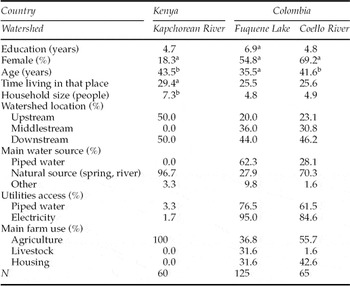
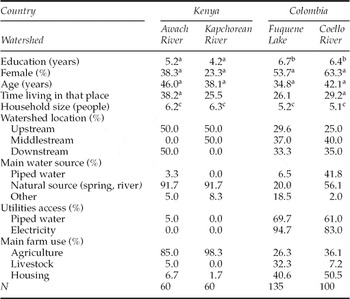
We recruited actual watersheds inhabitants who in their daily lives face water provision and appropriation decisions such as those simulated in the games. A total of 500 inhabitants across the four watersheds participated in the games. The distribution of the players between the games and watersheds is shown in table 1.Footnote 9 Each experimental session was conducted with five participants, usually living in the same village. We recruited people by written or verbal invitations some days before the games and the people who showed up the day of the experiment and decided to participate were assigned randomly to games and sessions. We explicitly avoided having two members of the same family participate in the same session. The recruitment strategy was made as wide as possible in the villages of each watershed and all adults who showed up were accepted for participating. Although we cannot confirm or reject that we have a sampling bias problem, our demographic characteristics support our belief that we recruited a sample of people that could represent well the variance of important social, economic, and demographic variables, as illustrated in tables 2 and 3. At any rate, our regression analysis will be conducted at individual levels. Additionally, since the demographic characteristics of the sample are unbalanced, we will control for sociodemographic variables and for village level ones.
Sociodemographic characteristics VCM participants

Notes: T-test significance level: a1%, b5%.
Sociodemographic characteristics of irrigation game participants

Notes: T-test significance level: a1%, b5%. cThe results of watersheds of the same country are not statistically significant, but it is different between countries.
There is considerable variation in education level, household size, access to utilities, and main farm use between Colombian and Kenyan participants. Although VCM participants in Coello and Kapchorean have similar levels of education, irrigation game participants in Colombian watersheds were more educated than the Kenyan participants. Participation of women in the games was lower in the Kenyan watersheds than in the Colombian watersheds; in both Colombian watersheds more than half of the participants were females. Access to utilities is higher in the Colombian watersheds, especially in Fuquene. Piped water access was very low in both the Awach and Kapchorean watersheds. It was higher for the Fuquene and Coello watersheds; nonetheless, many Coello participants used natural water sources instead of piped water as their main water source.
The information about age and time living in the communities is similar for both countries. Household size is larger in Kenya, and the agricultural land use shows a pattern of higher dependence on crop agriculture in Kenya compared to Colombia, with 100 per cent and 85 per cent of Kenyan participants reporting cropping as the principal land use for the VCM and irrigation game, respectively. In contrast, the percentage of Coello and Fuquene participants who reported housing as the main farm use is close to 40 per cent of the cases, which probably means that these people have alternative jobs outside of agriculture. Off-farm employment and income are known to be important in all communities, though more so in Colombia than Kenya (Teyie, 2006; Johnson et al., Reference Johnson, Garcia, Rubiano, Quintero, Estrada, Mwangi, Morena, Peralta and Granados2009).
6. Games data and results
Let us recall that the social optimum or maximum social efficiency for the VCM game is obtained when all 125 tokens are contributed to the public good, generating 250 tokens in benefits. In the irrigation game, this is achieved when all 50 tokens of the endowment are contributed producing 100 units of water.Footnote 10 The Nash equilibrium for both games is zero contribution resulting in a suboptimal result of 50 per cent of the maximum social efficiency.
The overall results replicate two patterns observed in previous experimental studies. The individual behavior for the baseline treatments and for the first 10 rounds of the entire sample does not confirm the hypothesis of self-oriented free-riding from noncooperative game theory. The fraction of decisions that fall within the category of Nash strategy was only 3 per cent for all 10 rounds, and 5.6 per cent for the 10th round of the VCM game. For the irrigation game, 6.2 per cent of all decisions and 7.3 per cent of 10th round decisions were consistent with a Nash strategy. The results also support the finding that face-to-face communication does increase the levels of cooperation and social efficiency, although with different results across watersheds. On average, groups that were allowed to communicate achieved substantial improvements on their provision decisions even under conditions of asymmetric appropriation. We will first present the overall patterns of the results in graphical form and then proceed to the econometric analysis of the data.
6.1. Voluntary contribution game
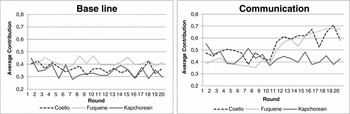
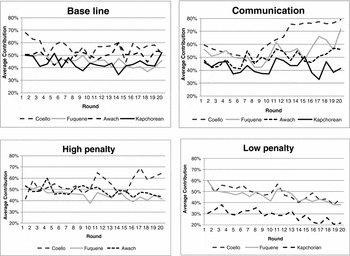
The graphs in figure 1 compare the results of average amounts contributed by the players round by round, expressed as percentages of the initial endowments. In the baseline treatments, the players’ environment of incentives and rules were the same during all 20 rounds, while in the communication treatment, the players were allowed to talk to each other after round 10 and in every subsequent round. The regulation treatments played the first 10 rounds under the baseline treatment, but from round 11, they faced one of the regulatory regimes already described.
Voluntary contribution mechanism average results.

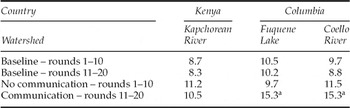
The players contributed on average 40.6 per cent of their endowments (10.14 tokens) in the 10 initial rounds. Groups that continue playing in the baseline treatment contributed on average 36.4 per cent (9.1 tokens) of their endowments in the following 10 rounds. Contributions jumped to 58.7 per cent of the endowment when players could communicate with other players in the group. However, communication was not equally effective in all three watersheds.Footnote 11 While the average contribution for communication groups increased from 11.47 to 15.3 tokens in the Coello and Fuquene watersheds, contributions did not increase as a consequence of communication in the Kapchorean watershed, remaining at 10.53 tokens, which was very close to the baseline contribution level. Table 4 summarizes these results.
Summary of average contribution of the VCM

Notes: a1% level of significance for the difference between stage 1 (rounds 1–10) and stage 2 (rounds 11–20).
T-test and the Mann-Whitney RankSum test.
The effectiveness of communication depends on the possibility that players craft agreements to cooperate. While 75 per cent of Colombian participants in communication treatment believed that the group got an agreement, for Kapchorean participants only 33 per cent of the participants answered this question affirmatively in a postgame survey.
6.2. Irrigation game
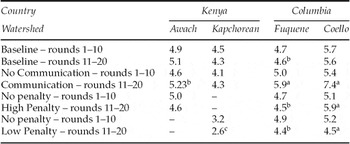
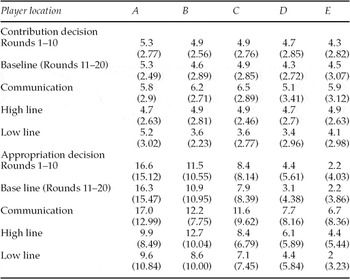
The individual contribution was on average 4.82 tokens for the irrigation game, 48.2 per cent of players’ endowment, for the 10 initial rounds.Footnote 12 The graphs in figure 2 present the average contribution over rounds and by treatment for the contribution stage of the irrigation game. Table 5 shows the average contributions in the irrigation game and across the different watersheds in both countries with the significance test for the statistical difference between the first stage and the second stage of the games. However, these contributions slightly varied according to the players’ location along the water system. While the contributions of player A were on average 53.17 per cent of initial endowment, contributions by player E were 42.76 per cent. If we compare these results with VCM results, we find that while total efficiency is higher, distribution is less equitable under the sequential structure of appropriation (see table 6 for the average contributions and extraction, by player location). During the second stage of the game, the groups that continued playing with baseline conditions obtained an average contribution of 4.71 tokens, while the groups that communicated reached an average contribution of 5.9 tokens, showing the net positive effect of nonbinding communication within groups. The penalty treatments obtained an average contribution of 4.83 for high penalty and 3.96 for low penalty.
Irrigation game (contributions stage).

Summary of average contribution of the irrigation game

Notes: a1%, b5%, c10%, level of significance for the difference between stage 1 (rounds 1–10) and stage 2 (rounds 11–20). T-test and Mann Whitney Ranksum test.
Contributions to public fund and appropriation of water by player's location and by treatment in the second stage (rounds 11–20, irrigation game)

Notes: Standard deviations in parentheses.
Communication was the most effective treatment, but the level of effectiveness depended on the watershed, just as in the VCM game. Once again the Coello watershed inhabitants achieved the best results with an average contribution of 7.42 tokens, while Kapchorean watershed participants did not change their contributions despite the change in game conditions.Footnote 13 These results appear to be related to the effectiveness of the communication that took place before each round. According to the postgame survey results, 88 per cent of Coello participants believed that they reached an agreement during the conversation period compared to only 54.3 per cent for Fuquene, 35 per cent for Kapchorean watersheds, and 30 per cent for Awach.
In contrast to the face-to-face communication treatment, the imposition of an external regulation that was imperfectly enforced did not improve social efficiency. In fact, our participants decreased their contributions under the regulations, especially in the case of the low fine. Some explanations for this behavior, such as the crowding-out of cooperative behavior, have been explored in other works (Cardenas et al., Reference Cardenas, Stranlund and Willis2000; Bowles, Reference Bowles2008). The basic argument is that the intrinsic motivations to cooperate with others can be crowded out when explicit monetary incentives are introduced, turning a group-oriented task into a game between each individual player and the external regulator with imperfect monitoring and sanctioning capacities.
Of course, the results of the irrigation game depend on the appropriation possibilities for players, which depend on their location along the water system. This asymmetric access to the benefits of the public good is the main difference between the irrigation game and the VCM, and is a factor that has a significant effect on contribution decisions, as will be discussed in the next section. Table 6 presents the contribution and appropriation decisions by treatment and player's location, showing that communication had a substantial effect on water distribution and contribution decisions.Footnote 14
7. Regression results
The decisions that players made during the experiments depend on the information available to them when making their decisions. Three distinct types or layers of information are hypothesized to be relevant, according to Cardenas and Ostrom (Reference Cardenas and Ostrom2004): the material incentives and the dynamics of the game, the composition of the group of players, and the individual characteristics of each player. The dynamics of the game include the fact that the same players meet in future rounds so they can learn and construct a reputation. These dynamics can be crucial to cooperation: ‘the information that can be gathered about past rounds and the probability of future ones with the same players creates the conditions that are conducive for cooperation through reciprocity, including retaliation towards non-cooperators as a group selection mechanism’ (p. 312).
The group-context layer is based on the notion that players’ decisions are also influenced by the recognition of who the other players are in the transaction. This knowledge can influence reputation, reciprocity, and trust construction in the game as players allow their prior knowledge (i.e., prior to the experiment) or preconceptions of the other players to influence their decisions. Finally, the individual identity layer consists of information about personal characteristics of players that can affect strategies and subjective payoffs (the noneconomic value of a payoff to a player due to moral values and internalized norms).
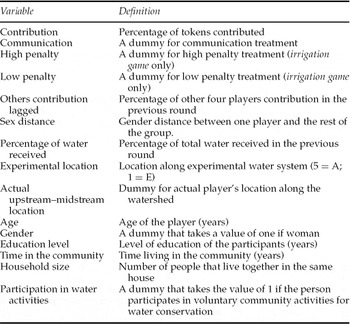
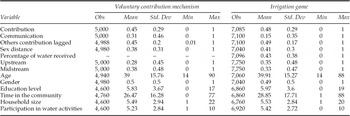
In order to identify how these different sets of factors influence collective action in these watersheds, we use a regression analysis in which we attempt to explain the individual levels of cooperation in each round as a function of vectors of these three types of variables. The individual data were obtained through a questionnaire that the players filled out at the end of the game and include information about basic sociodemographic variables, as well as perceptions about community cooperation. The cooperation or contribution variable is defined as the percentage of tokens contributed from her endowment, by each player in each round. The game structure variables are the round, the treatment, and the other four players’ contribution in the previous round. We include controls for the group-context variables, such as dummy variables for the watersheds, for the actual location of the players along the watershed and for the particular session. Because we are interested in the particular role that women may play in the management of water resources in rural areas, we also tested the gender role by controlling for the gender of the player and for the gender composition of the group by calculating an index of gender distance among players.Footnote 15 In table 7, we present the definition of the variables we use for the regression analysis and in table 8 their descriptive statistics.
Definition of variables included in the regression analysis

Summary statistics voluntary contribution mechanism and irrigation game

Overall, we have more than 5,000 observations for the VCM and 7,000 for the irrigation game from the 50 and 71 sessions, respectively. We are aware that these are not independent observations as they are nested within one player and players within sessions, within villages, and within basins. Therefore, we have used a fixed effects model to control for these effects. Nevertheless, the variability of the socioeconomic data provided by the participants allows us to conduct regression analysis to better understand the determinants of individual behavior. Since the mean results of these variables are similar for both games and the units and scale of the dependent variable are the same, we can compare results across games.
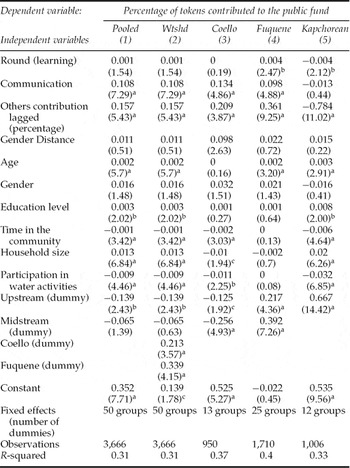
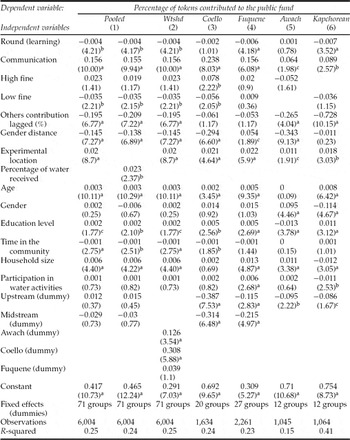
Tables 9 and 10 show the regression results for the games, where the dependent variable is the individual contribution as a fraction of the individual endowment. In both games, contributions are equivalent in terms of the opportunity cost of the tokens contributed to the public fund because tokens not invested add to the private monetary earnings of the player. However, we must remember that the externalities flow symmetrically across the five players in the VCM game, whereas there is a unidirectional flow from upstream to downstream players in the irrigation game. Our estimated models explain a substantial amount of the variation in the individual contributions, near 1/3 of variation in contribution for the VCM and 1/4 for the irrigation game.
Fixed-effects OLS estimation of contribution decisions VCM

Notes: a1%, b5%, c10%, level of significance. Standard deviations in parentheses.
Fixed-effects OLS estimation of contribution decisions irrigation game

Notes: a1%, b5%, c10%, level of significance.
We use the same regression strategy for both games. The first model estimated is a pooled model where we regress the contribution level on the variables previously mentioned. The second model includes watershed dummies (the omitted dummy corresponds to the Kapchorean watershed for both games). Finally, we estimate the regression separately for each of the four watersheds. For all cases, the round effect is rather small suggesting that for these games the deterioration of cooperation usually observed in VCM laboratory experiments is not confirmed here. In the case of the irrigation game, we do observe a consistent negative and significant effect over time, although again the coefficient size is not very large. Our conjecture is that the nature of the sequential problem in the irrigation game does trigger stronger reactions than in the VCM case. For both games, we observe the significant effect of the communication treatment in increasing contributions for all estimated models, although we find a stronger effect for Colombian watersheds compared to Kenyan watersheds as can be observed in the size of the coefficients. As mentioned in section 6, when asking the participants if they perceived that the group had achieved an agreement during the communication sessions, a much larger fraction of players reported so for the Colombian watersheds than for the Kenyan cases. The introduction of high and low penalties, in the case of the irrigation game, has a rather poor effect on individual contributions compared to communication, and even to the baseline.
While contributions by other players in the previous round had a positive effect in the VCM, it had a negative effect on contribution in the irrigation game. This contradictory result may be due to the fact that because of the asymmetries in appropriation, players in the irrigation game are less able to perceive the benefits of increased overall contributions as the sequence moves downstream. However, the negative effect is stronger for the Kenyan basins than for the Colombian basins. For the irrigation game, the experimental location has a positive and significant effect, i.e., players located in a higher position contribute higher percentages of their endowment since they perceive more clearly the returns from their contributions. It is true that in the Nash equilibrium all players, including A, should invest no tokens in the public fund. However, any positive contribution by the others should induce player A to invest more tokens and therefore increase her returns on her own investment given that she gets to extract first. We analyzed the effect of the water received in the previous round as a percentage of the total water produced by the group and as we expected this variable has a positive and significant effect. We include this variable just for one regression because it is correlated with the experimental location of the players.
While the variable that measures the gender distance between the player and the rest of the group has a slightly positive effect in the VCM, its effect is negative and stronger for the irrigation game, which means that greater gender homogeneity leads to larger contributions. The negative effect in the case of the irrigation game may be explained by two nonmutually exclusive reasons. One, the framing of the game makes clear that this is a game about water, and women in general suffer the consequences of poor supply of water in the villages (cooking, animal care and rearing children are highly dependent on water). The second reason may be Tajfel's ingroup/outgroup effect, in this case based on gender, although this should also apply for the VCM where we do not find the effect as clear.
An interesting result is that the actual location of players along the watersheds has a significant effect on their contribution decisions for both games. Upstream and midstream players tend to contribute less than the downstream players (omitted dummy). Although the effect for the pooled regression in the VCM looks stronger – the significance disappeared in the pooled irrigation game regression – the negative sign remains when we analyze the watersheds one by one in this game. This result seems more pronounced in Colombian watersheds.
Given the heterogeneity of the demographic composition of the groups we have included in the regressions other controls that can be checked in tables 9 and 10. The more educated people and those who live in larger households tend to contribute more in both games. The variable measuring the participation in community activities has inconclusive results. It has a negative effect in VCM and no effect in the irrigation game but with different signs in watershed models.
8. Discussion
These two games offer some valuable contrasts that can enrich our understanding of cooperation in watershed management. One of the main differences between the two games relates to the opposite effects of the contributions by the others in the previous round. While it has a positive effect in the VCM, it has a negative effect in the irrigation game, possibly indicating that the irrigation game does not build a setting for positive reciprocity.Footnote 16 As suggested above, one explanation for this is that because of the asymmetries in appropriation, increases in overall contributions may not translate into increases in individual level water allocations.
In our results, upstream players increase their extraction levels and as the size of the pot grows they realize that they can appropriate it and get away with it. The implication for policy is that groups facing this structure of incentives will likely need additional mechanisms to maintain collective action over time. On the other hand, the stronger negative effect is observed for the two Kenyan watersheds. It is worth noting that in the Kapchorean watershed, there was negative effect of contributions in previous rounds even in the VCM. Remember, face-to-face communication had the poorest results in the Kenyan watersheds, and particularly lower for the Kapchorean basin (see table 5). There are some possible explanations in the demographics of our Kapchorean sample, as shown in table 3. First, they had the lowest education level which we have seen has a positive effect on contributions. Likewise, they had larger average household size, which also seems to affect negatively contributions. Finally, the Kenyan samples in general and the Kapchorean in particular show very high percentages of households who get their water from natural sources, have no access to piped water or electricity, and are dedicated mostly to agriculture. This all may suggest less experience with water management institutions and infrastructure, although we do not have detailed information about informal institutions in place by watershed.
The most powerful treatment to increase cooperation is communication, but with differences across watersheds. The Kenyan watersheds in particular obtained lower benefits from communication. As mentioned earlier, this seems to be because groups failed to reach consensus during the communication period. Although some Kenyan participants try to start a conversation that could lead to an agreement, these efforts usually did not succeed. For example, one of the group conversations went like this: ‘The first person to play gets more points. I am getting zero so many times that I will reduce my contribution’; ‘It is good to extract water and remember others’; ‘Some people take too much water but contribute less’.
These results can also be linked to differences in the cultural and biophysical contexts of the two countries and among watersheds. First of all, while water scarcity is an important issue in both Colombian watersheds, this perception can be different in Kenyan basins where ethnic customs – mainly Luo and Kalenjin – hold that water access should be freely available, particularly for basic household uses. According to Swallow et al. (Reference Swallow, Onyango, Meinzen-Dick, van Koppen, Giordano and Butterworth2007), ‘one possible drawback of the Luo custom for land and water governance is that there is a relatively little incentive for private individuals or small groups to invest in protecting existing water sources. This has particular impacts on women, who are responsible for provisioning the household with water and for providing health care within the household’. Footnote 17 Additionally, perceptions of water scarcity – collected in the postgame surveys – differ across communities reflecting both biophysical realities and cultural influences about how water should be distributed. While 50.7 per cent and 48 per cent of Coello and Fuquene irrigation game participants, respectively, consider that in the future people should consume less water, these percentages are 28 per cent and 25.2 per cent for the Awach and Kapchorean watersheds.Footnote 18
These perceptions may also be influenced by past community organization. While NGOs mobilization is lower in Fuquene than in Coello, community organization related to piped water access is important. The organizational process in Coello around environment protection has been strong and has emphasized the upstream-downstream linkages among people. Nyando basin has an important presence of community groups, but there has been relatively little success in initiating and sustaining local social organization around water management (World Agroforestry Centre, 2006). Explanations for this include gender roles that separate responsibility for household water provision and land tenure arrangements that restrict group investment on private land (ibid). The effect of different gender roles around water provision could be reflected during the games in the negative sign of the gender distance variable for the irrigation game and not for the VCM and particularly, the negative and significant effect in cooperation of women in the Kapchorean watershed for the irrigation game.
These results suggest two implications for policy. The first is that while communication is an effective tool for enhancing collective action, it can only work through a series of steps that start from the understanding of the mapping of actions into outcomes in the social dilemma to the crafting of the agreements and the trial and error of the cycle of trust, reputation, and reciprocity (Cardenas et al., Reference Cardenas, Ahn, Ostrom and Huck2004). Allowing groups to talk for a fixed amount of time does not necessarily mean that the process will happen. Any intervention incorporating communication should pay attention to the factors that enhance and inhibit communication in a particular context. Second, the institutional and cultural context, including beliefs about how resources should be managed and shared, will have a strong effect on how people make decisions about water management and use. These need to be considered in the formulation of any intervention.
Ironically, achieving the social optimum in the game is not always about encouraging people to act less selfishly. On average, the participants in position E in the irrigation game extracted only 74.4 per cent of the water available to them. Experimentally, there was nobody below E so there were good reasons for them to take the entire remaining water. The importance of leaving water to downstream users was mentioned in some conversations, especially in Coello: ‘Player E should leave water in the canal for the people below him’, suggesting a pattern of either shame or guilt from doing so, or preferences toward the symbolic value of water from the framing of the game.
9. Conclusions
Our experiments explore the specific problems of contribution to the public projects under two scenarios, namely when the resource and benefits are distributed evenly and simultaneously among the players, regardless of the contributions that each made to the public fund, and when the appropriation stage occurs sequentially starting with those players located in the upstream section of the water system. Given our sample and the different treatments tested, we were able to derive some conclusions regarding behavior and the effect of certain institutional regimes on cooperation in the provision of public goods. We found that there were differences across the two countries and even across basins within countries. We also observed that the external regulations of imposing fines on overextraction were rather ineffective, while communication does perform better than the baseline situation and the fines externally imposed. We mentioned earlier the work of Lam (Reference Lam1998) who compared 150 Nepalese irrigation systems finding that farmer managed systems could be quite effective in solving the problems of provision and appropriation of water and superior to the government managed systems in the cases where local farmers are not involved in managing of problem.
There were significant differences across watersheds in terms of their socioeconomic and cultural and institutional contexts as well as in the experimental results obtained. The most powerful treatment to increase cooperation was communication, but it differed by watershed. Communication was more beneficial in the Colombian watersheds than in the Kenyan sites. Participants in Colombia were able to communicate more effectively and reach agreements about how to coordinate their behavior to improve the game outcomes. There was no evidence that participants in Kenyan sites were less likely to honor informal agreements once they were made; however, they had difficulty getting to such agreements, as reported by the participants at the end of the games. Interventions designed to promote communication for fostering collective action would need to take this into account. Future studies using this game might consider varying the length of the communication period or providing facilitation to see whether this affects groups’ ability to reach an agreement.
Another important result was that the sequential structure in the irrigation game appears to inhibit the development of reciprocity among the players. Past research has shown that reciprocity is key to maintaining collective action. The VCM with its symmetric payoffs did build reciprocity, whereas the irrigation game with its less clear link between the total contributions and the amount received by downstream players made it difficult for them to build a virtuous cycle. We have shown that the higher the player is, the more she is willing to contribute to the public fund. Just in the baseline, by the end of the stage, players in the last position E were contributing 38 per cent of their endowment, while players A were contributing 52 per cent. Through face-to-face communication we observed that such differences practically vanished, and now players were contributing around 66 per cent for the case of the two Colombian basins and 47 per cent for the case of Kenya. Interestingly, the actual location of the players in their real watershed seems to help explain the variation of their behavior in terms of contributions, but in the opposite direction than the experimental location. Those living upstream contributed slightly less to the public fund.
Collective action in water management requires that individuals overcome their individual incentives to free-ride and be willing to cooperate in the provision dilemma, which usually corresponds to a problem of public goods where cooperation is privately costly but socially efficient. In some cases, the public benefits of cooperation can be distributed evenly and simultaneously across the players – examples include a common water source like a pond or spring from which all users extract simultaneously – while in other cases like irrigation schemes or watersheds the benefits are distributed in a sequential manner along the system. In the latter case, head-enders/upstream residents have better opportunities to extract the resource while tail-enders/downstream inhabitants suffer the greater externalities in terms of water quantity and quality from upstream users’ actions.