Background
Corpus linguistics has transformed the landscape of empirical research on languages in recent decades. The proliferation of corpus technology has enabled researchers worldwide to conduct research in their own geographical locations with few hindrances. It has become increasingly commonplace for researchers to compile their own corpora for specific research questions or to conduct research on the basis of corpora constructed by other researchers. Moreover, corpus linguistics has become accessible to language teachers, providing ideas, instructions and new opportunities to apply corpus techniques, corpus-based materials and activities in their classrooms (e.g., Bennett Reference Bennett2010; Reppen Reference Reppen2010; Scheffler Reference Scheffler2011).
The Department of Linguistics and Modern Language Studies (LML) at the Hong Kong Institute of Education (HKIEd) was established in July 2012 and has corpus linguistics and corpus-based research as its strategic focus areas. Indeed, more than half of the department's 14 academic staff has been actively engaged in constructing corpora and/or conducting corpora-based research. Eight corpora of various sizes have been identified where LML staff members have played pivotal roles in their construction and development in different regional networks. These corpora contain both spoken and written Chinese and English language materials ranging from natural languages and learner languages to language data produced by children with language impairments. In addition, there are a number of ongoing research projects focusing on corpus linguistics and corpus-based research at the LML. This paper introduces these corpora and the ongoing corpus-based research projects.
Corpus construction
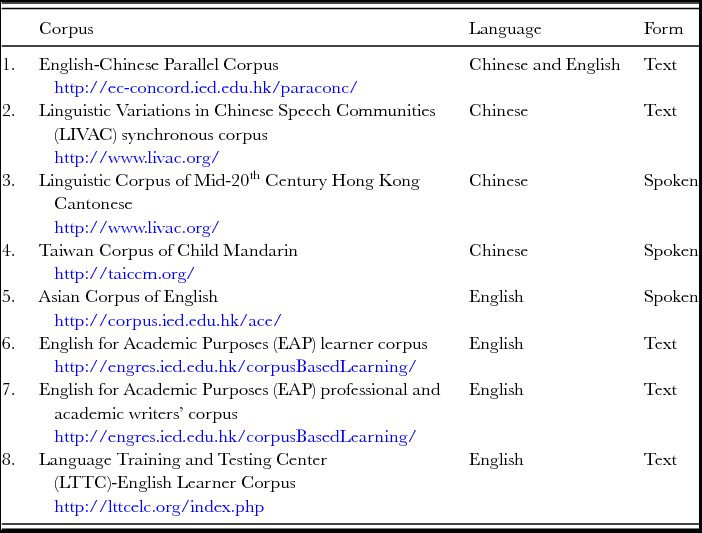
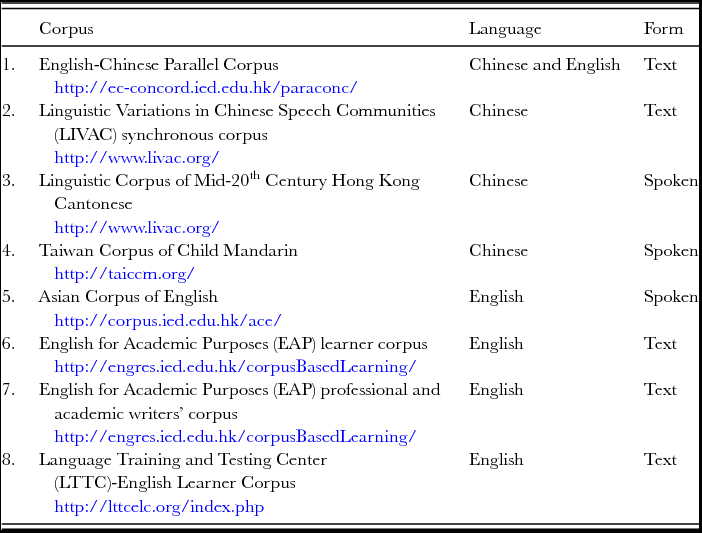
Table 1 lists the eight corpora and their web links. These corpora, which comprise one bilingual parallel corpus, three Chinese corpora and four English corpora, are currently open access and available free of charge. As can be seen from the table, the English and Chinese corpora are in both written and spoken form. The bilingual English-Chinese Parallel Corpus (Wang Reference Wang2013a) allows users to compare parallel language items from the two languages in one concordance. It consists of Chinese and English texts from a wide range of authentic language sources such as novels, legal documents, fairytales, essays and articles. The concordance tool, which is based on the parallel corpus, provides a platform for researchers to conduct cross-linguistic research whereby the linguistic and cultural differences of the two languages and their effects on second language (L2) learning can be compared and analysed systematically.
Major corpus projects
Among the three Chinese corpora, there is one consisting of written Chinese texts and two of transcribed spoken Chinese. The Linguistic Variations in Chinese Speech Communities (LIVAC) synchronous corpus (Tsou, Chin & Kwong Reference Tsou, Chin and Kwong2011) consists of texts primarily from major Chinese language newspapers and electronic media found in five Chinese speech communities: Hong Kong, Beijing, Shanghai, Macau and Singapore. LIVAC was compiled to investigate the linguistic variations in Chinese over time across the five Chinese speech communities. The LIVAC data can be traced back to 1993. As LIVAC synchronizes all language materials from the five communities, it provides an innovative approach to comparative studies over time. For instance, LIVAC releases an annual Pan-Chinese common new words roster. In 2012 new words such as ‘騎馬舞’ (horse-riding dance) by the Korean pop singer Psy in his song ‘Gangnam Style’, ‘薄案’ (Bo's case), which relates to the Chongqing Party Chief Bo Xilai and associates being involved in the murder of Englishman businessman Neil Heywood, and ‘財政懸崖’ (fiscal cliff) were identified as the three most popular new words to have emerged across four language communities (Hong Kong, Beijing, Macau and Singapore). High-frequency words appearing in the media also reflect the economic livelihood and politics of a particular community. In 2012 words such as ‘梁班子’ (the ministerial line-up of CY Leung, the new Chief Executive of Hong Kong), ‘港人港地’ (the ‘Hong Kong land for Hong Kong residents’ policy) and ‘剪布’ (curtailing) clearly echo the political and socioeconomic landscape of Hong Kong.
The Linguistic Corpus of Mid-20th Century Hong Kong Cantonese consists of transcribed spoken Cantonese (a dialect of Chinese spoken in Hong Kong and south China). Of great interest is that this language data was sourced from 21 Cantonese movies produced between 1950 and 1970. Each movie is approximately one hundred minutes long. This real-time language data of mid-20th-century Hong Kong is annotated, tagged and complemented with Cantonese Pinyin (the Romanized Cantonese pronunciation system) in the corpus, which totals 200,000 words. The concordance tool, which is based on the corpus, provides various search criteria, such as keywords, Pinyin, movie titles and actors’ names (Chin Reference Chin2012). It enables investigation of the evolution of the Cantonese language over time and the study of specific features of this vernacular language with respect to particular language features, such as sentence particles, aspects and styles (Chin Reference Chin2013).
The second spoken Chinese corpus is the Taiwan Corpus of Child Mandarin (Cheung et al. Reference Cheung, Cheung, Ke and Cai2011). This corpus collects spoken data from Chinese children between the ages of one and a half and eight and a half. Of the 362 language data files in the corpus, 159 are from children diagnosed with specific language impairments. All language data has been digitized in accordance with international standards (CHAT format). The research team aims to develop relevant tools for analysing the language of Chinese children (e.g. normal vs. those with language impairments), an open access research platform, and the ongoing co-construction of children's language databases with researchers from across Taiwan.
Among the four English language corpora, one contains transcribed spoken English while the other three comprise written texts. The Asian Corpus of English (Wang Reference Wang2013b) is a one-million-word English language corpus consisting of naturally occurring spoken and interactive data that is being used as a lingua franca in Asia. This project aims to identify the linguistic features of Asian English as a foreign language (EFL) and the communicative strategies of Asian EFL users. The research team also works in close collaboration with a European team that has been compiling a European corpus of EFL. This collaboration allows the two research teams to compare the features and uses of EFL.
The other three English corpora include English for Academic Purposes (EAP) written texts from different sources. The first two corpora are generated from one project (Ma et al. Reference Ma, Wang, He and Decoursey2012), which collects written texts from two sources: learners, and professional and academic writers. The learner corpus contains undergraduate students’ English essays, while the professional and academic writers’ corpus contains texts concerning language and education published in Chinese core journals and international journals (primarily those that are indexed in accordance with the Social Sciences Citation Index (SSCI)). Based on these two corpora, an online learning system has been developed for students to study academic lexico-grammatical items and practise using such items through exercises designed by the research team. These two corpora can be analysed individually or together to identify students’ recurrent difficulties when using English lexico-grammatical items, and to identify the possible sources of such difficulties by comparing the relevant features in the two corpora. The final EAP written corpus is the Language Training & Testing Center (LTTC)-English Learner Corpus (ELC) corpus (Cheung et al. Reference Cheung, Wu, Gao and Chung2011). The LTTC-ELC corpus consists of academic writing samples by Taiwanese learners of English who have taken the General English Proficiency Test (GEPT) administered by the LTTC. The present size of the corpus is approximately two million words taken from 12,758 compositions, among which 1,206 compositions (202,717 words) are available for the general public to access.
Ongoing corpus-based research
Besides compiling interesting corpora, some LML staff also engage in corpus-based research, either on the basis of the aforementioned self-constructed corpora or those constructed elsewhere. One new project (Chin Reference Chin2013) is based on the mid-20th-century Hong Kong Cantonese corpus described earlier (see Corpus 4). This project will undertake a preliminary study on the evolution of Cantonese over time by means of corpus linguistics analysis. The analysis will focus on lexical items (that are different from modern Cantonese) and their usage. Another ongoing project focuses on the corpus-based investigation of cognitive linguists and second language acquisition (Holme, Ma & Wang Reference Holme, Ma and Wang2012). The project investigates L2 errors by adopting a cognitive linguistic approach and focusing on the phenomenon of language transfer among Chinese users of academic English, particularly the errors that are attributable to native language interferences. This project compares two EAP corpora: the first is a one-million-word corpus of academic writing in English from Chinese first language (L1) speakers while the other is the International Corpus of Learner English (ICLE). Consistent errors from the Chinese learner corpus are identified and classified according to their lexico-grammatical features. These selected errors are translated into Chinese, their frequency within the ICLE is ascertained, and this result is then compared with data from non-Chinese learners. The comparison will ultimately help to determine whether or not the errors are specific to the different conceptual and semantic systems of the Chinese language. The project will culminate in the compilation of an empirically verified inventory of English constructions that Chinese learners find difficult.
A further ongoing study focuses on corpus-based pronunciation learning. The research will compile a corpus consisting of Hong Kong and Mainland Chinese students’ English pronunciation data and develop a pronunciation learning system to enhance students’ learning of English pronunciation (Chen et al. Reference Chen, Wang, Wong, Chan and Chee2012). The research aims to first identify learners’ recurrent pronunciation difficulties at the segmental and suprasegmental levels, and then to offer remedies to students and teachers to improve the accuracy of students’ English pronunciation.
Another interesting project examines English language textbooks in Hong Kong (Lee Reference Lee2012). The study applies corpus techniques to explore and understand the dynamics behind the issue of gender representation in the English language textbooks adopted in Hong Kong schools. Based on authentic corpus data, the study aims to reveal the discourse of sexism within an educational context.
To sum up, the corpus projects described above and corpus-based research in LML showcase some possibilities in corpus construction and their applications in studies of language teaching and learning. They clearly indicate the great potential and opportunities that corpus technology can present for innovative researchers, language teachers and learners.