INTRODUCTION
Are religious Americans more likely to support the use of torture on suspected terrorists? When the Pew Research Center for the People and the Press released results from its April 2009 Values Survey, one finding made national media headlines. The survey demonstrated an apparent association between religious identification, attendance, and support for the use of torture. A substantial majority, 62%, of white evangelical Protestants said that torture is “often” or “sometimes” justified “in order to gain important information,” compared to 51% of non-Hispanic Catholics and 39% of the religiously unaffiliated (Pew Research Center for the People and the process 2009b; 2009c).Footnote 1 Moreover, those attending religious services at least monthly, regardless of denomination, reported similar levels of support for torture.
Rarely do findings such as these reach public attention, yet a bar graph accompanying the report prompted a wave of attention and even self-critical examination among some religious leaders (Gushee Reference Gushee2009; Montopoli Reference Montopoli2009; Paulson Reference Paulson2009; Sullivan Reference Sullivan2009). At the time, the results appeared more than anomalous, as a prior 2008 survey found high support among Southern white evangelicals for the use of torture (Public Religion Research Institute 2008). Lending some implicit support for the survey's findings, over the three years prior to 2009 aggregate opinion remained stable and almost evenly split on the question of whether torture is “justified” (Pew Research Center for the People and the Press 2009a). Overall, the interpretation of the results appeared to reflect a familiar theme, the affiliation between evangelicals and the Bush presidency, particularly support for the interventionism of the “Bush doctrine” (Barker et al. Reference Barker, Hurwitz and Nelson2008; Baumgartner et al. Reference Baumgartner, Francia and Morris2008; Guth Reference Guth, Smidt, Kellstedt and Guth2009b).
The Pew findings raise at least two questions, drawn from theories of American religion as a foundation of public opinion (Djupe and Gilbert Reference Djupe and Gilbert2009; Layman Reference Layman2001; Leege and Kellstedt Reference Leege and Kellstedt1993; Jelen Reference Jelen1998; Putnam and Campbell Reference Putnam and Campbell2010; Wald et al. Reference Wald, Owen and Hill1988; Woodberry and Smith Reference Woodberry and Smith1998; Woodberry et al. Reference Woodberry, Park, Kellstedt, Regnerus and Steensland2012; Wuthnow Reference Wuthnow1988). To what extent do religious commitment, orthodoxy, and belonging (particularly among evangelicals) associate with stronger support for torture? Or is any relationship largely spurious, the product of the partisan-ideological orientation of evangelicals, who formed a critical part of President Bush's election base (Abramowitz Reference Abramowitz2010; Guth Reference Guth, Box-Steffensmeier and Schier2009a)? The use of torture on suspected terrorists is both a moral issue that engages religious ethics (Hunsinger Reference Hunsinger2008) and one strongly associated with Bush era foreign policy and partisan polarization (Gushee et al. Reference Gushee, Zimmer and Zimmer2010; NRCAT 2006; Steinfels Reference Steinfels2007). As such it provides an interesting case for examining theories of religious influence on public opinion.
Our answer to these questions places particular emphasis on the interaction of religious commitment and belief orthodoxy within religious traditions. American religious leaders took clear positions opposing torture; and, thus, the issue provides a good test of the theory of religious commitment, the extent to which a shift from the least to most committed congregants' results in individuals forming opinions reflecting the prevailing position of their respective tradition (Djupe and Gilbert Reference Djupe and Gilbert2009). From an analysis of the 2008 American National Election Studies (ANES) survey, we find that within major traditions, while affiliation increases support for torture, increased religious commitment decreases support. The influence of belief orthodoxy, however, more subtly interacts with tradition. For the unaffiliated, belief orthodoxy increases support for torture, while within major religious traditions, the influence of belief orthodoxy is largely null.
RELIGION IN OPINION TOWARD TORTURE
We begin with torture as a policy issue in the constellation of war related issues during the Bush presidency. We consider two concerns of war “hawkishness” surrounding the use of torture. One is the controversy over the treatment and torture of detainees in Guantánamo, Cuba, and Central Intelligence Agency prisons (Mayer Reference Mayer2006). The second, broader concern is the set of foreign policy goals of the Bush doctrine, particularly the belief that grave new threats of global terrorism and rogue states require new, aggressive counter policies (Jervis Reference Jervis2003). If the use of torture on suspected terrorists is viewed as an instrumental part of the Bush doctrine, prior studies of public opinion provide some guidance on the extent to which American religious affiliations, and particularly beliefs, could exercise any influence.
During the first Gulf War, Jelen (Reference Jelen1994) found that Roman Catholics appeared slightly less likely than other traditions to favor the use of force in international relations and placed lesser importance in building a strong military, while evangelical Protestants were more likely to believe that Saddam Hussein should have been deposed prior to American troop withdrawal. All Protestants with evangelical beliefs (measured as a belief in Biblical literalism and “born again” status) were more likely to agree that bombing targets near civilians “may be necessary in wartime,” while Catholics with evangelical beliefs were much less so (Jelen Reference Jelen1994, 393). For the George W. Bush White House, Jacobson's (2010) wide-ranging work on public opinion toward the Bush administration found foreign policy support rooted in religious conservatism. Analyzing Pew Center polls, Baumgartner et al. (Reference Baumgartner, Francia and Morris2008) observed that relative to mainline Protestants, evangelical Christians (identified as “born again” Protestants) were systematically more supportive of President Bush's war policy in Iraq, but not Catholics or other Christian traditions. Such works provide some evidence that broad categories of affiliation are correlated with war support. Beyond religious affiliation, we consider the potential influence of religious commitment and belief orthodoxy. While commitment and belief orthodoxy have been treated as joint measures of an underlying saliency of religion (Wald et al. Reference Wald, Owen and Hill1988), we distinguish separable relationships for these two factors with respect to opinion toward torture.
Religious Traditions, Religious Commitment, and Torture Support
A consistent source of influence on opinion toward torture is likely found within religious commitment. Religious groups identify lines of communication for cues from religious elites, without which lay believers may find it difficult to interpret the meaning of policy issues in light of their beliefs (Wilcox Reference Wilcox1989). In a prior study of a Pew Center poll from 2006, Green (Reference Green2007) found that within religious denominations, identifiers attending services less frequently did not possess systematically distinct views toward torture, but weekly service attendance reduced support for torture. Similarly, Malka and Soto (Reference Malka and Soto2011) observed a modest influence of religiosity — measured only by attendance frequency and reliance on religion for guidance — reducing support for torture. In the presence of elite cues against torture, within religious traditions, greater commitment should yield greater opposition to the use of torture.
On the issue of torture, leaders of major religious organizations in the United States took clear, public positions against it. Most visibly, and within the context of the debate over the treatment of prisoners in Iraq and allegations over the treatment of prisoners within Central Intelligence Agency prisons across Europe, Pope Benedict XVI condemned torture, calling upon nations to respect Geneva Convention protections (Fisher Reference Fisher2005). More directly, the United States Conference of Catholic Bishops (USCCB) released a study guide clarifying the Vatican's position on torture within the Compendium of the Social Doctrine of the Church (Pontifical Council for Justice and Peace 2005; USCCB 2008). An ecumenical document organized by the National Religious Campaign against Torture (NRCAT) denounced torture as a violation of “the basic dignity of the human person that all religions, in their highest ideals, hold dear” (NRCAT 2006.) The document was endorsed by the USCCB and signed by leaders of mainline Protestant churches of the National Council of Churches, as well as major Jewish and Muslim religious leaders. Similarly, leaders of evangelical churches within the National Association of Evangelicals endorsed a statement against torture, though not without dissent (Steinfels Reference Steinfels2007).
Clearly, common theologies, across major Western religions at least, appear to provide uniform linkage of opposition to the use of torture. (For example, see the essays across faith traditions in Hunsinger (Reference Hunsinger2008).) Given the uniformity of opposition from religious elites based on theological convictions, we expect that greater religious commitment should on average lead individuals toward stronger opposition to torture.
Belief Orthodoxy, Authoritarianism, and Torture Support
The influence of orthodoxy on opinion toward torture depends, in part, on the extension of religious and policy conflict from the orthodox-progressive divide of American religious movements (Hunter Reference Hunter1991; Layman Reference Layman2001; Layman and Green Reference Layman and Green2005) into conflicting opinion over torture. In Hunter's (Reference Hunter1991) formulation, the view from within orthodoxy of a moral authority that is less forgiving, more rigid and divinely grounded may lead to an association between greater orthodoxy of religious beliefs and torture support.
Guth (Reference Guth, Smidt, Kellstedt and Guth2009b) consistently finds that across a range of Bush doctrine policies — pre-emptive military action, support for Israel, unilateralism — and American foreign policy exceptionalism, stronger Christian orthodox beliefs increase support for Bush policies. Reaffirming these earlier findings, Guth (Reference Guth2013) observes stronger orthodoxy of beliefs lead to support for Wittkopf's (Reference Wittkopf1990) “militant internationalism.” The association between orthodoxy and militantism hints at a similar relationship for the use of torture. Nevertheless, the association requires distinguishing orthodoxy from a concept with a closely related conceptual domain, authoritarianism.
Belief Orthodoxy and Authoritarianism
The current treatment of authoritarianism in political science draws largely from Altemeyer (Reference Altemeyer1996). Authoritarianism is a stable, broad attitude spanning three traits: support for traditionally conventional social norms, a hostile attitude toward social “others” or out-groups, and obedience to authority. Clearly, the last two authoritarian traits should yield support for the use of torture. Hetherington and Suhay (Reference Hetherington and Suhay2011) find that higher authoritarianism increases Americans' support for the use of torture on terrorists “caught red-handed” (551) and restrictions on Americans' civil liberties. These findings are consistent with the lengthy intellectual history of authoritarianism and studies of civil liberties in other national contexts (Cannetti et al. Reference Canetti, Halperin, Hobfoll and Shapira2009; Cohrs et al. Reference Cohrs, Kielmann, Maes and Moschner2005).
Yet, the first authoritarian trait, an affinity for tradition, is more important for gauging the association between orthodoxy and opinion toward torture. The trait partially overlaps with belief orthodoxy (Mavor et al. Reference Mavor, Louis and Laythe2011), but also structures it, shaping the individual's religious experience. Altemeyer (Reference Altemeyer1996) observes that authoritarians tend to also be religious traditionalists, motivated toward what they perceive as more fundamental beliefs and practices. Based on the relationship between authoritarianism and orthodoxy, and because an individual's orthodoxy of beliefs and affiliation with a religious tradition are separable, there are likely different meanings and directions of influence from orthodoxy to torture.
We suspect that absent a religious affiliation, an individual's orthodox beliefs are more strongly shaped by authoritarianism, compared to the orthodox beliefs held within a religious tradition. For the unaffiliated, belief orthodoxy reflects a worldview that shares with it authoritarian predispositions. They are more likely, in the context of the September 11, 2001 attacks, to view suspected terrorists as the “other,” violent Islamists, and as a result the legitimate subject of torture to restore order.
Yet for the affiliated, the same orthodox beliefs, shaped by authoritarianism, are also molded by a theology and at least some participation within a religious community. Because there is more “religion” in orthodox beliefs molded by a religious tradition, the influence of orthodoxy on opinion toward torture is potentially divergent. One direction of influence for orthodoxy among the affiliated is toward greater support for torture, given the foundational relationship between authoritarianism and orthodoxy. Barker et al. (Reference Barker, Hurwitz and Nelson2008, 308), identify a strain of Christian traditionalism that promotes “messianic militarism” (308); elements of it parallel orthodoxy and authoritarianism. Messianic militarism is based in part on belief in Biblical inerrancy and “hierarchical visions of authority,” which align with elite opinion leadership to produce a tendency to favor militarism. Consistent with Guth (Reference Guth, Smidt, Kellstedt and Guth2009b; Reference Guth2013), greater orthodoxy within a tradition may yield support for torture. An alternative direction of influence follows from a closer saliency of the core theological convictions that motivate elite opposition, orthodox beliefs conditioned within a tradition may lead to opposition to torture. Here, the orthodox, following theological and elite cues from their respective religious tradition, are more motivated to oppose torture.
Overall, the voices of religious elites may not persuade all congregants, but the unanimity of religious organizations in the United States condemning torture strongly suggests that any conclusion about religious identifiers in the United States supporting torture, as in the Pew Center study, merits additional scrutiny. Greater commitment should reduce support for torture. For those unaffiliated with a religious tradition, orthodoxy of beliefs represents a kind of “naïve” orthodoxy, one at least partially channeling authoritarianism. For the affiliated, to the extent that the issue of torture fits within the domain of “militant” Bush era foreign policy, orthodoxy of religious beliefs matter, and may lead the more orthodox toward greater support for the use of torture. These beliefs may be more important for some affiliations than others; belief orthodoxy may lead evangelical Protestants toward greater support for the use of torture than other traditions. On the other hand, the theological considerations that guide elite opposition to torture may also motivate the orthodox to reject it as well.
Linking Theory to the Empirical Model
Our approach to the analysis of religious tradition, orthodoxy, and commitment in opinion toward the use of torture follows Layman's (Reference Layman2001) general multivariate analysis. We specify a model to capture the influence of major religious traditions, combined with the interactive influence of religious commitment and orthodoxy, plus relevant controls. Prior to the presentation of these models and results, however, we first describe the source of the data, and then present a bivariate analysis of opinion toward torture across key sources of variation in an individual's religious orientation.
DATA: 2008 AMERICAN NATIONAL ELECTION STUDIES (ANES)
The 2008 ANES pre and post-election surveys facilitate a close investigation of the association between support for torture and religion, along with a strong set of analytical controls. On the question of torture, respondents were first asked, “Do you favor, oppose, or neither favor nor oppose the U.S. government torturing people, who are suspected of being terrorists, to try to get information?” Within the overall American public, 52% of respondents “neither favor nor oppose” torture, while 24% favor and 24% oppose the use of torture.Footnote 2 After indicating an opinion direction, respondents indicated they favored or opposed the use of torture, “a great deal,” “moderately,” or “a little,” resulting in a seven-point scale ranging from “oppose” torture “a great deal” to “favor” torture “a great deal.” A simple tabulation of responses showed 11% favor torture a great deal, 10% favor moderately, 4% favor a little, 24% neither favor nor oppose, 7% oppose slightly, 16% oppose moderately, and 28% oppose a great deal. On a seven-point scale (scored from 1 “oppose a great deal” to 4 “neither” to 7 “favor a great deal”), the overall mean score was a 3.30 (3.19 to 3.41 within a 95% confidence interval) reflecting a distribution of opinion slightly opposing the use of torture.
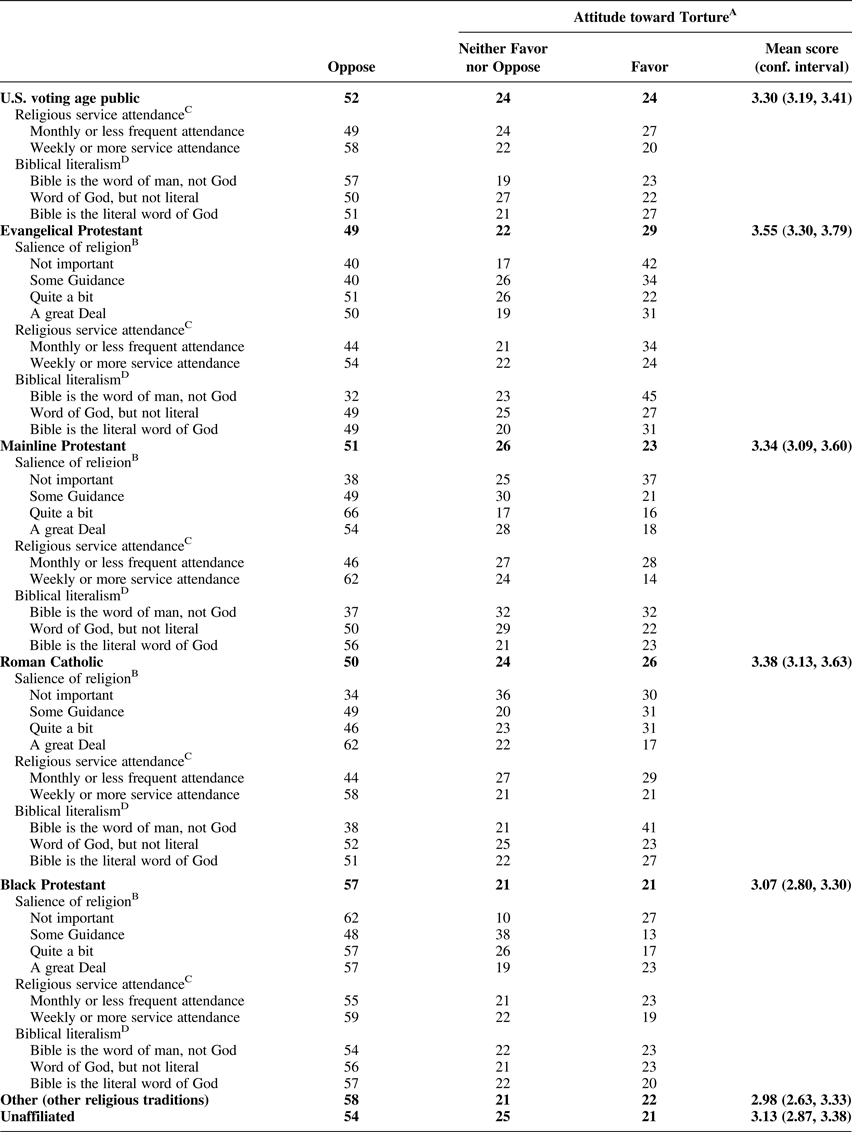
The analysis of variation in opinion toward torture proceeds as follows. We first examine differences across major religious traditions (sufficiently large enough in sampling for reliable group comparisons) and then within each one along key indicators of doctrinal difference (Hunter Reference Hunter1991; Layman Reference Layman2001; Smidt et al. Guth Reference Smidt, Kellstedt, Guth, Smidt, Kellstedt and Guth2009; Wuthnow Reference Wuthnow1988). Table 1 contrasts the voting age public at large with major religious traditions contrasted within the survey. Within each tradition, the table displays variation in indicators of religious commitment: salience and service attendance, along with a measure of religious belief orthodoxy, Biblical literalism (Layman and Green Reference Layman and Green2005).
Religion and Support for Torture, 2008 American National Election Study

Source: 2008 American National Election Studies Survey. Note: Main table entries are weighted row percentages.
A “Do you favor, oppose, or neither favor nor oppose, the United States government torturing people, who are suspected of being terrorists, to try to get information?”, combined with strength of support, yielding a seven-point scale, ranging from (1) oppose torture “a great deal” to (4) “4. Neither favor nor oppose” to (7) favor “a great deal.”
B A measure combining scores on two variables, ranging from “religion not important in life” to “stronger guidance of religion in daily life.”
C Frequency of service attendance combining those who report attending services “weekly or more than a weekly” frequency, contrasted with those reporting “monthly or less attendance.”
D Exact question and response wording appears in Appendix A.
Bi-Variant Comparisons of Tradition, Belief, and Commitment
Table 1 displays a series of cross-tabulations, contrasting survey respondents' direction of opinion toward torture; we use the initial three-point question of torture, for those who oppose torture, followed by neither favor nor oppose, then favor. The final column, however, displays a mean score on the seven-point scale. As a starting point for comparison, the uppermost section of the table breaks down support for torture by religious service attendance and Biblical literalism among the United States voting age public. (Appendix A presents the survey question wording for all measures of religion discussed here.) Service attendance appears to structure opinion the most, given the significant results of an F-distributed test of independence (Rao and Scott Reference Rao and Scott1984), (F (1.93, 164.40) = 6.57; p = 0.002). From monthly or less to weekly or more frequent attendance, opposition to torture increases from 49 to 58% of the public. Effects for belief orthodoxy (Biblical literalism) are slighter, though statistically significant, as a more literalist interpretation leads to greater support for torture (F (3.70, 314.63) = 2.80; p = 0.03).
The other entries in Table 1 present religious traditions, broken down by the three indicators. The traditions are measured through a comparison of individual responses to survey questions on affiliation with major religious groups and among Protestants, specific denominations by respective historical traditions (Woodberry et al. Reference Woodberry, Park, Kellstedt, Regnerus and Steensland2012), following the categorization criteria common to Steensland et al. (Reference Steensland, Park, Regnerus, Robinson, Wilcox and Woodberry2000) and Putnam and Campbell (Reference Putnam and Campbell2010). Respondents indicating an affiliation were divided into historical groups (Roman) Catholics, mainline Protestants, evangelical Protestants, black Protestants, and a remaining category of all other religious traditions. Those respondents indicating they do not consider themselves part of a religious tradition — the “nones” or unaffiliated — were recorded as well. Appendix A describes the coding rules for placing individual survey respondents into each category.Footnote 3
Comparisons within and across traditions reveal some significant differences. A comparison of the bold-faced entries in the table show that black Protestants and members of the “Other” group are the most opposed to torture (at 57%), while differences among mainline, evangelical Protestants, and Catholics are narrower. Among these groups, opposition to torture centers around 50%. Still, a contrasting 29% of evangelical Protestants support torture, compared to 21% of black Protestants. While black Protestants stand out as the tradition most opposed to torture, service attendance, salience, and Biblical literalism show no significant influence shaping views toward torture in these bi-variant comparisons.
Religious salience does, however, shape opinion toward torture among other traditions. Among Catholics, for whom religion provides no guidance, 34% oppose torture, while opposition nearly doubles among those for whom religion provides “A great deal” of guidance at 62% (F (5.33, 453.36) = 2.40, p = 0.03). Among evangelical and mainline Protestants, the effects of religious salience move in the same direction as Catholics, though they are insignificant.
Service attendance does shapes opinion toward torture among mainline Protestants; more frequent attendance increases opposition to torture from 46% to 62% (F (1.96, 166.18) = 3.03, p = 0.05). But among other traditions, the association is the same yet smaller in magnitude. For evangelical Protestants, the effect of commitment is marginally significant, slightly increasing opposition to torture (F (1.99, 163.28) = 2.42, p = 0.09).
Finally, across mainline, evangelicals, and Catholics, Biblical literalism appears to slightly increase opposition to torture. The associations, however, fail to reach statistical significance. However, a more compelling test of the relationship between religion and support for torture is found within an examination of multivariate relationships.
Multiple Sources of Influence on Opinion toward Torture in the 2008 ANES
We estimate a series of multivariate regression models following the approach of Layman (Reference Layman2001). Both orthodoxy and commitment are interacted with religious traditions to observe potential differences within traditions along each of these two measures of denominational difference. Consistent with the measures of orthodoxy and commitment in Layman and Green (Reference Layman and Green2005), we measure religious orthodoxy by Biblical literalism.Footnote 4 The measure of religious commitment is based on a principal components analysis of religious salience, frequency of prayer, and frequency of service attendance. Appendix A presents technical details.
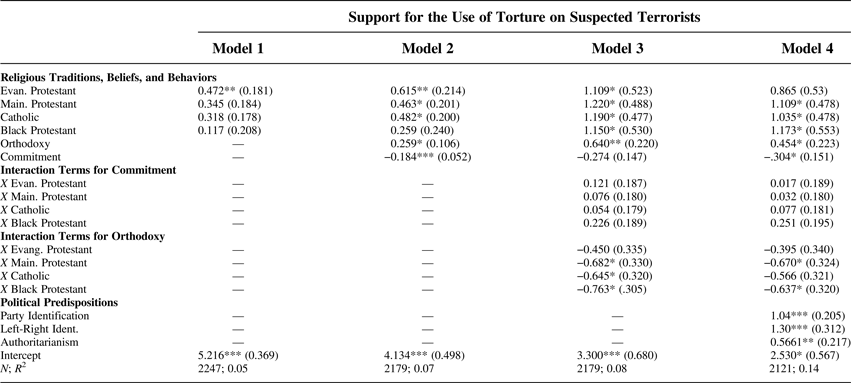
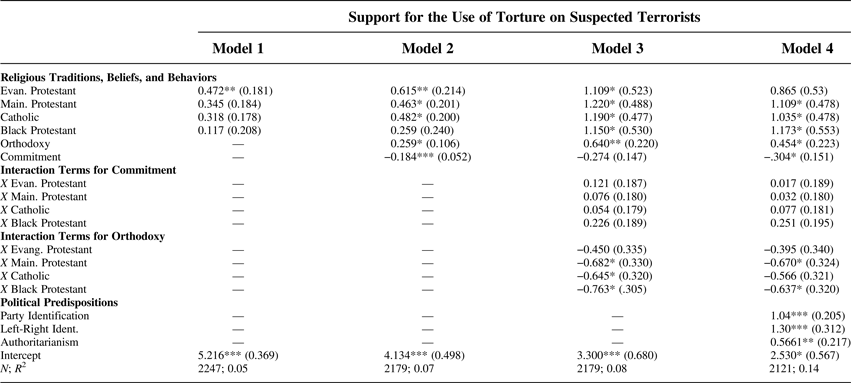
Table 2 presents a series of ordinary least squares regression models of attitudes toward torture (ranging from 1 “greatly oppose” to 7 “greatly support”) on religious traditions, with each successive model specifying additional interactive measures of religious orthodoxy and commitment, along with political predispositions. For clarity of presentation, estimates for stable demographic characteristics and associated estimates for the “other” religious category are excluded from the table.Footnote 5 Model 1 contrasts the effects for religious traditions with the religiously unaffiliated. Beginning with this model, we find that affiliation with the four religious traditions is associated with stronger support for torture (relative to the unaffiliated); although only in the case of evangelical Protestants does the association reach statistical significance.
Multivariate Analysis of Opinion toward the Use of Torture, 2008 ANES
Source: 2008 American National Election Studies Survey.
Note: Entries are survey-weighted OLS regression coefficients, standard errors in parentheses. Attitude toward torture is a seven-point scale, ranging from oppose torture “a great deal” (1) to support torture “a great deal” (7). See Appendix A for measures of religion. With the exceptions of age, orthodoxy (from 0 “written by men…” 1, to 2 “actual word of God”), and commitment (principal components score), all other covariates scaled from zero to one; mean commitment is approximately 0. Estimates for demographic characteristics (race, gender, age, formal educational attainment, income, and Southern United State residence), religious affiliation of “Other,” and interactions for the “Other” category are excluded from the table for clarity of presentation. A table of results for the full model specifications is available upon request from the authors.
* p < 0.05; ** p < 0.01; *** p < 0.001.
Model 2 includes the measures of belief orthodoxy and commitment. After controlling for beliefs and behaviors, a countervailing influence of religious tradition appears. Relative to the unaffiliated, both evangelical and mainline Protestants, along with Catholics are significantly more likely to support the use of torture. More orthodox beliefs are significantly associated with greater support for torture, yet religious commitment works in the opposite direction, significantly reducing support for it.
Models 3 and 4 specify a series of interactions with religious traditions by orthodoxy and commitment. In the entries for Models 3 and 4, the coefficients on religious traditions change magnitude, as the terms now capture a marginal effect of religious traditions while orthodoxy and commitment are at the value of zero. Model 3, for example, shows that on average identification with a religious tradition, relative to the unaffiliated, increases support for torture by one point on the seven point scale, among those low in orthodoxy and about average in commitment. The difference in model 4 is the inclusion of a standard seven point party identification, left-right ideological identification scale, and the measure of authoritarianism based on the standard battery of child-rearing practices (Barker and Tinnick Reference Barker and Tinnick2006; Hetherington and Weiler Reference Hetherington and Weiler2009).
The comparison between models 3 and 4 demonstrates that the direction, magnitude, and statistical significance of the estimated effects for religion are resilient to the inclusion of greater controls in model 4. Stronger Republican Party identification, conservatism, and also authoritarian values produce significantly stronger support for torture. Movement in the torture scale for party identification and conservatism is at approximately twice the magnitude of change for authoritarianism. Because religious traditions are interacted with commitment and orthodoxy, sorting out their relationships with torture support requires additional analysis. To more clearly communicate the main analytical result of the interactive models, we present an additional figure and table.
Figure 1 displays the marginal effect of each tradition on support for the use of torture.Footnote 6 Divided by three panels, the figure displays results for the interaction between tradition, commitment, and orthodoxy in Model 4 of Table 2.Footnote 7 Within the panels, marginal effects of religious tradition on torture support are plotted across levels of religious commitment, from low to high orthodoxy across panels A to C.
Marginal Effects of Religious Tradition on Support for Torture, by Commitment and level of Orthodoxy. Note: Panels display the expected change in the torture scale for each religious tradition, relative to the unaffiliated, across the religious commitment scale, at specific values of orthodoxy. The figures are based on the results from Model 4 of Table 2. Panel A, for example, shows a positive association between religious traditions and torture support, across all levels of commitment, given low religious orthodoxy. With the exception of Black Protestants, for whom support for the use of torture increases across levels of commitment, the effects of religious traditions are relatively flat across religious commitment.

Across the panels, with the exception of the black Protestant tradition, the lines are generally flat, indicating that the association between tradition and torture support does not substantially vary with level of religious commitment. Within Panel A, the marginal effects are positive in magnitude, but statistically significant effects are observed only for mainline Protestants and Catholics at lower levels of commitment; at the minimum of the commitment scale, the marginal effect of identifying with mainline Protestantism (β = 1.026 s.e. 0.360) and Catholicism (β = 0.836, s.e. 0.399) significantly increase support for torture by about one point on the torture scale. The line for evangelical Protestants, running below that of Catholics and mainline Protestants, is indistinguishable from zero across the commitment scale.
The comparison of the magnitude of effects for tradition, between Panel A with Panels B to C, shows that as orthodoxy increases the effect for tradition is null or slightly negative (though statistically insignificant) in magnitude. Within Panel C, at high orthodoxy the flat lines for most traditions, and the sloped line for black Protestants, shift to below zero, indicating that while statistically insignificant, identification with a tradition is associated with lower torture support. Overall, Figure 1 shows that any meaningful relationship between religious tradition and torture support is limited to those low in religious orthodoxy; for the major religious traditions, support for torture does not vary with religious commitment.
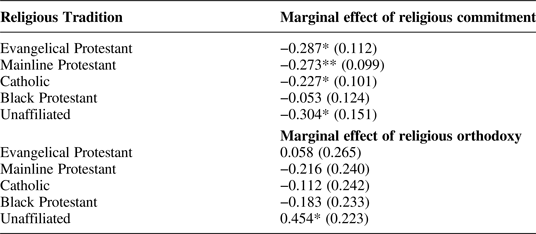
Table 3 displays the marginal effects from another perspective, those of orthodoxy and commitment on torture, by religious tradition.Footnote 8 For example, among evangelical Protestants, a one unit increase in commitment decreases support for torture by −0.287 points on the torture scale. For the unaffiliated, evangelical, mainline Protestants, and Catholics, religious commitment significantly decreases support for torture. These results are largely consistent with the theory of religious commitment and elite influence on individual opinion. And interestingly, while similar in magnitude, the largest marginal decrease in support occurs within evangelical Protestants. Based on these results, it does appear that religious commitment is tempering torture support for torture.
Marginal Effects of Religious Commitment and Orthodoxy on Torture Support, by Religious Tradition

Source: Data from 2008 American National Election Studies survey.
Note: Table entries are average marginal effects of religious commitment and orthodoxy on support for torture, by each religious tradition. The estimated effects are based on Model 4 in Table 2. Attitude toward torture is a seven point scale, ranging from oppose torture “a great deal” (1) to support “a great deal” (7). Commitment is the principal component score, scaled toward greater commitment, orthodoxy is scaled (from 0 “written by men…”, 1, to 2 “actual word of God”). * p < 0.05; ** p < 0.01; *** p < 0.001.
In contrast, increasing orthodoxy does not substantively alter support for torture. For all but evangelical Protestants and the unaffiliated, the direction of the effect is negative and statistically insignificant. It appears that unlike commitment, among those affiliated with a tradition orthodoxy plays no meaningful role in conditioning the opinions on torture among the affiliated. Importantly, we see that for the unaffiliated, increasing orthodoxy leads to a substantial increase in support for torture. For the unaffiliated, perhaps high orthodox individuals who do not align with a Christian tradition are not susceptible to religious elites' opinions on torture. Absent the constraint of a tradition, the unaffiliated link their orthodox beliefs to support for the use of torture.
DISCUSSION: RELIGION AND OPINION TOWARD TORTURE
The results cast strong doubt on the claim that evangelical Protestants are unusual in their support for torture. Instead, the results presented here suggest that evangelical Protestants are susceptible to the influence of religious commitment, decreasing support for torture. Interestingly, with the exception of black Protestants, increased religious commitment has the effect of decreasing support for torture, even among the unaffiliated. The results generally show that greater exposure to religious ethics and elite influence decreases support for torture.
Yet the meaning of religious orthodoxy appears to differ, depending on the presence of any religious affiliation. Among the unaffiliated, it is the case that greater orthodoxy yields significantly stronger support for torture. Yet this is a kind of “naïve” Biblical literalism, unconditioned by religious association. Among Catholics, evangelicals, mainline, and black Protestants, greater orthodoxy is statistically insignificantly, yet negatively associated with torture support. The results suggest that for the religious affiliated the issue of torture sits outside the cluster of issues for which religious orthodoxy is associated with a “militant internationalist” (Guth Reference Guth2013) or “messianic militarist” (Barker et al. Reference Barker, Hurwitz and Nelson2008).
Moreover, the results are largely consistent with the general theory of religious commitment and its effect on public opinion (cf., Campbell and Putnam Reference Putnam and Campbell2010; Djupe and Gilbert Reference Djupe and Gilbert2009). For the formally unaffiliated and affiliated alike, greater commitment largely reduces support for torture. Whether due to greater engagement with religious ethics, exposure to elite-drive dialogue, or socialization, the precise mechanism of commitment's influence is beyond the scope of this article.
Some of the positive association between religious traditions and torture (relative to the unaffiliated) are possibly due to an indirect influence, stemming from a partisan-ideological identification increasingly associated with individuals' religious orientations. Contemporary changes in American politics make detecting religious effects on opinion toward torture more difficult to detect. The realignment of the Democratic and Republican parties along partisan-ideological lines is structured in part by wide ranging aspects of religion (Abramowitz Reference Abramowitz2010; Hunter Reference Hunter1991; Layman Reference Layman2001; Leege and Kellstedt Reference Leege and Kellstedt1993; Wilson Reference Wilson2007; Wuthnow Reference Wuthnow1988). Thus religion's influence may be partially indirect, mediated through partisanship and an ideological identification (Guth Reference Guth, Smidt, Kellstedt and Guth2009b).
One last theoretical concern over detecting religion's influence cannot be resolved with the data examined in this paper. Specifically, a fundamental concern is the order of the causal influence: whether religious orientations influence partisanship and ideology, which subsequently influence attitudes, or whether partisan-ideological elites shape the views of the religiously affiliated electorate who internalize the cues in line with the predispositions of their religious group (Guth Reference Guth, Smidt, Kellstedt and Guth2009b). Resolving this debate would require data beyond the cross-sectional measures analyzed here; for example, evidence would likely require panel data over a time period in which religious and partisan elites take distinctly different positions on salient issues, for which there are observations of how religiously affiliated individuals respond accordingly. Regardless, either of these perspectives affirms the nuanced role of religion in shaping public opinion toward torture and point toward valuable subjects for religion future research.
APPENDIX A
Measurement of Religion, 2008 American National Election Study (ANES)
Measuring Religious Traditions
Religious traditions were divided within the ANES survey sample into the following groups based upon their self-identification with a major religious group (Protestant, Catholic, Jewish, or Other). Roman Catholics were categorized via self-identification as “Catholic.” Evangelical Protestants were identified by affiliation with the denominational groups common to Putnam and Campbell (Reference Putnam and Campbell2010) and Steensland et al. (Reference Steensland, Park, Regnerus, Robinson, Wilcox and Woodberry2000), specifically Assembly of God, Evangelical United Brethren, the Reformed tradition and the Christian Reformed Church, Church (or Churches) of Christ and the specific sub-denomination of Church of Christ, Holiness, Lutheran and Missouri Synod or Lutheran and any other Lutheran church not specifically named, Pentecostal, Baptist and Southern Baptist Convention, National Baptist Convention, “Independent Baptist” or another Baptist church not further specified, Methodist and a church not specifically named, Reformed and not further specified, Church of God and “Cleveland, Tennessee” or not specifically named. Mainline Protestants were identified from the common groups of Putnam and Campbell (Reference Putnam and Campbell2010) and Steensland et al. (Reference Steensland, Park, Regnerus, Robinson, Wilcox and Woodberry2000): Episcopalian or Anglican or Church of England, Baptist and American Baptist Churches in USA, Lutheran and Evangelical Lutheran Church of America, Methodist and United Methodist Church, Presbyterian and Presbyterian Church USA, Reformed and The Reformed Church in America, United Church of Christ, Disciples of Christ, and Congregationalist. Some individual respondents self-identified as Protestant, but further specified a denomination as simply, “Non-denominational – Protestant” or “Christian” or “just Christian.” These non-denominational Christians were assigned to evangelical Protestants or mainline Protestants following Smidt et al. (Reference Smidt, Kellstedt, Guth, Smidt, Kellstedt and Guth2009): those reporting that they are “born again,” (“Would you call yourself a born-again Christian, that is, have you personally had a conversion experience related to Jesus Christ?”) were assigned to evangelical Protestants. Those reporting they had not were assigned to mainline Protestants. Following Putnam and Campbell (Reference Putnam and Campbell2010), Black Protestants were identified as all Protestant or non-denominational Christians with a primary racial mention of African-American.
All remaining religious traditions were assigned to an “Other” category. This Other category included Christian traditions that do not fit within the historical groups of Mainline or Evangelical Protestants, including the responses “Christian Scientist,” “Jehovah's Witnesses,” “Latter Day Saints,” “Friends, Quaker,” as well as much smaller religious traditions, including Buddhist, Muslim, Jewish, Hindu, “Native American,” and Unitarian Universalist.
The religiously Unaffiliated were categorized as those responding “No” to the question, “Regardless of whether you now attend any religious services do you ever think of yourself as part of a particular church or denomination?”
Orthodoxy
A measure of religious orthodoxy was gauged by a single survey item querying biblical literalism, “Which of these statements comes closest to describing your feelings about the Bible? You can just give me the number of your choice. (1) The Bible is the actual word of God and is to be taken literally, word for word. (2) The Bible is the word of God but not everything in it should be taken literally, word for word. (3) The Bible is a book written by men and is not the word of God.”
Religious Commitment
Religious commitment is measured by the unrotated first component from a principal components analysis of three items, self-reported frequency of prayer (“Outside of attending religious service, do you pray several times a day, once a day, a few times a week, once a week or less, never?”), self-reported frequency of service attendance (“Do you go to religious services every week, almost every week, once or twice a month, a few times a year, or never?”), and religious guidance (“Would you say your religion provides no guidance, some guidance, quite a bit of guidance, or a great deal of guidance in your day-to-day life?”). The first component accounted for 73% of the total variance between the three items.