

Introduction
Disturbance is a factor structuring all ecosystems (Pickett & White, Reference Pickett and White2013). In some instances, minimal physical disturbance leads to the development of climax communities (Dayton & Hessler, Reference Dayton and Hessler1972; Sousa, Reference Sousa2001); in others, regular disturbance promotes high diversity (Dial & Roughgarden, Reference Dial and Roughgarden1998; Sousa, Reference Sousa1979). The Antarctic benthic habitat has been generally perceived as stable due in part to small temperature fluctuations and minimal wave disturbance (Barnes & Conlan, Reference Barnes and Conlan2007; Gallardo, Reference Gallardo1987; Richardson & Hedgpeth, Reference Richardson and Hedgpeth1977). Extensive literature, however, highlights the regular disturbances caused by ice, both in the form of icebergs (Barnes & Lien, Reference Barnes and Lien1988; Gutt, Reference Gutt2001) and anchor ice (Bockus, Reference Bockus1996; Dayton, Robilliard, & Devries Reference Dayton, Robilliard and Devries1969).
In offshore polar areas, both icebergs and anchor ice remove and redistribute seafloor fauna and sediment. Icebergs are pushed by wind and currents, and when their draft is greater than the water depth, they plough through soft sediments and scrape rocky substrates leaving trails of altered and cleared habitat in their wake (Barnes & Conlan, Reference Barnes and Conlan2007 and refs therein; Barnes & Lien, Reference Barnes and Lien1988). Gutt (Reference Gutt2001) estimates that at depths shallower than 500 m, icebergs disturb the entire seafloor once every 340 years; iceberg disturbance may be more frequent as depth shoals. Anchor ice forms on the seafloor at shallow depths and eventually the buoyancy of the ice crystals lifts away animals and sediment (Bockus, Reference Bockus1996). Anchor ice formation is an annual process occurring at less than 30 m depths in areas near ice shelves. The amount of anchor ice produced in an area varies yearly and depends on the melt and circulation variability of the ice shelf adjacent to it (personal observation; Bockus, Reference Bockus1996). Though not all of the shallow seafloor will be lifted every year, disturbance from anchor ice and from related direct freezing is frequent enough to shape communities above the anchor ice formation depth (Dayton, Robilliard, & Paine, Reference Dayton, Robilliard and Paine1970; Bockus, Reference Bockus1996). Shallow shelf communities affected by anchor ice are dominated by rapidly recruiting or mobile fauna, whereas at greater depths benthic communities often include larger, sessile, habitat-forming fauna such as hexactinellid sponges (Dayton, Robilliard, & Paine, Reference Dayton, Robilliard and Paine1970). Hexactinellid sponges in these communities are ecosystem engineers (Vargas, Dohrmann, Göcke, Janussen, & Wörheide, Reference Vargas, Dohrmann, Göcke, Janussen and Wörheide2017).
Ice disturbance is among the most significant disturbances that any large ecosystem on earth experiences (Gutt & Starmans, Reference Gutt and Starmans2001). In the Weddell Sea region (Fig. 1), ice disturbance is so frequent that the benthos never reaches peak maturity (Gutt & Starmans, Reference Gutt and Starmans2001). Also in the Weddell Sea, community diversity, abundance, biomass, and variety of feeding types and lifestyles is reduced in iceberg scours, and recovers slowly (Gerdes, Hilbig, & Montiel, Reference Gerdes, Hilbig and Montiel2003). A local experimental disturbance mimicking iceberg scours led to significant reductions in invertebrate benthic biomass, while mean abundances were only slightly reduced, at least on the short time scale of days (Gerdes, Isla, Knust, Mintenbeck, & Rossi, Reference Gerdes, Isla, Knust, Mintenbeck and Rossi2008). In the Weddell Sea region, benthic community recolonization pace and succession sequence following iceberg disturbance exhibit high variability and unpredictability, and community diversity response is scale dependent (Gutt & Piepenburg, Reference Gutt and Piepenburg2003). Along the West Antarctic Peninsula, iceberg disturbance to the benthos has been linked to reduced survival to reproductive age (Barnes & Souster, Reference Barnes and Souster2011). In the Larsen area, macrobenthic populations can exhibit dramatic population dynamics in response to iceberg disturbance (Gutt, Cape, Dimmler, Fillinger, Isla, Lieb, Lundälv, & Pulcher, Reference Gutt, Cape, Dimmler, Fillinger, Isla, Lieb and Pulcher2013). All of these locations cluster around the Antarctic Peninsula.
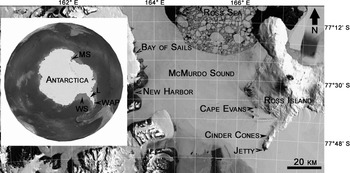
Map of study sites in Antarctica and other local sites referred to in the text; Winter Quarters Bay (not labeled) is just north of Jetty. Inset globe shows other locations around the continent referred to in the text; MS = McMurdo Sound, WS = Weddell Sea, L = Larsen Ice Shelf, WAP = West Antarctic Peninsula. Modified from Google Earth.

In McMurdo Sound in the Ross Sea region (Fig. 1), long term studies by Dayton et al. (Reference Dayton, Jarrell, Kim, Thrush, Hammerstrom, Slattery and Parnell2016) and Dayton (Reference Dayton1989) have showed that recruitment is highly episodic in Antarctic epifauna on hard substrates. Similarly unexpected were results of recent studies that revealed that growth of hexactinellid sponges can be surprisingly rapid over the first several years post-recruitment (Dayton et al., Reference Dayton, Kim, Jarrell, Oliver, Hammerstrom, Fisher and Thurber2013, Reference Dayton, Jarrell, Kim, Thrush, Hammerstrom, Slattery and Parnell2016) or following habitat disturbance (Fillinger, Janussen, Lundälv, & Richter, Reference Fillinger, Janussen, Lundälv and Richter2013); these observations are contrary to the general paradigm of slow growth in Antarctic organisms. These incongruities with general habitat stability in the Antarctic suggest that further examination of disturbance and recruitment in Antarctic benthos is warranted.
In the present study we report the impacts of iceberg scour on benthic communities in select regions of McMurdo Sound, Antarctica, at depths between 18 and 105 m. Though many studies have offered insights on iceberg effects in other regions of Antarctica (e.g. Gerdes, Hilbig, & Montiel, Reference Gerdes, Hilbig and Montiel2003; Gutt & Piepenburg, Reference Gutt and Piepenburg2003; Smale, Barnes, Fraser, & Peck, Reference Smale, Barnes, Fraser and Peck2008), little information has been published on iceberg impacts to the benthos in the Ross Sea region. We provide additional information on short term recruitment patterns of Antarctic in- and epi-fauna in the McMurdo Sound region, following experimental disturbances of different sizes that mimic ice disturbance, to determine if local immigration and/or direct settlement are important factors in community recovery dynamics.
Materials and methods
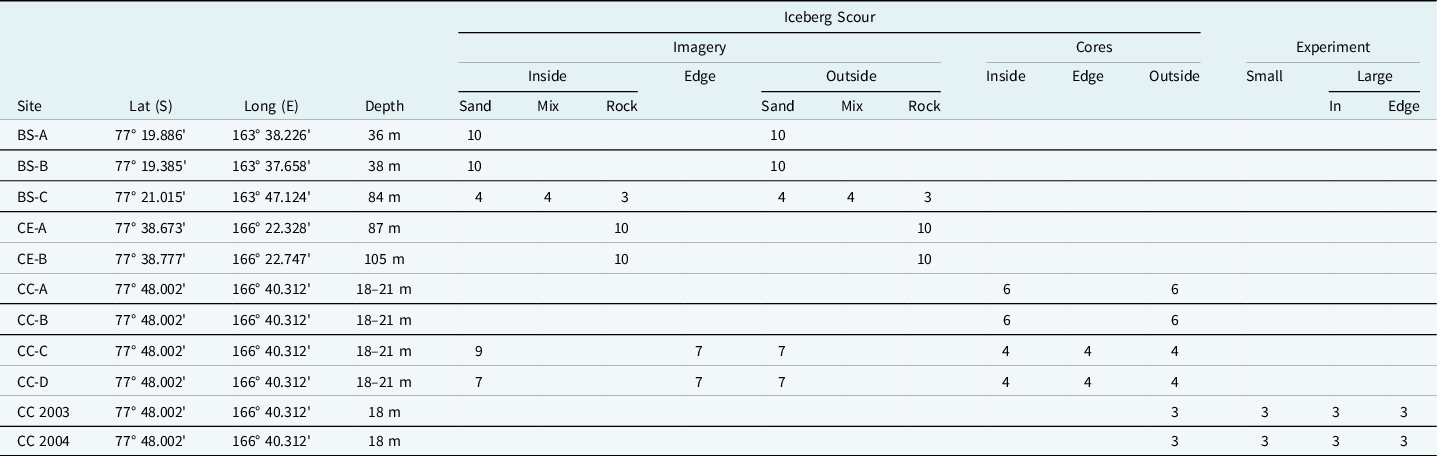
Opportunistic quantitative observations of seafloor communities in the vicinity of icebergs in McMurdo Sound, Antarctica were collected between 1997 and 2012. Three sites were sampled, Bay of Sails, Cape Evans, and Cinder Cones (Fig. 1); this and following sections are organized by site. Year of data collection was driven by the goals of unrelated projects and thus temporal comparisons that can be made are minimal. In the Bay of Sails on the west side of McMurdo Sound, imagery data were collected with the remotely operated vehicle SCINI (Cazenave, Zook, Carroll, Flagg, & Kim, Reference Cazenave, Zook, Carroll, Flagg and Kim2011) in 2009 (Table 1). The separate scours behind three slowly moving icebergs that were still in contact with the seafloor were sampled; sites BS-A, BS-B (approximately 950 m north of BS-A), and BS-C (approximately 4200 m southeast of BS-A). The sampled area around each iceberg encompassed approximately 15,000 m2. At site BS-C the substrate was heterogeneous, and for analysis an additional substrate factor with three levels (sand, rock, and mixed sand and rock) was added. At Cape Evans on the east side of McMurdo Sound, SCINI image data were collected at two sites around a single iceberg in 2008. Site CE-A was on the northwest side of the iceberg and site CE-B on the southeast side; they were separated by 250 m horizontal distance. The sampled area on each side of the iceberg was approximately 15,000 m2. At Cinder Cones on the east side of McMurdo Sound, divers collected similar imagery data using a handheld digital camera (Olympus CAMEDIA C 5060 Wide Zoom 5.1 MP) in 2012. Though no icebergs were present at Cinder Cones, long linear scars on the seafloor that had not been present in previous years indicated that icebergs had moved through relatively recently. There were two scars, sites CC-C and site CC-D, separated by approximately 10 m. At each site, 7–11 images taken approximately 1 m above the seafloor were used for analysis (Table 1). The sampled area in each scour was approximately 15 m2. Dual paired scaling lasers on the ROV and diver video cameras were used to convert counts to per unit area (m2). Imaged organisms were identified to the lowest possible taxonomic category, referenced to the World Register of Marine Species (WoRMS).
Number and type of samples collected at each iceberg scour site, location, and substrate

BS = Bay of Sails, CE = Cape Evans, CC = Cinder Cones.
Letters following dashes indicate sites.
Evidence of iceberg activity was also observed by SCUBA divers in the Cinder Cones area during two previous years, 1997 (site CC-A) and 2002 (site CC-B). The Cinder Cones site was visited irregularly so the exact dates of iceberg scouring were not recorded; however, time boundaries for each scour are known. No scour evidence was observed at site CC-A three years prior, at site CC-B two years prior, and at sites CC-C and D one year prior. Each scour was in a slightly different location from the others; none were resampled. The steeply sloping seafloor and loose sediment underlying a polychaete tube-mat in this area is unstable when the tube-mat is removed, thus scours fill in relatively quickly and large-scale visual evidence of scours does not remain for very long. For example, by 2014 divers could no longer visually detect the scour that was sampled in 2012.
The four Cinder Cones scours were less than 1 m deep, were bordered with distinct edge berms of height less than 50 cm above the undisturbed seafloor, ranged from 2 to 5 m wide, 3–10 m long, and were spatially separated by <50 m. In 1997, 2002, and 2012, divers collected four to six 10 cm diameter PVC cores inside each of the four scours and an equal number approximately 7 m away, outside the scours but at the same depth (Table 1). At the last sampling (2012), four replicate cores were collected from the edge berms of the two scours, as well as inside and outside. Cores were inserted to a depth of 10 cm, individual core locations were separated by >1 m, and exact locations inside or outside the four scours were haphazard. Core collection protocol followed that established by Dayton and Oliver (Reference Dayton and Oliver1977) as suitable for describing the infaunal community in this region, which has been followed by benthic ecologists since 1977.
From 2002 to 2004, an in situ experiment simulating seafloor ice disturbance was conducted by scuba divers at 18 m depth at Cinder Cones. In 2002, six 1 m diameter (large), and six 10 cm diameter (small) disturbance areas were created using defaunated sediment taken from Cinder Cones. Sediment was defaunated by warming to room temperature to kill all animals and sieving over coarse (2 mm) mesh; larger rocks were returned to the sediment but animals were removed. Core rings were pushed 10 cm into the sediment, 10 cm of sediment inside the cores was excavated, and then re-filled with defaunated sediment to a depth of 10 cm. All cores were open at the bottom, potentially allowing organisms to move in from underneath, as well as across the surface of the seafloor as rings were flush with the sediment surface. In 2003, half were sampled; three of the 10 cm diameter core rings were collected, and three 10 cm diameter cores each were collected from the middle and edge of the 1 m diameter rings. Three control cores (10 cm diameter) were collected from adjacent undisturbed areas. In 2004, the remaining rings were sampled in the same fashion.
Core samples were sieved alive over a 500 µm sieve, placed into jars containing MgCl to relax the organisms, then preserved with 10% buffered formalin in seawater. Samples were transferred into 90% ethanol two days later for storage. All species were identified to lowest taxonomic level possible and enumerated to calculate abundance per core.
All statistical tests were conducted in Primer v6 (Clarke & Gorley, Reference Clarke and Gorley2001). Abundances were square root transformed to balance the effects of abundant and moderately abundant species. Bray-Curtis similarities were then calculated. We used multi-dimensional scaling (MDS) to provide a clear graphical display of community similarities and differences. To test for differences due to site or location relative to scours, PERMANOVA was used in a two-way crossed model, with pairwise comparisons when appropriate (Anderson, Gorley, & Clarke, 2008). To determine which species characterized groups and were responsible for differences between groups, we used the SIMPER routine.
Results
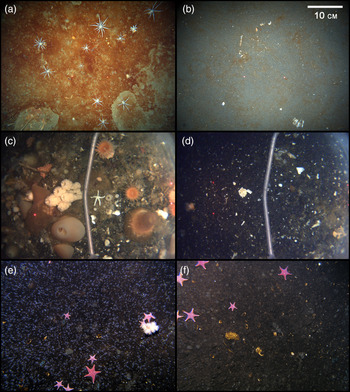
The presentation of results is organized by site. A brief description of the substrate is followed by overall PERMANOVA results and appropriate pairwise comparisons. Where differences were significant, taxa that dominated each community are described, as well as taxa that defined each community and the differences between them. Representative images of the communities at different sites and locations are shown in Figure 2.
Representative images for sites and locations. Scale bar in upper right is for all images. (a) Bay of Sails outside of iceberg scour. (b) Bay of Sails inside iceberg scour. (c) Cape Evans outside iceberg scour. Grey vertical bar is part of the protective cage on the ROV. (d) Cape Evans inside iceberg scour. Grey vertical bar is part of the protective cage on the ROV. (e) Cinder Cones outside icebergs scour. (f) Cinder Cones inside iceberg scour.

Bay of Sails, 2009
The substrate at site BS-A was fine grey mud overlain by a thick diatom cover that had grown in situ, with areas of lighter diatom cover due to underlying bioturbation (e.g. Fig. 2(a)). Inside the iceberg scour, the substrate was very different, a dark sand overlain with uneven light cover of diatoms that had settled to the seafloor, interspersed with broken Adamussium colbecki (E. A. Smith, 1902) scallop shells and scattered pieces of volcanic cobble. Site BS-B substrate was grey sand with scattered dead A. colbecki shells and a light layer of diatoms settled on top. Inside the scour there was also patchy volcanic cobble. Site BS-C substrate was a patchy mixture of fine to coarse grey sand, volcanic cobble and rock, irrespective of scour marks. There were occasional A. colbecki shells but no diatom cover. Due to the patchiness of the substrate at BS-C, this site was analyzed separately to allow substrate type to be treated as a separate factor.
At BS-A and BS-B, a two-way PERMANOVA showed that location (inside or outside scour, pseudo-F = 9.4394, p = 0.001) and the interaction term (pseudo-F = 1.7204, p = 0.046) were significant, while site was not significant (pseudo-F = 1.6424, p = 0.059). Pairwise analysis of locations showed that they were significantly different at both sites: for BS-A t = 2.6907, P(perm) = 0.001; for BS-B t = 1.9515, P(perm) = 0.002. Supplemental Figure 1 shows the MDS for these sites.
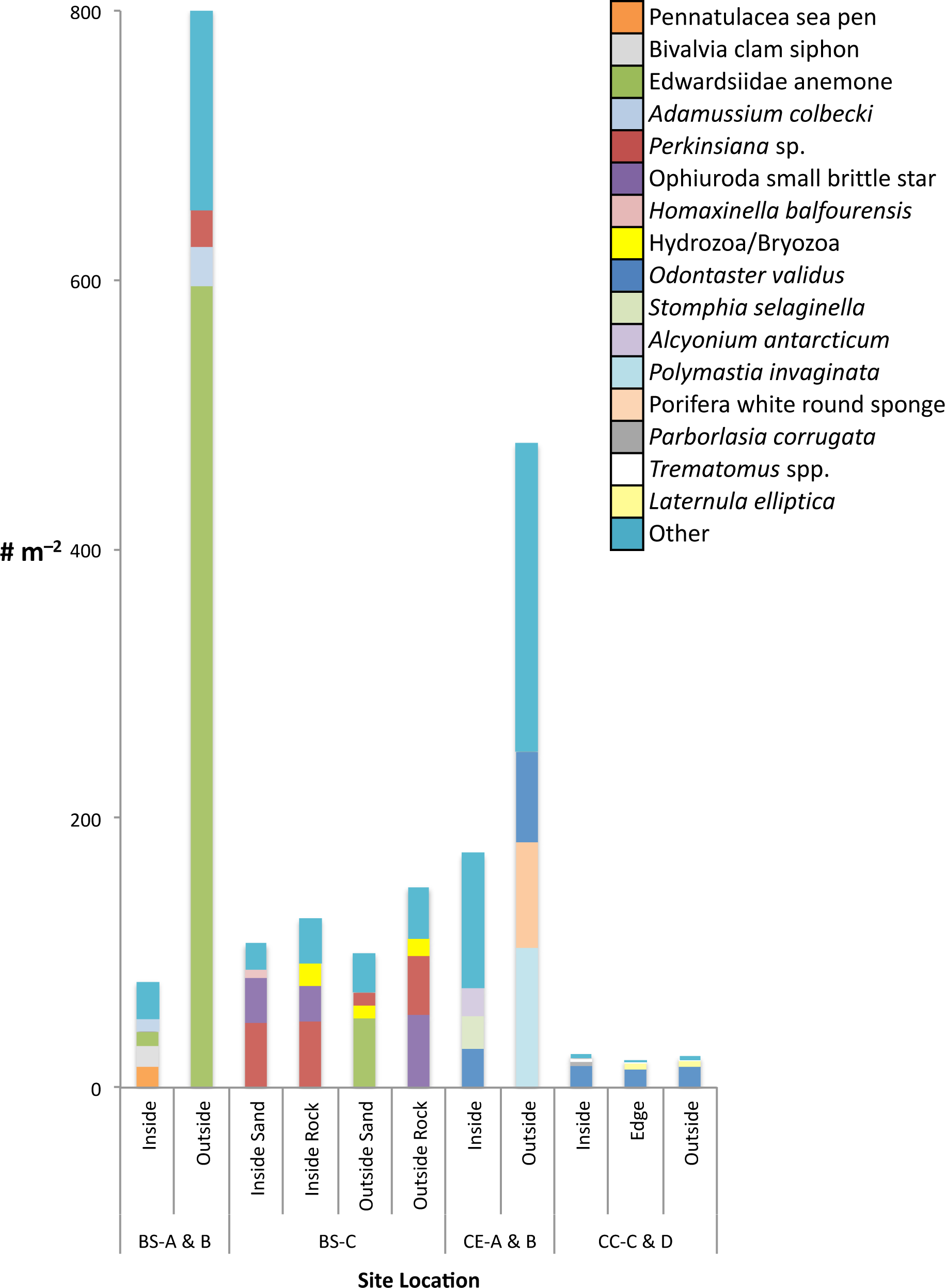
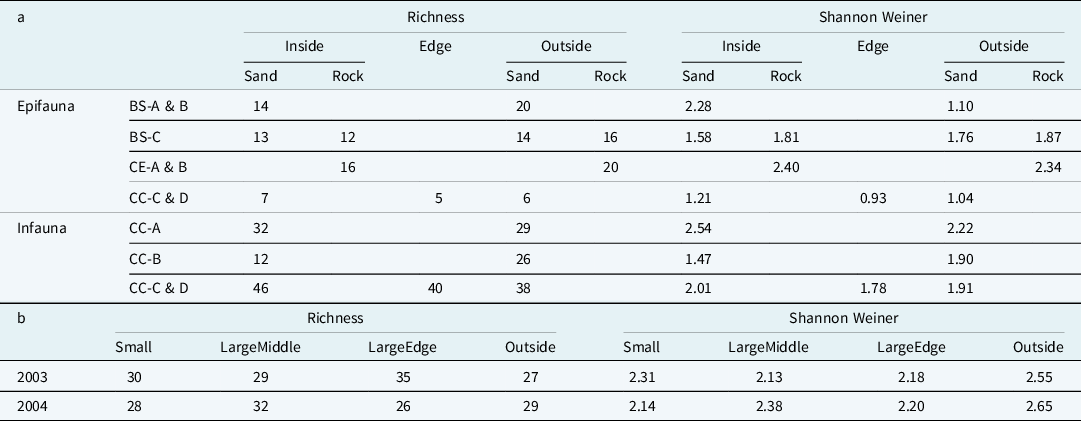
The community outside scours at BS-A and B was numerically dominated by small white edwarsiid anemones, followed by scallops (Adamussium colbecki) and Perkinsiana sp. Knight-Jones, 1983 (Fig. 3). Inside these scours, the overall abundances were markedly lower, and the community dominants were sea pens, siphons of buried bivalves, edwarsiid anemones, and A. colbecki. The community diversities outside of scours were richer, while the community diversities inside scours were more even (Table 2).
Epifaunal abundances at statistically different sites and locations. The three most common species (four if there were ties) and total abundances are presented.

Community diversity at sites and locations grouped as indicated by significant differences in PERMANOVA tests. (a) Epifaunal and infaunal communities inside, on the edge, and outside of iceberg scours, in sand and rock substrate. (b) Experimentally manipulated communities with small, and large disturbances sampled on the edge and in the middle, and controls outside of iceberg scours

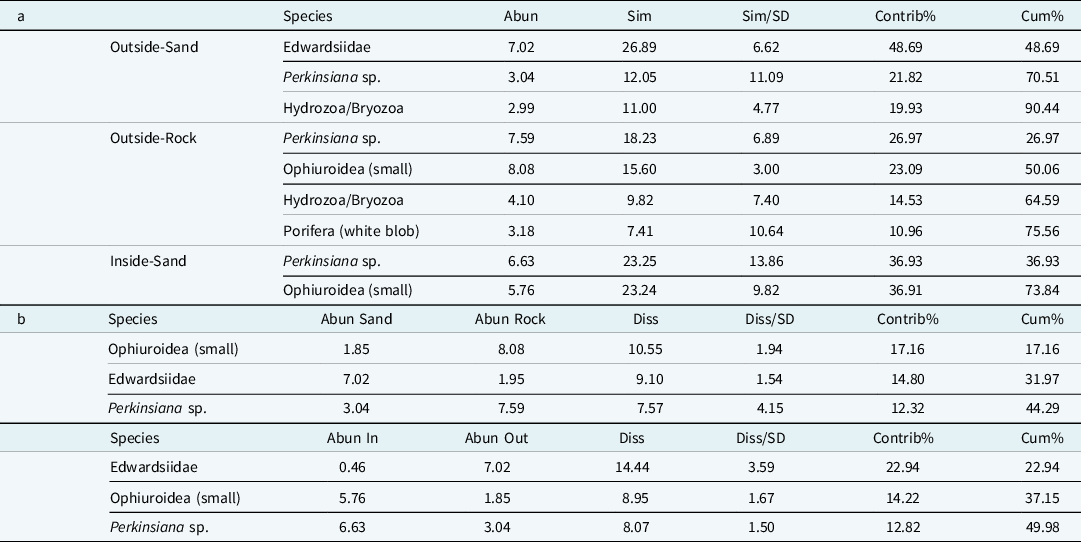
Inside the scour at BS-A and BS-B the very sparse community was defined by Adamussium colbecki, with similarity of 4%, while the outside community was defined by edwarsiid anemones, with similarity of 42% (Table 3). Differences between communities inside and outside the scours were due to edwarsiid anemones, bivalve siphons, A. colbecki, gorgonians, Perkinsiana sp., the sponge Homaxinella balfourensis (Ridley & Dendy, 1886), sea spiders (Pycnogonida), hydroids/bryozoans, the brittle star Ophionotus victoriae Bell, 1902, and pink sponges, with a dissimilarity of 98%.
Diagnostic species for similarities (a) and dissimilarities (b) in Bay of Sails sites BS-A and BS-B epifaunal communities, inside and outside of iceberg scours, from SIMPER analysis of significant groupings, cutoff at Contrib% <10

Abun = abundance, Contrib% = contributed percent, Cum% = cumulative percent, Diss = dissimilarity, SD = standard deviation, Sim = similarity.
At BS-C the two-way PERMANOVA factors were location and substrate type, and all, including the interaction term, were significant: location pseudo-F = 2.7358, p = 0.022; substrate pseudo-F = 2.6703, p = 0.009; interaction pseudo-F = 2.4631, p = 0.011 (Supplemental Figure 1).
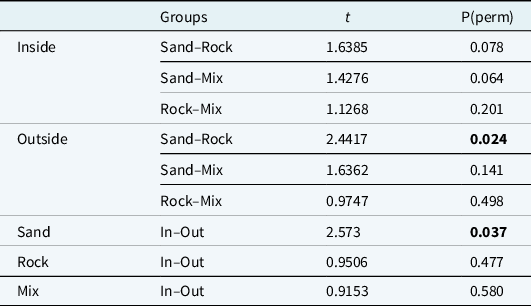
Because all factors were significant, separate pairwise comparisons were done within location, and within substrate. Inside the scour there were no significant differences between substrates, but outside communities on sand and rock substrates were significantly different (Table 4). Only in sand were communities significantly different between locations.
Results of pairwise comparisons at Bay of Sails site BS-C, inside and outside of iceberg scours and on sand, rock and mixed substrate. Bold indicates significant differences

At site BS-C inside the scour, regardless of whether the substrate was rock or sand, Perkinsiana sp. and small brittle stars (Ophiuroida) were the most abundant taxa, while the third most abundant taxa in sand was Homaxinella balfourensis, and in rock was hydroids/bryozoans (Fig. 3). Outside the scour, in sand, edwarsiid anemones were the most abundant taxa, and in rock, small brittle stars. Outside of the scour the second and third most abundant taxa were Perkinsiana sp. and hydroids/bryozoans, though relative abundances differed between substrates. Unlike at other sites, the total abundances between inside and outside of scours were not very different. As at the other Bay of Sails sites, the community outside the iceberg scour was richer; however, diversity outside was more even than inside (Table 2). Additionally, the diversity of communities on rock was more even than in sand.
The community outside the BS-C scour in sand was defined by edwarsiid anemones and Perkinsiana sp., with a similarity of 55%, and in rock by Perkinsiana sp., small brittle stars (Ophiuroida) and hydroids/bryozoans with 68% similarity (Table 5). The difference between the sand and rock substrate communities was due to small ophiuroids, edwarsiid anemones, Perkinsiana sp., sponges, and terebellid worms, with a dissimilarity of 61%. In sand substrate at BS-C, the community inside the scour was defined by Perkinsiana sp. and small ophiuroids with a similarity of 63%, and the difference between inside and outside communities by edwarsiid anemones, small ophiuroids, Perkinsiana sp., Homaxinella balfourensis, terebellids, hydroids/bryozoans and sponges with 63% dissimilarity.
Diagnostic species for similarities (a) and dissimilarities (b) in Bay of Sails BS-C epifaunal communities, inside and outside of iceberg scours, and on sand, rock and mixed substrate, from SIMPER analysis of significant groupings, cutoff at Contrib% < 10

Abun = abundance, Contrib% = contributed percent, Cum% = cumulative percent, Diss = dissimilarity, SD = standard deviation, Sim = similarity.
Cape Evans, 2008
The Cape Evans seafloor was volcanic cobble to boulder at both sites. A two-way PERMANOVA on factors site (CE-A or CE-B) and location (inside or outside scour) showed a significant difference between locations (pseudo-F = 5.2685, p = 0.001) (supplemental Figure 2). Site (pseudo-F = 1.7923, p = 0.104) and the interaction term (pseudo-F = 1.8144, p = 0.091) were not significant.
Outside the Cape Evans scour the dominant taxa were the sponge Polymastia invaginata Kirkpatrick, 1907, a white round sponge, and the seastar Odontaster validus Koehler, 1906 (Fig. 3). Inside the scour O. validus, Stomphia selaginella (Stephenson, 1918), and Alcyonium antarcticum Wright & Studer, 1889 were the dominant taxa. The three dominant taxa here made up a smaller proportion of the total abundance than at other sites. Diversity measures showed that the communities outside the iceberg scour were richer, and inside the scours were more even (Table 2).
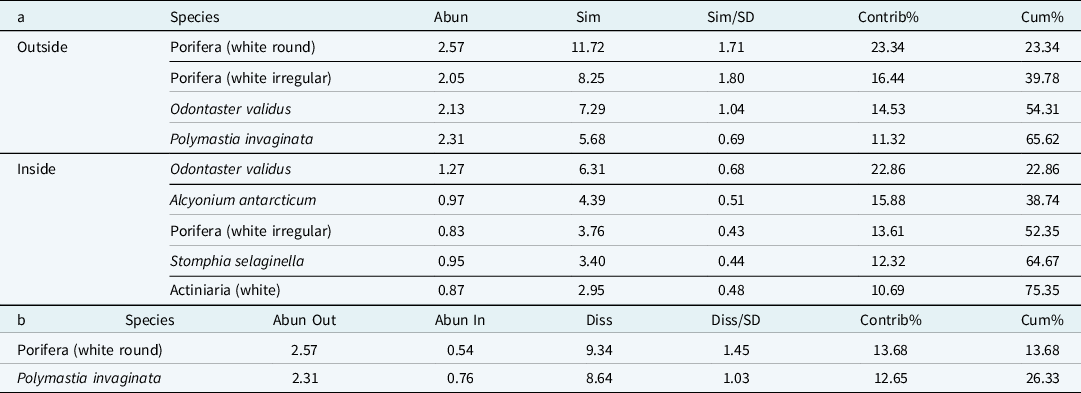
The community outside scours at Cape Evans was defined by sponges (Porifera) and the seastar Odontaster validus, with low within-group similarity of 50% (Table 6). The community inside scours was defined by O. validus and the soft coral Alcyonium antarcticum with very low within-group similarity of 28%. Differences between the two locations were due to Porifera, the sponge Polymastia invaginata, O. validus, A. antarcticum, anemones (Anthozoa), and the fan worm Perkinsiana sp. with a dissimilarity of 68%.
Diagnostic species for similarities (a) and dissimilarities (b) in Cape Evans epifaunal communities inside and outside of iceberg scours, from SIMPER analysis of significant groupings, cutoff at Contrib% <10

Abun = abundance, Contrib% = contributed percent, Cum% = cumulative percent, Diss = dissimilarity, SD = standard deviation, Sim = similarity.
Cinder Cones
The substrate at Cinder Cones was coarse volcanic sand and gravel sediment, with occasional rock outcrops.
Epifauna
At Cinder Cones, the epifaunal community was significantly different at different locations in a two-way PERMANOVA (pseudo-F = 3.3032, p = 0.005), but there was no difference between sites and the interaction term was not significant (site pseudo-F = 0.9984, p = 0.419; interaction pseudo-F = 1.6463, p = 0.136) (Supplemental Figure 3).
Pairwise comparison showed that the community inside the scour was different from the community at the edge of the scour, t = 2.5494, p = 0.001. The community at the edge of the scour was not different from the community outside the scour, t = 1.1922, p = 0.267, and the communities inside versus outside the scour were also not statistically different, t = 1.2942, p = 0.191.
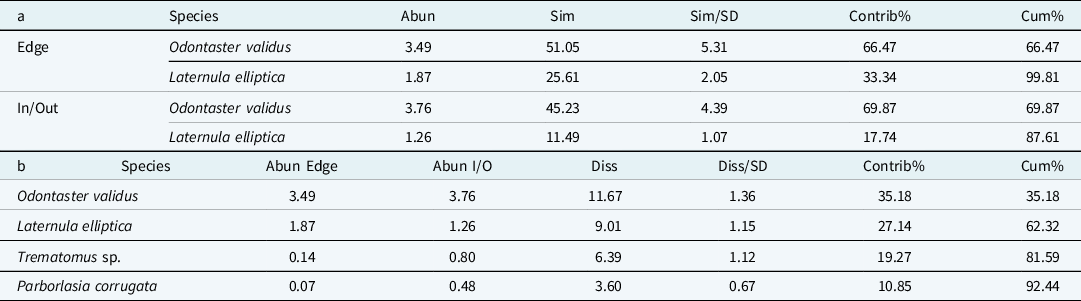
Regardless of location relative to the scour, Odontaster validus was the most dominant epifaunal species at Cinder Cones, and fish Trematomus spp. Boulenger, 1902 were the third most abundant taxa (Fig. 3). The second most abundant species inside the scour was the nemertean Parborlasia corrugatus (McIntosh, 1876), and on the edge and outside was the clam Laternula elliptica (P. P. King, 1832). As at BS-C, there was very little difference in overall abundance between locations relative to iceberg scours. Species richness was highest outside iceberg scours, and lowest at the edge, and evenness was highest inside and least at the edge of iceberg scours (Table 2).
The species that defined the edge communities were the seastar Odontaster validus and the clam Laternula elliptica, with a similarity of 77% (Table 7). The inner and outer communities were defined by O. validus with similarity of 65%. Odontaster validus was also the species responsible for the difference between edge communities and those inside and outside, with a dissimilarity of 33%.
Diagnostic species for similarities (a) and dissimilarities (b) in Cinder Cones epifaunal communities at two sites (CC-C and CC-D) and two statistically different locations (edge of iceberg scours, and inside and outside of iceberg scours combined), from SIMPER analysis of significant groupings, cutoff at Contrib% < 10

Abun = abundance, Contrib% = contributed percent, Cum% = cumulative percent, Diss = dissimilarity, I/O = inside and outside, SD = standard deviation, Sim = similarity.
Infauna
The infaunal communities at Cinder Cones were significantly different for both factors, site and location (pseudo-F = 27.995, p = 0.001 and pseudo-F = 11.657, p = 0.001 respectively), and the interaction term (pseudo-F = 5.0235, p = 0.001) (Supplemental Figure 4).
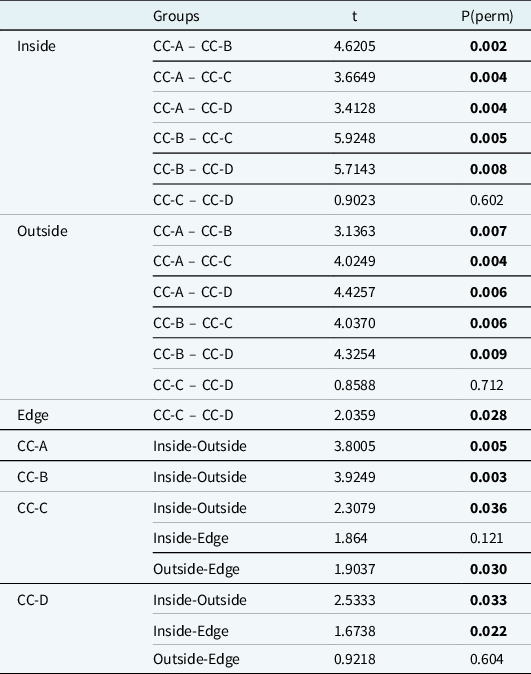
Because of the significant interaction term, pairwise comparisons were made separately for sites within locations and for locations within sites. Both inside and outside of scours, only CC-C and CC-D were not significantly different from each other, but these two sites were significantly different at edge locations (Table 8). At all sites, outside scours was significantly different from inside, but edge locations (sampled only at sites CC-C and CC-D) were variable.
Results of pairwise comparisons on Cinder Cones infaunal data at four sites (CC-A, CC-B, CC-C and CC-D), inside, edge and outside of iceberg scours. Bold indicates significant differences

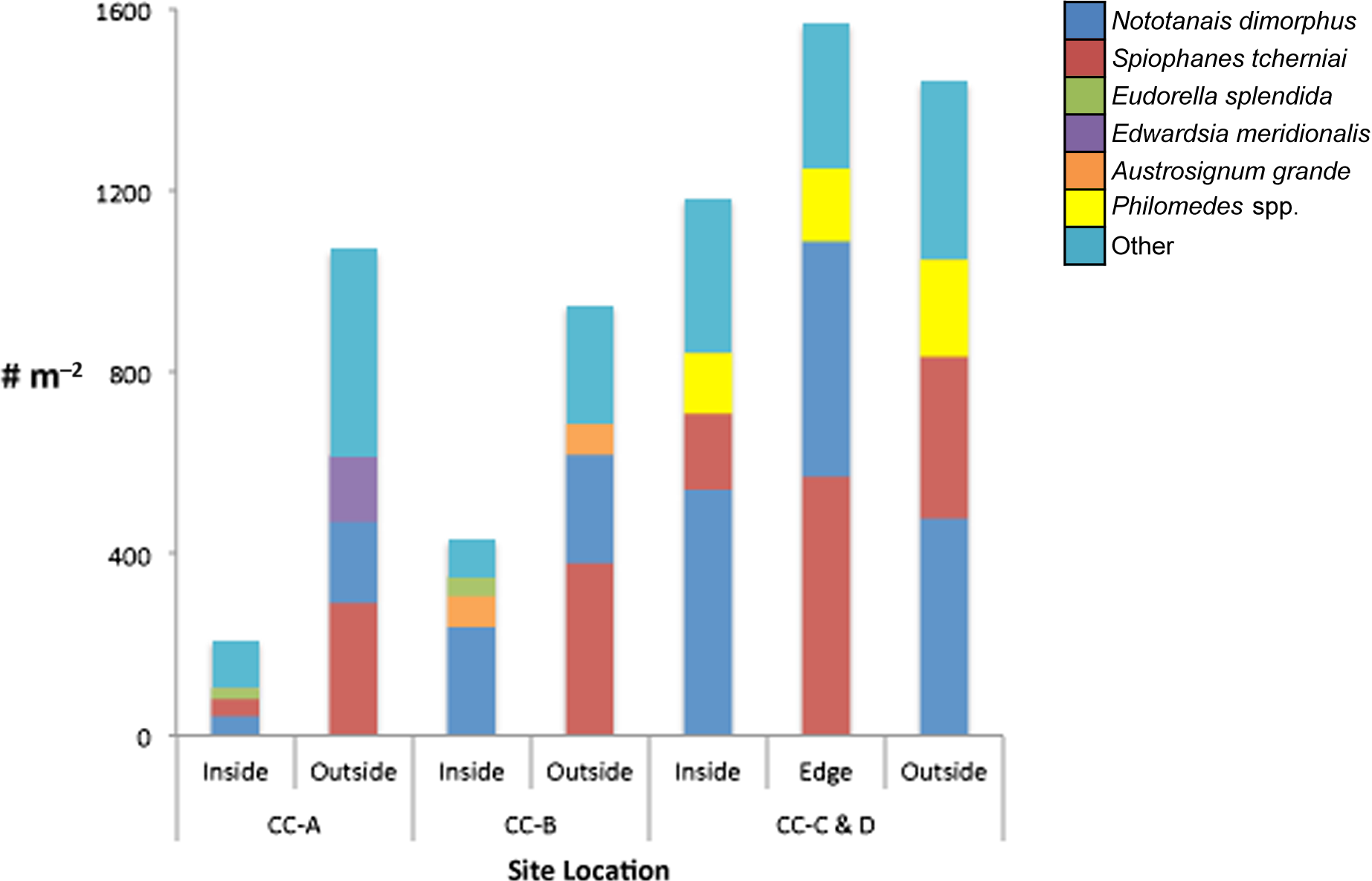
Inside the scours at Cinder Cones the dominant species was Nototanais dimorphus (Beddard, 1886), while outside and at the edge the two most dominant species were N. dimorphus and Spiophanes tcherniai Fauvel, 1950 in differing abundances (Fig. 4). Inside the scours at sites CC-A and CC-C/D the second most abundant species was S. tcherniai, and at site CC-B it was Austrosignum grande Hodgson, 1910. The third most abundant taxa inside scours at CC-A and CC-B was Eudorella splendida Zimmer, 1902. At CC-C/D the third most abundant taxa was Philomedes sp. Lilljeborg, 1853, regardless of location relative to the scours. Outside of the scours, the third most abundant species were Edwardsia meridionalis Williams, 1981 and A. grande at CC-A and CC-B respectively. At all sites, abundances were lower inside scours than outside. Species richness was higher inside scours than outside at CC-A and CC-C/D, but the opposite at CC-B. Communities inside scours were more even at CC-A and CC-C/D, and again, the opposite at CC-B (Table 2).
Infaunal abundances at statistically different sites and locations. The three most common species and total abundances are presented.

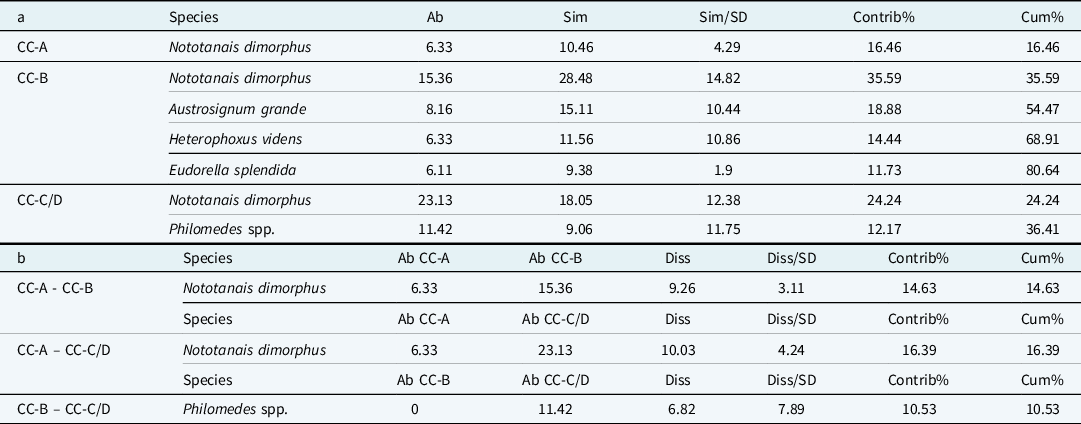
Inside each scour, at sites CC-A, CC-B, and combined CC-C and CC-D, the infaunal communities were defined by the crustacean Nototanais dimorphus plus a variety of other species, with similarities of 64%, 80%, and 74% respectively (Table 9). Nototanais dimorphus was also the largest contributor to differences between CC-A and CC-B, and CC-A and CC-C/D (dissimilarities 63% and 61% respectively). Philomedes spp. and other species differentiated between CC-B and CC-C/D (dissimilarity 65%). Outside the scours, both the tubeworm Spiophanes tcherniai and N. dimorphus, plus several other species, defined communities at CC-A, CC-B and CC-C/D, with similarities of 83%, 74%, and 85% respectively. CC-A and CC-B, and CC-B and CC-C/D communities were primarily differentiated by the ostracod Philomedes spp. (34% and 48% dissimilarity respectively). CC-A and CC-C/D differences were primarily due to N. dimorphus (35% dissimilarity). At site CC-A, the inside scour community was defined primarily by N. dimorphus (similarity 64%) and outside by S. tcherniai (similarity 83%). Spiophanes tcherniai was also primarily responsible for the differences between inside and outside communities, with a dissimilarity of 51%. The pattern was the same at CC-B, with inside similarity 80%, outside similarity 74%, and dissimilarity 44%. At CC-C/D, both inside and outside were primarily defined by N. dimorphus; similarities were 74 and 85% respectively. Spiophanes tcherniai was primarily responsible for differences between inside and outside, with dissimilarity of 32%.
Diagnostic species for similarities (a) and dissimilarities (b) in Cinder Cones infaunal communities at three sites, CC-A, CC-B, and CC-C and CC-D combined, from SIMPER analysis of significant groupings, cutoff at Contrib% < 10.

Ab = abundance, Contrib% = contributed percent, Cum% = cumulative percent, Diss = dissimilarity, SD = standard deviation, Sim = similarity.
Experiment
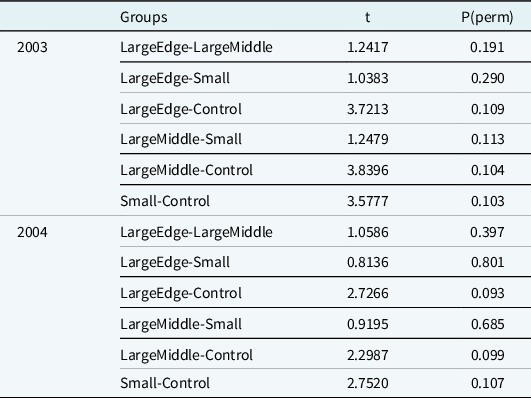
From the disturbance experiment at Cinder Cones, a two-way PERMANOVA showed that both factors, year and treatment (pseudo-F = 3.0204, p = 0.003; pseudo-F = 7.4816, p = 0.001 respectively), and their interaction (pseudo-F = 3.2207, p = 0.001), were significantly different (Supplemental Figure 5). However, in pairwise comparisons within each factor, no differences were significant at the p = 0.05 level (Table 10).
Results of pairwise comparisons on Cinder Cones experiment data after one year (2003) and two years (2004), comparing the middle and edge of large disturbances, small disturbances, and controls (outside disturbances)

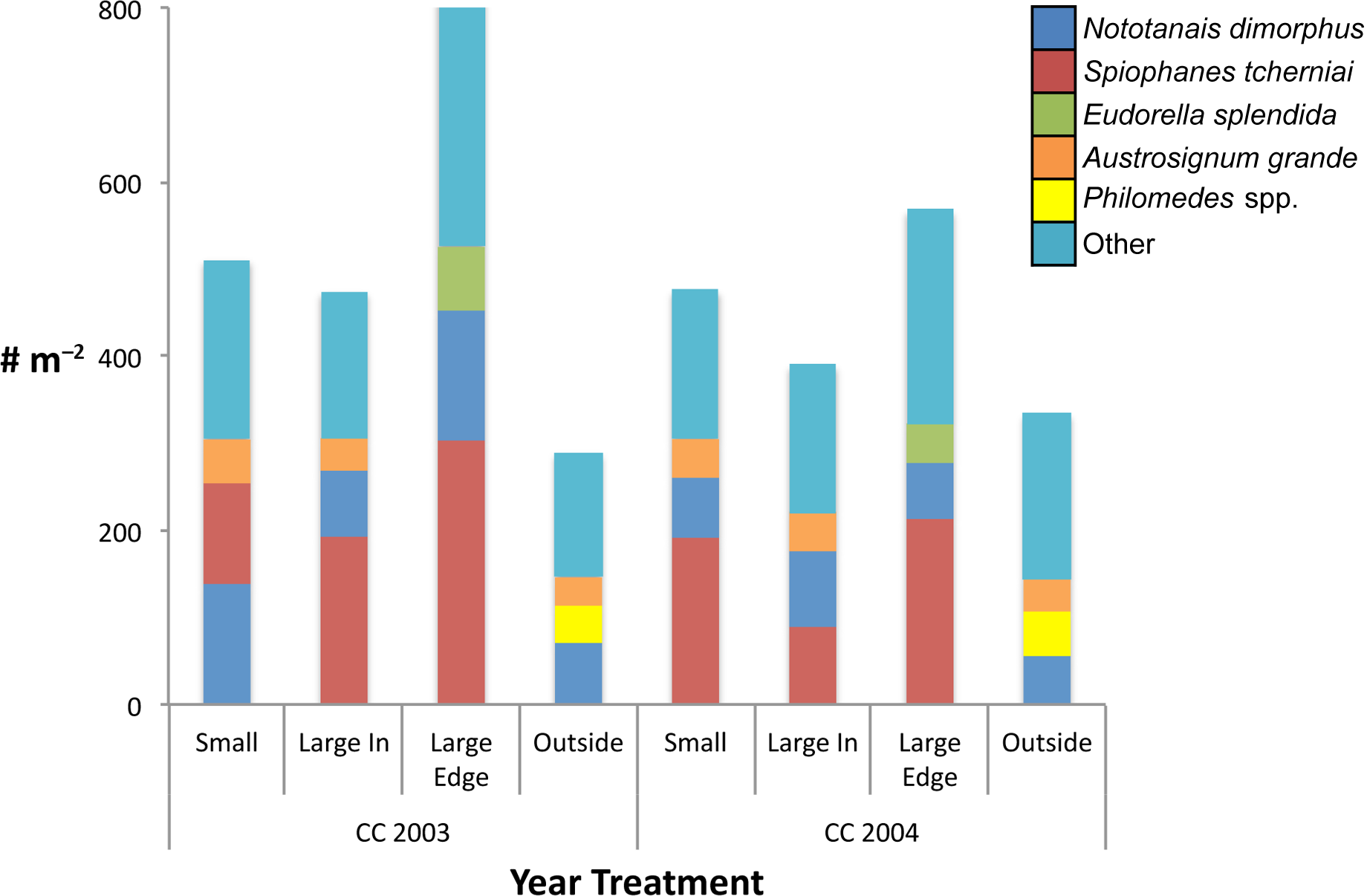
Dominance patterns were identical in both years (Fig. 5). In each of the disturbance treatments, Spiophanes tcherniai and Nototanais dimorphus were the two most abundant species, and only in the small disturbances in 2003 was N. dimorphus more abundant than S. tcherniai. Austrosignum grande was the third most abundant species in small and the middle of large disturbances; at the edge of large disturbances Eudorella splendida was the third most abundant species. In the undisturbed outside controls the three most abundant species were N. dimorphus, Philomedes spp. and A. grande. Total abundances were highest at the edge of the large disturbances, sequentially lower in small and the middle of large disturbances, and lowest outside of the disturbances. Numerical differences were smaller in 2004 than in 2003. After one year (in 2003) all of the experimentally disturbed communities were richer than undisturbed communities, but after two years (2004) small and edge of large disturbance communities were less rich that undisturbed, though communities in the middle of large disturbance remained the richest (Table 2). At both times (2003 and 2004) undisturbed communities were more even than disturbed communities.
Infaunal abundances from the experiment at Cinder Cones. The three most common species and total abundances are presented.

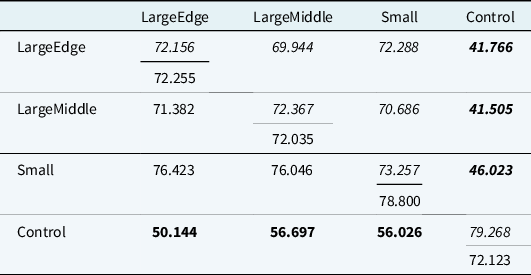
A detailed examination of the results of the pairwise tests shows consistently lower similarities between outside controls and all treatments than any other comparisons (Table 11). A visual examination of the MDS (Supplemental Figure 5) also suggests that real differences exist, despite low statistical power due to the small number of experimental replicates (n = 3).
Pairwise similarities of Cinder Cones experiment data after one year (2003) and two years (2004), between the middle and edge of large disturbances, small disturbances, and controls (outside disturbances). Italics is 2003, non-italics is 2004. Bold indicates similarities less than 60%

We therefore examine the main aspect of community recovery by grouping all disturbance treatments together to compare to the outside communities, in SIMPER examination of the species that contribute to community similarities and differences. In this overall analysis, Spiophanes tcherniai and Nototanais dimorphus defined the experimentally disturbed areas, with overall similarity of 73% (Table 12). Undisturbed control communities were defined by N. dimorphus, with similarity of 76%. Spiophanes tcherniai was responsible for differences between experimental and control communities, with dissimilarity of 51%.
Diagnostic species for similarities (a) and dissimilarities (b) in Cinder Cones experiment, in two treatments (controls, and all disturbances), from SIMPER analysis of MDS clusters, cutoff at Contrib% < 10

Abun = abundance, Contrib% = contributed percent, Cum% = cumulative percent, Diss = dissimilarity, SD = standard deviation, Sim = similarity.
Discussion
Community differences due to Iceberg scouring
Communities inside iceberg scours were consistently different from the surrounding communities in all three study areas, Bay of Sails, Cape Evans, and Cinder Cones (infauna only), regardless of habitat differences in depth, substrate, and oceanographic setting. Only for the Cinder Cones epifaunal community was the difference between inside and outside the scour not significant. Regardless of habitat differences, iceberg scour strongly altered benthic communities. The main pattern indicates the strength of iceberg scouring as a structuring factor in McMurdo Sound benthic ecosystems. This supports continent-wide applicability of studies in other Antarctic regions (Barnes & Conlan, Reference Barnes and Conlan2007; Gutt, Starmans, & Dieckmann, Reference Gutt, Starmans and Dieckmann1996).
Cinder Cones was the only site at depths shallow enough for anchor ice formation and resultant annual disturbance, which may have obscured effects of iceberg disturbance there. The Cinder Cones epifaunal community was dominated by motile species (e.g. Odontaster validus, Parborlasia corrugata, Trematomus spp.) whose adults can easily move in to recolonise following regular disturbances; of the species that define the community only the clam Laternula elliptica is not motile. Regular anchor ice disturbance leads to an epifaunal community dominated by motile species (Bockus, Reference Bockus1996), which can quickly reoccupy areas disturbed by icebergs, and therefore minimize community differences between iceberg-disturbed and undisturbed areas. In contrast, at sites below the depth of anchor ice formation, only one of the community-defining species was mobile; at Cape Evans it was the seastar Odontaster validus, and at Bay of Sails, small brittle stars.
Our results show that iceberg disturbances to benthic communities in McMurdo Sound are extreme, as they are in other regions of the Antarctic. However, in some shallow areas annual disturbance from anchor ice obscures the impacts of iceberg scours by fostering a benthic community with dominant taxa that are mobile.
Dominant taxa and community diversity
The substrate in different areas ranged from rocky boulder and cobble at Cape Evans, through a mixed substrate of rocks scattered in sand and mud at Bay of Sails, to coarse sand and gravel at Cinder Cones. Substrate was interrelated with depth; Cape Evans rocky areas were deepest at 87–105 m, substrate was mixed at intermediate Bay of Sails depths of 36–84 m, and substrate was soft sediment at Cinder Cones depths of 18–21 m. Dominant species were clearly dependent on substrate; sponges, attached to stable substrate, dominated the undisturbed community outside scours at Cape Evans, while taxa that bury in soft sediment were distinguishing species at Bay of Sails (edwardsiid anemones, Perkinsiana sp. fan worms, and ophiuroid brittle stars) and at Cinder Cones (Laternula elliptica clams). The edwardsiid anemone species from Bay of Sails, though not completely identified because no samples were collected by the ROV, extended its column into soft sediment as does Edwardsia meridionalis found at Cinder Cones, though it was generally larger. Despite the substrate differences and consequent taxomonic differences in dominant species, community disturbance dynamics were similar.
Oceanographic differences between sites also did not appear to effect disturbance dynamics though they strongly influence the baseline community. Cape Evans and Cinder Cones, on the eastern side of McMurdo Sound, are bathed by plankton-rich water from the open Ross Sea, providing a good food resource to rich and diverse benthic communities during the summer months (Barry & Dayton, Reference Barry and Dayton1988; Dayton & Oliver, Reference Dayton and Oliver1977). But at Bay of Sails, on the western side of the sound, the water has been circulating in darkness under the thick ice of the permanent Ross Ice Shelf for years, so it is very oligotrophic and the benthic community is relatively depauperate (Dayton & Oliver, Reference Dayton and Oliver1977). Observed diversity indices from epifaunal data were highest at Cape Evans, lower at Bay of Sails, but were lowest at Cinder Cones (Table 2). The regular disturbance of anchor ice overwhelmed the effect of rich food resources resulting from current patterns and shallow water.
Communities at Cape Evans and Bay of Sails sites disturbed by icebergs had very low within-location similarities due to the low number of animals per quadrat, which was often just one. It is difficult to accurately portray very sparse communities in a statistical reduction. The near-complete removal of all organisms within iceberg scours was the consistent pattern; however, low statistical within-group similarities were found inside scours. This was most likely due to there being one or a few remaining animals of different species in each replicate. Though one might predict that sessile species would be slower to recover from iceberg disturbance than motile species, some sessile species, including Alcyonium antarcticum and Perkinisiana sp., were diagnostic of communities inside iceberg scours. Iceberg scouring does not always completely remove all organisms, and the persistence of single well-attached sessile individuals is a likely driver for this statistical result that at first glance is ecologically confusing.
Our results suggest that ice disturbance overrode other habitat characteristics in structuring communities. Regardless of substrate type, iceberg scouring in McMurdo Sound resulted in nearly complete removal of both sessile and mobile epifaunal organisms. In addition, food availability had less influence on epifaunal communities than did anchor ice disturbance.
Infaunal communities
In comparisons between locations at Cinder Cones, infaunal community dissimilarity values were low between locations and between sites outside the scours, as were epifaunal community dissimilarities between locations. As mentioned above, Cinder Cones is shallow enough that anchor ice disturbance is frequent and may obscure effects of iceberg disturbance. In addition, though different years of sampling did not appear to alter epifaunal community recovery, they may have influenced infaunal communities. Sea ice extent and ice production vary year-to-year in the Ross Sea (Comiso, Kwok, Martin, & Gordon, Reference Comiso, Kwok, Martin and Gordon2011), as does fast-ice (sea ice that is “fastened” to the coastline); both were influenced by the arrival and persistence of several large tabular icebergs in the Ross Sea from 2001 to 2005 (Brunt, Sergienko, & MacAyeal, Reference Brunt, Sergienko and MacAyeal2006). The mega-icebergs B-15A and C-19 grounded near the mouth of McMurdo Sound and restricted the normal ebb and flow of summer sea ice movements, increasing overall ice cover, reducing phytoplankton growth and the length of the algal growing season, and resulting in reduced primary productivity throughout the region (Arrigo & van Dijken, Reference Arrigo and van Dijken2003, Reference Arrigo and van Dijken2004; Seibel & Dierssen, Reference Seibel and Dierssen2003). Poor feeding conditions altered local infaunal communities (Conlan, Kim, Thurber, & Hendrycks, Reference Conlan, Kim, Thurber and Hendrycks2010; Thrush & Cummings, Reference Thrush and Cummings2011). This reduced productivity also appears to have impacted recovery of infaunal communities in scours in 2002 based upon the absence of two common and dominant members of this community, Spiophanes tcherniai and Edwardsia meridionalis. It appears that infaunal recolonisation was altered by the presence of B-15A, suggesting that variability in environmental conditions may play a large role in community recovery following iceberg scour.
While our results indicated that food availability impacts the recovery dynamics of infaunal communities, we were not able to confirm this for epifaunal communities, due to the lack of resampling opportunities.
Community recovery
Previous studies have demonstrated slow community recovery rates from iceberg disturbances, taking anywhere from years (Lenihan & Oliver, Reference Lenihan and Oliver1995) to decades to centuries (Gutt et al., Reference Gutt, Starmans and Dieckmann1996; Gutt & Starmans, Reference Gutt and Starmans2001; Peck, Brockington, Vanhove, & Beghyn, Reference Peck, Brockington, Vanhove and Beghyn1999) before scour locations were similar to adjacent undisturbed communities. This slow pace of recolonization in polar regions has been attributed to diverse assemblages of species, as well as the presence of slow-growing sponges. However, regularly iceberg-disturbed communities in very shallow water are apparently well adapted to rapid recovery (Smale et al., Reference Smale, Barnes, Fraser and Peck2008; Vause et al., Reference Vause, Morley, Fonseca, Jażdżewska, Ashton, Barnes and Peck2019); epifaunal communities at Cinder Cones also appear to recover relatively rapidly. The frequency at which anchor ice disturbances occur at Cinder Cones may prevent the recruitment of organisms with slower growth (Arntz, Brey, & Gallardo, Reference Arntz, Brey and Gallardo1994; Clarke, Reference Clarke1988) and episodic reproduction (Dayton et al., Reference Dayton1989, Reference Dayton, Kim, Jarrell, Oliver, Hammerstrom, Fisher and Thurber2013), which are commonly found at greater depths.
Community recovery appears to be a lengthy process in deeper Antarctic habitats. Many Antarctic organisms with planktotrophic larvae spawn in late winter and early spring to synchronize with increasing food availability during summer plankton blooms (Pearse, Bosch, McClintock, Marinovic, & Britton, Reference Pearse, Bosch, McClintock, Marinovic and Britton1986). These species may recruit en masse in freshly scoured areas that generally occur in mid-to-late summer (Smale et al., Reference Smale, Barnes, Fraser and Peck2008). In contrast, species that produce lecithotrophic larvae and brooded embryos tend to spawn year-round (Pearse et al., Reference Pearse, Bosch, McClintock, Marinovic and Britton1986), and may settle singly, within a community of predators and competitors that have already been established for some time (Oliver & Slattery, Reference Oliver and Slattery1985). In addition, Dayton et al. (Reference Dayton1989, Reference Dayton, Kim, Jarrell, Oliver, Hammerstrom, Fisher and Thurber2013) have described several cases of irregular episodic mass recruitment and suggest that community recovery in Antarctic benthic ecosystems may be a discontinuous process. These factors contribute to a slow community recovery process.
Infaunal communities, sampled only at Cinder Cones, were different not only between locations, but also between sites. At all sites there were fewer Spiophanes tcherniai tubeworms and Edwardsia meridionalis anemones inside scours than outside. Spiophanes tcherniai forms extensive mats of intertwined tubes that stabilize the sediment. Edwardsia meridionalis prefers a stable soft substrate where it can burrow its column into the sediment. Regardless of iceberg scouring, sites CC-C/D had high abundances of Philomedes spp. and Nototanais dimorphus. Both of these species are colonizers; Philomedes spp. is a rapid initial colonizer and N. dimorphus is an intermediate species (Lenihan & Oliver, Reference Lenihan and Oliver1995; Oliver & Slattery, Reference Oliver and Slattery1985). The Cinder Cones sites were sampled during austral springs (October), and the high abundances of both species at CC-C/D suggests that the iceberg disturbance there occurred recently. As there was no evidence of iceberg disturbance observed by divers at these sites one year prior, and iceberg movement most likely occurs during austral late summer-early fall (January–March) when the sea ice is open, seven to nine months before sampling is the probable window of disturbance at these sites. At site CC-B, Philomedes spp. abundances were low but N. dimorphus were abundant inside the scour, indicating a slightly longer time since disturbance. Site CC-B had not been visited by divers/visualized for two years, and it is therefore likely that an iceberg moved through the area 19–21 months prior to sampling. At CC-A, low abundances of both colonizing species suggest that an iceberg probably disturbed the seafloor even earlier. Site CC-A was last visited three years prior, so iceberg movement at this site likely occurred 31–33 months before sampling. Differences in the infaunal communities between sites are likely due to different elapsed times since iceberg disturbance.
From infaunal samples collected at three different times at Cinder Cones, we conclude that infaunal communities in McMurdo Sound had not fully recovered three years after iceberg disturbances.
Manipulative experiment
The experiment to determine whether immigration was important to recolonisation was suggestive but inconclusive. Overall, communities in experimentally disturbed areas were dominated by Spiophanes tcherniai. Spiophanes larvae are planktotrophic and disperse well (Blake & Arnofsky, Reference Blake and Arnofsky1999), perhaps contributing to their high abundances in the disturbed areas. Previous studies suggest that taxa with high dispersal ability are and should be dominant at disturbed Antarctic sites (Poulin, Palma, & Féral, Reference Poulin, Palma and Féral2002). Nevertheless, over the short timescale of the experiment, two years, the disturbed communities did not recover to match the outside communities, even in the small disturbances.
That the infaunal community recovery was not complete after two years is in concordance with the results of Lenihan and Oliver (Reference Lenihan and Oliver1995) for a nearby area (Jetty) where it took six years for the infaunal community to recover from disturbance. However, Lenihan and Oliver (Reference Lenihan and Oliver1995) also found that at other sites where infaunal communities were less diverse (Winter Quarters Bay, a chemically and organically contaminated site, and New Harbor, a food-poor site on the west side of McMurdo Sound), infaunal community recovery following disturbance was much more rapid (one year and two years respectively). They concluded that colonists in disturbed sediments included a large proportion of animals that moved in from surrounding habitat, however, our results were more equivocal. Either colonists moved equally across distances of 0.5 and 0.05 m, reaching the middle of large disturbances in the same numbers as they did the edges and small disturbances, or local migration of already-settled animals was not important to recolonization.
Infaunal communities in experimentally disturbed areas did not recover in two years, regardless of the disturbance size or distance from an undisturbed community. Thus, migration does not appear to be an important factor to infaunal community recolonisation in McMurdo Sound.
Conclusions
Iceberg scouring is an extreme disturbance to Antarctic benthic communities, regardless of local habitat and environmental parameters. In relatively shallow areas that are regularly disturbed by anchor ice, infaunal communities showed more variability than epifaunal communities, and did not fully recover from experimental disturbances in two years or from natural disturbances after three years. Recolonization of infaunal species is via settlement from the water column above, not from animals crawling in from the adjacent sediment. Benthic community recovery from iceberg disturbance appears to be an intermittent process that depends in part on the erratic episodic recruitment that apparently typifies Antarctic benthos.
Acknowledgements
We are very grateful for the assistance of the too many people to name who supported this effort from 1997 to date. We would, however, like to especially thank Francois Cazenave for hours of patient ROV piloting, John Oliver for scientific inspiration, Kamille Hammerstrom for scientific slogging, and Kathy Conlan for taxonomic support. Nothing could have been accomplished without the helpful support staff and contract employees for the USAP and MLML. Numerous MLML Benthic Lab graduate students, interns and volunteers supported sample processing. We thank anonymous reviewers for suggesting improvements to the manuscript.
Financial support
Funding was provided by ABA; CC&R; and NSF (S.K., grant numbers ANT-0944747, OPP-0619622, OPP-0126319, OPP-59088). Any opinions, findings, and conclusions or recommendations expressed in this material are those of the authors and do not necessarily reflect the views of the NSF.
Conflict of interest
None.
Author contributions
SK was primarily responsible for conception, design and execution of the study, and participated in interpretation of the data, and drafting and revising the manuscript. CC shared responsibility for data collection and data analysis, and paper preparation and editing.
Supplementary material
To view supplementary material for this article, please visit https://doi.org/10.1017/S0032247421000048