

Tetracycline (TC), a broad-spectrum bacteriostatic antibiotic, has been extensively used in human and veterinary medicine, making it the second most prevalent antibiotic globally (Klein et al., Reference Klein, Van Boeckel, Martinez, Pant, Gandra and Levin2018; Scaria et al., Reference Scaria, Anupama and Nidheesh2021; Ren et al., Reference Ren, Wang, Hu, Guo, Gao and Huang2024; Wolska et al., Reference Wolska, Zioła-Frankowska, Jenczyk, Zaleta, Sobańska, Pietrzyk and Wolski2025). However, its persistent detection in aquatic environments in recent years, attributed to its environmental persistence and low biodegradability, has raised significant concerns regarding growing environmental and public health risks associated with its use (Perez-Bou et al., Reference Perez-Bou, Gonzalez-Martinez, Gonzalez-Lopez and Correa-Galeote2024; Hu et al., Reference Hu, Wang, Zhang, Hu, Chen and Zeng2025). Beyond its direct toxicity to aquatic organisms, TC’s most insidious impact lies in its role as a key driver of the proliferation of antibiotic-resistant genes (ARGs), fundamentally altering microbial communities and undermining the efficacy of antibiotic therapies (Zainab et al., Reference Zainab, Junaid, Xu and Malik2020). The compound’s complex environmental behaviour (characterized by multi-source inputs, transformation products with retained bioactivity and synergistic effects with co-occurring pollutants) necessitates advanced treatment solutions combining high removal efficiency and environmental compatibility (Khan et al., Reference Khan, Bae and Jung2010; Zhang et al., Reference Zhang, Zhou and Li2013).
A variety of physical, biological and chemical methods have been explored for TC removal. Physical adsorption (e.g. using activated carbon) and membrane separation can rapidly concentrate TC but merely transfer the pollutant to another phase without achieving its decomposition, creating a secondary waste stream (Pan et al., Reference Pan, Zhu, Chen, Yuan, Zhong and Zheng2015; Zhang et al., Reference Zhang, Liu, Yao, Wang, Zeng and Zou2025b). Biological degradation is cost-effective but often suffers from slow kinetics and incomplete removal due to the antibacterial nature of TC (Qi et al., Reference Qi, Xiong, Zhao and Ru2022). In contrast, advanced oxidation processes (AOPs) have gained prominence for their ability to generate highly reactive oxygen species (ROS) in situ that can mineralize recalcitrant organic pollutants into harmless CO2 and H2O or transform them into less toxic byproducts (Kuang et al., Reference Kuang, Guo, Si, Guo and Ma2023; Zhang et al., Reference Zhang, Jiang, Lin, Zeng, Wang and Chen2025a). Among the AOPs, the Fenton reaction (Fe2+/H2O2) is particularly attractive; however, its homogeneous nature necessitates a strictly acidic pH, produces significant iron sludge and requires continuous iron supplementation, which limits its practical application (Wang et al., Reference Wang, Xiong, Miao, Wang, Xie, Wang and Ma2021; Jiang et al., Reference Jiang, Zeng, Xu, Xia and Feng2024).
Iron-based heterogeneous Fenton-like AOPs have emerged as a sustainable alternative to conventional water treatment methods, primarily due to their circumvention of strict pH limitations and inherent catalyst recyclability (Wang et al., Reference Wang, Kou, Zhao and Duan2020; Liang & Zhou, Reference Liang and Zhou2022). Notably, magnetite (Fe3O4)-rich tailings from global mining operations represent an underutilized resource with compelling advantages as a catalyst: their inherently low cost due to their waste origin, their natural abundance facilitating their large-scale availability and their intrinsic structural properties (e.g. Fe2+/Fe3+ dual-active sites and ferrimagnetism) that facilitate both redox cycling and magnetic recovery (Pereira et al., Reference Pereira, Tavares, Fabris, Lago, Murad and Criscuolo2007; He et al., Reference He, Zhong, Liang, Tan, Zhu and Yan Wang2015). However, compared to engineered catalysts (e.g. noble metals (Shao et al., Reference Shao, Li, Gong, Fan, Hu and Peng2022; Than-ardna et al., Reference Than-ardna, Kotcharat, Weder and Manuspiya2025) or modified composite (Esteves et al., Reference Esteves, Morales-Torres, Maldonado-Hódar and Madeira2024; Zhou et al., Reference Zhou, Liu, Liu, Wu and Fujii2025)), pristine magnetite faces intrinsic limitations regarding its practical implementation: its particle aggregation and insufficient specific surface area restrict the accessibility of active sites, leading to compromised catalytic efficiency (He et al., Reference He, Zhong, Liang, Tan, Zhu and Yan Wang2015). These structural constraints (coupled with its inherently sluggish reaction kinetics) represent critical barriers to its large-scale utilization, necessitating strategic material design to enhance its performance.
Several engineered modification strategies have been extensively investigated to enhance the catalytic performance of magnetite. These include: (1) doping with heteroatoms (e.g. Cu-doped Fe3O4 coupled to MIL-101 achieved 96.86% TC degradation efficiency within 50 min; Liang et al., Reference Liang, Li, Wu, Liu, Wang and Wu2025); (2) hybridization with carbon-based supports (e.g. Fe3O4-loaded biochar demonstrated a threefold enhancement in TC degradation efficiency compared to the original biochar; Kang et al., Reference Kang, Ren, Labidi, Liao, Wang and Zheng2025); and (3) integration with metal–organic frameworks (MOFs; e.g. Fe3O4@MOF-74 effectively catalysed persulfate across a broad pH range (3–9), achieving near-complete removal (100%) of amino black 10B and high removal (95.58%) of bisphenol A; Hu et al., Reference Hu, Tian, Liu, Xu, Niu and Zhang2024). However, such enhancements often come at the expense of practical scalability: complex synthesis protocols incur high levels of energy consumption and elevated production costs. At the same time, the introduction of expensive modifiers further undermines the economic viability of large-scale catalyst deployment. Consequently, reconciling activity optimization with industrial feasibility remains an urgent challenge in advancing Fe3O4-based wastewater remediation (Pereira et al., Reference Pereira, Oliveira and Murad2012). Extensive studies have demonstrated that nanoscale engineering is a practical approach to improving the catalytic activity of Fe3O4 (Shang et al., Reference Shang, Hu, Li, Wang and Farooq2025). Consequently, researchers often employ various physicochemical methods to design Fe3O4 particles at the nanoscale for use in heterogeneous aqueous reactions. Nanoscale Fe3O4 catalysts hold promise for efficiently removing aquatic pollutants.
To bridge this gap, we propose nanoengineering raw tailings into high-performance catalysts. This strategy addresses the insufficient active site exposure and sluggish kinetics of magnetite tailings while preserving their low cost and magnetic recoverability advantages. It is unknown whether natural magnetite with variable chemical compositions and microstructures can be active in catalysing organic decomposition. Crucially, a mechanistic understanding of nano-Fe3O4/H2O2 interactions is foundational for scalability. Herein, we employ a simple one-step co-precipitation method (FeSO4·7H2O and FeCl3·6H2O as iron sources) to synthesize pristine nano-Fe3O4 as a model system. Our objectives are to: (1) activate H2O2 with this nanoscale catalyst for TC degradation; (2) optimize the material synthesis procedure, investigate optimal reaction parameters and assess potential practical performance metrics; and (3) elucidate the ROS generation mechanisms through radical quenching experiments complemented by electron paramagnetic resonance (EPR) spectroscopy. This foundational study is conducted as a prerequisite for enabling the scalable deployment of magnetite tailings for organic pollutant degradation.
Materials
Ferrous sulfate heptahydrate (FeSO4·7H2O), ferric chloride hexahydrate (FeCl3·6H2O), ammonia solution (NH4OH), tert-butanol (TBA), p-benzoquinone (p-BQ) and histidine (His) were purchased from Sinopharm Chemical Reagent Co., Ltd. TC was supplied by Shanghai Macklin Biochemical Technology Co., Ltd. Hydrogen peroxide (H2O2) was obtained from Tianjin Yu Fu Tai Chemical Reagent Co., Ltd. All chemicals were of analytical or chromatographic grade and used without further purification. Deionized water was used throughout the experiments.
Experimental
Synthesis of catalysts
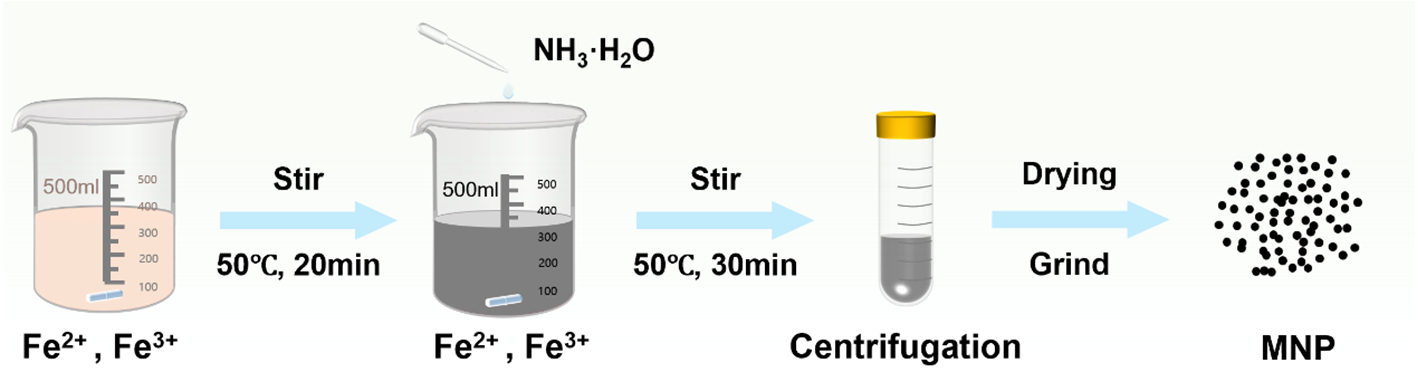
The catalyst was synthesized through a co-precipitation method, as described by the chemical reaction in Equation 1. FeSO4·7H2O and FeCl3·6H2O were dissolved in 100 mL of deionized water at varying Fe(II):Fe(III) molar ratios, with a constant total iron concentration of 0.45 mol L–1. The mixture was ultrasonically agitated until the iron salts were completely dissolved. The solution was sealed with cling film and stirred magnetically at a constant temperature of 50°C and a fixed rotational speed of 500 rpm for 20 min to homogenize the mixture. Subsequently, 10 mL of concentrated ammonia solution (13 mol L–1) was added dropwise manually at a controlled rate (∼1 mL min–1) to initiate precipitation. The reaction mixture was then stirred continuously at 50°C and 500 rpm for 30 min to allow particle maturation. The resulting black precipitate was collected by centrifugation, washed thoroughly with deionized water and dried at 60°C for 8 h in a vacuum oven. The final product (magnetic nanoparticles; MNPs) was obtained by gentle grinding of the dried powder.
 \begin{equation}{\text{F}}{{\text{e}}^{2 + }} + 2{\text{F}}{{\text{e}}^{3 + }} + 8{\text{O}}{{\text{H}}^ - } \to {\text{F}}{{\text{e}}_3}{{\text{O}}_4} + 4{{\text{H}}_2}{\text{O}}\end{equation}
Experimental procedure
Degradation experiments were conducted in batch mode. Typically, 50 mL of TC solution (20 mg L–1) was placed in a conical flask. MNP catalyst (0.1 g L–1 unless specified otherwise) was added, and the mixture was shaken in the dark for 30 min to establish adsorption–desorption equilibrium. The reaction was initiated by adding H2O2 (50 mM unless specified otherwise). Aliquots were withdrawn at predetermined intervals and immediately filtered through a 0.22 μm polyethersulfone (PES) syringe filter to remove the catalyst. The filtered solution was then quenched (if necessary). The residual TC concentration was analysed using high-performance liquid chromatography (HPLC; Dalian Elite EClassical-3200; column: C18, mobile phase: methanol/oxalic acid (0.01 M) = 35:65 (v/v), flow rate: 1.0 mL min–1, detection wavelength: 355 nm). Degradation kinetics were fitted to the pseudo-first-order model (Equation 2):
 \begin{equation} - \ln \left( {\frac{{{C_t}}}{{{{\text{C}}_0}}}} \right) = {{\text{K}}_{{\text{obs}}}}t\end{equation}
where C 0 and Ct are the TC concentrations (mg L–1) at initial time and time t (min), respectively, and Kobs is the apparent rate constant (min–1). After reaction, the catalyst was recovered using a magnet, washed and dried for potential reuse studies.
X-ray diffraction analysis
The phase composition and crystal structure of the samples were determined by X-ray diffraction (XRD; D8 ADVANCE, Bruker, Germany) with Cu-Κα radiation (λ = 0.1541nm) operated at 35 kV and 35 mA. The data were collected in the 10–80°2θ range with a step size of 0.05° and a scanning speed of 5° min–1. For sample preparation, the MNP powders were fully ground in an agate mortar and sieved to 200 mesh. The powders were then evenly sprinkled into the sample holder cavity, gently compacted with a spatula and finally flattened with a glass slide to form a smooth surface level with the holder. Phase identification was performed using the International Centre for Diffraction Data (ICDD) PDF-4+ database with the aid of MDI Jade 6 software.
Fourier-transform infrared spectrometry analysis
Fourier-transform infrared (FTIR) spectrometry analysis was performed using an FTIR-850 spectrometer (Tianjin Gangdong Sci. & Tech. Co., Ltd, China) operated in transmission mode. The samples were prepared by mixing them with dried KBr powder and pressing them into pellets. Spectra were collected in the wavenumber range of 4000 to 500 cm–1 with a resolution of 4 cm–1 and an average of 64 scans.
X-ray photoelectron spectroscopy analysis
The surface chemical states and bonding configurations were examined via X-ray photoelectron spectroscopy (XPS) on an ESCALAB250Xi spectrometer (Thermo Fisher Scientific, Inc., USA) using a monochromatic Al-Κα X-ray source (1486.6 eV). The analysis was performed with a spot size of 500 μm and a pass energy of 30 eV for high-resolution regional scans. The binding energy scale was calibrated by setting the adventitious carbon C 1s peak to 284.8 eV for charge correction. A Shirley background was applied for baseline subtraction, and the spectra were deconvoluted using the Thermo Avantage software with a Gaussian–Lorentzian (GL (30)) line shape for peak fitting.
Scanning electron microscopy analysis
The morphology of the samples was characterized using field-emission scanning electron microscopy (SEM; Nova Nano SEM, Thermo Fisher Scientific, Inc., USA). The powder samples were directly adhered onto conductive carbon tape. After removing excess powder via gentle air blowing, the samples were sputter-coated with a thin gold layer to enhance conductivity. Imaging was performed at an acceleration voltage of 7 kV and a working distance of 15 mm.
N2 adsorption/desorption analysis
The specific surface area and pore-size distribution of the prepared samples were studied by using a specific surface area and pore-size analyser (BET, JW-BK200A, JWGB Instruments, China). Prior to measurement, ∼50 mg of each sample was degassed under a dynamic vacuum at 120°C for 6 h to remove moisture and other adsorbed contaminants. The specific surface area was calculated using the Brunauer–Emmett–Teller (BET) method in the relative pressure (P/P 0) range of 0.05–0.30.
Vibrating sample magnetometer analysis
The magnetic properties of the samples were measured using a vibrating sample magnetometer (VSM; Model 7404, Lake Shore Cryotronics, USA). The powder sample was packed into a non-magnetic gelatin capsule for measurement. The hysteresis loop was recorded at room temperature with an applied magnetic field sweeping from –20 to +20 kOe.
Results and discussion
The degradation of TC by the MNP/H2O2 system
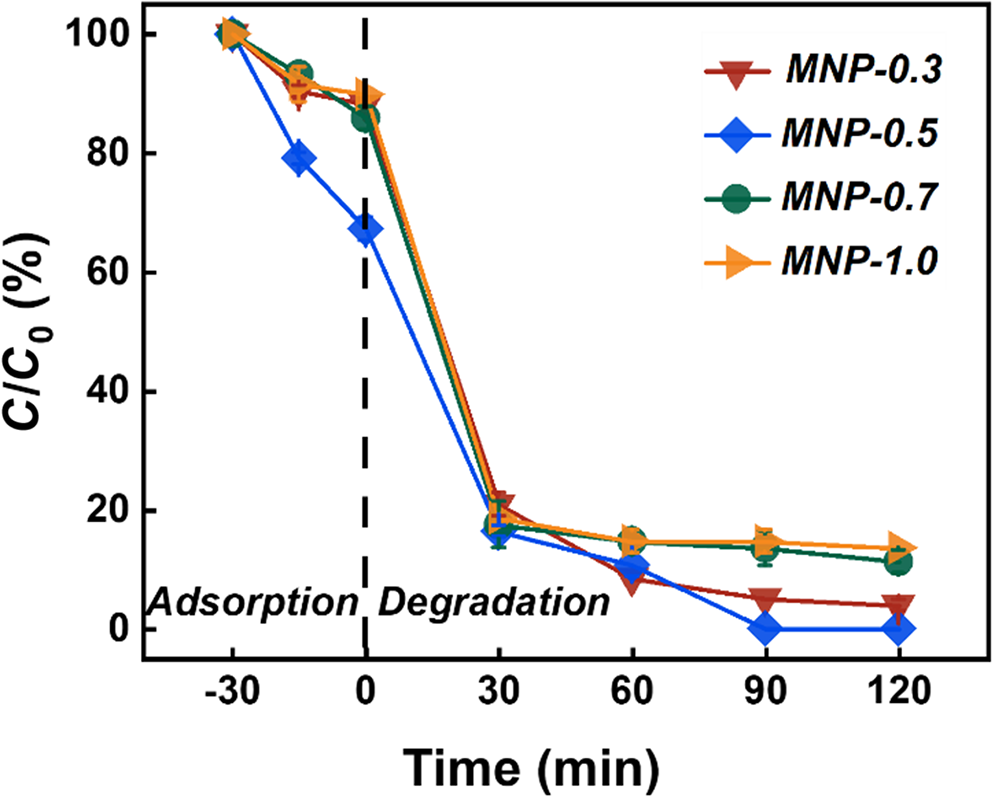
The synthesis route of MNP is depicted in Fig. 1. Four types of MNPs with Fe2+/Fe3+ molar ratios of 0.3, 0.5, 0.7 and 1.0 (denoted as MNP-0.3, MNP-0.5, MNP-0.7 and MNP-1.0, respectively) were synthesized to explore the optimal conditions, and the key synthesis parameters are summarized in Table 1. Regarding the adsorption–degradation effect of MNPs with different molar ratios on TC, as shown in Fig. 2, the adsorption–degradation effect of MNP-0.5 on TC is significantly better than those of the other materials. Upon adding H2O2, the degradation efficiencies of TC by MNP-0.3, MNP-0.7 and MNP-1.0 reached 96.04%, 88.70% and 86.44% within 120 min, respectively. In contrast, MNP-0.5 achieved complete degradation (100%) of TC within just 90 min. These results demonstrate that both the adsorptive and catalytic performances of MNP-0.5 are superior to those of the other materials. This enhanced activity may be attributed to the Fe2+/Fe3+ ratio in MNP-0.5 being closest to the theoretical value of 0.5 (Equation 1), which promotes the formation of high-purity Fe3O4 with optimal catalytic properties.
Schematic illustration of the MNP synthesis process.

Adsorption–catalytic degradation of TC by MNPs. Reaction conditions: [catalyst] = 0.1 g L–1, [H2O2] = 50 mM, [TC] = 20 mg L–1, pH = 7, T = 298 K.

Key synthesis parameters of MNP with various molar ratios.

The characterization of MNP
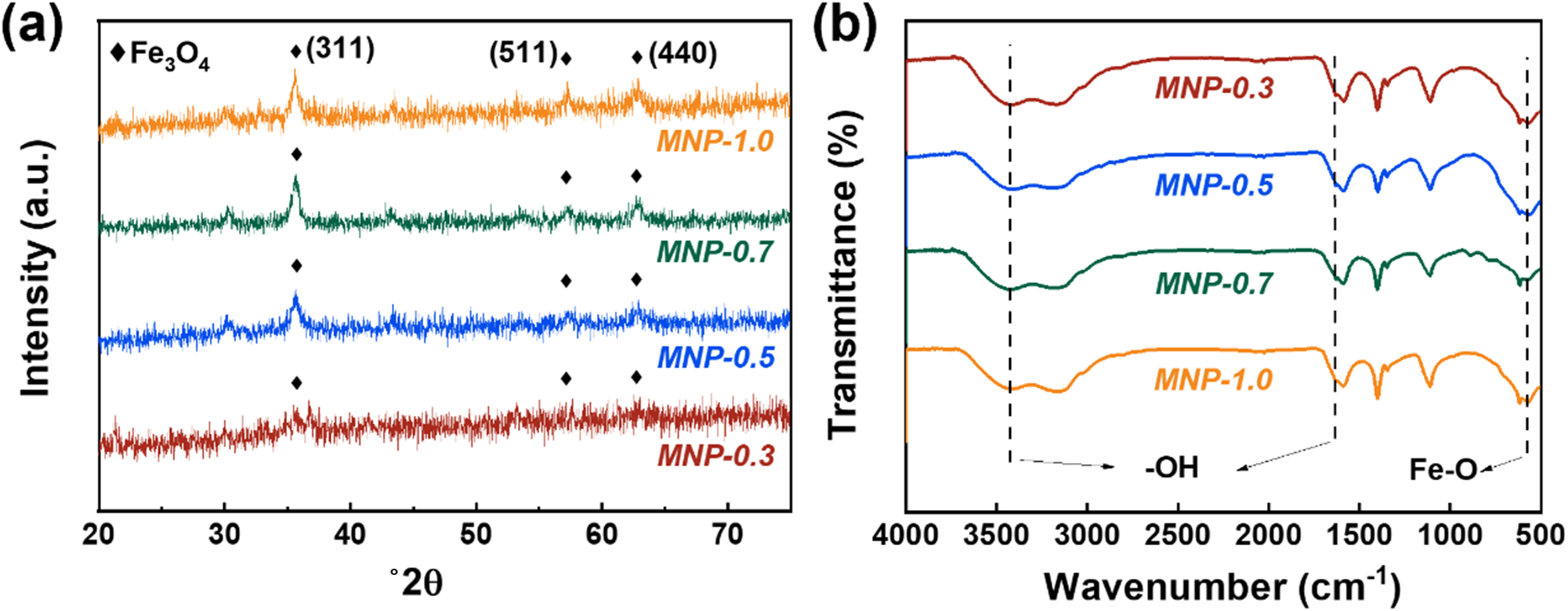
XRD was performed to characterize the crystallographic structures of the various MNP catalysts. As shown in Fig. 3a, distinct diffraction peaks were observed at 35.7°2θ, 57.1°2θ and 63.07°2θ, which correspond to the (311), (511) and (440) crystal planes of Fe3O4 (PDF #88-0315), respectively, confirming the successful synthesis of Fe3O4 (Liu et al., Reference Liu, Gan, Li, Xiong, Xu, Guo and Xue2025b). Furthermore, no detectable impurity peaks were present in the XRD trace, indicating the high purity of the synthesized product. However, the baseline of the trace exhibits slight fluctuations and a curved profile, which may be attributed to the presence of amorphous iron hydroxides (ferric and ferrous hydroxide) formed during the ammonia addition step. These amorphous intermediates may not have fully transformed into well-crystallized Fe3O4 (Liu et al., Reference Liu, Gan, Li, Xiong, Xu, Guo and Xue2025b). Further investigation of the surface functional groups of these four materials was conducted using FTIR spectroscopy. As shown in Fig. 3b, the characteristic peak at 572 cm–1 corresponds to the stretching vibration of Fe–O bonds in Fe3O, confirming the successful synthesis of Fe3O4 (Lu et al., Reference Lu, Jiao, Chen and Li2009). The absence of characteristic peaks for ferrous oxide at 700 cm–1 indicates no significant impurity phase in the product. The absorption peaks observed at 1631 and 3442 cm–1 are attributed to the hydroxyl groups’ bending and stretching vibrations from adsorbed water on the surface, respectively (Liu et al., Reference Liu, Wang, Wang and Zhang2013). When comparing Fe3O4 synthesized under various conditions, the characteristic peak intensity corresponding to Fe–O stretching vibrations reaches its maximum for MNP-0.5, demonstrating the optimal purity and structural orderliness of Fe3O4 at this molar ratio.
(a) XRD traces of MNP and (b) FTIR spectra of MNP.

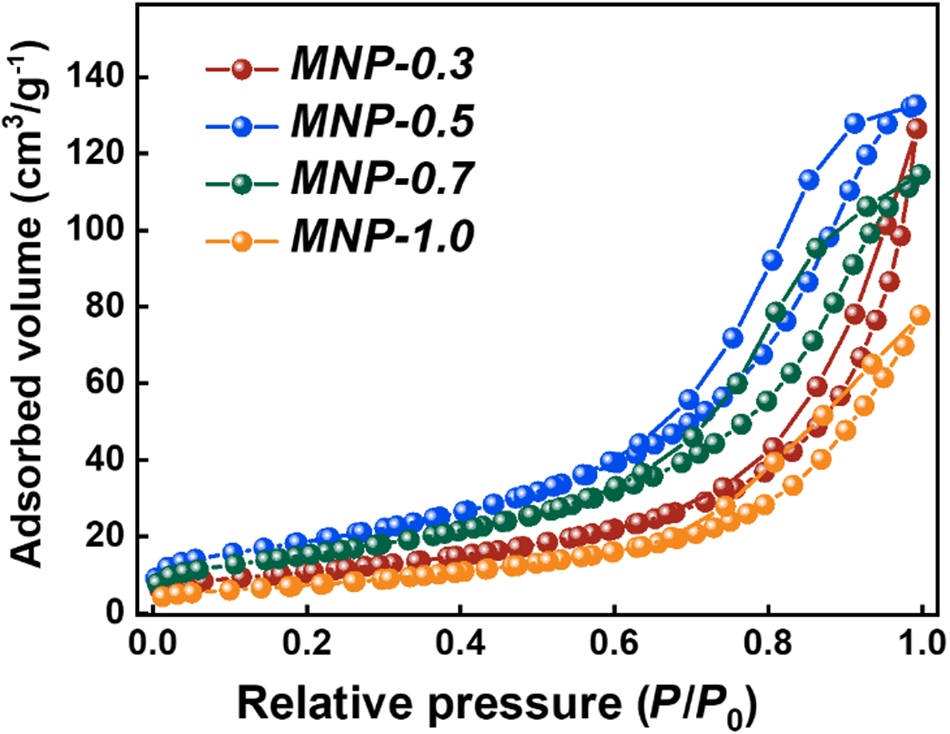
The N2 adsorption–desorption technique obtained the BET surface areas and pore-size distributions of the MNP catalysts. All samples exhibited similar type-IV curves according to the International Union of Pure and Applied Chemistry (IUPAC) classification (Fig. 4), reflecting their inherent microporous and mesoporous features (Ye et al., Reference Ye, Zeng, Tan, Wu, Liang and Song2020; Huang et al., Reference Huang, Xiao, Yi, Li, Liu and Liu2022). Specifically, MNP-0.5 possessed a larger specific surface area of 68.79 m2 g–1 compared to MNP-0.3 (39.30 m2 g–1), MNP-0.7 (56.89 m2 g–1) and MNP-1.0 (27.98 m2 g–1).
N2 adsorption–desorption isotherms of MNPs.

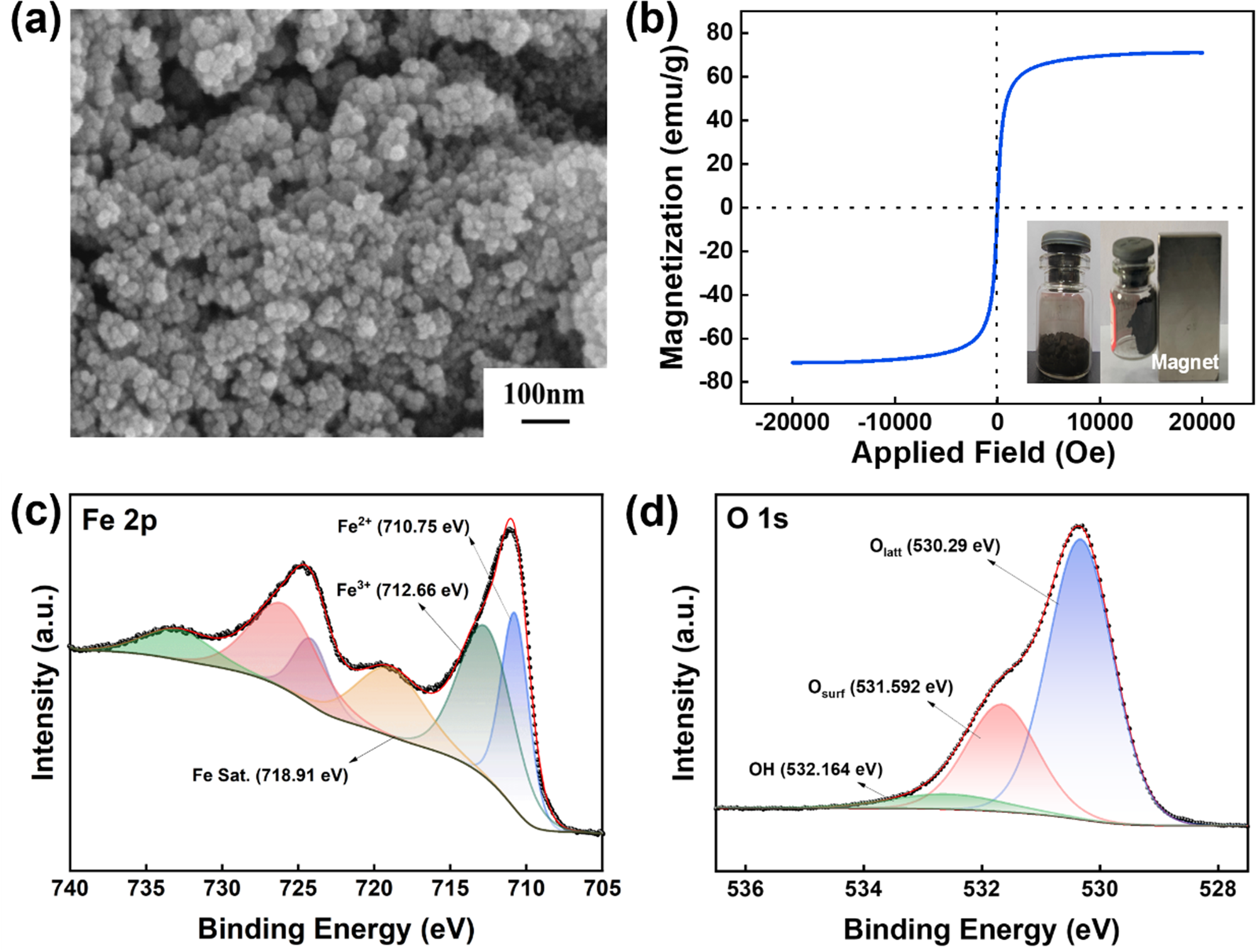
Based on the specific surface area measurements, MNP-0.5 and MNP-0.7 were selected for further investigation of their surface morphology, and the catalysts were characterized by SEM. As shown in Fig. 5a, MNP-0.5 is nanoscale in size and presents a uniformly distributed, spherical, stacked structure but a tendency to form aggregates. This is typical of magnetic nanomaterials synthesized by co-precipitation due to their strong interparticle magnetic dipole interactions and hydrogen bonding facilitated by their surface hydroxyl groups (Fouad et al., Reference Fouad, Zhang, El-Didamony, Yingnan, Mekuria and Shah2019; Rani et al., Reference Rani, Winantari, Amrillah and Setyawan2025). Statistical analysis revealed that the spherical MNP-0.5 particles predominantly ranged between 20 and 30 nm in diameter, with an average size of 23.36 nm (Fig. S1). As shown in Fig. S2, MNP-0.7 exhibited a similar spherical packing morphology. The particle sizes of MNP-0.7 were primarily distributed from 20 to 40 nm, with an average diameter of 29.85 nm (Fig. S3). The successful synthesis of nanoscale Fe3O4 was confirmed. Compared with MNP-0.7, the particle size of MNP-0.5 is smaller, which is also conducive to the greater exposure of active sites (Zou et al., Reference Zou, Li, Li and Zhao2025). VSM measurements (Fig. 5b) revealed that MNP-0.5 displays paramagnetic behaviour, characterized by a high saturation magnetization (Ms) of 71.02 emu g–1 and negligible coercivity and remanence. This strong magnetic response enabled the rapid and efficient separation of the catalyst from the solution within seconds, as illustrated in the inset of Fig. 5b, which captures the catalyst being attracted to an external magnet.
The characteristics of MNP-0.5: (a) SEM images of MNP-0.5. (b) Room-temperature magnetization curve and the magnetic properties of MNP-0.5; (c) Fe 2p XPS spectrum; and (d) O 1s XPS spectrum.

XPS analysis was conducted to further determine the elemental composition and valence states of MNP-0.5. The survey spectrum (Fig. S4) exhibits characteristic peaks of Fe 2p, O 1s and C 1s at ∼720, 530 and 284 eV, respectively. The elemental iron content was quantified as 20.42 wt.%. The C 1s signal can be attributed to adventitious carbon, which was used as a reference for binding energy calibration (Fig. S5). As shown in the high-resolution Fe 2p spectrum (Fig. 5c), the peaks located at 710.75 and 712.66 eV correspond to Fe(II) 2p3/2 and Fe(III) 2p3/2, respectively (Ouyang et al., Reference Ouyang, Zeng, Zhu, Yao, Yang and Long2023). A satellite peak is also observed at 718.91 eV. Peak-fitting analysis revealed that the relative proportions of Fe(II) and Fe(III) are 39.80% and 60.20%, respectively. The slightly greater Fe(II) content compared to the theoretical value may be attributed to the excessive addition of ammonia during synthesis, which promoted the formation of a stable iron–ammine complex that helped preserve Fe(II) against oxidation, thereby increasing its relative concentration (Li et al., Reference Li, Xiang, Li, Gu, Dong and Wu2023). The high-resolution O 1s spectrum (Fig. 5d) displays three fitted peaks at binding energies of 530.29, 531.59 and 532.16 eV assigned to lattice oxygen, oxygen defects and adsorbed oxygen, respectively. Their relative proportions are 66.85%, 26.89% and 6.26%. A notable amount of oxygen vacancies and defects can be associated with the use of high-concentration ammonia water during synthesis, which could perturb the crystallization process and promote the formation of defective Fe3O4 (Zhu et al., Reference Zhu, Zhou, Fei, Cheng, Zhu, Deng and Ma2022).
Optimization and practical assessment of the MNP/H2O2 system
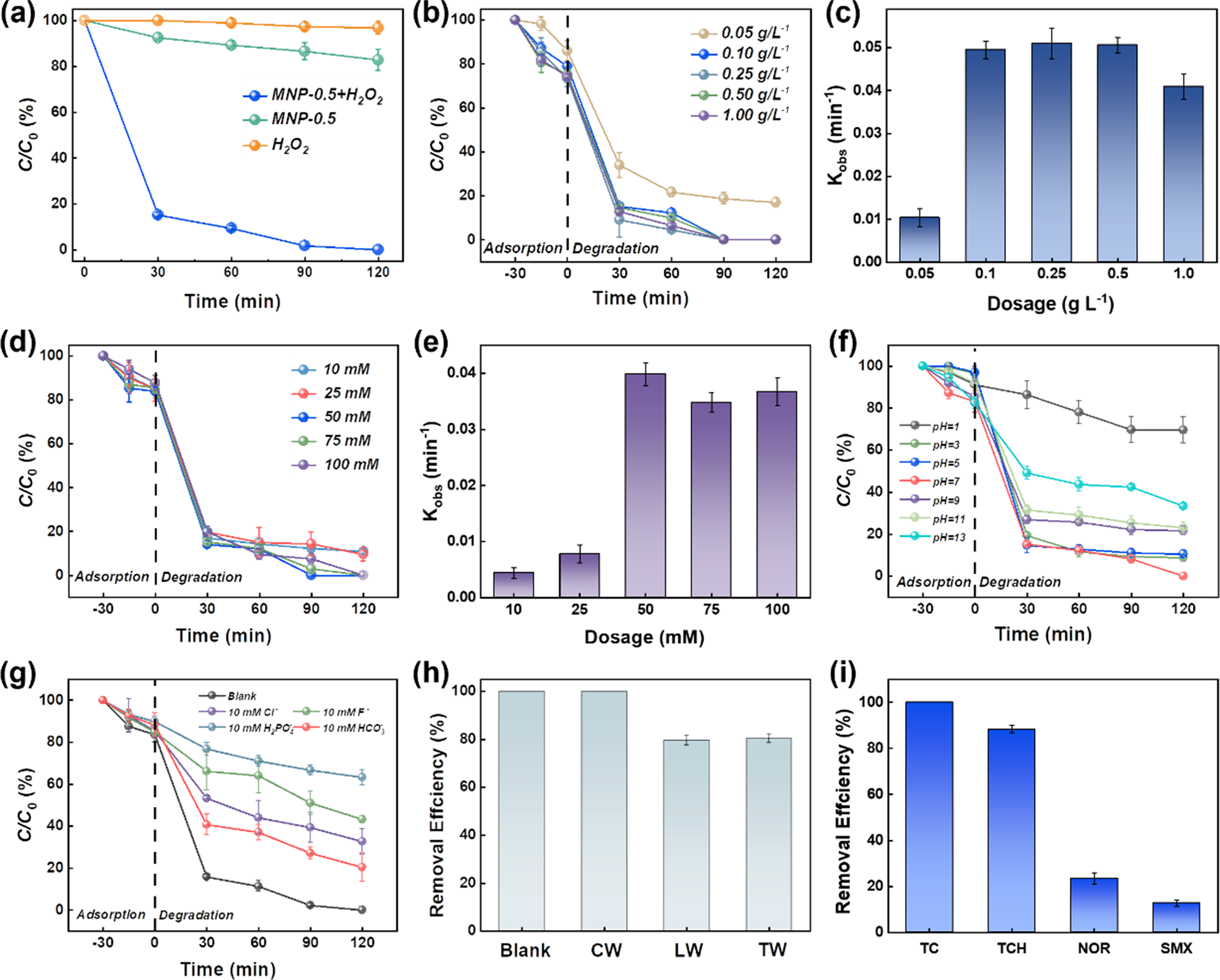
As shown in Fig. 6a, when H2O2 was added alone, the removal rate of TC reached only 4.84% after 120 min of reaction, indicating that H2O2 exhibited negligible degradation efficiency regarding TC. In the MNP-0.5-only system, the removal rate of TC reached 19.89%, which can be attributed to the inherent adsorption capacity of Fe3O4. In contrast, when MNP-0.5 and H2O2 were introduced, the TC removal rate reached 100% within 90 min, indicating that MNP-0.5 effectively activates H2O2 to degrade TC.
(a) TC degradation experiments of various systems. (b) Dosage of catalyst and (c) Kobs of MNP-0.5 degradation of TC at various dosages. (d) Dosage of H2O2 and (e) Kobs of MNP-0.5 degradation of TC at various H2O2 dosages. The oxidation activity of MNP-0.5 is show for: (f) various pH value environments; (g) effects of coexisting ions; (h) actual wastewater experiment; (i) the degradation of various types of antibiotics. Reaction conditions: [catalyst] = 0.1 g L–1, [H2O2] = 50 mM, [contaminants] = 20 mg L–1, pH = 7 (if not adjusted), T = 298 K.

The influence of parameters such as catalyst dosage and H2O2 concentration was further evaluated to achieve the best performance of the catalyst. Figure 6b illustrates the combined adsorption and degradation effects of TC under various MNP-0.5 dosages. The adsorption efficiency progressively increased from 14.03% to 26.55% as the catalyst loading rose from 0.05 to 1.0 g L–1, which is attributable to the enhanced availability of active adsorption sites at higher nanoparticle concentrations. Notably, the catalytic degradation exhibited distinct characteristics across various dosage ranges. While systems containing ≥0.1 g L–1 MNP-0.5 achieved complete TC removal within 120 min, the 0.05 g L–1 system demonstrated inferior performance, with only 83.04% removal efficiency. Kinetic analysis (Fig. 6c) revealed the relationship between catalyst loading and degradation rate. Kobs increased significantly from 0.0103 to 0.0510 min–1 as the dosage increased from 0.05 to 0.25 g L–1. However, further increases in catalyst loading beyond 0.25 g L–1 resulted in a paradoxical decrease of Kobs to 0.0490 min–1, suggesting nanoparticle aggregation-induced site blocking at elevated concentrations (Ren et al., Reference Ren, Wang, Hu, Guo, Gao and Huang2024). This particle agglomeration phenomenon probably reduces both active surface area and catalytic accessibility. The optimal MNP-0.5 dosage was determined as 0.1 g L–1 for subsequent experiments based on a comprehensive evaluation of reaction kinetics and economic feasibility. This loading achieved efficient TC degradation (100% removal in 90 min) while maintaining favourable reaction kinetics (Kobs = 0.0495 min–1) without significant nanoparticle aggregation effects.
The influence of H2O2 concentration (10–100 mM) is presented in Fig. 6d. When the H2O2 dosage increased from 10 to 50 mM, the TC removal efficiency improved from 89.12% to 100%, which is attributed to the enhanced generation of ROS at elevated H2O2 concentrations. Further increasing the H2O2 concentration to 100 mM maintained complete TC removal (100%), indicating that a 50 mM H2O2 dosage suffices for complete TC elimination. Figure 6e presents the apparent rate constants for TC removal under various H2O2 concentrations. The apparent rate constant increased significantly from 0.0044 min–1 at 10 mM H2O2 to 0.0398 min–1 at 50 mM H2O2. However, increasing H2O2 to 100 mM resulted in a decreased Kobs, which is attributed to the scavenging effect of excess H2O2 on ·OH and the formation of less reactive hydroperoxyl radicals (HO2·; Ma et al., Reference Ma, Dong, Zheng, Tang, Zhang and Zhao2025). Thus, 50 mM H2O2 was optimal.
The practical potential of MNP-0.5 was systematically evaluated. As shown in Fig. S6, the mineralization capability was confirmed by total organic carbon (TOC) analysis, which revealed a removal efficiency of 34.78% after 120 min in the presence of H2O2, a significant enhancement compared to the mere 9.38% removal by adsorption alone. Furthermore, as summarized in Table S1, the degradation efficiency of TC by MNP-0.5 surpasses that of most reported Fe3O4-based catalysts. However, recycling experiments (Fig. S7) revealed a limitation in its long-term stability, with the degradation efficiency dropping to 42.91% and 10.57% in the second and third cycles, respectively. This notable deactivation is primarily attributed to the passivation of active sites, probably caused by the formation of a surface oxide layer during the magnetic recovery process (Haji et al., Reference Haji, Sabea, Aljawder, Al-Aradi, Al-Khateeb, Elkanzi and Ahmed2021).
The catalytic activity across a wide pH range (1–13) is shown in Fig. 6f. At pH 1, only 31.5% TC removal was achieved after 120 min, primarily due to the rapid oxidation of Fe2+ to Fe3+ under strongly acidic conditions, which inhibits the Fenton-like reaction (Liu et al., Reference Liu, Tang, Wang, Zhang and Yuan2024a). In contrast, under alkaline conditions (pH 9–13), TC removal efficiencies decreased to 78.36%, 76.97% and 66.67% at pH 9, 11 and 13, respectively. This decline stems from two synergistic effects: (1) the formation of iron hydroxide precipitates via reaction between Fe ions and hydroxyl groups (OH⁻), which reduces active catalytic sites; and (2) accelerated decomposition of H2O2 into H2O and O2 under alkaline conditions, suppressing the generation of the hydroxyl radicals (⋅OH) critical for degradation (Liu et al., Reference Liu, Long, Liu, Wang, Zhang, Zhang and Liang2024b). Notably, within the pH range of 3–7, TC underwent near-complete removal, which is primarily attributed to its neutral or zwitterionic state, which facilitates adsorption onto the catalyst surface for enhanced surface-mediated reactions while concurrently maintaining Fe3O4 stability, which promotes ROS generation.
The influence of common anions (Cl⁻, F⁻, HCO3⁻ and H2PO4⁻; 10 mM) is shown in Fig. 6g. As the results show, all tested anions exhibited varying inhibitory effects on TC removal. H2PO4⁻ demonstrated the most pronounced suppression, reducing the TC removal efficiency to 36.72%. This potent inhibition arises from two mechanisms: (1) the high affinity of H2PO4⁻ for active surface sites on MNP-0.5, which blocks catalytic activity; and (2) its scavenging effect on hydroxyl radicals via competitive reactions (Equation 3), thereby diminishing oxidative degradation. In systems containing F⁻ and Cl⁻, TC removal efficiencies decreased to 56.77% and 67.33%, respectively. These halogen ions react with ⋅OH to form less reactive halogenated radicals (Equation 4), weakening the overall oxidative capacity. Similarly, the presence of HCO3⁻ reduced TC removal to 79.63%, as bicarbonate ions (HCO3−) scavenge ⋅OH to generate carbonate radicals HCO3∙ (Equation 5), which exhibit lower reactivity regarding TC degradation (Yang et al., Reference Yang, Pignatello, Ma and Mitch2016). These findings collectively highlight that the competitive quenching of reactive radicals by inorganic anions constitutes the primary limiting factor in TC degradation efficiency.
 \begin{equation}{{\text{H}}_2}{\text{PO}}_4^ - + \cdot{\text{OH}} \to {{\text{H}}_2}{\text{PO}}_4^\cdot + {\text{O}}{{\text{H}}^ - }\end{equation}
 \begin{equation}{\text{C}}{{\text{l}}^ - } + \cdot{\text{OH}} \to {\text{HOC}}{{\text{l}}^{\cdot - }}\end{equation}
 \begin{equation}\cdot{\text{OH}} + {\text{HCO}}_3^ - \to {\text{O}}{{\text{H}}^ - } + {\text{HCO}}_3^\cdot\end{equation}
The applicability of the MNPs was tested in copper-containing wastewater (CW), lake water (LW) and tap water (TW; Fig. 6h). Within 120 min, TC removal efficiencies reached 100%, 79.53% and 80.32% in CW, LW and TW, respectively, demonstrating robust tolerance of MNP-0.5 to complex aqueous environments. However, slightly reduced removal efficiencies in LW and TW were observed compared to CW. This attenuation probably stems from two factors: (1) competitive adsorption of coexisting anions and organic contaminants in LW and TW, which may occupy active sites on Fe3O4 surfaces; and (2) the consumption of ROS by these impurities during the catalytic process (Wang & Wang, Reference Wang and Wang2021). Despite these interferences, the system demonstrated robust catalytic performance, underscoring its potential for real-world wastewater treatment. As shown in Fig. 6i, TC, TC hydrochloride (TCH), norfloxacin (NOR) and sulfamethoxazole (SMX) were used as target pollutants to investigate the selective removal performance of the MNP-0.5/H2O2 system regarding various antibiotics. The MNP-0.5/H2O2 system achieved 100% removal of TC within 120 min and an 88.37% removal rate for TCH. However, the system exhibited poor catalytic performance regarding NOR and SMX, with removal rates reaching only 23.45% and 12.33%, respectively. The higher degradation efficiency of TC and TCH stems from their stronger adsorption onto the catalyst, which is a crucial step in the heterogeneous Fenton-like process, where ROSs are primarily generated on the surface, ensuring efficient pollutant–oxidant contact (Wang et al., Reference Wang, Yang, Guo, Wang and Zheng2023; Liu et al., Reference Liu, Wang, Yang, Liu and Liu2025a).
Roles and identification of ROS
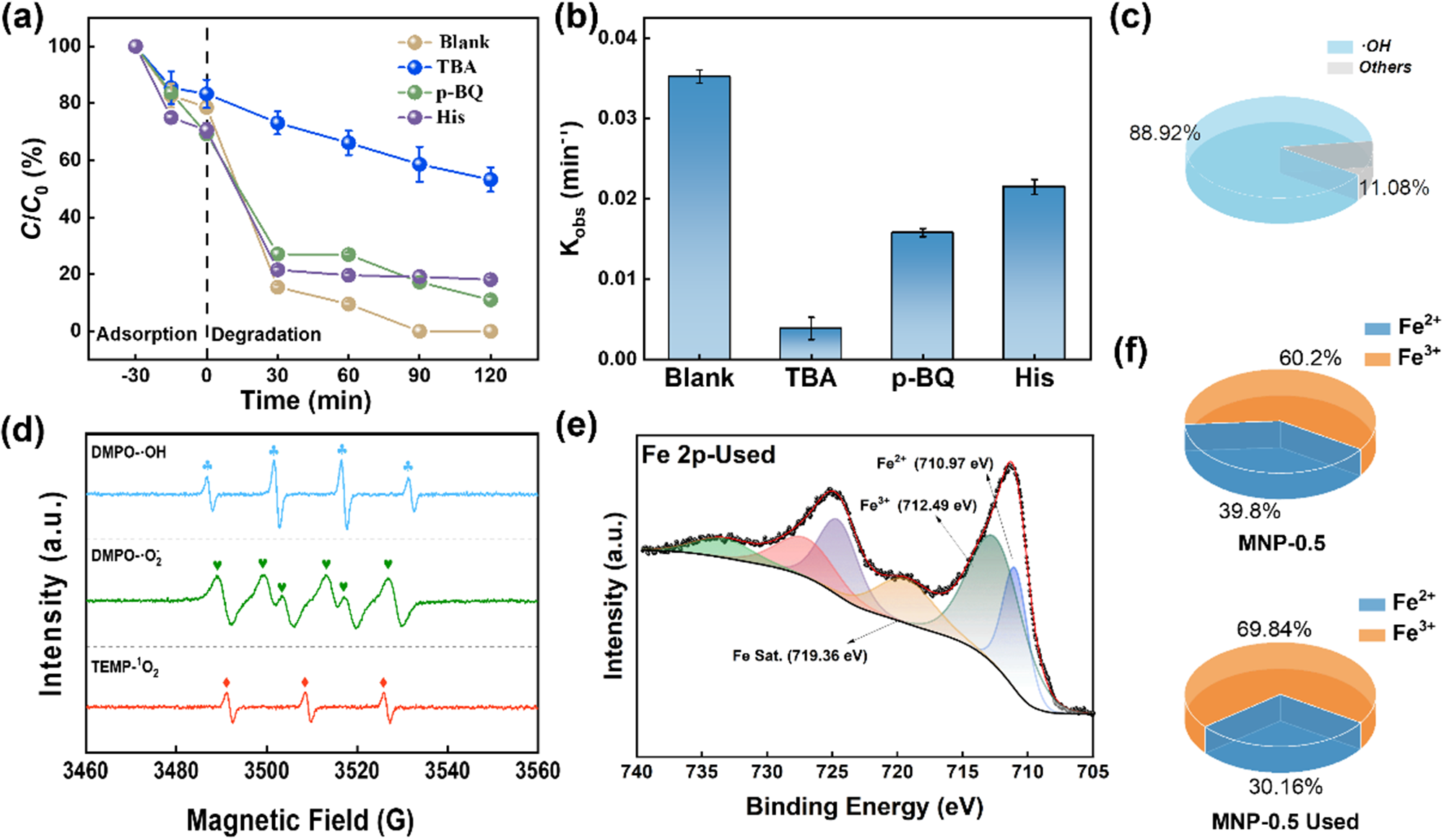
To further validate the roles of these reactive species and quantify their contributions to TC degradation, quenching experiments were performed using TBA (⋅OH scavenger), p-BQ (⋅O2⁻ scavenger) and His (1O2 scavenger). As depicted in Figs 7a & S8, adding TBA drastically inhibited TC removal, reducing the removal efficiency from 100% to 46.77%, suggesting that ⋅OH serves as the primary reactive species responsible for TC degradation. In contrast, introducing p-BQ or His resulted in comparatively minor suppression, with TC removal rates decreasing to 88.97% and 81.37%, respectively, indicating that ⋅O2⁻ and 1O2 also participate in the degradation process, but to a lesser extent. Furthermore, quantitative analysis of the contribution rate of ⋅OH was conducted based on scavenging kinetics. As illustrated in Fig. 7b,c, ⋅OH accounted for the majority of the degradation activity, with a relative contribution of 88.92%, underscoring its dominant role in the oxidative degradation of TC.
Reaction mechanism of MNP-0.5/H2O2 systems. (a) TC degradation in the presence of various scavengers and (b) Kobs data; (c) ROS contribution rate; (d) EPR tests; (e) Fe 2p of MNP-0.5 after reaction; (f) the change in the valence state of iron before and after the reaction. Reaction conditions: [catalyst] = 0.1 g L–1, [H2O2] = 50 mM, [contaminants] = 20 mg L–1, [scavenger] = 10mM, pH = 7, T = 298 K.

Furthermore, EPR spectroscopy was employed to detect ROSs. As shown in Fig. 7d, reactive species were detected using 5,5-dimethyl-1-pyrroline-N-oxide (DMPO) as the spin-trapping agent for ⋅OH and ⋅O2⁻ and 2,2,6,6-tetramethyl-4-piperidone (TEMP) for 1O2. Distinct EPR signals corresponding to DMPO-⋅OH, DMPO-⋅O2⁻ and TEMP-1O2 adducts were observed in the MNP-0.5/H2O2 system, confirming the generation of ⋅OH, ⋅O2⁻ and 1O2 during the reaction. These findings are consistent with the results obtained from the quenching experiments.
The residual H2O2 concentration was monitored over time via the potassium titanium oxalate method (Fig. S9). Within 120 min, 47.35 mM of H2O2 was consumed, corresponding to a utilization efficiency of 94.71%. These results confirm the outstanding catalytic performance of MNP-0.5, which facilitates rapid and efficient generation of ROS. To further investigate the catalyst’s evolution, XPS analysis of the used MNP-0.5 after the reaction was conducted. The high-resolution Fe 2p spectrum revealed a significant shift in the oxidation state of the catalyst after reaction. Compared to the fresh catalyst, the Fe2⁺ content decreased from 39.80% to 30.16%, whereas the Fe3⁺ content increased from 60.20% to 69.84%, as illustrated in Fig. 7e,f. This change can be attributed to the oxidation of surface Fe2+ during the activation of H2O2 (Equation 6), wherein Fe2+ acts as the primary active site. The limited electron transfer from bulk Fe2+ to the surface further contributed to the accumulation of Fe3+, underscoring the surface-dominated redox mechanism within the MNP-0.5/H2O2 system (Dong et al., Reference Dong, Du, Dong, Che, Kong and Cheng2022).
Mechanistic analysis reveals that ⋅OH is predominantly generated via Fe2+-activated H2O2 decomposition (Equation 6). Subsequent reactions between residual H2O2 and ⋅OH yield hydroperoxyl radicals (⋅HO2; Equation 7). Additionally, Fe3+ reacts with H2O2 to produce ⋅HO2 (Equation 8), which decomposes into ⋅O2⁻. The formation of 1O2 is primarily attributed to the dismutation (or self-reaction) of ⋅O2⁻, as represented in Equation 9 (Xie et al., Reference Xie, He, Pei, Dong, Yang and Xiong2023). Collectively, the degradation of TC in the MNP-0.5/H2O2 system involves synergistic contributions from ⋅OH (dominant), ⋅O2⁻ and 1O2. These findings elucidate the multi-radical pathways underpinning the oxidative degradation mechanism.
 \begin{equation}{\text{F}}{{\text{e}}^{2 + }} + {{\text{H}}_2}{{\text{O}}_2} \to {\text{F}}{{\text{e}}^{3 + }} + \cdot{\text{OH}}\end{equation}
 \begin{equation}\cdot{\text{OH}} + {{\text{H}}_2}{{\text{O}}_2} \to \cdot{\text{H}}{{\text{O}}_2} + {{\text{H}}_2}{\text{O}}\end{equation}
 \begin{equation}{\text{F}}{{\text{e}}^{3 + }} + {{\text{H}}_2}{{\text{O}}_2} \to {\text{F}}{{\text{e}}^{2 + }} + \cdot{\text{H}}{{\text{O}}_2} + {{\text{H}}^ + }\end{equation}
 \begin{equation}2\cdot{\text{O}}_2^ - + 2{{\text{H}}^ + } \to {}_{ }^1{{\text{O}}_2} + {{\text{H}}_2}{{\text{O}}_2}\end{equation}
Degradation mechanism in the MNP-0.5/H2O2 system
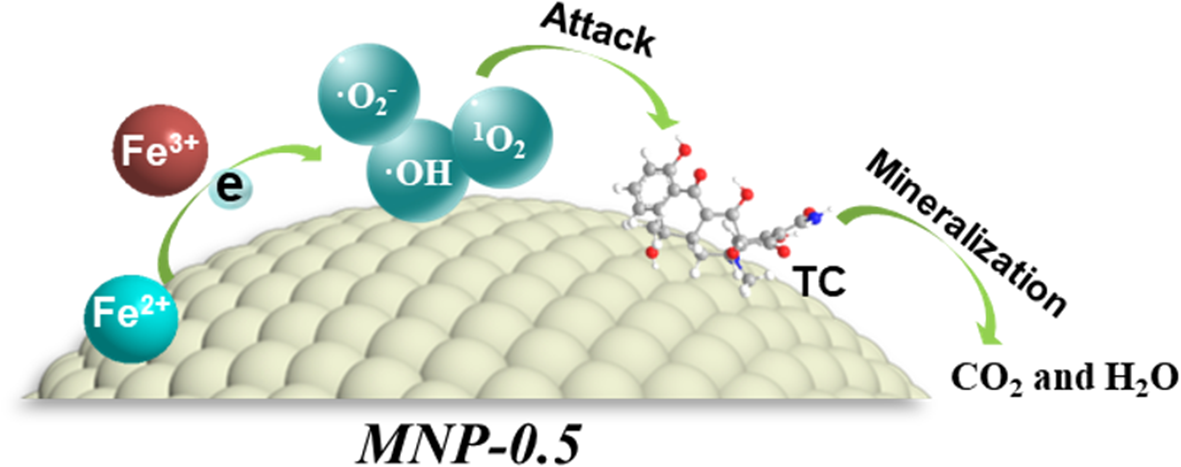
Based on the aforementioned results, a degradation mechanism is summarized in Fig. 8. The process begins with the adsorption of TC molecules onto the Fe3O4 surface. The adsorbed TC is then rapidly degraded primarily by ·OH, generated from the activation of H2O2 by surface-bound Fe2+. Concurrently, residual H2O2 reacts with ⋅OH to form ⋅O2⁻ (Equation 7), which subsequently undergoes self-reaction to 1O2 (Equation 9). Collectively, these ROS facilitate the ring-opening reactions of TC and its intermediates, ultimately leading to their mineralization into CO2 and H2O.
Mechanistic diagram of MNP-0.5’s adsorption–catalytic degradation of TC.

Conclusions
A magnetic Fe3O4 catalyst (denoted as MNP) was successfully synthesized via a simple one-step co-precipitation approach. By optimizing the Fe2+/Fe3+molar ratio to 0.5, the resulting material (MNP-0.5) exhibited high purity, a relatively large specific surface area (68.79 m2 g–1), small particle size (23.26 nm) and strong superparamagnetic properties (Ms = 71.02 emu g–1). The MNP-0.5/H2O2 system demonstrated remarkable efficiency, achieving not only complete degradation of TC (20 mg L–1) within 90 min, but also a 34.78% mineralization rate (TOC removal) after 120 min under optimal conditions (0.1 g L–1 catalyst, 50 mM H2O2). Moreover, its overall degradation performance surpasses that of most documented Fe3O4-based catalytic systems. A notable advantage of this system is its high catalytic activity over a broad pH range (3–7), overcoming the stringent acidic requirement of the classical Fenton reaction. Coexisting anions inhibited degradation in the order H2PO4⁻ > F⁻ > Cl⁻ > HCO3⁻. The system also retained significant activity (>79%) in real water samples, including LW and TW. Mechanistic investigations verified that ·OH is the dominant reactive species in TC degradation, with ⋅O2⁻ and 1O2 playing auxiliary roles. The catalyst can be readily recovered via magnetic separation, suggesting its good potential for reuse. These features highlight the practical applicability of the system in wastewater treatment in terms of efficiency, cost-effectiveness and environmental sustainability. Future studies will focus on enhancing the catalyst’s reusability, assessing its long-term stability and expanding its applications to other emerging contaminants.
Supplementary material
The supplementary material for this article can be found at https://doi.org/10.1180/clm.2025.10017.
CRediT authorship contribution statement
Ping Zhang: Conceptualization, supervision, writing – review & editing, resources. Zhanli Chen: Writing – review & editing. Xu Cao: Investigation, writing – original draft, formal analysis. Kunlei Wang: Investigation, writing – original draft, formal analysis. Fei Long: Investigation. Bo Zeng: Investigation, formal analysis. Longyong Wu: Investigation, methodology, formal analysis.
Financial support
This work was supported by the National Natural Science Foundation of China (No.52160020), the Key R&D Program of Jiangxi Province-General Projects (No. 20223BBG71014), the Jiangxi Provincial Natural Science Foundation Key Project (20242BAB26036) and the Earmarked Fund for Jiangxi Agriculture Research System (No. JXNK202306-04).
Competing interests
The authors declare that they have no known competing financial interests or personal relationships that could have appeared to influence the work reported in this paper.
Data availability
All relevant data are available within the manuscript and its supplementary information files.