Claims about the inevitable decline of corporatism have become commonplace in the literature on the comparative political economy of advanced industrial countries (Grahl and Teague Reference Grahl and Teague1997). Once seen by many observers as a highly efficient political economic system, the viability of corporatism is often questioned. Notably, centralized wage bargaining at the national level between unions, employers’ associations and the government – a key feature of many corporatist regimes – is no longer practised, even in canonical cases of corporatism, like Sweden (Pontusson and Swenson Reference Pontusson and Swenson1996).
Arguments about the inevitable decline of corporatism have been applied particularly forcefully to Central and Eastern Europe since the collapse of communism in 1989–91. Despite the claims of some researchers that transformative corporatism – essentially a form of social pacts – played a key role in a few countries in the early 1990s after the fall of communism (for example, Hungary, Czechoslovakia and Bulgaria) (Iankova Reference Iankova1998), the general trend in the region has been towards decentralization and fragmentation. Collective bargaining has occurred primarily at the company level, and coverage rates have been quite low. Social pacts have also been much less prominent than they were at the outset of the transition process in the early 1990s (Myant et al. Reference Myant, Slocock and Smith2000). Unions have lost members throughout the transition period, and employers’ associations have mostly been weak and fragmented. This has led one observer of Central and East European industrial relations to use the label ‘illusory corporatism’ to describe the kinds of tripartite bargaining that occurred in the region (Ost Reference Ost2000).
Yet, a few studies have noted that there is one country that has bucked the trend. Generally viewed as the only coordinated market economy in the region, Slovenia established centralized bargaining at the national level with a coverage rate of close to 100 per cent (Crowley and Stanojević Reference Crowley and Stanojević2011; Feldmann Reference Feldmann2006). Regular negotiations between trade unions, employers’ associations and the government have been highly institutionalized in the Economic and Social Council since 1994, and social pacts have played an important role, also in the run-up to euro adoption in 2007. A few studies have sought to identify the causes of Slovenian exceptionalism, highlighting pre-capitalist networks and their continuity (Feldmann Reference Feldmann2007), national traditions and ideas (Lukšič Reference Lukšič2003; on corporatist ideas in the 1920s and 1930s, see Zver Reference Zver1992) or power resources (Crowley and Stanojević Reference Crowley and Stanojević2011). Other scholars have examined the ways in which specific bargaining dynamics have contributed to the adoption of tripartite agreements at various times (Stanojević and Krašovec Reference Stanojević and Krašovec2011). However, more recently, some studies have cast doubt on the sustainability of Slovenian corporatism (Stanojević Reference Stanojević2012).
This article engages with the debate surrounding Slovenian corporatism. It re-examines the controversy about the origins of Slovenian exceptionalism and assesses its sustainability. Given the emphasis in the classical corporatist literature on flexible adjustment to crises and shocks, this article also examines how corporatist institutions have shaped Slovenia's response to the global financial crisis. More generally, how well have corporatist institutions held up in the face of global pressures, including the economic crisis and EU membership, and what does this suggest about the viability of corporatism?
This article draws on coalitional accounts of institutions (Mahoney and Thelen Reference Mahoney and Thelen2010). Instead of seeking the determinants of centralized bargaining solely in union pressure, employer preferences or government action, this article is premised on the idea that the support of all these actors is essential. If one of them chooses to defect, then tripartite bargaining is no longer possible. The main argument of this article is that a set of idiosyncratic legacies and economic challenges facilitated the formation of a cross-class coalition underpinning centralized bargaining in the 1990s. This was an integral part of the negotiated and egalitarian approach to transition in Slovenia. However, as a result of mutually reinforcing structural, organizational and political changes, this equilibrium has been gradually undermined over the last decade. Other aspects of Slovenian exceptionalism as a coordinated market economy, including sectoral bargaining, have not been affected by these processes.
This article begins with a brief overview of corporatism and the coalitional approach adopted here. It then turns to the analysis of Slovenian corporatism and the factors promoting its emergence. The next section examines the Slovenian experience in the context of the global economic crisis and the unravelling of the coalition underpinning centralized national bargaining. The final section concludes with some general lessons.
Corporatism and Its Decline
At the height of the crisis of the 1970s, characterized by the oil shocks and stagflation, Philippe Schmitter (Reference Schmitter1974) posed the question of whether this was ‘still the century of corporatism’. Answering the question in the affirmative, he concluded that corporatism as a form of interest representation and policymaking involving peak associations of labour and employers played a central role in many countries. After the publication of Schmitter's seminal paper an enormous literature on corporatism emerged, and the pluralism–corporatism debate became one of the most contested and extensively analysed issues in comparative politics and political economy (Crouch Reference Crouch1983; Lehmbruch Reference Lehmbruch1977; Molina and Rhodes Reference Molina and Rhodes2002).
Many subsequent studies found that corporatist institutions helped the small and export-oriented Western European economies adapt to the oil shocks and changing global conditions (Katzenstein Reference Katzenstein1985). Corporatist countries fared better in terms of growth, unemployment and structural adjustment than countries that lacked these institutions, given that they facilitated flexible and comprehensive solutions to adjustment challenges (Crepaz Reference Crepaz1992).
However, more recently, analyses of corporatism have mostly focused on its decline. In particular, numerous studies have documented the decentralization of bargaining. While some observers have suggested that corporatist-style institutions may no longer be viable, others have stressed that sectoral, rather than national-level, bargaining is most compatible with contemporary macroeconomic regimes and independent central banks and that it remains sustainable (Iversen Reference Iversen2000). The analysts who still argue for the continued relevance of national bargains tend to look beyond wage bargaining, notably to social pacts – for example, in the context of European Monetary Union (EMU) accession (Avdagic et al. Reference Avdagic, Rhodes and Visser2011; Hancké and Rhodes Reference Hancké and Rhodes2005). More recently, corporatist thinking has also influenced the development of the ‘Varieties of Capitalism’ view of political economy, where industrial relations are seen to be one of a set of key characteristics distinguishing liberal and coordinated market economies (Hall and Soskice Reference Hall and Soskice2001).
The literature on corporatism has numerous strands, but three sets of explanatory factors have received extensive attention.
Structural-economic factors, including the business preferences resulting from them, have featured in a series of influential studies (Swenson Reference Swenson1991). Here the centralization of wage bargaining is primarily attributable to challenges facing specific economic sectors. In a piece synthesizing much of this literature, Iversen (Reference Iversen1996) identifies three logics of consensual wage regulation. These include attempts to constrain the free-riding by some unions on the wage restraint of others, the objective of ensuring flexible wage structures and working conditions under centralized rules and the reconciliation of redistributive organizational goals with differentials in the market power of different occupational groups. This could be related to attempts to rein in inflationary pressures generated by a specific sector, such as the construction industry in Swenson's classic account (1991) of the origins of centralized wage bargaining in Sweden. Under such conditions cross-class coalitions could emerge, where both employers and unions favoured centralization. Such approaches tend to see the source of the decline of corporatism in the decline of Keynesian macroeconomic policy and Fordist production processes, which profoundly reshapes interests. In this context of more knowledge-intensive production models, new cross-class flexibility coalitions could emerge (Pontusson and Swenson Reference Pontusson and Swenson1996).
The second strand of the literature focuses on organizational factors, such as the structure and power of key interest groups. The most influential approach is the so-called ‘Power Resource Theory’ (PRT), which highlights the central role of organized labour in demanding negotiations and concessions from employers (Korpi Reference Korpi2006). The threat of strikes is a key factor in pushing the employers to the negotiating table. Another theory emphasizes the importance of the degree to which employers’ associations and especially trade unions are encompassing. In this case, encompassing unions bring about high degrees of wage bargaining centralization, as they have the capacity to ensure that agreements are enforced and respected by their members. Strong unions that are not encompassing may not internalize the effect of wage increases for their members on the entire economy. This can account for the Calmfors–Driffill (Reference Calmfors and Driffill1998) hypothesis of an inverted U-shaped relationship between centralization and inflation. This perspective suggests that falling unionization rates are another key factor contributing to the decentralization of wage bargaining.
Finally, a third strand of the literature highlights the political roots of centralization. For example, in recent work Martin and Swank (Reference Martin and Swank2011) emphasize the role of the state and the nature of political competition in bringing about the centralization of employers’ associations. They find that centralized employers’ associations were most likely to emerge in unitary states with multiparty systems, whereas such centralization failed to emerge in federal states with two-party systems. Within many power resource theory writings, political factors are also central, as the existence of an electorally successful social democratic party allied with strong union movement is also associated with centralization (Korpi Reference Korpi2006). More generally, there may also be a general commitment to consensus politics across the political spectrum, usually taken to be related to the electoral system or national traditions, which may be associated with corporatism and tripartite concertation (Lijphart and Crepaz Reference Lijphart and Crepaz1991).
Drawing on recent work in political economy and institutional theory, this article seeks to go beyond the three above-mentioned perspectives and to develop a coalitional approach to centralized bargaining (Mahoney and Thelen Reference Mahoney and Thelen2010). In particular, this article is premised on the idea that centralized bargaining at the national level requires the support or consent of all three kinds of actors – that is, organized labour, employers and the government. If any one of these actors decides to leave the negotiating table, then tripartite agreements are no longer feasible. There have been instances in various countries when one or several union associations, employers or the government have done this. For example, tripartite bargaining collapsed in Hungary in 2010 after the new conservative government refused to negotiate with the social partners. At various times tripartism in Poland has broken down as one of the two main union confederations – the Independent and Self-Governing Trade Union Solidarity (Solidarność)or the All-Poland Alliance of Trade Unions (OPZZ) – decided to boycott tripartite negotiations (Gąciarz and Pańków Reference Gąciarz and Pańków2001). Therefore, the absence of defection by any of these actors is a necessary condition for tripartism in general and for centralized wage bargaining in particular. As this article demonstrates, a variety of economic-structural, organizational and political factors may all contribute to making these actors inclined to support such centralization. This article seeks to explain how a coalition underpinning such a consensus came about in the Slovenian case and how, more recently, new coalitions in favour of decentralization have emerged. By analysing the general prerequisites of such coalitions in different periods, it complements accounts that focus more on specific agreements and the bargaining dynamics leading to their emergence (Stanojević and Krašovec Reference Stanojević and Krašovec2011) and sociological analyses that emphasize the systemic logic of corporatism and the role of systemic exhaustion due to internal and external pressures (Stanojević Reference Stanojević2012).
The Slovenian Political Economy
Slovenia, a small and export-dependent economy with a population of about 2 million, became independent in 1991 and chose a distinctive path to the market. Many economic reforms – such as the privatization programme – ran counter to the advice given by international experts. In recent years, several authors have analysed patterns of policymaking and economic institutions in Slovenia and classified the country as a coordinated market economy or a corporatist system – arguably the only case of such a regime in Central and Eastern Europe (Bohle and Greskovits 2007; Crowley and Stanojević Reference Crowley and Stanojević2011).
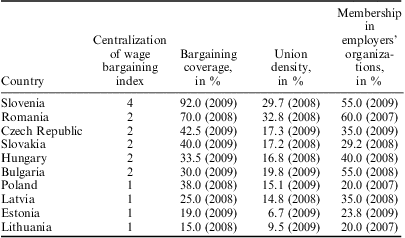
The corporatist institutions are the most remarkable element of the Slovenian political economy. While union–employer negotiations began early, even before Slovenia had gained independence, a more ambitious form of tripartism was institutionalized in 1994. This is also when the Economic and Social Council – the key organization in which employers, unions and the government negotiate about wages, social policy and a variety of related economic and regulatory policy priorities – was established. The first comprehensive national wage agreement covering the private sector was also signed in 1994. A number of national agreements for both the private and public sector and social pacts have been negotiated since that time. Until 2005 collective bargaining covered the entire labour force, and the coverage rate has remained high: 92 per cent in 2009. Although membership rates in unions and employers’ associations have fallen somewhat, they are still high by comparative standards in the region (see Table 1). In addition to national agreements, there is bargaining at the sectoral and company level. The sectoral level has become an increasingly important locus of private sector bargaining (Feldmann Reference Feldmann2006).
Industrial Relations in Central and Eastern Europe, 2009 (or most recent year indicated in brackets)

Source: Visser (Reference Visser2011).
This stands in sharp contrast to the rest of Central and Eastern Europe, where industrial relations have been decentralized. Collective bargaining has occurred mainly at the company level, and the coverage rate of agreements has been much lower. In some Central European countries social pacts played a significant role in the early 1990s, but their importance has subsequently fallen (Crowley Reference Crowley2004). Although unions and employers have more recently become involved in social dialogue at the European level, the hope harboured by some trade unions that EU membership would lead to the development of tripartism along the lines of Western European coordinated market economies has not been realized (Sissenich Reference Sissenich2007). Not even the prospect of European Monetary Union accession, which had facilitated social pacts in Western Europe, led to any strengthening of tripartism in Slovakia or Estonia, the only two euro-area members in the region apart from Slovenia.
What can explain the Slovenian outcome? As noted by several authors (Crowley and Stanojević Reference Crowley and Stanojević2011; Feldmann Reference Feldmann2007), specific communist legacies facilitated this. The Slovenian political economy was shaped by the unique Yugoslav variety of socialism. Although Yugoslavia initially developed an orthodox Soviet model of central planning after the Second World War, a significant decentralization of the economy occurred after 1948. Yugoslav socialism became known for its adherence to a model based on self-management. Most importantly, Yugoslavia abolished compulsory output and input targets, and the role of the market increased substantially.
This legacy facilitated the emergence of corporatism in the 1990s in two ways. First, relative to other communist systems, the Yugoslav model strengthened the autonomy of workers and management (Granick Reference Granick1975; Lydall 1989). Works councils had significant leeway to negotiate on wages and to influence decision-making within enterprises. There were also some horizontal ties between firms – for example, some inter-enterprise borrowing (Brus and Laski Reference Brus and Laski1989). While not genuinely independent, trade unions and chambers of commerce played a greater role in interest representation in Yugoslavia than in any other communist country except possibly Hungary (Pravda and Ruble Reference Pravda and Ruble1986). Therefore there was a tradition of more genuine involvement of managers and workers in decision-making and negotiations, which has led some observers to view this system as essentially proto-corporatist (Lukšič Reference Lukšič2003).
Second, Yugoslavia was also more integrated with world markets than other communist countries, which predominantly traded with the Soviet Union. About 17 per cent of Slovenia's output was sold abroad, and a substantial proportion of exports was directed to the West. By contrast, less than a quarter of Slovenia's national product was sold to other parts of Yugoslavia (Mencinger Reference Mencinger2004: 74). Therefore, pre-existing companies were in a better position to survive the introduction of a market economy than elsewhere in Central and Eastern Europe.
While self-management legacies may have contributed to the emergence of corporatism, it should be noted that Slovenia is the only post-Yugoslav country that has developed a corporatist system, although all the Yugoslav republics had similar institutions during the socialist period.
The decisive factor shaping a high degree of continuity is the role of a cross-class coalition for a unique method of privatization, which helped consolidate the influence of insiders – that is, managers and workers (Prašnikar et al. Reference Prašnikar, Jazbec, Mrak, Domadenik and Gregorič2002). A 40 per cent share of the privatized firms was divided equally between a Development Fund (20 per cent) and two state funds – the National Pension Fund and the Restitution Fund (20 per cent) – and 20 per cent was allocated to company insiders. The remaining 40 per cent was allocated by the company itself (either by its workers’ council or its board of directors), which could either sell it to insiders or put it out for public tender to outsiders. Therefore insiders had a central role in shaping the ownership structure of a given firm. This privatization scheme was also complemented with a voucher programme. It enabled people to buy shares of the company that employed them. This privatization strategy consolidated the role of insiders as owners and limited foreign investment in privatized companies. In 1999 insiders controlled majority stakes in 60 per cent of all companies (accounting for almost 50 per cent of the workforce, but a much smaller share of total capital) and substantial shares in most other companies as well (Simoneti et al. Reference Simoneti, Rojec and Gregorič2004: 232). The presence of the old insiders facilitated the involvement of unions and works councils in the economy. It also preserved the central role of some traditional Fordist industries in Slovenia, such as metal and chemical industries (Stanojević Reference Stanojević2011).
Privatization was highly contested in Slovenia. There were several proposals in 1991–2, including both pure insider-privatization (Korže–Mencinger–Simoneti model) and voucher-privatization (Sachs–Peterle–Umek model) (Kraft et al. Reference Kraft, Vodopivec and Cvikl1994: 210f.). At the time of the privatization debates, Slovenia had a tricameral parliament inherited from the Yugoslav period. Until the parliamentary election in 1992 it consisted of the Sociopolitical Chamber, the Chamber of Communes and Municipalities and the Chamber of Associated Labour. The Democratic Opposition of Slovenia (DEMOS) cabinet led by Prime Minister Lojze Peterle included various opposition groups and also three members of the former League of Communists, but it did not have a majority in all three houses of parliament. In particular, the third chamber, the Chamber of Associated Labour, featured strong representation of enterprise directors and other company insiders who were opposed to voucher privatization. Resistance by the third chamber effectively prevented the exclusive use of vouchers (Pleskovic and Sachs Reference Pleskovic and Sachs1994: 212). The government itself was also divided, as Prime Minister Peterle supported voucher privatization, whereas Vice Premier Mencinger was the architect of the insider privatization model. Some Christian Democrats favoured a model primarily based on restitution combined with some elements of voucher privatization. The Democratic Opposition of Slovenia cabinet collapsed in April 1992, largely as a result of conflicts over privatization. The new coalition was even broader, including both some Democratic Opposition of Slovenia members and reformist ex-communists under the leadership of Janez Drnovšek, who had served as president of Yugoslavia in 1989–90. Drnovšek proposed the privatization bill, which provided insiders – who had helped veto more extensive use of vouchers – with substantial control over enterprises. It was ultimately passed by all three chambers in November 1992. The new economic institutions also helped shape the coalition in favour of corporatist policymaking and centralized bargaining by reinforcing its economic-structural, organizational and political underpinnings.
First, in terms of economic-structural factors, this led to substantial continuity of economic actors from the pre-transition period, both with respect to the companies and their management. This stands in sharp contrast to many other transition countries in Central and Eastern Europe, whose growth strategy was premised on attracting foreign direct investment (FDI) (Nölke and Vliegenthart Reference Nölke and Vliegenthart2009). Despite having many advantages as an foreign direct investment location, Slovenia limited inward investment by adopting a very restrictive privatization method (Bandelj Reference Bandelj2004). Many of the biggest Slovenian companies were in traditional industries still largely organized along Fordist lines, and these companies played a prominent role in the Chamber of Commerce, the employers’ association of primary importance in the 1990s (Stanojević Reference Stanojević2011). As these companies were highly dependent on exports – in some cases to Western markets, in other cases to the Balkans – they were very concerned about the inflationary effects of a wage push and feared that it might be at least partially accommodated by the Central Bank. Notably, in 1993, the year preceding the first comprehensive national agreement, there was very high real wage growth – 11.6 per cent. Such concerns predisposed many employers favourably towards centralized wage agreements.
Secondly, this reform strategy also affected the organizational prerequisites of tripartism. The general pattern across Central and Eastern Europe has been that unionization in the new private sector, notably in foreign-owned companies and in small and medium-sized enterprises, is much lower than in the public sector and large traditional industry (Crowley Reference Crowley2004). Given the substantial continuity in Slovenia's economic and enterprise structure, unionization in general and in the private sector in particular was higher than elsewhere in the region. There was also significant strike activity, especially in the first half of the 1990s (but also more recently, as will be discussed below). Therefore the institutionalization of corporatism is also partly attributable to employer and government concerns about industrial peace (Crowley and Stanojević Reference Crowley and Stanojević2011). Similarly, many studies agree that the main barrier to tripartite negotiations in Central and Eastern Europe, particularly during the 1990s, was the weakness of employers’ representatives. By contrast, given that membership in the Chamber of Commerce (or Chamber of Crafts, in the case of small enterprises) was compulsory until 2006, the collective action problem involved in mobilizing employers to join a representative organization was essentially resolved by law. This also helped ensure that collective agreements covered the whole economy.
Thirdly, tripartism and centralized bargaining were also bound up with the political commitment to these processes. The key architects of much of the Slovenian reform strategy hailed from the Liberal Democratic Party (LDS), a centre-left party and the successor to the communist youth organization of the Yugoslav period, often referred to as the ‘systemic opposition’ since it was often simultaneously critical yet also a part of the system. The Liberal Democratic Party was the dominant party in virtually all governments between 1992 and 2004.Footnote 1 It had close ties to the elites in the old Yugoslav and new Slovenian system, including the privatized business sector (Tomšič Reference Tomšič2008). Given its centre-left constituency, it also had an interest in relatively egalitarian outcomes. Moreover, in cases of disagreement with the Chamber of Commerce, the government wielded strong influence over the negotiations, often threatening employer representatives by saying that they might rescind the provision of compulsory membership of the chamber.Footnote 2 Therefore the corporatist system and tripartite bargaining in the Slovenian economy were underpinned not only by economic and organizational factors but also by the long shadow of politics.
Continuity and Change: Slovenian Corporatism and The Crisis
Recent developments, especially the global economic crisis, have cast some doubt on the viability of Slovenian corporatism. Like most countries in Central and Eastern Europe, Slovenia has been affected by the crisis, notably in the form of recession and pressures on public finances. The contraction of GDP in 2009 – by 8.4 per cent – was the fifth largest in the EU. However, the impact of crises on corporatist institutions is not obvious. On the one hand, crises may heighten pressures for institutional change. On the other hand, corporatist systems performed very well during the crisis of the 1970s. This section will show that there is evidence of both continuity and change. Corporatist institutions have shaped the response to the crisis to some extent, but it is less clear whether these policies are sustainable and whether the system is viable in the longer term, as a number of long-term trends towards decentralization have been sharpened by the crisis.
There is substantial continuity, notably with respect to collective bargaining at the sectoral level. As in most countries, the crisis has triggered cutbacks in many domains of public spending, but negotiations and consultations have played a more significant role in the policy process than elsewhere in the region. For example, in February 2009 the government and trade unions signed an austerity pay deal for the public sector. This entailed a reduction of wage growth and of total spending in the public sector by about €100–120 million. This agreement involved 23 trade unions (Skledar Reference Skledar2011). Several policies have also served to protect employment and share the crisis adjustment costs in a relatively egalitarian way. Notably, the Law on Partial Refund of Pay Compensation is a good example of this. It is a temporary waiting-for-work scheme, for which up to 50 per cent of employees in eligible companies may qualify. In exchange for not working, they receive 85 per cent of their pay, but they are also required to devote at least 20 per cent of their time to education and training. Another piece of legislation guarantees subsidies to companies that choose to shorten the working week instead of laying off workers (Skledar Reference Skledar2011). Although there has not been any comprehensive national social pact to address the crisis, some of these initiatives have contributed to a relatively egalitarian approach. In particular, the Slovenian unemployment rates in March 2009 and 2010 were 5.0 per cent and 6.2 per cent – well below the EU average.
On the other hand, it is not clear whether the reforms to date have successfully addressed the internal and external pressures associated with the crisis. The public deficit rose from only 1.8 per cent in 2008 to 6.0 per cent in 2009 and has remained at a relatively high level since that time (5.5 per cent in 2010 and 5.3 per cent in 2011). These deficits have contributed to external pressure on Slovenia, as Fitch and Moody's have downgraded the credit ratings of Slovenian sovereign debt and various Slovenian banks. There has also been intense pressure for further cutbacks, not least since Slovenia is required under the excessive deficit procedure of the EU to bring down its deficit to below 3 per cent by 2013. However, cutbacks have proved difficult. The government's austerity plans contributed to a significant wave of strikes between September and October 2010, including protests against the cutbacks in public wages and social benefits as well as against a pension reform, which would entail an increase of the retirement age from a minimum of 57–8 years (depending on the number of years worked) to 65 years. The trade unions initiated a referendum on pension reform, which was voted down in June 2011 by a clear majority – 72.1 per cent – of those who participated. Another law which imposed some limits and taxes on part-time employment and which introduced the German ‘Mini Job’ model was also voted down in a referendum in April 2011 by a majority of 80.1 per cent.
The distinctiveness of the Slovenian response to the crisis can be illustrated by comparing it to Estonia and the other two Baltic states – Latvia and Lithuania – which were the only EU countries apart from Finland to experience a deeper recession than Slovenia in 2009. As shown in Table 1, the Baltic states are at the other end of the spectrum of the new Central and East European member states. Industrial relations are decentralized, and both unionization and employers’ association membership rates are very low. Estonia, in particular, has often been characterized as a liberal market economy (Feldmann Reference Feldmann2006).
However, Slovenia and Estonia also faced comparable constraints on macroeconomic policy. Since Estonia was strongly committed to a currency board arrangement, a devaluation of the national currency in response to the crisis was categorically ruled out by the government. Given that Slovenia was a member of the euro area, a devaluation was not possible either. Nevertheless, Estonia (and the other two Baltic states) responded to the crisis in a very different way from Slovenia, notably by making very substantial cuts to public spending. In the Estonian case the crisis was treated as a window of opportunity for euro adoption, and deficits were squeezed below 3 per cent to ensure that the Maastricht criteria were satisfied despite a GDP contraction of 14.3 per cent in 2009. Projected public expenditure was cut by approximately 13 per cent as a result of three austerity packages in 2009 (Raudla and Kattel Reference Raudla and Kattel2011). There were substantial reductions in both private and public sector wages as well (Dabušinskas and Rõõm Reference Dabušinskas and Rõõm2011). It should be noted that fiscal consolidation was not achieved by means of a social pact or negotiated adjustment, but imposed unilaterally by the government. Given the low deficits, the Estonian strategy was more successful in persuading international credit rating agencies of the country's creditworthiness, but this approach was much less egalitarian than the Slovenian policies and also led to a very sharp increase in unemployment. Estonian unemployment was 11.1 per cent in March 2009 and 15.5 per cent in March 2010.
In Slovenia the crisis brought about a heightened sense of conflict between the centre-left government in office in 2008–11 and the trade unions. The government increasingly adopted unilateral policy solutions and sought to move away from the tradition of consensus bargaining. Indeed, the government attempted to stop the referendum on pension reform by asking the Constitutional Court to assess whether it was constitutional given the severe budget situation (the Constitutional Court ruled that the referendum should not be deemed unconstitutional, as the government could not prove that the pension reform was the only possible way to balance public finances).
Most strikingly, while informal consultations and negotiations in the Economic and Social Council have continued – on the Law on Partial Refund of Pay Compensation, for example – no new national agreement for the private sector was signed in 2009, when the previous agreement expired. This reinforces the general trend away from national to sectoral bargaining, which is now the dominant level (Visser Reference Visser2011). This suggests that the government and employers no longer value tripartism and centralized bargaining at the national level as much as before.
While the crisis has heightened distributive conflict over adjustment costs, it is arguable that the changes to bargaining arrangements are merely a reflection of broader structural, organizational and political processes. Most of the factors which had facilitated the adoption of the corporatist bargaining at the national level in the 1990s were beginning to erode in the first decade of the twenty-first century.
First and foremost, the structure of Slovenian business has undergone gradual change. As a result of EU membership, many of the formal and informal barriers to foreign investment had dissipated, and a variety of new companies had entered the Slovenian market. Therefore, the role of traditional industry, especially in sectors characterized by Fordist production techniques, was no longer as central as it had been in the 1990s, and small- and medium-sized enterprises were also gaining in importance (Stanojević Reference Stanojević2011). As a survey by the Slovenian daily Delo found in 2005, such companies were much less satisfied with centralized agreements or the role of the Chamber of Commerce in representing the business sector (Feldmann Reference Feldmann2007). Hence there has been growing pressure to move away from centralized agreements, much like the attempts by flexibility coalitions to decentralize wage bargaining in Western Europe (Iversen Reference Iversen1996). Moreover, as a result of euro adoption in 2007, monetary policy is no longer set domestically, which means that there is less need to coordinate wage setting and national macroeconomic policy. Neither is there a need to contain inflation specifically in order to satisfy the Maastricht criteria for euro adoption.
Secondly, these broad trends have also contributed to organizational fragmentation. Until 2006, membership in the Chamber of Commerce was compulsory, although this was seen to be a violation of International Labour Organization rules in light of its participation in wage bargaining (Feldmann Reference Feldmann2006). In 2006 the centre-right government abolished the law on compulsory membership, and as a result the relative importance of other employers’ associations has increased. However, it has also led to a fall in membership rates of employers’ organizations from 100 per cent to about 40 per cent. At the same time, unionization has also fallen below 30 per cent, and the relative importance of public sector workers within the unions has increased (Crowley and Stanojević Reference Crowley and Stanojević2011). This has led to a situation where both employers’ associations and trade unions have to compete more actively for members by making appeals tailored to specific constituencies. They are no longer encompassing organizations in quite the same way as before, which opens up the possibility for new flexibility coalitions advocating liberalization (Iversen and Soskice Reference Iversen and Soskice2009).
Finally, the political underpinnings have also changed. The Liberal Democratic Party (LDS), which dominated Slovenian politics in the period 1992–2004, has since split, and both the Liberal Democratic Party and Zares (founded by defectors from the Liberal Democratic Party) failed to gain any seats in parliament in the 2011 election. The centre-left vote has been divided between a variety of parties, including the Social Democrats and two new entrants: Zoran Janković's List-Positive Slovenia (founded by the mayor of Ljubljana) and a new centre-right party, Gregor Virant's List (an offshoot of the centre-right Slovenian Democratic Party, SDS). The latter two are organized as leader-centred parties and have emerged as a result of dissatisfaction with the established parties. It remains to be seen whether this constitutes a durable transformation of the party scene and whether these parties will develop close ties with unions and employers. The government that took office in March 2013 includes both of these parties as well as the Social Democrats and the Pensioners’ Party. Their main priority has been to stave off a deeper financial crisis by introducing financial sector reforms and a privatization programme to raise revenue. The Slovenian Democratic Party, the main centre-right party, whose leader Janez Janša was prime minister in 2004–8 and again in 2012–13, has also begun to distance itself more explicitly from the traditional Slovenian economic model. It adopted a more market-oriented programme in 2011, focused on reducing public expenditure, deregulation of labour markets and a variety of business-friendly policies, notably to attract foreign direct investment. Many of these policies could sharpen the conflict with the trade unions and even challenge key features of Slovenian corporatism. Therefore the economic-structural, organizational and political prerequisites of centralized bargaining at the national level have been weakened.
Conclusion
This article has revisited the corporatist system that emerged and shaped economic policymaking in Slovenia in the 1990s and the first years of the new century. Corporatism was an integral part of Slovenia's exceptional transition model, which was more consensus-based than the transformations in the rest of the region. It was also a form of ‘transition without losers’ as key stakeholders of the old system forged a cross-class coalition that contributed to shaping the reforms (Lau et al. Reference Lau, Qian and Roland2000). This ensured that the transition to the market in the 1990s and the response to the global economic crisis have been more egalitarian than elsewhere in the region. This article argues that communist legacies and the privatization model served to create a dynamic where traditional Fordist industries played a relatively important role and where strong unions, employers in the Chamber of Commerce and centre-left governments all had a stake in the corporatist model and centralized bargaining. The kind of pacted transition that underpinned corporatism in Slovenia also had some idiosyncratic features, including strong employers’ representation ‘by design’ because of compulsory membership in the Chamber of Commerce.
However, while Slovenia is still in many ways a coordinated or even corporatist market economy, the centrality of national wage agreements covering the entire labour force has started to erode. Private sector wage agreements at the national level or social pacts have not been used to resolve tensions arising from the economic crisis. These changes are also related to pressures that are not very different to those encountered by many Western European countries. Most notably, globalization, EU membership and euro adoption have reshaped the structure of the economy. The increasing role of foreign direct investment and influence of small and medium-sized business have heightened demand for greater flexibility in wage setting. Membership of the European Monetary Union has also removed the direct connection between wage bargaining and monetary policymaking that existed before euro adoption. This has been associated with a weakening of the organizational and political forces in support of these arrangements, notably unions, employers’ organizations and one of the key political supporters of these arrangements, namely, the Liberal Democratic Party. This account of the rise and fall of centralized bargaining in Slovenia is consistent with a coalitional view of institutional change. Centralized bargaining was initially established by a broad coalition of managers, unions and their political allies. Socioeconomic, organizational and political changes have created the scope for a new flexibility coalition to emerge, which has undermined national bargaining for the private sector.
There are also some general lessons to be learned from the Slovenian case. First, the gradual unravelling of corporatism at the national level illustrates the fragility of these arrangements. Unlike the social pacts adopted by many European countries in the run-up to European Monetary Union accession, Slovenian corporatism was perceived to be highly institutionalized, not least because it was established a decade before Slovenia joined the EU. The absence of a national agreement to address the recent financial crisis is particularly telling, as it was a period of substantial economic challenges when a social pact could have been important. It represents a significant contrast to the earlier years of Slovenian corporatism. This suggests that there are limits to path dependence in the political economy. Unless all of the key actors remain committed to institutions, those institutions may unravel in a gradual fashion or possibly even more suddenly (Mahoney and Thelen Reference Mahoney and Thelen2010). As the Slovenian case illustrates, both domestic factors, such as the structure of the domestic economy and patterns of economic reform, and international factors like foreign direct investment, EU membership or euro adoption can have profound effects on coalition formation.
Secondly, the Slovenian experience can shed light on corporatism and the politics of adjustment. Despite the decline of national bargaining, many other aspects of the corporatist system, such as sectoral bargaining and strong organized interests with the ability to influence policymaking, remain important. This has contributed to a distinctive response to the financial crisis. Compared with the policies of liberal market economies, such as Estonia, where a series of austerity programmes were imposed unilaterally by the government, the Slovenian approach was more inclusive and involved more scope for consultation. While it was possible to maintain smaller fiscal deficits in Estonia, the Slovenian approach has put greater emphasis on egalitarianism and on containing unemployment. This suggests that institutional frameworks have been an important determinant of cross-country differences in crisis responses (cf. Glassner and Keune Reference Glassner and Keune2010).
Although a renewed commitment to regular wage bargaining at the national level seems unlikely, it is premature to proclaim the end of Slovenian corporatism. It is possible that sectoral bargaining, which has long been characteristic of many coordinated market economies in Western Europe, will continue to be central to the Slovenian political economy and that it will contribute to egalitarian and negotiated policymaking. The Slovenian welfare state still remains among the most generous in Central and Eastern Europe. Slovenia may also be better prepared for future social pacts than most other countries, given its corporatist traditions and pre-existing institutions (Stanojević Reference Stanojević2012). Another government that faces a significant problem load and wants to gain broader support for its policies may potentially seek to initiate a social pact (cf. Stanojević and Krašovec Reference Stanojević and Krašovec2011). On the other hand, if the Slovenian economy undergoes further structural change and the trend towards fragmentation of unions and employers’ associations continues, then encompassing agreements may be harder to negotiate in the future (Calmfors and Driffill Reference Calmfors and Driffill1998). In the context of both EU and financial market pressure to contain deficits, it remains to be seen whether further adjustments will be brought about by unilateral government action or whether political parties and organized interests will be able to forge a new coalition in favour of policies based on the traditional corporatist principles of flexibility and egalitarianism.
Acknowledgements
The author would like to thank two anonymous reviewers for their comments, and Vesselin Dimitrov, Torben Iversen and Miroslav Stanojević for helpful discussions. All responsibility for errors and shortcomings rests with the author.