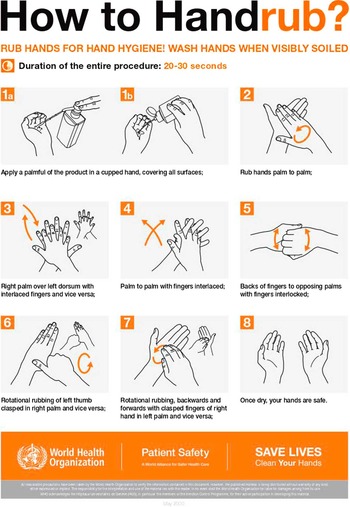
Hand hygiene is the most important measure undertaken to prevent healthcare-associated infections (HAI) and the spread of antimicrobial resistance. 1 One of the key components of the World Health Organization (WHO) hand hygiene multimodal implementation strategy, 2 which has been successfully applied worldwide,Reference Allegranzi, Gayet-Ageron and Damani 3 is the “How to Handrub” technique, which consists of 6 detailed steps that healthcare workers (HCWs) should perform to appropriately clean their hands with alcohol-based hand rub (ABHR). 2 However, recent studies have recognized that few HCWs perform the complete technique.Reference Stewardson, Iten and Camus 4 , Reference Tschudin-Sutter, Sepulcri, Dangel, Schuhmacher and Widmer 5 Furthermore, only the last step of the WHO 6-step technique specifically addresses fingertip rubbing (Figure 1), despite the fact that fingertips are the most heavily colonized part of the hand during clinical care.Reference Longtin, Schneider and Tschopp 6
World Health Organization (WHO) “How to Handrub” poster. For a detailed written description of all steps, see the “WHO Guide to the Implementation of the WHO Multimodal Hand Hygiene Improvement Strategy.” 2

We aimed to evaluate whether modifying the sequence of the WHO technique by performing step 6 first would result in greater bacterial reduction on HCW hands.
METHODS
In an experimental study at the University of Geneva Hospitals, 16 HCWs with expertise in hand hygiene performed the standard WHO “How to Handrub” technique (Figure 1) and a modified version, WHO “Fingertips First” (see Online Supplemental Figure). The WHO “Fingertips First” technique consisted of the same 6 steps of the standard WHO technique, but step 6 (rubbing of the fingertips) was performed first. The remaining sequence was unchanged. HCWs were supervised by 2 senior infection control experts.
Experiments were performed based on the European Norm 1500 standards (EN 1500). 7 Briefly, HCWs washed their hands with plain soap and water. Afterward, hands were immersed to the mid-metacarpals for 5 seconds in a bacterial suspension containing between 2.0×10⁸ and 2.0×10⁹ colony-forming units per milliliter of the reference strain E. coli ATCC10536 (contamination procedure). Hands were then let dry for 3 minutes. Baseline microbiological sampling consisted in rubbing the fingertips of the dominant hand in a Petri dish containing 10 mL of tryptone soya broth for 1 minute.
After baseline sampling, the contamination procedure was repeated twice, each time followed by 1 of the 2 hand-rubbing techniques under evaluation. All 16 volunteers performed both techniques; 8 started with the standard WHO technique and 8 started with the WHO “Fingertips First” technique. Regardless of the specific technique, hand rubbing was performed for 30 seconds using 3 mL isopropanol 60% (v/v; ie, the EN 1500 standard).
After each hand-rubbing procedure, fingertips were sampled as described above. For each of the 4 dilutions studied (10−1 to 10−4), a 1-mL sample was spread over the surface of a tryptone soy agar plate that was subsequently incubated at 36°C±1°C for 48 h. Bacterial colony-forming units were quantified by visual inspection. The primary outcome was the difference in colony-forming units retrieved from hands at baseline and after each of the 2 different techniques (log10 reduction from baseline).
Hand surface areas were calculated and categorized as “small” (≤375 cm2), “medium” (376–424 cm2), or “large” (≥425 cm2).Reference Bellissimo-Rodrigues, Soule, Gayet-Ageron, Martin and Pittet 8 A generalized linear mixed model with a random effect on the intercept was used to assess bacterial log10 reductions from baseline. The hand-rubbing technique (WHO “Fingertips First” vs standard WHO) was the main predictor. We assessed whether the effect of the technique differed according to hand size category by testing the interaction between the 2 variables. Finally, the model was adjusted for hand size and gender. Statistical analyses were performed using Stata version 14 (StataCorp College Station, TX). Statistical significance was defined as P<.05 (2-sided).
RESULTS
Among the 16 participants, there were 7 nurses (43.8%) and 9 medical doctors/pharmacists/biologists (56.2%); 10 participants (62.5%) were women. Additionally, 4 participants (25.0%) had small hands, 6 (37.5%) had medium-sized hands, and 6 (37.5%) had large hands.
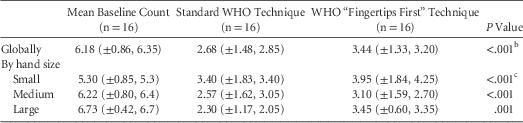
Overall, the log10 reduction in bacterial concentration was significantly higher when performing the WHO “Fingertips First” compared with the standard WHO technique (Table 1). Findings were confirmed across the 3 hand-size categories (Table 1), with no significant difference between the 3 groups (interaction term, P=.587). After adjustment for hand size and gender, the mean reduction of bacterial concentration was 0.77 log10 greater (95% CI, 0.27–1.26; P=.002) following the WHO “Fingertips First” technique than following the standard WHO technique. Bacterial reduction was not significantly associated with gender (P=.142) or hand-size category (medium vs small hand size: P=.125; large vs small hand size: P=.088; global P=.199).
Reduction of Bacterial Counts From Mean Baseline Values Depending on the Sequence of the Hand-Rubbing TechniqueFootnote a

a Data are log10 values shown as mean (±SD, median).
b From a mixed linear model with a random effect on the intercept.
c From a mixed linear model with a random effect on the intercept and an interaction between the sequence and hand size category.
DISCUSSION
Hand hygiene is the primary measure implemented to reduce HAI. 1 , 2 To date, the main focus of hand hygiene promotion has been on improving compliance,Reference Allegranzi, Gayet-Ageron and Damani 3 , Reference Rosenthal, Pawar and Leblebicioglu 9 and less attention has been devoted to the quality of hand hygiene action.Reference Pittet 10
The WHO “How to Handrub” technique was designed to ensure homogenous hand-surface coverage by applied hand hygiene agents. It was not developed to be user friendly or to address the most contaminated parts of hands. Notably, when monitored, HCW compliance with all 6 steps is very low.Reference Stewardson, Iten and Camus 4 , Reference Tschudin-Sutter, Sepulcri, Dangel, Schuhmacher and Widmer 5
A recent study showed that the standard WHO 6-step technique reduced bacterial contamination on HCW hands more effectively than the Centers for Disease Control and Prevention (CDC) 3-step technique.Reference Reilly, Price and Lang 11 However, another evaluation performed in laboratory conditions showed that a 3-step technique was comparable to the standard WHO 6-step technique.12 While the second study’s 3-step technique included a fingertip-rubbing step, the first did not, possibly accounting for the observed difference. Importantly, fingertips are significantly more contaminated than the thenar or hypothenar eminences or dorsa of hands after clinical examination.Reference Longtin, Schneider and Tschopp 6 Indeed, in accordance with the relevance of fingertips contamination in clinical practice, the fingertip sampling method was endorsed by EN 1500. 7
We investigated the possible role of modifying the WHO “How to Handrub” 6-step technique sequence, and we have shown that performing “Fingertips First” instead of last led to greater bacterial count reductions on HCW hands. These results can be explained in several ways. There might not be enough volume of ABHR left in HCW hands at the end of the standard WHO technique to adequately treat fingertips. Although not statistically significant, the observed trend toward a greater difference between techniques among HCWs with large hands supports this hypothesis. Hand size affects the microbiological efficacy of hand hygiene action.Reference Bellissimo-Rodrigues, Soule, Gayet-Ageron, Martin and Pittet 8 Importantly, however, our results were significant across all hand-size categories.
Our findings are likely to be relevant in clinical practice, especially considering that the average volume of ABHR used in routine care is only ~1 mL.Reference Leslie, Donskey, Zabarsky, Parker, Macinga and Assadian 13 In addition, the WHO technique is seldom preformed adequately,Reference Stewardson, Iten and Camus 4 , Reference Tschudin-Sutter, Sepulcri, Dangel, Schuhmacher and Widmer 5 reinforcing the need to focus HCW attention to the most contaminated hand parts.
Our study has several limitations. We only tested 1 strain and 1 type of ABHR, and the fingertip sampling method might have favored the “Fingertips First” technique. However, evidence suggests that fingertips are strongly implicated in cross transmission.Reference Longtin, Schneider and Tschopp 6 Further testing could be applied using other techniques to confirm our results, including the American Society for Testing and Materials “Glove Juice” method. Also, the clinical significance of the additional bacterial reduction achieved with the “Fingertips First” technique (ie, on average 0.77 log10) remains unknown.
In conclusion, rubbing the fingertips first is a simple measure that may lead to a greater reduction in bacterial loads on fingertips. We call the attention of HCWs to the importance of respecting the recommended steps of the WHO “How to Handrub” technique, with particular attention on fingertip rubbing, which is likely to be the most important for reducing cross transmission. Our findings merit further validation, but they could potentially improve hand hygiene action, a gesture of utmost importance for patient safety.
ACKNOWLEDGEMENTS
We are grateful to all volunteers who kindly participated in this study and to Mohamed Abbas for his substantial editing contribution to the manuscript.
Financial support: Daniela Pires is supported by Fundação para a Ciência e Tecnologia (grant no. SFRH/SINT/95317/2013) and by the Swiss National Science Foundation (grant no. 32003B_163262) for hand hygiene research activities. All other listed authors declare no financial support or grants.
Potential conflicts of interest: All authors report no conflicts of interest relevant to this article.
SUPPLEMENTARY MATERIAL
To view supplementary material for this article, please visit http://dx.doi.org/10.1017/ice.2016.241.