Introduction
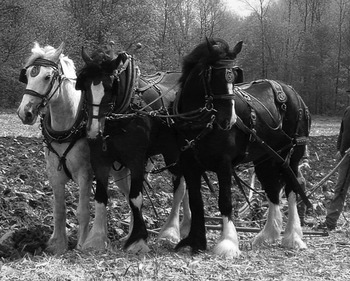
The Shire (Figure 1) is known as the largest of all horse breeds, standing up to 2 m (19.2 hands) tall at the shoulder (ALBC, 2012a). Originating in England, the breed descends from “The Great Horse”, a heavy horse developed for medieval warfare. Later bred as a general-purpose agricultural and urban draught horse, the average Shire horse weighs about 910 kg and can pull a 4 500 kg load.
Shire horses working on an agricultural plot in Ohio. Photo by Emily Cullison. Used with permission.

Shire horses played a key role in early American history. In the early nineteenth century, 80 percent of Americans lived on farms. Draft horses were in high demand, replacing oxen in terms of agricultural efficiency and general draught power. To satisfy demand for quality heavy horses, agents were sent to France, the Netherlands and the United Kingdom to purchase pedigreed stock (Moore-Colyer, Reference Moore-Colyer2000). Shire horses were first introduced to the United States in the mid-1800s, and the American Shire Horse Association (ASHA) was established in 1885 to oversee registration of animals, genetic preservation and breed promotion. The registry has been active continuously except for the period between 1955 and 1961, when most breeding activity ceased and the Shire horse nearly became extinct in the United States. Although some Shires are still used as agricultural or urban work horses or in promotional hitches for breweries and other commercial businesses, the widespread mechanization of the early twentieth century and subsequent urbanization of rural farmland has resulted in a worldwide drop in Shire numbers and a shift to more recreational uses for the breed. Today, the American Livestock Breeds Conservancy has assigned the American Shire horse “critical” status, its most serious threat category reserved for populations with less than 200 new registrations annually in the United States, and an estimated global population of less than 2 000 animals (ALBC, 2012b).
Despite concern for the breed's future in the United States, however, no assessment of population history or genetic variability has been completed to date. Such data are critical to allow for determination of breed conservation strategies and metrics of success once genetic management programmes are implemented. Therefore, the objective of this study was to evaluate current and historic levels and inbreeding, population demographics, and the number and contributions of ancestors and founders to the American Shire horse population.
Materials and methods
Pedigree information was obtained from the World Wide Shire Studbook (www.shirestudbook.com), an online database created in a joint effort between the AHSA, the Canadian Shire Horse Association, and the Shire Horse Society, the Shire horse organization for the United Kingdom. Animal (n = 86 494) data included sire, dam, animal registration number, birth date and gender. After edits and corrections, the dataset included 85 767 horses born between 1806 and 2011 registered in the American and/or English studbooks. From this dataset, a reference population including only American horses of the most current generation (2003–2011) was defined (n = 1 142). Pedigrees of these animals were traced as far back as possible (n = 4 718 ancestors), with founders defined as animals with both parents unknown.
Population descriptive statistics were calculated using SAS/STAT software version 9.2 (SAS Inst., Cary, NC). Pedigree completeness, complete generation equivalents, length and number of generation intervals, inbreeding coefficients, effective population size and effective number of founders, ancestors and founder genomes were calculated using PEDIG software (Boichard, Reference Boichard2002) as previously described by Bhatnagar, East and Splan (Reference Bhatnagar, East and Splan2011). Total and marginal contributions of ancestors were also calculated for influential males and females. Finally, contributions of founder males to contemporary sire lines were determined by tracing the paternal lineages of all animals at 10-year intervals from 1922 to 2011.
Results
Generation intervals were calculated for stallion–daughter, stallion–son, mare–daughter and mare–son pathways (Boichard, Reference Boichard2002). Values were not significantly different among pathways (range 8.27–9.04) and the average generation interval was determined to be 8.65 years. This value was used to determine which years to include in the reference population (i.e. 2003–2011), representing the most current generation of American Shire horses.
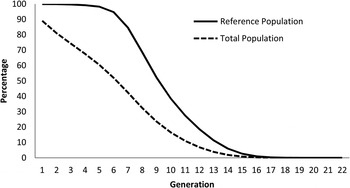
Estimates of genetic variability depend largely on the amount of available pedigree information, which may be measured via pedigree completeness. Within the total Shire horse population, pedigree completeness peaks at 90 percent in the first generation and then steadily decreases as more generations are included (Figure 2). In contrast, pedigree completeness for the reference population remains near 100 percent for five generations before it begins to decline. Maximal pedigree depth extended to 19 generations in contemporary animals. The average complete generation equivalent for the reference population was 9.12, and was 8.22 for the total population.
Average percent of pedigree completeness for the total and reference populations.

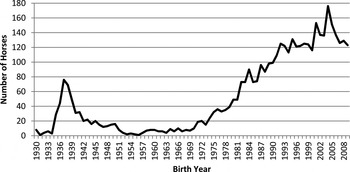
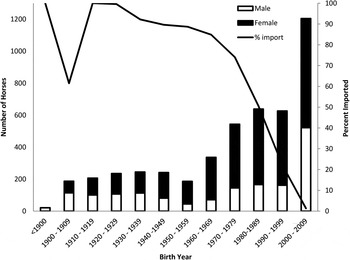
Demographic data for American-registered horses are shown in Figure 3. Animal numbers rose in the late 1930s before falling to less than five registered animals born per year between 1952 and 1957. Recovery was slow but animal numbers increased linearly between 1970 and 2000, and peaked in 2004 with more than 175 registered and domestically bred foals born that year. Figure 4 illustrates the number of Shire horses in the reference population database by year of birth, sex and percent imported stock, and indicates that the majority of horses in the pedigrees of the reference population were imported. Only after 1990 does the percentage of imported horses drop below 50 percent.
Number of domestically bred horses appearing in the American Shire Horse studbook, by birth year.

Number of Shire horses in reference population database by year of birth, sex and percent imported stock.

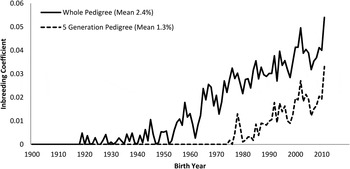
Average inbreeding coefficients were 2.4 percent considering all available generations, and 1.3 percent when only the most recent five generations were considered (Figure 5). With the reference population, representing the most recent generation, average inbreeding was 4.0 percent. Non-zero inbreeding coefficients were found for 71.7 percent of horses. Considering all pedigree information, inbreeding levels remained under 1 percent until the bottleneck of the 1950s, and have risen steadily afterward. Despite a short lag period, a lower value, but a very similar trend, is seen when only the last five generations are used, with identical peaks and troughs from 1992-on.
Average inbreeding coefficients by year of birth when tracing five generations or when using the entire available pedigree of the reference population.

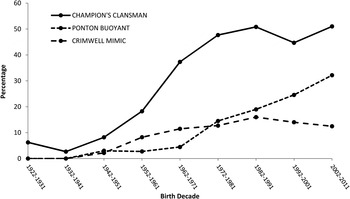
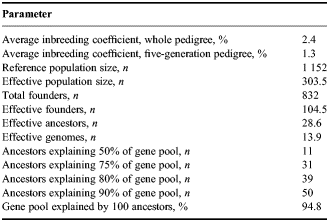
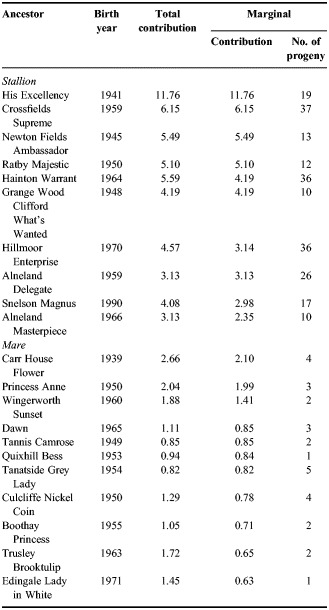
Table 1 summarizes results from pedigree analysis of the Shire horse reference population. The ten most influential male and female ancestors, along with their respective marginal and total contributions to the reference population, and number of progeny, are shown in Table 2. Together, the top ten stallions accounted for nearly half (48.5 percent) of the male influence on modern day pedigrees, while the top ten mares accounted for only an 11.6 percent contribution. Investigation into paternal lineages revealed only six sire lines present in the current generation, with 96 percent of horses tracing to just three foundation sires (Figure 6).
Contributions of top three male founders to paternal lineages, representing 96 percent of modern-day sirelines.

Summary of pedigree analysis for the American Shire horse reference population.

Total and marginal genetic contribution (percent) for the most influential ten male and female ancestors in the American Shire horse reference population.

Discussion
Population demographics reported here are consistent with the widely accepted history of the breed as it developed in the United States (ASHA, 2012). Most early foundation stock was imported between 1880 and 1918. After World War I, imports for Shires and other draft horses dropped drastically. Despite an initial rise in domestically bred horses in the 1930s, numbers fell through the 1940s and 1950s, as increasing mechanization reduced the usage of heavy horses in agricultural and urban sectors. In 1955, it is reported that there were less than 50 Shire horses in the entire United States (ASHA, 2012). During this time, the registry became inactive, reopening six years later in 1961. After this bottleneck event, numbers rose steadily during the last three decades of the twentieth century before reaching a peak in 2004. The percentage of imported horses contributing to the reference population dataset, which represents all domestically born animals in the most current generation as well as their ancestors, remained high until the 1970s.
Measures of genetic variability based on studbook records rely heavily on pedigree completeness. Lack of complete pedigree information can result in underestimation of inbreeding coefficients and incorrect assignment of influence to founders and ancestors (MacCluer et al., Reference MacCluer, Boyce, Dyke, Weitkamp, Pfennig and Parsons1983; Teegan, Edel and Thaller, Reference Teegan, Edel and Thaller2008). Pedigree completeness among the American Shire breed was similar to that found in other horse populations (Aberle, Wrede and Distl, Reference Aberle, Wrede and Distl2004; Valera et al., Reference Valera, Molina, Gutiérrez, Gómez and Goyache2005; Hamann and Distl, Reference Hamann and Distl2008; Olsen et al., Reference Olsen, Klemetsdal, Ruane and Helfjord2010; Bhatnagar, East and Splan, Reference Bhatnagar, East and Splan2011). The average complete generation equivalent found for the American Shire horse population (8.22) is similar to that reported for Andalusian horses (8.26; Valera et al., Reference Valera, Molina, Gutiérrez, Gómez and Goyache2005) and German Hanoverian horses (8.34; Hamann and Distl, Reference Hamann and Distl2008), but much lower than values described for the Lipizzan horse (15.22; Zechner et al., Reference Zechner, Sölkner, Bodo, Druml, Baumung, Achmann, Marti, Habe and Brem2002). Generation interval for the Shire horse was similar to the 10-year span that has been reported for many horse breeds (Moureaux et al., Reference Moureaux, Verrier, Ricard and Meriaux1996; Bhatnagar, East and Splan, Reference Bhatnagar, East and Splan2011; Schurink, Arts and Ducro, Reference Schurink, Arts and Ducro2012; Vicente, Carolino and Gama, Reference Vicente, Carolino and Gama2012). Longer generation intervals are often present in breeds with an extensive evaluation or a breeding approval process, while shorter generation intervals may be seen in populations with the heavy use of artificial insemination.
The mean coefficient of inbreeding remained low until the bottleneck of the mid-1950s, and then began to rise. The clear lag and parallel rate in increase of inbreeding coefficients based on five-generation pedigrees indicates that higher levels of inbreeding have occurred in recent generations. This is consistent with the marked rise in animal numbers and steep drop in the number of imported horses within the last 30 years. Although the mean inbreeding level for the reference population is fairly low (3.4 percent), more than 15 percent of animals have an inbreeding coefficient greater than 10 percent, with some as high as 33 percent. The similar rates of ascent in inbreeding between full- and five-generation pedigrees also indicate there have been no recent practices implemented to curb inbreeding in the population. Recent analysis of the Norwegian Fjord horse in North America, a breed with similar population structure and inbreeding levels, revealed that introgression of foreign stock and registry mandates prohibiting parent–offspring and sibling-to-sibling matings, resulted in a drop and stabilization of inbreeding levels within the modern-day population (Bhatnagar, East and Splan, Reference Bhatnagar, East and Splan2011).
Inbreeding levels in the English or American Shire horse have not been previously reported in the literature, but values for the American Shire horse calculated in this study were comparable to those reported for similarly sized populations of draught-bred horses, such as the North American Norwegian Fjord Horse (4.3 percent; Bhatnagar, East and Splan, Reference Bhatnagar, East and Splan2011), the Swiss Franches-Montagnes (6.0 percent; Poncet et al., Reference Poncet, Pfister, Muntwyler, Glowatzki-Mullis and Gaillard2006) and the Austrian Noriker (5.0 percent; Druml, Baumung and Sölkner, Reference Druml, Baumung and Sölkner2009). Higher inbreeding levels are reported for closed populations with deeper populations (e.g. 12.5 percent for the thoroughbred; Cunningham et al., Reference Cunningham, Dooley, Splan and Bradley2001 and 8.6–14.4 percent for the Lipizzan; Zechner et al., Reference Zechner, Sölkner, Bodo, Druml, Baumung, Achmann, Marti, Habe and Brem2002) and/or smaller effective population sizes (e.g. 36.9 percent for the Sorraia; Luis, Cothran and Oom, Reference Luis, Cothran and Oom2007). Lower average inbreeding coefficients are calculated for breeds that continually allow introgression of new genes from outside populations (e.g. 1.4 percent for the Hanoverian; Hamann and Distl, Reference Hamann and Distl2008).
Effective population size was 28.7 percent of the total reference population, indicating unequal representation of the breeding stock during breed formation. The effective number of founders, which is equivalent to the number of equally contributing founders expected to produce the same genetic diversity as the population under study, is a measure of loss of genetic variability from unequal founder contributions. In the Shire horse reference population, the total number of founders was 832, while the effective number of founders was 104.5 or 12.6 percent of total founders. This is similar to that reported for the French Arabian Horse (135; Moureaux et al., Reference Moureaux, Verrier, Ricard and Meriaux1996), Noriker draft horses (117.2; Druml, Baumung and Sölkner, Reference Druml, Baumung and Sölkner2009) and North American Norwegian Fjord horse (96; Bhatnagar, East and Splan, Reference Bhatnagar, East and Splan2011), but smaller than that calculated for Selle Francais horses (333; Moureaux et al., Reference Moureaux, Verrier, Ricard and Meriaux1996) and larger than published values for the Andalusian (39.6; Valera et al., Reference Valera, Molina, Gutiérrez, Gómez and Goyache2005), the Spanish Arabian horse (38.6; Cervantes et al., Reference Cervantes, Molina, Goyache, Gutiérrez and Valera2008) and the Thoroughbred (28; Cunningham et al., Reference Cunningham, Dooley, Splan and Bradley2001). The effective number of ancestors was 28.6, similar to that reported for North American Norwegian Fjord (30; Bhatnagar, East and Splan, Reference Bhatnagar, East and Splan2011) and Noriker draught (29.3; Druml, Baumung and Sölkner, Reference Druml, Baumung and Sölkner2009) and Lipizzan horses (26.2; Zechner et al., Reference Zechner, Sölkner, Bodo, Druml, Baumung, Achmann, Marti, Habe and Brem2002). The high ratio of f e /f a (3.7) reveals disproportionate use of some breeding animals, presumably stallions, resulting in loss of genetic diversity relative to that expected under random mating conditions. This is consistent with the high marginal and total contributions for several of the influential stallions in the breed (e.g. His Excellency) and the known bottleneck that occurred during the mid-1950s. This ratio was higher than that reported for several breeds of similar pedigree structure and inbreeding levels (Druml, Baumung and Sölkner, Reference Druml, Baumung and Sölkner2009; Bhatnagar, East and Splan, Reference Bhatnagar, East and Splan2011).
Within the American population of Shire horses, only six sirelines are present in the current generation. Of these lines, three foundation stallions account for 95.6 percent of the modern day paternal lineages. Champion's Clansman (ca. 1900) represents the highest contribution at 51 percent, while Ponton Buoyant (1939) and Crimwell Mimic (1936) contribute 32.2 percent and 12.5 percent, respectively. In most well-established breeds, a small number of sirelines can be found, with one sireline representing the majority of pedigrees (Cunningham et al., Reference Cunningham, Dooley, Splan and Bradley2001; Cervantes et al., Reference Cervantes, Molina, Goyache, Gutiérrez and Valera2008). In modern-day thoroughbreds, with pedigree records tracing to the mid-1600s, only three sirelines remain, with 95 percent of all horses tracing to one Y-chromosome source (Cunningham et al., Reference Cunningham, Dooley, Splan and Bradley2001). In a more recent analysis of the Lusitano horse, nine paternal lineages were identified in the current generation, with two sires contributing to 95 percent of these sirelines (Cervantes et al., Reference Cervantes, Molina, Goyache, Gutiérrez and Valera2008).
Conclusions
Current measures of genetic variability for the American Shire horse indicate that although the breed is not in immediate danger, conservation strategies should be developed and implemented to prevent further loss of genetic diversity. Small effective population size, unequal contributions of founders, low effective numbers of founders and ancestors, and a high ratio of the two parameters provides evidence that the breed has undergone loss of genetic variability over time beyond that expected from a random genetic drift. In addition, an increase in the number of foals born annually and the subsequent reduction in the use of an imported breeding stock have fuelled a linear rise in inbreeding coefficients in recent years. Thus, while current levels of inbreeding are not particularly high compared with several other closed breed populations, there is valid concern for reduction of genetic variability in future generations. The registry may wish to consider prohibiting mating of close relatives or incentives for breeders who utilize the breeding stock from less popular strains. In addition, steps may be taken to help educate breeders in methods that will minimize inbreeding and help maintain a broad genetic base for the breed. Careful and deliberate intervention, along with vigilant evaluation of conservation strategies, will allow the American Shire horse to maintain a genetically vibrant population.
Acknowledgements
The authors gratefully acknowledge the American Shire Horse Foundation for providing access to pedigree data and for supporting the research. Assistance with database editing from Ms. Jocelyn Cuthbert and Ms. Sarah Swisher is also greatly appreciated. The authors also wish to thank the anonymous reviewers for their insight and thoughtful contributions to the manuscript.