Introduction
Since the first documentation of herbicide resistance in Palmer amaranth to the dinitroaniline herbicide family, additional resistance has evolved to multiple herbicide modes of action (MOAs), including acetolactate synthase inhibitors, enolpyruvyl shikimate-3-phosphate synthase inhibitor, 4-hydroxyphenylpyruvate dioxygenase inhibitors, photosystem II inhibitors, and protoporphyrinogen oxidase inhibitors (Culpepper et al. Reference Culpepper, Grey, Vencill, Kichler, Webster, Brown, York, Davis and Hanna2006; Gossett et al. Reference Gossett, Murdock and Toler1992; Jhala et al. Reference Jhala, Sandell, Rena, Kruger and Knezevic2014; Salas et al. Reference Salas, Burgos, Tranel, Singh, Glasgow, Scott and Nichols2016; Sprague et al. Reference Sprague, Stoller, Maxx and Horak1997; Thompson et al. Reference Thompson, Peterson and Lally2012). Glyphosate-resistant (GR) Palmer amaranth was first documented in 2005 in Macon County, GA (Culpepper et al. Reference Culpepper, Grey, Vencill, Kichler, Webster, Brown, York, Davis and Hanna2006). After GR Palmer amaranth was identified in Georgia, control failures with glyphosate occurred in other southeastern states, including Alabama, Arkansas, Florida, Georgia, Louisiana, Missouri, Mississippi, North and South Carolina, Tennessee, and Texas (Heap Reference Heap2018). Currently, there are no documented cases of Palmer amaranth resistant to 2,4-D, dicamba, or glufosinate (Heap Reference Heap2018). However, other Amaranthus spp. such as tall waterhemp [Amaranthus tuberculatus (Moq.) J.D. Sauer] have been reported resistant to 2,4-D in both Illinois and Nebraska (Heap Reference Heap2018).
Auxinic herbicide such as 2,4-D are active on dicotyledonous plants by mimicking the natural plant hormone indole 3-acetic acid (IAA) (Grossman Reference Grossman2010; Shaner Reference Shaner2014). IAA is vital for communication between plant organs, cell elongation, and cell division (Grossman Reference Grossman2010; Mithila et al. Reference Mithila, Hall, Johnson, Kelly and Riechers2011; Went Reference Went1926). Several broadleaf weed species, including Amaranthus spp., are controlled with 2,4-D in multiple environments, including aquatic, lawn, and agricultural settings (EPA 2005; Shaner Reference Shaner2014). Current 2,4-D labeling is for POST weed control in barley (Hordeum vulgare L.), wheat (Triticum aestivum L.), oats (Avena sativa L.), grain sorghum [Sorghum bicolor (L.) Moench] pastures and rangeland, lawns, golf courses, cemeteries, parks, and ornamental turf with different specifications for each situation (EPA 2005). In sugarcane (Saccharum officinarum L.), rice (Oryza sativa L.), and corn (Zea mays L.), 2,4-D is labeled for preplant and POST applications (Anonymous 2014a; EPA 2005). Currently, the only labeling for 2,4-D application in non–2,4-D-resistant soybean is preplant (Anonymous 2014a; EPA 2005). However, 2,4-D choline is currently registered PRE and POST in 2,4-D–resistant (EnlistTM) cropping systems (Anonymous 2017a, 2017b).
Symptoms of 2,4-D in susceptible plants can be similar to those from other synthetic auxin herbicides and include leaf cupping and curling, epinastic petiole and stem response, stem swelling, and stem elongation (Shaner Reference Shaner2014). Abnormal growth and metabolic activation such as gene expression, enzyme synthesis, ethylene formation, and abscisic acid accumulation occur in broadleaf plants after 5 h of exposure to synthetic auxins. Decaying of plants begins as soon as 72 h after exposure to synthetic auxins (Grossman Reference Grossman2010). These symptoms are typically followed by chlorosis and necrosis at growing points, wilting, and growth inhibition. Total plant death is slow and can take 3 to 5 wk (Shaner Reference Shaner2014).
Glufosinate is a nonselective member of the phosphinic acid herbicide family and controls several dicotyledonous and monocot weed species, including Palmer amaranth (Anonymous 2015; Coetzer et al. Reference Coetzer, Al-Khatib and Peterson2002; York et al. Reference York, Prostko, Culpepper, Murphy and McCullogh2009). Glufosinate inhibits the glutamine synthetase pathway by binding to the active site of glutamine synthetase and competing for glutamate (Coetzer and Al-Khatib Reference Coetzer and Al-Khatib2001; Manderscheid and Wild Reference Manderscheid and Wild1986). The glutamine synthetase pathway is the most efficient pathway for detoxifying ammonia, which inhibits photosynthesis (Coetzer and Al-Khatib Reference Coetzer and Al-Khatib2001; Sauer et al. Reference Sauer, Wild and Ruhle1987; Wild and Manderscheid Reference Wild and Manderscheid1984).
Glyphosate is a broad-spectrum, nonselective herbicide developed in the 1970s (Nandula Reference Nandula2010). Glyphosate mainly inhibits 5-enolpyruvylshikimate acid 3-phosphate synthase, which competes with phosphoenolpyruvate (PEP) by binding to the PEP site and preventing the biosynthesis of aromatic amino acids (Schönbrunn et al. 2001; Steinruken and Amrhein Reference Steinruken and Amrhein1980). Glyphosate controls many dicotyledonous and monocot weed species (Anonymous 2014b). In recent years, glyphosate applications over vast cropland have resulted in the selection of GR weed biotypes (Franz et al. Reference Franz, Mao and Sikorski1997; Heap Reference Heap2018).
Single herbicide MOA programs are no longer recommended for controlling GR Palmer amaranth (Ward et al. Reference Ward, Webster and Steckel2013). Dicamba- and 2,4-D–resistant crops have been developed and deregulated (Anonymous 2017a, 2017b; Dario Reference Dario2015). Herbicides labeled for application in 2,4-D–resistant soybean include 2,4-D choline alone or in a prepackaged mixture with glyphosate (Anonymous 2017a, 2017b). Glufosinate may be mixed with 2,4-D choline in 2,4-D–resistant crops, but glufosinate is not a currently labeled mixture with the prepackaged 2,4-D choline plus glyphosate mixture (Anonymous 2018).
The use of 2,4-D–resistant soybean will offer producers more flexibility for controlling GR weeds (Johnson et al. Reference Johnson, Hallet, Legleiter, Whitford, Weller, Bordelon and Lerner2012). Miller and Norsworthy (Reference Miller and Norsworthy2016) controlled Palmer amaranth up to 95% with sequential applications of 2,4-D choline plus glyphosate at early-POST followed by (fb) mid-POST timings. Other research showed 2,4-D choline plus glyphosate fb glufosinate controlled Palmer amaranth 99% if trifluralin was applied PPI (Manuchehri et al. Reference Manuchehri, Peter and Keeling2017). Previous research has shown that mixtures of glufosinate and 2,4-D can control GR horseweed (Erigeron canadensis L.), GR common lambsquarters (Chenopodium album L.), and GR giant ragweed (Ambrosia trifida L.) up to 96% (Barnett et al. Reference Barnett, Mueller and Steckel2013; Chahal and Johnson Reference Chahal and Johnson2012). Barnett et al. (Reference Barnett, Mueller and Steckel2013) reported that when 2,4-D and dicamba were applied alone, GR giant ragweed control was 55% to 79%; however, the addition of glufosinate to either dicamba or 2,4-D improved control to ≥93%.
Glyphosate, glufosinate, and 2,4-D are used in a variety of cropping situations (Anonymous 2014a, 2014b, 2015). Soybean cultivars resistant to 2,4-D are also resistant to glyphosate and glufosinate (Simpson et al. Reference Simpson, Thompson, Ellis, Peterson and Walton2014). Understanding POST control of GR Palmer amaranth with multiple herbicide MOAs including auxinic herbicides is crucial to minimize GR Palmer amaranth interference with crops. Therefore, a greenhouse study and two separate field studies were conducted to evaluate 2,4-D alone and in mixtures for POST control of GR Palmer amaranth. The objective of the greenhouse study was to identify the optimum rate of 2,4-D for control of GR Palmer amaranth 5 and 10 cm in height. The objective of the field studies was to evaluate mixtures of glyphosate, glufosinate, and/or 2,4-D for control of GR Palmer amaranth of different heights.
Materials and Methods
Greenhouse Study
A greenhouse study was conducted in 2014 at the Mississippi State University Delta Research and Extension Center in Stoneville, MS (33.4239194 N, 90.9122667 W), to determine the optimum rate of 2,4-D for control of 5- and 10-cm GR Palmer amaranth. GR Palmer amaranth seeds were surface-seeded into 53 by 28 cm trays containing potting media (Metro-Mix®, Sun Gro Horticulture, 770 Silver Street, Agawam, MA 01001) composed of 35% to 45% Canadian sphagnum peat moss, horticulture-grade vermiculite, composted pine bark, bark ash, and dolomitic limestone. Greenhouse temperatures were computer controlled to achieve 32/25 C (±3 C) day/night fluctuation and supplemented with light from sodium-vapor lamps set to maintain a 14-h photoperiod. When seedlings reached the cotyledon stage and were approximately 1-cm tall, 20 seedlings were transplanted to 10-cm wide by 13-cm deep pots containing identical potting media. From these transplanted seedlings, 4 seedlings per treatment were selected when plants heights uniformly reached 5 or 10 cm. Pots were subirrigated as needed, and no additional fertilizer was applied.
Treatments were arranged as a two-factor factorial of application timings and 2,4-D rates in a randomized complete block design with four replications, and the study was repeated three times. Factor A was application timing and included treatments when GR Palmer amaranth reached 5 or 10 cm in height. Factor B was 2,4-D (2,4-D Amine herbicide, Agri Star, 1525 NE 36th Street, Ankeny, IA 50021) rates of 0, 0.56, 0.84, 1.12, 1.4, and 1.68 kg ae ha−1. Treatments were applied when plants uniformly reached 5 or 10 cm in height with 3 to 4 and 7 to 8 leaves, respectively. Treatments were applied using a Generation III Research Spray Chamber (DeVries Manufacturing, 86956 State Highway 251, Hollandale, MN 56045) fitted with an even flat-fan (XR8002E TeeJet®, P.O. Box 7900, Wheaton, IL 60187) nozzle calibrated to deliver 140 L ha−1 at 248 kPa. Following herbicide applications, plants were removed from the greenhouse and allowed to dry outside for 6 to 8 h before being returned to the greenhouse.
Visual estimates of GR Palmer amaranth control were recorded 7, 14, and 28 d after each treatment (DAT) on a scale from 0% to 100%, with 0% representing no control and 100% equaling complete control. Aboveground fresh biomass was collected at 28 DAT and dried via forced-draft oven for 7 d at 60 C to obtain dry weight. Dry weights were converted to a percent reduction from the nontreated control using the following formula:
 ${\rm{Percent reduction}} = [({\rm{plant dry weight of nontreated}} - {\rm{plant dry weight of treated}})/{\rm{plant dry weight of nontreated}}] \times 100$
Data from control treatments were removed, and the remaining data were subjected to ANOVA. Arcsine transformations of the square roots of visual control estimates, height reduction, and dry weight reduction were performed to improve homogeneity of variances. Transformed data were subjected to ANOVA using the PROC MIXED procedure in SAS v. 9.4 (SAS Institute, 100 SAS Campus Drive, Cary, NC 27513-2414) with experimental run (3) and replication (nested within experimental run) set as random effect parameters (Blouin et al. Reference Blouin, Webster and Bond2011). Type III statistics were used to test the fixed effect of application timing and 2,4-D rate for visual control estimates, height, and dry weight reduction of GR Palmer amaranth. Least-squares means were calculated, and mean separation (P ≤ 0.05) was produced using PDMIX800 in SAS, which is a macro for converting mean separation output to letter groupings (Saxton Reference Saxton1998). Nontransformed data are presented for clarity.
Herbicide Mixture Studies
Two separate non-crop field studies were conducted from 2013 to 2014 at the Mississippi State University Delta Research and Extension Center in Stoneville, MS, to evaluate control of GR Palmer amaranth of different heights with multiple rates of 2,4-D alone and in mixtures with glyphosate and/or glufosinate. Palmer amaranth populations at study locations were known to contain GR individuals, as evidenced in previous research in which the same populations were controlled 56% at 28 DAT by glyphosate at 1.37 kg ha−1 (Hydrick Reference Hydrick2017). An early-application study targeting 5- to 10-cm GR Palmer amaranth was conducted once in 2013 (33.4074056 −90.9253222) and twice in 2014 (33.4075083 −90.9268083; 33.4074472 −90.9268083). A late-application study targeting 15- to 20-cm GR Palmer amaranth was conducted once in 2013 (33.406925 −90.925294) and 2014 (33.40785, −90.925350). Soil series each site-year was a Newellton silty clay (clayey over loamy, smectitic over mixed, superactive, nonacid, thermic Fluvaquentic Epiaquepts) containing approximately 1.6% organic matter and having a pH of 6.85. Experimental sites were conventionally tilled to stimulate germination of GR Palmer amaranth. Weather data at time of application in all studies were recorded from the Delta Research and Extension Center weather station located approximately 2.3 km from the experimental sites (Table 1).
Herbicide application dates, temperature ranges on application dates, and precipitation intervals and quantities collected from the Mississippi State University Delta Research and Extension Center weather station for herbicide mixture studies in 2013 and 2014.

The experimental design for both herbicide mixture studies was a randomized complete block with a three-factor factorial treatment arrangement and four replications. Factor A was glyphosate (Roundup PowerMax® herbicide, Monsanto, 800 N. Lindbergh Boulevard, St Louis, MO 63167) rates of 0 and 0.86 kg ae ha−1; Factor B was glufosinate (Liberty® 280 herbicide, Bayer CropScience Crop Protection, Bayer CropScience AG, Alfred-Nobel-Strasse 50, 40789 Monheim am Rhein, Germany) rates of 0 and 0.59 kg ai ha−1; and Factor C was 2,4-D rates of 0, 0.56, and 1.12 kg ae ha−1. As in the greenhouse study, the amine formulation of 2,4-D was used in both herbicide mixture studies. Plot size in all studies were 3 m in width by 9 m in length. Treatments were applied using a tractor-mounted, compressed air sprayer calibrated to deliver 140 L ha−1 at 248 kPa and fitted with extended range flat-fan (XR10002 TeeJet®) nozzles when GR Palmer amaranth in each plot uniformly reached designated heights for each study.
In each herbicide mixture study, visual estimates of GR Palmer amaranth control were recorded at 7, 14, and 28 DAT on the scale previously described. At 28 DAT, all GR Palmer amaranth plants in two 1-m−2 quadrats in each plot were hand harvested to document density and aboveground dry weight. Harvested GR Palmer amaranth was dried in a forced-draft oven for 7 d at 60 C and then weighed.
Arcsine transformations of the square roots of visual control estimates for GR Palmer amaranth were performed to improve homogeneity of variances. Transformed data were subjected to ANOVA using the PROC MIXED procedure in SAS v. 9.4, with site-year and replication (nested within site-year) as random effect parameters (Blouin et al. Reference Blouin, Webster and Bond2011). Type III statistics were used to test the fixed effects of glyphosate, glufosinate, and 2,4-D rates for visual control estimates, density, and dry weight of GR Palmer amaranth. Least square means were calculated, and mean separation (P ≤ 0.05) was produced using PDMIX800 in SAS. Nontransformed data are presented for clarity.
Results and Discussions
Greenhouse Study
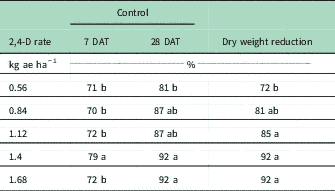
A main effect of 2,4-D rate was detected for GR Palmer amaranth control at 7 and 28 DAT and for dry weight reduction (Table 2). Averaged across application timing, 2,4-D at 1.4 kg ha−1 provided the greatest GR Palmer amaranth control at 7 DAT; however, control at 28 DAT was optimized with 2,4-D at 0.84 kg ha−1 (Table 2). Maximum GR Palmer amaranth dry weight reduction in the current research was observed with 2,4-D rates ≥0.84 kg ha−1; however, there were no differences among rates ≥0.84 kg ha−1.
Glyphosate-resistant Palmer amaranth control at 7 and 28 d after treatment (DAT) and dry weight reduction at 28 DAT in 2,4-D rate study at Stoneville, MS, in 2014.a

a All data pooled over two application timings and three experiments. Means within a column followed by the same letter are not different at P ≤ 0.05.
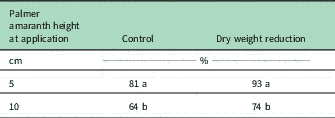
A main effect of application timing influenced GR Palmer amaranth control at 7 DAT and dry weight reduction at 28 DAT (Table 3). Pooled over 2,4-D rates, control of GR Palmer amaranth at 7 DAT was 81% and 64% for 5- and 10-cm GR Palmer amaranth, respectively. Edwards (Reference Edwards2013) reported that the greatest level of Palmer amaranth control with dicamba, another synthetic auxin herbicide, was achieved when targeting 5-cm plants. Hager (Reference Hager2014) suggested the use of auxinic herbicides when Palmer amaranth was ≤10 cm for optimal control. GR Palmer amaranth plants treated at 5 cm produced 19% less dry weight following 2,4-D application than plants treated at 10 cm (Table 3).
Effect of application timing on control of glyphosate-resistant Palmer amaranth control at 7 d after treatment and dry weight reduction at 28 DAT in 2,4-D rate study at Stoneville, MS, in 2014.a

a Data are pooled over five rates of 2,4-D and three experiments. Means within a column followed by the same letter are not different at P ≤ 0.05.
Herbicide Mixture Studies
Early-Application Study
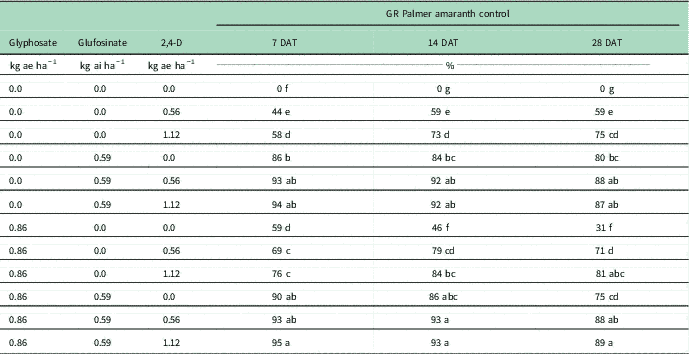
A three-way interaction of glyphosate, glufosinate, and 2,4-D was detected for GR Palmer amaranth control at all three evaluations. Glyphosate alone controlled GR Palmer amaranth 31% to 59% at all evaluation intervals, indicating the level of observed GR Palmer amaranth at study locations (Table 4). Control of GR Palmer amaranth with 2,4-D alone at 1.12 kg ha−1 and glyphosate alone was similar at 7 DAT. GR Palmer amaranth control was improved ≥14% with 2,4-D applied at 1.12 compared with 0.56 kg ha−1 at 7 DAT. The addition of glyphosate to 2,4-D at 0.56 or 1.12 kg ha−1 increased control to ≥69% at 7 DAT; however, control was ≥93% at 7 DAT when glufosinate was added to these combinations. Glufosinate alone controlled GR Palmer amaranth 86% at 7 DAT, and this control was comparable with that seen with all two- and three-way herbicide mixtures containing glufosinate, except glyphosate plus glufosinate plus 2,4-D at 1.12 kg ha−1.
Glyphosate-resistant (GR) Palmer amaranth control at 7, 14, and 28 d after treatment (DAT) with mixtures of 2,4-D, glyphosate, and/or glufosinate applied to 5- to 10-cm plants in the early-application study at Stoneville, MS, in 2013 and 2014.a

a Data are pooled over three experiments. Means followed by the same letter for each evaluation interval are not different at P ≤ 0.05.
At 14 DAT, maximum GR Palmer amaranth control on average was 93% (Table 4). GR Palmer amaranth control with 2,4-D at 0.56 and 1.12 kg ha−1 alone was greater than that with glyphosate alone (Table 4). Glyphosate plus 2,4-D at 0.56 kg ha−1 improved GR Palmer amaranth control at 14 DAT to ≥79% compared with 2,4-D at 0.56 kg ha−1 (59%) alone at 14 DAT; however, this mixture provided similar control to glufosinate alone or mixed with glyphosate. Three-way herbicide mixtures controlled GR Palmer amaranth 93% at 14 DAT, but control from those mixtures was comparable with that seen with two-way mixtures that contained glufosinate.
By 28 DAT, maximum GR Palmer amaranth control on average was 89% (Table 4). Glyphosate alone controlled GR Palmer amaranth 31% (Table 4). Increasing 2,4-D rate from 0.56 to 1.12 kg ha−1 increased control at 28 DAT from 59% to 75%. Glyphosate plus 2,4-D at 0.56 and 1.12 kg ha−1 provided ≥71% GR Palmer amaranth control; however, control with glyphosate plus 2,4-D at 0.56 kg ha−1 (71%) was similar to that seen with 2,4-D alone at 1.12 kg ha−1 (75%) (Table 4). Glyphosate plus 2,4-D at 1.12 kg ha−1 controlled GR Palmer amaranth 81% at 28 DAT, and this was comparable with control with all two- and three-way herbicide mixtures containing glufosinate, glufosinate alone, and/or 2,4-D at 1.12 kg ha−1 alone. GR Palmer amaranth control with glufosinate alone was 80% and similar to that seen with glyphosate plus glufosinate and glufosinate plus 2,4-D at 0.56 kg ha−1. Two- and three-way herbicide mixtures containing glufosinate and 2,4-D controlled GR Palmer amaranth ≥87% at 28 DAT.
At all evaluations except 14 DAT, increasing 2,4-D rate from 0.56 to 1.12 kg ha−1 in application with glufosinate did not improve GR Palmer amaranth control over glufosinate alone (Tables 4). No differences in GR Palmer amaranth control were observed at 14 and 28 DAT with two- and three-way herbicide mixtures containing glufosinate and 2,4-D (Table 4). Applied alone, 2,4-D at 1.12 kg ha−1 controlled GR Palmer amaranth similar to mixtures of glyphosate plus 2,4-D at 0.56 kg ha−1 at 14 DAT; however, by 28 DAT, 2,4-D at 1.12 kg ha−1 provided control equivalent to glufosinate applied alone, glufosinate plus glyphosate, and glyphosate plus 2,4-D at 0.56 and 1.12 kg ha−1 mixtures (Table 4). The addition of glufosinate to any mixture containing glyphosate or 2,4-D at 0.56 and 1.12 kg ha−1 with and without glyphosate provided the greatest level of GR Palmer amaranth control at 14 DAT (Table 4). Two-way herbicide mixtures containing glufosinate plus 2,4-D at 0.56 and 1.12 kg ha−1 provided ≥87% GR Palmer amaranth control; however, control with these mixtures was comparable with that seen with glufosinate alone and all three-way herbicide mixtures at 28 DAT (Table 4). Craigmyle et al. (Reference Craigmyle, Ellis and Bradley2013) also reported that an increase in 2,4-D rate in mixture with glufosinate did not improve broadleaf or grass control. Other research suggests that control of Palmer amaranth with auxin herbicides is maximized with the addition of glufosinate (Merchant et al. Reference Merchant, Sosnoskie, Culpepper, Steckel, York, Braxton and Ford2013). However, application timing is critical for weed control with glufosinate (Coetzer and Al- Khatib Reference Coetzer and Al-Khatib2001).
Two-way interactions were detected at 28 DAT for GR Palmer amaranth density and dry weight (Tables 5 and 6). A two-way interaction between 2,4-D and glufosinate was detected for GR Palmer amaranth dry weights at 28 DAT (Table 5). Dry weight was reduced from 82 to 40 g m−2 as 2,4-D rate increased from 0 to 0.56 kg ha−1; however, GR Palmer amaranth dry weight was similar following 2,4-D at 1.12 kg ha−1 and glufosinate alone. The addition of glufosinate to 2,4-D at 0.56 and 1.12 kg ha−1 reduced GR Palmer amaranth dry weight to ≤12 g m−2; however, similar dry weights were observed following glufosinate applied alone.
Glyphosate-resistant Palmer amaranth dry weight at 28 d after treatment (DAT) with mixtures of 2,4-D, glyphosate, and/or glufosinate applied to 5- to 10-cm plants in the early-application study at Stoneville, MS, in 2013 and 2014.a

a Data are pooled over two glyphosate rates (0 and 0.86 kg ae ha−1) and three experiments. Means followed by the same letter for each evaluation interval are not different at P ≤ 0.05.
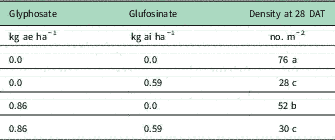
Glyphosate-resistant Palmer amaranth density at 28 d after treatment (DAT) with mixtures of 2,4-D, glyphosate, and/or glufosinate applied to 5- to 10-cm plants in the early-application study at Stoneville, MS, in 2013 and 2014.a

a Data are pooled over three 2,4-D rates (0.0, 0.56, and 1.12 kg ae ha−1) and three experiments. Means followed by the same letter for each evaluation interval are not different at P ≤ 0.05.
Pooled across three 2,4-D rates, glyphosate alone at 0.86 kg ha−1 reduced GR Palmer amaranth density at 28 DAT to 52 plants m−2 compared with 76 plants m−2 where no glufosinate or glyphosate was applied (Table 6). However, glufosinate alone reduced GR Palmer amaranth densities to 30 plants m−2 at 28 DAT, which was comparable with control with glufosinate plus glyphosate (Table 6).
Late-Application Study
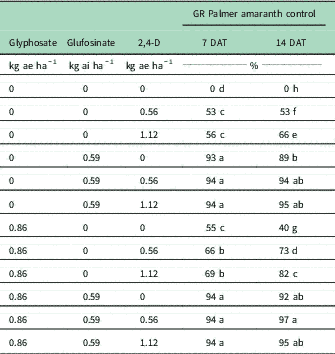
A three-way interaction between glyphosate, glufosinate, and 2,4-D was detected for control of 15- to 20-cm GR Palmer amaranth at 7 DAT (Table 7). GR Palmer amaranth control with 2,4-D at 0.56 and 1.12 kg ha−1 was 53% to 56% at 7 DAT, and control was comparable with that seen with glyphosate applied alone. Glyphosate plus 2,4-D at 0.56 and 1.12 kg ha−1 improved GR Palmer amaranth control to 66% to 69%. Glufosinate alone controlled GR Palmer amaranth 93% at 7 DAT; however, adding 2,4-D and/or glyphosate did not improve control.
Glyphosate-resistant (GR) Palmer amaranth control at 7 and 14 d after treatment (DAT) with mixtures of 2,4-D, glyphosate, and/or glufosinate applied to 15- to 20-cm plants in the late-application study at Stoneville, MS, in 2013 and 2014.a

a Data are pooled over three experiments. Means followed by the same letter for each evaluation interval are not different at P ≤ 0.05.
GR Palmer amaranth control at 14 DAT was 66% with 2,4-D applied alone at 1.12 kg ha−1 compared with 53% and 40% with 2,4-D at 0.56 kg ha−1 and glyphosate alone, respectively (Table 7). Control of GR Palmer amaranth increased to 73% to 82% at 14 DAT with the addition of glyphosate to 2,4-D at 0.56 and 1.12 kg ha−1. Improved GR Palmer amaranth control with glyphosate added to 2,4-D at 0.56 and 1.12 kg ha−1 at 14 DAT can be attributed to a natural mixed population of GR and glyphosate-susceptible Palmer amaranth (Whitaker et al. Reference Whitaker, York, Jordan and Culpepper2010). Previous research reported ≤23% control of populations with mixtures of GR and glyphosate-susceptible Palmer amaranth with glyphosate alone (Whitaker et al. Reference Whitaker, York, Jordan and Culpepper2010). Glufosinate alone controlled GR Palmer amaranth 89% at 14 DAT, and control was comparable with all two- and three-way mixtures containing glufosinate, with the exception of glyphosate plus glufosinate plus 2,4-D at 0.56 kg ha−1 (Table 7). Three-way mixtures of glyphosate, glufosinate, and 2,4-D provided ≥95% control regardless of 2,4-D rate; however, these treatments provided control similar to that seen with all two-way mixtures containing glufosinate at 14 DAT (Table 7).
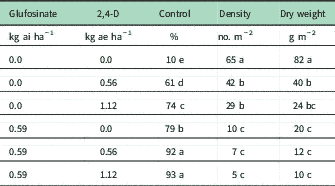
A two-way interaction between 2,4-D rate and glufosinate was detected for GR Palmer amaranth control at 28 DAT, density, and dry weight (Table 8). Control of GR Palmer amaranth increased from 61% to 74% at 28 DAT as 2,4-D rate increased from 0.56 to 1.12 kg ha−1, while glufosinate alone gave 79% control. Control was increased to ≥92% with mixtures of glufosinate and 2,4-D. GR Palmer amaranth density was reduced from 65 to 42 and 29 plants m−2 with 2,4-D at 0.56 and 1.12 kg ha−1, respectively, compared with no 2,4-D or glufosinate application. Glufosinate alone reduced GR Palmer amaranth densities to 10 plants m−2, and these were comparable with densities following glufosinate plus 2,4-D. GR Palmer amaranth dry weights were reduced from 141 g m−2 for plots with no 2,4-D or glufosinate to 62 and 28 gm−2 for 2,4-D at 0.56 and 1.12 kg ha−1, respectively. GR Palmer amaranth dry weights were reduced to 24 g m−2 with glufosinate alone; however, these dry weights were comparable with those seen with 2,4-D alone at 1.12 kg ha−1 and mixtures of glufosinate plus 2,4-D.
Glyphosate-resistant Palmer amaranth control, density, and dry weight at 28 d after treatment with mixtures of 2,4-D, glyphosate, and/or glufosinate applied to 15- to 20-cm plants in the late-application study at Stoneville, MS, in 2013 and 2014.a

a Data are pooled over two glyphosate rates (0 and 0.86 kg ae ha−1) and three experiments. Means followed by the same letter for each parameter are not different at P ≤ 0.05.
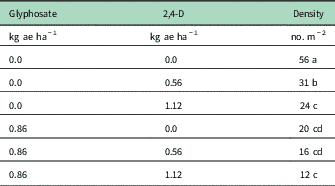
A two-way interaction between 2,4-D and glyphosate was identified for GR Palmer amaranth densities at 28 DAT (Table 9). GR Palmer amaranth densities were reduced from 31 to 24 plants m−2 as 2,4-D rate increased from 0.56 to 1.12 kg ha−1 compared with 56 plants m−2 where no glyphosate or 2,4-D was applied. GR Palmer amaranth densities were 20 plants m−2 with glyphosate alone and comparable with densities following 2,4-D alone at 1.12 kg ha−1 and mixtures of glyphosate plus 2,4-D at 0.56 and 1.12 kg ha−1 (Table 9).
Glyphosate-resistant Palmer amaranth density at 28 d after treatment with mixtures of 2,4-D, glyphosate, and/or glufosinate applied to 15- to 20-cm plants in the late-application study at Stoneville, MS, in 2013 and 2014.a

a Data are pooled over two glufosinate rates (0.0 and 0.59 kg ai ha−1) and three experiments. Means followed by the same letter for each evaluation interval are not different at P ≤ 0.05.
GR Palmer amaranth control at 28 DAT, density, and dry weight reduction were influenced by an interaction of glyphosate and glufosinate rates. Pooled across 2,4-D rates, glyphosate alone controlled GR Palmer amaranth 56%, reduced density to 26 plants m−2, and reduced dry weight to 64 g m−2 (Table 10). GR Palmer amaranth control was 86% with glufosinate; however, this control was identical to that following glufosinate plus glyphosate mixtures. The greatest GR Palmer amaranth density and dry weight reductions were observed with treatments containing glufosinate.
Glyphosate-resistant Palmer amaranth control, density, and dry weight at 28 d after treatment (DAT) with mixtures of 2,4-D, glyphosate, and/or glufosinate applied to 15- to 20-cm plants in the late-application study at Stoneville, MS, in 2013 and 2014.a

a Data are pooled over three 2,4-D rates (0, 0.56, and 1.12 kg ae ha−1) and three experiments. Means followed by the same letter for each parameter are not different at P ≤ 0.05.
Merchant et al. (Reference Merchant, Sosnoskie, Culpepper, Steckel, York, Braxton and Ford2013) reported control of 15- to 20-cm Palmer amaranth at 20 DAT similar to that observed in the current research with glufosinate alone; however, the addition of 2,4-D improved control to ≥90% control. These results are consistent with 14 and 28 DAT evaluations in the late-application study targeting 15- to 20-cm GR Palmer amaranth, for which ≥92% control of GR Palmer amaranth was observed when glufosinate was added to glyphosate and/or 2,4-D at 0.56 or 1.12 kg ha−1 (Tables 7 and 8).
Multiple herbicide MOAs provide optimal control of GR Palmer amaranth (Dillon et al. Reference Dillon, Scott, Dickson and Pearrow2011). Merchant et al. (Reference Merchant, Sosnoskie, Culpepper, Steckel, York, Braxton and Ford2013) reported that Palmer amaranth control with 2,4-D alone at rates of 0.53, 0.80, and 1.06 kg ha−1 was 68%, 79%, and 80%, respectively, with treatments applied to 15- to 20-cm plants. However, the addition of glufosinate to 2,4-D at these rates improved control of Palmer amaranth to 90% to 97%. This research also reported that the greatest control occurred when glufosinate and 2,4-D were applied in mixtures compared with either applied alone (Merchant et al. Reference Merchant, Sosnoskie, Culpepper, Steckel, York, Braxton and Ford2013).
Control of GR Palmer amaranth in the greenhouse study and herbicide mixture studies never reached 100%. Merchant et al. (Reference Merchant, Sosnoskie, Culpepper, Steckel, York, Braxton and Ford2013) suggested near-perfect control of GR Palmer amaranth is critical due to its competitiveness. Dillon et al. (Reference Dillon, Scott, Dickson and Pearrow2011) reported the most consistent control of GR Palmer amaranth was achieved with PRE herbicides fb POST herbicides with different MOAs on GR Palmer amaranth ≤7-cm tall.
In a greenhouse environment, optimal GR Palmer amaranth control with 2,4-D alone was achieved with rates similar to those currently labeled for preplant and in-season applications of 2,4-D choline on 2,4-D–tolerant crops (Anonymous 2014a, 2018), and no benefit was realized from increasing rates above 0.84 kg ha−1.
Based on this 2-yr study, multiple herbicide MOAs provided the greatest GR Palmer amaranth control. The addition of 2,4-D to herbicide treatments containing glyphosate and/or glufosinate was not beneficial for GR Palmer amaranth control, except when 2,4-D was added to glyphosate in both herbicide mixture studies and to glufosinate at the 28 DAT evaluation in the late-application study. In both studies, two- and three-way herbicide mixtures containing glufosinate and 2,4-D provided the greatest levels of GR Palmer amaranth control at 28 DAT. In either herbicide mixture study, glyphosate alone controlled Palmer amaranth ≤59%, indicating a mixed population of glyphosate-susceptible and -resistant individuals and validating that inclusion of glyphosate to herbicide treatments was beneficial. Control was similar with glufosinate alone or mixtures of glufosinate, 2,4-D, and/or glyphosate in the early-application study, excluding the three-way mixture with 2,4-D at 1.12 kg ha−1. However, in the late-application study, glufosinate alone provided less control than glufosinate plus 2,4-D (with and without glyphosate). Additionally, at all GR Palmer amaranth control evaluations, increasing 2,4-D rate from 0.56 to 1.12 kg ha−1 in mixture with glufosinate provided no additional control. When applied alone, 2,4-D at 1.12 kg ha−1 provided control comparable with that seen with glyphosate plus 2,4-D at 0.56 kg ha−1 and glyphosate plus glufosinate at 28 DAT in the early-application study.
Herbicide mixtures containing glufosinate provided the greatest control of GR Palmer amaranth in the late-application study; however, no mixtures provided 100% control of GR Palmer amaranth in POST-only herbicide applications. Culpepper et al. (Reference Culpepper, Webster, Sosnoskie and York2010) suggested that the most effective and economic techniques for GR Palmer amaranth control were those that were preventative, such as the use of soil-residual herbicides and MOA. Incorporation of PRE herbicides fb POST application herbicide systems should be used when managing GR Palmer amaranth (Whitaker et al. Reference Whitaker, York, Jordan and Culpepper2010). Dillon et al. (Reference Dillon, Scott, Dickson and Pearrow2011) reported the most consistent control of GR Palmer amaranth was achieved with PRE herbicides fb POST herbicides with different MOAs when GR Palmer amaranth was ≤7-cm tall. Additionally, optimal control with glyphosate plus 2,4-D programs is dependent upon application timing. However, glufosinate in mixture with 2,4-D did improve control compared with 2,4-D at 0.56 and 1.12 kg ha−1 and glufosinate applied alone at 28 DAT in the late-application study.
Glufosinate and 2,4-D are viable control options for GR Palmer amaranth. Soybean resistant to 2,4-D is also resistant to glyphosate and glufosinate; however, tank-mix options in this system are limited, and tank mixing glufosinate with the prepackaged formulation of 2,4-D choline plus glyphosate is not currently permitted (Anonymous 2017a, 2017b). Data from the current research indicate that POST applications containing mixtures of glufosinate plus 2,4-D or glufosinate plus glyphosate provided the greatest GR Palmer amaranth control, reductions in density, and dry weight. However, in neither study did GR Palmer amaranth control levels reach 100%. Miller and Norsworthy (Reference Miller and Norsworthy2016) reported 99% control of Palmer amaranth at the end of the growing season with applications of 2,4-D choline plus glyphosate plus acetochlor early-POST fb 2,4-D choline plus glyphosate applied mid-POST. Similarly, Manuchehri et al. (Reference Manuchehri, Peter and Keeling2017) controlled Palmer amaranth 97% at 21 DAT with applications of trifluralin PPI fb 2,4-D choline plus glufosinate to 5- to 10-cm Palmer amaranth. However, this research demonstrated that sequential applications of glufosinate alone, glyphosate plus 2,4-D choline, or three-way mixtures of glyphosate plus glufosinate plus 2,4-D choline applied early-POST fb mid-POST, following trifluralin applied PPI, controlled Palmer amaranth up to 99% at 28 DAT. Current research indicates POST-only herbicide programs containing single applications and mixtures of glyphosate, glufosinate, and 2,4-D will not achieve 100% control of GR Palmer amaranth ≤15- to 20-cm in height. Previous research confirms the most effective means of controlling GR Palmer amaranth includes PRE and POST herbicide applications (Culpepper et al. Reference Culpepper, Webster, Sosnoskie and York2010; Dillon et al. Reference Dillon, Scott, Dickson and Pearrow2011; Manuchehri et al. Reference Manuchehri, Peter and Keeling2017; Miller and Norsworthy Reference Miller and Norsworthy2016; Simpson et al. Reference Simpson, Thompson, Ellis, Peterson and Walton2014; Whitaker et al. Reference Whitaker, York, Jordan and Culpepper2010).
Acknowledgments
This publication is a contribution of the Mississippi Agricultural and Forestry Experiment Station. Material is based on work supported by the National Institute of Food and Agriculture, U.S. Department of Agriculture, Hatch project under accession number 153190. The authors would like to thank the Mississippi Soybean Promotion Board for partially funding this research. We thank personnel at the Mississippi State University Delta Research and Extension Center for their assistance. No conflicts of interest have been declared.