1 INTRODUCTION
This paper aims to compare the ways in which Australian and French hosts and guests interact at the start of visits between friends. The study was motivated by our initial subjective impression that, although these openings are similar in many respects, there is a difference in the quality of the interpersonal relationships enacted which warrants scrutiny using a range of linguistic tools. In order to assess this, we carried out a contrastive study of a series of visit openings using an interactional perspective. The first part of the paper presents the theoretical and methodological background for the contrastive framework of the study. The second part is devoted to data and results. The final section proposes an interpretative outcome.
2 A CONTRASTIVE INTERACTIONAL APPROACH
The purpose of analysing interaction is to unravel how participants behave in social encounters. To achieve this goal, researchers rely on an array of theoretical and methodological approaches (pragmatics, discourse analysis, conversation analysis (CA)). Beyond their differences and specificities, these approaches share the following core elements:
• They draw on naturally-occurring oral/multimodal data that is collected in various social settings. This involves fieldwork through recording and building corpora through transcription of, and selection from, the data;
• They rely mostly on a qualitative descriptive type of analysis and focus on the detail of interactional practices in their context;
• Their main concern is to show how all participants contribute in these practices.
Analysing interaction from a contrastive perspective is yet another challenge, with its own objectives, methodology and associated issues. These are examined below.
2.1 The objectives of the contrastive approach
The contrastive approach can be used for different purposes, which can be traced back to different theoretical and methodological backgrounds (mainly ethnography of communication, conversation analysis and cross-cultural pragmatics). These purposes can be sorted out into four main types (Traverso, Reference Traverso2006b):
i) describing how speakers construct interaction (i.e. conversation analysis), with the aim of considering whether the regular features identified in localised interactional phenomena also occur in cultures other than the culture in which they were first identified (e.g. Moerman's work on repairs in American English and Thai, Reference Moerman1996).
ii) identifying the linguistic and pragmatic preferential choices of speakers from different languages/cultures, e.g. speech acts, address terms and discourse particles (see, for instance, Béal, Reference Béal, Trudgill and Cheshire1998 for French vs Australian English; Katsiki, Reference Katsiki, Kerbrat-Orecchioni and Traverso2002 for French vs Greek).
iii) comparing the overall organisation of a given interaction type (e.g. radio phone-in sessions) to identify the activities that constitute the ‘building blocks’ of a given type of interaction, the order in which they occur, and how they are acted out (Béal, Reference Béal1992, Reference Béal1993, Cheng, Reference Cheng2005, Traverso, Reference Traverso and Traverso2000b, Reference Traverso2006b).
iv) contrasting communicative styles (Tannen, Reference Tannen1984; Kallmeyer and Keim, Reference Kallmeyer, Keim, Androutsopoulos and Georgakopoulou2002) and unveiling the underlying cultural values that make up the ‘communicative ethos’ (Kerbrat-Orecchioni, Reference Kerbrat-Orecchioni1994) of different languages/cultures (see, for example, Béal, Reference Béal, Bres, Delamotte-Legrand, Madray-Lesigne and Siblot1999 and Peeters, Reference Peeters1999 on Australian and French speakers, Bailey, Reference Bailey1997 on African-American and Korean in services encounters, Tannen, Reference Tannen1981 on New York Jewish conversational style).
In this study, our main aim is to describe the specific activity of ‘crossing the threshold’ from a contrastive point of view. The findings will then be discussed in terms of communicative style.
2.2 The methodology of comparing interaction in two languages/cultures
Comparing interaction in two languages-cultures involves specific steps,Footnote 1 which are presented below.
2.2.1 Data
The first step is to choose data which meet specific criteria for comparability. This involves identifying a situation which:
• Exists in the two (or more) different cultures;
• Translates into similar ‘interaction types’, for instance ‘an invitation to dinner’, ‘a medical consultation’, etc;
• Contains enough similar interactional ‘activities’Footnote 2 to warrant fitting under the same label.
The data for this study are audio-recordings of naturally-occurring interactions in visits between friends in Australia and France (twelve openings in each corpus; data transcribed using ICOR conventionsFootnote 3). The Australian corpus was designed to be comparable to the already existing French corpus in terms of context and participants. In both:
• The type of interaction is the same;
• The subjects are mainly young adults and some older people; most of them are tertiary educated and are from a similar socioeconomic stratum.
• The corpora were recorded in an urban environment (in Melbourne and Lyon) and each of them mostly in the same setting.
Nevertheless, as all researchers in this field point out, it is impossible to collect two corpora which are entirely similar in all respects. Some degree of compromise is unavoidable (Aston, Reference Aston1988; Kerbrat-Orecchioni, Reference Kerbrat-Orecchioni1994; Béal, Reference Béal and Traverso2000; Cheng, Reference Cheng2005; Traverso, Reference Traverso2006 a and b). In our case, there was a 15-year gap between the recordings (Lyon 1985 to 1987, Melbourne 2003); some of the French recordings involve siblings, unlike the Australian recordings; the Australian interactions include speakers from England and Scotland (reflecting the typical mix within Australian society), whereas the French corpus is more homogeneous. However, none of these differences have a real impact on our front door rituals.
2.2.2 Framework of the analysis
The second step in the comparison is to define the framework of analysis. Choosing similar ‘interactions’ and similar or at least comparable ‘activities’ involves identifying invariant features of the type of interaction considered. Once it has been established that similar activities are present, their various components are analysed at the following levels (in line with Traverso, Reference Traverso2006 a, b):
• Moment when a given component occurs in the playing out of the activity;
• What triggers it off (i.e. is there any sequential organisation at work between the component under scrutiny and what precedes or follows it);
• Details of linguistic formulation and gestural achievement of the component.
The defining features of a visit between friends are as follows:
i) One (or more) participant(s) come(s) to a friend's house to spend some time together.
ii) The participants take on the complementary roles of host and visiting friend (beyond, or in addition to, the range of other possible relationships between them).
iii) Some activities are regularly acted out throughout the visit, and thus become an expected feature, e.g. ushering the guests into the house, offering drinks, making small-talk (at least in some Western cultures).
Our study focuses on the activities that occur at the very start of the visits, the exchanges taking place during the opening of the front door, the crossing of the threshold and the settling down into the living area. These exchanges never last more than a few minutes.
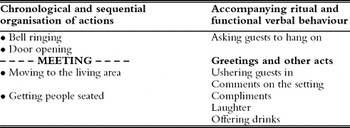
A preliminary macro-analysis of the way in which they unfold shows an overall shared pattern, summarised in Table 1 below:
Pattern of activities observed in both datasets

In the left-hand column, actions are sequentially organised (in line with Schegloff's Reference Schegloff and Psathas1979 observations on phone-call openings); the dotted line indicates the moment when the guests cross the threshold and find themselves together in the same location.
In the right-hand column, the actions listed may appear in a different order, except for the first one which is sequentially linked to the bell ringing. Table 1 shows the same activities to be present in both corpora, although not all activities may be found in each opening. A common feature of particular interest is the mix of greetings, comments and laughter. Most descriptions of greetings revolve around the way in which the core adjacency pair of this activity works (Schegloff, Reference Schegloff1968, Reference Schegloff and Psathas1979, Laver, Reference Laver and Coulmas1981; Firth, Reference Firth and Fontaine1972). In the French literature, researchers generally distinguish between ‘salutations’ (e.g. ‘bonjour’) and ‘questions de salutation’ (the more frequent of which being ‘questions sur la santé’, eg. ‘ça va?’). In visits, Traverso (Reference Traverso1996) has also identified ‘softening up’ exchanges which are related to the fact of entering another's domain and mostly focused on the fear of causing a disturbance, and comments on the setting and compliments, which are frequently used as a topic proffer. Another important feature of our corpora are comments on various aspects of the encounter or what has happened immediately before, like the journey to the hosts’ home (for instance having got lost, having lost time seeking a parking space, etc.), arrival time (being late or early) or devices linked to the start of the encounter (door bell, intercom, etc.). They are present in about 75% of openings and consist in single turns or pairs of turns. In both sets of data, they are triggered by the immediate context and they can appear just before, just after or even in the middle of greetings. They are also often accompanied by laughter. But this is where the similarities end. The rest of the paper focuses on the detailed cross-cultural comparison of these three main components (greetings, comments and laughter) of the opening sequence.
3 ANALYSIS
3.1 The greetings on their own: a slightly different ritual in France and in Australia
A significant number of small differences appear in the greeting rituals in our two corpora.
3.1.1 Greetings
In our Australian data, about a third of the greetings consist of a single adjacency pair, in which the first speaker uses ‘hello’, ‘hi’ or ‘how are you’ in an interchangeable way, and the second speaker responds along the same lines. ‘How are you?’ can be used on its own or combined with either ‘hello’ or ‘hi’ in the same turn i.e. ‘hello how are you?’. In these minimal greetings, there is no further separate exchange of ‘how are yous’, even when ‘hello’ or ‘hi’ have been used in the first place. This confirms the observation by Peeters (Reference Peeters1999: 240) that ‘how are you?’, which is rarely used as a real health/news enquiry, has a greater ‘phaticity’ in English than in French. Kissing is not the rule either. In our corpus, it only occurs in the case of friends who live in separate cities and have not seen each other for a while. All of these elements make for a rather brief greeting procedure.
In the French data, greetings is most of the time a two-step process. First, as the door opens, the participants produce a first adjacency pair, exchanging ‘Bonjour’ or ‘Salut’ both ways. Secondly, they produce at least one more adjacency pair consisting of health enquiries. ‘Ça va?’ is never used as a substitute for ‘Bonjour’ or ‘Salut’ in these data. Kissing is also a systematic feature of French greetings. The combination of these features means that the standard procedure for greetings in France takes longer than in Australia as all the guests exchange the ‘two step’ greetings plus kisses with all the participants present in the home at the time.
3.1.2 How are yous
In the Australian data, the second step of the greetings (i.e. health/news enquiries) does occur in about two-thirds of the examples. In these cases, however, the preferred response is a minimal, positive answer accompanied by thanks (i.e. ‘good thank you’). The question is rarely reciprocated or reiterated. We found only one occurrence of this, again in the case of the get together taking place after a fairly long separation. In this particular instance, after the guests have been ushered inside, one of the participants repeats the health/news enquiry, prefacing it with ‘so’, i.e. ‘so how are you going?’, which then clearly functions as a topic proffer.
By comparison, the French ‘ça va’ are never followed by thanking but are reciprocated in about 50% of instances (i.e. ‘et toi?’), leading to a new exchange. They are also frequently reiterated, often leading to more in-depth talk (Traverso, Reference Traverso1996). Therefore the second ‘step’ usually takes longer, yet again, in the French data.
These distinctive features partly account for the overall impression that the greeting ritual is a speedier and more matter-of-fact affair in the Australian corpus. The initial laughter (see section 3.4), kissing and repetitions involved in the French openings not only take longer, but build up an atmosphere of excitement.
3.2 Comments about time of arrival: two different stances
3.2.1 Preliminary remarks
Although the comments surrounding (or mixed in with) the greeting ritual are many and varied in both corpora, in the interests of brevity, we will focus only on those related to the actual time of arrival. The notion of what constitutes ‘being on time’ or ‘being late’ cannot be assessed by any common external yardstick, as it is subject to cultural/personal/social variation. Therefore we deal with this issue according to the attitude displayed by the participants in our recordings, that is to say, we consider that the guests are ‘early’, ‘on time’ or ‘late’ if either they or the hosts acknowledge it in a verbal or non verbal way.
3.2.2 The Australian corpus: excuses and jokes
In our Australian data, guests often apologise about their time of arrival, i.e. for being either early or late. We will now look at the different ways in which these excuses are packaged, and how they are dealt with by the host/s.
When the guests consider themselves to be late, they apologise profusely and produce many self-critical comments, as in example (1) below, where they had got lost:

In this excerpt, in addition to three occurrences of ‘sorry’ addressed to the two hosts in the first few seconds of the encounter, the guest also displays his embarrassment through an indirect apology (stating that he is late, line 3 and offering a self-critical explanation, line 7).
Even when the guests are on time, they often apologise as well, but in our data the excuses are couched in more indirect ways, such as a simple statement with a justification or a jokey comment. For example:
This second excerpt shows a guest's comment on her time of arrival, which, interestingly in our comparative perspective, concerns the fact of being on time. It is both an overstatement (with the use of ‘outrageously’) and an ‘auto-FTA’ (Kerbrat-Orecchioni, Reference Kerbrat-Orecchioni2005: 202), as it underlines what is presented as a speaker's negative behaviour. The humour of this utterance comes from the fact that being punctual is normally an appropriate, polite and expected behaviour. Therefore, it should be considered unmarked and should not attract any comment. However, this tends to prove that the time of arrival is a constant source of concern in visits.
If we now turn to the host's response, we can highlight some recurring features. Apologies are always accepted: ‘sorry’ usually triggers ‘that's alright’ or ‘don't worry’. Indirect apologies are also acknowledged using the same phrases. However, acceptance does not exclude the possibility of teasing (in the sense of uttering a mocking remark on the topic) as we will see in example (5) below.
When the apologies are offered in a jokey tone, the hosts are even more likely to continue in the same vein with the various participants taking turns outdoing each other. For example:
In line 4, the host responds to the guest's self-mocking comment by a tease, suggesting that the guests waited outside in order to ring the bell right on time. Whilst S gives a serious response (line 5), the second guest, L, (6–8) sticks to the imaginary scenario, by adding a new layer to the story. S and L thus display two well-documented ways of responding to a tease, i.e. treating the tease seriously and ‘escalating the teasable element’ (Glenn, Reference Glenn2003:123). The exchange then develops into animated banter, in which the hosts and the guests rival each other in their imaginings: K (11) claims that they would not have been ready to welcome their hosts, had they arrived earlier; and G (12) pursues the fictitious scenario, by suggesting they could have brought food to the guests in their car. L's contribution (14) plays both as a component of the imaginary story (i.e. as they were in the car waiting, they didn't think of asking for food) and as a meta-comment on his participation in co-constructing banter (i.e. he had not thought of that episode). This acts as the last turn in the story, and then the usual scenario of the visit picks up again (15).
3.2.3 The French corpus: the privileges that come with intimacy
In the French corpus, the time of arrival does not seem to be the focus of as much attention. It is sometimes commented upon, by the guests or by the host, but it seems never to warrant explicit apologies, even in the case of lateness. For example:
In example (4), where the guest makes a comment about lateness, it is not stated straight away at the time of the greetings, but later on in the conversation, almost as a fleeting aside. It is formulated as an understatement, and although there is a justification (‘on s'est laissé un peu euh’) the mention of what is obviously a shared ‘watering hole’ is a claim to common ground and common values (Brown and Levinson, Reference Brown and Levinson1987: 123). It constitutes a minimisation of the Self-Face-Threatening-Act. Such minimisation of the potential FTA in relation to being late is a common feature in our French corpus. In all cases, these implicit excuses are also ‘implicitly’ dealt with by the host.
In short, the different kinds of comments revolving around punctuality also contribute to the different tone of French and Australian openings. In the Australian data, the importance of punctuality transpires through the guests regularly worrying about the appropriateness of their time of arrival. This concern, however, is counterbalanced by an atmosphere of ‘ribbing’ and reciprocal banter. In the French data, the question of punctuality is de-emphasised altogether. It seems that being late is part of the privileges that go with being intimate.
3.3 Laughter
Laughter appears as another interesting feature for our comparison. Glenn (Reference Glenn2003) points out the social aspect of laughter and the need to study it as communication rather than as a simple response to humour.
Numerous outbreaks of laughter accompany the ‘threshold exchanges’ in the two corpora. As for the other components we have already studied, however, a closer examination reveals slight differences in location and use.
In the Australian data, laughs are always linked to the comments made by the participants, as in the two following excerpts:
This conversation begins with a greeting pair (lines 1 and 2). Then while the host is uttering ‘how are you’, the guest comments on his being late in an indirect self-critical way. In line 4, the host starts a new turn, then interrupts herself and produces a short burst of laughter in response. Comment and laughter are thus sequentially organized: we do not find that a first participant's laughter invites the co-participant to laugh (Jefferson, Reference Jefferson and Psathas1979), but rather that the first participant's ironical comment makes the co-participant laugh. After her delayed outbreak of laughter, the host launches into a comment that ‘rubs it in’ (lines 4–6), a typical response to the prior speaker ‘overdoing something’ (Glenn, Reference Glenn2003: 125), here the apology. In overlap with the tease, the ‘tardy’ guest continues to apologise.
In this second excerpt, the host turns into derision the ritual of visiting by producing a comment that is both ‘absurd’ and pretends to deny entrance to the guests. Although the two participants laugh, we find the same sequential organisation as in excerpt 5, in which the comment triggers the laugh of the recipient (4). Then the speaker herself joins in, continuing to talk in a ‘laughing’ voice (5), which signals that she is still joking.
In the French corpus, the location where laughter usually occurs is rather different:
In these two excerpts, the guests start laughing when the door opens, and throughout the first utterance of the conversation. From a comparative point of view, what is interesting here is: firstly, that laughter is not triggered by talk, but relates to seeing each other; secondly, that the guest seems to be the one who regularly laughs first at the very start of the encounter, with the host either joining in or not.
These first observations show a difference in the tone of the first exchanges, and converge with our other findings. The Australian outbreaks of laughter are joke-related whilst for the French they seem simply brought on by seeing each other.
4 CONCLUDING DISCUSSION
The analysis of French and Australian visit openings allows us to draw two different kinds of conclusions in relation to the contrastive approach.
From a methodological point of view, the results show that the criteria selected for comparability and the grid we developed in order to analyse the various levels of interaction in a contrastive way were operational: they allowed us to show the similarities and differences in the unfolding of the activity under scrutiny in the two different cultural contexts. On the similarity front, most of the same components are present in the French and the Australian data. The differences are to be found at the lowest level of the comparative ladder, so to speak, in the detail of specific exchanges and in the particular kinds of feeling displayed by the speakers. The careful building of corpora that are as similar as possible from the point of view of participants and context gives us a solid base to support the hypothesis that these recurring differences are most likely linked to culture.
On the level of conversational style and underlying cultural values (cf. Béal, Reference Béal2002), three points arise from our analysis:
• The greater attention paid to punctuality through numerous comments by friends in Australia in the data points towards a difference in relation to territory and face (in Goffman's or Brown and Levinson's sense), that is, being on time for Australians is a matter of respect for others, and being late is a kind of face loss, and ‘falling short of the mark’ in the presentation of the self (Olshtain, Reference Olshtain, Blum-Kulka, House and Kasper1989, Holmes, Reference Holmes1990:181). This perception of ‘time’ as a form of ‘territory’ does not seem shared to the same extent by friends in France.
• The way participants display their friendship reflects another difference in relation to territory and face. For the French, a closer and more intimate relationship tends to go hand in hand with fewer rather than more strategies of ‘negative politeness’ (hence the comparative scarcity of apologies).
• Affects are also displayed in different ways: the understated nature of the greetings combined with the banter in the Australian corpus is a good illustration of what Wierzbicka (Reference Wierzbicka1986) calls the ‘friendliness and antisentimentality’ of Australians, and their unease with the display of emotions. The French, on the other hand, not only appear comfortable stating their affection for each other, but indeed seem compelled to display it, as is clear in the effusive nature of the greetings, and in many other aspects of the data that cannot be discussed here for want of space: compliments on each other's appearance and on the location, response to gifts, food and drinks offering, etc.
Provided that clear and precise criteria for comparison are established and met, the analysis of comparable interactions is a most useful tool to gain new and interesting insights into how context and culture influence the way speakers interact.
The analysis of our data showed that the particular situation that has guests arriving on their friends’ doorsteps has similar consequences in different cultures (i.e. the similar way in which the first few minutes play themselves out and the peculiar mix of greetings with a variety of casual comments). But it also showed that the detail of how these different steps are dealt with reflect more general underlying cultural values, in ways that usually go unnoticed.