Wednesday 3 January (London)
In the evening I presided in Grand Lodge and carried in a very triumphant way my proposal to establish in perpetuity two life boats in record of the Prince of Wales's return from India.Footnote 574 It was undoubtedly a successful speech, as it convinced a divided and rather reluctant body.
But I had bad news from India. Sir L. MalletFootnote 575 came to me and gave me the details of the threatened scarcity in India. There is fault I think with the Foreign Office, and fault with the Government of India. I telegraphed to Lytton for more information – and I wrote to Lord Beaconsfield to ask for a very early Cabinet.Footnote 576 It is I fear a very serious case.
Thursday 4 January (London)
A very hard day's work.Footnote 577 This terrible Indian famine threatens to absorb all my time even if I had not the Colonial Office on my hands and plenty of other business. It looks very bad.
I spoke to RoweFootnote 578 as to the contemplated mission to Dahomey and told him that if he went he must be successful, that his capture or death would not only be the loss of everything to himself but would jeopardise the whole policy on the West Coast. He understood all, and is so cool and courageous a fellow that I am ready to trust him: but I suspect Derby will be too timid to run any risk even though I offer to bear ⅚ of it.
Wednesday 10 January (London)
Took the Chair at the Indian Council in the India Office. I found the Council disposed to be harmonious. I explained the position and had the Department despatch on the famine read, appointed a famine Committee and referred the Department to them appointing a fresh Council for tomorrow.Footnote 579 It is an unwieldly body to manage and as yet I have had no experience of it. Today however there was no difficulty. It is a curious episode in one's life to find oneself the really active Minister at the same time of two such departments as the Colonial and India Offices: but it remains to see how I can do it. It has added much to my work and must add.Footnote 580
I met Disraeli in the street and walked for half an hour with him. He was apparently in an amiable mood and spoke well of Salisbury, but this (perhaps I am uncharitable) may have been said with the personal object of letting me know or repeat it. I do not set much on this.Footnote 581
Saturday 13 January (Highclere)
Worse accounts again from India. On the public works of Bombay there are 300,000 persons and on the State of Madras the incredible number of 1,250,000!! This only reached me late this evening. I hope to be in London again on Monday and must take some further steps though I really hardly know what they should be.Footnote 582 I have written privately to Northbrook on the subject.Footnote 583
I received late in the afternoon a telegram from Salisbury. It took me some time to decypher it and reply but I succeeded in doing both in time for the last train.Footnote 584
Wednesday 17 January (Windsor Castle)
A very busy morning, almost entirely occupied with Indian work, a long conversation with Maine.Footnote 585 His is a singularly clear intelligence and not merely on abstract or legal subjects, but on high political matters [. . .].
After dinner I had a long conversation with the Queen. I told her as much as I could of the Indian famine but her thoughts were in TurkeyFootnote 586 and not in India and so I soon gave this part of the subject up.Footnote 587 I found her very Turkish. She said she felt for the way in which they had been treated, the spirit that they had shown and the recollection that we had in former times fought for and with them. I reminded her of the Bulgarian horrors. She disbelieved many, thought others exaggerated and that the Bulgarians had been equally guilty. It was clear that she had moved in this respect considerably forward since my last conversation with her, and I thought I could trace distinctly Disraeli's influence. I said enough to show my own feeling but did not of course argue it further.Footnote 588 She seemed to be entirely satisfied with Salisbury but had heard that Lady S. had talked too freely and foolishly. She was angry with the Opposition, but admitted that Granville had been cautious and HartingtonFootnote 589 had not behaved ill, but she did not agree much when I included ForsterFootnote 590 in this praise. She said he was not a man of the world and did not understand foreign affairs.
Thursday 18 January (London)
The best part again of my day has been spent on Indian affairs [. . .].
Later I called on Lady Derby and found her in. I had a long and very friendly talk on all subjects. Two or three things resulted:
1. It is quite clear that Derby is sore at my constant opposition (which as I explained is inevitable and is really more loyal than silent antagonism would be) in the Cabinet.Footnote 591
2. We are in a state of tension. She expects the Cabinet to break up. Derby cannot bear opposition. Disraeli she thinks if now thwarted may take the Garter and retire and Derby will retire with him.
3. When Disraeli lately told us that the Russian Ambassador had intimated that his Government desired the withdrawal of Sir H. Elliot and on that statement I and others at once agreed that Elliot could not be withdrawn she said that the statement was false. She repeated this more than once.
Thursday 8 March (London)
I dined with Froude to meet Tennyson.Footnote 592 I naturally wished to know him and he was good enough to say that he wished to know me. On the whole I think we were mutually satisfied. His conversation has very little of the poet in it: or at least there is more of the “Northern Farmer” than the “Lady of Shalott”.Footnote 593 He shows little sign too I should say of historical reading or knowledge which surprised me: but there were glimpses of his metaphysical studies in what he said, but generally he was straightforward and simple and fair and I liked what I saw of him in the two or three hours’ talk. There was no one else as Froude had asked him alone. He began on the subject of Colonies and Colonial Government and said he heartily agreed in my administration of them.
Wednesday 14 March (London)
Usual day of work. I attended Lowe's Sustentation of Incumbents Fund [. . .].
A conversation later with Lady Derby as to D.'s manner, a delicate matter to discuss, and one impossible but for her perfect straight forwardness and the fact that she is so old a friend. I said of course nothing that possibly hurt her as regards D. but I also said that I thought that on the whole it was best not to say anything to him or to force any renewal of friendly relations on him: but I leave it all to time. I am not myself very sanguine.
Thursday 15 March (London)
Dined with Rosebery at the St. James's Club: and then was with him admitted as a member of the Society of Antiquaries, where I listened to a wondrously dull discussion on an old charter which had turned up at Dover and another old Bull of the reign of Henry VII.Footnote 594
Just before going out to dinner I received in a circulation box a telegram from Lyons saying that IgnatieffFootnote 595 was coming to England immediately and was to go on Saturday to Hatfield. It is most singular and I can hardly believe it. Only a few days ago Salisbury agreed that it would be a great mistake if Ignatieff were to come to London and it is clear that his going to Hatfield would identify Salisbury with him and his Russian policy. It is altogether inexplicable, and I doubt if there is truth in it.Footnote 596 On returning home I found that Salisbury had called here at 7.45: but having to dine early I had gone. Probably he called to give some explanation.Footnote 597
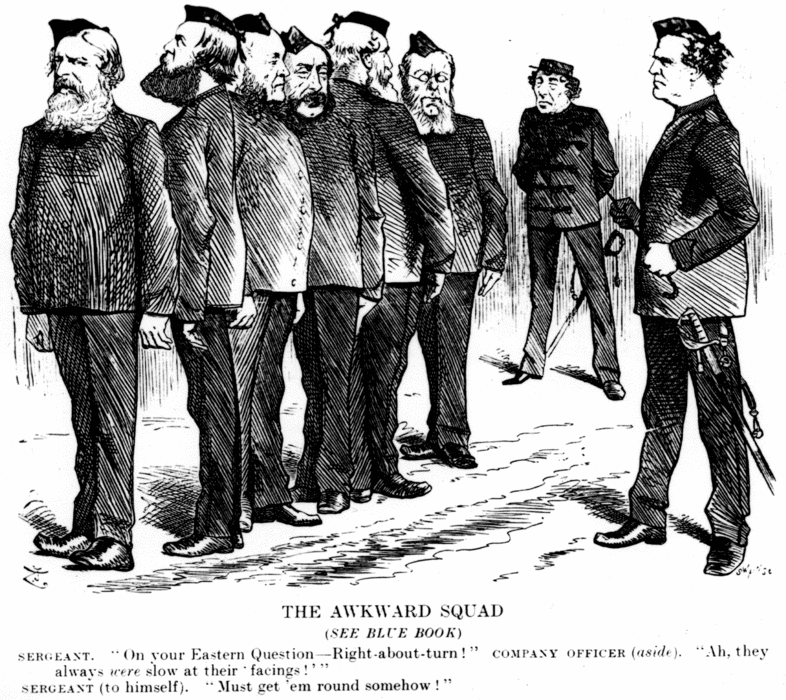
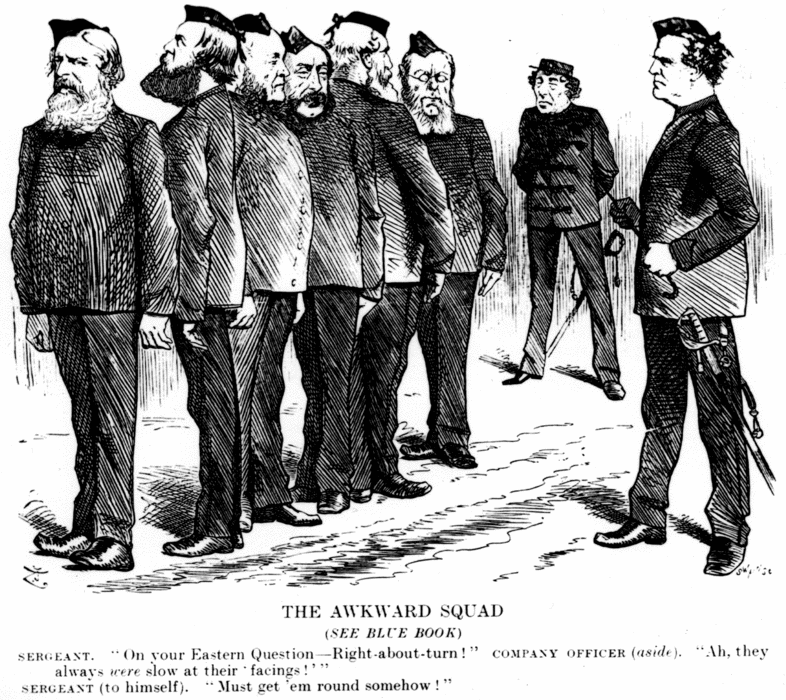
‘The Awkward Squad’, Punch, 24 February 1877, by Sir John Tenniel, depicting the differences within the Cabinet on the Eastern Question. The Sergeant represents Lord Derby and the Company Officer, Disraeli. Carnarvon is the fourth figure from the left.
Sunday 18 March (Hatfield)
Ambassadors, Northcote, Cross, Bourke,Footnote 598 Hartington, Bath, Goschen,Footnote 599 altogether about 35 or 40 persons – and on the whole everything well and handsomely done. As to the two chief guests Madam I. [Ignatieva] was certainly very pretty and is still good looking. She is agreeable, light in hand, speaks English very well and is extremely taking. He is very anxious to please: but I doubt if I quite like him. He talked to me some time this morning in a torrent of voluble French but the sum total of his conversation was reiterated assurances of his honesty and sincerity. At last I hardly knew how to answer him. This and the repeated statement that England and Russia had in the East few interests at variance comprised all he said. But he is doubtless clever and has evidently great energy.
I had a long and important conversation with Northcote as to the recent difficulty in the Cabinet respecting Elliot. He admitted and said that Derby's temper was becoming impracticable, that Disraeli seemed to be now entirely under Derby's influence, that matters could hardly go on as they now are and that the situation was growing dangerous and very disagreeable to all of us. The truth is that yesterday's Cabinet has been very useful in bringing matters on to a decisive issue. It has also perhaps cleared away that which was once a matter of extreme probability and which has always been a contingency – the succession of Derby to the Prime Ministership. I think this is almost disposed of. I doubt now if Salisbury would serve under him – I do not think I could – and if we both withdrew, as things now stand, it would make such an event almost impossible.Footnote 600
Good Friday 30 March (Highclere)
I wrote to Northcote on the singular article in the Pall Mall,Footnote 601 put in evidently by official inspiration and saying that the signing of the protocol was due to causes operating within and without the Cabinet, in other words advertising our differences. It seems to me an unjustifiable and unprecedented proceeding on Derby's part.Footnote 602
Saturday 7 April (Highclere)
I have had a tolerably quiet evening here by myself and I have done a good deal of work. I think I begin to see how to deal with my South African Confederation question.Footnote 603 One of my greatest difficulties in office is that I have really no time for any quiet or deliberate thought. Everything has to be decided on the spur of the moment, and either it must be decided by a sort of instinct or on the advice of those whose judgement I think I can trust and who have had more leisure to look into the case. Everything too at home naturally and necessarily is referred to me and if I do not listen to every question from the children's dresses to the cooking of the dinner I know all would go wrong. At the same time it is fair to admit that the head servants are excellent, have really good judgement, and honestly try to spare me in every way.
Monday 16 April (London)
Walked home from the House with Salisbury and he told me that tomorrow evening he is to have a conference with Disraeli on foreign affairs. It shows that D. feels we have come to a serious stage and as Salisbury thinks it means business. Also it means that D. does not mean to break with us just now: but we are on hollow and slippery ground. Salisbury's notion is that we must take the harbour in Crete, erect Crete into a republic undertaking for her the management of her foreign affairs, and on the whole as I understand him not to let Russia get hold of Constantinople.
[? Saturday 5 May (London)]
[Page torn away] [. . .] was understood at the last Cabinet. He is so averse to taking any decided step that even when matters are thought to be decided he leaves them open. Some discussion ensued but I doubt if he will take any real action.
I called at Lady Derby's before the Cabinet as she leaves England today for a month. I had as usual a most friendly talk. She says she can do no moreFootnote 604 and that she hopes that peace is now in the ascendant, but I do not think that she believes much in the stability of affairs. She would not, I suspect, be astonished if during her absence Derby retired from office, a contingency which at times has been in view. Meanwhile he has recovered all his serenity as far as I am concerned, and is very affable again.
At the Academy dinner tonight I sat next to Hardy and talked much with him. He is angry with Disraeli's appointment of ThoroldFootnote 605 as the new Bishop of Rochester, and certainly his way of speaking of the Prime Minister does not imply any great confidence in him on any subject. Gladstone spoke with singular eloquence at times, and Northcote in a wholly different and in a lower strain spoke well.
Monday 7 May (London)
Last night I received the news of the annexation of the Transvaal. On the 12th ult. it seems Shepstone after exhausting all other means told the Transvaal Government that he would wait no longer and acting on my general instructions he declared the territory to belong to the English Crown. It is a step which I think has no precedent for many a long year but I think it is right and it will anyhow mark my tenure of office.Footnote 606The Times gives a friendly but cautious approval and one or two other papers write in the same sense.Footnote 607 I expect that the foreign Press will criticise in no friendly manner; and just at this moment it might be well to be spared this, but it cannot be avoided and on the whole it is enough for me if this Country generally approves. But for the war in the East which absorbs everything else it is an event which would have created a good deal of discussion. Derby from a few words that he said evidently does not like it: but it is in opposition to everything that he approves and so I am not surprised. As to the rest of my colleagues they hardly seem to know much of it, except of course Salisbury is evidently amused at the whole transaction.
At the Levée today d'HarcourtFootnote 608 told me privately, saying that he wished to tell me but that he had mentioned it to no one but Derby, that the Prince of Wales whilst in Paris had talked in a very injudicious way of the present war, saying that Russia had planned all this for a long time and that Germany probably intended to take the first opportunity of attacking France.
Thursday 31 May (London)
In the evening I took the Chair at the Society of Antiquaries to hear Newton deliver a lecture on the date of the Mycenae discoveries.Footnote 609 Schliemann was there but he did not make much head at an explanation of the several points raised. Newton was very clear. I summed up, but I doubt if I did it as well as I ought to have done.Footnote 610
Friday 3 August (London)
I had some conversation with Lady Derby on recent events in the Cabinet. Derby had written to her before our alliance to say that he was extremely anxious and that affairs were more critical than they had as yet been: but now he was satisfied at the result and at the support which I had given him and which he seems to have appreciated. She was astonished at Salisbury's change of position and frequently recurred to it, saying she could not understand it.Footnote 611 Her general notion however was it was the result of his visit to Osborne and that the Queen had impressed him with her new ideas. It seems to have been Disraeli's notion that if he could be sure of Salisbury, he might count upon me, and if this was so all this must have been a great disappointment to him.
Monday 10 September (Highclere)
Derby has I find written a draft on the subject of Turkish atrocities but the draft when sent to Balmoral was disapproved. It came back to Disraeli who of course was in favour of assuming the Russians to be equally guilty, and since then it has been tinkered and patched and apparently has not yet gone.Footnote 612 PauncefoteFootnote 613 says that Serbia is entirely in Russian hands and only awaiting orders. Greece is much in the same position.
Tuesday 30 October (Highclere)
The Transvaal Delegates came down here for lunch before returning to London. Old KrugerFootnote 614 is a curious and really an interesting specimen. He illustrates, I take it, perfectly the Dutch “Dopper Boer”Footnote 615 – obstinate, narrow, rough, unlettered, prejudiced: but shrewd, not untruthful, homely and except as regards natives by no means unkindly. He looked at Margaret as she sat by me at luncheon with evident admiration and watched her as she moved about. But his chief admiration was for the stables and the horses: and when I had a breaking-in bit put into the mouth of one of the horses and a dumb jockey placed on the animals back he was extremely interested.
Both he and Jorissen promised to do all they could to influence their countrymen for good and to serve the Queen faithfully on their return.Footnote 616
General Summary of Cairns’ resolutions, 18 December [page missing]Footnote 617
1. Parliament to meet on the earliest day (7 January) and a vote of credit to be taken.
2. A despatch to be framed founded on the communication of 8th June to us by Russia which indicated the terms of peace which Russia would accept under certain circumstances, asking Russia whether we may communicate these terms to Turkey without expressing an opinion upon them.
3. Supposing that a vote is taken for increased armaments and that peace is not made and that Russia is not giving satisfactory assurances and that she continues to advance on Constantinople, that we should occupy the Gallipoli end of the Straits.
4. That the consent of the Sultan should be asked for this, but that if it is refused we should consider whether we should not take it by force.
5. That our objects are “British interest”, the conclusion of the war and some other generalities which I could not take down.
6. That we do not propose an alliance with Turkey beyond what circumstances render necessary (this being the sense of the passage though the words used were different), that we do not intend to encourage her to continue the war and some other similar generalities.