Cahokia is the largest archaeological site north of Mexico, a city built some 1,000 years ago by Native American peoples in the central Mississippi valley in what is today Illinois. Archaeologists debate how and why Cahokia became important. I argue that storytelling was ultimately the reason for Cahokia’s importance, because stories gave meaning to everything Cahokian.
By AD 900, Cahokia was one of many settlements in the American Bottom, the Mississippi River floodplain approximately 100 km (60 miles) north–south and roughly 15 km (10 miles) east–west at its widest point near Cahokia. People in these communities fished, hunted, gathered, and grew native plants, including squash, Chenopodium, and sunflower. Around AD 900, they adopted maize during a warm humid period, optimal for growing this tropical cereal. In the next century, some settlements grew into villages with central plazas. By AD 1050, Cahokia stood out as a central place, and the population of the American Bottom and adjacent uplands grew rapidly as immigrants came from places such as southeast Missouri, northeast Arkansas, and southern Indiana. Mounds became an important feature of town plazas, and as a large and complex urban center, Cahokia featured multiple plazas with multiple mounds. In total, some 120 mounds were built at Cahokia, 50 at East St. Louis, and 25 across the river at St. Louis. We might consider these to be a single sprawling development, extending nearly 13 km (8 miles) east to west, and sometimes called Greater Cahokia. Cahokian influence extended beyond the American Bottom; even before AD 1050, Cahokians built settlements in the upper Mississippi valley, and later in the lower Mississippi valley. At Mississippian sites, from Spiro in western Oklahoma to Etowah in Georgia to Lake Jackson in Florida, the presence of Cahokian artifacts and local imitation of them shows the influence of Cahokians among contemporary and later generations, long after Cahokia’s decline around AD 1350 (e.g., Alt Reference Alt, McNutt and Parish2020b; Brown and Kelly Reference Brown, Kelly, Morehart and Lucia2015; Emerson Reference Emerson, Emerson, Koldehoff and Brennan2018; Fritz Reference Fritz2019; Hall Reference Hall, Quilter and Miller2006; Kelly and Brown Reference Kelly, Brown, Creekmore III and Fisher2014; King Reference King, McNutt and Parish2020; McNutt and Parish Reference McNutt and Parish2020; Mehta and Connaway Reference Mehta and Connaway2020; Pauketat Reference Pauketat2003; Pauketat et al. Reference Pauketat, Boszhardt and Benden2015; Stauffer Reference Stauffer, McNutt and Parish2020; Zimmermann Holt Reference Zimmermann Holt2009).
Why were Cahokians so influential? Clearly, ideology was a factor (Alt Reference Alt, McNutt and Parish2020b; Pauketat Reference Pauketat2013). People came to Greater Cahokia, helping to build and feed it, because they were attracted to it as a spiritual center and because they wanted to take part in the drama (Zimmermann Holt Reference Zimmermann Holt2009). Among the most important Cahokian rituals were adoption ceremonies (Hall Reference Hall, Emerson and Lewis1991, Reference Hall1997, Reference Hall, Quilter and Miller2006) because these were critical in integrating the widespread and diverse peoples of this urban center (Zimmermann Holt Reference Zimmermann Holt2009; also see Pauketat Reference Pauketat2004). Through adoption, immigrants to the American Bottom became Cahokians, as did pilgrims who returned home as Cahokians. Marriage was another important ritual joining individuals and families (Brown Reference Brown and Beck2007a). Even human sacrifice or “scheduled death” (Hall Reference Hall1997) served to integrate Native peoples who became Cahokians, considering the diversity of those buried in Mound 72 and other locations within Cahokia (Emerson and Hedman Reference Emerson, Hedman and Faulseit2016; Hedman et al. Reference Hedman, Slater, Fort, Emerson and Lambert2018).
In this article, I contend that Cahokia was a city of storytellers. I briefly discuss storytelling, then summarize archaeological evidence for stories told by Cahokians. Like all people, Cahokians created their world through stories. Cahokians told stories about cosmology and stories about powerful women and men who were goddesses and heroes. Cahokians repurposed stories to create a new social order and reinforce the site’s significance as a central place on the Mississippian landscape. I propose that Cahokian ideology was spread by a new type of story: the heroic epic. The distribution of artifacts telling Cahokian stories embodies Cahokia’s heartland and its hinterland.
Stories and Storytelling
Although Native American beliefs are often distinctively different from Western thought, I begin with a note of caution. In this article, I hope to convey Native points of view by presenting the published work of Native authors. However, Native philosophies and practices vary between tribes, among individuals, and through time. Because different Native communities have different beliefs and traditions, and because individuals in those communities have different points of view, Native authors are identified with tribal affiliation throughout this article. Although none of these authors would claim to speak for Cahokians, they might help us gain insight into Cahokian storytelling. Additional insights would be gained by further discussion with descendant culture bearers—a goal not yet fully realized in this work.
Native American worldviews suggest that language and storytelling make us human. The Diné creation story tells us that “words as well as formless substances are among the world’s primordial constituents” (Witherspoon Reference Witherspoon1977:43). In The Man Made of Words, Kiowa author N. Scott Momaday (Reference Momaday1997:2) writes, “We exist in the element of language. . . . Language is necessary to thought, and thought (as it is manifested in language) distinguishes us humans from all other creatures.” In Storyteller, Laguna author Leslie Marmon Silko (Reference Silko2012:xvii) writes, “The human capacity for language and storytelling go hand in hand. Neither precedes the other; rather, the urge to share our experience, to tell our stories to another human is so strong that humans invented languages.” As the titles of these works emphasize, language and stories make us who we are. Native American cultures are traditionally oral cultures, and Native American storytelling remains alive and well today, flourishing far beyond the spoken word.
Stories provide frameworks for seeing the world. Momaday (Reference Momaday1997:3) writes, “Stories are realities lived and believed. They are true” (also see Hester and Cheney Reference Hester and Cheney2001; Welch Reference Welch2019). Anishinaabe scholar Gerald Vizenor states, “You can’t understand the world without telling a story. There isn’t any center to the world but a story” (Coltelli Reference Coltelli1990:156). Cherokee scholar Christopher Teuton (Reference Teuton2012:7) affirms that “stories are the foundation of Cherokee culture.”
Anthropologists and folklorists have also long recognized the importance of stories and storytelling (Zimmermann Reference Zimmermann, Lambert and Giles2026). Bronislaw Malinowski (Reference Malinowski1926:18) maintained that “myth” is “living reality” to people who believe in it. He wrote that mythology was “a cultural force” (Malinowski Reference Malinowski1926:87)—it does things; it has real power in the world. He also contended that myth “serves principally to establish a sociological charter” (Malinowski Reference Malinowski1926:87, 89); stories justify values, beliefs, and “sociological order” (Reference Malinowski1926:91–92). Native North American stories that justify the sociological order, revealing rights and responsibilities of societal roles, can be found from the Northwest Coast to the Southeast (Hann Reference Hann1988; Harris Reference Harris1974; Keyes Reference Keyes and Kwachka1994; Thompson Reference Thompson1929). In short, stories create and explain the world, and they legitimize the place of humans in that world (Georges Reference Georges1969; Vansina Reference Vansina1985).
Anthropologists and especially folklorists have written extensively about types of stories (e.g., Boas Reference Boas1914; Malinowski Reference Malinowski1926; Thompson Reference Thompson1929), and there is not enough space to review that literature here. I will examine evidence for cosmological, goddess, and hero stories at Cahokia because these are commonly recognized and understood. Nevertheless, these are not discrete types, and all types animate Native ontologies and outlooks.
Cosmological stories portray the creation and structure of the world. However, Standing Rock Sioux scholar Vine Deloria Jr. (Reference Deloria2003:87) suggests that creation is not a thing of the past for Native Americans in stating that “tribal stories recount how the people experience the creative process which continues today.” Anishinaabe scholar John Borrows (Reference Borrows2016:828) likewise states that “creation is not finished; it is still ongoing,” and Pawnee scholar Roger Echo-Hawk (Reference Echo-Hawk2018:9–10) declares in a similar vein that humanity is “an evolving revelation.” Time is not linear in Native American belief (e.g., Deloria Reference Deloria2003; Fixico Reference Fixico2003); this notion of continuous creation and creative process also reminds us that stories change through time.
“Culture heroes were plentiful in tribes,” Deloria (Reference Deloria2003:99) tells us. However, it was not the hero as a person but what he or she did that was important (Borrows Reference Borrows2016). Examples from Deloria include Deganiwidah, who founded the Iroquois League; Sweet Medicine, who brought new ceremonies to the Cheyenne; and White Buffalo Calf Woman, who brought the Sacred Pipe to the Lakota. White Buffalo Calf Woman is often described elsewhere as supernatural, but Deloria (Reference Deloria2003:99) clarifies that she was not “a personal object of salvation or adoration.” Although creators are common in Native cosmologies, Deloria insists that an anthropomorphic deity comparable to the Christian God is not typical of American Indian spirituality.
Considering Deloria’s observations on divinity, characters anthropologists have categorized as goddesses might be seen as female (super) heroes. Specifically, Old-Woman-Who-Never-Dies, aka Grandmother, is described as a Dhegihan Sioux goddess (Colvin Reference Colvin2012), but she could be seen as a hero with supernatural abilities. I will use the term “goddess” because it is commonly used and so as to distinguish female from male heroes. Heroes typically have supernatural abilities in Native American stories (Zimmermann Reference Zimmermann, Lambert and Giles2026), but Grandmother has more than most; she is superhuman.
To reiterate, these categories overlap: goddesses and heroes are not discrete types (Borrows Reference Borrows2016), and their tales are cosmological stories in that they tell us about creation and the nature of the world. Animals are commonly nonhuman persons in Native cosmologies. Echo-Hawk (Reference Echo-Hawk2018:9) tells us that “the essences of human nature are fused with the essences of animals”; animals are our relatives who can sometimes transform into human shape (Bruchac Reference Bruchac1996). Furthermore, “plants, rocks, and natural features” can also be seen as animate and powerful (Deloria Reference Deloria2003:89). Mohawk/Anishinaabe scholar Vanessa Watts (Reference Watts2013:21) emphasizes the “common intersections of the female, animals, the spirit world, and the mineral and plant world.” The importance of the land is central in Native stories (Basso Reference Basso1990; Deloria Reference Deloria2003; Watts Reference Watts2013); seeing storied locations on the living landscape are reminders that stories are true. Just as the land is alive and sacred, sacredness can be found in any story.
In short, all Native stories conceptualize cosmoscapes, “overarching models and templates for the shape and scope of the cosmos” (Reichel Reference Reichel, Pungetti, Oviedo and Hooke2012:136–137). Stauffer et alia (Reference Stauffer, Giles, Lambert, Stauffer, Giles and Lambert2022) stress that cosmoscapes are materialized throughout the archaeological record. Furthermore, Anishinaabe/Ojibwe archaeologist Sonya Atalay urges action, encouraging archaeologists “to appropriately consider and engage with some landscapes, sites, and artifacts as ‘beings that are other-than-human’” (Reference Atalay, Supernant, Baxter, Lyons and Atalay2020:256; emphasis in original). This Native worldview is central to the “ontological turn,” or the “new materialism” (e.g., Alt and Pauketat Reference Alt and Pauketat2020); however, some scholars are critical of this paradigm shift (e.g., Bessire and Bond Reference Bessire and Bond2014). Métis scholar Zoe Todd (Reference Todd2016), for example, cautions that “ontology is just another word for colonialism” when non-Native authors adopt the ideas but do not give proper credit to or “heed the teachings” of Native scholars.
The view of storytelling as a cultural force is supported by a large body of literature on the performance of storytelling (e.g., Abrahams Reference Abrahams and Bascom1977; Bauman Reference Bauman1977; Georges Reference Georges1969; Hymes Reference Hymes1981; Kroeber Reference Kroeber1992; Momaday Reference Momaday1997; Tedlock Reference Tedlock1983; Turner Reference Turner1982). Seminole/Muscogee Creek historian Donald Fixico (Reference Fixico2003) stresses not only the skills of the storyteller but also the role of the audience. He writes, “An audience is a reactionary power waiting to be acted upon . . . the audience is also an integral part of the American Indian oral tradition of oral history” (Fixico Reference Fixico2003:27). Similarly, Rodney Frey (Reference Frey2017) emphasizes the “responsibilities” of the audience: the audience is a participant in Native American storytelling, and passive listening is not allowed. Stó:lō and St’at’imc scholar Jo-Ann Archibald (Reference Archibald2008:33) confirms, “Synergistic interaction between storyteller, listener, and story is another critical storywork principle.” Silko (Reference Silko2012) likewise describes lively interaction between Pueblo storytellers and audiences.
Fixico (Reference Fixico2003) maintains that storytelling unites Native communities and gives them identity (also see Deloria Reference Deloria2003; Turner Reference Turner1969; van Gennep Reference van Gennep1960). Similarly, Kroeber (Reference Kroeber1992, Reference Kroeber1998) writes that stories are how societies define themselves and how they adapt (Hymes Reference Hymes2003). He further argues, “Storytelling is perhaps humanity’s primary tool for changing reality” (Kroeber Reference Kroeber1992:13). Stories can be intentionally changed to manipulate social conditions and redefine social narratives (Goody Reference Goody2010; Lankford Reference Lankford2008).
Because stories can be altered to drive and justify social change, storytelling can be a tool of statecraft. Jack Goody (Reference Goody2010:44–45) claims that “epic tales tend to be found in early states with important warrior classes that enjoy hearing of the brave exploits of their predecessors.” David Konstan and Kurt Raaflaub’s volume Epic and History (Reference Konstan and Raaflaub2010) presents case studies from around the world, suggesting that epic tales were used as a political tool. Storytelling was essential to statecraft in early states.
In sum, stories and storytellers do not just say things. They do things. They create the world. Stories justify values, beliefs, behaviors, and social conditions. Stories create individual and group identity. Stories change to reflect a changing world; stories in turn can change the world. If the epic tale evolved as a tool of statecraft, Cahokia might provide additional evidence of this. Stories can be a political tool; certainly, we see this today.
Storytelling at Cahokia
The material evidence of stories and storytelling are the artifacts and features left behind. Robert Hall (Reference Hall1997) was a pioneer in recognizing Native stories in midwestern archaeology, which is unsurprising given that he grew up “in a household that included [his] mother, grandmother, and great-grandmother, all of whom were enrolled members of the Wisconsin Stockbridge band of the Mohican Nation” (Hall Reference Hall and Nicholas2010:121). Vernon James Knight et alia (Reference Knight, Brown and Lankford2001) argue that the common theme of Southeastern Ceremonial Complex (SECC) imagery was a depiction of an “otherworldly reality”—that SECC art represents myths and mythical characters. They and others in a working group known as the Mississippian Iconography Conference have successfully used Native American stories to interpret Mississippian symbolism (Lankford et al. Reference Lankford, Reilly III and James2011; Reilly and Garber Reference Reilly and Garber2007). Although ultimately their research challenges the very concept of the SECC (see Knight Reference Knight2006), Knight et alia (Reference Knight, Brown and Lankford2001:136) write, “Our claim is that both Southeastern Ceremonial Complex imagery and certain charter myths, whose historically collected transforms may be used to interpret them, were parallel devices deployed in Mississippian societies to reinforce the same key social features of ritual and status.”
James Brown (Reference Brown, Townsend and Sharp2004, Reference Brown, Reilly III and Garber2007b) traces the roots of SECC iconography to the Braden style, which he hypothesizes originated at Cahokia. Brown and John Kelly (Reference Brown, Kelly and Ahler2000) document early Braden style at Cahokia with engravings found on pottery, shell, and bone dating to the Lohmann phase, which began with the “Big Bang” or “Mississippian Event of [AD] 1050” (Hall Reference Hall, Quilter and Miller2006; Kelly and Brown Reference Kelly, Brown, McNutt and Parish2020; Pauketat Reference Pauketat2004). James Duncan and Carol Diaz-Granados (Reference Duncan, Diaz-Granados, Stauffer, Giles and Lambert2022) also trace the origins of the Braden style to Cahokia through analysis of art at Picture Cave in Missouri, some 115 km (70 miles) west of Cahokia. Artifacts made in the Braden style proliferated during the Stirling phase at Cahokia (AD 1100–1200) and into the Moorehead phase (AD 1200–1275). These include red flint clay figurines found in good context on Stirling phase sites in the American Bottom and a flint clay workshop at East St. Louis dating to the first half of the Stirling phase (Boles et al. Reference Boles, Ely, Poling, Holschen, Kitchen, Emerson, Koldehoff and Brennan2018). Emerson and colleagues (Reference Emerson2003) demonstrate that flint clay came from a source near Picture Cave. Shell gorgets and copper artifacts are less commonly found in good context in the American Bottom (e.g., Kozuch Reference Kozuch2010). However, Brown and Kelly (Reference Brown, Kelly and Ahler2000) contend that the Braden style indicates that they too were made at Cahokia; they have also identified an early Moorehead phase copper workshop at Cahokia’s Mound 34 (Kelly et al. Reference Kelly, Brown, Hamlin, Kelly, Kozuch, Parker, Van Nest and King2007). Laura Kozuch (Reference Kozuch2022, Reference Kozuch2023) documents evidence for shell bead crafting at Greater Cahokia, and she believes that Cahokians organized expeditions to the Gulf of Mexico to obtain lightning whelks to make beads, cups, masks, and gorgets (Kozuch Reference Kozuch2010, Reference Kozuch2021, Reference Kozuch2022). Braden-style artifacts are recovered in later contexts, dating AD 1250–1350, at sites such as Spiro and Etowah (Brown Reference Brown, Townsend and Sharp2004; Brown and Kelly Reference Brown, Kelly and Ahler2000). In sum, this body of research indicates that Braden-style artifacts were made at Cahokia, then were sometimes used or curated for a century or more before being interred at sites hundreds of kilometers away.
However, Thomas Emerson (Reference Emerson2023a) has recently suggested that Caddo immigrants from Spiro were the originators of early Braden-style materials at Cahokia, and he questions the Cahokian origin of Braden-style marine shell cups and copper repoussé plates. It is not within the scope of this work to refute Emerson’s critique, except to note that the number of Caddo-like vessels found at East St. Louis (Greater Cahokia) was 39 out of 15,670 ceramic vessels, or 0.25% (Lambert and Ford Reference Lambert and Ford2023). Shawn Lambert and Paige Ford (Reference Lambert and Ford2023) conclude that Caddo craft specialists lived at Cahokia; still, the rarity of Caddo vessels suggests that they were a minority. Even if Emerson is correct, consensus remains that flint clay figurines were made in Greater Cahokia, because flint clay is sourced to the Cahokia region, and manufacturing debris is found in good context at East St. Louis (e.g., Boles Reference Boles, McNutt and Parish2020; Emerson Reference Emerson2023a).
The imagery in Braden-style and other artworks thought to originate at Cahokia provides evidence of stories told at Cahokia. These images suggest that cosmological stories as well as tales of powerful women and men were told. Illustrations of this art are not reproduced here out of respect to descendant communities who might object to their display; all works discussed are published elsewhere, and those references are cited. The archaeological distribution of these images over hundreds of kilometers provides evidence that stories were used to disseminate Cahokian influence and ideologies. The Cahokian landscape and the construction of Cahokia provide evidence that these too told the story of the Cahokian cosmoscape and therefore played a critical role in attracting pilgrims and immigrants.
Cosmological Storytelling
F. Kent Reilly (Reference Reilly, Singleton and Reilly III2020:221) suggests that “the primary theme of the Braden style is both foundational deities and their role in the act of creation.” In other words, artworks made by Cahokians told cosmological stories—ones that explained the origin of the world and how it is organized. They did this by using imagery that would have been readily recognized and understood across linguistic lines in the multiethnic community Cahokians created. I am relying here on generalized understanding of that cosmology formulated by scholars such as Hall (Reference Hall1997) and Charles Hudson (Reference Hudson1976) based on comparative study of historically known tribes, mostly southeastern and Plains. Cahokian cosmology surely differed from this general model in elusive ways, and meaningful collaboration with descendant communities is warranted to help us better understand these differences (Zimmermann et al. Reference Zimmermann, Deere, Candice, Deere, Zimmermann and Byrd-Boney2026).
Cosmological stories are told by ceramic vessels from cemeteries near Cahokia featuring earth divers (e.g., diving ducks, beavers) and animals associated with the Upper World (birds), This World (e.g., bears), and Under World (e.g., whelk; Hudson Reference Hudson1976; Zimmermann Holt Reference Zimmermann Holt1996). Owls are commonly represented on these vessels and are also suggested more abstractly by hooded bottles from Cahokia. As birds, they might be associated with the Upper World, but given that “the night sky is the equivalent of the underworld in Indian thought” (Hall Reference Hall1997:133), owls as nocturnal birds might be associated with the Under World or might travel between the two layers.
Animals carved by Cahokians from flint clay most commonly include frogs and birds. Steven Boles (Reference Boles, McNutt and Parish2020) notes that many of the animals depicted are Under World creatures (frogs, crawdads, owls), and he suggests that this imagery was tied to the subterranean origins of flint clay. As water creatures, crawdads might represent the Under World, but Hall (Reference Hall1997) suggests that they were earth divers. Boles (Reference Boles, McNutt and Parish2020) notes that two flint clay frogs held rattles, supporting Emerson’s (Reference Emerson2003, Reference Emerson and Claassen2023b) interpretation that frogs were associated with shamans or priests; frogs were also capable of going between This World and the Under World.
Braden-style copper plates commonly depict raptors, thereby representing the Upper World (Brown Reference Brown, Reilly III and Garber2007b). Raptor and other bird imagery suggestive of the Upper World are also common in Braden-style shell gorgets, but some gorgets show serpents—indicating the Under World—and others show composite creatures such as piasas (Brown Reference Brown, Townsend and Sharp2004). Composite creatures might represent the Under World, given its association with the night sky; Reilly (Reference Reilly, Townsend and Sharp2004) argues that composite creatures were supernaturals that could go between worlds. As Reilly (Reference Reilly, Townsend and Sharp2004:127) concludes, animals were “crucial actors in cosmogonic tales. In the Mississippian and later Native American world, ritual and ceremony were the means to access these cosmic powers.” In short, animal images tell cosmological stories because they symbolize how the Mississippian world was structured.
Artworks that depict priestly activity are also identified (Boles Reference Boles, McNutt and Parish2020, Reference Boles, Stauffer, Giles and Lambert2022; Emerson Reference Emerson2003, Reference Emerson, Pauketat and Alt2015, Reference Emerson and Claassen2023b). The Frog Smoker flint clay pipe found at Spiro depicts a man smoking a frog pipe, possibly a priest transforming into a frog (see Barrier Reference Barrier, Carmody and Barrier2020). Other priestly imagery identified among flint clay pipes includes the Macoupin Creek pipe, which depicts a man with rattle in hand. The Bostrom flint clay pipe portrays a person kneeling with a smaller person in their arms. The Gilcrease Rattler pipe, also found at Spiro, combines these two activities; this figure has a rattle in hand and a small person at their knee (Emerson Reference Emerson2003:Figure 1f). Priests tell cosmological stories, and pipes depicting them explicitly represent efforts to connect with the cosmos.
Cosmological stories are also told by abstract motifs on Ramey Incised vessels, according to Timothy Pauketat and Emerson (Reference Pauketat and Emerson1991:931), who see these “pots as cosmos.” They identify Upper and Under World imagery in Ramey motifs, and they suggest that Cahokian elites used these symbols to link themselves to “the cosmological order symbolized by the pot” and to legitimate their authority as “mediators of cosmic forces” (Pauketat and Emerson Reference Pauketat and Emerson1991:934, 935). In other words, Pauketat and Emerson propose that Cahokian elites repurposed traditional cosmological stories to create a new sociological order. Pauketat, Emerson, and others believe that Ramey pottery was primarily used during rituals, a hypothesis supported by residue analysis indicating that Ramey vessels were used for decoction of ritual drinks (Miller Reference Miller2015).
Heroic Storytelling
Along with the repurposing of cosmological stories indicated by Ramey vessels, a fundamental shift in Cahokian storytelling is indicated by the introduction of heroic imagery. Heroes probably existed as characters in earlier storytelling traditions, but the novel and dynamic portrayal of them in Mississippian media suggests a significant change in those traditions. Male heroes illustrated in Mississippian art were clearly warriors and athletes. Their images suggest epic tales in terms of both character and plot development. These stories included both males and females, although they were never depicted together in Cahokian art.
Among male images, one character in Braden-style art has been associated with Red Horn, a Ho-Chunk hero—an athlete, warrior, and healer—whose epic tale was told by storyteller Sam Blowsnake (Radin Reference Radin1948). In the beginning of the tale, he is the little brother who is always left at home, and his name is He-who-gets-hit-with-deer-lungs. He proves himself by winning a race when he turns into an arrow. He displays more magic when little human heads appear from his ears and his hair turns red as he announces the names given to him by the creators in the heavens above: He-who-wears-human-heads-as-earrings and Red Horn. Red Horn and his friends Otter, Wolf, Turtle (a trickster), and Storms-as-he-walks (a thunderbird) prove themselves in a series of battles, then in a series of contests with giants. Women flock to him, but Red Horn marries a poor orphan girl. Whereas many Native American heroes are tricksters (Thompson Reference Thompson1929:xviii), Red Horn is not: he heals people, and he always behaves honorably throughout his adventures. Although Red Horn himself is never “tricky,” in one scene, his human-head earrings wink their eyes and stick out their tongues, making the red-haired daughter of the giant chief laugh. This causes the giants to lose the ball game, and Red Horn takes the giantess for his second wife. Finally, Red Horn and his friends lose a contest, and the giants kill them. However, Red Horn’s two wives are pregnant. The orphan girl gives birth to a son whose hair and human-head earrings are just like those of his father; the giantess gives birth to a son who has red hair, but little human heads are attached to his nipples rather than his ears. The brothers call both women “mother,” effectively making them hero twins. The boys grow up, journey to the village of the giants, retrieve the heads of their father and his friends, return to their own village, and bring Red Horn and friends back to life. At the end of the story, Red Horn’s friends transform from humans back into their “natural condition” as animals, and Storms-as-he-walks gives the thunderbird war bundle to people when he rejoins the thunderbirds.
Of course, Cahokians did not tell this exact story, because stories change over time. Evidence of such change is found when comparing the Ho-Chunk tale of Red Horn with a story from the Iowa told by Robert Small (Skinner Reference Skinner1925). Like Red Horn, the Iowa hero known as Human-head-earrings is the youngest of 10 brothers, he is handsome with great hair, he is a fast runner, and he has human-head earrings. With his friends Turtle and Blackhawk, he beats giants as well as bears in several competitions. After a loss, the heroes are killed, but Human-head-earrings and Blackhawk each leave a son behind. The son of Human-head-earrings is exactly like him, except instead of earrings, he has one tiny human head in the middle of his chest. The sons of Human-head-earrings and Blackhawk later bring their fathers back to life. Turtle and Blackhawk leave. Turtle transforms into a turtle, and Blackhawk leaves the war bundle for their children. The Iowa story concludes with this: “Human-head-earrings was only a man like the rest of us, but he said that when he died his little heads should live always” (Skinner Reference Skinner1925:458). The Iowa story is much shorter, but the parallels indicate that the origins of the Ho-Chunk and Iowa heroes are the same. We do not know who was the first to tell it, but we know that Cahokians also told the story of a hero who wore human-head earrings.
An early depiction suggestive of Red Horn’s story is found at Gottschall rockshelter in Wisconsin (Salzer and Rajnovich Reference Salzer and Rajnovich2001), the Ho-Chunk’s historic homeland. The panel possibly dates to the Late Woodland period (AD 900–1000), and paintings of a turtle, a (thunder?) bird, and humans have been interpreted as characters from the Red Horn tale. Hall (Reference Hall1997) made this connection when he noticed one human had curious nipple features, reminiscent of Long-Nosed God earrings and the human heads on the nipples of Red Horn’s second son. Some, however, question the panel’s age and whether it depicts Red Horn imagery (Boszhardt Reference Boszhardt2004, Reference Boszhardt2015; Dieterle Reference Dieterle2024; Emerson Reference Emerson2022a). Regardless, the imagery is likely related to Cahokian migration and colonization in the upper Mississippi valley, efforts which began before Cahokia’s Big Bang of AD 1050 (Pauketat et al. Reference Pauketat, Boszhardt and Benden2015). Certainly, the forked falconoid eye surround of the bird links the painting to Mississippian artists or, perhaps, locals influenced by them.
Much closer to Cahokia, possible Red Horn imagery is found at Picture Cave in Missouri (Diaz-Granados Reference Diaz-Granados, Lankford, Reilly III and Garber2011; Diaz-Granados et al. Reference Diaz-Granados, Duncan and Reilly III2015). AMS dates from paintings in the cave slightly predate Cahokia’s Big Bang (Diaz-Granados et al. Reference Diaz-Granados, Rowe, Hyman, Duncan and Southon2001). A figure wearing human-head earrings holds a human head with his right hand and a bow in his left. Because Red Horn’s older son wore human-head earrings and carried his father’s head (Radin Reference Radin1948:131), this might depict Red Horn’s son bringing his head back from the giants’ village. Whatever his specific identity, this figure is a hero wearing human-head earrings.
The human-head earrings worn by the hero in Picture Cave look like Mississippian Long-Nosed God maskettes (Williams and Goggin Reference Williams and Goggin1956). Although erroneously termed “maskettes,” these were earrings, and their noses can be long or short (Duncan and Diaz-Granados Reference Duncan and Diaz-Granados2000). Typically made of copper or marine shell, they are usually found in burials of adult males. Hall (Reference Hall and Galloway1989) was the first to recognize that these human-head earrings might reference Red Horn or his Iowa counterpart. Regardless of who is referenced, these earrings tell a hero story.
More evidence of that story is apparent in artifacts depicting men wearing the earrings found at Spiro. Human-head earrings in the style of Long-Nosed God maskettes are worn by the Resting Warrior flint clay figurine (Reilly Reference Reilly, Townsend and Sharp2004:Figures 13a–b). Long-Nosed God earrings are also worn by a head engraved on a marine-shell cup (Phillips and Brown Reference Phillips and Brown1978:Plate 17) and by a head engraved on a copper repoussé plate (Phillips and Brown Reference Phillips and Brown1978:Figure 247). Although these artifacts were found at Spiro, they are in the Braden style, suggesting they were made at Cahokia, and the use of flint clay confirms that Resting Warrior was made at Greater Cahokia. Of all possible Red Horn portrayals, Resting Warrior is most convincing: the hero wears not only human-head earrings but a braid at the left side of his head that suggests his “Red Horn” (Brown Reference Brown, Reilly III and Garber2007b; Reilly Reference Reilly, Townsend and Sharp2004). Nevertheless, Brown, urging caution, states,
Although this might suggest that the Red Horn identification can be extrapolated into deep antiquity, caution is dictated because of the inherent ambiguities attendant upon the sources of our information, to say nothing of the time spread involved. For the archaeological expression a new name is called for. “Long Braid” is appropriate [Reference Brown, Reilly III and Garber2007b:99].
Unfortunately, Brown’s suggested name did not catch on, and archaeologists commonly refer to this character as Red Horn, or He-Who-Wears-Human-Heads-As-Earrings (Dye Reference Dye and Benfer2017). However, we do not know what Cahokians called their hero, and his story probably differed in unknown ways.
Reilly (Reference Reilly, Townsend and Sharp2004, Reference Reilly, Singleton and Reilly III2020) suggests that Resting Warrior and other flint clay figurines represent characters from the mythic cycle of Morning Star, another manifestation of Red Horn proposed by Radin (but see Dieterle Reference Dieterle2024). In addition to Resting Warrior, several other flint clay figures suggest Red Horn himself. Most convincing is the Chunkey Player from Muskogee County, Oklahoma (Brown Reference Brown, Townsend and Sharp2004:Figure 11). His facial features, ears, and hair bun appear identical to those of Resting Warrior. Whereas the Ho-Chunk hero Red Horn was a ballplayer, this hero holds a chunkey stone, appropriate given that Cahokians played chunkey (DeBoer Reference DeBoer1993). The Keesee figurine from eastern Arkansas looks like the same hero carved by the same artist, again with identical face, ears, and hair bun (Sharp Reference Sharp2014). The Keesee hero holds an object in his hand, which Robert Sharp identifies as a sacred bundle; a pot at his knee reminds us that Red Horn was a healer. All three of these sculptures have visible genitalia. Although the Chunkey Player was made as a pipe and Resting Warrior was later modified to be a pipe, Sharp (Reference Sharp2014) notes that the Keesee figurine is one of the few male flint clay figurines that was never a pipe.
Boles (Reference Boles, McNutt and Parish2020) suggests that several flint clay figurines found at Spiro represent the companions of Red Horn. All four were deposited in the same mound as Resting Warrior, are large for flint clay figures (23–27 cm in height), and were modified to be pipes. The NMAI Conquering Warrior (Dye Reference Dye, Townsend and Sharp2004:Figure 16.a–b) evokes Turtle; his headgear, armor, and back shield suggest a turtle’s shell transformed for human use. To emphasize the reference, the artist carved a tiny turtle atop the hero’s head. Boles (Reference Boles, McNutt and Parish2020) suggests that the WPA Conquering Warrior (Boles Reference Boles, McNutt and Parish2020:Figures 3.6–3.7) represents Otter, noting his flat face, wide eyes, neck rolls, and the way in which he grasps his prey. With his snarling face and a felled deer at his knee, the WPA Kneeling Rattler (Reilly Reference Reilly, Townsend and Sharp2004:Figure 18) might represent Wolf, according to Boles (Reference Boles, McNutt and Parish2020). Boles (Reference Boles, McNutt and Parish2020) suggests that these four figures were used together in rituals at Spiro after they were brought from Cahokia.
Whether or not these and other male flint clay figurines represent prototypes of Red Horn and his companions, they represent heroes from stories told by Cahokians. Analyses by Brown (Reference Brown, Townsend and Sharp2004, Reference Brown, Reilly III and Garber2007b, Reference Brown, George, Reilly III and James2011) and others demonstrate the linkages between these heroes and others in the Braden style, particularly the Classic Braden Birdman. The Birdman is a common character in Mississippian art, most readily identified by wings and falconoid eyes. It is easy to connect the Birdman directly to Cahokia given that small, engraved sandstone tablets found in the American Bottom include the Birdman Tablet found in Monks Mound, the largest mound at Cahokia. This tablet features a Birdman with a falconoid eye, beaked nose, and wing; on the tablet’s other side is a cross-hatched design suggestive of snake skin and the Under World (Brown and Kelly Reference Brown, Kelly and Ahler2000:Figure 4).
Analyzing Classic Braden Birdmen engraved in shell cups, shell gorgets, and copper plates found at Spiro and elsewhere, Brown (Reference Brown, Reilly III and Garber2007b:77) recognizes three primary “activity stances”: the warrior, the dancer, and the chunkey player. Identifying the common accoutrements and activities of figures who are clearly Birdmen, Brown (Reference Brown, Reilly III and Garber2007b) argues that other figures with these features are Birdmen too, even if they do not have wings. Examples include gorgets in the Eddyville style, which Brown sees as a variant of Braden style. Common attributes include bilobed arrows, earspools, forelock beads, necklace beads, columella pendants, mace-shaped clubs, chunkey stones, and chunkey poles.
Finally, Brown (Reference Brown, Reilly III and Garber2007b) suggests that these images form scenes in a narrative: broken chunkey poles indicate the Birdman lost at chunkey; scalps with foreign headdresses worn at his waist indicate that Birdman killed enemies. The head carried by Birdman, however, is sometimes that of a friend, indicated because both have falconoid eye surrounds. Brown writes,
To take a leap of interpretation, the two images, that of chunkey player and severed-head grasper, can be conceived of as two parts of the same sequence of action. Loss of the game is first, followed by a display of the chunkey player’s head upon its recovery by the hero. The intermediate step in which the chunkey player is beheaded [for losing the game] is skipped over. Thus, the severed head in the hands of a triumphant dancer makes sense as a consequence of a lost game, not as a battlefield trophy [Reference Brown, Reilly III and Garber2007b:90].
This plot recalls the death and resurrection of Red Horn. Consequently, Brown (Reference Brown, Reilly III and Garber2007b) connects the Classic Braden Birdman engraved in shell and copper to Red Horn.
Underlining other connections between Birdman and Red Horn, Brown (Reference Brown, Reilly III and Garber2007b:95) notes that Red Horn can fly. In the Red Horn epic, he and Storms-as-he-walks “travelled in the clouds” (Radin Reference Radin1948:120), and Paul Radin writes in his commentary that Red Horn was “a kind of” thunder-bird. Another connection, Red Horn’s origin as He-who-gets-hit-with-deer-lungs who turns himself into an arrow to win a race, is suggested by the Birdman’s bilobed arrow, which looks like lungs attached to an arrow. In addition to Red Horn, Brown (Reference Brown, Reilly III and Garber2007b) interprets Birdman with reference to the Osage sacred hawk. Citing La Flesche (Reference La Flesche1921), Brown describes the sacred hawk as “an avatar of warriors in combat and an object for supplication, not merely to ensure success or failure on the field of battle, but more essentially to ensure a lengthy life, a healthy family, and a long line of descendants” (Reference Brown, Reilly III and Garber2007b:56). For the Osage, symbolic rebirth is represented by the hawk, the avian identity of Birdman.
Emphasizing connections between Birdman and Resting Warrior, a long braid is worn on the left by both. Red Horn’s long red hair is comparable to a braid; Brown (Reference Brown, Reilly III and Garber2007b) notes that the hero’s “horn” is explicitly a long braid in the Ho-Chunk story “Blue Horn’s Nephews” (Radin Reference Radin1954:82). Brown (Reference Brown, Reilly III and Garber2007b:94) also cites La Flesche (Reference La Flesche1932), noting that for the Osage too, “the meaning of the word horn can include a lock or braid of long hair.” Although Resting Warrior does not have wings, he wears a feathered cape (Brown et al. Reference Brown, Barker, Sabo III, Singleton and Reilly III2020; Sharp Reference Sharp and Dye2021). Furthermore, Brown (Reference Brown, Reilly III and Garber2007b) demonstrates that Birdmen do not always have wings, and, as noted above, Red Horn could fly without them. Just as Resting Warrior’s braid connects the flint clay figures to Birdman imagery in shell and copper artifacts, the human-head earrings that appear in shell and copper engravings connect them to flint clay figures and Long-Nosed God earrings. In short, this is a corpus of art illustrating common narrative themes that include both characters and storylines (see Knight et al. Reference Knight, Brown and Lankford2001).
Whether or not these works of art represent an early version of Red Horn or the Osage Hawk, it is clear that Cahokians told stories of heroes who were warriors and athletes. It is notable that a few Birdmen appear to have enlarged breasts (Brown Reference Brown1982; Koehler Reference Koehler, Claassen and Joyce1997). Whether these works represent women, nonbinary persons, or men with large breasts, the figures were heroes. Women are more clearly depicted among so-called goddess figurines.
Goddess Storytelling
Another innovation in Cahokian storytelling is the appearance of images thought to represent goddesses—striking portraits of women and girls among the flint clay figures made at Greater Cahokia. After discovery of the Birger and Keller female figurines at a site near Cahokia, Emerson (Reference Emerson1982) analyzed Mississippian stone figures found in Illinois, which many archaeologists have studied since. Some figures are clearly women, as indicated by breasts. Based on those examples, skirts and hairstyles typically worn by women are recognizable, which allows identification of other females and their attributes among the flint clay figurines. Female figures are commonly portrayed with plants, snakes, and bundles. Archaeologists debate whether female flint clay figurines represent the wives of Morning Star, Earth Mothers, or Corn Mothers, but they seem to agree that they depict goddesses associated with fertility and renewal (Alt and Pauketat Reference Alt, Pauketat and King2007; Boles Reference Boles, Stauffer, Giles and Lambert2022; Colvin Reference Colvin2012; Emerson Reference Emerson1982, Reference Emerson, Pauketat and Alt2015; Fritz Reference Fritz2019; Mueller and Fritz Reference Mueller, Fritz and Claassen2016; Prentice Reference Prentice1986; Reilly Reference Reilly, Townsend and Sharp2004).
Matthew Colvin (Reference Colvin2012), Natalie Mueller and Gayle Fritz (Reference Mueller, Fritz and Claassen2016), and others have suggested that flint clay female figurines represent Old-Woman-Who-Never-Dies, or Grandmother. This Dhegihan Sioux goddess introduces new seeds, shows women how to grow them, and teaches proper plant rituals; the right to perform certain elements of these rituals seems to have belonged primarily to women’s societies (Beckwith Reference Beckwith1932:ii). Mueller and Fritz (Reference Mueller, Fritz and Claassen2016) argue that Grandmother is associated with women, women’s work, fertility, plants, renewal, and regeneration. Sunflowers, squashes, and snakes are common depictions on female flint clay figurines; these are Eastern Agricultural Complex plants, and snakes were Grandmother’s consorts. The relationship between woman and snake portrayed in the figures suggests supernatural activities and abilities.
When arranged by size, the smallest female figurine has no breasts, and the largest have well-defined breasts. The smallest figurine, found at East St. Louis, is 7.5 cm tall (Boles et al. Reference Boles, Ely, Poling, Holschen, Kitchen, Emerson, Koldehoff and Brennan2018). She has no breasts but is identified as female based on her hairstyle, skirt, and kneeling posture. She holds a lightning-whelk-shell cup, likely to serve the Black Drink (Crown et al. Reference Crown, Emerson, Gu, Hurst, Pauketat and Ward2012; Kozuch Reference Kozuch2021; Milanich Reference Milanich and Hudson1979). Her lack of breasts and her small size suggest a prepubescent girl. At 20 cm, the Birger figurine is the tallest of the females (Boles Reference Boles, McNutt and Parish2020), and hers are among the largest breasts. The Sponemann figurine is comparable in size to Birger, also with very well-defined breasts. The Birger and Sponemann figurines have strikingly similar facial features (Jackson Reference Jackson2017), and they were probably made by the same artist—possibly a woman, according to Mueller and Fritz (Reference Mueller, Fritz and Claassen2016). Both were found at sites near Cahokia.
If female flint clay figurines represent Old-Woman-Who-Never-Dies, then variations in size and breast development might portray her at various stages in life (see Emerson Reference Emerson, Pauketat and Alt2015), although no depictions appear elderly. Examining Mississippian female ceramic effigies not made at Cahokia, Sharp (Reference Sharp and Dye2021) suggests that the Earth Mother depicted in Middle Cumberland ceramics from Tennessee, whether portrayed as young or old with a hunched back, is the same mythological character. In the Mandan version of her story, Old-Woman-Who-Never-Dies becomes young again by bathing (Beckwith Reference Beckwith1932:134).
Knight et alia (Reference Knight, Brown and Lankford2001:132) state that “Cahokian statuary includes clear images relating to female fertility (Emerson Reference Emerson1997:195–212, 223) that are lacking in the imagery of the core SECC.” However, although Grandmother is never depicted as human in shell or copper, the spider motif engraved in shell gorgets is a female symbol (Brown Reference Brown, George, Reilly III and James2011; Duncan Reference Duncan, Lankford, Reilly III and James2011; Dye Reference Dye, Deter-Wolf and Diaz-Granados2013; Stauffer Reference Stauffer, Giles and Lambert2021; Wyatt Reference Wyatt2002; also see Kozuch Reference Kozuch2010). Duncan (Reference Duncan, Lankford, Reilly III and James2011) reports the Dhegihan belief that spiders are a manifestation of First Woman as Grandmother Spider, who weaves the web of life and creates the Middle World where humans live (Duncan and Diaz-Granados Reference Duncan, Diaz-Granados, Stauffer, Giles and Lambert2022). Brown (Reference Brown, George, Reilly III and James2011) argues that McAdams-style spider gorgets should be included in the Braden style (also see Duncan and Diaz-Granados Reference Duncan, Diaz-Granados, Stauffer, Giles and Lambert2022; Stauffer Reference Stauffer, Giles and Lambert2021). Therefore, Cahokians also told goddess stories with spiders engraved on marine-shell gorgets.
The Spread of Stories
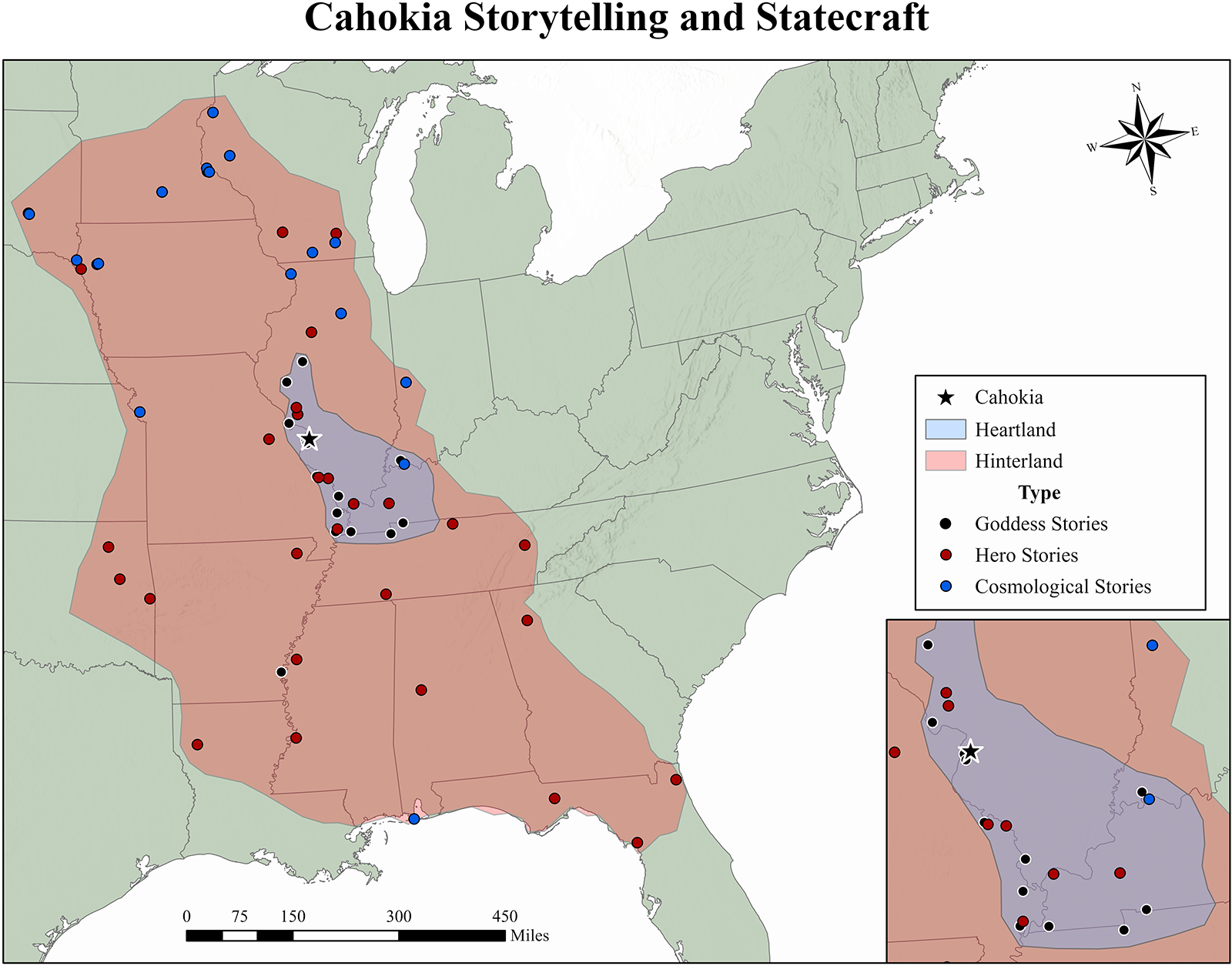
The distribution of Cahokian artwork and Cahokian styles indicates the spread of Cahokians and Cahokian beliefs. In any scenario regarding how specific events of this period unfurled, the spread of art, style, people, and beliefs entailed the spread of Cahokian stories. Cahokia’s heartland and hinterland can be inferred from this distribution.
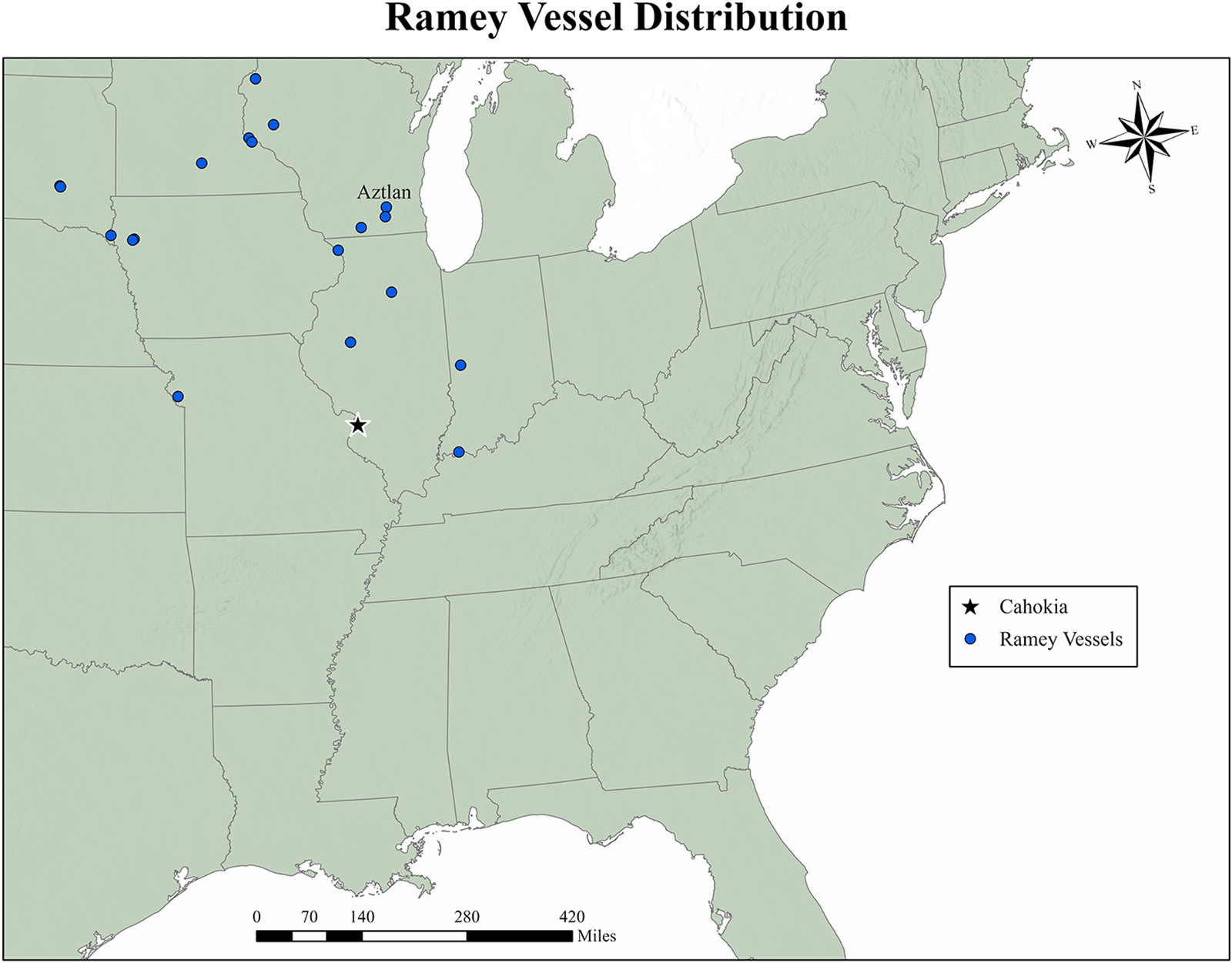
Ramey pottery, with its imagery of the cosmos, originated at Cahokia during the Stirling phase and has been identified as far north as Wisconsin and Minnesota (Figure 1; see O’Brien Reference O’Brien1990, Reference O’Brien, Claessen and van de Velde1991). However, most Ramey pottery found to the north appears to be locally made (Hall Reference Hall, Emerson and Lewis1991; Pauketat and Emerson Reference Pauketat and Emerson1991). Christina Friberg (Reference Friberg2018) reanalyzed Ramey pottery from the lower Illinois River valley to Wisconsin, finding that northern potters selectively used Cahokian motifs, incorporated some of their own local Woodland motifs, and also altered the Ramey design layout. Friberg (Reference Friberg2018:49) concludes that “inhabitants of northern regions selectively adopted only particular components of a Cahokian religious cosmology.” Nevertheless, as Pauketat and Emerson (Reference Pauketat and Emerson1991:924) state, “The spread of the [Ramey] vessel style itself no doubt was related to Mississippian centralization and the enlarged exchange networks of the Mississippian elites.” Consequently, potters who made Ramey vessels far north of Cahokia continued telling stories of local tradition, but they also incorporated Cahokian stories of the cosmos.
Distribution of Ramey vessels. Map by Elizabeth Semande. (Color online)

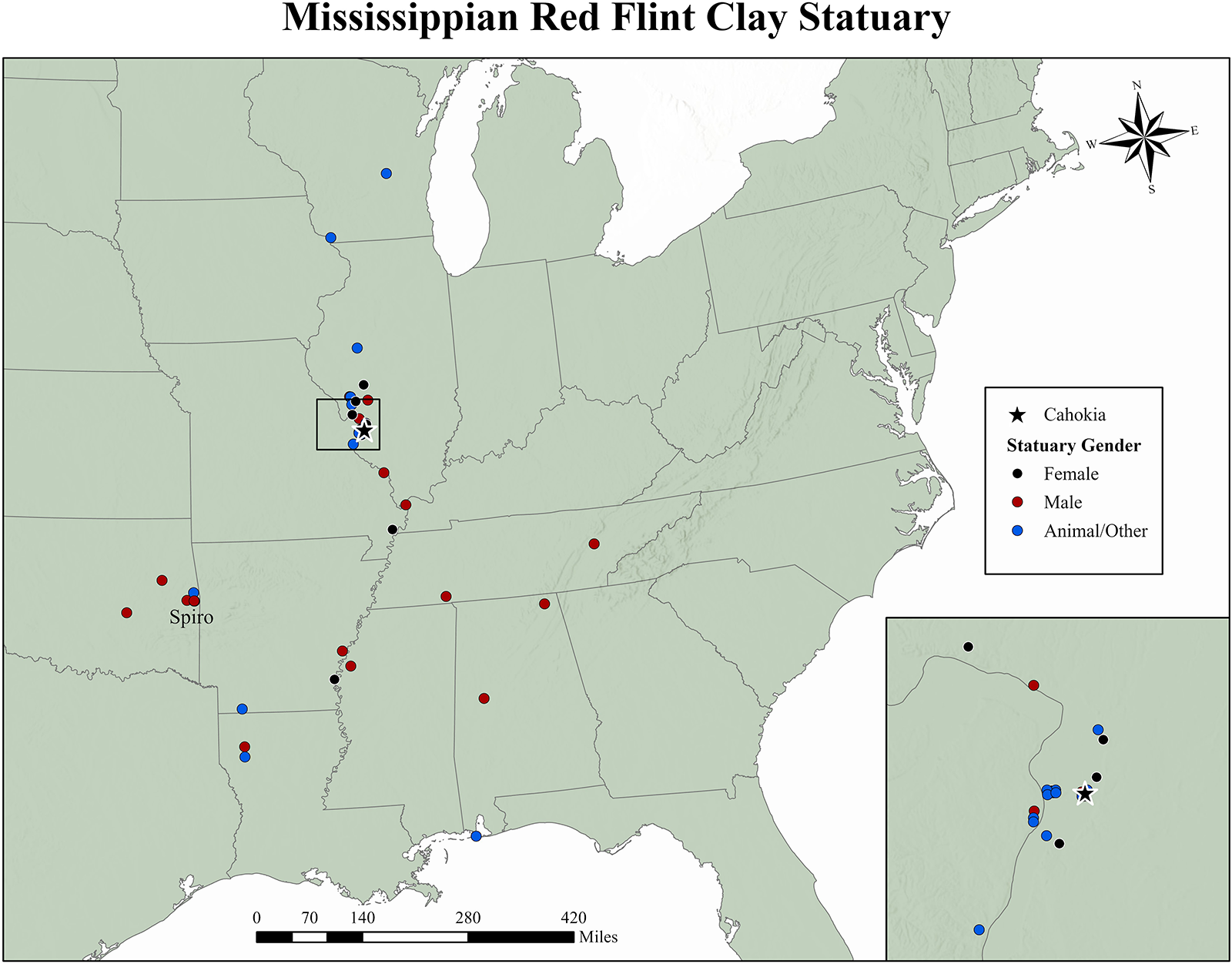
Cosmological stories were also told by Cahokians in flint clay sculptures of animals and priests (Reilly Reference Reilly, Singleton and Reilly III2020). Flint clay animal carvings often remained in the Cahokia region but have also been found far from Cahokia (Figure 2; see Boles Reference Boles, McNutt and Parish2020). Most flint clay frogs were found in Greater Cahokia or near Cahokia, but others have been identified in Louisiana, in Mississippi, and at Spiro. Most birds were also found near Cahokia, but an owl of flint clay was found in Wisconsin. A squirrel was found in St. Louis (Greater Cahokia), and a crawdad was found on Dauphin Island, Alabama, in the Gulf of Mexico (Boles Reference Boles2017). Similarly, most flint clay pipes depicting priests were found in Greater Cahokia or near Cahokia, but two were found at Spiro (Boles Reference Boles, McNutt and Parish2020; Emerson Reference Emerson2003, Reference Emerson, Pauketat and Alt2015, Reference Emerson and Claassen2023b).
Distribution of red flint clay sculptures. Map by Elizabeth Semande. (Color online)

The spread of Cahokian hero and goddess stories is also documented by the distribution of Braden-style red flint clay figurines (Figure 2). Reilly (Reference Reilly, Townsend and Sharp2004:132) observed, “With one exception, the female figures have come from the environs of Cahokia,” whereas “the male and zoomorphic figures have been found through the Eastern Woodlands, with a large number concentrated in the Caddoan area of Oklahoma” (also see Alt and Pauketat Reference Alt, Pauketat and King2007). Boles (Reference Boles, McNutt and Parish2020) tabulates data indicating that eight female and seven male figurines were found in the American Bottom, the lower Illinois valley, and southeast Missouri. The presence of these figurines in the regions closest to Cahokia indicates that hero and goddess stories were essential in Cahokia’s heartland. The only female flint clay figurine outside this region was found in Arkansas. In contrast, male figurines have been found at major sites including Moundville, Shiloh, and Spiro; Spiro yielded at least six male figurines. This distribution suggests that hero stories were disseminated far from Cahokia, and that Cahokian hero stories served to spread Cahokian ideologies.
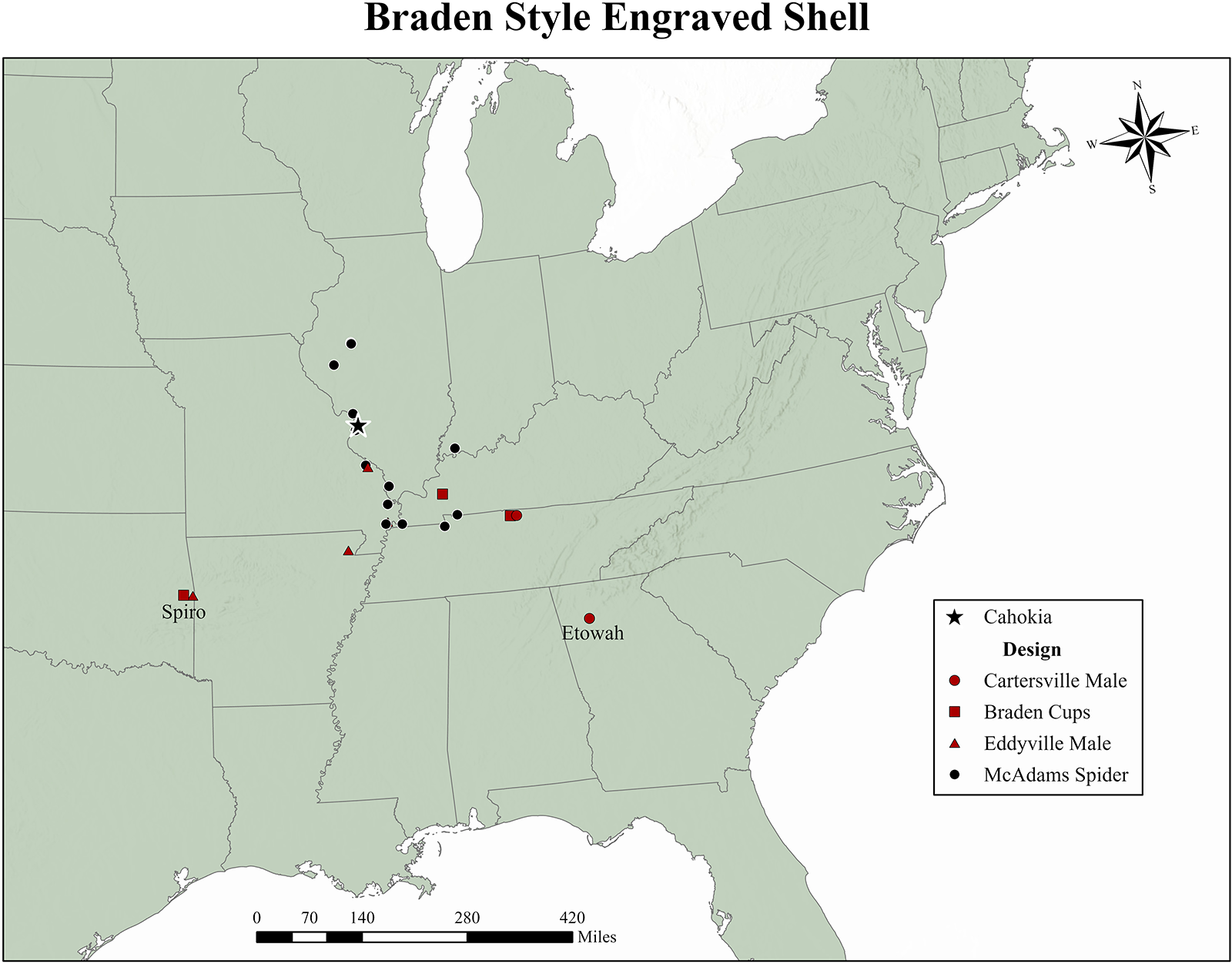
Engraved shell artifacts suggest a similar pattern (Figure 3). Braden-style shell cups with Birdman imagery are found at Spiro (Phillips and Brown Reference Phillips and Brown1978). Brown (Reference Brown, Reilly III and Garber2007b) has identified Braden-style shell gorgets showing Birdman imagery—also known as Eddyville gorgets—at sites in Missouri, in Kentucky, in Tennessee, and at Spiro. Cartersville shell gorgets depicting hero twins are also Braden style, according to Brown (Reference Brown, Townsend and Sharp2004); these have been found in Tennessee and at Etowah. Braden-style shell gorgets showing male and female imagery are found at some of the same sites, but Birdman imagery is distributed as far away as Spiro, whereas McAdams (Braden-style) spider gorgets telling goddess stories cluster in the central Mississippi River valley (Brain and Phillips Reference Brain and Phillips1996; Esarey Reference Esarey1990; Stauffer Reference Stauffer, Giles and Lambert2021). In short, the distribution of engraved shell artifacts is similar to the distribution of flint clay figurines: Braden-style artifacts telling goddess stories stayed closer to Cahokia, whereas those telling hero stories were disseminated far outside the central Mississippi valley.
Distribution of Braden-style engraved marine shell. Map by Elizabeth Semande. (Color online)

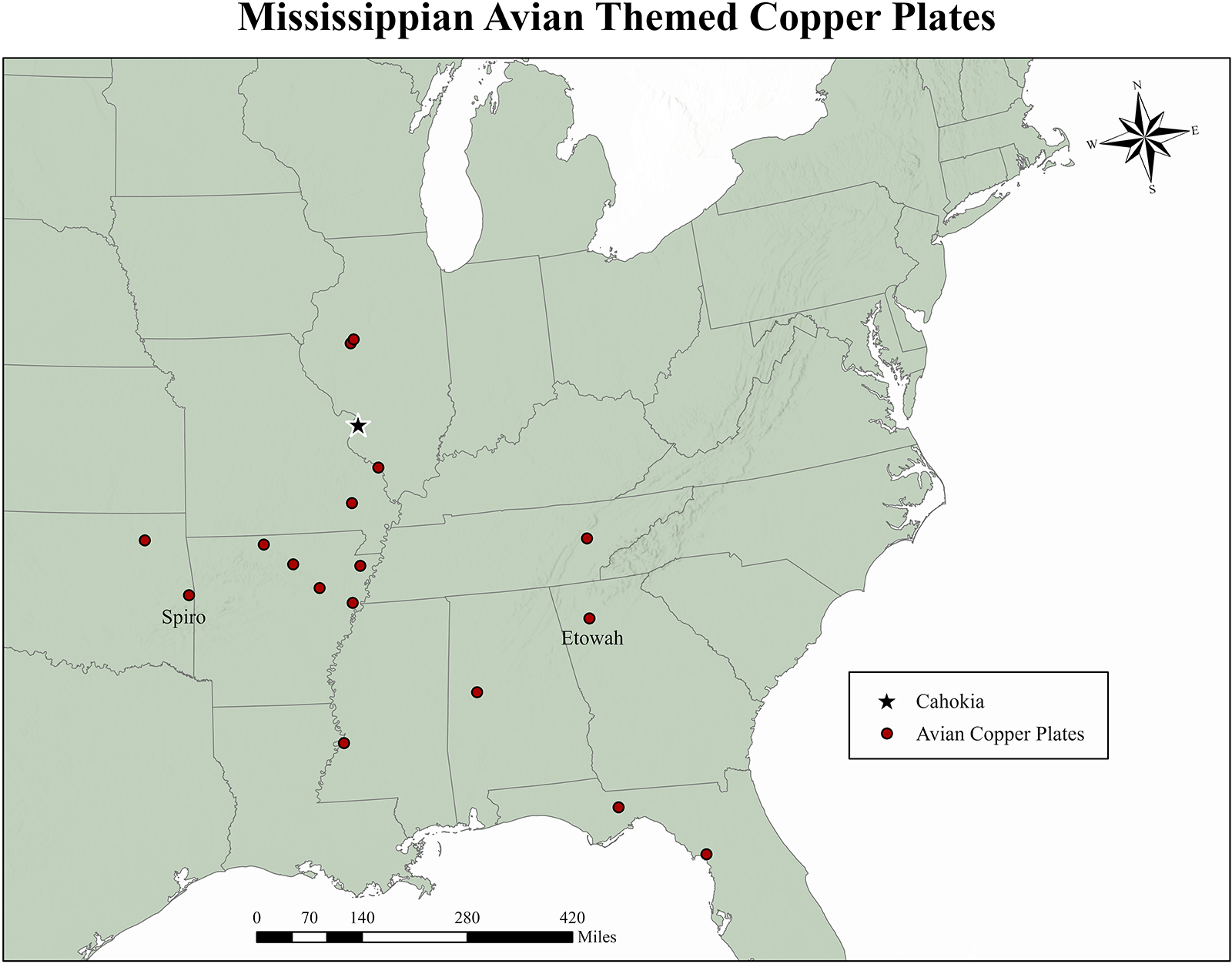
Copper plates in the Braden style show a similar but even more dramatic pattern (Figure 4). Braden-style copper plates typically show Birdman and falconoid imagery; none portray Grandmother or spider imagery. Braden-style copper plates depicting Birdmen were found in southeastern Missouri, at Spiro and Etowah, and from sites in Mississippi, Alabama, and Florida (Brown Reference Brown, Reilly III and Garber2007b). Of all Braden-style Birdman artifacts, these plates were disseminated farthest into the Southeast, again indicating that hero stories were used to spread Cahokian ideologies.
Distribution of Braden-style copper plates. Map by Elizabeth Semande. (Color online)

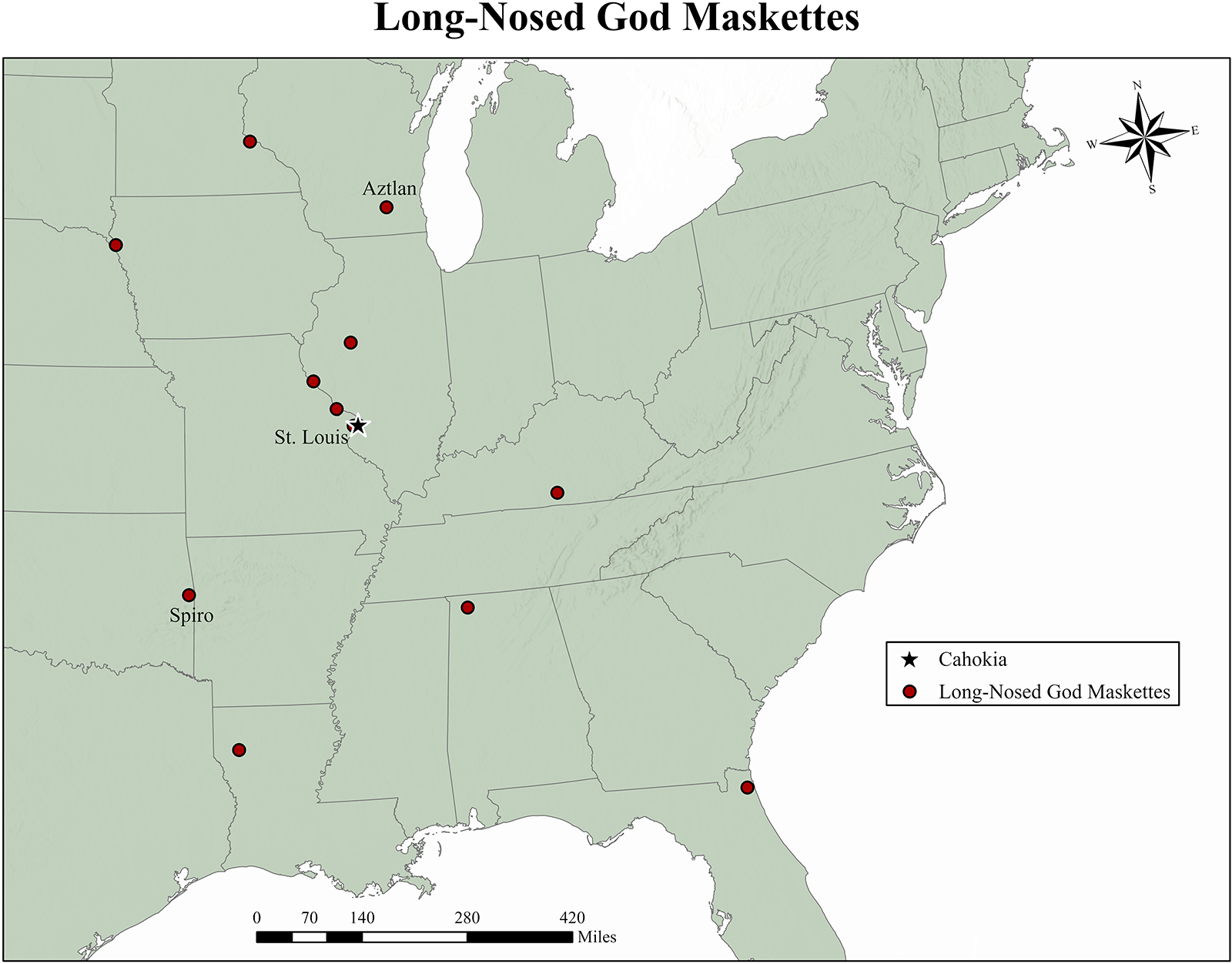
Finally, the distribution of Long-Nosed God maskettes indicates that Cahokian hero stories were also told in Cahokia’s northern hinterlands, not just the south (Figure 5). These human-head earrings have been found in Wisconsin, Iowa, Missouri, and Illinois as well as in Arkansas, Kentucky, Louisiana, Alabama, and Florida (Duncan and Diaz-Granados Reference Duncan and Diaz-Granados2000; Hall Reference Hall, Emerson and Lewis1991; Smith and Beahm Reference Smith and Beahm2009; Williams and Goggin Reference Williams and Goggin1956). Depictions of the earrings have been observed in Missouri’s Picture Cave, possibly Gottschall Rockshelter in Wisconsin, and on several artifacts from Spiro.
Distribution of Long-Nosed God maskettes. Map by Elizabeth Semande. (Color online)

The Context of Storytelling at Greater Cahokia
Traditional Native American storytelling often takes place in intimate settings, such as a family or community gathered indoors around a fire on a winter’s night (e.g., Bruchac Reference Bruchac1996; Silko Reference Silko2012; Vizenor Reference Vizenor1981). Given the size and complexity of Greater Cahokia, Cahokian storytelling would have taken place in these but also more varied settings. The story of the Cahokian cosmoscape is told not just by artifacts but also by features, internal site patterning, and landscapes (Atalay Reference Atalay, Supernant, Baxter, Lyons and Atalay2020; Stauffer et al. Reference Stauffer, Giles, Lambert, Stauffer, Giles and Lambert2022) visible in Greater Cahokia and beyond. Examining these locations, we can glimpse the context of storytelling—where and how Cahokian storytellers told stories.
Cahokian neighborhoods with specialized structures that were well suited for storytelling have been described by Alleen Betzenhauser and Pauketat (Reference Betzenhauser and Pauketat2019). Specialized structures varied, but they included larger structures and unusually shaped structures, sometimes containing ritual paraphernalia such as pipes. Pipes, flint clay figurines, and other artifacts were too small to be seen from a distance; they were nonhuman storytellers in rituals for sodalities and other restricted audiences. For example, five red flint clay female figurines were recovered from two “temple complexes” at the BBB Motor and Sponemann sites near Cahokia; structures interpreted as temples at these sites featured fires and ritual debris (Emerson Reference Emerson and Claassen2023b). These were likely women’s rituals, and women were the storytellers (see Galloway Reference Galloway, Claassen and Joyce1997; Mueller and Fritz Reference Mueller, Fritz and Claassen2016).
Mississippian platform mounds provided more public storytelling stages, and Pauketat (Reference Pauketat2009) suggests that Cahokia’s ridgetop mounds also functioned as such. Ridgetop mounds began as platform mounds—theatrical stages built in stages that were finally capped to become ridgetops. On each of these stages, rituals were performed publicly so all could see: “the mortuary theatrics on the mounds may have involved actors or impersonators who played specific parts in grand, staged plays that were intended to be seen and experienced by large audiences” (Pauketat Reference Pauketat2009:104). The best known of these is Cahokia’s Mound 72 (Emerson et al. Reference Emerson, Hedman, Hargrave, Cobb and Thompson2016; Fowler et al. Reference Fowler, Rose, Leest and Ahler1999), but Rattlesnake Mound and nearby Wilson Mound also offer striking examples of theatrical mortuary ritual (Alt and Pauketat Reference Alt, Pauketat and King2007; Baires Reference Baires2017; Pauketat Reference Pauketat2009). The taking of human life surely made these among the more dramatic stories told at Cahokia, powerfully engaging audiences in plazas below.
The largest public gatherings in the Mississippian world took place at the Grand Plaza of Cahokia, and these would have included oral performances. Rinita Dalan et alia (Reference Dalan, Holley, Woods, Watters and Koepke2003) calculate that people were visible to and from Monks Mound throughout Cahokia’s site core, although views were obstructed beyond the Palisade after it was built around AD 1200. They write,
The ability to orally communicate ideas and inspire one’s constituency was also critical for the leader of a society that had no known written language. Our field observations indicate that Monks Mound was constructed so that the sound of an unamplified human voice could be heard clearly across the area of the Grand Plaza when projected from the front of the First Terrace. It appears that the elevation of the terrace helped carry the sound over the Plaza, and in addition, sound bounced off the front of the Second Terrace; thus an unaided human voice could have been heard at the far edge of the plaza. Such evidence suggests that this distance was deliberately measured and the space laid out to facilitate auditory and visual control over the community, a goal that also affected the final form and scale of the central core [Dalan et al. Reference Dalan, Holley, Woods, Watters and Koepke2003:186–187].
Acoustics are difficult to test today, given a busy road on one side of Monks Mound and an interstate on the other. Regardless, plazas were clearly designed to view (also see Mersmann and Stauffer Reference Mersmann, Stauffer, Stauffer, Giles and Lambert2022) and hear performances from storytellers on mound tops. At the start of the Mississippian period, plazas were not new to American Bottom villages (Kelly Reference Kelly and Smith1990), but building platform mounds to rise above them was. This innovation, with the storyteller elevated in position above the audience, again suggests a significant revision in how Cahokian stories were told. Nevertheless, it remained the storyteller’s task to tell a story well—and the audience’s responsibility to listen and engage (Archibald Reference Archibald2008; Fixico Reference Fixico2003).
Stories were told in Cahokia’s plazas and mounds, but plazas and mounds themselves told stories. Kelly and Brown (Reference Kelly, Brown, Creekmore III and Fisher2014) contend that Cahokia’s city plan “encoded” the cosmos, as did later Osage and Omaha settlements. For example, paired mounds represented balance in the cosmos, mounds rising above plazas represented layers of the cosmos, black soils represented creation via earth divers, four plazas represented cardinal directions, and so on. In short, Cahokia was a cosmoscape; the site itself told the story of its creation (see Baires Reference Baires2017; Kehoe Reference Kehoe, Reilly III and Garber2007; Mersmann and Stauffer Reference Mersmann, Stauffer, Stauffer, Giles and Lambert2022; Rolingson Reference Rolingson1996).
The landscape of Greater Cahokia also created and re-created cosmoscape. Cahokia was situated near the confluence of major rivers, adjacent to a karstic zone of caves and rockshelters, and not far from the St. Francois Mountains. These landscape features provided important natural resources, but they were also significant for their sacred power (Diaz-Granados Reference Diaz-Granados, Townsend and Sharp2004). As Kelly and Brown (Reference Kelly, Brown, Rountree, Morris and Peatfield2012:116) suggest, “The source of Cahokia’s importance was its propitious location to tap into cosmic power.” In her discussion of the Emerald site, Alt (Reference Alt, Alt and Pauketat2020a:35) discusses the importance of the region’s water and caves as underworld portals, suggesting that Cahokia was so located “because of entanglements and interactions with otherworldly spirits and forces.”
The sky above was also a critical element of the Cahokian cosmoscape. Wittry (Reference Wittry1996) postulated that Woodhenge posts at Cahokia were used to track and predict solar events; Fowler (Reference Fowler1996) noted that Mound 72 also was aligned with the summer-solstice sunrise and winter-solstice sunset. More recently, Romain (Reference Romain2024a:3) has written that Cahokia was placed “at a unique location where celestial and landscape alignments crossed,” demonstrating that its mounds “were aligned to the Sun, Moon, Milky Way and landscape features” (Romain Reference Romain2024a:52; also see Romain Reference Romain2021). Close to downtown Cahokia, the BBB Motor and Sponemann sites were on lunar alignments northeast of Monks Mound, and some 24 km (15 miles) to the east, the Emerald site was located with reference to a lunar standstill (Alt Reference Alt, Gonlin and Nowell2018; Emerson Reference Emerson and Claassen2023b; Pauketat Reference Pauketat2013; Romain Reference Romain, Pauketat and Alt2015; Skousen Reference Skousen2018). Romain (Reference Romain2024b) notes that the St. Louis site was located on a high elevation with access to sinkholes and caves, and he further argues that its mounds were oriented with reference to cardinal directions, solstice events, and the Milky Way.
Native American stories reference the landscape; the landscape itself tells a story and is a reminder that stories are true. As Deloria (Reference Deloria2003:65–66) writes, “The places where revelations were experienced were remembered and set aside as locations where, through rituals and ceremonials, the people could once again communicate with the spirits.” Cahokia was surely such a place. In the Cahokian cosmoscape, the sun was associated with the Upper World, day, and men; the moon was associated with the Under World, night, and women; and the Milky Way represented the Path of Souls leading to the Land of the Dead. In sum, Cahokian sites and landscapes told a cosmological story; they were the Cahokian cosmoscape, a world of order and balance. Cahokia provided the primary theater in which to reenact this story.
Discussion
Brown (Reference Brown, Reilly III and Garber2007b), Knight (Reference Knight2013), and many others have discussed the dangers of a direct historical approach. Certainly, we should use caution when looking to descendant groups to interpret the past, because culture is dynamic: Native peoples, stories, and storytelling practices have changed through time. However, we cannot examine Mississippian iconography without reference to Native beliefs, practices, and stories (Carr Reference Carr and Carr2021; Duncan and Diaz-Granados Reference Duncan, Diaz-Granados, Stauffer, Giles and Lambert2022); Cahokia cannot be understood without reference to Native Americans who created it. We should proceed carefully, but we can infer meaning from recurring symbols and enduring metaphors in context (Diaz-Granados Reference Diaz-Granados and Diaz-Granados2023; Hall Reference Hall1997; Knight Reference Knight2013; Pauketat Reference Pauketat2013). Indigenous and community-based archaeology will help us better understand these symbols and metaphors; collaboration with descendant groups is imperative if we are to better understand Cahokian storytelling.
Native American worldviews suggest that storytelling makes us human: we are made of words, and stories are “realities lived and believed” (Momaday Reference Momaday1997:3). Alt (Reference Alt, McNutt and Parish2020b) argues that a religious movement inspired the rise of Cahokia (also see Pauketat Reference Pauketat2013). Whether this was a new religion or a revitalization movement, stories were its foundation: religion is a story (Erdrich Reference Erdrich2020:347), and Lankford (Reference Lankford2008) notes that redefinition of stories is critical to revitalization movements. Beck and Brown (Reference Beck and Brown2012:73) suggest that religious “routinization” occurred during the Mississippian period; citing Max Weber (Reference Weber1947), routinization is “the process by which a charismatic authority is institutionalized” with the purpose “to create a stable order.” This occurs when that authority successfully manages “to provide a charter for revitalizing the existing ideology or to propose a new movement altogether” (Beck and Brown Reference Beck and Brown2012:73). Beck and Brown suggest that glorification of founding ancestors and culture heroes enabled Mississippians to accomplish this, and that “Mississippian rites and traditions . . . legitimized and reinforced disparities between kin-based constituencies, whether social houses or lineages” (Reference Beck and Brown2012:83). Kin groups that gained status were better able to “direct the agenda” and “legitimize their political and ritual prerogatives” (Beck and Brown Reference Beck and Brown2012:83). Taking the name of past heroes confirmed and strengthened the status of later leaders (Hann Reference Hann1988).
Redefinition of stories was key to this process. Cosmological symbols such as birds and earth divers are common in the archaeological record of earlier periods, but images indicating hero and goddess stories appear dramatically in the Mississippian period (see Carr Reference Carr and Carr2021). Similar stories were probably told before this time (Berres Reference Berres2022), but new media for telling them suggest repurposing of those stories. Pauketat and Emerson (Reference Pauketat and Emerson1991) suggest that Ramey vessels provide evidence that Cahokian elites repurposed cosmological stories to create a new sociological order. Hero and goddess stories were likely repurposed for the same reason.
Stories are the basis of ideology and rituals. As Hall (Reference Hall1997:161) wrote, “Rituals are seldom without their origin myth, and the rituals themselves may consist of little more than a dramatic retelling or reenactment of the myth itself.” Certainly, any “doing” in Native society might be considered sacred (Fowles Reference Fowles2013), because even mundane activity is made sacred with story (Deloria Reference Deloria2003). Other ritual doings essential to Cahokian integration would have included feasts, chunkey, and dancing. Cahokia was located in prime agricultural ground, well suited to growing crops needed to feed a growing population and host communal feasts (Brown and Kelly Reference Brown, Kelly, Morehart and Lucia2015; Fritz Reference Fritz2019). Importantly, stories were told at those feasts. Chunkey probably enacted cosmological and hero stories (Busatta Reference Busatta2024), and it is believed that chunkey also was repurposed by Mississippian elites (DeBoer Reference DeBoer1993). Later stories were told about ball games (Hann Reference Hann1988; Radin Reference Radin1948), and those stories also were modified to legitimize social hierarchies (Keyes Reference Keyes and Kwachka1994). The Birdman was not only a chunkey player but also a dancer. Dance also inspired people at Cahokia. Dance is storytelling, according to Cherokee scholar Shay Welch (Reference Welch2019); Native dances recall (retell) “historic and valorous acts” and in so doing “stimulate a heroic spirit” (Callahan Reference Callahan1990:23, 32; Densmore Reference Densmore1918; Hann Reference Hann1988). In short, stories gave meaning to all doings that created Cahokia.
Attracted by its stories, pilgrims and immigrants coming to Cahokia were adopted and became Cahokians. The conversion of male flint clay figures into pipes suggests that they were smoked during adoption ceremonies (Hall Reference Hall1997). The Birdman’s bilobed arrow evokes the calumet pipe, which historically was a powerful agent of peace and alliance smoked during adoption ceremonies (Brown Reference Brown, Reilly III and Garber2007b; Hall Reference Hall1997). Some adoptees stayed at Cahokia for one or more generations, whereas others returned home, spreading Cahokian beliefs by telling Cahokian stories. When they left, they carried those stories as ear ornaments, flint clay sculptures, shell gorgets and cups, and copper plates.
The artworks depicting these stories were more than beautiful mnemonic devices; they were themselves storytellers. They were other-than-human-persons, or wakon’das, maintained for generations in bundles and in sacred spaces (Atalay Reference Atalay, Supernant, Baxter, Lyons and Atalay2020; Fletcher and La Flesche Reference Fletcher and Flesche1911:599; Hallowell Reference Hallowell and Diamond1960). Finally, they were “retired.” Many were “killed” first—broken and/or burnt—and finally buried. There is insufficient space here to describe either life trajectories of individual objects (Boles Reference Boles, Stauffer, Giles and Lambert2022; Emerson Reference Emerson2022b) or the contexts of each as they were buried, but regardless of their unique biographies, the extensive distribution of where these objects were finally deposited indicates the spread of Cahokians, Cahokian ideologies, and Cahokian influence. As storytellers left Cahokia, Cahokian stories changed again to both accommodate and guide changing social conditions (e.g., Brown et al. Reference Brown, Barker, Sabo III, Singleton and Reilly III2020; Buchanan Reference Buchanan2020; Dye Reference Dye, McNutt and Parish2020; Friberg Reference Friberg2018; King Reference King, McNutt and Parish2020; Mehta and Connaway Reference Mehta and Connaway2020; Pauketat et al. Reference Pauketat, Boszhardt and Benden2015; Stauffer Reference Stauffer, McNutt and Parish2020; Wilson et al. Reference Wilson, Bardolph, Esarey and Wilson2020). Not only did Cahokian stories change, but local storytellers had their own stories to tell, and these local oral traditions would have added new layers of meaning to Cahokian artifacts. Regional variations existed; nevertheless, “The history of key iconic themes reveals . . . change and transformation in a tradition characterized by long-term ideological stability” (Brown and Kelly Reference Brown, Kelly and Ahler2000:502; also see Hall Reference Hall1997; Pauketat Reference Pauketat2013).
Hero and goddess stories were meant to inspire. Hall (Reference Hall1997) points out themes of death and resurrection in Red Horn’s story (also see Dye Reference Dye and Benfer2017), and Brown (Reference Brown, Reilly III and Garber2007b) notes that the theme of symbolic rebirth was also central to the Osage hawk. Brown (Reference Brown, Reilly III and Garber2007b:75) writes that the power of the Red Horn story, and “the most convincing line of argument for this myth being a suitable socially charged ritual charter rests on the importance of [its] content, which at the core is the story of life’s triumph over death.” Brown (Reference Brown, Reilly III and Garber2007b:75) reminds us that Red Horn was brought back to life by his sons, and he adds, “Loss of life to death may be inevitable even to a god, but one’s ‘life-force’ continues in the bodies of one’s progeny.” How better to motivate those spreading the message of Cahokia than with the message not to fear death? Red Horn’s reliably heroic behavior also modeled for young men how they should behave.
Sharp (Reference Sharp and Dye2021) notes that stories of Old-Woman-Who-Never-Dies pertain to themes of annual rebirth (also see Mueller and Fritz Reference Mueller, Fritz and Claassen2016). Plants associated with her come back to life in spring; snakes also become active and shed their skin in spring. Sharp observes that female effigies from the Middle Cumberland were found in child and infant burials, suggesting that Grandmother would guide children on their journey to the next world. Although Cahokian flint clay female figurines were not typically found in burials, Cahokian goddesses also probably gave women hope that their children would live again. Grandmother’s story of regeneration, renewal, and reaffirmation of life was inspirational for women.
Eternal life is a theme that inspires believers, even as a story might mask changing social conditions: stories as social charter are changed to redefine social narratives. Radin (Reference Radin1948:45) noted that “the chief and his family occupy a very special position” in the Red Horn story, indicating “real rank” in the past compared to the historic Ho-Chunk. The story justified the social order, even if its underlying theme was its cosmological significance, “the saving of man and the final crushing of his enemies.” This story gives clues to the past, providing additional evidence that Cahokians changed stories to create change in Cahokian society and cosmoscape. In his examination of the sacred and profane, Mircea Eliade (Reference Eliade1959:205) observes that even in modern state societies, people need “myth.” We all need heroes.
Was the hero of Cahokia a real person? Emerson (Reference Emerson, Pauketat and Alt2015:57) writes, “For Cahokians, I suspect the Resting Warrior more likely represented an elite ancestor.” In his discussion of Red Horn, Pauketat (Reference Pauketat2009:93–94) suggests that there are “real connections between narrative and history.” The shift from reporting to mythologizing an event seems typical in the development of the heroic epic. Jan Vansina (Reference Vansina1985:25) writes, “Many epics have a historical dimension: The hero once really lived. . . . The historian uses them much more as reports about existing situations in a recent past than as a source about these persons or incidents.” There is a rich literature about the relationship between “myth” and history, from Franz Boas (Reference Boas1914) to Claude Lévi-Strauss (Reference Lévi-Strauss1979) to Roger Echo-Hawk (Reference Echo-Hawk2000, Reference Echo-Hawk2018). Fred Eggan (Reference Eggan, Hymes and Bittle1967) provides a striking example from the Hopi of how a known historical event evolved over decades as a story. Radin alternately refers to Red Horn as a hero or semidivine (Reference Radin1948, Reference Radin1954), but it is clear both things can be true: heroes can become divine through time, particularly if their stories are reformulated in a revitalization movement.
I have previously suggested that Cahokia might be understood using the model of a theater state, offered by Clifford Geertz (Reference Geertz1980) as an alternative to the Western notion of a state based on coercive power (Zimmermann Holt Reference Zimmermann Holt2009). People came to Cahokia, helping build and feed it, because they were attracted to it as a spiritual center, and because they wanted to take part in the drama. The ideology and theatrical rituals that attracted people to Cahokia were based on stories. Storytelling itself was a key ritual at Cahokia, and stories gave meaning to all other rituals performed there. This is clear, based on what we know about storytelling in oral societies—Native American societies in particular—and on the archaeological record of Cahokia and other Mississippian sites. Pilgrims and immigrants were attracted to Cahokia by its stories; Cahokian missionaries and emigrants in turn told stories to the peoples among whom they settled. Cahokian stories and storytellers were fundamental to creating the Cahokian cosmoscape.
Conclusion
Distribution of Cahokian goddess figures and gorgets versus distribution of heroic figures, gorgets, cups, and plates might be used to define the boundaries of the Cahokian heartland versus the Cahokian hinterland (Figure 6). Goddess stories were mostly kept close to home, in the heartland, and her stories were central to reproduction. Hero stories were disseminated as far as Oklahoma, Wisconsin, Florida, and Alabama. The extent of the hero’s reach indicates the Cahokian hinterland—the four corners of the Cahokian world. The dissemination of Cahokian cosmological stories indicate additional layers in that world (Figure 6). Even if we reject research that ties the Braden style to Cahokia and limit evidence to flint clay figures that were undoubtedly made in Greater Cahokia (Emerson Reference Emerson2023a), these patterns remain (Figure 2).
Distribution of goddess, hero, and cosmological stories: Cahokia heartland and hinterland. Map by Elizabeth Semande. (Color online)

Evidence of the heroic epic appears in the archaeological record as Cahokians began to expand their horizons. The historic significance of this new type of story is clear when we examine the proliferation of Braden-style artifacts depicting Birdman imagery, as well as the influence of Braden-style Birdman imagery on later SECC imagery. The limited distribution of Braden-style female figurines and spider gorgets indicates that they were used in Cahokia’s heartland to tell stories about fertility, renewal, and the crucial role of women in weaving together this multilayered world. In contrast, the dissemination of Braden-style heroic imagery to more distant lands supports the thesis that Cahokians used hero stories to inspire and to expand their influence.
This is consistent with evidence from early states, whose great heroes—such as Gilgamesh, Odysseus, and Beowulf—were featured in epic tales that inspired their people. The epic tale evolved as a tool of statecraft, and Cahokia might provide additional evidence of this. Cahokian stories increased Cahokian prestige in societies from the upper Mississippi valley in the north to the Gulf Coast in the south, and from Spiro in the west to Etowah in the east. Sometimes Cahokians built colonies (Pauketat et al. Reference Pauketat, Boszhardt and Benden2015), sometimes they used adoption rituals to assimilate pilgrims and immigrants (Hall Reference Hall1997), sometimes they used marriage ceremonies to build their social houses (Brown Reference Brown and Beck2007a; Dye Reference Dye, McNutt and Parish2020), and sometimes Cahokian culture bearers migrated to new theaters to tell their stories to new audiences (King Reference King, McNutt and Parish2020). In all of these scenarios, in both the heartland and hinterland of Cahokia, Cahokian stories were essential in spreading Cahokian culture. The most powerful of these stories featured a Birdman who wore a braid and human-head earrings. The epic tale of this great hero was likely the central charter myth in creating Cahokia.
Acknowledgments
Special thanks to Elizabeth Semande, who made the maps for her senior project in anthropology at SIUE in fall of 2020. Thanks to Roger Echo-Hawk, Shawn Lambert, Kelly Pool, Grant Stauffer, and others for their comments on earlier drafts of this article. Por fin, muchas gracias to Liz Fonseca for translating the abstract and keywords into Spanish.
Funding Statement
This research received no specific grant from any funding agency or commercial or not-for-profit sectors.
Data Availability Statement
No original data were used.
Competing Interests
The author declares none.