Introduction
Waders are able to change their body condition within short periods of time, varying the amount of subcutaneous fat and protein mass (Davidson, Reference Davidson1981; Soloviev & Tomkovich, Reference Soloviev and Tomkovich1997), and changing the size of some organs (Battley et al., Reference Battley, Piersma, Dietz, Tang, Dekinga and Hulsman2000). It is well known that changes in body condition are driven mainly by thermoregulatory needs, breeding and migration strategies (Pienkowski et al., Reference Pienkowski, Lloyd and Minton1979; Mitchell et al., Reference Mitchell, Scott and Evans2000), but the effects of other factors remain under-studied. This is the case for intestinal parasitization by helminths.
In other bird groups, helminths are associated with decreased body condition (Hudson et al., Reference Hudson, Newborn and Dobson1992b; Delahay et al., Reference Delahay, Speakman and Moss1995; Bosch et al., Reference Bosch, Torres and Figuerola2000; Calvete et al., Reference Calvete, Estrada, Lucientes, Estrada and Telletxea2003; Souchay et al., Reference Souchay, Gauthier and Pradel2013), although not all studies have found a clear impact (Barton & Houston, Reference Barton and Houston2001; Mallory et al., Reference Mallory, Mclaughlin and Forbes2007; Shutler et al., Reference Shutler, Alisauskas and Mclaughlin2012). Regardless of the effects on body condition, helminths may reduce bird survival (Hudson et al. Reference Hudson, Dobson and Newborn1992a; Souchay et al., Reference Souchay, Gauthier and Pradel2013) and breeding success (Hudson, Reference Hudson1986; Draycott et al., Reference Draycott, Woodburn, Ling and Sage2006). These factors are influenced by helminth prevalence (number or percentage of hosts infected with one or more parasites) and intensity of infection (number of parasites present in infected hosts) related to environmental factors and traits of the host (Moss et al., Reference Moss, Watson, Trenholm and Parr1993; Delahay, Reference Delahay1999; Bosch et al., Reference Bosch, Torres and Figuerola2000). Hence, a better understanding of helminth burdens may help us to understand possible pathological consequences and host–parasite cycles (Hudson et al., Reference Hudson, Dobson and Newborn1992a; Holmstad, Reference Holmstad2005).
The Eurasian woodcock Scolopax rusticola (hereafter woodcock), is a widespread wader of the Palaearctic, which makes a long-distance migration from breeding grounds in Scandinavia, Finland, the Baltic States and Russia to wintering areas in south-western Europe in autumn (Hoodless, Reference Hoodless2013). The helminth fauna of woodcock is relatively well known (Shorten, Reference Shorten1974) and, among different parasite groups, cestodes seem to be the most frequent (López-Neyra, Reference López-Neyra1947; Bondarenko & Kontrimavichus, Reference Bondarenko and Kontrimavichus2006; Okulewicz, Reference Okulewicz2014; Paoletti et al., Reference Paoletti, Di Cesare, Iorio, Tavaglione, Bartolini and Gatti2016). Although the available literature describes cestode species that woodcock may host (mainly Aploparaksis sp.), the prevalence, abundance and intensity of infection are poorly understood. To our knowledge, only one study, using 37 woodcock harvested in north-western Spain, has addressed the effects of cestodes on woodcock body condition, suggesting that the intensity of Aploparaksis sp. infection is negatively correlated with total body length and weight, and abdominal fat (Reguera et al., Reference Reguera, Castañón and Garnica1991). Additionally, in 1967 Grau suggested that juvenile birds are prone to heavy cestode infestations compared to adults (cited in Shorten, Reference Shorten1974). It is known that woodcock can store energy through fat and protein reserves (Boos, Reference Boos2000), and in a previous study we detected that these reserves are not only affected by prevailing weather, but also by migration and reproductive strategies (Sánchez-García & Hoodless, Reference Sánchez-García and Hoodless2016). It may be, then, that cestodes could have an impact on woodcock population dynamics through effects on body condition.
Globally, woodcock are not declining and they are categorized as a species of ‘least concern’ in Europe (Birdlife International, 2015), but in some countries, such as the UK, declines in breeding numbers have been recorded due to habitat changes and agricultural intensification (Heward et al., Reference Heward, Hoodless, Conway, Aebischer, Gillings and Fuller2015). The woodcock is also a highly valued quarry throughout its European wintering areas, mainly in France, Italy, the UK and Spain (Lutz & Jensen, Reference Lutz and Jensen2006). Thus, increasing our knowledge about cestodiasis and its possible effects on woodcock body condition may improve management decisions for the benefit of this gamebird of high socio-economic importance.
The aim of this study was to assess the variation in prevalence and intensity of infection of cestodes hosted by woodcock harvested in Britain, in relation to their body condition, which was evaluated in winter at four different geographical locations.
Materials and methods
Sampling locations
A total of 161 woodcock harvested between early December and late January during the winters of 2013/14 (winter 1, n = 17) and 2014/15 (winter 2, n = 144) were dissected. All birds in 2013–2014 were from Cornwall, whereas in 2014–2015 birds were collected from four wintering regions: Cornwall, East Anglia (Norfolk and Suffolk), Scotland (Angus, Argyll and Bute, Berwickshire, Highland and Stirlingshire) and Wessex (Dorset, Hampshire and Wiltshire) (see table 1). Carcasses were individually placed in labelled polythene bags and were frozen (−20°C) within 10 h of shooting. Six freshly killed birds were also dissected.
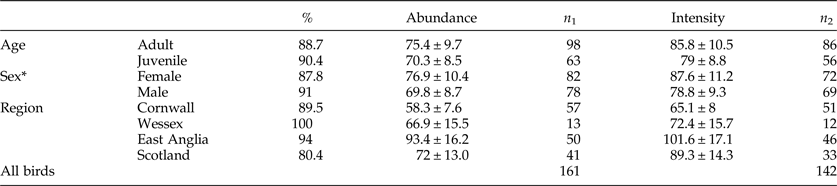
The prevalence (%) and mean values (± SE) of abundance and intensity (cm) of cestodiasis in woodcock harvested in Britain, relative to host age, sex and geographical region; n 1 = total number of birds, n 2 = number of infected birds.

*One bird from Scotland was not sexed.
Dissection
Woodcock were kept at a temperature of 8–10°C the day before the dissection. After defrosting, birds were weighed (±0.01 g) and aged by plumage characteristics of the wing and classified as juveniles (<1 year old) or adults (>1 year old) (Ferrand & Gossmann, Reference Ferrand and Gossmann2009). Birds were then plucked, weighed, sexed and the abdominal fat was dissected and weighed. The major and minor pectoral muscles were divided longitudinally along the sternum and the right half of these muscles was removed and weighed. Total pectoral mass was calculated by multiplying by two (see supplementary table S1).
Cestode detection
The entire intestine was measured and cut longitudinally and set on a plastic tray. Cestodes were collected with tweezers using a magnification of × 2. Debris was separated from cestodes using ethanol, and masses of cestodes were untangled. Owing to the negative effects of freezing on cestodes, they were often broken. Hence, fragments were measured (±0.1 mm), and a microscopic examination (×10) was conducted to count the number of scoleces. This allowed us to calculate the number of parasites and their total length per bird. We used parasitological terminology suggested by Bush et al. (Reference Bush, Lafferty, Lotz and Shostak1997): (1) prevalence, the number (or percentage) of birds infected with one or more parasites; (2) abundance, the number or total length of cestodes (cm) present in infected and non-infected birds; and (3) intensity, the number or total length of cestodes (cm) present only in infected birds. Owing to freezing damage, two birds were not used for the calculation of abundance and intensity.
It was not possible to conduct an accurate identification of cestode species, as rostellar hooks were absent from both frozen and fresh birds. However, mounted specimens from the Collection of the Natural History Museum (London) and available descriptions suggested that cestodes belonged to the following genera: Aploparaksis sp., Choanotaenia sp., Fuhrmannolepis sp. and Polycercus sp. In addition, the nematode Porrocaecum spp. (Nematoda) was detected in four birds.
Data analysis
Logistic regression, Generalized Linear Model (GLM; Crawley, Reference Crawley1993) with presence/absence as the dependent variable and a binomial error distribution, was used to test possible effects of bird age, sex and region on cestode prevalence. The total length of cestodes per bird was rounded to the nearest centimetre and considered as a discrete variable. The effects of age, sex, region and their first-order interactions on the abundance and intensity of cestodiasis were examined using GLMs, with the number or length of cestodes as the dependent variable, specifying a negative binomial distribution and a logarithm link function (Wilson & Grenfell, Reference Wilson and Grenfell1997). The effects of cestode abundance on fresh weight, total abdominal fat and protein were evaluated using Pearson's correlation. We used GENSTAT 16 (VSN International, Hemel Hempstead, UK) for the analysis.
Results
The prevalence of cestodiasis did not vary significantly in woodcock harvested in Cornwall between winters (F 1,50 = 1.73, P = 0.188), sex (F 1,50 = 0.87, P = 0.352) and age (F 1,50 = 0.11, P = 0.745), and no interactions were significant. Pooling birds from all regions, we found that 90% of woodcock (n = 144) were infected with cestodes. No significant differences were found in the prevalence between adults and juveniles (F 1,147 = 0.3, P = 0.581) or males and females (F 1,147 = 0.3, P = 0.560). There was some variation in prevalence between regions, but no significant difference (F 3,147 = 2.42, P = 0.064) and no significant first-order interactions between age, sex and region were found (table 1).
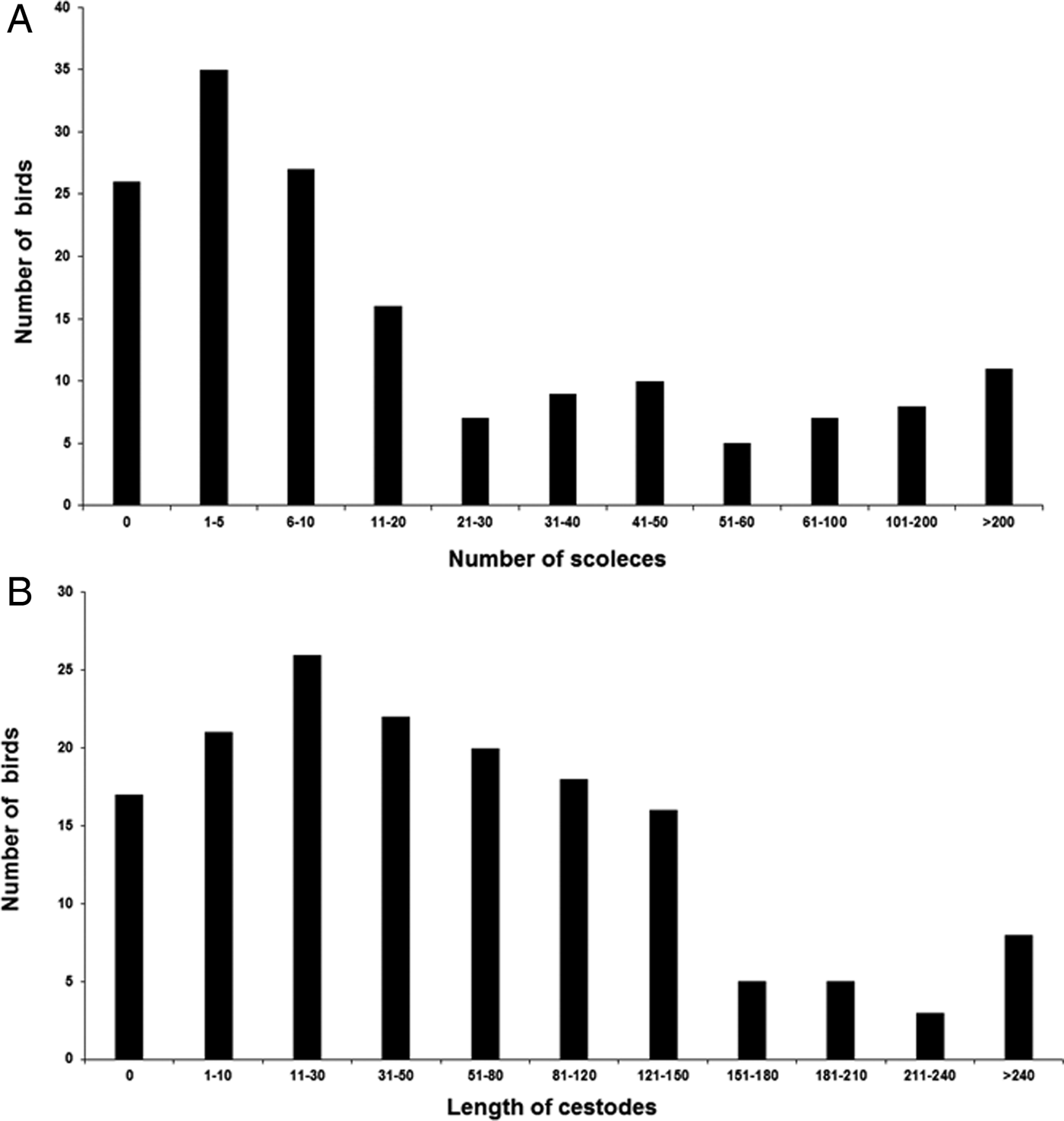
The number of cestodes per bird, estimated from the number of scoleces, ranged from 0 to 535, and in the infected birds in which scolex detection was possible (n = 135), 57% had from 1 to 20 scoleces (fig. 1A). In 36 bird samples with scoleces showing no obvious damage, the mean number of cestodes was 88.1 ± 19.7 (range 1–435), the mean length of each cestode was 1.8 ± 0.1 cm (range 0.5–18.0 cm), and the mean total length of cestodes per sample was 103.4 ± 19.0 cm (range 3.5–620 cm). The number of cestodes per bird was positively related to the total length of cestodes (r = 0.82, P = 0.003). The frequency distribution of cestode abundance, based on the length of cestodes, was similar to that from the count of scoleces (fig. 1B). Given the severity of scolex damage found in 125 samples (78%), only the length of the cestodes was used in statistical analysis of abundance and intensity of cestodiasis.
The frequency of cestode abundance in 161 woodcock, relative to (A) the number of scoleces and (B) the total length of cestodes per bird.

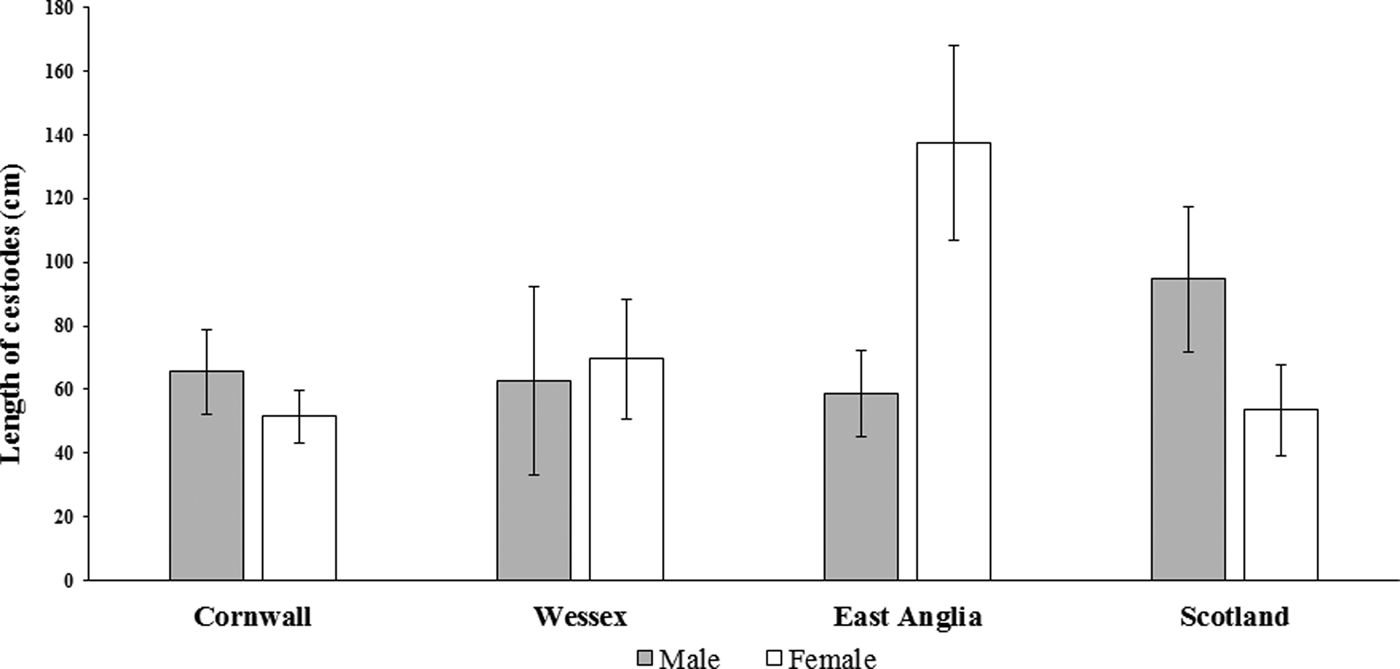
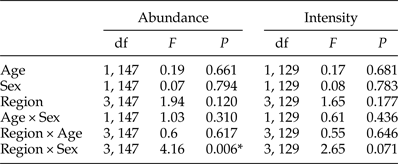
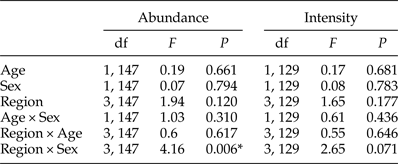
In Cornish birds, cestode abundance did not vary significantly between winters (F 1,55 = 1.78, P = 0.187), so all birds were pooled for subsequent analysis. Cestode abundance varied between sexes across regions (region × sex interaction F 3,147 = 4.16, P = 0.006), with a higher abundance in females from East Anglia and a lower abundance in females from Scotland (fig. 2). Bird age and its interactions had no significant effect on cestode abundance. Intensity was not affected by age, sex, region and first-order interactions were not significant (table 2). Owing to the small number of woodcock in which nematodes were also identified (n = 4), we could not explore possible parasite interactions, although these four birds were also infected by cestodes and the mean cestode length was 94.3 ± 23.7 cm.
Mean values (± SE) of abundance of cestodes (based on the total cestode length per bird, cm), relative to geographical region and host sex.

Effects of bird age, sex and region on cestode abundance and intensity in woodcock harvested in Britain.
*Level of significance with P < 0.01.
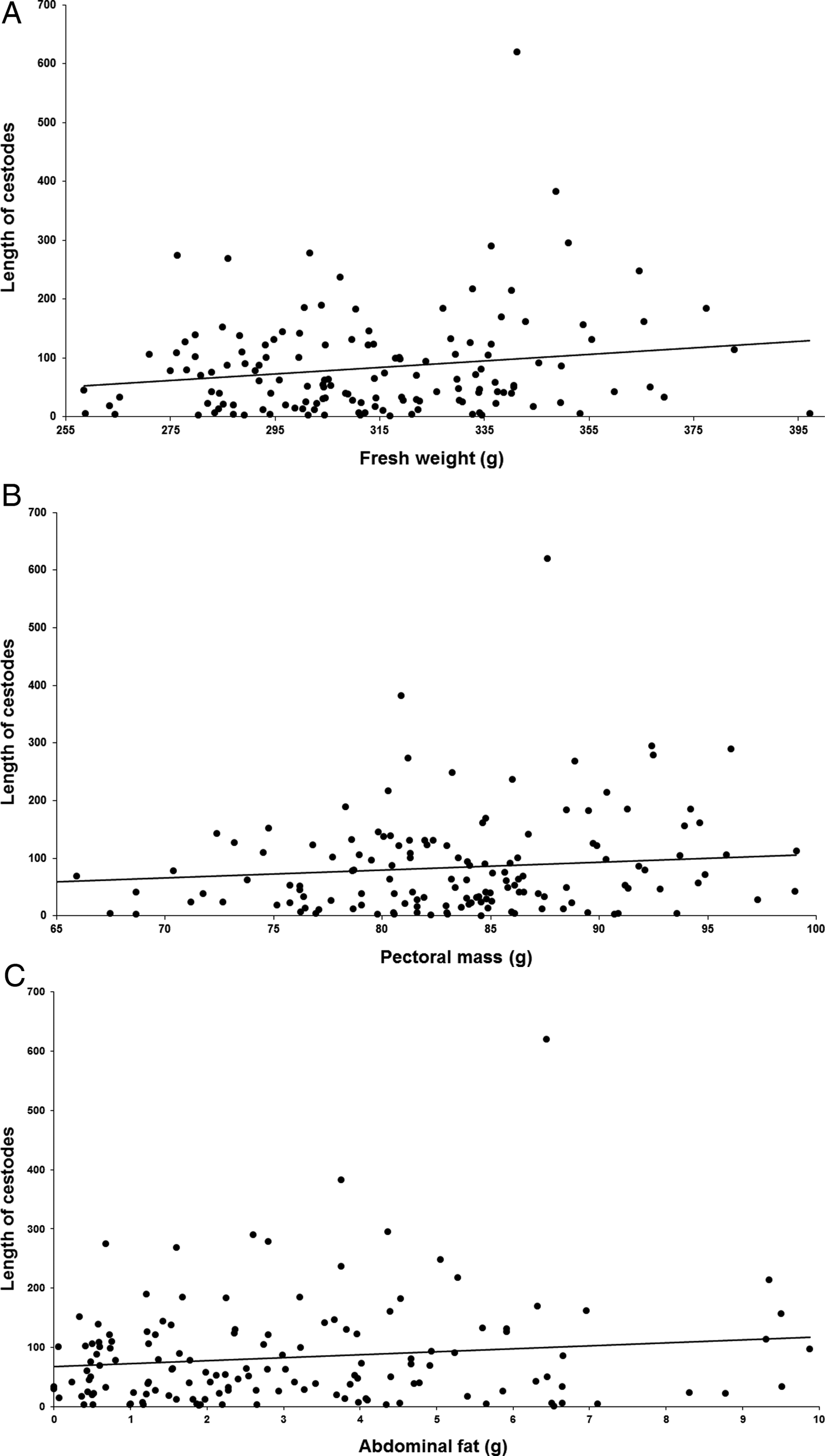
The intensity of cestodiasis was positively related to the fresh weight (r = 0.17, P = 0.039; fig. 3A) and pectoral mass (r = 0.20, P = 0.020, fig. 3B), but there was no relationship with the abdominal fat pad (r = 0.13, P = 0.100, fig. 3C). When omitting one bird from East Anglia in which the length of cestodes was 620 cm, the relationship between intensity and fresh weight was no longer significant (P = 0.074), while the relationship with pectoral mass remained significant (P = 0.019). The intensity of parasitization was not correlated with intestine length (r = 0.20, P = 0.585).
The relationship between (A) fresh weight, (B) pectoral mass and (C) mass of abdominal fat and intensity of infection (based on the total length (cm) of cestodes per bird), in woodcock harvested in Britain.

Discussion
This study confirms that woodcock wintering in Britain are frequently parasitized by cestodes, and suggests that the intensity of parasitization may be determined by the body condition of the host, as those birds with higher fresh weight and pectoral mass showed higher cestode burdens.
Given the fact that earthworms are intermediate hosts for several cestode species found in woodcock (Bondarenko & Kontrimavichus, Reference Bondarenko and Kontrimavichus2006), and that earthworms are one of the woodcock's main prey items (Granval, Reference Granval1987; Hoodless & Hirons, Reference Hoodless and Hirons2007), the high prevalence found in all regions was not surprising. Our results agree with an earlier suggestion of high prevalence levels (Shorten, Reference Shorten1974) and the prevalence in our sample was similar to that found by Reguera et al. (Reference Reguera, Castañón and Garnica1991) for woodcock harvested in Spain (89%), and to that found by Paoletti et al. (Reference Paoletti, Di Cesare, Iorio, Tavaglione, Bartolini and Gatti2016) in Italy (93.2%). We cannot rule out the possibility that the birds sampled in this study could have been biased towards infected birds. Hudson et al. (Reference Hudson, Dobson and Newborn1992a) showed that red grouse (Lagopus lagopus scoticus) infected by nematodes were more likely to be detected by dogs than uninfected birds, due to the emission of more scent. However, we doubt that cestodiasis directly affected woodcock survival, as cestodes are normally less virulent than nematodes (Shutler et al., Reference Shutler, Alisauskas and Mclaughlin2012). It is possible that the higher body weight in birds with higher intensity of infection may affect their ability to escape from predators (Bednekoff & Houston, Reference Bednekoff and Houston1994).
The prevalence of cestodiasis in woodcock seems to be broadly similar to levels found in other waders, such as Eurasian oystercatcher (Haematopus ostralegus) in The Netherlands (77%, Borgsteede et al., Reference Borgsteede, Van den Broek and Swennen1988), and gamebirds, such as red grouse in Scotland (80%, Delahay, Reference Delahay1999). However, it was considerably higher than in species likely to be ingesting fewer cestode intermediate hosts, such as red-legged partridge (Alectoris rufa) in Spain (40%, Millán et al., Reference Millán, Gortázar and Villafuerte2004), northern fulmars (Fulmarus glacialis) (52%, Mallory et al., Reference Mallory, Mclaughlin and Forbes2007) and willow ptarmigan (Lagopus lagopus) in Canada (34%, Thomas, Reference Thomas1986), and lesser snow geese (Chen caerulescens caerulescens) in North America (26%, Shutler et al., Reference Shutler, Alisauskas and Mclaughlin2012). Of infected birds, only four birds hosted both cestodes and nematodes (3%), which is a lower rate compared to that found by Paoletti et al. (Reference Paoletti, Di Cesare, Iorio, Tavaglione, Bartolini and Gatti2016) (28%). Given the high prevalence of cestode infection in woodcock, it is possible that co-infection with different species or between cestodes and nematodes could be appreciably more detrimental than infection with a single species of cestode (e.g. Poulin, Reference Poulin2001) and this is an area meriting further research.
As suggested for red grouse by Delahay (Reference Delahay1999), it seems that the distribution of cestodiasis in woodcock was aggregated, as the total length of cestodes per sample was below 80 cm for the majority of the birds. The intensity of cestodiasis in woodcock may be affected by differences in feeding patterns and earthworm availability in each region. Earthworm availability and subsequent woodcock diet composition vary among different regions, as demonstrated by Hoodless & Hirons (Reference Hoodless and Hirons2007) in spring, and by Granval (Reference Granval1987) in autumn and winter. It may be, then, that those birds feeding more efficiently in each region were more prone to cestodiasis. However, the interaction between bird sex and region in this study is difficult to explain without knowledge of the diet of each bird.
The fact that heavier birds supported higher cestode burdens disagrees with Reguera et al. (Reference Reguera, Castañón and Garnica1991), who found that the number of Aploparaksis sp. was negatively correlated with fresh weight and abdominal fat. Assuming that the majority of birds used by Reguera et al. (Reference Reguera, Castañón and Garnica1991) and our birds were migrants shot on their wintering grounds (Hoodless, Reference Hoodless1995; Arizaga, Reference Arizaga2013), it is likely that there were differences in the arrival dates, resulting in different stages of infestation. Interestingly, Reguera et al. (Reference Reguera, Castañón and Garnica1991) identified a maximum number of 27 Aploparaksis sp. and 32 Polycercus sp. per bird, while we found on average 88 cestodes in our subsample of 36 birds. Although we could not identify parasite species and we used the length of cestodes (rather than the number), it is possible that the woodcock studied by Reguera et al. (Reference Reguera, Castañón and Garnica1991) were subject to greater stress from hunting pressure and weather, resulting in a greater impact of cestodes on body condition. For instance, in the British areas where our birds were collected, woodcock were shot during a small number of days from mid-December to the end of January, while in Spain a higher number of shooting days may have occurred (Pérez-Garrido, pers. comm.). However, previous studies have shown contradictory results for the effects of cestodiasis on body condition: Holmstad (Reference Holmstad2005) found that cestodiasis reduced the body mass of willow ptarmigan, while Thomas (Reference Thomas1986) found no clear effect in the same species (but also found that parasitized birds had larger small intestines). Other studies have found no significant effects of cestodiasis on bird body condition, for example Delahay (Reference Delahay1999) on red grouse and Shutler et al. (Reference Shutler, Alisauskas and Mclaughlin2012) on lesser snow geese. We cannot rule out possible differences in cestode virulence, though it is known that cestodes and trematodes are normally less virulent than nematodes (Shutler et al., Reference Shutler, Alisauskas and Mclaughlin2012).
In conclusion, this study shows a high prevalence of cestodiasis in woodcock wintering in Britain, though woodcock body condition is not significantly affected. Although it does not seem that cestodiasis is a limiting factor for woodcock survival, further research should be conducted to assess the real impact of cestodiasis, especially under certain circumstances, such as food shortage and high predation pressure (Newton, Reference Newton1998).
Supplementary material
To view supplementary material for this article, please visit https://doi.org/10.1017/S0022149X17000037
Acknowledgements
We are indebted to the estates, landowners and gamekeepers for providing woodcock. We thank B. Reig, A. Oliver and J.A. Moreno for their help with dissections. M.R. Hidalgo and N. Díez advised on the literature review. C.J. Heward helped with age determination and, together with N. McHugh, improved a first draft of this paper. We also thank A. Young, J. Page, B. Johnson and R. Plant for their help in the veterinary laboratory, and Dick Potts for the training given on cestode detection. We are indebted to an anonymous referee for constructive comments.
Financial support
This study was funded by the Game & Wildlife Conservation Trust.
Conflict of interest
None.
Ethical standards
This protocol was approved by the Local Ethical Review Committee of the Game & Wildlife Conservation Trust, in line with United Kingdom animal welfare legislation. Birds were donated by private estates and the sample size represented less than 0.001% of the estimated wintering British population.