1 Introduction
The vowel inventories in the world's languages differ considerably in size. Thus, according to the UPSID corpus of 317 languages (Maddieson Reference Maddieson1984), there are, on average, approximately six contrastive vowel categories per language. Of the languages surveyed, 5.7% contain only three vowel phonemes while, at the other extreme, 4.1% have 17 or more contrastive vowel categories. The most common vowels are /a i u/, while front and central rounded vowels, for instance, are comparatively rare (see also Maddieson Reference Maddieson, Haspelmath, Dryer, Gil and Comrie2008 for further details).
In terms of its vowel inventory, Welsh, a member of the Brythonic branch of Celtic languages, is an interesting case since it distinguishes up to thirteen monophthongs and the same number of diphthongs. Interestingly, however, not all varieties of the language exploit the full number of contrastive categories. While there is a wealth of auditory-based descriptions of Welsh vowels (Awbery Reference Awbery1984, Ball Reference Ball1984, Jones Reference Jones1984, Ball & Williams Reference Ball and Williams2001), only a limited number of small-scale acoustic studies is available. Moreover, the few existing ones (Oftedal Reference Oftedal1969; Ball Reference Ball1983, Reference Ball1984; Ball & Williams Reference Ball and Williams2001; Mayr & Davies Reference Mayr and Davies2009) only include information on some of the relevant categories and are restricted to northern varieties of Welsh. The purpose of the present study is to complement the existing literature by providing an initial systematic acoustic investigation of the monophthongs and diphthongs in the two main varieties of Welsh: Northern and Southern Welsh.
2 Background
2.1 Welsh
The Welsh language is spoken by approximately 700,000 people, or 21% of the population of Wales (http://www.statistics.gov.uk/census2001, Gathercole & Thomas Reference Gathercole and Thomas2009, Gathercole & Thomas Reference Gathercole and Thomas2009). The geographical distribution of Welsh speakers is uneven, however. Welsh-language strongholds are found in Gwynedd (69%) and Anglesey (60%) in North Wales, Ceredigion (52%) in Mid Wales, and Carmarthenshire (50%) in South Wales. Conversely, only 9% of the people in Blaenau Gwent and Monmouthshire are able to speak Welsh.
The sociolinguistic situation of Welsh is complex. In line with other diglossic areas (Ferguson Reference Ferguson1959), a high variety, used in literary and academic contexts, is distinguished from a low variety, used in spoken every-day interactions (Ball, Griffiths & Jones Reference Jones1988). While there is a standard written form of Welsh, attempts to develop a spoken standard form of the language, Cymraeg Byw [Living Welsh] that can be used as a model for second-language learners, have only been partially successful (Davies Reference Davies1988, B. P. Jones Reference Jones1988, D. G. Jones Reference Jones1988). Spoken Welsh finds expression in the form of various regional dialects, with major dialect areas found in the North, the Midlands and the South, each further divided into eastern and western parts (Thomas Reference Thomas1973, Reference Thomas1988; Ball Reference Ball1988a).
Unlike Received Pronunciation (RP) for English, there is no generally accepted supra-regional standard accent of Welsh (Ball Reference Ball1988: 50). However, it is commonly acknowledged that the accents of educated speakers from North and South Wales, as used in formal contexts, come closest to standard forms of pronunciation. Accordingly, descriptive accounts of the sound system of Welsh (Awbery Reference Awbery1984, Jones Reference Jones1984, Ball & Williams Reference Ball and Williams2001) have focused on Northern and Southern varieties, as well. Central and western accents, on the other hand, tend to be treated as hybrid forms and are therefore described in terms of their commonalities with, and differences from, Northern or Southern accents.
2.2 The vowels of Welsh
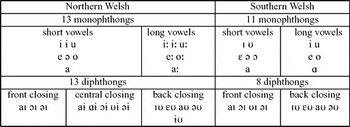
Table 1 summarizes the vowel phonemes of Northern and Southern Welsh, as distinguished in Ball & Williams (Reference Ball and Williams2001). Note that the notation differs slightly from that used in Awbery (Reference Awbery1984) and Jones (Reference Jones1984).
The vowel inventory of Northern and Southern Welsh (adapted from Ball & Williams Reference Ball and Williams2001: 29–48).

With the exception of /ə/, Southern Welsh monophthongs are described as occurring in the form of tense–lax pairs that differ in terms of vowel quality and quantity. Note that the symbols used by Ball & Williams (Reference Ball and Williams2001) merely reflect the qualitative differences. Northern Welsh monophthongs, on the other hand, are described as only being distinguished on the basis of duration. Moreover, this variety includes an additional set of phonemes: the close central vowels /ɨː/ and /ɨ/. In Southern Welsh, there are no close central vowels, so Northern Welsh tŷ ‘house’ /tɨː/ and ti ‘you’ /tiː/ are homophones in southern varieties and pronounced [tiː].
Northern and Southern Welsh also differ in terms of their diphthong categories. Southern Welsh has two sets of diphthongs, one that moves towards a close front quality, and another that moves towards a close back quality (see Table 1).Footnote 1 Northern Welsh, in contrast, also distinguishes a set of central closing diphthongs. As a result, many of the Northern Welsh contrasts are neutralized in southern varieties. Thus, Northern Welsh (h)ail ‘second’Footnote 2 /haɪl/, hael ‘liberal’ /hɑɨl/, and haul ‘sun’ /haɨl/ are homophones in Southern Welsh and pronounced [haɪl].Footnote 3
Cross-dialectal differences also affect the phonetic realization of Welsh diphthongs in terms of the relative distribution of spectral change across formant trajectories. Thus, according to Ball & Williams (Reference Ball and Williams2001), Southern Welsh diphthongs have short initial elements, while Northern Welsh diphthongs vary systematically in the relative duration of their onsets and offsets. The main spectral change in Northern Welsh /ɑɨ/, for instance, occurs later in the vowel than that in /aɪ/ and /aɨ/.
While the latter difference has been confirmed in acoustic studies (Ball Reference Ball1983, Mayr & Davies Reference Mayr and Davies2009), information on the acoustic properties of Welsh vowels is generally scarce. With respect to the monophthongs, the only available studies are Oftedal (Reference Oftedal1969), Ball (Reference Ball and Jones1984), Ball & Williams (Reference Ball and Williams2001) and Mayr & Davies (Reference Mayr and Davies2009). These are, however, all small-scale studies based on individual speakers from North Wales. Information on the duration of Welsh monophthongs is also available in Jones (Reference Jones1982). With respect to the diphthongs, Ball (Reference Ball1983) provides an account of Northern Welsh /aɪ/, /aɨ/ and /ɑɨ/. The only acoustic study to date that encompasses all monophthong and diphthong categories of Northern Welsh is Mayr & Davies (Reference Mayr and Davies2009). However, this study is based on a single speaker from the village of Dyffryn Clwyd in north-eastern Wales. No acoustic record is currently available of Southern Welsh vowels. The present study aims to provide an extension of the available literature by systematically examining the acoustic properties of Northern and Southern Welsh vowels.
3 Methods
3.1 Participants
Twenty male native speakers of Welsh participated in the study, ten from North Wales (Gwynedd and Anglesey) and ten from South Wales (Carmarthenshire and Swansea). They had a mean age of 20 years (range: 18–21 years), and were recruited from a local Welsh Language Society. All participants were university students at the time of the study.
Exposure to Welsh from birth was an essential requirement for inclusion in the study, with Welsh as the participants’ only home language. They were also required to have spent their formative years locally, attending Welsh-medium education for most of their schooling. Note that due to the prevalence of English in Wales, the participants had also had extensive exposure to English throughout their childhood and adolescence. Nevertheless, they all identified themselves clearly as Welsh-dominant bilinguals in terms of their language use and proficiency.
3.2 Materials and procedure
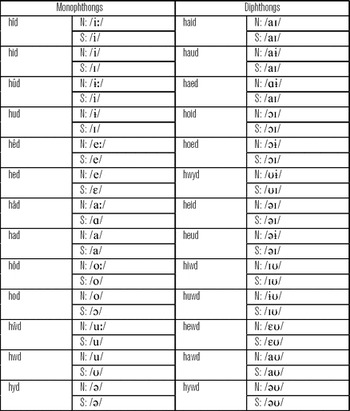
Table 2 displays the target words used in the study, alongside the corresponding phonetic symbols, as distinguished in Ball & Williams (Reference Ball and Williams2001: 29–48). The materials were selected so as to provide the participants with ample opportunities to produce all the contrastive monophthong and diphthong categories of Welsh. To control for phonetic context effects, these were embedded in a /hVd/ frame.
Target words and corresponding phonetic symbols in Northern Welsh (N) and Southern Welsh (S) (Ball & Williams Reference Ball and Williams2001).

Note that despite a number of real words (e.g. had ‘seed’, haid ‘swarm’, hid ‘heed’, hyd ‘length’), the majority of the target words are non-words. While the spelling conventions of Welsh are generally consistent (Ball & Williams Reference Ball and Williams2001: 81–89), they do permit some degree of variability. As a result, orthography-based difficulties with some of the target words could not be ruled out altogether. In order to ensure activation of the intended vowel categories, production of the target words was therefore primed by the use of real words of Welsh that contain the relevant vowels. Where feasible, rhyming words were used (see Appendix A).Footnote 4 Data collection took place in individual sessions in a quiet room of a local Welsh Language Society. Recordings were made using a Zoom H2 Handy Recorder with integrated microphone, which was positioned a few centimeters from the participant's mouth. Each session commenced with a brief interaction in Welsh between the participant and the second author, a native speaker of Southern Welsh. This was done so as to activate the participant's Welsh language mode (Grosjean Reference Grosjean1989, Reference Grosjean and Nicol2001). Upon familiarization with the target words, the participants read out the real word primes for each category at a natural pace followed by the relevant target word produced once in isolation and subsequently three times in the carrier phrase Dyweda X hefyd ‘Say X also’. This procedure yielded 26 × 3 = 78 sentences from each participant. On average, the recording sessions lasted approximately 20 minutes.
3.3 Analysis
The acoustic material was transferred to a standard PC and analyzed using Praat software (Boersma & Weenink Reference Boersma and Weenink2008). Following extraction of the target words from the carrier phrases, the duration of each vowel was measured from the first positive peak in the digitized waveform up to, but not including, the portion of acoustic silence that signals the constriction of the post-vocalic plosive. Subsequently, the frequency of the first two formants was measured using formant trackers, set at a frequency maximum of 5500 Hz with a dynamic range of 30 dB and a window length of 0.025 seconds. F1 and F2 frequencies were measured at the vowel mid-point for the monophthongs, and at the 20%, 35%, 50%, 65% and 80% portions for the diphthongs. Where mistracking occurred, the automatically tracked formants were hand corrected.
In addition to formant frequency measurements, the trajectory length (TL) and spectral rate of change (SpecROC) were determined for each diphthong, following Fox & Jacewicz's (Reference Fox and Jacewicz2009) account. Trajectory length constitutes a measure of spectral change that tracks formant movement in the F1~F2 space across equidistant sections. In the present study, as in Fox & Jacewicz (Reference Fox and Jacewicz2009), this involved four sections: 20%–35%, 35%–50%, 50%–65% and 65%–80%. The TL of each section was calculated on the basis of the following formula, where VSLn constitutes the length of one vowel section:

Overall TL was then defined as the sum of the length of the four sections. Note that TL has been shown to constitute a more accurate measure of spectral change than vector length, which involves calculating the Euclidean distance from the diphthong onset point to its offset point (Fox & Jacewicz Reference Fox and Jacewicz2009). However, TL is a time-normalized measure and, as a result, does not indicate how quickly, or slowly, spectral change occurs in real time. To account for dynamic changes across the duration of Welsh diphthongs, their overall spectral rate of changhe (TLroc) was calculated, using the following formula:

In addition, the spectral rate of change was calculated separately for each section (VSLrocn) on the basis of the following formula:

Together, these measurements make it possible to determine dialect-specific changes in spectral dynamics across diphthong trajectories, revealing how ‘the same’ category may be realized differently in Northern and Southern Welsh.
4 Results
4.1 Monophthongs
4.1.1 Duration
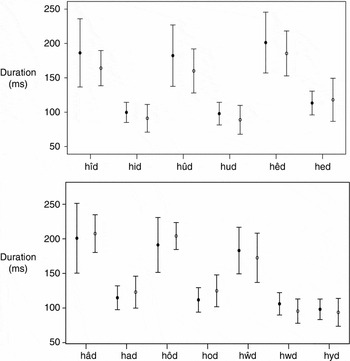
Figure 1 displays the mean duration values (in ms), with standard deviations, of the Northern and Southern Welsh monophthongs. Note that these are labeled in terms of the /hVd/ target words, rather than IPA symbols, since one of the objectives of this study is to determine whether the conventionally used symbols for the vowels are in line with their acoustic properties.
Mean duration (in ms) of the monophthongs of Northern Welsh (filled circles) and Southern Welsh (unfilled circles). Error bars denote +/−1 SD.

Inspection of the figure shows that the speakers in both varieties made a clear durational distinction between phonologically long and short monophthongs. Not surprisingly, a 13 (vowel) × 2 (variety) mixed-plot ANOVA (repeated measures) revealed a significant main effect of vowel (F(12,216) = 119.894, p < .001), a significant vowel*variety interaction (F(12,216) = 2.417, p = .006), but a non-significant main effect of variety (F(1,18) = .176, p = .679). Subsequent independent samples t-tests, conducted separately for each monophthong, failed to show any significant differences in duration across the two varieties. This suggests that vowel duration is utilized in the same way for Northern and Southern Welsh monophthongs.
4.1.2 Formant frequencies
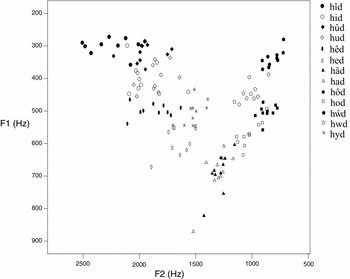
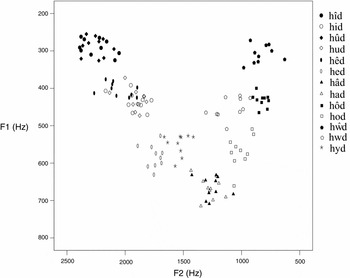
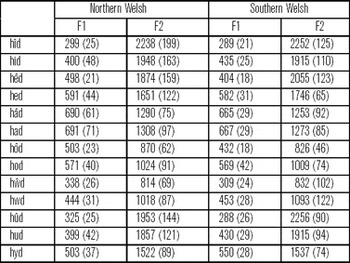
Figures 2 and 3 display the mean F1 and F2 frequencies (in Hz) of the monophthong categories of Northern and Southern Welsh, respectively, as produced by each speaker. For F1 and F2 mean values and standard deviations in each variety, see Table 3.
F1~F2 plot of Northern Welsh monophthongs, as produced by ten speakers.

F1~F2 plot of Southern Welsh monophthongs, as produced by ten speakers.

Mean F1 and F2 frequencies (in Hz) of the monophthongs of Northern and Southern Welsh; standard deviations in parentheses.

Inspection of Figure 2 indicates that the thirteen monophthong categories of Northern Welsh are spectrally largely distinct, with the exception of the vowels in hâd and had, which only appear to contrast in duration (see Section 4.1.1 above). Moreover, together with the results for duration, it appears that the monophthongs of Northern Welsh form tense–lax pairs, with the tense vowels produced with greater duration and a more peripheral quality than their lax counterparts. The tense–lax pairs concerned are hîd – hid, hêd – hed, hôd – hod, hŵd – hwd, and hûd – hud. The only Northern Welsh vowel that remains unpaired is hyd.
According to descriptive accounts (Jones Reference Jones1984, Ball & Williams Reference Ball and Williams2001), one of the most striking characteristics of Northern Welsh is the contrast between close front and close central vowels, as we have seen. Figure 2 corroborates this distinction, in particular for the tense vowels hîd and hûd, which clearly differ in F2 (see also table 3). The lax contrast hid – hud, on the other hand, is less clearly distinct and shows a certain degree of variability across individuals. Interestingly, although the majority of speakers from North Wales conformed to the expected pattern, three speakers did not produce a clear F2 contrast between hud and hid.
The Southern Welsh monophthong system, in turn, largely mirrors that of Northern Welsh in terms of its distinctive categories, as Figure 3 shows. Thus, the Southern Welsh monophthongs occur in the same tense–lax pairs as Northern Welsh vowels, with the exception of the close central vowels. As in Northern Welsh, the two open vowels are spectrally largely overlapping, yet contrastive in duration, and the mid central vowel hyd has no counterpart in Southern Welsh, either. As anticipated, the most conspicuous difference between the two varieties is the absence of close central vowel categories in Southern Welsh. Accordingly, inspection of Figure 3 shows that Southern Welsh speakers’ productions of hîd and hûd, on the one hand, and hid and hud, on the other, are almost identical in the F1~F2 space, with all four categories produced as front vowels (see also Table 3).
While the monophthong systems in the two Welsh varieties are phonologically similar, with the exception of the close central contrast, they may nevertheless be quite distinct in terms of their phonetic realization. In order to enquire into cross-dialectal phonetic differences, the mean formant frequency values from each participant were submitted to 13 (vowel) × 2 (variety) mixed-plot ANOVAs (repeated measures), run separately for F1 and F2. The results revealed significant main effects of vowel (F1: F(12,216) = 447.469, p < .001; F2: F(12,216) = 744.339, p < .001), significant vowel*variety interactions (F1: F(12,216) = 10.926, p < .001; F2: F(12,216) = 7.766, p < .001), but non-significant main effects of variety (F1: F(1,18) = 1.782, p = .199; F2: F(1,18) = 1.814, p = .195).
Subsequently, a series of independent samples t-tests was conducted for each vowel and separately for F1 and F2. The results revealed significant cross-dialectal differences for hêd (F1: t(18) = 10.779, p < .001; F2: t(18) = −2.838, p = .011), hed (F2: t(18) = −2.178, p = .043), hôd (F1: t(18) = 7.677, p < .001), hŵd (F1: t(18) = 2.628, p = .017), hyd (F1: t(18) = −3.229, p = .005) and hûd (F1: t(18) = 3.205, p = .005; F2: t(18) = −5.65, p < .001). No significant differences in F1 and F2 across the two varieties were found for hîd, hid, had, hâd, hod, hwd, and hud. Together with the descriptive data (see Table 3), the results suggest that Northern Welsh hêd, hôd, hŵd, and hûd are realized with greater degrees of openness than their Southern Welsh counterparts, while the reverse holds true for hyd. Moreover, hêd, hed, and hûd are produced with more centralized qualities in Northern Welsh than Southern Welsh.
4.2 Diphthongs
4.2.1 Duration
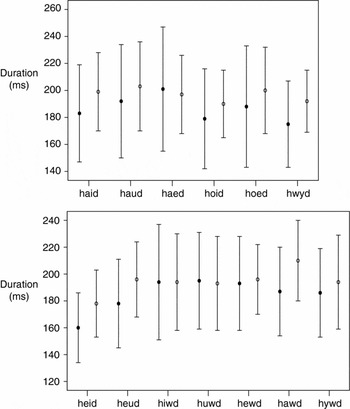
Figure 4 displays the mean vowel duration values (in ms) and standard deviations for Northern and Southern Welsh diphthongs. Inspection of the figure suggests a large degree of temporal overlap across the various categories. Moreover, there do not appear to be any cross-dialectal differences in the duration of Welsh diphthongs. A 13 (vowel) × 2 (variety) mixed-plot ANOVA (repeated measures) revealed a significant main effect of vowel (F(12,192) = 5.385, p < .001), a non-significant vowel*variety interaction (F(12,192) = 1.5, p = .127), and a non-significant main effect of variety (F(1,16) = .203, p = .658). A Bonferroni pairwise comparison revealed that heid is significantly shorter in duration than hewd (p = .001), hawd (p < .001), hywd (p = .004), huwd (p = .009), haud (p = .003), haed (p < .001), hoed (p = .011), and heud (p = .048). None of the other pairwise comparisons were significant. Despite the comparatively shorter duration of heid, it is noteworthy that this vowel exhibits a large degree of temporal overlap with all other diphthongs, as well as with the long monophthong categories. It is therefore unlikely that duration is used systematically as a critical cue to the identity of heid. Taken together, the results therefore suggest that, unlike the monophthongs, the Welsh diphthongs appear not to be distinguished on the basis of duration. This pattern is consistent across Northern and Southern varieties of the language.
Mean duration (in ms) of the diphthongs of Northern Welsh (filled circles) and Southern Welsh (unfilled circles). Error bars denote +/−1 SD.

4.2.2 Formant frequencies
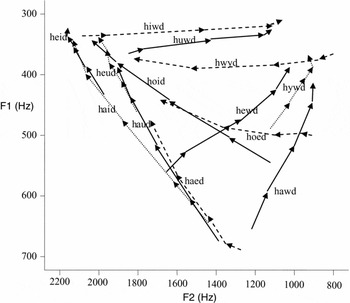
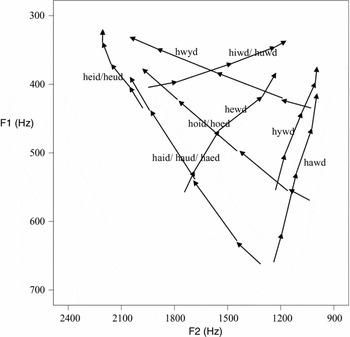
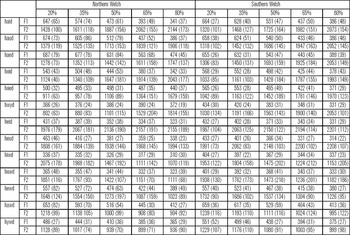
Figures 5 and 6 display the formant trajectories of Northern and Southern Welsh diphthongs, respectively. Note that each diphthong is depicted in the form of four arrowed lines, corresponding to the 25%–35%, 35%–50%, 50%–65%, and 65%–80% portions of the vowel. The purpose of the different line types in Figure 5 is to support visual differentiation of the Northern Welsh diphthongs. For a breakdown of F1 and F2 mean values and standard deviations by measurement point and variety, see Table 4.
F1~F2 plot of thirteen Northern Welsh diphthongs, measured at the 20%, 35%, 50%, 65% and 80% portions of the vowels.

F1~F2 plot of eight Southern Welsh diphthongs, measured at the 20%, 35%, 50%, 65% and 80% portions of the vowels.

Mean F1 and F2 frequencies of 13 Welsh diphthongs in two varieties, as measured at the 20%, 35%, 50%, 65% and 80% portions; standard deviations in parentheses.

In line with descriptive accounts (Jones Reference Jones1984, Ball & Williams Reference Ball and Williams2001), the Northern Welsh speakers made a clear spectral distinction between the thirteen Welsh diphthong categories (see Figure 5). In contrast, the Southern Welsh speakers only distinguished eight categories spectrally (see Figure 6). They failed to produce acoustic differences between haid – haud – haed, hoid – hoed, heid – heud, and hiwd – huwd, with virtually identical F1~F2 values for the elements of these contrasts (see Table 4).Footnote 5 These results corroborate the cross-dialectal phonological distinctions reported in the literature.
In terms of phonetic realization, all diphthongs were produced with decreasing F1 values in both varieties, as one would expect for closing diphthongs (see Table 4). In terms of F2, some categories (haid, haud, haed, hoid, hoed, hwyd, heid, heud) showed steady increases in formant frequency, with central to fronted offset points, while others (hiwd, huwd, hewd, hawd, hywd) showed steady decreases, with retracted offset points.
In order to identify differences in phonetic realization across Northern and Southern Welsh diphthongs, 13 (vowel) × 5 (measurement point) × 2 (variety) mixed-plot ANOVAs (repeated measures) were carried out separately for F1 and F2. The results revealed significant main effects of vowel (F1: F(12,192) = 188.575, p < .001; F2: F(12,192) = 265.617, p < .001), significant main effects of measurement point (F1: F(4,64) = 374.134, p < .001; F2: F(4,64) = 140.497, p < .001), but non-significant main effects of variety (F1: F(1,16) = .292, p = .597; F2: F(1,16) = 3.472, p = .081). Moreover, all interactions were significant, including vowel*variety (F1: F(12,192) = 8.666, p < .001; F2: F(12,192) = 13.753, p < .001), vowel*measurement point (F1: F(48,768) = 55.528, p < .001; F2: F(48,768) = 244.063, p < .001), measurement point*variety (F1: F(4,64) = 5.074, p = .001; F2: F(4,64) = 13.794, p < .001), and vowel*measurement point*variety (F1: F(48,768) = 6.352, p < .001; F2: F(48,768) = 3.038, p < .001).
Subsequently, a series of independent samples t-tests was carried out in order to determine cross-dialectal differences for each measurement point and formant (see Appendix B). The results indicate systematic differences in diphthong realization across Northern and Southern varieties. Cross-dialectally, heid and huwd are most similar, showing no significant difference for any of the ten acoustic components, i.e. F1 and F2 measured at five different points, while all other categories were found to differ on at least one acoustic component. The most dissimilar diphthongs across Northern and Southern Welsh are hoed and hwyd, with nine out of ten acoustic components significantly different. Inspection of Figures 5 and 6 as well as Table 4 suggests that hoed is characterized by greater F1-related change and consistently higher F2 values in Southern Welsh than Northern Welsh. Southern Welsh hwyd, in turn, is produced with consistently higher F1 and F2 values than its Northern Welsh counterpart. Other diphthongs that differ noticeably across the two varieties include heud, haed, hoid, and hywd (see Appendix B). While heud and haed are characterized by comparatively lower F1 and higher F2 frequencies in Southern Welsh than Northern Welsh, the opposite holds true for hoid. Finally, hywd is produced with consistently higher F1 and F2 values in Southern Welsh than in Northern Welsh.
4.2.3 Trajectory length
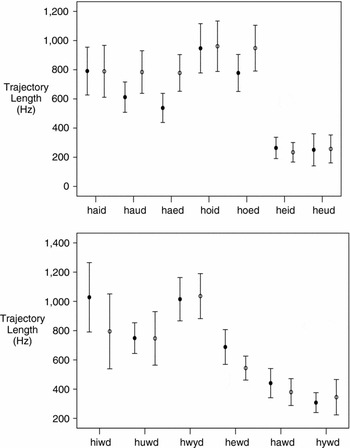
As a measure of spectral change, trajectory length (TL) was computed, following Fox & Jacewicz's (Reference Fox and Jacewicz2009) account. Recall (from Section 3.3 above) that this involved calculating the Euclidean distance in the F1~F2 space for each of the four sections of the diphthongs. Subsequently, the overall TL was determined by totaling the values of the four sections. Figure 7 displays the mean TL (in Hz) for each Northern and Southern Welsh diphthong.
Mean Trajectory Length (in Hz) of the diphthongs of Northern Welsh (filled circles) and Southern Welsh (unfilled circles). Error bars denote +/−1 SD.

Inspection of the figure indicates considerable differences in TL across the various diphthong categories: hwyd, hoid and hiwd exhibit the largest amount of spectral change, while movement in the F1~F2 space is minimal for heid, heud and hywd. Not surprisingly, the TL of the categories that are non-contrastive in Southern Welsh is very similar. In Northern Welsh, on the other hand, these categories may be quite distinct in their TL. For instance, hiwd has a considerably greater TL than huwd.
In order to determine differences in TL by diphthong and variety, the mean TL values from each participant were submitted to a 13 (vowel) × 2 (variety) mixed-plot ANOVA (repeated measures). The results revealed a significant main effect of vowel (F(12,192) = 108.686, p < .001), a significant vowel*variety interaction (F(12,192) = 6.115, p < .001), but a non-significant main effect of variety (F(1,16) = .183, p = .675). Subsequently, independent samples t-tests were conducted separately for each diphthong. The results revealed significant cross-dialectal differences in TL for haud (t(18) = 3.182, p = .005), haed (t(18) = 4.849, p < .001), hoed (t(18) = 2.898, p = .01), and hewd (t(18) = −2.529, p = .021). The TL of the other diphthongs did not differ significantly across the two varieties, although the difference for hiwd was found to approach significance (t(18) = −2.023, p = .058).
4.2.4 Spectral rate of change
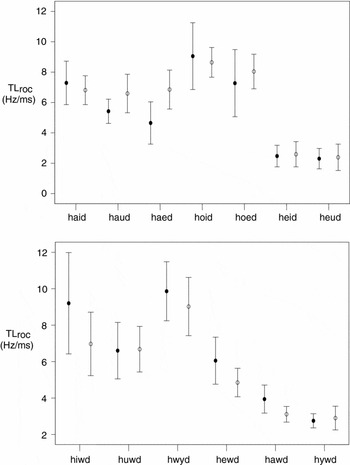
In addition to TL, the overall spectral rate of change (TLroc) was determined for each diphthong (Fox & Jacewicz Reference Fox and Jacewicz2009). Recall that this involved dividing the overall TL of each diphthong (in Hz) by its duration (in ms), as measured from the 20% point to the 80% point. Figure 8 depicts the mean TLroc of the Northern and Southern Welsh diphthongs.
Mean TLroc (in Hz/ms) of the diphthongs of Northern Welsh (filled circles) and Southern Welsh (unfilled circles). Error bars denote +/−1 SD.

The results indicate considerable differences in the spectral rate of change of the Welsh diphthongs. In line with measurements of TL, heid, heud and hywd are characterized by modest rates of change across diphthong trajectories, while hwyd and hoid exhibit large rates of spectral change. Not surprisingly, a 13 (vowel) × 2 (variety) mixed-plot ANOVA (repeated measures) for TLroc revealed a significant main effect of vowel (F(5,12) = 20.959, p = .002). In addition, it showed a significant vowel*variety interaction (F(5,12) = 7.921, p = .016), but a non-significant main effect of variety (F(1,16) = .071, p = .793). While TLroc does not appear to differ generally across Northern and Southern Welsh, the significant vowel*variety interaction indicates that cross-dialectal differences may be significant for some of the diphthong categories. As a result, independent samples t-tests were carried out separately for each diphthong. The results revealed significant differences between the varieties in the TLroc of haud (t(18) = 2.473, p = .024), haed (t(18) = 3.689, p = .002), hiwd (t(18) = −2.145, p = .046), hewd (t(18) = −2.516, p = .022) and hawd (t(18) = −2.939, p = .009). None of the other differences reached significance.
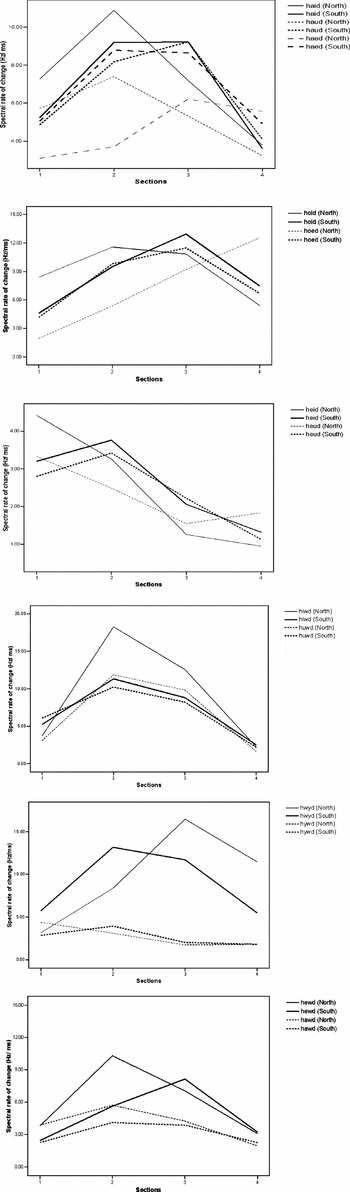
Finally, the spectral rate of change was determined for the four sections of each diphthong. This was done by dividing the trajectory length of a given section (VSLn) by its duration. Figure 9 depicts the mean spectral rate of change for each section by diphthong and variety. Note that Northern Welsh diphthongs are represented by thin lines, Southern Welsh diphthongs by bold lines.
Spectral rate of change for each section by diphthong and variety.

As one would expect, the figure shows similar patterns of spectral change for the categories that are non-contrastive in Southern Welsh, i.e. haid – haud – haed, hoid – hoed, hiwd – huwd, heid – heud. In Northern Welsh, however, these categories exhibit quite distinct patterns. Some, like haid and haud or hiwd and huwd differ in their extent of spectral change, but otherwise show similar patterns of peaks and troughs. Other categories differ in their relative distribution of spectral change across the four sections. For example, while haid and haud exhibit the greatest spectral change in the 35%–50% portion, haed is characterized by little F1 and F2 movement in initial phases, with a peak in the 50%–65% portion. Likewise, Northern Welsh hoid exhibits a peak in the 35%–50% portion of the vowel, while hoed shows a steady increase in spectral change, culminating in a peak in the 65%–80% portion. This latter pattern is atypical, as Figure 9 shows, since the majority of diphthongs display a peak in Sections 2 and 3, i.e. between the 35% and 65% points, rather than in the more peripheral areas.
To determine differences in the spectral rate of change for each section by diphthong and variety, a 13 (vowel) × 4 (section) × 2 (variety) mixed-plot ANOVA (repeated measures) was carried out. The results revealed a significant main effect of vowel (F(12,192) = 81.92, p < .001), a significant main effect of section (F(3,48) = 43.151, p < .001), but a non-significant main effect of variety (F(1,16) = .032, p = .86). Interactions were significant for vowel*variety (F(12,192) = 5.578, p < .001), vowel*section (F(36,576) = 11.505, p < .001), and vowel*section*variety (F(36,576) = 5.096, p < .001), but not for section*group (F(3,48) = 43.151, p < .001). Subsequently, independent samples t-tests were carried out separately for each diphthong section.
The results (see Appendix C) indicate that heud and huwd are cross-dialectally most similar, as they do not differ significantly on any of the four sections. All other diphthongs, on the other hand, differ across Northern and Southern Welsh on at least one of the four sections. Interestingly, hwyd, which exhibits no cross-dialectal differences in TL or TLroc, shows the largest degree of dissimilarity: all four sections of the diphthong were found to differ significantly across Northern and Southern Welsh. Inspection of Figure 9 shows that this is due to differences in the distribution of spectral change across the diphthong trajectories: in Southern Welsh, hwyd peaks in the 35%–50% portion, while in Northern Welsh it peaks in the 50%–65% portion.
5 Discussion
5.1 Monophthongs
This study set out to provide a first systematic acoustic account of the monophthongs and diphthongs in two varieties of Welsh: Northern Welsh and Southern Welsh.
With respect to the monophthongs, the results indicate a relatively symmetrical system for Southern Welsh, with four close vowels, four mid vowels, two open vowels, and a mid central vowel. In line with other languages that have large vowel inventories (e.g. Bohn Reference Bohn2004, Mayr Reference Mayr2005, Steinlen Reference Steinlen2005), Northern Welsh, in contrast, is characterized by less evenly distributed categories. This is mainly due to the two close central vowels, which make the close front to central portion of the vowel space more crowded.
In conformity with descriptive accounts (Jones Reference Jones1984, Ball & Williams Reference Ball and Williams2001), Southern Welsh was found to distinguish pairs of vowels on the basis of both spectrum and duration. Interestingly, however, this pattern also appears to hold true for Northern Welsh, despite the fact that Northern Welsh monophthongs are typically reported as being distinguished on the basis of duration alone (Jones Reference Jones1984: 57; Ball & Williams Reference Ball and Williams2001: 36–39).Footnote 6 The empirical data of the present study are hence at odds with the claims of descriptive studies. Interestingly, inspection of the formant values reported in the few existing acoustic studies of Northern Welsh also suggests consistent spectral distinctions between long and short monophthongs, in particular with respect to the mid-vowel pairs (see Oftedal Reference Oftedal1969, Ball & Williams Reference Ball and Williams2001, Mayr & Davies Reference Mayr and Davies2009). An implication of this finding is that the symbols used to represent Southern Welsh monophthongs may also be appropriate for those of Northern Welsh. Accordingly, on the basis of the spectral and temporal properties of the vowels obtained in this study, the eleven monophthongs shared by both varieties of Welsh may best be represented as /iː ɪ eː ɛ a aː oː ɔ uː ʊ ə/ and the two additional categories of Northern Welsh as /ɨː/ and /ɨ/.Footnote 7
With respect to the latter pair, the speakers from North Wales made a clear distinction between close front and close central vowels, as expected on the basis of previous studies. The tense contrast was maintained by all Northern Welsh speakers, and hence appears to function as a marker of regional identity. Interestingly, the contrast between the lax front and central monophthongs was only spectrally maintained by some of the Northern Welsh speakers. This could be indicative of a change in progress in the vocalic system of Northern Welsh, potentially leading to a merger of the two categories. However, before any conclusions can be drawn, it is, of course, imperative to obtain additional data.
The findings of this study also suggest a number of cross-dialectal differences in the phonetic realization of Welsh monophthongs. For example, the mid vowels /eː/ and /oː/ were found to be characterized by significantly higher F1 values in Northern Welsh than in Southern Welsh. Note that open realizations of these vowels are also reported in other acoustic studies of Northern Welsh (Ball & Williams Reference Ball and Williams2001, Mayr & Davies Reference Mayr and Davies2009). The more open realization of /eː/ is perhaps a result of the relatively crowded high-to-mid front vowel space in this variety. In other words, this vowel may be produced with higher F1 values in order to maintain contrastivity with the high front and high central vowels. In Southern Welsh, on the other hand, /eː/ remains distinctive despite its comparatively close realization, due to the absence of /ɨː/ and /ɨ/ in this variety. Note, however, that this hypothesis does not explain the observed differences in vowel height for /oː/ since the back vowel space is not crowded in either variety. Perhaps, the relatively more open realization of /oː/ in Northern Welsh is a result of vowel height harmonic processes by analogy with /eː/.
5.2 Diphthongs
The results for the diphthongs confirm the phonological distinctions identified in the literature (Awbery Reference Awbery1984, Jones Reference Jones1984, Ball & Williams Reference Ball and Williams2001): Northern Welsh distinguishes thirteen contrastive categories, Southern Welsh eight.
In realizational terms, the two-way distinction in Southern Welsh between front closing and back closing diphthongs seems appropriate. Note, however, that the offset points within these two sets are relatively heterogeneous (see Figure 6). Nevertheless, the symbols used to designate Southern Welsh diphthongs seem appropriate, with the exception of heid/ heud and hywd, which Ball & Williams (Reference Ball and Williams2001: 42–44) represent as /əɪ/ and /əʊ/, respectively. The acoustic analyses, however, suggest the symbols /eɪ/ and /ɔʊ/ to reflect the less centralized quality of the vowel onsets. Note that Ball & Williams (Reference Ball and Williams2001: 46) recognize these qualities as allophonic variants (see also Awbery Reference Awbery1984: 92).
The acoustic analysis of the Northern Welsh diphthongs, in turn, indicates a more complex picture: while the distinction between front closing and back closing diphthongs is largely borne out, the spectral quality of the central closing diphthongs is highly variable. The offset points of hoed and haed, for instance, are much more open than those of heud and hwyd (see Figure 5). As a result, not all the symbols used to designate the Northern Welsh diphthongs match the acoustic results. The open offset qualities of haed and hoed, for example, suggest that /ɑɛ/ and /ɔɛ/ may be more appropriate transcriptions than /ɑɨ/ and /ɔɨ/, respectively. As in Southern Welsh, the onsets of heid and hywd are relatively peripheral. The same holds true for heud. The quality of these vowels may therefore be better represented as /eɪ/, /ɔʊ/ and /eɨ/, respectively.Footnote 8
Following Fox & Jacewicz's (Reference Fox and Jacewicz2009) account, this study included two additional measures of spectral change: TL and SpecROC. The results for TL revealed systematic differences in formant movement across the various diphthong categories and the two varieties of Welsh. Some categories exhibited large degrees of spectral change, while others approximated monophthongal qualities.
Measurements of spectral rate of change, in turn, were included to factor in possible durational differences across Northern and Southern Welsh diphthongs. In contrast to cross-dialectal studies of other languages (e.g. Clopper, Pisoni & de Jong Reference Clopper, Pisoni and de Jong2005, Fox & Jacewicz Reference Fox and Jacewicz2009), vowel duration was not found to differ systematically between the two varieties of Welsh, however. Nevertheless, the results for SpecROC revealed interesting inter- and intra-dialectal differences in diphthong dynamics. Importantly, spectral change was not only manifest in the extent of formant movement, but also in the relative distribution of peaks and troughs across diphthong trajectories, revealing significant dialect-specific differences. The results largely confirm Ball & Williams’ (Reference Ball and Williams2001: 42–47) claims about the relative duration of diphthong onsets and offsets, in particular for Northern Welsh. Interestingly, however, not all Southern Welsh diphthongs were found to have short initial elements: hoid and hewd, for instance, exhibit their main spectral change after the vowel mid-point.
6 Conclusion
This study has provided a first acoustic account of Northern and Southern Welsh vowels. As such, it adds to a growing body of literature on cross-dialectal vowel acoustics (Tsukada Reference Tsukada2002, Yu, Li & Wang Reference Yu, Li and Wang2004, Clopper et al. Reference Clopper, Pisoni and de Jong2005, Morrison & Escudero Reference Morrison and Escudero2007, Escudero, Boersma, Rauber & Bion Reference Escudero, Boersma, Rauber and Bion2009, Fox & Jacewicz Reference Fox and Jacewicz2009). However, as only young middle-class males from North and South Wales were included, it is not certain whether the acoustic characteristics identified in this study are applicable to other groups of Welsh speakers. Thus, future sociophonetic work will need to build upon this study by taking account of different age groups, genders and socioeconomic classes, and comprise a wider range of regional accents. Moreover, it might be interesting to include not only Welsh-dominant bilinguals but also English-dominant ones. After all, there is a growing tendency for children from English-speaking homes to attend Welsh-medium education (Gathercole & Thomas Reference Gathercole and Thomas2009, http://wales.gov.uk/docs/statistics/2009/091029schoolsgen09ency.pdf).
For descriptive purposes, monophthongs and diphthongs were discussed separately in this study. However, it is important to point out that no categorical distinction was implied. After all, it is well-known that supposedly monophthongal vowels are never entirely steady-state (Nearey & Assmann Reference Nearey and Assmann1986, Morrison & Nearey Reference Morrison and Nearey2007, Fox & Jacewicz Reference Fox and Jacewicz2009), even when discounting consonantal transitions. In future studies, it might therefore be interesting to assess the amount of vowel-inherent spectral change in nominal Welsh monophthongs. This may be a particularly interesting approach to take in view of the minimal spectral change of some of the Welsh diphthongs.
By extension, this issue also raises questions about the role of vowel dynamics in perception. It is, for example, not clear how much spectral change is required to be perceptually relevant. More work is also needed on the role of dynamic properties in the identification of vowels. This will eventually enable us to understand how listeners manage to differentiate categories in languages with complex vowel systems, such as Welsh.
Acknowledgements
The authors are much indebted to Helen Pandeli, Enlli Môn Thomas and two anonymous reviewers for comments on an earlier draft of this paper.