Introduction
Bisphenol A (BPA), a chemical compound found in a variety of products, including food and water containers, infant feeding bottles, lining of food and beverage metal cans and dental fillings,Reference Kang, Kondo and Katayama1 is known to leach into the environment and could ultimately be ingested routinely by humans. This may explain why BPA can be detected in the serum, urine, amniotic fluid, follicular fluid, placental tissue, umbilical cord blood and breast milk.Reference Vandenberg, Hauser, Marcus, Olea and Welshons2 In some cases, total BPA (free and conjugated) levels in human blood and other fluids are higher than the concentrations reported to stimulate a number of molecular endpoints in cell culture, and are of the same order of magnitude as BPA levels used in animal studies.Reference Wetherill, Akingbemi and Kanno3
There is particular interest on the effects of BPA exposure during development. Recent studies in humans and rats have shown that the active form of BPA and its inactive metabolite can freely cross the placenta from the pregnant mother to the fetus.Reference Nishikawa, Iwano and Yanagisawa4, Reference Balakrishnan, Henare, Thorstensen, Ponnampalam and Mitchell5 These studies have also shown that once BPA has crossed to the fetus, its active form remained while the inactive form is converted to the active form. Thus, BPA may present a greater risk to the developing fetus than what was previously thought.
In rodent studies, BPA has been reported to exert a wide variety of metabolic effects, including decreased glucose tolerance, increased plasma insulin, triglyceride and leptin concentration, as well as increasing serum cholesterol and adipose tissue mass,Reference Alonso-Magdalena, Vieira and Soriano6, Reference Somm, Schwitzgebel and Toulotte7 thus promoting the development of obesity. These effects are likely to lead to increased risk of cardiovascular disease. BPA has been shown to cause arrhythmogenesis in female rodent heart.Reference Yan, Chen and Dong8 In humans, elevated BPA levels in the urine have been linked with increased risk of coronary heart disease.Reference Lang, Galloway and Scarlett9
In the present study, we examined whether administration of BPA to pregnant mice between gestational days 11 and 19 leads to changes in growth trajectory and organ size, impairs glucose homeostasis, alters blood pressure and vascular endothelial responses in adult offspring. Since obesity is associated with sedentary behavior, locomotor activity in these offspring was also assessed. In addition, we examined the effect of prenatal BPA on estrogen receptor alpha (ERα) gene expression in aortas of the adult offspring as it has been suggested that ERs can markedly influence the dose of BPA required to stimulate a cellular response,Reference Routledge, White, Parker and Sumpter10 hence estrogen-responsive tissues may show markedly greater sensitivity to BPA.
Methods
Experimental protocol
MF-1 mice were maintained under a 12-h light/dark cycle and at constant temperature (22 ± 2°C), with water and food (standard chow diet; RM1, SDS, UK) available ad libitum. All animal procedures were in accordance with the United Kingdom Animals (Scientific Procedure) Act 1986 and approved by the Local Ethics Committee. Virgin females were mated at 9 weeks of age. Plug positive females were then singly caged and given daily subcutaneous injection of bisphenol A (4,4′-isopropylidenediphenol, BPA; Sigma, UK) at 100 μg/kg body weight (bw) from days 11 to 19 of pregnancy (n = 8). This dosage of BPA was reported to be below the lowest-observed-adverse-effect-level (LOAEL, 50 mg/kg/day) used to calculate the current US Environmental Protection Agency's EPA reference dose in rodents.Reference Wetherill, Akingbemi and Kanno3, Reference Vandenberg, Maffini and Wadia11 BPA was diluted in sesame oil (Sigma, UK) to obtain the desired concentration of 0.6 μg/30 μl that corresponds to ∼100 μg BPA/kg bw. In pregnant females designated as controls (C, n = 6), sesame oil was injected during the same period of pregnancy. Studies in primates and rats have reported that most of the BPA administered by subcutaneous injection is absorbed in the systemic circulation without being metabolized in the subcutaneous tissue.Reference Tominaga, Negishi and Hirooka12 Following birth, litter size was adjusted to six (three males and three females, whenever possible) to ensure no litter was nutritionally biased. Pups were weighed at birth and every 2 weeks thereafter. At 3 weeks of age, offspring were weaned and group-housed according to sex.
Assessment of the effects of prenatal BPA exposure
Systolic blood pressure (SBP) was measured in a subgroup (n = 1–2 per litter) of male and female offspring at 12, 14 and 20 weeks of age by tail-cuff plethysmography, as previously described.Reference Elahi, Cagampang and Anthony13 At 14 and 18 weeks of age, all offspring were subjected to locomotor (open field) activity test, as previously described.Reference Watkins, Wilkins and Cunningham14 At 20 weeks of age, offspring were fasted overnight (12 h) and killed the following morning by cervical dislocation. Female offspring were killed during the diestrus phase of their estrous cycle, which was determined on the basis of daily vaginal smears for 2 consecutive weeks. Trunk blood was collected and fasting glucose level was measured using a commercially available portable glucose-monitoring device (Accu-Chek, UK). The heart, kidneys and fat depots (i.e. gonadal, retroperitoneal, interscapular brown adipose tissue (iBAT), inguinal and peri-renal) were immediately dissected out and weighed. Individual tissue weights from each animal were compared with their body weight and calculated as a percentage of total body weight (%bw). The descending aorta (thoracic and abdominal) was dissected, snap-frozen in liquid nitrogen and used for gene expression analysis. In male offspring, additional segment of the aorta was taken and used to assess vascular responsiveness.
Vascular responsiveness
Vascular function in a subgroup of male offspring (n = 3 per group, taken randomly from different litters) was assessed using the aortas collected from the 20-week-old offspring. We only used male offspring to assess vascular responsiveness to avoid the complication posed by steroid levels in females. The freshly dissected aorta was immersed in physiological salt solution (PSS) at 4°C and mounted in PSS on a wire myograph (Multi Myograph Model 610M; JP Trading, Denmark) for analysis of isometric tension, as described previously.Reference Torrens, Brawley and Barker15 Cumulative concentration response curves (CRCs) were constructed for phenylephrine (PE, 10−8–10−4 M), then, after pre-constriction with PE (EC80), cumulative CRCs to acetylcholine (ACh, 10−9–10−5 M) and sodium nitroprusside (SNP, 10−10–10−5 M) were conducted in that order. All drugs were purchased from Sigma (UK).
Gene expression analysis
RNA was extracted from frozen aortas (n = 6–8 per treatment per sex, one from litter) and cDNA was synthesized. TaqMan real-time PCR (polymerase chain reaction) was then performed for each sample using the ABI PRISM 7700 Sequence Detector (Perkin-Elmer Biosystems, UK) and qPCR Mastermix reagents (Eurogentec, UK). Specific primers and probes for ERα were designed based on their published sequences using the Primer Express™ (v1.0) software. Oligonucleotide sequences were synthesized by Eurogentec (UK). The ERα primer used had the following sequences: (forward 5′-GAGAAGCATTCAAGGACACAATGA-3′ and reverse 5′-TCTTCCTCCGGTTCTTGTCAA-3′, GenBank accession no. NM007393.2). β-actin was used as reference gene, and the primer used had the following sequences: (forward 5′-CACAGCCTGGATGGCTACGT-3′ and reverse 5′-CGTGAAAAGATGACCCAGATCA-3′, GenBank accession no. NM007393.2).
Data analysis
Statistical analyses were performed by comparing the BPA group with the C group using SPSS 14.0 (SPSS Inc.). The unit of comparison was the pregnant dam or the litter. Continues variable such as the offspring's body weight were subjected to one-way analysis of variance. All data are expressed as mean ± s.e.m. The difference was considered statistically significant P < 0.05.
Results
Dams
We did not observe any overt differences in behavior nor were there any significant differences in weight gain between the BPA- and vehicle-treated dams during the second half of pregnancy. All dams went on to deliver their pups.
Litter size and birth weight
There were no significant differences in offspring litter size between the BPA v. C dams. However, the newborn pups from BPA dams were lighter in weight v. pups from C dams (BPA pups: 1.2 ± 0.02 g v. C pups: 1.7 ± 0.06 g, P < 0.001).
Offspring postnatal growth, tissue mass and blood glucose levels
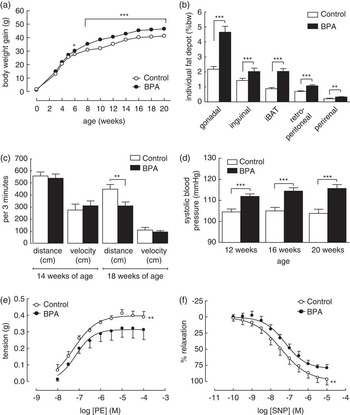
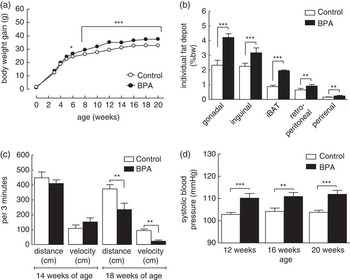
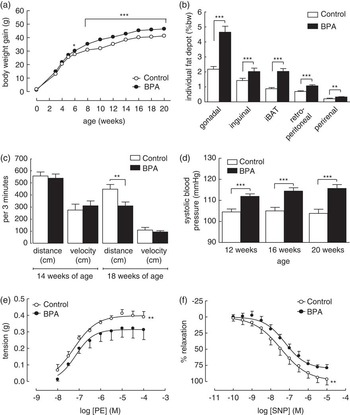
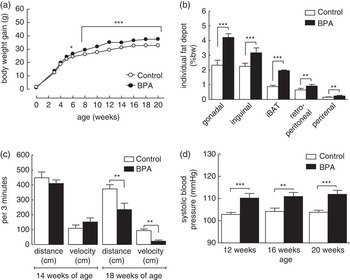
Both BPA male and female offspring became increasingly heavier with age compared with C offspring from vehicle-treated dams, with mean body weights increasing by 9.5% (P < 0.05) from 6 weeks of age to 12.6% (P < 0.001) by the time they have reached 20 weeks of age (Figs 1a and 2a, in male and female offspring, respectively). Individual weights of the various fat depots (expressed in %bw) was significantly higher in the BPA male and female offspring (Figs 1b and 2b, respectively) v. C groups (P < 0.001 in both male and female offspring for gonadal, inguinal and iBAT, and for the retroperitoneal fat in males; P < 0.01 for the retroperitoneal in females and peri-renal fat in both male and female offspring). Blood glucose levels were significantly elevated in BPA v. C male (BPA: 10.0 ± 0.4 mmol/l v. C: 7.2 ± 0.2 mmol/l, P < 0.001) and female offspring (BPA: 9.2 ± 0.2 mmol/l v. C: 7.9 ± 0.2 mmol/l, P < 0.01). The weight of the heart was similar in the BPA and C groups for both sexes (data not shown). On the other hand, kidney weights were significantly lighter in BPA v. C male (BPA: 1.25 ± 0.06%bw v. C: 1.50 ± 0.06%bw, P < 0.05) and female offspring (BPA: 0.88 ± 0.02%bw v. C: 0.97 ± 0.03%bw, P < 0.05).
Effect of prenatal exposure to BPA in the 20-week-old male offspring v. control group on body weight over time (a), individual fat depot (b), locomotor activity at 14 and 18 weeks of age (c), systolic blood pressure at 12, 16 and 20 weeks of age (d), and vasoreactivity of isolated male offspring aortas from cumulative addition of PE (e) and of the vasodilator SNP after pre-constriction with PE (f). *P < 0.05, **P < 0.01, and ***P < 0.001. Data are expressed as mean ± s.e.m. BPA, bisphenol A; PE, phenylephrine; SNP, sodium nitroprusside.
Effect of prenatal exposure to bisphenol A in the 20-week-old female offspring v. control group on body weight over time (a), individual fat depot (b), locomotor activity at 14 and 18 weeks of age (c), and systolic blood pressure at 12, 16 and 20 weeks of age (d). *P < 0.05, **P < 0.01, and ***P < 0.001. Data are expressed as mean ± s.e.m.
Locomotor activity and SBP in adult offspring
Locomotor activity in terms of distance traveled and velocity (in cm/3 min) were measured at 14 and 18 weeks of age (Figs 1c and 2c, in male and female, respectively). Initial measurement at 14 weeks of age did not show any significant differences in distance traveled and velocity between BPA and C groups. At 18 weeks of age, however, both BPA male and female offspring displayed significantly reduced distance traveled (31% in males and 37% in females, v. corresponding C groups) but velocity was only significantly reduced in females (3.95-fold reduction v. C group). Mean SBP (in mmHg) of the offspring was determined at 12, 16 and 20 weeks of age (Figs 1d and 2d, in male and female, respectively). The BPA offspring displayed significantly raised SBP at all assay times (averaging 9% and 7% higher SBP v. C male and female groups, respectively).
Vascular vasoresponsiveness in male offspring
The α1-adreneroceptor agonist PE produced a concentration-dependent vasoconstriction that was significantly attenuated in the BPA males compared with C group (g max response: BPA: 0.31 ± 0.01 v. C: 0.40 ± 0.01, Fig. 1e). The endothelium-dependent vasodilator ACh produced a concentration-dependent vasodilatation that was small but similar in both groups (data not shown). The endothelium-independent nitric oxide (NO)-donor SNP also produced a concentration-dependent vasodilatation that was significantly attenuated in BPA aorta compared with C group (% max response: BPA: 80.0 ± 2.5 v. C: 99.0 ± 1.7, Fig. 1f).
ERα gene expression in the aortas
No differences in relative mRNA expression were found for ERα in the aortas in male offspring (data not shown). In the aortas of diestrus BPA females, however, there was significant reduction in ERα mRNA expression (relative to β-actin levels) compared with C females with matched stage of the cycle (BPA: 1.35 ± 0.08 v. C: 1.85 ± 0.07, P < 0.01).
Discussion
We have shown in this study that offspring from dams treated daily with BPA during the second half of pregnancy became obese and developed relative hypertension in adulthood long after BPA was removed and without any further environmental manipulations. Thus, exposure of the fetus to BPA during development can produce organizational effects that persist into adulthood.
We found that prenatal exposure to BPA resulted in increased body weight gain and adiposity in male and female offspring even though they were given the same type of post-weaning diet. These findings are consistent with studies done in miceReference Alonso-Magdalena, Vieira and Soriano6, Reference Miyawaki, Sakayama, Kato, Yamamoto and Masuno16 and in rats.Reference Somm, Schwitzgebel and Toulotte7 Moreover, our study shows that pups from BPA-treated dams have lower birth weight v. pups from vehicle-treated mothers. Similar report of lower birth weight was observed in rats following maternal BPA treatment, but at relatively high levels of exposure.Reference Takagi, Shibutani and Masutomi17 In humans, maternal exposure to BPA during pregnancy was also found to be associated with reduced birth weight.Reference Miao, Yuan, Zhu, He and Li18 We are unable to make direct comparison on the levels of BPA exposure since we did not monitor both serum BPA levels in the dams and tissue concentration in the fetus itself. The BPA pups, nevertheless, started to gain more weight soon after birth, becoming heavier with age v. C groups. This observation appears similar to the phenomenon known as catch-up growth in humans, and is associated with greater risk to cardiometabolic diseases in adulthood.Reference Eriksson, Forsen, Tuomilehto, Osmond and Barker19 We observed this accelerated weight gain irrespective of the offspring's sex, and are characterized by the accumulation of excessive tissue mass in a range of fat depots and by raised fasting blood glucose levels. These metabolic changes may be due to BPA affecting the offspring endocrine system. A recent study in mice shows that offspring from dams treated with BPA between days 9 and 16 of gestation had reduced glucose tolerance, increased insulin resistance and altered blood insulin and glycerol levels, possibly due to apoptosis of beta cells in the offspring pancreas and altered sensitivity of these cells to extracellular glucose.Reference Alonso-Magdalena, Vieira and Soriano6 It was also suggested in the same study that the developing fetus may be exposed to altered maternal metabolism brought about by the BPA treatment, resulting in the pregnant dams themselves having impaired glucose tolerance and increased insulin resistance.Reference Alonso-Magdalena, Vieira and Soriano6 Another plausible explanation for the increased adiposity in the BPA offspring may involve the thyroid axis, which plays an important role in thermogenesis and energy expenditure.Reference Hall, Ribich and Christoffolete20 BPA has been shown to alter thyroid hormone sensitivity via modulation of its receptor activity.Reference Zoeller, Bansal and Parris21 Thus, alterations in this axis may result in reduced thermogenesis and energy expenditure, leading to increased fat deposition. Finally, exposure to BPA during development could act directly on preadipocytes. It has been reported that BPA increases gene expression of adipogenic transcription factors in mouse preadipocytesReference Phrakonkham, Viengchareun and Belloir22 and that female mouse fetuses from BPA-treated pregnant dams showed accelerated maturation of their mammary fat pads toward the end of gestation.Reference Vandenberg, Maffini and Wadia11 Similarly in rats, female offspring from dams treated with BPA from day 6 of gestation through to lactation had significantly excess white adipose tissue mass, which was associated with adipocyte hypertrophy and overexpression of lipogenic genes.Reference Somm, Schwitzgebel and Toulotte7 Thus, early life exposure to BPA could predispose the preadipocytes to differentiate at an accelerated pace and contribute to increased adiposity in later life. The increased body weight in the BPA offspring may be associated with reduced locomotor activity by 18 weeks of age.
Finally, we report for the first time that prenatal exposure to BPA results in raised SBP, in both the male and female offspring. Raised blood pressure has been observed in a number of models of developmental programing, but has not been shown before to be a result of prenatal exposure to BPA. We also observed reduced kidney weight in the BPA offspring v. C groups. Studies of maternal nutrient restriction during pregnancy in rats have suggested that renal development is one of the key mechanisms in the programing of adult blood pressure control.Reference Langley-Evans, Langley-Evans and Marchand23 It is possible that prenatal BPA exposure has a deleterious effect on kidney growth and development, contributing to increase cardiovascular disease risk in adulthood.
In the male BPA offspring, we also observed altered vascular function. This finding along with the observed raised blood pressure in the BPA animals is reminiscent of the effects of unbalanced diet during pregnancy on cardiovascular function in the offspring.Reference Brawley, Itoh and Torrens24 We also found the relative expression of the ERα gene to be significantly lower in the aortas of female offspring prenatally exposed to BPA. This may be detrimental as it negates the protective effect of estrogen from vascular impairment brought about by prenatal BPA exposure. This notion is substantiated by a study showing that BPA suppresses the athero-protective, angiogenesis-promoting product NO in a mouse macrophage cell line through an ER-dependent pathway.Reference Yoshitake, Kato and Yoshioka25 Our novel finding that vascular dysfunction can result from maternal exposure to BPA merits further research.
In conclusion, the present study provides evidence for adverse effects of BPA exposure during development, leading to increase susceptibility to obesity in later life. In addition, we now show for the first time that prenatal BPA exposure can also result in raised SBP and impaired vascular tone, effects associated with changes in growth trajectory, organ size and glucose homeostasis. Given its widespread presence in the environment and its identification in several tissues in human populations, reducing exposure to BPA during prenatal development may help in the prevention of obesity and cardiovascular dysfunction in later life.
Acknowledgments
This study was supported by the British Heart Foundation (to M.A.H.) and the Biotechnology and Biological Sciences Research Council (to F.R.C.).