1 Introduction: contrast, predictability and phonologisation
This paper explores the relationship between contrast, interpreted as the absence of redundant information from phonological representations, and the phonologisation of predictable properties. I argue that, although phonologisation via the life cycle of phonological processes introduces predictable information into phonological representation, this fact is compatible with the Contrastivist Hypothesis (Hall Reference Hall2007, Dresher Reference Dresher2009), which requires redundant features to be absent from the phonology. To demonstrate the viability of such a framework, I offer a case study involving mutually predictable distribution, where standard criteria fail to unequivocally identify a ‘contrastive’ phonological property. I address the three questions in (1).
-
(1)


1.1 The Contrastivist Hypothesis and its discontents
Our starting point is the Contrastivist Hypothesis, formulated by Hall (Reference Hall2007: 20) as: ‘the phonological component of a language L operates only on those features which are necessary to distinguish the phonemes of L from one another’. As discussed by Dresher (Reference Dresher2009), this principle was historically important in structuralist phonology, but downgraded by many (though not all) currents of generative phonological theory. More recently, it has again attracted the attention of phonologists (e.g. Dresher et al. Reference Dresher, Piggott and Rice1994, Hall Reference Hall2007, Dresher Reference Dresher2009, Mackenzie Reference Mackenzie2013, Cowper & Hall Reference Cowper and Currie Hall2014).
In Hall's version of the Contrastivist Hypothesis, contrastiveness is defined over phonemes as understood in generative phonology, i.e. segments found in underlying representations in a language. Kiparsky (Reference Kiparsky, Hyman and Plankforthcoming) refers to these as ‘m-phonemes’ (‘morphophonemes’) – a usage that I adopt here. Hence, establishing whether a feature is ‘contrastive’ in the language can be non-trivial, since the set of m-phonemes can only be discovered through careful analysis.
Disagreements over such analysis are frequent in cases of mutually predictable distribution, where two apparently distinct phonological properties are coextensive in surface representations. Both properties are candidates for being contrastive (and thus available to the phonological grammar), but under strict contrastivist assumptions one of them must be redundant. The problem for contrastivist approaches is that this choice must be made, but it appears to be vacuous, and forced only by theoretical considerations, since the data seem equally compatible with either solution.
I consider a case of mutually predictable distribution in Welsh, focusing on vowel quantity and quality. As in languages like English and German, Welsh vowels can be divided into two classes, which differ both in quantity and ‘tense’ vs. ‘lax’ quality. The analysis of such systems is controversial: some scholars view the contrast as primarily one of length (e.g. Durand Reference Durand, Carr, Durand and Ewen2005), others see the quality distinction as primary (e.g. Harris Reference Harris1994) and yet others subsume the difference under ‘syllable cut’ (e.g. Botma & van Oostendorp Reference Botma, van Oostendorp, Botma and Noske2012).
I focus on dialectal diversity in Welsh vowel systems, concentrating in particular on south-western varieties, where, according to previous descriptions, vowel quantity and quality have diverged in ways unattested in other dialects. I report an acoustic study and argue that in these varieties quality must be represented in the phonology separately from the length. I argue that this is consistent with a view of phonologisation where the identification of phonological patterns proceeds bottom-up, on the basis of categoricity in the ambient data, but the precise characterisation of the resulting phenomena in terms of distinctive features is driven at least partly by top-down contrastivist pressures.
1.2 Establishing the criteria
Being able to verify or falsify a theory that allows for the manipulation of predictable information by the phonology requires criteria to establish whether a phenomenon falls within the purview of phonological grammar. It is common to ascribe ‘gradient’ phenomena to ‘phonetics’, and to take categoricity of distribution as a sign of phonologisation (e.g. Myers Reference Myers, Burton-Roberts, Carr and Docherty2000). However, this approach can be problematic. Even classifying phonological phenomena as ‘categorical’ or ‘gradient’ is not trivial (Strycharczuk Reference Strycharczuk2012).
In this paper, I argue that the phonological status of a pattern should be determined with reference to the criterion of modularity (see e.g. Scheer Reference Scheer2011, Bermúdez-Otero Reference Bermúdez-Otero and Trommer2012), which requires that the flow of information between grammatical modules be restricted. I focus on representational incommensurability between modules. Specifically, some kinds of objects are proprietary to ‘their’ module: for phonology, examples are featural specifications, autosegmental association lines, metrical constituency, etc. Under this approach, if a pattern makes crucial reference to such proprietary phonological information, it must also be phonological, because only computation inside the phonological module can access such phonology-internal information.
Using this criterion, we can establish whether a pattern is within the scope of phonological grammar and thus, ideally, contrastivist restrictions. The Contrastivist Hypothesis can be reformulated as in (2).
-
(2)
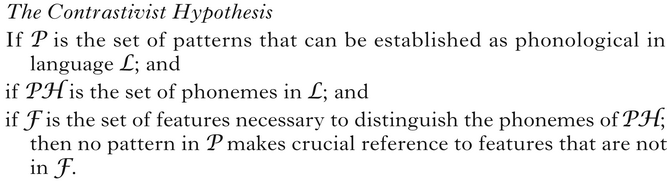
Assuming that we can establish the extent of P and PH using the modularity criteria suggested above – as I will exemplify in this paper – the content and correctness of the Contrastivist Hypothesis turn on the understanding of ‘necessity’ in the definition of the set F. In this paper I argue that contentful predictions can indeed be made, if the hypothesis is understood with reference to a contrastive hierarchy of distinctive features (Dresher Reference Dresher2009).
1.3 Phonologisation and redundancy
Another problem, directly relevant to the issue of phonologisation, is the determination of PH, the set of relevant ‘phonemes’, which, in Kiparsky's (Reference Kiparsky, Hyman and Plankforthcoming) terms, are m-phonemes, and contrastivists in the generative tradition have usually concentrated on this m-phonemic level. Kiparsky, however, suggests distinguishing between m-phonemes and ‘l-phonemes’ (‘lexical phonemes’): segments produced by phonological grammar at the lexical level (word-level phonology) in a stratal framework that builds on the insights of Lexical Phonology. He argues that typological and theoretical generalisations such as those concerning the structure of inventories or historical change should properly refer to this l-phonemic level. Crucially, he argues, the l-phonemic level may contain predictable information such as redundant feature specifications if it is introduced by phonological computation at the lexical level. Hence this framework appears incompatible with the Contrastivist Hypothesis.
The presence of redundant information in the phonological computation is only to be expected if the source of phonological patterns lies in the life cycle of phonological patterns, and specifically within the process of phonologisation (Hyman Reference Hyman and Juilland1976, Reference Hyman and Yu2013, Kiparsky Reference Kiparsky, Honeybone and Salmons2015). This term is commonly used to describe a linguistic change whereby a phenomenon previously construed as ‘phonetic’ enters the purview of phonological grammar. Phonetic processes give predictable (if stochastic) outcomes. Therefore, the system immediately after phonologisation is likely to have the new symbols standing in predictable distributions, and ‘new’ phonological patterns will tend to be allophonic, potentially reducing the scope for positing an m-phonemic contrast that could justify the phonological involvement of the relevant feature under contrastivist assumptions.
There is a tension between the Contrastivist Hypothesis and the study of phonologisation, because contrastivist approaches privilege ‘top-down’ information about contrast and morphophonological patterning, whilst models of phonologisation recognise the importance of ‘bottom-up’ information. Under contrastivist assumptions, the evidence for the existence of a phonological segment and its representational make-up comes from categorical information, such as the structure of the inventory and the segment's morphophonological behaviour. Theories of phonologisation, on the other hand, emphasise the role of variation in the speech signal, whether inherent and uncontrolled or speaker-specific.
I argue in this paper that this tension can be resolved in a framework where phonological features are categorical and assigned on the basis of contrastivist reasoning, but emergent and phonetically arbitrary (‘substance-free’). This makes it possible to construct an adequate theory of phonologisation that takes the speech signal as its starting point. In this framework, contrastivist assumptions serve both to capture the existence of top-down featurally implemented biases in phonologisation and to restrict the set of possible specifications one could assign to a given inventory.
The remainder of this paper is structured as follows. In §2 I review the available knowledge regarding vowel quantity and quality in dialects of Modern Welsh. §3 presents the results of an acoustic study of a south-western variety of Welsh that has been reported to show an unusual deviation from the common Welsh system; I argue that in this variety ‘tense’/‘lax’ quality and quantity are separately represented in the phonology. In §4 I take the criteria for phonological status developed in the course of this argument and apply them to other varieties of Welsh, showing the extent of dialect variation in feature specifications. Finally, in §5 I reconsider the status of contrastive specifications in an emergent-feature framework and their role in phonologisation.
2 Vowel quantity and quality in Welsh
Here I review available descriptions of vowel quantity and quality in Welsh, and argue that there is good evidence for viewing quantity as a phonological distinction, specifically one expressed via suprasegmental (metrical) structure. I also review the controversies in the literature around the phonemic interpretation of the Welsh vowel system.
2.1 The received view
A representative inventory of Welsh stressed monophthongs is shown in (3) (see Ball & Williams Reference Ball and Williams2001, Mayr & Davies Reference Mayr and Davies2011, Hannahs Reference Hannahs2013).
-
(3)
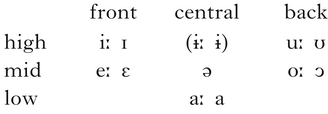
Some variation of this system is common throughout the Welsh-speaking region. Apart from the differences in the realisation of short and long vowels, subject to discussion below, the following dialectal variations should be noted: (a) the vowels [îː] and [î] are found only in northern Wales; (b) the vowel [ə] lacks a phonologically long counterpart; (c) in many varieties there is an additional low vowel, variously a low front [æː] or a raising and/or centralising diphthong, considered to be an allophone of [aː]. Here I concentrate on the relationship between the short and long vowels.
2.1.1 Distribution
All dialects of Welsh restrict phonologically long vowels to stressed syllables. In monosyllables we find both short and long vowels, as in (4).
-
(4)
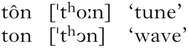
In polysyllabic words, stress falls overwhelmingly on the penult, apart from a small number of native words with final stress and a handful of borrowings with antepenultimate stress.
There is a major distinction between northern and southern varieties of Welsh in the behaviour of stressed penults (Awbery Reference Awbery, Ball and Jones1984). In South Welsh, short and long vowels are distinct in both penultimate and final stressed syllables. However, long vowels in penultimate syllables are phonetically shorter than long vowels in final syllables (e.g. Jones Reference Jones1971), and often described as ‘half-long’, as shown in (5).
-
(5)

In North Welsh, stressed vowels are always short in penults, so the minimal pair in (5) is impossible in such varieties: both tonau and tonnau are realised as [‘tHOna].
In addition to these patterns, the native lexicon of Welsh enforces restrictions on the distribution of short and long stressed vowels which depend on the properties of following consonants (Wells Reference Wells1979, Awbery Reference Awbery, Ball and Jones1984). The restrictions in final stressed syllables (including monosyllables) are as in (6).
-
(6)
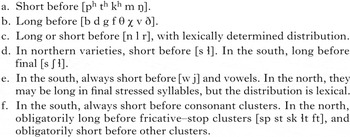
In non-final stressed syllables, vowels are always short in North Welsh. In the south, the distribution of length in stressed penults is very similar to that in stressed ultima, but not fully identical: vowels are obligatorily short before medial [s S ¡], but long before the same consonants word-finally.
To summarise, phonologically long vowels are restricted to stressed syllables. In northern Welsh they are further restricted to final stressed syllables. Vowel length in the native lexicon is largely predictable, depending both on syllable structure (with a dispreference for long vowels in closed syllables) and on the melody of the following consonant. Most often, the length of a stressed vowel is predictable from the manner and laryngeal specification of a following consonant, with the exception of [n l r], where the distribution is lexically conditioned.
2.1.2 Phonological length and phonetic duration
The phonetic correlates of the phonological distinction identified above as ‘length’ include both vowel quality and duration. First, phonologically long vowels have greater duration than phonologically short vowels (e.g. Jones Reference Jones1971, Grawunder et al. Reference Grawunder, Asmus and Anderson2015). Second, descriptions of South Welsh agree that consonants after a short stressed penult are ‘half-long’, irrespective of whether the vowel is followed by a single consonant (tonnau [‘tHOn;E]), or by a consonant sequence (amser [‘am;sEr] ‘time’); see e.g. Thomas (Reference Thomas1961), Awbery (Reference Awbery1986), Thomas (Reference Thomas1993). The situation is less clear in North Welsh. Many sources (summarised in Hannahs Reference Hannahs2013: §2.2.6) mention ‘gemination’ of the fortis stops [pH tH kH] after a stressed penult, and there are scattered references to other consonants being lengthened in the same position. Subject to further research, it appears that lengthening of consonants after a short stressed vowel in a penultimate syllable is universal across Welsh dialects.
Similar facts obtain in stressed ultima. Jones (Reference Jones, Ball and Jones1984: 54) states that consonants are long after short vowels in this context, as in (7).
-
(7)

Thomas (Reference Thomas1966) gives a similar statement for the Alyn Valley dialect (North Wales). For South Wales, the length of final consonants after a short stressed vowel is mentioned by Thomas (Reference Thomas1993: 69–70). For North Welsh monosyllables, the claim is corroborated experimentally by Grawunder et al. (Reference Grawunder, Asmus and Anderson2015).
Thus phonological ‘length’ is reflected by phonetic duration, and there is also a trading relation between the duration of stressed vowels and following consonants.
2.1.3 Length and quality
Another correlate of phonological ‘length’ is vowel quality. Vowels other than [ə] (and likely [a]) come in ‘tense’ and ‘lax’ pairs: [oː] vs. [O], [iː] vs. [I], and so on. Such pairs pattern together, as they participate in alternations determined by the consonantal context, as in (8).
-
(8)

It is sometimes desirable to refer to such vowel pairs without prejudice to the exact realisation; to do this, I adopt Wmffre's (Reference Wmffre2003) useful notation //i//, //e//, etc.
The precise quality of vowels depends on their phonological quantity and their position with respect to stress. The standard picture is as follows.
(i) Non-low stressed long vowels are ‘tense’ [iː uː eː oː]. Sources differ as to whether there is a similar qualitative distinction between long and short //a//: for instance, Awbery (Reference Awbery1986) does not describe a qualitative difference between [a] and [aː], but Jones (Reference Jones, Ball and Jones1984) describes long [aː] as somewhat retracted compared to [a]. Some descriptions (e.g. Thomas Reference Thomas1993, Jones Reference Jones2000) use the representation [A(ː)] for the ‘long’ member. However, in an instrumental study, Mayr & Davies (Reference Mayr and Davies2011) do not find a reliable qualitative distinction between short and long //a// in monosyllables, and Wmffre (Reference Wmffre2007) states that long //a// is never phonetically [A].
(ii) Stressed short vowels in South Wales are lax [E I O U]. This is confirmed for monosyllables by Mayr & Davies (Reference Mayr and Davies2011). For North Welsh, detailed descriptions are lacking, especially for stressed penults, but broadly the situation appears similar.
(iii) The length contrast is neutralised in unstressed syllables. There is agreement in the literature that quality varies between ‘tense’ and ‘lax’. For instance Awbery (Reference Awbery1986) describes the unstressed vowel system of Pembrokeshire Welsh as in (9).
-
(9)
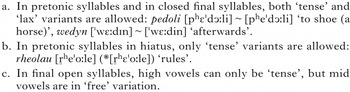
Thus it appears that greater leeway in the qualitative properties of unstressed vowels compared to those of stressed vowels is characteristic of most varieties of Welsh.
2.2 Analysis
As discussed in §1.1, a close relationship between vowel quantity and vowel length such as that found in Welsh presents a potential problem if redundant information has no place in phonological representation. One such approach is the traditional taxonomic framework, which aims to represent all utterances as uniquely identifiable phoneme strings, where ‘phonemes’ are understood as minimally redundant units standing in overlapping distribution. Kiparsky (Reference Kiparsky, Hyman and Plankforthcoming) dubs these units ‘s-phonemes’ (‘structuralist phonemes’), and argues that they do not have a privileged place in phonological architecture.
As the existing literature on Welsh demonstrates, an s-phonemic framework requires a choice between length and tenseness, but the data do not provide much guidance on which analysis is better. Much of the literature designates quality as primary (e.g. Pilch Reference Pilch1958, Watkins Reference Watkins and Meid1967, Thomas Reference Thomas1993, Jones Reference Jones2000), with length marks often altogether omitted from the phonemic transcriptions. Length is more consistently written in early literature that does not use a phonemic approach (e.g. Sommerfelt Reference Sommerfelt1925), but also in some later work (e.g. Thomas Reference Thomas1960).
The reasons for this choice are seldom explicitly discussed. Thomas (Reference Thomas1966) justifies his choice of length by referring to ‘symmetry’. Length is independently required to distinguish /a/ and /aː/: since it is used in the phonology of the language, it can be applied to express the same contrast in other pairs, making ‘tongue position’ redundant. On the other hand, Watkins (Reference Watkins and Meid1967) points out the existence of long ‘lax’ vowels in English borrowings, quoting [‘brOːn] brawn and [InJI’nEːr] engineer, and argues that this makes tenseness unpredictable and thus phonemic.
Both approaches are open to criticism. The symmetry-based argument for a quantity analysis is not empirical; it might also not go through if varieties with a quality distinction between [a] and [Aː] do exist. The argument for a quality analysis based on borrowings might be more plausible, but it runs into the unclear status of borrowings in the broader phonology. Moreover, it is not entirely clear that the borrowed long vowels are qualitatively identical to the native short ones: for instance, Thomas (Reference Thomas1993) uses different symbols for the native short //o// (she writes [Q]) and the borrowed long [Oː].
Here I adopt the analysis defended in Iosad (Reference Iosad2012), according to which quantity (more specifically, moraicity) must be present in underlying representations (i.e. it is m-phonemic). This is motivated by the interaction of the abstract ‘length’ distinction with the consonantal context; such systems, where vowel length depends on the properties of the following consonant, even where that consonant is not part of a cluster, can be given a moraic analysis (see, for instance, Morén Reference Morén2001 on Metropolitan New York English, Bye & de Lacy Reference Bye, de Lacy, de Carvalho, Scheer and Ségéral2008 on Latvian and Torres-Tamarit Reference Torres-Tamarit2015 on Northern Romance).
The basic idea, developed in depth in Iosad (Reference Iosad2012), to which I refer for details, and also found in Hannahs (Reference Hannahs2013), is that lengthening is driven by a stress-to-weight requirement, which is counteracted by faithfulness to underlying moraic specifications and by restrictions on which segments can acquire a mora. Within this framework, the phonotactics of stressed syllables across Welsh dialects can be analysed as a mix of ‘distinctive’ and ‘coerced’ weight, in Morén's (Reference Morén2001) terms. Weight coercion arises when a (stressed) syllable is required to be bimoraic. This can be satisfied by the lengthening of either the consonant or the vowel (with the choice dependent on the ranking of relevant constraints), or fail to be satisfied (as in the case of North Welsh penultimate syllables in hiatus, where stressed vowels remain short). In an optimality-theoretic framework (Prince & Smolensky Reference Prince and Smolensky1993) such as Morén's, the typology can be derived from the ranking of DepLink-m constraints for vowels and various kinds of consonants vis-à-vis each other and the stress-to-weight constraint.
‘Distinctive weight’, with underlying moraic specification faithfully reproduced on the surface, arises in the case of [n l r], which can be preceded by both long and short vowels, depending on the lexical specification of moraicity. In cases such as the minimal pair in (5), vowel lengthening depends on whether the post-tonic consonant is underlyingly moraic: if it is, there is no need for lengthening, because the second mora is already provided; if not, lengthening ensues (Iosad Reference Iosad2012).
Thus the behaviour of Welsh stressed vowels can be derived from moraic structure, some of it underlying. The moraicity of the vowels is definitely involved in the phonological grammar. It appears more difficult to offer a principled account of these facts if vowel quality is the sole phonologically relevant property, and so I conclude that if a choice between quantity and quality is to be made, then quantity is preferred.
Even if we accept this, however, the status of vowel ‘tensing’ (and/or ‘laxing’) in the grammar still remains ambiguous. One option is that it is not a symbolic phonological operation, but part of ‘phonetic implementation’, with tenseness never entering the phonological computation. The other possibility is that the distribution is introduced by the grammar, via a rule along the lines of (10) (or an equivalent OT ranking).
-
(10)

This could be a problem for contrastivist approaches, since the feature [tense] is not needed for m-phonemic contrasts: it is entirely predictable, being only introduced by rule (10). Crucially, the same cannot be said of moraicity, because it must be encoded in underlying representations in Welsh, at least for [n l r].Footnote 1 In a sense, this approach subverts the entire controversy: once a moraic representation of quantity is accepted, there is no need for a segmental feature [long], and there is no obligatory choice between [long] and [tense] to make. (I return to this issue briefly in §6.)
However, this analysis does not rule out the distinction between ‘tense’ and ‘lax’ vowels being visible to the phonology. In the remainder of the paper, I will argue that this distinction in Welsh must also be part of the phonological computation, despite being redundant at the s-phonemic level (in some varieties). To verify this, I use the criteria for phonological status offered in §1.2. Specifically, I discuss the distribution of length and quantity in several varieties of Welsh, and show that the ‘tenseness’ distinction fulfils the following two criteria: (i) it is inherently (not accidentally) categorical, in that its categoricity both can be established and cannot be derived using a continuous function from some other categorical distinction,Footnote 2 and (ii) its distribution is regulated by proprietary phonological factors.
Having established that ‘tenseness’ has undergone phonologisation to a degree where it is now part of l-phonemic representations in Welsh, I will then reconsider the criteria of contrastive status necessary for the Contrastivist Hypothesis to be falsifiable.
3 Quantity and quality in south-western Welsh
This section focuses on varieties of Welsh spoken in the south-western part of the country, specifically the counties of Carmarthenshire, Cardiganshire (Ceredigion), and the northern part of Pembrokeshire. These dialects possess a sound pattern that, unusually for Welsh, involves the ‘lax’ long mid vowels [Eː Oː] in the native vocabulary. As far as I am aware, these data have not previously been examined instrumentally, or brought to bear on the question of quantity–quality interactions in Welsh; this provides the motivation for this study.
3.1 Available descriptions
Several descriptions of dialects from this area are available. Jones & Thorne (Reference Jones and Thorne1992) offer an overview for a general audience. Awbery (Reference Awbery1986) provides an explicit description of the phonology of Pembrokeshire Welsh in a generative framework. Wmffre (Reference Wmffre2003) focuses on Cardiganshire place-names, but also provides numerous details of the phonology of relevant dialects. All these descriptions recognise the existence of distinct allophones for the long mid vowels: [eː oː] and [Eː Oː]. The latter appear in penultimate syllables when the vowel in the following (unstressed) syllable is high //i// or //u//, as in (11).
-
(11)

Long mid vowels in monosyllables are always tense. No similar allophony is described for either low or high long vowels, or for any kind of phonologically short vowel. Changes in relevant types of phonological conditioning produce the expected alternations in (12).
-
(12)

If these descriptions are correct, then these dialects are a potentially valuable testing ground for the status of [Eː Oː] in native (rather than borrowed) vocabulary. However, auditory descriptions cannot give us confidence that this south-western pattern is in fact categorical. I report here the results of an acoustic study conducted to verify these descriptions and establish the status of the pattern.
3.2 Methods
Eight participants were recruited in Carmarthen beforehand and on the spot.Footnote 3 This convenience sampling created some skewing in terms of gender and age. Since the focus of the study is on phonological aspects of the patterning rather than on precise factors driving sociolinguistic variation, this will not be further discussed.
Also as a result of the convenience sampling, the study included two speakers who had lived in the relevant area for a considerable period of time but reported being brought up elsewhere in Wales. Speaker 4 was brought up in the capital, Cardiff; however, her Welsh-speaking parent is from the south-western area, and she shows much the same system as the other south-western speakers. Her data was therefore pooled with other south-western speakers. Speaker 8, on the other hand, who was brought up in Aberystwyth, in Mid Wales, but had lived in the area for over ten years, turned out to have a different system. I report the data gathered from this speaker in §3.3.3 by way of comparison with the south-western system, but do not offer a detailed analysis, for lack of complete data. In addition, one of the demographically south-western speakers (Speaker 1) did not show the expected pattern, but instead demonstrated the system described for other South Welsh varieties. Since that system is relatively well understood, I do discuss those data in detail in §3.3.1.
In contrast to Mayr & Davies (Reference Mayr and Davies2011), the present study used actual rather than nonce words. Disyllabic words of a suitable shape were chosen, with reference to frequency counts in a corpus of written Welsh (Ellis et al. Reference Ellis, O'Dochartaigh, Hicks, Morgan and Laporte2001). As far as possible, the word-list aimed for balanced representation of the variables in (13).
-
(13)

The full list of 118 test items is given in Appendix A, with the expected pronunciation of the item in a south-western dialect. A total of 2767 tokens were analysed. Words were presented in their orthographic representation in the standard language: Welsh spelling is transparent enough for the intended vowel to be easily recoverable. Although some patterns of interest are less common in the standard language than in dialects (notably /u/ in non-final syllables), meaning no suitable test items could be found for some conditions, no attempt was made to guess dialectal pronunciations and represent them in the stimuli.
Stimuli were presented to participants in a self-paced reading task, with items appearing on a screen in three independently randomised blocks. The stimuli were embedded in the carrier phrase Glywes i'r gair __ ddoe ‘I heard the word __ yesterday’. Speakers were instructed to produce natural rather than spelling-based forms (which they did to varying extents).
The acoustic analysis was completed using Praat (Boersma & Weenink Reference Boersma and Weenink2015). The segments were marked up manually, noting the duration of vocalic intervals, consonantal intervals (stop closure, frication duration, etc.) and pre- and post-aspiration intervals separately. Formant measurements were taken at the midpoint of every vowel in final and penultimate syllables.Footnote 4
3.3 Results
The study reveals the existence of at least three different patterns of quantity–quality interactions. We begin with Speaker 1, who shows the neat co-occurrence of length and tenseness characteristic of most dialects of South Welsh. Six of the eight speakers exemplify the south-western system as described in the literature. Finally, Speaker 8 shows a pattern that appears to not have been systematically described before.
3.3.1 The standard southern system
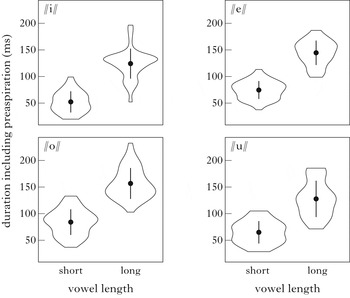
Speaker 1 shows the ‘standard’ South Welsh system. There is a distinction in duration between phonologically short and long vowels. Figure 1 demonstrates this by plotting the density of the distribution of durations for different short and long vowels, together with means and ±1 standard deviations. A two-way ANOVA, with vowel length and vowel quality as independent variables and vowel duration including preaspiration, shows both factors to be significant: for vowel length, the ANOVA gives F(1, 278) = 554.36, p < 0.00001, and for vowel quality F(3, 278) = 23.74, p < 0.00001, presumably reflecting inherent length effects.Footnote 5
Vowel duration by vowel category and length (Speaker 1).

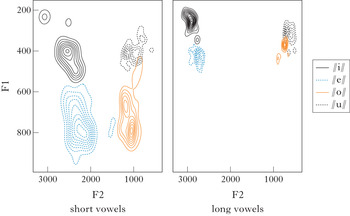
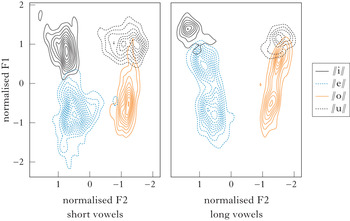
Figure 2 shows F1 and F2 values for Speaker 1 for short and long vowels. Instead of the traditional dot plot, the plot shows a binned 2D kernel density estimate of the distribution of tokens for each category. Thus the plot shows the extent of variation within each category, but also the region of the vowel space where most of the tokens are concentrated.
Formant values of vowels by length (Speaker 1).

In this case, long and short vowels form distinct clusters in the vowel space, particularly along the F1 dimension. However, in principle this qualitative difference could be an effect of undershoot or overshoot (Lindblom Reference Lindblom1963) relative to a fairly high target, so that the shorter the duration of the vowel, the lower (‘laxer’) it is in quality. The apparently categorical difference might then derive not from the existence of two qualitative categories underlying the distribution of the tokens but simply from the distribution of duration, without a categorical quality distinction.
If this were the case, we expect the relationship between the duration of the vowel and its quality to be expressible as a continuous function. To verify whether the relationship of vowel duration and vowel quality is continuous or discrete, several generalised additive models were fitted, using the mgcv package (Wood Reference Wood2006) in the R statistical environment (R Core Team 2016). A major motivation for the use of additive rather than linear models is their ability to model non-linear effects, which, as we shall see, are present in the data. After initial modelling, the residuals showed a non-normal distribution; this was corrected by treating log2 of F1 as the dependent variable. Independent variables included vowel quality, F2 (since the vowels are not evenly distributed in the vowel space) and the duration of the vowel, including preaspiration of the following consonant.
A good fit was obtained in a model that included an interaction between vowel length and vowel quality, as well as a random intercept for lexical item. A selection of the better models is shown in Table II in Appendix C, which includes the estimated coefficients and 95% confidence intervals. An effect is considered significant if the confidence interval excludes zero.
To evaluate goodness of fit of the different models, we can use the Akaike Information Criterion (AIC; see Burnham & Anderson Reference Burnham and Anderson2004 for a practical introduction). Briefly, the AIC produces a measure of the deviance explained by the model with a trade-off against the degrees of freedom, to avoid overfitting. Burnham & Anderson recommend using second-order AIC (AICc) in cases with relatively small samples, as is the case for all the datasets in this paper. Absolute AIC(c) values for different models are less informative than the difference (BAIC(c)) between the best model in the set (the one with the smallest value) and the model of interest. It is commonly assumed that a model with a BAIC lower than 3 is substantially supported by the data, that one with a BAIC of between 4 and 7 is substantially less supported by the data and that a model with a BAIC of over 10 has essentially no support.
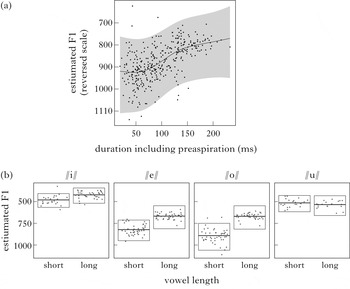
This type of modelling allows us to disentangle the influence of phonetic duration on vowel quality (e.g. undershoot effects) from the effects of a phonological ‘length’ category. Table II shows that both of these factors exert an influence. Specifically, a model including both is superior to models that exclude one of these terms: excluding phonological length produces a BAICc of 28, and excluding duration gives a BAICc of 10. The precise influence of both factors can be seen in Fig. 3a. The line shows the estimated effect, the shading the 95% confidence interval and the dots represent residuals. The vertical axis is reversed, to make the interpretation of the figures in terms of the vowel space easier.
Effects of (a) duration and (b) phonological length by vowel (Speaker 1).

As Fig. 3a shows, longer duration generally corresponds to a lower F1 value, although the effect is highly non-linear. I interpret this as an effect of undershoot: relatively short vowels are lower than the target. This is especially pronounced with vowels of greater duration (presumably mostly phonologically long ones), but less visible at short durations. This effect, however, cannot account for the full range of variation in F1, with the category of phonological length making a clear additional contribution (especially in the case of the mid vowels), as seen in Fig. 3b.
Thus Speaker 1 exemplifies the vowel system in penultimate syllables seen in existing descriptions of South Welsh. This speaker demonstrates a reliable distinction in duration between vowels in phonologically ‘short’ and ‘long’ contexts, and a categorical distinction in quality between the two classes. This applies to all the vowels that contrast in length, and the quality distinction cannot be accounted for solely by undershoot. This is precisely the phonologically ambiguous situation described in §2.2.
3.3.2 The south-western system
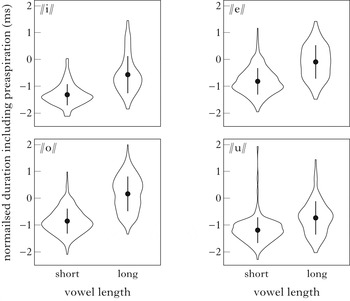
Six of the eight speakers exemplify the south-western system, where the quality of long mid vowels depends on the phonological category of the post-tonic vowel. Figure 4 demonstrates that all vowels show the expected difference in duration between the ‘short’ and ‘long’ contexts. (Durations have been normalised by converting to z-scores, with the mean duration of all vowels, including post-tonic ones, taken to be 0.) A two-way ANOVA with normalised duration as dependent variable again shows that both vowel length (F(1, 1699) = 744.85, p < 0.00001) and vowel quality (F(3, 1699) = 122.05, p < 0.00001) are significant predictors of duration.
Vowel duration by category (south-western speakers).

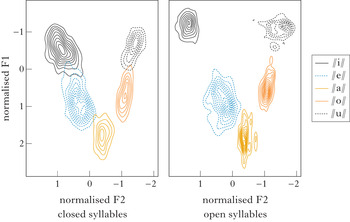
Figure 5 illustrates the distribution of vowel qualities by vowel duration, with formant values Lobanov-normalised (i.e. converted to z-scores) by speaker (Adank et al. Reference Adank, Smits and van Hout2004). The plot shows that long mid vowel tokens are concentrated in two regions of the vowel space: one with approximately the same quality as the corresponding short vowel and one corresponding to a higher, more peripheral vowel in the same region of the vowel space as the long ‘tense’ vowels of Speaker 1.
Densities of vowels for the south-western group, by vowel length.

The distribution of the lower (‘lax’) allophones of long mid vowels is consistent with the descriptions: they appear, almost without exception, before a high vowel. (Due to the restrictions of the lexicon, the high vowel in the post-tonic syllable was always //i//.) There is, however, at least one exception. The word ffenestr ‘window’ consistently has [Eː], despite the non-high vowel in the post-tonic syllable: [‘fEːnEst(r)]. Most speakers produced all three tokens of ffenestr in the task with a vowel with a normalised F1 of well above zero, even though most other tokens of long //e// before a non-high vowel have negative normalised F1. The exception is Speaker 4, who always has tense [eː].Footnote 6
Given the highly consistent behaviour of ffenestr (but not any other lexical items) across speakers, it seems likely that it is not an artefact of experimental conditions, but a true lexical exception. To take this into account, further modelling was conducted on the assumption that the stressed vowel of ffenestr for all speakers except Speaker 4 falls within the same category as other ‘lax’ long vowels.
To identify the nature of the following vowel's influence on the stressed vowel, several generalised additive mixed models were again fitted, all with random intercepts for Speaker and Word (see Table III in Appendix C). The results show that the quality of the stressed vowel is influenced by the high or non-high specification on the post-tonic vowel. A model without the height of the post-tonic vowel as a predictor fares worse than one that does. However, a model with only a single fixed effect of post-tonic vowel height (i.e. consistent across vowel quality and length specifications of the stressed vowel) does significantly worse than one with a three-way interaction between stressed vowel quality, stressed vowel length and post-tonic vowel height (BAICc = 20).
As Table III shows, most of the effect of the height of the post-tonic vowel is accounted for by the mid stressed vowels – neither short vowels nor long high vowels are affected by a post-tonic high vowel, exactly as the descriptions claim. The effect of the post-tonic high vowel essentially cancels out the raising effect of phonological length, making the ‘lax’ long vowels identical to the corresponding short ones. For short //e// (i.e. [E]) the estimated effect of vowel category is 1.58 SDs (relative to the F1 of [I]), while for long lax //e// (i.e. [Eː]) the sum of all relevant effects is 1.55 SDs; for //o//, the corresponding values are 1.54 for [O] and 1.72 for [Oː].
The results of the acoustic study confirm the existence of two qualitative categories within most vowel pairs.Footnote 7 Among high vowels, the distribution is identical to that found elsewhere in Welsh: ‘lax’ [I U] are associated with phonological shortness, and ‘tense’ [i u] are found in contexts requiring phonological length. The distribution of mid vowels is different: ‘lax’ [E O] are associated with short contexts, and with long contexts only if there is a following high vowel; ‘tense’ [e o] are found elsewhere in long contexts (before a non-high vowel and – following traditional descriptions and Mayr & Davies Reference Mayr and Davies2011 – presumably in stressed final syllables).
Modelling also allows us to exclude the hypothesis that the dissimilation is an artefact of a continuous trade-off in duration between two neighbouring vowels. Such an explanation has been proposed to account for height-dissimilation phenomena (Crosswhite Reference Crosswhite2000), and continuous trade-offs along these lines have been identified in Kera (Pearce Reference Pearce2007) and in dialects of Russian (Kniazev & Waul'skij Reference Kniazev and Waul'skij2007). However, modelling with the duration of the post-tonic vowel or its (normalised) F1 as the explanatory variable gives results inferior to those with the phonological category of the post-tonic vowel as the chief factor: BAICc = 27 for normalised duration and BAICc = 32 for normalised F1. Thus we are dealing with a categorical effect of the following vowel's height specification on the quality of the stressed one, rather than a continuous interaction. This justifies treating ‘mid vowel dissimilation’ as a categorical process that, crucially, involves access to proprietary phonological information – the featural specification of the post-tonic vowel. Under modularist assumptions, this presents clear evidence for the phonological nature of the distinction between the ‘tense’ and ‘lax’ variants, at least of the mid vowels.
3.3.3 The non-enhanced system
Finally, Speaker 8, brought up in Aberystwyth, in Mid Wales, apparently shows another type of interaction between vowel quantity and quality. Like other speakers in the study, Speaker 8 shows some difference in vowel duration between the ‘short’ and ‘long’ contexts, with the exception of //u//. Unfortunately, the dataset for the single speaker is insufficiently large for any definite pronouncements on statistical significance. A two-way ANOVA with vowel duration as dependent variable indicates that both phonological length (F(3, 276) = 50.38, p < 0.001) and vowel quality (F(1, 276) = 17.89, p < 0.001), as well as their interaction (F(3, 276) = 6.41, p < 0.001), are significant.
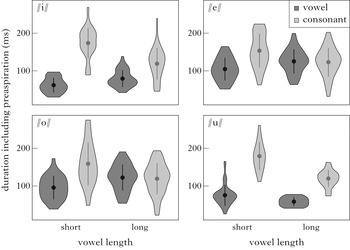
The existence of a quantitative distinction between short and long vowels in this variety is further confirmed by a distinction in the duration of post-tonic consonants, which are longer after short vowels and shorter after long vowels, consistent with the moraic structure postulated for South Welsh varieties in §2.2. This is seen in Fig. 6.
Vowel and consonant duration by context (Speaker 8).

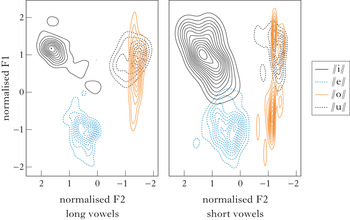
Vowel quality shows a different picture. Figure 7 demonstrates that ‘long’ and ‘short’ vowels occupy the same position in the vowel space (with the possible exception of //o//). It also shows that a large number of tokens coded as short //o// are located in the same region as tokens coded as //u//. This may be the result of a sound change, as the distribution of these anomalous tokens of //o// appears to be at least some extent lexically driven. Those cases where all tokens of a given word show an F1 value of under 400 Hz (unless this was the sole representative of the item in this dataset) were recoded, for the purposes of modelling as representing the category //u// rather than //o//. As the plot in Fig. 7 indicates, this is clearly not sufficient, as many tokens coded as //o// nevertheless clearly occupy much the same position in the vowel space as tokens of //u//, but without further investigation of relevant varieties no other attempts to prejudge the categorisation were made.
Density plot for vowel quality (Speaker 8).

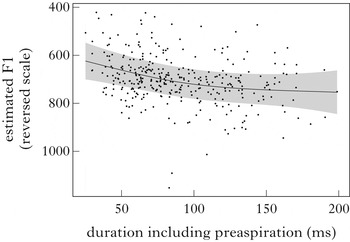
The results of modelling the F1 of the stressed vowel as predicted by vowel quality, vowel length and their interaction are shown in Table IV in Appendix C. They confirm that there is no significant effect of phonological length on the quality of the stressed vowel, in contrast to the standard southern system. Adding duration as a predictor improves model fit (BAICc = 14). Specifically, increased vowel duration gives a higher F1, i.e. a lower vowel (as shown in Fig. 8; as with Fig. 3, the y axis is reversed).
Effects of vowel duration on F1 (Speaker 8).

The variation in the quality of stressed vowels in this system is not sensitive to the phonological factors, notably length, that are so prominent in other varieties of Welsh. In fact, the raising effect of shorter duration seen in Fig. 8 is consistent with undershoot of a relatively low target: the target qualities of at least the mid vowels for this speaker are in the region of other speakers’ [E O], even when the vowels are phonologically long and have long duration. This clearly contrasts with Speaker 1, for whom undershoot produces relatively low vowels (Fig. 3).
Subject to further investigation, I tentatively conclude that Speaker 8 exemplifies a variety of Welsh which does not have a robust distinction in quality between long and short stressed vowels (at least in penultimate syllables), with all mid vowels being ‘lax’ in quality.
It is not clear whether such a system has been described in detail before in Welsh. Pilch (Reference Pilch1958) presents an auditory study based on the speech of a single informant from Bow Street, a village 3.5 miles outside Aberystwyth. Although no explicit statement of the distribution of ‘tense’ and ‘lax’ vowels is given, at least for the mid vowels the distribution appears to be ‘tense when long in a stressed monosyllable and pretonically, lax otherwise’: meddyg [‘mEDIg] ‘doctor’ vs. meddygon [me’DəgOn] ‘doctors’, hen [‘hen] ‘old’. Pilch does not, however, write length unless it has s-phonemic function: the minimal pair ton ‘wave’ vs. tôn ‘tune’ is transcribed [‘tHOn] vs. [‘tHon], even though the latter presumably has a long vowel. Hence, it is not clear whether his <mEDIg> corresponds to the [‘mEːDIg] expected for Speaker 8.
The situation is different in Lewis's (Reference Lewis1960) description of the dialects of north-west Ceredigion, i.e. the rural hinterland of Aberystwyth. He confirms that there is no length distinction in the penultimate syllables in this variety: [‘tHOn] ton and [‘tHoːn] tôn are distinct, but the plurals tonnau and tonau are not. However, according to Lewis, the realisation of vowels in penultimate syllables shows ‘free variation’ between a half-long tense vowel (followed by a short consonant) and a short lax vowel (followed by a long consonant): [‘tHoːnε̝]~[‘tHOnːE]. In final stressed syllables, the system described by Lewis is identical to the standard one for mid vowels, but, interestingly, he does not describe a quality difference between short and long high vowels even in stressed final syllables. Thus, although there are suggestive similarities between the system shown by Speaker 8 and those discussed by Pilch (Reference Pilch1958) and Lewis (Reference Lewis1960), it appears that, without further research, the pattern discussed here cannot be identified with any other pattern described in the literature.
3.3.4 Unstressed syllables
Finally, I turn to qualitative differences in post-tonic unstressed syllables. As noted in §2.1.3, previous descriptions lead us to expect no s-phonemic contrast in that position: the quality of the unstressed vowel is predictable, if sometimes variable. The distribution depends at least partly on syllable structure, with, for instance, high vowels always being tense in final open syllables and lax in final closed syllables.
If we accept the suggestion in §2.2 that short vowels in stressed syllables precede moraic codas, then this distribution is in fact very similar to that in stressed syllables: tense vowels are obligatory in open syllables, whether stressed (and thus phonologically long) or post-tonic (where the phonological quantity contrast is neutralised), while lax vowels are possible only in closed syllables (whether stressed or unstressed). The nature of the effect is open to question: given that vowels in closed syllables are commonly shorter than those in open ones, it could be due to duration rather than syllable structure.
The acoustic study allows us to conduct a preliminary examination of post-tonic vowels. A subset of the words were coded as containing a ‘closed’ or ‘open’ final syllable, and further models were fitted to this dataset.Footnote 8
Figure 9 shows (normalised) vowel quality in final syllables by syllable type. It indicates that the descriptions are largely, but not entirely, correct. There is obvious separation in the case of the high vowels //i u//, with significantly centralised quality in closed syllables, but no clear distinction among the non-low vowels. This is shown in Fig. 11 in Appendix B, which plots the estimated values of normalised F1 in a model that includes an interaction of vowel quality and syllable type (open or closed) in postvocalic syllables, as well as normalised duration, normalised F2 and random intercept by speaker as independent variables: as the figure shows, the 95% confidence intervals for vowels in open or closed syllables do not overlap for //i u//, but do overlap for other vowels.
Normalised vowel quality, by final syllable (all speakers).

Thus, if the picture painted by the present dataset is representative, the sources appear to be imprecise when they describe the realisation of //e o// in final syllables as variable. Instead of a stochastic choice between ‘lax’ [E O] and ‘tense’ [e o], or a phonetic continuum with the ‘tense’ and ‘lax’ qualities as endpoints, we observe unimodal distributions in the case of the mid vowels. Moreover, the F1 values of post-tonic //e o// are very close to the F1 values for the corresponding short stressed vowels. Thus we can tentatively conclude that post-tonic mid vowels are realised as [E O] in both closed and open syllables.
Since the conditions in post-tonic syllables were not controlled in this study, it is too early to give significant credence to the quantitative results reported here, even if the difference in the magnitude of the effects is highly suggestive. Further research is required to fully verify the hypotheses.
3.4 Summary
To summarise, the acoustic study has demonstrated the existence of three different types of interaction between vowel quantity and vowel quality: (i) the ‘standard southern’ system: a robust phonetic distinction between ‘tense’ and ‘lax’ vowels driven by phonological length, with an unclear phonological significance;Footnote 9 (ii) the ‘south-western’ system: a robust distinction between ‘tense’ and ‘lax’ vowels driven by phonological length and phonological specification of neighbouring vowels, and thus available to the phonological grammar; (iii) provisionally, the ‘non-enhanced’ system: phonological length distinction expressed via duration, but with no robust qualitative distinction.
In post-tonic syllables, high vowels are obligatorily tense in open syllables and lax in closed ones; mid (and low) vowels show no influence from syllable structure in any of the systems. Although in general terms the distribution of the allophones is similar, we can highlight the following differences between the systems: (i) in the standard southern system, all long vowels are tense, as are word-final high vowels; (ii) in the south-western system, tense vowels are either long or word-final, and restricted to a subset of open syllables; not all long vowels are tense; (iii) in the non-enhanced system, tenseness is found only word-finally, for a subset of vowels, and mid vowels are never tense. However, the situation in monosyllables is unclear.
In the next section I offer a phonological interpretation of these patterns of cross-dialectal diversity.
4 Analysis
This cross-dialectal variation requires a phonological analysis, with particular reference to the exact status of the ‘tenseness’ distinction. The acoustic study allows us to establish the categorical nature of the ‘tenseness’ distinction in the standard southern system; however, its phonological status can only be established with reference to a concrete analysis. To approach such an analysis, we begin with the south-western system, where the phonological status of the distinction is more secure.
4.1 The south-western system
As discussed above, I take the results of the acoustic study reported in §3.3 to mean that the co-occurrence of vowel tenseness and length in these varieties of Welsh is due to a phonological pattern, because the distinction is categorical (rather than continuously dependent on the duration of the vowel), and sensitive to phonological information. Specifically, high vowels are tense in open syllables and lax in closed syllables, irrespective of stress and length, as in (14a, b), while mid vowels are lax, irrespective of syllable structure, unless they are long and not followed by a high vowel, as shown in (14c, d).
-
(14)
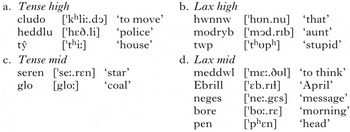
To complete the picture, we should discuss the vowel [ə], which is not found in final syllables.Footnote 10 In penultimate stressed syllables, it is always short, and hence requires a moraic coda: cyfan [‘kHəv;an] ‘all’. It is also impossible in hiatus. In other words, schwa only appears in closed syllables, fully patterning in this respect with the high lax vowels [I] and [U].
Hence, accounting for the distribution of tense and lax vowels in this system requires reference not just to the featural specifications of neighbouring vowels, but also to syllabic structure (the presence of a coda) and more specifically moraic structure (vowel length). This is clearly proprietary phonological information; hence, by the modularity criterion laid out in §1.2, the ‘tenseness’ specifications of these vowels are also phonological in nature. In other words, both the acoustic data (categoricity) and the details of the distribution (reference to moraic structure) converge on an analysis where pairs such as [e E] are distinct in the phonological grammar. Such distinctions are normally encoded via featural structure.
4.1.1 The featural analysis of tenseness
To address the exact featural difference between [i] and [I] or between [e] and [E], I draw on the major insight of contrastivist approaches to phonology, which seeks evidence for featural specifications primarily in the grammatical behaviour of the relevant segments and not (just) in their phonetic properties. As noted in §1.3, I implement this in a substance-free framework with emergent features (see e.g. Morén Reference Morén2006, Blaho Reference Blaho2008, Mielke Reference Mielke2008, Odden Reference Odden2013). In this approach, features do not have intrinsic phonetic content, highlighting the fact that they are arbitrary labels useful for designating sets of segments that show similar phonological behaviour, but without any claim to a one-to-one phonology–phonetics mapping.
In such a framework, we cannot assume that all pairs entering the ‘tenseness’ contrasts differ in the same feature. In fact, a closer analysis shows that ‘tenseness’ behaves differently in the high and mid vowel sub-inventories in south-western Welsh.
For mid vowels, the necessary condition on the presence of tenseness is bimoraicity. Bimoraicity itself is only possible in the absence of a coda, but this is an incidental generalisation unrelated to vowel quality. However, this condition is not sufficient: some long mid vowels are still lax. Moreover, the ‘tense’ specification of mid vowels interacts with featural specifications of other vowels, specifically with their height. Crucially, the tenseness of the post-tonic vowels is irrelevant: both tense and lax high vowels trigger laxing of a stressed mid vowel, as in (15).
-
(15)

High vowels (and [ə]), on the other hand, show a symmetric patterning of tense–lax pairs driven solely by syllable structure and only coincidentally related to length, thanks to open syllable lengthening: lax vowels are impossible in open syllables (some of which are bimoraic), and tense vowels are impossible in closed syllables. There is little evidence for the interaction of this distinction with any other element of the phonological grammar.
If we start from emergentist, substance-free principles requiring phonological, ideally positive, evidence before assigning a common feature to a set of segments, it is apparent that the assumption of a single ‘tenseness’ feature covering all four non-low pairs in Welsh (and the unpaired [ə]) is unfounded. Moreover, and perhaps even more seriously, common universal feature systems are unable to describe the relevant phonological classes: for instance, the class of segments excluded from open syllables – [I U ə] – cannot be described by a conjunction of features that excludes [E O] in common systems such as that of Jakobson et al. (Reference Jakobson, Fant and Halle1952) or Chomsky & Halle (Reference Chomsky and Halle1968);Footnote 11 it is even more difficult to express in featural terms the connection between mid vowel tenseness and the height of the following vowel.
Instead, I propose that the vowel patterns of south-western Welsh can be accounted for using the emergent featural specifications shown in (16). For concreteness, I use privative features with vaguely phonetic labels reminiscent of versions of Unified Feature Theory (Clements & Hume Reference Clements, Hume and Goldsmith1995); it is important to remember, however, that since the featural theory assumed here is substance-free, the labels do not lay claim to inherent phonetic content (thus, for example, the co-occurrence of [open] and [closed] in [e] is not meant to represent a paradox like the co-occurrence of [+high] and [+low] in some theories). For reasons of space and focus, I do not present an explicit account of how the specifications in (16) are manipulated by the grammar to produce the patterns; they can be quite straightforwardly implemented in a rule-based or OT formalism.
-
(16)

This system can be justified as follows: (i) the feature [closed] covers segments implicated in the height-dissimilation pattern, namely all high vowels (its triggers) and the ‘tense’ mid vowels [e] and [o]; (ii) the feature [lax] covers the class [I U ə], which is banned from open syllables.
The distribution of ‘tenseness’ vis-à-vis length is largely accounted for by restrictions on [closed] and [lax]. The [lax] vowels [I U ə] cannot be long, because they are always found in closed syllables. The mid ‘lax’ vowels [E] and [O] do not fall within the scope of this generalisation – correctly, as they are found in open syllables in this variety of Welsh, as in (15). In fact, the system in (16) implies that the markedness relationships of tense and lax vowels are reversed in high and mid sub-inventories: among the high vowels, lax [I U] are more marked (they bear the extra feature [lax]), and among the mid vowels, tense [e o] are more marked (they bear the extra feature [closed]).
In the high sub-inventory, this can be justified because lax [I U ə] are associated with the more cross-linguistically marked context of closed syllables. We can think of the obligatory laxing of vowels in this context as an instance of licensing: it is common in privative feature theories to assume that marked elements can only be retained in the presence of some additional material, and in this case [lax] licenses the coda.
As for the mid sub-inventory, in order to understand the markedness relationships between the sets [e o] and [E O], we need to determine the direction of the mid vowel tenseness alternation. Does the alternation in codi [‘kHOːdi] ‘rise’ vs. cododd [‘kHoːdOD] ‘(s)he rose’ reflect an underlying /O/ raised before a non-high vowel or an underlying /o/ lowered before a high one?Footnote 12
I suggest that the word ffenestr, consistently realised with [Eː] rather than the expected [eː] before a non-high vowel, provides a clue. Rather than being arbitrarily marked as exceptional, it could indicate that the phonological grammar fails to raise an input mid lax vowel, ensuring a faithful mapping in terms of quality even if the vowel is contextually lengthened. This analysis is, of course, also consistent with the possibility of long lax [Eː Oː] in English borrowings, discussed in §2.2. Thus, alternations in codi ~ cododd are examples of lowering, or deletion of [closed] in the presence of another instance of this feature within a final disyllabic domain; the domain could be, for instance, an uneven trochaic (HL) foot.
This deletion gives the expected result when applied to /o/. Deletion of [closed] from /e/ results in the disallowed segment [coronal, open], so [open] is further deleted to produce [E]. In the high vowels, which are all [closed], deletion of this feature would produce disallowed segments in the case of /i I U/, and the empty segment (presumably also disallowed) in the case of /u/, and therefore can be straightforwardly blocked.
I take the existence of the form [‘fEːnEst] (and possibly also English borrowings such as [‘brOːn] and [InJI’nEːr]) as indicating that there is no obligatory raising of long lax mid vowels, at least in polysyllables. Given that long mid vowels are (apparently) obligatorily tense in forms with final stress like hen [‘heːn], this requires us to posit either a tensing process somehow restricted to final stressed syllables, or to admit a lexical gap, i.e. the absence of lexical items of the shape /hEn/ that would map to surface [‘hEːn], as opposed to input /hen/, crucially with a [closed] /e/ that lengthens. The latter is not in fact entirely unattractive, because a diachronic explanation for the gap is readily available: if mid long vowels in final closed syllables are originally tense, there is no historical process by which they would become lax, and so the gap is simply due to the vagaries of history.Footnote 13
The relatively unrestricted patterning of [E O] contrasts with the fact that [e o] are subject to a further requirement. They are only allowed to surface when bimoraic: mid vowels are obligatorily lax in unstressed syllables and in stressed syllables with moraic codas. This patterning asymmetry further supports the proposition that ‘tense’ [e o] are more marked than ‘lax’ [E O], the reverse of the situation observed in the high sub-inventory.
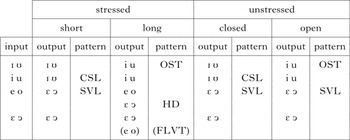
The phonological grammar of tenseness and laxness in south-western Welsh is summarised in Table I. It shows various types of potential inputs in different contexts, and any rules (or, in OT parlance, unfaithful mappings) that are required to effect the necessary changes. As discussed above, it is not clear whether input [E O] become [e o] when long in a final syllable.
Input–output mappings in a grammar of south-western Welsh. OST (open syllable tensing): I ʊ→i u in any open syllable. CSL (closed syllable laxing): i u→I ʊ in any closed syllable. SVL (short vowel laxing): e o→ ε ɔ when monomoraic. HD (height dissimilation): e o→ ε ɔ before [closed] vowel. FLVT (final long vowel tensing): ε ɔ→e o in a final stressed syllable.

4.1.2 Other phonological processes
Apart from the grammar of tenseness and laxness, the proposed featural specifications should also be consistent with other morphophonological alternations in Welsh. These tend to involve the coarser vowel categories (i.e. //i u//, etc.). The most important phenomena are the following (Iosad Reference Iosad2012, Hannahs Reference Hannahs2013).
(i) ‘Vowel mutation’: /ə/ is realised as //i// in a final syllable; this neutralisation can be analysed as deletion of [dorsal] (and [lax] if necessary because of syllable structure) to produce //i//.Footnote 14
(ii) ‘Vowel mutation’ in some varieties also encompasses the alternation between the diphthong [ai] in a final syllable and [ei] in a non-final one: braich [‘braiX] ‘hand’ ~ breichiau [‘breiXE] ‘hands’, analysed as the spreading of [coronal] from the glide to the nucleus of the diphthong.
(iii) Finally, an underlying [O] in some stressed monosyllables alternates with [ə], or [I] in varieties where schwa is excluded from this context: ffon [‘fOn] ‘stick’, plural ffyn [‘fən] or [‘fIn]; Iosad (2012) analyses this is as addition of a floating [coronal], and uses this evidence for the analysis of //ə// as the union of the features of //o// and //i//.
The present proposal preserves in the main the analysis in Iosad (Reference Iosad2012), to which I refer for detailed justification. The specifications are consistent with a substance-free approach, in that they refer only to phonological patterning: for instance, //o// and //u// do not share features, in contrast to an approach where they would share a colour specification, because they do not act as a class in any phonological pattern of Welsh.
4.1.3 The feature analysis and the contrastive hierarchy
I will now discuss how the present analysis is relevant to the Contrastivist Hypothesis. In particular, what is the import of contrastivism if phonological representations are constructed ‘from the bottom up’, on the basis of the inventory of categorically distinct units and their behaviour in the grammar? One could imagine that if there is enough evidence for phonological activity of redundant distinctions this could then defeat the Contrastivist Hypothesis (cf. Blaho Reference Blaho2008: §1.2.2).
Indeed, the emphasis in much contrastivist practice has been on identifying the proper assignment of a closed set of universal features, and Hall (Reference Hall2011) in particular presents a defence of this approach over emergent-feature theories in a contrastivist context. However, both Cowper & Hall (Reference Cowper and Currie Hall2014) and Dresher (Reference Dresher2014) suggest that emergent features are compatible with contrastivism, as long as the foundational importance of contrast is also recognised.
Here I follow the latter line of inquiry, and suggest that the Contrastivist Hypothesis can be made contentful in the context of emergent features by restating it as a condition on inventories. Specifically, I suggest that a set of featural specifications in an inventory is consistent with the Contrastivist Hypothesis if there exists a contrastive hierarchy constructed in line with the Successive Division Algorithm (SDA; Dresher Reference Dresher2009) that assigns that set of specifications to that inventory.
Briefly, the SDA takes an inventory and uses some feature F to divide it into two sub-inventories, depending on whether the segments in the sub-inventories have F (or [+F] and [—F] values, in the binary version), and then recursively repeats that procedure with different features, stopping when a sub-inventory consists of a single segment. This guarantees lack of redundancy: the algorithm only assigns a feature to a segment if it contributes to distinguishing it from some other segment. However, the SDA is not fully deterministic: the set of features used in a particular language, and the order of subdivisions, are subject to cross-linguistic variation.
Successive division can be applied to both binary and unary features. (17) shows a contrastive hierarchy corresponding to the inventory of south-western Welsh proposed in (16). It follows the version of the SDA for privative features described by Hall (Reference Hall2007), with one non-trivial difference.
-
(17)

Hall's SDA for privative features guarantees that one of the segments in the inventory remains featurally empty, because every cut produces a sub-inventory where no feature is assigned. I suggest that the presence of such an empty segment is a matter of cross-linguistic variation. It may well be that in some languages there is strong evidence for such empty segments in the phonological grammar. However, it is also possible that no evidence is available for a featurally empty segment: for instance, even if it is theoretically possible in inputs, the grammar may insist on always inserting some features to neutralise it with another segment. I suggest that in such cases the empty segment's place in the contrastive hierarchy may be occupied by another segment specified for a single feature, with the restriction that this feature is also used elsewhere in the hierarchy. Such features are deemed to be available, because, in the formulation of the Contrastivist Hypothesis adopted here, they are still necessary to distinguish (some other) phonemes of the language. If a feature were only assigned to this isolated segment, it cannot be said to be necessary, as the segment would still be distinct if it remained unspecified.
In the case of south-western Welsh, I suggest the segment is [a] and the feature is [open], which is also assigned to [e], fully in line with the algorithm. With this amendment, the inventory of south-western Welsh proposed in (16) is consistent with the Contrastivist Hypothesis, and allows us to successfully account for the behaviour of the categories ‘tense’ and ‘lax’ in this variety.
4.2 The standard southern system
Applying the criteria for phonological status used in the previous section to the standard southern system shows that the set of categories active in the phonological grammar is essentially identical to that in the south-west. The high vowels //i u// show the same sensitivity to syllable structure – tense in open syllables, lax in closed syllables. Thus the [i I] and [u U] distinctions are visible to the phonology. The markedness reasoning also carries over unchanged: [I U] are more marked than [i u].
The status of ‘tenseness’ in mid vowels is less clear. The distinction interacts with moraic structure, so by the modularity criterion its phonological status is assured. However, there are fewer cues to its featural content, since it is not involved in interactions with other segments. Yet there is an important difference between the standard southern and the south-western systems: in the latter, mid vowels are bimoraic if they are tense; in the former, mid vowels are bimoraic if and only if they are tense. Thus the argument from restricted distribution cannot be used to decide whether ‘tense’ or ‘lax’ mid vowels are more marked, as the restrictions are symmetrical.
One could reason that the mid tense vowels are more marked, since they are associated with the marked context of bimoraicity (much as lax high vowels are marked because they are associated with the marked context of closed syllables). Although such arguments are not particularly decisive, by parity of reasoning I adopt the solution whereby in high vowels it is the lax member that bears an extra feature, and in mid vowels it is the tense member. In any case, as in the south-western system, there does not appear to be positive phonological evidence for treating the ‘tenseness’ distinction in the mid and high vowels as instantiating the same contrast. (18) lays out the proposed analysis, with the specifications for the south-western system in (16) given in grey for comparison. Note that although I use the same feature labels as in the preceding section, no phonetic identity or similarity is necessarily implied.
-
(18)

It is worth noting the difference in the specification of [a], which has the feature [tense], whereas in the south-western system it is [open]. The reason is the different scope of [closed], which only singles out high vowels (and [ə]) in the latter, but does some of the work of [tense] in the former: essentially, in the standard southern system [tense] does the work that [closed] cannot do, because there is no phonological relationship between /e o/ on the one hand and high vowels on the other. This has a desirable consequence: if [a] is [tense], then the low vowel is expected not to support the tenseness distinction, agreeing with the instrumental data available so far: as noted in §2.1, no instrumental study has yet corroborated the claims of a qualitative difference between short and long vowels.
(19) shows a contrastive hierarchy, drawn up on the same principles as that in the previous section, and compatible with the specifications in (18).
-
(19)

Thus, despite the essentially identical surface inventory, the ‘south-western’ and ‘standard southern’ systems differ both in representation (i.e. featural specifications) and computation (i.e. the patterns and rankings that account for them). This supports the position of emergent feature theory, where the symbolic representation of very similar phonetic phenomena can vary cross-linguistically, and must be discovered with reference to patterns of distribution and alternation.
4.3 Featural analysis: summary
The cross-dialectal investigation of quantity–quality interaction in Welsh vowels demonstrates non-trivial cross-dialectal divergences in inventories, the phonological interpretation of very similar phonetic contrasts, and phonological grammars. In all cases, the most important differences concern the status of ‘tenseness’.
In the standard southern system, the tenseness distinction covers all vowels (except [ə] and [a]), but it does not create a surface (s-phonemic) contrast, and there is little positive phonological evidence to connect this distinction in high vowels with the one in mid vowels. By contrast, in the south-western system the distinction interacts with other features, which provides some evidence as to its nature within the context of the broader grammar. Moreover, in this system ‘tenseness’ is not just phonologised, but also phonemicised (Hyman Reference Hyman and Juilland1976): it appears to be necessary in underlying representations to account for forms like ffenestr [‘fEːnEst]. In the next section I discuss the role of the phonologisation process in creating these situations.
5 Phonologisation, redundancy and the Contrastivist Hypothesis
We can now return to the question of whether assigning a phonological ‘tenseness’ specification to Welsh vowels is consistent with the Contrastivist Hypothesis, using the criteria in §1.2. To recap, we established the following:
(i) The set of Welsh phonological patterns P contains categorical patterns involving proprietary phonological entities such as syllables;
(ii) It is possible to envisage a set of Welsh phonemes PH where ‘tense’/‘lax’ pairs such as /e E/ are treated as separate phonemes;
(iii) It is possible to use a version of the Successive Division Algorithm to assign a set of non-redundant specifications for PH using the feature set F (that includes, in this case, the features [tense] and [lax]);
(iv) All patterns in P make crucial reference to features that are present in F.
Under these criteria, then, Welsh ‘tenseness’ does not present a counterexample to the Contrastivist Hypothesis even if quality is also treated as phonologically relevant. This result stands in stark distinction to the traditional analysis, which has to designate ‘tenseness’ as an allophonic phenomenon.
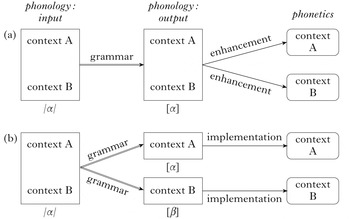
The key to the disconnect between the various understanding of contrastiveness lies in the life cycle of phonological processes, and specifically in the process of phonologisation. Phonologisation represents not so much a change in the observed patterns as a change in their interpretation by the learner. At least in the early stages of phonologisation, the distribution of newly created categories adheres very closely to the original phonetic conditioning, and thus appears to be ‘allophonic’ under traditional criteria. This is shown in Fig. 10.
Phonology–phonetics relationships (a) before and (b) after phonologisation.

Before phonologisation, the grammar maps an input category /a/ to a single category [a] in the surface phonological representation. However, enhancement (or other phonetic implementation processes) maps that output category [a] to several distinct regions in the phonetic space (contexts A and B). After phonologisation, the grammar includes rules mapping input /a/ to [a] in context A, but to [b] in context B, with attendant implementation mechanisms for [a] and [b]. In both cases, input phonological /a/ corresponds to a similar distribution of the phonetic variants, but the underlying mechanism has changed.
In the case of Welsh ‘tenseness’, the original ‘enhancement’ mechanism is the raising of long vowels, still apparently absent in (parts of) the ‘non-enhanced’ system. This raising must have originally been a pure implementation effect. In the standard southern system, however, this implementation effect coexists with its phonological congener, a categorical tensing rule for long vowels – an example of what Bermúdez-Otero (Reference Bermúdez-Otero, Honeybone and Salmons2015) calls ‘rule scattering’.
This framework requires the phonological computation to be able to create fully predictable (‘allophonic’) distributions of phonological symbols (such as segments), and thus break the link between phonological status and predictability. Indeed, just such a requirement has been at the heart of objections to the taxonomic phoneme – and hence to a privileged role for contrast in phonology – since at least Bloomfield (Reference Bloomfield1939). Here I suggest that even if we recognise that phonological computation can enforce such predictable distributions, a contrastivist approach provides a strong and useful restriction on inventory structure if it is reframed with reference to non-redundant specification implemented with a contrastive hierarchy.
In our definition of the Contrastivist Hypothesis, no phonological pattern can make reference to features that are not necessary to distinguish the phonemes of the language.Footnote 15 I suggest here that a feature is ‘necessary’ for the purposes of this definition if it is used to distinguish between at least one pair of segments without redundancy – that is, within a set of specifications consistent with being constructed by the Successive Division Algorithm. For instance, in the ‘standard’ Welsh system the features [lax] and [tense] are not redundant, since they distinguish between pairs that are otherwise non-distinct (such as [i I]).
The ‘(non-)redundancy’ of a feature is always relative to the entire set of specifications for the given language's inventory. A contrastive hierarchy captures the insight that redundancy is always contingent and language-specific. Much work in this area, usefully summarised by Dresher (Reference Dresher2009), has shown the range of cross-linguistic variation in contrastive specification. As Dresher (Reference Dresher2014) argues, the way each language structures the space of available distinctions determines the patterning of phonological symbols; the constitutive role of contrast, both in phonological and morphosyntactic domains, is also underlined by Cowper & Hall (Reference Cowper and Currie Hall2014).
How, then, can one falsify the Contrastivist Hypothesis within an emergent-feature framework? Such a falsification requires identifying the set of phonological symbols and phonological patterns, with reference to independent criteria for phonological status. I have suggested that categoricity is an important necessary condition, but also argued that it is not sufficient, given the possibility of categorical patterns emerging from non-categorical underlying processes, and suggested modularity as an additional criterion. Building on this analysis, the featural implementations of the necessary distinctions can be subjected to the contrastivist test: given a proposed phonological grammar P manipulating (emergent) features F, can the set F be derived using a contrastivist approach such as successive division? The Contrastivist Hypothesis can then be falsified if some independently motivated set of specifications F cannot be derived in such a non-redundant manner. Such a falsification is, of course, contingent on a fully worked-out analysis of the patterns of the individual language.
6 Conclusion
In this paper I have shown how an approach based on the contrastive hierarchy is compatible with emergent feature theory. As both Cowper & Hall (Reference Cowper and Currie Hall2014) and Dresher (Reference Dresher2014) emphasise, contrastive specification via successive division provides a fundamental mechanism for feature specification, but does not necessarily place substantive restrictions on the nature of the distinctive features involved. An emergent-feature approach goes hand in hand with a theory of phonologisation, where symbolic phonological generalisations emerge over the course of the life cycle. Once the categories are identified, the learner must label them. The labelling can be subject both to bottom-up pressures (e.g. the learnability advantage afforded by phonetically coherent categories) and to top-down influence. For the latter category, this paper has focused on morphophonological patterns as an important source of evidence for phonological specification, in line with emergent feature theory and contrastivist approaches.
The study of microvariation in featural specifications reiterates the advantages of emergent features. The varieties examined here have very similar surface inventories, and yet the behaviour of the ‘tenseness’ distinction differs in the three varieties. Emergent features allow us to not only offer an analysis of the patterns but also capture these cross-linguistic differences in a way that universal feature specifications fail to do, either because they cannot capture the right classes of segments (as in the case of the restriction on [ə I U] in open syllables) or because they predict the existence of classes for which there is no phonological evidence (as in the case of the set of [+tense] segments, which show differing markedness behaviour in the high and mid sub-inventories).
Further questions remain. One issue, as a reviewer correctly points out, is the level at which the ‘inventory’ PH relevant for contrastive specification should be determined. In the analysis given here, I have emphasised the phonological visibility of predictable information, which sits rather uncomfortably with the generativist emphasis on inventories of m-phonemes – segments that should be posited in underlying representations, stripped of predictable information introduced computationally.
It may well be turn out to be the case that the right level for generalisations about ‘inventories’ is Kiparsky's l-phonemic level: the output of the lexical stratum, which may contain predictable information.Footnote 16 By reframing the issue of ‘contrast’ in terms of lack of redundancy, I have not considered in detail whether the [tense] and [lax] specifications should be present at the m-phonemic level, i.e. whether they are contrastive in the traditional generative sense. For the south-western system, there are indications that at least for the mid vowels this distinction must be encoded there (‘phonemicised’ in the sense of Hyman Reference Hyman and Juilland1976), given the existence of unpredictable lax long vowels ([‘fEːnEst]). For the high vowels in the south-western system and all non-low vowels in the standard southern system, however, the distribution still appears fully predictable. Whether ‘tenseness’ should be encoded ‘m-phonemically’ in these cases is a separate question that cannot be addressed here in detail. Under certain OT assumptions, it is likely that non-alternating forms could lead the learner to postulate a distinction between underlying (say) /E/ and /e/ (for the standard southern system, cf. wedi [‘weːdi] ‘after’ but felly [‘vE¡i] ‘so’); (cf. Krämer Reference Krämer2012). By contrast, Dunbar et al. (Reference Dunbar, Dillon, Idsardi, Sanz, Laka and Tanenhaus2013) argue that fully predictable (‘allophonic’) variation is factored out during the learning process, so that such distinctions are not postulated underlyingly. I leave the exploration of this question to further research.
Another open question is whether the Contrastivist Hypothesis is applicable to all aspects of phonological representation, or only to subsegmental features. In the case of Welsh, I have not included moraic or other quantity specifications in the contrastive hierarchy. It is, however, clear that if the analysis of quantity laid out in §2.2 is correct, then moraic specifications are contrastive in the m-phonemic sense, since moraic and non-moraic /n l r/ are underlyingly distinct; thus the case treated here should not be problematic for contrastivist approaches. However, the question remains open in more general terms: for instance, Kiparsky (Reference Kiparsky, Hyman and Plankforthcoming) rejects the Contrastivist Hypothesis as formulated by Hall (Reference Hall2007) precisely because suprasegmental phenomena such as stress or syllabification can be phonologically relevant without being contrastive underlyingly.
To conclude, Dresher (Reference Dresher2014) objects to emergent-feature approaches on the grounds that they put too much of an explanatory burden on extraphonological factors and not enough on formal phonological structure. I have argued that both types of factors play an important role in a substance-free analysis. While functional and learnability pressures undoubtedly have an influence, in particular through their role in phonological change (including phonologisation), non-trivial formal hypotheses can be formulated and tested within a substance-free approach. In particular, an emergent-feature analysis can shed light on an important challenge to the Contrastivist Hypothesis, and contribute to its reconciliation with the data. The emphasis on phonology-internal evidence inherent in an emergent-feature approach allows us to clearly identify independent, computationally framed criteria for phonologisation (phonological status) that put contrastivist approaches on a firmer methodological footing.