1. Introduction
When Coase (Reference Coase1972) introduced his famous conjecture on the relationship between monopoly and durability, he used land as the example and assumed a monopolist who owns all land in America. However, in the subsequent literature in industrial organization, land has almost completely disappeared. Given the strong interest in the privatization of local public services and the growth of private communities worldwide, this paper revisits the Coase conjecture from a land economic and institutional perspective. The goal is to formally analyze intertemporal behavior in land development and explore the relationship among land market structure, community characteristics, and urban institutional forms.
In particular, this paper has two main research questions. First, most contemporary studies on institutions and the firm focus only on the relationship among parties within a contract or organization (see, for example, Williamson, Reference Williamson1985; Hart, Reference Hart1995), while those on property rights (Barzel, Reference Barzel1989) are largely limited to a static treatment. Market structure reflects economic organization's external environment, which certainly affects what institutional form can best survive. It remains an interesting research question how market structure and time dimension can be introduced into institutional studies. In the urban setting, it has also long been recognized that urban economic theories, such as the monocentric city model that focuses on land market structure, are not well integrated with theories on local public goods, especially the Tiebout Model (Wheaton, Reference Wheaton, Mieszkowski and Straszheim1979). It is interesting to explore how different land market structures, such as monopoly, affect the provision of local public goods and their institutional form.
Second, although there have been some studies on the general institutional structure of urban organizations or property rights arrangements (Foldvary, Reference Foldvary1994; Deng, Reference Deng2003), most research on urban institutions focus on one particular form, such as private communities, shopping malls, local government, and so on. It is not clear why some institutional forms thrive in a particular circumstance while the others do not. For example, despite the growing literature on private communities (see, for example, Barton and Silverman, Reference Barton and Silverman1994; Blakely and Snyder, Reference Blakely and Snyder1999; Beito et al., Reference Beito2002), there is no clear explanation for why most of them are for the middle-upper class and located in the suburbs. Another distinctive feature of urban institutions is the dominance of public institutions, especially when compared with industries where private firms dominate. Many studies in the Tiebout (Reference Tiebout1956) tradition can help us understand the behavior of local urban institutions but cannot explain their institutional forms.Footnote 1 This research question can be generally framed in this way: what is the relationship between the urban institutional form and community characteristics?
The Coase conjecture is about a monopolist who may price discriminate over time.Footnote 2 Since he does not internalize the impact of his behavior on the price of goods sold in the past, he tends to lower the price in the following period(s). However, by rationally expecting the monopolist to behave in this way, customers would hold their purchases now and wait until the next period(s), thus resulting in the disappearance of monopoly power ‘within a twinkling of eyes’ (Coase, Reference Coase1972:143).
One reason that Coase’ original example of land monopoly is no longer the main setting for the subsequent literature may be that land is a more complex good than standard industrial output. Foldvary (Reference Foldvary1994) provided a clear analysis of ‘territorial collective good’, a concept that indicates that land and local collective goods are bundled together. Not only is their consumption but their transactions are also bundled together (Deng, Reference Deng2002). The bundling of transactions is important because it rules out ‘home bundling’; consumers cannot buy land and the collective good separately and then consume them together at home. Therefore, we have to consider the demand and supply of land and the collective good in a bundle. Nevertheless, the provision of land and the collective good can be separate, giving rise to many important institutional issues in urban land use. Although this unique feature of land complicates the modeling effort, it provides an important link between the Coase conjecture and urban institutions.
Monopoly is an important model in urban land use. Although pure land monopoly may not be common or realistic, monopolistic power of varying degrees is common and monopoly is also a more tractable model than oligopoly. Fischel (Reference Fischel1985) carefully summarized several reasons for analyzing monopolistic power in land use.Footnote 3 Most importantly, he pointed out a setting in which a monopolistic model is very helpful: the community, instead of the individual landowner or resident, may have some monopolistic power over land supply. A typical example is zoning and various planning tools. Many scholars have decried the deprivation of landowners' development rights by local zoning or planning regulations. In that case, local government has become the de facto (monopolistic) landowner who determines land supply. It is fair to say that monopoly is ‘no more of an abstraction than models assuming perfect competition’ (Basu and Emerson, Reference Basu and Emerson2003: 230) and indivisibility and heterogeneity of housing markets do lead to monopoly power of landlords (Arnott, Reference Arnott1989).
On the topic of durable good monopoly, there has accumulated a large body of literature on intertemporal externality in the economics of industrial organization.Footnote 4 Bulow (Reference Bulow1982) constructed a simple two-period model to analyze the problem faced by a durable-goods monopolist and how leasing can avoid it. The rational expectations equilibrium model in Stokey (Reference Stokey1981) shows that as the length of the trading period approaches zero, the monopoly will eventually produce the competitive stock, following what Coase conjectured. Many studies analyze the same problem with some different assumptions and settings. Bond and Samuelson (Reference Bond and Samuelson1984) showed that depreciation and replacement sales reduce the monopolist's tendency to cut price. Reducing the durability of the output can also help the monopolist to avoid the time-inconsistency problem (Bulow, Reference Bulow1986). The choice of technology can also become an endogenous variable for the monopolist (Karp and Perloff, Reference Karp and Perloff1996; Kutsoati and Zabojnik, Reference Kutsoati and Zabojnik2001). Some recent papers (Waldman, Reference Waldman1996; Fudenberg and Tirole, Reference Fudenberg and Tirole1998) focus on technology upgrade and the interaction between the prices of new and used products.
The model setup in this paper is built on Fudenberg and Tirole (Reference Fudenberg and Tirole1998), which provides a general treatment of the time inconsistency problem. Its contribution to the theory of industrial organization includes the following features of the model that reflect the uniqueness of land and the link to urban institutions: (1) in contrast to the depreciation of the standard durable good, the quality variable for the collective good can change in any direction and is affected by how the collective good is provided – separately or bundled together with land. This feature makes the model a spatial model although it does not include traditional spatial variables such as distance.Footnote 5 (2) The quality change applies to both used and new products due to the definition of the public good; (3) the quality can be changed by government rather than by the monopolist. In separate provision of land and the collective good, I assume a median voter model for government provision of the collective good. However, the treatment in the model can be regarded as more general, given the separability of consumer type and collective good quality in the utility function. In other words, as long as the separability assumption holds, the result applies to any public decision-making model that only considers existing residents. These unique features of the model make it possible to analyze the institutional implications of intertemporal externality in the setting of urban or public economics.
On the other hand, this paper's contribution to urban economics is the integration of local public good and land market on the assumption of a particular type of market structure – a monopoly. The same methodological approach could be applied to a more complicated market structure, such as an oligopoly. The model also allows more realistic and formal analysis of urban institutions by linking market structure, community characteristics, and institutional forms. In particular, the findings help us better understand why public institutions dominate in the urban area and why most private communities are small, located in the suburbs, and for middle-upper class.
The remainder of the paper is organized as follows. The next section is a simple example that illustrates the intuition behind the paper. In the third section, the basic setup for the model is introduced and the two benchmark cases of rental are discussed. The fourth section constructs two-period models for private/owner and public/owner, respectively. Then numerical examples, based on different assumptions of consumer distribution, are provided to illustrate the efficiency of different institutional arrangements with different community characteristics. The last section discusses the findings and concludes the paper.
2. The simple story
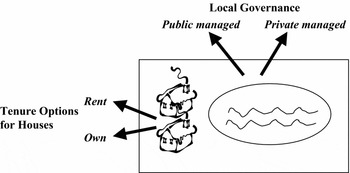
We first use a simple example to illustrate the intuition behind the paper. Since land can be rented or owned and the local collective good can be provided by government or a developer, institutional issues arise from the combinations of land tenure options and local governance structures.Footnote 6 Let us suppose that a monopolist who owns all the land in a ‘remote’ area is now developing the area and three groups of people are potential consumers. The difference among the groups is their income at high, middle, and low levels, respectively. Each consumer could rent or buy one unit of house. For simplicity, assume there are only two periods of time and houses do not depreciate over time. The second-hand market is frictionless and there is no difference between a used house and a new house in the second period. Hence, we do not need to differentiate between those who buy used houses and those who buy new houses.Footnote 7 We are only interested in the total sizes of each group of consumers. The houses (the private goods) surround a lake (the collective good). They are designated either owner-occupied or rented from the monopolist/developer, while the lake is designated publicly (by government) managed or managed by the same private monopolist. The quality of the collective good can refer to water quality, recreation, safety, and so on (see Figure 1).
Figure 1.

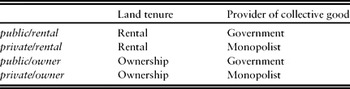
The combinations of land tenure options and local governance forms make up the four urban institutional forms we study: private/rental: private monopoly over both collective good and the rental of land/housing; public/rental: local government provision of collective good and rental of land/housing from a private monopolist; private/owner: private monopoly over collective good and individual ownership of land/housing; public/owner: local government provision of collective good and individual ownership of land/housing. As a special case, we also introduce restrictive zoning in the scenario of public/owner (see Appendix A). In the public provision of the collective good, the government is assumed to maximize the aggregate utility of all existing residents. The monopolist developer maximizes his profit in the second period; but in the first period, as a rational maximizer who can foresee the two-period behavior of consumers, he maximizes the total profit from both two periods.
Then the question becomes: what is the best combination of land tenure options and local governance forms? There are of course many factors that affect efficient institutional form. We are here only interested in how intertemporal price competition affects the behavior of consumers and the monopolist, and, consequently, the institutional form that is most efficient.
Assume first that only rental is allowed or feasible. Absent home ownership, there is no intertemporal price competition in that consumers only pay rent in each period and do not care about the price. So, in each period the number of houses for rent should be the same; there is no new construction in the second period. Suppose only the high-income group rent the houses in the case of private/rental due to their higher valuation of the houses. Then, if the government manages the lake (in public/rental), the middle-income group can also rent the houses. The reason is that the monopolist developer now enjoys the positive externality from public management of the lake since he does not need to care about the cost of managing the lake. The optimal rent for profit maximization is lower, thus allowing the middle-income group to move in given their middle-level valuation for the houses.
Now suppose the monopolist sells houses around the lake. Consumers with higher valuation buy the houses in the first period. In the second period, the monopolist will lower the price in order to attract more buyers. But the rational consumers can foresee his incentive to lower price in the second period and some of them would choose to wait in the first period. Let us assume that the final result of the interaction between the two rational sides is that the high-income group buys houses in the first period and the middle-income group buys houses in the second period. Compared to the case of private/rental where only the high-income group rent in both two periods, homeownership now leads to larger development size at the end of the time.
An important feature of this story is that, in private management of the lake, the monopolist can change the quality of the lake in the second period, thus effectively weakening intertemporal price competition. In other words, even rational consumers in the first period cannot fully predict how price will change in the second period and, hence, the efficacy of the ‘wait and see’ strategy will be reduced. This point is most obvious when we look at how consumer composition affects the efficient institutional form.
First, suppose the consumers are relatively evenly distributed by assuming that the three groups are of the same size. Now, public/owner is probably the most desirable institutional form. On the one hand, homeownership makes intertemporal price competition possible, weakening the monopoly power and it is therefore good for consumers; on the other hand, public provision also deprives the monopolist of the possibility of managing the lake as a way to weaken intertemporal competition. The other three institutional forms will lose either or both benefits to the consumers.
Second, suppose the consumers are rich by assuming that the middle group has the same income as the high group. Since most of the consumers (two-thirds of them who are in the two high-income groups) will move into the area in the first period no matter whether the houses are for rent or for sale, there are not many potential new buyers in the second period, and intertemporal price competition naturally becomes weaker. Private management of the lake may become more efficient because the monopolist can better accommodate the rich majority's demand for higher quality of the collective good. In private/owner, the monopolist has to significantly lower the price in the second period in order to attract the low-income group into buying the houses. This leads to lower profit but higher social welfare because more people's housing needs are satisfied.
Third, assume we have a relatively poor community, in which the middle group is the same as the low-income group. Now most of consumers cannot afford the houses in the first period. Homeownership does not significantly improve social welfare because only the high-income group can buy houses in the first period. Rental now becomes more attractive. Private/owner is not efficient because the monopolist's changing the quality of the lake in the second period only affects a small percentage of consumers who could afford houses in the first period. In this scenario, public/owner, public/rental, and private/rental are all possible institutional forms.
The general idea behind this simple story is that different ex ante institutional forms have different effects on ex post intertemporal price competition in land monopoly. Hence, intertemporal externality may cause different urban institutions to thrive in different scenarios.
3. The model
The basic setup follows Fudenberg and Tirole (Reference Fudenberg and Tirole1998). There are two periods, t = 1, 2, and the discount factor for both the consumers and the land monopolist is δ. This world ends after the second period. On the demand side, a continuum of consumers are indexed by θ ∈ [0, 1], with a constant marginal utility of income. Each consumer only needs to buy one unit of land. Per-period utility for a type-θ consumer is θ·V(Q) + I, where I is net income and Q denotes the quality of the local collective good. θ·V is then equal to consumer's valuation or willingness to pay (WTP) for the bundle good (of land and the collective good).Footnote 8 Since the land is assumed to be infinitely durable and physically homogeneous, only the collective good may cause different qualities over time.
The distribution of consumer types on [0, 1] is given by cumulative distribution function F(·) with continuous density. Following Fudenberg and Tirole (Reference Fudenberg and Tirole1998), it is assumed that the hazard rate h(θ) = f(θ)/(1 − F(θ)) is non-decreasing.Footnote 9 The monopolist sets a threshold price equal to θ*·V, which in turn determines the consumers who can buy land and, hence, the development scale. Given an existing stock of x 1 of developed land, potential or remaining consumers in the market for a price of θ*·V are those indexed by [θ*, 1] and their number is 1 − F(θ*) − x 1. Of course, in the first period x 1 = 0 and potential consumers are 1 – F(θ*). Quality Q is assumed to contribute positively to consumers' utility or WTP, i.e. V´(Q) ≥ 0.
On the supply side, the most important assumption is that land is bundled with a local collective good. Although their provision can be from different sources, their transactions and consumption are simultaneous. In the case of private/owner, both goods are provided by the monopolist whose objective is profit maximization.Footnote 10 In the case of public/owner, we assume some collective decision-making model (such as the median voter model) for the provision of the collective good, while the supply of land is still determined by the land monopolist's objective of profit maximization. Because land is infinitely durable, it is assumed that there is no cost of supplying land.Footnote 11 The cost of supplying the collective good is assumed to be constant relative to spatial scale (constant return to scale) but changes with Q, the quality variable.Footnote 12 Denote unit cost as C(Q) and assume C′(Q) ≥ 0.
When local government provides the collective good, a possible scenario is that the local government will use zoning or planning to restrict development.Footnote 13 With restrictive zoning or planning, the development right of landowners is effectively held by local government. As the de facto owner of land development rights, local government intends to use zoning to maximize the property values of existing residents whose votes determine local offices.Footnote 14 As the provider of collective good, local government maximizes the utilities of existing residents. Given our assumption of land monopoly that effectively rules out inter-governmental competition, these two objectives of local government do not necessarily need to be linked.Footnote 15
Besides, it is reasonable to assume that the cost of supplying the collective good can be evenly split among landowners in the case of public provision. There are several reasons why we do not explicitly include the government financing issue in this scenario. First, our specification of consumer utility separates consumption of the bundle good and net income. When the landowners pay for the provision of the collective good, their net income will be reduced. But, this will not directly affect their WTP for the bundle good. Second, due to our assumption of monopoly, property tax (or whatever fee local government charges) and the collective good will not be capitalized into land rent. Hence, this important factor that links local government behavior and the consumer housing decision is not necessary in our model. Third, our specification of the local government objective is essentially maximization of the consumers' aggregate utility. Hence, the indirect effect of what landowners pay for the provision of the collective good on their WTP for the bundle good is already captured. In this sense, the financing issue in the case of public provision is implicitly considered in the model.
The time line for the model is in the following sequence. We assume all actions in the same period happen simultaneously:

3.1. Benchmark case 1: public/rental
With separate provision of land and the collective good, the quality variable is exogenous to the monopolist's profit maximization problem. Rental demand for the bundle good at rental price r is equal to 1−F(θ), where

Then the optimization problem for the monopolist is to rent land to consumers with types above θ* so that his profit can be maximized

It is obvious that θ* is independent of V. Therefore, in Period 1, the monopolist rents 1 − F(θ*) of Q 1 quality land at a rental price of θ*V(Q 1); in Period 2, he rents the same amount of land to the same people at a price of θ*V(Q 2). From the first-order condition, we can have
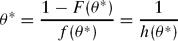
Because  is the inverse elasticity of demand, this equilibrium condition says that it has to be equal to one when the monopolist maximizes his profit.Footnote 16 The intuition behind this condition is that the monopolistic price distortion from the marginal cost has to be balanced against the decline in consumers' demand.
Since potential or future consumers have not rented land and are not living in this place, they are not included in the existing residents who determine the median voter. Given the separability of θ and V in consumer's utility, as specified in (1), all consumers' utilities change proportionately with V(Q). In this sense, maximizing the utility of the median voter, mean voter, or all voters does not make much difference to the result.
The maximization problem for the government can be written as the following

The first-order condition with respect to Q then becomes

In order to simplify the expression, here I slightly abuse the notation and use  to denote
 . This condition means that the consumers' marginal revenue with regard to quality Q should be equal to the marginal cost of providing the collective good. It also suggests that the quality of the collective good is stable over time in the case of public/rental.
3.2. Benchmark case 2: private/rental
With bundled provision, the monopolist provides both land and the collective good in a bundle and rents them to the consumers. He now faces the following maximization problem

The first-order condition then becomes


The second condition (5) means that when maximizing the profit to the monopolist, the marginal revenue (θ*V′) should be equal to the marginal cost (C′) with regard to the collective good provision. The first condition (4) looks similar to (2) but with an extra factor, which leads to the following proposition.
Proposition 1: When only rental is possible, what the land monopolist rents in the case of private provision of the collective good is less than or equal to that in the case of public provision.
The fundamental reason behind Proposition 1 is the externality in providing the collective good. With public provision, the monopolist can free-ride on the provision of the collective good and does not need to worry about the cost. In contrast, when he is responsible for providing both land and the collective good, he has to take into account the cost of providing the collective good. Therefore, the development scale will be bigger in public provision.
4. Two-period model of sale
In many situations, leasing may be inefficient or impossible and sale/purchase becomes the only or best option for the monopolist/consumers. Assume the monopolist cannot make any commitment or guarantee in terms of future sales or prices.Footnote 17 An ‘anonymous’ and frictionless second-hand market is also assumed to exist. Assuming the quantity of land sold in the first period is q 1 with quality Q 1, I first work on the second period and then backwards on the first period. Of course, consistent with the literature, a key assumption is that consumers can correctly or rationally anticipate the second-period price in the first period.
4.1. Private/owner
Let us first assume that land and the collective good are provided in a bundle by the monopolist, who intends to maximize the profit.
The second period
Assume the marginal consumer is of type θ2. He is indifferent about whether to purchase land or remain outside the area. So, we have

Consumers with θ above θ2 are all current residents in this area in the second period, including both those who bought land in the second period and those who bought a total amount of q 1 in the first period. That is, 1 − F(θ2) = q 1 + q 2. Hence

Now, the monopolist maximizes his second-period profit

The second term in the monopolist's profit function is based on the assumption that the provision of collective good has to cover not only new buyers but also all existing residents. The first-order conditions then become


Proposition 2: In private provision, the monopolist has cumulatively sold more land up to the second period than he rents in the rental case.
This proposition is qualitatively the same as in Bulow (Reference Bulow1982). The reason for this result is that the existence of intertemporal externality allows the monopolist to expand the sales at the cost of the consumers who bought land in the first period. Therefore, in private provision, homeownership results in a larger land development scale than rental.
Rearranging (9), we can have

Because θ2 ≤ 1 and it is also smaller than θ* in the private/rental case, as shown by Proposition 2, comparing (10) and (5) shows that  is now less than in the case of private/rental if the second-period sale quantity θ2 is assumed to be the same. Depending on the first-order derivatives of the cost and WTP functions, we can then analyze the impact of sale versus rental on Q. For example, if the first-order derivative of cost with regard to Q increases and that of WTP decreases with Q, then (10) implies that private/owner will result in lower quality of collective good given the same θ. Furthermore, since θ2 (the left-hand side in Equation (10)) is even smaller than in the rental case, as Proposition 2 shows, then quality Q will be even lower than in private/rental.
The first period
We now work backward to the first period. As the rational expectation assumption implies, land price in the first period should depend on their expectation of the second-period price. That is

So, the monopolist's first-period profit function is

We can also obtain the second-period profit function as in (7). The monopolist then maximizes his overall profit with regard to θ1 and Q 1

The first-order condition for Q 1 can be obtained as follows. Note that Q 1 is independent of θ2 and Q 2 given that the collective good is not durable and is always assumed to be provided to all residents within the area

The first-order condition for θ1 is quite complex and involves the derivatives of θ2 and Q 2 with regard to θ1. In a simpler approach (Fudenberg and Tirole, Reference Fudenberg and Tirole1998), we directly use q 1, q 2 instead of θ1, θ2. Denote x = q 1 = 1 − F(θ1), y = q 1 + q 2 = 1 − F(θ2). Obviously, θ2 = F −1(1−y). Also note that  . Then, the first-order condition with regard to x can be rewritten

where h(·) is the hazard rate function. Then the derivatives of Q 2, y with regard to x can be obtained
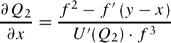

where  and
 . Equations (14) and (15) can solve for θ1 and Q 1, given the relations between θ2, Q 2, and θ1 as specified in (16) and (17). Hence, the whole system is now mathematically solvable.
4.2. Public/owner
Now consider the case that land and the collective good are provided separately. The monopolist maximizes profit from selling land to the consumers, but the collective good is provided by a government or some public entity that maximizes the (median voter) utility of existing residents within the area.
The second period
The monopolist's second-period profit function is

He now does not need to care about the cost of providing the collective good. The first-order condition for the monopolist's maximization problem then becomes

The government's optimization problem is the same as in the rental case. First-order condition (3) holds for the quality Q in both the first period and the second period.
The first period
Assume again that the consumers have correct or rational expectation in the first period and then Equation (11) still holds. The monopolist maximizes his overall profit with regard to θ1 or x

We still use x, y to replace θ1 and θ2, and then the first-order condition for the maximization problem in the second period, i.e. Equation (19), becomes

Taking derivative with regard to x yields
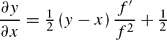
Because of the assumption of monotone hazard rate, f′>0. Hence, (22) implies  , which is consistent with the standard result in the durable goods literature.
The first-order condition for the first period maximization problem (20) is now

Now the system that consists of two equations of (3) (for both Q 1 and Q 2, respectively), (21), (22), and (23) is mathematically solvable.
5. Community characteristics and institutional form
To analyze which institutional form is best for either the society or the monopolist in different communities with different characteristics, we can calculate total social surplus and monopoly profit for each case. The institutional arrangement that yields the highest social surplus is most efficient from a social perspective. Because the quantity and quality of the bundle goods sold in each period are all interdependent and, ultimately, depend on consumer distribution, it is difficult to obtain closed-form solutions without specifying the functional forms. Numerical methods are used in this section to illustrate how different community characteristics affect efficient institutional form.
If we assume the ‘social’ discount rate is the same as the one used in the rational expectation of price, then we have the following formula to calculate total social surplusFootnote 18

where 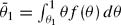 and
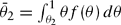 . This definition basically aggregates all current residents' utility minus the cost of providing the collective good in each period and then adds the discounted second-period value to the first period one. For simplicity, the discount rate is assumed to be one, i.e. no discount. We also assume the following functions for the cost and valuation (or WTP)


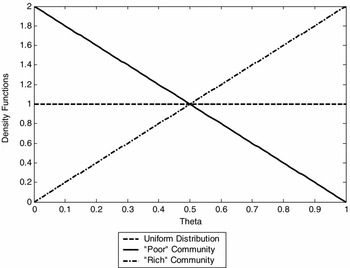
Three different distribution functions of the consumers are assumed for the following three numerical examples, respectively (Figure 2). For the first example, a uniform distribution of consumers is assumed on [0, 1]. Then, F(θ) = θ, f(θ) = 1, f′(θ) = 0,  . In the second example, the density function is assumed to be a linearly decreasing function. F(θ) = 2θ−θ2, f(θ) = 2−2θ, f′(θ) = −2,
 . This is like the case of a ‘poor’ community where consumers are concentrated in the lower end of the WTP distribution. The third example is the opposite, a ‘rich’ community, where consumers are concentrated in the upper end of the distribution. The density function is a linear increasing function of θ. f(θ) = 2θ, F(θ) = θ2, f′(θ) = 2,
 .
Consumer Distributions in the Numerical Examples

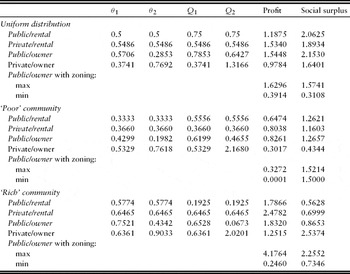
Table 2 lists the results for the three examples, each of which include five different institutional arrangements. For public/owner with restrictive zoning (see Appendix A), we find the solutions for a range of possible restrictiveness. Table 2 includes the maximum and minimum values of social surplus and monopolistic profit within the possible range of restrictive zoning.
There are some general results that hold for all three examples. First, the two rental cases have the same land quantity and quality in the two periods. This is expected because rental can effectively avoid the time inconsistency problem. Second, private/rental generally results in more development (i.e. smaller θ) than public/rental due to the ‘public good’ externality. In the cases of uniform distribution and ‘poor’ community, private/rental has lower quality of collective good (i.e. smaller Q) than public/rental. But, in the case of ‘rich’ community, private/rental yields higher quality of public goods. Third, in public/owner, there is new development in the second period, as indicated by θ2 < θ1, and the quality of collective good declines in the second period. This appears to fit into the common perception of development, especially its impact on public goods. But, with private/owner (as in CIDs), the size of land development actually decreases (θ2 > θ1) in the second period with a sharp increase in the quality of collective good.Footnote 19 This result implies that the monopolist may actually buy back land in the second period.
Uniform distribution
It is obvious from Table 1 that public/owner has the highest value of both profit and total social surplus. This result supports the common form of local government provision of collective goods in large urban areas. Since consumers in a large urban area should be more evenly distributed than in small neighborhoods due to the absence of Tiebout sorting, this example helps to explain why public institutions prevail at large spatial scales and why most private communities are of smaller size.
Summary of local governance and land-tenure options

Results of the numerical examples

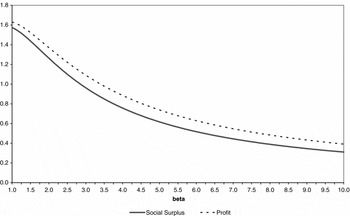
However, once restrictive zoning is introduced even the maximum value of social surplus drops below all other institutional arrangements while the monopolist's profit rises further up. This suggests that restrictive zoning is socially inefficient and only benefits existing landowners. Figure 3 shows how social surplus and profit changes with the restrictiveness of zoning. The more restrictive is zoning (the closer is beta to 1), the higher is social surplus and profit in this particular institutional setting.
Change of Social Surplus and Profit with Zoning Restrictiveness Uniform Distribution

‘Poor’ community
In the ‘poor’ community example, public/owner also dominates other institutional arrangements. However, two rental arrangements yield profits and social surpluses that are close to public/owner and significantly higher than private/owner. The reason may be that the concentration of consumers at the lower end of the distribution reduces the difference between sale and rental in terms of total social surplus. These results indicate the attractiveness of rental arrangements to ‘poor’ communities. Private/rental in company towns might be a case in point.
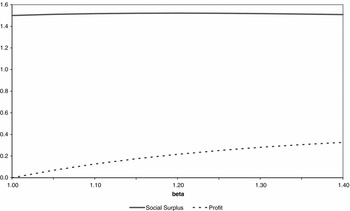
With restrictive zoning introduced in the case of public/owner, social surplus increases while profit drops. Now the monopolist develops most of land in the first period by anticipating the zoning constraint in the second period. This turns out to be good for poor people whose housing needs are better satisfied. Figure 4 shows that, for the ‘poor’ community, social surplus does not change much but profit rises when relaxing zoning restrictiveness. This is obviously different from the case of uniform distribution.
Change of Social Surplus and Profit with Zoning Restrictiveness ‘Poor’ Community

‘Rich’ community
The ‘rich’ community section in Table 1 shows that private provision can yield the highest social surplus or profit. In particular, private/owner has the highest social surplus even when compared with public/owner with restrictive zoning. Private/rental generates the highest profit. The reason is that the concentration of ‘rich’ consumers allows most people to buy land in the first period who can afford higher quality of the collective good. This example supports the common observation that most private communities are built for middle-upper class people and are mostly in the form of CIDs or condominiums, two types of private/owner.Footnote 20
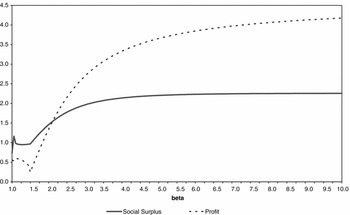
Figure 5 shows how social surplus and profit change with zoning restrictiveness. There is one local maximum for both social surplus and profit when beta is close to one, but when beta increases above 1.5, social surplus also rises. It appears that, while restrictive zoning generally reduces social welfare, once it is placed inside a rich community, the optimum level of zoning restrictiveness will be very high with little development in the second period. In other words, once zoning becomes ‘restrictive’ (in the sense of being in the local area of beta equal to one), it tends to be highly restrictive in affluent neighborhoods.
Change of Social Surplus and Profit with Zoning Restrictiveness ‘Rich’ Community

6. Conclusion
By focusing on the intertemporal externality in land monopoly, the two-period model developed in this paper revisits the Coase conjecture in its original example. The building block is that the transactions and consumption of land and the collective good are bundled together but their provision can be separate. This spatial fact is the link among land market structure, intertemporal externality, and urban institutions.
The findings point to the importance of intertemporal externality in urban land development. In a world of rentals only, public provision of the collective good results in more land developed. This suggests that, ceteris paribus, proprietary communities, based on leasehold and bundles the provision of land and the collective good may result in less development than under traditional government provision of the collective good. In the case of sales with bundled provision of the collective good, a larger cumulative quantity of land will be sold than what could be rented. The reason is that intertemporal competition can be weakened by the non-durable collective good, resulting in strengthened monopoly power and more development.
The model also helps us to explore the implications to the relationship among urban spatial structure, urban institutions, and local collective goods provision.Footnote 21 Suburbs obviously face more competition than the city center, which enjoys significant monopolistic power. Our numerical examples suggest that, within some range of parameterization, monopoly may make public provision more desirable. The reasons for this result include (1) sale or homeownership generates intertemporal price competition that is good for consumers; (2) bundling is instead good for the monopolist because it weakens intertemporal competition and emboldens time inconsistent behavior. This might be one reason why most private communities are located in the suburbs. A plausible explanation is that they are a new institutional form and most new developments are in the suburbs.Footnote 22 However, this argument does not hold in the case of urban renewal, and private communities such as company towns did exist in the history (Fishback, Reference Fishback1992).Footnote 23 In this sense, this paper provides a competing hypothesis for the location choice of private communities.
Community characteristics are also shown to affect urban institutional forms. Our first numerical example shows that public provision can effectively mitigate the time-inconsistency problem at large spatial scales where consumers are more evenly distributed. This is one reason for the dominance of public institutions in the urban area. In an area with a high concentration of ‘poor’ consumers, such as in company towns, rental arrangements can become more efficient. In contrast, private/owner (such as CIDs or condominiums) may be more efficient in a ‘rich’ area. In this sense, it is not surprising that private communities are often characterized as ‘secession of the successful’ (Reich, Reference Reich1991).
If the collective good is durable, such as some urban infrastructure, then it is a situation between (a single) completely durable good and a bundle of durable land and non-durable collective good. This certainly complicates the model and can be an interesting topic for future research. The result is probably also between our findings in this paper and standard Coase Conjecture.
A key assumption in the model is that consumers can correctly anticipate the price in the second period. This is of course a strong assumption in land use, given the high heterogeneity of urban land. If this assumption of rational expectation is relaxed, intertemporal competition will certainly become more weakened and the monopoly power will be more strengthened. The result might be more sales (overdevelopment) in the second period, lower quality of collective goods, and then more conflict between the development interest and current residents.
Appendix A: Public/owner with restrictive zoning
A special and more realistic case of separate provision with homeownership is public/owner with restrictive planning or zoning. In the beginning of the first period, land development is still determined by the monopolist. After the first-period purchasers become residents, they form (or dominate) local government and implement planning regulations to maximize the property values of first-period residents.Footnote 24 So, in the second period, land development is affected by the restrictiveness of zoning.Footnote 25
The second period
Zoning or planning is now in place and local government is dominated by existing (first-period) residents. With regard to planning control that determines land development, local government maximizes the property value of existing (first-period) residents

This yields the corner solution of θ2 = θ1, which means there will be no development in the second period at all. More realistically, the community usually allows some development due to exogenous factors such as special interest politics, public policy, legal environment, and so on. Suppose the restrictiveness of zoning can be represented by β, which satisfies

β is in the range of [1,1/x]. When β equals one, y = x and there is no development in the second period. The higher is β, the less restrictive is zoning or planning. The now ‘passive’ monopolist's profit function is still the same as in (18). With regard to providing the collective good of Q 2, local government maximizes all residents' utility. The first-order condition is the same as (3).
The first period
Consumer's rational expectation yields the same pricing equation as in (11). Now local government maximizes the residents' utility in providing the collective good. Since there are no residents in the beginning, the land monopolist determines the development scale by maximizing the total profit over the two periods. The maximization problem is the same as in (20) and yields the same first-order condition as (23).
Substituting (A1) into the first-order condition of (23) yields

The system of equations (3) (for Q 1 and Q 2, respectively), (A1), and (A2) is now mathematically solvable. Applying (3) to both periods yields
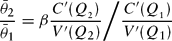
This equation tells us how the quality of the collective good changes with the restrictiveness of zoning or planning. For example, in the case of uniform distribution, since  . In most cases, θ2 > θ1, and then
 . So,
 , meaning that the equilibrium value of Q 2 will result in more costly provision of collective good in the second period.
Appendix B
Proposition 1: When only rental is possible, what the land monopolist rents in the case of private provision of collective good is less than or equal to that in the case of public provision.
Proof: In the case of bundled provision of land and the collective good, since hazard rate =  and θ∈[0, 1], obviously
 or else the hazard rate would become negative. Given that the hazard rate and θ are both within [0, 1], we must have
 . Hence, we have

Because the hazard rate and θ are both assumed to be non-decreasing, (θ · hazard rate) is also non-decreasing. Comparing conditions (2) and (4), we can see that (θ · hazard rate) is bigger than 1 with bundled provision, while it is equal to 1 with separate provision. Therefore, θ is not smaller in the case of bundled provision and the rental quantity q = 1 − F(θ) is then not larger. □
Proposition 2: In private provision, the monopolist has cumulatively sold more land up to the second period than he rents in the rental case.
Proof: In the case of private/owner, rearranging the terms in (8) and (9) and then dividing them yields

Substituting (9) into the above equation we can have
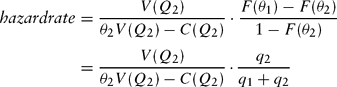
Because 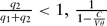 is a decreasing function of θ, and (θ · hazard rate) is a non-decreasing function, then comparing (B2) and (4) shows that θ2 is smaller now than in private/rental. (Please note that since (4) holds for both two periods, Q and θ should be replaced with Q 2 and θ2.) □