1 Introduction
Ontologies are a popular research topic in various communities such as knowledge engineering (Kitamura & Mizoguchi, Reference Kitamura and Mizoguchi2003; Gomez-Perez et al., Reference Gomez-Perez, Corcho-Garcia and Fernandez-Lopez2003), natural language processing (Zaihrayeu et al., Reference Zaihrayeu, Sun and Giunchiglia2007), cooperative information systems (Benassi et al., Reference Benassi, Beneventano, Bergamaschi, Guerra and Vincini2004; Guizzardi, Reference Guizzardi2007), intelligent information integration (Guarino, Reference Guarino1998; Bouquet et al., Reference Bouquet, Don and Serafini2002; Lenzerini, Reference Lenzerini2002), and knowledge management (Lueg, Reference Lueg2002; Bergamaschi et al., Reference Bergamaschi, Guerra, Orsini and Sartori2007). In computer science, ontologies can be defined as computational models which describe the kind of entities, properties of entities, and relations between entities that exist in a specified domain of knowledge; under an artificial intelligence (AI) perspective, they can be regarded as content theories, in opposition to mechanism theories (Chandrasekaran et al., Reference Chandrasekaran, Josephson and Benjamins1999).
One of the most popular end-use of ontologies in information technology is to create an agreed-upon vocabulary for information exchange within a domain. For instance, interoperability among autonomously developed databases (DBs) can be significantly hindered by the absence of uniform semantics; reconciliation can be accomplished through the use of a reference ontology to which the semantics of the individual resources can be related (Benassi et al., Reference Benassi, Beneventano, Bergamaschi, Guerra and Vincini2004).
Standard interchange languages (XML, OWL, RDF) were developed to enable the establishment of Web services to retrieve and exchange ontology-encoded information through the Web (W3C, Web Ontology Language). Nonetheless, the choice of specific representation languages for the formal ontology encoding, and the technological issues of database interoperability, do not wear out the whole range of problems concerning ontological modeling (Gruber, Reference Gruber1995; Guarino, Reference Guarino1995; Thomasson, Reference Thomasson2004). Despite the effort for defining a standard semantic, experts seem to resist to any attempt of homogenization. Partly, this is due to practical problems, but there are also theoretical reasons why this is not easily accepted and not even desirable. In fact, lots of cognitive and organizational studies show that there is a close relationship between knowledge and identity. Knowledge is not simply a matter of accumulating ‘true sentences’ about the world, but it is also a matter of interpretation schemes—for example, paradigms (Kuhn, Reference Kuhn1970), contexts (Benerecetti et al., Reference Benerecetti, Bouquet and Ghidini2000), mental models (Johnson-Laird, Reference Johnson-Laird1983), perspectives (Boland & Tenkasi, Reference Boland and Tenkasi1995)—which allow people to make sense of what they know. All these mental structures are an essential part of what people know, as each of them provides an alternative lens through which reality can be read.
A simple example of that divergence is the notion of herbivore and carnivore, an apparently intuitive, simplistic, and unambiguous category, which can be understood and successfully used even by children. Considering the standpoint of a farmer, or the zoo personnel responsible for the animal feeding, an animal is categorized as carnivore or herbivore according to its feeding habits, based either on meat and very few vegetables (carnivore), or only vegetables and no meat (herbivore), or a balanced amount of both (omnivorous); extending this criterion to human consumers (their categorizer being the food-retail personnel or the nutritionist), a vegan could be classified as herbivore: albeit unable to digest grass, his feeding is constituted only by vegetables. However, considering the standpoint of the paleontologist, or the veterinary dentist, the anatomy of the teeth set is the crucial criterion. According to that criterion, an animal is permanently carnivore, herbivore or omnivorous from its birth till its death, notwithstanding the feeding behavior exhibited during a certain time span; as a consequence, a vegan, having the teeth set of an omnivorous, is not herbivore. The case is analogous assuming a different anatomic criterion, for example, the structure of the full digestive systemFootnote 1.
The example displays that herbivore, omnivorous, and carnivore categories can be assigned according to different underlying criteria, defined within different classification systems. We argue that different classification criteria can be explicitly taken into account in the knowledge representation frame, and categories grounded on different criteria can be decomposed into common elements. Indeed, the feeding habits are enabled by the anatomical and physiological structure (digestive system), but co-determined by other factors (e.g. food availability for animals, or ethical choices for humans). Within this enlarged frame, a vegan can be successfully categorized as having an omnivorous digestive system, and herbivore feeding habit due to an ethical choice to avoid meat, overcoming the diverging classificatory solutions. Besides this simple example, and considering more articulated scientific contexts, the divergence of classificatory systems can be associated with different theories operating within a common discipline, in the context of the same research tradition (Laudan, Reference Laudan1977).Footnote 2 The notion of discipline, though apparently intuitive, was never formalized by prominent Philosophy of Science scholars such as Kuhn (Reference Kuhn1970), Feyerabend (Reference Feyerabend1975), Laudan (Reference Laudan1977), and Lakatos (Reference Lakatos1978). Here, a discipline is characterized by (a) the domain of reality being the object of study (e.g. neurovascular pathologies, or the human genome), (b) the aims, (c) the general methodology, (d) the general content theory; beside the aims, all the other components can be specified by different schools. Roughly speaking, these criteria underlie the different aggregations of scientific communities proposed by different Philosophy of Science scholars (Kuhn, Reference Kuhn1970; Feyerabend, Reference Feyerabend1975; Laudan, Reference Laudan1977; Lakatos, Reference Lakatos1978). Within the general scientific arena, the social group endorsing a certain theory is commonly termed School. Under this epistemological perspective, a School gathers groups of research communities, which share the same methodology of inquiryFootnote 3 and a common vision over a specific research area, including the adoption of common classificatory systems, as shown in (Thomasson, Reference Thomasson2004). Different schools are unified within a discipline by sharing the same objectives: they address the same problems, but they adopt different frames, leading to diverging solutions; concerning the content theory component, this situation is mirrored by the adoption of different classificatory systems. Under an ontological perspective, diverging content theories, belonging to different schools, can be reconciled by decomposing their categories according to the classificatory criteria adopted, and identifying common elementary units. The crossing of disciplines borders, to support multi-disciplinary research projects, poses even greater challenges than managing the existence of different schools. The same decomposition strategy can be applied to integrate the different content theories, but only at the condition of identifying a common ground between the two disciplines, underlying the different objects of study, aims, and methodologies.
In this paper, we discuss the NEUROWEB project as a case study of the modeling challenges arising in the outlined epistemic scenario. The first part concerns the aims of the project, and the way ontological modeling can contribute to their fulfillment; the second part outlines the different scientific communities involved in the project, and the consequent epistemological challenges; the third part presents the general Knowledge Acquisition (KA) and Knowledge Representation (KR) strategy devised to address those challenges; and the fourth part is devoted to a more detailed analysis of the ontological model.
2 The NEUROWEB project: aims
NEUROWEB is a EU (European Union)-funded, health-care oriented project. Its aim is the development of an IT (information technology) infrastructure to support association studies in the neurovascular domain. As their name suggests, association studies consist in the assessment of the statistical significance of association (i.e. co-occurrence) between a phenotype and genetic, environmental or demographic factors; typical examples are the search for genetic markers associated with an increased susceptibility to type-2 diabetes, or the discovery of a relation between the average number of daily-smoked cigarettes and the incidence of lung cancer. In these examples, the phenotype is always a pathology (type-2 diabetes, lung cancer); however, the notion of phenotype is commonly used also in non-pathological contexts (e.g. blood groups, somatic traits): according to a more general definition, a phenotype is an observable state of an individual organism (Bard et al., Reference Bard, Rhee and Seung2004). Phenotypes can consist of a single parameter (e.g. glycemia, the level of glucose in venous blood), or a structured ensemble of inter-related features (e.g. diabetes is a complex pathological state comprising abnormal glycemia). Within the NEUROWEB project, the phenotype is intended as a pathological state, due to the occurrence of a neurovascular lesion, and diagnosed by a clinical expert; this specific declension will be referred as clinical phenotype throughout the paper.
Association studies require large patient cohorts to be effective. For that reason, the NEUROWEB consortium is constituted by four clinical sites from different EU-member countries, which are recognized excellence centers in the field of neurovascular disorders, with a particular focus on ischemic stroke. However, the amount of available data is not a valuable asset itself, unless data quality and methodological coherence are carefully preserved. Considering the specific NEUROWEB context, the critical point is whether phenotypes are defined and assessed homogeneously across different sites. Indeed, although all sites comply with international guidelines, they also have developed specific diagnostic procedures, and in-depth competencies in different areas of stroke diagnosis (such as imaging, biochemical essays, etc.)Footnote 4. This situation is mirrored by the clinical repositories, which were independently developed in each local site to store patient profiles. Clearly, enforcing a top-down standardization of phenotype assessment is neither practicable nor desirable in the applicative context outlined (Van der Vet & Mars, Reference Van der Vet and Mars1998). Therefore, to address the problem of methodological coherence, the phenotypes were encoded in a specific Reference Ontology, which will be referred as the NEUROWEB Reference Ontology (or, shortly, the NEUROWEB ontology); the NEUROWEB ontology enables the NEUROWEB system to operate on different clinical repositories, and to retrieve patients characterized by a given (set of) phenotype(s), formulated according to negotiated criteria.
General-purpose medical ontologies (OBO; The Gene Ontology Consortium; The National Center for Biomedical Ontologies; Galen; PATO; SNOMED-CT) could not be used to meet that end, as they proved unsuitable to represent the specific expert knowledge of the NEUROWEB neurovascular communities (Bard et al., Reference Bard, Rhee and Seung2004; Bodenreider et al., Reference Bodenreider, Smith, Kumar and Burgun2007). The diagnostic process has traditionally resisted many efforts to be fully automatized (Miller, Reference Miller1994; Sicilia et al., Reference Sicilia, Sicilia and Sánchez-Alonso2009); it is important to point out that the aim of the NEUROWEB infrastructure is not to replace the clinical expert in the diagnostic activity, but rather to reconstruct the patients’ clinical phenotypes, according to the evidences collected—and interpreted—by the medical experts during the diagnostic process; the rationale of using explicit and analytical phenotype formulations is to integrate data from different sources preserving methodological coherence.
Association studies within the NEUROWEB project have a special commitment to genotype–phenotype relations [A, B]; specifically, the genotypic component assessed is the value of single nucleotide polymorphisms (SNPs) [C, D] in the patients’ genome. Beyond the search for statistically relevant SNPs–phenotype associations, there are valuable functionalities requiring to extend the NEUROWEB Reference Ontology to gene functions, and enabling it to treat phenotype formulations as provided by genomic resources. Conjugating phenotypes, as conceived within neurovascular medicine, with entities belonging to the genomic world, clearly requires to bridge two knowledge domains belonging to different disciplines; whereas clinical medicine is committed to the identification of pathological states (diagnosis) and their treatment (or prevention), molecular biology and molecular genetics are committed to the study of biological mechanisms at the molecule level and to the study of the information encoded by the genome.
3 The NEUROWEB project: epistemological challenges
NEUROWEB clinical sites are communities of neurovascular experts, whose daily work is the examination of patients; in each center, the patients have been previously diagnosed with a stroke in an ordinary hospital, and they are admitted to the center in order to undergo a more detailed diagnostic process, as well as to receive the most suitable treatment. The evidences collected during the diagnostic process include both objective/quantitative data (e.g. cholesterol level), and subjective/qualitative data, that is, filtered by the expert’s judgment (e.g. presence of a brain lesion); they are stored in locally run repositories and are available to the other clinicians of the center. These data can be further exploited for association studies, the task specifically addressed within the NEUROWEB project, as they enable to define a clinical phenotype. Besides the exchange of clinical records, each clinical community is characterized also by the encoding of their own procedural rules for diagnostics into written documents, termed Diagnostic Protocols. As mentioned before, local protocols have to comply with general guidelines, negotiated among top experts all over the world; yet, they retain specific elements, characteristic of the local communities’ customs and expertise. Considering the outlined features, the NEUROWEB clinical communities can be conveniently regarded as Research Communities, each distinguished from the others by different tradition of problem solving (i.e. diagnostic activity), but gathered together by a common vision over the problems to be solved and the ways of inquiry them.
As remarked by Laudan (Reference Laudan1977), the knowledge cycle of a Research Community typically originates a domain conceptualization (a domain vision), usually implicit and not formalized (Davenport & Prusack, Reference Davenport and Prusack1998; Holsapple & Joshi, Reference Holsapple and Joshi2001). These elements can be clearly identified in the NEUROWEB clinical communities:
• The examination of patients involves collective forms of working (e.g. advises from elder colleagues, collective discussions over anomalous cases);
• The examination of patients, followed by the diagnosis formulation, and the treatment decision, is a problem-solving activity; each problem-solving case undergoes reification into a clinical record;
• The Diagnostic Protocol can be regarded as a procedural manual, and it is the final product of the negotiation phase.
The domain conceptualization of a community may remain implicitly encoded in its routines and written documents, or it may undergo a process of structuring into a Representational Artifact. Examples of Representational Artifacts are, on the side of the content theories, classifications of pathologies; and on the side of mechanism theories, diagnostic algorithms; that is, decision trees in which the if-then-else clauses are formulated in Natural Language (NL) (Bowker et al., Reference Bowker, Turner, Star and Gasser1997; Bandini et al., Reference Bandini, Colombo, Colombo, Sartori and Simone2003; Smith et al., Reference Smith, Kusnierczyk, Schober and Ceusters2006). The capital difference between a narration, or a manual, and a Representational Artifact is the presence of an explicit structure; the structuring process consists in transferring the knowledge content from the NL-encoding to the structure of the artifact. Though the Representational Artifact is not directly encoded in a formal language, its construction is the necessary condition for knowledge formalizationFootnote 5. Representational Artifacts always have residual semantic elements, encoded as NL, and their structure may be partial or unsystematic (Smith et al., Reference Smith, Kusnierczyk, Schober and Ceusters2006). Therefore, it is not practicable to treat them as the sole knowledge asset. This is in agreement with consolidated knowledge engineering (KE) literature, stating that expert knowledge is primarily detained by subjects rather than artifacts or written documents (Nonaka & Takeuchi, Reference Nonaka and Takeuchi1995; Studer et al., Reference Studer, Benjamins and Fensel1998; Guida & Berini, Reference Guida and Berini2000), and consequently postulating the necessity of KA from the experts preliminary to the KR phase (Preece et al., Reference Preece, Sleeman and Flett2001). We argue that Representational Artifacts are valuable assets to guide the KA activity, but, as knowledge sources, they cannot replace the experts’ knowledge. In order to support association studies, we are specifically interested in Representational Artifacts (in our case, classificatory systems for clinical phenotypes) able to guide the clustering of patients. In the context of the NEUROWEB consortium, the structuring process does not occur within the local communities, but rather as a negotiation among different research communities. The TOAST (Trial of Org 10172 in Acute Stroke Treatment) classificatory system (Adams et al., Reference Adams, Bendixen, Kappelle, Biller, Love, Gordon and Marsh1993; Lee et al., Reference Lee2000; Goldstein et al., Reference Goldstein, Jones and Matchar2001; Ay et al., Reference Ay, Furie, Singhal, Smith, Sorensen and Koroshetz2005) is the Representational Artifact fulfilling, at best, the NEUROWEB needs. It was developed by the international neurovascular community to classify stroke patients on a diagnostic basis, and it was already adopted by most of the clinical sites before the existence of the NEUROWEB consortium. The adoption of the same Representational Artifact (the TOAST) testifies for the presence of a common conceptual and methodological ground across the different NEUROWEB Research Communities; therefore, it is possible to regard them as members of a neurovascular school. As a matter of fact, the TOAST assumes specific diagnostic criteria grounded not only on a common conceptualization of clinical phenotypes (content theory component), but also on shared methodological principles (mechanism theory component). These aspects will be better elucidated in the next session. So far, two major modeling issues have to be managed:
• The TOAST is a classificatory system with a strong NL-component; to be represented with a formal language, it requires a further structuring effort (i.e. refinement of the conceptual model); that activity cannot be carried out without involving the clinical experts from the Research Communities.
• Managing the difference among the Research Communities, which requires to conjugate two different objectives:
– federating their clinical repositories, and coherently formulating the TOAST clinical phenotypes on that basis;
– besides the TOAST phenotypes, allowing also the formulation of customized clinical phenotypes, in order to convey the Research Communities’ specificities.
As we briefed in the Introduction, to support genotype–phenotype association studies, it is valuable to connect clinical phenotypes to genomic entities; we argue that such an operation requires bridging two knowledge domains belonging to different disciplines. In this case, the two disciplines are clinical medicine, specifically vascular neurology, and molecular biosciences (the convergence of molecular biology, molecular genetics and genomics). The divergence between the two disciplines concerns multiple epistemological dimensions:
• The object of study is the same, the human body (though biosciences are not restricted to the study of humans, but also other life forms as well). However, the focus is on different facets, occupying different granularity levels: medicine mainly addresses the level of organs, anatomical parts, and global body parameters, though it also takes into account the tissue, cell, and molecule levels; molecular biosciences addresses the molecular level, with a particular focus on the genetic information encoded by the DNA molecule, and the processes centered on it. Therefore, clinical medicine and molecular biosciences have different reference levels of granularity.
• The two disciplines have different aims: clinical medicine aims at determining the pathological states of patients (diagnosis), in order to formulate a prognosis and a suitable treatment—in brief, to save lives; molecular biosciences aim at elucidating the molecular mechanism of biological organisms.
• The methodology is different as well (e.g. different experimental techniques), as a consequence of the different facets in the object of study, and the different aims.
• Finally, the content theory (the catalogue of entities, their properties and their relations) is different as well. This difference is influenced by the object of study and the methodology.
The genomic information of interest for NEUROWEB (in our case, gene functions and phenotypes) is typically stored within general-purpose repositories, which are not the expression of a research community with a specific methodology; as a consequence, the influence of the methodological component in the genomic setting is weaker than in the clinical setting. However, that does not imply that methodological problems do not occur in the genomic field; it simply means that they are not explicitly managed in the publicly available resources. For instance, HGMD (Human Gene Mutation Database) (Stenson et al., 2003), a repository for genotype–phenotype associations, includes phenotypes referring to pathologies, thus underpinning a clinical perspective, altogether with phenotypes referring to the alteration of specific molecular functions and processes, thus underpinning a molecular bioscience perspective; the former, however, are not treated with the level of detail adopted in the NEUROWEB project, and the methodological problem of how the pathology is diagnosed is not addressed. Nonetheless, even in this setting, significant discrepancies need to be managed, concerning the different granularity and the different aims. We will address these problems with full details in the next section, altogether with the solutions proposed.
As a whole, we argue that an explicit analysis of the epistemological setting constitutes:
• a valuable contribution to ontological modeling, by elucidating the role of the disciplines aims and methodology in shaping the content theory;
• a fulfillment of the KE methodology for ontological modeling; we specifically argue that a clear picture of the epistemological setting is extremely valuable to efficiently organize the KA and to drive the KR taskFootnote 6.
4 The ontological modeling strategy adopted
The core concept of the NEUROWEB Reference Ontology is the phenotype. The ontology is primarily committed to the representation of clinical phenotypes, federating the different clinical communities without compromising methodological coherence. Decomposing the clinical phenotypes into general domain components enables to extend the NEUROWEB Reference Ontology to genomic entities, bridging two different knowledge domains.
This section is organized into two parts: in the first part, we address the ontological model for clinical phenotypes; in the second part, we discuss how that model was suitably extended to take into account genomic entities.
4.1 A strategy for clinical phenotypes
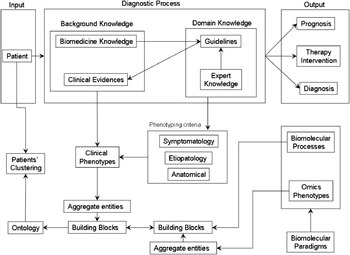
The NEUROWEB project is committed to associations’ studies, and the primary computational task is the retrieval of patients sharing a common phenotype. As we discussed in the previous sessions, this task is not straightforward. On the one hand, each site independently collects and organizes the clinical evidences required to formulate a phenotype, mirroring the methodological specificities of the local Research CommunityFootnote 7 (see Figure 1). On the other hand, however, the clinical communities accept the federation under a common standard for phenotype classification, the TOAST. All in all, the solution we adopted is an ontological model formulating clinical phenotypes on the basis of clinical evidences stored in the repositories. Given an input phenotype, the ontological model enables the query system to retrieve patients from different repositories; the adoption of an ontological phenotype formulation, opposed to a looser query system, grants the application of coherent criteria for phenotype formulation across different repositories. In the beginning, we devised an initial two-layered model. The lower layer is the Core Data-Set (CDS), a set of common indicators from the local repositories, which clinicians consider essential for stroke diagnosis (e.g. anterior cerebral artery lesion, blood pressure). The CDS enables to connect clinical evidences having the same semantic across the different communities. The CDS is the result of an iterative negotiation process among the NEUROWEB clinical communities, supervised and aided by the NEUROWEB Knowledge Engineers and IT personnel.
The figure depicts the main epistemological dimensions of knowledge identified within the NEUROWEB project, the TOAST classification criteria exploited for the clinical phenotype decomposition, and the ontological modeling strategy adopted to bridge the genomic entities to the clinical phenotypes

Under an IT perspective, the CDS alone would be enough to support a query system, operating on the integrated ensemble of the four clinical repositories; in that setting, the task of phenotype formulation would be executed by the user by assembling different CDS indicators into a query formula. We can reasonably expect that there is a set of clinical phenotypes used on a regular basis for association studies—the TOAST phenotypes, in the case of the NEUROWEB consortium, as previously discussed; a query system relying only on the CDS would oblige the user to reformulate the phenotypes for every new access to the system, a solution which would be time-consuming and error-prone. For that reason, we collect the TOAST phenotypes in a taxonomy of stroke types and subtypes, termed Top Phenotypes. The Top Phenotypes constitute the second layer of the model, and they are connected to the CDS indicators via a definition formula. The formula is structured as a conjunction/disjunction of criteria on the CDS indicators, expressed as equality/inequality bounds, or quantitative ranges to be satisfied. An example is: (Blood pressure > 50) AND (Anterior cerebral artery lesion = yes). The existence of a negotiated, but centrally encoded, phenotype formulation establishes a methodologically coherent federation of the different communities’ resources. Local practices are reconciled within this model, as different sets of CDS indicators can be used to identify a common phenotype. The easiest case occurs when the same clinical evidence can be assessed using different technologies but achieving the same degree of probatory strength (e.g. severe stenosis in the internal carotid artery can be determined by a duplex AND a computed tomography angiography scan, OR by a duplex AND a magnetic resonance angiogram scan). The way phenotypes are encoded strictly resembles the typical formulation of a query, and thus can be easily handled by a clinical expert; for that reason, the two-layered model was successfully used for the KA activity.
It is important to reassert that NEUROWEB is not a system for automatic diagnosis. If the CDS indicators were objective parameters, collecting all the clinical evidences for a patient, and then applying the phenotype formulation, as encoded by the NEUROWEB Ontology, would constitute a system for automatic diagnosis. That is not the case, as only some of the CDS indicators are objective, for example, the total level of cholesterol. Other CDS indicators, such as the presence or absence of a relevant lesion, require to be assessed (1) the expert’s interpretation of a scan image (subjective component), (2) to take into account not only on the features of the scan image itself, but also the other features of the patient (contextual component), only partially encoded as CDS indicators; in other words, the latter point means that some CDS indicators depend on the value of other indicators. Decomposing the CDS indicators into independent and objective elements is not a practicable solution, as the CDS indicators constitute the minimal elements of agreement among the NEUROWEB neurovascular community. We argue that these complications mirror the well-documented difficulty of diagnosis automatization (Szolovits et al., 1988; Miller, Reference Miller1994)Footnote 8. Nonetheless, we explicitly model the inter-dependencies among CDS indicators as logical formulas, used for methodological coherence checking: if a patient displays incoherence among the CDS elements required for a certain phenotype, that patient is discarded. An example is the CDS indicator Relevant Scan Lesion. According to the diagnostic knowledge, a lesion is relevant only in presence of a co-axial scan lesion (i.e. the evidence of some brain tissue damage) and stenosis (i.e. the evidence of a partial occlusion in a brain-afferent artery). It follows that Relevant Scan Lesion = yes is correct only when Scan Lesion = yes, Stenosis Degree > 50%, Side of the Scan Lesion = DX (SX), and Side of the Stenosis = DX (SX) Footnote 9.
The two-layered model is a simple and effective model to encode a set of given phenotypes, organized according to homogeneous classificatory criteria, as in the case of the TOAST. The NEUROWEB Consortium accepts the TOAST as a federation standard, but the ontology should be flexible enough to manage the existence of alternative neurovascular schools, adopting a classification alternative to the TOAST. The introduction of stroke types organized according to different classificatory criteria would be managed in the two-layer model by introducing an additional taxonomy, besides the TOAST taxonomy. However, the exploitation of clinical phenotypes for association studies requires to dynamically redefine the phenotypes, going beyond the categories of a specific classificatory system; in this scenario, the TOAST is a source of robust clinical phenotypes, grounded onto the diagnostic practice, which can be refined or modified to meet, at best, the ends of association studies. We argue that to enable, at best, the manipulation of Top Phenotypes, it is necessary to introduce an additional layer in which the Top Phenotypes are decomposed into their building blocks, according to the classification criteria. We will also show that decomposing the Top Phenotypes according to classification criteria enables to identify general domain concepts, supporting the bridging to genomic entities. The CDS indicators are not suitable building blocks, as
• the formulation of Top Phenotypes using the CDS indicators does not explicitly represent the classificatory criteria;
• CDS indicators do not represent general concepts of the medical domain; instead, they are the minimal elements of the diagnostic practice, as it is exerted in the NEUROWEB clinical communities. For example, anatomical parts are often referred in the CDS indicators, but they are not represented as stand-alone entities of the CDS.
The Top Phenotypes taxonomy enables to represent the characterizations of the stroke types with increasing specificity from the root to the leaves (e.g. Ischemic Stroke, Atherosclerotic Ischemic Stroke, Atherosclerotic Ischemic Stroke Evident, Atherosclerotic Stroke Evident with Intracranial Cerebral Artery Stenosis); however, the taxonomy is intrinsically incapable of representing the notion of part, as required by the identification of the building blocks. To identify the building blocks of the TOAST Top Phenotypes, it is necessary to consider what are the TOAST classification criteria:
• etiology (i.e. Atherosclerotic, Cardioembolic, Lacunar Stroke);
• confidence of the etiological assessment (i.e. Evident, Probable, Possible), depending on the probatory strength of the diagnostic evidence;
• anatomy (i.e. the location of the lesion, e.g. left carotid artery).
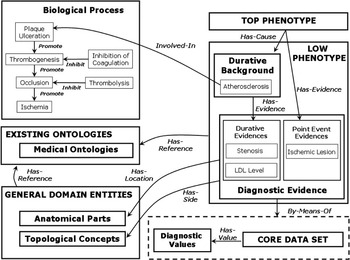
The TOAST classification criteria suggest the use of specialized relationsFootnote 10 to deconstruct the Top Phenotypes into building blocks (see Figure 2):
The figure depicts the NEUROWEB Ontology components, and their relations

• Has-Cause (pointing to the specific etiology);
• Has-Evidence (pointing to diagnostic evidences);
• Has-Location (pointing to the anatomical site of the neurovascular lesion);
• Has-Side (pointing to the side of the neurovascular lesion).
To account for the anatomical criterion, we add to the ontology the Anatomical Parts; the Anatomical Parts of interest for the NEUROWEB project are typically vascular territories, such as the intracranial cerebral artery (ICA). These concepts are not phenotypes, since phenotypes are generally defined as observable properties of an organism; on the contrary, Anatomical Parts are physical entities bearing observable properties. We also add to the ontology a set of Topological Concepts, to manage the side of the lesions (including the notions of spatial coaxiality and symmetry). Whereas the CDS indicators derive from the community-level diagnostic knowledge, and the TOAST Top Phenotypes derive from the school-level diagnostic knowledge, the Anatomical Parts and the Topological Concepts are general domain concepts (i.e. on the Biomedical Knowledge level).
The etiological criterion implicitly assumes a partition between:
• the Stroke as a neurovascular occlusive event, causing a brain lesion, and
• the pathophysiological factors causing the occlusive event.
This difference implicitly organizes the diagnostic activity, yet it essentially relies on the physiological nature of stroke as conceived in the general biomedical knowledge. Ischemic stroke literally means a sudden alteration of neurological functions due to an ischemic (i.e. absence of blood flow) event in a brain area. With more details, there is a cascade of sequential events: the initial trigger is the generation of the occluding body or structure, which stochastically leads to vessel occlusion; as a consequence, the brain area downstream the occluded vessel suffers a severe restriction in blood supply (i.e. there is a local ischemia); that leads to tissue damage, partial functional impairment at organ and system level (brain and nervous system), and finally behavioral and cognitive anomalies. The stroke can be diagnosed by looking for clinical evidences of these events: the brain region affected by ischemia and necrosis can be identified by means of imaging techniques (i.e. Relevant Lesion); behavioral and cognitive anomalies are typical symptoms exhibited by the stroke patient. The initial trigger, that is the generation of the occluding body, has causal roots in a specific pathological background; the TOAST assumes three etiological groups:
• Atherosclerotic,
• Cardioembolic,
• Lacunar.
Each of these groups refers to a durative pathological background, eventually leading to the generation of the occlusive body. For instance, Atherosclerosis is a systemic blood vessel pathology, affecting multiple sites in the circulatory system; it consists in the deposition of cholesterol on the blood wall, contextual to the establishment of an inflammatory process, eventually leading to the formation of an atherosclerotic plaque; if the inflammatory process overrides the wound healing process, the plaque ruptures, thus triggering the coagulation process and the generation of a clot on the inner side of the blood wall; if the clot detaches from the wall (i.e. embolization), it circulates until it behaves as an occluding body. Atherosclerosis is diagnosed by the observation of stenosis in the brain afferent arteries, altogether with other diagnostic evidences. For these reasons, we introduce the concept of Durative Background and Diagnostic Evidences; Diagnostic Evidences are further specified into Durative and Point Event, to distinguish the diagnostic evidences for the events triggered by the occlusion, and the ones enabling to recognize the durative background.
The decomposition according to these criteria leads to the identification of concepts we term Low Phenotypes. Altogether with Anatomical Parts and Topological Concepts, the Low Phenotypes constitute a new middle layer, connected to the Top Phenotypes and the CDS indicators. We argue that the criteria adopted to identify the Low Phenotypes are implicitly guided by the separation of different pathophysiological processes; in other words, Low Phenotypes are characterized by different underlying pathophysiological processes. For instance, Atherosclerotic Ischemic Stroke Evident (AISE) is caused by Atherosclerosis, whereas Lacunar Ischemic Stroke Evident (LISE) is caused by Small Vessel Disease; however, Atherosclerotic Ischemic Stroke Possible (AISPo) is caused by Small Vessel Disease and Atherosclerosis, thus there is a situation of two concurring causes. Therefore, LISE and AISPo share a common pathophysiological process, Small Vessel Disease. That information was not encoded by Top Phenotypes alone, and it would have been cumbersome to reconstruct it from the CDS-based definition formulas. Decomposing clinical phenotypes in terms of processes implies a shift from a clinical understanding—rooted onto diagnostic evidences, methods, and theories—to the general theory of biological function, which belongs to the corpus of biomedical knowledge. That is the common ground between medicine and molecular biosciences, providing the basis for the cross-domain bridging.
4.2 A strategy to bridge clinical phenotypes and genomic entities
Clinical phenotypes were encoded in order to conceive the diagnostic knowledge of the NEUROWEB clinical communities, and then decomposed to extrapolate general domain concepts. In order to specifically support genotype–phenotype association studies, it is necessary to establish relations between the clinical phenotypes and genomic entities. Specifically, two functionalities can be addressed:
• represent relations between gene functions and clinical phenotypes;
• integrate phenotypes from the clinical and genomic domains, managing
– the different aims and methodologies;
– the different granularities (spanning single molecules, biomolecular processes, cell types, tissues, organs, systems, body).
The first task was accomplished by introducing new relations and entities to connect the Low Phenotypes to the reference gene functions, as they are provided by the controlled vocabulary Gene Ontology. As we argued in the previous section, the decomposition into Low Phenotypes is implicitly guided by the separation of different pathophysiological processes. We add to the NEUROWEB Reference Ontology specific Biological ProcessesFootnote 11, relevant for the stroke and its causal backgrounds (e.g. Atherosclerotic Plaque Ulceration, Thrombogenesis). These concepts are connected to through the Low Phenotypes via the Involved-In relation (e.g. Atherosclerotic Plaque Ulceration Involved-In Atherosclerosis). NEUROWEB Biological Processes are then connected to their Gene Ontology counterparts via the Has-Reference relation. We argue that decomposing the clinical phenotypes into Low Phenotypes, associated with different processes, enables to overcome the discrepancy between the clinical and genomic phenotype representation, due to the different aims and methodologies of the two disciplines. For instance, the association between a genotype and the equivalent of the Low Phenotype Atherosclerosis is significantly more frequent than the association with the corresponding Top Phenotype, Atherosclerotic Ischemic Stroke. Indeed, the decomposition of Top Phenotypes into Low Phenotypes supports the analytical treatment of the context factor: Atherosclerotic Ischemic Stroke (Top Phenotype) is a stroke event (Low Phenotype: Relevant Scan Lesion) in the causative context of Atherosclerosis (Low Phenotype), but the notion of Top Phenotype alone does not enable to recognize these two separate elements.
As far as the second task is concerned, a granularity discrepancy arises when phenotypes—as represented in genomic resources—refer to entities spanning different level of organization (ranging from single molecules to the whole body); for instance, a phenotype can be expressed as the altered level of a protein or a molecular complex (e.g. increased level of LDL (low-density lipoproteins)). Granularity can be fully managed only in presence of a general-purpose content theory of biological parts and functions; since there is no such reference ontology available for the biological domain, it was not possible to accomplish this task, as out of the project reach. Although the task of managing the different granularities is not presently supported, the ontology can be suitably extended to handle it, just by adding more modules and relations to the existing structure: as we have already shown, the NEUROWEB Low Phenotypes can be put in relation with biomolecular processes; we argue that it is possible to establish relations also with other general domain concepts, such as cell types, tissues, and organs. For instance, a greater resolution in the representation of the Atherosclerotic processes and physical parts can provide the groundwork for the detailed acquisition and elaboration of genomic data. For instance, Atherosclerosis is a pathology with multiple facets, including molecular functions, biomolecular processes, cell types, anatomical sites, parts, and systems. The liability to trigger a stroke cascade depends on the state of all these components, organized at different level of granularity; different evidences from the genomic research (e.g. gene expression patterns, genotypic profiles, phenotypes) can be related to the clinical phenotypes, only in presence of a content theory organizing them accordingly.
4.3 Knowledge acquisition strategy
The KA was carried out with the four clinical partners. A substantial loop occurred between the establishment of the CDS indicators, and the identification of the clinical phenotypes of interest. In particular, the TOAST classification played an important role in shaping a common vision over the classification criteria. After several rounds of meetings and negotiation among the clinical experts, once the CDS reached a sufficiently stable version, the TOAST was encoded according to the two-layer model, and the experts were asked to formulate the clinical phenotypes according to that frame. This process was closely assisted by the KE team, organizing focused meetings with the most experienced clinicians to discuss the TOAST classification criteria, the phenotype formulation being compiled, and the limits of the model. During this process, the specialized relations used for the Low Phenotypes were introduced in a preliminary version of the three-layer model, and validated with the clinicians. In parallel, the genomic resources were analyzed to identify the discrepancies and the common ground with the clinical phenotype model. As a consequence, the three-layer model was further refined, reaching the final version.
5 The NEUROWEB ontology: the formal and the computational model
In this section, we systematically review the structure of the NEUROWEB Reference Ontology knowledge, formally represented using OWL-DL. We also present the architecture of the IT infrastructure that exploits the NEUROWEB ontology to retrieve patients from the local clinical repositories.
5.1 Methods
Description Logics were adopted as the formal language for the NEUROWEB Ontology. Description logics (Horrocks et al., Reference Horrocks, Sattler and Tobies1999; Sattler, Reference Sattler2000; Baader et al., Reference Baader, Calvanese and McGuinness2003) are a family of logic-based KR formalisms designed to represent and reason about the knowledge of an application domain in a structured and well-understood way. The basic notions in description logics are atomic concepts and atomic roles (unary and binary predicates in the terminology of first order language, respectively). A relation between two individual concepts (A and B) is represented as a binary predicate; the relation is termed role, the role concept is the first argument of the predicate (concept A), and the role filler is the second argument of the predicate (concept B). For instance, hasPart.Wheel represents the property of cars having wheels, in which the individual objects belonging to the concept Wheel are fillers of the role hasPart. A specific description logic is mainly characterized by the constructors it provides to form complex concepts and roles from the atomic ones. The language we used to formalize the ontological clinical knowledge is SHOIN(D), which is an extension of the basic description logic; specifically, we have adopted the OWL-DL version (Horrocks & Patel-Schneider, Reference Horrocks and Patel-Schneider2003). The editor adopted for the OWL file generation is Protg, a well known tool developed and distributed by the Standford University; in Protg, the NEUROWEB Ontology concepts are represented as T-Box (Terminological Box) entities.
5.2 The formal model of the ontology
The final ontology model is composed of three main layers: Top Phenotypes (the top layer), Low Phenotypes (the middle layer), and CDS (the bottom layer). The layer of the Low Phenotypes includes three additional modules, whose concepts are not phenotypes: Anatomical Parts, Topological Concept, and Biological Processes. Mappings to the external resources (ontologies, controlled vocabularies, genomic databases) are provided via the Has-Reference relation. The layer of the Top Phenotypes is a taxonomy of stroke types and subtypes according to the TOAST classification; alternative classifications can be accommodated as independent taxonomies, whereas user-customized TOAST phenotypes are included in the TOAST taxonomy. These entities represent clinical phenotypes (i.e. pathological states of stroke patients) judged relevant by clinicians, and recognizable through the diagnostic activity. The root of the TOAST taxonomy is Ischemic Stroke, whose children are Atherosclerotic Stroke, Cardioembolic Stroke and Lacunar Stroke; these stroke types constitute the three etiological groups according to the TOAST classification. Each of them is then divided into Evident, Probable, and Possible. Deeper levels of phenotype specification lead to the addition of children to these stroke subtypes. Although the reference to anatomical parts is important for the definition of the TOAST categoriesFootnote 12, the TOAST has no further phenotype specification explicitly based on the anatomical criterion (e.g. Atherosclerotic Ischemic Stroke Evident with Intracranial Cerebral Artery Stenosis). Some of the clinical experts have suggested the addition of a further layer to the Top Phenotypes TOAST taxonomy, based on the site of the lesion; after a phase of negotiation in the consortium, those phenotypes could be eventually added to the Reference Ontology.
Reflecting the TOAST classification criteria, the Top Phenotypes are decomposed into Low Phenotypes through two main relations:
• Has-Cause points to the log-term pathology underlying the stroke, represented by the Durative Background subclass of the Low Phenotypes (e.g. Atherosclerosis);
• Has-Evidence points to the diagnostic evidences for the stroke event, represented by the Point-Event Diagnostic Evidences subclass of the Low Phenotypes.
The Has-Evidence relation is also used to connect the Durative Background to its diagnostic evidences, represented by the Low Phenotypes subclass Durative Diagnostic Evidences. Please remark that the distinction between Durative and Point-Event diagnostic evidences is not coupled to any specification of the Has-Evidence relation. The Has-Location and Has-Side relations are used to connect a Low Phenotype to the anatomical site of a lesion (an Anatomical Part), and to the side of the lesion (a Topological Concept).
A Low Phenotype is finally decomposed into the clinical evidences required for its identification. The By-Means-Of relation connects a low Phenotype to a CDS indicator, and to specific value ranges (termed Diagnostic Values). The Has-Value relation connects the CDS indicator to the Diagnostic Values, and it is nested within the By-Means-Of formula. Since CDS indicators refer to anatomical parts, we introduce the relation Has-Location-CDS to explicitly represent it. An Anatomical Part is connected both to a Low Phenotype (Has-Location) and to the CDS indicators assessing that phenotype by referring to that Anatomical Part (Has-Location-CDS)Footnote 13.
Biological Processes constitute an additional module of the NEUROWEB Reference Ontology, and they are inter-related by Activates and Inhibits relations. Low phenotypes are connected to Biological Processes via the Involved-In relation.
To provide mappings to external resources, the ontology includes Has-Reference relations connecting NEUROWEB concepts to entities from genomic databases and biomedical ontologies or thesauri.
Metamodelling formulas
The following formula represents at a high level the NEUROWEB Taxonomy and the main axioms ruling the connections among the different NEUROWEB Entities. The meaning of the roles refer to the one informally described in the present section.
(1) NEUROWEBOntology ⊑ CDS ⊓ GeneralDomainEntity ⊓ Phenotype ⊓ OtherOntoResources ⊓ TopologicalEntity
(2) Phenotype ⊑ TopPhenotype ⊓ LowPhenotype
(3) LowPhenotype ⊑ DurativeBackground ⊓ DiagnosticEvidence
(4) DiagnosticEvidence ⊑ DurativeEvidence ⊓ PointEventEvidence
(5) GeneralDomainEntity ⊑ AnatomicalEntity ⊓ DiagnosticValue
(6) GeneralDomainEntity ⊑ ∀hasReference.OtherOntoResources
(7) Phenotype ⊑ ∀hasReference.OtherOntoResources
(8) TopPhenotype ⊑ ∀hasEvidence.DiagnosticEvidence
(9) TopPhenotype ⊑ ∀hasCause.DurativeBackground
(10) DurativeBackground ⊑ ∃hasEvidence.DurativeEvidence
(11) DiagnosticEvidence ⊑ ∃byMeansOf.(CDS ⊓ (hasValue.DiagnosticValue))
(12) LowPhenotype ⊑ ∀hasLocation.AnatomicalEntity
(13) LowPhenotype ⊑ ∀hasSide.TopologicalEntity
(14) CDS ⊑ ∀hasLocationCDS.AnatomicalEntity
(15) CDS ⊑ ∀hasSide.TopologicalEntity
(16) CDS ⊑ ∀hasValue.DiagnosticValue
The following formulas represent the Top Phenotype Atherosclerotic Stroke Evident, and its decomposition into Low Phenotypes.
• Ax1 encodes the Top Phenotype decomposition into the Durative Background, Atherosclerosis, and the evidence of the ischemic brain lesion proving the occurrence of the stroke event, Relevant Lesion;
• Ax2 encodes the decomposition of Relevant Lesion into Left Relevant Lesion and Right Relevant Lesion: the ischemic lesion can be on either side of the brain;
• Ax3 encodes the Left Relevant Lesion, requiring the co-axiality between the ischemic lesion site and the stenosis site (Stenosis is the evidence for Atherosclerosis); the encoding of the Right Relevant Lesion is omitted, as strictly similar to the left one;
• Ax4 encodes the left co-axility between the ischemic lesion site and the stenosis site; again, the right co-axiality as omitted, as strictly similar to the left one.
The Low Phenotypes Moderate and Severe Lesion are decomposed into CDS indicators and value validity ranges through the by-Means-Of and Has-Value relations; in axioms (Ax5:8) we display only the axioms referring to the Moderate Lesion. In axioms (Ax9:15) the Low Phenotype Severe Stenosis is connected to the anatomical part, and decomposed into CDS indicators.
(Ax1) AthIschStrokeEvident ≡ ∃hasEvidence.RelevantLesion ⊓ ∃hasCause.(Atherosclerosis ⊓ ∃hasEvidence.SevereStenosis)
(Ax2) RelevantLesion ≡ ∃hasEvidence.LeftRelevantLesion ⊔ ∃hasEvidenceRightRelevantLesion
(Ax3) LeftRelevantLesion ≡ ∃hasEvidence.LeftCoaxialityLesionStenosis
(Ax4) RightCoaxialityLesionStenosis ≡ ∃hasEvidence.((ModerateLesion ⊔ SevereLesion) ⊓ ∃hasSide.Right) ⊓ ∃hasEvidence.(SevereStenosis ⊓ ∃hasSide.Right)
(Ax5) ModerateLesion ≡ Lesion ⊓ ∃byMeansOf(CT-From2.5to5CentimetersLesion ⊔ MRI-From2.5to5CentimetersLesion ⊔ PET-From2.5to5CentimetersLesion)
(Ax6) CT-From2.5to5CentimetersLesion ≡ CT ⊓ ∃hasValue.2.5-5centimeters
(Ax7) MRIFrom2.5to5CentimetersLesion ≡ MRI ⊓ ∃hasValue.2.5-5centimeters
(Ax8) PET-From2.5to5CentimetersLesion ≡ PET ⊓ ∃hasValue.2.5-5centimeters
(Ax9) SevereStenosis ≡ Stenosis ⊓ ∃byMeansOf.((CTA-MoreThan60PercentInICA ⊔ DSA-MoreThan60PercenInICA ⊔ MRA-MoreThan60PercenInICA) ⊔ (CTA-MoreThan60PercentInCarotidArtery ⊔ DSA-MoreThan60PercentInCarotidArtery ⊔ MRA-MoreThan60PercentInCarotidArtery)) ⊓ ∃hasLocation.ICA
(Ax10) CTA-MoreThan60PercentInICA ≡ CTA ⊓ ∃hasValue.MoreThan60Percent ⊓ ∃hasLocationCDS.ICA
(Ax11) DSA-MoreThan60PercentInICA ≡ DSA ⊓ ∃hasValue.MoreThan60Percent⊓ ∃hasLocationCDS.ICA
(Ax12) MRA-MoreThan60PercentInICA ≡ MRA ⊓ ∃hasValue.MoreThan60Percent ⊓ ∃hasLocationCDS.ICA
(Ax13) CTA-MoreThan60PercentInCarotidArtery ≡ CTA ⊓ ∃hasValue.MoreThan60Percent ⊓ ∃hasLocationCDS.CarotidArtery
(Ax14) DSA-MoreThan60PercentInCarotidArtery ≡ CTA ⊓ ∃hasValue.MoreThan60Percent ⊓ ∃hasLocationCDS.CarotidArtery
(Ax15) MRA-MoreThan60PercentInCarotidArtery ≡ CTA ⊓ ∃hasValue.MoreThan60Percent ⊓ ∃hasLocationCDS.CarotidArtery
5.3 The overall computational architecture
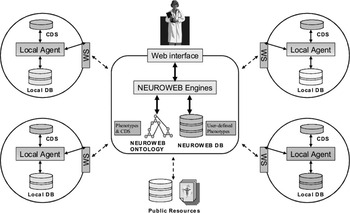
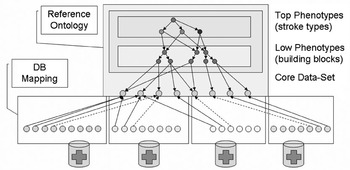
The NEUROWEB architecture has been designed to cope with the heterogeneity of the data sources, that is, the databases that are maintained at the participant institutions, public repositories and scientific literature. Figure 3 reports the overall architecture of the system. Web service technology has been exploited to decouple the NEUROWEB central components from the local sites in order to enable new clinical institutions to join the consortium. A key point is the unified language that every node uses to talk to the center of the system: every conversation is carried on in terms of the Reference Ontology. At every site a translation to the local terminology occurs to retrieve the patient clusters (see Figure 4).
The NEUROWEB architecture

The NEUROWEB Reference Ontology is composed of two parts: Phenotype Ontology and CDS. CDS is the set of clinical indicators concerning the required exams to perform diagnostic activities. It supports interoperability through the mapping established between its entities and the clinical data from local repositories. The Phenotype Ontology is composed of Top Phenotype and Low Phenotype layers. The Top Phenotype layer is an expert-defined taxonomy of strokes connected to the Low Phenotype layer, which provides an explicit representation of the classification criteria, the building blocks of phenotypes. Finally, the Low Phenotypes are connected to the CDS entities via axioms, which encode the value-ranges on CDS clinical variables required for the phenotype occurrence

To retrieve a patient cluster given a clinical phenotype encoded in the NEUROWEB ontology, it is necessary to
1. process the axioms of the ontology, converting the phenotypes into a CDS-based formula;
2. exploit the mapping between the CDS and the local repository, which is typically implemented as a relational database.
A NEUROWEB user formulates a query by means of Top Phenotypes, Low Phenotypes, and CDS elements. The queries are expressions that use standard operators (logical and relational operators), and are based on the axioms included in the NEUROWEB ontologyFootnote 14. A query can reflect a built-in phenotype definition (i.e., the associated axiom) as well as user-defined phenotypes to support the research of new associations. Such queries are sent to the Clinical Query Application module of each site to be processed.
In the current version of the system, queries are processed by a software module, the Phenotype Converter, which converts the ontology into a relational schema by navigating the ontology from the top-level phenotype axioms to low phenotypes, and finally to conditions on CDS elements, which are the elementary components of the phenotypes 4. For this navigation, the has-cause, has-evidence and by-means-of relations are used. The results are regular SQL queries containing only CDS indicators. The rewritten queries exploit the mapping between the local data schema and the CDS to query the local database and finally retrieve the matching patient cluster. For the clinical partners currently involved in the NEUROWEB consortium, we implemented the mapping by building a view over the existing databases; this work was done in collaboration with local medical experts that were familiar with the local coding, use and meaning of the local database fields.
The described solution enables for fast integration of new institutions: what is required is just a mapping table between the CDS elements and the local DB elements. This solution is feasible since the CDS was designed to accommodate the most important elements to fully describe a patient profile. However, this solution has the drawback of loosing the semantic definition of phenotypes included in the ontology. A more sophisticated solution can be supported by creating mappings between the NERUROWEB ontology (not just the CDS part) and the local database schema. Moreover, if an institution has already adopted an ontology to organize its phenotype knowledge, the mapping can occur between the local ontology and the reference ontology to deliver the most powerful solution possible.
To facilitate the entry of new institutions, a complete open-source solution has been developed to integrate local databases. The Clinical Query Application runs as a Web application on a Glassfish server, which is a lightweight and safe technology to manage call wrappings to expose local interfaces as WSDL (Web service definition language) documents (i.e. as Web Services). The Phenotype Converter is implemented in Java, exploiting the Jena programming interface, which is the most popular tool to manage ontologies. The database view is implemented in Postgres (Douglas, 2005), which supports all key features required for efficient database programming.
6 Conclusions and future works
The NEUROWEB project posed relevant challenges to the ontological modeling effort. On the one hand, it was necessary to take into account the specific methodologies adopted by different clinical communities of practice, and reconcile them it into a common classificatory system (the TOAST), developing an ontology for the clinical phenotypes; the resulting ontology supports a query system operating across the different repositories. As an explicit ontology design principle, we represented the classification criteria using specialized mereological relations; we argue that this feature enables to reconcile in a common representation frame different classificatory system, adopted by different neurovascular communities. On the other hand, a greater challenge was posed by the bridging of clinical phenotypes, belonging to the world of diagnostic medicine, onto gene functions and phenotypes belonging to the field of genomics. The strategy adopted was to identify a common ground, the general theory of biological function, and accordingly decompose the concepts from the different disciplines into common elementary units (i.e. building blocks). Specifically, we identified clinical phenotypes having a homogeneous physiological background, the Low Phenotypes, and we established connections to the biomolecular processes. A similar solution strategy was applied in the apparently unrelated field of mechanical engineering, where the representation of the design processes involves a deep analysis of the functional roles carried by the mechanical parts of an artifact (Colombo et al., Reference Colombo, Mosca and Sartori2007). In addition, we argue that an explicit analysis of the epistemological challenges is crucial for the ontological modeling activity. We specifically identified the community-specific methodologies as the source of tacit knowledge. The KA activity addressed these sources, and was guided by the aim of formalizing the TOAST system, a semi-formal Representational Artifact generated by the an international process of negotiation among the different neurovascular communities.
The software infrastructure required to exploit the classification services offered by the DL-Reasoners is currently under definition. Assertions at the A-Box level can be generated exploiting the mapping between the Reference Ontology and the local repositories. In addition, we are currently designing a user interface able to provide a conceptual view on the ontology, avoiding the direct access to DL axioms. The goal is to enable the clinical experts to interact with the ontology. The efficacy of the user interface is critical for the updating of the ontology, and its use among clinicians as a basis for the negotiation of new classification categories. We argue that the formalization of the TOAST provides the basis to extend the NEUROWEB framework to a system supporting cooperative work.
Acknowledgements
The work presented in this paper reflects the initial activities in the NEUROWEB project (project number 518513). We wish to thank the clinical partners: Istituto Nazionale Neurologico Carlo Besta (INNCB, Milan, Italy), Orszagos Pszichiatriai esNeurologiai Intezet (AOK-OPNI, Budapest, Hungary), University of Patras (UOP, Patras, Greece), Erasmus Universitair Medisch Centrum Rotterdam (MI-EMC, Rotterdam, Holland). In particular, we wish to thank Dr Yiannis Ellul and Dr Stella Marousi from UOP, Dr Zoltan Nagy and Dr Csaba Ovary from AOK-OPNI, Dr Aad Van Der Lugt and Dr Philip Homburg from MI-EMC, and Dr Giorgio Boncoraglio from INNCB, for the valuable contributions during the knowledge acquisition campaign and model refinement process.