Introduction
Concurrent with the recent global economic crisis, there is a raising concern about the consequences of economic downturns on the physical and mental health of the population, and particularly the effect of recession on suicide mortality rates. Three classical sociological theories tried to explain suicide rates according to the business cycle: Durkheim's U-shaped theory, Ginsberg's procyclical theory and Henry and Short's countercyclical theory (Lester, Reference Lester2001), but the application of these theories on epidemiological data is far from perfect (Blasco-Fontecilla et al. Reference Blasco-Fontecilla, Perez-Rodriguez, Garcia-Nieto, Fernandez-Navarro, Galfalvy, de Leon and Baca-Garcia2012). Therefore, in recent years much has been written about the relationship between suicide, unemployment and recession. In 2009, Stuckler et al. established a strong correlation between unemployment and suicide, with a 1% rise in unemployment being associated with a 0.79% increase in suicide in European working-age population (Stuckler et al. Reference Stuckler, Basu, Suhrcke, Coutts and McKee2009). Since then, there is continuous debate on the subject (Reeves et al. Reference Reeves, Stuckler, McKee, Gunnell, Chang and Basu2012, Reference Reeves, Stuckler, McKee, Gunnell, Chang and Basu2013; Ayuso-Mateos et al. Reference Ayuso-Mateos, Barros and Gusmão2013; Karanikolos et al. Reference Karanikolos, Mladovsky, Cylus, Thomson, Basu, Stuckler, Mackenbach and McKee2013; Rihmer et al. Reference Rihmer, Kapitany, Gonda and Dome2013).
The impact of economic recession differs across countries, with different repercussion in gross domestic product (GDP), which is a standard measure of the value of final goods and services produced by a country minus the value of imports during a year (OECD, 2014). A recent study evidences 10 000 additional suicides in Europe and North America following the 2008–2010 economic recession and four diverging trends in suicide mortality: acceleration of increasing rates (USA and Poland), rise from stable rates (Canada), inversion of decreasing rates (most countries, including Spain) and no change at all (Austria and Sweden) (Reeves et al. Reference Reeves, McKee and Stuckler2014). Previously, another comprehensive study used time trend analysis to compare suicides in 2009 with expected rates before the crisis in four continents and 53 countries (Chang et al. Reference Chang, Stuckler, Yip and Gunnell2013). They calculated 4900 excess suicides and attributed most of them to European and American males, particularly young Europeans (15–24 years) and older Americans (45–64 years). Of note, male suicide rates appeared to be associated with unemployment especially in those countries with low unemployment levels before the crisis. The 1997–1998 economic crisis in Asia had a large impact in Japan, Hong Kong and Korea (with 10 400 excess suicides in 1998 compared with 1997), while in Taiwan and Singapore, where the same crisis had a smaller impact on GDP and unemployment, trends in suicide rates did not change (Chang et al. Reference Chang, Gunnell, Sterne, Lu and Cheng2009). In the crisis related with the dissolution of the Soviet Union in the early 1990s, suicide rates increased in Russia (Gavrilova et al. Reference Gavrilova, Semyonova, Evdokushkina and Gavrilov2000; Pridemore et al. Reference Pridemore, Chamlin and Cochran2007) and Latvia (Rancans et al. Reference Rancans, Salander Renberg and Jacobsson2001) while a crisis affected Finland in 1990 increasing unemployment but not suicide rates (Hintikka et al. Reference Hintikka, Saarinen and Viinamäki1999). Finally, differences between high and low income countries should also be considered. Whereas in developed countries suicide rates decrease with economic growth, in developing countries the opposite might be true (Suhrcke & Stuckler, Reference Suhrcke and Stuckler2012).
Spain is a country with historically low suicide rates but, in recent years, it has experienced one of the highest rate increases both in Europe and the world (Ruiz-Pérez & Olry de Labry-Lima, Reference Ruiz-Pérez and Olry de Labry-Lima2006). In the 1981–2008 period the highest suicide rates were found in Spanish southern areas with the lowest GDP in the country, and rural areas in Northern Spain such as Galicia (Álvaro-Meca et al. Reference Álvaro-Meca, Kneib, Gil-Prieto and Gil de Miguel2013). Suicide rates are particularly high in the same regions among males of working age (Álvaro-Meca et al. Reference Álvaro-Meca, Kneib, Gil-Prieto and Gil de Miguel2013; Lopez Bernal et al. Reference Lopez Bernal, Gasparrini, Artundo and McKee2013). Interestingly, although Spain is a country chronically affected by high unemployment rates, a recent epidemiological study has not found a direct association between unemployment and suicide (Ayuso-Mateos et al. Reference Ayuso-Mateos, Barros and Gusmão2013). Accordingly, the increasing suicide rates from 1975 to 2012 in the southern Spanish region of Andalucía were independent of unemployment rates or changes in antidepressant prescription (Alameda-Palacios et al. Reference Alameda-Palacios, Ruiz-Ramos and García-Robredo2014).
In Spain, Galicia is one of the Spanish provinces with persistently higher suicide rates, only exceeded by the neighbouring region of Asturias (Lopez Bernal et al. Reference Lopez Bernal, Gasparrini, Artundo and McKee2013). The aims of the present study are (1) to study trends of suicide deaths in the Spanish region of Galicia between 1975 and 2012, (2) to detect points of change in suicide trends during this time period, and (3) to investigate the effect of unemployment and economic recession on suicide rates.
Methods
Data collection
We collected data on population and causes of death in Galicia for the period 1975–2012 using metadata provided by the ‘Instituto National de Estadística’ (INE), the Spanish Statistical Office. The INE updates the defining criteria of death causes according to the International Classification of Diseases. We classified the cause of death as a suicide according to INE specifications.
Data on GDP, employment and unemployment rates were collected from ‘Instituto Gallego de Estadística’ (IGE), the Galician Statistical Office. GDP per capita data (in annual thousands euros per person) were extracted from Regional Accounting of Instituto Nacional de Estadistica; Spanish Statistical Office. We defined economic recession as a period of time with two successive quarterly falls in GDP (Haw et al. Reference Haw, Hawton, Gunnell and Platt2014) and established four economic recession periods in Spain since 1975: 1975–1985, 1992–1993, 2008–2010 and 2011–2013.
Statistical analyses
Rates standardisation
The crude rates were adjusted (standardised) by age in 5-year intervals (0–4, 5–9, 10–14, 15–19, … , ≥85 years) and by sex using a standard European population as reference (19 Age Groups – Standard Populations – SEER Datasets). The adjusted rates were used to represent the temporal trends of suicide mortality in fitted regression models. This method of direct standardisation was chosen to control for structural variations in the Galician population, which is notoriously aged compared with other regions. We calculated stratified crude suicide mortality rates as number of suicides by year divided by total population of that year, expressed as number of suicides/100 000 habitants, and age-standardised suicide mortality rates weighted by the standardising population.
We studied age-standardised suicide rates in men and women and in four age groups according to their expected productivity: less than 25 years (young population), 25–45 years (period of highest productivity), 45–65 years, and more than 65 years (elderly population).
Changes in temporal suicide trends
We used joinpoint regression (Kim et al. Reference Kim, Fay, Feuer and Midthune2000) to identify points at which suicide trends suffered a significant change and to measure the size of the increase or decrease observed for each interval in terms of annual percentage of change (APC). For each group of age, regression models were fitted with joinpoint = 0 and we chose those best fitting up to four possible joinpoints. Statistical significance was fixed at 0.05% and model choice was based on a permutation test (Rodríguez-Rieiro et al. Reference Rodríguez-Rieiro, Aragonés, Pollan, López-Abente and Pérez-Gómez2009).
Relationship between suicide, recession and unemployment
We analysed the association between suicide, recession (yes/not) and unemployment by means of a temporal trend model. Specifically, we used a Generalised Additive Model (GAM) with non-parametric smoothing functions to control the effect of related variables without pre-setting their relationship with the outcome variable (Hastie & Tisbhirani, Reference Hastie and Tisbhirani1990). These models are commonly used in similar studies using time-series (Iñíguez et al. Reference Iñíguez, Pérez-Hoyos, Ballester and Sáez2003; Likhvar et al. Reference Likhvar, Honda and Ono2011a).
We assessed the relation between recession and suicide and unemployment and suicide in models including only these variables:
 $$\eqalign{& Y_{\rm t} = {\rm quasiPoisson}(E) \cr & {\rm log}(E(Y)_{\rm t} ) = \beta _0 + S({\rm time}) + \beta _{\rm t} ({\rm recession}) \cr & {\rm log}(E(Y)_{\rm t} ) = \beta _0 + S({\rm time}) + ) + S_{\rm t} ({\rm unemployment})} $$
Associations were measured using a quasi-Poisson GAM regression model, assuming:
 $$\eqalign{ Y_{\rm t} &= {\rm quasiPoisson}(E_{\rm t} ) \cr {\rm log}(E(Y)_{\rm t} ) &= \beta _0 + S({\rm time}_{\rm t} ) + \beta ({\rm recession}_{\rm t} ) \cr & \quad+ S({\rm unemployment}_{\rm t} ).{\rm recession}_{\rm t}} $$
where Y t is number of deaths during year t, E(Y)t is the expected value of number of deaths, S (time) is a smoothing function of time (years), ‘recession’ is a dichotomous variable indicating if the year (t) is in a recession period, S t (unemployment) is a smoothing function of unemployment (Sánchez-Cantalejo Ramírez & Ocaña-Riola, Reference Sánchez-Cantalejo Ramírez and Ocaña-Riola1997), and [S t (unemployment) recession] is an interaction term between unemployment and recession. We used a quasi-poisson distribution for fitting GAM models to control possible overdispersion. Smoothing was performed using ‘Thin plate regression splines’ (Wood, Reference Wood2003).
Statistical analyses were conducted using SEER*STAT (SEER*Stat Software), Joinpoint Regression software (Kim et al. Reference Kim, Fay, Feuer and Midthune2000) and R software for GAM models (The R Project for Statistical Computing).
Results
Suicide deaths from 1975 to 2012 in Galicia
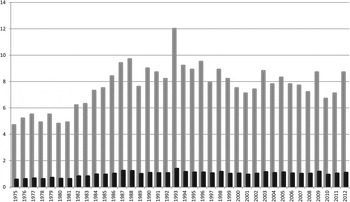
Over the period of study, there were 10 258 suicide deaths in Galicia, 7519 men and 2739 women. Suicide rates increased from 1975, with 145 suicides (0.56% of all deaths), to a high in 1993, with 377 suicides (1.38% of all deaths). Since then, the rates have decreased continuously to 335 suicides in 2012 (1.22% of all deaths) (Fig. 1).
Age-standardised rates of deaths by suicide in Galicia (grey bars) and percentage over the total causes of death (black bars).

Data on suicide and other causes of death in the period 1975–2012 in Galicia can be seen in supplementary data (Tables S1, S2 and S3).
Trends in suicide rates from 1975 to 2012 in Galicia
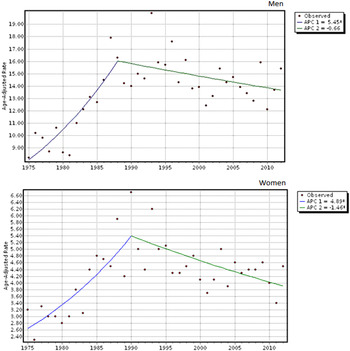
The joinpoint analyses show two different periods in suicide mortality rate for men (p = 0.0002) and for women (p = 0.0002). A first period of increasing suicide deaths between 1975 and 1988 is followed by a period of stability, with slightly decreasing trends thereafter. For men, the APC between 1975 and 1988 (CI 95% 1986–1994) was 5.45 (CI 95% = 3.5, –7.2) but from 1988 the APC became negative [−0.66 (CI 95% = −1.3, −0.1)]. For women, APC between 1974 and 1990 (CI 95% 1986–1992) was 4.86 (CI 95% = 3.2, −6.4) and −1.46 subsequently (CI 95% = −2.2, −0.5) (Fig. 2).
Joinpoint analyses of age-standardised suicide rates for all ages.

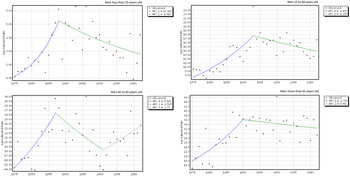
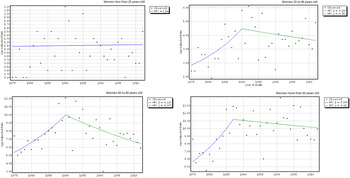
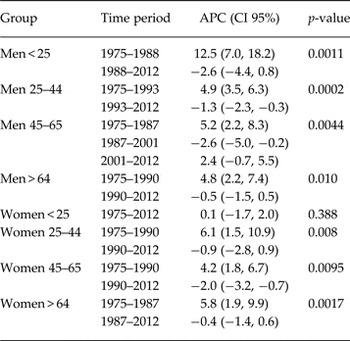
Joinpoint analyses of age-standardised suicide rates by age groups showed only one point of change in suicide trends for most of the groups, with the two periods described above (first increase and then slow descent). This pattern differed only among young women (less than 25 years), with stable suicide rates along the study period, and men aged 45–65 years, who showed two points of change and three temporal trends: (i) increasing rates from 1975 to 1987, (ii) decreasing rates until 2001, and (iii) increasing suicide rates again since 2001 (Figs 3 and 4).
Joinpoint analyses of age-standardised suicide rates: men.

Joinpoint analyses of age-standardised suicide rates: women.

Table 1 shows data of joinpoint analyses; all of them are significant except for women below 25 years of age.
Age-adjusted suicide mortality rate trends in Galicia in four age groups

APC, annual percentage of change; CI, confidence interval.
Relationship between suicide rates, unemployment and recession
First, we studied the independent correlation between unemployment and suicide, and then between recession and suicide. When studying both sexes, we found a significant association between unemployment and suicide (p = 0.002) but not between recession and suicide (estimate = 0.007; t = 0.501; p = 0.62). Similarly, among men there existed a positive correlation between unemployment and suicide (p = 0.01) but not between recession and suicide (estimate = 0.007; t = 0.572; p = 0.57). Among women, there was no significant correlation between suicide and unemployment (p = 0.487) or recession (estimate = 0.008; t = 0.335; p = 0.74).
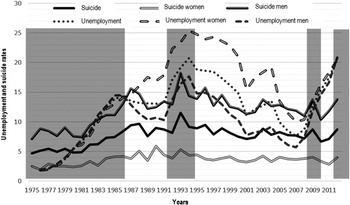
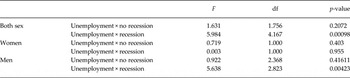
Next, we studied the effect of the interaction between unemployment and recession on suicide for both sexes. A significant interaction was found, showing that unemployment was related with suicide during economic recession periods. After adjusting by sex, the effect was confirmed among men, but not among women (Table 2). This interaction is graphically shown in Fig. 5.
Suicide and unemployment age-standardised rates by sex (recession periods are shaded).

Association between unemployment and suicide mortality rates within each group defined by recession

F, F in F test of significance for the smoothed variable; df, estimated residual degrees of freedom; p-value, p-value of F test.
Discussion
Main findings
Age-adjusted suicide mortality rates rose in Galicia from 1975 to 1990 and decreased slowly afterwards. Two age groups escaped this tendency, young women remained stable along the study period and men aged 45–65 years, with two points of change and increasing suicide rates since 2001. On the other hand, we found an independent association between unemployment and suicide and a clear interaction between unemployment and recession with regards to suicide rates, in both cases only among men.
Suicide mortality trends
The suicide trends found for the Galician region correspond to a similar pattern in the whole country of Spain according to a recent study (Álvaro-Meca et al. Reference Álvaro-Meca, Kneib, Gil-Prieto and Gil de Miguel2013). Adjusted suicide mortality rates rose after the 1975–1985 recession period until 1990, but then descended disregarding more recent recession periods in 1992–1993, 2008–2010 and 2011–2012. The same results are described by Ayuso-Mateos et al. (Reference Ayuso-Mateos, Barros and Gusmão2013) for Spain and by Alameda-Palacios et al. (Reference Alameda-Palacios, Ruiz-Ramos and García-Robredo2014) in the southern region of Andalucia. On the contrary, Lopez Bernal et al. (Reference Lopez Bernal, Gasparrini, Artundo and McKee2013), analysing monthly suicide data for Spain between 2005 and 2010, found an 8.0% steep increase in suicide rates following the 2008 financial crisis despite the underlying downward trend. Suicide rates during the current recession period have also been studied in England (Barr et al. Reference Barr, Taylor-Robinson, Scott-Samuel, McKee and Stuckler2012), the European Union (Stuckler et al. Reference Stuckler, Basu, Suhrcke, Coutts and McKee2009, Reference Stuckler, Basu, Suhrcke, Coutts and McKee2011) and other European, American and Asian countries (Chang et al. Reference Chang, Stuckler, Yip and Gunnell2013). Overall, there is a rising trend but findings differ across countries, with increased suicide rates in America and Europe, but not in Asia or Africa (Chang et al. Reference Chang, Stuckler, Yip and Gunnell2013).
The underlying decreasing suicide trend in Galicia is consistent with European rates and may reflect health policy changes, such as improved mental health provision or the extended use of antidepressants that have taken place in Spain as well as in the rest of Europe (Lopez Bernal et al. Reference Lopez Bernal, Gasparrini, Artundo and McKee2013). Recently, a suicide prevention program introduced in one of the four provinces of Galicia might have contributed to buffer the impact of the 2008 economic recession (Crespo, Reference Crespo2009; Grupo de trabajo de la Guía de Práctica Clínica de Prevención y Tratamiento de la Conducta Suicida. I. Evaluación y Tratamiento, 2012).
Vulnerable groups
We found higher rates of suicide deaths in men than in women in all age groups, consistently with national (Álvaro-Meca et al. Reference Álvaro-Meca, Kneib, Gil-Prieto and Gil de Miguel2013) and international (Haw et al. Reference Haw, Hawton, Gunnell and Platt2014) reports. To explain the so-called gender paradox, previous studies have hypothesised that men suffer more shame from unemployment and often seek less help for psychological pain than women (Haw et al. Reference Haw, Hawton, Gunnell and Platt2014). Of note, the first hypothesis agrees with our finding of increased suicide rates among working-age men (45–65 years) during the last two economic recession periods (2008–2010 and 2011–2013). Suicide rates were significantly correlated with unemployment in the group of men from 45 to 65 years but the aggregation of data might have prevented to capture a similar correlation with economic recession. However, other epidemiological studies in Spain suggest that younger men are particularly exposed to suicide risk: men of 15–44 years of age in Andalucía for the same time period (Alameda-Palacios et al. Reference Alameda-Palacios, Ruiz-Ramos and García-Robredo2014), or men of 15–39 years of age in whole Spain from 2005 to 2010 (Lopez Bernal et al. Reference Lopez Bernal, Gasparrini, Artundo and McKee2013).
When we compare our results with other countries, we find similar results in America, the most affected group being composed by men aged 45–64 in most countries, but different results in Europe, where suicide is most frequent among men aged 15–24 (Chang et al. Reference Chang, Stuckler, Yip and Gunnell2013). In contrast, in many Asian countries – Hong Kong, Korea, Taiwan and Singapore– men aged 65 or more had the highest suicide rates from 1985 to 2006, with the exception of Japan, where suicide mortality among males in the 35–64 age group was higher than in older adults after the economic crisis of 1997 (Chang et al. Reference Chang, Gunnell, Sterne, Lu and Cheng2009).
Unemployment, economic recession and suicide
Although recession by itself was not associated with suicide rates, according to our results unemployment was related with higher male suicide rates, especially during economic recession periods. In Spain, our results contrast with the lack of association between suicide and unemployment in Andalucía (Alameda-Palacios et al. Reference Alameda-Palacios, Ruiz-Ramos and García-Robredo2014). In international studies, researchers have examined the effect of unemployment on suicide rates with different findings. In England, levels of unemployment were strongly correlated with suicides in men and women during the 2008–2010 recession (Barr et al. Reference Barr, Taylor-Robinson, Scott-Samuel, McKee and Stuckler2012). In 26 European Union countries between 1970 and 2007, Stuckler et al. (Reference Stuckler, Basu, Suhrcke, Coutts and McKee2009) found, on average, a correlation of 0.12 (p = 0.0018), between unemployment and suicide rates, varying from −0·13 (Sweden) to 0·59 (Spain). They noted two interesting exceptions across Europe: Finland between 1990 and 1993, and Sweden between 1991 and 1992, where while unemployment rates rose, suicide rates dropped. In USA, a study examining the effect of the 2007 recession showed that for every 1% rise in unemployment there was a 0.99% increase in the suicide rate (Reeves et al. Reference Reeves, Stuckler, McKee, Gunnell, Chang and Basu2012). During Asian economic crisis in 1997–1998, suicide rates increased in Japan, Hong Kong and Korea, but not in Taiwan and Singapore, where the economic crisis had a smaller impact on GDP and unemployment (Chang et al. Reference Chang, Gunnell, Sterne, Lu and Cheng2009). In Australia from 1999 onwards, suicide and unemployment were not related for younger males, concurring to the implementation of a suicide prevention strategy (Morrell et al. Reference Morrell, Page and Taylor2007). Finally, for 2008 global economic crisis, in 54 countries around the world, Chang et al. (Reference Chang, Stuckler, Yip and Gunnell2013) found an association between the increased suicide numbers after the crisis and the increases in unemployment across countries, particularly male suicides in countries with low levels of unemployment before the crisis.
The relationship between unemployment and suicide is certainly complex. A recent review proposed unemployment, along with other factors such as debt or bankruptcy, psychiatric disorders, alcohol abuse, change in family relationships or social inequalities and loss of social cohesion, as a mediator in the relationship between recession and suicide, conforming an interesting explicative model (Haw et al. Reference Haw, Hawton, Gunnell and Platt2014).
There may be different potential causes for short-term fluctuations and long-term trends in suicide rates. In our data, spikes of suicides and unemployment occurred at the beginning of the 1993 and 2008–2010 recessions (Fig. 3), suggesting that unemployment increase in recession periods is associated with a relatively short upsurge in suicides. Early suicide increases in recession periods have also been reported in other countries and may even predate the rise of unemployment. They could be the result of personal bankruptcy before the official recession (Coope et al. Reference Coope, Gunnell, Hollingworth, Hawton, Kapur, Fearn, Wells and Metcalfe2014). Bankruptcy or failure could be stressed at that moment by the relative deprivation in comparison with a social context not yet in crisis. However, long-term suicide trends are dependent on the evolution of a country's GDP (adjusted for purchasing power parity) that needs to be sustained by adequate public health prevention policies and adequate mental health services (Blasco-Fontecilla et al. Reference Blasco-Fontecilla, Perez-Rodriguez, Garcia-Nieto, Fernandez-Navarro, Galfalvy, de Leon and Baca-Garcia2012).
Strengths and limitations
We analysed a whole Spanish region throughout a long period of time, 37 years, by using joinpoint regression, a method which allowed us to identify trend changes and identify underlying factors in corresponding time-periods. This method has been used for trend analysis of other diseases such as cancer (Rodríguez-Rieiro et al. Reference Rodríguez-Rieiro, Aragonés, Pollan, López-Abente and Pérez-Gómez2009; Vidal Lancis et al. Reference Vidal Lancis, Martínez-Sánchez, Mateos Mazón and Peris Tuser2010). Moreover, GAM models performed for the analysis of the association in time series is an accepted methodology and has been previously used in similar studies assessing suicide and other diseases (Dominici et al. Reference Dominici, McDermott, Zeger and Samet2002; Hajat et al. Reference Hajat, Kovats, Atkinson and Haines2002; Likhvar et al. Reference Likhvar, Honda and Ono2011b).
Our study also has a number of limitations. First, the accuracy of official suicide figures is currently under debate not only in Spain, but worldwide. Undetermined death is the most common alternative in death certificates in cases of probable suicide, and there is a significant downward linear trend in the number of undetermined deaths in Spain (Chishti et al. Reference Chishti, Stone, Corcoran, Williamson and Petridou2003; Värnik et al. Reference Värnik, Sisask, Värnik, Arensman, Van Audenhove, van der Feltz-Cornelis and Hegerl2012). During the timeframe of our study, suicide deaths increased while undetermined deaths decreased in Galicia (Tables S1, S2 and S3), which suggests that the quality of suicide data has been improving. Moreover, as in all population studies, we should be cautious not to extrapolate population results on individual people. Another limitation in our study is that we did not have data on important suicide risk factors such as mental disorders, antidepressant prescriptions, alcohol or drug use or marital status. Additionally, our study did not explore differences between provinces or municipalities. Future studies could increase the accuracy of our analysis using disaggregated data of the municipalities, but detailed official statistics are lacking.
Public health implications
Given that suicide is a major public health concern, the risk conveyed by excessive unemployment during recession periods could be reduced by labour-market programs as other authors have proposed (Lundin & Hemmingsson, Reference Lundin and Hemmingsson2009). Additionally, the development of specific prevention programs focused on vulnerable age group might be necessary, and could extend current interventions (Crespo, Reference Crespo2009; Grupo de trabajo de la Guía de Práctica Clínica de Prevención y Tratamiento de la Conducta Suicida. I. Evaluación y Tratamiento, 2012). Given that men aged 45–65 are a vulnerable population not likely to seek help (Chang et al. Reference Chang, Stuckler, Yip and Gunnell2013), targeted screening programs applied on primary health care could help to identify high-risk people in this group.
Although this study has provided information about suicide trends and its relationship with economic indicators in a Spanish region with high suicide rates, further research is needed. Spatial analysis would provide more information about suicide in Galicia, and incorporating clinical variables to these models is necessary to improve our understanding of the relationship between unemployment and suicide.
Acknowledgements
None.
Financial Support
This research was partially supported by Grant PI13/02200 Instituto de Salud Carlos III (Ministerio de economía y competitividad).
Conflict of Interest
None.
Ethical Standard
There are no ethical conflicts regarding this research. We used free public anonymised databases form Spanish Government servers.
Supplementary material
The supplementary materials referred to in this article can be found at http://dx.doi.org/10.1017/S2045796015000773