Introduction
Although organisations and human resource management agree about the importance of open dialogue, studies highlight that, in practice, many employees doubt their organisations’ support for mutual communication and the exchange of information, which consequently hampers the success of organisational goals and objectives (Dyne, Ang, & Botero, Reference Dyne, Ang and Botero2003). One of the main obstacles to the success of such objectives is the lack of information, which is often referred as ‘organisational silence’. This implies the suppression of ideas, opinions and information in relation to an organisation’s problems and effectiveness (Morrison, Reference Morrison2014), which is a notoriously widespread phenomenon (Kanani, Enayati, Lari, & Sal, Reference Tabatabaei and Bigdelli2015). Thus, organisational silence has a negative influence on the ability of organisations to detect errors and learnings (Nafei, Reference Nafei2016). Furthermore, organisational silence has a negative influence on both the organisation and employees as it makes employees feel they are not important, are not in control and lose confidence (Liang & Wang, Reference Liang and Wang2016). Therefore, it has become necessary for contemporary organisations to maintain and attract the human resources required to protect them from a culture of silence. This can be achieved by creating ideas, presenting views and having discussions that positively influence employees’ performances (Ehtiyar & Yanardağ, Reference Ehtiyar and Yanardağ2008; Tabatabaei & Bigdelli, Reference Tabatabaei and Bigdelli2015). Hence, organisations can adopt a culture that encourages employees to voice concerns that enable these issues to be tackled as soon as possible. This is of particular importance in hospitals (Nafei, Reference Nafei2016; Çaylak & Altuntaş, Reference Çaylak and Altuntaş2017).
Another issue related with organisational silence is organisational cynicism, which is one of the most undesirable organisational phenomena. Organisational cynicism, although not a recent phenomenon, has not been studied sufficiently by researchers (Tabatabaei & Bigdelli, Reference Tabatabaei and Bigdelli2015). Both organisational silence and organisational cynicism are factors that hinder the improvement of organisations, particularly in the health sector, because of the link between them and employees’ attitudes and behaviours (Çaylak & Altuntaş, Reference Çaylak and Altuntaş2017). This is important as employees’ views, ideas and the information they process are considered constructive means for the improvement of an organisation’s work. In some cases, employees – individually or in groups – voice their ideas, views and information regarding issues and organisational problems. However, sometimes they suffer from a reluctant ‘silence’, which is a vaguer concept than organisational voice (Dyne, Ang, & Botero, Reference Dyne, Ang and Botero2003).
A number of theories address these issues. Perceived organisational politics is defined by the conservation of resources theory as the process of everyone trying to conserve resources and achieve the most from them in any possible way (Hobfoll, Reference Hobfoll2001). Perceived organisational politics deals a recognised phenomenon in organisations and can significantly affect employees’ outcomes and beliefs (Delle, Reference Delle2013), one of which is organisational silence (Liang & Wang, Reference Liang and Wang2016). Social exchange theory (Armeli, Eisenberger, Fasolo, & Lynch, Reference Armeli, Eisenberger, Fasolo and Lynch1998) and organisational support theory (Eisenberger, Huntington, Hutchison, & Sowa, Reference Eisenberger, Huntington, Hutchison and Sowa1986; Rhoades & Eisenberger, Reference Rhoades and Eisenberger2002) also attempt to interpret employees’ perceptions with regard to the commitment of the organisation in satisfying their needs. In addition, the employee may compare their experiences with what happened to their peers in similar circumstances. Perceived support for employees can have a significant impact on their beliefs, feelings and behaviour (Settoon, Bennett, & Liden, Reference Settoon, Bennett and Liden1996; Riggle, Edmondson, & Hansen, Reference Riggle, Edmondson and Hansen2009). The relationship between the organisation and employees is judged by the employees in terms of what they are offered and what they actually receive from the organisation (Fatima, Salah-Ud-Din, Khan, Hassan, & Hoti, Reference Fatima, Salah-Ud-Din, Khan, Hassan and Hoti2015).
This study is important for two main reasons. First, many studies about the effect of perceived organisational politics on organisational silence have been undertaken in developed countries (e.g., Riggle, Edmondson, & Hansen, Reference Riggle, Edmondson and Hansen2009; Kurtessis, Eisenberger, Ford, Buffardi, Stewart, & Adis, Reference Kurtessis, Eisenberger, Ford, Buffardi, Stewart and Adis2017). However, empirical investigations in developing countries are still limited, especially in relation to public hospitals (Nafei, Reference Nafei2016). Second, in addition to the variables included in previous studies, the current study includes the variables of organisational cynicism as a mediator and of perceived support as a moderator. Therefore, the current study aims to identify the effect of the mediating role of organisational cynicism in relation to perceived organisational politics on organisational silence. It endeavours to test the part played by perceived support (moderating role) through assessing the views of a sample of employees working in public hospitals. Thus, the conceptual framework of this study is based on the links formed between the three interconnected factors that are expected to arise, namely, perception, attitude and outcomes. These links were found in several studies, albeit using different variables (e.g., Chang, Rosen, & Levy, Reference Chang, Rosen and Levy2009; Tabatabaei & Bigdelli, Reference Tabatabaei and Bigdelli2015). The negative perception of the organisational phenomena, that is perceived organisational politics, tends to increase employees’ negative attitudes towards organisational cynicism. Hence, this would increase the possible negative outcomes faced by an organisation regarding employees in terms of organisational silence. Thus, this study hypotheses that the effect of positive perceived support will reduce the negative perceptions of organisational politics.
Theory and hypotheses
Perceived organisational policies
The conservation of resources theory accounts for organisational politics by explaining that individuals attempt to conserve valuable resources (material or moral) and these individuals also attempt to exert control over them (Hobfoll, Reference Hobfoll2001). Most organisations have limited resources in different areas; therefore, this is likely to increase the occurrence of behaviours and activities aimed at achieving the conservation of resources which, in turn, give value to those controlling them (Kacmar & Carlson, Reference Kacmar and Carlson1997). Perceived organisational politics is defined as the behaviours and actions that happen informally inside an organisation and encompasses individuals’ actions aimed at supporting their private interests, which may agree or disagree with other individuals’ interests (Mintzberg, Reference Mintzberg1983; Ferris, Russ, & Fandt, Reference Ferris, Russ and Fandt1989; Bukhari & Kamal, Reference Bukhari and Kamal2015). It refers to behaviour in which personal interests are more important than those of the organisation (Malik, Danish, & Ghafoor, Reference Malik, Danish and Ghafoor2009). Furthermore, perceived organisational politics is the degree to which individuals view their work environment as a political one, which is characterised by injustice (Ferris, Russ, & Fandt, Reference Ferris, Russ and Fandt1989; Zivnuska, Kacmar, Witt, Carlson, & Bratton, Reference Zivnuska, Kacmar, Witt, Carlson and Bratton2004). Thus, determining the degree to which politics is promoted within the organisation can relate to employees’ perception of it (Zivnuska et al., Reference Zivnuska, Kacmar, Witt, Carlson and Bratton2004) demonstrating that employees’ perceptions of the political attitude of the organisation is very important (Zivnuska et al., Reference Zivnuska, Kacmar, Witt, Carlson and Bratton2004; Mathur, Nathani, & Dubey, Reference Mathur, Nathani and Dubey2013; Yilmaz, Reference Yilmaz2014).
Perceived organisational politics can be classified into two types. The first is the motivational motive which increases employees’ job satisfaction and organisational commitment and reduces the turnover of employees. In contrast, the punishment motive notably decreases employees’ job satisfaction and organisational commitment and encourages them to quit the organisation (Sogra, Shahid, & Najibullah, Reference Sogra, Shahid and Najibullah2009). Despite the difficulty in evaluating political attitudes, most employees directly or indirectly perceive a political event regardless of how a company attempts to represent it. Thus, this could facilitate the measurement of the political attitude either way (Kacmar & Carlson, Reference Kacmar and Carlson1997).
Over the past few years, organisational politics have become a significant area of study of the influential factors and ways in which organisations are run (Bodla, Afza, & Danish, Reference Bodla, Afza and Danish2015; Chinomona & Mofokeng, Reference Chinomona and Mofokeng2016). In this context, perception, recognition and group acceptance of political activities can be influential and determining factors in terms of the nature the organisational culture (Kacmar & Carlson, Reference Kacmar and Carlson1997). In addition, political attitude is able to impact upon numerous functional results and sometimes results in confusion at both individual and group levels, on whether the perception is positive or negative to the organisation (Mathur, Nathani, & Dubey, Reference Mathur, Nathani and Dubey2013; Arogundade, Arogundade, & Gbabijo, Reference Arogundade, Arogundade and Gbabijo2016). Moreover, it must be noted that the organisational politics are directionally associated with negative phenomena, including job stress, fatigue, absenteeism, organisational silence and work adverse behaviours (Goodman, Evans, & Carson, Reference Goodman, Evans and Carson2011; Bedi & Schat, Reference Bedi and Schat2013; Abbas, Raja, Darr, & Bouckenooghe, Reference Abbas, Raja, Darr and Bouckenooghe2014; Arogundade, Arogundade, & Gbabijo, Reference Arogundade, Arogundade and Gbabijo2016; Chinomona & Mofokeng, Reference Chinomona and Mofokeng2016). It is also inversely related to the positive phenomena at both the individual and organisational levels. These phenomena are represented by factors, such as organisational co-working behaviour, commitment, trust, organisational fairness, performance, job satisfaction and job engagement (Randall, Cropanzano, Bormann, & Birjulin, Reference Randall, Cropanzano, Bormann and Birjulin1999; Malik, Danish, & Ghafoor, Reference Malik, Danish and Ghafoor2009; Bedi & Schat, Reference Bedi and Schat2013; Delle, Reference Delle2013; Karatepe, Reference Karatepe2013; Meisler & Vigoda-Gadot, Reference Meisler and Vigoda-Gadot2014).
Ferris and Kacmar (Reference Ferris and Kacmar1992) proposed that perceived organisational politics can be specifically measured in relation to three factors: general political behaviour, go along to get ahead, and pay and promotion policies. (1) General political behaviour refers to the behaviour development addressed to obtain private interests. This could arise from unclear rules regarding general conduct. Therefore, it makes those who deal skilfully with individuals and situations winners at the expenses of others (Kacmar & Carlson, Reference Kacmar and Carlson1997; Yilmaz, Reference Yilmaz2014). (2) Go along to get ahead refers to individuals who wish to avoid conflict, and therefore, do not oppose other attempts at influence. These individuals are not viewed as a threatening adversary by those who act politically; thus, go along to get ahead (lack of action) is an appropriate and profitable policy to take in order to advance one’s own self-interests, particularly when working in a political environment (Kacmar & Carlson, Reference Kacmar and Carlson1997). (3) Pay and promotion policies involves the organisation’s political action in terms of the enactment of rules regarding promotions (Ferris, Russ, & Fandt, Reference Ferris, Russ and Fandt1989; Kacmar & Carlson, Reference Kacmar and Carlson1997). The stated rules may encourage particular individuals to exhibit political behaviour, such as when rewards are granted to only certain people, which can trigger disappointment in others and, consequently, cause them to resort to political behaviour (Kacmar & Carlson, Reference Kacmar and Carlson1997).
Organisational cynicism
The concept of cynicism dates back at least to 400 BCE, when Athenians were cynical about politicians’ monopolistic control over wealth (Stanley, Meyer, & Topolnytsky, Reference Stanley, Meyer and Topolnytsky2005). Since 1990, this concept has been developed and used in many areas, such as sociology, psychology and administration (Qian & Daniels, Reference Qian and Daniels2008). In general, cynicism refers to a predominate pessimism within society and the business environment. Within organisations, organisational cynicism refers to employees’ negative attitudes towards their organisations (Tabatabaei & Bigdelli, Reference Tabatabaei and Bigdelli2015). Moreover, organisational cynicism is connected with negative effects such as carelessness, resignation, alienation, despair, distrust, disdain, uncertainty, disappointment, personal conflict, poor performance, absenteeism and fatigue (Andersson & Bateman, Reference Andersson and Bateman1997; Dean, Brandes, & Dharwadkar, Reference Dean, Brandes and Dharwadkar1998; Abraham, Reference Abraham2000).
Furthermore, the use of cynicism is considered to be self-defensive. For those who embrace it, it is a means of changing their undesirable situation, which may be caused by corrupt and unfair circumstances within the working environment. These, consequently, have a negative impact on the employee’s prospects (Cole, Bruch, & Vogel, Reference Cole, Bruch and Vogel2006; Naus, Reference Naus2007). Thus, cynicism could have huge impacts on the individual and organisation (Naus, Van Iterson, & Roe, Reference Naus, Van Iterson and Roe2007). Although employee cynicism can appear to be a simple thing, it can greatly contribute to overall organisational cynicism and, thus, administrative interventions and the creation or enactment of policies and new practices can be targeted as a result (Naus, Reference Naus2007). As argued by Dean, Brandes, and Dharwadkar (Reference Dean, Brandes and Dharwadkar1998), organisational cynicism is negative for an organisation for the following reasons: (1) There is a belief that the organisation lacks integrity. (2) Employees’ possess negative impressions of the organisation. (3) The inclination to be critical and rude against the organisation. Moreover, according to (Mathur, Nathani, & Dubey, Reference Mathur, Nathani and Dubey2013), organisational cynicism tends to lead to negative predictions regarding organisational and administrative initiatives, with it being expressed in many forms, for instance complaining, joking, secret comments, swearwords, winking and destructive hints. However, these can be reduced by actions, such as open and honest communication.
Although some earlier researchers have addressed the concept of organisational cynicism as a one-dimensional construct (e.g., Andersson, Reference Andersson1996; Andersson & Bateman, Reference Andersson and Bateman1997), the current research tackles cynicism as a multidimensional conceptual construct (e.g., Dean, Brandes, & Dharwadkar, Reference Dean, Brandes and Dharwadkar1998; Brandes, Dharwadkar, & Dean, Reference Brandes, Dharwadkar and Dean1999; Proefschrift, Reference Proefschrift2007; Ince & Turan, Reference Ince and Turan2011). For example, Dean, Brandes, and Dharwadkar (Reference Dean, Brandes and Dharwadkar1998) used the traditional three-dimensional construct. This involves the belief dimension that is reflected in the employees’ cognitive evaluations regarding their organisation’s integrity and honesty; the emotional dimension that is reflected in their negative feelings and the behaviour dimension, which is reflected in significant behaviours regarding organisational cynicism. In addition, Nafei (Reference Nafei2013) developed a conceptual framework about organisational cynicism which includes: (1) belief or cognition, which is the key dimension of organisational cynicism. It refers to the employees’ belief that an organisation is lacking the credibility and consistency (Dean, Brandes, & Dharwadkar, Reference Dean, Brandes and Dharwadkar1998). When employees believe that the organisation’s practices are not just and honest, they adopt unprincipled actions and immoral attitudes as if they are norms. In addition, cynics may believe that human beings in general are untrustworthy and incoherent in their behaviours (Brandes, Dharwadkar, & Dean, Reference Brandes, Dharwadkar and Dean1999; Proefschrift, Reference Proefschrift2007; Ince & Turan, Reference Ince and Turan2011). (2) Emotional or affect, which is the second dimension, referring to the formation of emotional responses arising from employees’ realisation that their expectations and wishes, such as integrity and credibility, have not been achieved as a part of the organisation’s commitments (Proefschrift, Reference Proefschrift2007; Ince & Turan, Reference Ince and Turan2011). Therefore, cynicism against an organisation may carry with it powerful emotional responses, including anxiety, nervousness and disdain (Dean, Brandes, & Dharwadkar, Reference Dean, Brandes and Dharwadkar1998; Brandes, Dharwadkar, & Dean, Reference Brandes, Dharwadkar and Dean1999). (3) Behaviour, which represents the negative tendency to recognise the organisation’s strengths, value and importance (Dean, Brandes, & Dharwadkar, Reference Dean, Brandes and Dharwadkar1998). These negative attitudes to an organisation’s tangible and intangible elements may be expressed implicitly or explicitly and are an outcome of the negative beliefs and impressions employees feel towards an organisation (Brandes, Dharwadkar, & Dean, Reference Brandes, Dharwadkar and Dean1999; Proefschrift, Reference Proefschrift2007; Kutanis & Cetinel, Reference Kutanis and Cetinel2010).
Perceived organisational politics and organisational cynicism
It is very important to acknowledge the cognitive and emotional responses to the perceived political environment of an organisation (Davis & Gardner, Reference Davis and Gardner2004). This idea is supported by the reasons for the importance of measuring the perceived rather than the actual politics, as proposed by Ferris and Kacmar (Reference Ferris and Kacmar1992). The reasons include: (1) measurement of perceived politics being much easier than that of actual behaviour; (2) perceived politics represents the actual fact and, thus, they are more expressive of people’s views, attitudes and behaviours and (3) perceived politics are more influential in terms of employees’ views and behaviours than the actual politics. Therefore, employees’ perceptions that decisions and procedures which have been taken are unfair, or are deceptive or self-serving for the organisation lead them to being cynical (Dean, Brandes, & Dharwadkar, Reference Dean, Brandes and Dharwadkar1998). In other words, an employee using cynicism can be simply experiencing a defensive reaction against a feeling of psychological threat or injustice (Cole, Bruch, & Vogel, Reference Cole, Bruch and Vogel2006). Since organisational politics are an unwanted aspect within the organisational environment, employees being part of the environment are more likely to respond with cynicism (Davis & Gardner, Reference Davis and Gardner2004). In addition, perceived organisational politics are one of the factors that obstruct employees’ positive organisational behaviour (Bukhari & Kamal, Reference Bukhari and Kamal2015). Moreover, Goodman, Evans, and Carson (Reference Goodman, Evans and Carson2011) emphasise that organisational politics could have an effect on organisational and individual results in the sense that it alters situations and behaviours. Furthermore, influenced by the understanding and assessment of the degree of self-interest behaviour of other employees in the organisation, perception of organisational politics has been proved to have a significant influence on the attitude and behaviour of employees (Rong & Cao, Reference Rong and Cao2015). Meanwhile, Kiewitz, Restubog, Zagenczyk, and Hochwarter (Reference Kiewitz, Restubog, Zagenczyk and Hochwarter2009) argue that employees’ perceptions of organisational politics serve as an indicator for the overall charitable or malignant character of the organisation and their agents. These findings support Hypothesis 1.
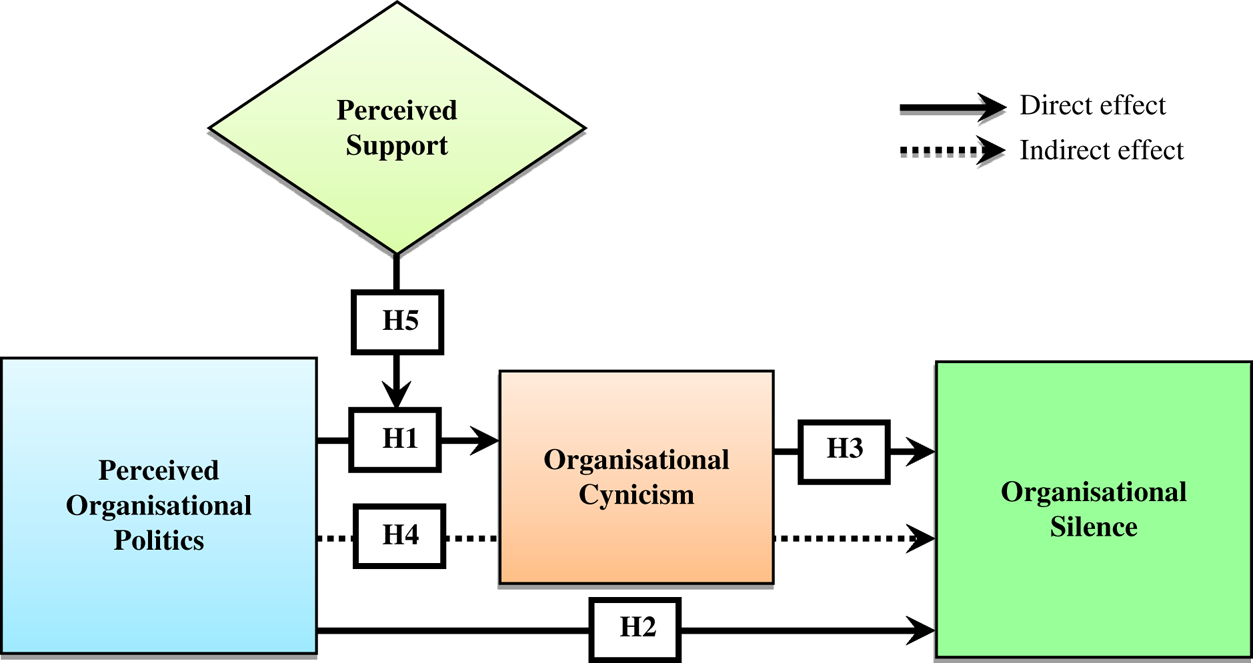
Hypothesis 1: Perceived organisational politics will be positively related to organisational cynicism.
Organisational silence
Organisational silence is not necessarily viewed as contradictory to organisational voice. Silence happens either when people do not have relevant ideas; information and opinions or they refuse to share information, opinions and views (Pinder & Harlos, Reference Pinder and Harlos2001; Dyne, Ang, & Botero, Reference Dyne, Ang and Botero2003). People usually keep silent to avoid confrontation, potential disagreements and perceived dangers (Ehtiyar & Yanardağ, Reference Ehtiyar and Yanardağ2008). The main characteristic that differentiates silence and voice is not the presence or absence of speaking up, but the individual’s motivation to withhold rather than express ideas, information and opinions about the business environment. Therefore, there are three specific employee motives: disengaged behaviour based on resignation, self-protective behaviour based on fear and other oriented behaviour based on cooperation (Dyne, Ang, & Botero, Reference Dyne, Ang and Botero2003). Organisational silence can be characterised in two ways: first, it is focussed on collective-level dynamics; and second, it is focussed on why employees usually prefer to be silent, rather than on why they do not choose to speak-up (Nafei, Reference Nafei2016). In this regard, Dyne, Ang, and Botero (Reference Dyne, Ang and Botero2003) define three vital points associated with organisational silence. First, the absence of a voice does not translate as the existence of organisational silence. Second, it does not include cases of reckless behaviour, which are not related to conscious decision-making. Third, it considers work-related issues that contribute to its improvement.
Organisational silence takes various forms, such as collective silence at meetings, low-level participation in discussions and low level of collective voice (Ehtiyar & Yanardağ, Reference Ehtiyar and Yanardağ2008). Therefore, the current study focusses on these forms. Furthermore, Nafei (Reference Nafei2016) highlights the five factors that influence organisational silence. The factors are: (1) top management support for silence owing to their fears of negative reactions or because of managers’ underlying beliefs; (2) chances for communication are unavailable; (3) supervisors’ encouragement of silence; (4) formal authority and (5) employees’ fears of negative reactions. Meanwhile, Ehtiyar and Yanardağ (Reference Ehtiyar and Yanardağ2008) believe that management encourages organisational silence because: (1) managers think that information raised by their subordinates could be threatening to their position, thus they ignore it, depreciate it or even doubt its credibility; (2) managers think employees when expressing their views, do not consider others’ interests and top management is the only authority able to do so; and (3) the underlying and unprecedented belief that unanimity is an indicator of organisational soundness. Therefore, it is thought better to avoid conflicting views.
Silence can also be classified according to the incentives for using it into: (1) behaving in a negative way with no participation or agreement on anything because of the feeling of inability to change precautionary behaviour; (2) premeditated behaviour, which involve self-defending and relies on the feeling of fear; (3) orientation towards others, thus relying on cooperation with other people and preference (Pinder & Harlos, Reference Pinder and Harlos2001; Dyne, Ang, & Botero, Reference Dyne, Ang and Botero2003). The first incentive represents acquiescent silence, which relies on non-engagement in discussion and the exchange of views and information due to the belief that change is unlikely to happen. The second incentive represents the defensive (quiescent) silence, which refuses to present conscious information, ideas and opinions; it is concerned with self-defence and is considered the best strategy in this context. The third incentive, the pro-social silence, is concerned with rational behaviour, hence it is not dictated by the organisation. It includes the withholding of ideas, opinions and information concerning work. It aims to support other people and the organisation’s interests and advantages, based on the concepts of preference and cooperation (Pinder & Harlos, Reference Pinder and Harlos2001; Dyne, Ang, & Botero, Reference Dyne, Ang and Botero2003).
Perceived organisational politics and organisational silence
Generally, organisational politics are not desired by employees; however, managers and supervisors use their political skills to keep things working, and employees can perceive it negatively. They think that it is based on personal interest and tolerance, which leads to employees showing negative responses (Chang, Rosen, & Levy, Reference Chang, Rosen and Levy2009). Furthermore, perceived organisational politics can have an effect on various processes, relationships and behaviours (Bodla, Afza, & Danish, Reference Bodla, Afza and Danish2014). Political behaviours are the means by which personal interests and status can be met. Thus, an imbalance in employees’ positions and attitudes is likely to happen as a result (Yilmaz, Reference Yilmaz2014). Liang and Wang (Reference Liang and Wang2016) inferred that organisational politics is one factor contributing to the formation of organisational silence, particularly in state-owned enterprises. In other words, perceived organisational politics is believed to have a positive effect on organisational silence. This supports the study Hypothesis 2.
Hypothesis 2: Perceived organisational politics will be positively related to organisational silence.
The mediating role of organisational cynicism and organisational silence
Organisational cynicism can be defined as ‘a negative attitude toward one’s employing organisation, comprising three dimensions: (1) a belief that the organisation lacks integrity; (2) negative affect toward the organisation; and (3) tendencies to disparaging and critical behavior toward the organisation that are consistent with these beliefs and affect’ (Dean, Brandes, & Dharwadkar, Reference Dean, Brandes and Dharwadkar1998). Since verbal, intellectual and physical behaviours form an indicator of organisational silence (Dyne, Ang, & Botero, Reference Dyne, Ang and Botero2003), employees tend to resort to their intellect, belief and behaviours in order to cover up their ideas and opinions when they feel they are invaluable (Ehtiyar & Yanardağ, Reference Ehtiyar and Yanardağ2008). Organisational silence is considered a normal response from employees who are cynical with regard to their organisations (Çaylak & Altuntaş, Reference Çaylak and Altuntaş2017). However, although research indicates that cynicism may lead to negative results for employees, cynical employees are often silent (Tabatabaei & Bigdelli, Reference Tabatabaei and Bigdelli2015). Moreover, organisations need to ensure that employees must be encouraged to present ideas and views. However, organisational silence has become widespread across modern organisations and has subsequently become a critical issue for managers. Hence, it is important to identify the actual reasons and motives behind such behaviours (Yu & Ye, Reference Yu and Ye2015). In this context, Chang, Rosen, and Levy (Reference Chang, Rosen and Levy2009) highlight a negative relationship between employee perception of self-serving, illegitimate political activities at work and their behaviour and attitudes. This supports Yu and Ye (Reference Yu and Ye2015) and Tabatabaei and Bigdelli (Reference Tabatabaei and Bigdelli2015) claims that there is mediating role for organisational cynicism in relation to the moral climax (or fairness) and organisational silence. Consequently, this study investigates the role of organisational cynicism as a mediator with regard to the relationship between the perceived organisational politics and organisational silence. This leads to two further hypotheses:
Hypothesis 3: Organisational cynicism will be positively related to organisational silence.
Hypothesis 4: The relationship between perceived organisational politics and organisational silence will be mediated by organisational cynicism.
Perceived support
Interest in the concept of support in relation to employees inside their organisations has been increasing. It is linked with employees’ views regarding how the organisation evaluates their work, contributions and prospects and, further, how it affects the important outcomes at an individual level (employees) and at a group level (organisation) (Rhoades & Eisenberger, Reference Rhoades and Eisenberger2002; Ambrose & Schminke, Reference Ambrose and Schminke2003). According to organisational support theory, an organisation is committed to satisfying their employees’ requirements, such as their social, emotional and financial needs. These can be assessed by employees using three main factors: justice, supervisor’s support, and organisational rewards and appropriate working conditions (Rhoades & Eisenberger, Reference Rhoades and Eisenberger2002). Pay rises and treating employees respectfully are also recommended (Bukhari & Kamal, Reference Bukhari and Kamal2015). Honesty and trustworthiness, which serve as precedents (Kurtessis et al., Reference Kurtessis, Eisenberger, Ford, Buffardi, Stewart and Adis2017), are also important factors in terms of the perceived support (Bukhari & Kamal, Reference Bukhari and Kamal2015). Moreover, employees’ past experience plays a part in this area (Wayne, Shore, & Liden, Reference Wayne, Shore and Liden1997) because employees’ past experiences, such as whether they had a connection with their current managers or organisation, are an organisational concern (Armeli et al., Reference Armeli, Eisenberger, Fasolo and Lynch1998; Rhoades & Eisenberger, Reference Rhoades and Eisenberger2002). Thus, perceived support can be defined as the employees’ overall impression regarding the extent to which the organisation considers their contributions and efforts (Eisenberger et al., Reference Eisenberger, Huntington, Hutchison and Sowa1986). Based on the self-enhancement and social exchange-related hypotheses, perceived support is supposed to meet the employees’ social, emotional, attribute and pertinence needs.
Employees’ positive perceptions of the support offered by organisations could seemingly provide the organisation with the necessary protection and stability (Daskin & Tezer, Reference Daskin and Tezer2012), since support can improve employees’ impressions of the organisation (Kurtessis et al., Reference Kurtessis, Eisenberger, Ford, Buffardi, Stewart and Adis2017). As a result, a decrease in support for employees may cause employees to meet others’ interests at the expense of their organisation’s interests (Riggle, Edmondson, & Hansen, Reference Riggle, Edmondson and Hansen2009). However, despite attempts made by some organisations to improve their employees’ perceptions, obstacles still remain, such as long-term supervision, assumptive work teams and shortages in resources (Aubé, Rousseau, & Morin, Reference Aubé, Rousseau and Morin2007). Moreover, Ambrose and Schminke (Reference Ambrose and Schminke2003) stress that organisational support is affected by one of the organisation’s contextual factors, organisational structure. Ambrose and Schminke (Reference Ambrose and Schminke2003) emphasise that it is the procedures of the mechanical structures that are used to define support, whereas human interactions are the best for defining support for individuals.
Although researchers, such as Eisenberger et al. (Reference Eisenberger, Huntington, Hutchison and Sowa1986), use perceived support as a one-dimensional variable, others, including Howes, Cropanzano, Grandey, and Mohler (Reference Howes, Cropanzano, Grandey and Mohler2000), use two dimensions: individual-support and team-support. Furthermore, perceived support is normally divided into perceived supervisor support and perceived organisational support (Dawley, Houghton, & Bucklew, Reference Dawley, Houghton and Bucklew2010). This study uses the latter in which perceived organisational support refers to the employee’s perceptions of material or abstract support offered by the organisation in response to employees’ efforts (Eisenberger et al., Reference Eisenberger, Huntington, Hutchison and Sowa1986; Aubé, Rousseau, & Morin, Reference Aubé, Rousseau and Morin2007). Hence, this is used as a justification for employees’ agreement or disagreement with the organisation’s position. Employees, therefore, think their agreement will ensure their demands are met (Dawley, Houghton, & Bucklew, Reference Dawley, Houghton and Bucklew2010). Perceived supervisor support refers to a supervisor’s degree of interest in employees’ concerns, demands, emotions and career development (Kottke & Sharafinski, Reference Kottke and Sharafinski1988; Ambrose & Schminke, Reference Ambrose and Schminke2003). Supervisor’s support is considered to be the main influence as employees’ perceptions are primarily gathered from bosses and thereafter from the organisation as a whole (Eisenberger et al., Reference Eisenberger, Huntington, Hutchison and Sowa1986; Ambrose & Schminke, Reference Ambrose and Schminke2003; Dawley, Houghton, & Bucklew, Reference Dawley, Houghton and Bucklew2010).
The moderating role of perceived support
Both perceived organisational politics and perceived support touch on many aspects of the business environment, including morale, stress, withdrawal and antagonistic behaviours (Cropanzano, Howes, Grandey, & Toth, Reference Cropanzano, Howes, Grandey and Toth1997). Also, they have a significant influence on what employees think about their job, such as satisfaction, turnover intentions and active commitment (Randall et al., Reference Randall, Cropanzano, Bormann and Birjulin1999). According to Riggle, Edmondson, and Hansen (Reference Riggle, Edmondson and Hansen2009), perceived organisational support has a positive effect on job satisfaction and organisational commitment and a moderate positive effect on employee performance. Politics and support are often viewed as contradicting terms, but they may actually have similar objectives when examined more closely. For example, some people tend to join groups and teams where organisational policies are practiced in order to obtain rewards and resources. Therefore, they feel they are in a supportive environment (Cropanzano et al., Reference Cropanzano, Howes, Grandey and Toth1997). Nevertheless, the existence of a supportive organisational environment does not mean the absence of organisational politics and the absence of organisational politics does not mean the availability of a supportive organisational environment (Cropanzano, Kacmar, & Bozeman, Reference Cropanzano, Kacmar and Bozeman1995; Randall et al., Reference Randall, Cropanzano, Bormann and Birjulin1999).
A high level of perceived support can motivate employees to give up personal goals, and thus, the organisation’s interests may be prioritised (Witt & Carlson, Reference Witt and Carlson2006). In this regard, Krongboonying and Lin (Reference Krongboonying and Lin2015) argue that perceived support by employees may undermine the negative effect of the perceived organisational politics in terms of the employees’ positive effect of being devoted to the organisation. An increase in employee support may actually help employees become more satisfied with the support offered by their organisations (Ellen, Ferris, & Buckley, Reference Ellen, Ferris and Buckley2013). Thus, it is an important factor in relation to the positive results of organisations, especially those with high organisational politics (Bukhari & Kamal, Reference Bukhari and Kamal2015). Thus, the perceived support effect is positively related to perceived organisational politics (Hochwarter, Kacmar, Perrewe, & Johnson, Reference Hochwarter, Kacmar, Perrewe and Johnson2003; Daskin & Tezer, Reference Daskin and Tezer2012; Bukhari & Kamal, Reference Bukhari and Kamal2015). Meanwhile, perceived support has been shown to have a negative impact on organisational cynicism (Cole, Bruch, & Vogel, Reference Cole, Bruch and Vogel2006; Özgür, Reference Özgür2015). This is because it is the perceived support that determines employee’s attitudes towards an organisation (Kurtessis et al., Reference Kurtessis, Eisenberger, Ford, Buffardi, Stewart and Adis2017). Overall, Interligi and Albrecht (Reference Interligi and Albrecht2006) and Rong and Cao (Reference Rong and Cao2015) emphasise that organisational and supervisors’ support play an important role in the effect of perceived organisational politics. This claim underpins the following hypothesis:
Hypothesis 5: The greater the perceived support, the weaker the positive relationship between perceived organisational politics and organisational cynicism.
The comprehensive conceptual framework model of study to establish relationship among the study variables is presented in Figure 1.
Conceptual model

Method
Research design
The current study is based on a quantitative approach, which relies on the deductive approach for the examination of the relationship between theory and research, seeking to test the theories embedded within a logical framework or social context (Creswell, Reference Creswell2009; Bryman & Bell, Reference Bryman and Bell2011). The study methodology is descriptive, allowing for a particular problem to be examined, with the relevant information described using the testing of hypotheses, which attempt to explain the nature of relationships among two or more variables. The descriptive approach is usually conducted when organisations are aware of the problem but lack certain knowledge (Zikmund, Babin, Carr, & Griffin, Reference Zikmund, Babin, Carr and Griffin2010).
The population, sample and data collection methods
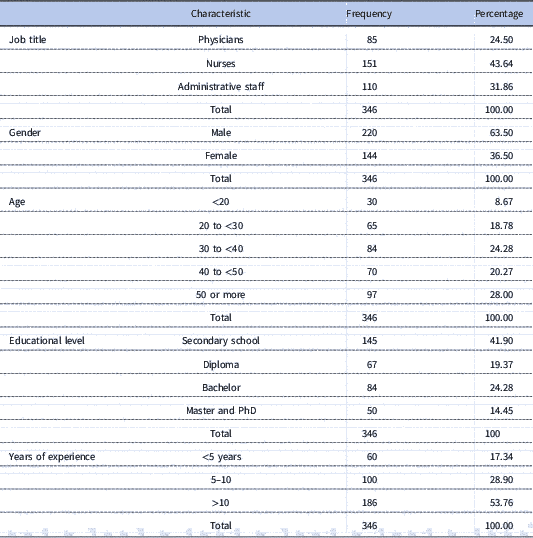
The population of study consists of employees in the health sector in Iraq, namely in the biggest three public hospitals that have around 3,455 employees. The sample consists of randomly selected employees, because employees’ perceptions about organisational politics and organisational silence vary across the organisation (Abbas et al., Reference Abbas, Raja, Darr and Bouckenooghe2014). It has been found that employees witness organisational issues more often than do managers; however, they prefer to remain silent because of fear of being penalised (Morrison, Reference Morrison2014). A total of 450 questionnaires were distributed, and 346 were returned giving a 77% response rate. Table 1 illustrates the demographic and professional characteristics of the respondents. The study used questionnaires to collect the required data. Several multi-option questions were used to obtain the responses. The final questionnaire included 54 items that covered the four key variables – perceived organisational politics, perceived support, organisational cynicism and organisational silence, each with between 11 and 15 dimensions. All items in the questionnaire were measured on a 5-point Likert scale (from 1=‘strongly disagree’ to 5 =‘strongly agree’).
Demographic and professional characteristic of respondents

Measures
Perceived organisational politics: The perceived organisational politics measure followed the dimensions used by Kacmar and Carlson (Reference Kacmar and Carlson1997). It consists of 15 items subdivided as follows: two items assigned for the general political dimension, seven items for the go-ahead dimension and six items for the payment and promotion policies dimension.
Perceived support: This standard was used by Eisenberger et al. (Reference Eisenberger, Huntington, Hutchison and Sowa1986, 2002) and Dawley, Houghton, and Bucklew (Reference Dawley, Houghton and Bucklew2010). It consists of 11 items and was subdivided based on Dawley, Houghton, and Bucklew (Reference Dawley, Houghton and Bucklew2010) into eight items for perceived organisational support and three items for perceived supervisor’s support.
Organisational cynicism: This standard was used by Dean, Brandes, and Dharwadkar (Reference Dean, Brandes and Dharwadkar1998) and Brandes, Dharwadkar, and Dean (Reference Brandes, Dharwadkar and Dean1999). It consists of 13 items: five items for belief and four each for emotion and behaviour.
Organisational silence: This standard was used by Dyne, Ang, and Botero (Reference Dyne, Ang and Botero2003). It consists of 15 items: five items each are devoted to quiescence silence, defensive silence and social positive silence.
Data analysis
Statistical techniques were used for the description and analysis of the study variables and to test the hypotheses. These techniques relied on SPSS V.22 and AMOS V.22. Cronbach’s α was also used to ensure the measures’ reliability, the model’s fit and the model’s validity, alongside Pearson’s correlation to establish the correlation coefficient among variables, a path analysis to check the effect of the hypotheses on mediator variable, and lastly, a hierarchical regression to check the effect of the hypotheses on the moderator variable.
Results
Normality test
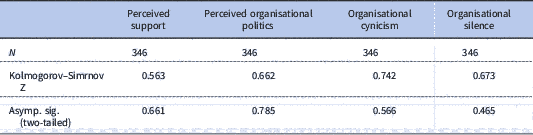
In order to assess the assumed normality, a one-sample Kolmogorov–Smirnov (K–S) test was performed. The results (see Table 2) from the K–S test reports a non-significant result (p>.05), indicating normality (Pallant, Reference Pallant2011).
Results from the one-sample Kolmogorov–Smirnov test

Reliability and assessing the model fit
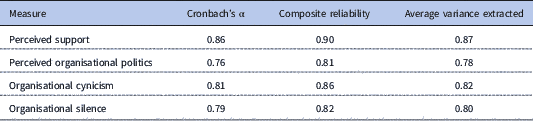
Cronbach’s α and the construct-level reliability (composite reliability) were used to check internal consistency to measure the reliability of each measure (Sekaran, Reference Sekaran2003; Hair, Black, Babin, & Anderson, Reference Dawley, Houghton and Bucklew2010; Pallant, Reference Pallant2011). In addition, the average variance extracted was used to assess the convergent validity of each dimension (Hair et al., Reference Dawley, Houghton and Bucklew2010). As can be seen from Table 3, the Cronbach’s α composite reliability values of all measures are higher than 0.70, thus demonstrating adequate internal consistency. Also, the average variance extracted for each construct ranged from 0.78 to 0.87, which indicates adequate construct convergent validity (Hair et al., Reference Dawley, Houghton and Bucklew2010; Pallant, Reference Pallant2011). Thus, the results show good discriminant validity for each measure.
Cronbach’s α and composite reliability values of scales

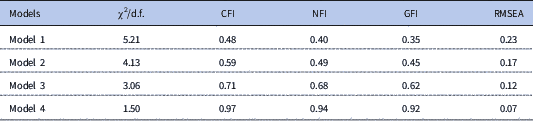
After examining the reliability and validity for each measure, a two-step model approach to structural equation modelling was used. It involved evaluating the measurement models followed by evaluating the structure model (Hair et al., Reference Dawley, Houghton and Bucklew2010; Kline, Reference Kline2011). Confirmatory factor analysis was used to evaluate the measures of the conceptual framework of this study using AMOS V.22. Table 4 summarises the fit result for all four measures.
Assessing the models’ fit

As can be seen in Table 4, Model 1 (single factor) was tested first so that all measures were exerted to one latent factor. This result was reached: χ2/d.f.=5.21; comparative fit index (CFI)=0.48; normal fit index (NFI)=0.40; goodness-of-fit (GFI)=0.35; root mean square error of approximation (RMSEA)=0.23. Model 2 (two-factors) was then tested. Perceived support was considered the first latent factor and other factors were designated to the second latent factor. The following results were obtained: χ2/d.f.=4.13; CFI=0.59; NFI=0.49; GFI=0.45; RMSEA=0.17. Subsequently, Model 3 (three factors) was tested, and perceived support was again considered to be the first latent factor, perceived organisational politics as second latent factor, while the third latent factor included organisational silence and cynicism. The following results were obtained: χ2/d.f.=3.06; CFI=0.71; NFI=0.68; GFI=0.62; RMSEA=0.12. Finally, Model 4 (four factors) was tested, in which all measures were separately associated with latent factors. The following results were obtained: χ2/d.f.=1.50; CFI=0.97; NFI=0.94; GFI=0.92; RMSEA=0.07. Thus, it appears that the indicators of the four-factor model were accepted. This model was characterised by the constructs and discriminant validity, as well as containing the best data for this study’s sample (Hair et al., Reference Dawley, Houghton and Bucklew2010; Kline, Reference Kline2011). In addition, the findings show that all relationships between the indicator variables and the latent variables were statistically significant.
Hypotheses tests
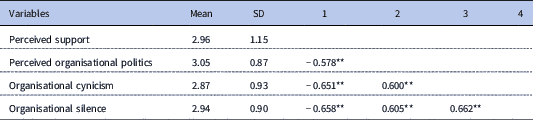
Table 5 illustrates the descriptive statistics and correlation coefficient between the four variables of the study. The mean value ranges from 2.87 to 3.05 and standard deviation from 0.87 to 1.15. The correlations among the study variables model are significant at the 0.01 level. Hence, this offers primary support with regard to the study’s main hypotheses.
Descriptive statistics and correlation coefficient between variables

Note: **Correlation is significant at the 0.01 level (two-tailed).
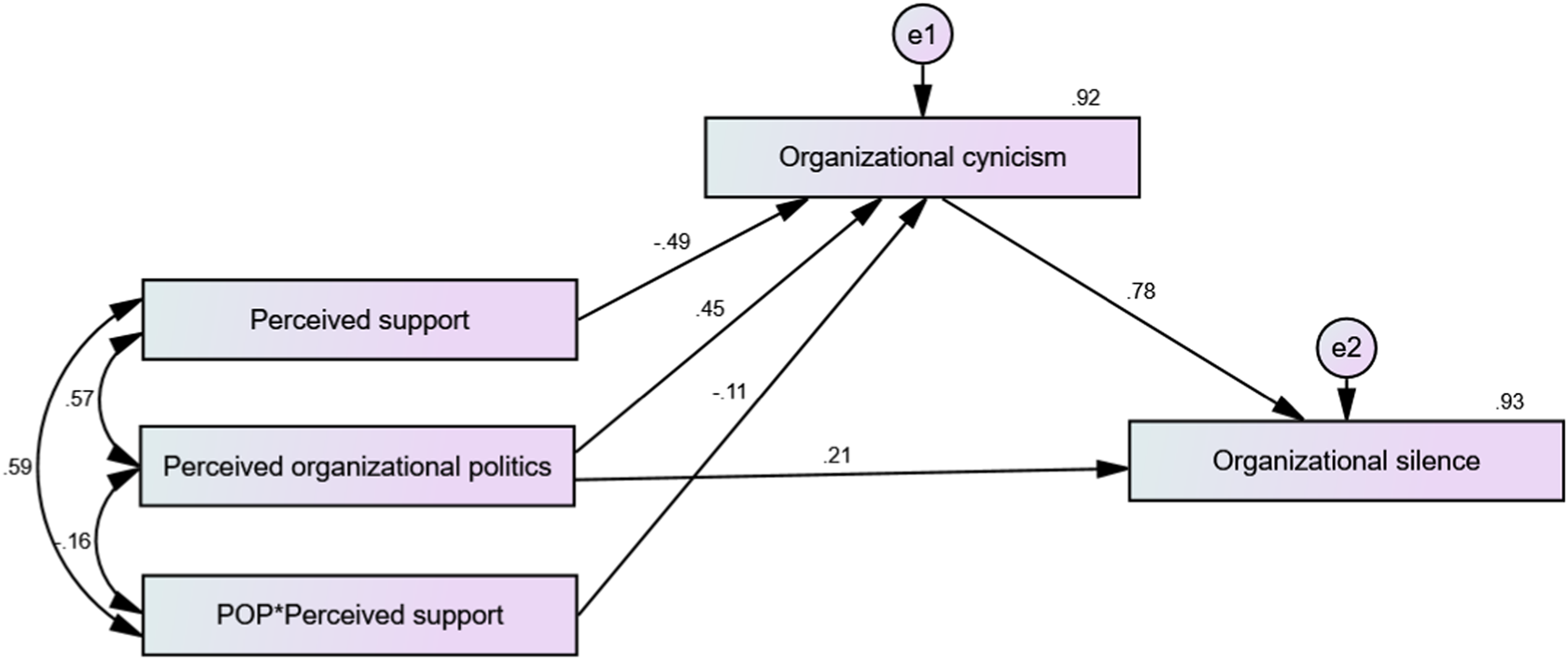
For the testing of the study’s hypotheses, a path analysis was used, which was included in AMOS, V.22. Figure 2 and Table 5 show the results.
Testing of the main hypotheses of the study. Source: AMOS, V.22 program outputs

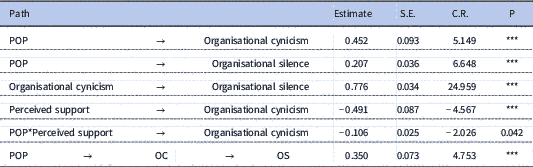
According to Table 6, all direct and indirect effect hypotheses (H1, H2, H3 and H4) were accepted. The Soble test is a suitable method to test individual mediating effects (Baron & Kenny, Reference Baron and Kenny1986). Therefore, the Sobel test was used to identify test data for Hypothesis 4 (Baron & Kenny, Reference Baron and Kenny1986). The results show there is a partial mediating role of organisational cynicism in the relationship between perceived organisational politics and organisational silence.
Test hypotheses

Source: AMOS, V.22 program outputs.
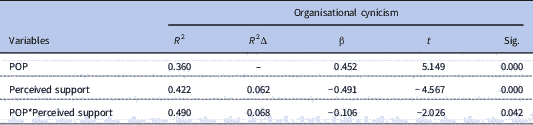
In relation to the Hypothesis 5 test, a moderating effect of perceived support is shown in relation to perceived organisational politics on organisational cynicism. In addition, the hierarchical regression analysis was used to ensure the moderator’s role. First, the independent variable (perceived organisational politics) was added, after which the amended variable (perceived support) was added, and finally, the factor resulting from the interaction of the two variables was added. Table 7 shows the results.
Test the perceived support as a moderating variable

As Table 7 shows, perceived organisational politics explains 36% of the changes which occurred in relation to organisational cynicism, while the effect of adding the amended variable and its reaction alongside perceived organisational politics implies 49% of changes occurred with regard to organisational cynicism (a 13% difference). It also appears to have had an effect between perceived organisational politics and organisational cynicism, causing a negative effect. This may be due to the positive reverse effect between perceived support and organisational cynicism. Therefore, Hypothesis 5, the moderating effect of perceived support on the perceived organisational politics, can be accepted.
Discussion
Throughout this paper, efforts are made to determine the impacts of perceived organisational politics, which is interpreted by resource preservation theory as the act of hiding ideas, information and opinions through the use of organisational silence. How this happens, through the mediating influence of organisational cynicism as a response to a highly political organisational environment is also discussed. Moreover, attempts were made to identify the effect of employees’ perceived support, which is interpreted by the theories of social exchange and organisational support as related to employees’ perceptions of organisational politics. The sample population was drawn from three public hospitals in Iraq. Five hypotheses, derived from previous studies (Interligi & Albrecht, Reference Interligi and Albrecht2006; Rong & Cao, Reference Rong and Cao2015; Tabatabaei & Bigdelli, Reference Tabatabaei and Bigdelli2015; Yu & Ye, Reference Yu and Ye2015), were tested. The first hypothesis is concerned with the positive relationship between perceived organisational politics and organisational cynicism. An initial indication of the relationship was gained through using a Pearson correlation which showed a strong correlation (0.6000 at the level p<.01) between the two variables, perceived organisational politics and organisational cynicism. The β-estimate of 0.452 shown in Table 6 indicates that perceived organisational politics has a positive influence on organisational cynicism in the public healthcare sector in Iraq. This finding is consistent with Davis and Gardner (Reference Davis and Gardner2004), who examine how perceived politics and organisational cynicism emerge from close versus distant leader–member relationships. Their study finds a positive relationship between perceived organisational politics and organisational cynicism. They believe that the leader–member attribution process represents a critical factor that impacts perceived political behaviour and organisation cynicism. The leader makes attributions regarding member performance who respond accordingly. These attributions impact the nature of the exchange relationship, as proposed by Dienesch and Liden (Reference Dienesch and Liden1986), and, as this study proves, affects member perceptions of politics and organisational cynicism.
The second hypothesis of this study examines the effect of perceived organisational politics on organisational silence. Table 5 shows a positive correlation between perceived organisational politics and organisational silence of 0.605 at the level p<.01. In addition, the structural equation modelling analysis shows that perceived organisational politics has a positive influence on organisational silence on those who work in the public hospitals in Iraq, especially managers who play a double role of politics and management. This is consistent with the findings of Liang and Wang (Reference Liang and Wang2016) that the perception of organisational politics partially plays an intermediary role in the formation mechanism of organisational silence. According to Liang and Wang (Reference Liang and Wang2016), employees decide to remain silent when they are faced with serious problems. This is because they are worried about the negative impact on themselves brought about by making suggestions. Therefore, when the relationship between employees and managers is distant, employees tend to be towards silence. However, when the relationship between employees and their managers is closer, and even goes beyond that set out in the employment contract, the employees are more willing to put forward their opinions on problems in the organisation and provide constructive comments.
The third hypothesis examines the relationship between organisational cynicism and organisational silence. According to the results shown in Table 5, the correlation between organisational cynicism and organisational silence was 0.662 at the level p<.01, while the β-estimate in Table 6 shows a positive relationship between organisational cynicism (belief, emotion and behaviour) and organisational silence (quiescence, defensive and social). These results support the findings of Çaylak and Altuntaş (Reference Kurtessis, Eisenberger, Ford, Buffardi, Stewart and Adis2017) who examined the relationship between the organisational silence, organisational cynicism and intention to leave work in university hospitals. Their results show that behavioural cynicism increases when employees remain silent on issues about ethics and responsibilities, employee performance and improvement efforts, particularly when employees feel there is a lack of justice, honesty and sincerity in their workplace and that personal interests unfairly influence the decision-making processes. The fourth hypothesis is related to the mediating role of organisational cynicism on perceived organisational support’s influence on organisational silence. The results show organisational cynicism has a significant mediating role in this case. In other words, the effect of perceived organisational politics on organisational silence is made clearer through organisational cynicism. According to Yu and Ye (Reference Yu and Ye2015), cynicism partially mediated the relationship between instrumental ethical climate and employee’s silence behaviour. Therefore, managers should take into consideration promoting strong positive relations among employees themselves and between management and employees as this encourages employees to speak up.
Finally, the fifth hypothesis examines the moderating role of perceived support to weaken the direct positive relationship between perceived organisational politics and organisational cynicism. The results of this study found perceived support plays a significant role in reversing the positive effect of perceived organisational politics on organisational cynicism. Perceived organisational support for employees can reduce the employees’ attention paid to negative behaviours and activities and encourage them to embrace organisational interests over the interests of themselves and others. Thus, their negative impressions of perceived support are liable to weaken the organisation while positive impressions are likely to strengthen as an organisation–employee mutually reinforceable relationship arises. The results of this study are consistent with studies such as Rong and Cao (Reference Rong and Cao2015) who conclude that perceived organisation support as a moderating variable plays a significant role in the relationship between perceptions of organisational politics and employees’ organisational commitment in such a way that the relationship would be weakened for those with higher perceived organisational support.
Theoretical implications
There is obvious importance for organisations in gaining an understanding of the behaviour of employees. For instance, Ferris, Frink, Galang, Zhou, Kacmar, and Howard (Reference Ferris, Frink, Galang, Zhou, Kacmar and Howard1996) claim that the perception of individuals with an ability to deal with political dynamics is less negative than that of individuals without such ability. Often, managers concentrate their attention on work procedures and ignore the employee perception issue. Furthermore, negative and positive aspects affect the way in which they respond to employees’ emotional and behavioural concerns (see Zivnuska et al., Reference Zivnuska, Kacmar, Witt, Carlson and Bratton2004; Mathur, Nathani, & Dubey, Reference Mathur, Nathani and Dubey2013). Therefore, managers’ emphasis on the perception aspect may alter their beliefs and attitudes towards human resources, thereby obtaining the maximum contribution from individuals to their organisation. In contrast, employees’ reactions to such perceptions will be gradual and accumulative. The process begins with their unconscious behaviour, but will evolve into real behaviours that can be seen in the workplace. This has been explained through the role of organisational cynicism in relation to the connection between perceived organisational politics and organisational silence. Thus, managers need to acknowledge that their employees’ perceptions of the organisation’s political environment can determine their behaviours, which in turn can impact on the organisation as a whole. Moreover, this effect can have greater repercussions than that of the actual organisational environment itself.
The results illustrate that the mean of the employees’ perceived organisational politics was higher than the rest of the variables, which focusses attention on the reasons for this case. Therefore, it is necessary for top management to make decisions that balance between cost and benefits of engaging in behaviours that may be perceived as political (Chang, Rosen, & Levy, Reference Chang, Rosen and Levy2009)
Interestingly, however, despite the existence of a positive relationship between perceived organisational politics and organisation silence (e.g., Yilmaz, Reference Yilmaz2014; Liang & Wang, Reference Liang and Wang2016), this study highlights the importance of the mediating role of organisation cynicism. However, the indirect effect of organisation cynicism – ‘attitude’ – holds more clarity in explaining that the sequential correlation are larger among the three variables (cognition, attitude and behaviour), which is in line with previous studies such as Chang, Rosen, and Levy (Reference Chang, Rosen and Levy2009), Yu and Ye (Reference Yu and Ye2015) and Tabatabaei and Bigdelli (Reference Tabatabaei and Bigdelli2015). Moreover, looking at the organisational politics, it appears to have an undesirable and negative effect on the attitudes and behaviours of employees. This result is consistent with the results of many studies (e.g., Mathur, Nathani, & Dubey, Reference Mathur, Nathani and Dubey2013; Arogundade, Arogundade, & Gbabijo, Reference Arogundade, Arogundade and Gbabijo2016; Chinomona & Mofokeng, Reference Chinomona and Mofokeng2016). This indicates that perceived politics in organisations will potentially lead to attitudes and behaviours that are not wanted within organisations. Furthermore, it can be argued that perceived organisational politics results in employees moving towards self-interest and promoting their indifference to the interests of the organisation and others (Ferris, Russ, & Fandt, Reference Ferris, Russ and Fandt1989; Malik, Danish, & Ghafoor, Reference Malik, Danish and Ghafoor2009). This has all been interpreted by the current study, in the presence of a positive effect of perceived organisational politics on organisational silence, which is something that is harmful to the organisation’s interests owing to the blocking of ideas, opinions and information relating to work.
Managerial implications
This study generates a number of practical implications for managers. First, while managers are processing problems, differences and conflicts among employees, they must take into consideration the level of political behaviour in the processing procedure, since this level will lead to one of the parties’ (sometimes all parties) behaviour being exaggerated. Consequently, this makes individuals think that everything is against them and pushes them to pursue avenues that serve their self-interest regardless of the interests of others, including the organisation. Second, despite the importance of understanding political behaviour, the understanding of how managers perceive their employees’ behaviour is essential, as well as endeavouring to use emotional and social intelligence in interpreting these perceptions. This will allow managers to influence the employees in a number of different ways (e.g., give their support), which is extremely important and offers positive organisational results in terms of changing employees’ views regarding the situation at hand.
The third implication is that dealing with problems linked with organisational politics is not limited to managers at the middle levels, or at the bottom; there is, in fact, an important and significant role for the top management of the hospital or the ministry (see Chang, Rosen, & Levy, Reference Chang, Rosen and Levy2009). Their role is to reduce the incidence of political behaviours or reducing factors that contribute to such issues. This can be achieved through: (1) transparency in all actions and organisational activities to root out any apprehension relating to political practices; (2) following-up of serious complaints and grievances submitted by employees, and with precision; (3) clarity, accuracy and generality of instructions issued by top management in order to prevent practice managers or supervisors from using organisational politics in the application of instructions and (4) conducting awareness and guidelines programmes to clarify risks connected with organisational politics that will benefit everyone.
Finally, there is a need to establish open channels of communication between managers or supervisors and employees (see Dyne, Ang, & Botero, Reference Dyne, Ang and Botero2003), whether this communication takes place periodically or as needed, since these channels will achieve several benefits for the organisation. Furthermore, their absence would be detrimental. This communication has the potential to eliminate the culture of organisational silence that is disastrous because of the negative attitudes of the employees towards the organisation (see Nafei, Reference Nafei2016). Moreover, these channels have been shown to change many of the negative beliefs and feelings towards the organisation or its agents (managers or supervisors) (see Mathur, Nathani, & Dubey, Reference Mathur, Nathani and Dubey2013). This contributes to changing everyone’s motivation in this regard and making individuals more aware of what is happening around them.
Limitations and future research directions
All hypotheses are accepted in this study, particularly as the model clearly demonstrates the role of organisational cynicism as a mediator variable and perceived support as a moderator variable. However, there are still limitations that could be addressed in future research. This study and the model have been applied only in three big hospitals in the health sector in a developing country, namely Iraq. However, using different data in different sectors and in other contexts will help to generalise stronger results. Furthermore, as mentioned, the current study underlines the moderating effect of perceived support on the relationship between organisational silence and perceived organisational politics. Given these results, future research should assess the moderating role of other variables such as organisational trust and perceived organisational justice. This may explain, in greater detail, how it impacts on the occurrence of the phenomenon of organisational silence. In addition, conducting longitudinal studies with further empirical material should support the results obtained in the study. Furthermore, as the variables in this study are complex, the future research might benefit from a qualitative approach to provide richer insights into the antecedents and outcomes associated with the organisational dimensions.
Conclusion
Social exchange theory has been used to make conceptual understanding of the research issues and hence to develop the five hypotheses (e.g., Eisenberger et al., Reference Eisenberger, Huntington, Hutchison and Sowa1986; Dawley, Houghton, & Bucklew, Reference Dawley, Houghton and Bucklew2010). The findings reveal that employees’ perceptions (negative or positive) of various organisational policies and practices are highly influential to their behaviours in organisations, including the use of organisational silence. This subsequently influences the overall organisational environment, which, in turn, defines employees’ attitudes towards their employing organisation. Finally, in spite of the limitations highlighted in the previous section, this study provides academics and managers with an important understanding and interpretation of how employees’ perceptions of the negative and positive aspects inside an organisation affects their beliefs, emotions and behaviours. This is obvious from the results obtained through testing the reaction of employees with regard to perceived support and perceived organisational politics. Their roles in mediating and moderating the outcomes for the organisation lead to a number of implications for top management in these organisations to help offset the negative impact of organisation silence.