1. Introduction
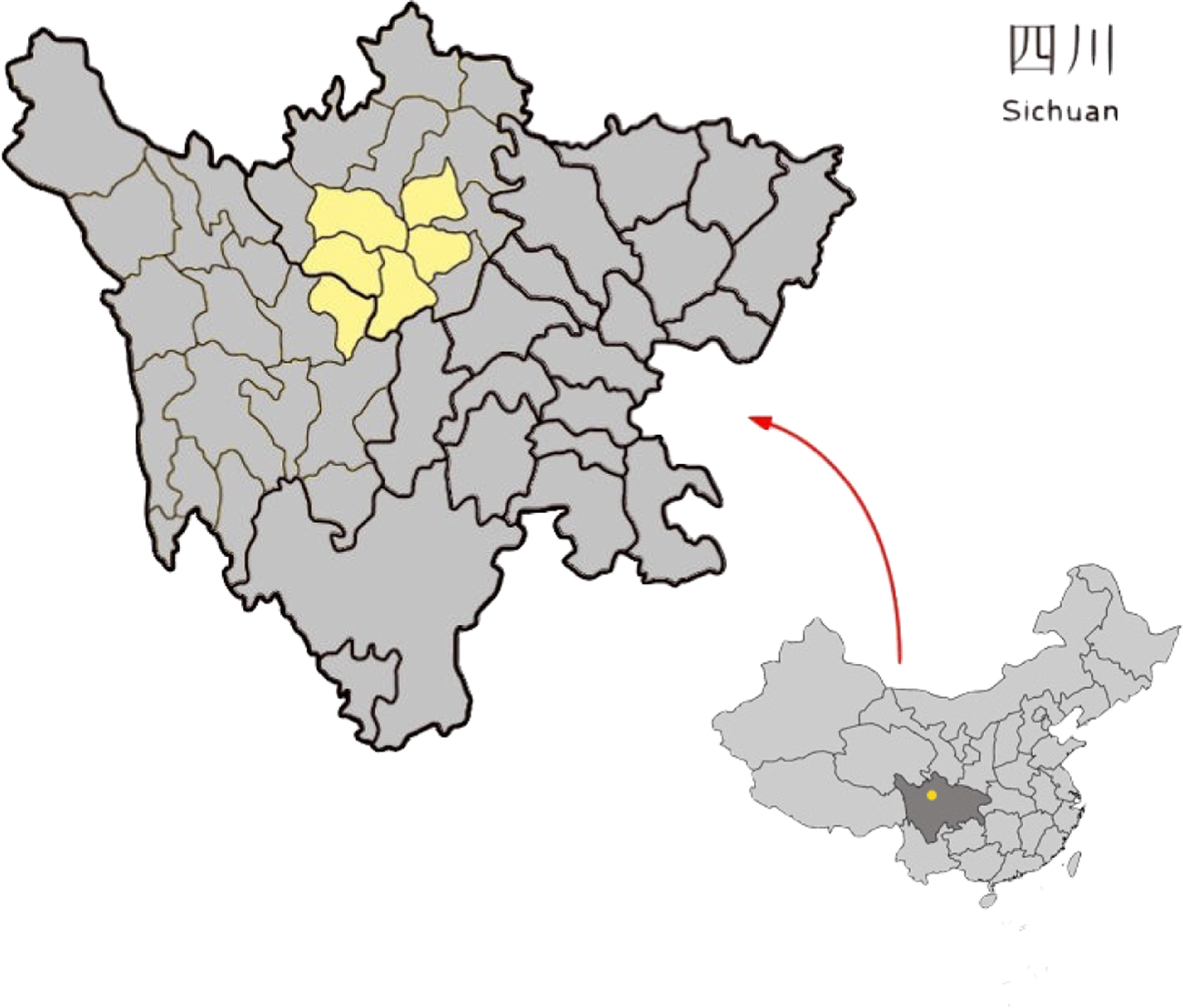
The Rgyalrong languages are spoken in north-western Sichuan Province, China. Speakers of Rgyalrong languages are classified as part of the Tibetan Minzu by the Chinese government.Footnote 1 Previous studies (Jacques Reference Jacques2008: 42–3; Reference Jacques and Hill2012b) show that Omaha skewing is attested in the Japhug (Northern Rgyalrong) kinship system and might once have existed in Tangut, an extinct West Rgyalrongic language. Nevertheless this special cross-generational equation seems to be absent in Situ (Eastern Rgyalrong) terminologies (Wang Reference Wang2016).
This paper deals with the previously undescribed kinship terminology of Brag-bar (Situ). Based on the comparative method, it attempts to explain the divergences between the kinship systems of Brag-bar and Japhug.
First, in section 2, we provide background information on the language in question. Then, in section 3, we introduce the terminological framework and the concepts of cross-parallel distinction and skewing in kinship studies. In section 4 we present the Japhug kinship terminology, and then we describe the present Brag-bar terminology and the morphology relevant to Brag-bar kinship terms in section 5. In section 6 we provide both internal and external evidence to account for several changes that have happened in the Brag-bar terminology.
2. Rgyalrong languages
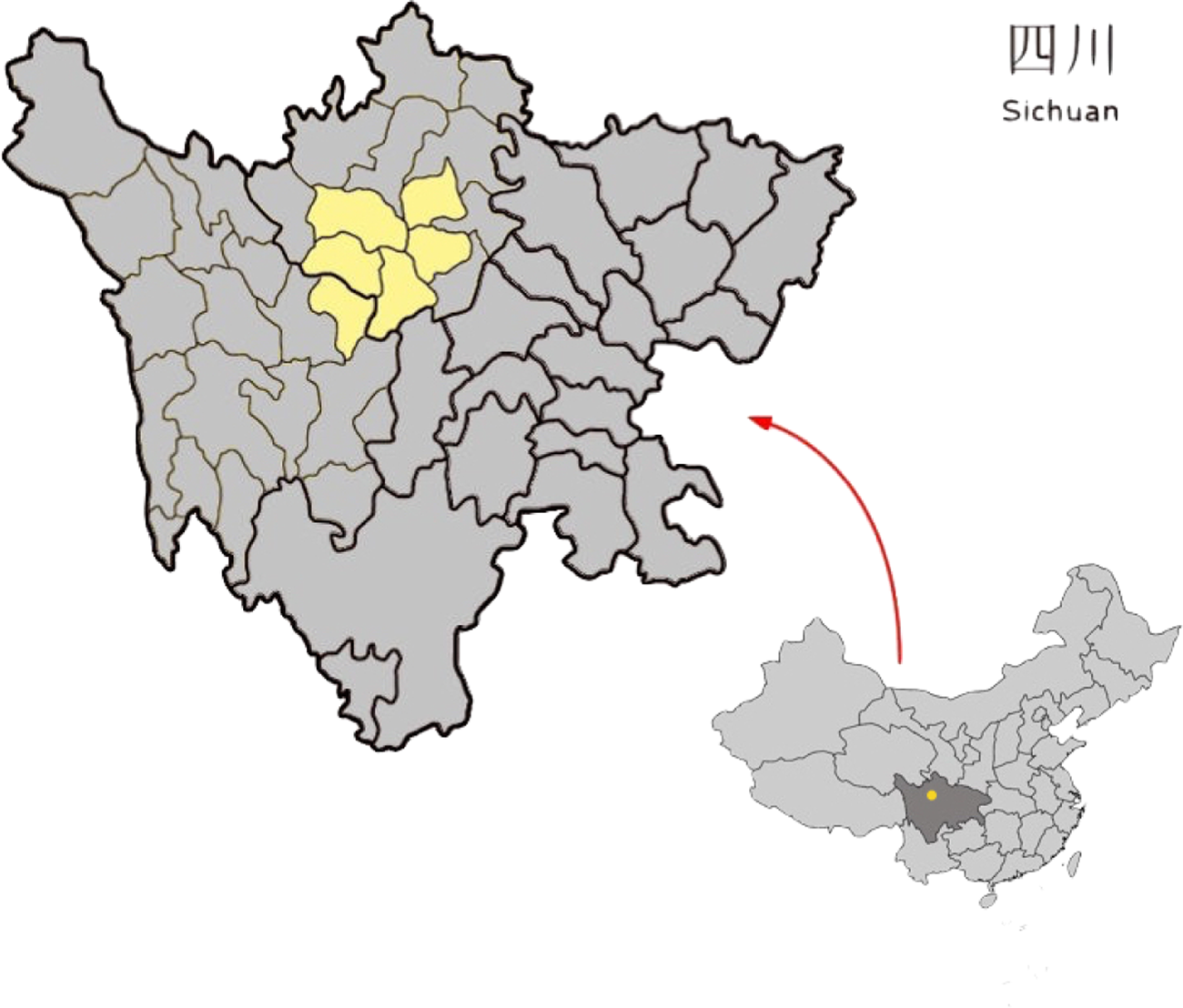
The Rgyalrong languages are distributed in northwestern Sichuan, mainly in Ngawa Tibetan and Qiang Autonomous Prefecture and Garzê Tibetan Autonomous Prefecture, whose speakers are generally referred to as Rgyalrong Tibetans (see Figure 1). These languages stand out in the Sino-Tibetan family for their complex phonology and polysynthetic verbal morphology, however, they are insufficiently studied and documented. From a sociolinguistic point of view, they are in heavy contact with Amdo Tibetan and Southwestern Mandarin.
The geographic distribution of Rgyalrong languages
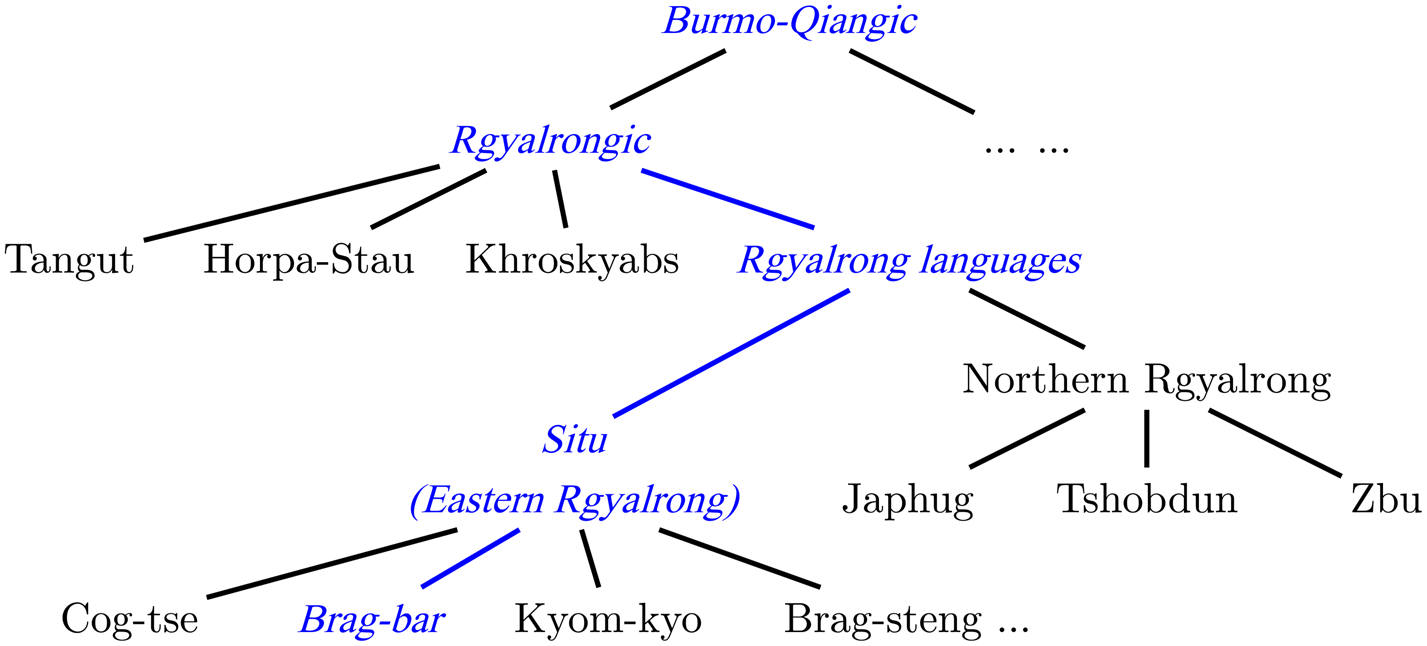
They belong to the Burmo-Qiangic branch (Jacques and Michaud Reference Jacques and Michaud2011), and consist of the Rgyalrongic group with Horpa-Stau, Khroskyabs, and Tangut (extinct) (Sun Reference Sun2000a; Lai Reference Lai2017: 10; Gong Reference Gong2018: 19; Lai et al. Manuscript) (see Figure 2). Based on mutual intelligibility, at least four Rgyalrong languages should be recognized: Situ, Japhug, Tshobdun, and Zbu (Jacques Reference Jacques2004: 5; Gates Reference Gates2014). Situ Rgyalrong, also known as Eastern Rgyalrong, has a considerable number of dialects, most of which remain undescribed.
Stammbaum

This paper focuses on the dialect of Brag-bar (/prawâr/; Chinese: 白湾 Báiwān; Tibetan: བྲག་བར) of Situ Rgyalrong, mainly spoken in Brag-bar Township, about 33 km to the east of Barkam, capital of the Ngawa Prefecture. The data were collected during summer fieldwork in 2017 and 2018 with Tshering-Dpalldan,Footnote 2 Bsodnams-MgonpoFootnote 3 and Bsodnams-Lhamo,Footnote 4 native speakers of the Brag-bar dialect.
Other Rgyalrongic languages mentioned in this paper include Tangut, Japhug, Zbu, Kyom-kyo (Situ), Cogtse (Situ) and Brag-steng (Situ). The Tangut and Japhug data are taken from Jacques (Reference Jacques and Hill2012b). The Zbu data were provided by Gong Xun.Footnote 5 The Kyom-kyo data were provided by Tshedbang-Sgrolma,Footnote 6 and rechecked with Prins (Reference Prins2016). The Brag-steng data were collected during previous fieldwork with Baoquan, a native speaker of Brag-steng. Kinship terms are transcribed in IPA form, and texts follow the Leipzig glossing rules.
3. Terminological framework
Abbreviations for kinship terms in this paper follow the anthropological tradition (see for example Ghasarian Reference Ghasarian1996: 41–2), summarized in Table 1. More complex relationships are described by combinations of these abbreviations, for instance, FB means father's brother, MyZ stands for mother's younger sister.
Abbreviations

Description of the terminological structure in Rgyalrong kinship systems generally follows the framework of Kroeber (Reference Kroeber1909), in which the following parameters are particularly relevant to our discussion: (i) generation, (ii) lineal vs. collateral distinction,Footnote 7 (iii) age within generation, (iv) sex of the relative, (v) sex of the connecting relative.
There are two concepts, cross-parallel distinction and skewing, that are particularly relevant to the discussion on Rgyalrong kinship terminologies, and are briefly introduced in the following two sections.
3.1. Cross-parallel distinction
Distinction between cross and parallel kin can be traced back to Morgan's (Reference Morgan1871) classification of the world's kinship systems, and is fundamental for the classificatory systems, in which the terminology serves to classify the kinsmen (Ghasarian Reference Ghasarian1996: 201) and presents the merger between lineal kin (e.g. F, M) and collateral kin (e.g. FB, MZ) (Trautmann and Whiteley Reference Trautmann and Whiteley2012b: 303). In G+1, a distinction is made between the Ego's parents’ same-sex and different-sex siblings. The parents’ same-sex siblings are referred to as parallel uncle and aunt, as opposed to parents’ different-sex siblings, referred to as cross uncle and aunt. In G0, descendants of parallel uncles and aunts are referred to as parallel cousins, and those of cross uncles and aunts are cross cousins.
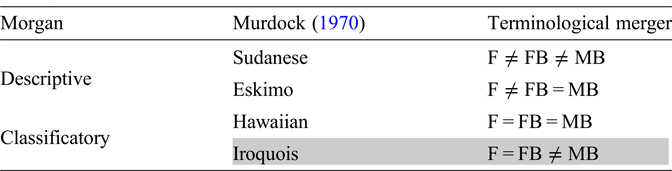
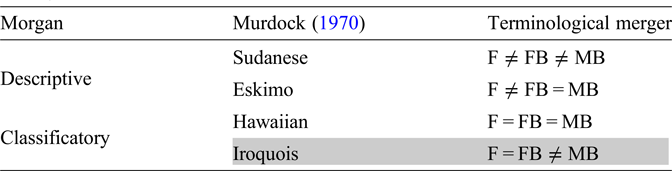
Based on the presence or absence of the terminological merger among F, FB and MB, as well as M, MZ and FZ, the world's kinship systems can be categorized according to the following typology (see Table 2).
Typology of kinship systemsFootnote 8 (adapted from Trautmann and Whiteley Reference Trautmann, Whiteley, Thomas Trautmann and Peter Whiteley2012a)
3.2. Omaha skewing patterns
Skewing, from a purely terminological point of view, is shown as the terminological equation between kin from different generations,Footnote 9 and is particularly attested in the Omaha and Crow terminologies. Since the Crow terminology is irrelevant to the study of Rgyalrong kinship systems, it is not treated in this paper.
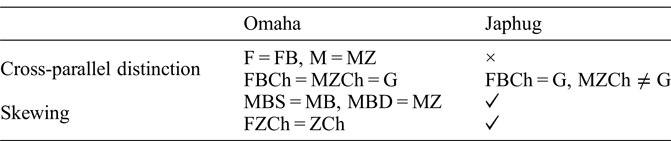
The Omaha terminology is classified as a sub-type of the Iroquois system (Lounsbury Reference Lounsbury and Goodenough1964), since they are both classificatory systems, presenting the same cross-parallel distinction: parallel uncle and aunt are terminologically equal to Ego's parents (FB=F, MZ=M), and parallel cousins are grouped together with Ego's siblings (FBCh=MZCh=G).
However, the Omaha terminology differs from the Iroquois type in that it presents skewing rules concerning the cross cousins. In the Omaha system, cross cousins are terminologically merged with kin in other generations (see Appendix 2, Figure 5). The maternal cross cousins are merged with kin in the ascending generation (G0→G+1 MB=MBS=MBSS, MBZ=MZFootnote 10), whereas the paternal cross cousins are terminologically equal to kin of the descending generation (G0→G–1: FZCh=ZCh).
4. Japhug terminology
The Rgyalrong kinship terminologies are insufficiently described, and the only systematic description available is that of the Japhug kinship system, a Northern Rgyalrong language (Jacques Reference Jacques2008: 42–3; Reference Jacques and Hill2012b). This section presents three major characteristics of Japhug terminology, which can serve as a model to help us understand changes that happened in the Brag-bar terminology, discussed at length in sections 5 and 6.
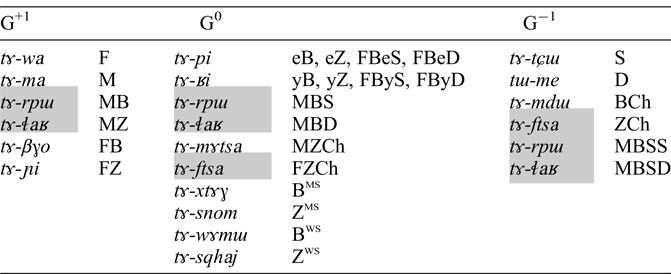
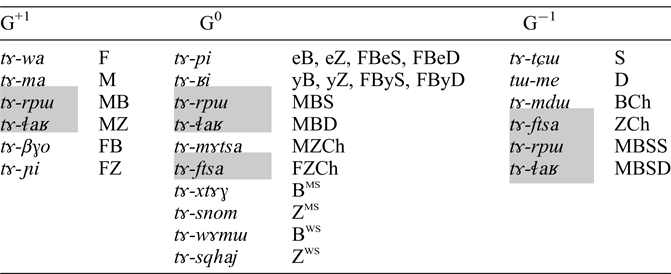
Kinship terms in Japhug, as in other Rgyalrong languages (Sun Reference Sun1998; Lin Reference Lin2016: 17–18; Gong Reference Gong2018: 104–5) are inalienably possessed nouns, and never occur in their bare stem form. The Japhug kinship terms presented in Table 3 are in citation form, with the indefinite possessive prefixes tɤ-/tɯ-.
Japhug terminology
4.1. Skewing
Jacques (Reference Jacques2008: 43; Reference Jacques and Hill2012b) first noticed the existence of Omaha-like skewing rules in Japhug terminology. This cross-generational terminological merger involves both maternal and paternal cross cousins. On the maternal side, sex distinction is present in cross-cousin terms, MB = MBS = MBSS (tɤ-rpɯ), and MZ = MBD (tɤ-ɬaʁ). On the paternal side, sex distinction is not specified in the FZCh term, thus FZCh = ZCh (tɤ-ftsa) (see Appendix 2, Figure 6).
Such terminological structure is peculiar, and is absent in the adjacent Amdo-speaking (Wu Reference Wu2013: 77–102) and Chinese-speaking (Hu Reference Hu2007) communities. In the literature on Sino-Tibetan kinship terminologies, the cross-generational terminological merger is only reported in Khumbu Sherpa (Allen Reference Allen1976) in north-eastern Nepal.
4.2. Cross-parallel distinction
Cross-parallel distinction in Japhug is not identical to that of prototypical Omaha and Iroquois terminological distinctions. Instead of a two-way distinction between parallel and cross kin, in both G+1 and G0, a four-way terminological distinction is found in Japhug. In G+1, F tɤ-wa ≠ FB tɤ-βɣo ≠ MB tɤ-rpɯ, M tɤ-ma ≠ MZ tɤ-ɬaʁ ≠ FZ tɤ-ɲi, and these terms are also etymologically unrelated. In G0, cousin terms present the four-way distinction in a similar way, FBCh tɤ-pi, tɤ-ʁi ≠ FZCh tɤ-ftsa ≠ MBCh tɤ-rpɯ, tɤ-ɬaʁ ≠ MZCh tɤ-mɤtsa.
Although the cross-parallel distinction does exist in the Japhug terminology, it exists in a less explicit way. In G0, cross cousins are distinguished from parallel cousins: the skewing rules only apply to cross cousins, while parallel cousins are referred to by terms specific to G0. The Japhug system also deviates from the prototypical Omaha system in that it further distinguishes paternal parallel cousins from maternal parallel cousins. Paternal parallel cousin terminologically merges with Ego's siblings, whereas maternal parallel cousin has a devoted term (FBCh = G tɤ-pi tɤ-ʁi ≠ MZCh tɤ-mɤtsa).
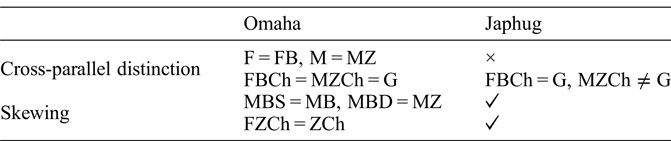
Table 4 compares the Japhug terminology with the prototypical Omaha terminology.
Comparison between the Japhug and Omaha systems
4.3. Sex of the connecting relative
Sex of the connecting relative concerns the sex of the person through whom a particular relationship exists (Kroeber Reference Kroeber1909). This parameter is reflected in sibling terms in Japhug.
Japhug has two sets of terms for siblings. The first system consists of two terms, tɤ-pi ‘eB, eZ’ and tɤ-ʁi ‘yB, yZ’, presenting only the age distinction within the generation and indifferent to the sex of the siblings and the connecting relative.
The second system encodes the sex distinction of both siblings and connecting relative, and is composed of four terms tɤ-xtɤɣ ‘Bms’, tɤ-snom ‘Zms’, tɤ-wɤmɯ ‘Bws’ and tɤ-sqhaj ‘Zws’. The terms tɤ-xtɤɣ ‘Bws’ and tɤ-snom ‘Zms’ are used to designate the brother or sister of a male, and tɤ-wɤmɯ ‘Bws’ and tɤ-sqhaj ‘Zws’ designate the brother or sister of a female. Note this distinction is not limited to the sex of the speaker. If a male speaker is talking about the sister of a woman, he must use tɤ-sqhaj ‘Zws’ rather than tɤ-snom ‘Zms’.
It has been argued that marking the sex of the connecting relative is an archaic feature in Sino-Tibetan (Benedict Reference Benedict1942). Terminological systems with this contrast include Tangut (Jacques Reference Jacques and Hill2012b) and Lolo-Burmese languages (Gong Reference Gong2018: 34). In the Western Himalayas, this is also found in Limbu Kiranti (Davids and van Driem Reference Davids and van Driem1985), although the exact terms involved are not cognate with those of the Japhug system.
5. Brag-bar (Situ)
This section presents the Brag-bar terminology at the synchronic level. It focuses on the semantic structure of kinship terms for each generation (section 5.1), and then explains the prefixation on kinship terms in (5.2).
5.1. Semantic structure of the Brag-bar terminology
Since Kroeber's (Reference Kroeber1909) parameters (mentioned in section 3) are not constantly reflected in each generation, the following paragraphs are organized in terms of generations, and other parameters will be commented on if necessary. The general tendency reflected by the Brag-bar terminology is that the closer a generation is to Ego's generation, the more distinctions are made in kinship terms.
Kinship terms presented in the following parts are in their indefinite possessive prefixing forms (see 5.2 for details of prefixation on kinship terms).
5.1.1. G+2 and G−2
In G+2 and G−2 (Table 5), lineal vs. collateral and matrilateral vs. patrilateral distinctions are neutralized. In G+2, there are only two terms ta-wû ‘FF, MF’ and tɐ-wî ‘FM, MM’, coding the sex of the relative. G−2 has only one term tə-wûj ‘CCh, FCh, CCh’, which can be used for both Ego's and Ego's siblings' and cousins’ grandchild.
Brag-bar kinship terms in G+2 and G−2

5.1.2. G−1
Kinship terms in G−1 (Table 6) reflect the lineal vs. collateral distinction. Lineal kinship terms encode sex distinction tə-ziɛ^ ‘S’, tə-mī ‘D’, while collateral kin in this generation are called by a single term tə-mdôk ‘GCh, CCh’.
Brag-bar kinship terms in G−1

5.1.3. G+1
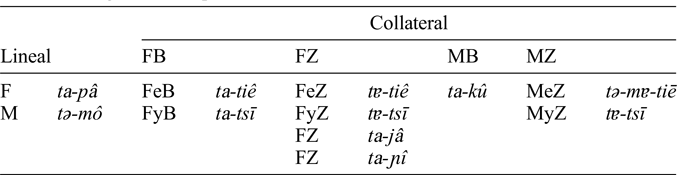
Brag-bar kinship terms in G+1
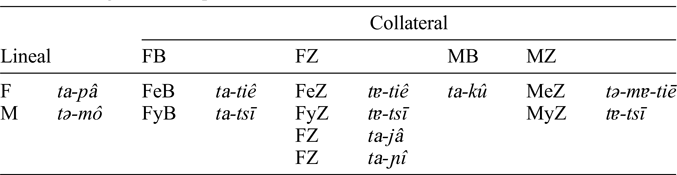
G+1 includes terms for Ego's parents (lineal) and Ego's parents’ siblings (collateral) (Table 7). Like Japhug, in Brag-bar the four-way classification is also found for G+1, FB ≠ FZ ≠ MB ≠ MZ. However, unlike Japhug, several uncle and aunt terms are etymologically related to each other.
Age distinction is present in the terms for parallel uncle and aunt, reflected by the elements -tiê [+ elder] and -tsī [+ younger], and is absent from the term for maternal uncle. This distinction is present in some of the FZ terms, but absent from others. The four FZ terms can be divided into three groups: (i) ta-ɲî ‘FZ’; (ii) ta-jâ ‘FZ’; (iii) tɐ-tiê ‘FeZ’, tɐ-tsī ‘FyZ’. Relative age is not specified in (i) and (ii), but it is specified in group (iii).
The terms in the three groups have semantic overlaps.Footnote 11 First, tɐ-tiê tends to be selected for FeZ, in order to show respect for relatives older than Ego's parents. Second, in modern Brag-bar, ta-ɲî is more often used for affinal kin (MBW, WM, eBW), though using it to designate FZ is also acceptable but considered to be influenced by the Rdzong'gag or Cogtse dialect of Situ.Footnote 12 Third, the difference between tɐ-tiê/tɐ-tsī and ta-jâ is very subtle. The term tɐ-tiê or tɐ-tsī is selected if the speaker wants to emphasize the generation distinction, while using ta-jâ to designate FZ weakens the generation distinction, since ta-jâ also means Ego's eZ (G0).
The peculiar use of the eZ term ta-jâ to designate FZ reflects in fact the change of the point of view of the speaker, according to the interpretation of Brag-bar speakers. As illustrated in (1), a person called Dpal-ndzin calls her paternal aunt ta-jâ from her father's point of view. This practice can be considered to be a kind of reverse teknonymy (Lévi-Strauss Reference Lévi-Strauss1969: 348), the younger generation adopts the point of view of the elder generation. This practice is different from most reported cases of teknonymy in Tibeto-Burman terminologies (Benedict Reference Benedict1942; Davids and van Driem Reference Davids and van Driem1985) where the elder generation adopts the speech of the younger generation.
(1) wa-pâ kə a-jâ rɐ-tsīs tɕɐnə pandzə̂n nɟe kə
3sg.poss-father erg voc-Z pfv-to.sayii conj Dpal-ndzin du erg
a-jâ ɕo tsə̂-ntɕ do
voc-FZ all to.sayi-3du part:assertive
‘Her father called (her) a-jâ, so Dpal-ndzin (and her sister) both call (her) a-jâ.’
In addition, the distribution of Brag-bar FZ terms is also determined by the relationship that a particular relative has with regard to Ego. It seems that ta-jâ is often used in intimate relations and used among family members. For example the daughter of our informant (male) often calls his sister a-ja-mâ, combining the addressing form a-jâ with the last syllable of the addressee's name tsharaŋ-gomâ.
5.1.4. G0
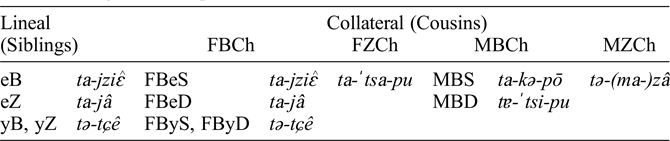
Sibling terms in Brag-bar (Table 8) encode a relative age distinction between siblings elder and younger than Ego. Sex distinction is present in terms for elder siblings ta-jziɛ^ ‘eB’ vs. ta-jâ ‘eZ’, but it is neutralized in the term for younger siblings tə-tɕê. This structure is different from the Japhug terminology (tɤ-pi ‘eB, eZ’ vs. tɤ-ʁi ‘yB, yZ’), but is attested in other Tibeto-Burman languages (Benedict (Reference Benedict1942) on Classical Tibetan; Davids and van Driem (Reference Davids and van Driem1985) on Limbu, Kiranti).
Brag-bar kinship terms in G0
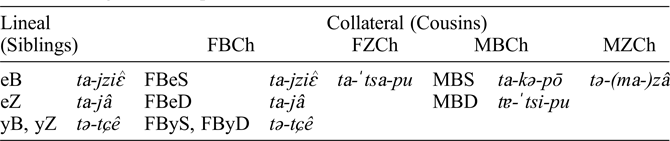
Cousin terms also present a similar four-way distinction as in Japhug terminology. With the exception of FBCh who have the same terms as Ego's siblings, other cousins have their own dedicated terms (G = FBCh ≠ FZCh ≠ MBCh ≠ MZCh). Relative age is not encoded in these cousin terms, and sex distinction is only specified for MBCh (ta-kə-pō ‘MBS’ vs. tɐ-ˈtsi-pu ‘MBD’).
Although Brag-bar does not have dedicated cross or parallel cousin terms, the concept of the cross-parallel distinction can still be perceived if we take into consideration how Brag-bar speakers interpret the relationship among parallel or among cross cousins. Paternal parallel cousins are often interpreted as children of two boys (2a), i.e. children of Ego's father and father's brother (same-sex sibling), and maternal parallel cousins are often referred to as children between two girls (2b), i.e. children of Ego's mother and her sister. Cross-cousins are interpreted as the children between a girl and a boy (2c), i.e. children of Ego's parent and his/her different-sex sibling.
(2) a. tə-ziɛ^ kənə^s wa-pū
poss.indef-boy two 3sg.poss-child
‘Children of two boys’
b. tə-mī kənə^s wa-pū
poss.indef-girl two 3sg.poss-child
‘Children of two girls’
c. tə-ziɛ^ kərīk nə tə-mī kərīk wa-pū
poss.indef-boy one and poss.indef-girl one 3sg.poss-child
‘Children between a girl and a boy’
5.1.5. Sex of the connecting relative
The sex of the connecting relative (section 4.3) is not encoded in the Brag-bar terminology. Despite that tə-ktiə̄k ‘yB’ and tə-snâm ‘yZ’ in Brag-bar are etymologically related to tɤ-xtɤɣ ‘Bms’ and tɤ-snom ‘Zms’ in Japhug, the semantic structure is totally different. First, tə-ktiə̄k ‘yB’ and tə-snâm ‘yZ’ in Brag-bar are indifferent to the sex of the connecting speaker, and are limited to younger siblings. Second, the two terms rarely occur in their vocative forms (see section 5.2).
The loss of contrast between the female and male connecting relative can also be supported by the fact that tɐ-ɕkhî ‘(female) friend’, cognate with Japhug tɤ-sqhaj ‘Zws’, has undergone a semantic change from ‘Zws’ to ‘female friend’. On the one hand, the existence of tɐ-ɕkhî in Brag-bar suggests that the distinction of sex of the connecting relative once existed in Brag-bar. On the other hand, tɐ-ɕkhî is no longer a kinship term in Brag-bar, the semantic change from ‘Zws > female friend’ indicates the loss of this distinction. The closeness between terms for siblings and for friends is also attested in Sinitic languages, where the same element 姐 jiě ‘elder Z’ can be used in both 姐姐 jiějie ‘elder Z’ and 姐们儿 jiěmenr ‘female friend’, and 哥 gē in 哥哥 gēge ‘elder B’ and 哥们儿 gēmenr ‘male friend’.
5.1.6. Affinal kinship
Like other Rgyalrongic languages (Jacques Reference Jacques and Hill2012b) and some Tibetic languages (Benedict Reference Benedict1942; Goldstein Reference Goldstein1975; Allen Reference Allen1976; Kaplanian Reference Kaplanian2015), Brag-bar lacks pure affinal terms.
In G+1, terms for cross uncle ta-kû and cross aunt ta-ɲî are generalized for affinal kin. In case of affinal kin elder than Ego's parents, ta-tiê and tɐ-tiê are selected respectively for the male and female affinal kin. In G0, sibling terms are generalized for affinal kin. Except for the eB spouse, called by ta-ɲî, other affinal kinsmen are referred to by sibling terms ta-jziɛ^ ‘eB’, ta-jâ ‘eZ’ and tə-tɕê ‘yB, yZ’.
The term ta-ɲî is peculiar when used for affinal kin, since it can be used for affinal kin of different generations, WM (G+1)=MBW (G+1)=eBW (G0). Although the terminological merger of FZ=MBW=WM is reported in Sherpa terminology (Goldstein Reference Goldstein1975; Allen Reference Allen1976), using the same term to designate eBW seems to be a particularity of Rgyalrong systems. However, in Japhug, unlike Brag-bar, it is the parallel aunt term tɤ-ɬaʁ ‘MZ’ that is generalized.Footnote 13
5.2. Prefixation on kinship terms
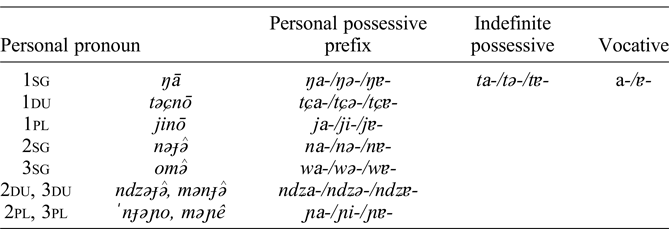
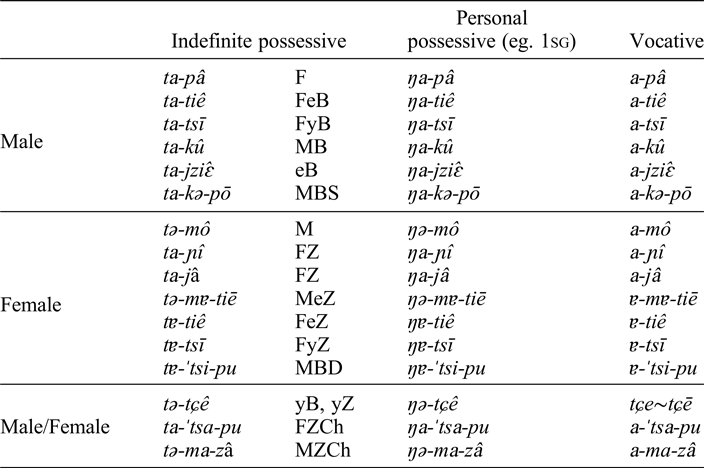
Kinship terms in Brag-bar do not occur in their bare stem form; in most cases, they are prefixed either by the possessive or the vocative. These prefixes are important elements and convey information such as direct addressing vs. indirect referring, or female vs. male kin.
Table 9 lists an inventory of prefixes occurring with kinship terms in Brag-bar.
Possessive and vocative prefixes in Brag-bar
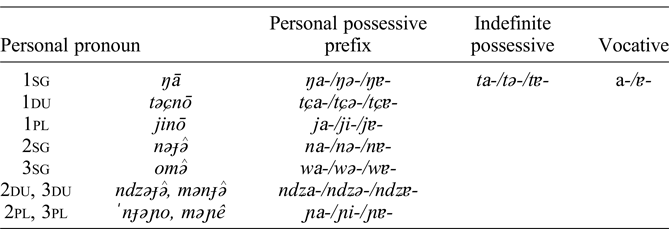
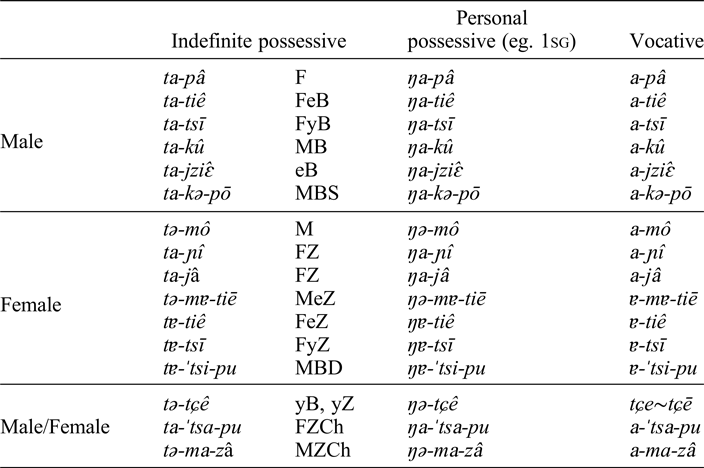
The indefinite possessive, personal possessive, and vocative prefixing forms of each kinship terms are listed in Appendix 1.
5.2.1. Address vs. reference
Indefinite possessive prefixing forms are used in indirect referring situations, when the speaker wants to designate a particular relative in general. The indefinite possessive prefixes are lexically determined, as in ta-pâ ‘F’, tə-mô ‘M’, tɐ-tsī ‘FyZ, MyZ’.
Personal possessive prefixes are related to personal pronouns, in which both person and number are distinguished. The vocalism of the personal possessive prefix follows that of the indefinite possessive forms, as in ŋa-pâ ‘my father’, nə-mô ‘your mother’. First person possessive prefixing forms can also be used in direct addressing situations, accompanied by an initial stress, which is a common feature shared among Rgyalrong languages (Lin Reference Lin2012, Reference Lin2016; Gong Reference Gong2018: 112–3). For example, ˈŋə-mo is the singular first person possessive form used in direct addressing situations, as opposed to ŋə-mô ‘my mother’ used in indirect referring.
In other direct addressing situations, especially in the case of kin who are older than Ego, the speaker uses vocative nouns. With the exception of tə-tɕê ‘yB, yZ’, whose vocative noun is formed by reduplication with a tonal alternation tɕe~tɕē, other kinship terms form their vocative form by adding a vocative prefix, as in a-mô ‘mom!’, ɐ-mɐ-tiē ‘aunt!’
5.2.2. Vocative prefixes marking sex distinction
Brag-bar presents an unexpected contrast between two vocative prefixes a- and ɐ-. The vocative prefix ɐ- has a limited distribution, and mainly occurs in terms for female relatives, having in many cases a- prefixing counterparts for male kin, as shown in (3):
(3) ɐ-wî FM, MM a-wû FF, MF
ɐ-tiê FeZ a-tiê FeB
ɐ-tsī MyZ, FyZ a-tsī FyB
ɐ-mɐ-tiē MeZ
It is possible that a- and ɐ- are on the way to being grammaticalized as marking gender distinction, since in cases of ɐ-tiê ‘FeZ’ vs. a-tiê ‘FeB’, ɐ-tsī ‘FyZ, MyZ’ vs. a-tsī ‘FyB’, the vocative prefixes are the only element serving to distinguish female from male kin. In other cases, such as ɐ-wî ‘FM, MM’ vs. a-wû ‘FF, MF’, and ɐ-ɕkhî ‘friend (female)’ vs. a-rgô ‘friend (male)’, in which sex distinction is also coded by the lexical base, a- and ɐ- behave like gender agreement elements. However, it should be mentioned that ɐ- does not occur in female kinship terms in a systematic way; there are female kinship terms selecting the a- vocative prefix, as in a-jâ ‘FZ, eZ’ and a-ɲî ‘FZ’.
6. Comparative terminology
As explained in section 5, the synchronic Brag-bar terminology differs considerably from the Japhug terminology (section 4), and does not exactly correspond to any of the prototypical kinship models (section 3). Based on both internal and external evidence, this section attempts to explain the directionality of changes that have happened in the Brag-bar terminology and to distinguish Brag-bar innovations from shared retentions of Rgyalrongic languages.
6.1. Internal evidence
This section elucidates the formation of particular kinship terms in G+1 and G0 on the basis of internal morphological analysis, and proposes a relative chronology of the creation of each of the terms in Brag-bar (Situ) terminology.
The main criteria consist of two aspects. First, from a morphological point of view, we investigate whether kinship terms can be analysed or not. For the analysable terms, we show whether they are in a complete state of compounding or not. Second, we examine the semantic transparency of each composing element.
6.1.1. Terms in G+1
In G+1, most kinship terms are unanalysable lexemes, except for tə-mɐ-tiē ‘MeZ’. Since -tiê and -tsī are attested outside of the kinship terms in G+1, we can safely analyse tə-mɐ-tiē ‘MeZ’ as being composed of the indefinite prefix tə-, and the lexical bases -mɐ-, which is the construct state of tə-mô ‘M’,Footnote 14 and -tiê [+ elder].
(4) tə-mɐ-tiē ‘MeZ’ = tə-mô ’M’ + -tie [+elder]
The element -tie [+elder] is etymologically related to the stative verb kə-tī ‘large’.Footnote 15 The term tə-mɐ-tiē ‘MeZ’ can be analysed as a compound noun, composed of a nominal base, and a quality noun, related to a particular stative verb and modifying the preceding nominal base (Gong Reference Gong2018: 109–11). Another example with the same quality noun is proposed in (5):
(5) ɕɐkha-tiê ‘vast forest’ = ɕɐkhiɛ^ ‘forest’ + -tiê ‘large’
FB, FZ and MyZ terms (ta-tiê ‘FeB’, ta-tsī ‘FyB’ and tɐ-tiê ‘FeZ’, tɐ-tsī ‘FyZ, MyZ’) are not compound nouns in the synchronic system, and -tiê and -tsī serve as the only root for these terms. Similar to -tiê, -tsī [+ younger] can be related to the stative verb kə-tsɐ^j ‘small’.Footnote 16
It is possible that these terms were quality nouns like tə-mɐ-tiē ‘MeZ’, in which -tiê and -tsī are elements originally used to specify relative age, which later became the only lexical base in FB and FZ terms.
6.1.2. Terms in G0
With the exception of terms for FBCh, identical to those for Ego's siblings, other cousin terms in Brag-bar are analysable compounds. The four compound cousin terms can be divided into two groups according to their morphological structure.
First, tə-ma-zâ ‘MZCh’ and ta-kə-pō ‘MBS’, are lexicalized compounds. The first element of the root occurs in construct state, and the final syllable of the root receives either a high level or a falling tone (L-H-HL, or L-H-H).
Second, tɐ-ˈtsi-pu ‘MBD’ and ta-ˈtsa-pu ‘FZCh’ are loose compounds. The first element does not occur in their construct state, and instead of the final tonal contrast, the penultimate syllable receives the stress (L-H-L) (†tɐ-tsə-pū, †ta-tsa-pū).
(6) a. Lexicalized compound
tə-ma-zâ ‘MZCh’ tə-mô ‘M’ + ?tsa diminutive
ta-kə-pō ‘MBS’ ta-kû ‘MB’ + -po ?diminutive
b. Loose compound
tɐ-ˈtsi-pu ‘MBD’ tɐ-tsī ‘FyZ, MyZ’ + -pu diminutive
ta-ˈtsa-pu ‘FZCh’ ta-(p)tsâ? + -pu diminutive
The loose compounds can be considered as recently formed since: (i) their morphological structure suggests an incomplete state of word compounding and; (ii) the origin of the two composing elements is relatively transparent. The second element -pū is the diminutive suffix, related to ta-pū ‘child’. The first element of tɐ-ˈtsi-pu ‘MBD’ is tɐ-tsī ‘FyZ, MyZ’. The base noun of ta-ˈtsa-pu should be *ta-ptsâ, with a p- prefixal element found in the derived social relation collective noun koɕə-ptsa-pə^ ‘(be) daughters of two cross cousins’.Footnote 17 However, *ta-ptsâ is no longer used in modern Brag-bar, and will be explained with the help of comparative data from other Rgyalrong languages (in section 6.2.2).
Although the etymology of the two lexicalized compounds are less transparent, they can still be analysed. The base noun of a-kə-pō ‘MBS’ is a-kû ‘MB’. There are two possible explanations for the suffix -po. First, it could be related to -pu, and the vocalism o in this suffix might be due to a certain kind of assimilation by the diminutive. An alternative etymology would be the masculine suffix, borrowed from ཕོ་ pho ‘male’ in Tibetan.
The term tə-ma-zâ ‘MZCh’ is more problematic. First, ma- could be related to tə-mô ‘M’. Since we would expect mɐ- as the construct state of tə-mô, as in tə-mɐ-tiē ‘MeZ’, the term tə-ma-zâ could have been lexicalized very early and the vocalism a can be explained by assimilation of the following element. Second, there are two possible explanations for the origin of -za. It could be related to the diminutive suffix -tsa, the initial consonant z- can be explained by the *ts->z- lenition, as in tə-ziɛ^ ‘son, boy’ < *tə-tsâ, kəzû ‘monkey’ < *kətsû. An alternative analysis of -za would be to account for the allomorphy with *ta-ptsâ, due to *-tsa from *-ptsa as the second element of the compound *a-ma-ptsâ > *a-ma-tsâ > a-ma-zâ.
Therefore, from the internal evidence, it is clear that the four compound cousins terms were not coined at the same time in the development of the language. The etymologically ambiguous term tə-ma-zâ ‘MeZ’ must be archaic, and the loose compounds tɐ-ˈtsi-pu ‘MBD’ and ta-ˈtsa-pu ‘FZCh’ must be newly formed.
6.2. Comparative evidence
This section focuses on the comparative data from other languages in the same branch, in order to unveil the different layers of kinship terms in Brag-bar. It is universally accepted that Japhug and Situ belong to a Rgyalrong subgroup (Sun Reference Sun2000a, Reference Sun2000b) and are considerably closer to each other than either is to Tangut. Therefore, any etymon shared by any Rgyalrong language and Tangut (unless it can be demonstrated to be a loanword) can be reconstructed to Proto-Rgyalrongic.
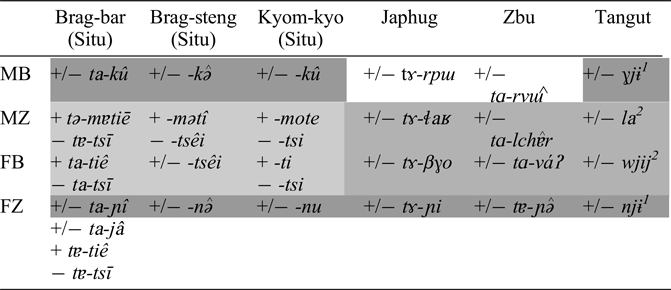
The following parts are organized according to generations: for each generation cognate terms of Kyom-kyo (Situ), Brag-steng (Situ), Japhug, Zbu, and Tangut are listed. The cells for Situ cognates are shaded light grey, those for cognates between Japhug and Tangut are shaded medium grey, and those for Rgyalrongic cognates are shaded dark grey. Two aspects are taken into consideration: the cognate lexical forms and their corresponding semantic structure, since a cognate lexeme would involve different semantic structures in different terminologies (Allen Reference Allen1976).
6.2.1. Cognates in G+1
Although the Tangut terms are phonetically distant from those found in the Rgyalrong languages, we can still recognize the cognate forms with the help of previously established phonetic correspondences. Table 10 lists the four Tangut terms for uncles and aunts, and the cognate forms in Situ, Japhug, and Zbu.
Cognates in G+1 in Rgyalrongic languages
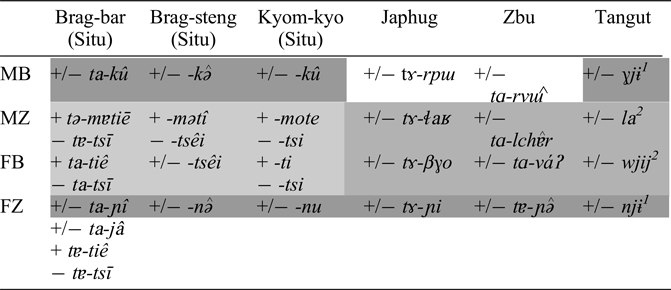
The Tangut MB term ɣjɨ1 is cognate with those in Situ (Jacques Reference Jacques2016: 33, 144). The initial ɣ- in Tangut regularly corresponds to k- or kh- in Situ, as in Tangut ɣju ‘to call’, Brag-bar (Situ) okhō ‘to call’, Tangut ɣu ‘head’, and Cogtse (Situ) ta-kō ‘head’.
The Tangut MZ term la2 comes from *lak in pre-Tangut (Jacques Reference Jacques2016: 133), and can be identified as cognate of -ɬaʁ in Japhug and tɐ-lchɐ^ʁ in Zbu.
For the FB term, the Japhug FB term tɤ-βɣo comes from *pko-<*-kpaŋ. The initial consonant w- in the Tangut form wjij2 is due to *k- > w- lenition, and the rhyme -ij corresponds to o in Rgyalrong, as in Tangut njij ‘to chase’ and Japhug -no ‘to chase’ (Jacques Reference Jacques and Beckwith2006). The Zbu term tɑ-vɑ́ʔ comprises a velarized vowel ɑ (aɣ) (Gong Reference Gong2018: 38), the velarized element corresponds to the median ɣ in Japhug. The initial consonant v- in the Zbu term can be explained by the *p- > v- lenition.
As shown in Table 10, the Situ systems differ from Japhug and Tangut in the presence of age encoding in uncle/aunt terms. With the exception of Brag-bar, the Situ dialects have a symmetric semantic structure in G+1, with age distinction present in terms for parallel uncle/aunt and absent from terms for cross uncle/aunt.
In Brag-bar, the term for maternal uncle ta-kû ‘MB’ does not encode age distinction, as with other Situ dialects. As for FZ terms, age distinction is absent from ta-ɲî ‘FZ’ and ta-jâ ‘FZ’, but present in the pair of tɐ-tiê ‘FeZ’ and tɐ-tsī ‘FyZ’. In order to explain the asymmetric structure in Brag-bar G+1 terminology, two possible hypotheses can be put forward:
1. There would have been a symmetrical terminological structure concerning uncle/aunt terms in Brag-bar, with age distinction present in terms for parallel uncle/aunt terms and absent from terms for cross uncle/aunt.
2. Like parallel uncle/aunt terms, age distinction could probably be present in cross uncle/aunt terms in Brag-bar, but later this distinction was (partially) lost. Brag-bar might once have had MB terms specifying the relative age of the maternal uncle, similar to tɐ-tiê ‘FeZ’ and tɐ-tsī ‘FyZ’. The MB terms could have been replaced by a loanword from an adjacent community, for example the Amdo Tibetans, since Rgyalrong languages are in heavy contact with Amdo Tibetan.
The second hypothesis should be rejected, since the term ta-kû ‘MB’ in Brag-bar, as in other Situ dialects and Tangut, reflects the common Sino-Tibetan root for MB.Footnote 18 It is comparable to *[g](r)uʔ in Archaic Chinese and 舅 *gjuwX in Middle Chinese (Baxter and Sagart Reference Baxter and Sagart2014: 347), and ཨ་ཁུ a-khu in Tibetan. It cannot be borrowed from Tibetan ཨ་ཁུ a-khu since that term has undergone a semantic shift from ‘MB’ to ‘FB’ (Benedict Reference Benedict1942; Nagano Reference Nagano1994).Footnote 19
Furthermore, comparative data from Tangut suggest that ta-ɲî must be from a very old layer of the terminology. This FZ term is shared among all the languages in Table 10, indicating its early existence in the Rgyalrongic branch, although there is no clear evidence to elucidate its exact origin. It could be inherited from the Tibeto-Burman FZ root (Benedict Reference Benedict1942). It could also be borrowed either in Proto-Rgyalrongic or separately in each variety. But whether borrowed or not, it can be safely reconstructed for the Rgyalrongic Z term. As no cognates of ta-jâ ‘FZ’, tɐ-tiê ‘FeZ’ and tɐ-tsī ‘FyZ’ are found in other Rgyalrong languages, it can be presumed that other FZ terms in the present Brag-bar terminology might occur later than ta-ɲî.
The Situ parallel uncle/aunt terms are not only etymologically unrelated to those in Japhug and Tangut, but also present different semantic structure. A symmetric structure can be reconstructed for Brag-bar, and for proto-Situ as well, in which cross-parallel distinction in G+1 is expressed by the presence or absence of age distinction. In addition, given that the Japhug and Tangut parallel uncle/aunt terms are cognate, they should be reconstructed to proto-Rgyalrongic. This observation implies that this symmetric structure in Situ terminologies should be innovative.
As explained in section 6.1.1, the element -tiê [+elder] in Brag-bar is also etymologically related to kə-tī ‘large’. A possible chain of semantic changes concerning the term for FeB in Situ can be formulated, as in (7):
(7) ‘large’ > [+ elder] > father's elder brotherFootnote 20
A similar case is found with Chinese 伯 bó < Archaic Chinese *pʕrak (Baxter and Sagart Reference Baxter and Sagart2014). This word has undergone a similar semantic change from ‘be the eldest (as father, brother, sister); elder, clan head, etc.’ > ‘father's elder brother, uncle’ (Schuessler Reference Schuessler2007: 169).Footnote 21
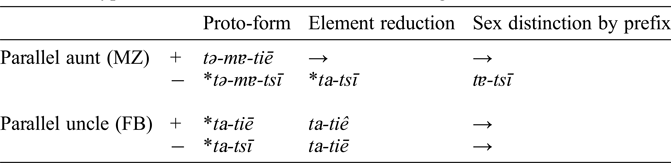
The semantic shift of the root -tiê in Situ triggered corresponding changes at least in the following areas. On the one hand, the term -tiê was reserved for FeB, and a new form related to ‘small’ was created for FyB. On the other hand, FB terms in Situ were unmarked, whereas the innovative MZ terms in Situ were marked: they are compound lexemes composed of the M term, specifying sex, and the elements -tiê and -tsī specifying relative age of the parallel aunts.
Therefore, the present parallel uncle and aunt terms in Brag-bar can be explained by the two rules shown in Table 11. First, the element reduction rule deletes the nominal bases in the term for MyZ, and creates homophony between MeZ and FyB. This rule reflects a general tendency in Brag-bar, knowing that a-ma-zâ, the vocative form of tə-ma-zâ ‘MZCh’, is being abbreviated as a-zâ. Second, the homophony is eliminated by the prefix, with the female kinship term taking the prefixes with ɐ vocalism and the male kinship term with a vocalism.
Hypothesis on terms for FB and MZ in Brag-bar
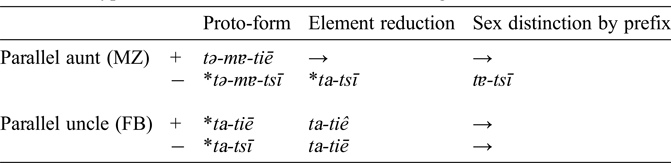
This hypothesis can also be supported by comparative data from other Sino-Tibetan languages. Within Rgyalrong languages, the form *tə-mɐ-tsī is attested in Brag-steng (Situ) despite the semantic difference (Table 12), and the homophony between MyZ and FyB is attested in the present Kyom-kyo (Situ) (Table 10). The same structure of the reconstructed proto-forms is also found in Classical Tibetan, in which elements such as chen ‘large’ and chung ‘small’ can be added to parallel aunt terms to express age distinction, as in ma-chen ‘MeZ’ and ma-chung ‘MyZ’ (Benedict Reference Benedict1942).
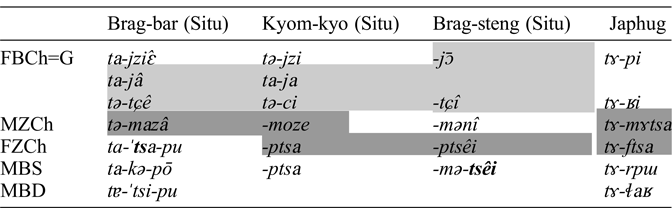
Cognates in G0 in Rgyalrong languages
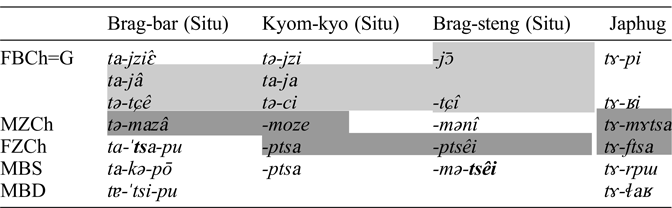
6.2.2. Cognates in G0
In G0 (Table 12), the term tə-ma-zâ ‘MZCh’ in Brag-bar reflects the Rgyalrong root for MZCh. With the exception of Brag-steng, cognate forms of tə-ma-zâ are found in Japhug, suggesting its occurrence in proto-Rgyalrong.
As explained in section 6.1.2, ta-ˈtsa-pu ‘FZCh’ in Brag-bar is formed by a recent suffixation of the diminutive -pu on the base noun *ta-(p)tsa. Although this word is no longer used in the modern language, with the cognate forms found in other languages of the group, *ta-(p)tsa can be safely reconstructed for FZCh at an earlier stage of Brag-bar.
Situ and Japhug have the same semantic structure for terms for FBCh and siblings. Despite their different origins, FBCh = G can be regarded as a feature shared among Rgyalrong languages.
Terms for MBCh in Brag-bar are more complex. On the one hand, like the Japhug MBCh terms, sex distinction is specified in Brag-bar MBCh terms (MBS ≠ MBD). Regardless of the different origins of these terms, MBCh terms in Brag-bar and Japhug are both related to terms for uncle and aunt. In Japhug, MBS and MBD are terminologically merged with MB tɤ-rpɯ and MZ tɤ-ɬaʁ. In Brag-bar, since the suffixation of the diminutive is recent, we would also expect a similar terminological merger of MBS = MB ta-kû and MBS = MyZ tɐ-tsī.
On the other hand, inside Situ dialects, tɐ-ˈtsi-pu in Brag-bar shares the same base noun with -mə-tsêi ‘MBCh’ in Brag-steng. The morphological structure of -mə-tsêi in Brag-steng is comparable to its MeZ term -mə-ti, in which -mə- is related to the M term and -tsêi is related to the ‘MyZ’ term -tsêi. In spite of the semantic difference, the form of the Brag-steng MBCh term supports the hypothesis for Brag-bar MZ terms, *tə-mɐ-tsī > tɐ-tsī ‘MyZ’ as illustrated in Table 11. It is also likely that Brag-steng -tsêi ‘MyZ’ and -mə-tsêi ‘MBCh’ come from the same proto-term *-mə-tsêi, involving similar cross-generational merging between MyZ and MBD at an earlier stage. Later in Brag-steng, the term *-mə-tsêi ‘MyZ, MBD’ split into two terms, -tsêi is reserved for MyZ, and -mə-tsêi for MBD then for MBCh, as illustrated in (8).
(8) Brag-steng terms for MyZ and MBCh
—> -tsêi ‘MyZ’ (element reduction)
*-mə-tsêi ‘MyZ, MBD’
—> -mə-tsêi ‘MBD > MBCh’
On the basis of the comparative data, it is possible to hypothesize that the present cousin terminology in Brag-bar originates from a system similar to that in Japhug, characterized by the following rules in (9):
(9) a. Four-way classification of cousins
G = FBCh ≠ MZCh ≠ *ta-ptsâ FZCh ≠ *ta-kû MBS,*tɐ-tsī MBD.
b. Cross-generational merging concerning MBCh
*ta-kû MBS = MB, *tɐ-tsī MBD = MyZ
6.2.3. Cognates in G−1
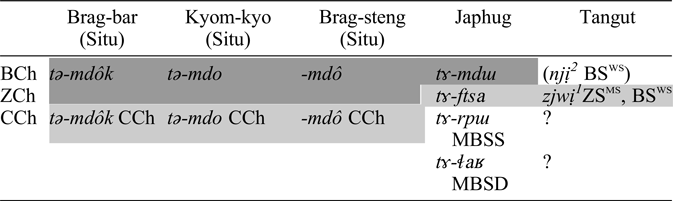
Table 13 lists the G−1 terminology in Rgyalrong languages and in Tangut. The Tangut term zjwị1 for ZSms, BSws is cognate with Japhug tɤ-ftsa ‘ZCh, FZCh’ as well as *ta-ptsâ in Brag-bar. The initial z- in Tangut has undergone *ts->z- lenition, and the vowel ị regularly corresponds to -a in Japhug, as in Tangut zjị ‘shoe’ and Japhug -xtsa ‘shoe’ (Jacques Reference Jacques2016: 81).
Cognates in G−1 in Rgyalrongic languages
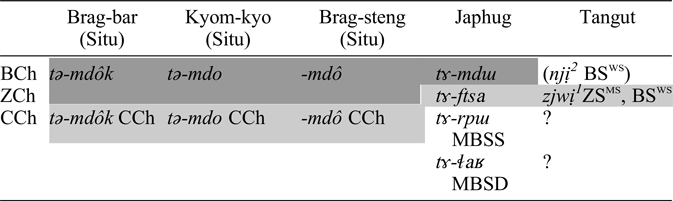
In G−1, the terminology for the descendants of siblings and cousins in Situ differs from that of Japhug and Tangut. In Situ, the term tə-mdô(k) Footnote 22 is generalized for descendants of both siblings and cousins, whereas Japhug and Tangut present more distinctions. In Japhug, the term tɤ-mdɯ ‘BCh’ is etymologically related to tə-mdô(k) in Situ, but is restricted to BCh. FZCh is designated by the term tɤ-ftsa, terminologically merged with FZCh in G0. The same semantic structure of siblings’ descendant terminology is also present in Tangut njị2 BSws and zjwị1 ZSms.
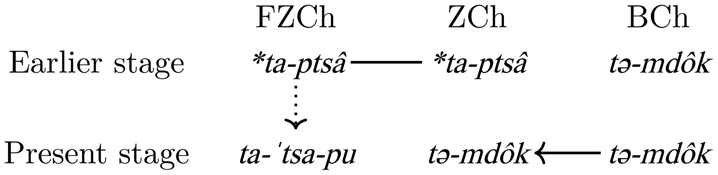
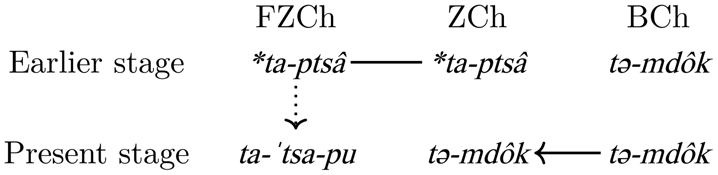
If we posit for Brag-bar the similar semantic structure of GCh terms at an earlier stage, then the present terminology can be explained by a two-stage semantic change concerning the term *ta-ptsâ and tə-mdôk.
As illustrated in Figure 3, at an earlier stage, *ta-ptsâ could designate both FZCh and ZCh, presenting cross-generational merging FZCh = ZCh as in modern Japhug. Then with the suffixation of the diminutive -pu, the skewing rule was broken, and the designation of ta-ˈtsa-pu is limited to FZCh. The term tə-mdôk, whose original meaning was also restricted to BCh, spread to the ZCh slot.
Semantic changes concerning *ta-ptsâ and tə-mdôk in Brag-bar
6.2.4. FZ terminology
One particularity of the Brag-bar terminology lies in the terms for FZ. The four FZ terms can be divided into three groups: (i) ta-ɲî; (ii) ta-jâ; (iii) tɐ-tiê and tɐ-tsī.
Since ta-ɲî FZ is related to the common FZ term in Rgyalrong languages (see section 6.2.1), it is possible that it belongs to the oldest layer of the Brag-bar terminology.Footnote 23 It should be mentioned that ta-ɲî tends to be reserved for affinal kin (WM, MBW, eBW). A parallel case was found in Jinghpo, where its possible cognate -ni33 Footnote 24 is preserved as a WM term (Benedict Reference Benedict1942).
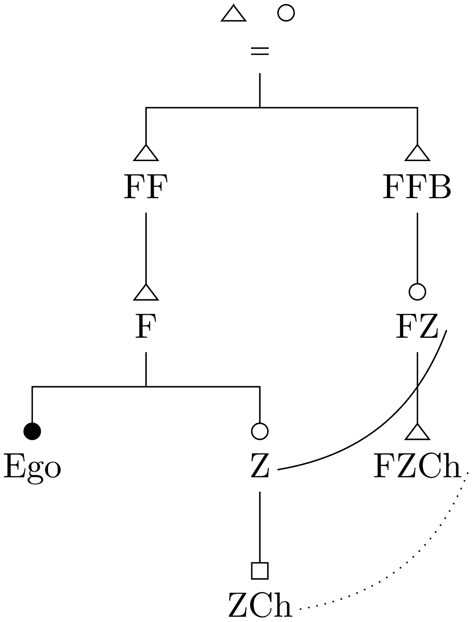
The use of the eZ term ta-jâ to designate FZ in Brag-bar is not found in other Rgyalrong languages.Footnote 25 At the second stage, ta-jâ assumed the original function of ta-ɲî as an FZ term. A possible motivation for this lexical replacement could be analogical from FZCh = ZCh. As illustrated in Figure 4, FZ = Z could be regarded as an analogical skewing rule (linked by the black curve) copied from FZCh = ZCh (linked by the dotted curve).
Analogical skewing rule of FZ=Z from FZCh=ZCh
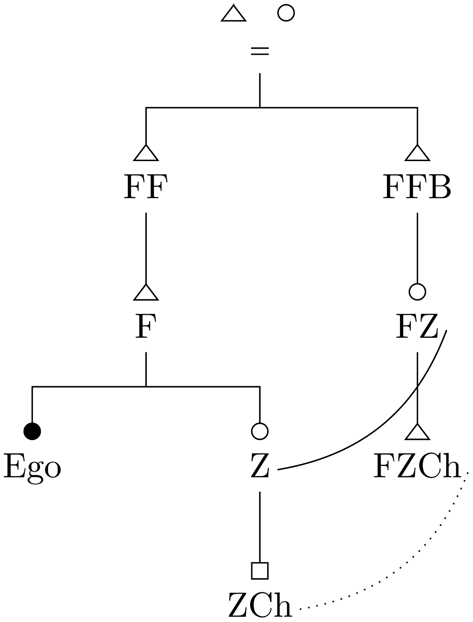
It should be noted that the occurrence of ta-jâ as a FZ term must have occurred earlier than the suffixation of -pu on *ta-ptsâ, since the latter reflects a weakening of former skewing rules.
Finally, with the weakening of cross-generational merging, it became necessary to introduce new FZ terms to reclaim the generation distinction, considering that ta-jâ would cause generation confusions. Therefore, the base -tiê FeZ and -tsī FyZ became possible candidates.
7. Conclusion
Based on internal reconstruction and comparative data, this paper explains the directionality of both formal and semantic changes that have happened in Brag-bar kinship terminology, and suggests that Brag-bar preserves indirect traces of the Omaha terminology, characterized by a cross-parallel distinction and skewing rules. The directionality of changes in Brag-bar terminology can serve as a model to account for the highly divergent terminologies inside Rgyalrong languages (Jacques Reference Jacques and Hill2012b; Wang Reference Wang2016). It sheds light on how an Omaha-like proto-system can transform into branching terminologies that deviate from the typological models (Morgan Reference Morgan1871).
Divergence in kinship terminologies inside a single language community is not rare, worldwide. A similar case to the Rgyalrong languages found in Sino-Tibetan are the Sherpa terminologies (Allen Reference Allen1976). With the help of Classical Tibetan, there is more certainty about the directionality of certains changes that may take place in the Sherpa terminologies. However, for languages such as the Rgyalrong languages, without a written tradition, reconstruction of their kinship systems first requires adequate documentation, based on which comparative studies can be carried out. Although panchronic study alone can not unveil the whole system of relationship, it can reveal general laws in the evolution of a particular terminology.
Appendix
Prefixation in kin terms
Appendix 2
The Omaha system (Trautmann and Whiteley Reference Trautmann, Whiteley, Thomas Trautmann and Peter Whiteley2012a)

The Japhug kinship system (Jacques Reference Jacques2008: 43, Reference Jacques and Hill2012b)

The Brag-bar kinship system