‘ES EQUA.’ ‘You are a mare.’ Thus declares the motetus of Machaut's Tant Doucement/Eins que ma dame/Ruina (M13) in a Latin acrostic imbedded into an otherwise French text (Fig. 1). This acrostic, which has hitherto gone unnoticed, clearly references the Roman de Fauvel, whose interpolated motet Super cathedram/Presidentes in thronis/Ruina (F4) is also the source of the motet's tenor.Footnote 1 Machaut does more than borrow a convenient tenor. He invokes the whole of the Fauvel story, placing his own motet in conversation with F4. Fauvel's fate is the quintessential example of the Goddess Fortuna's changeable antics. Fortune aids the horse to power, then denies Fauvel, who ultimately destroys the Church and France. Whether Fortune spurns or promotes, she is in charge, deceitfully turning established orders on their heads. Deceit and reversal thoroughly pervade M13’s musical and poetic structure, a telltale sign that Fortune holds sway over this motet.Footnote 2
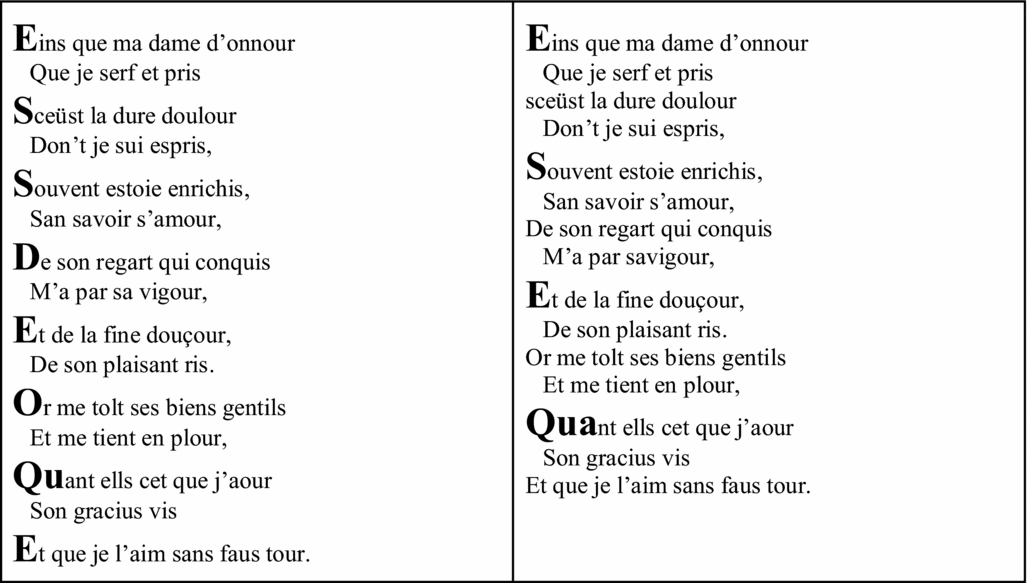
Motetus acrostics. Left: acrostic formed from first letter of each poetic line. Right: acrostic formed from first letter of the first poetic line in each talea.

Through a close reading of Fortune in M13, this article achieves several goals. First, it offers new insight into the musico-poetic structure and symbolism of the motet, as little individual analysis has been devoted to this piece.Footnote 3 Second, by revealing a new acrostic that cites the source of the motet's tenor, the article provides another point of entry into Machaut's compositional process, specifically in how he responded to his source materials. Finally, the revealed ‘Fortune’ theme of M13 suggests that it could be added to a list of motets that prominently feature Fortune: M12, 14 and 15.Footnote 4 Exhibiting similar characteristics as M12, 14 and 15, as well as filling a sequential gap, M13 may be the missing link to reading M12–15 as a group of motets based on Fortune. By proposing M12–15 as a discrete group, I add support to scholars who have proposed that these motets function together.Footnote 5
There is one immediate impediment to including M13 in a Fortune group: it does not mention Fortune. However, as Anna Zayaruznaya shows in her analysis of M15, Fortune need not be mentioned by name to exert her influence.Footnote 6 Zayaruznaya insightfully explores how voice-crossing – register exchange between a motet's upper voices – can symbolise Fortune. Fortune disrupts the order of things; bringing the low high and the high low with each turn of her iconic wheel. In a genre where the triplum typically sings above the motetus, voice-crossing disrupts the established order, bringing the high voice low and the low voice high.Footnote 7 Voice-crossing, structural reversal and themes of reversal, deceit or duality can be evidence of Fortune, who herself is deceitful and two-faced. Even so, M13 does not immediately exhibit any of the features that draw Zayaruznaya's attention to M12, 14 and 15. Unlike M12, in which the triplum and motetus are crossed in the first half of the motet and then un-cross precisely at the midpoint, M13’s six crossings are spread evenly throughout. The triplum and motetus texts of M14 seem to be in opposition, but in M13 triplum and motetus appear to be typical courtly love texts with fairly similar plots.Footnote 8 The motetus of M15 talks about being deceived by Fortune and then undeceived, but M13 does not present any unusual shift in text.Footnote 9 Though M14 and 15 do not directly mention Fortune, the lying and deceit in the texts are enough for Zayaruznaya to read Fortune's presence. Despite these differences, I argue below that M13 fits Zayaruznaya's schema well and that by including M13 a group of Fortune motets can be proposed.
Closer analysis of M13 reveals that the upper voices are heavily manipulated so that positive comments about the beloved lady and the experience of love are voiced in the upper-most register, while negative comments are voiced in the middle register. Zayaruznaya convincingly maps the registers of a motet – triplum, motetus, tenor – onto the Boethian spheres: Fortune, Providence and Divine Simplicity.Footnote 10 As Philosophy explains in Boethius's Consolatio, the further one strays from the un-moving centre of ‘primary intelligence’ or the ‘centre of things’, the more one is subjected to Fate's changes.Footnote 11 Hence, in a motet, the triplum is registrally the furthest from the sacred tenor and typically also the fastest moving voice. The motetus is closer to the (often) chant-derived tenor and tends to move more slowly than the triplum. Zayaruznaya suggests this Boethian model as a way to analyse M12, whose voices she sees as falling clearly within each of the three spheres. This model elucidates M13’s structure as well because this piece also relegates secular material to the outer sphere and sacred material to the inner sphere. In many instances, M13 performs musico-poetic gymnastics to make text that is negative toward Fortune sound in the motetus and positive text sound in the triplum.
Fortune and voice-crossing
Fortune exerts her control in M13 through seven instances of voice-crossing as she forces positive text into the upper-register and negative text into the middle range.Footnote 12 Both the triplum and motetus of M13 are typical courtly love texts and, as such, describe in turn both the pleasure and the pain of love (Fig. 2).Footnote 13 The protagonists of both upper voice texts have experienced some amount of joy from the appearance of their beloved lady, but ultimately are shunned or deceived. Their texts generally progress from positive to negative, changing when the lady finds out about the lover's feelings. In the triplum, while the overarching message is a general progression from positive to negative, the text actually oscillates from positive to negative twice.
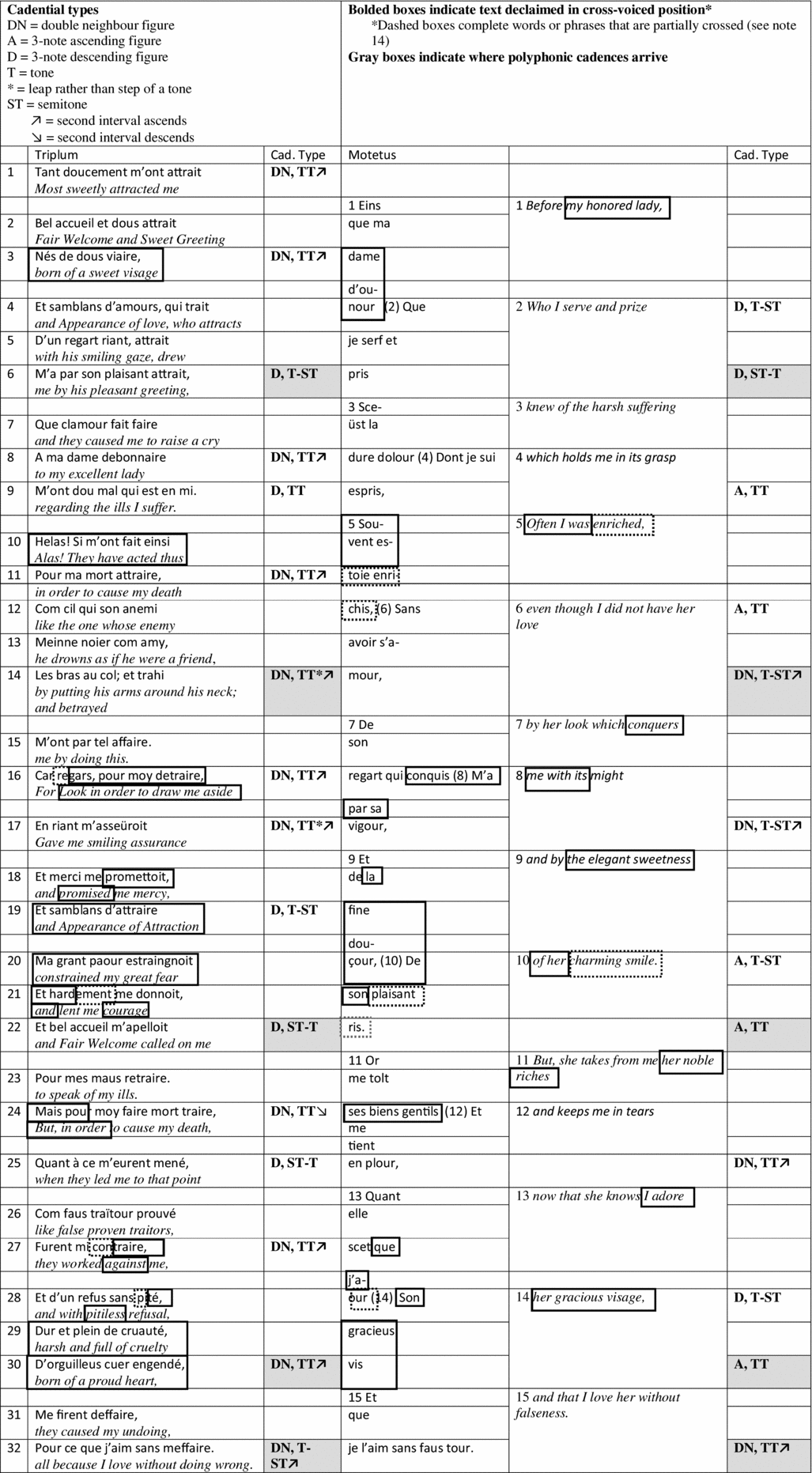
Triplum and motetus texts and translations. Cadential types, voice-crossings and motetus interjections indicated (the first row provides a key). Cadential types are from Jennifer Bain, ‘Tonal Structure and the Melodic Role of Chromatic Inflections in the Music of Machaut’, Plainsong and Medieval Music, 14 (2005), 59–88.

The motetus text states that once upon a time, before his lady knew of his suffering love, he used to be enriched by her look and smile even though he did not have her love. But once she found out, the lady took even her look away from him. This story is not an altogether happy one. In contrast, the motetus texts in all seven instances of M13’s voice-crossing are positive (boxed in Fig. 2, labelled with numbered black boxes in Ex. 1).Footnote 14 A sizeable portion of the motetus – 21/68 words and 27/110 measuresFootnote 15 of the duration – are voiced in the upper register. As a result, most of the text sung in the middle range is negative. The text that is subject to Fortune, the positive, is forced to sound in a higher range: Fortune's realm.
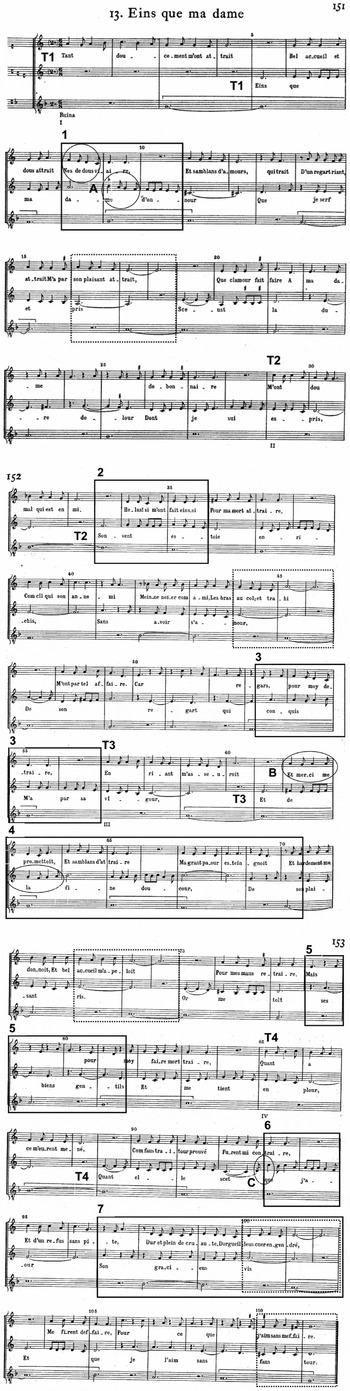
Tant doucement m'ont attrait/Eins que ma dame/Ruina (M13). Permission to reproduce granted by the University of Melbourne.

Excepting crossings no. 1 and no. 4, the triplum lyrics during these crossings are negative, though the triplum message, as a whole, is not. The triplum has experienced sweetness, attraction, assurance and courage from the personified characteristics of his lady even though these characteristics ultimately deceive him. That negative moments in a mixed-emotion text are frequently the ones involved in voice-crossings advances the hypothesis that Fortune forces negative comments about love out of the upper register. Notably, much negative text about the Lady and her characteristics is heard in the triplum during non-crossed portions of the motet. Nonetheless, enough negative words occur during crossings to confirm that voice-crossing is often employed as a means of reversing positive and negative.
The crossings are not simply instances where the motetus happens to sing higher than the triplum. As Zayaruznaya has noted, voice-crossings are not a by-product of the close ranges of upper voices in Machaut's motets.Footnote 16 Rather, M13’s crossing are musically highlighted moments. Some of the crossings in M13 are initiated by one voice being tacit, suggesting that the voice entering second was conceived with the other voice in mind. Crossings no. 2 (bb. 34–5) and no. 5 (bb. 78–80), for instance, begin with one voice entering at least a breve before the other, thus the voice entering second cannot cross coincidentally (see Ex. 1). When the triplum enters a fourth below the motetus after a full breve rest, in crossing no. 2, it does so deliberately. Just before crossing no. 3 (bb. 53–6), the triplum initiates a hocketing section in b. 50, and then, when the motetus joins, it enters on the same note before descending. Similarly, in crossing no. 5, the triplum begins a hocketing section on an e, and the motetus's first pitch enters a fourth higher.Footnote 17 Unquestionably, these are thoughtful compositional choices.
The purposeful nature of these crossings is evidenced when one considers how the music would proceed if the voices were un-crossed. In many cases, the excerpt would make more musical sense if the voices were reversed. For instance, in crossing no. 1 (bb. 8–10), the motetus's first crossed pitch is an a, the pitch the triplum has just left. Meanwhile, the triplum's first crossed pitch is an f, which the motetus could sing convincingly as it would fit with the neighbour-tone alternation pattern it has followed for the previous two measures. Additionally, there is a brief imitative section where the triplum sings an alternating long–short pattern on a descending line from f to c followed by the motetus singing the same rhythm on a descent from b flat to f (see circled portion ‘A’ in bb. 8–10 of score). These lines could easily be swapped. Likewise, in crossing no. 4 (see the circled portion ‘B’ in bb. 62–9 of score), the motetus in b. 63 could be the continuation of a sequence begun in the triplum in b. 62. For the triplum to drop below the motetus results in a sudden leap of a fifth. If it continued the sequence, it would instead move down by step from a to g. Just before crossing no. 3 (bb. 53–6), the motetus sings regart in bb. 50–1, and, after the brief hocket that initiates the crossed section, the triplum sings regars in b. 52. During the crossing, were the triplum's regars set to the motetus's rhythm, it would emphasise the poetic repetition between voices by repeating the rhythm paired with the word. In the same hocket, the motetus sings the words qui and then conquis on f and a respectively, set to two different durations. Were the motetus's text set to the triplum's rhythm and pitches, qui would be heard on a minim F, as would con quis , emphasising the internal rhymes of the poetry by setting them to the same rhythmic pattern. Considering that Machaut often emphasises internal rhymes, assonances and consonances in his musical settings, we might expect this type of compositional technique. The fact that the voices are crossed and do not capitalise on the potential of these repeated sounds implies another motivation. Crossing no. 6 is the best example of how unnaturally these crossings proceed. From bb. 92–3, the motetus has to make an octave leap in order to jump above the triplum (see the circled portion ‘C’ in bb. 92–3 of score). The apparent intentionality of these crossings allows us to hold lightly any suspicion that may arise from the few crossed-but-positive triplum texts.
The moments of voice-crossing, emphasised aurally by their musical introductions, display a reversal of the normal order, suggesting that Fortune is at work in this piece. As poetry alone, the triplum and motetus texts sound similar in tone, yet when set to music, voice-crossings pit positive motetus text against negative triplum text. The crossings make the upper voices oppose one another while also placing positive portions of the texts in the upper register and negative parts in the lower register. The Boethian sphere model therefore applies to M13, as Fortune seems to demand praise in the upper register while the middle register takes responsibility for voicing more critical opinions.
Fortune and contradictory taleae
Registral exchange is not the only type of exchange in M13. While voice-crossing emphasises the image of Fortune turning her wheel, each voice's repeated switching between positive and negative text, as well as their careful juxtaposition to each other, reflect Fortune's two-faced nature. These positive and negative sections align closely with the taleae of each voice. M13 is pan-isorhythmic with all three voices consisting of four taleae repetitions with a single colour, though the motetus's fourth talea is incomplete. The triplum and tenor taleae are aligned, while the motetus's are offset by four measures (marked in the score with T1–T4).
The triplum's text oscillates between positive and negative on the basis of its syntactical structure (lines 1–9 positive, lines 10–15 negative, lines 16–23 positive, lines 24–31 negative, lines 32 positive). The musical setting of this text also isolates positive and negative text sections within ‘sections’ of the musical form, the taleae (Table 1).
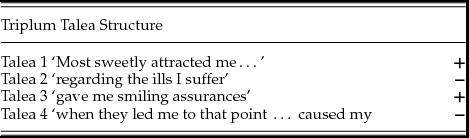
Triplum text corresponding to talea structure.

In the triplum, talea 1 begins with the lover saying that Fair Welcome (Bel accueil), Sweet Greeting (dous attrait) and the Appearance of Love (samblans d'amours) have caused him to raise a cry to his lady (Fig. 2). This text is largely positive as the lover has been attracted by a ‘smiling gaze’ (un regard raint) and ‘pleasant greeting’ (plaisant attrait). In talea 2 the text reverses, revealing that the pleasant greeting and smile were used to betray the lover and cause his ruin. Then the triplum discusses in more detail how this betrayal has come to pass, thereby traversing from positive to negative once again. Talea 3 discusses how Look (regars) gave smiles that promised the lover mercy while the Appearance of Attraction (samblans d'attraire) gave him the courage to tell his lady how he suffered in his love for her: a turn for the better. Then talea 4 accuses the lady's personified attributes of having ulterior motives and ultimately tricking him. Therefore, the triplum's taleae contain distinctive chunks of text alternating between positive and negative, or between the deceptively positive attributes of love/Fortune and the harsh reality of being in Fortune's grasp.Footnote 18
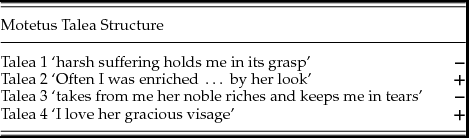
Meanwhile, at first glance, the motetus text moves only once through the positive to negative progression. The lover says that before his lady knew of his suffering, he used to be happy, but now that she knows of his love, she keeps him in tears. The motetus's four taleae, however, dissect the text into alternating negative and positive sections (Table 2).
Motetus text corresponding to talea structure.

Talea 1 corresponds to the text ‘Before the lady knew of my suffering’, which, in isolation, is fairly negative. The text beginning at the second talea shows an abrupt shift to the positive: ‘often I was enriched’. Talea 3 does contain positive text – attractive characteristics of the lady – but ends with the lady taking them away, a decisively negative experience for the motetus's protagonist. Talea 4 makes a sudden turn back to the positive with ‘now that she knows I adore her gracious visage’, and in doing so, isolates the motetus's true love from the sadness that complicates it. The motetus's taleae repetitions divide the text into alternating negative/positive sections, the reverse of the triplum.
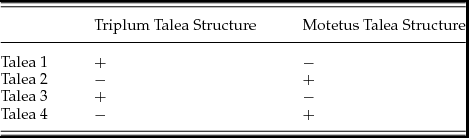
The triplum and motetus are carefully composed so that they are always opposing one another (Table 3). Though the upper voice texts are similar in both tone and content, the motet's musical structure pits them against each other. When the triplum is positive, the motetus is negative, and vice versa. In this way the voices obscure each other's message. The triplum's overly negative text about his lady, less fitting for ‘Fortune's realm’, is juxtaposed by positive text in the motetus while the motetus's accepting stance on love is diluted by the triplum's negative text. As acknowledged previously, some positive text snippets are found within the motetus's negative taleae, but several of these are declaimed while the voices are crossed.
Triplum and motetus texts corresponding to talea structures.

It may seem incongruous to call a talea positive or negative, as it is simply a defined rhythmic pattern, but in both upper voices, taleae beginnings are clearly marked. In each subsequent talea, the triplum begins after a breve rest and shares its rhythm exactly with the motetus (bb. 29, 57, 85). The triplum rhythm at each talea beginning duplicates the motetus rhythm of the previous measure, and this two-measure pattern is reserved exclusively for triplum talea repetitions. At each motetus talea repetition, the motetus enters by itself with the triplum re-entering a measure later. These are the only times in the motet that the motetus has a held note while the triplum is tacit. Much like the triplum talea repetitions, the motetus taleae begin by imitating the triplum's rhythm from the previous measure. Because each voice's taleae structures begin with clear imitation of the other, it emphasises the way the voices are linked in this somersaulting game. It is as if the feet of the triplum are tied to the hands of the motetus. Though they turn together, one will necessarily be on top while the other is on bottom, or one positive and one negative. The boundaries of each talea are audibly distinctive and encourage listeners to tune in to these structures in the piece. Listeners may then hear the text segmented accordingly as well. The duplicitous setting of each text reminds us of Fortune's two sides, the contrast between deception and reality recalls her two-facedness, and the constant somersaulting from positive to negative between triplum and motetus reminds us of her turning wheel. Fortune's sway in the isorhythmic structure of this motet is further evidenced by the motetus's incomplete fourth talea. The moment the perfect pattern breaks down, the motetus sings, ‘when she knows that I love her’. Fortune disrupts the order of the motet as she does the pursuit of love.
Wrestled rhymes
Machaut's musical setting of the upper voices’ poetry disturbs the rhyme scheme of these texts, showing yet another situation where natural order is altered in M13 – further evidence of Fortune's influence. The triplum's rhyme scheme for each talea is aabaaabb with corresponding syllable count 77577757.Footnote 19 The motetus's rhyme scheme follows the pattern abab/baba/abba/aba, arranged in alternating lines of seven and five syllables. Yet Machaut's musical setting obscures this system, rendering the syllable counts for both voices entirely irregular and the end-rhyme scheme incompatible with the music's cadences.
As Marie-Louise Göllner has demonstrated, Machaut frequently obscures or changes how poetic structures are heard, musically manipulating them in order to highlight an internal rhyme scheme or draw attention to a particular word.Footnote 20 In M13, Machaut deconstructs the rhyme scheme but creates a new, more symmetrical one in its place. The pauses in the triplum part, which I define as a full measure of rest, divide its poetry such that it follows an abab rhyme scheme within each stanza/talea. (The lines that end with these pauses have cadential types noted in Fig. 2). I have chosen to define the phrases as such because the patterns of held notes and rests repeat, are part of the musical language of each voice and are also audible. The majority of these phrase endings follow the melodic patterns that Jennifer Bain has shown to dominate cadences in Machaut's monophonic songs, thereby adding support to an analysis of these moments as cadences. Bain presents three figures that account for most monophonic cadences: a three-note ascending figure or step down followed by ascending leap; a descending figure or step up followed by descending leap; and a double neighbour figure or leap followed by a step in the opposite direction. Bain argues that the position of tones and semitones in these figures determines the relative strength or weakness of the cadence.Footnote 21 From her data of the monophonic songs, the double-neighbour figure with an ascending whole-tone and descending figure with ST–T or T–T patterns, which account for all but two of the triplum-voice cadences, are more stable cadences.Footnote 22 These moments of rest in the triplum are fairly stable-sounding cadences, creating a greater aural separation of the text. The abab rhyme schema created by these cadences is much simpler than the aabaaabb schema of the text sans musical setting.
In the motetus, I define the cadences as the points where a pitch is held for the duration of a long. In some of these instances, a breve rest follows this held pitch, further strengthening the sense of pause. The motetus line's cadences are not as stable as those of the triplum, with half of them using figures Bain suggests are more associated with unstable or open cadences, but half of them do follow closed or stable ending figures. Though several of the cadences are less stable, every motetus cadence follows the rising, falling, or double neighbour figure exactly, suggesting that these places are clearly moments of repose. The newly created rhyme scheme (abb/baa/aba/aba) consists of fewer lines, which, while not necessarily significantly simpler than the original, certainly disrupts the poetry's original structure.
Two levels of veiling are found here. The first is between the poetic structure and musical structure: the cadences of the music obscure the apparent perfection of the lines’ syllable count, which emphasises the number 7.Footnote 23 According to Augustine, the number 7 symbolises perfection or completeness and is used frequently in the Bible for seven days of creation, seven churches in Revelation, seven years of famine/plenty, seven gifts of the Holy Spirit and so on.Footnote 24 The second veil of deception is the discovery that the music's apparent deception actually produces new forms of perfection. Veiling and deceit are associated with Fortune, and so we find one more characteristic of the goddess lurking in M13. Elizabeth Eva Leach analyses a similar phenomenon in a pair of Machaut's ballades about Fortune, saying that musical alteration of the poetry, ‘serves to create aural confusion, removing any musical security as to the structure of the poem, reflecting the disruptive actions of Fortune herself’.Footnote 25
Zooming out from the melodic cadential points in individual voices and considering cadences in the polyphonic context, other forms of poetic distortion or reorganisation are found. Sarah Fuller's criteria for cadences are that they are directed progressions – move from an imperfect to perfect sonority – that occur only at textual phrase endings in both upper voices, have a long duration, occur at the end of musical phrases and fall on major mensural units.Footnote 26 The cadences in M13 are essentially where the upper voices cadence simultaneously, most with the doubly imperfect to perfect progression, marking them as strong moments of arrival.Footnote 27 These cadences are marked in the score in dashed-line boxes and in grey boxes in Figure 2 next to the corresponding text lines. Looking at these larger scale cadences, we find that the alternation or book-ending of a- and b-rhymes, inherent to both upper voice texts, is completely dissolved. The triplum, in whose text b-rhymes remain the same despite its a-rhymes changing in each section, is reduced to only a-rhymes, with the originally stable b-rhyme only appearing at the final cadence: a/a/a/ab. The motetus's poetry alternates the same a- and b-rhymes throughout, with the first two stanzas following an abab/baba pattern and the second two stanzas abba/aba. In the second two stanzas, the book-ending of similar rhymes is an important feature of the poetry. In terms of these structural cadences, the motetus's rhyme scheme is the b/a/b/ba devoid of book-ending rhymes. Here we find order turned on its head once more. The play between a- and b-rhymes, foundationally characteristic of the upper voices’ poetry, is largely undone in the triplum, and the return of similar rhymes in the motetus's poetry is done away with. Like Fortune's changing identity, M13’s musical setting changes the identity of its text.
Speaking on behalf of. . .
We have observed that the upper voice texts have similar content but are made more contradictory through their musical settings. Voice-crossings and talea structures often present us with oppositional texts. Yet, the upper voices of M13 do much more than reverse roles. The motetus actually speaks for the triplum, because bits of its text are heard within the silences created by triplum rests. The resulting message is a straightforward accusation against the lady, one that the triplum hints at, but is more befitting of the motetus than the triplum in terms of their relative positions in the Boethian spheres. In addition, the motetus continues the story begun in the triplum. The triplum protagonist states that he has been encouraged to speak to his lady and that this encouragement has led him to ruin. The motetus actually discloses what he told his lady and describes the ruin that the triplum says was intended.
Typically, as the fastest moving voice of a motet, the triplum has the fewest rests and held pitches and, correspondingly, the most text. In M13, the triplum's text is twice as long as the motetus's, so it is noteworthy that it happens to contain several aural windows through which we can hear snatches of the motetus voice. Looking at the snippets of motetus text heard during these few rests, held notes, or hockets with the triplum yields the following words (indicated in bold, italic text in Fig. 2): ‘Eins d'on(our) que Sce(ust) dure dolour sui sou(vent) (en)ri(chis) sans de regart qui con(quis) par sa et dou(cour) de or ses biens gentils tient quant j'a(our) son et je l'aim sans (faus tour).’ While these words do not form a semantically perfect sentence, we do find the distillation of the motetus's two major points. First, before his lady knew how he felt, he enjoyed the sweetness of her look: ‘Before honoured knew harsh suffering am often enriched without Look which conquers with its sweetness.’ Second, the lady then refuses the lover any part of herself when she finds out that he loves her: ‘but her noble riches keeps when I adore her and I love without falseness’. The last two words in parentheses, ‘faus tour’, are not heard within a triplum rest or held note, but, in the preceding measures, the triplum and motetus are hocketing, and their final lines are nearly identical in meaning. Including the end of the sentence is justifiable since it is the only thought heard at that moment. Because this text is heard in the triplum's rests, it is heard in its sphere. The triplum protagonist never explicitly accuses his lady of causing his undoing, but rather the allegorical characteristics of the lady such as Look, Fair Welcome and Appearance of Love. The motetus protagonist, on the other hand, directly blames his lady for his demise. The motetus, at least in hindsight, seems to be able to differentiate between the lady and her charms, a characteristic fitting with the middle position in the Boethian model that is closer to divine wisdom. In a way, the motetus speaks for the triplum. The motetus voice, heard in the triplum space, voices the feelings the triplum hints at: yet another reversal of roles between the upper voices in M13. As already evidenced by its voice-crossing and talea structure, M13 makes sure that negative talk about the lady stays in the motetus voice.
The motetus speaks for the triplum in a second way by elaborating on the triplum text and continuing its story. Interpreting the relationship between voices this way is not unprecedented as Zayaruznaya argues for a similar approach to understanding the seemingly contradictory upper voice texts of M14. In M14, the triplum says it is forced to sing a song in praise of his lady even though it is a lie. Zayaruznaya suggests that the motetus is this paean.Footnote 28 In M13, the triplum says that, ‘Fair Welcome . . . caused me to raise a cry to my excellent lady of the ills I suffer’, and echoes this message again later on saying, ‘Appearance of Attraction called me to speak of my ills.’ But, he claims these invitations to speak are a trap intended to cause death. While the triplum shows Fair Welcome's intended plot to draw the truth out of him, the motetus shows the actualisation of the same plot. Going further than the triplum, the motetus has not simply discovered his lady's plot, but he has experienced its results. He has already lost her ‘noble riches’ and been ‘kept in tears’. The triplum never actually speaks its ills; it only says that it was drawn to do so and implies that it has not gone well. The triplum voice suggests that he has been mistreated by Look, Fair Welcome and so on because he loves without doing wrong, but it is not completely clear that this guileless love is what he confessed to his lady. The motetus, in contrast, declares that he suffers because the lady found out that he loves her, attributing his suffering from the beginning of the motet ‘before the woman of honour [. . .] knew my harsh suffering’ to the subsequent ‘takes from me her noble riches and keeps me in tears now that she knows I adore her gracious visage and love her without falseness’. The motetus's confession of love is the cry the triplum says it was drawn to raise. The ‘death’ intended for the triplum by the deceiving attributes of the lady is the lady turning her face away from the motetus. The motetus in M13 is an elaboration or gloss of the triplum, speaking the message the triplum says he has been coerced to speak.
That both triplum and motetus mention Look, Visage, Smile and Sweetness is evidence that Machaut conceived of the two voices together. The excerpt from each voice about Look is especially convincing. The triplum says, ‘For Look in order to draw me aside gave me smiling assurances’. The motetus further elaborates on how Look drew the triplum aside and gave smiling assurance. The motetus tells us that the lady's ‘look which conquers [me] with its might’ and the ‘sweetness of her charming smile’ enriched. The high degree of similarity in language justifies us reading the upper voices together. An indignant allegation is heard at the same time as a resigned account. The simultaneity of past and present, statement and explanation, anger and resignation, adds to our growing list of characteristics that announce Fortune's presence in M13. As Zayaruznaya argues, duality ‘infects everything Fortune touches’.Footnote 29 The idea of duality is especially seen in the voices’ shared invocation of ‘Look’ (regart), heard in both voices right before the motet's midpoint in a crossed-voice section.Footnote 30 As Karen Desmond has argued, Look, the personification of a secular vice, is linked in some of Machaut's ballades with the beastly basilisk, who destroys everything it gazes on. The falseness of this Look, which appears at first to be welcoming and pleasant, hides danger, and consequently links Faus Semblant, the personification of this false seeming, with Fortune.Footnote 31
M13 and F4
This ‘speaking for’ phenomenon is also present in Fauvel 4, the motet from which M13 takes its tenor.Footnote 32 The speaking for construction is perhaps one way that Machaut pays homage to or reacts to his source material. As it will become apparent below, Machaut not only subtly alludes to F4, but also announces his borrowing blatantly in the acrostic mentioned at the beginning of this article. Alice Clark notes that Machaut may be in conversation with F4 by paralleling Faux Semblant in M13 with Fauvel in F4 by way of making a small change to the tenor.Footnote 33 I argue that Machaut's conversation with F4 is not only seen in such subtle ways. Machaut borrows the relationship of F4’s upper voices and directly cites the Fauvel motet in addition to borrowing its tenor. M13 can be seen to be in intentional conversation with another piece of music, a relationship with a predecessor that goes beyond artistic re-working or appeal to authority.
Similar to M13, the motetus of F4 reflects the realisation of what the triplum warns will happen. Both texts are invectives against authority: the triplum against the popes and prelates, the motetus against the ‘rulers on the thrones of this world’. Quoting Matthew 7:15, the triplum's text accuses the popes of being, ‘false prophets [who] will come in sheep's clothing’.Footnote 34 The act of deception is used in the future tense. Again, it threatens that ‘rapacious wolves are near’.Footnote 35 The triplum also justifies his attack saying, ‘But it is the hour unless the crooked are made straight, ruin; danger lies in delay.’Footnote 36 It seems that the purpose of using such harsh language is to convict the leaders of their falseness before it is too late. The motetus of F4, in contrast, uses the present tense saying, ‘Presiding on the thrones of the present age are today trickery and robbery’Footnote 37 and again in the ending exclamation ‘Ruin is at hand!’Footnote 38 These inopportune events are happening in the very moment they are announced. No more warning can be made. The relationship with the triplum is especially clear when the motetus repeats the word rapacious, saying ‘the rapacious house rules’ and discusses a similar animal to the wolf, the fox (volpina).Footnote 39 The greedy wolves are coming in the triplum, but in the motetus, the greedy foxes already rule. The danger and ruin that would occur if any delay was made in straightening the crooked path has indeed come to pass. Like M13, whose motetus gives a more detailed account and displays the results of what the triplum hints at, the motetus of F4 relates the results of what the triplum foretold. The parallel relationship of triplum and motetus suggests to me that Machaut borrowed more than the tenor from F4. Indeed, in M13, he imitates the perceived movement of time from triplum to motetus.
Alice V. Clark notes additional similarities between these two motets. She observes that Machaut changes one pitch of the F4 tenor when using it in M13. The F4 tenor sings g–b–c–a in bb. 29–31 and 69–71, which in the M13 tenor is subtly changed to g–c–b–a (bb. 25–35). This change briefly imitates an earlier passage, which Clark suggests creates the false impression that the M13 tenor has a repeating colour like F4 though it has only one melodic iteration.Footnote 40 Such a change is unusual for borrowed tenors as most copy their source melody exactly. This deceitful appearance, masking reality, is related to the content of the upper voices where the lady and her characteristics appear kind but are found to be far from benevolent. It is interesting to note that the motetus and triplum voices in F4 are crossed at the moment of the altered g–b–c–a pattern, providing even more shades of deception by potentially implying Fortune's influence. Clark notes the repeated use of the adjective ‘appearance’ to qualify attraction and love as well as the appearance of the word faus, interpreting these words as allusions to the character Faus Semblant. In the Roman de la Rose, Faus Semblant quotes from Matthew 23:1–2 as does the triplum of the Fauvel motet saying: ‘quod vobis dicunt facite sed quod faciunt nolite’ (Do what they say to you, but do not do what they do). Adding connections between these motets and the Roman de la Rose, Jacques Boogaart identifies a quotation from the Roman in M13: ‘Com cils que son anemy / Meinne noier com amy / le bras au col’ (‘like him who leads his enemy to be drowned, as a friend with arms around his neck’).Footnote 41 Boogaart notes that in the Roman, the lover's helper, Ami, invokes this phrase to suggest that the lover must use hypocrisy to gain the lady's love, while in M13, the lady uses hypocrisy to ruin the lover. Clark observes that in the Roman, Faus Semblant uses the passage from Matthew to criticise mendicant orders, while all the time Faus Semblant's very purpose is to show lovers that they must look attractive even if the appearance is deceptive. In F4, the passage is used to call out the deceit of popes and prelates directly. Both Clark and Boogaart note that, in M13, Machaut takes passages or references from his source material but uses them in different contexts. Both see the connections to Faus Semblant, whether through the Matthew passage or the quote from the Roman de la Rose, as emphasising M13 and F4’s shared theme of hypocrisy. According to Clark, the tenor's text, ‘Ruina’, which in F4 mourns religious hypocrisy, is reworked to mourn deceit in the pursuit of love. Clark concludes that Machaut's manipulation of the tenor emphasises the theme of false appearance and therefore that Machaut associates Faus Semblant with Fauvel.Footnote 42 Even outside the context of these two motets, there may be linguistic reasons to connect the two characters. As Kevin Brownlee observed, the only direct reference in Fauvel to the Rose is in relation to Faus Semblant, and there are connections between the names Faus Semblant and Fauvel, which means ‘veil of falseness’.Footnote 43
The acrostic ES EQUA reveals that Machaut does not just replace Fauvel with Faus Semblant or allude to their parallel roles, but declares they are one and the same. Taking the first letter of each line of the motetus produces the letters ESEQ. Including the ‘ua’ attached to the q in the word ‘quant’, a reasonable allowance since q's rarely occur without u's after them, delivers ES EQUA: ‘You are a mare’ (Fig. 1). Machaut could hardly respond more directly to his source material. The false appearance of the lady's virtues is declared to be Fauvel. This is similar to Machaut's equation of Fortune to Sin in M8.Footnote 44 Fauvel is also an acrostic for seven vices, so here Machaut responds to an acrostic with an acrostic. One may question why Machaut uses the feminine equa instead of equus, and if this difference undermines a reference to Fauvel, who is male in the Roman. The ‘you’ of Machaut's motet is the appearance of attraction, appearance of love, fair welcome and so on – that is, the attributes of the lady – that Fortune, the female goddess, uses to deceive. The beloved lady and Lady Fortune neither act less deceitfully nor cause less destruction than the hated Fauvel. It is also known that Machaut employed transgendering in his citations as part of his intertextual play.Footnote 45 Even without a connection to Faus Semblant and themes of deceit, this direct reference to Fauvel, who was both helped and harmed by Fortune, loudly proclaims Fortune's presence in M13.
The motetus offers another possible acrostic. Analysing the first letter of each motetus line (if the 7575 pattern is grouped into two lines of 75/75) yields the letters ESSDEOQ. Adding the ‘ue’ attached to the Q in the text, we have ES(S) DEOQUE, meaning ‘and you belong to God’ (Fig. 1). Read separately, the two acrostics represent the secular and the sacred dimensions of a motet, but, surprisingly, both in the motetus rather than the tenor vs the upper voices. Though this acrostic is less convincing than the first, linking the two acrostics does produce a complete idea: ‘You are a horse, and you belong to God!’ Invoking God adds authority to the accusation. Perhaps the cry of ‘Ruin!’ in the tenor can, in light of this acrostic, be read as God's message to the lady's deceptive appeal. It is not just a spurned lover's petulant curse but also the condemnation of the divine, bringing the seemingly secular M13 closer to the more religiously oriented F4.
Even if this second acrostic is rejected, that the original acrostic is Latin, not French, the language of the text from which it is formed, is especially noteworthy. By hiding Latin acrostics in M13, Machaut embeds a nod to his source: a Latin motet. Literary tricks such as acrostics and anagrams are found often in Machaut's work, more often in his poetry than his music, and these anagrams usually name the author or a patron.Footnote 46 As far as I am aware, however, M13 is the only known example of a word puzzle that reveals a source from which Machaut borrowed. Anagrams show authorial accuracy while also inviting readers and performers to author the text by figuring out the puzzle.Footnote 47 An acrostic does not provide instructions in the way an anagram does, therefore less obviously inviting the reader to play a game and also not so obviously stamping the piece with the author's name. But, the acrostic, if noticed by readers and performers, marks the piece with the stamp of the original author by alluding to the character Fauvel. Since the acrostic is not visually distinguished on the page, it is only by hearing and producing the aural distinction between taleae repetitions that this footnote is revealed. Machaut claims the auctoritas of the Roman de Fauvel with this clever citation.
Such a cross-lingual playfulness, citing a Latin source in a Latin acrostic formed from French verse, may prompt us to expand our ideas of quotation and inter-textuality. The use of borrowed refrains and citations in Machaut's motets has been investigated widely, but M13’s case is unique. This motet presents an intertextual allusion comprising all new material rather than a quotation, paraphrase, or manipulation of the source itself. While one may expect quotations from Fauvel in the motetus or triplum, instead Machaut quotes from the Roman de la Rose. He manages to create an intertextual allusion without a quotation, cunningly obscuring his most important intertextual links. This approach is exceptional as most composers who borrow tenor material, as Alice Clark has argued, usually make connections to their sources clear.Footnote 48
Ordering and grouping in Machaut's motets
Having established Fortune as a prominent theme in M13 through its many forms of voice-reversal, it can be firmly placed among the motets Zayaruznaya (in terms of voice-crossing) and Boogart (based on characteristic rhythmic patterns)Footnote 49 have marked as particularly Fortune-potent: M12, M14 and M15. Since it is widely accepted that Machaut purposefully ordered his manuscripts, I propose that the addition of M13 provides the opportunity to consider M12–15 as an intentionally ordered set of Fortune-related motets, rather than a coincidental collection. The four motets are related as a group, but also related to each other subsequently. In some ways, M12 – whose triplum, motetus and tenor divide into the three Boethian spheres – courtly, philosophical, and religious – sets the rules for how M13 should function.Footnote 50 The voice-crossing in M13 moves positive text about the pursuit of love to the upper register and negative text to the middle register. Similarly, M13 establishes a relationship between triplum and motetus taken up in M14. M13’s motetus describes the aftermath of the mistreatment the triplum claims to have endured, and, as Zayaruznaya argues, M14’s motetus serves as the song its triplum says it was forced to sing.Footnote 51 M13’s motetus and triplum seemingly agree, but musically their texts are set to constantly oppose one another. In a similar yet opposite way, M14’s upper texts seem diametrically opposed, yet positive triplum text is musically paired with positive motetus text, and the same holds true for negative words.Footnote 52 The word choice of ‘false turn’ (faus tour), which ends the motetus of M13, links M13 to M14, which also suggests the idea of turning. M14’s motetus says that Fortune ‘turn[s] great sadness into pure joy’ (de grant tris tour en toute joie mis). The turning in the motetus parts of M13 and M14 foreshadows the actual allegorical figure of Faus Semblant, the focus on M15’s motetus, who deceives and un-deceives in turn. The vocabulary choice connects these motets as it also, once again, recalls Fortune's turning wheel. The shared use of allegorical figures, noted by Karen Desmond, further links M13 and M15 as does the strong contradiction in the use of the word ‘faus’ between the false-less lover of M13 and false beloved of M15.Footnote 53 M14 and M15 share several compositional similarities, which will be discussed further below. Finally, M12 and M15, the bracket motets of my proposed group, both use tenors with liturgical positions in the second week of Lent, and they are the only two Machaut motets that employ tenors with this liturgical assignment.Footnote 54
While he does not directly propose M12–15 as a group, Thomas Brown's ordering schema for M1–20 provides additional evidence for such a grouping.Footnote 55 His order is based on a quotation found in M10 from the midpoint of the Roman de la Rose. Using Jacques Boogaart's observation that the proportion of motet lengths between M1, M5 and M10 as well as M11, M16 and M20 (the three motets built on chanson tenors) form near perfect ratios, Brown shows that a M10/M11 midpoint creates a mirrored structure that frames sets of paired motets. M14/M15 are one such pair, nestled between M11 and M16 as ratio anchor posts. Brown's suggested structure not only frames this pair of motets, but also exactly brackets the group M12–15. Brown thus implicitly suggests that M12–15 are intentionally ordered. Anne Walters Robertson's work, outlined below, provides one rationale for why this may be, at least for M11–14. My analysis of Fortune in M13 provides another, which fills a gap in Zayaruznaya and Boogaart's set of Fortune-prominent motets, accounts for several grouping analyses, and shrinks the distance between secular and sacred-based groupings.
Anne Walters Robertson argues that M1–17 can be viewed through the interpretive frame of a spiritual journey. Within this journey, M11–14 work as a ‘mini-series’ emphasising the theme of longing, a discipline the spiritual pilgrim must learn. This lesson aligns with the ninth step in the spiritual journey as given in Book 1, Chapter 8 of Henry Suso's Horologium Sapientiae. Footnote 56 The mature spiritual disciple knows she cannot have complete unity with Christ or constant benefit from Wisdom. Sometimes wisdom is fleeting, and sometimes though the disciple is well on his way in his battle against sin, his brothers will deceive him or the Devil will dig a pit to trip him up. As a spiritual disciple, this step is the journey's middle, not its end. Similarly, when pursuing love, sometimes the lady graces the lover with her smile, but sometimes she turns away. Sometimes she provides pleasure, while others sorrow and ruin.Footnote 57 That Robertson argues for a grouping similar to the one I propose, though on different grounds, provides additional support that these motets work as a set.
Robertson's exclusion of M15 and her more spiritual interpretation may raise questions as to their applicability as evidence for a Fortune-based grouping of M12–15. For Robertson, M15 fits with the next step of the spiritual journey because its tenor, ‘I have seen the Lord’, suggests that some satisfaction of the longing in M11–14 has been found. Though Robertson does not include M15 in her grouping, Zayaruznaya notes that in both M14 and M15 the voice-crossing is isolated in one half of the motet. Additionally, Thomas Brown argues that M14 and M15 can be paired because of their identical lengths.Footnote 58 Both these facts suggest that M15 is closely connected to M14 and, as it follows, M12–15. Concerning her spiritual interpretation, Robertson makes parallels between secular and sacred in her analysis, so we need not see her spiritual journey grouping as contradictory to a Fortune grouping. Robertson quotes from the Horologium in which the disciple is encouraged to press on, even though he has experienced bad fortune. The disciple must continue striving for Christ despite the turning wheel of love.Footnote 59 In this wording, Fortune is not merely the secular foil to the sacred experience. The language of Fortune is entwined with the sacred.
According to Karen Desmond, the language of Fortune that is linked to Faus Semblant, and therefore to Look (Regard) by way of the sacred sin of pride, further entwines secular and sacred. Considering the beast in the acrostic, M13 may be described, along with the many bestial pieces Desmond discusses, as one that ‘suggests an intersection of references to both secular and sacred realms, and resists confinement in, or privileging of, one realm over the other’.Footnote 60 If this were not enough, Robertson describes the voyage the disciple takes in M10–17 as being full of ‘ups and downs, [and] twists and turns’, and the language from Suso's Horologium that Robertson aligns with M11–14 says that ‘Wisdom/Christ comes and goes’: all the language of variability, reversal, and most importantly, high and low that is also associated with Fortune.Footnote 61
Of course, Machaut mentions Fortune outside of these four motets, directly in M3 and M8, and themes of deception and reversal are found in many of his works. My suggestion of a Fortune-related grouping for M12–15 does not claim that Machaut isolates Fortune material to this group or that other motets that use one of these themes or compositional devices are necessarily primarily about Fortune. There are certainly ties between M12–15 and other motets as well that could suggest alternative groupings (though not in the sequential way we would expect in Machaut's collected works). M9, for example, a motet that does not state Fortune's name but discusses deception and vices, Fortune-related topics, has associations with the M12–15 group on the basis of bestial content. At least M13 and M15 include personified vices and beasts as does M9 (tenor ‘Fera pessima’ or ‘Most evil beast’). In M13, if we consider the acrostic's ‘you’ as conflated with the personifications of the lady, they are equal to Fauvel: a beast.Footnote 62 M9 and M13 may also suggest the beginning of a collection of Fauvel-related motets. Margaret Bent has noted the close relationship of the tenors of M9 and the Fauvel motet Tribum / Quoniam / Merito hec patimu.Footnote 63 While associations between M12–15 and other Machaut motets may be found and Fortune may be present in other motets, these four motets are especially saturated in cross-voicing, rhythmic patterns and compositional and musico-poetic reversals that signal Fortune. This group of four motets clearly function consecutively and are bounded in several meaningful ways, which marks them specially as a Fortune unit.
Conclusions
M13 is a sly piece. Looking only at its basic isorhythmic structure, voice-crossing, or individual texts, few features flag the motet as one of particular interest. Yet its voices are crossed against musical sense, its rhymes re-arranged, and its straightforward texts musically coerced into flip-flopping moods. The many layers of disruption and reversal in this motet signal the theme of Fortune, who is found hiding in plain sight within the motetus acrostic: a Latin acrostic that is an invective against Fauvel, who has ridden Fortune's wheel to the top and back down again. Finding Fortune in M13 offers evidence that Machaut grouped M12–15 because of their especially noteworthy Fortune characteristics, and with this study, I add talea/text relations and reversals to a growing list of musical characteristics that may signal Fortune.
The ES EQUA acrostic also prompts new questions about borrowing and intertextuality. Borrowed and repurposed melodies and texts are foundational to the motet genre itself, of course, but in the case of M13, Machaut does not simply re-work old material into a new form or even borrow its themes, but pays homage to it and is in dialogue with it in a very direct way. M13 exemplifies the exegetically ambiguous nature of the motet, which Sylvia Huot describes as, ‘a free play of allegory, a simultaneous presence of figurative readings both sacred and profane, none of which excludes the others’.Footnote 64 Yet M13 does more than hold sacred and secular readings simultaneously. It goes farther than replacing the more sacred-oriented Fauvel with the more secular Faus Semblant, equating problems of deceit in the government/church with problems of deceit in fin'amours through a shared tenor, as Clark suggests.Footnote 65 Instead, M13 places both the secular and the sacred within the upper voices. Faus Semblant and Fauvel co-exist in the motetus. What is more, God and Fauvel co-exist in the motetus. The free play of allegory extends not only to upper voices read in light of tenors or tenors read in light of upper voices, but upper voices in light of upper voices. Investigating sacred/secular conflations within a given voice of a motet may reveal additional layers of meaning within motets. As noted earlier, F4 quotes two passages from Matthew, both having to do with deceptively innocent-looking characters that actually do evil. Association with the sacred does not ensure one will be godly. In Matthew 12, the Pharisees make a similar argument, suggesting that just because Jesus casts out demons does not mean he is divine, but instead may be demonic by association with the demons. A similar accusation seems to be taking place in the motetus of M13. The deceit of the upper voices, of Faus Semblant or the lover's lady, is accused of being Fauvel, the culmination of sin, that is, the Devil. Clark notes how in his speech in the Roman de la Rose, Faus Semblant calls attention to the deceit of the religious orders, yet at the same time Faus Semblant, who is false, is also needed in the pursuit of love. Can one have it both ways? While motets, as a whole, allow interpretations as either secular or sacred, the motetus of M13 attempts to do both at the same time, and in so doing, points out inherent contradictions.
Though the liturgical origin of the tenor is unknown, if there is one, Jesus's reply to the Pharisees' accusation in Matthew 12:25 embodies M13’s sentiment: ‘Jesus autem sciens cogitationes eorum, dixit eis: Omne regnum divisum contra se desolabitur: et omnis civitas vel domus divisa contra se, non stabit’ (‘And Jesus knowing their thoughts, said to them: Every kingdom divided against itself shall be made desolate: and every city or house divided against itself shall not stand’).Footnote 66 Sacred and secular may both live within the motetus's sphere, but the protagonist of its text cannot have both.