Introduction
Dirofilariasis is a parasitic infection caused by helminths of the genus Dirofilaria. In Europe, the most important causative agents of disease are Dirofilaria repens, a parasite of subcutaneous tissues, and Dirofilaria immitis which causes the pulmonary and heart form of disease. Definitive hosts of both species are dogs and other carnivores and several mosquito species play the role of both intermediate host and vector of the parasite. Nowadays, subcutaneous dirofilariasis is regarded to be an arthropod-borne disease with the fastest spread in Europe, representing a high infection risk for both animals and humans. An increase of prevalence and new endemic foci have been ascertained in several eastern and central European countries, such as Bulgaria (Georgieva et al., Reference Georgieva, Kirkova and Ivanov2001), Serbia (Dimitrijevic et al., Reference Dimitrijevic, Tasic, Tasic, Adamovic, Ilic, Genchi, Rinaldi and Cringoli2007), Hungary (Fok et al., Reference Fok, Kiss, Majoros, Jacsó, Farkas, Gyurkovszky, Genchi, Rinaldi and Cringoli2007) and also Austria (Duscher et al., Reference Duscher, Feiler, Wille-Piazzai, Bakonyi, Leschnik, Miterpáková, Kolodziejek, Nowotny and Joachim2009). The main reasons for such an expansion are in particular climatic changes, which have occurred in central Europe in recent years, accompanied by global warming and frequent floods, resulting in an increased abundance of mosquitoes (Genchi et al., Reference Genchi, Rinaldi, Cascone, Mortarino and Cringoli2005; Rinaldi et al., Reference Rinaldi, Musela, Biggeri and Cringoli2006).
In the Slovak Republic, canine subcutaneous dirofilariasis was recorded for the first time in 2005 (Svobodová et al., Reference Svobodová, Svobodová, Beladičová and Valentová2005). Within the primary monitoring of dirofilariasis that has been started in southern parts of Slovakia in February 2007, in total, 287 dogs of different age, sex, breeds and use were examined for the presence of microfilariae. Infection was diagnosed in 99 animals (32.1%). The prevalence was the highest in the group of police dogs, with microfilariae detected in 46 out of 90 examined individuals (51%; Miterpáková et al., Reference Miterpáková, Antolová, Hurníková and Dubinský2008).
Therefore, the aim of the present study was to ascertain the prevalence of dirofilariasis in working dogs in Slovakia.
Materials and methods
Study area and dog origin
The survey of dirofilariasis in working dogs took place in between September 2007 and February 2008. Within the co-operation of the Ministry of the Interior and the Ministry of Defence, blood samples from 710 working dogs (591 police and 119 military dogs) from kennels in different districts of Slovakia were collected and examined. While police dogs are used in almost all districts, military dogs serve in only ten districts.
Sample collection and questionnaire
Sampling was done by police, military and/or contract veterinarians. All veterinarians were asked to fill out a questionnaire regarding the breed, age, sex, kennel locality, localities visited by dogs and eventual health problems of each dog.
Histological and molecular procedures
Larval stages of dirofilariae and microfilariae were detected in total blood using a modified Knott (Reference Knott1939) test. Briefly, 1 ml blood was mixed with 9 ml of 2% buffered formalin and centrifuged at 2000 rpm for 5 min. The supernatant was removed and sediment was stained with 1% methylene blue. The stained sediment was examined under the light microscope at 150 × magnification.
For species determination, positive samples were analysed using histochemical staining based on the different distribution of acid phosphatase activity using a commercial kit test (Leucognost-SP, Merck, Darmstadt, Germany) according to Peribáñez et al. (Reference Peribanez, Lucientes, Arce, Morales, Castillo and Gracia2001). Microfilariae of D. immitis show two acid phosphatase activity spots localized around the anal and excretory pores, whereas D. repens shows only one acid phosphatase activity spot localized around the anal pore.
DNA was extracted from positive samples using a DNeasy Blood and Tissue Kit (Qiagen, Hilden, Germany) for polymerase chain reaction (PCR) analyses. The amplification of DNA fragments for cytochrome oxidase subunit 1 gene was performed with specific D. repens and D. immitis pairs of primers according to Rishniw et al. (Reference Rishniw, Barr, Simpson, Frongillo, Franz and Dominquez Alpizar2006). All PCRs consisted of a denaturing step at 94°C for 2 min and 35 cycles of denaturing for 30 s at 94°C, annealing for 30 s at 57°C and extension for 30 s at 72°C, with final extension for 7 min at 72°C. The PCR products were visualized by 1.5% agarose gel electrophoresis.
Data analysis
Questionnaire data were analysed with respect to relative dependency of infection incidence and different epidemiological indicators, especially the kennel locality. A non-parametrical test (χ2 test with Yates correlation) was used for statistical comparison using Statistica 6 Base (StatSoft, Inc., Tulsa, Oklahoma, USA).
Results
Dirofilariasis in police dogs
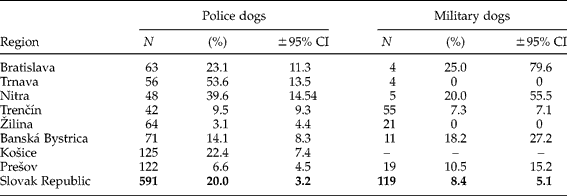
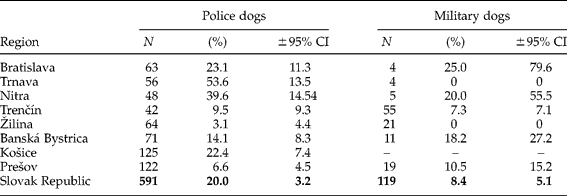
Microfilariae were detected in 118 blood samples out of 591 police dogs, which represents an overall prevalence of 20.0% (table 1). Dogs originated from 55 districts in Slovakia, and the parasite was diagnosed in animals from 28 districts. Statistically significant differences in infection occurrence were found between individual regions (χ2 test: χ2 = 83.0304; df = 7; P = 0.0000). The majority of infected police dogs had been bred in southern regions of Slovakia (Trnava region 53.6% and Nitra region 39.6%). The incidence was the lowest in northern parts of Slovakia, in the region of Žilina (3.1%) and Prešov (6.6%). Dogs born between years 1996 and 2003 were infected more frequently than younger animals born between 2004 and 2007; however, the difference was statistically insignificant.
Dirofilariasis in working dogs in individual regions of Slovakia (N, number examined; %, prevalence).
Bold values are the total values for the Slovak Republic.
D. repens was detected in all infected police dogs and, in three individuals, co-infection with D. immitis was present. The mixed infection occurred in one dog from the south-western Nitra region and in two dogs bred in the south-eastern part of Slovakia in the village Velké Slamence on the frontier with Ukraine.
Dirofilariasis in military dogs
A total of 119 military dogs were examined from ten districts of Slovakia. The prevalence of dirofilariasis in military dogs was significantly lower compared with police dogs (χ2 test: χ2 = 8.9616; df = 1; P = 0.0028). Infection was confirmed in ten animals from seven districts. The average prevalence in military dogs was 8.4% (table 1). The infection was present in nine dogs born in the years 1995–2003 and in one dog born in 2005. In all infected military dogs, simple infection with D. repens was confirmed by PCR analysis.
Discussion
In the present study, we aimed to establish dirofilariasis prevalence in working dogs bred in the territory of Slovakia and to identify the localities where the disease could originate.
The results of the first reported investigation of dirofilariasis in working dogs were published from southern France, where in 1983, in total, 207 military dogs and, 5 years later, 180 dogs utilized by the army were examined for dirofilariasis. Chauve (Reference Chauve1997) recorded a high prevalence in both years under study (46.8 and 37.2%, respectively).
Our results point to a frequent occurrence of infection in police dogs; the prevalence rates in some districts exceeded 40.0%. The infection in military dogs was significantly lower with an average prevalence 8.4%. The number of microfilariae in 1 ml of blood varied between one up to several hundreds of specimens.
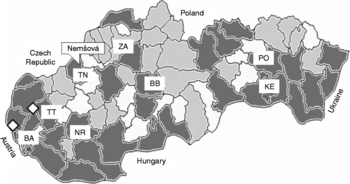
Based on the evaluation of questionnaire data, we consider all infections to be autochthonous (all dogs became infected in Slovakia). Nevertheless, the exact determination of the locality where the disease was acquired and the designation of the origin of individual infection cases are very difficult. The reason is that almost all police dogs spend several weeks per year in a training centre located in Záhorie (Bratislava and Trnava regions), which is considered to be an endemic area of subcutaneous dirofilariasis. Also, a police dogs' kennel is situated in this region. The stay in endemic localities is believed to be the main cause of high infection prevalence in dogs working in northern parts of Slovakia with climatically less favourable conditions, as well as the possible reason for big difference in numbers of infected police dogs when compared with military dogs. Out of ten infected military dogs, we were able to identify the source of infection only in one individual. This dog lived in the cadastre of Nemšová village (latitude 48°57′0″N; longitude 18°10′0″E) in Trenčín district and is regarded as the northernmost localized autochthonous case of subcutaneous dirofilariasis in Slovakia (fig. 1). Despite the impossibility of localizing exactly the origin of infection, infected dogs become the source of parasite and, in suitable climatic conditions, they may be considered as source for new foci of dirofilariasis.
Dirofilariasis in Slovakia (regions: BA, Bratislava; TT, Trnava; NR, Nitra; TN, Trenčín; ZA, Žilina; BB, Banská Bystrica; PO, Prešov; KE, Košice); dogs not examined (○), uninfected ( ), infected (
 ), human cases (⋄).

The high prevalence of infection recorded in police dogs represents a considerable veterinary problem, as the disease (in particular, the pulmonary and heart forms caused by D. immitis) and its pharmacotherapy may cause thrombosis and heart failure, especially in animals exposed to physical labour.
Another potential risk is the transplacental transfer of microfilariae from the female dog to fetuses. The possibility of intrauterine infection has being discussed for several decades and this transmission pattern has been proved experimentally in gravid female dogs. Mantovani & Jackson (Reference Mantovani and Jackson1966) found microfilariae in amniotic fluid, in fetuses and in the blood of newborn whelps. In Todd & Howland (Reference Todd and Howland1983) investigated the transmission of microfilariae from three gravid bitches to their offspring. They found microfilariae in nine whelps from one mother; in other female dogs, the transmission was not proved. The numbers of microfilariae in newborn whelps varied between 1 and 39 specimens per individual.
Regarding the zoonotic character of infection, the risk of human infection is also of importance, in particular, in endemic localities and in regions with high mosquito populations. Humans represent a ‘dead end’ of infection because they are not suitable definitive hosts for the parasite, and larvae develop only from infective L3 stage to pre-adult L5 larvae. To date in Slovakia, two autochthonous human dirofilariasis cases with the subcutaneous form of infection have been reported in 2007 (Jalili et al., Reference Jalili, Kobzová, Novák, Dubinský and Babál2007) and in 2008 (Ondriska et al., Reference Ondriska, Lengyel, Miterpáková, Valentová, Beladičová, Lengyelová, Strehárová and Dubinský2008). Both cases were reported from western Slovakia, in the regions of Bratislava and Trnava (fig. 1).
The high prevalence of subcutaneous dirofilariasis in working dogs from Slovakia, with 40% of dogs infected in some regions, requires the urgent introduction of prophylactic and control measures. In endemic localities, prevention includes the administration of selamectin-, ivermectin- or moxidectin-based preparations monthly throughout the mosquito season and for 1 month after. Preventive administration of these anti-parasitic drugs is effective on L3 and L4 larvae and inhibits their development to the adult stage. A single dose of drug should also be administered to dogs travelling into endemic localities. When a longer stay is expected, monthly administration during the entire period of residence is recommended. The use of repellents and anti-parasitic collars is also an alternative protective measure.
Acknowledgements
The investigation was supported by the Science Grant Agency VEGA 2/7186/27.