1. Introduction
Abundant evidence shows that individual and population health, and the distribution of health and illness, are strongly determined by political, social, economic and cultural factors. The social determinants of health and health equity (SDH/HE) are manifest in the everyday circumstances in which we are born, grow, live, work and age. Socially structured inequalities in the SDH lead to health inequalities within and between countries (Commission on the Social Determinants of Health, 2008). Health inequalities caused by avoidable and unfair socioeconomic or cultural inequalities are recognised as health inequities (Whitehead, Reference Whitehead1992); a view we endorse (noting that equivalent terms such as ‘health inequalities’ are preferred in other jurisdictions). Differences in access to health care can also contribute to health inequities (Figueras and McKee, Reference Figueras and McKee2012), and ill-health itself can cause or exacerbate social disadvantage (Smith et al., Reference Smith, Easterlow, Munro and Turner2003). Evidence within countries shows that health inequities occur both as health gaps between one group and another, and as social gradients where relative health status decreases progressively with measures of decreasing socioeconomic status (SES) (Marmot and Friel, Reference Marmot and Friel2008).
In considering what governments should do about SDH/HE, the 2008 WHO Commission on Social Determinants of Health (CSDH) (2008) called for leadership in all policy sectors but also argued that the health sector has a crucial stewardship role to play, by marshalling evidence and acting on SDH/HE itself and engaging other sectors of government to understand and address the health and health equity effects of their own policies. One Australian State health department has implemented this approach through a Health in All Policies programme. A recent national parliamentary enquiry into Australia's response to the CSDH report criticised the national health department for failing to take adequate account of SDH/HE (Community Affairs References Committee, 2013). This article reports on research that examined how and to what extent Australian health sectors have taken up a stewardship role.
It is not easy to develop health policy – including policy intended to engage other policy sectors – to address SDH/HE outside of access to health care. Governments face political pressures to devote resources to expensive acute-care systems, creating a barrier to policy actions in other areas (Baum et al., Reference Baum, Laris, Fisher, Newman and MacDougall2013), or to limit actions to those that place responsibility on individual behaviour (Hastings, Reference Hastings2012). Policy actions in health sectors may be limited by the ideological dispositions of governments (Baum and Fisher, Reference Baum and Fisher2014) or by institutional norms (Smith, Reference Smith2013). Effective engagement between health and other sectors to address SDH and reduce health inequities in a systematic fashion remains elusive in many jurisdictions (Raphael, Reference Raphael2012; UCL Institute of Health Equity, 2013). Furthermore, while health policies now frequently acknowledge evidence on SDH/HE, their proposals for action nevertheless often focus predominantly on health care or motivating individuals to change their ‘lifestyle’ (Hunter et al., Reference Hunter, Popay, Tannahill and Whitehead2010).
This research adds to our understanding of policy by assessing how, and to what extent, government health sector policies recognise evidence on SDH/HE, translate evidence into specific goals and strategies, and engage with other sectors or levels of governments to formulate action. The article draws on Kingdon's multiple streams theory (2011) to examine the political and institutional factors affecting governments’ actions or inactions on SDH/HE (Bernier and Clavier, Reference Bernier and Clavier2011). Kingdon claims that a government's policy agenda (at any point in time) is determined by policy actors inside and outside government operating within three ‘streams’: the problem stream, wherein certain issues are taken up as problems requiring policy attention; the policy stream, wherein options for policy action are contested and preferred options selected; and the political stream, wherein policy choices are affected by the political context in which they occur. Kingdon argues that policies are most successful when actors bring these elements together by ‘hook[ing] solutions to problems, proposals to political momentum, and political events to policy problems’ (Reference Kingdon2011: 182).
Kingdon's perspective is used as an analytical frame for content analysis (Bowen, Reference Bowen2009) which investigated uptake of evidence on SDH/HE within a set of all strategic health policies of Australian governments circa 2012–13. In this article we start by examining critically how and to what extent these policies:
-
a) recognised evidence on SDH/HE;
-
b) expressed aims and proposed actions to address health inequities within the health sector;
-
c) expressed aims and proposed actions to address social determinants of health and health equity outside of access to health care (including via intersectoral action).
In our discussion we draw on Kingdon to examine how a multiple streams view of policy might serve to explain our findings. Finally, we draw some conclusions about the extent to which Australian health policy at this time-point reflected the stewardship role for the health sector proposed by the CSDH.
Health inequities in Australia
Although Australians have high average levels of health by world standards, significant health inequities remain. By most measures, health outcomes for Australia's Indigenous Aboriginal and Torres Strait Islander (hereafter ‘Aboriginal’) peoples are markedly worse than for other Australians. Other population groups with worse than average health include people with low socioeconomic status (SES), those living in regional, rural or remote areas, sole parents, and people living with disability or mental illness. In Australia, as with most countries, many indicators of health status or risk, including: tobacco use, obesity, diabetes, heart disease, premature mortality, and mental illness, follow a social gradient (Australian Institute of Health and Welfare [AIHW], 2014).
The Australian health policy environment
Under Australia's federal system, responsibilities in health policy are split between the Commonwealth (national or ‘federal’) government and eight regional State or Territory (hereafter, ‘State’) governments. The Commonwealth government has far greater revenue raising powers than the States through taxation. With the States, it jointly funds public hospital services and directly funds other medical services through Medicare, the national public health insurance system. States manage public hospitals and community health services within their respective jurisdictions. Around 57% of Australian adults also hold some private health insurance, which is subsidised by the Commonwealth government. These mixed arrangements commonly lead to blame-shifting between levels of government about perceived problems in health service delivery (Woodward et al., Reference Woodward, Parkin and Summers2010). Health policy often bridges this national/state government divide and policies on the same topic are common across jurisdictions. From 2007 to 2013 a degree of bipartisan political support at national and state levels emerged for closing the gap in health outcomes between Aboriginal and non-Aboriginal Australians.
Australian governments of the last several decades have been formed under either the centre-left Australian Labor Party (ALP), or a conservative, centre-right Coalition of the Liberal Party and the National Party. At the national level, both Labor and Coalition governments have implemented neoliberal economic reforms over the last 30 years such as labour market deregulation and privatisation of public services. However, the ALP has sought to combine these with compensatory social spending, including the establishment of Medicare (Spies-Butcher, Reference Spies-Butcher2014). Electoral support in Australia began to turn markedly in favour of conservative Coalition governments from around 2010, after a period of Labor dominance from 2002. Nationally, the ALP held government from 2007 to 2013. The majority of policies analysed in this research were developed under Labor governments, and all were current within this six-year period.
2. Methods
The methods outlined in this section have been described in further detail elsewhere (Fisher et al., Reference Fisher, Baum, MacDougall, Newman and McDermott2014).
Conceptual frameworks and evidence base
Our critical analysis of Australian health policy drew on several key sources to provide conceptual frameworks for understanding the intersection between evidence on SDH/HE and public policy, including the role of the health sector. We drew on Whitehead and Dahlgren's (Reference Whitehead and Dahlgren2006) analysis of policy responses to health inequities, which claims that policy actions to improve ‘health equity’ can be formulated in various ways: to improve equity of access to health care, improve health among the most disadvantaged groups, reduce health gaps, or to level up health gradients. They argue that adoption of one or other of these formulations will determine quite different policy strategies, and that optimal responses to health inequities will include elements of all these approaches. We drew on the framework for policy action on SDH/HE from the CSDH Final Report (2008) including the need to address SDH both in people's immediate circumstances and in the higher level political factors determining the unequal distribution of social and economic resources. We drew on Baum's (Reference Baum2008) analysis of policy responses required to effectively address SDH and reduce health inequities in Australia, and of the historical dominance of biomedical and individualised behavioural approaches to health in Australian health policy. In relation to evidence on SDH/HE, we drew on Baum's (Reference Baum2008) review of evidence on SDH/HE in Australia and the research team's knowledge of research literature on SDH/HE in Australia and globally.
Document selection
From December 2012 to early 2013 the research team compiled a complete data set of all the then-current, strategic health policies from all nine Australian national and state governments. We developed and applied criteria to identify health department policies that described principles, goals, objectives and strategies for action in any area of departmental responsibility for population health or health services, and that were recognised at the time as current policy. We also selected some policies from ‘higher-level’ agencies such as the department of the government leader and Cabinet. We included these when they addressed a recognised health issue and assigned responsibilities to several departments, including the health department. Two team members audited each health department website to create a provisional list of policies meeting our criteria. A senior staff member in each respective department checked this list for currency and completeness so it could be adjusted to be more accurate. In each case, this resulted in only one or two policies being added or removed. Electronic copies of all listed policies were then compiled to create a dataset of 266 documents. We grouped the documents into four broad categories: whole-of-government or whole-of-department policies; health issue policies; population group policies; and policies on health care delivery.
Document analysis
We used document analysis because it is recognised as a potentially ‘rich source of information about. . . organizations and programs’ (Patton, Reference Patton2002: 293), which can be fruitfully combined with other methods (Bowen, Reference Bowen2009). Recent literature shows document analysis has been used to assess: uptake of research evidence in health policies (e.g. Rosella et al., Reference Rosella, Wilson, Crowcroft, Chu, Upshur and Willison2013); the extent to which health policies address equity issues (e.g. Keleher, Reference Keleher2013); and uptake of evidence on SDH/HE (e.g. Borrell et al., Reference Borrell, Morrison, Burstrom, Pons-Vigués, Hoffmann and Gandarillas2013).
We analysed each individual policy (with documents grouped by jurisdiction) using qualitative analysis software (NVivo 10). The research team developed an a priori coding framework for content analysis to code text into categories related to our research questions (Bowen, Reference Bowen2009), which we tested and revised to produce the final structure. In the initial phase, selected individual policies were coded separately by two team members and outcomes discussed by the team to ensure consistent interpretation. We constructed the coding framework drawing on Whitehead and Dahlgren (Reference Whitehead and Dahlgren2006), Baum (Reference Baum2008) and Carter et al. (Reference Carter, Hooker and Davey2009) and structured it to identify sections of text in each document conveying:
-
(a) Normative values;
-
(b) General acknowledgement or more detailed auditing of evidence on SDH/HE;
-
(c) Goals for improvements in population health;
-
(d) Objectives for improved operational performance; and
-
(e) Strategies for action.
Following Carter et al. (Reference Carter, Hooker and Davey2009), we identified text which broadly acknowledged SDH and/or health inequities, or which audited salient empirical evidence on: differences in health, risk factors or access to health services between population groups associated with differences in social, economic or cultural circumstances; or socially-produced changes in population characteristics over time relevant to burden of disease, e.g. rise in obesity rates.
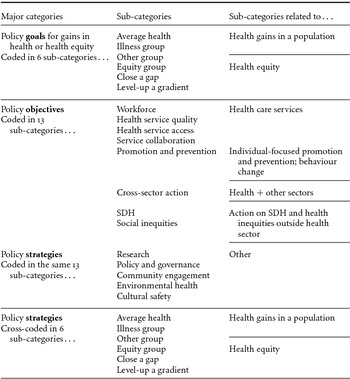
Those parts of the structure concerned with goals, objectives and strategies are shown in Table 1, below. In relation to goals for health improvement, sub-codes were designed to assess the extent to which policies aimed to improve health equitably. Drawing on Whitehead and Dahlgren (Reference Whitehead and Dahlgren2006), codes distinguished between goals according to whether they aimed to improve health in the general population, or within a designated group; or to close a health gap, or level-up a health gradient. Further, in relation to groups, we distinguished between ‘equity’, ‘illness’ and other groups. Illness groups were those defined in the text according to an existing illness. We identified equity groups as any group defined in the text, where (according to our knowledge) that group is subject to some form of systemic social or locational disadvantage and evidence suggests the disadvantage causally contributes to worse health outcomes within the group than in the wider population.
Coding Structure – Health goals, objectives and strategies

In our coding, drawing on Baum (Reference Baum2008) and evidence on health inequities in Australia (e.g. AIHW, 2014) the equity groups we recognised included: people in rural/regional/remote areas; low SES groups; Aboriginal people; lesbian, gay, bisexual, transgender and intersex (LGBTI) groups; people with a disability; people in prison; victims of family violence; and refugees. We distinguished between goals to improve health in such groups, and goals to reduce a health gap or gradient because, as Whitehead and Dahlgren (Reference Whitehead and Dahlgren2006) point out, one could achieve the former without necessarily achieving the latter.
With both objectives and strategies, we sub-coded these in each case according to 13 domains of activity as shown in Table 1. For example an objective on workforce might be to increase retention of Aboriginal people in the health workforce; a strategy in the same domain might be to improve career pathways for Aboriginal employees. Application of these categories and analysis of the relative number of items coded in each allowed us to assess the overall extent to which objectives and strategies in one policy or a group of policies were concerned with health care delivery, individualised forms of disease prevention or health promotion, or addressing SDH/HE outside of health care.
We also cross-coded each identified strategy according to our interpretation of the intended health outcome, using the same categories applied to health goals. Thus, as coding progressed, we could assess strategies in one policy or a group of policies according to the kinds of strategies proposed, and the extent to which they addressed health equity.
We coded strategies as addressing disease prevention or health promotion, but not addressing SDH/HE, when they intended to change individuals’ attributes, choices or behaviours, so that they are more protected against environmental or social risk factors, or replace patterns of unhealthy behaviour with healthy ones. We also included strategies intended to intervene in highly targeted ways to break a link between individuals and a health risk. Strategies recognised as addressing SDH were any we interpreted as intended to change social, economic or cultural environments in order to improve health.
3. Results
Evidence on SDH/HE
We found that SDH/HE were generally acknowledged and/or that salient evidence was audited in almost all of the policies analysed. While this varied in ‘depth’ from policy to policy, each jurisdiction's policy set contained some documents which recognised SDH/HE explicitly in general terms, and some which audited salient evidence in considerable depth. This passage provides a typical example of general acknowledgement:
Good health and wellbeing is determined by more than adequate health care. Social, economic, environmental and cultural experiences largely determine people's health status: these factors are referred to as the social determinants of health. (South Australia) Aboriginal Health Care Plan 2010–2016
Here is an example of more detailed auditing of evidence:
Groups with lower socio-economic status experience higher rates of diet-related illness including low birth weight babies, childhood and infant anaemia, lowered immunity, dental caries, obesity, blood pressure, Type 2 diabetes, heart disease and stroke. (Tasmania 2009–2012) Working in Health Promoting Ways: A Strategic Framework for DHHS
Coding of those individual policies that did most in this area typically identified between 50 and 100 sections of text in each policy either acknowledging SDH/HE or auditing relevant evidence. Commonly recognised social determinants included factors related to: SES (e.g. income); settings (e.g. urban environments); psychosocial conditions (e.g. social support); socio-cultural conditions (e.g. gender, racism); location (e.g. remoteness); and early child development (e.g. family environment).
Each jurisdiction's set of policies audited evidence of health inequities affecting all the equity groups listed earlier. Out of the 266 policies in the data set, 48 focused specifically on issues related to Aboriginal peoples’ health, and all audited evidence on health inequities between Aboriginal and non-Aboriginal Australians. This was the largest group of policies focused on any one population group or health issue.
However, policies only rarely referred to evidence on social gradients in health and, then, usually without detail. Policies generally did not recognise broader policy settings affecting the overall distribution of socioeconomic resources as determinants of health inequities. Thus, evidence on health inequities was predominantly represented as a problem of relatively poor health within specified disadvantaged groups. This is consistent with findings of research in the UK (Smith et al., Reference Smith, Hunter, Blackman, Elliott, Greene and Harrington2009) but, until now, has not been adequately identified as a feature of Australian health policy.
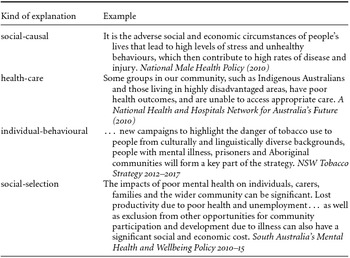
We also found that policies within and across jurisdictions varied in the views they presented on the causes of health inequities. It was common to find simple recognition of (what we recognised as) a health inequity without any accompanying explicit or implicit explanation of its causes or determinants. Where descriptions did offer explanations of a health inequity, these variously incorporated social-causal, health-care, individual-behavioural and social-selection forms of explanation. These respectively assert that health inequities are predominantly caused by differences in: socioeconomic or cultural conditions (outside health care); access to health care; behavioural choices; or health status (wherein existing illness leads to social disadvantage) (Solar and Irwin, Reference Solar and Irwin2010). Examples of each kind of explanation are shown in Table 2.
Explanations of health inequities

Within individual policies, or in some particular types of policy, we also found that use of health-care or individual-behavioural explanations of health inequities was followed with strategies preferentially focused on those kinds of interventions. For example, despite significant evidence on social determinants of inequities in cancer risk factors, such as smoking, in Australia (e.g. Thomas et al., Reference Thomas, Briggs, Anderson and Cunningham2008), the four cancer policies in our dataset acknowledged these inequities but typically explained them in terms of differences in individuals’ behavioural choices or health literacy; providing a rationale for a predominantly behaviourist approach to prevention in the strategies which followed. In one case, the South Australia Statewide Cancer Control Plan 2011–2015 recognised evidence on inequities in cancer incidence and mortality between Aboriginal and non-Aboriginal South Australians but also went on to explain cancer incidence as largely a product of individuals’ lifestyle choices. The Plan claimed that: ‘Current estimates indicate that around half of all cancers are due to lifestyle factors and therefore are largely preventable.’ The equity-related preventive strategies which followed focused on improving health literacy on cancer risks and participation in cancer screening among equity groups, especially Aboriginal people.
Similarly, Victoria's Cancer Action Plan 2008–2011 acknowledged that ‘smoking rates are highest among some of the most disadvantaged groups in Victoria’, but went on to make the following claim, as a preface to strategies focused on individualised behaviour change using methods such as social marketing:
Some of the most common cancers have been found to be associated with smoking [and other behavioural risk factors]. This means that a significant number of cancer deaths could be avoided by helping people to adopt healthier lifestyles.
The implication that strategies to improve lifestyle choices among disadvantaged groups are an appropriate response to health inequities is also inconsistent with research showing that individualised health promotion strategies such as social marketing campaigns tend, in fact, to exacerbate health inequities (Lorenc et al., Reference Lorenc, Petticrew, Welch and Tugwell2013). Individualised conceptions of health can also shift attention away from social conditions affecting capabilities for healthy behaviours among disadvantaged groups (Dagdeviren et al., Reference Dagdeviren, Donoghue and Promberger2015).
Social selection explanations were used in many of the 31 mental health policies analysed, but rarely used elsewhere. Although these policies often recognised SDH/HE affecting mental health across the broader population, they used social selection explanations to reframe the problem as established mental illness leading to social disadvantage. The strategies proposed then focused on health care or support services for the relatively small group of people with more severe forms of illness and did not address means of keeping the broader population mentally healthy.
Thus, our research shows that evidence on health inequities that are known to be determined in large part by social factors can be recognised in policy but nevertheless explained in ways that shift the locus of the problem and presumptive ‘need’ for policy action onto health care services, individualised health promotion programmes, or support services for people with existing mental illness.
Addressing health inequities
Health goals within each jurisdiction's set of policies were most often framed in terms of improved health for the population at large. However, in each case, around a quarter to a third of all goals coded addressed health inequities. The ways intended improvements in health equity were expressed were consistent with Whitehead and Dahlgren's (Reference Whitehead and Dahlgren2006) types of policy approaches to health inequities. Most common were goals to improve health within an equity group, and then goals to reduce or eliminate a health gap. The great majority of the latter goals were focused on the health gap between Aboriginal and non-Aboriginal Australians. For example:
COAG [Council of Australian Governments] has agreed to the following targets. . .closing the life expectancy gap within a generation [and] halving the gap in mortality rates for Indigenous children under five within a decade. National Indigenous Reform Agreement (Closing the Gap) 2011
In relation to Whitehead and Dahlgren's third type of approach, however, only eight policies out of 266 clearly articulated a goal to level-up a health gradient, such as the example below:
Rather than focusing just on those with the greatest needs, the aim is to have a shallower gradient in health and wellbeing than we have at present. (South Australian) Primary Prevention Plan 2011–2016
Even then, the wording of some of these goals, despite referring to the social gradient, represented health inequities as largely a problem of poor health among the most disadvantaged groups. For example:
. . .to level the social gradient in tobacco use across the Victorian community by improving the health of the least advantaged. Victoria's Cancer Action Plan 2008–2011
Whitehead and Dahlgren (Reference Whitehead and Dahlgren2006) also recognised that a principle of health equity can be defined and operationalised in policy as equity of access to health care. This approach was present in the objectives and strategies of all jurisdictions’ policies. At the national level, the principle of equity of access to public health care according to need was spelt out in national policies such as the National Health Reform Agreement (2011) for Commonwealth funding to States for public hospital and emergency services:
States will provide health and emergency services through the public hospital system, based on the following Medicare principles: eligible persons are to be given the choice to receive, free of charge as public patients, health and emergency services [. . .]; access to such services by public patients free of charge is to be on the basis of clinical need [. . .]; and arrangements are to be in place to ensure equitable access to such services for all eligible persons, regardless of their geographic location.
Several of the States’ health care policies included strategies to distribute resources for health care or disease prevention services according to need across their whole population. For example:
. . .planning prevention and early intervention services to achieve comprehensive access throughout the state based on population health data and with particular provision for people with high-risk and specific health needs. Victorian Health Priorities Framework 2012–2022: Metropolitan Health Plan
Given that many quantitative measures of health follow a social gradient in Australia (AIHW, 2014), we interpreted these strategies as addressing health inequities across the social gradient, whether or not they were explicitly presented in those terms. These strategies to distribute healthcare according to need were the only strategies we identified as addressing health inequities as a gradient.
It is also important to note that one of the key national health care strategies found in these policies was health system reform (under the then Labor government) to shift emphasis from episodic acute care in public hospitals to improved health promotion, disease prevention, and managed care in primary health care (PHC); in keeping with World Health Organisation recommendations (2008). The WHO (2008) argued that policy emphasis on universal, accessible and appropriate PHC is important for supporting health equity (Starfield, Reference Starfield2012) and this is borne out in Australian research (Hajizadeh et al., Reference Hajizadeh, Connelly and Butler2012).
Among all the strategies we identified as addressing health inequities, within each jurisdiction and in the data set as a whole, the most common were those that proposed action to improve access to health care for specific equity groups or disadvantaged areas; whether through infrastructure development in under-served areas, targeted services, improved collaboration between services, improved cultural safety of services, or other means.
The second most common set of actions proposed to address health inequities, in all jurisdictions, were targeted, individualised interventions to prevent disease, promote healthy behaviours, or minimise harm; such as targeted programmes in immunisation, smoking cessation or child protection.
Overall, our findings suggest that Australian health policy at the time of our research contained strategies to address equity in health care combining some elements of Whitehead and Dahlgren's (Reference Whitehead and Dahlgren2006) formulation: a universal approach in primary and acute care systems, aims to strengthen PHC, and targeted strategies to improve access for equity groups. However, there is also reason for concern, given that policies frequently represented and addressed health inequities as a problem of poor health among specific disadvantaged groups and did relatively little to address (or call for cross-sectoral action to address) social gradients in health.
As found in research in other jurisdictions (Smith et al., Reference Smith, Hunter, Blackman, Elliott, Greene and Harrington2009), despite the widespread acknowledgements of SDH/HE and auditing of relevant evidence noted earlier, each jurisdiction's set of strategies to address health inequities predominantly consisted of health care or individualised promotion/prevention strategies.
Social determinants of health and health inequities
Despite the overall, dominant focus on health care and individualised promotion/prevention, each jurisdiction's policies included a lesser group of strategies to address SDH/HE outside health care, suggesting some attention to the broader stewardship role proposed for the health sector by the CSDH (2008). Some of these were directed toward the general population, or broad groups such as children or older people; others focused on equity groups, illness groups, or other minority groups.
We also identified several policy mechanisms in use to stimulate cross-sectoral actions (within or across levels of government) to address health issues; some in health department policies, others in the policies of a head-of-government agency. Many of the strategies on SDH/HE we identified were within these kinds of policies. Instances of these mechanisms at the state level included a ‘Health in All Policies’ programme, public health legislation, and policy based in the Department of Premier and Cabinet. At the national level, a number of policies formed under the Council of Australian Governments were strongly cross-sectoral in the relevant sense. Other national or state government agencies most commonly featuring as partners with the health sector in cross-sectoral policies included those with responsibility for public education, social services, social housing, justice and corrections, and urban planning. State-level cross-sectoral policies also frequently identified local (municipal) governments as partners on health issues, with a focus on strategies in community development, early child development, food security, urban planning and sustainability. These findings indicate that at least some Australian policy makers have taken up, and are seeking ways to operationalise, a whole-of-government approach to address SDH/HE. South Australia and Tasmania were the two jurisdictions doing most in this direction.
Across the dataset and in each jurisdiction we found strategies addressing social determinants in relation to: SES, settings, psychosocial or socio-cultural conditions, location, and early child development. Gender and sexuality were mainly addressed as factors influencing access to health care. Strategies addressing SDH in relation to general population health or broad population groups included strategies in urban planning, food environments, parenting support, food and water safety, and regulation of tobacco industry practices. All jurisdictions supported prescriptive regulation of tobacco but only proposed self-regulation strategies in the food and alcohol sectors, despite the evidence that this does little to change corporate behaviours, and that corporations actively promote self-regulation to avoid regulation by governments (Freudenberg, Reference Freudenberg2014).
It was relatively common for policies on mental health (in all jurisdictions) to include strategies on SDH focused on an illness group. These typically focused on providing support services in housing or employment for the relatively small group of people with more severe, on-going illness; rather than aiming to prevent illness.
Strategies specifically addressing social determinants of health inequities were most apparent in nationally-led policies addressing the health gap between Aboriginal and non-Aboriginal people, especially in early child development and education, employment, housing, and environmental health. Funding was tied to performance measures to progressively eliminate gaps in life expectancy, child mortality and educational outcomes over a 20-year period. However, although other key determinants, such as racism and high incarceration rates or, on the positive side, cultural identities and strong community governance structures, are also significant (Anderson et al., Reference Anderson, Baum and Bentley2007), we found few instances of strategies addressing these.
Beyond this, many of the strategies we identified as addressing SDH were targeted at equity groups, including strategies in: housing, employment support, family support and parenting, community development, and food security. In disability policies, determinants addressed included physical access issues, social inclusion and stigma.
Overall, we saw the range of actions on SDH/HE as a positive, but also noted that the scope of strategies was often limited relative to the nature of the determinant addressed. Examples include: improving menu choices in school canteens (food environments); behaviourist health programmes for parents (family environments for children); or housing support for people with established mental illness (housing affordability).
Furthermore, despite frequent recognition of evidence of the relationship between SES and health we did not identify any attempts within these policies to raise broader issues underpinning socioeconomic determinants of health inequities such as income distribution, taxation structures, welfare payments, education funding, housing affordability, and disparities in employment status as policy areas for possible action, or as the focus for health sector advocacy for action to other sectors. This is a policy silence when judged against research suggesting that concerted policy action to reduce socioeconomic inequalities in Australia could result in considerable savings in public expenditure, by improving health (Brown et al., Reference Brown, Thurecht and Nepal2012). Furthermore, evidence indicates that socioeconomic inequities have in fact increased in Australia over the last decade (OECD Directorate for Employment Labour and Social Affairs, 2011). Other SDH/HE not addressed or addressed in only marginal ways included pollution, new media environments and trade liberalisation. Health risks arising from climate change were only addressed in terms of health service responses to extreme weather events or changes in contagious disease vectors.
4. Discussion
Kingdon's multiple streams model (Reference Kingdon2011) claims that success in setting the policy agenda is most likely to occur when a problem is recognised, ‘acceptable’ policy options are identified and political circumstances are regarded as favourable. He describes the coming together of problem, policy and politics in this way as a ‘window of opportunity’ for agenda setting. Here we examine how this model serves to explain the findings reported above.
The strongest element of action on health inequities in Australian health policy circa 2012–13 was action focused on equity in access to health care. We suggest this is because there were favourable conditions in each of Kingdon's three streams, keeping the policy window open for such an approach. In the politics stream, despite the expansion of private health insurance in Australia, strong public support for Medicare as a universal public healthcare system has been maintained since its introduction, protecting it from policy change (Dugdale, Reference Dugdale2008). Maintaining public hospital performance is also a political priority for state governments, due in part to the willingness of doctors and the media to exert pressure around any perceived failings in care (Baum et al., Reference Baum, Laris, Fisher, Newman and MacDougall2013). In the policy stream, delivery of medical care remains at the core of Australian health departments’ institutional identity and operational structure (Baum, Reference Baum2008) and thus is readily available as a policy tool (Smith, Reference Smith2013). Of course such services are consistent with a biomedical view of health/illness (in the problem stream), which remains the norm in Australian health politics and policy (Baum, Reference Baum2008).
A favourable combination of conditions in the three streams can also be used to explain why, despite frequently recognising SDH/HE, policies favoured individual-behavioural responses to health inequities, often targeted toward the most disadvantaged groups. In the politics and problem streams, Australian politics over several decades has constructed social disadvantage in various forms (e.g. unemployment) and risky health behaviours (e.g. smoking) as problems of inadequate personal initiative or responsibility (Archer, Reference Archer2014). This stance is in keeping with the shift towards a more neoliberal politics in Australia since the 1980s (Miller and Orchard, Reference Miller and Orchard2014), and its philosophical commitment to individualism also suits the interests of some major industry sectors (Baum and Fisher, Reference Baum and Fisher2014). Furthermore, in the policy stream, individualised health promotion strategies are another well-established policy tool available to health sector agencies. Thus, it is plausible to suggest that the combination of these factors makes it both politically and operationally easier for health policy actors to adopt individualised, behaviourist ‘solutions’ to the key risk factors for chronic disease. Our findings also echo those of Smith (Reference Smith2013), that policy actors sometimes used narrow healthcare and behaviourist explanations to reframe health inequities as a policy problem in ways to suit their conventional policy tools.
In relation to the main focal point of our research, conditions for action on social determinants of health and health equity in Kingdon's three streams appear to be more mixed. In the problem stream, our findings show that SDH/HE were widely recognised as issues for health, both in the general description of issues and through references to a wide range of relevant evidence. In the policy stream, the text of some policies in each jurisdiction indicates the presence of policy actors who understood a social determinants perspective on health, were familiar with a range of salient evidence, and had brought that knowledge into policy discourse. A range of policy mechanisms to operationalise cross-sectoral action on SDH/HE were also in evidence, and were used in some of those policies that performed relatively well in proposing strategies to address SDH/HE. The location of some of these cross-sectoral policies in the department of the government leader and Cabinet suggests at least some high-level political support.
However, it appears that the scope for health policy action on SDH/HE is also constrained by significant limitations in each of Kingdon's streams. In the problem stream, our findings show that health inequities were predominantly represented as nothing more than a problem of poor health among disadvantaged groups, and this limitation was then reflected in the scope of strategies proposed. In the political and policy streams, our findings suggest that Australian health sector agencies have only, thus far, been able to engage a limited number of other policy sectors in action on SDH/HE, and that the policy mechanisms employed to motivate cross-sectoral action are overlaid on conventional, siloed institutional structures that remain unchanged. Furthermore, the 266 policies we analysed did not contain any evidence of health sector stewardship to engage with policy sectors and mechanisms most able to influence the broader distribution of socioeconomic advantage and disadvantage in Australia, and to advocate action to address those matters for health reasons. Importantly in an Australian context, it is the Commonwealth government that controls the majority of taxation revenue as well as a number of the key policy tools affecting the distribution of social and economic resources in areas such as taxation, social security, labour markets, housing policy and trade. From this position, the Commonwealth government can also exercise considerable influence on States. Our research shows that the willingness of a Labor-led national government to acknowledge the systemic and historical disadvantages faced by Aboriginal people supported a period of nationally-coordinated, cross-sectoral policy action to address SDH systemically in order to reduce a health inequity. However, no similar leadership was in evidence to address health inequities as a broader problem associated with socioeconomic inequities across the whole population. This finding is significant for Australia, because it suggests that the Commonwealth-State relationship is a key factor of political context which can open or close windows of opportunity for action on SDH/HE.
Taken together, the observations above would serve to explain our finding that, outside of the group of policies focused on ‘closing the gap’ between Aboriginal peoples and other Australians, the strategies put forward to address SDH/HE were limited to actions in proximal environments, with a proportion of these targeted towards specific equity or illness groups. The broader socio-political determinants of inequities in the distribution of ‘power, money and resources’, that the CSDH (2008) recognised as the fundamental causes of health inequities, are present in Australia (Baum, Reference Baum2008). They were acknowledged, in the problem stream, as issues to be addressed for health reasons, but not combined with the political support, institutional partnerships and policy tools required to achieve systemic change. The policy sectors and agencies most able to bring policy options to the table to address those issues were not visible in health policy, and were not called upon to take action.
Limitations of the research
The analysis of health policy documents employed in this research necessarily took the goals, objectives and strategies identified in those policies as written, and did not assess policy implementation. Furthermore, the view offered here of Australian governments’ actions on SDH/HE does not take account of concurrent policy activity in other sectors (not involving the health sector). Other research is required to investigate how government actions across multiple sectors interact to affect health and health equity. Finally, a focus on existing ‘finished’ policy documents does not consider how policy development processes facilitate or inhibit SDH/HE getting onto the policy agenda. In another part of our research, not reported here, we have conducted case studies on individual policies, selected from our data set as examples of good practice on SDH/HE, to explore in more depth what enabled this to occur during policy development.
5. Conclusions
Our research showed that Australian health policy circa 2012–2013 took health inequities seriously as a policy problem but continued to dedicate the bulk of its efforts to biomedical and individualised behavioural action to improve health outcomes with little regard to the equity of those outcomes. However, through a combination of recognition of SDH/HE as a problem, innovative cross-sectoral policy mechanisms and a degree of political support, the health sector was, to some extent, enacting the stewardship of population health and health equity envisioned by the CSDH. In contrast, it is also evident that constraints in the way health inequities are understood and represented as a policy problem, together with constraints in the broader institutional and political environments of Australian government, are limiting the scope of that role to strategies that do not ‘challenge’ the higher-level determinants of health inequities across the Australian population.
Acknowledgements
The authors acknowledge the support of Australian health department staff. Frances Baum was a Commissioner on the WHO Commission on the Social Determinants of Health. This research was funded by the Australian Research Council [DP120101510].