INTRODUCTION
The cotton (Gossypium hirsutum L.)–wheat (Triticum aestivum L.) (CW) system is the second most important system after rice–wheat (RW) in terms of area, covering 4.19 M ha in South Asia (Singh et al., Reference Singh, Kukal, Jat and Sidhu2014). About 80–90% of the area under cotton in North-West (NW) India and eastern region of Pakistan is under the cotton–wheat system (Mayee et al., Reference Mayee, Monga, Dhillon, Nehra and Pundhir2008). The optimum time of wheat sowing in NW India is last week of October to first fortnight of November (Bajwa, Reference Bajwa2011). Wheat planting after cotton harvest is often delayed due to late pickings in cotton and the time involved in its seed bed preparation. The sowing of wheat after 20th November reduces its productivity at the rate of 1.0–1.5% day−1 of delay (Nasrullah et al., Reference Nasrullah, Cheema and Akhtar2010; Subhan et al., Reference Subhan, Ahmaed, Anwar, Shah, Siddiq, Ali, Rahman and Sajjad2004). Therefore, average productivity of wheat in CW system is lower (about 3.2 t ha−1) compared to the productivity in the RW system (about 4.7 t ha−1) of Indian Punjab (Buttar et al., Reference Buttar, Sidhu, Singh, Jat, Gupta, Singh and Singh2013). Delay in wheat sowing in the CW system can be avoided by relay seeding by manual broadcast (MB) or direct sowing of wheat using self-propelled walk behind type relay seeder (RS) in standing cotton (Buttar et al., Reference Buttar, Sidhu, Singh, Jat, Gupta, Singh and Singh2013; Khan and Khaliq, Reference Khan and Khaliq2005). The wheat yield gains with self-propelled walk behind type RS were 12–41% compared with conventional tillage wheat (CTW) after cotton harvest. However, farmers’ adoption of this three-row walk behind type RS for planting wheat in the CW system is very limited due its low capacity (<0.6 ha day−1) and drudgery. Hence, there is a need for a four-wheel tractor operated RS, which can sow wheat in standing cotton crop with different row geometries. High capacity four-wheel high clearance tractor-driven RSs with different types of furrow openers were developed for seeding of three or five rows of wheat in adjacent rows of cotton planted at two row spacings causing minimal damage to the crop (Singh et al., Reference Singh, Mahal, Sidhu, Manes, Jat and Singh2016). This paper focuses on the field evaluation of the two types of RSs and three types of furrow openers (zero-till tine, zero till double disc (ZTDD) and strip till rotor) driven by high clearance four-wheel high clearance tractor in two cotton genotypes for relay seeding of wheat in the CW system.
MATERIAL AND METHODS
Development of high clearance four-wheel tractor-operated RS
A four-wheel tractor was mounted on high clearance platform, which increased the ground clearance from 45 to 115 cm and facilitated easy movement of the tractor above the standing cotton crop (Singh et al., Reference Singh, Mahal, Sidhu, Manes, Jat and Singh2016). The working clearance (from ground) of the tractor was 110 cm. Two RSs (suitable for 67.5 and 101 cm cotton row spacing) fitted with three types of furrow openers (zero-till inverted T-type (ZTT), (ZTDD) and strip rotor (SR)) were used for relay seeding of wheat in cotton crop.
Furrow openers
Three types of furrow openers were fabricated and evaluated for seeding of wheat (Supplementary Figure S1, available online at http://dx.doi.org/10.1017/S0014479716000569). SR openers make a narrow strip (2.5–3.5 cm) using steel blades mounted on a rotor in front of each zero till furrow opener to facilitate placement of seed and fertilizer. The ZTT opener is a zero till furrow opener, which opens the furrow (width 2–3 cm) and places both seed and fertilizer in the soil. The ZTDD furrow opener has two spring mounted discs to open furrow for the placement of seed and fertilizer. The depth of seeding is controlled by the spring tension, whereas for SR and ZTT furrow openers separate depth control wheels were mounted on the frame of RS.
Relay seeders
The two types of RSs were chosen in view of the two row geometries in cotton prevalent in the region. The main frame of RSs has a ground clearance of 114 cm enabling its movement above the standing cotton with minimal interference with the plants. The 12-row RS consists of four seeding units (36 cm wide) having three metering units mounted on each unit and thus covering four rows of cotton crop in a single pass. The seeding unit of 12-row RS consists of a toolbar with three furrow openers mounted at 18 cm apart (Figure S2). Similarly, 15-row RS consists of three seeding units (72 cm wide) having five metering units and it covers three rows of cotton crop in a single pass (Figure S3). The seeding unit of 15-row RS consists of a toolbar with five furrow openers mounted 18 cm apart. Brief specifications of 12-row and 15-row RSs are included in Supplementary Table S1. The width of unit for 12- and 15-row RS is 45 and 80 cm at bottom and 5 cm at the top. The main frame of RS moves above the cotton plant and seeding assemblies move between the rows of cotton. Four seeding units for 12-row seeder were staggered on the main frame of RS (alternate two on front tool bar and remaining two on rear tool bar of the machine) to provide more open space to cotton plant during machine operation. Similarly, three seeding units (two on front tool bar and one in centre of rear tool bar) were clamped alternately to the both bars of the main frame of 15-row RS.
Evaluation of relay seeders for planting wheat in standing cotton
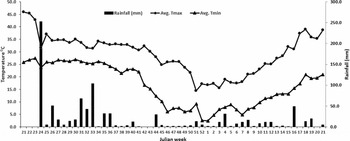
The field experiment was conducted on a sandy loam soil during 2013–2014 at the research farm of the Borlaug Institute for South Asia (BISA) at Ladhowal (30°59'N and 75°44'E), Ludhiana (Punjab), India. The soil in the 0–15 cm layer was non-saline (electrical conductivity 0.26 dS m−1) with pH 8.07 and 5.7 g kg−1 organic carbon using the Walkley and Black (Reference Walkley and Black1934) method. The climate of the region is subtropical, semi-arid. Under average climatic conditions, the area receives about 699 mm of rainfall during the cotton season (May–November) and 237 mm during the wheat season (November– May). Temperature data during May 2013 to April 2014 were recorded with an automatic weather station installed at the BISA farm (Figure 1). The mean daily minimum and maximum temperatures during the cotton season ranged from 6.0 to 27.4 °C and 27.9 to 45.9 °C respectively, and the corresponding values during the wheat season were 2.4 to 20.9 °C and 14.5 to 39.0 °C.
Weekly average minimum, maximum temperatures and rainfall recorded in 2013–2014.

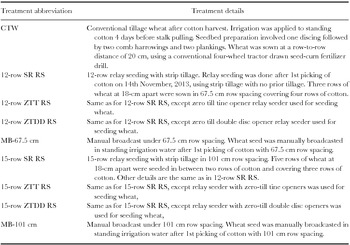
Field trial was laid out in a strip-plot design with three replications. Treatments included two Bt-cotton genotypes (RCH 776 and MRC 7017) having different canopy cover and vigour in the main plots. For ease in the movement of tractor and RSs, cotton genotypes were planted in strips. The sub-plot treatments included eight combinations of two types of RSs (suitable for cotton with either 67.5 or 101 cm row spacing), four types of relay seeding methods (manual broadcast [MB], SR-RS, ZTDD-RS, ZTT-RS) and conventional tillage wheat (CTW). The details of each treatment are given in Table 1. Plot size was 219 and 252 m2 for 67.5 and 101 cm row spacing in cotton, respectively (13 rows for 67.5 cm and 10 rows for 101 cm spacing). An alley way of 10 m was kept between the two replications as well as at head lands to facilitate movement of the tractor and implement. Tractor was operated at the 1st low gear at 1300–1400 engine rpm and delivered ~400 rpm at PTO for powering the SR of RS. The forward speed of travel was 1.75 km h−1 and the field capacity of 12- and 15-row RSs was 1.8 to 2.0 ha day−1.
Sub-plot treatment details.

Cotton crop management
After the harvest of well-fertilized wheat in mid-April, two Bt-cotton genotypes (MRC 7017 and RCH 776) were planted on 22 April 2013 under two geometries (67.5 cm row by 75 cm plant spacing and 101 cm row by 50 cm plant spacing). Cotton was planted with tractor operated inclined plate cotton planter using a seed rate of 3 kg ha−1. The crop management practices except the method of seeding were common for all the treatments. A uniform recommended dose of 150 kg N ha−1 as urea, 30 kg ha−1 of P as diammonium phosphate (DAP) and 25 kg K ha−1 as muriate of potash (MOP) was applied to the cotton crop. Although whole of the P and K was applied at seeding, fertilizer N was applied in equal split doses; 50% N top dressed after thinning in the fourth week after sowing and the remaining 50% N applied at flowering stage. Solution of potassium nitrate (2%) was sprayed four times at weekly interval starting from the initiation of flowering in the cotton. The first irrigation to cotton crop was applied at 35 days after sowing and remaining four irrigations were applied at 2–3 weeks interval. Sucking pests (aphids) of cotton were controlled by spraying Imidacloprid 200 SL (0.1 L ha−1). Four sprays of Ethion 50 EC (2 L ha−1) were made to protect cotton against whitefly attack. After the first picking of cotton on 4 November 2013, flood irrigation (75–80 mm) was applied on 7 November 2013. Wheat was sown into the residual moisture (14.7%) using the relay seeding on 15 November 2013. The average residue load on dry basis was 3.2 t ha−1. The third picking of cotton was done at 25 days after relay seeding. In the relay, seeded plots cotton stalks were manually pulled out after applying first post-sowing irrigation at 25 days after planting. In CTW, pre-sowing irrigation was applied to standing cotton 4 days before stalk pulling and the wheat was sown after conventional tillage using seed-cum-fertilizer drill on 13 December 2013. In relay seeding treatments, one additional picking of cotton was made at the time of manual uprooting of cotton stalks when majority of immature bolls were fully opened.
Wheat crop management
Wheat (HD-2967) was sown using a seed rate of 100 kg ha−1. Crop management practices except the method of seeding were similar for all the treatments. A uniform dose of fertilizers (120 kg N, 26 kg P and 25 kg K ha−1) was applied to the wheat. Whole of the P and K, and 50% of N was applied at seeding. Remaining 50% of fertilizer N was top dressed before the first post-sowing irrigation done 3 weeks after sowing. The broad leaf weeds and Phalaris minor were controlled by applying Algrip 20 WP (metsulfuron) at 25 g ha−1 and clodinafop (15 WP) at 400 g ha−1. Four irrigations of 7.5 cm each were applied to the crop. Rogor 30 EC (dimethoate) was sprayed at 0.38 L dissolved in 250 L ha−1 water for control of aphids.
Crop yield
Seed cotton yield was recorded after every picking from 20 randomly selected and tagged plants within each plot. The total yield is the sum of the three pickings from CTW and four pickings from the relay-seeded treatments (Table 1). The cotton with the relay seeding remained in the main field for 30 days more than the CTW system.
Wheat emergence count (plants that had emerged through the soil) at 20 days after seeding, and grain yield and yield components (spike density, number of grains per spike and grain weight) were measured at harvest. Emergence count was recorded in three randomly selected locations within each plot from 1-m long three adjacent rows for 67.5 cm cotton row spacing and 1-m long five adjacent rows (101 cm row spacing) and 1 m × 1 m area in MB and CTW. Spike density was measured in three randomly selected locations within each plot as in the case of emergence count. The number of grains per spike was recorded from 15 randomly selected spikes in each plot at maturity. Grain yield was determined on two randomly selected locations within each plot from an area of 10 m2, varying slightly due to changes in row geometry in cotton. Wheat was manually harvested and threshed using small plot power thresher and grain yield was reported on air dry weight basis. Average grain weight was determined on 1000 grains.
Economic analysis
The variable cost of growing wheat in each treatment was calculated by taking into account the costs of inputs (seed, fertilizers and pesticides), tillage (discing, cultivator and planking), seeding under different treatments (seed-cum-fertilizer drill, broadcast seeding and tractor operated RS), hiring of manual labour, custom hire for machinery operations, transport and marketing. Hiring charges for combine harvester and straw chopper/trolley were included for calculating harvesting and threshing costs. Electricity for pumping water is supplied free of cost to the farmers, the cost of irrigation included the cost of labour involved in applying irrigation water. The cost of a 50-kg bag of urea, DAP and muriate of potash was taken as US$ 4.4, 19.5 and 13.5, respectively. The charges for human labour hiring were taken as US$ 0.6 h−1. The cost of labour for fertilizer application, pesticide spray and irrigation was included for each of these operations. The charges for discing, cultivators and planking were US$ 23.2, 21.2 and 8.1 ha−1, respectively. The cost of seeding was considered as US$ 23.2 ha−1 for CTW, US$ 54.6 ha−1 for relay seeding and US$ 9 ha−1 for MB. The cost of RS was taken as US$ 1613 and its fuel consumption is 4.0 L h−1. The RS can seed wheat at 0.18 ha h−1 with a working window period of 20 days in a year and its life was taken as 10 years. The market price of wheat grain as fixed by Govt. of India was US$ 226 t−1 and prevailing market price of straw was US$ 0.04 kg−1. The market price of seed cotton was taken as US$ 0.6 kg−1. Straw yield of wheat was calculated on the basis of straw–grain ratio of 1:1. The data on variable cost for the cultivation of cotton and wheat for the year 2013–2014 were obtained from the Department of Economics and Sociology, Punjab Agricultural University, Ludhiana, India. The interest on variable cost was considered as 9% for the half crop season. The variable cost used for cotton was similar under different RS treatments, except the additional cost for the 4th picking of cotton under relay planting treatments. The value of increased cotton yield in relay planting treatments was included for calculating gross returns. The net return was calculated by subtracting total variable costs from the gross return.
Statistical analysis
Data collected for all the dependent variables were subjected to analysis of variance in factorial strip plot design using SAS 9.2 software package. Before analysis, Levene's test was performed to test the homogeneity of variances using the proc GLM procedure with the HOVTEST option in the MEANS statement. Differences between treatment means were compared using an LSD test at p < 0.05 (Gomez and Gomez, Reference Gomez and Gomez1984). The economic analysis was also done by Student's T-test using SAS 9.2 software package.
RESULTS
Seed cotton yield
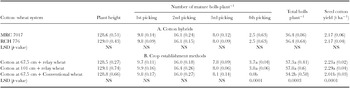
Cotton genotypes (MRC 7017 and RCH 776) and row spacing (67.5 and 101 cm) showed no significant effect on the number of mature bolls in all the four pickings (Table 2). The average number of mature bolls at the fourth picking was 4 per plant in all the relay seeded treatments. The total number of mature bolls per plant was higher (+10%) for cotton genotypes in relay seeded treatments than in CTW. Cotton genotypes and their interaction with crop establishment methods had no significant effect on seed cotton yield. Mean seed cotton yield for 67.5 and 101 cm row spacing under relay seeding was 11–14% higher compared with conventional crop.
Growth and yield attributing characters of cotton and seed yield as influenced by different planting methods in the cotton–wheat system.

The values with in a column with different letter are statistically different at p ≤ 0.05, standard error in parentheses
Wheat establishment
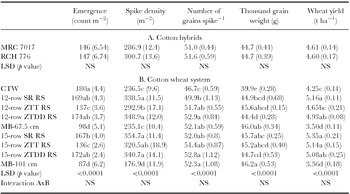
There was no significant interaction among cotton genotypes, RSs (or row spacing) and type of furrow openers on wheat emergence at 20 days after sowing (Figure S4). RSs (for 67.5 and 101 cm cotton row spacing) and cotton genotypes had no significant effect on emergence count of wheat (Table 3). Furrow openers (SR, ZTT, ZTDD) and MB significantly influenced the emergence count. Wheat seeded with STR and ZTDD furrow openers, and CTW resulted in higher (+18.5, +20.8 and +23.9% respectively) emergence count compared with ZTT furrow openers. Emergence count was 41.5% lower for MB compared to relay seeded wheat due to poor soil–seed contact.
Wheat emergence, grain yield and yield attributing characters as influenced by different planting methods in the cotton–wheat system.

The values with in a column with different letter are statistically different at p ≤ 0.05, standard error in parentheses.
SR-Strip rotor, ZTT-Zero till tine, ZTDD-Zero till double disc and MB-Manual broadcast, RS-Relay Seeder, CTW-Conventional tillage wheat and CW-Cotton wheat rotation.
Time saving under relay planting of wheat
The relay seeding advanced the sowing of wheat by 31 days compared to CTW; however, it matured at the same time under both planting methods. The crop duration (sowing to maturity) was thus 165 days and 134 days for relay seeded and CTW, respectively.
Wheat yield and yield contributing parameters
Relay seeded treatments had about 27.3 and 38% more spike density compared with conventional sown wheat and MB, respectively (Table 3). The number of grains/spike was higher (+10.9%) in relay seeded as compared to CTW. The mean grain weight of wheat was lower (–11.5%) for CTW compared to that for relay seeded in standing cotton.
There was no significant effect of cotton genotypes and row geometry (three rows in 67.5 cm row spacing and five rows in 101 cm row spacing) of RSs on wheat yield (Table 3). With exception of ZTT furrow openers, all the relay seeded treatments produced significantly higher wheat yield compared to CTW (Table 3). Wheat yield was significantly lower by 32.1 and 19.3% for the MB compared with drilling sowing using RSs and CTW. The grain yield was significantly higher for SR compared with ZTT furrow openers.
Economic analysis
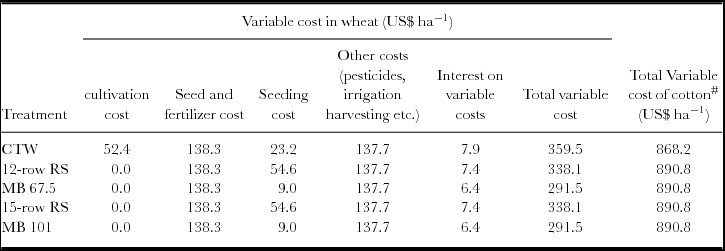
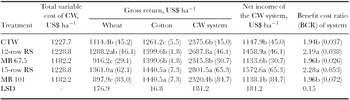
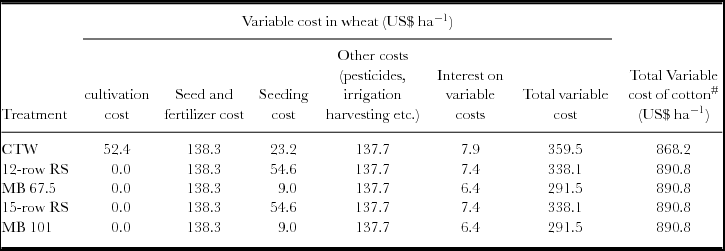
The data presented in Table 5 revealed similar variable costs and higher gross returns (US$ 312 to 426 ha−1) for planting wheat with RS compared to CTW. Similarly, net returns were US$ 311 to 425 ha−1 more (an increase of 27–37%) under relay seeding of wheat using high clearance tractor compared with the CW system due to higher gross returns and lower variable costs (Table 6). Net returns from the CW system with MB in standing cotton were statistically similar to CTW. The average gross return of cotton in the relay seeding system was higher (+15.5 and +18.4%) compared with CTW and relay seeding using MB treatments. Similarly, the benefit to cost ratio was also higher for the relay seeded (+15 and +14%) compared with the CTW and MB of wheat in cotton. All the economic indicators were statistically similar when comparing row spacings of cotton, i.e., 67.5 and 101 cm.
DISCUSSION
Cotton and wheat yield
Relay seeding of wheat increased cotton yield by creating opportunity for one additional picking, which was made possible due to the extended growing period of the cotton for about 30 days. This extra growing period helped in fully opening of the majority of the immature bolls at the time of pulling out of cotton stalks leading to 11–14% increase in seed cotton yield over CTW. Consistent with our study, Buttar et al. (Reference Buttar, Sidhu, Singh, Jat, Gupta, Singh and Singh2013) recorded significantly higher seed cotton yield under the relay seeding of wheat compared with cotton followed by CTW.
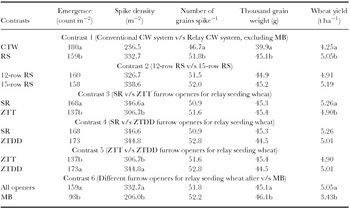
The lower wheat emergence count in ZTT compared to SR and ZTDD furrow openers was mainly due to the uneven depth of seeding caused by high weeds/plant residues accumulation in front of furrow openers (Table 4). Emergence count was higher for the SR compared with ZTT openers because of the better seed–soil contact (Singh et al., Reference Singh, Mahal, Sidhu, Manes, Jat and Singh2016). The average emergence count in wheat was markedly lower–41.9%) for the MB compared with RS. It may be due to poor soil and seed contact for MB compared with drill sowing by RSs. Better wheat emergence under drill sowing compared to MB has been reported by many researchers (Ali et al., Reference Ali, Ali, Waqar and Ali2012; Shaalan et al., Reference Shaalan, Chaudhary and Sorour1997; Tanveer et al., Reference Tanveer, Husssain, Sohail, Kissana and Abbas2003) due to the placement of seed at optimum and uniform depth under drill sowing. However, Fischer et al. (Reference Fischer, Aguilar, Maurer and Rivas1976) found a wide range in optimum plant density (80–200 plants m−2, provided that plant density was even) for maximum yield for a range of irrigated spring wheat varieties grown under climatic conditions fairly similar to those of northwest India, suggesting adequate plant population in all crop establishment methods in our experiment.
Contrast analysis of wheat emergence, grain yield and yield attributing characters as influenced by different planting methods in the cotton–wheat system.

Values with for a dependent parameter (in a contrast group) with different letter are statistically different at p≤ 0.05 and dependent parameters with same and no letter are statically same for each contrast group.
SR-Strip rotor, ZTT-Zero till tine, ZTDD-Zero till double disc and MB-Manual broadcast, RS-Relay Seeder, CTW-Conventional tillage wheat and CW-Cotton wheat rotation.
Variable costs (in US$ ha−1) under different crop establishment methods in the cotton–wheat system.
US$1 = ₹ 62 INR
The values with in a column with different letter are statistically different at p ≤ 0.05.
# Variable cost for the cotton is similar for all the treatments except the cost of one additional manual picking @ US $ 22.6.
MB-Manual broadcast, RS-Relay Seeder, CTW-Conventional tillage wheat.
Variable costs, gross income and net income (in US$ ha−1) under different crop establishment methods in the cotton–wheat system.

The values with in a column with different letter are statistically different at p ≤ 0.05, standard error in parentheses.
MB-Manual broadcast, RS-Relay Seeder, CTW-Conventional tillage wheat and CW-Cotton wheat rotation.
US$1 = ₹ 62 INR.
The lower spike density in CTW might be attributed to the reduced length of the crop vegetative and reproductive stages. Kirby and Ellis (Reference Kirby and Ellis1980) reported that delay in sowing resulted in decline in the number of leaves per stem, because of the decrease in the length of the period of leaf initiation that in turn reduced the number of tillers initiated. However, the poor crop establishment in MB was the main reason for significantly lower spike density compared with the other treatments. Khan and Khaliq (Reference Khan and Khaliq2005) reported that reductions in tillers per plant in wheat sown after harvest of cotton might be attributed to delay in sowing.
A fewer number of grains/spike in the CTW could be attributed to higher temperatures experienced by the crop at anthesis and grain development stages due to late sowing compared with timely sown relay seeded wheat (Table 4). Delayed sowing of wheat commonly has a negative influence on the number of grains/spike (Jan et al., Reference Jan, Hammed and Muhammad2000). Higher mean grain weight for relay wheat compared with CTW is attributed to a longer grain filling period available to the early sown crop. These results are in accordance with those of Green et al. (Reference Green, Paulson and Ivins1985) and Jan et al. (Reference Jan, Hammed and Muhammad2000) who reported that grain weight decreased significantly with delay in sowing.
The contrast analysis of yield contributing parameters of wheat showed that spike density, grains spike−1 and test weight were higher in RS wheat compared with CTW (Table 4). Contrast analysis among the different RSs (cotton geometries) showed that all previously cited parameters were statistically similar; therefore, the RSs are versatile enough for different geometries used in the region (Table 4). Among the three furrow openers used, the ZTDD and SR openers performed better compared with ZTT openers for emergence count and spike density (Table 4).
Grain yield of wheat is a product of spike density, number of grains/spike and grain weight. Early sowing of relay wheat by 31 days compared to CTW increased all the three yield parameters thereby increasing grain yield by 19%. Khan and Khaliq (Reference Khan and Khaliq2005) reported that the relay seeded wheat produced 13.2% higher grain weight as compared to CTW. This is consistent with the observation made by Buttar et al. (Reference Buttar, Sidhu, Singh, Jat, Gupta, Singh and Singh2013) who reported 25% higher grain yield of wheat sown with manual walk behind self-propelled RS compared to CTW.
The short duration of CTW and unfavourable temperature regime during grain development phase experienced by the crop adversely affected the yield of CTW. The lower grain yields recorded in ZTT furrow opener in 67.5 cm row spacing of cotton and MB were due to poor crop establishment caused by uneven seeding depth and/or poor soil–seed contact. Dawelbeit and Babiker (Reference Dawelbeit and Babiker1997) and Khan et al. (Reference Khan, Arif, Shah, Ali, Hussain and Khan2007) have also reported lower grain yields from seed broadcasting compared to drill sowing of wheat. There was no significant effect of row geometries in cotton (three rows in 67.5 cm row spacing and five rows in 101 cm row spacing) on wheat yield. The performance of RSs as well as furrow openers was similar in both the cotton genotypes. Porter and Khalilian (2005) have reported that yield of CTW was not affected by skip-row geometry designed to allow for relay intercropping of either soybean or cotton.
Projected increases in atmospheric carbon dioxide concentration and air temperature associated with future climate change are expected to affect crop development and crop yield. Gupta et al. (Reference Gupta, Gopal, Jat, Jat, Sidhu, Minhas and Malik2010) reported that wheat growing season was reduced by about 12 days and grain yield of wheat declined significantly due to high day and night temperature during March. Relay seeding will allow farmers to advance the planting date to first week of November that will significantly improve wheat productivity. Relay seeding will also promote adoption of conservation agriculture that holds promise as an adaptive strategy to face climate challenges to the CW system.
The contrast analysis of wheat yield showed that grain yield was significantly higher for the relay CW system compared with the conventional CW system (Table 4). Among the three furrow openers used the ZTDD and SR openers produced significantly higher yield of wheat compared with ZTT openers (Table 4). SR openers requires a power transmission system to drive the SR and depth control wheels, whereas the ZTDD opener mounting is simple and robust and depth of seeding is maintained by the springs mounted on the twin disc openers. Therefore, the ZTDD openers are better compared with SR in the context of machine simplicity (lesser number of moving parts).
Economic analysis
The average gross returns from the relay CW system were 15.5% higher compared with the CTW system due to lower tillage costs and higher yields of seed cotton, grain and straw of wheat. Net returns were US$ 311–425 ha−1 more (an increase of 27 to 37%) under relay seeding of wheat using high clearance tractor compared with the CTW system. The relay seeding of wheat using different furrow openers included single operation, whereas CTW needed five–six tillage operations. This is consistent with Aryal et al. (Reference Aryal, Sapkota, Jat and Bishnoi2015) who reported that shifting from conventional tillage to zero tillage wheat production system reduces the farmers total input cost ha−1 by 20% and increases net revenue per ha by 28%. Buttar et al. (Reference Buttar, Sidhu, Singh, Jat, Gupta, Singh and Singh2013) have also recorded higher net returns from the mechanical relay seeding of wheat into standing cotton compared with the conventional CW system.
CONCLUSIONS
Considering seed emergence and damage to standing cotton, our study demonstrates that wheat can be successfully relay seeded in cotton with either 67.5 or 101 cm row spacing, using specifically designed RSs attached to a high clearance four-wheel tractor. Both double disc and strip till rotor furrow openers for RSs resulted in 23–26% higher emergence count of wheat compared with ZTT openers, irrespective of cotton cultivar. The wheat emergence count can be increased by reducing the plant residue accumulation on the ZTT openers by placing a coulter ahead of ZTT openers. The relay seeding increased wheat yield by about 19% and provided 27–37% higher net returns in the CW system compared to conventional sowing. Considering the case of Punjab, only this intervention may increase the wheat production by 0.29 millon tons without any adverse effect of cotton yield.
Acknowledgements
The study was financially supported by International Maize and Wheat Improvement Centre (CIMMYT) under CGIAR Research Program on WHEAT (CRP 3.1). The Land and other resources provided by BISA are thankfully acknowledged. The support of Rajar Agricultural works, Mullanpur, Punjab for fabrication of high clearance tractor platform and Jagajit Industries, Cheema Mandi, Punjab, India for fabrication of relay seeder is thankfully acknowledged. The support of PAU, Ludhiana for granting study leave for First author's PhD thesis research under this study is also thankfully acknowledged.
SUPPLEMENTARY MATERIAL
To view supplementary material for this article, please visit http://dx.doi.org/10.1017/S0014479716000569