INTRODUCTION
Our present knowledge of the marine flora from the Gulf of California is still in progress. Over the last 20 years new records (Cruz-Ayala et al., Reference Cruz-Ayala, Nuñez-Lopez and Lopez2001; Riosmena-Rodriguez et al., Reference Riosmena-Rodríguez, Paul-Chávez and Hinojosa-Arango2001; Cho et al., Reference Cho, Riosmena-Rodríguez and Boo2003; Santamaria-Gallegos et al., Reference Santamaría-Gallegos, Riosmena-Rodríguez and Sánchez-Lizaso2006; Won et al., Reference Won, Cho and Fredericq2009), and new species (Cho & Riosmena-Rodriguez, Reference Cho and Riosmena-Rodriguez2008) have been described, increasing the recognized species in the area. This better understanding of the flora recognizes the importance of rhodolith beds and their associated flora (Steller et al., Reference Steller, Riosmena-Rodriguez, Foster and Roberts2003). Steller et al. (Reference Steller, Riosmena-Rodriguez, Foster and Roberts2003) showed that blade-like red algae species are the dominant element in rhodolith beds during the winter in the Gulf of California. Traditionally most of these blade-like species have been included in the genera Halymenia and Cryptonemia (Steller et al., Reference Steller, Riosmena-Rodriguez, Foster and Roberts2003; Hernandez-Kantún et al., Reference Hernández-Kantún, Riosmena-Rodriguez and Leon-Cisneros2009). However, there are other similar genera that have been reported in the region such as Kallymenia and Schizymenia, but their taxonomy is still weak and there are several species which might be confused without a proper anatomical study.
Traditionally, in the Gulf of California Kallymenia veleroae as Callymenia veleroae Dawson, K. bleckii Dawson, K. baldwinii Dawson and K. pertusa Setchell & Gardner are reported (Dawson, Reference Dawson1944, Reference Dawson1966; Norris & Norris, Reference Norris and Norris1973). Nevertheless, based on previous surveys of rhodolith beds (Yabur-Pacheco & Riosmena-Rodriguez, Reference Yabur-Pacheco and Riosmena-Rodriguez2007; Hernandez-Kantún et al., Reference Hernández-Kantún, Riosmena-Rodriguez and Leon-Cisneros2009) and our studies of rocky areas along the Gulf of California, we have enhanced the range extension of three other species in this area: Kallymenia norrisii, K. oblongifructa and K. pertusa. We present here the description of the collected specimens along this region with detailed information about their morphology, habitat and new geographical distribution.
MATERIALS AND METHODS
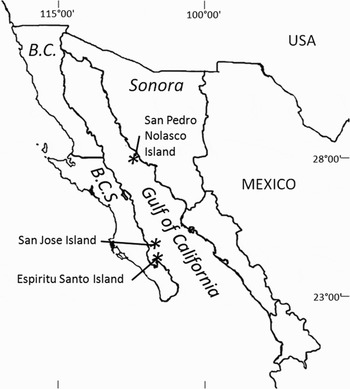
Extensive collections have been developed over the last 20 years along the Gulf of California. In particular, at least 60 localities have been found with rhodolith beds (Riosmena-Rodriguez et al., Reference Riosmena-Rodríguez, Steller, Hinojosa-Arango, Foster and Bursca2007) ranging from shallow areas to deep areas (1–40 m depth). As part of the rhodolith sampling, associated flora was collected for taxonomic and ecological purposes (Steller et al., Reference Steller, Riosmena-Rodriguez, Foster and Roberts2003; Hernandez-Kantún et al., Reference Hernández-Kantún, Riosmena-Rodriguez and Leon-Cisneros2009). Collections of associated flora were done using traditional field methods such as SCUBA diving and the specimens were preserved in a solution of 4% formalin–seawater. Plants of Kallymenia were found in four localities (Figure 1). All the material was deposited in the Phycological Herbarium of Universidad Autónoma de Baja California Sur (FBCS). For the anatomy, the material was cut with a razor blade and stained with 1% aqueous aniline blue acidified with aqueous 1% HCl. The new records were identified based on modern taxonomic concepts (Abbott & McDermid, Reference Abbott and McDermid2002) and traditional identification keys for the area (Dawson, Reference Dawson1944, Reference Dawson1966; Abbott & Hollenberg, Reference Abbott and Hollenberg1976).
Collection localities of Kallymenia pertusa (San Jose Island), K. norrisii (Espíritu Santo Island and San José Island) and K. oblongifructa (San Pedro Nolasco Island) in the Gulf of California. B.C.S., Baja California Sur; B.C., Baja California.

RESULTS
DESCRIPTION
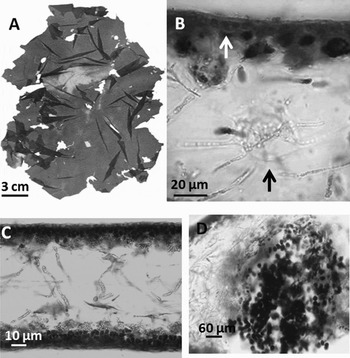
Thalli from purple to red; blades ruffle (Figure 2A) up to 21 cm high and 17 cm wide; margin entire or cut, with a small stipe almost imperceptible and a discoid holdfast; anatomically, the cross-section has a thickness of 200–250 µm; the external layers are 4–5 lines of cells (Figure 2B), the most external layer composed of spherical cells 4 µm in diameter and the most internal layer with cells 45 µm in diameter emitting some projections (stellate); medulla with stellate cells 50–60 µm in diameter (Figure 2B) and anticlinal filaments from cortex to cortex (Figure 2C).
Kallymenia norrisii (FBCS 10349). (A) Blade with smooth margin; (B) transversal view showing the cortex integrated for small cells (white arrow) in the external part and big cells with projections (black arrow) in the internal part; (C) anticlinal filaments running from cortex to cortex; (D) mature gonimocarp.

Cystocarp (no ostiole was observed) 0.5–1 mm in diameter (Figure 2D), growing all over the surface of the blade, projected out of the cortex and covered by a pericarp made by thin medullar filaments; carpospores 10–15 µm in diameter. Tetrasporangia and spermatangia were not observed in the present study.
HABITAT
The species was collected in late spring and early summer associated with subtidal (12–15 m) rhodolith beds and strong currents only in the south of the Gulf of California. Additionally it was found on rocky substrata.
PREVIOUS RECORDS
California (Hollenberg & Abbott, Reference Hollenberg and Abbott1965, Reference Hollenberg and Abbott1966; Abbot & Hollenberg, Reference Abbott and Hollenberg1976).
NEW DISTRIBUTIONAL RANGE
Isla Espíritu Santo, La Ballena, 10 June 2006, coll. Fabiola Villegas and Lucia Santos, 25 m, rocky substrata, FBCS 10208; Isla San José, 25 August 1996, coll. Marco Medina, FBCS 10349.
DESCRIPTION
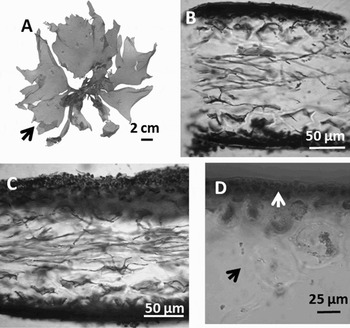
Plants growing in clusters and having many blades, blades cherry or red in colour, 10–15 (30) cm high, simples, broad lanceolate or lobate, cuneate divisions and the margin is smooth or dentate; stipe inconspicuous and with a discoidal holdfast (Figure 3A); anatomically, 100–250 thickness (Figure 3B, C); the cortex has 3–4 layers of cells, increasing in size from the external (4 µm diameter) to the internal (45 µm with projections or stellate) part (Figure 3D); medulla with predominantly periclinal filaments of 3–4 µm (diameter) and some stellate cells with projections that run as periclinal filaments (Figure 3C).
Kallymenia oblongifructa (FBCS10273). (A) Blade irregularly lobate and with smooth margin (black arrow), stipe not visible; (B, C) transversal view showing the medulla with predominantly periclinal filaments and big cells with projections in the internal part; (D) transversal view showing the cortex integrated for small cells (white arrow) in the external part and big cells with projections (black arrow) in the internal part.

No cystocarps, tetrasporangia or spermatangia were observed in this study.
HABITAT
This species was observed on rhodolith beds. It was found in channels associated with strong currents in late winter and spring.
PREVIOUS RECORDS
Alaska (Scagel et al., Reference Scagel, Gabrielson, Garbary, Golden, Hawkes, Lindstrom, Oliveira and Widdowson1993), British Columbia (Scagel et al., Reference Scagel, Gabrielson, Garbary, Golden, Hawkes, Lindstrom, Oliveira and Widdowson1993), California (Abbott & Hollenberg, Reference Abbott and Hollenberg1976; Scagel et al., Reference Scagel, Gabrielson, Garbary, Golden, Hawkes, Lindstrom, Oliveira and Widdowson1993), Oregon (Hansen, Reference Hansen, Kaye, Liston, Love, Luoma, Meinke and Wilson1997), Washington (Scagel et al., Reference Scagel, Gabrielson, Garbary, Golden, Hawkes, Lindstrom, Oliveira and Widdowson1993).
NEW DISTRIBUTIONAL RANGE
El Faro, Isla San Pedro Nolasco, Sonora, 21 May 2005, coll. Marina Hirales Cota and María del Carmen Altamirano, 20 m, FBCS 10273; Isla San Pedro Nolasco, Sonora, 13 March 2007, coll. María del Carmen Altamirano and Natalia Blancas, 16 m, FBCS 10268; North, Isla San Pedro Nolasco, Sonora, 21 May 2005, coll. Marina Hirales Cota and María del Carmen Altamirano, 13 m, FBCS 10274.
DESCRIPTION
Irregular blades (up to 30 cm high) from cherry to pink colour; regular perforations (1–2 cm diameter) all over the thallus and smooth margin; stipe and holdfast were not found in the blade; anatomically, the cortex of 4–5 cells, increases in size from the external (5 µm diameter) to the internal (40 µm diameter) part; medulla with predominantly anticlinal filaments (4–5 µm diameter) and stellate cells with projections that run as periclinal filaments (illustrated in Norris & Norris, Reference Norris and Norris1973).
Cystocarps (0.5–1 mm diameter) covered by a thin filamentous pericarp; ostiole, tetrasporangia or spermatangia were not observed in this study.
HABITAT
This species was observed on rhodolith beds. It was found in summer in channels associated with strong currents.
PREVIOUS RECORDS
Northern Gulf of California (Norris & Norris, Reference Norris and Norris1973; Norris & Bucher, Reference Norris and Bucher1976).
NEW DISTRIBUTIONAL RANGE
Isla San José, 25 August 1996, coll. Marco Medina, FBCS 5607.
DISCUSSION
The taxonomy of these species is based on the morphology, and the identification at the genus level must be done using the reproductive structures (Abbott & McDermid, Reference Abbott and McDermid2002). Nevertheless, sometimes these species are not reproductive in several collections, so to differentiate between Kallymenia and Halymenia Abbott & McDermid (Reference Abbott and McDermid2002) suggested the use of stellate cell size and shape, located in the inner cortex (20 µm in size in Halymenia and 45–50 µm in Kallymenia). The projections or arms are bigger in Kallymenia than in Halymenia. In the case of K. oblongifructa, these kinds of characteristics for identification were used, as the samples were not reproductive.
The present description of K. norrisii has some differences with the original description by Hollenberg & Abbott (Reference Hollenberg and Abbott1965) of a cystocarp of up to 3 mm (1 mm in the present study) and a prominent ostiole (inconspicuous in the present study). These differences could be related to the latitudinal separation of the original type locality and the oceanographic characteristics in the Gulf of California (temperature and irradiance). These patterns have been documented for some other species of algae in the Gulf of California, Cutleria hancockii Dawson (Riosmena-Rodriguez et al., Reference Riosmena-Rodríguez, Paul-Chávez and Hinojosa-Arango2001) and Corallina vancouveriensis Yendo (Riosmena-Rodriguez & Siqueiros-Beltrones, Reference Riosmena-Rodriguez and Siqueiros-Beltrones1995).
Most of the characteristics were the same as the original description for Kallynmenia oblongifructa. Additional information is presented in Guiry & Guiry (Reference Guiry and Guiry2010), where this name is used as a synonym of Kallymeniopsis oblongifructa (Setchell) Hansen. Nevertheless, the information presented in Hansen (Reference Hansen, Kaye, Liston, Love, Luoma, Meinke and Wilson1997) is not enough for the change of name because the publication is not yet available. The characteristics of our specimens are related to the genus Kallymenia based on Abbott & McDermid (Reference Abbott and McDermid2002) and additional research will be needed to establish if the organisms identified as Kallymenia oblongifructa in the Gulf of California belong to the genus Kallymeniopsis or Kallymenia using the cystocarps information (absent in this study). The new species ranges established in this research should prove useful for other scientists studying the classification of the specimens identified as Kallymenia oblongifructa.
Kallymenia pertusa is distinguished for the presence of holes on the blade; however this has not been tested as a diagnostic feature. Our results show that this species is very versatile in habitat selection; previous records pointed to epiphytical growth on Sargassum (Norris & Norris, Reference Norris and Norris1973) and now to rodolith habitats.
Species of Kallymenia and Halymenia have been reported as regular finds in the rhodolith beds in Spain and on the European coast (Barbara et al., Reference Bárbara, Cremades and Veiga2004; Peña & Barbara, Reference Pena and Bárbara2008). But the presence of Kallymenia pertusa (southern), K. norrisii and K. oblongifructa living in rodolith beds in the Gulf of California is relatively new. The other blade-like seaweed reported to live in rodolith beds is Halymenia actinophysa (Hernandez-Kantun et al., Reference Hernández-Kantún, Riosmena-Rodriguez and Leon-Cisneros2009).
In this study, only Kallymenia pertusa of the four previously reported Kallymenia species in the Gulf of California was found (Dawson, Reference Dawson1944, Reference Dawson1966; Norris & Norris, Reference Norris and Norris1973). There are now six species reported in the Gulf of California based on morphology and a few reproductive characteristics. Further studies are required for a better understanding of the biology, distribution, taxonomy and the diversity present in the Gulf of California.
ACKNOWLEDGEMENTS
This project was supported by grants from CONABIO (V044), CONACYT-SEMARNAT (FOSEMARNAT 2004-01-243) and CONACYT-SEP (34118-V) from the Mexican Government, to which we are thankful. J.H.K. thanks CONACYT for the scholarship for her Master's degree. We thank the anonymous referees for their comments which helped to prepare an improved version of this manuscript.