Water consumption within the Irish dairy sector is relatively high at 2·5 m3/m3 of milk processed and 14·9 m3/tonne product (Geraghty, Reference Geraghty2011). In comparison, water consumption in the Australian dairy industry has dropped to 1·4 m3/m3 of milk processed while the UK dairy industry reported an improved water consumption ratio of 1·1 m3/m3 of milk processed in 2015 (ADIC, 2013; Dairy UK, 2015). Water is used both internally and externally within factories for manual washing, pasteurisation, operational processes and internal pipe washing (i.e. cleaning-in-place: CIP). Research has shown that water reuse practices in Ireland remain low due to the damp climate and low water stress (Deloitte, 2015). Nevertheless, with an increase in sustainability initiatives and stringent legislation within this sector water reclamation and reuse may be a necessary consideration in the near future.
Wastewater from dairy processing factories can be divided into three main categories; (i) cooling water, (ii) sanitary wastewater and (iii) industrial wastewater. In terms of the origin of the microbiological contamination within these waste streams there are a multitude of sources including milking machines and bulk tanks on farms and tankers transporting the milk. While the majority of these bacteria are destroyed during the initial pasteurisation process, some pathogenic strains are known to survive post-pasteurisation such as Listeria monocytogenes and spore-forming Bacillus spp. (Gopal et al., Reference Gopal, Hill, Ross, Beresford, Fenelon and Cotter2015). Other pathogens associated with the dairy industry include Salmonella spp., Staphylococcus aureus and Campylobacter spp. (Oliver et al., Reference Oliver, Jayarao and Almeida2005). Therefore, aside from chemical disinfection of wastewaters for potential reuse there may also be a requirement for enhanced pathogen removal depending on the intended purpose of the reclaimed water. Research studies into the reuse of such treated wastewaters have generally focused on the use of membrane filtration techniques (Riera et al., Reference Riera, Suárez and Muro2013). Although filtration techniques are effective, their application in this setting can be hampered by fouling issues (Fitzhenry et al., Reference Fitzhenry, Barrett, O'Flaherty, Dore, Keaveney, Cormican and Clifford2014). Ultravoilet (UV) technologies for wastewater disinfection are often favoured as they tend to be low maintenance and cost-effective, but they can also be hindered by the presence of suspended solids (SS) (UKWIR, 2016).
This study aims to investigate (i) the microbiological characterisation of a variety of wastewater streams from three dairy processing factories and (ii) the application of two UV technologies for potential low-level wastewater reuse within dairy processing factories. In addition, the impact of SS on the disinfection efficiency of both a domestic low pressure UV (LPUV) system and a novel pulsed UV (PUV) flow-through system was evaluated.
Material and methods
Wastewater characterisation analysis
Three dairy processing factories were selected for water/wastewater stream analysis ranging from factories which process milk from 100 million litres per year (Site 1) to those which process up to 1000 million litres per year (Site 3). Grab samples (1–2 l) were collected at various sampling points of the dairy processing factory which included cooling water, condensate water, wastewater treatment plant (WWTP) influent and WWTP effluent. The samples were subjected to a series of standard methods testing (within 8 h) The following two tests were carried out; (i) heterotrophic plate counts (HPC) at 37 and 22 °C and (ii) total coliform and Escherichia coli analysis. These samples (100 ml) were also sent for specific pathogen target analysis at externally accredited laboratory, (Complete Lab Solutions, Rosmuc, Galway) for analysis of Listeria monocytogenes, Staphylococcus aureus, Bacillus cereus, Campylobacter spp. and Salmonella spp. Further details of the sampling points and specific tests are included in the Online Supplementary File. Each dairy wastewater treatment plant was surveyed at least twice.
PUV system analysis
A bench-scale pulsed power source (PUV-01, Samtech Ltd., Glasgow) was used to power a low pressure (60 kPa) xenon-filled flashlamp (Heraeus Noblelight XAP type; NL4006 series) which produced a high intensity beam of polychromatic pulsed light. The lamp was placed 10·75 cm above a sterilised aluminium flow-through vessel (with a plan surface area of 290 cm2) which pumped water through the vessel at the desired flow rate corresponding to a hydraulic residence time (HRT). The PUV system allowed for the input voltage and the pulse rate to be varied between 400 and 1000 V and for a pulse frequency of between 0·1 and 10 pulses per second (PPS). The UV dose was determined by calculating the output voltage energy, the distance from the lamp, the area of the vessel, the PPS and the HRT. All PUV doses were calculated to only include wavelengths below 300 nm.
LPUV system analysis
The continuous-flow monochromatic LPUV system (LCD 412 Plus, S.I.T.A., Halpin & Hayward Ltd.) had a fixed power output of 40 W with a maximum flow rate of 45 l/min. The UV dose was altered by varying the influent flow rate e.g. influent pumped at a rate of 27 l/min gave a retention time of 0·4 s and a UV dose output of 11 mJ/cm2.
Impact of SS on UV systems
Various concentrations of bentonite, calcium carbonate (CaCO3) or organic dairy wastewater solids were added to the influent sample of both the PUV (2·5 l distilled water) and LPUV (30 l tap water) to give a range of samples with SS concentrations that varied between 0 and 200 mg/l. Subsequently the samples were spiked with E. coli to give an initial concentration, prior to UV treatment, of 1 × 10⁶ CFU/ml. Samples were then processed through the LPUV and PUV systems. Influent and effluent samples were analysed using the standard pour plate technique (1 ml) using non-selective nutrient agar. Log inactivation was determined as the difference between log influent concentration (N 0) – log effluent concentration (N).
Results and discussion
Dairy wastewater characterisation analysis
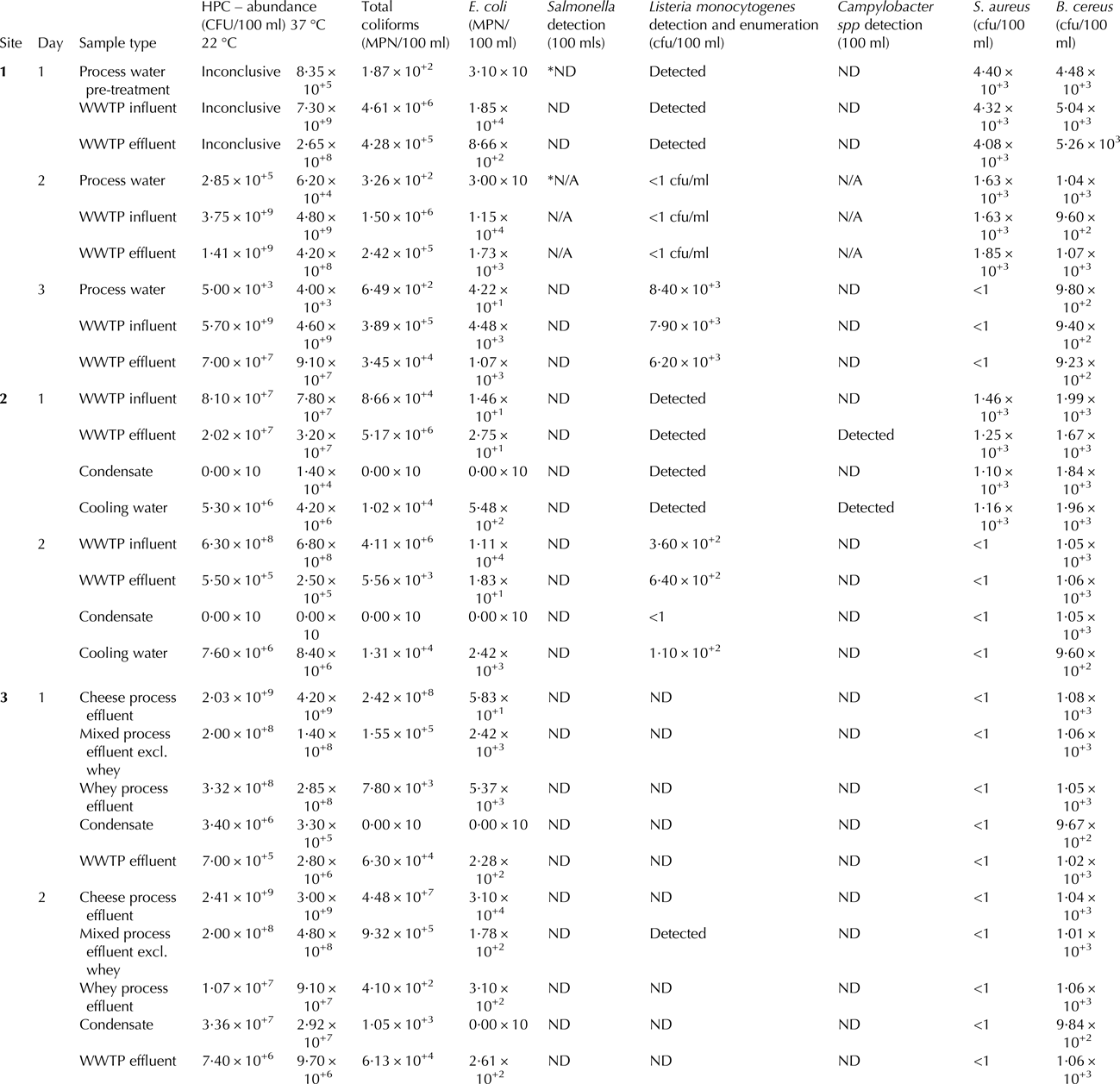
Table 1 outlines the total abundance of aerobic bacteria in the samples in addition to standard faecal indicator concentrations and results of detection/enumeration tests for five targeted pathogens in the dairy water samples. Faecal indicators of total coliforms and E. coli were present in all WWTP influent & effluent samples. E. coli was detected in all samples apart from the condensate water samples from Site 2 and Site 3. Thus, if effluent discharge regulations were extended to microbiological monitoring in addition to current regulations, it is likely that tertiary disinfection would be required at all three WWTP sites tested. Separate wastewater streams emerging directly from the dairy processing factories were analysed to determine bacterial contamination levels and suitability for potential low-level water reuse in/around the dairy processing factory. A cooling water waste stream was analysed at Site 2 while condensate wastewater was available for collection at both Site 2 and Site 3. Analysis of the cooling water stream yielded the presence of both faecal indicators and four out of the five targeted pathogens (thus disinfection may be required depending on the desired water reuse purpose). Condensate water from Site 2 appeared relatively uncontaminated as aerobic bacterial loads were low and faecal indicators absent. However pathogenic Listeria monocytogenes was still detected on both sampling days highlighting the importance of rigorous microbiological analysis of dairy wastewater streams if they are to be considered for reuse purposes. Studies have shown this bacteria to survive post-pasteurisation in dairy processing environments, therefore, particular attention may be warranted for this strain in terms of water reclamation in the dairy environment (Oliver et al., Reference Oliver, Jayarao and Almeida2005). Listeria monocytogenes was also detected in all samples at Site 1 and Site 2 and after a further enumeration test the highest levels were detected in Site 1. Salmonella spp. went undetected in all 12 samples tested while Bacillus cereus was consistently detected in all 12 samples at low concentrations. Staphylococcus aureus was found to be most prevalent at Site 1 where process water (pre-treatment) WWTP influent and WWTP effluent streams were tested.
Faecal indicator and pathogenic bacteria analysis of various water and wastewater streams at three Irish dairy processing factories

HPC, heterotrophic plate counts; ND, not detected; N/A, test not performed.
Impact of SS on UV systems
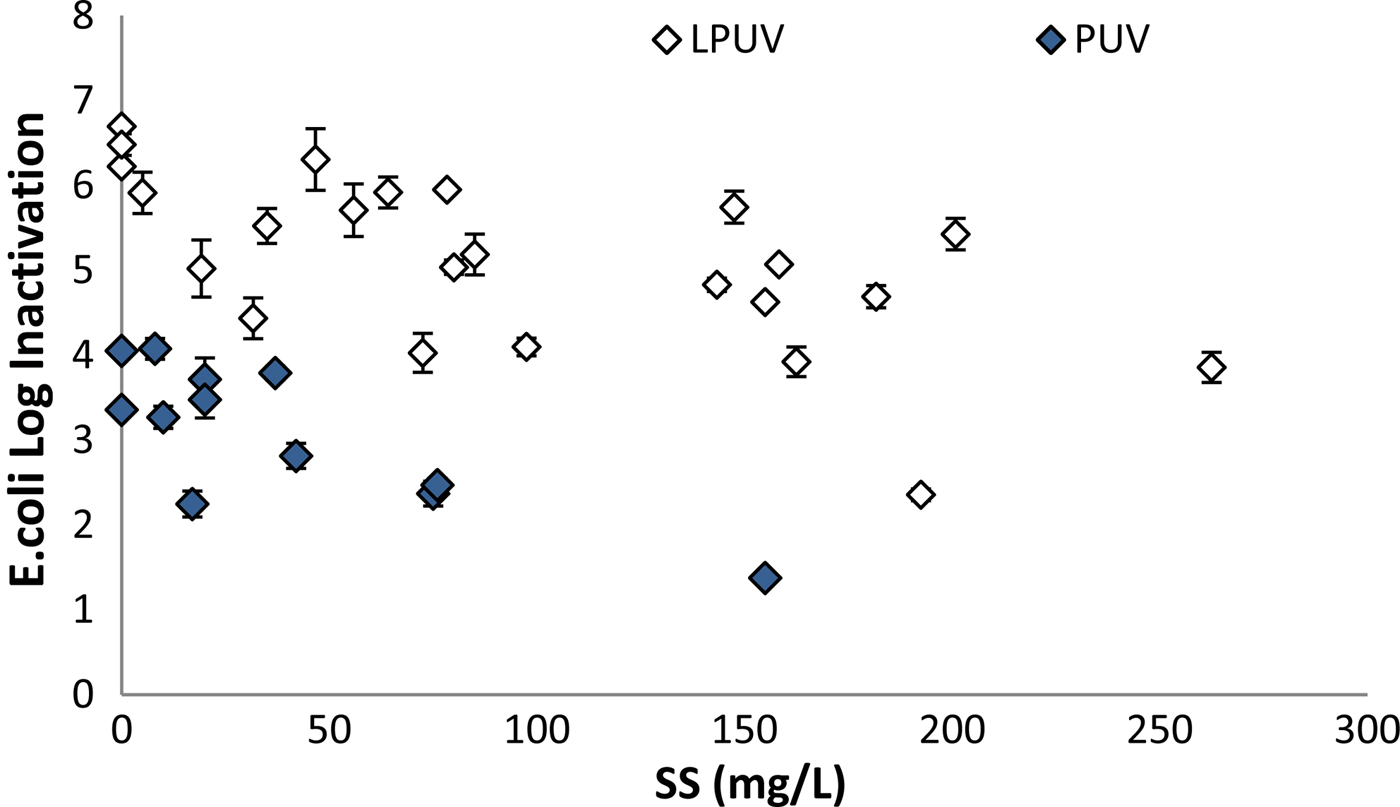
It was observed that inorganic SS (bentonite and calcium carbonate) concentrations of less than 200 mg/l had limited impact on both LPUV and PUV efficiency for E. coli inactivation (data available in online Supplementary File). Organic particles (dairy wastewater solids) appeared to have minimal impact on the LPUV system while a decreasing trend of E. coli log inactivation with increasing SS concentration can be seen for the PUV system (Fig. 1). These results indicate that priority should be given to organic suspended solids removal if wastewater reuse and disinfection is being considered. They further indicate that the PUV appears to be more readily impacted by the presence of suspended solids in comparison to the LPUV system. A significantly higher UV dose was required from the PUV system in comparison to the LPUV system for E. coli inactivation. Further analysis into the cost of a higher energy system may be of interest for comparative purposes between the PUV and LPUV.
Impact of suspended solids on E.coli log inactivation via low pressure ultraviolet (LPUV) and pulsed ultraviolet (PUV) disinfection, where the ultraviolet (UV) dose is 11 and 1946 mJ/cm2, respectively

In conclusion, results from the wastewater characterisation analysis indicate that the majority of wastewater streams from different dairy processing factories were contaminated with either faecal indicators or foodborne pathogens or a mixture of both. The condensate wastewater streams appeared to be the most suitable to utilise in terms of water reuse as they appeared to be the least contaminated. As some dairy processing factories produce significant quantities of this wastewater as a by-product of dairy processes (e.g. evaporation and drying of milk powder) it may be a suitable choice for wastewater reclamation and reuse within the factory. Comparative analysis of LPUV and PUV disinfection efficiency suggest that the flow-through PUV system appeared to be more sensitive to the presence of organic SS in wastewater samples. Therefore, the LPUV system may offer a more robust disinfection method as it appears to be less susceptible to the presence of suspended solids.
Supplementary material
The supplementary material for this article can be found at https://doi.org/10.1017/S0022029918000602.
The authors would like to acknowledge the Department of Agriculture, Food and the Marine for the funding of this research (Ref: 13-F-507). Additionally, the DairyWater research team would like to the members of the Irish dairy sector for their cooperation and contributions throughout the research project.