

A surprisingly strong case can be made for seeking the origins of English pop music not in the 1950s, but in the 1590s (or thereabouts). As the sixteenth century drew to a close, broadside ballads – single sheet songs that sold cheaply on the streets and covered a range of themes – were becoming big business in London and beyond. A Ditty delightfull of mother watkins ale, for example, evidently set feet tapping up and down the country with its jaunty melody and its irresistible innuendo.Footnote 1 Like many modern pop songs, its subject was sex, and the lines delivered by its male protagonist – ‘For I will without faile/Mayden, give you Watkins ale’ – ensured that it stimulated moral outrage, again with modern parallels. One commentator called it a ‘lascivious under song’, while another marvelled that any self-respecting printer could issue ‘such odious…ribauldrie as Watkins Ale’. This may also have been the song that was initially licensed for printing by the Stationers’ Company – as ‘A ballad of a yonge man that went a wooying &c’ – but which was subsequently ‘Cancelled out of the book, for the undecentnes of it in Diverse verses’. The imagined substance, Watkin's ale, was not, of course, a rejuvenating beverage but instead, to use the careful expression of the ballad scholar Tessa Watt, ‘a bawdy allegory for the male generative fluid’.Footnote 2 The last decade of the sixteenth century also saw Thomas Deloney, a weaver turned wordsmith, churning out hit after hit in a compositional purple patch to rival that of Lennon and McCartney in the 1960s.Footnote 3
In Deloney's time, the format of the ballad was evolving as the business developed, and by the 1620s a standard broadside included a title, multiple verses, one or more woodcut pictures and the name of a recommended tune (musical notation was rarely included – instead, we have to find the melodies in books of instrumental pieces, dance tunes or songs). Tunes and pictures were regularly recycled, sometimes appearing on many different ballads, and most of the sheets – printed on poor-quality paper – were used and displayed until they fell apart. We would know little of the genre were it not for the activities of educated men such as John Selden and Samuel Pepys, who collected ballads and pasted them into volumes, thus preserving for posterity so many pieces of ephemera.Footnote 4 Of course, early modern balladry differed from modern pop music in many ways too. The cult of the celebrity artist and the notion of a definitive performance were absent, for example, and there were many more songs on public execution and the need for repentance than we typically see in the charts today. It can nevertheless be claimed that this was where English pop music – commercially driven, based in London and aiming at a mass audience – had its roots.
In most modern pop songs, the romantic characters are single and sexually driven, but marriage is scarcely mentioned. Early modern ballads, in contrast, tend to assume that marriage is part of the context: tales are told of single men and women who seek marriage and, crucially for this paper, there are also many songs that feature married couples. These are topics of great interest to social historians, and early modern ballads – which are increasingly available in digital online facsimiles – have provided us with important and abundant source materials.Footnote 5 There is not space to survey this work in detail here but it seems appropriate to draw attention at the outset to what is arguably a distorting tendency in much of the existing literature. In a nutshell, ballads are most frequently deployed in order to illustrate arguments about marriages that were threatened from within primarily by female failings: adulterous lust, subversive scolding and murderous intent.Footnote 6 In some of the ballads favoured by scholars, vigorous husbands are commended for rising to the challenge, using violence against their insubordinate wives if necessary. In others, feeble men are mocked and castigated for a range of shortcomings, including sexual inadequacy, jealousy and an inability to exert authority. Admirable wives are thin on the ground. Indeed, the content of ballads about courtship and marriage is often labelled misogynistic and interpreted as evidence of profound male anxiety. Historians highlight titles about tortured males – Cuckolds Haven: OR, The marry'd mans miserie, for example – and Anthony Fletcher has said about balladry, ‘the creation of female gender here is confined to a familiar catalogue of vices that should be avoided or that men had it in their power to check’.Footnote 7 Thus, wild wives and the challenge they posed to troubled husbands are considered to have been the dominant themes, and ballads about marriages in which the woman murdered the man have proved particularly appealing. There are some important exceptions – a more rounded account of ballad-marriages can, for example, be found in the work of Joy Wiltenburg, Sandra Clark and Eleanor Hubbard – but relationships endangered from within have certainly caught the imagination.Footnote 8
There is an interpretative difficulty here. Historians pull from the existing ballad-collections texts that suit their particular purposes, but in doing so they often create the impression that they are characterising marriage-ballads in general (and sometimes the argument is explicit). This matters: ballads were the most widely available form of print in the period – freely accessible even to the illiterate because they were so often performed – and they therefore offer us insights into commonplace tastes and attitudes (though it is notoriously difficult to define these insights).Footnote 9 If we get ballads wrong, the consequences for our understandings of early modern culture and society more generally may be significant. Clearly, we need a methodology that is based on principles more sophisticated than lucky dip and source-mining.
For this reason, I am currently working with Angela McShane, the musicians of The Carnival Band and a number of invited singers to identify, record and display online 120 of the seventeenth century's most successful ballads. The aim is to select ballads not because they illustrate particular topics that interest us but because they were best-sellers in their own age. Sadly, there are no sales figures and the exercise is therefore challenging. We feel, however, that we have compiled as robust a list of hits as the evidence will allow, using the following indicators of popularity: the number of known editions of individual ballads and the distribution of these editions through time; the number of surviving copies of each song; evidence that publishers were keen to assert their copyright in specific titles (based on records kept by the Stationers’ Company); the survival of songs beyond the seventeenth century, both in print and in vernacular tradition; and the capacity of songs to generate new names for existing tunes, a rough and ready sign of their success.
Our methodology aims to compensate for the inevitable privileging of songs that lasted many years by including criteria that allow more explosive but shorter-lived songs to qualify for inclusion. It also aims to balance the inevitable influence of the collectors by identifying indicators that instead reflect the broader priorities of the publishers. The limitations of the evidence mean that the results of this exercise are defensible rather than definitive, but there is no doubt that all of the selected songs were extraordinarily successful. When it comes to our efforts to understand these songs as historians, our distinctive emphasis is upon the integration of texts, tunes, pictures and performances. A somewhat restrictive ‘lyrics-only’ approach has characterised scholarly work on printed ballads for many decades, including much of what has so far been cited. Other recent work, however, attempts to develop a more holistic approach.Footnote 10
The following pages will discuss a selection of these songs, concentrating in particular on those that feature marriage as a prominent theme. Roughly twenty-five of the 120 ballads fall into this category, and they can be used to address the following questions: how were husbands and wives represented in hit songs of the seventeenth century, and how might this representation encourage historians to re-think balladry and, perhaps, gender relations more widely? Let us begin with the simple observation that very few of our twenty-five hit songs have featured prominently in previous scholarly discussions of marital relations as represented in early modern ballads. When historians choose their songs, these are not usually the songs they choose.Footnote 11
Most of our songs do not, therefore, sit comfortably with the historiographical emphasis on ballad-marriages that were endangered by a challenging wife. Three might just about qualify, and the strongest candidate among them was The lamentable fall of Queen Elenor, who for her Pride and wickedness by Gods judgements sunk into the ground at Charing-Cross and rose at Queen hive. This describes the cruelty and sinfulness of Edward I's queen, Eleanor of Castile, who, according to its narrative, committed numerous outrages, including the vile murder of the mayor of London's honest wife, and adultery with a friar. Eleanor clearly is a dangerous woman, and her husband the king is well meaning but a little ineffectual. This is not, however, a ballad that says critical things of English marriages in general. Quite the opposite: Eleanor's wickedness is very clearly related to the fact that she is Spanish, and ‘her spight to women-kind’ is carefully noted. Thus, she is the enemy of her sex rather than its representative. Furthermore, the apparently exemplary marriage of the mayor and his wife, ‘the London Lady good’, suggests that healthy English relationships at all levels of society are threatened not by internal stresses but by the vanity and viciousness of a foreigner (sinister Spaniards were particularly appealing to English audiences when this song was originally composed, probably soon after the Armada of 1588). Appropriately enough, Queen Eleanor eventually loses her life after being swallowed mysteriously into the ground and then regurgitated several miles away.Footnote 12
A further eight ballads are similar in that they bear some relation to the scholarly emphasis on wicked wives and harassed husbands, but in all cases there are unexpected subtleties and complications. We have, for example, the only title in our chart that portrays a woman who murders her husband – making it also one of the few that has already been discussed by historians.Footnote 13 The ballad, composed by Thomas Deloney in the 1590s, is actually three songs in one, all set to a sombre and immensely popular tune, ‘Fortune my foe’, that had powerful associations both with romance and with the ‘last dying speeches’ of condemned killers. The first of the three songs on this sheet is entitled The Lamentation of Master Pages wife of Plimmouth. It tells the tale of Eulalia Page who, in 1590, was executed for the murder of her husband, along with her collaborating lover, George Strangwidge, and two hired killers. Singing from the heart and in her own voice – as channelled by the male author – Eulalia faces execution and describes her journey along a road to ruin. She begins,
Thus far, the song fits the pattern that characterised most ballads about husband-killers. In several respects, however, it is strikingly different from others on the same theme. Eulalia is portrayed with considerable sympathy and is allowed the space to explain her conduct. She accepts the legitimacy of her punishment but explains that she was ‘forced’ into marriage by her greedy parents, her father in particular, and that she was already engaged to Strangwidge, her ‘husband true’. The song also omits the kind of graphic detail about the murder and the execution that filled otherwise comparable ballads. And Eulalia is represented much more positively in the ballad than she was in a prose account of the same case.Footnote 15 Even her acknowledged weakness is rooted in her romantic constancy. This is no cardboard cut-out of the husband-killing ‘petty traitor’ but in fact a surprisingly subtle and sophisticated account of one honest and loving woman's descent into criminality under the tragically combined influence of true love and an oppressive father. It seems likely that the song's immense popularity was connected, at least in part, with its complex and uncategorical portrayal of the murderer whom it made famous.Footnote 16 This raises interesting questions about the nature of its audience, a point to which we will return.
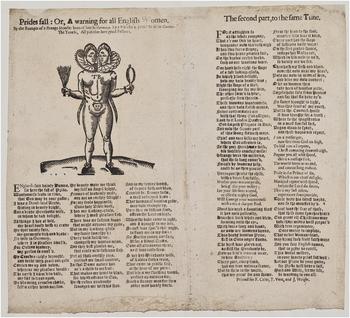
Other hit ballads in this sub-group of eight steer clear of murder but nevertheless follow a comparable line in representing with some sympathy wives who bring danger to their households. In Prides fall, a Dutch woman – married to a wealthy merchant – explains in graphic terms how her personal vanity led God to place in her womb a monstrous baby, designed as a warning to all ‘fair dainty Dames’ (Figure 1). The baby's strange physical characteristics reflect the mother's vanity and both the woodcut artist and the wordsmith went to considerable and unusual pains in visualising a creature that scared all witnesses.
Prides fall (edition of 1663–74). Euing Ballads, 269. By permission of the University of Glasgow Library, Special Collections.

The baby dies, but not before delivering a stern – and remarkably precocious – warning to the astonished townsfolk. This is, then, a ballad about the dangers of female sinfulness – the word ‘wanton’ is used repeatedly – and yet, as with Mistress Page, the wayward wife speaks for herself (as it were) and expresses her deep remorse. She turns her sin into something positive by seeking to influence other women, and the song ends with the lines, ‘Maid and Wife, let my life,/be warning to you all’. The tune is also distinctly upbeat and it was strongly connected by association with another hit ballad about a heroic male apprentice, a resonance that contributes a curiously positive vibe to Prides fall.Footnote 17 Of course, the anonymous song is probably a man's imagining of a female persona – it is difficult to escape such ventriloquism in the seventeenth century – but it is not a straightforwardly hostile representation of the Dutch wife. At the very least, she stands in the spotlight, delivering ninety-eight lines of spoken text, only three of which mention her husband even in passing.
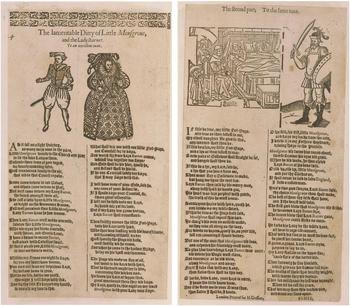
Other songs in this sub-group feature female adulterers but, once again, their portrayal in our hit ballads is rather different from the blunt and brutal representations of lascivious wives that have been highlighted in the scholarly literature. In The lamentable Ditty of Little Mousgrove, and the Lady Barnet, for example, an aristocratic wife, Lady Barnet, seduces an attractive local man, Little Mousgrove, luring him to her flower-strewn bower for an hour of passion (Figure 2). Her husband learns of the assignation and bursts in upon the couple as they lie in bed. The denouement is bloody: Lord Barnet slays Little Mousgrove in a sword-fight, then kills his wife, and finally takes his own life. In the closing lines, we are warned about the consequences of lust, and yet the song – when heard in its entirety – certainly does not feel like a fierce condemnation of a wicked wife. Even in the moralising final verse, Lady Barnet is described as a ‘worthy wight’, and the multiple deaths that occur are more like the climax of a tragic love story than an account of sin and its foul-smelling fruits.Footnote 18 The pictures, as so often, are recycled from other sources. On the right, for example, a commonly encountered soldier represents the angry Lord Barnet as he approaches a bed-scene that also began life elsewhere (viewers must make their own sense of the fact that the Lady and her lover appear to be sharing those precious post-coital moments with some visiting clerics).
The lamentable Ditty of Little Mousgrove (edition of c. 1630). Pepys Ballads, i, 364–5. By permission of the Pepys Library, Magdalene College, Cambridge.

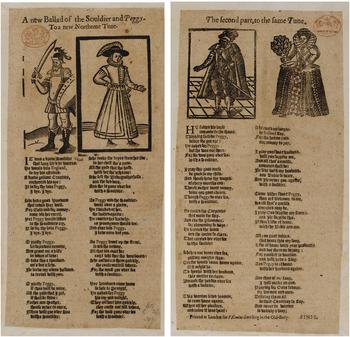
The lamentable Ditty shares one of its pictures with our next song, A new Ballad of the Souldier and Peggy (Figure 3). There were several editions of this ballad in the second half of the seventeenth century, and its lovely lilting melody – described on the sheet as ‘a new Northerne Tune’ – subsequently became known as ‘Peg and the soldier’.Footnote 19 The song tells the story of another female adulterer who places her marriage in jeopardy, but its conclusion sets it apart from many more merciless accounts of such characters. Peggy has a baby at home but she nevertheless runs off willingly to Ireland with a seductive soldier. Her ‘good husband’ is understandably distraught when he realises that Peggy has sailed away on a lustful impulse. After hiring a nurse to feed the baby, he expresses his anger but chooses other targets than his wife:
When life on the road proves a disappointment to Peggy, she returns home and begs forgiveness. Her husband, remarkably, welcomes her back immediately, asking only that she promise not to stray again.
A new Ballad of the Souldier and Peggy (edition of c. 1640). Roxburghe Ballads, i, 370–1. © The British Library.

Although Peggy is at fault – she is a ‘wanton lewd woman’ – she is also treated rather generously, both by her husband and by the narrator. We might expect a more savage act of judgement, like the one at the climax of the ‘Little Mousegrove’ ballad. Instead, Peggy's waywardness is presented as almost excusable – ‘For youth it is wanton/ and will have a fling’ – so long as the lesson is learned, ‘And Peggy is at home with her husband againe’. The mood of the tune contributes to the ‘all's well that ends well’ tone, and the recycled pictures track the narrative in a rudimentary manner. On the left, we see the soldier who, having represented Lord Barnet on the previous ballad, now stands beside an interesting illustration of a woman with a sword at her side. This image also appeared subsequently on a song – popular but not quite one of our hits – about the female soldier, Mary Ambree, who brought England glory with the great deeds she performed in the Netherlands. Clearly, she carried an association with soldiering from one ballad to the next (more mysteriously, however, Mary Ambree has apparently mislaid the sword).Footnote 20 On the song about Peggy, two woodcuts on the right complete the tale. Here, she is no longer the bold young woman running off with a soldier but instead the conventional wife who stands beside her happy husband (everybody had seen both of these pictures dozens of times). The assumptions that underlie the ballad are, of course, conventionally patriarchal – the wife goes astray, and her deliverance consists in returning to live with a husband who forgives her as God forgives him – but this song can hardly be said to express the ‘crude if jocular misogyny’ that Bernard Capp and others have found to be characteristic of the cheaper forms of print in general.Footnote 21
The fourteen ballads that complete our collection of marital mega-songs carry us even further from this emphasis, suggesting that the role of balladry within early modern debates about marriage and gender relations more generally may have been misunderstood. Some of these ballads idealise marriage and present to the listener wives and husbands who live together in love and happiness. The Happy Husbandman: OR, Country Innocence, for example, opens with the lines,
The song is almost nauseating in its portrayal of an idyllic rural marriage in which the spouses perform their distinct but complementary roles with a coy smile on their faces and a sentimental song in their hearts. Their lives are full of love-making but devoid of trouble-making (wisely, they leave politics to others). This feels, of course, like a town Tory's imagining of country life, and we are told that London wives are greedy and domineering in comparison to the paragon described here. It is difficult at first to see why this song was so popular, but if we listen as well as look, then some sense of its appeal can be recaptured. The melody, described on the sheet as ‘a pleasant new Court Tune’, is beautiful, capable perhaps of conjuring something sublime from something ridiculous.Footnote 22
Most of our remaining songs are different in that they do demonstrate an acute awareness of the dangers to marriage but, crucially, these dangers are typically the work of forces external to the relationship rather than the result of tensions between husband and wife. Frequently, marriages are threatened or complicated by the disapproval of parents or relatives, and the ballad-makers’ sympathies are invariably with the couple rather than their critics. One ballad, printed repeatedly during the seventeenth century, bore the title, A constant Wife, a kinde Wife, A loving Wife, and a fine Wife, Which gives content unto mans life. In several editions, the repeated capital Ws in the title make the point that finding a worthy woman to wed is the song's principal focus. Written in the man's voice, the first half of the ballad describes the battle he fought to free his beloved from the evil clutches of her disapproving family (‘She likely was for to be rich,/ and I a man but meanely’). He smashes his way into her uncle's house, rescues his sweetheart and marries her without the consent of her family – and he urges other men to adopt a similarly belligerent attitude to the enemies of true love. In calmer mood, he then devotes the second half of the song to praising his new wife, commending her physical beauty, her virtue, her wisdom and her obedience. The woman in this song, though set at its centre, is a passive figure, a desirable trophy over which men fight, but she is nothing like an adulterous scold.Footnote 23
The woman featured in A worthy example of a vertuous wife was a far more active presence. The song was popular in England from the 1590s right through into the eighteenth century. It tells the story of a woman from ancient Rome who, having married against her father's will, grasps the opportunity to achieve reconciliation with him after he is imprisoned and starved by the emperor. And where the man in our previous ballad uses his fists to effect a rescue, the heroine of this song must deploy more subtle and feminine means. To cut a long story short, she tricks the authorities into allowing her access to the old man, and then keeps him alive by secretly breast-feeding him through the bars of his cell every day for a year (he ‘was most faire and fat to see,/yet no man knew which way’). The emperor eventually realises what has happened and, impressed by such virtuous devotion, pardons the prisoner and rewards his daughter with ‘great preferments’.Footnote 24 The song acknowledges no sources but it is clearly based on ancient Roman stories recorded by Valerius Maximus and Pliny the Elder as examples of familial devotion. Valerius told two similar tales, and the one that he developed most fully actually featured an imprisoned mother rather than a father. Pliny, interestingly, recorded only this all-female version. By the sixteenth century, however, a single narrative about Cimon (the father) and Pero (the daughter) was firmly in fashion, and it subsequently became known as ‘Roman charity’. It appears that early modern minds preferred the version in which a woman fed a man, perhaps because this intensified the incestuous frisson and reflected the topical complexities of patriarchy-in-practice.Footnote 25
There are several interesting points to be made about this hit song. Its focus is not actually the woman's marital relationship, except indirectly, and yet the title and the final verse highlight her status as a ‘vertuous’ and ‘loving’ wife. The story is really about her conduct as a daughter, and the insistence upon her wifeliness at the song's top and tail perhaps has the effect of tying different types of female dependence and obligation together. Ballads about active women – transvestite soldiers, for example – very often conclude with verses about marriage, in which convention reclaims those who might seem to have threatened it. This is necessary here too, for the men in this song are not impressive: her father is pathetic, the emperor is autocratic and the husband hardly features. The ‘vertuous wife’ is a feisty, resourceful and active woman who stars in her own show. She has previously defied her father, and now she defies the emperor – labelling him a ‘tyrant’ – and tricks his guards. She deploys traditional womanly wiles – ‘wringing hands and bitter teares’ – in order to do good and get her way. She also displays more clearly admirable feminine qualities such as selflessness, and the instruments through which these qualities are revealed – her own breasts – could hardly be more conventional in their symbolism. She is a complex creation, clearly set up for our admiration, and the tune – strongly associated with a heroic male ballad about the medieval battle at Chevy Chase – adds to the positive atmosphere.Footnote 26 We cannot know who bought this ballad, nor why it was so successful, but we might speculate that this virtuous wife worked her way, in exaggerated and exoticised guise, through the daily dilemma that faced many early modern English wives: how to find fulfilment within patriarchy through the somewhat paradoxical or counter-intuitive project of making it their own. The ballad was simultaneously a fantastical escape from ‘reality’ and a sturdy tool with which to work on it.
It is perhaps difficult to reconcile the popularity of the woman who fed her father with the undoubted appeal of Thomas Deloney's Excellent Ballad of Patient Grissel. In this version of an old story previously told by Boccaccio, Petrarch and Chaucer, a marquis marries a beautiful but poor woman called Grissel, and soon faces murmuring criticism from his noble advisers for marrying so far beneath him. He loves Grissel truly, but resolves that he must prove her moral worth to the doubters by subjecting her to a terrible series of ordeals. He removes her children, telling her (falsely) that he has had them killed, and he banishes her back to her father's miserable cottage. Grissel bears it all with patience and constancy, obeying each of her husband's outrageous commands until, finally, he reunites her with her children and explains that she has now passed all the necessary tests.Footnote 27 It is an unsettling ballad, and very different in its portrayal of the featured wife from the song we have just considered. Its appeal to men is obvious enough, but the reasons why women might have felt drawn to it, perhaps cherishing it alongside their copies of A worthy example of a vertuous wife, are harder to fathom. Chaucer had argued forcefully that no wife could be expected to copy Grissel, but the author of a seventeenth-century chapbook about her, taking issue with those who complained about ‘the absurdity of the example’, urged that this is exactly what women should do.Footnote 28 Arguably, it was possible to admire Grissel not primarily for her obedience but instead for her refusal to buckle under unimaginable pressure from a cruel husband. Within this view, her extreme passivity becomes almost a species of defiant action, and – like the woman who fed her father – she survives and eventually thrives. Of course, there is a fine line between admiring obedience and admiring the capacity to suffer without complaint, but the genius of Deloney resided, arguably, in his ability to devise songs that appealed to men and women simultaneously but for different reasons. Such songs clearly stimulated debate, and the ballad ‘Of Patient Grissel’ was said to be a favourite choice for display on the walls of country homes.Footnote 29
In our last ballads, marriages are endangered not by disapproving observers but by a range of other circumstances, none of which has anything to do with stresses within the core relationship. Indeed, most of the marriages are strong and loving, exemplary even, but assaulted from outside. There is one about Catherine Willoughby, duchess of Suffolk, who fled England with her husband and baby during the 1550s in order to escape persecution for her godly Protestantism. Another introduces us to a more humble bride, who dies suddenly on her wedding day after dispensing godly and practical advice to her husband and friends (she sensibly suggests that they hire a carpenter to turn her marital bed into a coffin). In both songs, the wives take centre-stage, their courageous conduct praised and promoted. They are often surrounded by men and conventional in their femininity, but they shine nonetheless.Footnote 30 The same is true of The Constancy of SUSANNA, which recounts the famous Biblical tale: Susanna, wife of Joachim, is forced to take a stand against two lecherous elders of Babylon who first make a pass at her, and then, angered by her resistance, accuse her falsely of committing adultery with another man.Footnote 31 The opening verses run,
The ballad-writer, working in the late sixteenth century, begins with a man of high status – Joachim – but then quickly abandons him in favour of his much more interesting wife. The author feels the need to justify his decision – ‘Why should not we of her learn thus,/To live godly’? – but it was clearly a good one, and Susanna's song sold for centuries. Two hundred years after the ballad was composed, a Welsh fiddler, Alawon John Thomas, wrote into his notebook a tune called ‘Susannah’ which is recognizably a version of the Elizabethan melody.Footnote 32 The original ballad has Susanna at its heart, and the refrain – ‘Lady, lady’ – keeps her there, even when Daniel, sent by God, arrives to save her at the end.Footnote 33 Of course, it can be argued that Susanna's appeal lay partly in her capacity to titillate men – the woodcuts used by printers in the seventeenth century came to follow the greater artworks of the age in concentrating on the moment of attempted seduction and depicting Susanna as almost nude – but this was surely not enough to carry her song up the charts.Footnote 34 However we look at her, however we listen to her, Susanna is a long, long way from the scolding and lascivious wives who have tended to dominate the literature on balladry and gender.
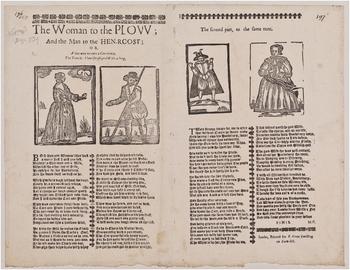
Our final song is a little closer to the conventional view of ballad-marriages in that it discusses a relationship that is endangered by a difference of opinion between the wife and the husband. It will help to draw strings together and matters to a close. Martin Parker's The Woman to the PLOW; And the Man to the HEN-ROOST was printed repeatedly after its first appearance during the 1620s (Figure 4). Its status as a hit is also suggested by the survival of closely related narratives in later folk-song and by the prominent inclusion of its title in a fascinating medley – a coloured drawing that creates the illusion of an overlapping pile of printed papers – devised by Samuel Moore in the early eighteenth century.Footnote 35 In the song, a married couple criticise one another's work and decide to swap tasks, with results that are as disastrous as they are predictable:
Here, there are clear points of contact with the types of ballad that have previously been highlighted by historians. Conflict is at its heart, as husband and wife clash over their proper economic roles and spheres of influence. The sexual inadequacy of the husband is not mentioned explicitly but it is alluded to in the label ‘Cot-quean’ – a man who busies himself with women's matters – and emphasised more strongly in a little woodcut of the man with horns. After its appearance here, this picture became one of the stock images for ballads about cuckoldry in the decades that followed.Footnote 36 On The Woman to the PLOW, the picture implies that the husband can expect to be cuckolded, and probably that he deserves it, even if it has not happened yet. He is argumentative, calling his wife a ‘whore’ at the outset, but his empty masculine bluster merely masks his foolishness, and at the end he has no choice but to back down.
The Woman to the PLOW (edition of c. 1629) Euing Ballads, 397. By permission of the University of Glasgow Library, Special Collections.
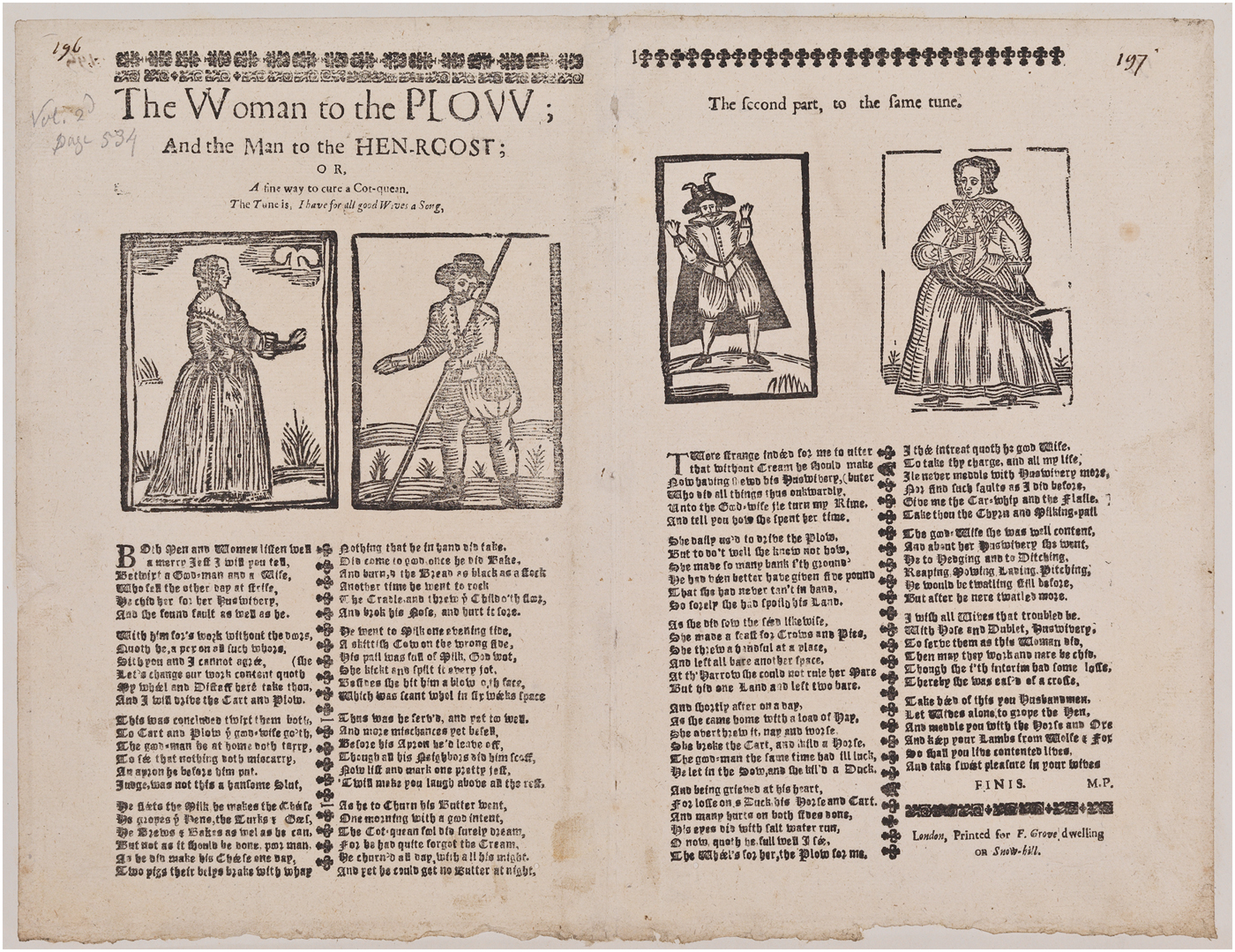
In other ways, however, this ballad – like most of the songs mentioned above – distinguishes itself from those typically highlighted by historians (and let us remember that this one was a major hit in its own time). We could not, for example, call it misogynistic or even desperately anxious, nor could we characterise it as obsessed with the notorious female vices.Footnote 37 Indeed, the wife is scarcely criticised at all and, by the end, the author's sympathies clearly lie with her (the pictures chosen to represent her are, by prior association, also more solidly positive than the male woodcuts). The sub-title implies that she must ‘cure’ her cotquean-husband, and she does so primarily by tolerating his misguided intervention until he realises his mistake. And while the husband is scorned, he does nevertheless find his way out of the thicket in which he has entangled himself. The marriage is in trouble but the problem is eventually solved; we can therefore see this as a companionate relationship in which wife and husband, working together by working apart, prove capable of managing their difficulties (of course, there is now plenty of work to suggest that the ‘separate spheres’ model deployed in the ballad bore only a passing resemblance to the daily experiences of most people).Footnote 38 The role models are eventually and essentially positive, as in most of the ballads surveyed above, and these super-successful songs display a notable preoccupation with the resolution of crisis through interpersonal reconciliation. The fact that the female role model in this particular ballad is the more positive of the two may tell us something about the core audience for the song. Although it begins, ‘Both Men and Women listen well’, there is a sense in which Parker appears to aim particularly at female consumers, allowing and encouraging them to laugh at their interfering husbands. Female and male labour are accorded equal value, and it is the wife who earns praise for quietly sorting out her foolish man. Other wives with interfering husbands are advised ‘To serve them as this Woman did’ (there is a nice ambiguity to the term ‘serve’ here). Perhaps the title of the lost tune provides another clue: ‘I have for all good wives a song’.
This suggestion deserves development. We have very little concrete evidence about gendered patterns of ballad-consumption, and all propositions must therefore be tentative, but it does seem probable that many of the ballads discussed above were aimed primarily at and consumed primarily by women. There is anecdotal literary evidence to suggest that women loved ballads, perhaps even more than men did. As early as 1584, the publisher of a collection of ballads assured potential readers, ‘Here may you have such pretie thinges,/ as women much desire’. Ballads, said John Earle a few decades later, were ‘chanted from market to market, to a vile tune and a worse throat; whilst the poor country wench melts like her butter to hear them’.Footnote 39 Women were sometimes said to have a particular taste for love-ballads. We might be tempted to dismiss this as a male slur designed to imply female frivolity, but Margaret Cavendish agreed, commenting in one letter that ballads were properly the music of spinsters and housewives in company on a winter evening. Other evidence suggests the role played by women in selling ballads.Footnote 40 Furthermore, references within our twenty-five songs seem to suggest that the ballad-makers, most of whom were male, often had female consumers firmly in mind. The songs contain forty direct appeals to either women or men, and three-quarters of these favour females: ballads are aimed at ‘dainty dames’, ‘You maidens’, ‘English women’, ‘maid and wife’ and so on. Of the eighteen titles that highlight either male or female characters, fourteen choose women and only four pick men. And ballad-makers were also far more willing than we might have imagined to flatter female characters: the ten adjectives applied most frequently to women in our twenty-five hit marriage-ballads included ‘fair’, ‘comely’, ‘sweet’, ‘bright’, ‘good’ and ‘virtuous’, and only one term – ‘wanton’ – was clearly pejorative (and thirteen of its seventeen appearances occurred in a single song).Footnote 41 This begins to look rather like a negotiation between male didacticism and female taste, with female taste more than holding its own. It calls to mind the evidence assembled by Jacqueline Pearson to show how female theatre-goers influenced the content of male-authored plays in the later seventeenth century.Footnote 42 In the case of balladry, there emerges from the negotiation a set of songs that emphasise the female side of marriage, presenting wives whose conventional femininity is either strong, spirited and admirable or wayward but deserving of sympathy. Male authors and publishers – promoters of ‘transvestite ventriloquism’, to use Elizabeth Harvey's phrase – were, of course, aiming to shape female opinion, but if they wanted to make money they also needed to let female opinion shape their products.Footnote 43 We might note, in passing, a wealth of theoretical work on ‘active audiences’ for modern pop music and other cultural forms. As consumers, we are capable of making products our own not just by purchasing them but by doing our own thing with them once they are in our hands or our heads; we can receive, re-jig or reject the messages towards which the creators may have aimed to guide us.Footnote 44
It seems certain that these ballads were successful partly because they allowed and encouraged women to take them on, take them over and breathe new life into them. All sorts of escapes into fantasy-worlds were possible through reading and singing, and all sorts of personal re-imaginings too. The woman who inhabited one of our ballads could pass comment, discreetly, on her own marriage and the marriages of others, or she could travel as far from her own daily life as possible. These possibilities fit well with recent work emphasising the influence of female singers over the content of Thomas Campion's ayres and the importance of women's musical voices more generally.Footnote 45 Judith Bennett has used late medieval song to argue that it helped women to ‘negotiate the contradictions and complexities of…patriarchy’. Katie Barclay, writing about early nineteenth-century Scotland, has shown how the ballad-repertoires of female singers differed from those of their male counterparts, partly because men and women memorised contrasting verses from the same song, resulting in versions that had distinctive and gendered emphases.Footnote 46 Throughout these centuries, women somehow found their voices through the words of men, and male composers knew that it made good sense to facilitate this process. In the estimation of Sandra Clark, ballad-writers in particular were ‘as concerned to address women's concerns as men's’.Footnote 47
Other categories of early modern ballads may have catered more to male audiences. The most clearly political of our hit ballads, for example, seem to mention women much less frequently and much less positively than the marriage-ballads.Footnote 48 We might also need to include within the ‘predominantly male’ category those ballads – highlighted by historians and mentioned at the outset – in which wives are sexually driven, power-hungry scolds and husbands are under pressure to assert their authority. There were many such ballads but, a little strangely, they hardly feature on our list. This too may imply the economic power of the female consumer, and it suggests that the time has come for historians of balladry and marriage to think less about Cuckolds Haven and more about The Constancy of SUSANNA. Just for the record, there is one extant copy of the former but sixteen of the latter.