Introduction
Dry bean (Phaseolus vulgaris L.) is the most widely consumed edible legume, covering an area of 33.06 million hectares with a production of 28.90 million tonnes per year (FAOSTAT, 2019). Asian nations share the giant dry bean-producing regions (49.7%), followed by America (24.4%) and Africa (24.4%) (FAOSTAT, 2019). It has an excellent source of protein, dietary fibre, minerals and vitamins in grains. This crop was domesticated in two different parts of the New World: Mesoamerica (mainly Mexico) and the eastern slope of the Andes in South America (Gepts and Debouck, Reference Gepts, Debouck, van Schoonhoven and Voysest1991). Mesoamerica cultivars have small seeds (25 g 100-seed weight (HSW)-1) or medium seeds (25–40 g HSW-1) and generate S and B phaseolin types, in contrast to South American cultivars, which have large seeds (>40 g HSW-1) and produce T, C, H and A phaseolin types (Gepts and Debouck, Reference Gepts, Debouck, van Schoonhoven and Voysest1991; Blair et al., Reference Blair, Díaz, Buendia and Duque2009). India has tremendous genetic diversity of dry beans in the foothills of the Himalayan region, such as Himachal Pradesh, Jammu & Kashmir, Uttarakhand and Sikkim. The seed size, shape and colour of germplasm resemble European and Chinese beans, which depict a combination of Mesoamerican and Andean cultivated gene pools (Blair et al., Reference Blair, Díaz, Buendia and Duque2009; Rana et al., Reference Rana, Sharma, Tyagi, Chahota, Gautam, Singh, Sharma and Ojha2015; Basavaraja et al., Reference Basavaraja, Lamichaney, Chaturvedi, Sewak and Singh2017).
It is commonly known as rajmash or rajma (Hindi) in India. It is grown under rainfed conditions under a conventional production system that includes a rotation with vegetables and inter-cropping of climbing beans with grain amaranth and maize during the rainy season in the mountains, while bush-type varieties are grown solely during winters in the Indian plains. The landraces grown in the high mountain regions give a pleasant aroma after cooking or boiling and fetch up to 2–3 times the higher market price of those grown on the plains. Usually, farmers grow as many as 10–12 landraces according to their preferences and taste. Still, they are highly prone to various biotic and abiotic factors affecting the establishment of the crop, which ultimately causes yield loss. As a result, traditional genetic diversity is displaced in high-cropping-intensive areas and traditional dry bean growing areas (Rana et al., Reference Rana, Singh, Sharma, Pradheep and Mendiratta2010; Sofi et al., Reference Sofi, Rana and Bhat2014). Among the many diseases affecting dry beans, bean common mosaic virus (BCMV) is India's most common and destructive disease, causing significant economic damage to susceptible bean cultivars and landraces that react with apical bud necrosis, leads to significantly affecting dry bean production (Sharma et al., Reference Sharma, Sharma, Sharma, Rajput and Sharma2015). In India, the BCMV occurrence was simultaneously reported for the first time by Yaraguntaiah and Nariani (Reference Yaraguntaiah and Nariani1963) and Nagaich and Vashisth (Reference Nagaich and Vashisth1963). Similarly, the presence of BCMV disease in Himachal Pradesh and the Kashmir valley (India) was revealed by Sharma et al. (Reference Sharma, Pathania, Kapil, Sharma, Sharma, Patial and Kapoor2008) and Hamid et al. (Reference Hamid, Ahmad, Padder, Shah, Sehar, Sofi and Mir2013). Hamid et al. (Reference Hamid, Ahmad, Padder, Shah, Sehar, Sofi and Mir2013) identified five BCMV strains (NL-1, NL-4, NL7, NL1n and NL7n) in the Kashmir valley using an international differential set of 100 samples collected during the survey. Genetic resistance is the most cost-effective and durable among the several methods available to prevent viral infection in dry bean (Drijfhout, Reference Drijfhout1978; Miklas et al., Reference Miklas, Larsen, Riley and Kelly2000). Classical work on the genetics of BCMV resistance in dry bean demonstrated the involvement of four recessive loci (bc-1, bc-2, bc-3 and bc-u) and one dominant gene, I (Drijfhout, Reference Drijfhout1978).
Similarly, the nature of resistance in resistant cultivars/donors is well understood by various researchers (Miklas et al., Reference Miklas, Kelly, Beebe and Blair2005 (USA); Mukeshimana et al., Reference Mukeshimana, Pãneda, Rodriguez, Ferreira, Giraldez and Kelly2005 (Rawand); Sharma et al., Reference Sharma, Pathania, Kapil, Sharma, Sharma, Patial and Kapoor2008). However, this crop has remained an under-explored crop in India. It has released only 20 cultivars to date, out of which they have developed 15 cultivars through germplasm selection or pure line selection and the rest through breeding efforts. Due to the lack of high-yielding varieties, farmers actively grow local cultivars and landraces susceptible to BCMV disease. Therefore, an effort was made to assess the genetic diversity of 318 dry bean collections and evaluated a set of selected diverse germplasm panels against the BCMV disease under natural epiphytotic conditions for 3 consecutive years in two various agro-ecological regions of India. The study results would enable us to identify the most efficient trait-specific landraces/germplasm accessions and stable BCMV-resistant donors for dry bean improvement.
Materials and methods
Assessment of phenotypic diversity
During the winter crop season of 2015, 318 dry bean accessions (including three checks) were investigated in an augmented experimental design at the Indian Institute of Pulses Research's experimental fields for eight agronomic traits and BCMV disease appearance. The accessions included indigenous germplasm, local landrace, high-yielding cultivars and exotic collections collected from NBPGR, New Delhi, CIAT, Cali, Colombia. The three checks, Arun, Uday and Utkarsh, were replicated in each block at random, while the landraces/accessions were allocated to plots in each block at random.
Screening of germplasm panels against BCMV disease reaction
Based on the results of the phenotypic diversity, a set of 71 agronomically superior dry bean accessions were chosen for screening against BCMV disease in a randomized block design with two replication using two resistant controls (Arun and Amber) and two susceptible controls (Uday and Jawala) over 3 consecutive years (2016–2018) in two geographically diverse locations (Kanpur and Shimla). In addition, we conducted five seasons of disease screening in two different bean growing regions to identify stable BCMV-resistant donors.
We present here the details of the experimental locations:
(a) Kanpur: It is situated in the northern plain region of India and is classified as agro-climatic zone IV (Upper India Gangetic Plain). We experimented at the Indian Institute of Pulses Research, Kanpur, Uttar Pradesh, which is located at 26°7′N latitude, 80°14′E longitude, and approximately 152.4 m above the mean sea level. Summers are hot and humid, while winters are mild and dry, with an annual rainfall of 722 mm and mean annual maximum and lowest temperatures of 33 and 20°C, respectively. During the winter of 2015–16, germplasm evaluation was performed, and we screened for the BCMV disease in the winters of 2016–17, 2017–18 and 2018–19.
(b) Shimla: It is situated in the western Himalayan region and belongs to agro-climatic zone I. The topography and temperature showed significant variation. We experimented at the regional station of the National Bureau of Plant Genetic Resources, Phagli, Shimla, in 2017 and 2018. The crop was sown in June each year and harvested in October–November. The experimental farm is located at 31°05′53.89″N and 77°09′34.92″E and has an elevation of 1920 m above sea level. The soil of the experimental site is of sandy loam texture having skeletal particle size, dry nature, shallow with soil depth ranging from 25 to 50 cm, and is moderately rich in organic matter. The annual rainfall for 2017 and 2018 was 1290 and 1660 mm, respectively. More than 70% of annual rainfall is received from June to September. BCMV screening occurred during the rainy season of 2017 and 2018. The mean maximum and minimum temperatures over the 2 years ranged from 26.5 to 2.8 °C. We followed standard cultivation and screening techniques for growing common beans in the hilly region. In both the investigations, 10 d after sowing, seedlings were thinned-out to maintain a plant to plant spacing of 15 cm, and a row to row spacing of 45 cm was maintained. The recommended dose of fertilizer, i.e. 100, 60, 20 kg of NPK, was given. A full dose of P, K and 30 kg N was given as basal during field preparation, and the remaining N was given during flowering. Each genotype consisted of 35–40 plants per plot.
Data collection
We recorded phenotypic data on eight agronomic traits, including days to 50% flowering, days to maturity, HSW and seed yield per ha. In addition, plant height, pods per plant, pod length and other parameters were measured on five randomly selected plants in each plot (Upadhyaya et al., Reference Upadhyaya, Reddy, Gowda and Singh2007; Manyasa et al., Reference Manyasa, Silim, Githiri and Christiansen2008). We examined germplasm for the appearance of the first typical symptoms of BCMV disease on the susceptible checks. The disease severity in terms of the total number of healthy plants and the number of infected plants was counted in each accession and scored at 55 and 95 d after sowing using the 1–6 disease scale developed by Sharma et al. (Reference Sharma, Rana, Sharma, Rathour and Sharma2006). The disease scores averaged for two replications were used for statistical analysis. Using the BCMV disease scale, the per cent disease incidence (PDI) was calculated as the ratio of the total number of infected plants per plot to the total number of healthy plants per plot, expressed as a percentage. The genotypes were then put into five severity grades, from 1 to 5, as follows: 1 – highly resistant (5%), 2 – resistant (6–10%), 3 – moderately susceptible (11–20%), 4 – susceptible (21–30%) and 5 – highly susceptible (>30%).
Statistical analyses
We used mean phenotypic data to estimate fundamental statistical parameters such as range, mean, standard error (SE) and coefficient of variation, as well as phenotypic, genotypic and environmental variance (2P, 2G and 2E) (Aravind et al., Reference Aravind, Mukesh Sankar, Wankhede and Kaur2021). Likewise, Federer (Reference Federer1956); Federer and Searle's (Reference Federer and Searle1976) expected mean square value was computed using analysis of variance (ANOVA). Burton and Devane's (Reference Burton and Devane1953) statistical method was used to estimate the genotypic and phenotypic variance components and the coefficient of phenotypic and genotypic variability. Also, broad-sense heritability (H2), expected genetic advance (GA) and expected genetic advance as a per cent of the mean (GAM) were estimated. To assess the relationship among the eight agronomic traits of 318 dry bean accessions, we estimated Pearson's correlation coefficients and principal components (PCs) to determine patterns of variation and the genetic relationship between accessions in the collection. Hence, the R software version 4.0.0 package was used to estimate genetic variability components. Furthermore, the D2.dist and tocherclut function was used to calculate the squared generalized Mahalanobis distance and hierarchical cluster analysis on dissimilarities among germplasm accessions (Mahalanobis, Reference Mahalanobis1936). As a result, in the BCMV disease screening study, the PDI of BCMV disease is estimated for each germplasm accession based on data obtained from each season at two locations. The final mean of PDI is calculated based on the average PDI mean of five seasons and across the location.
Results
Genetic variability components for agronomic traits
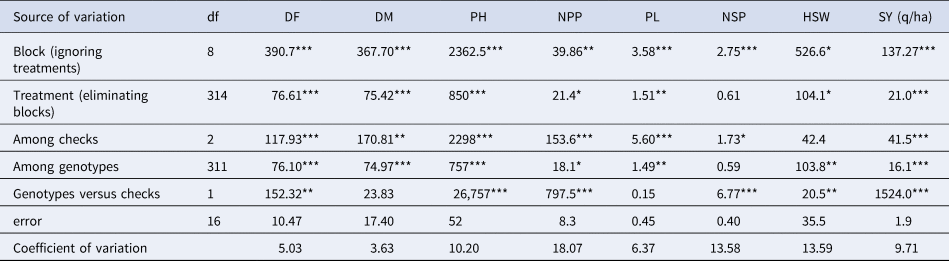
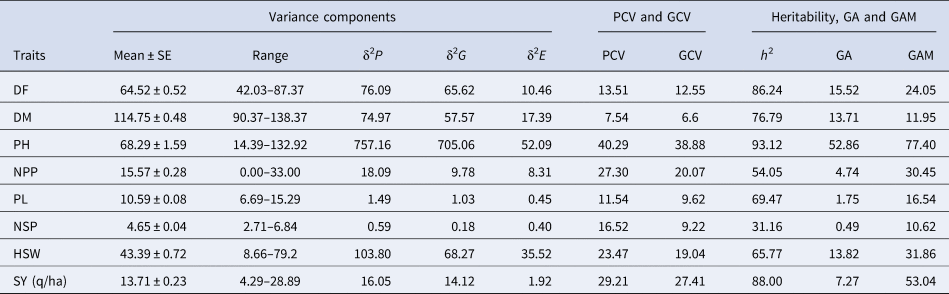
The results revealed that ANOVA found substantial differences in the yield attributes investigated among the accessions (Table 1). Likewise, Table 2 displays the basic statistical parameters, phenotypic, genotypic and environmental variances, and their coefficients of variation, heritability and expected genetic progress. Days to 50% flowering recorded a general mean value of 64.52 d ranging from 45.0 d (IC356020) to 86.0 d (IC355993). Twenty accessions were identified as early flowering types (50 d), 193 as medium types (51–75 d) and 105 as late (>75 d) out of 318 accessions studied. Similarly, days to maturity recorded an average mean value of 114.75 d ranging from 90.37 d (IC393265) to 138.37 d (EC 861791). One accession (EC861816) was found to be early (90 d), 249 accessions were medium (101–120 d) and 68 accessions were late (>130 d). Similarly, the plant height varied from 14.39 (EC931272) to 132.92 cm (IC340946), with a mean value of 68.29. The mean value for the number of pods per plant was 15.57, ranging from 4.8 (EC931110) to 35 (EC931272). Hence, concerning the pod length, the longest pod was observed in three accessions, IC340924, EC400407 and IC356064 (13.9 cm), while the shortest one was in IC341395 (6.6 cm), with an average pod length value among the accession was 10.59 cm. Correspondingly, the average seeds per pod value were 4.65, and the highest of seven seeds per pod was observed in IC340910, and a minimum of three seeds per pod was observed in accessions IC356008, IC3911356 and IC419787, respectively. The HSW ranged from 11.2 g (EC931132, EC931110, EC931152 and IC261277) to 72.1 g (IC340923 and EC931388). It was categorized into four classes of germplasm accessions the extra small seed size group (15 g, five accessions), small seed size group (16–20 g, five accessions), medium seed size group (21–30 g, 23 accessions), large seed size group (31–40 g, 99 accessions) and extra-large seed size group (>40 g, 186 accessions). Grain yield (q/ha) ranged from 5.4 q/ha (GPL420) to 28.6 q/ha (EC931417), with a general mean of 13.71 q/ha.
ANOVA for augmented randomized complete block design for eight agronomic traits in 318 dry bean accessions

DF, days to 50% flowering; DM, days to maturity; HSW, 100-seed weight (g); PH, plant height (cm); PL, pod length (cm); NPP, no. of pods/plant; NSP, no. of seeds/pod; SY, seed yield (q/ha).
Estimates of simple variance and components of genetic variability in 318 dry bean collections

δ2E, environmental variance; δ2G, genotypic variance; δ2P, phenotypic variance; GCV, genotypic coefficient of variation; PCV, phenotypic coefficient of variation; SE, standard error.
The mean values of eight agronomic traits were utilized to assess variance and estimate the components of genetic variability, as shown in Table 2. Out of eight traits, plant height (757.16) had the highest phenotypic variance, followed by HSW (g) (103.80), days to 50% flowering (76.90), days to maturity (74.97), pods per/plant (18.09), seed yield (q/ha) (16.05), pod length (1.49) and seeds per/pod (0.59). Furthermore, we observed the highest genotypic variance for plant height (705.06) followed by HSW (g) (68.27), days to 50% flowering (65.62), days to maturity (57.57), seed yield (q/ha) (14.12), pods per plant (9.78), pod length (1.03) and seeds/pod (0.18). In the same way, the highest environment variance was observed for plant height (52.09), followed by HSW (g) (68.27), days to maturity (17.39), days to 50% flowering (10.46), pods per plant (8.31), seed yield (q/ha) (1.92), pod length (0.45) and seeds/pod (0.40). It was observed that high phenotypic coefficient of variation (PCV) coupled with high genotypic coefficient of variation (GCV) was recorded for plant height (40.29 and 38.88 respectively), pods per plant (27.30 and 20.07 respectively) and seed yield (q/ha) (29.21 and 27.41 respectively). Similarly medium PCV and GCV observed for days to 50% flowering (13.51 and 12.55, respectively), medium PCV coupled with low GCV for pod length (11.54 and 9.62 respectively) and seeds per pod (16.52 and 9.22 respectively), high PCV combined with medium GCV (23.47 and 19.04 respectively) for HSW (g) and low PCV linked with low GCV (7.54 and 6.6 respectively) for days to maturity. Indistinctly, the high heritability accompanied high GAM recorded for plant height (93.12 and 77.40, respectively) followed by days to 50% flowering (86.24 and 24.05, respectively), seed yield (q/ha) (88.00 and 53.04, respectively) and HSW (65.77 and 31.86, respectively).
Association studies among agronomic traits
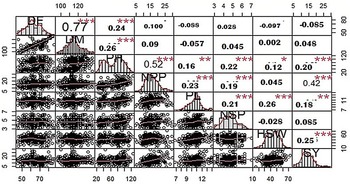
The Pearson's correlation coefficient between seed yield and its attributing traits was determined, as shown in Fig. 1. The results revealed a strong and significant positive association between days to 50% flowering and days to maturity (r = 0.770), followed by plant height and pods per plant. They noticed a highly significant positive correlation (r = 0.520). Similarly, the yield parameter between pods per plant and seed yield/ha showed a significant positive association (r = 0.420) among the eight traits studied. Other yield attributing traits such as HSW (r = 0.250), plant height (r = 0.200) and pod length (r = 0.180) exhibit significant positive associations with seed yield/ha.
Estimation of correlation coefficients of yield and yield attributing traits among 318 dry bean accessions.

Cluster analysis and principal component analysis (PCA)
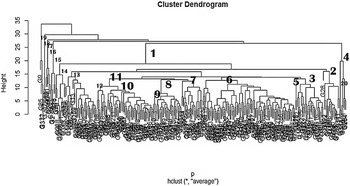
Hierarchical clustering analysis described the existing variability in the dry bean collection resemblances and differences between individuals based on the eight agronomic traits. The clustering pattern indicated a significant variability among the dry bean collection. All the accessions were grouped into 20 clusters, and each cluster had a varied number of accessions (Fig. 2 and online Supplementary Table S1). For example, cluster I consists of a maximum number of germplasm accessions (253 accessions), followed by cluster II (eight accessions). The mean values of agronomic traits about all the clusters showed that cluster I included accessions with high grain yield/ha, days to 50% flowering, HSW, pod length and pod/plant.
Dendrogram depicting the genetic relationship among 318 dry bean accessions.

The PCA-based correlation was used to study interrelationships among the different traits. The first four PCs provided an excellent data summary, with a 75.30% variance in dry bean germplasms (online Supplementary Table S2). The first two PCs (PC1 and PC2) accounted for 27.5 and 22.5% of the variation, respectively (online Supplementary Fig. S1), and the PCA scree plot shows the per cent contribution of variance by each variable. The genotype-trait biplot based on two PCs was also generated to depict the two-dimensional view of accession scores. A large proportion of the accessions were distributed across the plot despite their origin being unknown, and each of the eight quantitative characteristics exhibited a substantial positive correlation with PC1.
Identified trait-specific germplasm
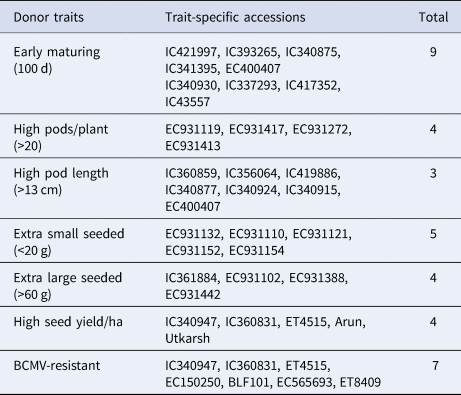
The extensive phenotyping was performed on 318 different dry bean germplasm accessions to evaluate their responses to BCMV disease and eight different agronomic features (Table 3). Among agronomic traits, days to maturity varied from 90 to 138 d after sowing, with a mean value of 114 d. The nine accessions with early maturity (100 d) were IC421997, IC393265, IC340875, IC341395, EC400407, IC340930, IC337293, IC417352 and IC43557. The pods per plant ranged from 4 to 35 with a mean of 15, and EC931119, EC931417, EC931272 and EC931413 had more than 20 pods per plant. Pod length varied from 6 to 14 cm, with an average being 11 cm and the unique accession with a larger pod length of more than 13 cm was IC360859, IC356064, IC419886, IC340877, IC340924, IC340915 and EC400407. Likewise, HSW ranged from 11 to 72 g with an average of 43 g. The promising extra small-seeded accessions with less than 20 g/HSW were EC931132, EC931110, EC931121, EC931152 and EC931154. In addition, extra-large-seeded bean accessions with more than 60 g were IC361884, EC931102, EC931388 and EC931442. Similarly, high seed yields ranging from 5.4 to 28.6 (q/ha) with an average yield of 13 (q/ha) and the higher seed yield/ha were recorded in IC340947, IC360831, ET4515, Arun and Utkarsh. Besides this, 71 accessions were found highly superior over check varieties in terms of BCMV disease resistance and other desired agronomic traits. These selected 71 accessions were subjected to BCMV screening to confirm stable BCMV resistance in two different bean production environments.
Trait-specific accessions identified in dry bean collections

Multi-location screening of dry bean accessions for BCMV resistance
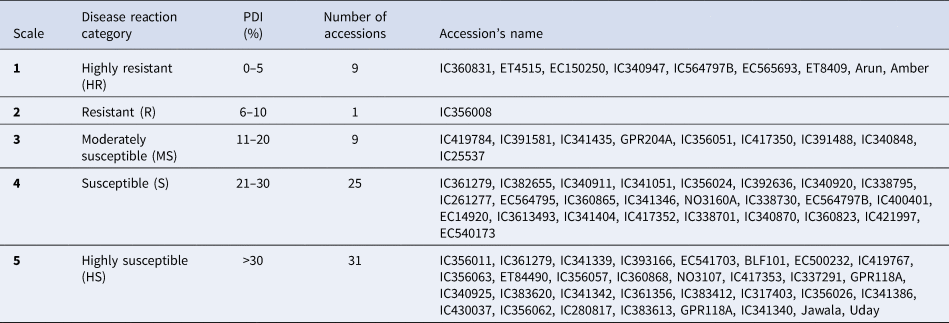
The results exhibited that the PDI and seed yield/ha at both locations varied across the seasons. During winter seasons of 2016, 2017 and 2018 in plains, the PDI ranged from 0.0 to 100, 0.0 to 92.5 and 0.0 to 69.2%, respectively with a mean PDI of 33.8, 26.0 and 24.1%, respectively. Similarly, during rainy seasons of 2017 and 2018 in hills, the PDI ranged from 0.0 to 100 and 0.0 to 87.0%, respectively with a mean PDI of 39.3 and 18.8%, respectively (online Supplementary Table S3). The susceptible check varieties Jawala and Uday recorded 54.3 and 57.8% mean PDI and mean yield of 1176 kg/ha and 1192 kg/ha, respectively, across the season and location. Similarly, the resistant checks varieties, Arun and Amber recorded 0.20 and 0.0% mean PDI value and mean yield of 2123 and 2183 kg/ha, respectively, over the season and location. Through extensive disease screening over five consecutive seasons (during winter and rainy seasons) under natural field conditions, dry bean germplasms were categorized based on the average PDI of two locations (Table 4). Out of 71 accessions screened, seven bean accessions were (IC360831, ET4515, EC150250, IC340947, IC564797B, EC565693 and ET8409) found to be highly resistant to BCMV in comparison with both the susceptible and resistant cultivars. One accession named IC356008 is categorized as a resistant group. Likewise, another nine accessions IC419784, IC391581, IC341435, GPR204A, IC356051, IC417350, IC391488, IC340848 and IC25537 were classified as a moderately susceptible group. Furthermore, there were 25 accessions categorized as a susceptible group. Similarly, 31 accessions of bean germplasm classified as a highly susceptible group based on the mean PDI value across the season and location. We concluded that IC360831 and IC340947 were superior to check varieties in terms of agronomic features and resistance to disease among the seven resistant germplasm accessions.
Distribution of dry bean accessions in various BCMV disease reaction categories

Discussion
Genetic diversity is a primary step for crop improvement in any crop species. Therefore, we found a vast diversity in the phenotypic traits evaluated among the accessions in the present study. We studied eight agronomic traits in a sample of dry bean accessions and found significant phenotypic diversity in all characteristics. Therefore, these accessions may provide a valuable source of diversity for dry bean crop improvement. Variation among the bean accessions for many traits is similar to the variability reported by Santalla et al. (Reference Santalla, Rodiño and De Ron2002), Kwak and Gepts (Reference Kwak and Gepts2009) and Caproni et al. (Reference Caproni, Raggi, Ceccarelli, Negri and Carboni2019). Mean performance observed in pods per plant, seeds per pod and HSW was higher than that reported earlier in the Spanish collection (Rodiño et al., Reference Rodiño, Monteagudo, De Ron and Santalla2009) and 604 accessions from the CIAT core germplasm collection (Blair et al., Reference Blair, Díaz, Buendia and Duque2009). Plant height, HSW and days to 50% flowering all had higher genotypic and phenotypic variances, resulting in higher environmental variances. As a result, the heritability of these traits is primarily determined by environmental influences on their expression and selection. Accordingly, the estimates of PCV were higher than those of GCV for all characters, suggesting that the most significant variability observed in quantitative traits was partly due to environmental factors. This tendency was general in phenotypic diversity studies and has been well reported in dry beans (Zeven, Reference Zeven1997; Beebe et al., Reference Beebe, Rengifo, Gaita'n-Solı's, Duque and Tohme2001; Rodiño et al., Reference Rodiño, Monteagudo, De Ron and Santalla2009; Rodriguez et al., Reference Rodriguez, Rau, Bitocchi, Bellucci, Biagetti, Carboni, Gepts, Nanni and Papa2016). The magnitude between these two genetic parameters was low for the character days to maturity and moderate for days to 50% flowering, the number of seeds per pod and pod length. Environmental effects influenced slightly these characters. Low to moderate coefficients of variation of phenotype and genotype for all the traits except for plant height, number of pods per plant and HSW parameters encourage the use of yield parameters in selecting suitable parents for crosses or lines for further improvement. These results augment the analysis done by Beebe et al. (Reference Beebe, Rengifo, Gaita'n-Solı's, Duque and Tohme2001); Kwak and Gepts (Reference Kwak and Gepts2009) and Rana et al. (Reference Rana, Sharma, Tyagi, Chahota, Gautam, Singh, Sharma and Ojha2015). Heritability is the percentage of phenotypic variance that is attributed to genetic variance. Heritability was high (greater than 80%) for all traits studied in the present study. High heritability indicates that the environmental influence is minimal on characters. The highest heritability coupled with high GAM was for plant height, followed by days to 50% flowering, seed yield (q/ha) and HSW. Similar findings have also reported high heritability for different yield-controlling traits in dry bean (Raggi et al., Reference Raggi, Tiranti and Negri2013; Sofi et al., Reference Sofi, Rana and Bhat2014; Basavaraja et al., Reference Basavaraja, Pratap, Dubey, Gurumurthy, Gupta, Singh, Gosal and Wani2020). The comparatively lower heritability was for seeds per pod and pods/plant.
A thorough understanding of the relationships between various characteristics is crucial for any crop (Mazid et al., Reference Mazid, Rafii, Hanafi, Rahim, Shabanimofrad and Latif2013). Two significant correlations were recorded among the 318 dry bean accessions studied. The first influential group of correlations between seed yield and its component number of pods per plant showed a significant positive association among the eight traits. The yield attributes such as HSW, plant height and pod length significantly correlate with seed yield/ha. Our results agree with the findings of Kumar et al. (Reference Kumar, Sharma, Sharma, Kumar, Sharma, Malik, Singh, Sanger and Bhat2014) and Basavaraja et al. (Reference Basavaraja, Pratap, Dubey, Gurumurthy, Gupta, Singh, Gosal and Wani2020). This study enables plant breeders to select accessions that possess desirable traits related to seed yield. Since seed yield per ha positively correlated with plant height, number of pods per plant, pod length and HSW, selection for these traits could be considered the criteria for higher seed yield, as they were mutually and directly associated. Second, highly significant and positive correlations were observed between the vegetative characters, such as between days to 50% flowering and days to maturity, plant height and pods/plant noticed the highly significant positive correlation.
The phenotypic diversity of dry bean was highly explored in the hilly tract of the Himalayan region in the northwest part of India known as ‘Chamba Rajmah’, ‘Barot’, ‘Kinnauree’, ‘Auli’, ‘Munsiyari’, ‘Harshil’, ‘Bhaderwah’ and ‘Kashmiri’. These landraces have been named based on the geographical region in which they are grown (Rana et al., Reference Rana, Sharma, Tyagi, Chahota, Gautam, Singh, Sharma and Ojha2015). However, the purpose of this study was to assess the genetic diversity present in CIAT and indigenous collections. The information obtained through clustering also enhances efficiency in identifying unique traits, novel genes, disease-resistant donors, polymorphic markers, the marker-trait association for genetic improvement, etc. The clustering did not show any relationship of accessions with their geographical origin. As clustering was carried out based on the phenotypic traits, morphologically distinct genotypes from the same source must have clustered in different groups. The results obtained are similar to Sharma et al. (Reference Sharma, Rana, Sharma, Rathour and Sharma2006), Rana et al. (Reference Rana, Sharma, Tyagi, Chahota, Gautam, Singh, Sharma and Ojha2015) and Basavaraja et al. (Reference Basavaraja, Pratap, Dubey, Gurumurthy, Gupta, Singh, Gosal and Wani2020). About 60% of dry bean accessions used in the study belong to Indian origin; the clustering pattern suggests that the gene flow between distant regions occurs. Variation in the dry bean genome may be mainly attributed to environmental conditions, disease and insect pest pressure, rather than geographical distance. The resemblance in the genetic and geographical relationship was observed earlier among dry bean collections (Sicard et al., Reference Sicard, Nanni, Porfiri, Bulfon and Papa2005; Blair et al., Reference Blair, Soler and Cortés2012; Basavaraja et al., Reference Basavaraja, Pratap, Dubey, Gurumurthy, Gupta, Singh, Gosal and Wani2020). A PCA was performed to visualize the relationship among dry bean accessions based on agronomic traits. The cumulative variance of 63.47% by the first three axes indicates the identified traits within the axes exhibited significant influence on the phenotype of the accessions and could effectively be used for selection. This result was inconsistent with the findings of Raggi et al. (Reference Raggi, Tiranti and Negri2013) and Rodriguez et al. (Reference Rodriguez, Rau, Bitocchi, Bellucci, Biagetti, Carboni, Gepts, Nanni and Papa2016), which suggest that the first three components (PC1, PC2 and PC3) and associated traits were the most reliable in explaining distinct patterns among different genotypes. Plotting PC1 against PC2 resulted in different clustering accessions. The results of the genotype by trait biplot explained that 50% of the total variation is a good approximation of the total variation of the standardized data and agree with the results reported by Blair et al. (Reference Blair, Díaz, Buendia and Duque2009); Kwak and Gepts (Reference Kwak and Gepts2009); Caproni et al. (Reference Caproni, Raggi, Ceccarelli, Negri and Carboni2019) and Basavaraja et al. (Reference Basavaraja, Manjunatha, Chandora, Gurumurthy and Singh2021). Based on PC1 and PC2 number of pods per plant, plant height, days to maturity, days to 50% flowering and seed yield per ha had relatively long vectors, suggesting a rather considerable variation among genotypes.
For decades, BCMV disease emerged as a major constraint in the bean production region of India. Control measures such as chemical and cultural methods may not adequately deal with the BCMV disease damage. Therefore, it is critical to consider that host plant resistance is one of the most effective and sustainable measures to limit the damage of BCMV disease. A bean germplasm screening study revealed the presence of adequate sources of resistance against bean common mosaic potyvirus strains prevalent in Himachal Pradesh (Kapil et al., Reference Kapil, Sharma, Sharma, Sharma and Padder2005; Sharma et al., Reference Sharma, Pathania, Kapil, Sharma, Sharma, Patial and Kapoor2008; Hamid et al., Reference Hamid, Ahmad, Padder, Shah, Sehar, Sofi and Mir2013). Few attempts have been made in the past to address this issue. More study is still needed to understand the response of indigenous collection and exotic germplasm collection against BCMV disease reaction. Therefore, evaluating the untapped gene pool of dry bean is necessary to find out the new sources of tolerance/resistance for major diseases. This study observed the differential response of bean germplasm with varying degrees of susceptibility to BCMV. The reaction differed among the accessions at two locations based on the incidence and severity of the symptoms under natural disease pressure. The results suggest that the resistance or tolerance can also be influenced by several other factors, such as the presence or absence of possible virulent strains of the viruses, climatic conditions and inoculums pressure in both the production environments. All of these factors can have a significant influence on the measure of the disease in an individual plant (severity) as well as in population (incidence) (Sharma et al., Reference Sharma, Pathania, Kapil, Sharma, Sharma, Patial and Kapoor2008; Kapil et al., Reference Kapil, Sharma, Sharma, Sharma, Dhar and Sharma2011; Manjunatha et al., Reference Manjunatha, Basavaraja, Manjunatha, Srinivasa, Kumar, Chandora, Singh and Singh2021). From the five consecutive seasons of disease screening, seven bean accessions, IC360831, ET4515, EC150250, IC340947, IC564797B, EC565693 and ET8409 were found stably resistant to BCMV disease. This study agrees with Melotto et al. (Reference Melotto, Afanador and Kelly1996); Kelly (Reference Kelly1997); Sharma et al., Reference Sharma, Pathania, Kapil, Sharma, Sharma, Patial and Kapoor2008; Sharma et al., Reference Sharma, Sharma, Sharma, Rajput and Sharma2015 and Manjunatha et al. (Reference Manjunatha, Basavaraja, Manjunatha, Srinivasa, Kumar, Chandora, Singh and Singh2021), where several potentially different sources of disease resistance were identified. However, a great deal of work is still to be done in this area that could serve as valuable genetic resources for future disease resistance breeding programmes.
Trait-specific accessions were valuable genetic resources to enhance utilization by the plant breeders to refine the genetic resource management strategy. Note that nine early maturing accessions which mature within 90–110 d after sowing could play an essential role in sustaining dry bean production. Short-duration varieties can improve dry bean cultivation in the northern plain; it is grown as the sole crop of bush types during winters. Identifying unique germplasm for specific traits like BCMV disease tolerance and resistance, early maturity, high pods/plant, high pod length, extra small-seeded, extra large-seeded and increased seed yield/ha plant could help find potential donors for the dry bean crop improvement programme.
The results of the present study revealed that among the evaluated dry bean accessions, there are seven potential and stable BCMV-resistant donors (IC360831, ET4515, EC150250, IC340947, IC564797B, EC565693 and ET8409) we identified, which may be valuable for dry bean crop improvement. This study would be helpful for breeders and pathologists in selecting germplasm with desirable traits of breeding importance, such as maturity, pod characteristics, disease resistance and grain yield.
Supplementary material
The supplementary material for this article can be found at https://doi.org/10.1017/S1479262122000144.
Acknowledgements
We sincerely thank the Director, ICAR-NBPGR, New Delhi, India, for providing dry bean accessions and field facility at ICAR-NBPGR, regional station, Shimla (Himachal Pradesh), for carrying out the offseason (rainy) field experiments.