

Introduction
‘First, do no harm’ is part of the ancient Hippocratic oath taken by physicians, nowadays incorporated into the definition of clinical supervision. For example, Bernard and Goodyear (Reference Bernard and Goodyear2019) stated that supervision should foster the supervisee’s professional development and ensure client welfare. They added that ensuring client welfare was the original purpose of supervision, an ethical and clinical obligation dating from the first formal use of clinical supervision in the 19th century. Doing no harm to clients, whilst promoting their welfare, remains the priority in current definitions of supervision, echoed faithfully across nations and disciplines (e.g. American Psychological Association, 2015; Watkins and Wang, Reference Watkins, Wang, Watkins and Milne2014).
The aims of this theoretical review are to advance our understanding of the harm that is related to supervision, and to suggest related ways to improve cognitive behavioural therapy supervision, so as to prevent harm (CBT supervision, hereafter ‘supervision’). The objectives are to broaden current conceptualizations of harm by mapping out ten types of problem behaviour that commonly contribute to harm. These start with the harm that supervisors can cause to supervisees, but extend the analysis systemically to indicate multiple sources of harm within healthcare organizations. A preliminary ‘infidelity framework’ is sketched out in order to classify these problem behaviours, drawing on related frameworks and neighbouring literature. Secondly, this review will offer a generic functional analysis, by describing the typical antecedents and consequences of each of these ten behaviours. A third objective is to suggest how CBT supervision might prevent or rectify these examples of harm. Finally, ways to take forward this framework are identified, with a view to improving supervision and the associated clinical outcomes. Therefore, this review has the same goals as the Roth and Pilling (Reference Roth and Pilling2007) supervision framework, but takes the perspective of harm rather than competence.
Definitions of welfare and harm
For present purposes, client welfare can be defined in terms of the customary outcomes sought through CBT, such as reduced anxiety symptoms or increased quality of life. Client harm is taken to include lasting psychological damage that is due to therapy, where the therapy has been incorrectly selected or applied, or where unethical events occur. Such harm is understood to arise from human errors of omission and commission, commonly taking the form of incompetence (e.g. deviations from appropriate CBT or supervisory practice), unethical behaviour (e.g. boundary violations) and poor health, alongside other types of unprofessional conduct (e.g. causing deliberate damage). In turn, harm that is related to supervision is defined as the enduring psychological and/or physical damage directly arising from supervision as it affects supervisees and their clients (e.g. psychological distress that interferes significantly with functional ability or quality of life). The present definition excludes the transient and/or minor personal discomfort or distress that may accompany appropriate psychological interventions (e.g. supervisees’ anxiety concerning evaluative feedback). So far, this definition builds on those provided within supervision research (e.g. Ellis et al., Reference Ellis, Berger, Hanus, Ayala, Swords and Siembor2014; Ladany, Reference Ladany2014), with definitions of harm in the therapy literature (e.g. Curran et al., Reference Curran, Parry, Hardy, Darling, Mason and Chambers2019; Klatte et al., Reference Klatte, Strauss, Flückiger and Rosendahl2018; Schermuly-Haupt et al., Reference Schermuly-Haupt, Linden and Rush2018), and on those within the ‘client safety’ literature (e.g. World Health Organization, 2009).
As these examples indicate, harm related to supervision may arise deliberately or unintentionally. Perhaps the most common example of unintended harm is when well-intentioned supervisors lack the necessary socialization or training for the role. As a result, they may conduct supervision incompetently, but believe themselves to be competent, precisely because they lack proficiency (i.e. they do not know what they do not know: Kruger and Dunning, Reference Kruger and Dunning2009). This phenomenon has been observed repeatedly during the baseline phases of a series of intensive n = 1 analyses of supervision, even with experienced supervisors as the participants (e.g. Milne et al., Reference Milne, Reiser and Cliffe2013). Only with systematic training have these supervisors become skilled and aware of their competencies, with corrective feedback proving essential.
In the present review, the above definition of harm is extended from the individual level to include the wider healthcare context. At this more systemic level, the present definition includes the various staff as well their workplace environments, and adds the assumption that complex, bi-directional causal pathways may operate (e.g. harmful systems may damage supervisors or supervisees, who may then damage their clients). System errors usually entail faults, breakdowns or dysfunctions within a healthcare organization’s operational methods, processes or infrastructure. Finally, at the more distal level, harm to the system or by the system can adversely affect individuals and groups within the healthcare context (e.g. loss of morale or peer support), and generalize to the wider organizational system (e.g. having legal, social or economic consequences, such as harmful litigation related to a supervisor’s malpractice). This systemic dimension incorporates useful examples from the organizational literature (e.g. Chang et al., Reference Chang, Schyve, Croteau, O’Leary and Loeb2005; World Health Organization, 2009). In summary, this systemic definition is novel in relation to supervision, and is intended to afford a necessarily ‘large canvass’ perspective on harm, capturing the multi-dimensional nature of harm with respect to clients, therapists (supervisees) and supervisors, as understood within their organizational context. This breadth and complexity is required to develop a suitably complete and generic formulation of harm, one that is consistent with current CBT formulations of supervision within naturalistic environments (Newman et al., Reference Newman, Reiser and Milne2016).
Evidence of welfare and harm
The professional development of the supervisee is one of a range of positive outcomes associated with supervision (Bambling, Reference Bambling2014; Wheeler and Richards, Reference Wheeler and Richards2007). Evidence linking supervision with client welfare has proved more elusive (Ellis and Ladany, Reference Ellis, Ladany and Watkins1997; Inman et al., Reference Inman, Hutman, Pendse, Devdas, Luu, Ellis, Watkins and Milne2014), but there is some evidence that supervision appears to outperform no supervision, with no indications of client harm within a sample of 12 relevant studies (Reiser and Milne, Reference Reiser and Milne2014). As this sample illustrates, harm to any party is rarely included as a specific focus within the general outcome evaluations of supervision (Ellis, Reference Ellis2017), but nonetheless there are occasional reports of harm. For example, a systematic review that included 15 studies evaluating supervision (including CBT supervision) noted that two of these studies reported negative effects, two others noted ‘unwanted’ effects, while a further three studies reported supervision-related stress or anxiety in some supervisees (Kuhne et al., Reference Kuhne, Maas, Wiesenthal and Weck2019). Unfortunately, these studies did not describe or quantify these adverse outcomes. By contrast, research that takes harm as a specific focus indicates frequent harm to clients, linked to harm to supervisees (i.e. the therapists). For instance, Ellis et al. (Reference Ellis, Berger, Hanus, Ayala, Swords and Siembor2014) summarized a survey of 363 multi-disciplinary supervisees in which 35% of these supervisees reported that they were currently receiving harmful supervision. Furthermore, 33% of these supervisees judged that their inadequate supervision was also harmful to their clients. For their part, supervisors are often exposed to chronically high levels of stress at work, which can compromise their well-being and their supervision (e.g. Griffiths et al., Reference Griffiths, Harper, Desrosiers, Murphy and Royse2019). However, it should be noted that both these studies were based on subjective judgements, with no objective measures of any of these variables provided.
This worryingly high level of reported harm to supervisees and their clients is echoed in neighbouring clinical fields, such as in studies of clinician ‘burnout’. Burnout consists of emotional exhaustion, depersonalization (cynicism) and ineffectiveness at work (reduced ‘accomplishment’: Maslach et al., Reference Maslach, Schaufeli and Leiter2001). Although the term ‘burnout’ is absent from the descriptors of harm in the survey by Ellis et al. (Reference Ellis, Berger, Hanus, Ayala, Swords and Siembor2014), it is consistent with the effects of harm that they describe (e.g. functional failings, loss of self-confidence), as well as with the accounts of harm provided by supervisees (e.g. depressed, withdrawn; Ellis et al., Reference Ellis, Corp, Taylor and Kangos2017). Burnout is associated with multiple adverse consequences. Physicians experiencing burnout are twice as likely to compromise client safety, and to deliver a lower quality of client care (Panagioti et al., Reference Panagioti, Geraghty, Johnson, Zhou, Panagopoulou, Chew-Graham and Esmail2018). Reviews of research have provided evidence that clinician burnout may jeopardize client care (Bourne et al., Reference Bourne, Shah, Falconieri, Timmerman, Lees, Wright, Lumsden, Regan and Calster2019; Panagioti et al., Reference Panagioti, Geraghty, Johnson, Zhou, Panagopoulou, Chew-Graham and Esmail2018). The assumption that clinician burnout contributes to the harm done to clients is also accepted within healthcare policy (e.g. National Health Service, 2019).
In addition to the harm caused to clients, a calamitous generalization of adverse consequences can ensue, including increased sickness/absence amongst staff, low staff morale, lost organizational productivity, and a low quality of care (entailing errors and accidents: Panagioti et al., Reference Panagioti, Geraghty, Johnson, Zhou, Panagopoulou, Chew-Graham and Esmail2018). In turn, the cascade of costs for society of these successive adverse consequences within healthcare is considerable, such as high staff turnover and expensive litigation (Naczenski et al., Reference Naczenski, de Vries, Madelon, van Hooff and Kompier2017; National Health Service, 2019). Furthermore, the families of therapists may also suffer the effects of burnout (Thoits, Reference Thoits2010). To contextualize and corroborate these estimates of harm, harm is sadly very common in healthcare, so much so that it has been described as ‘normal’ (Jha et al., Reference Jha, Larizgoitia, Audera-Lopez, Prasopa-Plaizier, Waters and Bates2013). The unfortunate implication is that errors and harm are to be expected in healthcare, including supervision, and carry significant adverse consequences. It follows that harm related to supervision merits improved understanding and informed corrective action (Ellis, Reference Ellis2001; Tepper, Reference Tepper2000). This is particularly true of supervisees, who are especially vulnerable to abuse as a result of their relative powerlessness, which may be compounded by diversity issues (Hawkins and McMahon, Reference Hawkins and McMahon2020).
In this context, the present theoretical review draws on a wide range of theoretical and empirical literature in order to develop a generic functional analysis of how harmful behaviours are potentially related to supervision. This formulation will also summarize the most common types of antecedents and adverse consequences, which will be organized systematically through a preliminary ‘infidelity framework’. It incorporates the prior consideration of the harm reportedly done to supervisees by their supervisors (e.g. Ellis, Reference Ellis2001), extending the analysis of harm to the wider healthcare system, and integrating the taxonomy with the better-established literature on client safety (e.g. Chang et al., Reference Chang, Schyve, Croteau, O’Leary and Loeb2005; Chatburn et al., Reference Chatburn, Macrae, Carthey and Vincent2018; Vincent et al., Reference Vincent, Burnett and Carthey2014). After setting out the theoretical basis and practical implications of this infidelity framework, examples are provided on how supervision might prevent or ameliorate such harm.
Formulating harm: a preliminary conceptual framework
Classification schemes such as the infidelity framework are a characteristic of science, playing a valuable role in developing consistent and clear terminology, and bringing order to otherwise confusing phenomena through categorization based on shared characteristics (e.g. the identification, recording and analysis of things that can go wrong in health care: Chang et al., Reference Chang, Schyve, Croteau, O’Leary and Loeb2005). As highlighted by Ellis (Reference Ellis2001) and by Tepper (Reference Tepper2000), such a scheme is sorely needed in order to classify problematic supervision, advancing our understanding beyond simply creating lists (e.g. ten examples of ‘supervision failure’: Ladany, Reference Ladany2014). To illustrate, Ellis et al. (Reference Ellis, Berger, Hanus, Ayala, Swords and Siembor2014) developed an initial classification of the harm caused to supervisees (and their clients) through an expert consensus-building procedure. This process added a theoretical foundation, together with testable definitions of harmful and inadequate supervision. Empirical support was obtained through experts’ ratings of the defined supervisor behaviours. The result was a taxonomy of 16 inadequate (e.g. ‘relationship is cold and distant’) and 21 harmful supervision descriptors (e.g. ‘traumatized by supervision’). Therefore, in relation to the benefits of classification, this valuable work created a consistent terminology, enabling the identification, recording and analysis of harm due to clinical supervision (e.g. Ellis et al., Reference Ellis, Berger, Hanus, Ayala, Swords and Siembor2014). Formulations can build on such classification systems to advance our understanding of why harm occurs, and to enable prevention or treatment. A rare example was provided by Reiser and Milne (Reference Reiser and Milne2017), who used a CBT approach to understand narrative accounts of harm as provided by 11 supervisees.
Theoretical rationale for the infidelity framework
One of the advantages of such a classification system is that describing the current understanding of harm allows others to judge whether important variables have been overlooked. In this instance there is reason to believe that the important work carried out by Ellis et al. (Reference Ellis, Berger, Hanus, Ayala, Swords and Siembor2014) may usefully be enhanced to include other types of harm. Even with these 37 descriptors, Ellis et al. (Reference Ellis, Berger, Hanus, Ayala, Swords and Siembor2014) may only have captured part of the spectrum of harm that is related to supervision. This possibility is indicated by another expert consensus-building procedure, through which over 200 descriptors or categories of client harm were delineated within a medical context (Chang et al., Reference Chang, Schyve, Croteau, O’Leary and Loeb2005). These authors sought to create a comprehensive taxonomy to encompass diverse health care settings, and many of these categories (and the accompanying concepts) have a clear relevance to supervision. In particular, the ‘intervention’ phase appears to be especially applicable to supervision. For instance, it distinguishes between the administration or omission of the correct procedure, and between incompetent and inappropriate administration. Other advantages of the Chang et al. (Reference Chang, Schyve, Croteau, O’Leary and Loeb2005) taxonomy are that it introduces concepts which usefully illuminate the critical variables affecting harm, makes theoretical sense, is highly applicable, and appears in these respects to be the best-available taxonomy to adapt for CBT supervision (e.g. being explicitly evidence-based). In the absence of empirical evidence, these considerations are regarded as a sufficient basis to draw analogies of this kind, so as to develop a taxonomy or framework (Kretz and Krawczyk, Reference Kretz and Krawczyk2015).
Such advantages are also embodied within another taxonomy developed though expert consensus, the ‘fidelity framework’ (Bellg et al., Reference Bellg, Borrelli, Resnick, Hecht, Minicucci, Ory, Ogedegbe, Orwig, Ernst and Czajkowski2004; Borrelli et al., Reference Borrelli, Sepinwall, Bellg, Czajkowski, Greger, DeFrancesco, Levesque, Sharp, Ogedegbe, Resnick and Orwig2005). For the present purposes, this can be viewed as building on the concepts of Chang et al. (Reference Chang, Schyve, Croteau, O’Leary and Loeb2005) by suggesting how they might best be organised. The fidelity framework is a five-step framework for addressing fidelity in clinical trials, defined as the ‘methodological strategies used to monitor and enhance the reliability and validity of behavioural interventions’ (Borrelli et al., Reference Borrelli, Sepinwall, Bellg, Czajkowski, Greger, DeFrancesco, Levesque, Sharp, Ogedegbe, Resnick and Orwig2005, p. 852). These steps, which equate to such terms as ‘treatment adherence’ and ‘intervention integrity’ in CBT, are:
-
Design: this first step represents the blueprint for supervision, indicating the right model or approach to take to supervision, preferably as specified in an evidence-based manual or guideline.
-
Training: next, systematic training should be provided for supervisors, to ensure that they are competent (i.e. that they adhere to the selected model or approach to supervision).
-
Delivery: to ensure that training has generalized, supervision should be observed and monitored, to assess intervention integrity.
-
Receipt: in turn, a high-fidelity intervention should produce the intended effects with the supervisee, such as competence development
-
Enactment: lastly, the fidelity framework asks whether the supervisee (therapist) is having the intended outcomes with clients (i.e. a generalization effect from supervision to therapy).
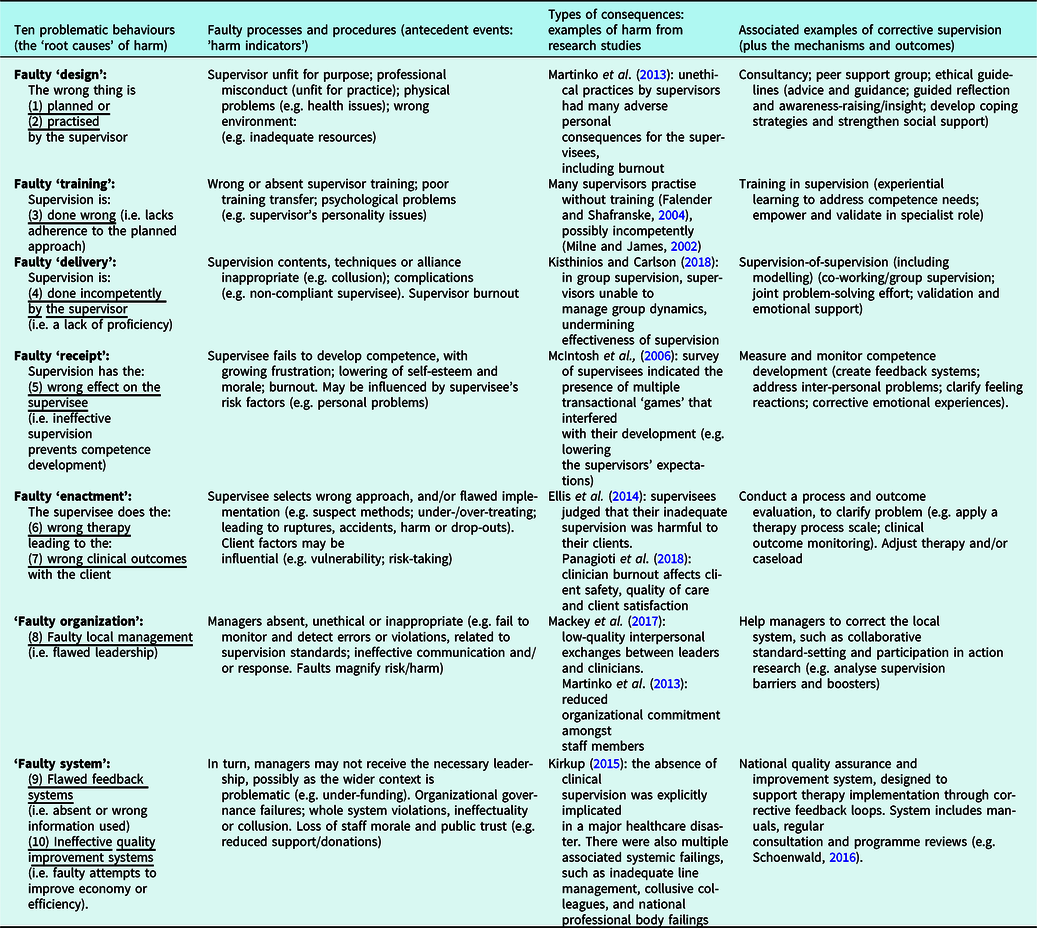
The fidelity framework is rarely used explicitly within supervision, but appears to be implicit within at least some current supervision theory and research. This is illustrated by a review of 12 outcome evaluation studies of supervision (Reiser and Milne, Reference Reiser and Milne2014), which indicated that all five steps within the fidelity framework were utilized by this sample of supervision researchers (although only three of these 12 studies applied all five evaluation criteria). Because the fidelity framework provides such an exceptionally systematic way of thinking about supervision outcomes, it has been operationalised into ten objectives of high-fidelity supervision (Milne, Reference Milne2018). Of particular relevance to this present theoretical review, the five-step fidelity framework and these ten objectives can also provide a rationale for classifying harm related to supervision, as each variable can potentially range from high to low fidelity (i.e. it is a multi-dimensional scale). Table 1 lists some of these negative, low-fidelity outcomes, effectively mirroring the positive fidelity framework.
The infidelity framework: a classification of things that can go wrong and cause harm in relation to clinical supervision

This reasoning creates the basis for a new ‘infidelity framework’. Table 1 summarizes the infidelity framework, integrating the most relevant aspects of the taxonomies and frameworks reviewed above (i.e. Bellg et al., Reference Bellg, Borrelli, Resnick, Hecht, Minicucci, Ory, Ogedegbe, Orwig, Ernst and Czajkowski2004; Borrelli et al., Reference Borrelli, Sepinwall, Bellg, Czajkowski, Greger, DeFrancesco, Levesque, Sharp, Ogedegbe, Resnick and Orwig2005; Chang et al., Reference Chang, Schyve, Croteau, O’Leary and Loeb2005; Ellis et al., Reference Ellis, Berger, Hanus, Ayala, Swords and Siembor2014). Table 1 also incorporates valuable concepts from the literature on the harm that therapy can cause to clients (e.g. Curran et al., Reference Curran, Parry, Hardy, Darling, Mason and Chambers2019; Hardy et al., Reference Hardy, Bishop-Edwards, Chambers, Connell, Dent-Brown, Kothari, O’Hara and Parry2017; Klatte et al., Reference Klatte, Strauss, Flückiger and Rosendahl2018), in addition to examples of the systemic harm that can be done to supervisors and supervisees within organizations. This ensures that the key roles related to supervision are each accorded due emphasis: the supervisors, supervisees (therapists), clients and service managers. The justification for this integrative approach is to create a framework that is theoretically sound (i.e. CBT-compatible), practically relevant and sufficiently comprehensive to include all the logically-likely and empirically demonstrated causes of harm that can be distinguished, with respect to the diverse forms of harm that can be related to supervision. As a result, the infidelity framework is a more comprehensive depiction of harm than provided in Ellis et al. (Reference Ellis, Berger, Hanus, Ayala, Swords and Siembor2014), and one that is therefore likely to enhance our understanding and treatment of the harm that is related to supervision.
A practical outline of the infidelity framework
In this section, the columns of the infidelity framework in Table 1 are explained, using practical examples. For brevity reasons, only row 1 is outlined, but further detail can be found within the cited literature in column 4. These columns are based on the standard harm dimensions used in the client safety literature (e.g. Chang et al., Reference Chang, Schyve, Croteau, O’Leary and Loeb2005). They are the causes, types of problems, contexts, impacts and harm reduction options. These headings have been adapted to a functional analysis framework and CBT terminology within Table 1 (i.e. ‘problem behaviours’, ‘antecedents’, ‘consequences’ and ‘corrective supervision’).
Column 1
The ten types of harm are listed in order of severity, from least to greatest harm, in terms of the number of people potentially harmed, and the growing severity of the harm (e.g. the growing financial or political consequences). Row 1 describes the ‘design’ aspect of the infidelity framework, the problematic behaviour of a supervisor who may choose the wrong supervisory approach, and/or implement an approach unethically (i.e. ‘harmful supervision’: Ellis et al., Reference Ellis, Corp, Taylor and Kangos2017). To expand on the notes in Table 1, in column 2 (the antecedents or harm indicators), professional misconduct includes unethical, improper or illegal acts by the supervisor (e.g. relationship boundary violations). These are personal failings that render a supervisor unfit for professional practice. A second category concerns misrepresentation, being imposters or ‘quacks’ who fake or misrepresent their supervisory credentials or experience. Such supervisors are unfit for purpose, and will tend to make significant errors of judgement as a result of their incompetence or flawed judgement. A third type of indicator is the supervisor’s poor health: this refers to physical or psychological deficits that undermine good practice. This can include an inability to address the tasks of supervision, as in procrastinating or making decision-making errors (e.g. faulty goal-setting). There may also be personality issues, as in supervisors adopting a persecutory style (e.g. undermining, manipulating or blaming their supervisees), or there may be attitudinal abnormalities, such as inflexibility and excessive control (e.g. rigid adherence to guidelines or professional standards; limited negotiation or collaboration). The fourth kind of antecedent to harm relates to failings within the workplace, such as inadequate resources or excessive job stressors (e.g. Griffiths et al., Reference Griffiths, Harper, Desrosiers, Murphy and Royse2019). A common illustration is insufficient supervision due to an organization’s management practices (insufficient duration, frequency, or intensity of supervision). There may also be situational complications, which compromise other resources needed for supervision (e.g. a quiet, confidential room).
In rows 2 and 3, these problems are compounded by the supervisor’s non-adherent or incompetent application of a supervision method, possibly related to faulty or absent training (i.e. sub-standard or ‘ineffective’ supervision: Ellis et al., Reference Ellis, Corp, Taylor and Kangos2017), or to flawed delivery (e.g. incompetent supervisory practice). As presented in row 4, this may lead to adverse impacts on the supervisee (harmful ‘receipts’), such as failing to develop clinical competencies through supervision, or experiencing psychological harm from unethical supervision (e.g. burnout). In turn, the supervisee’s ‘enactment’ of the foregoing experiences may lead to the use of contra-indicated therapy techniques, resulting in therapeutic ineffectiveness, or in harm to clients (‘failed supervision’: Ladany, Reference Ladany2014). This succession of ineffective and/or harmful practices by supervisors and supervisees may then be poorly managed, indicating harmful disorganization within a hospital or clinical service unit (e.g. unethical or incompetent leadership). For instance, management may fail to ensure that high-quality supervisor training occurs, or the supervisees’ training programme may fail to monitor the supervision provided in those units or services. Finally, the last row anticipates that such local disorganization may be related to a wider system failure. In this scenario, the wrong kind of management within a specific service or unit may be compounded by a generally dysfunctional national organization, perhaps because there is a lack of overall governance (e.g. ineffective quality control procedures), or possibly because an inadequate feedback system is in place. In summary, these ten types of harm represent a taxonomy indicating how harm can unfold, theoretically leading to negative generalization effects.
Column 2
For each of the ten problematic behaviours in column 1 (the ‘root causes’), column 2 adds the related antecedents (the ‘harm indicators’). These are human performance errors that are associated with the root causes (e.g. faulty psychological processes and procedures, such as biased decision-making). The examples given in Table 1 draw on the most relevant supervision concepts used in the aforementioned client safety and treatment fidelity literatures, but are phrased in terms specific to supervision.
Column 3
Examples of the main types of adverse consequences that tend to follow from these antecedents are given in column 3, drawn from illustrative research studies. The example in row 1 is that of unethical supervision behaviours, such as bullying, which were associated with burnout and other adverse consequences for supervisees in a review of over 60 studies (Martinko et al., Reference Martinko, Harvey, Brees and Mackey2013). The studies noted in column 3 provide some empirical support for the infidelity framework, in that these supervision studies have recorded many of the different types of harm outlined within Table 1. However, perhaps the most compelling illustrations of these negative effects come from healthcare disasters. For example, the wrong approach by midwives at a hospital in England (i.e. unwisely pursuing a ‘natural childbirth’ approach with all clients, which was unchecked by peer group supervision) led to the avoidable deaths of several babies and their mothers in receipt of that care (Kirkup, Reference Kirkup2015). The absence of proper clinical supervision was explicitly implicated in this disaster. There were also multiple associated systemic failings within this hospital, such as inadequate line management. These sub-standard local practices were compounded by national failings (e.g. a lack of appropriate guidance on supervision by the midwives’ professional body). In short, the kinds of harm summarized within Table 1 can be found in this report (Kirkup, Reference Kirkup2015), indicating that it is an adequately comprehensive taxonomy, at least with respect to supervision.
Column 4
Lastly, column 4 of Table 1 notes some evidence-based ways in which supervisors can prevent or rectify the preceding problems, related to the faulty design of supervision. This final cell of row 1 within Table 1 also draws attention to the role that other stakeholders can play in managing supervisors effectively. Promising actions include support and guidance for supervisors (e.g. through consultancy or peer support groups). We also note in this last column the mechanisms through which these supervision interventions are understood to help (e.g. by guiding reflection, awareness-raising and insight). These corrective interventions, and the others in Table 1, are fully explained in Milne and Reiser (Reference Milne and Reiser2020).
Discussion
The aims of this theoretical review were to enhance our understanding and management of supervision-related harm, by developing a preliminary classification scheme, and by suggesting ways to improve CBT supervision so as to prevent harm. The novel ‘infidelity framework’ was constructed by integrating the most relevant and suitable prior conceptualizations, and by drawing on neighbouring literature. Following the structure of functional analysis, the infidelity framework defined and formulated ten supervision behaviours that are related to harm, alongside their antecedents and consequences. This integrative effort built on current conceptualizations of supervision-related harm, extending them to offer a more systematic and systemic map. As a result, the infidelity framework provides the broadest understanding of harm to date, leading to a greater sensitivity to problems, and to a wider range of suggestions for improving supervision. To illustrate, information obtained from using the infidelity framework as a reporting system could be used to evaluate and develop an organization’s systems, policies and procedures. The goal would be to create a ‘resilient’ or adaptive system that detects, prevents, mitigates or ameliorates errors and harm, resuming optimal functioning quickly after harm has occurred (World Health Organization, 2009).
At the individual level, the framework suggests some related supervision interventions for preventing or rectifying such harm (see the final column of Table 1 for a summary). Helpfully, these more positive supervision methods promote well-being and are basically incompatible with harm-related supervision, as per the contrast between the consequences of harm and the corrective alternatives (i.e. the contrast between columns 3 and 4 of Table 1). Table 1 gives the example of how such positive approaches as supervision-of-supervision (including modelling) and group supervision can aid joint problem-solving, together with validation and emotional support. These are incompatible with damaging group dynamics, as described by Kisthinios and Carlson (Reference Kisthinios and Carlson2018). Supervisors should also routinely seek and consider supervisee feedback, engaging in discussions of the feedback with their supervisees and with other stakeholders (e.g. reviewing with training programme staff a sample of the supervisee ‘satisfaction’ or ‘reaction’ data, obtained from self-report questionnaires). As indicated in Table 1, feedback can advantageously include outcome information related to the supervisees’ clinical work. Both types of feedback can enrich ongoing discussions, and help to ensure that the supervisor has the necessary ‘clinical oversight’ (i.e. sufficient awareness of the quality of clinical care to ensure client safety: Kennedy et al., Reference Kennedy, Regehr, Baker and Lingard2007).
In addition to these specific supervision methods, there is a clear implication from the association between personal distress in clinicians and harm to clients (e.g. Ellis et al., Reference Ellis, Berger, Hanus, Ayala, Swords and Siembor2014; Panagioti et al., Reference Panagioti, Geraghty, Johnson, Zhou, Panagopoulou, Chew-Graham and Esmail2018) that supervisors should enhance the restorative function of their supervision. According to a rare supervision guideline on the topic, this would include clarifying the workplace challenges faced by supervisees; encouraging the supervisees’ emotional processing and personal growth; strengthening their personal coping strategies; boosting their morale, motivation and job satisfaction; and fostering their social support (Milne and Reiser, Reference Milne and Reiser2017).
At the group level, the framework can be viewed as a syllabus for supervisor training, both to highlight faulty approaches, and to suggest more appropriate techniques. For instance, all supervisors need to recognize that they are capable of providing harmful supervision, based on methods that cause burnout or other forms of distress to their supervisees (Borders, Reference Borders2017). Consequently, they should be encouraged to regularly monitor their approach to supervision, while assessing how their supervisees are reacting. Although increasingly endorsed, systematic training in supervision remains the exception rather than the rule (Watkins and Wang, Reference Watkins, Wang, Watkins and Milne2014), and consequently many supervisors still practise supervision based on how they were themselves supervised. Given that their supervision may also have included inadequate or harmful supervision, and that they may be unaware of their formal supervisory responsibilities, there is a clear need for enhanced training and quality assurance. The same principles apply to supervisees. As Ellis et al. (Reference Ellis, Berger, Hanus, Ayala, Swords and Siembor2014, p. 29) pointed out, ‘…many supervisees may have unknowingly received inadequate and/or harmful supervision’, and also be unaware of their responsibilities or rights within supervision. Training, including guidelines and joint participation by supervisors and supervisees, can increase informed awareness and help to rectify any such misunderstandings.
The infidelity framework also carries action implications for researchers. The dominant perspective on outcome evaluation in supervision prizes clinical outcomes above all else, the so-called ‘acid test’ (Ellis and Ladany, Reference Ellis, Ladany and Watkins1997). To illustrate the pervasive effect of this perspective, authors who fail to obtain clinical benefits tend to conclude that supervision is ineffective, even when important secondary outcomes are achieved, such as competence development in the supervisees (e.g. Alfonsson et al., Reference Alfonsson, Parling, Spännargård, Andersson and Lundgren2018). Supervisors and especially supervisees appear to share this narrow perspective (Rast et al., Reference Rast, Daniel, Herman, Rousmaniere, Jason, Whipple and Swift2017), although thankfully several intermediate outcomes are also valued as having a positive effect on client outcomes (e.g. preventing client drop-out; enhancing supervisees’ ethical awareness). However, only one of 12 such outcomes in this survey (Rast et al., Reference Rast, Daniel, Herman, Rousmaniere, Jason, Whipple and Swift2017) was related to the prevention of harm to clients, namely supervision that encourages ‘self-care’ by the supervisee (‘Reminding me to pay attention to myself and maintain my health’). Similarly, although a review of 12 studies of supervision defined 18 different supervision outcomes (Reiser and Milne, Reference Reiser and Milne2014), none assessed client harm.
This emphasis on the clinical outcomes appears negligent, considering that reviews have indicated significant levels of harm to supervisees (e.g. Ellis et al., Reference Ellis, Berger, Hanus, Ayala, Swords and Siembor2014), and to clients (e.g. Klatte et al., Reference Klatte, Strauss, Flückiger and Rosendahl2018). Indeed, harm seems to be a common feature within healthcare, affecting everyone involved (Chang et al., Reference Chang, Schyve, Croteau, O’Leary and Loeb2005; Jha et al., Reference Jha, Larizgoitia, Audera-Lopez, Prasopa-Plaizier, Waters and Bates2013). The implication is that harm should also be regarded as an outcome (adverse), and so should be assessed alongside benefit. This would allow a harm-to-benefit ratio to be calculated (for all study participants), and would significantly revise and re-balance the way we think about the effectiveness of supervision. With this logic, client benefit is only one extreme end of a bi-polar continuum, extending through a series of stepwise or intermediate outcomes that lead to client harm. The fidelity framework lists the positive steps in this continuum, while the infidelity framework in Table 1 above lists the negative ones. This logic is consistent with the primary purpose of supervision, to ‘First, cause no harm’. Also, including adverse events allows a more balanced decision to be made about the value of an intervention (Klatte et al., Reference Klatte, Strauss, Flückiger and Rosendahl2018). In summary, I believe that ‘doing no harm’ should be an equally valued outcome, and should be incorporated appropriately within evaluations of the effectiveness of supervision.
Limitations
However, the infidelity framework also has some disadvantages and challenges. Unlike the taxonomy developed by Ellis et al. (Reference Ellis, Berger, Hanus, Ayala, Swords and Siembor2014), it has not yet been subjected to a process of expert-consensus building to test its content validity, nor has it been subjected to any exploratory research (e.g. regarding the implications for supervisor training). Other limitations include the extensive use of analogies to construct the infidelity framework, and the complex nature of interactions between the elements. In addition, the potential for inadvertent and unwitting harm merits development, and inclusion within a suitably enhanced infidelity framework.
On analogies, some will believe that it is misleading and unhelpful to integrate concepts, frameworks and examples from the wider literature on harm in healthcare (e.g. Chang et al., Reference Chang, Schyve, Croteau, O’Leary and Loeb2005; Chatburn et al., Reference Chatburn, Macrae, Carthey and Vincent2018; Vincent et al., Reference Vincent, Burnett and Carthey2014). The justification is firstly that such extrapolation is necessary, given the paucity of the supervision-specific literature on harm. By contrast, the literature on harm within healthcare generally is extensive, relevant and evidence-based, making it an informative starting point when considering supervision. Secondly, extrapolation is in any case a helpful form of expert reasoning, when based on the careful use of justified analogies (Milne, Reference Milne2006). Careful examination of analogies is therefore appropriate, including whether or not the parallels that are being drawn are truly similar, are from closely related fields, and are plausible (given relevant research and theory: Kretz and Krawczyk, Reference Kretz and Krawczyk2015). Therefore, although the taxonomy developed by Chang et al. (Reference Chang, Schyve, Croteau, O’Leary and Loeb2005) is not about supervision, it is similar, comes from a closely related field (especially in relation to CBT supervision), and is only being used here to sketch out a preliminary framework. Such considerations make this kind of analogy less risky, and a more suitable basis for formulating issues (Kretz and Krawczyk, Reference Kretz and Krawczyk2015). The analogies used to construct the infidelity framework pass these logical tests, but future research may suggest some important differences, which should of course be incorporated.
On the complex nature of interactions between the elements of the framework, there is a second type of conceptual problem. Being a taxonomy, the infidelity framework retains the idea that the different elements influence one another, and so need to be considered together. With this logic, the ten antecedents to harm in column 1 of Table 1 are presented as a succession of linked problems, with each one assumed to be necessary for the next (i.e. the initial error of doing the wrong thing has the knock-on effect of creating even greater harm further down the steps of the infidelity framework). We should stress that this is a diagrammatic simplification, intended to help to introduce a novel and complex concept (the infidelity framework). In practice, it is recognized that errors in healthcare can be yet more complex, having multiple determinants and occurring within complex environmental contexts. Therefore, it is not assumed that the fidelity framework actually operates in the stepwise fashion presented in Table 1, as errors may impact the different levels in complex, dynamic ways. For instance, burnout can be both a cause and a consequence of several such errors. For this reason, in the infidelity framework it is assumed that some or all of these ten causes typically combine in a vicious cycle of ever-decreasing performance (e.g. doing the wrong thing contributes to doing it wrong, which increases the likelihood of the wrong outcome). This kind of cyclical interaction, where faulty systems, negative events and human errors increasingly compound inappropriate responses, operating in cyclical interpersonal interactions, is recognized in the literature on harmful supervision (Mackey et al., Reference Mackey, Frieder, Brees and Martinnko2017). Not included in Table 1 but best construed as the context for the infidelity framework, it is also possible that there may in turn be impacts on neighbouring communities or wider society, on an even larger scale (e.g. harm to the families of supervisees or clients; the loss of trust and support for hospitals; litigation costs; the closure of healthcare facilities).
Finally, a practical limitation is that the implementation of an adaptive safety system based on something like the infidelity framework requires strong leadership from supervisors, training programme staff, service managers, and others. In their study of such a system, Chatburn et al. (Reference Chatburn, Macrae, Carthey and Vincent2018) reported that, while their framework promoted a substantial shift in the service leaders’ thinking about how safety can be actively managed, their interviewees acknowledged that this did not always translate into changes in practice. An attitude of enquiry, routine measurement and close collaboration with clinicians were amongst the more helpful ways to encourage safer practices. However, it should be acknowledged that healthcare organizations have little capacity for such measures, or for the kind of action research that might address the motivational, leadership or other contributing factors (Vincent et al., Reference Vincent, Burnett and Carthey2014).
Conclusions
‘First, do no harm’ is a piece of wisdom that has been widely incorporated into the definition of clinical supervision (e.g. Bernard and Goodyear, Reference Bernard and Goodyear2019), but the supervision literature has neglected the issue of harm. This is of concern, as growing evidence indicates that harm is reported to occur to supervisees and their clients as a result of supervision (e.g. Ellis et al., Reference Ellis, Berger, Hanus, Ayala, Swords and Siembor2014). Further research is required to test and improve the preliminary infidelity framework, but it may be informative, as it offers a theoretically enhanced conceptualization. It also emphasizes how high-fidelity supervision is exceptionally well placed to prevent or rectify harm (Tomlinson, Reference Tomlinson2015; Milne and Reiser, Reference Milne and Reiser2020). Furthermore, supervisors are capable of fostering personal well-being and professional excellence in their supervisees, and conveniently many of the associated high-fidelity methods are incompatible with harmful or inadequate supervision.
Acknowledgements
The author is grateful to Robert Reiser for helpful suggestions on an earlier draft of this paper; and to Jan Little for help in preparing the manuscript.
Financial support
This review received no specific grant from any funding agency, commercial or not-for-profit sectors.
Conflicts of interest
None.



Comments
No Comments have been published for this article.