BACKGROUND
Being seriously ill and facing dying and death means living with the unpredictability of the illness and experiencing physical, emotional, social, and spiritual suffering (Rasmussen et al., Reference Rasmussen, Jansson and Norberg2000; Cassel, Reference Cassel1982), that is, living with total pain (Clark, Reference Clark1999). To holistically meet the diverse needs of and to address total pain in persons within palliative care (PC), a specialized PC team is considered to require healthcare professionals (HCPs) with multiple competencies and skills (Jünger et al., Reference Jünger, Pestinger and Elsner2007; Gamondi et al., Reference Gamondi, Larkin and Payne2013) for the provision of high-quality palliative care. Knowledge of the effectiveness of PC teams, including specialized palliative home care (SPHC) teams, is gradually accumulating, even if, according to a review by Higginson and Evans (Reference Higginson and Evans2010), there is still a need to understand which specific components of PC team activity and which types of teams are most effective in achieving the desired patient outcomes. Furthermore, much of the research regarding PC teams has been performed either from the perspective of service providers or based on the outcomes of care, often using questionnaire studies, and has less often focused on patients' and families' experiences of being cared for by such a team (Johnston et al., Reference Johnston, Milligan and Foster2012). The terminology regarding PC teams varies, so where previous research is referred to we use the terminology chosen by the original authors.
Reviews of studies investigating outcomes for patients with cancer and their families admitted to specialized PC show positive effects, especially regarding pain and symptom control, and reduction in the number of hospital admissions or lengths of stay (Higginson & Evans, Reference Higginson and Evans2010; Zimmermann et al., Reference Zimmermann, Riechelmann and Krzyzanowska2008). In their retrospective cohort study in Italy, Riolfi and colleagues (Reference Riolfi, Buja and Zanardo2014) showed that palliative home care services reduced the number of days in hospital during the last two months of life from an average of 20 to 4 days. Melin-Johansson and coworkers (Reference Melin-Johansson, Axelsson and Gaston-Johansson2010) explored outcomes by using quality-of-life assessments in patients with incurable cancer before and after designation to an SPHC team and found significant improvement in global quality of life after inclusion of the team. Another example of outcome focus is found in a 2013 Cochrane review by Gomes et al. (Reference Gomes, Calanzani and Curiale2013a ), which concluded that there is clear and reliable evidence that palliative home care teams reduce the symptom burden in patients.
Gomes and colleagues' (Reference Gomes, Calanzani and Gysels2013 b) review of preferences for care and dying found that most persons prefer to receive home care and to die at home. Palliative home care began in Sweden in the early 1970s. Studies from the past 12 years in northern Europe investigating patients' and families' experiences of palliative home care have reported that experiencing a sense of security (Goldschmidt et al., Reference Goldschmidt, Schmidt and Krasnik2006; Milberg et al., Reference Milberg, Friedrichsen and Jakobsson2014), the accessibility of 24/7 care (Milberg & Strang, Reference Milberg and Strang2011; Hunstad & Foelsvik Svindseth, Reference Hunstad and Foelsvik Svindseth2011), being able to remain at home (Milberg & Strang, Reference Milberg and Strang2007; Appelin & Bertero, Reference Appelin and Bertero2004), and experiencing continuity of care (Bostrom et al., Reference Bostrom, Sandh and Lundberg2004; Milberg & Strang, Reference Milberg and Strang2007; Milberg et al., Reference Milberg, Wahlberg and Jakobsson2012) are key components in the work of SPHC teams. Milberg and coworkers (Reference Milberg, Wahlberg and Jakobsson2012) outlined an overview, a theoretical model, of dying patients' and family members' experiences of palliative home care as a “secure base.” A sense of security is created, among other things, through trust in the team, being recognized as an individual, experiencing burden relief, being informed, and having an everyday life at home. This is in line with international findings where patients and family members expressed that the PC team enabled them to cope with difficult circumstances (Noble et al., Reference Noble, King and Woolmore2015), that around-the-clock continuity was paramount (Johnston et al., Reference Johnston, Milligan and Foster2012; Noble et al., Reference Noble, King and Woolmore2015; Mehta et al., Reference Mehta, Chan and Cohen2014), and that HCP relations or collaborations were important (Noble et al., Reference Noble, King and Woolmore2015; Mehta et al., Reference Mehta, Chan and Cohen2014). Thus, even though the benefits of the work of SPHC teams have been identified regarding symptom management, reduced hospital admissions, global quality of life, and through providing a “secure base,” a further exploration is warranted into how persons cared for by a team experience the work of the team. This is particularly necessary since replication of qualitative studies is encouraged to “confirm concepts, relationships, or patterns” as a strategy to enhance the potential for generalizability (Polit & Beck, Reference Polit and Beck2010).
Given this background, and in order to explore and strengthen the understanding of which of the components in a team's work are considered important from the perspective of patients and family members, our objective was to investigate how the work of the team is manifested in care episodes narrated by patients and families receiving SPHC.
MATERIALS AND METHODS
Context
The four SPHC teams providing care to the patients and families included in our study had from 50 to 100 patients in their care at any one time, and each team comprised approximately 30 HCPs. All teams included physicians, registered nurses (RNs), social workers (SWs), physical therapists (PTs), and occupational therapists (OTs) in varying proportions and availability. Team leaders were either physicians or registered nurses. The SPHC team was responsible for all the healthcare at home—such as symptom management, treatment, and nutritional support—as well as care regarding social and existential issues, depending on individual situations and needs. The only exceptions included assistance with tasks for which the county home care services were responsible (e.g., personal hygiene and house cleaning). SPHC teams mainly organize care so that one physician is paired with a group of RNs to constitute the core caring system, and so that each patient has a designated RN who is responsible for planning care. The patients in these SPHC units were cared for on average for 58–90 days by teams. Most HCPs had participated in continuous education in PC, and, within these teams, three nurses were certified for palliative care, as was one physician. The teams operated in different counties, either in urban or suburban settings, with different reimbursement systems and conditions.
Recruitment and Sampling
Due to the organization of healthcare services in Sweden and Swedish patient confidentiality laws, SPHC team leaders were asked to independently select and invite patients and family members (persons involved in home care or cohabiting partners) to participate in the study. Brief verbal information about the study was given to prospective participants. If initial consent was given, team leaders provided written information regarding the study and research group contact information. The first author contacted potential participants by telephone, reiterating study information, and, if verbal consent was given, an interview was scheduled. All potential patients and family members who gave consent to team leaders were included in our study.
The inclusion criteria were patients over 18 years of age who were currently enrolled in SPHC or family members of enrolled persons. Information regarding the exact time since enrollment in SPHC was not requested. The exclusion criteria were persons under 18 years of age and those who did not speak Swedish. During the 6-month study period, 13 participants gave consent to be interviewed. The sample consisted of 8 women and 5 men ranging in age from 50 to 89 years. Six patients (three women, three men) with advanced malignant diagnoses were interviewed, as were seven cohabiting partners (five women, two men), hereafter called family members. These included six patient/family member dyads who were interviewed separately. All participants had completed high school or its equivalent, while four had continued with an associates degree and one with a university degree.
Data Collection
The data were collected though narrative research interviews (Riessman, Reference Riessman2008) and were inspired by the critical incident technique (CIT), as initially described by Flanagan (Flanagan, Reference Flanagan1954). After introductory conversations, the starting question was “Which HCPs do you meet in association with care in your home?” Next, participants were asked to narrate their experiences of specific positive and/or negative care episodes that had occurred. To support participant narratives of the team's work in the home context, probing questions were used—such as: “How did you experience the HCPs' collaboration?” or “Could you tell me more about …?”—linking to something the participant had mentioned previously if these topics were not addressed spontaneously. Alternatively, echo probing was utilized, which means repeating the last thing a participant had said and asking them to continue. All participants were invited to share one or more care episodes involving HCPs from the SPHC. The interviewer avoided using the English word “team” since, though it is a word used by organizations in Sweden, it is not commonly employed and understood in everyday language. The audiotaped interviews were transcribed verbatim and validated. The tape-recorded part of the interviews, conducted by the first author in participants' homes, lasted from 30 to 57 minutes (mean = 38).
Data Analysis
The study was inspired by narrative research tradition and thematic analysis (Riessman, Reference Riessman2008). By performing a thematic analysis, we aimed to remain close to the content of the care episodes narrated by patients and families. The analysis process was conducted in five stages:
-
1. The transcripts were checked against the recordings for accuracy. Analysis started with reading the transcribed individual interviews several times to get a good sense of the whole.
-
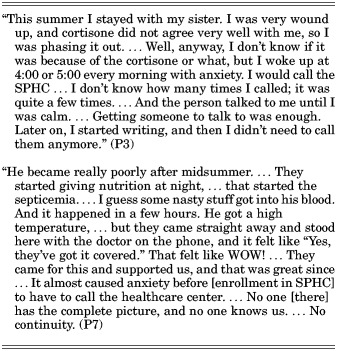
2. Each interview was read to identify the narrated care situations, that is, stories of different length having a beginning, middle, and end (Riessman, Reference Riessman2008), which are from now on called “care episodes.” These were digitally colored and inserted into a matrix. For examples of care episodes, see Table 1.
-
3. Each care episode was analyzed, and we extracted the words that participants used to describe HCPs, such as personal pronouns or names, and the words they used when evaluating the received care and their encounters with the HCP.
-
4. The thematic analysis of the care episodes continued with highlighting and coding of the content of care episodes, and with examining and recording patterns (themes) within and between the care episodes. Patients' and family members' separate narratives of care episodes were compared and, as there were no essential differences in the descriptions of components of the SPHC team's work, they were analyzed together.
-
5. Finally, the content of the patterns together with the words used to describe and evaluate the components of the SPHC team's work in the care episodes were discussed, analyzed, and compared, resulting in two main themes. Inspired by Sandelowski and Leeman (Reference Sandelowski and Leeman2012), these themes were translated into thematic sentences using participant expressions in an effort to ease understanding of our findings by portraying complete ideas. Quotations from the interviews were translated, and pauses, hesitations, and repetitions were removed (Riessman, Reference Riessman2008).
This study received ethical approval from the Regional Ethical Review Committee at the Karolinska Institutet (2010/1491–31/3).
Two examples of care episodes in the themes “security” and “continuity” of care as narrated by one patient and one family member

RESULTS
In total, 74 care episodes involving HCPs in SPHC were narrated by 6 patients and 7 family members. Even though the interviews were rather short, since the patients were severely ill, each patient contributed at least three care episodes. For two examples of care episodes, see Table 1.
Of the care episodes, 50 were descriptions of regularly scheduled visits, while 24 related to acute care visits and/or interventions. Most care episodes narrated by participants concerned HCPs attending to the needs of the whole person, even if the reason behind the contacts, especially in the acute visits, was a physical or pharmacological need. All of the care episodes had positive connotations, though there were a few critical comments, such as an HCP being late or not listening to a participant. When talking about the HCPs, participants in 64 of the 74 care episodes used personal pronouns—like “he,” “she,” and “they”—or the name of the profession—like “the nurse,” “the social worker,” or “the physician.” In 10 episodes, personal names were used—like Ruth or Steve. No participants used the word “team,” but in one instance the word “group” and in two instances the name of the service was employed.
The patterns identified in the thematic analysis are presented in the following two condensed themes: “security” and “continuity of care.” The themes are inseparable entities and are not mutually exclusive; therefore, care episodes may encompass both themes simultaneously. For clarity, the themes will be presented under separate headings.
Security (“They Are Always Available; I Get the Help I Need Quickly”)
A common thread running through the 37 care episodes in this theme is participants' experiences of security while being enrolled in specialized palliative home care. Patients provided 20 care episodes in this theme, and family members provided 17. Knowing that they could call the HCPs at any time, on any day, and rely on the fact that a person would answer and do all in their power to help was significant for experiences of security (see the examples in Table 1). Participants did not need to think about whether it was a weekday or weekend, or if it was after business hours, since the same phone number worked at all time. One patient put it like this:
I am really happy, and I know that I can call any time and any way, around the clock. There is always someone there to answer. (P1)
Experiences of security not only related to making contact with a HCP but also to the HCP's sensitivity to changing conditions and circumstances. Team members immediately assessed the situation and did what they could to meet these new needs. An example is found in the following excerpt:
A while back, I suddenly started vomiting in combination with diarrhea, and it was not long until she [the nurse] was here and listened, and I'll be right back, she said, and then returned with IV fluids … so, in with fluids because I'd lost so much that I was not coherent. Things like that are incredibly valuable. Yes, I called— What do you think I should do? I'll be right over, she said, and she came as quickly as she could. (P8)
Another important aspect of security was the experiences of the HCPs adjusting the practical aspects of care to accommodate patients' and families' situations. In the care episodes, the work of PTs and OTs in modifying the home environment to make home care possible was especially prominent and mentioned by all participants. Many described practical things—such as getting a hospital bed delivered and set up, or adjusting bathroom facilities, and organizing schedules according to the participant's wishes. As one family member stated,
They have been here and checked what's needed. We have a stair lift and a walker and a toilet seat extension, … we've received incredible help, haven't had to fight for anything. It has come along very smoothly. (P2)
Other participants told of HCPs finding practical working solutions for the family to enable secure care at home. This entailed assessing the home environment and adapting care provision to suit the environment, as stated by the following family member:
Here they've figured out that it is best to do all the changes and stuff here on the couch. And when we give IVs it's rather convenient to hang the bag from the lamp … so … All the time they see … there is lots to use in a home as well, and that the people who live there can run things or feel that “we are a part of this.” That's how they do things. It feels that way anyway. (P4)
Intertwined with the theme of security is the experience of feeling well cared for. The following quotation from one patient provides the bridge to the theme of continuity of care:
I am very content because I—When they leave, they always remind me to call them any time as soon as there is a concern. Well, yes, but I don't want to disturb you … You never disturb us, they say, we are here for you. So, just call us if you need us. Yeah, it's been like that all along and I think that—I feel privileged and said that to them [the SPHC team] … I feel so well taken care of. (P5)
Continuity of Care (“They Know Me/Us, Our Whole Situation, and They Really Care”)
Another common thread running through the 37 care episodes in this theme is participants' descriptions of how both the collaboration between HCPs and the HCPs' approach provide the basis for experiences of continuity of care. This is described both as an experience of a continuous caring relationship, where HCPs know the participants and are familiar with their whole situation, as well as experiences of the HCPs “really caring,” even about the “little things in life.” Patients provided 21 care episodes and family members 16.
The HCPs are described as collaborating, being well informed, and knowing the participants. Thus, in contrast to earlier experiences before admission to SPHC, having contact with different HCPs is no longer described as problematic. When one HCP leaves the home, the next team member arrives and continues from where the previous HCP left off, without requesting an update from the patient. This does not seem to be linked to particular persons; rather, it is demonstrated by all individual HCPs through a united approach in the SPHC team. As one patient recounted,
First I thought that there are so many different persons, but it doesn't matter. They are all like family. (P12).
The different team members merge into a group, or a team, with a mutual approach that includes knowing patients and families. The participants reported that, even when calling outside of office hours, or when a secretary answered the telephone, they just had to say their name and the person at the other end of the line immediately knew who they were and knew their situation. Even though several HCPs were involved, participants perceived the care they received as continuous, despite the fact that they may not have met the HCP in person before. Another patient expressed it like this:
The collaboration in this group, … they are tightly knit. They support each other, talk. … They quickly tell my story and what kind of person [I am]. … So they come here and [say], “Hello, hi. So you are David. I almost recognized you even though we've never met,” he said. (P8)
When the HCPs visited and asked questions like “How was the weekend?” or “What are your plans for the holidays?” the participants described this interest as an example of caring about the little things in life. Other examples of really caring surfaced in care episodes where HCPs followed up on prior issues, even though some time had since passed, as stated by one patient:
Yes, there was a nurse, a man, who came last week and took some blood. And I think he has been here once or maybe twice before. So, he asks me, how is your eating? Because I'd had problems last autumn, I lost a lot of weight. … I think it is fantastic that he remembers. … They care about the little things, ask how I've been over the holidays, what I've done, and so on. (P6)
Being known by the HCPs and experiencing continuity in the care received was a relief for participants. This is in contrast to their earlier experiences with healthcare where they had to visit several clinics and explain their situation over and over again to different HCPs. The HCPs in our study were described as managing all the care and having a complete picture of the situation, thus providing care that encompassed more than symptom management. One family member put it this way:
It is super with the doctors being so up to speed with everything. They know my husband inside and out, the whole picture—that is it … not only symptoms that need curing. … They know exactly, increase a dose or add something, or do something else. They really care about him, I must say. That is very comforting. (P2)
The narratives illustrate that, when an HCP is visiting, she/he naturally picks up from where a previous HCP left off, irrespective of the needs that patients and families may have, and also that the HCPs contact each other when a new need arises or when they are made aware of a need that requires a collaborative effort. Also surprising are the experiences of not only patients and family members contacting the SPHC team, but also the other way around. The HCPs contact the patient “just” to check in—for example, if the treatment provided is working. The following quotation gives an example of this:
Well … I feel like there is collaboration between— I asked the physiotherapist, I have numb places on my foot that I think are weird, and I asked if there was some kind of exercise or massage that I can do. And as I understand it, the information was relayed to the doctor. That is really good. Also, when I've had a common cold, they've checked up on me, been in touch and given me cough syrup, etc. And the doctor telephoned me twice just to check up on me. (P9)
Another important part of a team's work that participants described is the feeling of being included, being listened to, and having the final say in decision making regarding care. Basing care on participants' preferences added to experiences of receiving tailored comprehensive care. One patient expressed it as follows:
I make the decisions [regarding care] in collaboration with the SPHC. I might ask questions, and I get the answers I need, and if they cannot answer, they find out. … If they cannot fix it, they come with suggestions, perhaps we can do it this way instead, so … perhaps we can do it another way, to help you with this. (P13)
Likewise, by attending to family needs, the HCPs are described as including and caring for the family members as well as for the patients. For some, this was both unexpected and greatly appreciated. The following quotation provides an example:
They always take a little time to ask and to talk in general about things, … well, with us both, sometimes separately and sometimes together. I think that is lovely, that they ask me, too. I am grateful for that … For us and for me in particular, it has been a great comfort. (P1)
In the narrated care episodes, participants most often used terms like “we” or “us,” even though one was the patient and the other was not. This is another sign that the teams include the whole family unit in their work. The following is a quote from one family member expressing the experience of feeling cared for:
Here they know exactly. They take care of and bundle me up in cotton. That's what it feels like—for both of us. And that is exactly what is needed. They are kind and meet us with kindness all the time. (P10)
The way that the SPHC team works, in particular the attention to detail, results in the entire family experiencing continuity of care. This is an important component of the work of SPHC teams and is exemplified by the caring relationship between the HCPs and the family unit.
DISCUSSION
The results of the present study strengthen our knowledge about important components in the work of SPHC teams and provide everyday linguistic expressions of these components from patients' and family members' perspectives. The fostering of experiences of security was accomplished by the 24/7 accessibility of the SPHC team, the quick and adequate responses to problems, and the mutual approach of collaboration and communication within the team. Intertwined with and in reality inseparable from experiences of security are the experiences of continuity of care. This is shown by all the HCPs on the SPHC team knowing the participants and their whole situation, and through their approach, which includes really caring for the whole family unit and also for the little things in life. Interestingly, although our 13 participants came from four different and geographically dispersed SPHC organizations with different circumstances and systems for reimbursement, patients' and families' experiences were congruent. Patients' and family members' experiences and descriptions of the work of the SPHC teams in the present study very much resonate with how a palliative care team ought to work (Goldsmith et al., Reference Goldsmith, Wittenberg-Lyles and Rodriguez2010; Parker-Oliver et al., Reference Parker-Oliver, Bronstein and Kurzejeski2005). Our results also support Milberg et al.'s (Reference Milberg, Wahlberg and Jakobsson2012) overview of the components significant for patients and families to experience security when being treated by an SPHC.
In our study, as in several others (Noble et al., Reference Noble, King and Woolmore2015; Milberg et al., Reference Milberg, Friedrichsen and Jakobsson2014; Reference Milberg, Wahlberg and Jakobsson2012; Goldschmidt et al., Reference Goldschmidt, Schmidt and Krasnik2006), participants emphasized that experiences of security due to the availability of 24/7 care is a highly relevant feature of a team's work. The participants in our study described considerable differences from their previous experiences of needing several inpatient, ambulatory care, and community healthcare contacts compared to the present situation, with just one phone number to call for all concerns. Despite many different HCPs (in the same service) being involved in the provision of care, the sense of a continuous caring relationship was maintained due to the experience of HCPs collaborating and communicating. The three major attributes of continuity of care described by D'Angelo et al. (Reference D'Angelo, Mastroianni and Hammer2015)—namely relationship, communication, and comprehensive integrated care—are also described by the participants in our study and resonate with definitions of effective teamwork (Xyrichis & Ream, Reference Xyrichis and Ream2008; Salas & Frush, Reference Salas and Frush2013). It seems that the number of HCPs visiting is not key, but rather the atmosphere or approach, which can be related to such team psychosocial traits as cohesion, norms, efficacy, and problem-solving effectiveness, as described by Lemieux-Charles and McGuire (Reference Lemieux-Charles and McGuire2006) in their integrated health care team effectiveness model (ITEM).
Another important component of a team's work regarding continuity of care for participants was that they were known by the HCPs. The SPHC team is a group of persons responsible for any concerns or issues regarding care. Even though team members are working shifts and covering all hours, participants state that there is no need to explain, since they are known to the HCPs, as also described by Milberg et al. (Reference Milberg, Wahlberg and Jakobsson2012). Thus, experiences of security and continuity of care are in reality intertwined. Regarding organization, Baker and colleagues (Reference Baker, Day and Salas2006) argue that healthcare organizations are becoming increasingly dynamic and complex, which results in greater reliance on teams as well as greater complexity with regard to a team's composition and skills. The dynamics of how SPHC teams manage this remains to be investigated (Higginson & Evans, Reference Higginson and Evans2010; Bosch et al., Reference Bosch, Faber and Cruijsberg2009), especially since team members bring individual knowledge, skills, and attitudes (Baker et al., Reference Baker, Day and Salas2006; Salas & Frush, Reference Salas and Frush2013). In the present study, participants experienced that the HCPs communicated and collaborated well, even though participants rarely used the word “team” in reference to HCPs. Irrespective of the individual HCPs, they were all perceived as one, portraying a united approach and even described as family, so that one HCP continued where the previous one left off. This may be contrasted to Mehta et al.'s study (Reference Mehta, Chan and Cohen2014), where family members described distress due to a lack of information tailored to their families' situations and where individual needs remained unmet. However, a more thorough investigation into the relationship aspect of continuity of care, not necessarily continuity of persons, is an important topic for future research (D'Angelo et al., Reference D'Angelo, Mastroianni and Hammer2015).
The word “team” in patients' and family members' narratives is rarely stated explicitly, and individual HCPs within specialized palliative home care are seldom mentioned by name, but are instead described as a group. In the 1990s, Tishelman (Reference Tishelman1994) found that the nurse–patient relationship could be better generalized as a relationship between an individual patient and a collective rather than a one-to-one relationship. Rasmussen and Edvardsson (Reference Rasmussen and Edvardsson2007) found that, for hospice patients, the care received as well as the psychosocial and physical environment are inseparable entities, interacting in such a way that it is the “atmosphere of a place” rather than an individual nurse that either supports or hinders patients' experiences of well-being. Interestingly, our findings suggest that not only nurses but the whole interprofessional team appear to be considered as a collective, or family, by patients and families—a collective that together is able to foster an atmosphere of security and an experience of continuity of care. This is in accord with research regarding expert teams that develop a collective way of thinking, feeling, and acting (Salas & Frush, Reference Salas and Frush2013). Healthcare teams like this are able to shift between being a task-oriented group to being a collective team, in response to changing conditions, without being prompted (Saltman et al., Reference Saltman, O'Dea and Farmer2007). The findings of our present study suggest that patients and families meet a team, a collective, represented by the individual HCP making the home care visit. These findings add to the growing evidence base regarding important components of security and continuity in the work of SPHC teams. However, as most of these findings are based on qualitative research with small samples, an important next step would be a meta-synthesis of research studies on patients' and families' experiences of the work of SPHC teams, thereby allowing for more analytic generalizations (Polit & Beck, Reference Polit and Beck2010). Further research is also needed to better understand the implications of application of the “collective” approach in SPHC teams.
There are some limitations to be considered in our study. Participants were receiving care from an SPHC team when approached by team leaders and invited to participate, and this may have resulted in a bias toward reporting positive experiences. Participants were interviewed at different timepoints after the involvement of the SPHC team, which potentially may have affected the results depending on the need for care and the illness trajectory. Participants came from urban and suburban areas, and the results may therefore not be applicable to rural areas. Other characteristics that may limit transferability were that all participants had at least nine years of education, with one having received a higher-level education. Participants were all ethnic Swedes, and no other ethnic backgrounds were represented. It is possible that persons from other ethnic backgrounds and persons from rural areas could contribute to and develop other important components of the work of SPHC teams.
CONCLUSIONS
Patients' and family members' descriptions of the work of SPHC teams is conceptualized through experiences of security and continuity of care. Experiences of security are fostered through the 24/7 availability of the SPHC team, their sensitivity to and flexibility in meeting patients' and families' needs, as well as practical adjustments being made to enable care at home. Experiences of continuity of care are fostered through a team's collective approach, where the individual team member knows the patients and families, including their whole situation, and cares about the little things in life as well as caring for the family unit.
ACKNOWLEDGEMENTS
We would like to thank all patients and family members for sharing their time and experiences of palliative care teams. Thank you to the Sophiahemmet Clinical Research Foundation, the Ulrica Croné Foundation and the Institute for Palliative Care – Region Skåne and Lund University for resources and financial support to complete the study.