INTRODUCTION
The national park idea, now over a century old, has found its way into almost every nation state's land management strategy. By 2014 there were over 200 000 protected areas covering over 32 million square kilometers – some 15% of the world's land area (Juffe-Bignoli et al. Reference Juffe-Bignoli, Burgess, Bingham, Belle, de Lima, Deguignet, Bertzky, Milam, Martinez-Lopez, Lewis, Eassom, Wicander, Geldmann, van Soesbergen, Arnell, O'Connor, Park, Shi, MacSharry and Kingston2014). Given that a large and expanding portion of the world's surface is covered by protected areas, understanding how specific regimes of park management impact peoples’ well-being and security is critical for producing sustainable and positive social and ecological outcomes. Protected areas and their proper management are often linked to positive security outcomes. Not only are protected areas linked to ameliorating global environmental security issues such as climate change and biodiversity loss (Ricketts Reference Ricketts, Dinerstein, Boucher, Brooks, Butchart, Hoffmann, Lamoreux, Morrison, Parr, Pilgrim, Rodrigues, Sechrest, Wallace, Berlin, Bielby, Burgess, Church, Cox, Knox, Loucks, Luck, Master, Moore, Naidoo, Ridgely, Schatz, Shire, Strand, Wettengel and Wikramanayake2005; Heller & Zavaleta Reference Heller and Zavaleta2009), but also to broader security issues as they are linked with the suppression of global terrorist networks, narco-traffickers and civil unrest (Ferradás Reference Ferradás2004; Massé and Lunstrum Reference Massé and Lunstrum2015; Duffy Reference Duffy2015; Ybarra Reference Ybarra2012, Reference Ybarra2015). At the same time, it is widely recognized that parks can have unintended negative consequences for the security and well-being of human populations when land providing important natural resources such as fuel and food are acquired for the sake of environmental protection (Neumann Reference Neumann1998; Brockington Reference Brockington2002; Moore Reference Moore2005; West Reference West2006; West et al. Reference West, Igoe and Brockington2006; Hartter & Goldman Reference Hartter and Goldman2011; McShane et al. Reference McShane, Thomas, Hirsch, Trung, Songorwa, Kinzig, Monteferri, Mutekanga, Van Thang, Dammertf, Pulgar-Vidal, Welch-Devine, Brosius, Coppolillo and O'Connor2011).
The question of how protected areas affect human well-being and security is contentiously debated amongst conservation scholars and practitioners. Studies by both social and natural scientists have provided mixed results as to whether protected areas contribute to or detract from human development and poverty alleviation in the Global South (Adams et al. Reference Adams, Aveling, Brockington, Dickson, Elliott, Hutton, Roe, Vira and Wolmer2004; Roe Reference Roe2008). While there are studies that look at local people's experiences pre-park and post-park, few examine how those experiences shift over the long life of a park (Moore Reference Moore2005; West Reference West2006). Seeking to do just that, this study examines how and in what ways protected areas have affected human security over almost a century in Cameroon and Bostwana.
Broadly, human security is described by the UNDP (1994, p. 24) as ‘freedom from fear and freedom from want.’ More precisely, O'Brien (Reference O'Brien2006. p. 1) defines human security as a ‘condition when and where individuals and communities have the options necessary to end, mitigate or adapt to risks to their human, environmental, and social rights; have the capacity and freedom to exercise these options; and actively participate in attaining these options.’ Any analysis of security must also account for its context-dependent and experiential nature – subjective and objective dimensions that layer on top of each other (Millennium Ecosystem Assessment 2003). Thus, security is both material (what people have/don't have), relational (what people can/can't do with what they have) and subjective (what people think/feel; McGregor Reference McGregor, Gough and McGregor2007) and can change over time. While we could discuss all of the constituent and interdependent components of human security separately – resource tenure, economic stability, health, physical and community safety, as well as food, political and environmental security – it is the interaction of these components that collectively constitute security as it relates to protected areas. Thus, we choose to use the overarching term ‘security’ as a comprehensive way to discuss all of these components in concert. In this study we take a ‘bottom-up’ approach to security, responding to Schnurr and Swatuk's (Reference Schnurr and Swatuk2012) call for holistic, historically-informed, empirically grounded, context-specific studies that analyse the intersection of security, the environment, and broader social and political processes.
Using our case studies we analyse both material and subjective measures of security at a community level, looking specifically at metrics of security based on conservation-driven human displacement, processes well proven in the critical conservation literature as having negative impacts on former park residents’ food, economic and physical security (Geisler & De Sousa Reference Geisler and De Sousa2001; Schmidt-Soltau Reference Schmidt–Soltau2003; Brockington & Igoe Reference Brockington and Igoe2006). Using subjective measures of security we account for the ways in which our research participants define, experience and perceive their own concerns. Few studies dwell on the unquantifiable, more subjective, part of the UNDP's definition – ‘freedom from fear.’ Here we emphasize that not all threats to security involve palpable hurt or want, but can involve fear of those things.
Some of the most prominent critiques of protected areas and their effects on local populations view protected areas as sites of loss, primarily through the lenses of enclosure (Thompson Reference Thompson1975), dispossession (Büscher Reference Büscher2009; Kelly Reference Kelly2011; Corson & MacDonald Reference Corson and MacDonald2012) or ‘green grabbing’ (Benjaminsen & Bryceson Reference Benjaminsen and Bryceson2012; Fairhead et al. Reference Fairhead, Leach and Scoones2012). Though these scholars’ contributions are valuable for understanding the underlying motives behind, and impacts of protected areas in the Global South, they tend to paint the picture of these enclosures using a somewhat binary palette that can limit our understanding of how we should manage parks after they've already been established. On the one hand powerful individuals, states or conservation organisations are depicted as ‘winners’ as they gain political, economic, environmental and social control as well as capital by enclosing nature via national parks, nature preserves or ecotourism sites. On the other hand are the local agrarian and pastoral subjects (typically those using the resources that have been appropriated for conservation purposes) who are portrayed as ‘losers,’ as they are dispossessed of their land and subsequently face food, physical and community insecurity. Our cases show, however, that while at particular moments (usually the initial creation of protected areas), these broad stroke dynamics hold true, there is more to these stories.
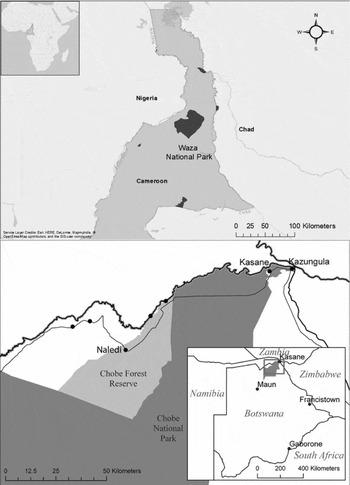
Our case studies pay close attention to how protected areas impact on people and those people's experiences of these areas can shift over time as populations and ecological, political, economic and management conditions change. We trace the social and ecological processes that give rise to local peoples’ lived experiences near parks. Taking into account material and subjective measures of security, we argue that interrogating present as well as past protected area management strategies is critical to understanding how natural resource users within and adjacent to these areas perceive their security in the contemporary context. By presenting the trajectories of two protected areas we researched individually – Waza National Park (Cameroon) and Chobe National Park (Botswana; Fig. 1) – we argue that people's attitudes towards these protected areas have been continually re-shaped by ongoing and intersecting social, political, economic and environmental processes long after the initial creation of these enclosures.
Waza National Park (top) and Chobe* National Park and Forest Reserve (bottom). *Note: Naledi is a pseudonym and not the name of an actual town in this region.

METHODS
The two authors’ fieldwork methods followed similar formats but with slight differences. Both studies involved participant observation, ethnography, targeted interviews and archival research. Both authors primarily interviewed populations living adjacent to their parks of study. ABK invested time with nomadic and transhumance pastoralists while ACG invested time in tracking down migrants from park enclave villages to major cities. ABK did not interview migrants while ACG did not interview pastoralists or people who had been physically displaced from the park (because they did not exist in her study site). ACG performed approximately 200 interviews, held eight focus groups and conducted a village survey of 90 households over 16 months in Botswana. C's village survey used a random sampling method, using plot registration data as the sampling frame, while the interviews conducted in the enclave villages relied on a snowball sampling approach. In addition, ACG collected contact information for family members who had migrated away during the survey, which was then used to contact and interview these migrants throughout the country. ABK interviewed approximately 300 people over a 12-month period in Cameroon. ABK sought to speak with 10% of the estimated households in each village she visited, using a random sampling method within each village to the greatest degree possible. With pastoralist groups and government officials she used a snowball sampling method.
As an additional note, in this study we refer to ‘local people,’ and ‘local natural resource users.’ The term ‘local’ almost anywhere is a fraught term. ‘Local’ is a particularly difficult term in Northern Cameroon where the population is highly mobile, and has been for centuries due to enslavement, war, segmentation of groups, raiding, as well as drought, epidemics, marriage, pilgrimages and long distance trade (Beauvilain Reference Beauvilain1989; Roitman Reference Roitman2005). When we refer to local people, we refer to people who have lived in or married into villages that were historically located within the parks of study and relocated villages that were historically on the parks’ border, and groups of pastoralists who have habitually used this region over long periods of time. Migrants are still considered local in the Botswana case if they maintain familial and economic ties to the villages adjacent to the park of study.
RESULTS
Waza and Chobe National Parks are both located very close to international borders, host similar mega-faunal populations and contain savanna ecologies that are heavily influenced by riverine systems (Fig. 1). Though of vastly differing sizes, both Waza (1700 km²) and Chobe (11 700 km2) have, at different points, gained international scientific recognition and pulled in large numbers of tourists – Waza for its rich biodiversity (as a UNESCO Biosphere Reserve) and Chobe for its prodigious elephant population. However, these two parks have very different histories of enclosure, management and dispossession. While Chobe's enclosure was characterized by the slow and steady attrition of community rights to natural resources, Waza's enclosure was characterized by more typical fortress conservation actions – physical dispossession of local people's land and resource rights, and the violent maintenance of park boundaries.
Waza: Northern Cameroon
Waza pre enclosure
Located approximately 160 km south of Lake Chad, the region that now makes up Waza National Park was critical to material and economic human security in the pre-colonial period. Waza's landscape offered important grazing, hunting, fishing and agricultural land that sustained the livelihoods of the sedentary, semi-nomadic and nomadic peoples who lived in or habitually passed through this area. The wood, wild legumes, tubers, grasses and other natural products found in this region were important parts of daily diets and routines. At moments when crops failed or cattle died off due to drought, the region's wild plants are remembered to be a source of nourishment for these people. Second, just before and throughout the German colonial period (1902–1915), control over the region's land and resources provided political security for Muslim FulBe leaders and their followers for a time (Moritz et al. Reference Moritz, Scholte and Kari2002).
Enclosing Waza
When the Waza region was enclosed for conservation purposes in the French colonial period (1934–1935), its presence was inscribed on the landscape with signs and cement markers delineating reserve boundaries. With the creation of the Zinah-Waza Reserve, the French colonial government physically removed resident populations. The only legally sanctioned users of this space were Europeans – either as scientists, hunters or tourists. With the initial and violent enclosure of the Zinah-Waza reserve, local resource users of many different kinds found their material and food security under threat. The livestock pastures, agricultural lands and fish ponds that had been the basis for local users’ livelihoods were now off limits. Gathering wood, vegetables, grasses and wildlife in the reserve were also criminalized (Scholte Reference Scholte2005, p.75–76). The maintenance of this enclosure continued, and if anything intensified, as Cameroon achieved independence – guards were posted in villages adjacent to the park and park officials regularly patrolled the park, meting out sometimes severe punishments for large-scale violators of park regulations.
The violent management of Waza National Park may have increased security for wildlife populations while decreasing security for its neighbouring human populations’ crops and livestock. While in the pre-colonial period elephants fuelled a thriving ivory market (Scholte Reference Scholte2011), with the strict management of park boundaries and wildlife populations, Waza became a refuge for elephants, animals that had been hunted nearly to extinction in the region by 1910 (Scholte Reference Scholte2011). The number of elephants in the region increased rapidly from one reported in 1947, to 50–80 in 1954, to 600 in 1968, and to over a 1000 individuals in the 1990s (Tchamba Reference Tchamba1996; Scholte Reference Scholte2011). With this dramatic increase in animal populations, local human populations (particularly agriculturally-based villagers) suffered the consequences as homes and crops were frequently destroyed and human life was threatened (Tchamba Reference Tchamba1996). Similarly, well-protected lion populations (100 individuals by 1962) threatened villagers’ and pastoralists’ livestock and were considered threats to human life (Tumenta et al. Reference Tumenta, Kok, van Rijssel, Buij, Croes, Funston, de Iongh and Udo de Haes2010). While human–wildlife conflict almost certainly did occur pre-enclosure, the resettlement of human populations on the borders of the park, a vast safe haven for these wildlife species, made human wildlife conflict a serious issue after the creation of this protected area (Bauer Reference Bauer2003).
Villagers living adjacent to the park feared fines and recriminations for taking natural resources out of the park. Several people remembered park managers searching their homes for evidence of hunting. The jokes, rumors and myths about the stringency of the well-known past managers were numerous. For example, one woman remarked, ‘If a chicken stuck its beak into the park, [the park manager] would know, and that chicken would have to apologize.’
Despite increased material insecurity due to lost lands and resources, wildlife predation of livestock and crops, as well as lost authority over formerly held land, some local users were still able to gain limited relative advantages over others by negotiating access to certain natural resources within the park. These advantages were gained via negotiations based on long-standing relationships with park guards, as well as ethnic, political or spatial affinities with park managers (Kelly Reference Kelly2014). These relationships and advantages were not static – they changed with the ethnic and political affiliations of park guards and managers. Even if they had not gained explicit permission to harvest protected area resources from park guards, local people frequently noted that they could avoid the harshest punishments on the basis of their use for subsistence purposes and their relationships with park management (Kelly Reference Kelly2014). Though this did not mean that park guards and local people always had peaceful, productive interactions – high rates of complaints about park guards and their abuses existed as late as 2003 (Bauer Reference Bauer2003) – it did mean that local, subsistence-oriented, natural resource users had an advantage over more distant commercially-oriented users of the park. It was these more distant natural resource users who faced serious violence or death at the hands of park guards if caught within protected area limits harvesting large mammals. Those natural resource users with the ability to negotiate with park guards were able to gain limited access to certain resources (e.g. fish, grass, legumes, dead and downed wood) within the park in the case of emergency, or for occasional personal use if the need was appropriately expressed (Kelly Reference Kelly2014).
Waza's un-enclosure
In the middle of the first decade of the 21st century the government's strictly maintained protected area began to crumble. Due to a loss of political will on the part of a new national administration focused on the nation's southern regions, as well as a loss of funding at a national level due to economic crisis, and an international level due to shifting conservation priorities (NGOs began focusing more on the country's southern tropical forests rather than savanna), Waza's guards retired or died and were not replaced, roads fell into disrepair, equipment disappeared or broke without replacement. Without the personnel and basic equipment needed for park patrols, the government's management of Waza National Park dissipated. Due to the fact that the park had centralized authority over this space, placing it outside of local authority for almost 70 years, and the fact that they still lacked the legal authority or the means to protect this area, local leaders did not step forward to manage the park. Waza became un-enclosed (Kelly Reference Kelly2014).
Without state or local authority present in this area, local populations lost their relative advantages over commercially-oriented people or natural resource users from further afield. As word got out that the park was unguarded, resource users formerly lacking the means to negotiate access to the park's resources began harvesting these resources at a rapacious rate, making long-time residents of the area seriously concerned about their food security. For example, one villager noted, ‘we used to use things from the park, we could get authorization. We would cut grasses and wood in the park, even though it was illegal. Now there are a lot of people who use the park. We don't like this because we do not have the power to chase them away. . .there are no guards now.’
With a lack of functional government or local authority in this space, local users’ physical security was also threatened. As Waza National Park lost its management it became a base of operations or transit for armed kidnappers, poachers and cattle smugglers. People living adjacent to the park frequently commented on perceived rising rates of violence and theft, as well as new types of violence. For example, kidnapping for ransom had formerly been a relatively rare phenomenon in this area. Pastoralists and villagers interviewed felt insecure in their homes, on the roads and out in the pasture with their livestock. Interviewees described the kidnapping of their children, violence, theft, intimidation, and even rape and murder at the hands of newcomers in the park. Interviewees described these newcomers to be from a variety of displaced groups in the region or unemployed people, all in search of quick money (Kelly Reference Kelly2014). Commenting on the attractiveness of the park as a depopulated and now unguarded space, one man related, ‘We were taken into the park. . .the bandits chose the park because it was isolated. No one there could see them. We were there for 11 days and never saw a park guard. We were given food and it was very bad food to eat but they [the bandits] didn't beat us. The money didn't come so they [the bandits] chose one man to kill and shot him in front of everyone.’
Given these new concerns, local resource users retrospectively recognized the importance of park guards in preserving their physical (bodily), food and material security and reminisced almost fondly about the times strong-handed park managers were in place. For example, one villager reminisced about one of the strictest park managers, ‘[With him] there were soldiers who protected the animals, but more importantly they protected the village.’ Faced with the alternative of the constant threat of kidnapping, theft and violence, strict park management – a form of authority strongly disliked in the past – seemed like the best option for local people to secure their own access to food and physical safety (Kelly Reference Kelly2014).
Chobe: Northern Botswana
Chobe pre-enclosure
Chobe's protected areas – referring to the area now enclosed by Chobe National Park and the nearby forest reserves – were populated by a small spatially disparate group composed primarily of the hunter–gatherer San ethnic group, and, later, members of a timber industry settlement (Spinage Reference Spinage1991). The rich soils of the Chobe floodplains, as well as higher than average rainfall in this region allowed residents living near this area to engage in floodplain agriculture (molapo) as well as dryland (rain-fed) agriculture. Due to erratic rainfall, periodic droughts and destructive flooding, local residents sought to maintain their food, personal and community security by diversifying their farming systems.
Although these diversified farming systems helped increase food security in the region, fluctuations in weather patterns (i.e. flooding and drought) led to alternating periods of plenty and periods of scarce food supply. However, even when crops failed rural dwellers could rely on fish from the rivers and meat from the hunting of wildlife to secure their diets. Concentrated efforts were made to manage wildlife during this time. Villages organised regiments of men to control flooding to prevent crop destruction, kill lions harassing villagers or scare elephants away from the fields.
Enclosing Chobe
The initial establishment of British colonial game laws marked the beginning of a steady but incremental process of enclosure and dispossession in the Chobe region. Local people were dispossessed of their rights to subsist in traditional ways as colonial Botswana's game laws led to greater restriction on an individual's right to hunt and tighter control of the methods of hunting and illegal hunting (Spinage Reference Spinage1991).
The first enclosures for conservation in colonial Botswana were no-hunting areas; areas on Crown land where the hunting of game became forbidden. The first application of this legislation (Sec 1 of Proc 2 of 1907) was in 1924, when all large game was protected for one year on all Crown land north of the Molapo River. By 1940, it became illegal to possess the parts of any game animal without authority or to hunt at night. Furthermore, government officials gained the right to search without warrant when an offence was suspected (Spinage Reference Spinage1991).
Starting in the early 1930s, colonial Resident Commissioner Rey began to lobby for the creation of a Chobe Game Reserve, arguing that it would serve as an excellent tourist attraction and bring in much needed revenue and development to the area (Spinage Reference Spinage1991). Rey's first step was to set aside a new area for conservation for a period of three years in an estimated 15 500 km2 (6000 sq miles) in Chobe district, with a view to declaring a game reserve and eventually a National Park. By 1960 the Chobe Game Reserve, comprised of an area of 15 4000 km2, was gazetted (Spinage Reference Spinage1991, also see Gumbo Reference Gumbo2002 for a detailed history of Chobe National Park).
In 1968 Chobe National Park was the first park to be established in Botswana. Unlike Waza, the creation of Chobe did not result in the removal of humans, as almost no settlements existed within the boundaries of the protected area (Spinage Reference Spinage1991). Carved out of this vast enclosure was the Chobe enclave, consisting of five villages hemmed in between the national park, forest reserves and the Linyanti-Kwando riverine border with Namibia that afforded land for local people to live and continue their traditional (if curtailed) practices of agriculture, hunting and pastoralism.
Local concerns about lost security extend as far back as the initial colonial proposals for a reserve in the Chobe region. Chief Konkwena of Munga voiced his objection to these plans that would prohibit hunting in the area. Writing to the Commanding Officer in Kasane in 1932, his objection came on the grounds that a no-hunting rule threatened his people's personal safety rather than their means to a livelihood or food source. He wrote, ‘Morena, I your servant say that we have heard our law of guns and we are sad. . .We your people have been accustomed to carry guns wherever one wishes to go, we will not be able to walk with only hands. . .Lions this time in winter and we shall be finished, we shall be killed by lions. . .’ (Botswana National Archives S. 238/15)
Although this fear for personal and community safety was the initial basis for arguments against the reserve, like Waza this protected area also threatened local livelihoods, further affecting security. Under conservation law, farmers had to abandon grazing areas and cattle posts located within the boundaries of the game park and forest reserve. Hunting, fishing and collecting natural resources were prohibited within the nearby forest reserves. Outside of the reserves, villagers were required to buy a permit from the district government to conduct these activities (Gumbo Reference Gumbo2002). At an African Advisory Council meeting in 1952, the chief from Chobe, Konkwena, further complained that hunting restrictions had brought tsetse fly into the Chobe region (because of the abundance of game) and that people were arrested for carrying arms, regardless of whether or not they were out hunting (Botswana National Archives S. 243/22).
Over the next several decades, villagers were banned from expanding communal grazing lands because such expansion would be deemed encroachment on the reserves (Mosetlhi Reference Mosetlhi2012). They found themselves unable to sell their livestock to the highly lucrative (and subsidized) European Union (EU) market as the rest of Botswana does because animals in proximity to wildlife cannot be certified as hoof-and-mouth disease free, as the EU market requires. Furthermore, livestock were (and continue to be) preyed upon by wild animals, which are protected under game laws and cannot be shot even in self-defense (Gumbo Reference Gumbo2002; World Bank, unpublished data 2009).
In addition to the vast 10 100 km2 Chobe protected area, in 1974 proposals were made for a new form of enclosure in the region. These would take the form of land termed Wildlife Management Areas that would exclude forms of land use such as agriculture or grazing in order to maintain viable wildlife populations. These areas were extended to cover 22.6% of the country under the 1986 Wildlife Conservation Policy and divided into zoned Controlled Hunting Areas (CHAs; Government of Botswana Reference Botswana1986).
As a result of this new legislation, Chobe enclave residents’ livelihoods and rights were further curtailed as the enclave was zoned into a CHA. Today the Chobe Enclave Community Trust, established in 1993, ostensibly manages the CHA. Chobe Enclave Community Trust (CECT) is a community organisation set up to manage natural resources in the five enclave villages. Yet villagers’ rights over wildlife remain highly circumscribed and communities remain passive recipients of royalties from wildlife tourism operations owned by outsiders (Gupta Reference Gupta2014). Villagers have not escaped a colonial legacy in which wildlife management remains primarily in the hands of state wildlife officials and wildlife is widely regarded as the property of the state (Gupta Reference Gupta2014).
By 2001, natural resources were estimated to contribute only 5% of household total income (including the value to households of their own production) from all livelihood activities in the Ngamiland and Chobe districts of Northern Botswana (BIDPA 2001).
From resistance to resignation: evolving attitudes towards Chobe
As in the Waza example, Chobe enclave residents accepted (however bitterly) state-centralized control over natural resources, including land and wildlife. By 2010, normal practices regarding reciprocity between villagers and collective responsibility for wildlife management had been replaced by an overall sentiment that wildlife was the property of the state and that the state, not the villagers, should be responsible for its management. While many younger residents did not remember a time when communities were responsible for land and resource management, elders in the village reported that traditional wildlife management practices had gradually dissolved under colonial rule and no longer existed. When asked if village wildlife management groups existed today to scare off crop-raiding animals, one woman explained, ‘There is no one. Such things are no longer there [for] my children. . .there are no people [in the village] who would do that. People have left. Even the chiefs have stopped practicing laws from the past. . .If they [villagers] would kill the animals, [they would] go to jail. . .it comes down to money. And Wildlife Department is the one that takes care of animals’ (A. C. Gupta, personal communication 2010).
International conservation organisations have tried to recreate wildlife-based livelihoods and re-establish the collective will for sustainable wildlife management over the last 20 years. Yet today, most village residents still do not view wildlife as accessible or as contributing to their livelihood security. The CECT's members are only vaguely cognizant of the fact that safari companies lease land from their community and that their organisation is involved in the management of tourism-related funds. Although people recognized that the CECT provided the village with a few community benefits, such as tractors for plowing and financial support for various civic groups in the village, most villagers reported that they did not see the CECT as bolstering their livelihood security. Community management of wildlife in Chobe plays a smaller role in compensating for wildlife-related damage to livelihoods in the Chobe enclave than government welfare provisioning policies and the remittances that flow to villagers from family members working outside the villages (Gupta Reference Gupta2013; Gupta Reference Gupta2014).
Losing out to elephants: issues of food and livelihood security for Chobe farmers
With the strict management of Chobe National Park, incremental dispossession of villagers of their livelihood security has increased. Research in 2009/2010 in the Chobe enclave revealed that despite 16 years of project efforts, villagers, particularly those living along migration corridors, associate wildlife with the worsening of agricultural livelihoods in recent years. This perception is driven by conflict with wildlife that frequently destroy agricultural crops, a problem locally perceived to be increasing (Gupta Reference Gupta2014). Data from the Department of Wildlife and National Parks show that the number of elephant conflict reports in a village located in the Chobe enclave rose dramatically over a 10 year period (K. Alexander, unpublished data 1998–2008). Botswana's elephant population has increased 16-fold over the past 50 years, to an estimated 133 829 individuals, with 70–80% of the population living outside of Chobe National Park (World Bank, unpublished data 2009). The increasing threats elephants pose to agricultural crops as well as the threats to livestock posed by predator populations have renewed local residents’ rancor towards the park. Resignation to state control over wildlife does not mean that residents are resigned to the livelihood costs that they believe wildlife incurs.
While not the sole reason for agricultural decline in the Chobe enclave, the protected area has nonetheless greatly reduced the role that agriculture can play as a safety net for the rural poor and as a buffer against external shocks to a rural household's livelihood portfolio (BIDPA 2001). As a result, residents now find themselves increasingly reliant on government transfers and remittances from family members working outside the enclave to survive (Gupta Reference Gupta2013; Gupta Reference Gupta2014). While some of these remittances come from family members working in the wildlife-based safari tourism industry – suggesting one way in which the park provides livelihood benefits – remittances represent a source of income over which rural residents feel they have little control. Residents repeatedly reiterated urban kin could not always be relied upon to support them, making remittances an undependable source of income. Migrants themselves face economic insecurity as they are increasingly expected to send remittances back home to support their families while facing the high costs of urban living (Gupta Reference Gupta2014). In this way, the park has contributed to material, economic as well as food insecurity, as rural residents now must depend on this inconsistent support to survive and urban kin must stretch their salaries to help them do so.
Chobe National Park also has an ‘invisible’ effect on the cultural security of local residents. While government transfers and remittances provide a limited degree of economic security for Chobe enclave residents (Gupta Reference Gupta2013; Gupta Reference Gupta2014), most villagers see farming as a main element of life and as integral to their own cultural identity. Threats to agrarian livelihoods from wildlife thus represent a threat to an important non-material perceived sense of security. Both residents and migrants originating from Chobe consistently articulate that farming is ‘an African tradition’ that should be continued, despite the challenges. There is a strong collective sense that personhood is deeply rooted in a tradition of involvement in agricultural activities, a sentiment that indicates the importance of land for cultural and economic security.
Thus, while people's homes and farms were not displaced from Chobe National Park, they are increasingly dispossessed of material, economic as well as food and community security as their cultural traditions of farming fade due to a loss of labour to the tourism industry (and urban work more broadly) and as the uncertainties they face (e.g. variable climate, global/national food prices) are exacerbated by the region's protected area status.
DISCUSSION
In keeping with the standard political ecology literature on protected areas, both the Waza and Chobe cases show that the initial creation of protected areas posed insecurity for their neighbouring populations, though to varying degrees of severity. From this point on, however, the discussion of security in each place begins to diverge. Using these two protected areas as examples, we have demonstrated that as people–park relations change over time, so too do nearby residents’ or resource users’ understanding of how these spaces impact their own security. The examples of Chobe and Waza show that conservation measures that various subsets of the local population once considered to be ‘bad’ (e.g. violent, exclusionary protected area creation) may be construed as ‘good’ at different historical moments and geographical areas. Similarly, complacency or resignation to the presence of a park can be reversed by changing environmental conditions (e.g. the increase of elephant populations). As Schnurr and Swatuk (Reference Schnurr and Swatuk2012, p. 7) point out, ‘Security’ looks very different depending on the filter one uses to view and interpret these events.’
Though we have used Chobe and Waza to describe the shifting and relational understandings of security and protected areas, these cases do not stand in isolation. As others (Greenough [Reference Greenough and Slater2003] and Dunn [Reference Dunn2009]) have shown, Waza is not the only protected area that over time has become a site for violence in the absence of effective management. Chobe is also not the only protected area where park management that has been effective in protecting large mammal populations has increased feelings of economic and physical insecurity in surround communities (Hayward & Somers Reference Hayward and Somers2009; Muhly & Musiani Reference Muhly and Musiani2009). While these cases and myriad others show that protected area creation and management do not follow a single storyline in terms of security for local populations, much of the current discourse around people and parks remains mired in debates over human security and well-being that rely on indices rooted in pre-determined benchmarks that do not necessarily account for change over time (see UNDP 2010 for a synthesis of existing analyses). While straightforward and easy to apply across widely varying regions, standardized indicators of security and well-being risk overlooking the subjective nature of these concepts in different places, historical moments and geopolitical/ecological milieus.
Thus, we call for a new approach to understanding protected areas, security and well-being. Such an approach would begin with people's lived experiences, and just as importantly, their perceptions of those experiences compared with past experiences over time. Furthermore, given local populations’ ever-changing perceptions of security in relation to protected areas, such assessments could not be static, but would necessitate ongoing engagement by managers or researchers interested in these issues. Just as protected area management plans must continuously adapt as new understandings of the ecological shifts associated with global climate change come to light, we argue that such plans should also continuously take into account shifts in a protected area's social, political and economic context. While adaptive management of all kinds is costly and time consuming, it is the only means by which human and ecological security can truly be consistently protected over time.
Acknowledging the calls for taking local communities into account before and during the creation of protected areas, here we argue that this initial moment of consideration represents only the first step in a long journey. As the Waza case shows, the abandonment of these areas far down the road can lead to frightening and even deadly consequences for local populations. As the Chobe case shows, the good management of a park can still create feelings of insecurity that must be addressed in a culturally sensitive manner. The creation of a protected area is not easily undone – land tenure, food and economic security, ecologies and subjective understandings of security are all altered by such an act – thus, those who create protected areas must understand that such an action is a long-term and ongoing commitment, not a quick solution to global environmental issues.
ACKNOWLEDGEMENTS
The authors wish to thank the residents of villages near Chobe and Waza National Parks for their time, insights and generosity. The authors are also grateful for feedback on previous drafts from Daniel Suarez, Merrill Baker-Medard, Hekia Bodwich, Kelly Easterday as well as our three anonymous peer reviewers. Funding for this research was provided by National Science Foundation, Award Nos. 1215762 and 1314091. The funders played no role in study design or the decision to submit this article for publication. The authors have no conflict of interest.