INTRODUCTION
Although the United States is religiously pluralistic, not all religious groups enjoy high levels of public approval and support. Indeed, American history is replete with examples of religious groups (for example, Catholics, Jews, and Jehovah's Witnesses), which have suffered discrimination or worse at the hands of the nation's religious majorities. Not surprisingly, groups that are perceived as new, as unusual, and/or as threatening to the existing religious establishment or culture have tended to fare the worst.
Two religious groups that have faced major challenges in winning public acceptance and approval in the United States are Muslims and Mormons.Footnote 1 For various reasons, members of both groups have been widely perceived as posing cultural, political, and theological threats to the “status quo” in the United States.
Muslims have faced particularly large obstacles in the United States. Mainstream America and, in particular, its large Christian populace, has never been completely comfortable with Islam. Theological and political conflict between Islam and Christianity, of course, is not new, with roots traceable at least as far back as the Crusades of the 11th–13th centuries. In the United States, these historical tensions have been exacerbated by perceived social and political differences between Muslims and mainstream America. Fair or not, Americans have tended to associate Muslims with such potentially threatening fringe groups as Black Muslims (Monitor 2008) and Arab extremists (Esposito Reference Esposito2008). Ignorance of Muslims may play a role in this negative stereotyping; surveys reveal that relatively few Americans have high levels of knowledge of Islam and few personally know a Muslim or interact with Muslims on a regular basis (Penning and Smidt Reference Penning and Smidt2006).
The terrorist attacks of September 11 highlighted and perhaps enhanced existing tension between Muslims and non-Muslims in the United States. Indeed, there is evidence that the September 11 attacks had a major impact on American public opinion, generating considerable antipathy, and distrust among the American populace toward Islam and its followers. Following the September 11 attacks, an ABC News poll showed, for example, that 34% of Americans agreed that mainstream Islam encourages violence, an increase of 20% over previous poll results (Hansen Reference Hansen2005). Although anti-Islamic sentiment in the general public diminished to slightly less than 20% following President Bush's well-publicized post-September 11 call for religious tolerance (Pew Reference Pew2001), it by no means disappeared. In the immediate aftermath of September 11, Muslims in the United States were subjected to considerable verbal and even physical abuse that some fear have created social and political wounds that will be difficult to heal (Relations 2006; Walsh Reference Walsh2006).
A second religious group that has failed to achieve full acceptance in the United States consists of Mormons. Despite the fact that, unlike Islam, Mormonism is a “home grown” American religion, Americans have never fully embraced the religion. Americans' antipathy toward Mormons can be traced almost to the religion's inception. During the 19th-Century, Joseph Smith and his followers were driven out of settlements in Ohio, Illinois, and Missouri before, under the leadership of Brigham Young, fleeing to the relative safety of Utah (Arrington Reference Arrington1992).
Tension between Mormonism and mainstream America likely has both cultural and theological roots. The tendency of Mormons, particularly in the 19th-Century, to separate themselves into distinct and occasionally isolated communities, to favor distinctive forms of dress, and to engage in the practice of polygamy marked them as “unusual,” to say the very least (Arrington Reference Arrington1992). American Protestants frequently found Mormon theology to be problematic. Particularly nettlesome to more traditional Christians were such Mormon practices as elevating the Book of Mormon to biblical status and engaging in polygamy. A major impediment to Utah's admission as a state into the Union was the Mormon practice of plural marriage (Thatcher Reference Thatcher2008).
Americans today are not uniformly hostile to Muslims or Mormons. In 2006, for example, the citizens of Minnesota's fifth congressional district elected Keith Ellison to the United States House of Representatives, making him the first avowedly Muslim member of Congress. Nonetheless, recent research has demonstrated considerable bias against Muslims in American elections (Sinno and Lawson Reference Sinno and Lawson2008). Moreover, experimental research has revealed that having a distinctively Arab-sounding name, often associated with Islam, has a negative impact on Americans' support for candidates for public office (Kalkan and Layman Reference Kalkan and Layman2008).
Mormons too have, at times, done well in the electoral arena, particularly in areas of relatively high Mormon populations. For example, Church of Jesus Christ of Latter-day Saints (LDS) politicians such as Morris Udall, George Romney, and Harry Reid have achieved considerable electoral success. On the other hand, the recent presidential candidacy of Mitt Romney, a Mormon, demonstrated that American distrust of Mormonism is alive and well. In the nominating process, Romney was repeatedly asked pointed questions about his religion and his religious practices, and felt it necessary to make public statements explaining and defending his religious views. Despite the fact that Romney is a Republican, he had difficulty gaining acceptance from evangelical Christians, one of the Grand Old Party's (G.O.P.'s) core constituencies (Green et al. Reference Green, Rozell and Wilcox2003; Oldfield Reference Oldfield1996). A recent poll revealed that nearly half (45%) of evangelical Christians in the United States do not consider Mormons to be Christians (Pew Reference Pew2008). Moreover, following voter approval of the 2008 California gay marriage ban, Proposal 8, Mormons suffered harsh verbal attacks from the Proposal's opponents for their alleged role in its passage.
To summarize, while Muslims and Mormons are exceedingly distinct religious groups, they share some important characteristics, at least in the American context. First, both Muslims and Mormons tend to be viewed by Americans as culturally, politically, and theologically “different” or “unusual,” existing in good measure outside of the mainstream of American life. And, second, perhaps because of this, at various times, both Muslims and Mormons have suffered political discrimination, verbal attack, and physical abuse in the United States. America's religious tolerance, apparently, has its limits. On the other hand, Americans are not uniformly hostile to either Muslims or Mormons. As discussed below, there are important theological and cultural differences between Islam and Mormonism that have the potential to shape the public acceptance of group members.
WHY STUDY ATTITUDES TOWARD MUSLIMS AND MORMONS?
There are several important reasons for examining Americans' attitudes toward Muslims and Mormons. First, Muslims and Mormons are relatively large and rapidly-growing groups in the United States. According to the Yearbook of American and Canadian Churches (Dunn Reference Dunn2008; Yearbook 2008), the Church of Jesus Christ of Latter-day Saints was second only to the Jehovah's Witnesses in percentage growth during the year 2007, with a current membership approaching 6 million. Moreover, since the year 1990, the number of Mormons in the United States has more than doubled (Statistical Abstract 2008).
Estimates of the number of Muslims in the United States are less precise, in part, because of vested political interests (Religious Tolerance 2008). Thus, we find wildly varying published estimates of the American Muslim population, ranging from as low as about 1.6 million to as high as 12 million. Probably the most accurate estimates of the Muslim population are between 1 and 2 million adherents (see, for example, Adherents.com 2007). United States Census data suggest a rapidly growing Muslim population in the United States, one that has more than doubled in size over the past decade (Statistical Abstract 2008).
A second reason for focusing on attitudes toward these two groups is that both Muslims and Mormons are enjoying increasing political clout in the United States and have a growing potential to influence American public policy in key areas (Meernik and Ault Reference Meernik and Ault2001; Hill Reference Hill1993). Since September 11, for example, Islam has become a growing topic of public conversation in the United States and American foreign policy has become increasingly attentive to strategic considerations related to politics in the Middle East. There is evidence that Muslims not only tend to have a particular interest in American policy toward the Middle East but that they have growing political influence as well (Matters 2001). As noted above, this influence was signified by the 2006 election of Keith Ellison (D-MN), the first Muslim to serve in the United States House of Representatives.
Mormons are also playing an increasingly important role in American politics and policy-making, though their role is less closely tied to foreign policy (Marrero Reference Marrero2008). Their political impact is not confined to the State of Utah, where Mormons exercise a form of religious hegemony. For example, Senator Harry Reid of Nevada, Majority Leader of the United States Senate, is a Mormon. And, as noted above, former Massachusetts Governor and United States presidential candidate, Mitt Romney, is an adherent of the Mormon faith. In the new (111th) Congress (House and Senate), there are 14 Mormon members, constituting 2.6% of the total membership. In comparison, Mormons constitute only 1.7% of the total adult American population (Pew Reference Pew2008).
A third reason for examining Americans' attitudes toward Muslims and Mormons is theoretical and scholarly in nature. Such an effort has the potential for increasing our understanding of the roots of attitudes toward religious groups, thereby contributing to the “religion and politics” literature. In particular, examining views of Muslims and Mormons may contribute to our understanding of the roots of tolerance or intolerance of religious groups. While the literature on religion and tolerance in the United States is vast (Busch Reference Busch1998; Eisenstein Reference Eisenstein2008; Gibson Reference Gibson2006; Green et al. Reference Green, Guth, Kellstedt and Smidt1994), relatively few studies have explicitly and comparatively examined attitudes toward Muslims and Mormons, and very few, if any, have sought to explain those attitudes.
This article seeks to increase our understanding of Americans' attitudes toward Muslims and Mormons. In particular, it focuses on the following questions: (1) How do Americans today view Muslims and Mormons? (2) How, if at all, have those views changed over time? (3) How much overlap is there between persons opposing Muslims and persons opposing Mormons? and (4) How can we best explain Americans' attitudes toward Muslims and Mormons?
MUSLIMS, MORMONS AND SOCIAL IDENTITY THEORY
The basic theoretical approach utilized in this article is social identity theory, a theory that links information processing to attitudes toward social groups (Tajfel Reference Tajfel1982; Hogg Reference Hogg, Leary and Tangney2003). The theory was first developed in the 1970s by Tajfel and Turner (Reference Tajfel, Turner, Worchel and Austin1979) as a way to better understand the psychological bases of inter-group hostility and discrimination (Callero Reference Callero and Ritzer2007).
According to social identity theory, the individual's self-concept is, in large measure, a product of perceived membership in social groups (Hogg and Vaughan Reference Hogg and Vaughan2002; Twente 2008). The theory suggests that “a person has not one, ‘personal self,’ but rather several selves that correspond to widening circles of group membership” (Twente 2008, 1). Thus, social identity theory posits that in order to understand human motivation and behavior, we must go beyond studying individuals simply as individuals and must understand how, when and why individuals define themselves in terms of their group associations (Bellanca Reference Bellanca2008, 1). However, social identity theory does not completely disregard the importance of individual differences. Tajfel argued that individual behavior can be represented as a bi-polar continuum, ranging from an interpersonal pole (behavior determined by character and goals) to a group pole (behavior determined by group memberships) (Bellanca Reference Bellanca2008) Thus, understanding human behavior requires one to assess complex interactions between individual and group factors as well as the social environment.
Tajfel and Turner (Reference Tajfel, Turner, Worchel and Austin1979) argue that there are three processes involved in making inter-group distinctions. The first process, social categorization, involves mentally assigning people into particular categorical groups (e.g., black, white, Muslim, Christian, police officer, teacher), in part, as a means for reducing the burdens associated with information gathering and decision-making. Scholars have long noted that people employ various “shortcuts” as a way to process the continuous stream of information that confronts them in their daily lives. Some information may be old and easily processed. Other information may be new, but familiar in terms of its subject matter, and thus easily comprehended and evaluated. Still other information may be new and complex, and people presenting such information may provide conflicting assessments of the meaning, importance, and likely consequence of that information. Moreover, the time needed to gather information to make informed decisions on a topic frequently is quite limited. And yet, despite these difficulties, one is often called upon in politics to make evaluative decisions on complex matters of public policy. The process of categorization serves as a time-saver, permitting one to quickly associate group characteristics with individuals (Psychology 2008).
Second, Turner and Tajfel suggest that individuals employ group memberships as a source of social identification. That is, we adopt the identity of the group or groups to which we consider we belong. Such self-conceptions can have important cognitive and behavioral consequences. For example, if we identify ourselves as New York Yankees fans or as Democrats we may begin to act as we perceive Yankee fans or Democrats should act. Moreover, by identifying with a particular group or set of groups, one may develop an enhanced sense of self-esteem (Holah and Davies Reference Holah and Davies2008).
A third, and closely related, process identified by Turner and Tajfel (1979), social comparison, involves comparing one's “own” social group(s) to others. Since groups vary in terms of such factors as social status, belief systems, and behavior, comparing one's group to others may help to facilitate the creation of self-identity and to develop boundaries between the self and others.
In today's rapidly-changing political environment, how do persons choose to organize and evaluate information about groups, people, and nations about whom they may know relatively little? Social identity theory suggests that one way is to compare groups in terms of “us,” groups to which they belong or with which they identify, and “them,” groups external to themselves (Fiske and Taylor Reference Fiske and Taylor1991; Gamson Reference Gamson1995). In processing information, this “us” may be a family, an ethnic group, a political party, a religious group, or a nation.
Various scholars contend that this process of comparing groups on the basis of perceived shared characteristics is natural, and somewhat automatic (Fiske and Taylor Reference Fiske and Taylor1991; Nesdale et al. Reference Nesdale, Durkin, Maass and Griffiths2004) but that it has some important consequences in how it shapes the information processed. First, it diminishes perceptions of in-group diversity by focusing on what unites the collectivity and, second, it exaggerates the differences between the in-group and the out-group (Fiske and Taylor Reference Fiske and Taylor1991). Some research (Conover, Mingst, and Sigelman, Reference Conover, Mingst and Sigelman1980) suggests that, particularly in times of conflict or political uncertainty, there may be even greater pressure to view members of opposing groups as being aggressive, hostile, and possessing qualities antithetical to those of one's own group.
There is evidence that the process of social comparison may have important political consequences. Nincic and Russett (Reference Nincic and Russett1979), for example, have found that Americans express more positive assessments of countries with which they share common religious, racial, or ethnic characteristics — or even similar political or economic structures. In addition, Greene (Reference Greene2004) found social identity theory to be a powerful tool in understanding the development and maintenance of political party identification.
This article suggests that social identity theory may prove to be exceedingly useful in understanding Americans' attitudes toward Muslims and Mormons. As noted above, there is good reason to believe that most Americans tend to view the two religions as unusual and even potentially threatening — in other words, as out-groups. It is not difficult to imagine, for example, that a majority of American might view Muslims as an out-group (Rowatt et al. Reference Rowatt, Franklin and Cotton2005). Despite the growth of Islam in the United States, relatively few Americans are Muslims and much of the information coming from the Middle East tends to be negative in nature. The situation with respect to Mormons is more complex, in part, because Mormonism is a distinctively American religion, at least in terms of its origins. Furthermore, there is arguably greater theological overlap between America's more traditional Christian groups (for example, evangelical and mainline Protestants) and Mormonism than there is between those groups and Islam. Nonetheless, the theological and cultural gaps between Mormons and non-Mormons in the United States may also be sufficiently large to permit categorization of Mormons as members of an out-group.
In recent years, Americans have been confronted with complex political decisions with respect to both Muslims and Mormons. These decisions have implications that extend beyond ordinary electoral politics. For most Americans, the September 11 terrorist attacks were unexpected and shocking, forcing them, in short order, to evaluate individuals and groups (in this case, Muslims), which had been largely off their personal “radar screens.” Similarly, although in a less dramatic fashion, the prominent presidential candidacy of Mitt Romney, and more recent controversies concerning Fundamentalist Latter-day Saints (FLDS) groups in the Southwest, have challenged Americans to develop and/or reconsider their views of Mormons. Thus, to the extent that Americans employ the process of social categorization, group identification, and social comparison, social identity theory has the potential to facilitate our understanding of attitudes toward Muslims and Mormons. Indeed, this would appear to be precisely the type of endeavor for which social identity theory is ideally suited.
Using social identity theory, this article develops and tests three hypotheses. These hypotheses are not intended as an exhaustive list of all possible hypotheses. Rather they are intended as heuristic or exploratory devices, suggesting a variety of ways in which social identity theory might profitably direct our efforts to enhance our understanding of Americans' attitudes toward Muslims and Mormons.
HYPOTHESIS 1:
Americans will tend to hold more negative views of Islam and Mormonism than they hold concerning most other religious groups.
Rationale: As noted above, both Muslims and Mormons exhibit both cultural and theological qualities that mark them as distinct groups in American society. And each group has, at one time or another, suffered at the hands of mainstream America. Recent controversies regarding adherents of both religions may well have brought the distinctive nature of both groups into sharper focus. Social identity theory would suggest, then, that Americans would tend to view Muslims and Mormons as members of out-groups and those recent controversies might have a tendency to reinforce those perceptions.
HYPOTHESIS 2:
Evaluations of American Muslims and Mormons will tend to be more positive than evaluations of Muslims in general.
Rationale: Social identity theory suggests that persons' evaluations of individuals or groups tend to be closely related to their perceptions of individual or group characteristics. In particular, individuals or groups perceived as socially, politically or theologically similar to a respondent, tend to be perceived more favorably than are those perceived as being different. In the case of American Muslims or Mormons (members of a distinctively “American” form of religion), association with the American nation may serve to bring members of a particular out-group closer to an in-group category — namely, the American people or nation as a whole. Thus, we would anticipate that assessments of American Muslims and Mormons would likely be more positive than assessments of Muslims or Islam as a whole.
HYPOTHESIS 3:
While social, political, and religious variables will all help us explain variation in Americans' attitudes toward Muslims and Mormons, religious variables will tend to have the greatest explanatory value.
Rationale: While the process of social group categorization may be a relatively common phenomenon, the nature of the way in which an out-group is viewed is likely to be important. In particular, there are different ways in which Muslims and Mormons can be viewed as out-groups. Muslims and Mormons might be seen largely as reflecting a different kind of civilization or cultural system, a different approach to politics, or competing religious faiths. Thus, one can reasonably expect that social, political, and religious variables might all play a role in shaping American's attitudes toward Muslims and Mormons.
First, one would expect that a variety of social variables might well affect attitudes toward Muslims and Mormons, if only because those variables have been found to be associated with levels of tolerance and compassion. For example, one might anticipate that levels of education would be related to favorable assessments of Muslims and Mormons. Education has been consistently shown to be positively related to political and social tolerance, support for dialogue, higher levels of knowledge, and understanding of “out-groups” (Glaser Reference Glaser2006; Vogt Reference Vogt1997). Thus, one would expect that those persons with higher levels of education would be less prone to support the negative stereotyping of “out-groups.”
One might also anticipate that sex would be related to views of Islam and Muslims. While the relationships between sex and socio-political attitudes such as tolerance and compassion are complex and somewhat contradictory (Hart Reference Hart2006; Eagly and Crowley Reference Eagly and Crowley1986; Golebiowska Reference Golebiowska1999), some research has shown that, for a variety of reasons, women tend to be more compassionate and non-violent than men (Batson et al. Reference Batson, Chang, Orr and Rowland2002; McFarland and Rhoades Reference McFarland and Rhoades1998; Shapiro and Mahajan Reference Shapiro and Mahajan1986; Stambor Reference Stambor2006). In addition, women, as members of a traditionally oppressed group, might possess a particular sensitivity to members of out-groups such as Muslims and Mormons. Thus, one might anticipate that women would be somewhat less likely than men to hold negative, hostile, or combative attitudes toward Muslims and Mormons. One might make similar arguments concerning race, suggesting that African-Americans and Hispanics, historically members of out-groups in the United States, might tend to be more supportive of Muslims and Mormons than would members of majority groups.
Another socio-economic variable that might help us explain attitudes toward Muslims and Mormons is respondents' level of knowledge of the religions. While one must avoid simplistically associating knowledge and attitudes toward religious groups, there is some evidence that higher levels of knowledge of out-groups is indeed positively related to increased understanding, tolerance and empathy (Boase et al. Reference Boase, Horrigan and Rainie2004; Boldi Reference Boldi2007; Godwin et al. Reference Godwin, Godwin and Martinez-Ebers2004). Second, one might also expect political variables such as party identification and political ideology to have an impact on Americans' attitudes toward Muslims and Mormons, although in a somewhat different fashion for each group. For example, social identity theory would suggest that members of the Democratic Party, with its arguably greater emphasis on the rights of minorities and related out-groups, might prove to hold somewhat more positive views of Muslims and Mormons than would Republicans. However, it is also possible that the tendency of today's Mormons to be politically and culturally conservative might temper the potential hostility of Republicans and conservatives toward Mormons.Footnote 2
Finally, one might expect religious variables to be particularly important in shaping attitudes toward Muslims and Mormons. One likely reason for this is that Muslims and Mormons are themselves religious groups. But what specifically about religion is likely to shape those attitudes? Several aspects of religion may well prove to be important.
Previous research suggests that religious tradition may matter. For example, there is evidence that evangelical Protestants in the United States tend to hold particularly negative views of Muslims (Penning and Smidt Reference Penning and Smidt2006). Why might this be the case? First, while evangelical Christians have long exhibited a certain degree of hostility toward Muslims, the September 11 attacks appear to have intensified that hostility. In a content analysis of evangelical books published before and after September 11, Cimino (Reference Cimino2005) found that there was a noticeable change of emphasis and perspective on Muslims after the attacks, with most of the post-September 11 literature drawing sharper boundaries between Islam and Christianity and contending that Islam is basically a violent religion. Of course, not all evangelicals necessarily share this perspective, and many evangelicals regret that Islam and its followers “have become the modern-day equivalent of the Evil Empire” (Goodstein Reference Goodstein2005, 3–4).Footnote 3 For example, Richard Cizik, former Vice-President for Governmental Affairs of the National Association of Evangelicals (NAE), recently bemoaned the “stridency of a young generation of evangelicals in politics, in whose rhetoric Islam has often replaced the now-defunct Soviet Union as a foe” (Siemon-Netto Reference Siemon-Netto2005, 2–3).
In addition, despite a tendency for evangelicals and Mormons to share conservative political and cultural values, evangelicals have also demonstrated considerable distrust of Mormons and the LDS Church (Waligorski Reference Waligorski2008; Neff Reference Neff2008; Sullivan Reference Sullivan2005). Indeed, there is evidence that although Mormon G.O.P. presidential hopeful Mitt Romney did unexpectedly well among evangelicals in northern states (CNN 2008), this distrust contributed to his relatively poor showing against Baptist Mike Huckabee in southern state primaries (Kranish Reference Kranish2008).
One might also anticipate that respondents' degree of religious commitment would matter, with more highly committed Christians and Jews tending to exhibit more negative attitudes toward Muslims and Mormons than those who are less committed religiously. Clearly Islam and Mormonism represent, at least potentially, alternative religions and competing faiths to the Jewish and Christian faiths. Consequently, regardless of religious expression within the faith tradition, one might expect that those Christians and Jews who exhibit higher levels of religiosity would likely assess Islam more negatively than those who exhibit lower levels of religiosity.
DATA AND METHODS
The data used here are drawn primarily from the August 2007 Religion and Public Life Survey sponsored by the Pew Research Center for the People & the Press and the Pew Forum on Religion and Public Life (conducted by Princeton Survey Research Associates). This poll is among a series of national telephone surveys sponsored by Pew. Like most Pew surveys, this survey has a large “N” (of 3,000+ respondents) and a national focus.
What makes the August 2007 Pew poll especially useful for the purposes of this article is that its primary focus is on Americans' views of several key religious groups, including Muslims and Mormons. While, as noted below, a number of national surveys have examined Americans' views of Islam and Muslims (particularly since September 11), relatively few have examined attitudes toward Mormons. And no other existing survey permits the extensive, current comparison of attitudes toward Muslims and Mormons that the 2007 Pew survey permits.Footnote 4
Additional data, pertaining particularly to Muslims are drawn from five national Washington Post-ABC news polls conducted during the 2001–2006 time period. While these polls contain only a limited number of questions pertaining to Muslims and Mormons, pertinent data are used wherever possible.
FINDINGS
Americans' Views of Religious Groups
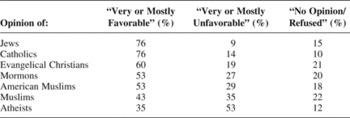
In order to assess Americans' attitudes toward Muslims and Mormons, it is useful to examine the broader pattern of attitudes toward religious groups in the United States. That is, it is helpful to ask how various religious groups compare with each other in terms of public approval. Table 1 helps us examine this question by presenting Pew “favorability” data for a variety of religious groups (plus Atheists).
Americans' Opinions of Religious Groups

Source: Pew Religion and Public Life Survey, August 2007.
From Table 1 it is apparent that Americans hold widely divergent views of various religious groups. At the top of the “favorability” list are Jews and Catholics, with each group receiving a “very favorable” or “mostly favorable” rating from over three-quarters of the respondents. Jews are ranked at the top of the list, however, because a slightly lower percentage of respondents placed Jews in the “unfavorable” category than did so for Catholics. Nevertheless, the differences between the two groups are relatively minor. Evangelical Christians also receive favorable ratings from solid majorities of respondents (60%), although they do not fare as well as their Jewish and Catholic counterparts.
On the other hand, only bare majorities of respondents gave “very favorable” or “mostly favorable” ratings to Mormons or American Muslims, with each group receiving a 53% approval rating. Slightly over a quarter of respondents gave “very unfavorable” or “mostly unfavorable” ratings to members of the two religious groups, although American Muslims fared slightly worse than did Mormons.
Only a plurality (43%) of the respondents gave Muslims “very” or “mostly favorable” ratings and over a third (35%) assigned them “very unfavorable” or “mostly unfavorable” ratings. These findings comport well with our predictions, based on social identity theory, which Mormons and American Muslims would tend to receive higher approval ratings than would Muslims in general. This suggests the possibility that association with positive national symbols such as “American” may indeed help to mitigate or soften negative perceptions of religious groups. Thus, Table 1 provides evidence in support of H1 and H2. The table supports the first hypothesis' prediction that Americans will hold more negative views of Muslims and Mormons than adherents of other religions. And it also supports the second hypothesis' prediction that Americans' evaluations of American Muslims and Mormons will tend to be more positive than their views of Muslims in general.
The only group that received a lower favorability rating than Muslims in Table 1 was atheists, arguably not a religious group at all. Indeed, unlike members of all of the other groups, atheists were viewed unfavorably by a majority of respondents (53%). Apparently, then, Americans tend to give a degree of credit to persons with religious beliefs, even if those beliefs may be markedly different from their own.
While it is important to recognize that Americans tend to view Muslims and Mormons more negatively than they view members of other religious groups, it is also important to ask whether Americans who hold negative views of Muslims tend to be the same persons who hold negative views of Mormons. Or, to put it differently, we need to know the extent to which Americans tend to make key distinctions between Muslims and Mormons.
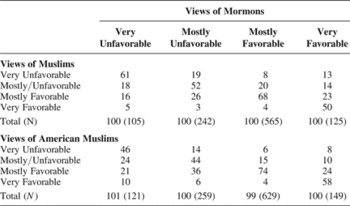
Table 2 helps us examine this question by reporting cross-tabulations between views of Muslims and views of Mormons. The top half of Table 2 reveals that the correlation between the two variables was relatively high (τb = 0.43) and statistically significant (p < 0.001). There is considerable overlap between respondents who reported holding negative views of Muslims and those who reported holding negative views of Mormons. For example, 63% of respondents who held very unfavorable views of Mormons also reported holding very unfavorable views of Muslims. The converse was also largely true, with fully half of those respondents holding very favorable views of Muslims also holding very favorable views of Mormons. Only small percentages of respondents reported holding highly divergent views of the two religious groups.
Americans' Views of Mormons by Views of Muslims (%)

Source: Pew Religion and Public Life Survey, August 2007. τb = 0.43; p < 0.001.
Similar patterns are revealed in the bottom half of Table 2 that presents relationships between views of American Muslims and views of Mormons. Once again, we find a strong (τb = 0.41) and statistically significant (p < 0.001) relationships, suggesting considerable overlap between views of Muslims and Mormons. Persons who tend to hold positive views of one group also tend to hold positive views of the other group. So too, is the reverse; persons holding negative views of one group also tend to hold negative views of the other group.
These findings might be of only academic interest if they did not have real-world consequences. Thus, it is important, for example, to ask whether these views of Muslims and Mormons matter politically. To help answer this question, respondents were asked whether a presidential candidate's membership in various religious groups would make respondents “more likely” to support” him/her, “less likely to support” him/her, or would “make no difference.” An examination of the responses (data not shown) reveals that among the religious groups examined, Catholics tended to fare best. While 8% of the respondents indicated that they would be less likely to vote for a Catholic candidate, 13% indicated that they would be more likely to vote for a Catholic candidate, producing a net advantage of 5%. Evangelical Christians also tended to do reasonably well, with a net advantage of 3%.
On the other hand, Jewish candidates fared somewhat worse, with a net disadvantage of 2%. However, most important for our purposes, Muslims and Mormons fared far worse than did the other three religious groups included in the study. The net disadvantage faced by Mormon presidential candidates proved to be fully 20% (6% more likely to support and 26% less likely to support) and the net disadvantage faced by Muslim candidates was an even greater 43% (3% more likely to support and 46% less likely to support). The only group that fared worse than Muslims proved to be atheists, with a net disadvantage of 59%. Once again, the out-group status of Muslims and Mormons appears in bold relief.
Have Americans' attitudes toward Muslims and Mormons changed over time? While we lack good data pertaining to Mormons, we do have good post-September 11 data pertaining to Muslims. A series of four Pew Religion and Public Life polls, conducted in 2002, 2003, 2004, and 2007, sought to measure Americans' views of Muslims. The data reveal that there have been few major changes in Americans' views of Muslims over time. This is particularly true with respect to favorable views of Muslims. The percentage of Americans holding “very” or “mostly favorable” views of Muslims proved to be 47%, 47%, 48%, and 43%, respectively, for each of the four years. On the other hand, the data also suggest a slight increase in the percentage of Americans holding unfavorable views of Muslims, with the percentage reporting “very” or “mostly unfavorable” views proving to be 29%, 31%, 32%, and 35%, respectively.
Sources of Americans' Views of Muslims and Mormons
What are the key sources of Americans' views of Muslims and Mormons? The August 2007 Pew Religion and Politics poll provides us with a useful way to begin answering this question. Specifically, respondents were asked “what one word best describes your impression of the Islamic/Mormon religion?” A summary of the findings, reported by Pew (Reference Pew2009, 5–8) reinforces the perceptions of both religions as “out-groups.” Muslims fared particularly poorly; while 15% of the adjectives used to describe Muslims were positive in nature, fully 30% were negative. Mormons fared only slightly better, with a 23% to 27% positive to negative rating.
The five most frequently given descriptors applied to Muslims were “devout/devoted” (43 mentions), “fanatic/fanatical” (40 mentions), “different” (35 mentions), “peaceful” (34 mentions), and “confused/confusing” (31 mentions) while the top five descriptors applied to Mormons were “polygamy/bigamy” (75 mentions), “family/family values” (74 mentions), “cult” (57 mentions), “different” (40 mentions), and “dedicated” (34 mentions). Clearly, Americans tend to hold mixed views of these two religious groups, applying both positive and adjectives. Yet the frequency with which “out-group” terms such as “different,” “cult,” and “confusing” are applied once again suggests the potential utility of using social identity theory in our analysis.
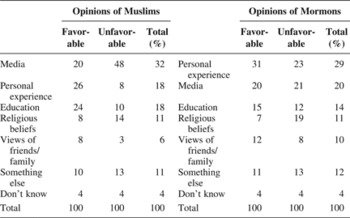
In addition to being asked to give one-word descriptors of Muslims and Mormons, respondents were asked “what influenced” their opinions of Muslims and Mormons. The findings, reported in Table 3, are divided into “very or mostly favorable,” “very or mostly unfavorable,” and “total” categories for each religious group.
What Influenced Respondents' Views of Muslims and Mormons? (%)

Source: Pew Religion and Public Life Survey, August 2007.
Table 3 reveals that the top three self-identified factors influencing views of Muslims and Mormons were the media, personal experience, and education. Given the relatively smaller numbers of Muslims (than Mormons) in the United States, it is not surprising that personal experience had a greater impact on views of Mormons than of Muslims and that conversely, the media had a greater self-reported impact on Americans' views of Islam.
This is a potentially notable finding in that the media appear to be an important source of negative views of Muslims (20% favorable versus 48% unfavorable). On the other hand, the media seemingly had a neutral impact on public perceptions of Mormons. For both groups, both personal experience and education were positively related to views of the two religious groups.
Respondents also indicated that their opinions were influenced by other factors, including religious beliefs, views of friends/family, and/or “something else,” although these factors tended to fall farther down the list. For both Muslims and Mormons, “religious beliefs” proved to be the fourth most important factor influencing Americans' views (with 11% of respondents mentioning religious beliefs as a factor). It is interesting to note that with respect to both Muslims and Mormons, religious beliefs tended to have a greater net negative effect than net positive effect on public perceptions, reinforcing the possibility, noted above, that some Americans tend to view both Muslims and Mormons as members of competing religious belief systems.
Views of Muslims and Mormons: Multivariate Analysis
These data suggest that respondents may be reacting to Muslims and Mormons in terms of a variety of social, political, and religious variables. But which variables are most useful in explaining variance in Americans' views of Muslims and Mormons? In order to adequately address this question, it is necessary to conduct some form of multivariate analysis.
For analytical purposes, independent variables are divided into social, political, and religious categories, as discussed above. A complete roster of these variables, along with coding schemes, is included in Table 4. One should note that race is divided into two dummy variables, with the first being black/non-black and the second being other (Hispanic, Asian, other/non-other).Footnote 5 In addition, two dummy variables are utilized to assess responses to the questionnaire item, “Islam/Mormonism and my religion have a lot in common/are very different.” The first of these variables divides respondents into those who agreed that their religion and Islam/Mormonism have a lot in common and those who did not agree. Because a relatively high proportion of respondents refused to answer this question, a second dummy variable is also utilized, consisting of those who refused to answer and those who did not refuse to answer.
Ordered Logit Models: Views of Muslims, American Muslims, and Mormons by Social, Political and Religious Variables

Source: Pew Religion and Public Life Survey, August, 2007. * p < 0.05 ** p < 0.01 *** p < 0.001.
These independent variables are used to generate three regression models, with the three dependent variables being views of Muslims, views of American Muslims, and views of Mormons, respectively. Since each of these dependent variables is ordinal (coded 1 = very unfavorable, 2 = unfavorable, 3 = favorable, 4 = very favorable), ordered logit is employed.Footnote 6 Similar to binary logistic regression, ordered logit models are nonlinear. Instead of estimating whether or not an event will occur, ordered logit regression estimates the probability that a case will fall in the next highest level of the dependent variable by estimating “cut points” between values of the dependent variable. These cut points replace the constant in the model (Deckman et al. Reference Deckman, Crawford and Olson2008, 396).
Since, in ordered logit, neither the coefficients nor the cut points have clear substantive interpretations, Table 4 provides odds ratios for each of the independent variables. An odds ratio can be defined as the ratio of the likelihood of an event occurring in one category or group compared to the likelihood of it occurring in another category or group. Thus, odds ratios have a more intuitive interpretation than unstandardized logit regression coefficients. Specifically, the odds ratio associated with two variables indicates the degree of change in a dependent variable for each unit increase in an independent variable, ceteris paribus (i.e., assuming that all of the other independent variables are held constant).
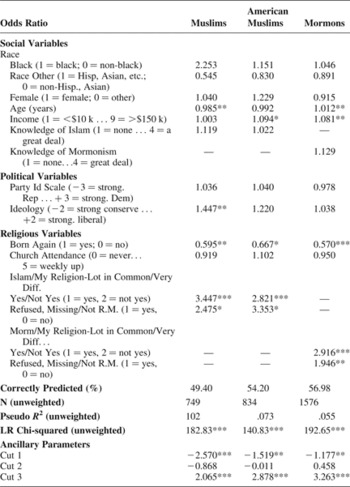
To illustrate, the black/non-black dummy variable in Table 4 indicates that black respondents proved to be over twice as likely as non-black respondents (odds ratio of 2.253) with the same social, political, and religious characteristics to express positive views of Muslims. While this relationship did not prove to be statistically significant at the 0.05 level, it came close, with p < 0.06. Table 4 also reveals, however, that the black/non-black dummy variable apparently had little impact on respondents' views either of American Muslims or of Mormons.Footnote 7
Table 4 reveals that all three categories of variables had a degree of impact in each of the three logit models. Among social variables, age proved to be negatively related to support for Muslims but positively related to support for Mormons. That is, holding other variables constant, older respondents tended to be slightly less supportive of Muslims and more supportive of Mormons. Income proved to be significantly related to views of American Muslims and Mormons, with persons in higher income categories tending to express somewhat more favorable views than those in lower income categories.
An examination of political variables reveals no significant relationship between party identification and any of our three dependent variables. One the other hand, political ideology had a notable impact on views of Islam, with more liberal respondents tending to hold more positive views of Islam than did more conservative respondents. The odds ratio (1.447) reveals that ceterus paribus, for each category increase in liberalism (along the five point scale), respondents proved to be nearly one and a half times more likely to assess Islam favorably. As suggested above, the lack of impact of ideology on views of Mormons may reflect the fact that political conservatives may be cross pressured on the issue (agreeing politically but disagreeing theologically).
Finally, Table 4 supports the H3 proposition that religious variables may have a particularly large impact on views of the three religious groups. In each of the three ordered logit models, the variable having the greatest impact proved to be whether or not respondents perceived Muslims or Mormons as having “a lot in common” with their own religion or are “very different from” their own religion. As hypothesized, those perceiving similarities proved far more likely to hold positive views of the various religious groups. While this finding makes intuitive sense, it is nonetheless exceedingly important both theoretically (supporting the utility of social identity theory) and practically (adding to our understanding of the roots of religious tolerance and intolerance). Table 4 also indicates that the “born again” variable significantly affects views of each of the dependent variables, with “born again” respondents tending to hold more negative views of Muslims, American Muslims, and Mormons than do those who do not self-identify as “born again.”
Table 4, then, provides considerable support for H3. While all three types of variables (social, political, and religious variables) have an impact on Americans views of Muslims and Mormons, religious variables and, in particular, the perceived religious differences and born again variables tended to be most important. Among the social variables, age and income tended to have the greatest explanatory power. And the only political variable with a notable impact was political ideology (and only with respect to views of Muslims).
CONCLUSIONS
The findings reported here have potentially important theoretical and substantive implications. In the first place, the data provide evidence of the value of employing social identity theory in the examination of views of Muslims and Mormons (and, potentially, other religious groups). Social identity theory, rooted in information processing theory, was used to develop and test three hypotheses concerning Americans' views of Muslims and Mormons. The findings presented here largely support each of the hypotheses and suggest that people do indeed tend to categorize religious groups and process information pertaining to those groups in terms of perceived group characteristics. Members of out-groups tend to be viewed less favorably than members of in-groups. Equally important, as predicted by social identity theory, group status is not necessarily a fixed or unchangeable characteristic of groups. Perceptions of out-groups can and do change over time. And out-groups potentially can improve their status (as in the case of American Muslims) if they become identified with positive national symbols.
This article also has notable substantive implications, revealing that a variety of socio-economic, political, and religious variables help us explain Americans — views of Muslims and Mormons. The most important variable helping to explain variance in Americans' views of Islam proved to be perceptions of distance between a given respondent's religion and the religious group in question. Other important contributing variable was whether or not a given responded was “born again.”
The data presented here also indicate that views of Muslims may be moving in a negative direction and that attitudes may be becoming increasingly polarized, with fewer Americans adopting neutral or undecided positions. The good news, however, is that, despite perceived religious differences and despite negative political developments, substantial reservoirs of good will toward both Muslims and Mormons remain among the American public. Indeed, it is worth noting that Americans, in large numbers, continue to hold positive views of both Muslims and Mormons, a finding that may bode well for domestic tranquility and political harmony.