


Life was grim in the Balkans during the 1990s. Ethnic wars that ravaged the former Yugoslavia led to widespread atrocities, including massive civilian displacement, destruction of property, sexual assault, and systematic murder. In an attempt to halt the violence, the European Union and the United Nations (UN) sent expert negotiators to the area on several occasions, but none managed to restore peace. “What we lack is clout,” European mediator David Owen complained in 1992, arguing that the lack of major power involvement caused his failure to secure a lasting peace settlement.Footnote 1 Indeed, the warring parties in Bosnia alone violated more than 30 cease-fires and peace agreements until the United States stepped up its level of involvement in the conflict. With superior military strength, the superpower put pressure on the disputants and achieved a settlement even after all previous third parties had failed. But power—and the military threat that accompanied it—was not enough to bring about peace. The United States failed to convince Yugoslav forces to withdraw from Kosovo, and launching air strikes to induce their compliance, killed many civilians in the process.
When can a powerful third party succeed in efforts to end conflicts without resorting to force? Does great power intervention impede or further peacemaking? Research on mediation, armed intervention, and crisis bargaining yields mixed results. On the one hand, scholars have found that a strong state that mediates in a violent crisis has a better chance than any other third party to negotiate a peace agreement (Frei Reference Frei1976; Greig Reference Greig2001; Touval Reference Touval1982). With its vast military and economic resources, the powerful state can change the embattled parties' cost-benefit calculus by threatening punishments and promising rewards (Kleiboer Reference Kleiboer and Bercovitch2002; Smith and Stam Reference Smith and Stam2003; Touval Reference Touval, Bercovitch and Rubin1992). Furthermore, a powerful third party can guarantee that all adversaries adhere to a peace settlement once they have agreed on its terms (Walter Reference Walter2002, Reference Walter2003). On the other hand, evidence has shown that superior military strength, which gives powerful third parties a bargaining advantage in settlement talks, can backfire. Great powers sometimes become entangled in disputes, even when they intend to quell the fighting and reduce the death toll—and interveners' use of military force in these situations can prolong and worsen the hostilities (Johnston and Dagne Reference Johnston, Dagne, Clarke and Herbst1997; Regan Reference Regan2002b; Woods Reference Woods, Clarke and Herbst1997).
Although research has demonstrated that powerful countries negotiate settlements in some conflicts while aggravating others, scholars have yet to explain why great-power intervention brings about such divergent outcomes. Mediation scholarship has argued that states with superior military and economic resources make excellent mediators, but theory on the subject has not explained why powerful third parties sometimes use military coercion to negotiate a settlement and, in some cases, resort to the actual use of force.Footnote 2 This body of work has focused only on identifying the conditions under which a mutually acceptable settlement can be achieved, because mediation, unlike military coercion, is a voluntary process in which a third party seeks to change disputants' behavior or settle their conflict without threatening or resorting to physical force (Bercovitch and Houston Reference Bercovitch, Houston and Bercovitch1996). Armed-intervention scholars have shown that military interventions can prolong and worsen conflicts, but these authors have not considered instances in which states mediate agreements or impose them with credible threats of force. This research has focused on the use of military force in conflicts and not on the diplomatic process that usually precedes and accompanies it.Footnote 3 In a similar fashion, crisis-bargaining scholars have demonstrated that states sending costly signals can communicate their willingness to fight better than those relying on cheap signals, but the models in this literature have not considered whether the same logic applies to situations of third-party intervention.Footnote 4 As a result, existing theories in international relations explain aspects of great-power intervention but not how the process actually works.
This paper examines the role of biased major powers—those whose interests in a crisis are closely aligned with a single disputant's interests—in the manner and the outcome of an intervention. I seek to answer whether recognized third-party bias can help convince bargainers that the third party will use force, and whether this information can influence the resolution of crises. I demonstrate that when highly biased major powers intervene in a crisis, a peaceful settlement is likely because crisis actors are certain the major power will enforce an agreement by military means. When a major power is biased to a lesser degree, negotiations are more inclined to fail because the disputants may doubt the intervening state's commitment to use force. Peace is again more likely when an intervener is impartial, because such an intervener avoids military coercion and seeks agreements that both adversaries find acceptable. The paper proceeds as follows. In the first section, I frame the problem and discuss the literature on the role of great-power contributions to conflict management. Second, I present a formal model that demonstrates how uncertainty and middling values of bias contribute to the failure of peace negotiations, even when peaceful settlements are in every actor's best interest. Finally, I draw out the observable implications of the model and develop case studies from the Balkans that illustrate the modeled interaction.
GREAT-POWER CONTRIBUTIONS TO CONFLICT MANAGEMENT
Though mediation and military coercion are distinct strategies, we cannot understand how powerful states intervene in conflicts if we study their behavior as mediators in isolation from their behavior as hegemons able to threaten and wage war. Each step a third party takes during an intervention depends not only on the behavior of other actors but also on its own steps—those it took in the past and those it might take in the future. For this reason, a study of great-power intervention should take into account the ability of a militarily superior third party to invoke its power and use military coercion whenever it must do so to gain a bargaining advantage. To begin to understand why great powers fail or succeed as third parties, we must look to the causes of war and what these powers can do best to end or prevent it. Strong third parties have the ability to mitigate some of the most widely discussed causes of conflict (see Fearon Reference Fearon1995). First, they are well positioned to help disputants solve problems of incomplete information and incentives to misrepresent it, because they can provide facts that other, less powerful parties might not be able to gather. As Fearon (Reference Fearon1995) shows, conflict can arise when adversaries have private information about each other's military capabilities and willingness to fight, and when either has an incentive to misrepresent such information in order to get a better deal. As a result, disputants cannot clarify their relative power or resolve to each other without generating a real risk of war. According to bargaining theory, parties that share complete information quickly reach agreements because they want to avoid the cost of conflict (Rubinstein Reference Rubinstein1982). Therefore, wars rooted in disagreements over power and resolve should end when disputants learn the full extent of each other's strength and intentions. Great powers can provide the information that disputants need and help facilitate cooperation because of their superior intelligence-gathering resources and access to other states' diplomatic channels (Kydd Reference Kydd2003; Rauchhaus Reference Rauchhaus2006).
Militarily superior third parties might also be useful in mitigating conflicts resulting from commitment problems. Even when adversaries share the same assessment of the bargaining range, they may not be able to trust each other to uphold a deal if they have an incentive to renege on its terms. As Fearon (Reference Fearon1995, 401) writes, in bilateral interactions “no hegemonic power exists to threaten states with ‘jail’ if they use force.” However, powerful nations serving as third parties can, and do, use threats to get adversaries to cooperate. Furthermore, they can send troops to a war-afflicted area to guarantee each side's security if it were to settle and disarm, and research has shown that militarily superior third parties are in the best position to serve as such guarantors, both in interstate and civil wars. Smith and Stam (Reference Smith and Stam2003) find that powerful nations make the best peacekeepers because their troops can form an artificial barrier between belligerents and raise the cost of a potential attack. Focusing on civil war settlement, Walter (Reference Walter2002, Reference Walter2003) concludes that militarily superior third parties are the best candidates to help disputants cooperate. She finds that a strong display of force by a third-party guarantor, as opposed to the presence of “traditional” peacekeepers, makes it more likely that combatants will sign and implement a peace settlement (Walter Reference Walter2002, 41).Footnote 5
In addition to fostering cooperation in crises originating from incomplete information and commitment problems, powerful states are in a better position than any other third party to intervene in the deadliest, most difficult type of conflicts—conflicts of indivisibility. Problems of indivisibility, or near indivisibility, occur when one or both adversaries believe they cannot divide the disputed good between them. These bargaining deadlocks are difficult to resolve and may lead to total war, ethnic cleansing or genocide. However, great powers can get settlements or minimize casualties in such conflicts because of their ability to broaden or even create a bargaining space.Footnote 6 To mitigate crises of indivisibility by making fighting over the perceived indivisibilities less attractive, great powers can do three things. First, they might pursue a strategy to lessen the humanitarian toll without attempting to help the adversaries divide the pie. As Smith and Stam (Reference Smith and Stam2003) demonstrate, they may create a barrier between warring sides by placing troops on the ground and keeping the adversaries away from each other. Second, powerful nations can help adversaries engaged in conflicts of near indivisibility through the process of mediation. Great powers can expand the issue dimensions, such that one side might get a total concession on one issue in exchange for conceding on another issue. Powerful mediators might also offer inducements or threaten to take away benefits. In fact, empirical findings suggest that a limited amount of coercion is a bargaining technique often associated with mediation success (Beardsley et al. Reference Beardsley, Quinn, Biswas and Wilkenfeld2006; Schrodt and Gerner Reference Schrodt and Gerner2004; Wilkenfeld et al. Reference Wilkenfeld, Young, Asal and Quinn2003). Strong countries are well positioned for this type of mediation because of their vast resources and influence in many regions of the world (Touval Reference Touval, Bercovitch and Rubin1992). Last, in issues of indivisibility where even great-power mediation fails, properly motivated great powers can use military coercion and significantly manipulate or even create a bargaining space by threatening to wage war against one of the sides.
Powerful third parties that choose military coercion to induce settlements may, like any other disputant attempting to signal power and resolve, face problems of incomplete information. As a result, they must find a way to convey their intentions to the targeted adversary in a believable way. Crisis-bargaining scholars in international relations have shown that a state intending to go to war can communicate its resolve through the use of costly signals—signals incurring a cost that an unresolved sender would not wish to pay (Fearon Reference Fearon1994, Reference Fearon1995, Reference Fearon1997; Morrow Reference Morrow1999; Sartori Reference Sartori2002; Schelling Reference Schelling1960; Schultz Reference Schultz1998; Slantchev Reference Slantchev2005). However, signaling is not the only way to communicate resolve. As Jervis (Reference Jervis1970, 4) argues, international actors can effectively project images “on the cheap,” without paying the high cost of altering their policies. States can show their willingness to use force by sending signals in conjunction with indices—observable indicators that carry inherent evidence that the signals states project are correct. Whereas cheap signals are intended to influence others, and targets discount them appropriately, indices are more persuasive. For example, a state's behavior is a good index when the state does not know what aspect of its behavior is being observed or when it cannot control that aspect of its behavior to give a desired, but misleading, impression.Footnote 7 I show that bias—a major power's close alignment of bargaining preferences with one of the crisis actors—is an index that can help reveal the great power's private information on resolve. Although threats are not always credible because unresolved third parties have an incentive to bluff, bias might help alleviate credibility problems because it is a recognized feature of a state's foreign policy and, as such, difficult to misrepresent. For example, one source of a great power's bias in a crisis might be its previous relationship with each disputant. Carnevale and Arad (Reference Carnevale, Arad and Bercovitch1996) argue that bias can stem from a third party's closer cultural, economic, or political ties with one of the parties. States' strategic alignments—as reflected in alliances, treaties, or economic ties—can be an observable index of resolve in a crisis because states form these alignments over time and independently of the crises in which they might intervene someday.
Traditionally, the literature analyzing coercive interventions in international relations has focused primarily on the interaction between a third party and its opponent, ignoring the presence of a bargainer whose side the third party had chosen. Although it may be prudent in some cases to ignore the existence of a seemingly inconsequential bargainer, this approach also runs the risk of losing a significant amount of explanatory power. In two-way bargaining, a defender does not always yield to a challenger's demands simply because the challenger is more powerful than the defender. As ample research in international relations has suggested, the challenger's perceived will to employ military force plays an important part in the bargainers' interaction (see Bueno De Mesquita, Morrow, and Zorick Reference Bueno De Mesquita, Morrow and Zorick1997; Fearon Reference Fearon1994, Reference Fearon1995, Reference Fearon1997; Morrow Reference Morrow1999; Schultz Reference Schultz1998, Reference Schultz1999, Reference Schultz2001; Smith Reference Smith1996a,Reference Smithb, Reference Smith1998, among others). Yet, when a powerful third party positions itself between two principals and bargains for a particular outcome by threatening force, the third party's position in relation to the two bargainers may reveal private information regarding whether or not this party is willing to use force. Therefore, determining the exact location of the third party's position vis-à-vis the other bargainers is an essential aspect of this paper.
The most recent debate over third-party bias has arisen in the formal literature on mediation and asymmetric information. Smith and Stam (Reference Smith and Stam2003) present a random-walk model of mediation, in which they assume that mediators are biased if they prefer peace to war, war to peace, or one nation to the other. The authors examine whether mediators can help end wars by informing combatants about each other's relative strength, and find that biased mediators cannot provide credible information and serve as honest brokers. On the other hand, Kydd (Reference Kydd2003) analyzes mediators who prefer one side to the other and find war costly at the same time. Kydd's biased mediators are quite effective because they help end conflicts by relaying credible information on the disputed parties' resolve. Yet, Kydd (Reference Kydd2006) finds that in crises where mistrust is the primary cause of sustained hostilities, only impartial mediators can help parties build the trust necessary to reach agreements. Similarly, Rauchhaus (Reference Rauchhaus2006) shows that although both impartial and biased mediators may prove effective in information provision, impartial mediators generally outperform biased ones. These findings clarify what makes great powers, under a specified set of conditions, effective in helping disputants identify the bargaining space. Yet, this work does not explain what motivates powerful third parties to broaden or create the bargaining range to get agreements—and under what circumstances they can successfully do so.
More generally, scholars in mediation, armed third-party intervention, and rationalist crisis bargaining have long disagreed over the role of bias as an aspect of conflict resolution. Whereas some authors have posited that biased third parties can detract from successful peace negotiations (Bien Reference Bien, Greenberg, Barton and McGuinness2000; Burton and Dukes Reference Burton and Dukes1990; Fisher Reference Fisher, Fisher, Vasquez, Johnson, Jaffe and Stamato1995; Kydd Reference Kydd2006; Young Reference Young1967), others have argued that impartiality is neither a necessary nor a sufficient condition for reaching settlements (Bercovitch, Anagnoson, and Wille Reference Bercovitch, Anagnoson and Wille1991; Gent Reference Gent2008; Lederach and Wehr Reference Lederach and Wehr1991; Regan Reference Regan2002b; Touval Reference Touval1982). Examining conditions for civil war settlement, (Walter Reference Walter2003) has found that third parties can be biased and still maintain peace in the postsettlement stage. Scholarly work has even demonstrated the positive effects of biased advice on rational decision making (Calvert Reference Calvert1985; Kydd Reference Kydd2003; Myers Reference Myers1998).Footnote 8 However, the research so far has studied third-party bias as a dichotomous variable and never examined whether more than two varying degrees of bias can bring about distinct bargaining outcomes. In this paper, I treat bias as a continuous variable.
In the model that follows, a biased great power's interests in a conflict are closely aligned with a single side's interests. Because this alignment of preferences varies continuously, bias can take on an infinite number of values. But my treatment of bias differs from the current conceptualization of the term in another way. Scholars have identified one additional dimension of bias—“bias for peace”—which denotes a third party's desire that a peaceful bargain be struck (Kydd Reference Kydd2003, Reference Kydd2006; Rauchhaus Reference Rauchhaus2006; Smith and Stam Reference Smith and Stam2003). I argue this dimension is unnecessary. Any power that intervenes in a conflict, even if it threatens force to compel parties to cooperate, is biased for peace. Following Fearon (Reference Fearon1995) and Rubinstein (Reference Rubinstein1982), bargainers always want to strike a deal that allows them to avoid costly conflict. Therefore, a third party that is willing to commit significant resources, even risk war, to enact a settlement wants to see such a settlement implemented. High bias, by my definition, means that a third party has a strong preference for a settlement that favors its protégé—but the third party still desires that there be a settlement. Similarly, unbiased mediators who intervene to negotiate a settlement are only biased for peace and do not have a stake in securing better settlement terms for either side.Footnote 9 Therefore, because bias for peace is a constant, I do not include it in the model.
The Intervention Bargaining Game
In this section, I show that a major power's bargaining position vis-à-vis the other bargainers affects (1) the manner of a potential intervention (i.e., mediation or military coercion), and (2) the other bargainers' beliefs about whether or not an intervener threatening force is actually willing to go to war. When the major power's preferences are located near the middle of the opposing players' preferences, that is, when the major power is impartial, it is more likely to mediate without threatening force. On the other hand, when the intervener favors a single disputant, it seeks to ensure a better settlement for the favored side by threatening the disfavored side with force. Whether the disliked player actually takes the intervener's threats seriously also depends on bias: If bias is high, the disfavored side likely believes the intervener is resolute and accepts the proposed settlement terms. If bias is middling, the disfavored side likely assumes the intervener is bluffing and, as a result, refuses to settle.
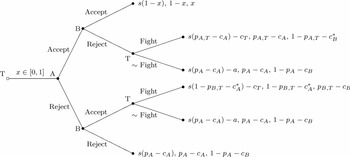
I consider a game with three players: T, A, and B (see Figure 1). Actors A and B clash over the division of a prize, while the third party T attempts to secure a peaceful solution to the bilateral conflict.Footnote 10 T possesses superior military and economic capabilities and thus presents a potential military threat to A and B. The major power favors A, as captured in the parameter s, which denotes the intensity of the intervener's favoritism of A and influences the intervener's payoffs in the game. Because T always prefers A to some degree (s > 0), it is motivated to secure a favorable payoff on A's behalf.Footnote 11 The game begins when T proposes a solution x ∈ [0, 1], where A keeps 1 − x and B keeps x. Both actors then have the opportunity to accept or reject the proposal, with A moving first.Footnote 12 If both accept, the negotiation ends in a peaceful settlement. If both reject, the major power takes no further action and the bilateral crisis continues. If one rejects and the other accepts, the major power can stay out of the conflict and allow the bilateral crisis to continue, or it can fight on the side of the player that accepted its offer. If the major power backs down after one of the disputants rejects its offer, it incurs audience costs a for backing down.
Intervention Bargaining Game

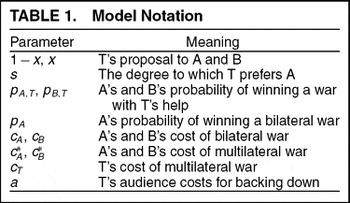
T's hegemonic status allows us to draw some conclusions about the ranking of the parameters. When T fights on the side of one player against the other, the former has a better chance of winning than it does in a bilateral war, that is, pA, T > pA and pB, T > 1 − pA. Similarly, when T wages war against a player, the latter incurs far greater costs than it would in a bilateral conflict: c*B > cB and c*A > cA. By assumption, A and B expect a positive payoff from the bilateral conflict—even if bilateral hostilities were, at one point, rooted in one or both disputants' misrepresentation of resolve, both players over time began to perceive their end costs of fighting to be smaller than their expected benefits. For this reason, pB > cB and pA > cA. The payoffs for each outcome of the game are calculated on the basis of previously stated assumptions as well. Because the disputants are engaged in a zero-sum conflict, one side's gain constitutes the other side's loss. For instance, A's payoff from multilateral war is pA,T − cA, whereas B's payoff is 1 − pA, T − c*B. T's payoffs, on the other hand, are partially determined by the parameter s. Because T prefers A, its payoffs are a function of A's payoffs. Of course, T also pays a possible price for its involvement—audience costs a for backing down and costs of war cT for fighting a multilateral war. In addition, T's strength compared to that of the other players is such that, when it fights on the side of one player, the other player incurs a negative payoff: 1 − pA,T − c*B < 0 and 1 − pB, T − c*A < 0.
Model Notation

Results
Suppose that A's and B's costs of multilateral war are known but that T's are not. In this case, two perfect Bayesian equilibria exist—a semi-separating one and a pooling one, depending on whether the disputants have good reason to believe that T is resolved. T is resolute when it intends to fight B if B rejects x = 0 and irresolute when it plans to back down. T's behavior at the final node depends on whether its anticipated cost of war, cT, is greater or less than a critical value

where typesit cT > c*T choose to back down and types cT < c*T go to war. Because only T knows its exact value for war, the parameter that helps inform A and B on the issue of resolve is T's bias, s. The bias, which is known to both disputants, affects their beliefs about T's resolve. Let s* denote the value of s that separates the two equilibria and posit that, if s ≤ s*, players' strategies and beliefs are defined by the semi-separating equilibrium, and if s > s*, they are defined by the pooling one. Both equilibria are substantively interesting because they provide insight into the relationship between bias and the likelihood of peace. A comparative statics analysis reveals that, when players are uncertain about T's resolve, the probability of peace decreases with an increase in bias. However, when bias is so high that players have no doubt T is resolute, the game gains the characteristics of a complete information game, always resulting in a settlement. I summarize the game's findings in two results as follows (complete statements and proofs appear in the appendix).
Result 1. When s ≤ s*, negotiations can fail because A and B are unsure about whether T will use force at the final node.
In the semi-separating equilibrium, when T's bias is low to middling (s ≤ s*), T proposes either an x = 1 − pA − cB or an x = 0, depending on whether cT is greater or less than a cut-point value ĉT. T types cT < ĉT offer x = 0, and T types cT > ĉT offer 1 − pA − cB. Note that types cT ∈ [c*T, ĉT] mimic the behavior of resolved types, offering x = 0 even though, if their low offer is rejected, they back down. A and B believe that cT is distributed by FT, truncated below at ĉT if they observe x > 0 and that cT is distributed by FT, truncated above at ĉT if they observe x = 0. If p′ denotes the posterior belief that T will fight if the low offer is rejected (cT < c*T), p′ = 0 for all offers x > 0, and p′ =  if x = 0 (see equations (3) and (4), below). Although there is a continuous range of x values off the equilibrium path, only two distinct offers are possible in the equilibrium proposed here. No T type wants to offer anything more than B's payoff for bilateral war, 1 − pA − cB. Types cT < ĉT offer x = 0, whether or not they are resolved, because if irresolute types offered a value between 0 and 1 − pA − cB, resolute types would have an incentive to distinguish themselves from the bluffers by further lowering their offer. For this reason, all types cT < ĉT make the lowest offer, x = 0.
Types cT ∈ [c*T, ĉT] offer x = 0 and back down if B rejects the low offer. Let r denote T's assessment of the probability that B will reject the low offer. Types cT > c*T are indifferent between sending the low and the high offer when
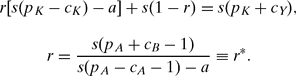
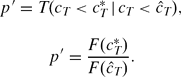
These types propose x = 0 when r < r* and x = 1 − pA − cB when the reverse is true. If B rejects the low offer, T types cT > c*T choose not to fight, whereas types cT < c*T choose to fight. A accepts T's offer whether or not it believes T is resolved because each one of the payoffs A can get from accepting T's offer—negotiated peace, multilateral war with T fighting on A's side, and continued bilateral war—is at least as good if not better than each of the possible payoffs resulting from A's rejecting the offer. B faces a different scenario. B always accepts the high offer because it is at least as good as engaging in bilateral hostilities, and clearly better than fighting a multilateral war. But when the offer is low, there is a possibility that T is bluffing, so B must rely on its own beliefs about T's resolve when choosing a strategy. Let p′ denote B's assessment of the probability that it is facing a resolute intervener type, given that it was presented with a low offer. Using Bayes' rule,
Next, a critical value is chosen so that, if p′ < , B rejects T's low offer and accepts it if p′ > . At the indifference point , B plays a mixed strategy, sometimes rejecting and sometimes accepting T's offer:
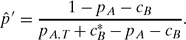
For the semi-separating equilibrium to hold, not all T types are believed to be resolved; that is, F(c*T) < . Substituting now for the value of c*T, we see that

From this, we can infer that when s is smaller than the critical value s*, this condition holds. At the critical value s*,
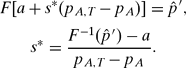
Turning now to the pooling equilibrium, sustained by an s greater than s*, I demonstrate how the picture changes when the players no longer doubt the intervener's resolve.
Result 2. When s > s*, A and B settle because they are certain T is resolved to fight B.
In the pooling equilibrium, when bias is high (s > s*), all T types propose x = 0. A and B believe that T is resolved to use force, and the disputants' prior remains unchanged upon observing x = 0. They believe cT is distributed by FT, truncated below at c*T, if they observe x > 0. For this reason, types cT < c*T and cT > c*T propose the low offer, and both disputants accept it. There would be no incentive for an intervener of any type to propose anything more than x = 0 because each type realizes that the low offer is taken as a sign of resolve. No bluffing is possible in this scenario, and because bias is high, the two adversaries are convinced of T's commitment to enforce a settlement by military means. This equilibrium is sustained if F(c*T) > , that is, if the value of s is higher than the critical value s*.
OBSERVABLE IMPLICATIONS AND CASE STUDIES
The model demonstrates that the degree of third-party bias may help convey private information about the intervener's resolve under conditions of uncertainty. For example, a high degree of bias can help persuade the adversaries that the intervener is motivated to enforce a settlement through the use of arms. By contrast, middling values of intervener bias provide no information on resolve. In fact, disputants may consider a middling-bias intervener unacceptable because it is likely to champion a single player's cause while failing to convey credible threats of force. For this reason, the disfavored player may not be compelled to accept such an intervener's terms, and negotiations likely end in war. The main implications of the model are expressed in two hypotheses as follows.
Hypothesis 1. When a major power equally favors two parties involved in a crisis, it is more likely to mediate in the crisis without threatening force. When the major power significantly favors one crisis actor over the other, it attempts to coerce the disfavored party into accepting a settlement.
Hypothesis 2. Whether disputants take an intervener's threats seriously depends on the degree of intervener bias, affecting the success or failure of negotiations:
(i) When highly biased major powers intervene in a crisis, a peaceful settlement is more likely because bargainers are certain the intervener is resolved to enforce a settlement by military means.
(ii) When an intervener is biased to a lesser degree, negotiations are more inclined to fail because there is less certainty about the intervener's commitment to use force.
To consider the implications of the model, I cite the following case studies: (i) the Trieste crisis of 1945, (ii) the final Trieste settlement of 1954, and (iii) NATO's war with Yugoslavia of 1999. All cases take place in the Balkans and include some of the same players—the United States and Great Britain play roles as interveners while Yugoslavia is the disfavored disputant.Footnote 13 In the Balkans' tumultuous history, there have been many instances of major-power intervention. While some Balkan interventions have ended in successful peace settlements, others have triggered large-scale wars with worldwide implications. For this reason, analyzing major-power intervention in the Balkans can help us understand how such intervention works more generally. Holding some conditions constant and providing variation on the independent variable, that is, on the degree of intervener bias, the cases exhibit unique results. Though both U.S. and British interventions in the crises involving Trieste ended in a settlement, the two states negotiated these agreements by very different means. In 1945, the interveners—highly biased against Yugoslavia—demanded that the Communist country give up Trieste or face them in a military confrontation. Yugoslavia took the threat seriously and complied with the Allies' demands. By 1954, however, the United States and Great Britain saw Yugoslavia more favorably because of its separation from the Soviet Bloc, and they reentered negotiations regarding Trieste as impartial mediators. As a result, Yugoslavia and Italy were more eager to negotiate, and the United States and Great Britain secured an agreement without demanding that either adversary accept an unfavorable deal. By contrast, in 1999, when the United States and NATO intervened in the crisis concerning Kosovo, the alliance to some degree preferred the Kosovar Albanians and demanded that Yugoslavia grant Kosovo autonomy or face air strikes. However, NATO's bias for the Kosovar Albanians was not very strong, and the disputants did not seem to believe that the alliance was truly committed to punishing Yugoslavia. In the end, Yugoslavia challenged NATO by refusing to settle, and a resolved NATO initiated air strikes against it.
I present each case as follows. First, I characterize the intervener's proposal and discuss whether the bargainers perceived it as a high or a low offer. The intervener's proposal reveals whether the type of intervention it has chosen constitutes mediation or coercion: A high offer to the disfavored player indicates that the intervener does not intend to use force whereas a low offer indicates that the intervener may be resolved to enforce a settlement through the use of arms.Footnote 14 Next, I define the degree of the intervener's bias and examine whether the players believe that the intervener is resolute.Footnote 15
High Intervener Bias and Successful Negotiation: The Trieste Crisis
At the end of World War II, Italy and Yugoslavia clashed over the possession of Venezia Giulia, a region on the northern Adriatic Coast with an ethnically mixed population of Italians and Slovenes. The most disputed part of the territory was the city of Trieste, an important port that had historically provided Eastern and Central Europe access to the Adriatic Sea. Yugoslav forces entered the city in April 1945, but were forced to abandon their positions after British and American governments intervened on the side of Italy and gave Yugoslavia an ultimatum to withdraw or face a military confrontation with the West. Convinced of the Allies' high bias in favor of Italy, Yugoslav leaders took the threat seriously and conceded to an agreement that gave Yugoslavia significantly less territory than it had previously anticipated (Isaković Reference Isakovié1973). In this case, the Allies' bias was high enough to persuade the players of the interveners' resolve—that is, the high bias added credibility to the interveners' signals and generated the conditions of the pooling equilibrium proposed in the model.
The territorial dispute between Italy and Yugoslavia first arose at the end of World War I, when each state sought to gain Trieste, Istria, and other territories on the northern Adriatic Coast from the ruins of the Austro-Hungarian Empire. The peace settlement that ended World War I granted Italy most of the Slav-populated territory. In the decades that followed, Yugoslav-Italian relations deteriorated further, most notably when Mussolini instituted a policy of persecution and denationalization of the Slav minority in Italy. During World War II, Italy occupied a large portion of Yugoslavia and established a puppet fascist regime in Croatia. After the fall of Mussolini's regime in 1943, Yugoslav leaders became determined to gain Trieste and reverse the territorial decisions of 1920–1924 (Campbell Reference Campbell1976). The Trieste question threatened to undermine Slovene support for the fledgling Yugoslav federal system and became widely seen among Yugoslav Slovenes as a test of Belgrade's commitment to its Slovene constituency (Kardelj Reference Kardelj1980).
As Yugoslav forces advanced on Trieste, the Italian authorities began their own campaign for Istria and Venezia Giulia. On April 30, Italy's Premier Ivanoe Bonomi demanded that Trieste and all of Venezia Giulia be governed by Allied military authorities “under [the] terms of the armistice.”Footnote 16 A few days after Yugoslav forces entered Venezia Giulia, Italian Ambassador to the United States Alberto Tarchiani met with U.S. diplomat William Phillips, who at the time served as special assistant to Secretary of State Edward Stettinius. In his memoirs, Tarchiani remembers requesting of Phillips that American military units occupy Trieste and the rest of Venezia Giulia. According to Tarchiani, Phillips asked, “What if the Yugoslavs resist? If they open fire?” Tarchiani replied, “They won't resist . . . and if they do, start shooting; they will back down for sure” (Tarchiani Reference Tarchiani1955, 53). On May 14, Italian diplomat Franco Malfatti returned from his meeting with British Foreign Secretary Ernest Bevin in London and informed Italian Vice Premier Pietro Nenni that the British “support us on Trieste” (Nenni Reference Nenni1981, 115).
The Allies' proposal that Yugoslav forces withdraw from Trieste represented a low offer to the Yugoslavs—x = 0, in terms of the model—for several reasons. First, the Yugoslav leadership was convinced that Trieste belonged to Yugoslavia because it was located east of the Isonzo River—a rough ethnic line of division between Italians and Slovenes. Second, Tito's fledgling federal system derived much of its legitimacy with the Slovene populace from the promise that all Slovenes would be united in a single state. As British Ambassador to Belgrade R. S. Stevenson reported in one of his dispatches to the British Foreign Office in 1945, “In Serbia there has never been much public interest in the Trieste question, although it is known to be a burning issue to the Slovenes” (Stevenson Reference Stevenson, Preston and Partridge1998). Isaković (Reference Isakovié1973, 748) offers a first-person account of the battle for Trieste:
As the Kosovel Brigade was chosen to march on Trieste, some of the senior soldiers remembered the words of its first commander, Ivan Turšič-Iztok: “The Kosovel Brigade must be the first to enter Trieste!” After many battles that took place throughout southwestern Slovenia, this wish was about to come true, though few of the soldiers who had originally heard Turšič speak were still alive. The brigade's ranks were thinning down, and newcomers replaced the perished every day. But they, as all units of the Slovene liberation army, were driven by the same goal—to unite all Slovenes in a new, free, Tito's Yugoslavia.
Finally, the offer to withdraw was unfavorable to Yugoslavia because the Yugoslavs thought they would never be able to regain Trieste if they were forced to abandon it in 1945. Though the Allies would establish an Allied occupation and administration of the city before relinquishing its control to Italy in 1954, Yugoslavia's leadership recognized that Trieste had been lost when it ordered its army to withdraw. Vladimir Velebit, chief negotiator for the Yugoslav side and one of Tito's top foreign affairs advisers, offers his recollection of events:
We were forced to accept, first of all, the diktat on withdrawal of the Yugoslav troops, and then we made . . . the arrangement about partition into Zone A and Zone B. At that period, I myself—but I mention also [Tito's right-hand man Edvard] Kardelj—was convinced that we had lost Trieste. (Cited in Campbell Reference Campbell1976, 87).
The Yugoslavs disliked the Allies' offer and would have preferred to keep Trieste, but its loss was nevertheless preferable to engaging the West in a military confrontation. According to a message from the Yugoslav Foreign Minister Ivan Šubašić to the U.S. and British governments, Yugoslavia was “fully aware of how much the interests and feelings of the Yugoslav population in Trieste, Istria, the Slovene littoral and the Yugoslav people in general [were] hurt by the fact that . . . the Yugoslav Army must withdraw from the [disputed] territories.” Šubašić goes on to say, “However, this decision was taken to prevent every possible conflict . . . among the Allied armies.”Footnote 17
There was no doubt on the part of the Yugoslav leadership that the British and American governments were biased in favor of Italy and resolved to make good on their threat. Velebit recounts his perspective:
Churchill was really at the head of the crusade against the Red invasion of Europe. He wanted to prevent the Russians from using the port of Trieste, and because he identified a Yugoslav Trieste with a Russian Trieste—Russian bases, facilities, who knows what?—he was absolutely ready to fight against us—to turn his guns against us—in order to secure Trieste for the Italians. . . . He did so in order to keep Trieste Italian, to keep us out. (Quoted in Campbell Reference Campbell1976, 84–85)
Tito agreed. In an interview with the Slovene daily Delo in 1974, at a time of détente, Tito recalled that, once the Allies signaled their intent to engage his forces in a military confrontation, he knew Trieste had been lost. “So we stayed in Trieste for a little while longer and then our military had to retreat. . . . Because the English and the Americans were very much on Italy's side [emphasis added], in favor of Italy getting Trieste.”Footnote 18
The Yugoslavs were not mistaken. Cold war rivalries were already setting in at the time, and Churchill had indeed urged Truman to unite with him in protecting Italian interests in Trieste (Churchill Reference Churchill1962; Sand Reference Sand2004; Truman Reference Truman1955). With its prominent position on the Mediterranean and a long history of Western political thought, Italy was seen as an indispensable ally in the arising rivalries of the Cold war. It was politically unstable, and because the West feared a possible Communist takeover, British and American leaders wanted to ensure the survival of the non-Communist Italian regime. As the New York Times reported on January 9, “No Italian can contemplate, except with grief and rage, the possibility of the loss of Trieste. No Italian government that agreed to such a loss could survive one moment.”Footnote 19 Churchill, who was about to label Trieste and its surroundings the southwestern end of the Iron Curtain, did not wish for Soviet dominance in the area (Whittam Reference Whittam1991). Yugoslavia was Communist, at that point still friendly with Stalin's Soviet regime, and the British and American governments exhibited a strong preference that Trieste remain Italian.
This example is illustrative of the formal model presented in this paper for the following reasons. A powerful alliance, whose military prowess surpassed that of either disputant, intervened in a foreign conflict to protect the interests of the party it preferred. It presented the disfavored player with a low offer and an ultimatum to accept it or risk waging a multilateral war, initiating military coercion. After receiving the signal, the disfavored disputant estimated the third party to be highly biased and committed to enforcing its will by employing force. Because waging war with a superpower represented a significantly worse outcome than capitulation, the disfavored party backed down and accepted the proposed terms. The high degree of bias in this case served to reveal the otherwise private information regarding the intervener's resolve and helped convince the nonpreferred actor to back down.
Low Intervener Bias and Successful Negotiation: The Final Trieste Settlement
Although Yugoslav forces retreated from Trieste in 1945, the final partition of the city and its surroundings remained unresolved until 1954. In 1947 the Allies established a Free Territory of Trieste, with Allied forces administering Northern Zone A, including the city, and the Yugoslavs overseeing Southern Zone B. Both Italy and Yugoslavia remained adamant in their claims to the entire territory of Venezia Giulia, and in 1948 the Allies recommended that the territory go to Italy. However, before any action could be taken, a dramatic shift in the Allies' bias changed the fundamentals of the Trieste problem. In June 1948, following a dispute between Tito and Stalin, Yugoslavia split with the Soviet Union and ended Soviet interference in its affairs. Its relations with the West began to approach a high point of cooperation, with Western military and economic aid to Yugoslavia flowing regularly. Yugoslavia also formed an entente with Greece and Turkey, both of which were members of NATO (Campbell Reference Campbell1976).
As the threat of Soviet power in the Adriatic receded, and the Allies began to make an investment in Yugoslavia's independence, Italy's bargaining position grew significantly weaker (Campbell Reference Campbell1976). In February 1949, the CIA reported that “any territorial concessions Tito might make to his non-Communist neighbors would weaken the support he is receiving from Yugoslav nationalists” (U.S. Central Intelligence Agency 1949). At the same time, the U.S. Department of State concluded that “it is in the obvious interest of the United States that ‘Titoism’ continue to exist as an erosive and disintegrating force operating within the Kremlin's power sphere” (U.S. Department of State 1949). Eventually, the U.S. policy on Trieste, as stated in President Eisenhower's letter to John Foster Dulles on October 27, 1954, was “to do almost anything to keep Tito not only outside Kremlin orbit but—so far as possible—actively on our side” (Eisenhower Reference Eisenhower, Galambos and van Ee1954a). Great Britain pursued the same strategy. In his memoirs, Yugoslav Foreign Minister Edvard Kardelj remembers his 1949 journey to the United States aboard the British ocean liner Queen Elizabeth: “I traveled with [British Foreign Secretary Ernest] Bevin, who had put me down and treated me so rudely at the [Paris] peace conference; now he was asking me to lunch and behaving quite differently” (Kardelj Reference Kardelj1980).
As a result of their newly adopted position on Yugoslavia, British and American governments entered another round of negotiations with Italy and Yugoslavia in 1954, this time as mediators proposing a high offer to Yugoslavia. President Eisenhower's letter to Tito, in which he expressed the desire that the Trieste question “be worked out to the mutual advantage of Yugoslavia and Italy,” reflects the significant shift in U.S. rhetoric and foreign policy toward Yugoslavia:
In stressing the importance to Europe and to the United States of a prompt and happy termination of the long, drawn-out negotiation regarding Trieste, I count on your continued wisdom and statesmanship. You understand, I am sure, better than I can describe, the larger issues weighing on the free world of which our countries are part. As you know, the United States is providing massive support in Europe to promote collective security which benefits both our countries. The American aid program for your country is not inconsiderable. It is because of our close association and cooperation in the economic and military fields that I feel it is appropriate to call on you in this friendly fashion to intervene personally in the Trieste negotiations to settle the exceedingly small differences now remaining. These are overshadowed by the larger considerations affecting us all. (Eisenhower Reference Eisenhower, Galambos and van Ee1954b).
After an intense mediation effort, the United States and Britain negotiated an agreement. In the end, Italy took control of Zone A while Yugoslavia kept Zone B, with minor adjustments to each part of the territory. In addition, Yugoslavia won rights and concessions in the use of the port at Trieste, the right to an unrestricted movement of people across the Yugoslav-Italian border, minority rights for Slovenes in Italy, and Slovene cultural centers in Zone A. Yugoslav financial claims on Italy were settled in favor of Yugoslavia, and Yugoslavia was to receive economic aid from the United States and Great Britain for port construction in Zone B, as well as general economic aid (Campbell Reference Campbell1976).Footnote 20 Italy's interests were equally well served, as the state finally and irrevocably reclaimed Trieste, the most significant part of the disputed territory.
This case is characterized by the conditions of the semi-separating equilibrium presented in the formal model. A powerful alliance, intervening in a dispute between two players, mediated by proposing a high offer to the disfavored player, because its affinity for the other player was too low. This behavior is consistent with the model's comparative static analysis, which predicts that when bias is low, the intervener is more likely to negotiate a peaceful settlement. In addition, the Allies' choice of mediation as the preferred mode of intervention is consistent with the model's prediction that an unbiased, or only slightly biased, intervener is likely to mediate, seeking and proposing agreements that do not need to be enforced with the threat of war.
Middling Intervener Bias and Failed Negotiation: NATO's War with Yugoslavia
In the spring of 1999, the United States and its NATO allies were faced with a crisis in Kosovo, the southernmost province of Yugoslavia populated mostly by ethnic Albanians. Albanian guerrillas demanding Kosovo's independence from Yugoslavia were waging a war with Yugoslav police and paramilitary forces, deployed to the region by Yugoslav President Slobodan Milošević. Led by the United States, NATO established negotiations in Rambouillet, France, and presented Yugoslavia with a deal that would grant Kosovar Albanians a considerable measure of sovereignty, prepare them for eventual independence from Yugoslavia, and allow UN and NATO forces to patrol the area in the interim. Yugoslavia was to accept this proposal or face NATO air strikes. Reluctant to sign an agreement that would end Yugoslavia's authority over Kosovo, and unsure whether the U.S.-led alliance was committed to acting upon its threats, Milošević refused to back down and continued to engage in bilateral hostilities. The negotiations concluded at an impasse, and on March 24, 1999, NATO began launching air strikes against targets in Yugoslavia.Footnote 21
The negotiations at Rambouillet were unsuccessful because Yugoslavia failed to take NATO's threats seriously and gambled on the possibility that the alliance was unresolved. The intervener's bias in this instance appeared middling, and it is possible Milošević thought NATO would back down or return with a more favorable proposal. This case exhibits conditions of the semi-separating equilibrium proposed in the formal model because the disputants found themselves uncertain of the intervener's commitment to defend its favored player in war. All parties were aware that the intervener was biased in favor of one disputant, but because the bias was not very high, they could not be certain whether the intervener was resolute.
Yugoslavia perceived NATO's proposal as a low offer for the following reasons: Kosovo carried unique significance for the Serbs, even though they represented a minority population in Kosovo and had consistently fled the province for economic reasons since the early 1980s. When the Ottoman Empire defeated the Serbian army at the Battle of Kosovo in 1389, extending Turkish dominance farther into the Balkans, Kosovo gained religious significance for the Serbs (Bennett Reference Bennett1995, Malcolm Reference Malcolm1998). Although Kosovo became a less salient issue for the Serbs in the twentieth century, it regained its prominence with the resurgence of nationalism at the outset of Yugoslavia's collapse. For these reasons, the consensus among the Serbs in 1999 was that Kosovo should remain under Yugoslav rule. In addition to relinquishing Kosovo, NATO's proposal called for Yugoslavia to agree to an international military presence within its borders. The Serbs were to “invite NATO to constitute and lead a military force to help ensure compliance with the [Rambouillet Agreement]” (U.S. Department of State 1999). Appendix B of the proposed agreement gave NATO troops:
[F]ree and unrestricted passage and unimpeded access throughout [Yugoslavia] including associated airspace and territorial waters. This shall include, but not be limited to, the right of bivouac, maneuver, billet, and utilization of any areas or facilities as required for support, training, and operations. (U.S. Department of State, under “Rambouillet Agreement”).
According to sources present at the accords, this annex had been drawn by NATO officers who were told the deal was nonnegotiable and who then drafted “a sort of military wish-list” (Judah Reference Judah2000, 210). The prospect of losing Kosovo while NATO's forces policed the entire area of Yugoslavia represented an unattractive deal to Milošević and his supporters, one they would have preferred to avoid had there been a possibility of a bluffing NATO.
Multilateral war, with NATO fighting on the Kosovar side, was a worse outcome for Yugoslavia than the loss of Kosovo and the entry of KFOR would have been. In spite of this, Yugoslavia rejected NATO's low offer and challenged the alliance to a military engagement. There is some evidence that Milošević doubted NATO would carry out the threat of air strikes. When Milošević rejected the final U.S. peace proposal, U.S. envoy Richard Holbrooke warned him, “You understand what will happen when I leave here today if you don't change your position, if you don't agree to negotiate?” Milošević replied, “No more engagement, no more negotiations, I understand that, you will bomb us.” However, as Holbrooke proceeded to leave, Milošević asked, “Will I ever see you again?” To Holbrooke, Milošević appeared indifferent and unafraid (Judah Reference Judah2000, 227; Halberstam Reference Halberstam2001).
Milošević may have doubted NATO's resolve because there was sufficient evidence to doubt NATO's commitment to the Kosovars. Throughout the 1990s, U.S. and European leaders ignored Milošević's actions in Kosovo and issued empty threats to express their disapproval (Daalder Reference Daalder2000). Even in 1998, when Albright attempted to gather support within the Clinton administration for air strikes, President Clinton and NATO publicly rejected her proposal.Footnote 22 Though it received little international attention, Kosovo was a problem already in the 1980s. It paved the way for Milošević's rise to power in Serbia and served as a catalyst for the dissolution of Yugoslavia. In the 1980s, when the Serbian media alleged that ethnic Albanians were harassing Kosovar Serbs and forcing them out of the province, Milošević recognized the situation as a way to ascend to power (Bennett Reference Bennett1995). He revoked Kosovo's autonomy in 1989, subjected Albanians to police harassment, dismissed them from government jobs, and made Serbian the principal language in Kosovo's public schools. At that point, his actions in Kosovo drew criticism only from the republics of Slovenia and Croatia, whose leaders feared that a similar fate might await them. Though the issue of Kosovo fueled the drive for the two republics' secession from Yugoslavia, Europe and the United States largely ignored the situation (Ramet Reference Ramet1992).
As ethnic warfare engulfed Bosnia and Croatia, Milošević continued to receive little international scorn for his tactics in Kosovo. He was seen as indispensable for maintaining peace in Bosnia after the Dayton Accords of 1995, and his policies on Kosovo did not receive much criticism until 1998 (Daalder and O'Hanlon Reference Daalder and O'Hanlon2000). Even in February 1999, when Hugh Shelton, Chairman of the Joint Chiefs of Staff, and Secretary of Defense William Cohen announced the Pentagon was planning to send 2,000–4,000 troops to a possible Kosovo Force, President Clinton said the following day that “no decision has been reached.” It was not until a full week into the Rambouillet negotiations that President Clinton pledged “a little less than 4,000 troops” for possible KFOR action (Daalder Reference Daalder2000, 74).
The Kosovars were equally suspicious of NATO's commitment to protect them. The Kosovar delegation in Rambouillet did not take NATO's threat to Yugoslavia seriously but its members, unlike the Yugoslavs, understood it was worth signing any deal that might bring them closer to gaining NATO as an ally. They believed the United States and Great Britain were biased against Milošević but not to the extent that military intervention would truly be an option. Judah (Reference Judah2000, 212) describes a meeting, as recounted by a source, between Secretary Albright and the Albanian delegation:
[The Kosovars] admired [Albright] and they didn't want to offend her, but the delegation had not discussed what it was supposed to sign . . . . The understanding was that there would be bombing [if they signed and the Serbs did not] but they didn't take it seriously. They weren't persuaded by it.
In spite of this, the Kosovars signed the document because Albright and the other negotiators wrote it to represent Kosovar demands. Before presenting the proposal to the Serbs, Albright and her team revised several drafts, with input from the Albanian delegation, until the latter endorsed the plan. Albright told them in a private conference: “You'll get NATO to protect your people. Don't mind the small print because you will be running the show and many of the problems in the text will be irrelevant” (Judah Reference Judah2000, 213). The possibility of a referendum, which was of central concern to the Albanians, was not included in the original text. To capture Kosovar demands, the final agreement was revised, its final version stating that, “[T]hree years after the entry into the force of the agreement an international meeting shall be convened to determine a mechanism for a final settlement for Kosovo, on the basis of the will of the people” (Judah Reference Judah2000, 213).
While there is evidence that the U.S. and European governments preferred the Kosovars to Milošević, it appeared that their bias was not particularly strong, giving Yugoslavia reason to believe that NATO might not proceed with air strikes in the event negotiations at Rambouillet were unsuccessful. The absence of a high intervener bias and the concurrent uncertainty are synonymous with the conditions of the semi-separating equilibrium developed in the formal model. Private information that was conveyed by the middling-bias intervener was not revealing enough to allow the disfavored player to distinguish between resolute and irresolute intervener types. The disfavored player thus miscalculated the intervener's resolve, rejecting settlement terms that would have yielded an outcome more efficient than war.
Conclusion
Major-power intervention in international conflicts has the potential to bring about peace to longtime rivals or trigger large-scale wars with worldwide implications. Unlike previous studies, this work uses a rationalist bargaining framework to consider mediation and military coercion as strategies that are equally available to great powers. Though mediation and armed-intervention scholars have focused a great deal on intervention by powerful third parties, they have not been able to explain the divergent outcomes of such intervention. In part, the lack of theory can be blamed on selection bias—each of these approaches has focused on one type of intervention without considering the full range of strategies a strong third party has at its disposal. By considering the entire process of great-power intervention, I have identified the conditions under which great powers can use their military power as leverage in securing settlements—and conditions under which mediation works best.
As I have argued, powerful states generally intervene in two different ways. Impartial or only slightly biased powers are more likely to mediate, looking for settlements disputants can accept absent the threat of military force. On the other hand, sufficiently biased powers are inclined to use military coercion, threatening to fight on the side of their protégé if the less-favored disputant refuses to settle. Unlike previous studies of intervention, I have modeled the third party's choice of strategy without presuming its identity as a mediator or a forcible intervener. Rather, the power's choice of intervention strategy is determined endogenously by parameters such as bias. Without prejudging what type of offer the third party will make, two ideal types emerge in equilibrium—the third party can either make an offer both sides are certain to accept or it can make an offer that will only be accepted if the threat of military intervention is credible. In the case study analysis, I have shown how this might work in practice. For example, when Stalin-friendly Yugoslavia first clashed with Italy over Trieste, the United States and Britain threatened force to protect Italy's interests because they were heavily biased against Yugoslavia. However, after Yugoslavia ended Soviet interference in its affairs and began cooperating with the West, the two powers were willing to revisit the Trieste issue and mediate between the two rivals.Footnote 23
Great-power mediation can be very successful, as it was in the final settlement of the Trieste conflict, because strong mediators are uniquely positioned to manipulate the bargaining range in a way that ensures both disputants can be reasonably satisfied with the outcome. However, when great powers resort to military coercion in an attempt to alter the bargaining range in a significant way—even creating it, if it does not exist—bargaining can produce very divergent outcomes. On the one hand, parties may settle even in conflicts of indivisibility, which might have otherwise led to total war. As I have argued, Yugoslavia's invasion of Italy in 1945 was reversed precisely because of such an intervention. On the other hand, military coercion can fail to produce a settlement and draw a powerful third party into the fighting. A fitting example is the U.S. failure to convince Milošević that it was willing to compel Yugoslav withdrawal from Kosovo by force. In this case, the intervener's bias was middling, and the disfavored side had no way to discern whether the threats of force were genuine. As the formal model suggests, bias has an impact on the outcome of such coercive bargaining because it reveals private information about the third party's resolve to use military force. When bias is high, disputants can be certain that the third party will resort to fighting if necessary. By contrast, when the degree of bias is middling, negotiations likely fail because disputants expect that the intervener may be unwilling to deliver consequences for a failure to settle. Situations of middling bias are particularly dangerous because bias is high enough for the third party to threaten force but not high enough to provide a good index of resolve.
These findings may explain, in part, why military interventions sometimes prolong violence among disputants. The answer might lie in two types of selection effects. First, great powers are more likely to send their forces into conflicts that are more difficult to resolve, thus trying “to maintain peace where both sides have the capacity to disrupt it” (Fortna Reference Fortna2004, 288). Second, the powers that intervene militarily may not be sufficiently resolved to devote enough resources to the endeavor. As my model suggests, a highly biased third party should always be able to communicate its intention to use force in a conflict. Therefore, third parties with the highest stakes in disputes should never have to resort to military intervention. By contrast, intervening powers that are biased enough to threaten force and use it if challenged—but not biased enough to signal their resolve credibly—may end up launching military interventions they are not committed to fighting effectively. These states may not have enough at stake to fight a decisive battle with a full range of resources at their disposal, and may not get agreements even after they resort to military force.Footnote 24
My results also challenge the extensive focus in bargaining models of war on costly signaling as a way for states to mitigate problems of asymmetric information. As the results suggest, costly signals are not the only way states can communicate their willingness to wage war under conditions of incomplete information. Such signals are costly for a reason—they bring parties closer to war (Fearon Reference Fearon1995, Reference Fearon1997). As Slantchev (Reference Slantchev2005, 546) argues, “Military coercion can be exceptionally dangerous because it alters the strategic environment and may change it to such an extent that war becomes a necessity.” However, a powerful third party can send its signal of resolve in addition to projecting an index—bias in this case—that can inform the receiver whether the signal being projected is correct. Because my model applies only to three-way bargaining, formal modelers might look into ways to apply the idea of indices to two-player games. One possible avenue for research might be the relationship between trade and conflict. The relationship between trade and conflict has been a topic of much debate in international relations.Footnote 25 Because states develop trade ties over a long period of time, and very rarely with specific or future crises in mind, these ties are more an example of an index than a signal. For example, a state might make a claim of resolve to fight in a conflict that would interrupt (or boost) an important trading arrangement. The target will likely judge the validity of such a signal in conjunction with observable indices of resolve—expected trade outcomes, in this case.Footnote 26
Another useful area of research—and a possible extension of my model—might be to allow for a second biased third party to intervene on the side of its own protégé, effectively undoing the work of the first third party. Disputed states or groups often try to recruit a party to represent them, but only if one is available and if they have a chance to benefit from its intervention. If each side is successful in recruiting a biased third party willing to threaten (or use) force, the dispute might become a military crisis between the two interveners (such as the interventions of Germany and Russia in Austro-Hungarian Empire's conflict with Serbia in 1914, the U.S. and Chinese interventions in Korea in 1950, or U.S. and Soviet interventions in Afghanistan in the 1980s). Though important and highly publicized, situations in which two opposing powerful interveners are able and willing to commit to a large military effort are relatively rare, as we can see in the tacit Cold War agreement between the United States and the Soviet Union to divide the world into spheres of influence. For example, in post-World War II Eastern Europe, when anti-Communist groups rebelled against their Communist governments, the Soviet Union intervened in these countries to protect its interests but the United States did not. Similarly, the Soviet Union did not interfere when the United States and Britain intervened in the Trieste crisis against Yugoslavia. After the Cold War, united hegemonic interventions became even more common, as can be seen in multilateral actions in Kuwait, Bosnia, Croatia, Kosovo, Somalia and Haiti. However, tweaking my model to allow for two powerful interveners might be an interesting avenue for scholars, especially those interested in Cold War dynamics.
Empirical testing of the model's results might also be a useful area for future research. I have presented case studies from the Balkans that illustrate how the intervention bargaining I am proposing might work. Though the cases are selected on the basis of their variance on the independent variable (intervener bias) and produce unique results on the dependent variable (success or failure of negotiations), a more rigorous test would be necessary to draw conclusive inferences on the general validity of my findings. In future work, it would be useful to test two claims about intervention success, as suggested by the formal model: (i) that slightly biased or impartial powers make effective peace brokers because they seek settlements both disputants are willing to accept without the threat of military force, and (ii) that highly biased powers successfully impose agreements on the less-favored side because of their credible threat to go to war.Footnote 27 If this is true, we would expect to find that peace agreements negotiated by means of mediation are self-enforcing and last longer than settlements achieved by military coercion (unless the coercive threat remains present or the dissatisfied disputant is rendered unable to revise the status quo).Footnote 28 Following my argument that many components of bias are publicly observable, empirical work might operationalize bias using states' alliance portfolios.Footnote 29 Alliance ties might be a good way to measure observable components of bias because states tend to honor their alliance commitments most of the time (Leeds Reference Leeds2003a,Reference Leedsb; Leeds Long, and Mitchell Reference Leeds, Long and Mitchell2000). Empirical testing of my model's predictions is important because it might help scholars and practitioners predict which states make good candidates for mediation, military coercion, and armed intervention. As they are, the findings in this article propose a starting point for such research, because they identify possible conditions for peaceful settlement and answer, in part, why great-power intervention brings about such drastically different outcomes.
APPENDIX
Semi-Separating Equilibrium
Let
When s* ≤ s, the following beliefs and strategies form a perfect Bayesian equilibrium in the game.
Strategies and Beliefs. T offers x = 0 if cT < ĉT and x = 1 − p − cB if cT > ĉT. B accepts any offer x ≥ 1 − p − cB, rejects x = 0 with probability r, and always rejects 0 < x < 1 − p − cB. A accepts any offer x ≤ 1 − p + cA and rejects any offer x > 1 − p + cA. A and B believe that cT is distributed by FT, truncated below at ĉT if they observe x > 0, and that cT is distributed by FT, truncated above at ĉT if they observe x = 0. If p′ denotes the posterior belief that T will fight if the low offer is rejected (cT < c*T), p′ = 0 for all offers x > 0, and p′ = if x = 0.
Proof. For there to exist a perfect Bayesian equilibrium of this kind, the following conditions must hold. All strategies are sequentially rational. Suppose that at the final node, intervener types cT < c*T fight by subgame perfection, implying that s(pA − cA) − a < s(pA,T − cA) − cT. Similarly, suppose types cT > c*T do not fight. Then, s(pA − cA) − a > s(pA,T − cA) − cT. There exists a critical type cT = c*T, which remains indifferent, so that s(pA − cA) − a = s(pA,T − cA) − cT. Solving this equality for cT, we find the above condition holds when a + s(pA,T − pA) ≡ c*T. Beliefs are derived from Bayes' rule. B's choice, given x = 0, is based on its assessment of the probability that it is facing a resolved T. This probability is denoted by p′ = T(cT < c*T|cT < ĉT); that is, p′ = F(c*T)/F(ĉT). Because offers x > 0 other than 1 − p − cB are never seen in equilibrium, I assume that A and B believe that T is irresolute when it makes an offer more generous than the offer the resolute types make in equilibrium. While there exist equilibria in which resolute types of T make an offer greater than x = 0, such equilibria rely on off-the-equilibrium-path beliefs that defy the Intuitive Criterion, as defined by Cho and Kreps (Reference Cho and Kreps1987), and can thus be eliminated.
B accepts the T's offer if x = 1 − pA − cB, because a negotiated solution is better than fighting a multilateral war and at least as good as fighting a bilateral war. When x = 0, B accepts the offer if p′(1 − pA,T − c*B) + (1 − p′)(1 − pA − cB) < 0, rejects it if the reverse is true, and remains indifferent if p′(1 − pA,T − c*B) + (1 − p′)(1 − pA − cB) = 0. Solving now for the critical value at which B is indifferent, , we find that = (1 − pA − cB)/(pA,T + c*B − pA − cB). This allows us to solve for the critical value ĉT, chosen such that B is indifferent between accepting and rejecting the low offer:

that is,

At the first node, intervener types cT > c*T incorporate their beliefs about the other players' strategies into the decision whether to send a low or a high offer. T proposes a low offer when r[s(pA − cA) − a] + s(1 − r) > s(pA + cB), where r denotes the intervener's assessment of the probability that B will reject the low offer. T proposes a high offer when the reverse is true and remains indifferent when r[s(pA − cA) − a] + s(1 − r) = s(pA + cB), that is, when r = [s(pA + cB − 1)]/[s(pA − cA − 1) − a].Footnote 30
When B is indifferent between rejecting and accepting the intervener's low offer, it plays a mixed strategy, sometimes rejecting and sometimes accepting the offer. If B were always to accept x = 0, a pooling equilibrium would ensue in which all intervener types would make the low offer, resulting in ĉT → ∞ and F(ĉT) → 1. This would render p′ equal to F(c*T), because p′ = F(c*T)/F(ĉT). By assumption, however, F(ĉT) < , and when p′ < , B wants to reject the low offer.Footnote 31 Therefore, we cannot assume that B always accepts the low offer. Similarly, we cannot assume that B always rejects the low offer. If B were to do that, only the resolved intervener types would make the low offer. This would create a separating equilibrium, in which ĉT would converge to c*T or less, rendering p′ = 1. Since 1 > , B would want to accept the low offer, violating the assumption that B always rejects the low offer. A always accepts the intervener's offer, whether or not it perceives the intervener as resolved. Since the intervener is motivated to negotiate a better deal for A by virtue of the parameter s, x will never be higher than 1 − pA − cB. In other words, A's payoff from a negotiated peace settlement, 1 or pA + cB, can never be worse than its payoff from continued bilateral war. This means that each one of the payoffs that A could get from accepting the intervener's offer—negotiated peace, multilateral war with the intervener fighting on A's side, and continued bilateral war—is at least as good if not better than each one of the possible payoffs resulting from A's rejecting the offer. In other words, 1 − x > pA − cA > 1 − pB,T − c*A, and pA,T − cA > pA − cA.
Pooling Equilibrium
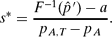
Let s* = [F −1() − a]/[pA, T − pA]. When s* > s, the following beliefs and strategies form a perfect Bayesian equilibrium in the game.
Strategies and Beliefs. T offers x = 0 and fights iff cT < c*T. B accepts x = 0, rejects any offer 0 < x < 1 − p − cB and accepts any offer x ≥ 1 − p − cB. A and B believe that T is resolved to use force, and the disputants' prior remains unchanged upon observing x = 0. They believe cT is distributed by FT, truncated below at c*T, if they observe x > 0. If p′ denotes the posterior belief that T will fight if the low offer is rejected (cT < c*T), p′ = 0 for all offers x > 0, and p′ = 1 if x = 0.
Proof. For there to exist a perfect Bayesian equilibrium of this kind, the following conditions must hold. All strategies are sequentially rational. Suppose that at the final node, intervener types cT < c*T fight by subgame perfection, implying that s(pA − cA) − a < s(pA,T − cA) − cT. Similarly, suppose types cT > c*T do not fight. Then, s(pA − cA) − a > s(pA,T − cA) − cT. There exists a critical type cT = c*T, which remains indifferent, so that s(pA − cA) − a = s(pA,T − cA) − cT. Solving this equality for cT, we find the above condition holds when a + s(pA,T − pA) ≡ c*T. Beliefs are derived from Bayes's rule. B's choice, when it receives a low offer, is based on its assessment of the probability that it is facing a resolved intervener. This probability is denoted by p′ = T(cT < c*T|cT < ĉT), that is, p′ = F(c*T)/F(ĉT), and since ĉT → ∞ and F(ĉT) → 1, p′ = F(c*T). By assumption, s > s*, and so B accepts because F(c*T) > , that is, p′ = . B accepts the intervener's low offer because p′(1 − pA,T − c*B) + (1 − p′)(1 − pA − cB) < 0. At the first node, intervener types cT > c*T incorporate their beliefs about the other players' strategies into the decision whether to send a low or a high offer. T always proposes a low offer because r[s(pA − cA) − a] + s(1 − r) > s(pA + cB). A always accepts the intervener's offer because its payoff from a negotiated peace settlement, 1, is clearly better than its payoffs from continued bilateral war or multilateral war with T fighting on B's side.



Comments
No Comments have been published for this article.