1. INTRODUCTION
In the last half of the nineteenth century, politicians and social investigators grappled with welfare issues regarding the aged poor and sought to address and explain their dependency and poverty.Footnote 1 Old age and pauperism were linked together, as many of those occupying poor law workhouses were elderly and infirm. Much of the history of social welfare in nineteenth-century England has understandably focused on the plight of the working-class poor and both state and charitable interventions.Footnote 2 But what happened when middle-class individuals or families fell on hard times?Footnote 3 How did philanthropic bodies meet their needs? The vertical model of charitable benefice has assumed the working classes to be the recipients of charity, but in what ways does this model change with inter-middle-class charity? The records of St Scholastica's Retreat, an almshouse founded by the Catholic spinster Elizabeth Harrison (1798–1867), reveal some answers to these questions.Footnote 4 Initially known locally as Clapton Almshouse & Library, St Scholastica's offered Catholic ‘decayed members of the middle and upper classes of society’ free accommodation commensurate with their social status, thus providing them with the opportunity to live autonomously and respectably, despite their reduced circumstances.Footnote 5
St Scholastica's must be understood within the larger historiography of old age and social welfare and the evolving historiography of the almshouse. Almshouses sprung out of a monastic tradition of offering shelter to travellers and the sick poor. They were commonplace in parts of Europe, especially in Britain and the Netherlands, but also in Ireland, Belgium, Denmark, Germany, Italy and Norway.Footnote 6 The Reformation did away with monasteries in Britain and eventually two forms of assistance replaced monastic welfare provision.Footnote 7 First, the state through the Old Poor Law provided outdoor relief in cash and kind. By the nineteenth century, the provision for the poor provided by the New Poor Law (1832) led to the institutionalisation of the poor in workhouses. Workhouses became known as places whose occupants were penalised and stigmatised for their poverty; they were places of last resort for the so-called ‘undeserving’ poor. This form of institutional living meant dependence, lack of privacy, and, in some cases, harsh conditions.Footnote 8 Second, wealthy individuals or corporate bodies (local or religious groups, livery companies and guilds, etc.) provided welfare through pensions and almshouses to the ‘deserving’ poor. Pensions allowed individuals to live in their own homes and almshouses allowed for independent living without the stigma of the workhouse. Despite their proliferation, almshouses have received little sustained historiographical attention until recently.Footnote 9 Since 2006, the British almshouse has been the focus of a Family and Community Historical Research Society (FACHRS) project, a collaboration between family historians and academic scholars aimed at developing the history of almshouses over the longue durée through publications and a comprehensive online gazetteer of British almshouses.Footnote 10 The present research has developed out of this larger project.
St Scholastica's records consist of a rich tranche of post-1867 minutes, correspondence, accounts and wardens’ reports and, importantly, a register of inmates which provides the basis for carrying out qualitative as well as quantitative analysis that reveals both the characteristics of the Retreat residents and the tenor of trustee decision-making. The register is particularly fruitful; it offers details of applicants to St Scholastica's Retreat and provides a record of their previous address, date of application, admission or rejection, age at application, date of death and place of burial, and, handwritten in the wide margins, are administrative notes about the inmates. These marginalia make for fascinating reading; they recount not only the mundane, such as the names of executors and dates that wills were received, but give particulars of family circumstances and the financial state of the applicants. Though focusing on one case study may seem particularist, using a microhistorical approach with such rich sources offers a means of stepping back from grand narratives. The result allows us to consider this model of inter-middle-class charity, noting both the similarities with welfare practices for the working-class poor as well as differences. It brings us closer to the lived experiences of the middle-class inhabitants of a charitable institution.Footnote 11
This essay begins with a brief sketch of welfare provision for the ‘deserving’ poor, including the middle classes, before discussing the development of St Scholastica's Retreat. Next, the Retreat community is profiled, focusing on social status to demonstrate how middle-class identity was created and maintained. Then, the essay relates how middle-class occupants utilised a mixture of resources to uphold their social status. The final section will suggest how domestic spaces within the Retreat were important to retaining social status.
2. CHARITABLE RESPONSES TO LIFE-CYCLE POVERTY
B. Seebohm Rowntree's early twentieth-century study of poverty in York pointed to the significance of life-cycle poverty. The last critical period of poverty in this cycle occurred in old age, when individuals were unable to work and children had married and left home.Footnote 12 Rowntree had derived his analysis from the examination of the lives of the very poor of York, but, as this essay argues, even those who held respectable positions in society could find old age a time of financial hardship. Until the 1908 Old Age Pensions Act, the elderly relied on their own resources and social networks to maintain them as they exited the years of paid employment.Footnote 13
In his volume of London charities, publisher Sampson Low identifies philanthropic entities that provided welfare for the elderly in two chapters. The first, entitled ‘Benevolent and provident pension funds’ listed groups that distributed pensions to those rendered ‘necessitous by untoward circumstances’. Most of these charities dispensed pensions to men (and sometimes their widows) who had worked in various trades or occupations such as schoolmasters and governesses, curates and ministers, seamen and licenced victuallers and those in the iron and metal trades. In his second chapter ‘Asylums for the aged’, Low addressed residential charities for the elderly; most provided local housing and sometimes small pensions to discrete occupational categories of individuals who were capable of independent living. The housing came under a variety of names; most common of the 120 listed were almshouses (85), asylums (12), hospitals (9) and colleges (8).Footnote 14 Often, these were endowed philanthropic institutions where the aged, (typically) working-class poor were offered free housing, and frequently a stipend of money or material goods. These were not places that offered institutional community living. Inhabitants lived independently in private accommodation and managed their own households. Though almshouses have typically been considered working-class housing, Patrick Joyce has noted that those named hospitals and colleges offered a more ‘superior’ reputation and they accepted those who had experienced ‘better days’.Footnote 15 This element of social class is fundamental to our understanding of St Scholastica's Retreat and will be examined in more detail in the next sections. The growth in numbers of almshouse foundations in the nineteenth century continued with some small stops and starts.Footnote 16 Much depended on place: the unevenness in development in certain locales was linked to economic vitality and urbanisation.Footnote 17 The precise number of almshouses in existence in the nineteenth century is unknown; the FACHRS project should go a long way to identifying almshouse residents as well developing an understanding of the continuities and changes of almshouse provision.
Charitable acts have always been a part of Catholic theology and practice reflecting both a religious obligation and a social expectation. Within the context of the nineteenth century, Catholic charitable giving was also influenced by the 1834 Poor Law. Government relief, particularly in the workhouse, was seen by Catholics as impersonal and devoid of the moral influence of charity that brought spiritual gains for both the recipient and the donor.Footnote 18 Catholic charitable initiatives were in part a reaction to government and public philanthropic institutions that Catholics believed placed too little emphasis on Catholic spiritual care, and may even have been aimed at conversion.Footnote 19 Catholic charities for the elderly came in the two forms noted by Low. Catholic organisations such as the Aged Poor Society and the Benevolent Society for the Relief of the Aged and Infirm Poor were managed by lay Catholics and distributed pensions to working-class Catholics. There were also establishments for the elderly managed by religious institutes or the diocese (a few managed homes for retired priests). The majority of these were operated by two women's congregations, the Sisters of Nazareth and the Little Sisters of the Poor, who between them managed 35 homes for the aged poor by the end of the nineteenth century. These were typically homes for the infirm and those incapable of independent living and can be linked to the conventual model that had been in place since medieval times. In these places, the corporal and the spiritual were entwined. Both the medical practitioner and the priest were regular features in these institutions; the nuns provided medical welfare and spiritual care in the form of daily mass and regular devotions.Footnote 20
Catholic almshouses were more distantly linked to the conventual model. St Scholastica's Retreat was part of a specifically Roman Catholic response to poverty: like earlier monastic establishments it addressed both the material and spiritual needs of elderly Catholics. Inhabitants of Catholic institutions would have easy access to clergy and frequent access to Catholic rites, rituals and sacraments. Also significant, with regards to the elderly, was the ready availability of the priest to give the last sacraments that would provide, according to Catholic belief, for a ‘good death’. Extreme Unction (the anointing of the sick) was the final sacrament administered to the dying and believed to convey the grace of patience to bear the trials of sickness and to ‘comfort and strengthen’ and help the dying ‘die a happy death’.Footnote 21 This was an important sacrament particularly for devout, ageing Catholics. However, unlike other Catholic almshouses, St Scholastica's was not located near a Catholic church. Harrison had intended St Scholastica's Retreat to be the centre of a larger Catholic community which would have included a parish church, presbytery and schools but that never happened. The small Catholic community in this area had been under the care of the Fathers of Charity (Rosminians) until 1874. Unfortunately, the Rosminians were unable to commit funds to building the complex that Elizabeth Harrison intended. Instead, weekly mass was held in the library, and from 1882 in the nearby small Catholic school which operated as a chapel on the weekends. The local Catholic community grew very slowly and a Catholic church was not built on the site until 1962. St Scholastica's residents, and their servants and co-inmates, were required to be Roman Catholic. But only one other requirement specifically related to their Catholic faith was noted in ‘Rights, Restrictions & Rules of Inmates of St. Scholastica's Retreat’: if an inmate died and no family could attend the Catholic funeral, the other three residents in the deceased's dwelling were required to attend the funeral services. It was assumed, and not explicitly stated, that as Catholics St Scholastica's residents would practise their faith regularly.
Catholic almshouses were not commonplace features of the British landscape. Five were operating in London in the nineteenth century, including St Scholastica's Retreat; and a sixth was located in Essex.Footnote 22 All were called almshouses except for St Scholastica's. ‘Retreat’ was not a term typically used in Catholic circles for charitable houses though a ‘retreat’, as a haven of peace or a place of spiritual reflection, could have reflected Harrison's religious aims for Retreat inhabitants. Harrison's use of the term ‘Retreat’ rather than almshouse is unusual; perhaps it was meant to reflect a more superior social status. She was probably aware of the Ministers’ Friend which operated a ‘Retreat’ for Congregational ministers in Hackney from 1851.Footnote 23 Harrison founded St Scholastica's Retreat in 1861 for ‘poor and reduced Catholics’. These Catholics were not the working-class poor that as we have seen were so often the focus of charitable efforts. The recipients of this charity belonged to an unusual subcategory of the ‘poor’: downwardly mobile gentry or professional/commercial families.
3. ELIZABETH HARRISON AND THE BUILDING OF ST SCHOLASTICA'S RETREAT
Unlike the occupants of St Scholastica's Retreat, the Harrison family over the years had moved up in social class and economic status. It was family wealth that provided the funding for Elizabeth Harrison's charitable endeavours. Elizabeth's father Robert, a carpenter, married a carpenter's daughter, Ann Plowman, in Yorkshire. They moved to Hackney in the 1790s and by the 1831 census, Robert Harrison was listed as a timber merchant. The family business was subsequently managed by Elizabeth's two brothers who were both childless.Footnote 24 The legacy received from brother Robert (1795–1852), through his wife Charlotte Scholastica's (1808–1858) estate, gave Elizabeth the funds necessary to fund two almshouses, St John's Hospice in Hackney and St Scholastica's Retreat in Clapton. St John's on Warburton Road was founded with her unmarried brother William (1802–1876) in October 1861 for Hackney's elderly poor.Footnote 25 It seems likely that this foundation was nearer to William's heart than Elizabeth's, as the residue of William's estate was used to pay operating expenses and a stipend to each inmate and Elizabeth left nothing in her will to St John's.
The charitable work of Catholic lay women like Hackney-born spinster Elizabeth Harrison reflected a tradition of individual charity that is often ignored in the historiography.Footnote 26 Harrison was an experienced hand at Catholic philanthropy. Her obituary in The Tablet, a well-read Catholic publication, opined she was one of the ‘most active and energetic members’ of charities for the relief of the poor. It also noted she was ‘indefatigable in her exertions’, ‘unsparing of personal pains’ and ‘long known as the life and mainspring of the benevolent society in which she was interested’.Footnote 27 These descriptions give us a sense of her level of involvement in charitable work even before her founding of St Scholastica's Retreat. Her obituary identified her as a philanthropist with a strong will and a resolute social conscience with regards to the poor of Hackney.
In the last 10 years of her life, Harrison shifted her attention from the working-class poor to the gentry and professional and commercial classes through the building of St Scholastica's Retreat. She may have hoped that spiritual gains would continue to accrue for herself and her family.Footnote 28 It is also likely that she wanted a lasting family memorial.Footnote 29 Statues of St Scholastica and her twin brother St Benedict were fitted near the front door in Gothic niches.Footnote 30 The Harrison coat of arms was displayed above the front door, along with the Harrison mottos Sapiens dominabiter astres and Facta non verba.Footnote 31 On the foundation stone near the front entrance was inscribed:
St Scholastica's Retreat
Founded in the Year 1861.
out of the Estate of Robert Harrison
and Charlotte Scholastica Harrison his widow
On whose souls may the
Lord Jesus have mercy.
Harrison bought the property in what was to become the leafy suburbs of London in the hamlet of Clapton just north of Hackney village for £2,160 in 1859. She hired Edward Welby Pugin (1834–1875), the architect son of the well-known A. W. Pugin (1812–1852), to design the complex. The younger Pugin had already begun to make a name for himself designing churches and cathedrals, mostly in the Northwest of England. The Retreat's grand Victorian Gothic façade with its roof ornaments tipped with iron faced the London Road (later Kenninghall Road).Footnote 32 Building began on the north side of the plot in 1861 and by 1862 the first inhabitants entered the front terrace of six apartments. The final complex, completed in 1874, included 40 apartments each with a suite of 5 rooms plus a communal library. This was an almshouse of extraordinary proportions in comparison with other Victorian almshouses which tended to have only one storey with between 5 and 12 individual dwellings.Footnote 33 St Scholastica's size and Gothic splendour (see Figure 1) reflected Harrison's intent to build a structure fit for the social status of the respectable gentry and professional/commercial classes.Footnote 34
Photograph of postcard ‘St Scholastica's Retreat’ by sludgegulper on flickr.com, used under the Creative Commons license CC By SA 2.0. https://www.flickr.com/search/?l=commderiv&q=st%20scholastica's%20retreat (accessed 20 August 2014).

Each of the 10 terraced houses held four apartments, two located on the ground floor and two above on the first floor. Inhabitants entered the front door into a corridor; on either side of the corridor were the inner doors to the first two apartments. Walking up a flight of stairs, one would find the two doors of the third and fourth apartments. Each door opened into a sitting room. Through the sitting room one could walk into the bedroom and behind that the kitchen and scullery and coal place which overlooked the back garden.Footnote 35 On the second floor was the attic, where two rooms housed up to four servants (one for each inhabitant). The spacious front garden on the front of the Retreat faced the London Road but was large enough to allow for some privacy. The library was also used as a meeting room (and until 1882 operated as a temporary chapel) and included two large fireplaces and oil paintings of Robert, Charlotte Scholastica and Elizabeth Harrison (no longer extant).Footnote 36 The stained-glass windows in the library (see Figure 2) included the Harrison coat of arms and the family mottos. All this has sadly disappeared; the entire structure was demolished in the 1970s as it was considered unfit for habitation and judged to be too expensive to modernise.
Photograph of postcard ‘The Hall, St Scholastica's Retreat’ by sludgegulper on flickr.com, used under the Creative Commons license CC By SA 2.0. https://www.flickr.com/search/?l=commderiv&q=st%20scholastica's%20retreat (accessed 20 August 2014).
Harrison was fully committed to St Scholastica's Retreat, managing it personally until days before her death in 1867 when its management was passed on to five trustees.Footnote 37 She was personally responsible for accepting the first group of inmates and she devised the ‘Rights, Restrictions & Rules of Inmates of St Scholastica's Retreat’. On her death, except for some small bequests, the entirety of her estate valued at over £36,000 was left to St Scholastica's.Footnote 38 It is to the Retreat candidates and inhabitants that this essay now turns to in order to better understand how this community of ‘decayed members’Footnote 39 of the middle classes of society was created and constituted.
4. SOCIAL CLASS
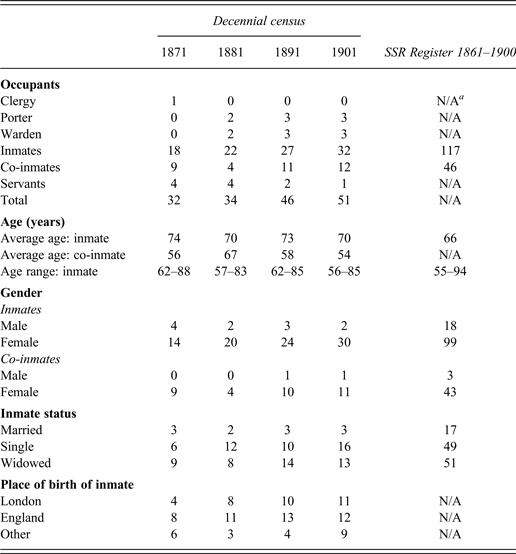
The document entitled ‘Rights, Restrictions & Rules of Inmates of St. Scholastica's Retreat’ elaborated on the list of qualifications of potential occupants: they were ‘poor and reduced’ Roman Catholics over 60 years of age belonging to the ranks of the gentry or professional or commercial classes. Accepted candidates could bring with them a spouse or other blood relative (limited to father/mother/brother/sister/son/daughter) as a co-inmate (only women over 50 years of age and men over 60 years of age) and one servant over 30 years of age.Footnote 40 The population at St Scholastica's as derived from the census and the analysis of St Scholastica's register matches these criteria quite closely (see Table 1).Footnote 41 What is clear from the census data is that though the complex was completed in 1874, it was never fully occupied. One house was inhabited by the warden and his family and included offices for the warden and the trustees. In 1881, a porter and his family occupied another house (until 1884 when the separate porter's cottage was completed). The reason behind these empty apartments is provided by warden Harry Gilmore who notes that because investment income could not cover stipends for all occupants, the trustees left some apartments empty.Footnote 42
St Scholastica's Retreat: inmate statistics, 1861–1901
a Data not available.
Sources: England and Wales Census, 1871–1901; St Scholastica's Retreat (SSR) Inmates Register.
The age and gender balance at St Scholastica's Retreat was quite consistent with the preliminary figures of the FACHRS almshouse project. Of those that were accepted, the average and median age was 66 years (FACHRS was 64 years), with the youngest being 55 years and the oldest 94 years. Retreat occupants were overwhelmingly female (84.62 per cent compared with the FACRS figures of 82.65 per cent in Middlesex), with 46 per cent unmarried and 47 per cent widowed women.Footnote 43 Scholars have argued that women were often ‘heavily overrepresented’ in institutions (mainly workhouses) due to their ‘weak social situation’.Footnote 44 Contemporary voices such as those of writer Ada Moore point to a dearth of education and employment opportunities for middle-class women, remarking that ‘decayed’ gentlewomen were part of ‘that large army of unmarried gentlewomen who are practically destitute’.Footnote 45 Yet historians have not come to any firm conclusions as to whether such ‘decay’ was the common experience of unmarried middle-class women.Footnote 46
Announcements promoting the opening of St Scholastica's Retreat in 1862 included a circular sent to the Roman Catholic bishops of England and Wales, an article published in The Tablet and a small notice included in the annual Catholic directory. These announcements highlighted the primary criterion for admittance into St Scholastica's: that of social class. St Scholastica's was promoted as a charity for ‘poor and reduced Catholics’ from the gentry or wholesale commercial or professional classes.Footnote 47 This was not the social class that inhabited the majority of English almshouses. Preliminary FACHRS data indicate that English almshouse inhabitants were primarily from the labouring classes; frequently noted occupations from the census data included agricultural workers and labourers if male and nurses and servants if female.Footnote 48 Low's handbooks suggested that pensions were often given to those a social class above the typical almshouse resident. St Scholastica's inhabitants had an even higher social status than this grouping.Footnote 49
Elizabeth Harrison, and later the trustees, demarcated the parameters of the social class they wished to attract to St Scholastica's quite precisely by occupation. Occupational information about the applicant, husband of the applicant and, often, parents of the applicant was requested from candidates. Occupations documented in the register ranged from the rather imprecise ‘gentleman’ to the more descriptive ‘wholesale champagne and cork merchant’.Footnote 50 Most applicants were female, and had no stated waged occupation, so nothing or ‘no profession’ was listed. In many cases father's employment was noted. More surprising was that the father's livelihood was recorded even when there was a notation of the widow's deceased husband's occupation. St Scholastica's trustees apparently wished to ensure that the applicant had not recently risen in social class or through marriage. Each potential inmate was interviewed to confirm that they were ‘of respectable character and behaviour’.Footnote 51 Correspondence with potential applicants also signalled the importance of social class. James Batchelor's application shows that he was a ‘dealer in silk and furniture fringes’ but trustee John Haly questioned whether this meant he was a manufacturer or warehouseman. Batchelor's response is not extant but he must have assured the trustees of his professional credentials, as he became a resident of St Scholastica's.Footnote 52
Unfortunately, we have less occupational information for those who withdrew their application or were rejected, but at least three applicants were explicitly disallowed because of their social class. Irene Foscigier did not belong ‘to classes for whom [the] charity [was] designed’; her father was a foreman at Messrs Broadwood. The remaining two did not have occupations listed, but notes indicated of one applicant that her ‘rank in life [was] below those of other cases elected’ and, in the other, her ‘condition of life makes her ineligible’.Footnote 53 Trustees intended that St Scholastica's Retreat would maintain the ideals of middle-class respectability and thus the class cohesion of its occupants was deemed crucial; respectability was intrinsic to this idealised class identity despite the financial penury of inhabitants.Footnote 54
Candidates were also required to be born in or otherwise domiciled in Great Britain for 10 consecutive years.Footnote 55 Elizabeth Harrison emphasised the connection to Hackney with her stated preference for Hackney residents, but St Scholastica's was always meant as a national institution. It was advertised in the national Catholic press, thus encouraging a wider assortment of applicants. This was contrary to the typical almshouse occupants who have traditionally been linked to place, local inhabitants being the primary intended recipients.Footnote 56 Likewise, and despite being advertised nationally, Retreat occupants had strong links to London. The census analysis (Table 1) confirms that 22 to 37 per cent of occupants were Londoners by birth. The register indicates also that 72 per cent of all inmates had London addresses before entering. However, given the increasing numbers of Irish emigrants to Britain in the nineteenth century, the majority of whom were Catholic, restricting entry to those born or resident in Great Britain for 10 years would seem like a harsh and exclusionary parameter. It is difficult to gauge why Elizabeth Harrison would have included this clause. She would be an unlikely candidate for anti-Irish sentiment. Her sister-in-law Charlotte Scholastica was Irish-born and they appeared to have a close relationship, given the naming of St Scholastica's Retreat. Harrison chose as Trustee and handpicked successor for daily business matters, Cork-born John Haly, Charlotte Scholastica's brother. Yet, the census indicates only six of the occupants over the 40-year census period were Irish-born (presumably, they were offered admission under the 10-year rule). This is probably simply a matter of timing. Trustee John Haly's response to a challenge to this rule in 1874 points to more robust numbers of Irish occupants:
I feel intensely for Mrs Fallon and, all the more that it is not in my power to exercise the least influence over my Co Trustees who bring as well as I do a single eye to bear on the defined object of the Trust clearly meant by the Foundress for the benefit of Catholics born in England; or, of such as can shew a residence of ten years complete to the date of application. … I am naturally unwilling that either you or Mrs Fallon should cherish a delusion that the Retreat was closed to applicants of Irish birth or origin—and by way of correcting so erroneous a conclusion. I tell you that at the present moment out of Twenty five occupations, eight are Irish a short while ago the proportion was, out of twenty seven occupations, eleven were Irish—this ought to satisfy all who are interested in the St Scholastica's Retreat at Clapton that there is no prejudice against Irish birth.Footnote 57
It also points to the sensitivity to this ‘Irish question’. It is true, of course, that the majority of the Irish in Britain would have been working class and thus ineligible for entry into St Scholastica's Retreat. John Belchem's work on Liverpool's nineteenth-century Irish middle class indicates that they fashioned themselves as a ‘self-enclosed, self-sufficient network’ which could be interpreted by the English as an ‘Irish Catholic apartness’.Footnote 58 Perhaps such Irish ‘apartness’ was considered too difficult to integrate into what was meant to be a community of like-minded and socially equal occupants. The overall emphasis on social class points to the significance of class cohesion to Elizabeth Harrison and the trustees of St Scholastica's Retreat.
5. ‘MIXED ECONOMY OF WELFARE’
The commercial leadership of the nineteenth-century middle classes has been woven into the narrative of the great nation, industrialisation and progress. Missing from this discourse, though, was financial uncertainty, more commonplace than normally assumed for the middle classes. Changing industrial technologies brought opportunities but also strains and insecurity; fears of bankruptcy were very real.Footnote 59 A middle-class family's financial security altered with the deaths of wage-earners, the fickleness of employers, downturns in the economy or poor qualifications, education or work skills. While we do not know the financial circumstances of all applicants who applied to enter St Scholastica's, causes of economic instability were occasionally noted in the register and provide a window into the causes of middle-class economic distress. Dr William Kenny and his wife Theresa were admitted in April 1880. His private fortune had been used to ‘pay the defalcation of a Trustee who had absconded’.Footnote 60 Frances Dudley Ward, a retired governess and daughter of an army officer, applied for entrance into St Scholastica's in 1896; her conversion to Catholicism had led to her financial insecurity.Footnote 61 Sixty-three-year-old spinster Frances Cuddon, whose father was a managing clerk in Wright's Bank, indicated that the bank's failure in 1840 ‘ruined the family’.Footnote 62
Importantly, Retreat inhabitants were not destitute. Accommodation was provided free of charge, but inhabitants were expected to provide for their own maintenance with a guarantee of an annuity of £80 (£60 if female).Footnote 63 For those who could not guarantee this annuity, Elizabeth Harrison's legacy initially allowed for a stipend of up to £40 to make up for the shortfall. Effectively this meant that the minimum guarantee of annuity became £40 (£20 if female). But shortly after Harrison's death, investment capital began to decline. Trustees began limiting the number of occupants in St Scholastica's Retreat. In 1890, stipends were dropped to a maximum of £25 per annum, which meant that the effective guarantees of annuity rose to £55 (£35 if female).Footnote 64
The analysis of annuities can shed some light on the personal finances of the inhabitants but there are factors that limit the overall analysis and contradict the stated guarantees listed above. First, Elizabeth Harrison was known to have made exceptions to the annuity requirements while she was managing St Scholastica's. Second, the annuities of only 85 inmates (of 117) were documented. Annual annuities from 1861 to 1900 averaged £39, though they ranged from £9 to £85 per annum.Footnote 65 Extant minutes and correspondence with the Charity Commission indicate that trustees, prior to 1888, were more likely to offer places to those that had higher guaranteed personal allowances in order to minimise the stipend distributed by St Scholastica's Retreat. This reflected their concern that investment interest would not stretch far enough to meet the needs of all occupants.Footnote 66
Annuity sources were included in the records of 76 residents.Footnote 67 Half derived some or all of their annuity from personal investments. Family support was also significant; 26 family members provided annuities. This corresponds with Pat Thane's contention that families did not always take in elderly family members, suggesting the elderly preferred living independently.Footnote 68 Friends, Catholic elites and charitable associations also contributed to annuities. Of the inhabitants, 14 were subsidised, at least in part, by charities such as the Molyneux Fund or the Universal Beneficent Society.Footnote 69 In nine cases, friends or named individuals provided some financial support. Here, we find some explicit links to the Catholic elite that point to the significance of social networks. Some candidates were financially supported by English and European Catholic nobility. Miss Georgina Crowe was given £5 per annum from the Duchess of Norfolk and another £5 from the Lord and Lady Compton.Footnote 70 Countess Tasker guaranteed an annuity of £20 per annum for Miss Anna Harding.Footnote 71 Some had employment links to the Catholic aristocracy. Inmate Henri la Serre, a ‘gentleman’ whose parents were ‘ruined nobles’, received a £20 annuity from the Duke of Norfolk whose son he had taught in the 1860s.Footnote 72 Mary Spain was a governess in the family of the French monarchist politician Auguste-Louis-Albéric, Prince d'Arenberg (1837–1924) who paid her annuity of £50 per annum.Footnote 73 What this analysis suggests is that financial impoverishment and residency in St Scholastica's Retreat did not necessarily mean estrangement from friends and family; social and familial networks remained important sources of support even after inmates entered St Scholastica's Retreat.
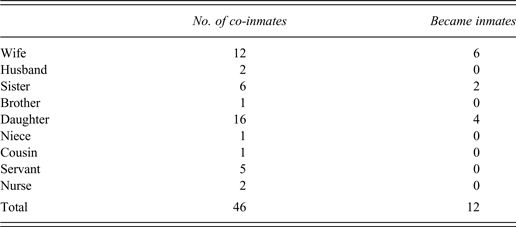
Another resource for Retreat occupants was co-residency. The decennial censuses indicate that the community at St Scholastica's ranged from 32 to 51 individuals (Table 1). Only two or three inmates in each census decade were married; most were widowed or unmarried. Though allowed to bring in servants, only 4 of 18 inmates had a servant in 1871 and this dropped to 1 out of 32 inmates in 1901. More inmates had co-inmates, though this did not remain a popular option according to census data; in 1871 half the inmates had a co-inmate but the ratio declined thereafter. The register suggests a more robust incidence of co-residents. Of the 46 (out of the 117) inhabitants with co-residents listed in Table 2, the majority of co-residents were spouses (14) and daughters (16).Footnote 74 Seven co-residents were servants and nurses. In 12 cases, the co-inmate became an inmate upon the death of their co-resident inmate. In one unusual case, one inmate brought in four additional family members to reside at St Scholastica's. Frances Kirkby was accepted as an inmate in 1869 with her 55-year-old daughter Fanny May as co-inmate; a second daughter Jessica appeared in the 1871 census. Frances died in 1875, and Fanny May was elected an inmate. In 1881, the census records her living with her sister Elizabeth as co-inmate and in 1891, with both Elizabeth and her brother Herbert. In 1890, Herbert became a co-inmate. In 1895, Elizabeth Kirkby died. Four years later, the last of the Kirkbys, Fanny May and her brother Herbert, died.Footnote 75 Altogether, a member of the Kirkby family resided at St Scholastica's for 30 years.Footnote 76 These patterns of co-residence point to the mutuality of self-help amongst family members. The elected inmate supported another family member by providing free lodging. But this could be a mutually beneficial arrangement, as the co-inmate could also act as caretaker. Several examples of this exist in the records. Joseph Richardson's 41-year-old daughter, Mary Jane, was admitted as his attendant.Footnote 77 In the 1871 census, 67-year-old Elizabeth Kurton's co-inmate Sarah Flint, her cousin, was listed as her servant.Footnote 78 This highlights the fluidity between family member and carer/servant. It is likely that more co-inmates were carers than is reflected in the extant documents, as St Scholastica's did not employ a resident doctor or nurse for residents until the twentieth century.
St Scholastica's Retreat: number of co-inmates, 1861–1900a
a Total of 117 inmates.
Source: St Scholastica's Retreat Inmates Register.
Historically, almshouses were for those who were capable of independent living and St Scholastica's was no different in this regard. The ‘Rights and Restrictions of Inmates’ stipulated that ‘no lunatic or insane person, nor any bed-ridden person, nor any person afflicted with outward disease declared to be contagious or incurable shall be admissible either as an inmate or as a co-inmate’.Footnote 79 Therefore any subsequent infirmity or physical decline could mean withdrawal. The friends of Madame Augustine Georgen removed her from St Scholastica's ‘on account of her great age and having no one to attend upon her’. She was 84 years old at the time.Footnote 80 Two additional inmates left for Nazareth House, the home for the aged run by the Sisters of Nazareth.Footnote 81 Former teacher Catherine Holland became ill and left for St Mary's Hospital in Stone run by the Dominicans of St Catherine of Siena.Footnote 82 After a severe illness, Julia Ravenscroft's brother insisted she leave St Scholastica's so she could have ‘better attendance’.Footnote 83 In all these cases, the implication was that the inmate needed long-term medical or personal care. Family and friends were still available when the inmate's health declined and independent living was no longer possible. In addition, there were other Catholic forms of institutional support available, such as Nazareth House and St Mary's Hospital, when inmates could no longer live independently. For many, St Scholastica's was not the ‘last resort’.Footnote 84
Inhabitants accessed a mix of resources, from personal assets, kinship relationships, friendship and charitable networks, as part of a ‘mixed economy of welfare’ so often discussed by welfare historians in Britain. This term, used to describe the numerous ways that the poor made ends meet, has found its place in histories of the poor who used state-funded poor relief, philanthropic resources and informal sources, such as friendship and family networks, to subsist through times of financial hardship.Footnote 85 This concept also has its place in our discussion of middle-class downward mobility. Numerous applicants had some personal sources of income, though perhaps not enough for independent living in their own homes. But for many more, additional financial supports were necessary. Kin relationships were for some of utmost importance; many inmates derived their allowances from family members. Also, in other cases, a reciprocal relationship may have existed where inmates provided accommodation (and future inmate status) for a family member whilst the family member co-inmate provided nursing or other bodily aid.
6. DOMESTIC SPACES AND IDENTITY
Despite its charitable status, St Scholastica's Retreat was successful in developing an institutional identity that did not pauperise its occupants. Elizabeth Harrison, and later St Scholastica's Retreat trustees, sought a set of inhabitants whose ‘rank in life’ was similar; they relied on occupation to identify appropriate inhabitants but that alone was not enough.Footnote 86 What this section will argue is that the well-kept home was an important signifier of middle-class status and respectability even (and maybe especially) for those whose financial position was unstable.Footnote 87 St Scholastica's provided this home, but in order to make certain that inmates conformed to expected middle-class ideals, the trustees upheld explicit rules regarding standards of interior design and cleanliness.
As mentioned earlier, the location of St Scholastica's Retreat in Clapton denoted the significance of place. Elizabeth Harrison located St Scholastica's Retreat in Clapton where the ‘situation of building [was] healthy, being in the immediate neighbourhood of Hackney-downs’.Footnote 88 Charles Booth's 1898–1899 maps colour the surrounding urban residences of Clapton pink and red to indicate the middle-class tenor of the locale.Footnote 89 The Victorian Gothic structure built by Pugin was suitably impressive and appropriate to these environs. Streets were wide, and buildings plots appeared spacious.
St Scholastica's Retreat provided its inmates with apartments that included a suite of rooms which allowed for clearly delineated activities: sitting room, bedroom, kitchen, scullery with pantry, coal-place as well as an attic room for shared servants’ accommodation. This regulation of space through segregation of activities and functions was a marker of middle-class identity.Footnote 90 That these spaces were private was emphasised by the trustees and minuted in 1892 when the warden reported his concern that he did not maintain a set of keys for inmates’ rooms. When Miss Morgan lost consciousness, he had had to enter her residence through a window. The trustees, in response to his ‘expression of anxiety’, reminded him that it was not their duty (or his) to intrude upon the privacy of inmates and their rooms should be looked upon as private.Footnote 91 Richard Trainor, in discussing middle-class housing, noted a strong desire for privacy and St Scholastica's Retreat provided this for its inmates.Footnote 92 Though a library existed as a common room, this was not communal living. St Scholastica's Retreat inhabitants lived independently, managing their own household, handling their own finances and arranging for their own meals.
However, the prescribed rules documented in the ‘Rights and Restrictions of Inmates’ for decorating and spatial planning were scrupulous. The sitting room floor was carpeted ‘and if possible of one material and pattern’. It could not be used as a kitchen or a bedroom. Residents were instructed to ‘introduce household goods and furniture as can be conveniently and properly placed for ordinary use’. Rule VI indicated:
They shall not introduce any but iron bedsteads into the Retreat, and they shall not stow away boxes or any kind of lumber underneath the same. All ornaments and moveable fittings must be approved by and disposed according to the directions of the Trustees or their Deputy; and any articles not approved by the Trustees or their Deputy, shall be excluded.Footnote 93
There were prescriptions regarding the outdoor environment also: ‘No drying, bleaching, airing linen, clothes etc in front premises, open ground, gardens; no alterations of walks, flowerbeds, etc.’ Exceptions to the rules were made on occasion. In 1895, the warden noted that 72-year-old Mrs Aves and some other inmates placed boxes of flowers near the outer doors. The response of the Trustees indicated some cautious leeway that considered the ‘amusement’ of the inmates:
The Trustees were of opinion that the Inmates should be subject to the minimum of control and restraint in regard to flowers as they furnished a means of amusement. The Warden was to report to the Trustees in any case where flower boxes caused palpable dis-sight or interfered with the orderly and pleasing arrangement of the Garden Ground.Footnote 94
Respectability went hand in hand with a preoccupation with cleanliness and this was also reflected in St Scholastica's rules and minutes.Footnote 95 Rule V indicated that inmates should be ‘cleanly and orderly in the care of their rooms’. While there is no surviving evidence of regular inspections of internal spaces, there are occasional notes about untidiness in the correspondence and minutes.Footnote 96 Inhabitants whose rooms were not up to a certain standard of hygiene were admonished in person and in writing. When the warden noted that Miss Isabella Gray's rooms were not clean, the solicitor was instructed to ‘write to that Lady upon the subject’.Footnote 97 The same complaint was made of Elizabeth Steed and the warden was requested to ‘draw Mrs Steed's attention to the need of cleanliness in her apartments owing to the shortcomings of her servant’.Footnote 98 Retreat rules were exact about cleanliness. The apartments were to be cleaned weekly. The occupants of the upper and lower floors were to take turns washing the landing and watercloset and sweeping and washing the back external flight of stone steps. The back step was to be washed twice a week, while the front door step and doormat were to be shaken weekly. Monthly, inmates of the lower floors took turns to wash the basement or paved lobby. Inmates paid for chimney sweeping when necessary. There were also rules about lighting the gas each evening at dusk, and then lights out at 10 pm: ‘the inmate in charge of the basement shall each night fasten the external doors at 10 pm when everyone was expected to be within the apartment’.Footnote 99 This was part of the code that John Burnett argues defined middle-class status. The home became not only a place of comfort and protection from the outside world, but also:
proclaim[ed] by its ordered arrangements, polite behaviour, cleanliness, tidiness and distinctive taste, that its members belonged to a class of substance, culture and respectability. The house itself was to be the visible expression of these values.Footnote 100
St Scholastica's Retreat register and correspondence indicate that it was well regarded even amongst those who were financially better off; 11 applicants were rejected or withdrew because their income or property holdings exceeded the maximum limits set by the Trustees.Footnote 101 Inmate Mariana Monteiro, author of As David and the sibyls say (1905) noted her address, ‘St Scholastica's Retreat’, in the preface of this text, which would suggest she felt no embarrassment at living in charitable accommodation.Footnote 102 Relations of trustees can also be found in St Scholastica's. Susannah White (c. 1789–1877), the aunt by marriage of trustee Stephen White (1837–1906; trustee 1890–1906), resided in St Scholastica's from 1863 to 1877 after the death of her husband, surgeon Edward White. Their son (and Stephen White's cousin) George White (c. 1823–1898) with his wife Lavinia (1831–1910) entered in 1886. Lavinia remained in St Scholastica's after George's death, bringing in her sister-in-law Agnes White (also Stephen's cousin) as a co-inmate.Footnote 103 There is little evidence of the ‘social subordination’ or the ‘whiff of failure’ that Frank Prochaska claims was intrinsic to inter-middle-class charities.Footnote 104 Rather than understanding St Scholastica's and almshouses for the middle classes as arenas of failure, we might better understand them as philanthropic housing necessary to maintain the social order. Almshouse places were much coveted and did not necessarily lead to a loss in social status.
7. CONCLUSION
In the half-century before old-age pensions, almshouses were simply one option in the ‘mixed economy of welfare’, which in nineteenth-century England comprised a range of responses to poverty including help from friends and family, charitable efforts and the state-funded poor law. Elizabeth Harrison in setting up this charity showed her concern for those of her own class who could no longer maintain material comforts congruent with their social status. This study of St Scholastica's Retreat offers an opportunity to examine a charity for the middle classes and the horizontal relationship between middle-class benefactors and recipients that did not appear to stigmatise the middle-class recipient of charity. St Scholastica's physical structure with its imposing Gothic façade oozed affluence and respectability, as did the apartments, which were larger than typical almshouse accommodation. Importantly, the Retreat was a flexible institution, where inhabitants could come and go according to their material and medical needs. Retreat occupants maintained strong social and familial networks that remained important resources for them; St Scholastica's Retreat was not a ‘last resort’ for many of its inhabitants. There is some continuity with the claims of early modern historians who have noted that almshouses performed a charitable function whilst still allowing respectability.Footnote 105 The receipt of welfare for these gentry and professional/commercial classes did not pauperise them in the same way it did the working classes. In many ways, this reflects what Joyce concludes in his examination of Morden College: ‘in poverty as in wealth two worlds were maintained in distinction and separation’.Footnote 106 It is always difficult to capture the lived experiences of those in the past given the complicated nature of social relations but the St Scholastica's Retreat records reveal the agency of its occupants despite their shrinking financial resources and their so-called ‘decay’. Their ‘choices’ were limited but networks of family, friends, elites and charitable institutions, such as St Scholastica's Retreat, enabled them to maintain their middle-class social status. These records and the findings presented here not only demonstrate the flexibility of charitable accommodation but also the meanings inherent in the domestic space which emphasised middle-class respectability.
While many scholars have developed a robust research agenda concentrating on the working-class poor, more research needs to analyse financial dependence as it afflicted members of other social classes, such as the downwardly mobile middle classes detailed here, especially the elderly. Life-cycle poverty also influenced the middle classes, and economic circumstances and adverse events combined with ageing left some of its members reliant on charitable bodies. The work presented here demonstrates that social class was far from stable, and that institutions, individuals and families would go to great lengths to promote the social stability of the middle classes. Victorians did not always stigmatise or penalise those whose financial status became precarious; class mattered. What this history of the almshouse suggests is that the history of poverty has a wider remit than that of the working classes. Almshouses were places that, despite their prescriptive rules and regulations, offered respite and respectability from the uncertainties of poverty and old age. Perhaps further studies on financial dependence will help to remove the moral stigma of poverty and better address the economic needs of those who find themselves requiring assistance.
ACKNOWLEDGEMENTS
This essay has benefited much from the knowledge and meticulous research of R. A. Kidd, a local historian and current occupant of St Scholastica's Retreat, who has most generously shared his research with me. In addition, I would like to thank the trustees of St Scholastica's Retreat as well as the Archives of the Archdiocese of Westminster for allowing access to the records of St Scholastica's Retreat. Though I am responsible for the contents of this essay, it has benefited from the feedback from the anonymous peer reviewers, the attendees of the international conference ‘Almshouses in Europe’, held in Haarlem, the Netherlands, 7–9 September 2011 as well as Sean Brady, Marian Flint, Jane Hamlett, Sylvia Pinches and Victoria Van Hyning. Special thanks to Janet Cumner, whose gentle prodding encouraged me to look at St Scholastica's Retreat in more detail.