1. Introduction
The Frasnian Stage (Upper Devonian) is remarkable in that it preserved one of the major Palaeozoic sea-level rises (Haq & Shutter, Reference Haq and Schutter2008; Morrow & Sandberg, Reference Morrow and Sandberg2008), which culminated in the spreading of basinal anoxic waters. Major biotic turnovers occurred during the early and late Kellwasser Events during latest Frasnian time (e.g. Hallam & Wignall, Reference Hallam and Wignall1999), which was also a period of origination of new faunas (Bambach et al. Reference Bambach, Knoll and Wang2004; Stigall, Reference Stigall2012). This long-term eustatic rise was documented mainly in Laurussia (e.g. Johnson et al. Reference Johnson, Klapper and Sandberg1985; Johnson & Sandberg, Reference Johnson, Sandberg, McMillan, Embry and Glass1988; Narkiewicz, Reference Narkiewicz, McMillan, Embry and Glass1988; Alekseev et al. Reference Alekseev, Kononova and Nikishin1996; House & Ziegler, Reference House and Ziegler1997; Filer, Reference Filer2002; Bond & Wignall, Reference Bond and Wignall2008; Morrow & Sandberg, Reference Morrow and Sandberg2008) and in South China (Chen & Tucker, Reference Chen and Tucker2003). Using preliminary records from the Moroccan Anti-Atlas (Wendt & Belka, Reference Wendt and Belka1991), one accurate sea-level curve was recently provided on the African Gondwana margin (Dopieralska et al. Reference Dopieralska, Belka and Walczak2016).
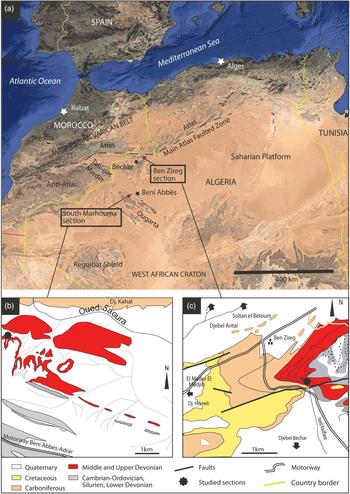
In this contribution we focus on Upper Devonian facies and sea-level fluctuations in the Algerian Sahara by integrating results from two representative Frasnian sections of different marine palaeoenvironmental settings: the South Marhouma (MH) and the Ben Zireg (BZ) sections (Fig. 1a). Indeed, this area is still poorly understood compared with the time-equivalent North America and European regions.
(a) Location of South Marhouma section (Ougarta Basin) and Ben Zireg section (Bechar Basin) in NW Algeria (photograph from Google Earth). (b) Investigated section in the Saoura region (after Petter, Reference Petter1959). (c) Investigated section in the Ben Zireg anticline (after Pareyn, Reference Pareyn1961).

Analyses of lithofacies, magnetic susceptibility (MS) and conodont biofacies were performed to determine changes in the depositional environment and sea level through time. MS data record the changes in the amount of detrital content in rocks that may potentially be related to sea-level variations (e.g. Crick et al. Reference Crick, Ellwood, Hladil, El Hassani, Hrouda and Chlupac2001). The MS signal can be obscured by sedimentary processes and diagenesis, and should be tested by additional magnetic techniques (Da Silva et al. Reference Da Silva, Mabille and Boulvain2009, Reference Da Silva, De Vleeschouwer, Boulvain, Claeys, Fagel, Humblet, Mabille, Michel, Sardar Abadi, Pas and Dekkers2013). Conodont genera are often thought to be associated with typical water depth preferences during Late Devonian time. The proportions of each genus within a level were therefore interpreted as a proxy for water depth variation, an approach known as conodont biofacies (Seddon & Sweet, Reference Seddon and Sweet1971; Sandberg, Reference Sandberg and Barnes1976). However, we are aware that changes in bathymetry might not be the only cause of fluctuations in the percentage of conodont genera in succeeding populations (Belka & Wendt, Reference Belka and Wendt1992; Vierek & Racki, Reference Vierek and Racki2011). At least four genera (Polygnathus, Icriodus, Ancyrodella and Palmatolepis) were present during early–late Frasnian time, and can provide information about depositional environments.
The main objectives of this study are first to determine whether observed changes and trends in the environment occur concomitantly in different settings of the region and, second, to propose a second-order relative sea-level curve through the Frasnian Age that can be compared with data from other continental entities. As such, we aim to compare fluctuations in sea level with those determined in the neighbouring Tafilalt region by analysing the Nd isotope composition of conodonts (ɛNd decrease during regressions and increase during transgressions; Dopieralska et al. Reference Dopieralska, Belka and Walczak2016) and with the global trends in Laurussia by using sedimentological data.
2. Geological setting
The Algerian Sahara is part of the North Gondwana epicontinental margin between the Maghrebian Variscan Belt to the north and the West African Craton to the south (Fig. 1a). This domain was moderately affected by the Variscan deformation. The South Marhouma section is located in the intracratonic Ougarta Basin that is bordered to the south by a Precambrian shield. This basin was a strongly subsiding trough filled with continental and marine Ordovician–Carboniferous sediments, up to 10 km in thickness and slightly deformed by Variscan compressional movements (Donzeau, Reference Donzeau1974). Upper Devonian deposits are well exposed in the northern part of the basin. At least 75 m of Frasnian sediments continuously crop out in the South Marhouma section (29° 57′ 31.6′′ N, 002° 06′ 07.8′′ W; Fig. 1b). The succession comprises mudrock deposits (shales and marls) containing argillaceous micritic nodules and, at its top, black shales that correspond to the upper Kellwasser horizon (Mahboubi et al. Reference Mahboubi, Feist, Cornée, Mehadji and Girard2015). Goniatites from this area were described by Petter (Reference Petter, Alimen, Le Maitre, Menchikoff, Petter and Poueyto1952) and Göddertz (Reference Göddertz1987) and trilobites by Feist et al. (Reference Feist, Mahboubi and Girard2016), and ichnological analyses were performed by Bendella & Mehadji (Reference Bendella and Mehadji2014). The first conodont research was conducted by Mahboubi & Gatovsky (Reference Mahboubi and Gatovsky2014) and revealed a rather moderate yield of often insignificant conodont elements (less than 10 conodonts per kilogram in most samples), preventing a fine-scaled biostratigraphic framework from being established. However, the presence of a restricted number of conodont zones, that is, Frasnian Zones (FZ) 5, 11, 12 and 13 (Klapper & Kirchgasser, Reference Klapper and Kirchgasser2016), were recognized with confidence, whereas zones 6 and 7 and 8–10 remain undifferentiated. Many dark shale intervals, notably at the base of the succession (FZ1–4?) and in the uppermost part, did not provide any conodonts. At present, we rely on these poor data that only permit an incomplete zonation to be established at South Marhouma.
In contrast to the high sedimentation rates in the Ougarta trough, sedimentation rates were much lower in the Bechar region some 300 km further to the north. Here, Upper Devonian deposits represent condensed carbonate successions punctuated by hiatuses (Weyant, Reference Weyant1988). The Frasnian succession is most complete in the Ben Zireg section (31° 54′ 39.4′′ N, 001° 47′ 58.8′′ W; Fig. 1c) on the steep southern flank of an acute anticlinal structure. Conodont-based biostratigraphy revealed an upper Givetian – lower Frasnian hiatus, superseded by a complete sequence where all conodont zones from FZ5 to the top of FZ13, corresponding to the Frasnian–Famennian boundary, were recognized (Mahboubi et al. Reference Mahboubi, Feist, Cornée, Mehadji and Girard2015). At the top of the succession a marker bed of typical Kellwasser facies is developed.
3. Materials and methods
Samples of well-cemented rock were collected in intervals ranging from 0.2 m to 2 m, depending on the thickness of the soft shale intercalations. A total of 40 and 60 thin-sections were prepared from rock samples from the South Marhouma and Ben Zireg sections, respectively, in order to analyse petrofacies and fabrics. Microfacies descriptions follow Dunham (Reference Dunham and Ham1962) for carbonate rocks and Schieber (Reference Schieber1989) for black shales. The identified facies were interpreted and related to a depositional setting according to Wright & Burchette (Reference Wright, Burchette and Reading1996), Flügel (Reference Flügel2004) and Pas et al. (Reference Pas, Da Silva, Cornet, Bultynck, Königshof and Boulvain2013, Reference Pas, Da Silva, Sutter, Kido, Bultynck, Pondrelli, Corradini, Devleeschouwer, Dojen and Boulvain2014). Photographs were taken with an integrated Olympus digital camera. The uppermost Frasnian shales were also studied using the tungsten-filament JEOL 5600 scanning electron microscope (SEM) of the Department of Electron Microscopy and Analytics (MEA) of the University of Montpellier. The resolution of this SEM is of the order of a few microns.
MS measurements were performed on 90 and 54 samples from the South Marhouma and Ben Zireg sections, respectively, for preliminary investigation. Various lithologies were measured (shales and arenaceous and carbonate rocks). In the laboratory, samples were cleaned from iron coatings prior to weighing with a highly accurate balance (with a precision of 0.01 g). MS was measured on samples weighing 5–10 g with a Bartington susceptibility meter (MS-2), which provided measurements in units of ×10−8 m3 kg−1.
4. Results
4.a. Lithostratigraphy
Each section in the field was first described on the basis of informal lithostratigraphic units, that is, stratified bodies of rocks defined and characterized on the basis of their lithologic properties and ages.
4.a.1. Ben Zireg section
The Ben Zireg section is 26.6 m thick (Fig. 2) and includes five units (Units 1–5) extending from the middle Frasnian to the lower Famennian strata (Mahboubi et al. Reference Mahboubi, Feist, Cornée, Mehadji and Girard2015). The succession is dominated by rhythmic, fine-grained carbonates.
Lithological column with relative abundance of fossil components and facies fabrics of the Ben Zireg section. Conodont zones from Mahboubi et al. (Reference Mahboubi, Feist, Cornée, Mehadji and Girard2015). Lithostratigraphic Unit 1: ochre cherty limestones with soft-deformations; Unit 2: massive micritic limestones; Unit 3: ferruginous limestones; Unit 4: pseudo nodular argillaceous limestones; Unit 5: nodular limestones. Abbreviations: M – mudstone; W – wackestone; P – packstone; F – floatstone; FZ – Frasnian conodont Zone (after Klapper & Kirchgasser, Reference Klapper and Kirchgasser2016). The recrystallization interval corresponds to carbonate deposits which suffered post-diagenetic processes and were recrystallized into microsparite to sparite; most of sedimentary features and fossils cannot be determined.

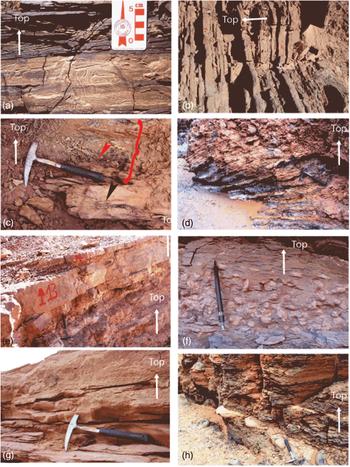
Unit 1 contains conodonts representative of FZ5 (Palmatolepis punctata) just above a depositional hiatus of early Frasnian age. This unit is characterized by ochre, sometimes brecciated, cherty beds with convolute lamination (Fig. 3a). Thin iron hydroxide coatings are displayed at the top of the unit.
Lithofacies. (a) Unit 1 at Ben Zireg, convolute laminations (Facies 2). (b) Unit 5 at Ben Zireg, thin-bedded, upper Frasnian micritic limestones (Facies 3). (c) Uppermost Unit 5 at Ben Zireg, detail of the upper Kellwasser bed with a layer of black shales (red arrow and bracket, Facies 1) superseded by laminated pinkish calcisiltic shale (black arrow, Facies 7). (d) Unit 1 at South Marhouma, blackish shales (Facies 1). (e) Unit 2 at South Marhouma, alternating Facies 6 pseudonodular limestone beds and Facies 1 grey shales. (f) Unit 3 at South Marhouma, cross-sectional view of interbedded Facies 3 argillaceous lime nodules. (g) Top of Unit 3 at South Marhouma, laminated black to pinky shales (Facies 7) of the upper Kellwasser bed. (h) Unit 4 at South Marhouma, decimetre-thick diagenetic limestones and Facies 1 dark shales from lower Famennian strata.

Unit 2 contains conodonts representative of FZ6 (Ancyrodella gigas form 2). It consists of greyish to brownish massive limestone beds, of centimetre to decimetre thickness, intercalated by millimetre- to centimetre-thick argillaceous limestone beds that display discrete nodular structures (Fig. 3b).
Unit 3 contains conodonts representative of the interval ranging from FZ7 (An. lobata and An. curvata) to FZ11 (Pa. feisti). It is characterized by well-bedded lime and argillaceous mudstone to wackestone. Beds are frequently coated at the top by iron hydroxide films. The limestone beds are often wackestone with abundant pelagic microfauna (tentaculites and entomozoan crustaceans) associated with sparse euhedral pyrites and some phosphate grains. The amount of nodular structures increases progressively upwards and they are mostly related to pressure-dissolution surfaces.
Unit 4 contains conodonts representative of FZ12 (Pa. winchelli), and is characterized by yellowish, massive, clay-rich limestones sometimes interbedded with thin dark shales. Clay-rich limestones display poorly defined nodules (pseudo-nodular limestones). The limestones are mudstone to wackestone with sparse pelagic bioclasts (Fig. 2), some of which are slightly bioturbated.
Unit 5 extends from FZ13 (Pa. bogartensis) to the lower Famennian strata (Pa. triangularis). It consists of greyish and pinkish nodular to pseudo-nodular limestones and interbedded argillaceous micrite yielding rare faunas, including tentaculite and cephalopod fragments. A 30-cm-thick interval of laminated dark grey to black shales, overlain by 35-cm-thick laminated pinkish fine-grained lime wackestone (‘calcisiltites’) without fossils (Fig. 3c), is observed in the upper part of the limestones. The dark shales represent the upper Kellwasser horizon.
4.a.2. South Marhouma section
The Frasnian succession is approximately 75 m thick and includes four units (Units 1–4). The base of this section cannot be precisely dated because of a lack of conodont specimens. Details concerning conodont contents and their biostratigraphic implications were presented in Mahboubi & Gatovsky (Reference Mahboubi and Gatovsky2014). In contrast to Ben Zireg, this section is dominated by monotonous shale deposits rich in carbonate nodules (Fig. 4).
Lithological column with relative abundance of fossil components and facies fabrics of the South Marhouma section. Conodont zones from Mahboubi & Gatovsky (Reference Mahboubi and Gatovsky2014). Lithostratigraphic Unit 1: dark shales; Unit 2: bioclastic nodular/pseudonodular limestones, grey shales; Unit 3: nodular muddy limestones, greenish/darkish shales; Unit 4: diagenetic limestones, black shales. Abbreviations: L.tr. – lower triangularis; FAM – Famennian; and as for Figure 2.

Unit 1 contains conodonts (Ancyrodella sp.) attributed to the FZ1–4 interval as FZ5 was identified in Unit 2. It consists of dark grey shales (Fig. 3d) with some nodular limestones and some black shale interbeds.
Unit 2 extends from FZ5 (Pa. punctata) to the lower part of the undifferentiated FZ8–10 interval (Ancyrognathus coeni – Ancyrodella lobata). It is characterized by centimetre- to decimetre-thick, greyish to reddish, pseudo-nodular to nodular bioclastic limestones (Fig. 3e), which alternate with unfossiliferous greyish to blackish shales. The limestones are wackestones with Styliolina (tentaculites) coquinas; they yield phacopid trilobites and cephalopods (Mesobeloceras sp.) on the surface of bed MH9 (Feist et al. Reference Feist, Mahboubi and Girard2016).
Unit 3 contains conodonts representative of the top of FZ8–10 to FZ13 (the latter with Pa. bogartensis) interval. It is characterized by unfossiliferous greenish and greyish shales with frequent reddish and greenish argillaceous nodular limestones (Fig. 3f) and some dark shale interbeds. The input of siliciclastic material increases towards the top, including millimetre-thick intercalations of parallel laminated sandstone. The upper Kellwasser horizon of this section is marked by plane-laminated shales (Fig. 3g).
Unit 4 contains conodonts representative of the early Famennian Age (Pa. ultima, Pa. subperlobata). It is mainly composed of decimetre-thick dark grey to black argillaceous nodular limestones, displaying large orthoceratids and brachiopods, and of unfossiliferous greyish laminated shales (Fig. 3h).
4.b. Facies
On the basis of differences in texture, fossil components and lithological nature, seven sedimentary facies (F1–7) are identified (Figs 2, 4). The original texture of most rocks was obscured or obliterated during burial and diagenesis, tectonic processes or both. Indeed, microshear zones and stylolites are locally identified within nodular limestones. Moreover, the original lime mud was minutely recrystallized (e.g. Fig. 5h, i).
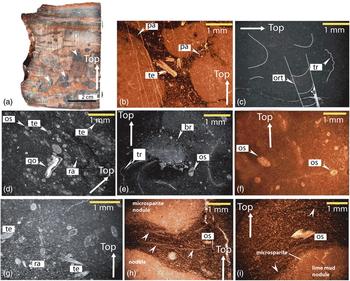
Facies of the depositional environments of the South Marhouma section and the Ben Zireg section: (a) hand sample and (b–i) thin-sections. (a) Facies 2, outer-ramp deposit: reworked mudstone layers in the Ben Zireg section (bed BZ2B). (b) Facies 2, outer-ramp deposit: zoom on reworked mudstone layers (bed BZ1C). (c) Facies 6, mid–outer-ramp deposit: lime mudstone with cephalopod bioclasts (bed MH34). (d) Facies 4, outer-ramp deposit: pelagic argillaceous wackestone displaying distinct lamination by parallel arrangement of tentaculite coquinas (bed MH10). (e) Facies 6, mid–outer-ramp deposit: diversified wackestone with bioclasts consisting of abundant brachiopod shells (bed MH32). (f) Facies 6, mid-ramp deposit: fine-grained mudstone with benthic ostracods (bed BZ10B). (g) Nodule of carbonate Facies 3 within shales of Facies 1, outer-ramp deposit: fine-grained wackestone with randomly orientated tentaculites and radiolarians (Bed MH 28). (h) Recrystallized nodule of Facies 3 in Facies 1: lime mud transformed into microsparite; note tension gashes filled by calcite (arrow). (i) Nodule of Facies 3 in Facies 1: lime mud partially transformed into microsparite in the margin; note pressure-solution surfaces underlined by oxide concentrations (arrow). Abbreviations: br – brachiopod; go – goniatite; ort – orthoceras; os – ostracod; pa – parabreccia; ra – radiolarian; tr – trilobite; te – tentaculite.

4.b.1. Shale and calcareous nodules (F1)
In both sections, finely laminated greyish shales are interbedded with dark grey shales, calcareous shales or both. Bed thicknesses range from millimetres to a few metres. Thick layers of shales also display septaria nodules in the South Marhouma section, whereas such shales are less common at Ben Zireg. The faunal content is represented only by poorly preserved shelly pelagic organisms (e.g. tentaculites and bivalves).
4.b.2. Lithoclastic floatstone (F2)
This facies is uncommon and was found only at Ben Zireg. The lithoclasts mainly consist of chaotic, randomly organized angular to rounded limestone and cherty clasts (Fig. 5a, b). Carbonate clasts are composed of monomict, poorly sorted pelagic mudstones belonging to Facies 3 (see below). Lithoclasts are supported by a matrix composed of lime mud, clay, microsparite and iron hydroxide. Recrystallized millimetre-thick siliceous laminae can locally occur. The fossil components consist of rare pelagic ostracods (entomozoans) and tentaculite debris. Inverse grading in the lower part of some decimetre-thick beds was observed.
4.b.3. Poorly fossiliferous mudstone (F3)
This facies is common in both sections. In the South Marhouma section, F3 is found in Units 1 and 3 consisting of greyish nodular, centimetre-thick lime beds in shale. Nodules consist of lime mud and wackestone partially or totally transformed into microsparite (Fig. 5h, i). In the Ben Zireg section it occurs mainly in Units 3 and 5 as centimetre-thick fine-grained limestone beds or greyish nodular limestones, respectively. The matrix of this facies is lime mud or microsparite. Micritic limestones lack bioturbation fabrics, whereas burrowing traces are sometimes observed in nodular limestones embedded within greyish shales. F3 is characterized by poor faunal content that is locally represented by pelagic organisms such as tentaculites, pelagic bivalves, entomozoans and radiolarians (Fig. 5g). No current fabrics have been macroscopically observed in this facies.
4.b.4. Argillaceous wackestone (F4)
This facies occurs mainly in middle Frasnian strata in both sections. It comprises centimetre- to decimetre-thick greyish to reddish limestones. Pressure-solution processes commonly triggered tectonic stylolithization. The common type of texture is wackestone with microbioclasts occurring in a patchy distribution. The matrix therefore displays ferruginous blisters organized into isolated or grouped, concentric internal structures. Submicrometric hydroxide grains are often found. Beds are frequently coated at the top with films of iron hydroxides. The faunal content is commonly abundant, with tentaculites as the dominating organisms followed by entomozoans, radiolarians, cephalopods and pelagic bivalves (Fig. 5d). Additionally, scarce benthic faunas are represented by debris of trilobites, brachiopods and ostracods. Bioclasts are generally poorly sorted; they can be concentrated into millimetre-thick laminations with a random distribution of fossils, and are partially affected by bioturbation.
4.b.5. Diversified fauna mudstone to wackestone (F5)
This facies is most commonly found in the uppermost part of both sections. In the South Marhouma section, it is composed of large dark microsparitic nodules of early triangularis Zone age. In the Ben Zireg section, the same facies consists of greyish nodular muddy limestones. Fossil components are dominated by nektonic faunas such as cephalopods including Orthoceras, mostly fragmented and poorly preserved (Fig. 5c). Pelagic organisms, radiolarians, entomozoans and tentaculites are less frequent. Benthic faunas are more abundant compared with Facies 4 (Fig. 5e); they are dominated by ostracods and the skeletal debris of echinoderms, brachiopods and trilobites. This facies is locally bioturbated. Geopetal structures are recognized within ostracods and cephalopods coquinas.
4.b.6. Lime ostracod mudstone (F6)
This facies is not frequent in the studied sections (samples BZ10a, BZ11, BZ13a and MH6′). It occurs mostly in FZ12 in the Ben Zireg section. It consists of yellowish thin-bedded argillaceous limestones. The matrix is microsparite to sparite, rarely containing euhedral replacement of dolomite crystals. The bioclastic components of this mudstone consist predominantly of benthic ostracods (Fig. 5f), followed by trilobite and brachiopod fragments. Additionally, pelagic elements are limited to entomozoans, radiolarians and recrystallized fragments attributed to pelagic molluscs. Lime mud geopetal infillings are sometimes observed. The systematic study of benthic ostracods from acid residues revealed the presence of the suborders Podocopida and Metacopida, related to Assemblage III of Casier (Reference Casier2008).
4.b.7. Microbial (?) shale (F7)
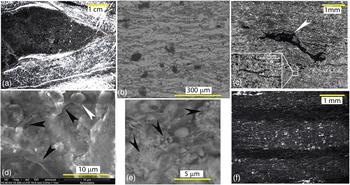
This facies is found only in the uppermost part of the studied sections, below the Frasnian–Famennian boundary (Figs 2, 4). It is exhibited in the South Marhouma section as lenticular centimetre- to decimetre-thick dark, carbonaceous to silty shale. The texture is close to the striped shale facies of Schieber (Reference Schieber1989), with silt and mud couplets (light) alternating with carbonaceous silty shale (dark) (Fig. 6f). In petrographic thin-section, the texture displays discontinuous wavy-crinkly laminae of kerogenous matter that are associated with framboidal pyrites and cubic euhedral crystals (Fig. 6b, c, e). Terrigenous quartz grains, isolated mud fragments and imbricated flat pebbles can also be found (Fig. 6a). Characteristic organisms are reworked benthic ostracods, rare brachiopods and undetermined mollusc shells.
Facies 7, mid-ramp deposits, uppermost Frasnian strata at South Marhouma and Ben Zireg sections. (a) Flat pebble conglomerate fabric (bed MH26bas). (b, c) SEM image of kerogenous laminae (wavy-crinkly structures) (bed MH29). (d) SEM image of tube-like structures (black arrows) and possible coccoid structure (white arrow) (arrows, bed BZ15D). (e) Framboidal pyrite (arrows, bed MH29). (f) Finely laminated striped shale displaying silt–mud couplets (bed MH30).

In the Ben Zireg section, the microbial (?) shale facies is observed in bed BZ15D (uppermost FZ13). It consists of pink, laminated, calcareous, silty shale. The thin-sections display a fine-grained matrix with abundant dolomite crystals and rare mica crystals. The wavy-crinkly laminae described above are discrete and are organized into submicrometric-thick kerogenous units alternating with fine-grained calcareous laminae. SEM observations display tube-like shapes locally forming ramiform structures, possible coccoid structures (Fig. 6d) and some framboidal pyrite. Fossils are very sparse, with brachiopods, benthic ostracods and tentaculite fragments.
4.c. MS trends
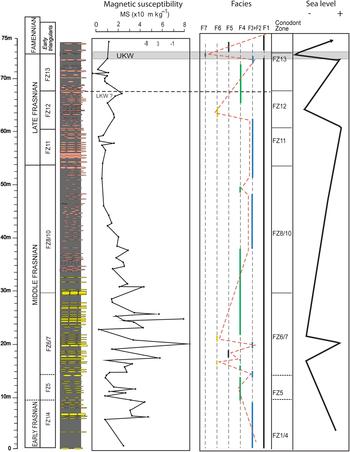
Our measurements of MS (Figs 7, 8) provided extremely low values for the Frasnian and basal Famennian strata. These vary between 0.1 and 8 × 10⁻⁸ m3 kg−1 at the South Marhouma section with an empirical average value of 1.9 × 10⁻⁸ m3 kg−1. They are even lower in the Ben Zireg anticline, where they fluctuate between 0.4 and 3.7 × 10⁻⁸ m3 kg−1 with an average of 1.3 × 10⁻⁸ m3 kg−1. Although MS values are low, they are consistent with results from other localities of similar ages. In both Algerian sections, the averages of MS values are lower than those for the MS<Sub>marinestandard</Sub> (5.5 × 10⁻⁸ m3 kg−1) of Ellwood et al. (Reference Ellwood, Tomkin, El Hassani, Bultynck, Brett, Schindler, Feist and Bartholomew2011) and Da Silva et al. (Reference Da Silva, Mabille and Boulvain2009). This was also observed in the Carnic Alps (Pas et al. Reference Pas, Da Silva, Sutter, Kido, Bultynck, Pondrelli, Corradini, Devleeschouwer, Dojen and Boulvain2014) and in the Dinant Synclinorium (Pas et al. Reference Pas, Da Silva, Devleeschouwer, Devleeschouwer, Labaye, Cornet, Michel, Boulvain, Da Silva, Whalen, Hladil, Chadimova, Chen, Spassov, Boulvain and Devleeschouwer2015), where mean values range over 0.1–1 × 10⁻⁸ m3 kg−1. In contrast, values are highly variable in the Frasnian deposits of western Canada (Whalen & Day, Reference Whalen and Day2010). Low values are mainly recorded during late transgression and early highstand intervals, and MS signature is generally lower in platform settings than in basinal settings.
Magnetic susceptibility evolution, facies change and sea-level fluctuations through the Frasnian strata in the South Marhouma section. Abbreviations: LKW – lower Kellwasser; UKW – upper Kellwasser; and as for Figure 2. Stippled line: assumed position of the LKW.

Qualitative analysis of the MS data suggests the same global trend with shared peaks, which are considered as isochronous (Crick et al. 2001) in the South Marhouma and Ben Zireg sections (Figs 7, 8). At South Marhouma, the lower part of the section from FZ1–4 to FZ6–7 shows fluctuations in MS value from 0 to 8 × 10⁻⁸ m3 kg−1. The upper part of the section, from FZ8–10 to the Famennian strata, shows low values between 0 and 3 × 10⁻⁸ m3 kg−1. At Ben Zireg, the lower part of the section from FZ5 to FZ7 shows little fluctuation between 0 and 3 × 10⁻⁸ m3 kg−1. In the upper part of the section, from FZ8–10 to the Famennian strata, the MS value remains low between 0 and 1 × 10⁻⁸ m3 kg−1.
Magnetic susceptibility evolution, facies change and sea-level fluctuations through the Frasnian strata in the Ben Zireg section. Abbreviations as for Figure 7. Stippled line: assumed position of the LKW.

5. Discussion
5.a. Facies interpretation
5.a.1. Shale and calcareous nodules (F1)
Shales such as those at the base of the South Marhouma section (Fig. 3d) are usually interpreted as representing deposition in deep basin settings (e.g. Boulvain et al. Reference Boulvain, Cornet, Da Silva, Delaite, Demany, Humblet, Renard and Coen-Aubert2004), but recent sedimentological investigations indicate that mudrocks may also have been deposited under current activity from proximal to distal parts of shelves (e.g. Schieber et al. Reference Schieber, Southard and Thaisen2007; Bohacs et al. Reference Bohacs, Lazar and Demko2014). At South Marhouma, calcareous nodules within shales are lime mudstone to wackestone and frequently display randomly orientated pelagic bioclasts, tentaculites and microspheres interpreted as calcitized radiolarians (Fig. 6g). F1 is therefore interpreted as the deepest facies in the Frasnian interval, deposited below storm wave-base. This facies is common in the Frasnian deposits in North Africa (e.g. Ahnet and Mouydir basins; Lüning et al. Reference Lüning, Wendt, Belka and Kaufmann2004; Wendt et al. Reference Wendt, Kaufmann, Belka, Klug and Lubeseder2006), sometimes associated with organic matter (Boote et al. Reference Boote, Clark-Lowes, Traut, Macgregor, Moody and Clark-Lowes1998). Grey shale can locally change into black shale intervals, the latter interpreted as deposited in dominantly dysoxic setting with variable amounts of free hydrogen sulphide in the sediments (e.g. Boyer et al. Reference Boyer, Owens, Lyons and Droser2011). Brief episodes of anoxia may occur in this depositional setting. Such conditions may be found in different places on epeiric platforms, even in shallow-water deposits (Boyer & Droser, Reference Boyer and Droser2009; Boyer et al. Reference Boyer, Owens, Lyons and Droser2011), but at South Marhouma they are interpreted as having been emplaced in a deep-sea setting within F1.
5.a.2. Lithoclastic floatstone (F2)
This facies was assigned to seismo-turbidites by Mutti et al. (Reference Mutti, Lucchi, Seguret and Zanzucchi1984) or megaturbidites by Cook et al. (Reference Cook, Mcdaniel, Mountjoy and Pray1972). In our case, this facies is restricted to Unit 1 of the Ben Zireg section in association with convolute bedding, and corresponds to debris flows into a distal pelagic domain. This facies may also correspond to gravitational deposits that formed under low sedimentation rates and tectonic activity (Rossetti & Góes, Reference Rossetti and Góes2000). Convolute structures associated with reworked lithoclasts can be generated by seismic shocks giving rise to downslope movements (Spalletta & Vai, Reference Spalletta and Vai1984). F2 is similar to facies described elsewhere in the Upper Devonian successions from the Eastern Anti-Atlas (Wendt & Belka, Reference Wendt and Belka1991).
5.a.3. Poorly fossiliferous mudstone (F3)
The fine-grained matrix with rare fossils suggest low-energy and open-marine conditions, remaining below storm wave-base (Pas et al. Reference Pas, Da Silva, Cornet, Bultynck, Königshof and Boulvain2013, Reference Pas, Da Silva, Sutter, Kido, Bultynck, Pondrelli, Corradini, Devleeschouwer, Dojen and Boulvain2014). The scarcity of bioturbation could reflect oxygen-depleted waters (Flügel, Reference Flügel2004). Nodules are composed of lime mudstone to wackestone (Fig. 5h, i) which suffered partial to complete transformation into microsparite. They are considered as late diagenetic in origin (James & Choquette, Reference James, Choquette, Mc Ilreath and Morrow1990).
5.a.4. Argillaceous wackestone (F4)
On the basis of the abundance of pelagic fossils, facies F4 is interpreted as having been deposited in a deep-water environment, below storm wave-base (Pas et al. Reference Pas, Da Silva, Cornet, Bultynck, Königshof and Boulvain2013, Reference Pas, Da Silva, Sutter, Kido, Bultynck, Pondrelli, Corradini, Devleeschouwer, Dojen and Boulvain2014). Finely laminated biogenic detritus is interpreted as having been deposited by turbidity currents or distal tempestites (sensu Aigner, Reference Aigner1985). Iron hydroxide grains within the matrix may result from anaerobic bacteria activity in the uppermost part of the sediment (Mamet & Préat, Reference Mamet and Préat2006).
5.a.5. Diversified fauna mudstone to wackestone (F5)
Compared with F4, the increase in both benthic faunal diversity and bioturbation, typical of areas with normal oxygen concentration (Flügel, Reference Flügel2004), in F5 indicates that the depositional setting of this facies was predominantly below storm wave-base action, but shallower than for F4.
5.a.6. Lime ostracod mudstone (F6)
The frequent occurrence of disarticulated ostracods may suggest para-autochthonous aggregations produced by episodic storm-induced seafloor disturbances (Schülke & Popp, Reference Schülke and Popp2005). The increase in benthic fauna and the ostracod assemblage might also indicate a more proximal depositional setting compared with the previous environment, likely between the fair-weather wave-base and the storm wave-base.
5.a.7. Microbial (?) shale (F7)
Framboidal pyrite is commonly present in hypoxic to anoxic environments (e.g. Bond et al. Reference Bond, Wignall and Racki2004; Peckmann & Thiel, Reference Peckmann and Thiel2004; Wignall et al. Reference Wignall, Newton and Brookfield2005; Tian et al. Reference Tian, Tong, Algeo, Song, Chu, Shi and Bottjer2014) where crystallization is partly controlled by bacterial activity (e.g. Folk, Reference Folk2005; MacLean et al. Reference MacLean, Tyliszczak, Gilbert, Zhou, Pray, Onstott and Southam2008). The association of wavy-crinkly structures with kerogen laminae has been considered as resulting from the occurrence of benthic microbial (cyanobacterial?) mats (e.g. Schieber, Reference Schieber1986, Reference Schieber1989; Sur et al. Reference Sur, Schieber and Banerjee2006; Deb et al. Reference Deb, Schieber, Chaudhuri, Schieber, Bose, Eriksson, Banerjee, Jadavpur, Altermann and Catuneanu2007) and coccoidal bacteria that have been identified within such deposits (Kaźmierczak et al. Reference Kaźmierczak, Kremer and Racki2012). Even if no obvious diagnostic feature of primary cyanobacterial mats (e.g. web-like texture indicator of benthic coccoidal remnants, Kremer & Kaźmierczak, Reference Kremer and Kaźmierczak2005) were found in the studied sections, the presence of organic matter, framboidal pyrite, wavy lamination, wavy lenticular lamination with shale fragments, wavy-crinkly structure, possible coccoid structure and submicrometric tubular structures are strongly suggestive of the presence of microbial mats during the deposition of the dark shales in the two sections. The presence of mud and silt couplets with locally reworked fossils indicates fluctuating high-energy episodes attributed to storms. Such an interpretation is compatible with that of Schieber (Reference Schieber1986, Reference Schieber1989) who located the depositional environment of similar shales between fair-weather wave-base and average storm wave-base.
5.b. Local depositional environment
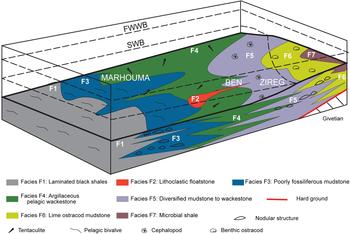
Palaeoenvironmental interpretations of the depositional settings of F1 and F3–7 observed in both sections (plus F2 at Ben Zireg only) support the interpretation that the sediments were deposited along a low-angle, mid- to outer-ramp profile sensu Wright & Burchette (Reference Wright, Burchette and Reading1996) on a regional scale (Fig. 9).
Sedimentary model in NW Algeria through the Frasnian Stage (South Marhouma and Ben Zireg sections). This model shows a mid- to outer-ramp setting with lateral distribution of facies from the most proximal setting (F7) to the most distal (F1). Abbreviations: SWB – storm wave-base; FWWB – fair-weather wave-base.

5.b.1. Ben Zireg section
The section is dominated by fine-grained carbonates above a major gap in the lower Frasnian strata. From FZ5 to FZ11 sedimentation resumed in autochthonous Facies 1 and 3 and allochthonous Facies 2, which are the deepest facies (Fig. 2). Primary iron hydroxide coatings at the top of the lime beds are common. The lower Frasnian gap corresponds to a non-deposition and possibly erosion in a submarine setting, and has been related elsewhere to bottom currents (Hüneke, Reference Hüneke2006). There is no evidence of the presence of such currents at Ben Zireg. Indeed, features such as erosional surfaces, coarsening-upwards and fining-upwards micro-sequences, and limestone with orientated tentaculitid, laminated calcisiltites, phosphatic grains, phosphorites and phosphatic hard-grounds (Hüneke, Reference Hüneke2013) have not been found. From FZ11 to lower FZ13, shallower Facies 5 and 6 alternate with the deep Facies 1. From lower to upper FZ13, Facies 5 and 6 are replaced by deeper Facies 4 and 3. The shallowest Facies 7 was deposited within the uppermost FZ13, (upper Kellwasser), below the Frasnian–Famennian boundary.
An outer-ramp model is suggested for this area at the northern margin of the Algerian Sahara (Fig. 9). In this model, the deepest deposits are represented by some grey to black shale intervals (Facies 1, Fig. 3d) and siliceous deposits with convolute lamination and breccias (Facies 2; Figs 3a, 5a, b). In our model (Fig. 9), Facies 4 and 5 were emplaced below storm wave-base, as no current features were found. Common ferruginous coatings point to repeated episodes of hydroxide cementation on the sea floor. The proximal part of the ramp displays accumulations of fragmented bioclasts from both benthic and pelagic communities. This is interpreted as indicating deposition between storm wave-base and fair-weather wave-base, with an increasing amount of benthic fauna from Facies 5 to shallower Facies 6. The overall stratigraphic trend estimated at Ben Zireg from broad lithologic trends indicates a deep-sea depositional setting disrupted by a shallower setting within FZ12, the lower part of FZ13 and at the top of FZ13.
5.b.2. South Marhouma section
This section is dominated by mudrocks (e.g. shales) and fine-grained carbonate deposits with mostly pelagic, open-marine fauna.
From FZ1 to FZ4, sedimentation resumed in autochthonous Facies 1 and 3 which are the deepest facies (Fig. 4). Facies 2 was not found. From FZ5 to FZ13, the nodular argillaceous limestones (Facies 3) with mudstone texture and rare fauna suggest distal depositional setting under quiet conditions. The fine-grained bioclastic mudstone and wackestone (Facies 4) with an overwhelming abundance of pelagic marine fauna still supports a quiet depositional setting but in shallower waters. A shallower ramp is recognized within FZ6–7 and FZ12 by the increase of benthic faunal components (Facies 5 and 6). The shallowest facies is represented here by the occurrence of microbial (?) benthic mats (Facies 7) that are affected by storm action below the fair-weather wave-base. In summary, the broad lithologic trends indicate a deep-sea depositional setting, with shallower intervals during the deposition of FZ5–7, FZ12 and uppermost FZ13.
5.b.3. Comparison between sections
Stratigraphic correlation between Ben Zireg and South Marhouma is documented in Mahboubi et al. (Reference Mahboubi, Feist, Cornée, Mehadji and Girard2015). The Frasnian deposits of the South Marhouma section are nearly three times thicker than those of Ben Zireg, although mostly represented by shale deposits of Facies 1. The highly expanded section at South Marhouma is interpreted as indicating a higher sedimentation rate in the subsiding basin closer to the source (the West African Craton, Fig. 1a). In contrast, condensed carbonate deposits with minor shaly interbeds and frequent hydroxide coatings characterize Ben Zireg, where shallower Facies 3–5 dominates. Such a depositional setting results either from submarine positive relief (shoal) or from a more distal location to the source areas of detrital inputs.
5.c. Sea-level fluctuations
Integrating both lithofacies and MS data (Figs 8, 9), as well as data of conodont biofacies (Seddon & Sweet, Reference Seddon and Sweet1971; Sandberg, Reference Sandberg and Barnes1976; Klapper & Barrick, Reference Klapper and Barrick1978; Sandberg & Ziegler, Reference Sandberg and Ziegler1979) published on both studied sections (Mahboubi & Gatovsky, Reference Mahboubi and Gatovsky2014; Mahboubi et al. Reference Mahboubi, Feist, Cornée, Mehadji and Girard2015), we tentatively interpret environmental changes through middle–late Frasnian time in terms of bathymetrical variation.
Our MS data were collected in the same kind of depositional setting (outer to mid ramp) and, during diagenesis, we did not observe dolomitization or hydrocarbon migrations, suggesting that the MS results are related to primary signal. Nevertheless, MS data do not seem to clearly record variations in sea level consistent with the other proxies, especially within FZ8–13 where MS values remain very low (Figs 7, 8).
5.c.1. Early Frasnian
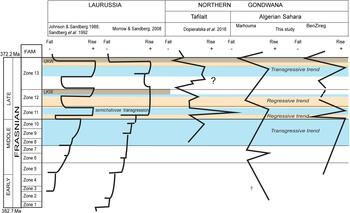
During early Frasnian time (FZ1–4), the South Marhouma section displays a regressive trend with an upwards change from Facies 1 to 3 and fluctuating MS values that are consistent with regression (Fig. 7). This trend is in contradiction to the transgressive trend recorded in North America at that time (Fig. 10). It could be related to the specific location of the South Marhouma section, where abundant fine-grained siliciclastic inputs from the emerging West African Shield might have obscured the eustatic signal.
Comparison of sea-level fluctuations from Laurussia and northern Gondwana through the Frasnian Stage. FZ (Frasnian Zones) after Klapper & Kirchgasser (Reference Klapper and Kirchgasser2016), relative duration of conodont Zones are from Becker et al. (Reference Becker, Gradstein, Hammer, Gradstein, Ogg, Schmitz and Ogg2012). In grey: anoxic events. UKW: Upper Kellwasser; LKW: Lower Kellwasser; FAM: Famennian.

5.c.2. Middle Frasnian
Between FZ5 and the beginning of FZ8–10, both sections display fluctuations in the MS signal and lithofacies (Figs 7, 8). Within this interval, slight shifts in MS values at South Marhouma roughly reflect concomitant shifts in lithofacies. In contrast, shifts in both MS and lithofacies, although discernible, are less pronounced at Ben Zireg. In particular, MS values, which vary between 0 and 8 × 10⁻⁸ m3 kg−1 at South Marhouma, are much lower at Ben Zireg with a shift from 1 to 3 × 10⁻⁸ m3 kg−1, being almost insignificant. In parallel, variations in succeeding lithofacies are more frequent with shifts from Facies 1 to 6 at South Marhouma, whereas these are restricted to Facies 2 and 3 and Facies 4 at Ben Zireg. The mean prevalence of Facies 4 in both sections, along with a weak decrease in MS values, coincides with biofacies indicators available at Ben Zireg that shift temporarily from shallower Polygnathus–Icriodus biofacies in FZ6 to deeper Polygnathus biofacies between FZ7 and the beginning of FZ8–10, before returning to Polygnathus–Icriodus biofacies thereafter (Mahboubi et al. Reference Mahboubi, Feist, Cornée, Mehadji and Girard2015).
During middle Frasnian time the global trend is transgressive (Johnson & Sandberg, Reference Johnson, Sandberg, McMillan, Embry and Glass1988; Sandberg et al. Reference Sandberg, Ziegler, Dreesen and Butler1992; Filer, Reference Filer2002; Morrow & Sandberg, Reference Morrow and Sandberg2008), with important deepening during the deposition of FZ5–6 (punctata Event) (Pisarzowska & Racki, Reference Pisarzowska and Racki2012). In the nearby Tafilalt region, the global transgressive trend is documented from FZ8 (Dopieralska et al. Reference Dopieralska, Belka and Walczak2016) and culminates at the end of FZ10 (Fig. 10). This global trend is likewise observed at Ben Zireg. At South Marhouma, the global transgressive trend begins in the lower part of FZ6–10 but a marked regressive event occurred at the transition between FZ6 and FZ7.
5.c.3. Late Frasnian
MS values remain constantly very low within upper Frasnian strata without any significant changes at the upper Kellwasser level in particular, and such values cannot be related to transgression only. The reasons for such stable low values remain unknown.
Within the lower FZ11, facies changes indicate a regressive event followed by a transgressive peak in the upper FZ11. This transgressive peak is characterized by a significant extension of deep-sea lithofacies, associated with conodont records dominated by biofacies Polygnathus–Palmatolepis. This signal is most obvious at Ben Zireg (Mahboubi et al. Reference Mahboubi, Feist, Cornée, Mehadji and Girard2015), whereas at South Marhouma the paucity of available conodont records prevents confirmation of the slight deepening of the sedimentary setting (Mahboubi & Gatovsky, Reference Mahboubi and Gatovsky2014). The curve of Ben Zireg remarkably coincides with the curves obtained in Euramerica and in the Tafilalt (Fig. 10). At South Marhouma, only the transgressive peak is clearly recorded. Dopieralska et al. (Reference Dopieralska, Belka and Walczak2016) emphasize the importance of the semichatovae transgression with the highest positive shift in ɛNd values within FZ11. This event has earlier been described in Euramerica, where it is characterized by the sudden spread of Palmatolepis semichatovae in FZ11 (Sandberg et al. Reference Sandberg, Ziegler, Dreesen and Butler1992, Reference Sandberg, Morrow and Ziegler2002). This species has not been established in the studied sections, but the obvious transgressive episode recorded within FZ11 at both South Marhouma and Ben Zireg may most likely correspond to this event. As a whole, evidence of the semichatovae transgression (Sandberg et al. Reference Sandberg, Ziegler, Dreesen and Butler1992) is observed in the Saharian Platform.
During deposition of FZ12, evidence of shallower environments is provided by the deposition of Facies 5 and 6 at Ben Zireg and Facies 4–6 interbeds within Facies 1 at South Marhouma. Biofacies in both sections clearly indicate a shallowing trend with predominance of Polygnathus–Ancyrodella (Mahboubi & Gatovsky, Reference Mahboubi and Gatovsky2014; Mahboubi et al. Reference Mahboubi, Feist, Cornée, Mehadji and Girard2015). This regressive trend was also identified in Euramerica and in the Tafilalt (Fig. 10).
At the top of FZ12 and the transition between FZ12 and 13, the hypoxic lower Kellwasser horizon, usually occurring elsewhere, is not developed in its typical shale facies in our sections. Litho- and biofacies indicate an increase in water depth followed by fluctuations of lithofacies with an increase in water depth up to the upper Kellwasser horizon. Indicators of concomitant biofacies appear to be somewhat contradictory regarding this increase in water depth: they remain constant in terms of prevalence of Palmatolepis–Polygnathus and Palmatolepis at Ben Zireg, but return to shallower signals at South Marhouma with Polygnathus–Ancyrodella (Mahboubi & Gatovsky, Reference Mahboubi and Gatovsky2014; Mahboubi et al. Reference Mahboubi, Feist, Cornée, Mehadji and Girard2015). The increase in bathymetry observed in our sections is in accordance with that of Euramerica and Tafilalt (Fig. 10). Dopieralska et al. (Reference Dopieralska, Belka and Walczak2016) also identified regressive trends coinciding in particular with the early and late Kellwasser extinction events at the FZ12–13 transition and at the top of FZ13, respectively. In the studied sections, the regressive trend occurs slightly earlier within FZ12 when biofacies Polygnathus–Ancyrodella dominate. The lower Kellwasser deposits have been related to large-scale enhanced productivity and stratification of sea waters (Riquier et al. Reference Riquier, Tribovillard, Averbuch, Joachimski, Racki, Devleeschouwer, El Albani, Riboulleau, Over, Morrow and Wignall2005). The anomaly we observed in Algeria might perhaps be the result of regional controls that could have complicated the biological/sedimentological signal. Furthermore, this part of the successions lacks precise stratigraphic controls; a precise location of the lower Kellwasser equivalent deposit is not yet possible. Thereafter, ‘normal’ transgressive conditions match the global sea-level trend. The upper Kellwasser horizon is characterized by its typical hypoxic facies at Ben Zireg. Bathymetric criteria point to a relative highstand of sea level at the beginning of the event, followed by a marked decrease of water depth until its top with the development of Palmatolepis–Ancyrodella biofacies (Mahboubi et al. Reference Mahboubi, Feist, Cornée, Mehadji and Girard2015) and occurrence of possible ‘microbial shales’ (F7). In contrast, at South Marhouma, the drop in sea level seems to start earlier when Facies 7 and Polygnatus–Icriodus conodonts are present at the beginning of the presumed upper Kellwasser horizon (Mahboubi & Gatovsky, Reference Mahboubi and Gatovsky2014). Consequently, it cannot be excluded that the equivalent of the late Kellwasser event started a little earlier at South Marhouma than considered by Mahboubi & Gatovsky (Reference Mahboubi and Gatovsky2014). At top of FZ13, the major regression during the upper Kellwasser horizon occurs both at Ben Zireg and South Marhouma, and is in accordance with the results of Johnson & Sandberg (Reference Johnson, Sandberg, McMillan, Embry and Glass1988) and Dopieralska et al. (Reference Dopieralska, Belka and Walczak2016).
5.c.4. Summary
The bathymetric curves on the Saharian Platform display a continuing sea-level rise through middle Frasnian time. A minor regression occurred within FZ6 at South Marhouma (Facies 3 shifts to Facies 6, consistent with the highest MS values), in accordance with the results of Pisarzowska & Racki (Reference Pisarzowska and Racki2012). A regression also occurred at the base of FZ11: at Ben Zireg, Facies 1 changes upwards into Facies 6, but MS values remain constantly low. During late Frasnian time in Euramerica, the global transgressive event achieved its highest stand from FZ11 to FZ13 (e.g. Morrow & Sandberg, Reference Morrow and Sandberg2008). This is matched by the recently established curve based on Nd isotopic data presented by Dopieralska et al. (Reference Dopieralska, Belka and Walczak2016) with a transgressive trend up to the upper part of FZ13 (Fig. 10).
As expected, Frasnian sections of SW Algeria display a similar sea-level evolution through middle and late Frasnian time as in neighbouring parts of Gondwana (Morocco). Differences in deposits (the absence or presence of the lower Kellwasser horizon), timing (changes in sea level occurring later in SW Algeria than elsewhere) and amplitude of changes in both litho- and biofacies between sites might result from the effects of locally different rates of tectonically driven subsidence. In addition, sampling bias cannot be excluded in highly condensed portions such as in the lower part of the Ben Zireg section or, on the contrary, when conodonts are rather scarce in deposits with high sedimentation rates, as occurs in the lower–middle Frasnian Marhouma trough (Mahboubi et al. Reference Mahboubi, Feist, Cornée, Mehadji and Girard2015).
6. Conclusions
The investigated sections through the middle–upper Frasnian deposits are composed of seven marine lithofacies. These lithofacies are organized along a very low-angle, middle to outer ramp along the western part of the Saharian Platform. Condensed carbonate sedimentation occurred in the north (Ben Zireg), whereas abundant shaly deposits occur in the south (Marhouma). Vertical facies changes indicative of sea-level fluctuations are most perceptible at South Marhouma within the lower–middle and the upper Frasnian strata, where rapid shifts between deep and shallow lithofacies occur. During early–late Frasnian time, more stable conditions prevailed with the deposition of bioclastic mud- and wackestones. Conversely, at Ben Zireg these latter conditions characterize the condensed middle and lowermost-upper Frasnian succession. A deepening occurred in the upper part of FZ11, followed by a marked shallowing at the beginning of FZ12 and an average deepening up to the upper Kellwasser horizon. The latter is marked in both sections by a transgressive–regressive cycle.
Provisional measurements of magnetic susceptibility provided very low values. Shifts are more pronounced with rapid variations in the lower part of the middle Frasnian strata, remaining constantly rather low thereafter up to the Frasnian–Famennian boundary in both sections. In particular, no significant shift is observed at the equivalent levels of the Kellwasser deposits. More detailed and bed-by-bed measurements are necessary to consider MS trends comparatively.
A sea-level curve essentially built on the data acquired at Ben Zireg matches the standard curves already provided at a global scale. In particular, evidence of the middle Frasnian transgression, the lower FZ11 regression, the semichatovae transgression within FZ11, the lower FZ12 regression, the upper FZ13 transgression and the regression associated with the upper Kellwasser deposits are clearly observed in the Saharian Platform.
Acknowledgements
We are grateful to the Algerian authorities for providing permission to access the field. We thank Tadjedinne Hassen, Kada Abess and Brigitte Meyer-Berthaud for their help with fieldwork. We thank D. Pas, D. L. Boyer and two reviewers for suggesting improvements to the manuscript, and copy-editor Elaine Rowan. The first field trip was supported by the ANR Palasiafrica (ANR-08-JCJC-0017). A. Mahboubi is grateful to Jean-Louis Bodinier for his funding (IRSES MEDYNA grant) for one month. This is ISEM publication no. 2018-164.