Introduction
The genus Placopyrenium currently contains 11 accepted species, characterized by an areolate to subsquamulose thallus, immersed perithecia lacking an involucrellum, colourless, simple to 1-septate ascospores, and pycnidia of Dermatocarpon-type. The lateral surface and (where present) the lower surface of the areoles are often dark brown, and several species of the genus are parasitic on other lichens, at least in the early stages of growth. The genus was originally described for subsquamulose taxa, but several crustose species previously referred to the polyphyletic genus, Verrucaria s.lat., are now included. A multigene phylogenetic analysis of numerous species in Verrucariaceae has shown that three species, P. bucekii (Nádv. & Serv.) Breuss (the type of the genus), P. canellum (Nyl.) Gueidan & Cl. Roux and P. fuscellum (Turner) Gueidan & Cl. Roux, formed a well-supported monophyletic group, but P. lecideoides (A. Massal.) Gueidan & Cl. Roux grouped with species referred to Verruculopsis, the sister-group to Placopyrenium (Gueidan et al. Reference Gueidan, Roux and Lutzoni2007; Gueidan et al. Reference Gueidan, Savić, Thüs, Roux, Keller, Tibell, Prieto, Heiðmarsson, Breuss, Orange, Fröberg, Amtoft, Navarro-Rosinés, Krzewicka, Pykälä and Lutzoni2008), and is now placed in that genus as V. lecideoides (A. Massal.) Gueidan & Cl. Roux. In Great Britain, two species now referred to Placopyrenium (P. canellum and P. fuscellum) have been recognized up to now (Coppins Reference Coppins2002). These were revised by Orange (Reference Orange2004), as part of a ‘Verrucaria fuscella group', but two additional, previously unidentified species are known to occur on rocks in British rivers; these are described below.
Materials and Methods
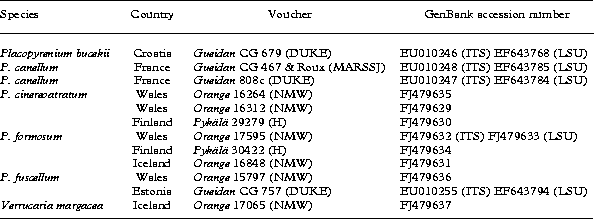
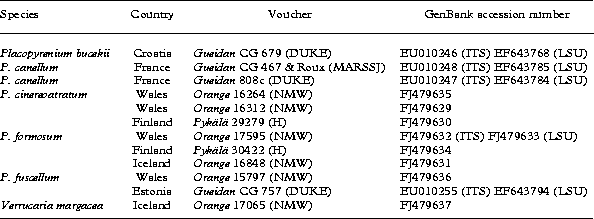
This study is based on selected material from BM, E, H, NMW and UPS. Fresh specimens for DNA study were collected by the author from Wales and Iceland, and by Juha Pykälä from Finland. DNA sequences representing two additional species of Placopyrenium, with collection details given by Navarro-Rosinés et al. (Reference Navarro-Rosinés, Roux and Gueidan2007), were available from GenBank. The taxa included in the phylogenetic analysis are listed in Table 1. Sections were cut by hand and examined in water and 5% KOH. Because of their small size, it could not be confirmed whether pycnidia were uni- or multilocular.
Specimens used in the phylogenetic analysis.
DNA extraction and sequencing
DNA was extracted from thallus tissue of recently collected specimens, using the Qiagen DNeasy Plant Mini Kit; the manufacturer's instructions were followed except that warm water was used for the final elution. PCR amplification was carried out using PuReTaq Ready-To-Go PCR Beads (Amersham Biosciences). For the Placopyrenium specimens, the two internal transcribed spacer regions and the 5.8S region (ITS1-5.8S-ITS2) of the nuclear ribosomal genes, and the 5′ end of the nuclear ribosomal large subunit (LSU) were amplified, using the primers ITS1F, LR3, nu-LSU-155-5′ and LR7. The identity of three specimens of Aspicilia associated with Placopyrenium was investigated by amplifying the ITS1-5.8S-ITS2 region of the nuclear ribosomal DNA gene, using the primers ITS1F and ITS4. The PCR thermal cycling parameters were: initial denaturation for 5 min at 94°C, followed by 5 cycles of 30 s at 94°C, 30 s at 55°C, and 1 min at 72°C, then 30 cycles of 30 s at 94°C, 30 s at 52°C and 1 min at 72°C. PCR products were visualized on agarose gels stained with ethidium bromide, and purified using the Sigma GenElute PCR Clean-Up Kit. Sequencing was performed by The Sequencing Service (College of Life Sciences, University of Dundee, www.dnaseq.co.uk) using Applied Biosystems Big-Dye Ver 3.1 chemistry on an Applied Biosystems model 3730 automated capillary DNA sequencer.
Sequence editing and alignment
Sequences were assembled and edited using DNAstar Lasergene software (http://www.dnastar.com/products/lasergene.php). Alignment was carried out using BioEdit (http://www.mbio.ncsu.edu/BioEdit/bioedit.html); ClustalW was used to create an initial alignment, which was edited manually. Sequences downloaded from GenBank which represented the ITS region and part of the LSU from the same isolate were concatenated before alignment.
Phylogenetic analysis
Phylogenetic relationships were investigated using a Maximum Parsimony analysis. Analyses of a range of taxa of Verrucariaceae (A. Orange, unpublished) suggested that the sequences obtained for this study formed a monophyletic clade distinct from other taxa studied, and suggested a sequence of Verrucaria margacea as a suitable outgroup for further analysis of this clade. For the Placopyrenium sequences, an exhaustive search for the most parsimonious tree or trees was conducted using the ‘alltrees’ command in PAUP* (Swofford Reference Swofford1998). Insertions and ambiguously aligned regions were excluded from the analysis; after exclusion of these regions the alignment contained no gaps.
Results and Discussion
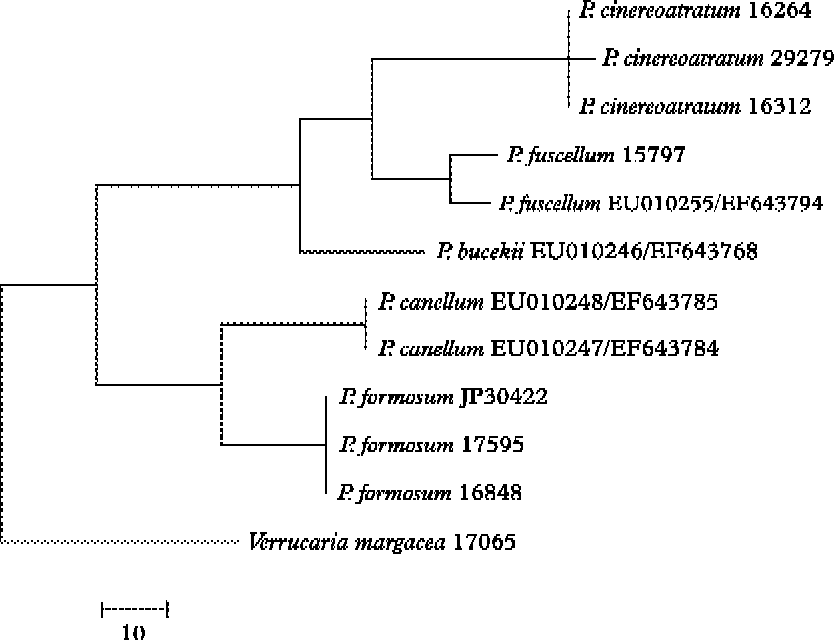
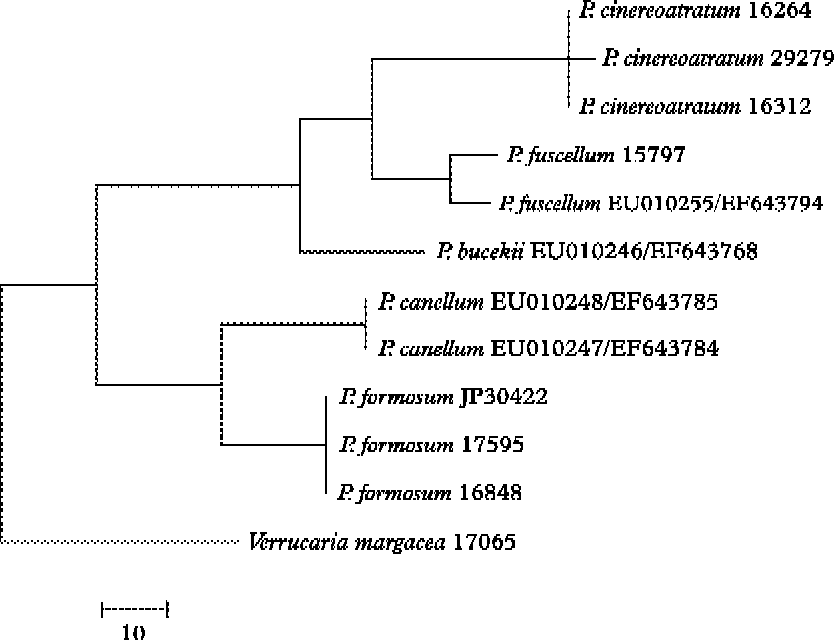
After exclusion of ambiguously aligned regions, the alignment of Placopyrenium taxa contained 1341 characters, of which 1160 were constant, 68 were variable but parsimony-uninformative, and 113 were parsimony-informative. Four equally most-parsimonious trees were recovered by the analysis, one of which is shown in Fig. 1. The five Placopyrenium species analysed fall into two clades, the first comprising P. canellum and P. formosum, and the second comprising P. bucekii, P. cinereoatratum and P. fuscellum. All four equally most-parsimonious trees recovered the same topology, except that in two trees P. bucekii is basal to the second clade, and in the other two trees it is nested within the clade, basal to the two sequences of P. fuscellum.
One of four most parsimonious trees resulting from an exhaustive search in the parsimony analysis. The scale bar indicates the number of substitutions per site.
The Species
Placopyrenium cinereoatratum (Degel.) Orange, comb. nov
Verrucaria cinereoatrata Degel., Svensk Bot. Tidskr. 39: 18 (1945) nomen novum.—Verrucaria cinereoatra Zsch. in H. Magn., Botan. Notiser 1930: 461 (1930), nom. illeg., non Verrucaria cinereoatra Hoffm. (1787); type: Sweden: Bohuslän: Långelanda par., Långelanda, by the church, 21 July 1926, on rocks by a brook, A. H. Magnusson [Magnusson, Lich. sel. scand. exs. 114] (UPS [L-154303]—isosyntype!); same locality, date and exsiccata (UPS [L-171543]—isosyntype!); same locality, date and exsiccata (BM—isosyntype!).
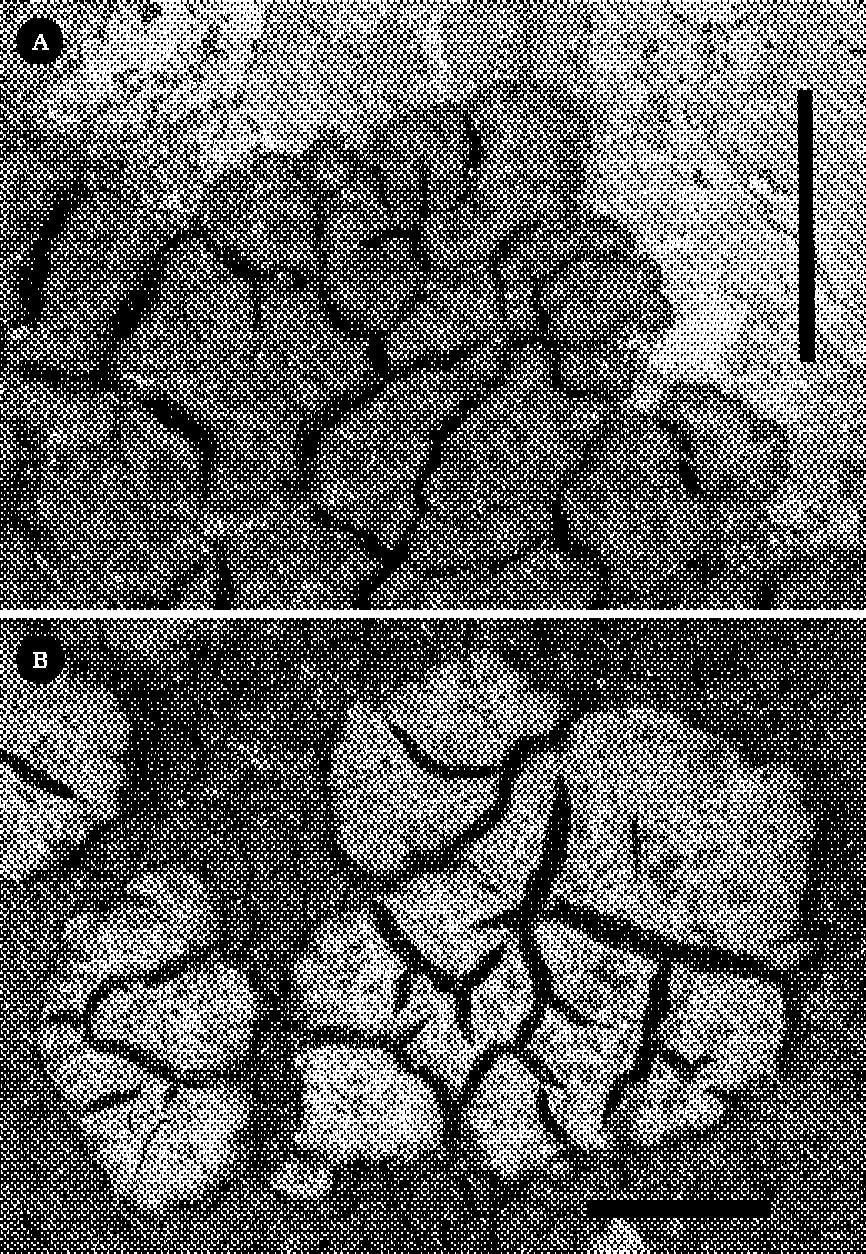
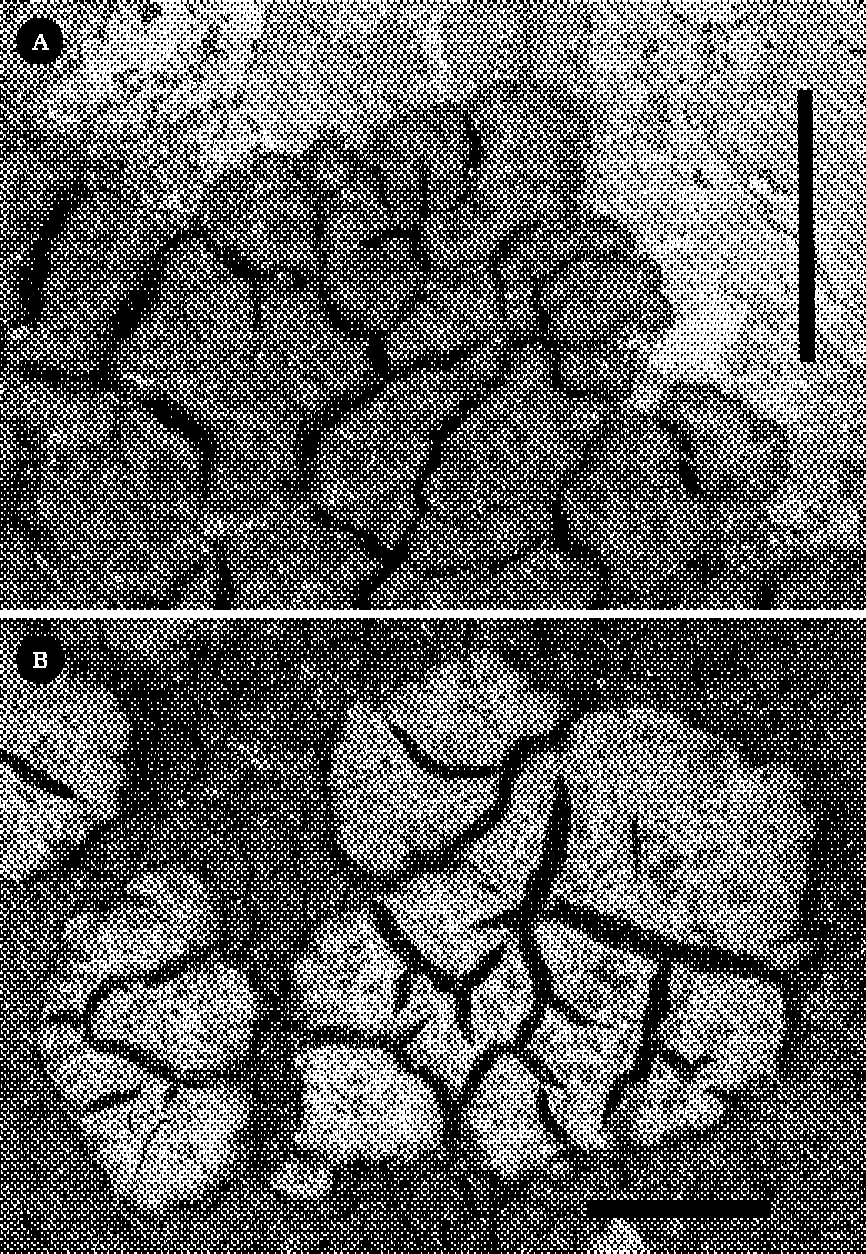
(Fig. 2)
Placopyrenium cinereoatratum. A, isosyntype (UPS L-154303); B, Orange 16264. Scales = 1 mm.
Prothallus absent, or less frequently present but very narrow and inconspicuous. Thallus crustose to subsquamulose, free-living thalli 200–600 μm thick, margin well-defined; very young thalli entire, but soon with deep cracks reaching to the margin, dividing the thallus into discrete, sharp-edged areoles; areoles 500–1200 μm diam., upper surface plane or uneven, occasionally convex when older, pale grey to mid brown, faintly to distinctly pruinose; areoles undivided or occasionally upper surface divided by a few dark lines; sides of areoles adjacent to cracks black; also parasitic on the thallus of Staurothele fissa, and then the thallus is thin, cracked and without a distinct margin. Areoles are attached by the lower surface, without rhizines or hapters. Cortex poorly differentiated from the photobiont layer (a pseudocortex sensu Gueidan et al. Reference Gueidan, Roux and Lutzoni2007), walls often with brown pigment. Epinecral layer usually present, up to 12 μm thick but sometimes scarcely developed, composed of broken cells with collapsed cell remains above. Fungal cells of the photobiont layer 4–7 × 3·5–5 μm, more or less rounded in outline, arranged in weakly defined columns. Lower parts of the thallus with dense brown pigment. Perithecia immersed in the thallus, several to many per areole, apex often inconspicuous in surface view, sometimes visible as a small brown dot, occasionally the apex is easily visible as a plane or slightly projecting black disc 60–120 μm diam. Exciple 140–300 μm diam., brown at the apex, colourless below. Involucrellum absent. Ascospores (13–)16–18·5–21·0(−25·5) × (5·5–)6·5–7·2–8·0(−9·5) μm, length/breadth ratio (1·9–)2·2–2·6–2·9(−4·0) [n = 110/10], ellipsoid, colourless, rarely faintly brown when overmature, perispore usually absent or indistinct, occasionally to 0·8 μm thick. Pycnidia immersed in the thallus, 80–105 × 25–42 μm, wall colourless or faintly brown at the ostiole; conidia simple, colourless, rod-shaped, 4–6 × 1·2 μm.
Ecology and distribution. On siliceous rocks beside streams and lakes, sometimes parasitic on Staurothele fissa; associated species include Collemopsidium angermannicum, Dermatocarpon deminuens, D. meiophyllizum, Ionaspis lacustris, Leptogium plicatile, Staurothele fissa, Verrucaria aethiobola, V. latebrosa, V. pachyderma, and the bryophytes Amblystegium fluviatile and Cinclidotus fontinaloides. Wales, N England, Norway, Sweden, Finland.
Notes. Several collections show thalli clearly invading the thallus of Staurothele fissa; the two species then often intergrade in appearance and sometimes the thallus of P. cinereoatratum is outwardly indistinguishable from that of the host except by the presence of grey pruina.
Placopyrenium formosum also grows in freshwater habitats, but in that species the ascospores are slightly larger, with a more distinct perispore, a prothallus is better developed, the areoles are more frequently gently convex, and young thalli are parasitic on Aspicilia. These differences are relatively minor, but ITS sequences indicate that the two species are clearly distinct. Placopyrenium fuscellum differs in the more strongly developed thallus, areoles which are frequently subdivided into smaller units in surface view, the slightly swollen margin of the areoles, the smaller ascospores, and the habitat usually on calcareous terrestrial rocks. The North American P. noxium Breuss is said to be parasitic on Staurothele areolata, but the areoles are attached by corticated stipes (Breuss Reference Breuss1998).
Nomenclature and typification. Two of the specimens in UPS (L-171544 and L-171545) have the same locality and date as the syntype cited above, but cannot be regarded as isosyntypes as Magnusson gave them different collection numbers.
Selected specimens examined. Great Britain: Wales: V.C. 42, Breconshire: Builth Wells, Irfon, Caer Beris, 32/0317.5073, 2003, A. Orange 14715 (NMW [C.2007.001.245]); near Llyn y Fan Fawr, Nant-y-llyn, 22/8519.2027, alt. 360 m, 2005, A. Orange 16312 (NMW [C.2005.001.335]). V.C. 43, Radnorshire: Llandeilo Graban, River Wye, 32/1056.4274, 2005, A. Orange 16264 (NMW [C.2005.001.327]); same locality and date, A. Orange 16267 (NMW [C.2005.001.330]). England: V.C. 68, North Northumberland: Carham, River Tweed, 36/8019.3885, 2005, B. J. Coppins 21792, J. Douglass & B. Simpson (E, NMW [C.2006.011.55]).—Sweden: Bohuslän: Långelanda par., Långelanda, by the church, 1926, on rocks by a brook, A. H. Magnusson 9870 (UPS [L-171545]); same locality and date, A. H. Magnusson 9871b (UPS [L-171544); Norum par, Stora Askerön, Danestan, 1946, A. H. Magnusson 20102a (UPS [L-171548]).—Norway: Nordland: Vega par., Vega Island, Gulsvåg, Lake Floavand, 1972, G. Degelius V-109 (UPS [L-171561]).—Finland: Varsinais-Suomi: Lohja, Ojamo, Lahokallio, 27°E: 6684236:334558, 2004, J. Pykälä 24380 (H); Lohja, Hiittinen, Kotniemi, Saarensalmi, on shore of lake Hormajärvi, 27°E 669023:33604, 2006, J. Pykälä 29279 (H); Lohja, Skraatila, Selkäsaaret, 27°E: 6686251:327971, 2003, J. Pykälä 23267 & R. Murto (H).
Placopyrenium formosum Orange, sp. nov
MycoBank No: MB 512702
Thallus initio in thallo Aspiciliae parasitica, demum 130–400 μm crassus, profunde rimosus, areolas discretas formans; areolae fuscocinereae vel brunneae, lateribus atris. Perithecia immersa, involucrellum nullum. Ascoporae aseptatae, hyalinae, (14–)17·5–20·2–22·5(−28) × (7–)8·0–9·0–10(−11) μm, perispora 1–1·5 μm crassa.
Typus: Iceland: Suður-Þingeyjarsýsla, Dalmynni, Fnjóská, below Litlagerði, 65°50.57′N, 18°02.15′W, 2007, on rocks by river, initially parasitic on Aspicilia aquatica, A. Orange 16848 (NMW [C.2007.001.157]—holotypus; AMNH—isotypus; GenBank accession no. FJ479631).
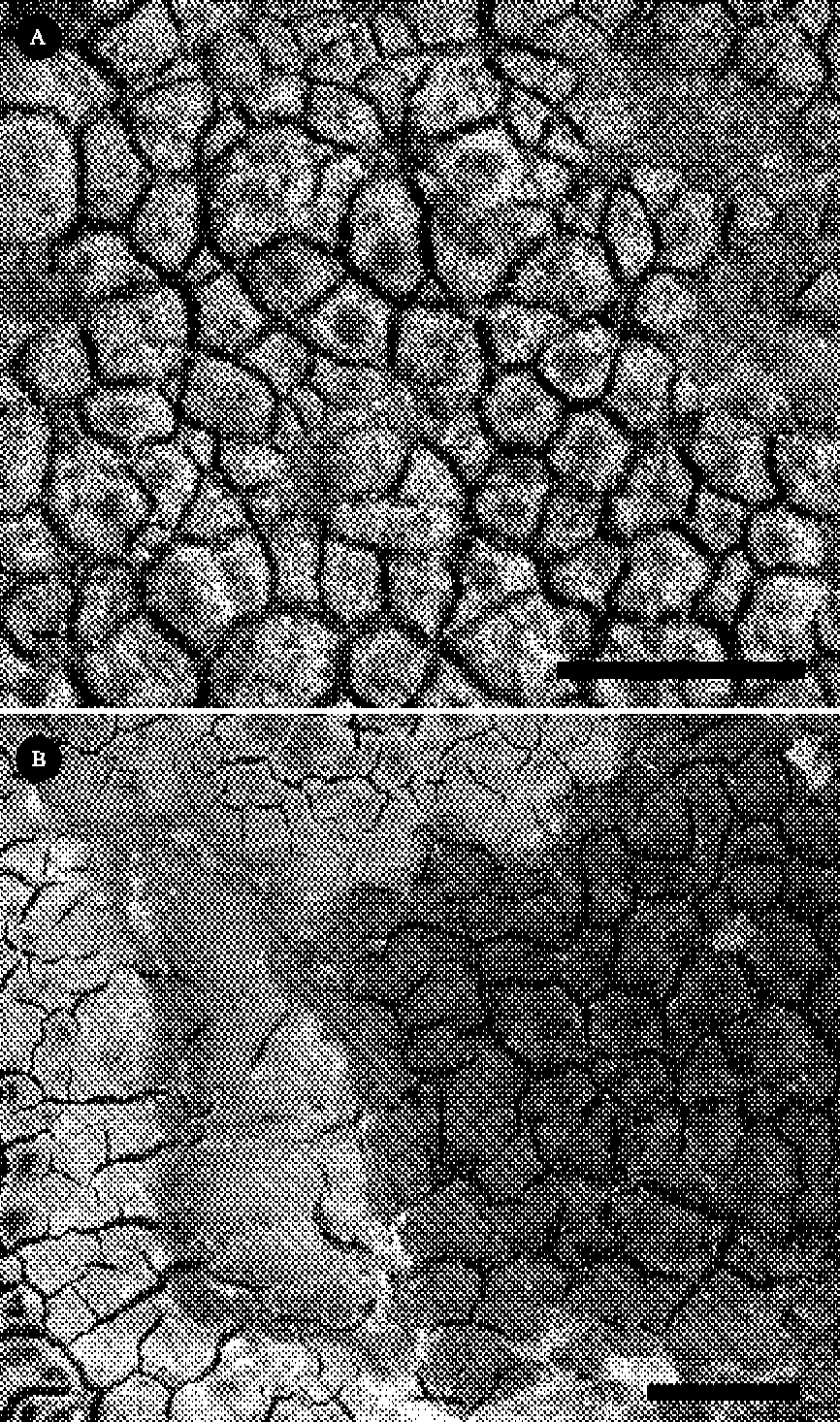
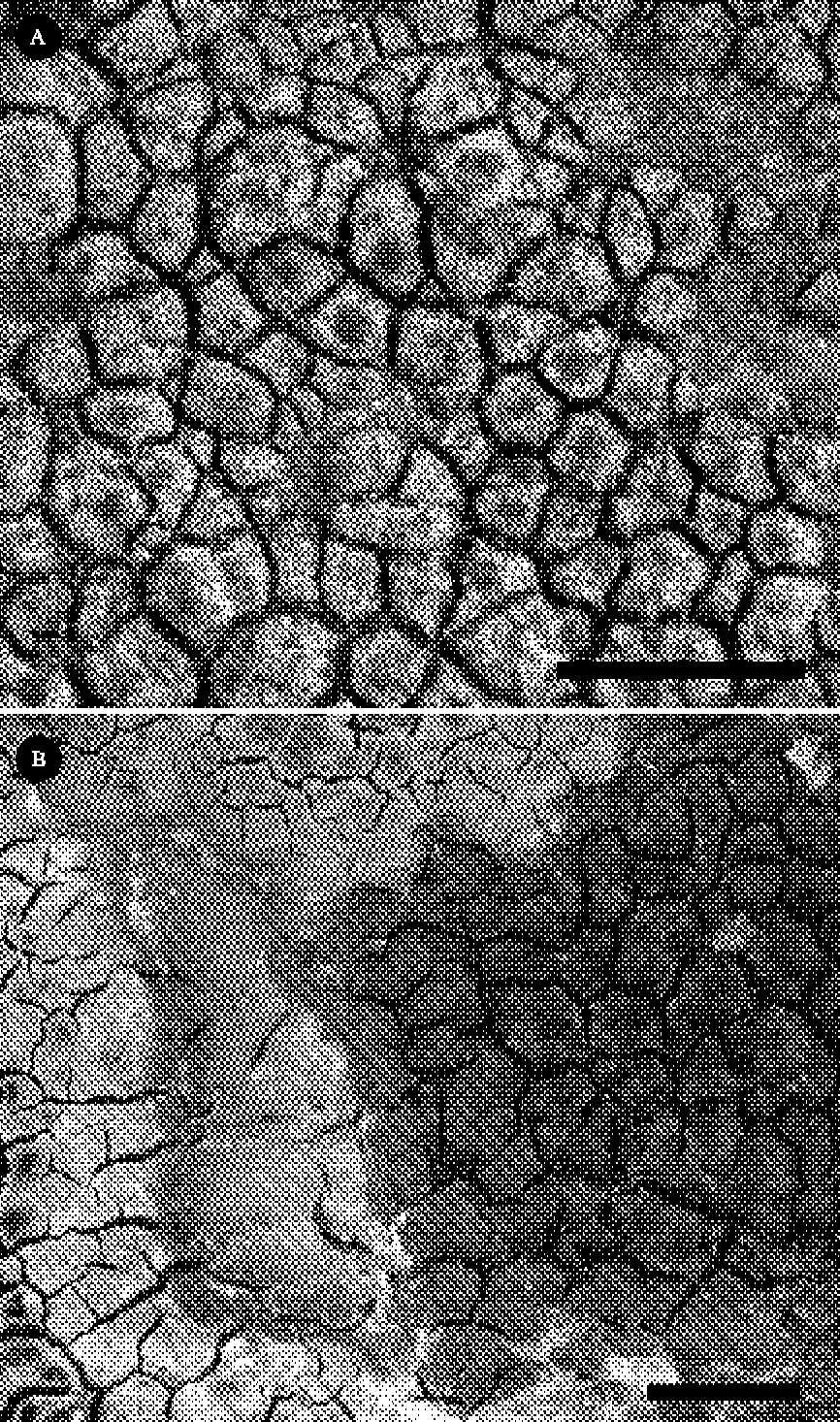
Placopyrenium formosum. A, holotype; B, Orange 12373: P. formosum (right) invading a thallus of Aspicilia aquatica (left of centre), with Ionaspis lacustris (left and top). Scales = 1 mm.
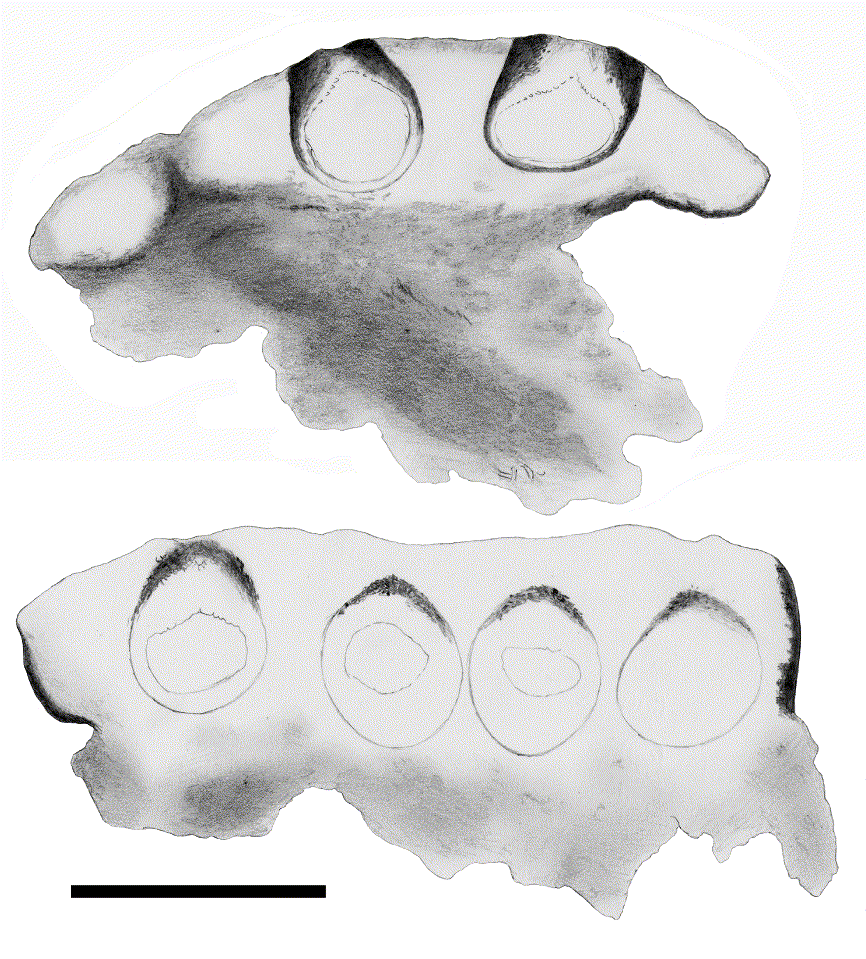
Placopyrenium formosum (holotype), thallus sections. Scale = 300 μm.
Prothallus brown, non-fimbriate, often present around areoles on rock. Thallus initially invading Aspicilia thalli, killing the host; superficial, well-developed, 130–400 μm thick; areoles discrete from early on, soon separated by deep cracks, at first c. 200–400 μm wide, later up to 1200 μm wide, at first plane, but mature areoles plane to gently convex, sometimes becoming subdivided by grooves; upper surface grey-brown to brown, epruinose or pruinose, the sides black. Areoles attached by the lower surface, without rhizines or hapters. Cortex weakly developed, with brown pigment; cells in the photobiont layer irregularly arranged or in weakly defined columns, lower parts of the thallus often with irregularly shaped areas with brown pigment, tissue adjacent to the sides of areoles densely pigmented with brown pigment. Perithecia immersed in the thallus, 1–22 per areole, apex black, plane or slightly convex, up to 180 μm diam. Exciple 140–220 μm diam., colourless or brown below, thickened and brown above. Involucrellum absent. Ascospores simple, colourless, oblong-ellipsoid, (14–)17·5–20·2–22·5(−28) × (7–)8·0–9·0–10(−11) μm, length/breadth ratio (1·6–)2·0–2·3–2·5(−3·0) [n = 114/6], colourless at maturity, but often faintly brown when overmature; perispore present, 1–1.5 μm thick, compact and often difficult to distinguish from the wall. Pycnidia immersed in the thallus, detected in three specimens; conidia simple, colourless, rod-shaped, 3·7–5·3 × 1·2 μm.
Ecology and distribution. Initially parasitic on Aspicilia aquatica on siliceous rocks beside streams, later free-living. Associated species include Ionaspis lacustris, Porpidia tuberculosa, Rhizocarpon lavatum, Rimularia badioatra, Staurothele fissa, and the bryophytes Cinclidotus fontinaloides, Racomitrium aciculare and Schistidium rivulare. N Wales, Scotland, Ireland, Italy, France, Iceland, Finland. In Britain it is apparently rare, living beside species-rich streams.
Notes. The thallus is clearly parasitic at first, killing the host shortly in advance of the visible thallus margin of the Placopyrenium; areoles directly on rock are sometimes apparently occupying a space formerly covered by the host. A free-living, advancing thallus margin on rock has not definitely been seen. The thickness of the thallus and degree of development of pruina are variable, so that some specimens differ from each other in appearance (compare Fig. 3A and 3B); it is suggested that these differences are due to differences in the age of the thallus, or environmental conditions. Three specimens from Wales, Iceland and Finland had identical DNA sequences, including three insertions of 81, 51 and 365 base pairs in the LSU, suggesting that the specimens are conspecific. Placopyrenium canellum differs in the larger ascospores and the different host (Aspicilia calcarea). See under P. cinereoatratum for the distinction from that species.
Some British specimens were originally recorded as parasitic on Aspicilia caesiocinerea, but this was probably always a misidentification for A. aquatica, which has not been recognized as a British species until recently. A specimen of Aspicilia from the Afon Llafar (Orange 17592 [NMW]), which was parasitized by P. formosum, had an ITS sequence (GenBank accession no FJ532371) almost identical to that of a specimen identified as A. aquatica from Sweden (GenBank accession no EU057896) generated for the study of Nordin et al. (Reference Nordin, Tibell and Owe-Larsson2007). A specimen of Aspicilia collected at the type locality of P. formosum (Orange 16852 [NMW], GenBank accession no FJ532370), and believed to be the same taxon as the host of the type specimen, had an ITS sequence similar to these two sequences, but with significant differences (differing from the Afon Llafar specimen in 4 transversions, 11 transitions and 9 indels). The Aspicilia specimens from Wales and Iceland are regarded here as conspecific, but this may need to be reviewed after further studies on the taxonomy of the genus. Aspicilia caesiocinerea also occurs on boulders in the Afon Llafar (Orange 17594 [NMW], confirmed by ITS sequence, GenBank accession no FJ532372), but occupies a less frequently inundated zone than A. aquatica, and no P. formosum has been found parasitizing it there. Aspicilia aquatica can be distinguished from A. caesiocinerea by the lack of aspicilin, and the semi-aquatic habitat; differences in the size of the conidia are reported, but specimens often lack pycnidia.
Nomenclature and typification. The name Verrucaria crustulosa Nyl. has been applied to this species, but it is unlikely that the type specimens are conspecific. The name was first published in Lamy de la Chapelle (Reference Lamy de la Chapelle1879: 493) as ‘in litteris ad Lamy'. Lamy de la Chapelle wrote “C'est l'Endocarpon crassum Anzi Symbolae p. 231 [sic], mais ce nom ne parait pas á Nylander devoir être maintenu, l'espèce n'ayant pas rien de crassum.” Thus the name V. crustulosa was intended to refer to Anzi's species. Nylander's objection to Anzi's name is not clear; the sentence above implies that Nylander thought that Anzi intended a new combination of some earlier species with the epithet ‘crassum'. However, Anzi (1864) clearly intended to describe E. crassum as a species, and not a new combination. The combination Verrucaria crassa was not available for Anzi's species, so it is reasonable to assume that V. crustulosa Nyl. was intended as a nomen novum for E. crassum, despite the ambiguity of Lamy de Chapelle's notes. Lamy de Chapelle cited Arnold, Lich. exs. 770, as additional (non-type) material of V. crustulosa; Arnold's specimen is Placopyrenium formosum. Two isotypes of Endocarpon crassum (Italy: Ad rupem micaceum in Valle del forno (Ceréna): rarissimum [Anzi, Lich. rar. Langob. exs. 487] (BM-isotype!, S [F97364]–isotype!) have areoles which are thicker and more convex than is usual in P. formosum or P. cinereoatratum, and the sides of the areoles are more weakly pigmented; the ascospores were 16–20 × 7–9 μm (8 measured). In these specimens a growing thallus margin could not be seen, and there was no evidence of parasitism. It is not clear whether the specimen is from a freshwater habitat; associated species include Xanthoria cf. elegans, Caloplaca sp., Lecanora sp., and small amounts of a sterile brown crust, possibly Staurothele sp. Because it is uncertain whether E. crassum is conspecific with P. formosum or P. cinereoatratum, or with neither species, the name has not been adopted here. The synonymy of Verrucaria crustulosa was given by Orange (Reference Orange2004: 180).
Specimens examined. Great Britain: Wales: V.C. 49, Caernarvonshire: Bethesda, Afon Llafar, 23/650.653, alt. 395 m, 1998, A. Orange 12011 (NMW [C.2005.001.721]); same locality, 23/649.653, alt. 390 m, 1998, A. Orange 12321 (NMW [C.2005.001.722]); same locality, 23/650.653, A. Orange 12373 (NMW [C.2005.001.724]); same locality, 23/6431.6560, 2008, A. Orange 17595 (NMW [C.2007.001.299]); 4 km south of Llanfairfechan, Afon Anafon, 23/680.710, alt. 240 m, 1998, A. Orange 12342 (NMW [C.2005.001.723]). Scotland: V.C. 87, West Perthshire: Ochil Hills, Menstrie Burn, 26/84.97, alt. 90–150 m, B. J. Coppins 10268, 10269 (E).—France: An öfter überfluhteten Granitblöcken im Bache la Glane bei der Mühle Brisse unweit St. Junien: Haute Vienne, 25 September 1878, Lamy de la Chapelle [Arnold, Lich. exs. 770] (H-NYL 7058).—Iceland: Suður-Þingeyjarsýsla: Dalmynni, Fnjóská, below Litlagerði, 65°50.57′N, 18°02.15′W, 2007, A. Orange 16844 (NMW [C.2007.001.156]). Eyjarfjarðarsýsla: near Akureyri, Stóri-Hvammur farm, 65.633°N, 18.071°W, 2007, J. Pykälä 31098 (H).—Finland: Varsinais-Suomi: Lohja, Vohloinen, Liessaari island, shore of lake Lohjanjärvi, 27°E 6685287:333420, alt. 32 m, 2007, J. Pykälä 30422 (H).
I would like to thank Juha Pykälä for making freshly collected material available, the curators of BM, E, H and UPS for the loan of specimens, and the two referees for their helpful suggestions.